Checking Up on my Class Markers
I'm suddenly missing some big ones.
My passport expired last summer, so I now make part of that oft-cited figure--is it 70%?--of Americans, most of whom are presumed to be benighted, who don't have one. Sadly, I probably won't be getting another one any time soon either--certainly I won't need to--unless something spurs me with great force to desire to go to Canada again, as I think you need one even for there now.
I also don't have a master's degree, which I did not think of as a socially crippling lack formerly, but it seems in the past few years, especially since women have started getting the sizable majority of them, to be the new cutoff in some quarters for qualifying as officially educated. Real men don't care about this, but lacking a high degree of authentic competence, as well as basic horse sense, I have a pathological need to retain some means by which to plausibly deceive myself that I can claim to other contemporary people to be an educated person, or at least comparable in mental development to what they are themselves. It is doubtful that my projected M.A. in theology or whatever will make much of a difference in how I present myself socially, but by not having one I am almost making it too easy for people to dismiss me out of hand.
I went to my local Borders the other day, which is already in full-fledged shutdown mode--they have already taken out all the chairs. While I haven't spent as much time in bookstores in the last couple of years because seeing all the books that had made it successfully to publication was depressing to me, it never impressed itself upon me that they would literally begin disappearing. Librairies doubtless will be next to go--I think half the people running for my local city council in the next election are doing so just so they can close the library down. A lot of people want to put college online too and turn the current campuses, or least the non-STEM portions of them, into tract housing or something. When I was young of course these places were inspiring to me--wrongfully so, apparently, though in my defense children generally are still not allowed to hang out in and poke around insurance offices or medical research labs or other places serving useful purposes--and these are very sad changes and passings for people like me (I seem to be too old to be able to imbibe from the computer screen the physical and aesthetic atmosphere and more appealing conception of life that the presence of actual books, pictures, oak reading tables, etc, suggests, and while it doubtless sounds ridiculous to someone who did not pass many significant hours in one's early life in such places, I do experience many aspects of the new age as a loss which I won't be able to wholly recover with the new and improved methods). I do enjoy tormenting myself by reading the myriad commentators who find these developments cause for celebration, directing laughter and a surprising amount of contempt at English majors and other sensitive idiots whose cherished and already irrelevant world continues to collapse around them. I can sort of grasp the hardcore technophilia, and the exhiliration of feeling one is fully on board with the creative destruction ushering in a new cultural paradigm and all that. The total disdain for the era that is passing away does always catch me off guard. I don't get that.
As I had another weekend of staying behind to work whilst the family was away I tried going out to dinner again. This place was not as bad as the Olive Garden though the dining room was full and I had to sit at the bar, which I would have preferred not to do. There were a pair of distracting TVs on--in my inexorable march to unmitigated crankiness, I find I increasingly dislike televisions on when I am eating in a restaurant, which formerly did not bother me, and which indeed I often enjoyed, especially when in a foreign country--one of which had on COPS, which really puts one in a great frame of mind for enjoying one's dinner, and the other was showing a competition from the "X Games" in which a bunch of guys oozing some kind of I'm-better-than-you attitude whom I still have no real desire to be like other than that they get to sleep with tons of the kinds of girls I would have wanted for myself were doing some skateboarding thing on a U-shaped wooden track kind of structure. Shaun White, the multiple Olympic snowboarding gold medalist, was one of the competitors in this event, though I did not notice where he finished. This guy seems to get a lot of publicity, and I don't really see why. Is he genuinely popular among any segment of the public? I have seen that he also has a clothing line with an alternative sportswear type theme at Target. There isn't a lot in his presentation that I can see would be appealing at all. He is the dominant figure in his sport, but what kind of a sport even is it? I did watch his turn at skateboarding expecting to see clear evidence of unique athletic abilities, but nothing jumped out at me. It does seem to be true in general in the winter sports, especially those contested on mountains, that the most skilled practitioners are the kingpins (and sometimes queenpins) of a fairly vibrant social scene, with groupies and disciples and the rest of it. This is not the case in every Olympic type sport. Top runners are greatly respected by other runners, but as compared to skiers their lives seem rather boring. They neither rule over a desirable party scene nor exude much sexual charisma. But does Shaun White exude sexual charisma, or any other kind? He probably does, but it's so original I can't even see it.
The main thrust of this post was going to be a short discursion on the subject of immigration, but there really is no short discursion on that subject. Politically I have the problem that I can rarely refute the arguments of either of the more extreme positions, so I end up having to stake the moderate ground where you mainly hear the furious demands coming from both sides simultaneously that you grow a pair and declare for one side of the confrontation or the other. None of this namby-pamby I-can't-make-up-my-mind-stuff. So my article, at least for now, was not going to be intentionally inflammatory, and indeed likely would not have had anything in it that hasn't been written a million times. It would mainly have served the purpose of adding support to a few particular positions which already exist, and which strike me as reasonable enough, and not callously offensive. Questions such as What is the plan in instances when say, several thousand Somalian refugees begin turning up in places like Lewiston and Portland Maine? Should there be a plan? Why are the perfectly legitimate and natural concerns of the native population regarding quite drastic demographic changes as well as strains on existing institutions not treated seriously, and indeed with contempt, by so many of their fellow citizens, including most of those in positions of influence? What is the source of the ideological refusal to even address these concerns as adults and equal partners in the future of the country. Why has the leadership of the country seemingly given up on developing intellectual talent and other desirable qualities for a vital civic life in the native population? or, Why has the human capital and spirit of the native population collapsed so spectacularly that the top people increasingly prefer to deal with any other people but them? (For me a lot of the emotion on this subject is the sense of shame and rejection by the elders and leading people of my own country and seeing them extol foreigners as preferable and better than I am. I can't claim that I didn't deserve this rejection, I guess, but it still hurts).
All of this would have taken a long time to write.
Sunday, August 07, 2011

Sunday, July 31, 2011
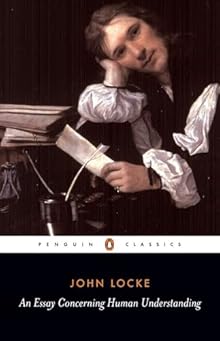
Going to Close Out John Locke (#6)
Book IV, Chap. XVI ("Degrees of Assent"). There is a section on the difficulty of changing or giving up one's opinion (try doing this on the internet), as well as an observation about the most thoroughly instructed people being less imperious towards others, which latter argument however I think, speaking as a less thoroughly instructed person, is dubious. The older I get, the more I am inclined to think the real reason it is difficult for people to change their opinions about anything is less stubbornness than because they no longer trust their brains' capacity to perceive any ideas, especially new ones, with the degree of clarity and totality needed to embrace an understanding of existence completely opposite to what has informed them previously, however airtight the arguments in its favor are laid not. I certainly cannot.
Locke on the subject of miracles (quotation from a footnote, from a work called Discourse on Miracles): "A miracle I take to be a sensible operation, which being above the comprehension of the spectator, and in his opinion contrary to the established course of nature, is taken by him to be divine." This seems a reasonable definition, or did to me at the time I read it. Now I think it is not solid enough, unless "the spectator" refers to the entirety of humanity.
This chapter closes with the assertion that faith was "nothing else but an assent founded on the highest reason", which is complemented in the notes by a quote attributed to Coleridge ("Christian faith is the perfection of human intelligence"). Would that it were that easy, "easy" striking me here as an ugly thought, in the face of these fine and very beautiful sentiments. I mean this sincerely, and I even believe it is possible that religious faith may in fact be the perfection of human intelligence, especially if ultimate 'truth' is either unknowable or fails to rise above what the most refined minds would consider to be prosaic. Or perhaps these are two of those deceptive statements, at which the naive reader, reassured perhaps, or at least satisfied that he grasps the author's intent, is content to stop considering the matter, while the real intent of the words lies behind this apparent meaning. Or at least one hopes so.
 Book IV, Chap XVII ("Reason"): "Secondly, another way that men ordinarily use to drive others, and force them to submit their judgements, and receive the opinion in debate, is to require the adversary to admit what they allege as proof, or to assign a better. And this I call argumentum ad ignorantiam". This is an excellent point.
Book IV, Chap. XIX ("Enthusiasm"): "Hence we see, that, in all ages, men in whom melancholy has mixed with devotion, or whose conceit of themselves has raised them into an opinion of a greater familiarity with God, and a nearer admittance to his favour than is afforded to others, have often flattered themselves with a persuasion of an immediate intercourse with the Deity, and frequent communications from the Divine Spirit." Hmm...No, it is just that I would have had a lot of these traits I'm sure if I had lived in that age.
Book IV, Chap XX ("Wrong Assent, or Error") "Take an intelligent Romanist, that, from the first dawning of any notions in his understanding, hath had this principle constantly inculcated, viz. that he must believe as the church...believes, or that the pope is infallible, and this he never so much as heard questioned, till at forty or fifty years old...how is he prepared easily to swallow, not only against all probability, but even the clear evidence of his senses, the doctrine of transubstantiation? This principle has such an influence on his mind, that he will believe that to be flesh which he sees to be bread." The further we move from an intellectual universe where Anglo-Saxon antipathies toward Catholic doctrine and culture constitute one of the primary energies and points of contention--and we seem to have gone a long way down that road just in the last 25 years--the more passages like this, which are to be found all through the major strains of English literature and even philosophical writings, from the Elizabethans up to World War I at least, will serve to call into question the seriousness and even cognitive abilities of the authors who fall into these kinds of traps, especially of course if their powers of reasoning are supposed to be the main basis of their fame. Questioning Catholic beliefs and their origins, or those of other systems one finds distasteful, mind you, I do not see as the problem, but rather to do so, especially as a philosopher, from an attitude that takes for granted one does so within an inherited belief system of his own that is superior without making it clear why this is so that is unacceptable.
 "Tell a man passionately in love that he is jilted; bring a score of witnesses on the falsehood of his mistress, it is ten to one but three kind words of hers shall invalidate all their testimonies."
Book IV, Chap. XVI ("Degrees of Assent"). There is a section on the difficulty of changing or giving up one's opinion (try doing this on the internet), as well as an observation about the most thoroughly instructed people being less imperious towards others, which latter argument however I think, speaking as a less thoroughly instructed person, is dubious. The older I get, the more I am inclined to think the real reason it is difficult for people to change their opinions about anything is less stubbornness than because they no longer trust their brains' capacity to perceive any ideas, especially new ones, with the degree of clarity and totality needed to embrace an understanding of existence completely opposite to what has informed them previously, however airtight the arguments in its favor are laid not. I certainly cannot.
Locke on the subject of miracles (quotation from a footnote, from a work called Discourse on Miracles): "A miracle I take to be a sensible operation, which being above the comprehension of the spectator, and in his opinion contrary to the established course of nature, is taken by him to be divine." This seems a reasonable definition, or did to me at the time I read it. Now I think it is not solid enough, unless "the spectator" refers to the entirety of humanity.
This chapter closes with the assertion that faith was "nothing else but an assent founded on the highest reason", which is complemented in the notes by a quote attributed to Coleridge ("Christian faith is the perfection of human intelligence"). Would that it were that easy, "easy" striking me here as an ugly thought, in the face of these fine and very beautiful sentiments. I mean this sincerely, and I even believe it is possible that religious faith may in fact be the perfection of human intelligence, especially if ultimate 'truth' is either unknowable or fails to rise above what the most refined minds would consider to be prosaic. Or perhaps these are two of those deceptive statements, at which the naive reader, reassured perhaps, or at least satisfied that he grasps the author's intent, is content to stop considering the matter, while the real intent of the words lies behind this apparent meaning. Or at least one hopes so.
Book IV, Chap XVII ("Reason"): "Secondly, another way that men ordinarily use to drive others, and force them to submit their judgements, and receive the opinion in debate, is to require the adversary to admit what they allege as proof, or to assign a better. And this I call argumentum ad ignorantiam". This is an excellent point.
Book IV, Chap. XIX ("Enthusiasm"): "Hence we see, that, in all ages, men in whom melancholy has mixed with devotion, or whose conceit of themselves has raised them into an opinion of a greater familiarity with God, and a nearer admittance to his favour than is afforded to others, have often flattered themselves with a persuasion of an immediate intercourse with the Deity, and frequent communications from the Divine Spirit." Hmm...No, it is just that I would have had a lot of these traits I'm sure if I had lived in that age.
Book IV, Chap XX ("Wrong Assent, or Error") "Take an intelligent Romanist, that, from the first dawning of any notions in his understanding, hath had this principle constantly inculcated, viz. that he must believe as the church...believes, or that the pope is infallible, and this he never so much as heard questioned, till at forty or fifty years old...how is he prepared easily to swallow, not only against all probability, but even the clear evidence of his senses, the doctrine of transubstantiation? This principle has such an influence on his mind, that he will believe that to be flesh which he sees to be bread." The further we move from an intellectual universe where Anglo-Saxon antipathies toward Catholic doctrine and culture constitute one of the primary energies and points of contention--and we seem to have gone a long way down that road just in the last 25 years--the more passages like this, which are to be found all through the major strains of English literature and even philosophical writings, from the Elizabethans up to World War I at least, will serve to call into question the seriousness and even cognitive abilities of the authors who fall into these kinds of traps, especially of course if their powers of reasoning are supposed to be the main basis of their fame. Questioning Catholic beliefs and their origins, or those of other systems one finds distasteful, mind you, I do not see as the problem, but rather to do so, especially as a philosopher, from an attitude that takes for granted one does so within an inherited belief system of his own that is superior without making it clear why this is so that is unacceptable.
"Tell a man passionately in love that he is jilted; bring a score of witnesses on the falsehood of his mistress, it is ten to one but three kind words of hers shall invalidate all their testimonies."Monday, July 25, 2011
John Locke 5
 Book III, Chapter X ("Abuse of Words"): "...he that will look into that sort of learned writings, will find the words there much more obscure, uncertain, and undetermined in their meaning, than they are in ordinary conversation." There are some good points in this section about idle, useless pedants, as well as something useful, which word unfortunately I can no longer make out in my scribblings, which I too often forget.
"He that hath words of any language, without distinct ideas in his mind to which he applies them, does, so far as he uses them in discourse, only make a noise without any sense or signification; and...is not much more advanced thereby in knowledge, than he would be in learning, who had nothing in his study but the bare titles of books, without possessing the contents of them." O.K., they have me figured out.
Book III, Chapter XI ("Remedies of the Abuse of Words"): "This exactness will, perhaps, be judged very troublesome; and therefore most men will think they may be excused from settling the complex ideas of mixed modes so precisely in their minds." The "excused" is well-chosen here.
I believe I have already mentioned that the guy who wrote the footnotes is more obscure than Locke, but he must have been really bad, seeing as I felt the need to note it a second time in the course of the reading.
Book IV, Chapter I ("Of Knowledge In General"): "Nobody, I think, can deny, that Mr Newton certainly knows any proposition that he now at any time reads in his book to be true; though he has not in actual view that admirable chain of intermediate ideas whereby he at first discovered it to be true." Perhaps not the whole view, but I would guess that he had a lot of it.
Book IV, Chapter IV ("Reality of Knowledge"): "...the truth and certainty of moral discourses abstracts from the lives of men, and the existence of those virtues in the world whereof they treat: nor are Tully's Offices less true, because there is nobody in the world that exactly practises his rules, and lives up to that pattern of a virtuous man which he has given us, and which existed nowhere when he writ but in idea." Morality as an abstraction comparable to mathematics. Or art.
"...where God or any other law-maker, hath defined any moral names, there they have made the essence of that species to which that name belongs..." The influence of lawgivers and other authorities is a serious matter with Locke.
In Book IV, Chapter VII ("Of Maxims") Locke discusses unlocking and opening the "secrets of knowledge". For the most part it is all just a big secret, isn't it?
"The Schools having made disputation the touchstone of men's abilities, and the criterion of knowledge, adjudged victory to him that kept the field: and he that had the last word was concluded to have the better of the argument, if not of the cause." Someday wisdom is really going to have to learn how to project itself better.
Book IV, Chapter X ("Our Knowledge of the Existence of a God"): "If, therefore, we know there is some real being, and that nonentity cannot produce any real being, it is an evident demonstration, that from eternity there has been something; since what was not from eternity had a beginning; and what had a beginning must be produced by something else." Pretty clever, I guess. It caught me napping at first, but on a closer look you can see all the assumptions that are embedded in it.
There's a translated quote from Cicero, or as Locke refers to him, Tully, on the same subject: "What can be more sillily arrogant and misbecoming, than for a man to think that he has a mind and understanding in him, but yet in all the universe beside there is no such thing?" I believe much of this line of thinking with its fairly wild range of generalities was later clarified by Hume and perfected by Kant. Not that I would know.
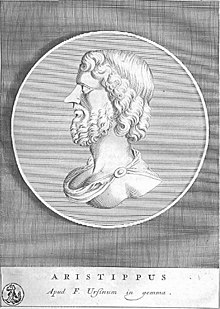
Remember Aristippus, who placed happiness in bodily pleasure? I was a terrible philosophy student and would be hard pressed to name ten general principles running through the history of the pursuit if my life depended on it, but you sure will never be able to persuade me that happiness lies in bodily pleasure. That teaching I cannot seem to forget.
"Hence I think I may conclude, that morality is the proper science and business of mankind in general,...as several arts, conversant about several parts of nature, are the lot and private talent of particular men, for the common use of human life, and their own particular subsistence in this world." I have never developed an effective program of my own for how to live/approach life as an active agent in its course. This being after all the purpose of philosophy, I would have to say that my education was really not a success. This is besides that it is hard to participate in any kind of social intercourse requiring a decent level of thought when one does not have (or does not wish to reveal) a coherent explanation of why one's existence is playing out the way it is in any way and in what directions one might wish to direct it in the future.
Locke does not appear to be one who is especially impressed by nature (as in outside, the natural world) as something more interesting or grand than the human mind. One would have spent a lot more time grappling with it in the 17th century than we do today, and it doubtless seemed less wondrous than the possibilities of rigorous thought to the intellectuals of that time. It is a tone that I think few thinkers would take, and maybe even feel, today.
Book III, Chapter X ("Abuse of Words"): "...he that will look into that sort of learned writings, will find the words there much more obscure, uncertain, and undetermined in their meaning, than they are in ordinary conversation." There are some good points in this section about idle, useless pedants, as well as something useful, which word unfortunately I can no longer make out in my scribblings, which I too often forget."He that hath words of any language, without distinct ideas in his mind to which he applies them, does, so far as he uses them in discourse, only make a noise without any sense or signification; and...is not much more advanced thereby in knowledge, than he would be in learning, who had nothing in his study but the bare titles of books, without possessing the contents of them." O.K., they have me figured out.
Book III, Chapter XI ("Remedies of the Abuse of Words"): "This exactness will, perhaps, be judged very troublesome; and therefore most men will think they may be excused from settling the complex ideas of mixed modes so precisely in their minds." The "excused" is well-chosen here.
I believe I have already mentioned that the guy who wrote the footnotes is more obscure than Locke, but he must have been really bad, seeing as I felt the need to note it a second time in the course of the reading.
Book IV, Chapter I ("Of Knowledge In General"): "Nobody, I think, can deny, that Mr Newton certainly knows any proposition that he now at any time reads in his book to be true; though he has not in actual view that admirable chain of intermediate ideas whereby he at first discovered it to be true." Perhaps not the whole view, but I would guess that he had a lot of it.
Book IV, Chapter IV ("Reality of Knowledge"): "...the truth and certainty of moral discourses abstracts from the lives of men, and the existence of those virtues in the world whereof they treat: nor are Tully's Offices less true, because there is nobody in the world that exactly practises his rules, and lives up to that pattern of a virtuous man which he has given us, and which existed nowhere when he writ but in idea." Morality as an abstraction comparable to mathematics. Or art.
"...where God or any other law-maker, hath defined any moral names, there they have made the essence of that species to which that name belongs..." The influence of lawgivers and other authorities is a serious matter with Locke.
In Book IV, Chapter VII ("Of Maxims") Locke discusses unlocking and opening the "secrets of knowledge". For the most part it is all just a big secret, isn't it?
"The Schools having made disputation the touchstone of men's abilities, and the criterion of knowledge, adjudged victory to him that kept the field: and he that had the last word was concluded to have the better of the argument, if not of the cause." Someday wisdom is really going to have to learn how to project itself better.
Book IV, Chapter X ("Our Knowledge of the Existence of a God"): "If, therefore, we know there is some real being, and that nonentity cannot produce any real being, it is an evident demonstration, that from eternity there has been something; since what was not from eternity had a beginning; and what had a beginning must be produced by something else." Pretty clever, I guess. It caught me napping at first, but on a closer look you can see all the assumptions that are embedded in it.
There's a translated quote from Cicero, or as Locke refers to him, Tully, on the same subject: "What can be more sillily arrogant and misbecoming, than for a man to think that he has a mind and understanding in him, but yet in all the universe beside there is no such thing?" I believe much of this line of thinking with its fairly wild range of generalities was later clarified by Hume and perfected by Kant. Not that I would know.
Remember Aristippus, who placed happiness in bodily pleasure? I was a terrible philosophy student and would be hard pressed to name ten general principles running through the history of the pursuit if my life depended on it, but you sure will never be able to persuade me that happiness lies in bodily pleasure. That teaching I cannot seem to forget.
"Hence I think I may conclude, that morality is the proper science and business of mankind in general,...as several arts, conversant about several parts of nature, are the lot and private talent of particular men, for the common use of human life, and their own particular subsistence in this world." I have never developed an effective program of my own for how to live/approach life as an active agent in its course. This being after all the purpose of philosophy, I would have to say that my education was really not a success. This is besides that it is hard to participate in any kind of social intercourse requiring a decent level of thought when one does not have (or does not wish to reveal) a coherent explanation of why one's existence is playing out the way it is in any way and in what directions one might wish to direct it in the future.
Locke does not appear to be one who is especially impressed by nature (as in outside, the natural world) as something more interesting or grand than the human mind. One would have spent a lot more time grappling with it in the 17th century than we do today, and it doubtless seemed less wondrous than the possibilities of rigorous thought to the intellectuals of that time. It is a tone that I think few thinkers would take, and maybe even feel, today.
Thursday, July 07, 2011
Movies 1981-2002 (Common Theme: Great Depression)
The Road to Perdition (2002) My main impressions while watching this movie:
What is the point of this story?
I'm not buying Paul Newman and Tom Hanks as ruthless gangsters, especially to the extreme they are supposed to be in this movie.
I can more easily buy Daniel Craig and Jude Law as sociopaths, I guess, though I don't get the point of their characters either.
Despite a lengthy trail of corpses and bank robberies, no police ever appear. They do not exist in this movie. The characters only have to worry about other gangsters.
It might be worth seeing just for the sets and clothes and heavily artsified 30s ambiance. If they hadn't actually gunned down a child and his mother in their own bathroom I would probably say it was definitely worth seeing.
Jennifer Jason Leigh, in the period (1931) dress and hair, looks quite a bit like my wife in this, which probably caused the scene where she is murdered with the child in cold blood to upset me more than it ordinarily would have. I know this is at least the 3rd time I have said a movie actress resembles my wife (Shirley Maclaine circa The Apartment and Sybil Seeley from the Buster Keaton movies are the other 2 I can think of off hand), but in each instance something in the resemblance was striking enough to make an impression that I thought it worthwhile to take note of.
I wondered how differently the history of cinema might have developed if the United States had not been the dominant filmmaking country during the formative years of this art. Specifically I was assuming that the genre of the super-violent gangster film would not have attained quite the place of esteem in the cinematic repertoire that it has attained, to the point that nations as disparate as Britain and Korea, who do not have much of a history of their citizens engaging in machine gun massacres and shootouts in their streets and places of public business, feel impelled to regularly make movies in which as many people are blown away by advanced weaponry in a single scene as normally die in such manner in a couple of decades in those countries.
It may be argued that my quibbles about the lack of realism in certain instances in this movie are prosaic and beside the point, that the narrative does away with these restrictions because it is really about other things. In the present case however this is where the movie, which is otherwise almost impeccably made, most falters. The departure from probability and consistency within the parameters it sets out, especially given the excessive brutality of its violence, I found to be too great. Most stories that attain a degree of cultural importance require some suspension of literal disbelief, to be sure, but the psychology of the characters has to be believable and consistent within the parameters of whatever imagined or idealized world they are inhabiting, which also necessitates the mental and emotional universe of that world being comprehensible to the audience. That did not occur to my satisfaction here.
Tarzan (1999)

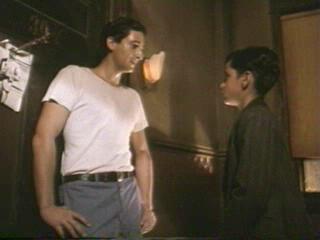
 Just a few postings ago I mentioned that I had never seen this New Hampshire-set movie, a few days after which my system predictably turned it up to go on my list. This summer happens to be the film's 30th anniversary, so there are a number of events in New Hampshire commemorating the occasion as well, such as local theatrical productions of the original play and so on. I am not planning on attending any of them, but I think it is of interest to note that these goings-on are in the atmosphere as I try to make some sense of this old--in many ways really prematurely old--movie for myself.
The Road to Perdition (2002)
What is the point of this story?
I'm not buying Paul Newman and Tom Hanks as ruthless gangsters, especially to the extreme they are supposed to be in this movie.
I can more easily buy Daniel Craig and Jude Law as sociopaths, I guess, though I don't get the point of their characters either.
Despite a lengthy trail of corpses and bank robberies, no police ever appear. They do not exist in this movie. The characters only have to worry about other gangsters.
It might be worth seeing just for the sets and clothes and heavily artsified 30s ambiance. If they hadn't actually gunned down a child and his mother in their own bathroom I would probably say it was definitely worth seeing.
Jennifer Jason Leigh, in the period (1931) dress and hair, looks quite a bit like my wife in this, which probably caused the scene where she is murdered with the child in cold blood to upset me more than it ordinarily would have. I know this is at least the 3rd time I have said a movie actress resembles my wife (Shirley Maclaine circa The Apartment and Sybil Seeley from the Buster Keaton movies are the other 2 I can think of off hand), but in each instance something in the resemblance was striking enough to make an impression that I thought it worthwhile to take note of.
I wondered how differently the history of cinema might have developed if the United States had not been the dominant filmmaking country during the formative years of this art. Specifically I was assuming that the genre of the super-violent gangster film would not have attained quite the place of esteem in the cinematic repertoire that it has attained, to the point that nations as disparate as Britain and Korea, who do not have much of a history of their citizens engaging in machine gun massacres and shootouts in their streets and places of public business, feel impelled to regularly make movies in which as many people are blown away by advanced weaponry in a single scene as normally die in such manner in a couple of decades in those countries.
It may be argued that my quibbles about the lack of realism in certain instances in this movie are prosaic and beside the point, that the narrative does away with these restrictions because it is really about other things. In the present case however this is where the movie, which is otherwise almost impeccably made, most falters. The departure from probability and consistency within the parameters it sets out, especially given the excessive brutality of its violence, I found to be too great. Most stories that attain a degree of cultural importance require some suspension of literal disbelief, to be sure, but the psychology of the characters has to be believable and consistent within the parameters of whatever imagined or idealized world they are inhabiting, which also necessitates the mental and emotional universe of that world being comprehensible to the audience. That did not occur to my satisfaction here.
Tarzan (1999)
In addition to the undiscriminating reviewer who overly loves TV movies, my system suffers from another critic who has caused me to suspect him or her to be in the employ of the Walt Disney Corporation, so uniformly and emphatically partial to the works of this studio he be. There are a few Disney movies that I will admit to liking, though they were all made before 1960; the artistic sensibility of the pre-1945 productions especially, middlebrow though it was, is of an entirely different order from what they seem to be able to muster lately.
This late model Tarzan, following in the train of the big 90s hits like The Lion King and Beauty and the Beast, wholly escaped my notice on its initial appearance. I was willing enough to like it if it had moved me to do so, but I did not see anything the least noteworthy or at all different from any other 90s Disney movie.
King of the Hill (1993)
Another movie set in the Great Depression ('33 I believe was the year in this case) which seems to have been a recurring theme with me lately, or perhaps the time is such a good one to set movies in that more of them turn up on my list than they do from other periods. While Road to Perdition was based on a comic book/graphic novel and had a more mythical atmosphere about it, this was based on a memoir by a more conventional earnest writer type (A. E. Hotchner, of whom I had not previously heard). Despite being directed by Steven Soderbergh, whom I thought was considered an A or near A-list director, having a largely recognizable if not star-studded cast, and receiving almost uniformly positive reviews, the film is still not available on DVD. (I still have a VCR, so I bought an old videotape and watched that).
The sets and props and costumes lack the calculated grandeur and overall sense of Sturm und Drang, so in keeping with the post-millenial spirit, that we got in Road to Perdition, and are more in what I would consider the 'traditional' Depression period-piece style, iron bedsteads, print dresses in muted colors, peeling wallpaper and flaking plaster, scratchy radios, dusty streets, all of which motifs I am much more comfortable with. They boil some hot dogs--never destined to be eaten, as it happens--in water in a big heavy pot at one point which for some reason I found extremely pleasing, as if the image summed up all of my most superficial feelings about the 1930s in a single blow. While there is a plot, and a not wholly insignificant one, the interest in the movie to me rests on the effectiveness of these images from the lives of our grandparents and great-grandparents and what relevance we can be persuaded to think they have for us now. It is about half-successful in this.
This movie has a couple of early 80s era actresses whose careers never really blew up big but whom I always liked a little, Lisa Eichhorn and Elizabeth McGovern. Lisa Eichhorn is 41 here, my age exactly now, and she still looks like her sweet senstive self. Now she is 59 and she looks old and not like her sweet sensitive self at all. This is nothing to the point except that I probably had not thought about her since around that time, so it came as rather a shock to realize that she was nearly 60 now. 1993 in certain things does not seem to me a long time ago. I was already with my wife in that year, for example, and she is still only in her 30s, and does not seem to me to have changed all that dramatically. Elizabeth McGovern probably is not much my type personality-wise. However she always reminds me of my main junior high love interest, who was also named Elizabeth, who also had an Irish surname beginning in McG--, who also had short cropped curly brown hair, and who due to the custom of forcing students to sit in rows in alphabetical order in class which was the rule in my middle school was seated about 2 feet in front of me around five hours a day for two years. Though she engaged in some mild teasing, on the whole she was cordial to me, and even danced with me twice at the Christmas dance in 1983, which was practically the highlight of the entire decade of the 80s as far as I was concerned; nonetheless she expertly managed me so that my passion remained always at a fairly low boil and never threatened to burst out in an unseemly spectacle, which looking back I think is quite admirable. She was flirty and playful without being conniving or narcissistic, and at least in junior high and early high school she always maintained a genuine respectability without being a killjoy, all of which are qualities I like in females. But all of this has very little to do with Elizabeth McGovern outside of my own head...
On Golden Pond (1981)
Just a few postings ago I mentioned that I had never seen this New Hampshire-set movie, a few days after which my system predictably turned it up to go on my list. This summer happens to be the film's 30th anniversary, so there are a number of events in New Hampshire commemorating the occasion as well, such as local theatrical productions of the original play and so on. I am not planning on attending any of them, but I think it is of interest to note that these goings-on are in the atmosphere as I try to make some sense of this old--in many ways really prematurely old--movie for myself.In the first place I suspect that the most noteworthy aspect of the picture is the performances of Katherine Hepburn and Henry Fonda, which appear to be so strikingly good that one almost wonders if it is not somehow an illusion, and that either the rest of the cast, or the writing of their characters, are abnormally terrible, or that there is something in the old legends' superior, almost effortlessly self-assured bearings that hoodwink the viewer into thinking their acting work grander than it really was, because we have become unaccustomed to seeing these particular qualities in our contemporaries. The dominance of the aged stars also contributes to the film's seeming to belong to a more remote past than it really does, Hepburn and Fonda's careers of course dating back to the earliest days of talking pictures, nearly half the entire history of which is (remarkably) contained within my own lifetime, but which are such a ubiquitous part of our cultural lives that its early era psychologically feels nearly as distant to us as artistic movements hundreds of years old.
The story is also dated in other of its concerns. Its primary theme is the generational conflict between the hard core of the Depression/WWII generation (Hepburn and Fonda) and their children, the Silent Generation that came of age in the 50s and early 60s. Unlike the baby boomers, who though usually obnoxious even they aren't being dangerously wrong-headed are at least adversarially strong, the Silents were never much of a match for their elders, and even in this movie which was clearly written by one of their number (it has been noted that the cohort of Americans born in the 1930s has been highly prolific and accomplished in most of the arts comparative to most of those which followed it), which I gather was intended to present their situation in a sympathetic light and try to reconcile especially the Henry Fonda character's overbearing and stifling qualities with his strong ones, they come across as almost hopelessly weak and stunted in their development when juxtaposed against their parents. One of the major plot threads is that Henry Fonda and his daughter (played by his actual famous daughter Jane, whose limited acting ability contrasted against her father's brilliance while essentially on his deathbed only further emphasizes the previous point) are estranged because he was hard and emotionally distant. In 2011, with middle class society on the brink of collapse and when our concerns are almost exclusively socio-economic, these 1970s era complaints about domineering and emotionally unavailable fathers strike one as almost quaint. From our vantage point, Henry Fonda hardly seems like such a terrible father. Besides being married and having a better relationship with his children's mother than most contemporary men are able to manage, he not only had a career, but quite a prestigious one (professor at an Ivy League university! think of the advantages! the connections!). The children doubtless were all sent to private schools. He was a competent outdoorsman and was a good role model as far as not being a total pussy or woman-dominated man goes. No evidence is offered that he beat his children unduly. Who cares that he was not the most cuddly guy in the world? Where is all this sensitive new age fathering getting us anyway?
This was filmed at Squam Lake in New Hampshire, about a 45 minute drive from my house. While I have driven past it numerous times, I have never actually gone in or on it, though I believe there are points that are publicly accessible. There are a multitude of other lakes around that I have been to, so it is more a matter of chance that I have not been there rather than socioeconomic deprivation, though I am under the impression that it is one of the more expensive lakes in the area as far as property values. Although I don't think of myself as having any friends, I have still managed over the years to get myself invited to a few private cabins on other lakes, several of which were older and a lot like the one in the movie, though the ones I visited were probably a little smaller. It has been a trend since affluent people began to really rake in the bucks in the mid-90s to knock down these older cabins and build something more in keeping with one's contemporary level of grandeur, but there are still a good number of old New Englanders of more modest means clinging to the old cabins their family bought in the 40s. These are the people I mainly know. Of course the temptation to sell out when mom finally passes on is increasingly great, and if Mitt Romney (to name one noted summerer on the New Hampshire lakes) or one of his buddies is the buyer, you can be sure they won't be keeping the old house standing, unless it is to store boats and take showers in.
Monday, July 04, 2011
Human Understanding--Part the Fourth
***(Picture, see below)

Book II, Chap. XXVII (Idea of Personal Idenity): "...I once met with one, who was persuaded his had been the soul of Socrates." I think I met that guy too.
Chap. XXVIII (Idea of Moral Relations): "...mankind have fitted their notions and words to the use of common life, and not to the truth and extent of things." Yes, but if you do not have something of the thought process of a philosopher, this idea will have no meaning for you.
***(Picture, see below)
I seem to have already exhausted all the pictures of John Locke that are in circulation, so this post will be words only. Not even any girls today. I could not find anything that fit the mood.
Book II, Chap. XXVII (Idea of Personal Idenity): "...I once met with one, who was persuaded his had been the soul of Socrates." I think I met that guy too.
Chap. XXVIII (Idea of Moral Relations): "...mankind have fitted their notions and words to the use of common life, and not to the truth and extent of things." Yes, but if you do not have something of the thought process of a philosopher, this idea will have no meaning for you.
Chap XXXI (Of Adequate and Inadequate Ideas): "And so each sensation answering the power that operates on any of our senses, the idea so produced is a real idea, (and not a fiction of the mind, which has no power to produce any simple idea)..." I like the clarity of this. I have very few distinct ideas which would contribute in any way to a general understanding or world view. This sounds correct to me, but I have a very hard time adhering to any singular, precise viewpoint where abstractions are concerned.
"Thus by having the idea of a figure with three sides meeting at three angles, I have a complete idea, wherein I require nothing else to make it perfect." The perfection of the idea of the triangle is one of the pillars on which my old school was built, and the extent to which you are able to internalize this idea and allow it to become a guiding tenet of your life plays a great role in determining the nature of your experience there. Not necessarily the quality of your actual learning, but definitely the nature of your experience.
I thought that the breakdown of true and false ideas was clear and sensible.
I am finally through my tidbits from Volume 1. I am pretty sure I have much fewer notes on Volume 2.
Book III, Chap IV (Of the Names of Simple Ideas). "I say that the names of simple ideas, and those only, are incapable of being defined." His reasoning was that a definition is an explanation of the meaning of one word by the use of other words, but these cannot describe a basic idea that is not a composite of other ideas but has only a single attribute that it signifies, and is in fact meaningless itself until brought into relations. My impression is that this difficulty has been overcome.
Old philosophers in general are concerned with (......? I cannot make out my note here. It is a big word too) the mind, which is not only the locus of knowledge but the most important repository of it. I am not certain that going forward this is going to be regarded as the case.
***Chap VI (Names of Our Ideas of Substances) "...and our idea of any individual man would be as far different from what it is now, as is his who knows all the springs and wheels and other contrivances within of the famous clock at Strasburg, from that which a gazing contryman has of it, who barely sees the motion of the hand, and hears the clock strike, and observes only some of the outward appearances." I would have liked to have gone to Strasbourg. Some major segment of the EU governing apparatus operates out of there, so it is modernized and trendy to a greater degree than I am usually comfortable with, but the cathedral and the old quarter are still reputed to be remarkable, and the food is supposed to be very special as well, the Alsatian cuisine being as far as I can make out something like the marriage of Germanic ingredients and Gallic sensibility, both of which I like.
I thought that the bit about necessity applying to ideas rather than things themselves uncontemplated was ingenious. Of course without mind, what does the entirety of creation signify? It is preposterous.
"There is not so contemptible a plant or animal, that does not confound the most enlarged understanding." I know these forays into high Civilization must be profoundly boring and singularly uninstructive to everybody else, but they restore my equilibrium.
There is a reference in this same chapter to Thomas Aquinas's "ordines angelorum"--gradations of angels. This evidently invoked a reminiscence at the time, though unfortunately I forgot to record what it was.
Personal anecdote: 'November 19, 2008--Oscar (my oldest son, then 6 1/2) said "Is everything I do something?" A Lockean question. I answered, "If your mind is capable of perceiving the action, it is something."' I would never have remembered this if I had not jotted it down hastily in the margin of my book.
Locke quotes a story from a French miscellany of anecdotes and bons mots that I think will make a good end for this post:
"When the abbott of St Martin was born, he had so little of the figure of a man, that it bespake him rather a monster. It was for some time under deliberation, whether he should be baptized or no. However, he was baptized, and declared a man provisionally [till time should show what he would prove]. Nature had moulded him so untowardly, that he was called all his life the Abbot Malotru; i.e. ill-shaped. He was of Caen." Caen is not so distinctive and remarkable as Strasbourg, but I should have liked to have gone there too. I believe it is a run down old seaside resort in Normandy, and was frequented by many of the Impressionist painters. It sounds like my kind of place.
Thursday, June 30, 2011
Anatomy of a Failed Dinner
So tonight I went to the Olive Garden--why is not important, but it was a combination of not being dressed properly to go somewhere else, wanting to eat a meal the rhythms of which resembled that of a real dinner but without requiring me to do a lot of thinking, and laziness.
It did not go as I had hoped.
Most of this was my fault, though in most of the offending incidents I could twist the facts enough to cast some of the blame on the establishment.
My main problem was that I was not prepared to concentrate on what I was doing and be 'in the moment' to the extent that it was necessary for me to be until it was too late, and my good time was irretrievably lost. Granted, I went to the Olive Garden largely because I wanted to think about other things and not have to pay close attention to the progress of my meal, but that is beside the point.
I was alone, which is unusual for me. My family went to Vermont for the weekend but I stayed behind because I had to work. This may, as it turned out, have thrown me off, because I have become unaccustomed to going out alone. My first disappointment, albeit it a mild one, came when I was given a cocky male server instead of the attractive, or at least young, lady I had been subconsciously expecting, and which is (admittedly sadly) one of the main reasons one goes to such places. I would have gotten over this disappointment easily enough, but the guy immediately began trying to manipulate me to buy a more expensive wine than I had been planning to do.
Being the kind of person who spends a lot of time getting in a stew over my various failures to broach the realm of high level drinking, the thought of getting worked over or embarrassed in wine etiquette and knowledge on the floor of the Olive Garden caused my ego to circle every wagon at its disposal (which unfortunately was not many). Immediately after dropping the menu he whips out a bottle of some cabernet and asks me if I would like a sample. I should have cut it off right there, because my intention was, as it always is, to order the house wine, as I am foremost a quantity-oriented drinker, and require at least two glasses to properly enjoy myself, preferably three. However, I agreed to try the sample, still imagining I would easily be able to control the exchange to my satisfaction. A glass was set before me and a small portion of wine was poured into it, I imagine approximately like they do in a real restaurant, though it has been so long since I have been to one that I forget. As I do not remember all the parts of the wine-tasting ritual exactly, I merely took it up and emptied it in a draught, which is anyway my impression of how Samuel Johnson and company dealt with their wine in the 18th century. It was tasty enough to me, enough that I made my first big mistake, which was to distract myself by trying to scan the menu to see what the price of it was.
It was $8.25 a glass, so I was not having it, and I thanked the man for the sample and said I would stick with the house wine.
He was uncertain about whether I would like the house wine--many people found it strong, even overpowering--and strongly encouraged me to try a sample of that before I committed to ordering.
I should definitely have refused the sample here but I still felt myself to be in command of the situation and regarded the offer as an opportunity to steal an extra mouthful of drink at no charge. Yes, I said, bring it on. He had to step away for a moment to fetch the bottle, which time I used to make a cursory examination of the menu.
At his return with the other bottle I had to confess that it was not very good in comparison with the wine that was $8.25 a glass, and my eyes began to flit over the menu again in search of a possible substitute, though I refused to succumb to the product he was pushing on me. I felt myself becoming more and more uncomfortable however and said, probably in an irritable voice, that I was going to stick with the house wine. I was now distracted however, and, though I did not realize it at the time, I became careless. I ordered fettucine alfredo when I actually wanted, and meant to ask for, chicken alfredo. Though there were four soup choices, I did not bother to inquire about what they consisted of, and quickly ordered minestrone, and when asked if I wanted a bowl of some sauce or other to dip my breadsticks in, said yes without thinking about it.
All of these distracted orders led to mild but frustrating little incidents which accrued to the point that I could not repair my mood and ability to enjoy the meal.
Campbell's minestrone soup, I believe, is made up of little chunks of beef, the little white noodle-like things that share a common shape with Sugar Crisps cereal, small carrots and pieces of potatoes and beans, etc. Anyway, a heartier version of that was what I was expecting. What I got was a meatless stew filled with enormous quantities of vegetables, such as crunchy beans and zucchini, that I don't like. This was not the fault of the restaurant of course, but as it represented an anticipated pleasure that failed to achieve fruition, it had the effect of lowering my mood, as well as my ability to resist further disappointments, the next of which came when the fettucine alfredo I had ordered arrived without chicken in it as I had expected. My inward overreaction to this disappointment was no doubt the result of its being the second dish within ten minutes to arrive which I had anticipated to contain meat which turned out to contain none, on top of the sting with which I was already agitated after my blundering during the ceremony with the wine.
At this point, especially as I knew that if I ate the meal before me without the chicken I was craving that the whole enterprise would be irretrievably ruined, I know I should have explained my situation to the waiter and requested a change in my order. However, I knew that technically I had ordered the plate they had brought me, it was a busy Saturday night, I did not want to come across as a dick when I was the one who had made the mistake, and so on. So I ate my plate of noodles, rather miserably, out of all proportion to what the circumstances called for, and though I had intended to have a full dining experience with dessert and coffee, decided before I had finished to just give up after the main course and get out of there.
When the check came there was a $3.50 charge on it for the bowl of sauce that had been brought me to dip my bread sticks in.
This was the breaking point. I knew that if I did not offer some official protest that I would have no inner peace for the next week. My immediate thought was to deduct the sauce charge from the tip, which would have reduced that sum to a quarter. It occurred to me that my waiter would likely have no idea why I was stiffing him in this way, so I thought to write a note on the blank side of the check approximating the substance of this post in explanation. But as that not only would have taken too long, but seemed weaselly, I resigned myself to having to declare my intentions, and the reasons for them, aloud upon the man's return.
I commenced by informing him solemnly, as I handed him the settlement of my account, that I would not be able to leave him a tip.
He was practically enthusiastic at the reception of this news and assured me it was no problem at all.
I asked him if he did not want to know my reasons for taking what seemed to me this rather momentous decision.
Not at all, he said, it did not matter, whatever I wanted to do was fine with him.
This obfuscation of my gravity and its intended effect annoyed me and I stated directly that I wished to tell him my reasons, at which he consented to hear them.
It was at this point that my most egregious failure was realized. No, they did not laugh at me--indeed, the $3.50 charge for the dipping sauce which I felt I should have been informed of was immediately struck from the bill, though the spirit was much more "please don't come back and shoot me, O.K." than submission to my overpowering will. Midway through my retracing of my various complaints with the entire evening's progression, I became incoherent and I could feel my voice quavering. I am in my 40s. And I cannot dress down, let alone dominate, the staff at an Olive Garden in New Hampshire without faltering. I had once imagined by this point of my life to be able to enter any establishment or social setting in the world and be able to hold my own with anyone present. This was ridiculous, obviously, but not being able to take control over my dinner at Olive Garden represents a serious failure of development, that at this point probably cannot be corrected. As I wrote in my novel when I was 25 years old: "He had sunk his head and asked how his parents, his schools, his country could have allowed such a boy as he to have drifted into that degree of useless and cowardly adulthood under its auspices." If anything, I have only gotten worse since then, though I acknowledge that that is my own fault, as anybody over a fairly young age--fourteen maybe--is responsible for directing his own further development.
I view this as a snapshot illustration of why our country is in such a mess. People like me who are reasonably intelligent and in the prime of life who should be helping to resolve some of the problems besetting us cannot command a simple situation in a forking fifth rate restaurant. It's very frustrating.
Tuesday, June 21, 2011
In Which the Author Opens a Time Capsule
This is the greatest idea I've ever had (there is going to be a renewed emphasis on positivity on the site henceforward).
Each of the two yearbooks I have preserved from high school contain a two page spread dedicated to the various phrases and words which defined the year. These phrases are not listed in any kind of linear order but float over grainy images of largely unidentifiable groups of students. Some of them are strictly school or regionally specific references, while other are broader in origin and would be familiar to anyone inhabiting this country in a state of reasonably developed consciousness at the time. I thought it would be curious to examine whether they signify anything now. For what it is worth, I went to a public high school in Portland, Maine from 1986 to 88. Like most places, Northern New England seemed at that time much more culturally remote and isolated from the rest of the country, to say nothing of the world, than it is now. I gather that for most intelligent people, the intervening political and social and technological changes have greatly improved the quality of their mental lives and social discourse, and they have no desire to go back. Neither do I, of course. I only spend most of my writing energy in the past because that is where such paltry references and experiences as I have primarily reside. I regret to report haven't found much of life that I have discovered after age 30 to be terribly interesting compared to what I did up to that point.
Without further delay, especially as there are so many of them to break down, here are the vital terms of 1986-'87.
Staph Infection. This is a local reference, there being an outbreak of this malady during the winter. Its ravages were mostly limited to the wrestling team. I remember that their mats had to be burned, or something like that.
Beastie Boys' Licensed to Ill. The now legendary album of course, which famously "caught the guardians of popular culture napping" in 1987. We did have MTV (and not much else) in Maine, so we knew about the Beasties.
Mousse and Styling Gel. It was certainly big with the girls at the time. Is it still? Perhaps not. One does not see the rather spectacularly teased hairdos among the younger set nowadays that were so prevalent in the 80s. I tried to put some gel in my hair exactly once and predictably, it was a disaster, unless you consider looking like a regular on Dance Party USA to be a triumph.
Converse High-Tops. I assume this refers to Chuck Taylors? That retro fashion statement lasted well into the early 90s, at my college anyway. I never had Chucks, because I had an idea of presenting myself as a quasi-"real" athlete in those days and considered most of the people who wore them to not belong to that category. These are many of the people same however who now run triathlons and eat gluten-free diets. I currently dent the scales at 230 and can barely run 200 yards without collapsing, though I'm pretty sure I can still beat 85% of the 'men' half my age in a footrace at that distance, as well as 99% of the guys who actually are my age. Not that this means anything.
Driver's Ed. I took driver's ed the year before, when I was still in Pennsylvania. If you're usually in the 'college-bound' track, this was one of your chances to take a class with the regular population. It was not an inspiring experience. Looking back of course I should have taken the opportunity to try to bond with the two girls in the class who were fellow refugees from 'honors' English, etc. and who clung to each other pretty tightly in their revulsion at everyone around them, not least the teacher, who was one of those unctuous JV coach types whom no one was ever going to entrust with running his own program. It was really dismal.
Homecoming. I didn't go.
Feathered-Back Hair. I associate this more with the '81-'84 period, though I guess a few laggards were still squeezing the last dregs of fashion out of the style in the winter of '87.
Intense. A popular catch-all adjective of the season, applicable to the gamut of teenaged experience. I used it sparingly, and almost certainly never accurately.
It's Harsh. See entry for "intense". There was one very cool and decidedly affluent guy, who wore plaid shorts and sunglasses with straps around his neck and knew all about Camper Van Beethoven and even Vigil (to be honest, I'm not sure that he really belonged at our school), who expanded this to the--when he spoke it--somewhat hipper sounding "You're harshing my mellow", which no imitator among our student body could really pull off. I can't find this guy on Facebook, but I have no doubt that his current profession involves words like "investment", "securities" and such.
The Iran-Contra Scandal. I cannot pretend that I was paying terribly close attention to this at the time. My main association with this episode of history involves a kid who was called "The Dumpster". This was the most accurate and all-around brilliant nickname given to anybody I have personally ever known, by the way. By the time I came along no one could even remember where it originated; the second you heard it, it was immediately obvious to whom it referred, and why, such the word could never thereafter be separated from the image of the man. The Dumpster was a rather intelligent, if strange fellow, who looked like and carried himself in every way like a 46-year old man who had been working in some dreary bureaucratic office for seventeen years, never married, or remotely close to being married, ate a greasy grilled meat and cheese sandwich every day for lunch, manhandled multiple newspapers daily while reading them front to back, and took driving tours to famous battlefields on his vacations. He was a diehard Republican, champion of Reagan and sworn enemy of communism in all its forms; the stridency with which he expressed all this was decidedly singular at our school. Along with lunch, it appeared to be the great joy of his life to shake his head with a bemused smirk at such effusions as the various committed liberals of the class--mainly earnest girls, several of whom I was mildly in love with at the time, fey boys, and a handful of would be rebel boys whose fury at various social injustices came across to me at least, who was admittedly jealous of them, as slightly put upon (they certainly did better with the chicks than either I or the Dumpster)--were wont to make. When the scandal broke big, I remember that he took to regularly wearing an Oliver North t-shirt to school both to show his solidarity with the president and to antagonize his political enemies. Update: I have found the Dumpster on Facebook! And he has 30 more friends than I do! It looks like he is a high school teacher in rural Maine, which I would not have thought would be his destiny (the teaching part). His info also says he has been to China seven times, which I really would not have thought to be his destiny.
Football Games. Our program was not very powerful in those days; the team went 1-8 both of my years at the school, which was pretty pitiful considering we were the 3rd largest high school in the state and were close to twice as big as most of our rivals. I never played organized football. I thought about giving it a try before both my sophomore and junior years but due to various circumstances, I was not settled at a school in either of those years until the day or two before classes started, long after practice had started. So I gave up the idea.
Macdonald's. I think it is supposed to be McDonald's, isn't it? I'm not sure why this made the list. Obviously people went there, but they went to other places just as much, and which were much more conducive to hanging out, and had more poignant atmospheres as well.
Couching. Must have been a slang term, but one that seems to have passed me by.
Snow Days. This was actually notable, as the Portland schools hardly ever closed since A) most people lived within a mile of school, which was considered walking distance, and B) people expected it to snow in the winter in those days, and nobody seemed to worry too much about the roads and accidents and slipping on ice and all of that like they do now. The school had to close because the roof was leaking as a result of all the snow that was piled up on it; not the roof of the original 1924 building of course, but the one on the addition that had been put on the back and was less than 10 years old at the time.
Tretorns. I have no idea what this is (ed--I looked it up and it apparently is some kind of sneaker). Whomever these were a big deal among, I did not know them.
Ronald Reagan. Wasn't this around the time that he really began to be affected by his condition and largely cease to appear publicly though?
Penny Loafers. They were kind of a trend among a certain crowd that seemed to me to have something going for them, though exactly what I do not remember at present, and I must admit I had a pair myself, and put the pennies in them. They probably were an improvement over whatever shoes I had been wearing to school before, but they didn't propel me into a new realm of social success or anything like that.
Road Trips. When you live in Maine, you do get in the habit of roadtripping quite a lot, even in high school. The main destinations on these trips were Boston and the beaches further south (i.e. Mass and even New Hampshire!) where inherently tougher and sexier people and more dangerous vices were supposed to be found. Montreal, which is 4-5 hours away, was also popular, among other things because the drinking age is 18 there. There are also lots of strip clubs and I suppose other illicit entertainments to be had as well, and at discount Canadian prices. The Mexican versions of these expeditions for the underaged crowd--Tijuana, Cancun--are more celebrated in popular lore. I suppose they are technically more wild, more decadent, and host more spectacular physical specimens than their Canadian counterparts. As is the case with Las Vegas and bascially anywhere warm however I cannot imagine myself among such scenes having any fun and suspect I would have been totally lost in them. Therefore the Montreal/Niagara Falls-type drinking and (attempted) whoring weekends have always held a greater interest for me. I never went on one of these trips myself, it probably goes without saying.
MTV. It was a big part of day to day life. '87 was the year they started switching heavily to the pop metal bands (Def Leppard, Poison, etc), which most people I knew were not too happy about. There was still hope at that time that it would become cool again, maybe another girl like Martha Quinn would be hired, and so on.
Platoon. The movie. Won the best picture at the Oscars that year. In case you have forgotten, it was directed by Oliver Stone and starring Charlie Sheen, and I am guessing this has contributed to the eclipse of its reputation as a significant work of art in the ensuing 25 years.
Denim Jackets. These were pretty big.
Norweigan Sweaters. I guess these were big too, though I did not notice it at the time. I assumed everybody wore them all the time because it was a cold climate. In general, during the vital years of my youth--approximately 1985-95--young women really were not flaunting a lot of skin in public. Anytime you look at pictures from 1990 or so, they've all got the heavy sweatshirt over turtleneck look going on, and the stirrup pants. It's probably for the best that girls were not regularly going around in heavy cleavage-revealing tank tops with visible thongs in the places I was when I was seventeen, eighteen, nineteen. I probably would have had to be institutionalized.
Dances. The dances at my high school were actually really lame, which surprised me, and still does surprise me a little. People just didn't know what to do at them, there was no organization or direction emanating from anyone enough people trusted, and the majority of the attendees suffered from bad inhibitions. They (the dances) were just a mess. It didn't help that the all-boys Catholic school and statewide sports powerhouse a half mile away threw dances open to any girls who wanted to come to them which were major and much looked forward to happenings as far as many of the ladies were concerned for miles around, especially when they were scheduled on the same night. Especially when they were scheduled on the same night that this rival school beat us in basketball 92-59.
SATs. The yearbook was run by the ambitious, GPA-calculating, prestigious university striving crowd, so they made a lot of fuss about the SATs. Believe it or not, I was not part of this crowd. I wanted to get high test scores and go to a hoity-toity college and all that, but I kind of kept that to myself, mainly because I knew my effort would have looked pretty ridiculous compared to these people, and I didn't want to expose myself to having that pointed out.
Benetton. I didn't realize anybody at our school actually wore this. Whoever it was never came anywhere near me.
Funneling. Now this was an activity that I achieved a reasonable amount of proficiency in, enough that I was a little disappointed that the opportunity to demostrate my prowess never came up in college, the drinking culture there being too sophisticated I guess for the introduction of silly contraptions into the process. Of course I could have made my own funneling apparatus and brought it to the party, but you see that would not have worked, because I certainly would not have been the best or most prolific funneler, the idea was merely to show modestly that, yes ladies, I do know my way around the world of binge drinking and wild parties and thus if you feel the urge to indulge in a session of sloppy, non-committal sensual intimacy, you can trust that you will be in secure hands. Needless to say, this idea was never effectively communicated.
Closing the Gym. I cannot remember if this was on account of the staph infection or the leaking roof. Perhaps both.
College Application Deadlines. See SATs, above.
Macbeth. This must have been the drama club's offering that year, which I would have ignored, being preoccupied with my own obsessions. Our school was the kind that always had a pretty good drama program however. The auditorium was part of the original 1924 building, maybe even its highlight. It was beautiful. It had a balcony, arched stone doorways, plush red seats. Portland is a comparatively liberal and cultured city, or at least a significant part of it is, so any stigmas that existed against boys acting in plays, or even presenting themselves as pretty blatantly gay, were somewhat less pronounced than they would have been in many other places, especially at that time.
Skiing. I never learned how to ski, though it is still a big social thing that normal people do in New England. My wife of course knows how, and I've had my two oldest sons take lessons through their school the last few years, and I'm told that they're very good at it, so that pleases me. It is one of those things, like piano playing, that it is good to know how to do. It is done all over the world in invariably pleasant places by good-looking, healthy, affluent, and usually reasonably well-educated people. Skiing locales in Europe, especially, are filled with gorgeous women looking to party and whatever else, but you're kind of cut off from this pleasurable scene if you can't ski yourself. This all sounds calculating, but I don't mean it to be. As somebody who doesn't have, in the parlance of Napoleon Dynamite, a lot of skills, I would like to see my kids be a little more able than I am, especially in areas like skiing that are easy to learn when you're six, not so much when you a long-legged 6'3" adult with a high center of gravity and precarious balance.
The Red Sox in the World Series. This was of course the infamous 1986 World Series when they lost to the Mets. This all took place about a month to six weeks after I moved there, so it was a good introduction both to the relationship and its accompanying angst of the Boston Red Sox to the collective life of the entire New England region. The spring of '86 had seen the last, and most dominant, of the Larry Bird championship Celtics teams, following shortly afterwards by the drafting of Len Bias and his death by cocaine overdose the very same night. So I missed that, but the spirit was still high through '87, when the Celtics miraculously beat Detroit in the Eastern playoffs and lost to an admittedly superior Lakers team in the finals. I was at a party the next year when they lost to Detroit in the rematch in the Eastern finals and the minute the game ended everybody knew immediately that that was the end of this team, which it was. The point is, for all these people Larry Bird, Parish, McHale had been around since they were little children, 8 or 9 or so, and now they were finally vanquished and done and it really was like a part of their life, albeit a minor one, was over. It was actually kind of dramatic, not in a hysterical way, but it was sad (and yes, those players played on for a few more years, increasing old and injured, but they were no longer a great team after '88).
Sweet! Another popular expression. I think this was in one of those army bootcamp movies, Full Metal Jacket or one of those. I did not use it. My word I liked to throw out was "treacherous" which is really an awful word, especially when it's being flung around indiscriminately by a 17-year old.
Dissecting in Biology. Something else the smart kids did. Obviously I did this too, but it would not have stood out to me as a vital memory. The only thing I remember from high school biology is the day the teacher, who was the kind of guy that you just knew hadn't had sex in 30 years, and maybe never, talked about animal reproduction, sperm-and-egg, testes-enlargening nuts and bolts kind of stuff, with diagrams on the board and all the rest of it. Naturally this now conjures up the vision of a certain blondish individual who sat in the front row of the class in the far left seat with her well-formed face visible to me in profile, the rows of chairs being arranged in semicircles as in an amphitheatre or traditional lecture hall. This was not one of those girls you consciously connected with animal behaviors though the instant you saw her, at least I didn't at that age. The association was doubtless always there, but had always been convoluted, and the two memories maintained separate existences. Until now.
Crew Cuts. I had one. It did not look good, and I have never gotten another since. It took six months for my hair to grow back to a normal appearance, so I guess I saved some money on haircuts. Looking back, it is odd that this fashion statement suddenly became popular again. I don't know what I was thinking when I got it. I have always had a certain amount of angst about my hairstyle, and believed there was some elusive look I could capture that would make me appear more commanding, dapper, serious, or whatever. Doubtless some guys I thought possessed a winning look had gotten the buzz cuts and these seemed to be working for them, and I figured I had nothing to lose. It didn't work.
PDA. I don't remember much of this going on at our school, with the exception of the (admittedly sizable) heavy metal contigent. As I thought these people, the females included, were almost uniformly gross, I suppose I tended not to count them. No one could deny however that on the whole they were getting a lot more action than the more conventional community was, for whatever it was worth.
Bon Jovi's Slippery When Wet. Had to have been the album of that year in Portland for 1987 (the album of the year for 1988 will be revealed in that year's post). It was almost all because of the girls of course, and not just the metal ones (though nowadays, judging from the size of the hair, they all look like potential metal girls, there were major gradations of metaltude within the female population, and one learned pretty easily what these were) though Bon Jovi himself was not as widely despised among the males at our school as elsewhere. This was because a lot of the male social leaders were Italian and they thought he was cool. Unlike at the school I had gone to in PA, where only fat people and obvious losers listened to music a mainstream person would ever have heard of, in Maine there were really pretty girls who not only listened to lame contemporary top 40 pop but even old stuff like Simon and Garfunkel. I cannot overstate the extent to which this state of affairs struck me as almost quasi-miraculous at the time.
Parking Bans. I don't remember this. I didn't pass my driving test until around April, so these did not effect me.
"Twist and Shout" I assume this refers to the Beatles version of the song becoming a minor hit again that year due to the Ferris Bueller movie, which (the movie) I never liked.
Guess Jeans. Needless to say, I wasn't getting close to any girls who wore these.
The Health Clinic Controversy. I didn't even know we had a health clinic. Wherever you are, it turns out there is always something going on with the health clinic that is enraging certain people, and I never have any idea what it is.
Detention. I never had detention in high school. I had it once in 7th grade for throwing a couple of tomato slices at a girl who physically excited me. I have no recollection of what the thought process was that inspired that particular gesture.
The Bonfire. I missed the bonfire, both years. Once I had to work, and the other time I think I was depressed or something. They had them in mid to late October. In New England this is an extremely poignant and sentimental time of year anyway, and I think something about the whole scene, and feeling that I was not really a part of the community, was somehow too much for me at the time. I kind of regret not going now. The poignant falls of youth are fleeting.
Chemistry Labs. I wish I had done better in science throughout my life. I suppose I could try to learn it now, but given that guys who are science whizzes in high school go to college and are immediately slapped down and told they don't understand anything, it seems that any self-taught knowledge I might acquire would be unreliable.
Bruce Springsteen Live 1975-1985. This album had like 5 records in it. And everybody got the set with the records too, never the cassettes. A lot of people got this as a Christmas present from their parents or other older family member, I think. I did. The package was substantial, the perception of Springsteen among adults was that, unlike say, Billy Joel, he was cool enough that a teenager could play his records among friends without becoming a social outcast, but also acceptably retro and unannoying, unlike the Beastie Boys or Guns and Roses. I have dragged the thing around for all these years and probably still have it, though I haven't listened to it maybe even since before college. When I did show up at college, I actually made small talk about this album with a guy who spotted it in a crate I was carrying in who became one of my best friends and remains so to this day, as far as I know (there was a moderately unbalanced girl who tried to convince me that he was not my friend and had done terrible things to me, but she wouldn't specify what they were, I never received any other hints or clues as to the veracity of her accusations, and the man himself seemed genuinely puzzled and bemused when I related the story to him, so I did not bother myself about the matter any further). I don't know that we ever got around to listening to any of the album, though. Maybe briefly that very first afternoon, but I'm pretty sure some real music aficiondos arrived and took over the record player.
That marks the end of this journey into the depths of lost time. It took me an embarrassingly long time to write this post.
Friday, June 17, 2011
Photo Update
We haven't had any straight picture posts for a while. Between the pregnancy, and not going to Florida, and the camera's going down for a while there isn't a ton of riveting material. Still, it's a whole season or two of life, and even ten random selections can put a little coherence to it and help you remember it.
1. All the way back to the aftermath of Christmas. Children #4 and #2. That red toy in the center of the frame is a device for scooping sand/making sand castles, though in the winter we use them with snow for the same purposes. 2. Line for Snowtubing, Ski Lifts, et al
 3. The Making of a Triple Decker Bunk Bed. #s 3 & 2.

4. Easter. My annual Easter verses are visible on the table, though happily I don't think anybody will be able to read them.
 5. On the Verge of Spring. This may even have been the first day the buds were out. #2 learned to ride in literally a single afternoon. Lest I be mistaken for a modern safety nut, I try to discourage them from wearing the helmets, but the kids today think it's de rigueur equipment and it's cool. Like I would have thought about playing baseball without a glove, even though the tough kids in the Dominican who grew up to be real ballplayers didn't need any stinking gloves. I would have thought it was declasse' at the time though.

6. 9th Birthday Party for Child #1. At the bowling alley.
 7. The End of the Party. Deer Hunting
 8. #5, a Few Hours Old
 9. We Did Go on an Outing to White Lake, Near the White Mountains, on Memorial Day Weekend.

10. #5, 2-3 Weeks Old. Her head still looks like the other guys, but the rest of her looks more like a girl, especially her limbs, fingers, toes and such are daintier and more refined in appearance.
 3 quickie posts. I probably won't be able to get up anything quasi-reminiscent of a piece of writing by a legitimate intelligent male adult until the middle of next week at the earliest.
We haven't had any straight picture posts for a while. Between the pregnancy, and not going to Florida, and the camera's going down for a while there isn't a ton of riveting material. Still, it's a whole season or two of life, and even ten random selections can put a little coherence to it and help you remember it.
1. All the way back to the aftermath of Christmas. Children #4 and #2. That red toy in the center of the frame is a device for scooping sand/making sand castles, though in the winter we use them with snow for the same purposes.
 2. Line for Snowtubing, Ski Lifts, et al
 3. The Making of a Triple Decker Bunk Bed. #s 3 & 2.

4. Easter. My annual Easter verses are visible on the table, though happily I don't think anybody will be able to read them.
 5. On the Verge of Spring. This may even have been the first day the buds were out. #2 learned to ride in literally a single afternoon. Lest I be mistaken for a modern safety nut, I try to discourage them from wearing the helmets, but the kids today think it's de rigueur equipment and it's cool. Like I would have thought about playing baseball without a glove, even though the tough kids in the Dominican who grew up to be real ballplayers didn't need any stinking gloves. I would have thought it was declasse' at the time though.

6. 9th Birthday Party for Child #1. At the bowling alley.
 7. The End of the Party. Deer Hunting
 8. #5, a Few Hours Old
 9. We Did Go on an Outing to White Lake, Near the White Mountains, on Memorial Day Weekend.

10. #5, 2-3 Weeks Old. Her head still looks like the other guys, but the rest of her looks more like a girl, especially her limbs, fingers, toes and such are daintier and more refined in appearance.
 3 quickie posts. I probably won't be able to get up anything quasi-reminiscent of a piece of writing by a legitimate intelligent male adult until the middle of next week at the earliest.
The only Google search that led anyone to the site today was for "paul eskey". Who wouldn't be intrigued?
Wednesday, June 15, 2011
A Few Songs to Cover the Gap
Maybe it is better to be honest about our habits and try to work through them than to keep them hidden.
"I've Told Every Little Star" (1961, Linda Scott). It was evidently featured in a David Lynch movie (Mulholland Falls) and is accompanied by clips from his various films.
One thing I will say about David Lynch, unlike many people in the visual entertainment field over the last 20-25 years, he has an eye for good-looking white girls, and a sense for how to bring out some of the latent and sadly underutilized appeal that a lot of us have been missing during that time.
My Lennon Sisters fetish is perhaps getting clinical. I'm going to have to bleed my sentiments until I am purged. Now I've stumbled upon a treasure trove of their really old Laurence Welk appearances from the 50s and early 60s, when they were just little girls and teenagers. The arrangements are better and the performances more poignant than those I've been putting up from the mid to late 60s, when the show began to get really corny and the girls' genuine wholesome good looks and assuring poise were about the only things it had left going for it.
In their early years on the show the girls mostly just stood in a little group on the stage in tasteful but unspectacular dresses and sang, no ridiculous costumes or props or little skits. To be honest the skits from the 50s were not even that bad, were in fact often in keeping with the times, and the program does not appear to have started becoming the paragon of bad taste and total uncoolness that it is famed as now until sometime in the early 60s. This one below for example, from 1959, would not have been far out of place on any music-themed show of the era. (The three older Lennon Sisters only provide backup in this one but at ages 16, 18 & 19 they display the mainstream teen-age girl styles of the day in all their considerable glory).
Linda Scott was good-looking in the matronly way young women sometimes have, where they are twenty-two and good-natured but already have the features and movements of a fifty year-old. I've known a couple of women like that and I remember thinking, not so much at the time but an hour later, or the next day, or the next week, that gosh, that girl was really sexy (followed by, why was/am I so unresponsive to my own instincts in real time?).
Sunday, June 12, 2011
New Baby I figure I had better announce, before she starts popping up, without formal introduction, in photos of writers' graves or outhouses or whatever, that I have a daughter, born May 18, 2011. This is a surprise, and perhaps an additional comfort for my declining years, even if society does descend into the total barbarism and chaos that is frequently predicted. Her name is Susanna. One of Shakespeare's daughters was named Susannah, you may recall, though that had nothing to do with my daughter's name, in fact I did not remember it until after the fact. It does give it a certain poetic glamour though, I think, which cannot be harmful to its bearer. Susanna was also the name of the bride in The Marriage of Figaro. I am sure I will remember or come upon other ancient or modern Susannas who further add to this lustre.
Since I recounted when my last son was born all the books I was reading at the times of the children's various births (The Golden Bowl; Confessions of an English Opium-Eater; The Spectator; and The Tower of London), I should report that the reading on this occasion was On Approval by Frederick Lonsdale, which is a champagne-fizzy British drawing room comedy from 1927. There are worse omens to be born under. On the other hand, my wife's own mother was reading The Gulag Archipelago at the time she delivered Dearest, and this has not resulted in any ill-effects thus far, so most likely there is nothing in these literary circumstances that surround ones birth.
 I figure I had better announce, before she starts popping up, without formal introduction, in photos of writers' graves or outhouses or whatever, that I have a daughter, born May 18, 2011. This is a surprise, and perhaps an additional comfort for my declining years, even if society does descend into the total barbarism and chaos that is frequently predicted. Her name is Susanna. One of Shakespeare's daughters was named Susannah, you may recall, though that had nothing to do with my daughter's name, in fact I did not remember it until after the fact. It does give it a certain poetic glamour though, I think, which cannot be harmful to its bearer. Susanna was also the name of the bride in The Marriage of Figaro. I am sure I will remember or come upon other ancient or modern Susannas who further add to this lustre.
Since I recounted when my last son was born all the books I was reading at the times of the children's various births (The Golden Bowl; Confessions of an English Opium-Eater; The Spectator; and The Tower of London), I should report that the reading on this occasion was On Approval by Frederick Lonsdale, which is a champagne-fizzy British drawing room comedy from 1927. There are worse omens to be born under. On the other hand, my wife's own mother was reading The Gulag Archipelago at the time she delivered Dearest, and this has not resulted in any ill-effects thus far, so most likely there is nothing in these literary circumstances that surround ones birth.
Tuesday, June 07, 2011
Football Scandals, Death of a Sex Fiend and, Why Won't the Literary Itch Ever Just Die?
Football Scandals, Death of a Sex Fiend, and, Why Won't the Literary Itch Ever Just Die?
With USC and Ohio State football both being handed big punishments recently after some scandals, or at least blatant rulebreaking, by various of their coaches and players, much of the progressive sports media has been reviving the call for paying college athletes, or at least football and basketball players at powerhouse programs. I do not follow college sports that closely so I don't really care whether things move in this direction--I would prefer it didn't, though it doesn't look like the college presidents and other people who would be in charge of this have any intention of (officially) implementing such a system. One suspects a modest stipend would not be satisfactory to some of the more prominent talents; and anything more than that would remove most of the remaining pretenses that the players were students and would require them to be dealt with as employees, with all that that entails, which I don't think the university powers are interested in doing.
The primary source of amusement for me in these debates is all the hand-wringing about how the players on scholarship, many being from disadvantaged backgrounds, don't have any money to so much as go to a movie or take their girlfriends out for pizza (and presumably milkshakes). They aren't allowed to hold jobs anymore, apparently because of the probability of abuse at the most extreme football-mad schools (i.e., $10,000 for putting in a couple of hours sitting at the desk at a prominent alumnus' car dealership). For some reason one never hears about the football players at Appalachian State or Arkansas-Pine Bluff having to forgo dates or be consigned to their rooms for the weekend because they have no walking around money, yet they are presumably from similar backgrounds as athletes at most of the big time schools. My father was a scholarship athlete back in the 60s at a fairly major sports school (Villanova) in track and field, now a minor sport but more significant at that time. Everything having to do with life at school--books, meals, laundry, etc--was completely free. He was fond of telling the story that he was given so many 'snack tickets' (i.e. for free snacks) that he ended up giving most of them away. My father was intelligent and had gotten a very good education in the pre-Vatican II Catholic school system--much better than the public education I received 20 years later--but due to parental alcoholism, chronic unemployment, marital separation--the usual story--his family was quite poor at the time he was in school, and he certainly would never have attended a comparable private university without the scholarship. I realize this was a different era, and people were in general accustomed to living more austerely, especially at school, but he regarded himself as having gotten the break of his life. He was able to work in the summer, and though he gave quite a bit of that to his mother, what he had left was sufficient to support a perfectly reasonable social life. I doubt that the problem today is that the players are so materially deprived, but that their expectations and grandiose self-conceptions, as well as those of their coaches and institutions, have 'gotten out of hand'. I would say 'transcended far beyond the bounds which a proper foundation in liberal learning might have had the effect of inculcating', but the use of phrases like "liberal learning" as if it represented something that actually existed seems to send more college graduates into a state of fury nowadays than any number of scandals involving athletes and money, crime, etc.
Another anecdote about my father's career is that the Villanova team, which was in those days, and generally still is, a powerhouse in college track, got to travel several times a year to big meets in places in New York and Boston, and I think they even went to Tennessee once. This going to New York and staying in a hotel and being taken sightseeing and all--even though the college was just in Philadelphia--was considered kind of a big deal, a real perk, as it were. Even when I was a kid, there would be footage on TV of the players from Iowa or Ohio State visiting Disneyland when they made the Rose Bowl as if being able to go to California must be the thrill of their lives. Nowadays of course the top high school teams in most sports fly all over the country to play each other, often televised on ESPN 2 or 3. Of course they expect to get paid.
I know the colleges--or at least a handful of them at the very top of the pyramid--make a lot of money off of these players, and unlike the institutional networks at Harvard and places like that, the players' affiliation with their school does not seem to be of much help to many (though not all) of them later in life. The amount of money at stake clearly contributes to corruption, compromises of integrity, and so forth, at many of the schools, and the institutional energy and resources expended on athletics in general at most places I think has become really disproportionate even compared to what it was in the 1970s. I also think it puts the schools in a bad position vis-a-vis the players, many of whom obviously consider that they should be getting a cut of this largess beyond their scholarships and the benefits of their prominent affiliation with the university. I think there is a place for athletics in collegiate life, but it should never have been allowed to get to the point where it is so much about money at all, and especially the kind of sums that are involved now.

I was going to write something a sex maniac I read about who killed himself at age 73 while facing trial for thirteen separate rape charges. He was the guy wrote the song "You Light Up My Life"--which I thought was about God or Jesus or something but never mind--and he had been a moderately succesful, if not critically respected, figure in show business, with the peak of his career coming during the 1970s. My immediate impression was "Gosh, this guy has had a lot of sex in his life, and, at least in his own desire and expectation to fornicate, he remained voracious into his old age (He lured the girls he is accused of raping--all aged 18-30--to his apartment via ads for a 'casting call'). Obviously the guy was a total sleaze even on his good days and was revealed as a criminal in the end, but for somebody like me who goes through life feeling as if I so much as put a hand on a woman's shoulder in a moment of spontaneity authorities are going to instantly descend upon me and make sure that I am forbidden entry to any pleasant corner of society ever again and that my life will be generally ruined, the audacity and sense of entitlement of people like this just blows you away. I could have used just a little of it, and it would have made a enormous difference in my life.
Literary Nudgings?
Several incidents happened this week which made me wonder if I should not go back and try writing again. In short, I found out that a couple of people I vaguely know, who were decidedly outsiders of the publishing world at the time that I knew them, have succeeded not only in having their books published, but have received some good acclaim and more than enough validation to bear the title and status of 'writer' among all but the very uppermost reaches of the educated classes. I am a long way from getting to such a point now, farther than I was 10 years ago, but...there is still something there, some material, some idea that I would like to see presented in a way that may be peculiar to myself. It needs to be organized and thought through with a clearer head than I have at the moment, but my instincts for the type of writing I would want to do are still pretty good, and I am still pretty secure in their value, assuming they could be skillfully executed. But as I say, I am now a very long way from being capable of doing that...
Subscribe to:
Posts (Atom)

