Showing posts with label edmund spenser. Show all posts

Thursday, January 31, 2008

The Faerie Queene--Part 11

This is going to be the last post on the Faerie Queene (I promise).

Although I find myself of late disliking almost all of the real writers, artists, intellectuals, etc, that I see or read about, I do still believe that regular human beings have naturally a much larger capacity for artistic development and engagement with life than most seem to attain. I also increasingly think that our culture and way of life stifles this and makes artistic, as well as intellectual, behavior, when it does occur, much more artificial and outside the common stream of life than it properly ought to be. An incident that occurred when I was in the Czech Republic made a strong impression on me in this regard. In that nation it was not unusual, at a party or even at a tavern, for people to sing communally, accompanied by a guitar or other instrument if one happened to be at hand, and though nearly everyone had a reasonable level of competence in these areas, enough at least to contribute to a genuinely lively atmosphere, there was no distinction between performers and non-performers, indeed the performers were participating rather than performing, and anyone desiring to join in would have found no barrier to his doing so. On one of these occasions another American, besides myself, happened to make one of the group and he asked if he might play something on the guitar. Having been given the instrument he demonstrated no awareness of the spirit of the gathering and immediately began to play some piece requiring technical virtuosity, no doubt seeking the admiration of the crowd, or the most important part of it, that being in his mind at some deep level what one ultimately played music for. As it was not an especially beautiful song, nor was it one in which anyone else could really join it had the effect of rather quickly draining all the life from the room. This display seemed to illustrate to me much of the attitude of our entire culture towards learning and art and the place of these in actual life, in which it is my opinion most of us (not the best people, of course) have badly lost our way.

VII. vi. 42 (7-9) From one of the two cantos of Mutabilitie, a fragment of some further unfinished book, on Faunus's lust for Diana:
"Foolish God Faunus, though full many a day
He saw her clad, yet longed foolishly
To see her naked mongst her Nymphes in privity."
Why was this desire foolish? I asked myself. Well, it was foolish because upon seeing the beautous sight the faun could not contain himself in silence in the bower from which he peeped, and he suffered painful and humiliating punishment for his trangression.

VII. vii. 11 Description of a hill. This is what is meant by seeing with an artistic eye. It is not merely a display of cleverness, but conveys to the beholder what this hill, at least, actually is:
"And Mole himselfe, to honour her the more,
Did decke himself in freshest faire attire,
And his high head, that seemeth alwayes hore
With hardned frosts of former winters ire,
He with an Oaken girlond now did tire,
As if the love of some new Nymph late seene,
Had in him kindled youthfull fresh desire,
And made him change his gray attire to greene;
Ah gentle Mole! such joyaunce hath thee well beseene."

I think I touched on this before but I cannot begin to fathom how many symbols I must have missed in the course of this book. In my edition the dedicatory letters and verses are put at the end of the poem, and in the author's letter to Ralegh he makes mention of an incident in Booke I where "the Lady told him that unlesse that armour which she brought would serve him (that is the armour of a Christian man specified by Saint Paul v. Ephes.) that he could not succeed in that enterprise..." This whole language of symbols is just not part of my mental repertoire, and doubtless most people would say, so what? Well, first of all as far as I can tell nearly all of the really great, super high art and literature in the world (I cannot say about music), most of which has its basis in sophisticated religion, is very symbolically sophisticated at some level of its meaning. Indeed, it seems almost necessary that it has to be. I do not believe but that we must in some fundamental way be impoverished, however blissfully unconsciously we may be of it, if we are cut off so nearly entirely from this source of insight. Secondly the symbols form a reference of ideas that, as they are in some way independent of man's existence and its immediate concerns, in nature say, or in the idea of immortal beings and spirits, lend themselves more easily to the sensation of universality that I believe men crave and that I also believe is desperately missing from even the private moments of contemporary life. I am probably wrong in thinking this is why any of this matters to me, I probably really just want to be able to prove somehow that I am smarter than other people so can I have a sinecure where the occasional nineteen year old girl will think I am a superior person and want me to talk to her all about life. But competition for desirable status aside, I do maintain that even dreadfully mediocre people in terms of intelligence, beauty and other abilities prized by science and economics, still have the potential to lead more intelligent and artistic, more humanistic lives than most do. If they do not, then human life has no inherent meaning whatsoever but is just a vulgar competition among beasts in which we ought not to take any pride, however enjoyable it is for the winners.
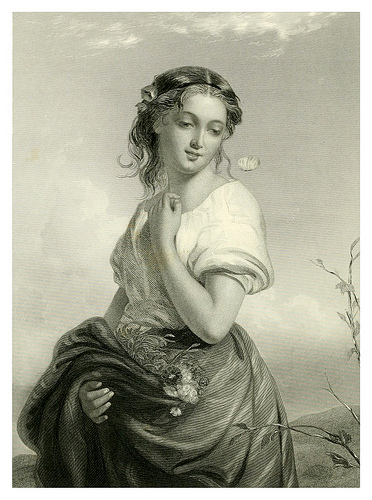
The rather Spanish-looking gentleman in this picture is supposedly our poet. It is a great picture, but it does not look anything like any other likeness of Spenser that I have seen.The commendatory verses and dedications in these old books are always great fun, being so over the top in their flatteries and other hyperbole. Ralegh wrote two "visions", in the first of which the graces who had been watching over the tomb of Laura, Petrarch's poetic inspiration, abandon it to attend to the Faerie Queene, leaving only Oblivion behind; in the second, perhaps as a result of some bad tobacco he had been smoking, he advises Spenser:
"If Chastitie want ought, or Temperaunce her dew,
Behold her Princely mind aright, and write thy Queene anew."
There is only, I think, so much Queene even Spenser could have been expected to write.

In one of the Commendatory Verses, "To the Learned Shepheard", addressed to the poet, we have a little patriotic nod:
"Elyzas blessed field, that Albion hight.
That shieldes her friends, and warres her mighty foes.
Yet still with people, peace, and plentie flowes."

The dedication to Lord Buckhurst has some of the most absurd sucking up I have ever seen in a poem, especially by a great poet:
"In vain I thinke right honourable Lord,
By this rude rime to memorize thy name;
Whose learned muse hath writ her owne record,
In golden verse, worthy immortal fame:"
His Lordship apparently was a versifier as well. Spenser goes on to suggest that while Buckhurst is too busy carrying out his duties on her majesty's privy council to record that monarch's virtues "In loftie numbers and heroicke stile" he may still perchance be able to correct the "grosse defaults" of Spenser's own efforts.

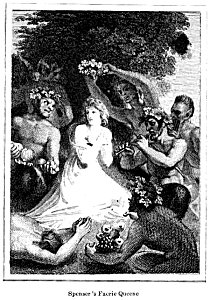
The picture below recreates a scene from one of my favorite sections of the poem, Sir Calepine's rescue of Serena from the cannibals, which we quoted from at some length in parts 9 & 10 of this series. "To all the gratious and beautifull Ladies in the Court":
"If all the world to seeke I overwent,
A fairer crew yet no where could I see,
Then that brave court doth to mine eie present,
That the worlds pride seemes gathered there to bee.
Of each a part I stole by cunning thefte:
Forgive it me faire Dames, sith lesse ye have not lefte."
This is a bit of silliness, obviously, but it is still elegantly done. One of the results--in my opinion a somewhat unfortunate one--of the ever increasing separation between "art" and "life" is that all legitimate art now is supposed to be edgy and threatening, especially to anyone outside of the art world, to whom the artist(s) seem to be as often antagonistic as sympathetic. While this type of thing is undoubtedly necessary on occasion, I don't think the artist should conceive himself as presenting a challenge to the audience so much as grappling, from more or less the same psychological starting point as they are, with an issue both have in common--and on all matters of the greatest import the artist and the audience should start out from, and even end at, a fairly similar position in terms of the overall magnitude of the question. This is where the use of slight but skillful little dainties such as this find their purpose.

Spenser's birthplace is unknown, other than that is supposed he was born in London, and he was buried in Westminster Abbey. Indeed, he is said to have set in motion the custom of interring poets in the area that is now named after them, as he requested to be buried next to Chaucer, who had been laid there because he had been an employee of the Abbey at the time of his death.

Thursday, January 24, 2008

Faerie Queene 10

This is the point, now that I am nearing the end, when I begin to feel I will miss this subject once it is over and buried in the archives. Every topic one takes up is an opportunity to make, in some way, the experience, the perception of all life better, even if only momentarily; but most of the time the opportunity ends up eluding one, and one feels the loss. This is where I am at the moment.

VI. viii. 41, 42 & 43 (1-3) This is a lot, but I think it is finely done. With this poet it is extremely hard for me to lay hands on the details that make this work. It is something along the lines of: by maintaining his pristine, finely molded verses even when describing savage characters and their vile lust for a beautiful naked woman, he imparts something of the refinement of his writing into our image of the woman, and even our own lust, and elevates them perhaps to something resembling a civilized man. Perhaps:
"But all bootes not: they hands upon her lay;
And first they spoil her of her jewels deare,
And afterwards of all her rich array;
The which amongst them they in peeces teare,
And of the pray each one a part doth beare.
Now being naked, to their sordid eyes
The goodly threasures of nature appeare:
Which as they view with lustfull fantasyes,
Each wisheth to him selfe, and to the rest envyes.

"Her yvorie necke, her alabaster brest,
Her paps, which like white silken pillowes were,
For love in soft delight thereon to rest;
Her tender sides, her bellie white and clere,
Which like an Altar did it selfe uprere,
To offer sacrifice divine thereon;
Her goodly thighes, whose glorie did appeare
Like a triumphall Arch, and thereupon
The spoiles of Princes hang'd, which were in battel won.

"Those daintie parts, the dearlings of delight,
Which mote not be prophaned of common eyes,
Those villeins vew'd with loose lascivious sight..."

The observation of my man James Swan (the previous owner of my book) blows me away. At VI. viii. 47 (9) he notes when Sir Calepine catches up "his armes streight to the noise forth past" that he had been stripped of his arms 35 pages earlier and had not had occasion to acquire new ones. That is like finding an inconsistency between two panels at opposite ends of a frieze that is twenty feet above one's head. I can't believe he noticed that on his own. He didn't seem to have that kind of keenness.

Spenser is one of the very few English language authors, it is worth remembering, whose chance it was to be free from the immense shadow of Shakespeare, and comparisons with the same, while active, which is a state of mind scarcely imaginable for almost any other English poet. The ancients would have loomed as giants and exerted a considerable influence on him of course, but one still had the luxury of working in a language, at least, as well as in many significant ways a distinct culture on which these precursors had no claim. We cannot as yet meaningfully rewrite Shakespeare and the other icons of post-medieval culture as Shakespeare, Racine, etc, even onto Joyce, were able to do with the ancients. But Spenser is almost, I think, as if obliterated by his nearness to Shakespeare; and if he were truly great, it seems we ought to be able to rewrite him, if we cannot read him as he was originally written.

VI. x. 35 Fine contrast between the heroic and the ordinary cowardly man, delightful rhymes. I am not, in the future, going to reproduce so many quotations. This happens to be a very unique book full of many wondrous feats that I am certain I would forget otherwise:
"Which Coridon first hearing ran in hast
To rescue her, but when he saw the feend,
Through cowherd feare he fled away as fast,
Ne durst abide the daunger of the end;
His life he steemed dearer than his frend.
But Calidore soone comming to her ayde,
When he the beast saw ready now to rend
His loves deare spoile, in which his heart was prayde,
He ran at him enraged in stead of being frayde."

VI. x. 37 (3-4) Followed by the judgement of Coridon:
"But Coridon for cowherdize reject,
Fit to keepe sheepe, unfit for loves content:"
It is easy to forget, and unfortunately it is not clearly articulated by the zealots of firearms and other weaponry who view the bearing and willingness to use arms as a moral question, that in primitive times and economies, indeed even as it is today in druglord and mafiosi culture, where all one's possessions, including one's women, are at great risk of being physically taken from one at any time, it is genuinely necessary that one is able to personally muster some force to defend them, a necessity that does not really exist on an immediate level in today's world, such that many get by quite nicely without even confronting the question. VI. xi. 1 This is a tremendous poem, lost in this vast work, that if any minor poet of the 19th or 20th century had published singly in a magazine would have had the triumph of his career:
"The joyes of love, if they should ever last,
Without affliction or disquietnesse,
That worldly chaunces do amongst them cast,
Would be on earth too great a blessednesse,
Liker to heaven, than mortall wretchednesse.
Therefore the winged God, to let men weet,
That here on earth is no sure happinesse,
A thousand sowres hath tempred with one sweet,
To make it seem more deare and dainty, as is meet."

The sudden descent into captivity/slavery/murder (not sensational, criminal murder such as makes the newspapers, but murder as a force afoot in the world rendering its victims into oblivion) is a recurring and doubtless symbolic theme throughout this book, as well as many other works of similar antiquity. It is again a state of existence of which we in modern society are not so much exactly ignorant, but unwary, faithful that our wealth or inoffensiveness will somehow protect us.

We have a sighting of the old one-guy-armed-with-a-spear-single-handedly-kills-a-hundred-other-men motif. Being a democratic man, I tend to identify too much with the hapless slayees to fully embrace the greatness of the champion. It is one of my goals to overcome this weakness however.

XI. xii. 23 (1-3) In this stanza it is revealed that the hero Calidore has just completed a tour through the estates of man, leaving many massacres behind, and is now at last come to the Clergy. I completely missed this detail.

XI. xii. 30 (6-9). The demon Calidore is fighting in this booke breaks into a monastery in the climactic scene and runs amok, smashing the altars, chasing the monks, etc, until the hero puts him down in what I suppose could be seen as an expression of the triumph of civilisation over barbarism:
"His shield he on him threw, and fast downe held,
Like as a bullocke, that in bloudy stall
Of butchers balefull hand to grounde is feld,
Is forcibly kept downe, till he be thoroughly queld."

Tuesday, January 15, 2008

The Faerie Queene--Part IX

I have to leave off politics for a few days. It is always a tiring and humbling subject for me to try to write about. Literature is generally not much better but at least I have a sense of something that I want to get across regarding it, even if I almost never succeed in doing so. I have by comparison no principled political ideology, other than a collection of vague dislikes--of police, of lawyers, of masses of degraded people--the influence or presence of which in society I would like to see diminished. I am going to try to make to make the literary reports livelier, and do away with all pretensions to seeking profound understanding, if I have had any. If this last must always be elusive to one I still do not think it necessarily means that he has to live wholly cut off from any noble influence that is bestowed by such things as contain it; this hope being more or less the overarching theme of this entire blog.

I had hoped to make this the last post about the Faerie Queene, but there is just too much material remaining which I don't want to give up, though I am giving up some. VI. ii. 17 (1-3) For example, I can't leave out the lines about the bad lusty knight:
"Whom when my knight did see so lovely faire,
He inly gan her lover to envy,
And wish, that he part of his spoyle might share..."
He later attacks the other knight when the latter is unarmed. In most classic, and nearly all ancient, art and literature, characters invariably either have to master their impulses or act upon them. There is very little of the type of neurotic who dominates the modern Western intellectual classes, and by extension its polite literature, which sort of person generally never masters his desires, and only acts upon such as are conveniently attained, and pose no threat to public order, prosperity, health, and so on. Successful artistic endeavors however usually require either a demonstration of strength of character, by which is largely meant superior abilities combined with self-mastery, or the conflict brought upon by the active pursuit of a superior person's basest impulses.

Having said this, I do not want to immediately present myself as a wimp, but the idea of having my teeth bashed in by a rock, a fate which occurs on numerous occasions in this and other poems and romances of medieval warfare, disturbs me greatly. I have lived a pretty much sinfully pain-free life to this point--and I am well into it--and there are moments when I cannot believe that I am going to be permitted to get all the way through without having to suffer some horribly painful violence or torture at some juncture. I certainly cannot claim to have done anything that might argue me to be particularly deserving of exemption from such a fate as opposed to anyone else.

VI. iv. 35 (4-9) About 700 pages in, we have the first suggestion, which is heartening after so many grim thoughts, that philosophy is an equal option with war for a worthy young man to dedicate himself to:
"This litle babe, of sweete and lovely face,
And spotlesse spirit, in which ye may enchace
Whatever formes ye list thereto apply,
Being now soft and fit them to embrace;
Whether ye list him train in chevalry,
Or noursle up in lore of learn'd Philosophy."

VI. v. It also took us a long time to get to a hermit, but we got one! I may well have been a hermit had I lived in the middle ages, particularly since there was so little comfort, information, entertainment and fine dining experiences for common people to forgo anyway, which one would think are the major temptations discouraging people from adopting this mode of living in our time, and all records of hermits that have come down to us indicate that this class of men were uniformly far past any point of life where they might have had a thought of being and acting as sexual creatures. I have the temperament for this calling, and I would certainly have had no doubts or misgivings about God or anything in the whole Christian doctrine had I lived at any period probably up to about the 1870s or 80s, and perhaps much later. What evidence in the visible world would have suggested to me that all was not as the ecclesiastical and political authorities said they were? I would not have suspected anything, and that is one reason why I could never be a scholar even of literature. I always assume that every important matter surrounding anything which has a long existing tradition is settled, and neglect even to wonder whether it is really so or not.

I do wonder though if modern poets should not start more often from the base of a broader, more conventional story, just to experiment and get them selves going a little, give them somewhere to move. The great problem, as far as I can tell, with much modern poetry, academic and otherwise, is that it fixes itself on too small or precise a detail or idea and has no room, or no capacity, to expand. Of course miniaturism can be exquisite when it is done well, but most of the origins of poetry, and English poetry especially, were not on this small scale, and I suspect were not so for good reasons. VI. vii. 8 (7-9) Books of this type frequently remind that death can come in an instant. One moment you are riding your horse in the woods, you are recruited by a villain, two minutes later your corpse is stretched out on the earth. Obviously one can get this reminder by reading a newspaper account of a soldier killed in the war zone, or a woman struck by a car crossing the street, or, even more vividly of course, by witnessing such a thing oneself, as many people have. In this instance however the poetic image made a particular impression on me, at least at the moment. I think I like the "cold steele" and the "to the ground him bore" especially, as if these satisfy my idea of what being slain by a sword really consists (of? I have backed myself into a grammatical corner with this sentence):
"That the cold steele through piercing, did devowre
His vitall breath, and to the ground him bore,
Where still he bathed lay in his owne bloody gore."

VI. vii 26 (3-5) & 27 (1-2). The story of all civilization. Domination of one man over another. In this instance the morally better man has triumphed, so it is actually occasion for rejoicing. However, the weak must always remain conscious that they live wholly at the mercy and benevolence of the strong, which thought does not seem to be a comfort to many in our age:
"But as he lay upon the humbled gras,
His foot he set on his vile necke, in signe
Of servile yoke, that nobler harts repine...
"And after all, for greater infamie,
He by the heeles him hung upon a tree..."

I wish I loved this poem better because it is not a book that a lot of annoying people are territorial about, and would doggedly deny others their enjoyment of, such as is the case with Flaubert, or Tristram Shandy. Of course no one can do this literally, but one can feel very lonely seeing a book one admired for its good humor, interesting characters, and dispassionate but very adroit observations about human nature constantly trumpeted and understood in a spirit that to me is really rather trivial compared to these other qualities. I don't think anyone has much of a grasp on the essential spirit of the F.Q. anymore; even its professional scholars strike me as approaching from too great a psychological distance to be wholly trusted about what it really is.

VI. viii. 3 (8-9)
"For aye the more, that she did them entreat,
The more they him misust, and cruelly did beat."
It is just very funny to come across verses like this when in the middle of a mostly serious 38,000 line poem. But it shouldn't be.

VI. viii. 37 (6-9) & 38 (6-9) The deliberations of the cannibals on coming upon the beautiful sleeping maiden offer more hilarity (and there was even more than this that I left out), cannibals being as irresistible a plot introduction to the Elizabethan artistic mind as nerds desperate to get laid are with us:
"Then gan they to devize what course to take:
Whether to slay her there upon the place,
Or suffer her out of sleepe to wake,
And then her eat attonce; or many meales to make.
"Unto their God they would her sacrifize,
Whose share her guiltlesse blood they would present,
But of her dainty flesh they did devize
To make a common feast, and feed with gurmandize."
There are actually some more incredible verses from this adventure, which I will continue with in another post.

Monday, January 07, 2008

F.Q.--Part 8
It occurred to me the day after finishing my last entry that I had made--and have been making throughout the history of this blog-- a giant blunder when I indicated that my idea of the purpose of a thorough and organized understanding of various areas of learning would be so that life would be more fun. While certainly a degree of fun is allowable from time to time if one's mind is developed interestingly enough to have earned the right--the Greeks themselves had the festival of Dionysius, after all--on the whole any highly serious person, whether he be a philosopher, a Christian, a scientist, a great artist, etc, is not greatly concerned with having "fun" as the term is ordinarily understood--ease, pleasure, sensualism, projecting a desirable appearance--so much as in realizing his human potential to the fullest possible extent, which usually requires hard work, discipline, and confronting the sort of hard and unpleasant truths that, we are told, people who prefer comfort don't even dare to look in the face. I have known this for a long time, too, but have always been unable to keep it consistently before me. At the time that this idea recurred to me I rapidly made a list of deadly serious people--Nietzsche, Wittgenstein, Adorno, Dante Aligheri, Ezra Pound, Mohammed, and such like--and rhetorically asked an imaginary banquet table of fellow idlers on holiday--we were in Venice--"Did they have fun? Was that the object of their exertions?" I then imagined the responses: "But those people were all insane fascists!--What do I care about some dick who lived a hundred years ago?--I get more action than all of those guys put together, except Mohammed--Stop worshipping the idea of famous people. Are they friends of yours? Then they don't matter. Decide what it is you want, and either do it or shut the fuck up--Everybody's life is irrelevant. Especially Nietzsche's. Get over it--Kick back and have another glass of wine--Hey, that girl over there has a tattoo in Hebrew on the small of her back. Somebody tell me what it says--" In short, since they could afford them, they were comparatively well-satisfied that their wisdom and abilities and accomplishments were good enough, and justified their indulging in and enjoyment of pleasures. This is a state to which I have not fully attained, though of course I do not forgo any opportunity to wallow in sensualism that presents itself, however unearned and gross of a spectacle I must present in so doing.

I had thought about stopping all of the book referencing, but as 1) I view the blog as in some sense an organ for seeking wisdom as well as a record of what I was doing on such and such a day, and the consideration of literature ought to stimulate some activity of that nature, and 2) I have read in several places that it is a common, and generally considered a good, practice, for writers to copy out passages that they admire or that strike their fancy, I think I will keep at it a little longer, though I will try to mix in other observations more frequently so it does not become a codex of ancient quotations.

So, onto V. vii. 29 (5-9) Ladies fighting, at least in the guise of allegories. Also pervasive in Cuchulain stories; not however in Ossian, the Morte d'Arthur, Beowulf, Sir Gawain, etc.
"...ne spared not
Their dainty parts, which nature had created
So faire and tender, without staine or spot,
For other uses, then they them translated;
Which now they hackt and hewed, as if such use they hated."

V. vii. 31 (5-9) Good image, especially ll. 8-9:
"So long they fought, that all the grassie flore
Was fild with bloud, which from their sides did flow,
And gushed through their armes, that all in gore
They trode, and on the ground their lives did strow,
Like fruitles seed, of which untimely death should grow."

V. viii. 28 (6-9) The horses of the Souldan (he's a bad guy, blatant infidel, etc):
"And drawne of cruell steedes, which he had fed
With flesh of men, whom through fell tyranny
He slaughtred had, and ere they were halfe ded,
Their bodies to his beasts for provender did spred."
The possibility of a fate like this no doubt was an especial encouragement to men to take both care to and hope in the state of their souls.

V. viii. 31 (1-4) You probably saw this coming, but the strategy employed above does not always pay off:
"Like to the Thracian tyrant, who they say
Unto his horses gave his guests for meat,
Till he himselfe was made their greedie pray,
And torn in peeces by Alcides great..."

V. ix. 6 (2-5) Another great rhyme:
"And eke the rock, in which he wonts to dwell,
Is wondrous strong, and hewen farre under ground
A dreadfull depth, how deepe no man can tell;
But some doe say, it goeth downe to hell." V. x. 23 (2-5) And another:
"Are not all places full of forraine powres?
My pallaces possessed of my foe,
My cities sackt, and their sky-threating towres
Raced, and made smooth fields now full of flowres?"
One can see the fields, too, in all their beauty. Somehow this same effect does not occur when blocks of ruins in American cities such as Philadelphia or Detroit or Newark revert back to a more natural state.

V. x. 36 (6-9) An infidel is slain from behind after trying to flee. I always find this manner of death, which is endemic is books where sword-battles are the dominant mode of warfare, to be particularly unsettling:
"The hindmost in the gate he overhent,
And as he pressed in, him there did slay:
His carkasse tumbling on the threshold, sent
His groning soule unto her place of punishment."

VI. Intro. 5 (8-9) The theme of the sixth Booke is Courtesie. This is some Rhyme Time and philosophy rolled into one:
"But vertues seat is deep within the mynd,
And not in outward shows, but inward thoughts defyned."

By Booke VI, the fights with monsters begin to take on a repetitive pattern. The seemingly overmatched hero dodges a blow, usually involving the sacrifice or debilitation of his shield in some manner, yet he is always able to hold out/wait long enough to find himself for a split second in the only positional advantage available to him, at which point he seizes the opportunity and destroys the monster.

VI. i. 26 (9) More philosophy:
"No greater shame to man than inhumanitie."

Wednesday, January 02, 2008

The Faerie Queene--Part 7
IV. xi. 19 (7-9) Sorry. At this site we celebrate all allusions to sensual vigor in aging men in real literature:
".....So wise is Nereus old,
And so well skild; nathlesse he takes great joy
Oft-times amongst the wanton Nymphs to sport and toy."

I like much the catalogue of English rivers in IV/xi. Such a treatment is an honor to a place and the people associated with it, a minor one perhaps, but in the scrum of day-to-day life that most people live it is not that insubstantial if you can develop some capacity for feeling its force. For a sample I chose 36, 1-5, which calls on the river's role in human history to give it such a character as might stir a spirited breast:
"Next these came Tyne, along whose stony bancke
That Romaine Monarch built a brasen wall,
Which mote the feebled Britons strongly flancke
Against the Picts, that swarmed over all,
Which yet thereof Gualsever they doe call:"

IV. xii. 6 This could be the new epigraph for the blog:
"Though vaine I see my sorrowes to unfold,
And count my cares, when none is nigh to heare,
Yet hoping griefe may lessen being told,
I will them tell though unto no man neare:
For heaven that unto all lends equall eare,
Is farre from hearing of my heavy plight;
And lowest hell, to which I lie most neare,
Cares not what evils hap to wretched wight;
And greedy seas doe in the spoile of life delight."

The idea expressed in line 3 is widely discredited among the serious people of our own day, the doing classes; we can allow Spenser to have had it because it can be assumed he believed both in a human soul that was susceptible to healing, as well as Christian doctrine to by our standards a fairly advanced degree.

I don't know what this painting is. Someone had stuck it on a page where the Faerie Queene was being discussed but there was no identification on it. I am pretty sure we are talking Italian, mid-15th century, possibly second half; I am not advanced enough to identify an artist or a city, though I am 85% certain it is either from the Tuscan or Venetian school. Is it Titian perhaps? Are the characters Minerva, Cupid & Venus? What is the tomb, and why is Cupid rummaging through it? Is there a party game which involves puzzling out allegories?

IV. xii. 13 Speaking of Cupid, here is a good image of the means by which he conquers Man:
"Thus whilst his stony heart with tender ruth
Was toucht, and mighty courage mollifide,
Dame Venus sonne that tameth stubborne youth
With iron bit, and maketh him abide,
Till like a victor on his back he ride,
Into his mouth his maystring bridle threw,
That made him stoupe, till he did him best ride:
Then gan he make him tread his steps anew,
And learne to love, by learning lovers paines to rew."

There is an excellent fight scene in a river between the knight Artegall, representing Justice, and a pagan that takes up much of Canto ii in Booke V. Some favorite selections are 16 (8-9):
"So ought each Knight, that use of perill has,
In swimming be expert through waters force to pas."

and 18 (3-8), on the brutality of death:
"That as his head he gan a litle reare
Above the brincke, to tread upon the land,
He smote it off, that tumbling on the strand
It bit the earth for very fell despight,
And gnashed with his teeth, as if he band (cursed)
High God, whose goodnesse he despaired quight..."

At this point I noted, more hopefully than anything else, that this was a book that at least would help me to read other books in the future and...what? Hasn't it been demonstrated that literature is utterly useless and has no measurable positive effect on at least 97% of the people who still insist on indulging in it in today's world? Yes, well, the thing is, it all still seems like it would be such fun to really get it, really be a master of all that history and philology and myth, to have it all functioning and rolling about smoothly in the brain like the Sirocco (sorry, I forget the names of the other winds; I know this is the hot one) rippling through a grove of olive trees on an Aegean hillside.

V. ii. 41 (3-6) My sentiments exactly:
"The hils doe not the lowly dales disdaine;
The dales doe not the lofty hils envy.
He maketh Kings to sit in souverainty;
He maketh subjects to their power obey..."

V. iv. 31 (3-9) Subjection of men by an enchantress:
"First she doth them of warlike armes despoile,
And cloth in womens weedes: And then with threat

Doth them compell to worke, to earn their meat,
To spin, to card, to sew, to wash, to wring;
Ne doth she give them other thing to eat,
But bread and water, or like feeble thing,
Them to disable from revenge adventuring."

I don't think Jim Swan liked this passage either. He made much use of his pink underliner in it.

V. v. 50 (7-9) Like the rhyme:
"And lay upon him, for his greater dread,
Cold yron chaines, with which let him be tide;
And let, what ever he desires, be him denide."

V. vi. 25 This is an excellent verse. It is actually rather Shakespearean now that I look at it again:
"Ye guilty eyes (sayd she) the which with guyle
My heart at first betrayd, will ye betray
My life now to, for which a little whyle
Ye will not watch? false watches, wellaway,
I wote when ye did watch both night and day
Unto your losse: and now needes will ye sleepe?
Now ye have made my heart to wake alway,
Now will ye sleepe? ah wake, and rather weepe,
To thinke of your nights want, that should yee waking keepe."

Thursday, December 20, 2007

FQ-6
In this posting I am going to attempt to grapple somewhat with ideas and actual poetry, as I am under the influence of a mood which tells me that as I will likely never return to this subject again once I have come to the end of this series, there is no point in rushing through it, especially given that I am scarcely paying it any attention as it is.

The picture below is taken from a 1913 children's book called Stories From Spenser. I wonder how many children read this book, or what influence it might have had on them, but I have not found any record of it. The scene depicts action from the 11th Canto of the 1st Booke generally, though to put some caption to it, I think I. xi. 5 is most fitting:

"Then bad the knight his lady yede aloofe,
And to an hill her selfe with draw aside,
From whence she might behold that batailles proofe
And eke be safe from daunger far descryde:
She him obayd, and turnd a little wyde."
IV. ii. 46 (3-5) Verse 45 describes the rape of a fairy nymph by a knight who came upon her combing her golden locks, presumably while in a state of undress, by a crystal flood, which got "three lovely babes, that proved three champions bold" on her. The young lads were raised in seclusion in the forest (their father having ridden off immediately after the gratification of his lust), but their genes would manifest themselves:

"Then shewing forth signes of their fathers blood,
They loved armes, and knighthood did ensew,
Seeking adventures, where they anie knew."

This getting of children by rape in this manner is, in most classical literature and art both ancient and modern (pre-1700), always set either in fairyland or some remote age, though the act is otherwise presented as the natural and obvious consequence of a lusty young man without the benefit of up to date education and civilizing coming across a luscious and lonely lass in the woods.

IV. iii. 27 (6-9) This is a striking and well-executed image:
"But when the floud is spent, then backe againe
His borrowed waters forst to redisbourse,
He sends the sea his owne with double gaine,
And tribute eke withall, as to his Soveraine."

IV. iv. 28 (6-9) This is a typical scenario in fight scenes involving knights on horseback; some variation of this is repeated about thirty or forty times in this poem alone. Indeed, for a significant portion of the lifespan of Western literary history--around 500 years-- the dominant narrative was of guys in armor swordfighting. This was one of the great lessons impressed upon me in 2007:
"A mightie spear eftsoones at him he bent;
Who seeing him come on so furiously,
Met him mid-way with equall hardiment,
That forcibly to ground they both together went."

IV. v. 35 (4-5) Regarding a blacksmith. Humorous:
"And fingers filthie, with long nayles unpared,
Right fit to rend the food, on which he fared."

IV. viii. 27 (5-8) On the hardiness of men of former ages:
"And eke that age despysed nicenesse vaine,
Enur'd to hardnesse and to homely fare,
Which them to warlike discipline did trayne,
And manly limbs endur'd with litle care..."

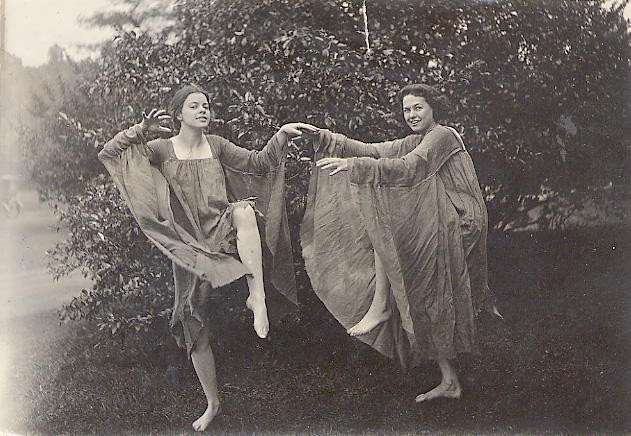
This picture has the words "Faerie Queene" in its title, though this refers it seems to a particular and curious self-image held by the artist and evoked by the terms rather than to anything connected with the poem.

IV. ix. 18 (5-9), 19 (1-4) The perils of being in the power and debt of a mighty man for a desirable woman, and the security against these which the virtues of true chivalry ensure:

"But now in feare of shame she more did stond/Seeing herselfe all soly succourlesse/Left in the victors powre, like vassall bond/Whose will her weaknesse could no way represse/In case his burning lust should breake into excesse."

"But cause of feare sure had she none at all/Of him, who goodly learned had of yore/The course of loose affection to forstall/And lawlesse lust to rule with reasons lore."

IV. x. 14 (8-9) "And time to steal, the threasure of man's day/Whose smallest minute lost, no riches render may." The book I used in this reading this poem was a 1935 Oxford University Press volume of 'Spenser's Poetical Works', which I found in Brattleboro, of all places. It had a glossary but not much in the way of explanatory notes. The previous owner, or one of them, of the book was a fellow whose name, though it is hard to decipher his handwriting, appears to have been Jim Swan; he lived at 40 Monroe Street in New York City. As this is in lower Manhattan near the Manhattan bridge, my suspicion is that the building Jim Swan, and my book, once inhabited have been razed and replaced with some more modern construction, though I am probably wrong. Swan appears to have read the Faerie Queene all the way through--at least he has marked it, frequently in pink pencil, all the way through. Perhaps he was one of the 12 men Bliss Perry designated as the book's living readership, though I doubt it. He left posterity a brief note beside the two lines above stating simply "Poor Richard!". Only a mid-20th century American, especially a Manhattannite, could have written this with such unaffected enthusiasm.

IV. x. 24 Beautiful nature images. Evokes the old world:

"Fresh shadowes, fit to shroud from sunny ray;

Faire lawnds, to take the sunne in season dew;

Sweet springs, in which a thousand Nymphes did play;

Soft rombling brookes, that gentle slomber drew;

High reared mounts, the lands about to vew;

Low looking dales, disloigned from common gaze;

Delightful bowres, to solace lovers trew;

False Labyrinthes, fond runners eyes to daze;

All which by nature made did nature selfe amaze."

I can offer little comment where the poetry speaks so clearly for itself.

IV. x. 53 (3-7) Much of this canto continues the emphasis on courage always carrying the day with the ladies:

"For sacrilege me seem'd the Church to rob, (the robbery would be of a recluse virgin from the temple of Venus)

And folly seem'd to leave the thing undonne,

Which with so strong attempt I had begonne.

Tho shaking off all doubt and shamefast feare,

Which Ladies love I heard had never wonne..."

IV. xi. 16 (1-4) I just like the rhyme. (Humorous):

"For Albion the sonne of Neptune was,

Who for the proofe of his great puissance,

Out of his Albion did on dry-foot pas

Into old Gall, that now is cleeped France..."


Monday, December 17, 2007

FQ-5

I did not know many women when I was young, but among those in whose presences I chanced on occasion to find myself, quite a few claimed that their favorite movie was "Harold and Maude". When I finally saw the movie, which is watchable more for the fascination of the enormous 1971-era cars and dreary landscape (leaves, and vegetation in general, as well as bright sunlight, seem to have been in short supply around the years 1969-71, judging from the films of the period) and the Cat Stevens soundtrack, which sounds great in the actual movie, than the excruciating plot, which centers around a geek who has a love affair with a octogenarian, my reaction was "How the hell can this be anybody's favorite movie, especially a young girl's?" Meanwhile other men were regularly meeting attractive and volatile women who told them their favorite movies were "Betty Blue" or "Henry and June", and behaved accordingly (these films, as far as I could tell, were about women who required, and got, constant stimulation and high-intensity sex). Always slow to catch on to the most blatant codes (perhaps this is what is meant by being unable to recognize an allegory even when it is swallowing you alive), it just occurred to me a few days ago that the alleged favorite films were nothing but a means of informing you in what regard you were held, certainly as far as your sexual prospects went, by reference to the fate of the leading male characters in the films named. Subconsciously one always knew this; when my future wife claimed to be partial to uplifting and wholesome American films from the 1940s (to me; who knows what she would have said had a pulsating superman been present at the conversation, which thankfully, one was not), I knew that I had some hope, though being me I did not make out what form that hope must inevitably take, and therefore made no preparations for it. The point in all of this relating to the Faerie Queene is that it is possible I may be struck by more penetrating insights about what it really means in 10 or 15 years, and I will be able to add those too late epiphanies to the compendium of worldy wisdom I hope to accumulate for my sons to give them a little more advantage when they embark upon the great contest of life than I blundered into battle with.

The advantage to someone like me, who is a rather plodding scholar, of a longer work over a shorter one is that the longer one becomes a very distinct part of your life for the period in which you are reading it. Impressions have a greater chance of penetrating even the dull mind. One senses a degree of companionship with the author has been attained by the mere virtue of having been confined in the same carriage or boarding house with him for so many weeks. A lot of readers apparently don't care for this, and consider it presumptuous, especially in a multimedia age, for any person to demand twenty, or more, hours of another person's life to read his book, but I have always found that illusion of intimacy--the author cannot really escape my company either without my willing it--to be the primary reward of the habit.

III. viii. 42 (1-5) The theme of the third booke by the way is chastitie:
"Eternall thraldome was to her more liefe,
Then losse of chastitie, or chaunge of love:
Die had she rather in tormenting griefe,
Then any should of falsenesse her reprove,
Or loosenesse, that she lightly did remove."

III. ix. 30 This is a difficult part to make out exactly (I believe Cupid may just be working his perfidious effects on a pair of lovers with the aid of alcohol), but the poetry, as far as both language and the artfulness of the images, is remarkable:
"Thenceforth to her he sought to intimate
His inward griefe, by means to him well knowne,
Now Bacchus fruit out of the silver plate
He on the table dasht, as overthrowne,
Or of the fruitfull liquor overflowne,
And by the dancing bubbles did divine,
Or therein write to let his love be showne;
Which well she red out of the learned line,
A sacrament prophane in mistery of wine."

III. x. 48 A cuckold watches his wife in action:
"At night, when they all went to sleepe, he vewd,
Whereas his lovely wife emongst them lay,
Embraced of a Satyre rough and rude,
Who all the night did minde his joyous play:
Nine times he heard him come aloft ere day,
That all his hart with gealosie did swell;
But yet that nights ensample did bewray,
That not for nought his wife them loved so well,
When one so oft a night did ring his matins bell."

There are a large number of female warriors (as well as monsters) in the poem, which brings to mind that allegory in itself is entirely, as Blake pointed out, a pagan form, and is in fact antithetical to Christianity, which is revealed truth.

This painting is David's Death of Sappho, with Phaon. It too has nothing to do with the Faerie Queene (there is a Phaon character in the poem, but there is no allusion to this story). However, it came up when I was searching for a picture and I decided I wanted it in my collection. I have expressed my fondness for David, albeit largely unexamined, on this site before. This painting looks to be in the collection of the Hermitage in St Petersburg, which I still have a hope of getting to someday, though for what serious purpose at this point I could not pretend to say. It looks increasingly unlikely that that will happen anyway however.
III. xii. 18 (1-5) Displeasure is like me. Pleasance, of course, must be Mrs Bourgeois Surrender:

"After them went Displeasure and Pleasance.
He looking lompish and full sullein sad,
And hanging downe his heavy countenance;
She chearefull fresh and full of joyance glad,
As if no sorrow she ne felt ne drad..."

III. xii. 24 (3-5), 25 Catalogue of unsettled spirits:
"Repentance feeble, sorrowfull, and lame:
Reproch despightfull, carelesse, and unkind;
Shame most ill-favourd, bestiall, and blind...
"And after them a rude confused rout
Of persons flockt, whose names is hard to read:
Emongst them was sterne Strife, and Anger stout,
Unquiet care,and fond Unthriftihead,
Lewd Losse of Time, and Sorrow seeming dead,
Inconstant Chaunge, and false Disloyaltie,
Consuming Riotise, and guilty Dread,
Of heavenly vengeance, faint Infirmitie,
Vile Povertie, and lastly Death with infamie."

IV. i. 21-22 On discord. This could be sung over legs of mutton and ale, like a real epic poem. The theme of the 4th Booke is Friendship, by the way.
"And all within the riven walls were hung
With ragged monuments of time forepast,
All which the sad effects of discord sung:
There were rent robes, and broken scepters plast,
Alters defyl'd, and holy things defast,
Disshivered speares, and shields ytorne in twaine,
Great cities ransackt, and strong castles rast,
Nations captived, and huge armies slaine:
Of all which ruines there some relicks did remaine.

"There was the sign of antique Babylon,
Of fatall Thebes, of Rome that raigned long,
Of sacred Salem, and sad Ilion,
For memorie of which on high there hong
The golden Apple, cause of all their wrong,
For which the three faire Goddesses did strive:
There also was the name of Nimrod strong,
Of Alexander, and his Princes five,
Which shar'd to them the spoiles that he had got alive."

IV. i. 51 (5) Good line:
"All things not rooted well, will soon be rotten."

IV. ii. 27 (1-4) Western civilization in a nutshell:
"And of them all she that is fayrest found,
Shall have that golden girdle for reward,
And of those Knights who is most stout on ground,
Shall to that fairest Ladie be prefard..."


Thursday, December 13, 2007

FQ-4

I was going to give everybody a break from Spenser by linking to a video called "Lucky Guys Get Amazing Lapdances at Wild Party" at Youtube, but the clip appears to have been taken down. It showed a couple of future exurban mom types doing some heavy grinding on a couple of very smug studs at a frat party. I don't know that I have ever been at a truly "wild party", by which I mean one where reasonably attractive women were drunk and totally out of control, unable to keep their hands and other body parts off of men, etc, though God knows the quest of my entire youth was to find one. Actually I suppose I have been at a couple that fit this description but I was so far from the action myself that I don't really count them.

After my pitiful attempts at poetical analysis in Part 3 I decided to retrench and try to work my way through the dilemmas caused by this poem a little harder. I determined that one of the reasons it is hard to take up much from the lines I am quoting and run a little with them is that unlike contemporary artists the poet is not really confronting us with provocative opinions about the literature, society, religion, or anything else. He is not, nor does he expect his reader to be, in serious doubt over such matters as the nature of virtue and vice, whether one ought to believe everything one reads in the Bible, if feudalism is really the optimal model for attaining human happiness, etc. The problems are almost purely artistic, matters of finding the best form to understand and demonstrate what is already accepted as true. This is the Medieval aspect of Spenser, and it is what people like Ruskin and Henry Adams are getting at when they claim that Western Civilization attained its highest point in the Middle Ages--around 1300. The idea is that men had, compared to ages before and after, a truly lofty sense of their purpose with the least confusion about what that purpose might be.

This ability of the artist to have his content already settled and to find the most suitable form for it, while not regarded in our time as the highest achievement possible, has its advantages. This occurred to me as I was driving around in my new minivan listening to the satellite radio which seems, at first anyway, to have come with it. My children like to listen to the kiddie radio station, most of which is truly execrable, grasping efforts of the "I Like Pretzels" variety by people who are clearly desperate to do anything to be able to call themselves artists, though I do like the Wiggles a little("Big Red Car" and "Ooh It's Captain Feathersword!" are catchier tunes than anything Elton John has ever put out). Whenever they break out something like a selection from the Mary Poppins soundtrack--"A Spoonful of Sugar", say--it's practically time to rock out. The point is, if you are totally on your own playing with your guitar straining to invent a song, you are going, especially if you have no genuine talent or imagination, to end up writing something solipsistic like "I Like Pretzels". You likely won't even be able to reach the heights of "A Spoonful of Sugar" because the concept, and more importantly, its place in the flow of a bigger narrative, likely will not present themselves to you.


II. x. 27-32 recount the story of King Lear (the whole booke is "a chronicle of Briton kings/from Brute to Uther's Rayne.") Here is how he presents the fate of Cordelia:
"Till that her sisters children, woxen strong
Through proud ambition, against her rebeld,
And overcommen kept in prison long,
Till wearie of that wretched life, her selfe she hong."

II. xi. 30 A common theme of old literature:
"So greatest and most glorious thing on ground
May often need the helpe of weaker hand;
So feeble is mans state, and life unsound,
That in assurance it may never stand,
Till it dissolved be by earthly band.
Proofe be thou Prince, the prowest man alive,
And noblest borne of all in Britayne land;
Yet thee fierce Fortune did so nearly drive,
That had not grace thee blest, thou shouldest not survive."

II. xii. 73 (1-8) Though this is about the privation of the soul through lust, it is pretty sexy stuff. This is what I imagine college as like for cool people:
"And all that while, right over him she hong,
With her false eyes fast fixed in his sight,
As seeking medicine, whence she was stong,
Or greedily depasturing (feeding on) delight:
And oft inclining downe with kisses light,
For feare of waking him, his lips bedewed,
And through his humid eyes did suck his spright,
Quite molten into lust and pleasure lewd..."

III. i. 13 Here is some Spenserian nostalgia for days of yore reminiscent of my own writing:
"O goodly usage of those antique times,
In which the sword was servant unto right;
When not for malice and contentious crimes,
But all for praise, and proofe of manly might,
The martiall brood accustomed to fight:
Then honour was the meed of victorie,
And yet the vanquished had no despight:
Let later age that noble use envie,
Vile rancour to avoid, and cruell surquedrie (arrogance).

III. ii. 32 (6-9) Volcanic love:
"Like an huge Aetn' of deep engulfed griefe,
Sorrow is heaped in thy hollow chest,
Whence forth it breakes in sighs and anguish rife,
As smoke and sulphure mingled with confused strife."


For all the wonder of this book, it is hard to maintain a consistent concentration day in, day out, all the way through. The 1962 Catholic History of Western Civilization that I frequently refer to says it is "a technically perfect poem, but lacks power." I would like to attribute my at times flagging attention to this lack of power but I really did not experience or perceive it in this way.
III. v. 23 (7-9), 25 (4-7) Reminders of Man's Fate/Intimacy With Forces of Darkness (I am at home now, so my return key skips a space):
"Downe on the ground his carkas groveling fell;/His sinfull soule with desperate disdain,/Out of her fleshly ferme (habitation) fled to the place of paine."
"And strooke at him with force so violent,/That headlesse him into the foord he sent:/The carkas with the streame was carried downe,/But th'head fell backward on the Continent."
III. v. 42 This is some elegant versification here:
"O foolish Physicke, and unfruitfull paine,/That heales up one and makes another wound:/She his hurt thigh to him recur'd againe,/But hurt his hart, the which before was sound,/Through an unwary dart, which did rebound/From her faire eyes and gracious countenance./What bootes it him from death to be unbound,/To be capitved in endlesse duraunce/Of sorrow and despair without aleggaunce?"
Most commentators on the Fairie Queene make note of how many figures and concepts of paganism populate this work. Especially as many of the Christian messages/scripture references are artfully, and usually beautifully dressed in symbolic garb, (i.e. an upgrade of armor) that nonetheless are probably lost on a great many modern readers, including me, without referring to the notes, the impression made by the ubiquity of various classical and nature gods is a strong one.
III. vii. 12 I noted beside this stanza "like me", which was obviously the immediate impression I had upon reading it, unflattering though it be. I cannot make out on a quick second perusal who or what he and his mother specifically sympolize:
"This wicked woman had a wicked sonne,/The comfort of her age and weary dayes,/A laesie loord, for nothing good to donne,/But stretched forth in idlenesse alwayes,/Ne ever cast his mind to covet prayse,/Or ply him selfe to any honest trade,/But all the day before the sunny rayes/He us'd to sing, or slepe in slothful shade:/Such laesiness both lewd and poore attonce him made."

Tuesday, December 11, 2007

FQ-3

The second & third stanzas of the Introduction of the second Booke (of Temperaunce), reference the newly discovered lands of the New World. As an inhabitant of those lands, they caught my interest enough to want to quote them, besides that there is the typical smooth versification of our poet:

"But let that man with better sence advize,
That of the world least part to us is red:
And dayly how through hardy enterprize,
Many great regions are discovered,
Which to late age were never mentioned.
Who ever heard of th'Indian Peru?
Or who in venturous vessell measured
The Amazons huge river now found trew?
Or fruitfullest Virginia who did ever vew?

"Yet all these were, when no man did them know;
Yet have from wisest ages hidden beene:"

I don't want to club anyone over the head with quotations, as I know most readers' inclination will be to skip over them to see if I have written anything ridiculous relating to sex or failure or perhaps the collapse of civilization. However I took to writing these book reports primarily to try to help myself remember something of what I read, as I found I was starting to forget almost all of it. Also Spenser is not one of those authors like Orwell or Johnson or Wilde with whose quotations one is constantly bombarded even from the most tangentially well-read sources, so I thought it would not be the worst thing for him to have a little presence on my site. To be honest I am a bit burned out and disillusioned at the moment with reading, and to a certain extent with writing, but I don't really know what else to do with myself. Most of my interests would lead me back to reading and confronting mountains of learning and well-staked out territory in some manner. What I probably really need to do is to go on a long quest or pilgrimage of some kind, preferably one that has some tangential importance to human progress--I have discovered that it is fashionable now to trash even the Lewis and Clark expedition as meaningless because it 'accomplished nothing of value that would not have happened anyway'. This attitude poses a problem to modern western Man, because the idea of the quest, whether individual or the group, is one of the main engines which drives any culture, yet increasingly we feel that there is no more ground for us to stake out or seek that a million more able people have not covered and pronounced upon already. One looks inward and finds nothing there that has not already been made manifest, and to a far greater extent, by a thousand others one knows of.

II. 1. 11 (5-8)
"Her looser golden lockes he rudely rent,
And drew her on the ground, and his sharpe sword
Against her snowy brest he fiercely bent,
And threatned death with many a bloudie word;"

This action is taken by one of the villians on the side of intemperance, who doubtless has a more precise identification that eludes me. Violence, or the threat of it, sexual and otherwise, is a constant throughout the work, and is frequently written about in a way that, while solidly moral and judgmental, is also rather arousing.

II. 2. 2 This is a good poem.
"Ah lucklesse babe, borne under cruell starre,
And in dead parents balefull ashes bred,
Full weenest little thou, what sorrowes are
Left thee for portion of thy livelihed,
Poore Orphane in the wide world scattered,
As budding braunch rent from the native tree,
And throwen forth, till it be withered:
Such is the state of men: thus enter wee
Into this life with woe, and end with miseree."

II. 2. 15. Even if you are skipping the poems, this description of a desirable *modest* woman--a subject dear to Spenser's sensibility--might appeal to a romantic spirit:
"She led him up into a goodly bowre,
And comely courted with meet modestie,
Ne in her speach, ne in her haviour,
Was lightnesse seene, or looser vanitie,
But gratious womanhood, and gravitie,
Above the reason of her youthly yeares:
Her golden lockes she roundly did uptye
In beaded tramels, that no looser heares
Did out of order stray about her daintie eares."

II. 2. 29 (8-9)
"Vaine is the vaunt, and victory unjust,
That more to mighty hands, then rightfull cause doth trust."

II. 3. 36. I like this metaphor.
"As fearefull fowle, that long in secret cave
For dread of soaring hauke her selfe hath hid,
Not caring how, her silly life to save,
She her gay painted plumes disorderid,
Seeing at laste her selfe from daunger rid,
Peepes foorth, and soon renewes her native pride;
She gins her feathers foule disfigured
Proudly to prune, and set on every side,
So shakes off shame, ne thinks how erst she did her hide."

II. 3. 41 (1-4) This is about the sort of woman who prefers, and only prefers, men of action:
"In woods, in waves, in warres she wonts to dwell,
And will be found with perill and with paine;
Ne can the man, that moulds in idle cell,
Unto her happie mansion attaine."

Samples from II. v. 32-33 (loose nymphs)
"Amidst a flock of Damzels fresh and gay,
That round about him dissolute did play...
Every of which did loosely disaray
Her upper parts of meet habiliments,
And shewed them naked, deckt with many ornaments.

"And every one of them strove, with most delights,
Him to aggrate, and greatest pleasures shew...
One boasts her beautie, and does yield to vew
Her daintie limbes above her tender hips;
Another her out boastes, and all for tryall strips."

II. vii. 52 (6-9) verses on Socrates
"With which th'unjust Athenians made to dy
Wise Socrates, who thereof quaffing glad
Pourd out his life, and last Philosophy
To the faire Critias his dearest Belamy."
II. vii. 60 (1-5) A harsh reply to Tantalus, upon that wretch's asking for food:
"Nay, nay, thou greedie Tantalus (quoth he)
Abide the fortune of thy present fate,
And unto all that live in high degree,
Ensample be of mind intemperate,
To teach them how to use their present state."

II. viii. 16 (8-9) A villian disputes Sir Guyon's right to a funeral (he is not actually dead but in a swoon):
What herce or steed (said he) should he have dight (adorned),
But be entombed in the raven or the kight?"

II. viii. 50 (2-5) Condition of an inferior being:
"For as a Bittur (bittern--a type of heron) in the Eagles claw,
That may not hope by flight to scape alive,
Still waites for death with dread and trembling aw;
So he now subject to the victours law..."

There is something about this poem that is causing me to be melancholy. I think that is because it either is truly great or is very near to being truly great, and because I feel something of an impossibility to understand it in anything close to what it really is. One feels terribly lonely and unarmed wandering around in it, and companionship in terms of attitude towards the poem is hard to come by. Yet at the same time it does not feel alien. It feels as if something one has lost, something rather powerful, is buried within it, that is probably irretrievable except in fragments and shards of language.

I am going to try to do shorter posts and more of them, as well as to cut down on the quotes. However, they all seem important or good or humorous enough at the time.

Thursday, December 06, 2007

FQ-2

I have previously written on this blog about Spenser's Epithalamium, in which I think I made it clear that I am an admirer of this poet, if from a considerable distance of intellect. His oeuvre achieves a satisfying sense of totality both in the parts and in the whole that very few English poets, and I would have to say no modern ones, have attained. By this I do not mean that the best of the moderns are bad, or even technically or intellectually inferior, but I never have the same feeling of encountering a complete man, or woman, and certainly not the distilled spirit of an entire society, in either a single poem or collected works of a modern poet. It is this positive quality of fullness that causes readers to find certain old books soothing and consoling as much as the avoidance of serious contemporary dilemmas. The best poetry of the 20th century was to my mind more remarkable for its sophistication than for any projection of fullness, though I do consider some of the great modern novelists to have achieved the latter, and certainly someone like Picasso, as well as other giants of modern art, would appear to have attained something of this quality as well, whether we like what we see in the result or not.

Booke I, Canto IV, Verse 20 "Idlenesse":
"From worldly cares himselfe he did esloyne (withdraw)
And greatly shunned manly exercise,
From every worke he chalenged (claimed) essoyne (exemption),
For contemplation sake: yet otherwise,
His life he led in lawlesse riotise;
By which he grew to grievous malady;
For in his lustlesse limbs through evill guise
A shaking fever raigned continually:
Such one was Idlenesse, first of this company."

This is a good sample of a Spenserian stanza. Recalling that there are over 3800 more of the kind, and that the poem was begun around 1580 and the second completed part published in 1596, one realizes that, that means that he wrote an average of 0.65 of these every day for 16 years; and of course numerous other productions also appeared in the meantime, most notably the Amoretti and Epithalamium. While this is meticulous, it is not languid poetry. It builds up a character fairly quickly and economically with statements of fact rather than impressions or speculations, and is ready to set him into purposeful action, though he is Idlenesse himself.

At some point during the fourth Canto of the 1st Booke I made a note that "the life depicted by the poets far different from that we know" and also that I had a dream of the book falling into pieces. I have no recollection of what either of these refers to now.

I.v.1 (1-4) "Great Enterprise"
"The noble heart, that harbours vertuous thought,
And is with child of glorious great intent,
Can never rest, until it forth have brought
Th'eternall brood of glorie excellent:"

I.v.7 (8-9), 9 (3-8) "Effects of Sword-Fighting"
"That from their shields forth flyeth firie light,
And helms hewen deepe, shew marks of eithers might...
The cruel steel so greedily doth bight
In tender flesh, that streames of blood down flow,
With which the armes, that earst so bright did show,
Into a pure vermillion now are dyde:
Great ruth in all the gazers harts did grow,
Seeing the gored woundes to gape so wyde,..."

I thought this was well-wrought. The Christian knight representing holiness is fighting a Sarazin here, so the fight is hardly to be avoided, and thus physical courage and strength are not merely subjects for admiration or philosophical inquiry but are actually necessary. One gets something of the sense of what that fully entails.

This book is certainly a lot of poetry for your money. Surely, I thought, no one can ever have memorized all of it, but it is clear that people, primarily in previous ages, have memorized very large swathes of it. Many of these have also distinguished subtleties of characterizations, symbols and allusions, which are more than usually exquisite and beautiful when revealed, most of which I was sadly not within a thousand neuron waves of being able to pick up on.

I.vi.24 "How to Raise a Man"
"For all he taught the tender ymp, was but
To banish cowardize and bastard feare;
His trembling hand he would him force to put
Upon the Lyon and the rugged Beare,
And from the she Beares teats her whelps to teare;
And eke wyld roring Buls he would him make
To tame, and ryde their backs not made to beare;
And the Robuckes in flight to overtake,
That every beast for feare of him did fly and quake."


I constantly ask myself both in reading these kinds of books and poems and in attempting to keep this blog, What is the nature of my enjoyment of this? and What is the nature of other people's apparently far different sort of enjoyment in the same? Poetry seems not to be much served by my being one of its audience, and certainly not by my being one of its critics. The benefits to me, as far as pleasure goes, while not completely illusory, have much about them of voyeurism and the vicarious. To read Spenser as myself, Bourgeois Surrender, would have no obvious purpose, would not, could not, be translated in any way to anything actually interesting that might ever transpire in real life. For such reading I have to invent another, livelier and more brilliant person who inhabits a particular, and likewise invented world, neither of which are likely to ever break through to real life, to give the reading meaning, to take a place, as it were, at one of the tables where the grand feasts of humanity are regularly served. I do not receive the poems directly and integrate them into the manner in which I eat my breakfast or interact with people at cocktail parties, at least not so that anyone, including myself, can perceive them. They must diffuse themselves into little microscopic bits that lodge themselves in odd and disconnected spots in the sediment of my mind.

I.viii.46 (6-9)

"Such as she was, their eyes might her behold,

That her misshaped parts did them appall,

A loathly, wrinckled hag, ill favoured, old.

Whose secret filth good manners biddeth not be told"

It is probably pointless to read this if one is not going to read it at least twice.

I.x. 66 (7-9) "On Natural Superiority/Courage Asserting Itself In Spite of Lowly Origins"

"Till prickt with courage, and thy forces pryde,

To Faery court thou cam'st to seeke for fame,

And prove thy puissant armes, as seemes thee best became."

At this climactic point of the first Booke St George, or the Redcrosse Knight, overcomes the dragon. By necessity, it seemed, many had to die at the dragon's hands in order to make this hero, and to illustrate his virtues. This is still the formula of many popular stories today, at least those that are popular among the crowd that is not particularly attuned to being sophisticated; among those who are, there is more of a sense that modern life and the modern mind have mitigated the idea of any such necessity even for the sake of virtue where anonymous and random death on any scale is to be the price.

I.xii. 39 (Some Very Catholic Sensibilities)

"During the which there was an heavenly noise

Heard sound through all the Pallace pleasantly,

Like as it had bene many an Angels voice,

Singing before th'eternall majesty,

In their trinall (threefold) triplicities on hye;

Yet wist no creature, whence that heavenly sweet

Proceeded, yet each one felt secretly

Himselfe thereby reft of his sences meet,

And ravished with rare impression in his sprite."


Sunday, December 02, 2007

Edmund Spenser--The Faerie Queene (1590, 1596) Part 1

According to the 1966 Illustrated World Encyclopedia's supplemental section "Library of the Literary Treasures", which has had such a singular influence in my life, Bliss Perry, professor of English at Yale (there's a blast from the past for you) estimated at one time that "there were no more than a dozen men living who had read the Faerie Queene through, though it is acknowledged to be one of the greatest works in English poetry". This seemed preposterous to me even at a young age, and I continued to be dumbfounded as I grew older and repeatedly encountered estimates by scholars of the living readership of classic books that numbered no higher than the mid double digits. It was only very recently that I finally caught on that when such people say that only twelve people alive have read a book they do not mean to include in that group all the people such as myself who might at some point have managed to fix their eyes upon and mouth over every word from page 1 to the last of the surviving fragments, but only such as have the education, intelligence, experience and understanding of the human condition to be able to read the book properly, with a mind that bears some measurable proportion to what is at work in it. I have little doubt that the Faerie Queene is much less read than other famous books such as Proust, or Ulysses, or Don Quixote, which according to scholars and pop authors and journalists of the ironic school no one is supposed to have read either, though I suspect the number is higher than twelve, and is probably closer to a thousand, even with the more stringent criteria. I also suspect that many, if not most of these thousand are spread out at great removes from each other, from the camaraderie and even love which the mutual possession of any exalted and refined understanding promises to offer. The idea at least appeals to me.

Though only half-completed according to the original plan, the Faerie Queene is a massive and complicated edifice of poetry that one could easily write about for months without getting anywhere near the actual point of it. It contains over 3,800 stanzas and 34,000 lines of very tight, mostly technically faultless verse, all in the famous Spenserian stanza, nine lines with a rhyme scheme of ababbcbcc, with the ninth line having an extra foot (i.e. two syllables, making twelve altogether). As reading this book is in some ways as much a test of endurance as of skill such that it resembles a heavyweight fight, I think it is not bad form to ease my way into an attempted description of it by the use of statistics. The poem is routinely described as an allegory, though I admit I have found any great allegory hard to keep in clear view, and experienced it more as comprised of various allegorical episodes. The well-known Internet writer Spengler at the Asia Times website, who appears to be learned after the German manner (languages, philosophy, no hint of anything "light" being allowed to have influence; this guy considers Shakespeare overrated and frivolous compared against Goethe and Lope de Vega), but like many of his countrymen has more than a bit of the inflexible fanatic about him where his pet subjects are concerned, once opined that Americans could not recognize an allegory if one were eating them alive. This idea interested me--I was not sure what being eaten alive by an allegory would even mean, and why one should have an especial appetite for Americans, or any other sorts of people, as victims to be devoured. Each book (Booke) is divided into 12 cantos, each of which is comprised of around 50 stanzas, and (each Booke again) is represented by a quality, which a different knight, usually one of long renown relevant to the topic such as Arthur or St George, undertakes a quest in the course of the Booke to attain. The theme of Booke I is holinesse, of Booke II is temperaunce, etc. The construction and execution of the poem itself into a kind of unassailable castle of awesome correctness unfolds very much as a parallel to these quests, and succeeds to a large extent in embodying many of the qualities it champions. The Faerie Queene herself is of course supposed to be Elizabeth I.


My impression is that there is currently very little real taste for this poem afoot in the general culture. Some Renaissance Faire types indicate a mild interest from time to time in what it might be about, but I don't know how far they get in their investigations. While undeniably impressive, the book is more than a bit of a slog to get through, and I don't know that I have ever read of or heard anyone lamenting that the poet died before he could complete the remaining 35,000 lines he had projected. I can find no evidence that the literature scholars and grad students currently bedding the most desirable women (or who are currently the most desirable women) pay it any attention at all. Spenser was held in enthusiatic regard in the 19th century by the Romantics, especially Keats, who recognized in him a poetic sensibility and talent both natural and masterful. Ruskin too considered him a giant of true imaginative literature from a much grander and more serious age than that of human degeneration which he considered to mark the Victorian era. The Faerie Queene seems to have been a standard part of university English curriculums throughout the Anglosphere up until the 50s and 60s, around which time, and I fear not coincidentally, the boozing, womanizing, irreverent postwar generation of British poets and novelists were invited for teaching assignments in American colleges. These were given to ridiculing their earnest American colleagues and students for various innocences and pretensions, among the foremost of which was claiming to like, or believing anyone else liked, or ought to like, books like the Faerie Queene. The enviable (to the Americans) professional, social and sexual successes, these latter frequently with the wives and denoted girlfriends of the duller natives, that these swaggerers were able to effortlessly achieve no doubt contributed to making the diligent study of such an enormous and not easily accessible work seem even more pointless and unsexy than it probably already had. The nearly universal neglect of it among people who have other literary options continues unabated to this day.

It should be acknowledged that in the same postwar period another faction of Britons, represented by C.S. Lewis and his ilk, continued to trump up the greatness of medieval allegorical poetry, which tradition Spenser certainly pays much homage to, though he is more than half, if often resistant to it, a man of the Renaissance. Lewis seems to be mainly popular nowadays among practitioners of a kind of gentle Christianity and nerdy fantasists, sometimes found in confusion in the same person. I actually think most of these people understand at some level that his idea of Christianity is actually something rather intense that it is difficult for modern intellectuals, including I am quite certain himself, to tap into. Understanding something of a poet like Spenser especially, but probably any very good poet, requires getting into a similar mindset. This was a man who spoke and wrote in a young language that did not yet have a vast literature or, apparently, well-worn ruts and grooves in its spoken form that it was difficult to find one's way out of. His experience of the English language was as something that in all its forms, including the simplest, was rapidly and continually evolving all around him throughout his life. The Elizabethans experienced their language almost the way we do certain areas of technological advancement. They did not have to strain to 'make it new', because one did not have to go terribly far to come to a point where it was necessary to do so. Happily in literature they 'seized the moment', which can only arise at certain junctures in the history of any language, though English is perhaps at such a juncture now where it is coming into widespread use in places and among peoples who can experience it as something brand new.

I am not satisfied with this last thought but as I will have several posts on this poem maybe I will take it up again another time.

Monday, January 22, 2007

More reading.

Spenser--Epithalamium (Wedding Song)

Edmund Spenser is surely one of the four or five most beautiful poets ever to write in the English language, and probably the most committed to a pure beauty of line above any other consideration, for this purpose is never interrupted or sacrificed in his work. He is not overflowing with particularly fresh ideas or images even in the context of his own age. However the formation and flow of his words when read aloud seems so natural, so obvious as to be quite remarkable when one considers that approximately 450 million people speak English now as a first tongue, and virtually none employ it in this manner either in writing or speech.

"Early before the worlds light giving lampe,
His golden beame upon the hills doth spred,
Having disperst the nights unchearefull dampe,
Doe ye awake, and with fresh lustyhed
Go to the bowre of my beloved love,
My truest turtle dove,
Bid her awake; for Hymen is awake,
And long since ready forth his maske to move,
With his bright Tead that flames with many a flake,
And many a bachelor to waite on him,
In theyr fresh garments trim."

There are no earth-shattering intellectual gymnastics here. All the rituals of the poem are utterly conventional, the actions and personalities of the participants artificial and contrived, most of the descriptions and classical allusions border on being hackneyed, and the pagan gods invoked have the air of long refrigeration about them, at best. The exuberance is all in the writing, and that is genuine, that is the new, alive wondrous object of love, and certainly the poem takes on a much added dimension if we think of the English language in its youthful bloom as the maiden about to be cultivated, ravished and loved by an enthusiastic and virile practitioner.

"Never had man more joyfull day than this,
Whom heaven would heape with blis.
Make feast therefore now all this live long day,
This day for ever to me holy is,
Poure out the wine without restraint or stay,
Poure not by cups, but by the belly full,
Poure out to all that wull,
And sprinkle all the posts and wals with wine,
That they may sweat, and drunken be withall.
Crown ye God Bacchus with a coronall..."

The consummation of the marriage, which lasts much of the night and culminates most happily in the bliss of the groom and the impregnation of the bride, takes about 100 lines to recount, most of them imploring the night to be extra dark and quiet during the poet's business, but there are some good ones which I will try to cull:


"Now day is doen, and night is nighing fast:
Now bring the Bryde into the brydall boures.
Now night is come, now soone her disaray,
And in her bed her lay;"

Addressing the moon:

"and sith of wemens labours thou hast charge,
And generation goodly doth enlarge,
Encline thy will t'effect our wishfull vow,
And the chast wombe informe with timely seed..."

His description of his lady gives us a heavy dose of ivory forehead, apple cheeks, cherry lips, etc, though it is not every day one hears this satisfying image spoken anymore:

"Her brest like to a bowl of creame uncrudded,
Her paps lyke lillies budded..."

Among Spenser's poems that I have read I would rate this behind the Amoretti (exquisite love sonnets) and The Shephearde's Calendar, which is what it sounds like, a tour of the pastoral year. These other things are a little more interesting to read and have slightly more pungency to them. Still, the essential quality of this author is that he unites one of the highest poetic sensibilities of all time to a vision of existence that is, or at least aspires to be, almost willfully happy and, what is most rare among artists of high talent, innocent. That this quality is not easy to attain is shown in the work of the major author below, born 218 years after Spenser and committed as well to the pastoral, the lyrical, the beautiful, the traditional, the authentic, in a world and a literary culture in which it had already become more difficult to believe wholly in the reality of these things than it had been in Spenser's day.

Wordsworth--"She Dwelt Among the Untrodden Ways"/Hartley Coleridge--"He lived amidst th'untrodden ways"

I have been slow in gaining an appreciation of the poems of Wordsworth, of which I have not read more than a handful, and even those at long intervals from each other. To begin with, his authorial personality has something about it that reminds me of those earnest, bearded old men of the generation of the 50s and early 60s who one still always sees hanging around used book stores and who have always annoyed me, probably because if I had happened to grow up at that time I would doubtless be exactly like them; they are neither particularly cool nor talented nor interesting, though they have been aspiring for half a century to be these things above all else, a whole mass of failed Beatnik Robert Bly types still trying to define what it is to be a man, an artist, an American, an American man artist, not very absorbingly and completely innocent of humor (the real Beatniks at least were often very funny). I have to turn tail at the sight of them. To the modern raw reader of poetry, Wordsworth comes off initially as partaking of some of these traits. There is nothing in his lines or thoughts that particularly grabs one by the throat and stamps an indelible image on the mind the way that say, Byron's or Edgar Allen Poe's poems can still do. All of the poems seem at first to be similar meditations upon the same handful of subjects. The titles themselves are very plain and somewhat hard to keep straight in one's mind, apart from "Tintern Abbey". Judging by the notes I have made in my Norton Anthology I appear to have at least read over at various times "Ode: Intimations of Immortality", "It is a Beauteous Evening" and "I Wandered Lonely as a Cloud", yet I could not have named these from memory if asked. It is not that I did not like them; however they obviously lacked for me a certain force that I had come to associate as necessary for being memorable.

Nonetheless I have come over time to a certain respect for Wordsworth's work because of the intelligent and humane manner in which so many notable, energetic and thoughtful men of the 19th century responded to these on the surface rather plain and intellectually uninvestigative musings on natural beauty. Mill in particular, who had been educated to shun poetry, Shakespeare included, as insubstantial, credited them with helping to restore his interest in life after he had suffered a nervous breakdown at age twenty, traditionally attributed to an overpreponderance of pure logical thought. Any man whose work is capable of this I consider to merit my attention more than the general run of poets. Mill attributed their power to the expression of "states of feeling, and of thought colored by feeling, under the excitement of beauty." This strikes me as reasonable, as well as being pleasingly without being overly subtle writing on the part of the poet. Still, one has to experience something of the effect oneself to really understand what the hubbub is about.

"She Dwelt among the Untrodden Ways" read aloud or looked at on the page, consists of 67 words that can be disposed of in a crisp 20 seconds or so either way. As far as initial time commitment goes for the student of literature, it is not Remembrance of Things Past. It is about a maid named Lucy (many Wordsworth poems feature a girl named Lucy) who lived in a remote area, was deserving of a greater degree of praise and love than it was possible for her to get in those pre-MySpace days, and died, her death strongly affecting the poet though apparently no one else. There are 3 little stanzas, of which the first establishes her worldly condition in life and the 3rd the same in death. The 2nd contains the metaphors and, I assume, the poem's meaning:

"A violet by a mossy stone
Half hidden from the eye!
--Fair as a star, when only one
Is shining in the sky."

It is a slight and delicate set of images, though in this instance it suits the subject matter very nicely and subtly, which I think the 19th century appreciated more than we do, who think slightness and delicacy, even where that is the state of life or the form of idea being taken up by the poet, the exclusive province of wimps. One can extrapolate in a number of directions from the images given, which is a benefit of writing about nature and "general" subjects. The maid's beauty is, while she lives, continually in some state of fragility. First there is the matter of its being generally unseen, then there is the suggestion that it is beautiful because there is nothing else--no competing star--with which to compare it. The poet seems to have known her only at a distance--not well at all. Perhaps this is all a small but well-wrought metaphor for life. There is in a small space much suggested, all of which, however is manageable--the poet only requires the reader to recognize the suggestions, not learn a foreign manner of thinking. Perhaps I am starting to get at something of the appeal of Wordsworth.

I am not quite sure exactly what to make of Hartley Coleridge's parody. The same three-stanza setup is used, the first referring to a poet who lived in unread and unloved obscurity, and the third to the poet's book gathering dust in the shop. However if Wordsworth is the author invoked, this is all obviously opposite to his actual situation; his house and neighborhood in the Lake District were already attracting tourists while he was still living in them. Coleridge's second stanza has possibly a little edge to it:

"Behind a cloud his mystic sense,
Deep-hidden, who can spy?
Bright as the night, when not a star
Is shining in the sky."

Coleridge was the son of Samuel T Coleridge, and a minor poet himself. Basic biographical information on him is a bit of a chore to hustle up, but he appears to have been intimate and on reasonably good terms with Wordsworth all his life. It may not mean anything, but he and Wordsworth are buried right next to each other in Grasmere churchyard. I assume the parody was intended to be good-natured.