Showing posts with label pretentiousness. Show all posts

Tuesday, December 04, 2012

Wisconsin 3


1. The Garden Under the Blazing Sun, Again.


2. Little Wagon Provided By Our Hosts.


Child #4 had broken his leg in May and had just begun walking again, with a tremendous limp, which prompted our innkeeper to produce this cart for going around the garden trails in. He did not stay in the cart very long however and ending up walking most of the way, being more discomfited by the heat than by his injury.

3. Group Photo of Boys, Cooksville, Wisconsin, 7/2012


It is not always so harmonious as this picture makes it appear, of course, but right now they are really best friends for the most part. They play and sleep and do everything together almost all the time. I do not want to make the obvious prediction and lament that it will not always be so, because maybe it won't be, in every case at least. I don't have a great feel yet for what kind of attitude to the family any of them are likely to develop in adolescence and adulthood. Even by age ten I already felt a great desire to be away from my parents and be alone all the time--I did not have any brothers--and even today though I know it is irrational and petty I hold them responsible enough for my lack of social popularity, my total lack of any talents that would allow me entry into one of the more dynamic sectors of society, and my inability to ever focus on and progress in a serious adult career that I cannot bring myself to behave around them with more than a cold cordiality, and if my wife did not insist on this as my duty I do not think I would speak or have any contact with them at all; certainly I would seek none out. I don't detect any signs of that sort of attitude in these children yet, but I hope I will not be surprised if they should develop such later on. Still, not to be maudlin, but when I bought a ticket for the 580 million dollar lottery drawing my oldest son was concerned that we would win and we would have to move out of our house and he would have to leave his school ('but your new school would instill in you the qualities of casual superiority and domination that will drive your less fortunate social competitors insane with envy', I tried to remonstrate, but he did not get it). This is the same child who wants a manual typewriter for Christmas, so there is truly reason to worry that being raised by me is setting him up for unpleasant disappointments when he gets out somewhat amongst the thrash and brawl of the world, and I think it likely he will make it out there at some point.

4. Wisconsin Has a Distinctive and Well-Situated State Capitol


State capitols are a recurrent theme with us. Children like recurrent themes. We live in one of these cities, and we went to school in another one, so this was a natural one to adopt. There are still quite a few that we have yet to visit in-depth despite literally walking past them on numerous occasions (Boston, Montepelier) or  passing frequently through the towns (Trenton, Harrisburg).

5. Horseplay in the Main Rotunda.


Wisconsin's capitol building is huge. They have their Supreme Court in there as well as the State Library and  several other governmental departments (the historical society?) that have separate homes in other states. The inside is the usual classic marbled and mildly ornate Victorian era U.S. capitol building, though this one has especially attractive antiquated light fixtures and signs.

6. State Street, Outside a Sports-Type Bar That Literary Types Probably Don't Frequent.


State Street connects the capitol building with the University of Wisconsin, to which we walked down and hung out for a while in the Union. Never having attended a regular University of any substantial size, let alone a sports and research colossus like this one, I am always fascinated to visit--just sitting on one of couches near a bathroom I saw three or four academics who exuded 'major league intellectual development' pass through and meet up with graduate students or junior colleagues, very often attractive and driven-looking young women, to take up whatever serious study they were collaborating on. This is all most heady stuff for me of course, so after letting me have a gander at a few commanding intellectuals and Big 10 co-eds and other college people my wife wisely nudged us back again towards the real world.

7. Another View Back up State Street Towards the Capitol


State Street is kind of a big deal in Madison I guess, for tourists anyway. It is not very big, compared to what a similar district would be in a major city, though I liked it. It has a lot of bars and cafes and college type shops, and the kind of shops that I guess appeal to the bohemian/college educated demographic. There were one or two fairly large used book stores that I would have liked to peek into. Unfortunately with so many children I could not actually go into any of these places, but they are the kinds of things that hopefully, I will live long enough and have enough time to do again someday.

8. The Great Windmill of Cooksville


The whole place is attractively laid out. I found the whole are of South Central Wisconsin to be aesthetically pleasant. Obviously there are Wal-Marts and strip malls in places and parking garages in the cities and so on, but only a small part of the geography there is blighted in this way. For the most part, as I noted in an earlier post, it does not look all that different from what it would have looked like 50 or 60 years ago. Maybe some of the smaller towns would have been more bustling, but even these did not look so badly off as some of their counterparts in upstate New York and Pennsylvania.

9. Hitting the Road Out of Wisconsin


This is one place I really don't know if I will ever get back to. It would be nice to be able to skewer that whole region of the country a la Evelyn Waugh or even a third rate hack New York writer and say "Good riddance" and have all of the sneering people in our haute literary intelligentsia nod approvingly at my taste and sensibility, but unfortunately I actually liked it there, and I cannot summon up that necessary feeling of revulsion for geographically inferior locales that the would-be second and third rank urban intellectual needs to be able to produce in such instances.

Wednesday, May 02, 2012

Top Six Mathematicians of All Time


(Note: April 29--I have been on vacation for a week, I was unable to get anything done for two weeks before that, and now the Blogspot site is all changed and I am having difficulty even in moving my cursor up and down the edit page with any of the speed to which we have become accustomed. I was also planning to reinvent myself during the hiatus but I have had to shelve that plan, for the moment anyway).

I was looking for a questionnaire, 'meme' or top whatever list to plug in here, not having done one for a while, when I came across someone's list of the 100 greatest mathematicians. I realized that I could not, without some struggle, name a personal top 10. It's pretty disgraceful, at least for a 42-year old man who is supposed to be interested in the life of the mind. I had meant of course to re-engage with both the history of math and some advanced mathematical studies at some point--once I had become established in my main career, I think--well, we all know how that goes. (Note: I was back at my alma mater last weekend. These visits always produce an odd muddle of sensations, most of which I will not get into here, but the book store there remains highly satisfying, the more so as places anything like it grow increasingly rare. Even the bookstores at colleges like Harvard and Dartmouth are Barnes and Noble-like, and while not bad, contain a lot of topical or practical-oriented material, as well as some total fluff. St John's is still having very little of that even in the general non-fiction categories, and the outsized portion of space given over to books of pure mathematics, Greek literature, musical scores, and philosophy make it quite unlike any other place in the world and maintain a tone of seriousness despite the increasing, though still modest, quotient of T-shirts and other souvenirs, which were almost non-existent in my time. At the same time all of this, as well as the displays of the college's collection of antique scientific instruments the purposes of which I for the most part cannot identify, serve as a sad reminder of all the learning I not only failed to retain, but failed to acquire in the first place. And the stuff they teach in liberal arts schools is supposedly child's play that the typical engineering graduate picks up in his free time over the internet.) (Another note: I am so desperate to finish this post that I am trying to distract my 3-year old with television and junk food. Unfortunately even that is not working). Since I cannot make up my own list, I am going to see what I know about the top 6 on that referred to above before looking up what they actually did (I am doing the top 6 instead of the top 5 because Euclid was ranked #6, and I have actually heard of him).


6. Euclid


Scene from the "School of Athens", of course, one of the central paintings of the western world, and, as I believe I had written elsewhere here, one of the more thrilling moments in tourism to see in person, not least perhaps because what is technically the 'main attraction'--that being the Sistine Chapel, which is however much more difficult to see and concentrate on in real time--still awaits.

We read the Elements, or much of it--all of the first 3 books, the 5th (? the one on proportions), the 10th--in the first year at the old school, and while it was always hinted that everything in its pages was subject to disputation, naturally it was hardly obvious to me where the vulnerability lay, and as such seemed perfectly reasonable and representative of some kind of truth, probably something along the lines of, there is an order to be found in existence that is independent of death and ugliness and stupidity, and the best part of our minds is that which enables us to make out what that is. The greater genius of moving/seeing beyond it, or even imagining that one must desire to do so, I was not to have a portion of, however. I was deeply impressed by the actual squares drawn onto the lines for the proof of the Pythagorean Theorem, as were most of the mathematical naifs. That conception had simply never been hinted at anywhere in my previous life.


5. Bernhard Riemann


I don't know anything at all about this guy. I have never even heard of him


3. Carl Gauss

My pictures got out of order, so number 3 comes before number 4.

I have heard of Gauss, though I have very little idea of what he did. The picture of the bell curve on the 10-Deutschmark bill reminds me that his name is associated with that device, but I am assuming that if he is the 3rd greatest mathematician of all time this was not his signature accomplishment, or that there is much more profound import in it than is generally known.


Intermission

There was an article in the New York Times last week (now a month ago) about a college student who died of alcohol poisoning in a fraternity hazing ritual. There are usually a couple of these a year. The comments were predictably full of indignation and disgust at the continued tolerance of this juvenile, anti-intellectual, and prelapsarian culture at many of our finest universities (the particular incident referenced in the article happened at Cornell). I am no lover of the fraternity scene myself. As a teenager I was so terrified of their reputed social and sexual power at the schools where they predominated that, knowing I could never be one of them, I was very much determined to go somewhere that didn't have them, and I don't regret having avoided them in my day. Nonetheless, it seems hardly to be disputed that, among those not constituting the true academic elite of the nation, which at most colleges is 1 or 2% of the student body if they are lucky, 15-20% at the better ones, and I suppose a little more than that at a few places like Cal Tech, the supposedly widely reviled fraternity boys are about the greatest winners, and greatest men, in our whole society. Have you ever met a member of a winners' fraternity who was stuck in support staff making $40,000 a year, or, God forbid, working retail, 10 years after graduation? Neither have I. It scarcely requires an effort to find examples of frat parties even at highly exclusive schools where the crudest, and by the supposed standards of respectable contemporary society most blatantly offensive displays of racism and misogyny are openly advertised and recorded for all the world to see that are well attended by scores of thin, physically desirable and willing women while legions of men for whom the thought of inadvertently causing offense to a minority or feminist or homosexual is a source of constant mortification enjoy another night of pizza, soft drinks, and dungeons and dragons, followed by a restful sleep unburdened by female company. Yes, the hazing rites sound ridiculous, juvenile, and unnecessarily dangerous, and certainly on the surface would appear to be wisely avoided; however, they evidently serve some important purpose that is essential to male development, since most men who successfully pass through them seem to do quite well in their careers and the social world of adulthood. I don't really understand it, but I suspect it's about demonstrating that you are one of 'us' in whatever milieu you are talking about, that you can be trusted to maintain the culture of success and achievement that you are gaining admission to, that you are worthy. How having to eat grapes that have been jammed up the buttocks of your fellow pledges directly from that place of storage--to give an example related by one of my high school friends--demonstrates this peculiar value is still rather mysterious to me, though again in this intance the gentleman I reference went on to attend Yale Law School and currently works intimately with the highest officials and most powerful interests in his state on matters of substantial and decidedly adult import, so I would have to say that at some level his socialization served him well.    


4. Leonhard Euler.
A complete blank. Nothing at all.


2. Archimedes


When I was in Annapolis last weekend I saw an attractive girl with Archimedes's quotation (in English) about being able to move the earth if he could find a place to stand on displayed across her upper back, in what looked to be a temporary tattoo.

A patriotic Syracusan, the mathematician turns up frequently in the ancient histories. Catapults designed by him provided an effective defense of the city, or at least caused the enemy no little consternation in its assault, on several occasions. The illustration above commemorates his famous bathtub epiphany. What was it again? I don't remember. It was not the lever problem. Was it the formula for cubic measurement? This is atrocious. I don't remember. I do remember that he was killed because he was so immersed in a geometrical problem that he ignored, or did not register, the commands of the encroaching army (were they the Romans? I seem to remember this from Plutarch. Archimedes lived later than the time of the Pelopponesian War I believe), though the overheated meathead who personally slayed him quickly became infamous among his own leaders when the identity of the old man was discovered.


1. Isaac Newton


My store of top Isaac Newton thoughts/knowledge:

I have the impression that Isaac Newton was the child of farmers, and that his mother was wholly illiterate and ignorant about the wider world. One legend about his precocity goes that given the first proposition in Book I of Euclid--perhaps it was even the first definition--at around the age of ten, he deduced the entirety of the remaining 47 propositions of that Book without further reference to its pages and stated that the work was rather obvious. I have no idea if this story has any credibility. I read it in passing once. Somebody, I presume his teacher or local clergyman, coming to the realization that they had a legitimate genius in their midst, got him some proper schooling and to Cambridge, where he doubtless belonged more than anybody else in the kingdom (or the Protectorate--I can't remember his exact date of matriculation) at that time. Author of the Principia, which is a dark horse candidate for the greatest book of all time, and was considered by many scholars at St John's to be the most genuinely difficult volume on the program there-- perhaps legitimately smart and educated people can work up to reading Hegel and Kant and even Einstein with some degree of familiarity, but the singular mind of Newton cannot be prepared for or really taught. Also a perennial candidate for the Most Important Figure in the history of the world, with his only challengers in recent decades usually being the now rapidly fading Jesus Christ, and Muhammed. He was reportedly unable to have satisfying relationships of any kind, personal or professional, his intelligence being so far beyond that of actual individual people that it was impossible for him to find any common ground with anyone on which to form an ordinary human friendship. His books are addressed to the collective knowledge of entire schools of hundreds or even thousands of scholars whose combined brainpower can only in rare instances begin to comprehend their meaning. Alexander Pope had a terrific man-crush on him.

I did look up the claims to fame of the mathematicians I knew nothing about, however I think it would be ridiculous even to copy the record of their achievements without having studied them, for the terms (Differential Geometry, Real Analysis, etc) mean no more to me than the names. I did look up Archimedes's biography, and he did live later than the Peloponesian War period (287-212 B.C.), and did die at the hands of the Romans. The discovery he came upon in the bathtub was of course that of the water being displaced by a mass inserted into it and that this principle could be applied to calculating volume. I definitely knew that, or at least I was familiar with the general parts of the story, at one long lost time.

Hopefully on to further (and better) posts after this dead period...I should do a link at least to the list I am taking these rankings from, but it will take too much time now at 10:52 in the evening. If lots of people complain about it I'll go back and put it in later...

Tuesday, March 13, 2012

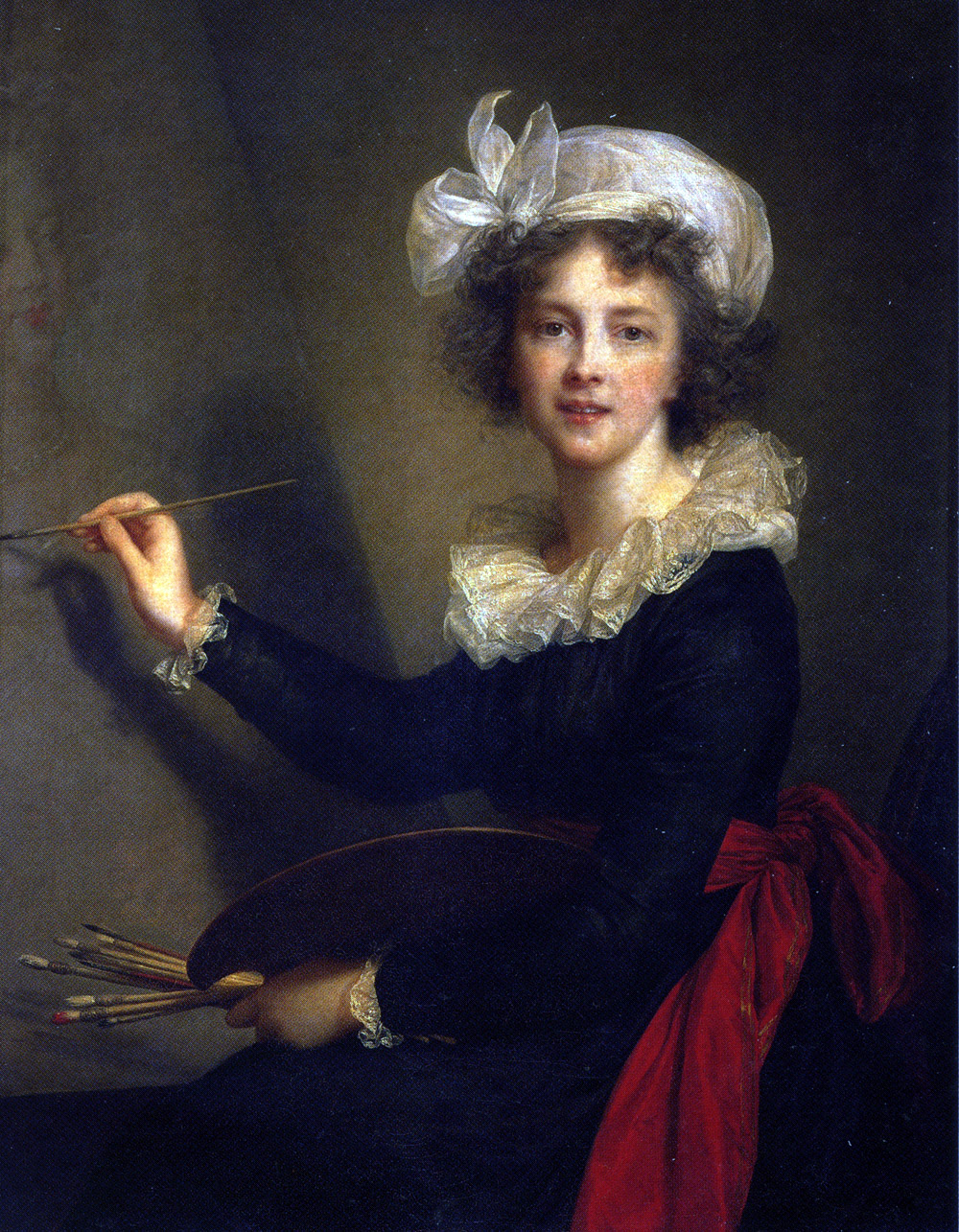
Favorite Women of Art #14--Elisabeth Vigee-LeBrun
I think the time has come for an occasional revival of this series. My art writing is undoubtedly among the best work I do, besides that it invariably puts me in a positive state of mind in spite of all the objections which might be argued against its doing so. I had the good fortune to have formed romantic ideas about various subjects, including most of the arts and even much of history before I was exposed to the more realistic and exacting interpretations and scholarship, either of the exalting beyond the reach of my understanding or too thoroughly eviscerating variety. The sense of the sublime, or the ideal, or even the merely sensuously better never died entirely within me; and it still seeps through the myriad unpleasant to contemplate truths in most instances.

Elisabeth Vigee-LeBrun seems to me an excellent painter. She was primarily a portraitist (portraitiste? portraitess?), and not just of run-of-the-mill and now forgotten aristocrats and wealthy merchants either, but royalty and the elite of the elite of her age. She was fond of doing flattering self-portraits as well--talk about controlling the image--of which this is my favorite example, at least of the ones that I am aware of. I like the hand full of paint brushes--it says, I am serious, and I like to work, but I am not grim about it. I like the prim petite black dress with the red sash--I don't exactly know what it says, but I think it is something like, I favor a slightly understated look that is still feminine and attractive. The headgear with the greater part of a head full of ebullient curls still out and framing the face, says, I am a 18th century French lady du monde, I really understand what titillates the more refined type of male brain, and there is pleasure in having the capacity to do so. The single visible row of teeth, and the eyes lazily open and completely exposed to the viewer says, I cast rather than bore for artistic truth. Illumination holds for me the primary appeal, obscurity very little.

Has there ever been a time when the greatest artist in a particular age, or country, or school, was a woman? It has occurred in literature; Jane Austen for example was almost certainly the best novelist working in English from 1800-17 (her death), and some would argue that Emily Dickinson was the greatest poet active during the 1860s and 70s, in America at least (I am less certain about this, though I am as yet skeptical of the supposed greatness of Whitman). It is true that neither was, or probably would have been, recognized as such at the time, but the retroactive recognition demonstrates that obviously the possibility exists at any time. Going way back I suppose most Greek scholars consider Sappho the best lyric poet of her generation. One would think it would have happened in painting at some point. In England anyway I had the impression that drawing was one of the major components of the education of young ladies of means going back to the 1700s. I realize that in most of these instances intense training was not received yet there are always instances throughout history where people who would not appear to have received world class preparation in a subject have managed to burst through with works or acts of original genius which altered the historical course of their nation's culture. I suppose the great artists have by tradition been a physically robust and combative lot, very competitive, energetic, quick to disparage the work of rivals and pour contempt on that of inferiors. When men of this combination of personality traits mixed with serious artistic abilities and a serious intellect, working in a culture that understands, cultivates and highly values the especial talents that they possess, you get something like Periclean Athens or the Italian Renaissance, in English literature perhaps the Elizabethan period, hyper-male ages of male cultural achievement, in which the contributions of female artists seem to be even more conspicuously absent than in ordinary eras, as if when highly realized male energy and power are set loose in the artistic arena, the best efforts of women are simply for a time overwhelmed? I don't know where I am going with this. Women are of course highly prominent in the art world at present not only as artists but as curators and scholars, where my suspicion is that among the under-50 set they are dominant, and as big money patronesses as well. When you get into the money and the higher refinements of true taste I kind of lose the thread because there is a disconnect with that side of the business from my romantic view. Now we're talking about who controls art, how it is presented, what one is supposed to think about it, etc, and it does seem like in many ways there is a class of woman that definitely has a strong say in that...

I don't have much time to write reviews on Amazon.com--I think I have gotten nine up in two years. No one has commented on any of my reviews yet and only 8 of 14 people have found my pieces helpful, 3 of 9 when you take out the one review I published (of the silent film Variete) that was popular. This is a matter of no interest and little meaning, but I thought I'd throw it out there.

Winter was short this year, I was busy, and I think I might have missed Maple Sugaring season. I've grown to like Maple Sugaring season, and I find myself looking forward to it, so hopefully it will still be going on somewhere. But I doubt it.

Wednesday, November 30, 2011

So Unfocused I Can't Even Come Up With a Credible Title

Still not up to writing much lately. I seem to be going through some further life transition, which seems unfortunately to be steering me even further away from mental activity of any passable quality than I was before. What is the nature of these afflictions which beset me? The usual busyness. Anxiety and mild depression. Sentimentality--despite still having 2 babies and a 5-year old, I find myself of late missing the years when my oldest two boys were little. At the time of course I was doubtless as anxious and I was certainly quite a bit poorer than I am at the moment at least, but the past, being safely gotten through, is easily remembered as a happier time. And in fact, I was younger, and there was more time and less housework with 2 than there is with 5, and I still perceived myself to be able to write halfway decently, which, while almost certainly a deception, did still inject a joy and sense of purpose into my private mental life that I have had trouble accessing the past few years. I am unable to find pleasure in many of the things I formerly found pleasure in, and while I think my children are likely to be worthy human beings who would be capable of being contributors to a worthy society where they will feel themselves to belong, I have grown overly pessimistic that they will ever inhabit such a society, not for any long term. And also before they were in school we used, it seemed, to go so many places. All over New England, Montreal once a year, the Mid-Atlantic three times or more. Gas was much cheaper. I still have one of the cars I had then. It cost $16 to fill the gas tank at that time. It's around $35-40 now.

This used to be the time of year--from October through New Year's Day--in which I formerly took the most pleasure. Lately I scarcely notice it in passing, such is my general distraction. I am lucky if I manage to spend three days in the whole of these months in the observance of some ritual of the season--but enough of this weak-headed lamenting. I would like to be able to have some more time to appreciate the spirit of the seasons though, especially around Christmas. I haven't got all that many left anymore.

This post was originally going to be, not an insistence on, but a defense or attempted justification of going to college in certain circumstances, even of liberal arts coursework, in response to the ever-growing ranks of those who think almost anything would be a more constructive use of a capable young person's time and money, let alone an incapable one's. My main problem of course in attempting this task is that all the doubters as to the virtues I would be espousing would have to buy into the idea that I am, in the heart of midlife, an acceptably developed or educated man by the most minimum standards denoted by those words, who could be demonstrably shown to have acquired any knowledge or experience in the course of my education that I carry with me through life that is even roughly equivalent to the expense which Somebody incurred to have it imparted to me; and my impression is that this is exceedingly unlikely to happen. I am not merely in most people's eyes, including, frequently, my own, a poor advertisement for expensive 'humanistic' schooling, but the very portrait of the fate people congratulate themselves as avoiding when they choose to concentrate in other fields. At the same time I do know a few people who studied the same course and received the same degree as I did who do strike me as excellent advertisements for this same (though this does not seem to cut any ice with the naysayers). And even with regard to myself I still have a hard time convincing myself that I would have been any better off, or significantly happier, forgoing the course I did take, for the army, or the pursuit of a trade, or entrepreneurship, or what would have been a likely futile course of study in the hard sciences or engineering or even computers, for which I had no significant preparation up to that age. My essential problems are deeper set in the way I relate to the world, my general level of comfort in it, etc, which have always been uncertain and confused, and have always been largely impervious to attempts at improvement. I have never been very much in any harmony with my surroundings--the things I write about most on the blog are those where I feel closest to attaining this sense.

I think the defenders of humanism should drop the "it teaches you how to think" meme for a while, since non-believers don't seem to be buying it, and anyway if it were true and people were honest with themselves it should be largely manifest when you met such a person. I am coming around to Ruskin's view on this matter, that genuinely intelligent people think as naturally as they breathe. I do not think at this point particularly well, though I during and for a few years after school my studies and the generally higher caliber of everyday discourse and interactions did inculcate some stronger habits of thought, attentiveness, attunedness to environment, etc, than I was wont to have formerly. Now however I have been removed from higher intensity mental environments for so many years that I seem to have regressed back to that more confused and sluggish method of thinking and perceiving.

So if humanistic studies don't teach you how to think in some superior way, what good are they for exactly? First of all, they may well teach you to think in some way highly prized by the better classes of society--I just don't think people should insist upon it where it is not evident in itself. Done reasonably well of course, they should give you a strong foundation of general knowledge, not merely practical facts, but a better awareness of what kinds of things (smart/smarter) people think about, and the way that they think or came to think about them. I think for introverts of a high academic intelligence quotient it has a social value that seems to be woefully underappreciated. Yes, people do a lot of drinking and wasting time in school, but above a certain threshold of intelligence social and intellectual life are not really capable of being separate entities. To be brief, it is important for smart people to be predominantly around other smart people sometimes. Of course there is much examination of and guidance on the nature of existence as a whole, how to approach life, to become attuned to and become somewhat at home in all the various part's of one's mental and aesthetic world, one's language, physical environment, sense of proportion, and justice, perhaps it enables one to discover and understand strengths within himself, though this never quite happened for me. Unfortunately emphasis on mastering demonstrable skills--in languages, composition, rhetoric/public speaking, music, as well as those areas of math and science in which a general competence is well within the capacity of the intelligent non-specialist--before the degree is awarded has never been strong in this country, so this realm of learning as a whole has come to be seen as less difficult and therefore the province of less substantial men and women than the hard sciences especially.

Article about young writers in New York--seems something like the kind of scene I would have liked to have found at that age, though they seem a little too nice and devoid of edge to make much of a literary impression. As usual in modern literary circles, vital male heterosexual energy seems to be lacking, as well as any sign of a genuinely unconventional take on life, and usually where these are absent, there is not much hope of compelling work being produced. Still, it is hard not to think that if I had been able to achieve success in my chosen career, these are the types of girls who would likely hold me in high esteem and even awe now, and those thoughts are pleasing to me.

Sunday, September 04, 2011

The Best and the Brightest

Though it may not be evident to the reader, I do know that it is unseemly for me to protest too stridently that I am just as good as people who have achieved exponentially more worldly success than I have, and this does effect some restraint upon my writing. Still. my heart dies a little whenever I see Wall Street multimillionaires extolled as the best and brightest minds of my generation. That this frequently occurs in articles or other fora decrying the deprivation of all this dynamic talent from other fields such as the arts, academia, and even science, which have presumably been left with very little for themselves, rubs the wounds of failure that much harder. All I can say, since I personally seem incapable of either effectively combating the image of this as truth, putting some curb on these people's ability to amass such an extent of power and wealth within an evidently largely closed system, or to succeed to a comparable extent in some alternative system, is, I dearly hope it is not true.

I was re-reading some Plato lately--yes, it is ridiculous, especially as I seem to understand anything important about it less now than I did when I was twenty, though I still do not think reading it is completely valueless--and I was struck by a statement in the Republic in which Socrates (I assume) observes that the "best and strongest natures are most thoroughly corrupted in bad environments". I thought this might apply to certain aspects of the contemporary scene, where the perception among much of that part of the public that are not possessed of the best and strongest natures is that for a critical mass of their superiors life has gone beyond mere triumph and claiming the positions of leadership and wealth that are rightfully theirs, but of actively making life more unpleasant and unnecessarily difficult for everyone beneath them. I know this has been the case more or less in all times and all places, but the degree and kind of the pressure fluctuates in different eras, and it is my impression that currently we seem to be in a fairly severe downturn in the cycle, in which the brightest and strongest people, or those who are supposed to be they, are dissemenating very little in the way of joy, or optimism, or sense of shared humanity through the greater society, and are applying the hammer instead. I am probably more optimistic than most that the mood and tone of society, if not concrete economic and social conditions, will eventually improve from what they are today; while I don't see myself ever taking much of a part in that change, my children, if they live, will be able to pass much of their youth and young adulthood in, I hope, a more generally positive atmosphere than what I have perceived to be the norm in my own life. Properly, it seems one should take some delight in the most intelligent and energetic people, or at the least a good many of them-- else the alleged desirability of these qualities seems difficult to conceive; yet I find most of the people who are supposed to be the best educated to be nearly as dreary in personal intercourse as I am, which leads me to believe that something is missing.

Why are the strong so strong? What is the source and nature of this mental power? This is not a minor question, for whatever this quality is the lack of it not infrequently has the effect of rendering a human life in a post-religious society, in particular that of the male of the species, essentially worthless, whatever other positive qualities he may have. Not necessarily unpleasant or devoid of simple delights, but not usually, except in rare instances of unique talent, a life befitting a Man. This life properly demands a high, or at least comparatively high degree of testosterone combined with an equally virile and energetic intelligence, the two traits constantly feeding off of and amplifying their counterpart. Other than working harder and more purposefully than most people in our society have any idea how to go about doing, there seems to be little the person of mediocre mind can do to actually improve his intelligence; what seems to be hoped for in his case in that education will persuade him somewhat of the breadth of his limitations and he will defer more readily to those of greater understanding. It would seem that the testosterone deficiency could easily be cured by medical means, and that the general population would be pleased by this, as it hates languid and effeminate men, but the tendency to be over- and perhaps unnaturally aggressive seems as yet to outweigh any of the more positive effects of this treatment.

On Debt

I have to finish this post in the next 25 minutes--as well my 2-year old is refusing to take a nap--so I am going to truncate this section on debt in order to rush it to the press. In short, I have always for the most part been afraid of it, and have tried whenever possible to avoid it assiduously, and now I realize in middle age that that was in many ways as foolish as indulging every idle whim. When I think now of certain experiences I missed or places I did not go to or improvements to my appearance I neglected to undertake because I didn't have 50 or 100 dollars and I refused to even consider the possibility of enhancing my daily life through the power of credit, I wonder if it was really worth it. Men with high testosterone and self-regard do not let the lack of present funds get in the way of living, and they tend not to worry about or be much stressed by the consequences of being in or even defaulting on debt comparative to what I would be. The regrets I have in life are primarily the lack of interesting experiences and social interactions, and the failure to develop either proper adult talents or skills. Money obviously was not the only obstacle preventing me from attaining these things, but allowing myself a little wider vision (of that substitute for real money, credit) to operate in might have allowed for a little more expansion of life itself, wherein the world I inhabited was not such a pinched and constricted one, both of experience and possibility to generate income.

I also note that while I have at various times taken out loans, for college, cars, household necessities, etc, and while in the past especially this debt always weighed heavily on my mind and sense of possibility, the instant they were paid off all memories of the worry they caused me seemed to dissipate into nothing and seemed as if they never existed; yet as this worry was a dominant part of my life, the result is that it seems as if my life has consisted of very few actual episodes or events or periods even of fervent mental activity, spaced out at very long intervals.

Titles/Phrases Read in Youth That Stick in the Mind All Life Long

1. Ja, the Rebels Eat Babies

This was the title of Chapter 1 of Gettysburg from the 1950s Landmark series of children's history books. This expression pops into my head about once a week. The bit about eating babies referred to wartime propaganda, but I never figured out where the Ja came from.

2. You Can't Do Business With Hitler

This was the title of a Reader's Digest article from 1938 or thereabouts that had been ripped out of the magazine and stuffed into the pages of an old (but cheap) book I bought at a book barn in Bucks County, Pennsylvania when I was a teenage (circa 1985). I'm sure the article was ridiculous, but the title caused my grandfather, who rarely laughed at anything, no small amount of amusement for a few minutes, enough for the incident to be memorable more than 25 years later.

Monday, May 02, 2011

curtain wall poet dead occurrence (or, this site needs a more definitive personality)

There are three possibilities to achieve this that I can see. The first is what I originally envisioned the site as being, which is the dissemination of a highly developed, sparkling, singular and consistently rigorous point of view in the matter of my pet subjects. This obviously has not come to pass. The second is to find some niche or quirky subject matter that will capture some people's attention --bathroom stalls of Manhattan or obscure baseball players or high end Belgian furniture or bicycling culture--and burrow deep enough into it so that everything you write or post a picture of becomes informed and often made slightly more interesting than it was before by your consuming obsession. I might like this, but I have not been struck yet by the particular theme that I was born to run a blog about. The third possibility is to stop being earnest at all costs and try to cultivate a kind of mannered weirdness wherein coherence with regard to anything independent of the manner is of scant importance. This last is, while a slim one, probably the best hope I have at this point. There are others, such as to go the Samuel Beckett route and start writing in French or some other foreign language to cultivate a more streamlined style; but most of these are not really practicable at the moment either. I don't know what to believe is going on in the supposed Osama Bin Laden killing, but if the official story is true, I think he should have been brought back to the United States and placed on public trial. Yes, it would have been a circus, but so what? The American public needs to become better acquainted with its alleged enemies, besides that openness and the spectacles of justice and respect for law are supposed to be our core values, to which this whole saga right from the start has demonstrated either a lack of faith in or indifference, both of which strike me as bad. The new policy of openly (as opposed to covertly) targeting specific prominent international figures and killing them, accompanied by a high degree of public enthusiasm based on limited knowledge of the government's motivations strikes me as a dangerous mindset to be cultivating in the masses. I am not reassured when I encounter it.

I put up a few old pictures from college on my Facebook page, in commemoration of one of the rites of spring there. I had told myself when I first went on that I would never do that, that I would try to remain psychically in the present and facing forward there as much as possible, but in truth for the 99% of the population who are not visionary figures and the 80-85% who have not figured out the secrets of true adult satisfaction vis-a-vis the freedom and sensual possibilities of youth this mindset is probably nonsense, and does more harm to the associations and relationships which might give his life meaning, which sources of that meaning are almost entirely rooted in past memories. I certainly have some need to be alert to present life and cognizant of the future, but in general when I seek in my day to day existence for signs or indications of new associations and causes for optimism as regards my own prospects, as well as those of my children, I do not encounter much that excites a sense of possibility stronger than what I felt when I was in my 20s (hopefully the children are experiencing their own present lives differently) so why should I give up entirely the sense of self and life that I had when I was less resigned and dull until I do figure out the superior, or at least more realized, mode of being, that will allow me to leave the past more or less where it belongs, and live eternally in the moment, with the most vital parts of my psyche always pushing, slightly but ever firmly, into the future?


I am going to make this another short posting. I do have other things I would like to write about but they all require organization or elaboration or review which would take longer than the 15 minutes I have right now before I want to post this. Better pre-organization of the random observations and subjects I sometimes would like to touch upon, as well as the half-baked serials I undertake, would be a major step in improving the quality of the site. I just don't have a lot of time.

Monday, April 11, 2011

More (Hopefully) Brief Observations on the Current Scene/////

There is some problem with this website where my paragraph divisions are not always being saved or honored or what have you and I cannot figure out why. So in case it doesn't work the slanting lines represent where paragraph breaks are supposed to be./////

I spent a not insignificant part of my day today trying to remember the word "corroborate". This sort of thing happens all the time now. This incident ended happily in that the word came to me about 30 minutes after I gave up trying to think of it, but increasingly that which I am looking for, often so far even having a sense of its syllabic and musical relation to the other words I intend to use it with, does not come. I seem to be reverting, as most people seem to as they age, to only really possessing the vocabulary I had when I was 14, which is about the time I set out consciously to improve it. Evidently you can improve it somewhat during your late teens and twenties for the sake of establishing your place in life, but then around 35, being, like physical attractiveness, presumably no longer needed, it begins to atrophy./////

Before I go on I thought I should address an objection which sometimes is brought up when taxation of the wealthy is under discussion, that being the global society argument, wherein I am (hypothetically) asked if I would be willing to see my own standard of living suffer to redistribute wealth to the masses of the third world, and, if not, how that is any different from the situation the Forbes 400 is in in relation to me. I of course have not yet assimilated fully to the globalist outlook that the people out on the frontiers of current thought and perception move in so easily, so this is to me like the argument that even though I live in a region of the world where the number of children under 18 is declining considerably (N.H-Maine-Vermont-Massachusetts-Upstate N.Y.; if you throw in Quebec and the Canadian Maritimes which adjoin these states the decline is even more dramatic, and over an enormous expanse of territory) I should have myself refrained from having more than one preferably, and more than two absolutely, because in Yemen and Niger the birth rate is still around 8 children per woman and the resources are not present there to support them all. Regarding the original question however, while I would not be willing to adjust my standard of living to slums of Rio levels, I would certainly be able to live, and it could be argued that I have lived, easily enough at a considerably lower level of material consumption, as could many Americans. A great deal of our overconsumption and constant need to be generating money is built into the system and is largely unavoidable compared to many countries that get by on more modest GDPs. I have written many times on this site that I was quite happy when I lived in Prague with its per capita income of $6,000 a year, and I certainly did not have or spend much more than that. Of course the price scale for things like housing and food was commensurate with the local incomes, and the offerings in the market meager compared with advance economies, but I at least found these limitations not unbearable. Other goods and services such as heating, public transportation, health care, and education were heavily subsidized by the government, doubtless at far cheaper rates than is or could be done here, and apart from the upper ends of our population providing as good or better quality as similar efforts achieve in the United States./////

Indeed, the major obstacle that the United States faces in convincing its people to give up anything for any kind of common good is the absolute horror people have of losing whatever precious amount of social status they can lay claim to having, because they cannot count on the general tenor of life at any level of the pyramid beneath their own (which is frequently unsatisfactory enough) to be bearable. In Prague and similar expat locales and in certain other places of refuge, such as graduate school, reduced circumstances are more bearable to intelligent people mainly because there is still a critical mass of people there of comparable intelligence at a similar level of income and consequently interesting and accessible social and cultural opportunities. This has never been the case in mainstream American life however and only seems to be getting worse./////

The two rackets--the Scylla and Charybdis, if you will--that are currently getting the most blame for the current demolition of the former American middle class, are the costs of Health Care and education, which of course in almost every other advanced country are heavily subsidized, if not administered, by the government. Having worked in the health care industry and long followed the world of academia with longing eyes from afar, I can tell you that the executives and administrators and other top professionals in both hold a similar view where the public is concerned. Both regard having a plan in place to pay for their services should be after food and maybe clothing (your house is seen as something you could transfer into cash to give to them) the number one financial priority any person has. Health care executives affect astonishment that more people haven't stashed away a couple hundred grand at least to deal with unforeseen medical expenses in old age. Personally, I would prefer that both of these enterprises be considered as public goods with broadly agreed upon standards governing accessibility and restrictions to accessibility, because I think these would be indicators of a more coherent and politically healthier society, which is the main problem of course underlying almost every issue in American life today. Of course there would be some limitations compared to what is available now, though if you are below the 80th or so percentile of wealth, do not have extraordinary health issues, and are not a hypochondriac, I do not see that such limitations would be likely to affect the typical consumer much. I actually have thought for a long time that we would eventually move back more in that directions, but now I am not so sure. I do not see how either can survive in its current form either however./////

Other problems that are underscored, which I don't have time to expand on this week: the disparity of pay, as well as opportunity for any advancement or even wage increases, between the ever-shrinking numbers of decent to high-paying jobs and the mass of dead end jobs, and how this distorts both civil society and the economy, and is almost certainly unsustainable; entrepreneurship as an increasingly unrealistic solution given the numbers of underemployed and deeply indebted people and the size of the market in which entrepreneurs have to compete; the problem of what to do with all the unemployable liberal arts graduates who imagine themselves (incorrectly) to belong to some kind of intellectual/professional class, a topic especially dear to me. I know there is a movement to try to direct these mush headed people (at least the male contigent of them) into more masculine pursuits, which are also seen as needed and in short supply in our civic and economic life--the military, plumbing, carpentry, oil-drilling, engineering maybe if they have legitimate academic aptitude--where they can be productive, useful, strong members of society and leaders in their homes and communities, instead of the effeminate, cowardly, useless parasites we are all so familiar with in our own time./////

Our standard, and overly literary, narrative of childhood, largely English in origin though with a dose of good old irreverent common sense Americanism (think Tom Sawyer or Penrod) mixed in, wherein childhood is a largely whimsical time to wander freely about the streets or fields or riding the trains taking in life, finding wonder in some of it, perhaps picking up some useful skills and knowledge by the by, in the worst case scenario honing one's sensitivity in preparation for an adult life as an author, is, it is implied in so many words, outdated, and is getting us clobbered in this new age by the likes of the tiger mother and the ferociously developed quantitatitive abilities of the technology overclass and their offspring. I'll have to expand on this another time too.

Thursday, April 07, 2011

Brief Comments on Politics


I only ever write about politics as a penance for not having a greater mastery over them, either in actual influence or merely ideologically.


This rush, in my state as in many others, as well as at the federal level, to smash public unions, reduce pensions and other benefits of public workers, cut funding for schools and health care, among various other of the usual bugbears of the right wing, all accompanied of course by much talk about adult responsibility and seriousness, the inability of leftists to grasp basic economics, the non-productiveness and unconscionable selfishness and parasitism of public employees, the thankless toil and groaning agony of the ever-dwindling number of net tax contributers and the increasing difficulty of retaining these vital people in the municipality/state/nation, it probably goes without saying, has a stink about it to me that is beyond rotten. There is nothing objectionable in pointing out that governments at all levels are in a financial crisis and that certain levels of spending at current rates are unsustainable. This does not account for or excuse the way the right wing is attempting to address these issues. The tone of discourse as well as the character of the moves taken is absolutely ideological. Everyone knows that destroying public unions, and taking the hammer to Medicare and Social Security and school funding have been long-held goals of the right wing, and their politicians and more zealous supporters anyway are in their glory at having an opportunity to do this. If these cuts absolutely must be made, as the self-proclaimed responsible heads insist, it should be undertaken in a considerably more sober attitude. Taxes should be raised if for nothing else as a token--by the nominal political leadership of the people--of societal solidarity and respect to those who will be badly hurt by these cuts, and to help mitigate the effects of them as much as possible.

I do believe that if deficits are the problem that they are said to be, that tax increases on the upper brackets should have been one of the first options rather than the last. However poor my grasp of economics and deficient my sense of justice are compared to Republicans if the numbers published regarding the wealth possessed by the top people are true 1) they can absorb a substantial tax hit and not suffer in the least, let alone unduly, compared to the needs of the greater society which, as great as individually many of them doubtless are, still affords them a considerable amount of support in ensuring their lives go off without too many unpleasant hitches and 2) there is something badly wrong with the system that requires correction. Superrich people really do not like it when you say, in the political arena, that their massive wealth has any whiff of having been gained unfairly. So I will merely say that whatever system we are currently operating under by which people who already possess enormous wealth are positioned to fairly easily acquire ever more jaw dropping sums while large swathes of the population sink ever deeper into debt just to maintain the bare trappings of a civilized modern life, and even larger swathes have largely abandoned any pretense to those trappings altogether, is so badly skewed in favor of the wealthy as to be in my opinion a structural problem of society, in much the same way that in the past other gross inequities and abuses of privileged status by one class or group over another came to be viewed as structural problems of the society and addressed politically as such.

As to the argument that there are not enough billionaires to tax to pay for all of the entitlements the masses crave, there are at least enough to pay for a few of the more worthy ones. If it is true, as it is frequently reported, that the 400 richest Americans have as much combined wealth as the bottom 100 million--some accounts say the bottom 150 million--then there are definitely enough to keep Social Security (average recipient around 14K a year) funded, especially with the contributions of present workers contuining to stream in, for a few more years, if that were a national priority.

I want to put something up before a week goes by, so I am going to save my thoughts on health care and education spending and the general need of the whole structure of the economy to adjust to a level that would make our society reasonably functioning again for another posting.

Wednesday, October 07, 2009

A Few Old Notes on Old Shakespeare Readings (From the Pre-Blog Archives)

Coriolanus: The traditional interpretation in the circles in which I moved was that W.S. is sympathetic to Coriolanus's greatness and superiority, being a great and superior man himself after all, and is equally disdainful of the masses as a concept (qua masses), but judged that (Coriolanus) exercised his superiority unwisely. Of course these struggles between the truly superior type of man and the vermin become more acute and uncomfortable to hold an impassioned view of if one gets older and understands that the side he naturally belongs to is not the one with which he breezily identified as a younger man.

Macbeth: I was impressed by the manner in the many longer speeches in which image after image after image bursts out, each seemingly at an extreme of human possibility, language, characterization and meaning. The standard of expression established in itself makes the writing self-evidently important in a way that is unknown except among the very small number of the truly greatest writers in history. I don't know how many constitutes the number of those possessing this quality, but it is a small minority even of those whose work is recognized as literature, even of those whose work has legitimate historical importance.

Othello: If one can find everything in Shakespeare, one ought to write about him every chance...

All is found in all. The answer was indicated in every pattern... (on Iago's speech comparing the body to a garden in I, iii).

More human condition in all its glory and squalidness (sic). O. never one of my favorite plays. Problems perhaps not my problems (?). The demonstration of active will is a proper chastisement to me, however. Much irony, half-true observations by Iago. Is Othello sensitive or just intemperate? I suspect the latter. Was does W.S. think about life, as gauged by this play? A hard call...

Iago achieves his ends by speaking exact truth in a manner of modesty...is a man of philosophy and poetry...wise, yet evil...more dangerous because paradoxical...convinces Othello that women are devils and dishonest by nature, or at least that all desirable ones should be...He believes he cannot enjoy what he loves, and thus believes that Iago is wise and honest (I used to struggle with a problem similar to this)...Because his reason is powerless, he is already lost...

The wordplay and poetry serve direct purposes and augment such language as was already necessary, unlike in other, less mature Shakespeare. Poetic power and literary experience (tightness, immediacy of action, etc) are here combined at one of the highest levels ever attained.

I post this because it is a kind of tradition in our language for literary men to record their personal impressions of Shakespeare from time to time, probably in order that others may better know them, by what they like, what they take from him, how they come off against and amongst the idea of humanity that he has put forth and in which the at all competent reader (or player) of him must be immersed. If there are very specific, esoteric meanings in him only to be gotten at by a specific intelligence and education and upbringing, I certainly will not be one of the people that has them. I really don't think that is the case, however. Certainly not the whole case, in any event.