Showing posts with label tennyson. Show all posts

Saturday, September 27, 2014

Some Recent Reading

Tennyson--"Guinevere"

Part of the Idylls of the King, which in the various books I have is never presented as a single coherent work, but as a set of various individual poems that belong to a cycle, and I guess Lord Alfred continued to add more episodes even after it was nominally finished. When I come around to undertaking the whole thing I suppose I will have to figure out what is considered really in and what isn't.

I've always been all right with reading Tennyson. He is still a pillar of English Poetry, and familiarity with some of his mass, his stories, his language, his way of looking at things, has been helpful to me as a background for reading other things. Right now my concentration and frame of mind are not conducive to do any very good reading of anything, but I am retaining contact with the field, and dipping into these classic guys on a semi-regular basis is important to me. (smooth and stout and suffering from comparatively little decay compared to some of his forbears,...I had meant to delete this but apparently forgot to. Maybe I will keep it in. It's not a chiseled thought, but maybe it indicates something).



King Arthur is too beta in this section, both in the way he is perceived by his disgraced queen as she reminisces on the delights of her relationship with Lancelot, and in his own address to her:

"I cannot touch thy lips, they are not mine,
But Lancelot's: nay, they never were the King's.
I cannot take thy hand; that too is flesh,
And in the flesh thou hast sinned; and mine own flesh,
Here looking down on thine polluted, cries
'I loathe thee:' yet not less, O Guinevere,
For I was ever virgin save for thee,
My love through flesh hath wrought into my life
So far, that my doom is, I love thee still."

No wonder Camelot fell.

Edward Hoaglund--"The Problem of the Golden Rule"


I had never heard of this guy, though he is still alive (born 1932), has been called the best essayist of his generation by numerous people (well, Edward Abbey and John Updike anyway) and has been working pretty steadily publishing in old guard magazines and newspapers right up to the present (articles of his appeared in the New York Times and The American Scholar in 2013!). His peak visibility and influence seems to have been in the late 60s and 70s. He is one of these old New York City/Deerfield Academy/Harvard guys who has lived in Vermont for decades now, when he isn't at his other place on Martha's Vineyard. The essay assigned for me appeared in Commentary in August of 1969. It was included in a collection of his essays published in 1979 under the title of The Edward Hoaglund Reader. I am always curious to read what people with some real literary perspective and ability have to say about this particular period, and this Hoaglund does have some of this. He has a talent for the hook--whenever he introduces an episode or an observation it seems like it is going to be interesting. In this essay however, these promising introductions never really come through, and they certainly do not come together to form any kind of unified theme in my mind. The premise of the essay is that in the modern world there are too many people, with most of whom one has increasingly little in common, to regard everyone as an individual or some kind of spiritual brother whom one can be expected to treat as one would be treated himself. He does not exactly wander away from this premise, but he does not maintain his focus on it with the clarity that I at least require. There is a germ there of a good idea, but the examples he uses to illustrate it are kind of all over the place, do not connect with each other all that well, and do not lead to any very vivid conclusion. I am piqued enough to try a couple more of these essays however and see if they have anything to say to me. I could use more somewhat contemporary writers whose manner I can bear.

Here is a sample passage. Does it give one something to chew over?:

"The difficulty will be how we regard individual people, a question which involves not only whether we think we're immortal but whether we think they are. The crowded impatience of suburb-city living doesn't often evoke intimations of other people's immortality, and neither do the hodge-podge, leveling procedures of a modern democracy. So much of the vigor of the Victorian church, for instance, grew out of the contrast between its members and the raw, destitute brown masses who covered the rest of the globe. Among an elite, self-congratulatory minority even the greatest of attributes--immortality--seemed plausible."


Milton--"Comus" (or, "A Mask")

This is pretty early Milton--he was 25 when it was presented. He had of course already been writing poetry for years by that point, and had already written 'L'Allegro' and "Il Penseroso', which retain some fame, though I have not as yet read these and passed my own all important judgment upon them. Milton is assuredly among those poets I still believe it does me good to retain contact with, even though at this point I would be hard-pressed to prove that classical English poetry has anything to do with my life, or that it will have anything meaningful to do with most of my children's lives (because all my own efforts at learning and development henceforth should be undertaken with a primary eye towards benefiting them). I have long believed that Milton is by far the least appreciated of the truly great English language authors. Even supposedly highly educated people think it is acceptable to scoff at reading him and assert that he is boring. In this one instance maybe more than any other I feel compelled to think, if the person is otherwise very confident and assertive regarding his own intelligence, 'no, it is you who are boring, and you reveal a limit in your own mental capacity that I have taken note of and marked as important whether you consider it so or not'. Maybe it is not quite this dramatic, but some thought of the kind does flutter across my mind even when everyone present, myself included, is more than satisfied of the otherwise overwhelming mental supremacy of my adversary. We English speakers take our language, a mighty gift and legacy that our forbears have bequeathed to us, too much for granted. Our precious intelligence is formed in large part by the images and scope for organized thought that our words give us, the possibilities of which are demonstrated by the great writers and speakers of our language, of whom Milton obviously was one.

All right, now that I have put in my plug for Milton, what do I think of the 'Comus'? It has the air of an exercise that our poet wanted to undertake. The subject involves a virgin who is separated from her brothers and protectors while crossing a wood and is set upon by a Satan-like figure (Comus) who is eager to relieve of her virtue, and the power of that virtue, if it is genuine, even in the face of the most dire threats. While Milton is careful in the course of most of his poems regarding matters of chastity and personal morality to present his official position as conformable with Puritan norms, he has a pronounced tendency to expound at great length, with great imaginativeness and great gusto on the alternative arguments to these correct positions. That is the best part of this poem too, when Comus dismisses the idea that God wants us to live a humble and austere life by pointing out the almost comical abundance with which He has furnished the world for our pleasure:
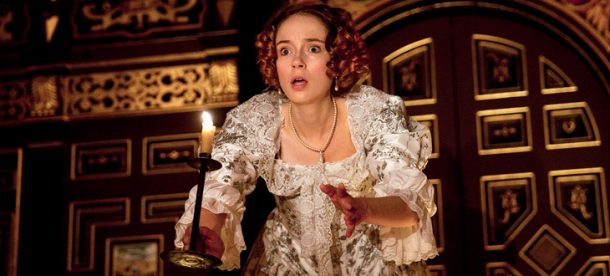


"Wherefore did nature powr her bounties forth
With such a full and unwithdrawing hand,
Covering the earth with odours, fruits, and flocks,
Thronging the seas with spawn innumerable,
But all to please and sate the curious taste?
And set to work millions of spinning worms
That in their green shops weave the smooth-hair'd silk
To deck her sons, and that no corner might
Be vacant of her plenty, in her own loyns
She hutch't th'all-worshipt ore and precious gems
To store her children with; etc....

To which the virtuous lady replies with:

Imposter, do not charge most innocent nature,
As if she would her children should be riotous
With her abundance...
 
Is it possible that there is not intellectual value in being exposed to this kind of concise, detailed, comprehensive and unique way of regarding the world and our existence on it? These are the kinds of arguments that would-be defenders of the humanities should be making and persuading people of the importance of if they want those studies to remain generally alive, that these kinds of studies do expand the mind, do expand thereon the collective richness and quality afoot in the common society. I don't know that even this will work on the general public, but someone at least ought to be able to put forth the argument confidently.


Wednesday, November 18, 2009

Tennyson--"Ulysses" (1842)

This is, or was until recently anyway, one of the central poems in the English tradition, read and known by every schoolchild. This is apparently one of Harold Bloom's favorite poems to claim as his own and break out in a recitation of in his public haranguings, but don't let that put you off. Harold will either be dead or too superannuated to maintain his current visibility and influence on the literary scene very soon, and the poem's greatness will long outlive his particular championing of it. I originally read and made comments on this poem on December 9, 1995. Looking over those comments I am astounded at the energy I previously had for reading. I still think it is a tremendous poem. My weary middle-aged take on it, perhaps speaking more of myself than the actual contemporary human condition, was: 'Man has become overwhelmed by his knowledge. He has overreached himself. These conceptions of human wholeness, oneness with life (i.e. in the poem) are striking. Saddening? We are moving ever away from this vision of ourselves.' I won't reproduce my entire 1995 report, though I did things like identify a symbolic meaning for nearly every image and adjective, and even note the aspects of the verbs, which sort of thing I can't be bothered with now, even assuming anybody would let me be bothered with it.

I will record a few of the observations I made on the poem in that former reading, which looks to me to have been at least as solid as anything I am likely to get out of it now.

Images of death ("By this still hearth, among these barren crags") linked to domesticity, homebodiness.

Feminine love is ultimate end (meaning death of vitality) for man.

His subjects live like animals, seem to have limited souls ("a savage race/That hoard, and sleep, and feed, and know not me.")

"Rest" ("I cannot rest from travel") is starvation, death.

Extremes of sensation felt often and simultaneously; trying to define what it means to say Ulysses is everyman, as is often said. But what does it mean? (2009--Ulysses was clearly never "everyman" except in the sense of being a culmination [i.e., not an average] of men collectively. He is almost as unlike the run of men as is it is possible to conceive of).

"Roaming" is a good metaphor for life.

"And drunk delight of battle with my peers". 3rd nourishment reference (l.16). Battle is delirious, 'ringing'; somehow proper for men.

Why is Troy 'windy'? Winds of time, timelessness perhaps?

"I am a part of all that I have met." I.e., in a greater way than most men.

ll. 19-21: "Yet all experience is an arch wherethrough
Gleams that untraveled world whose margin fades
Forever and forever when I move."

Arches bridge gaps and support weight. Does it fade only for him or for all men through him? This is a poetic crescendo. He did change human existence through his life and agency.

ll 22-3: "How dull it is to pause, to make an end,
To rust unburnished, not to shine in use!"

The end should not be made. Lofty ideal that man should gleam and shine. But only he can let himself tarnish. Use of course is a key word.

ll 24-5 "As though to breathe were life! Life piled on life
Were all too little..."

This may be the underlying sentiment behind all of advanced human civilization. Life in itself is as nothing, like a series of infinitessimals.

"Some three suns" (l.29) I miss the sense of.

ll 30-32: "And this gray spirit yearning in desire
To follow knowledge like a sinking star,
Beyond the utmost bound of human thought."

The spirit is gray because of the bounds in which human thought is restricted. Knowledge grows dimmer and dimmer, sinking away from land, life as it becomes more real.

On the stanza entrusting the island and scepter to Telemachus (ll. 33-43): How through (Telemachus's) worldly workmanship will he subdue them to the useful and the good? This labor is the greater part of man's work, but it is nonetheless not the work of the fully realized man. Therefore the overwhelming majority of men must remain essentially unrealized. Why 'blameless'? (l. 39--of Telemachus again) One who is 'centered' (l.39) cannot exactly move or escape the center. But man is not man because a because a few of his exceptional sorts are the center creating, not the circumscribed. (2009--I'm not exactly sure what I was trying to get at here.)

The sea is ever the unknown; even now when overlook (i.e., are largely unconscious of its enormous presence) it, it is the symbol of the (myriad) unknown we overlook (i.e., our ignorance).

Mariners are by nature not so domestic, societally-directed. Possess some glimpse onto otherworldliness. They were free because they welcomed what lay seemingly far outside themselves.

ll. 50-53: "Old age hath yet his honor and his toil.
Death closes all; but something ere the end,
Some work of noble note, may yet be done,
Not unbecoming men that strove with Gods."

Twin connection of glory and man's work. Only death can properly close a work. Whole passage very classical in view.

The last 15 lines have pretty obvious symbolism. Voices of the dead. The earth no longer as an utter limit in itself. Sunsets and baths being sailed beyond, the most distant voyages being made by the concentrated powers of the mind. The idea that heaven as well as earth can be moved (altered) by superior human acts is an interesting and old-fashioned one. Perhaps this is still possible in the common human perception. Since time and fate weaken him, a man need be robust of body and vigorous of mind to move heaven or earth in the slightest.

O.K., this is the other Ulysses, but I couldn't pass on the picture.

Thursday, January 04, 2007


Reading Update

I have been occupied for the past few weeks with a number of poems, which I will briefly comment on.

Tennyson-- "The Princess"

I generally look forward to Tennyson's coming up on my list. In his longer poems, he can be a little over-indulgent in his metaphors and romantic details, but his technique and sense of how the language works are so good that there is still much that is satisfying in them. "The Princess", a poem which our author clearly invested a significant amount of time and effort on in the prime years of his life, is not much remembered today except for the songs, especially "Tears, Idle Tears", which are inserted as breaks of comparative lightness from the main action. The plot, for those unfamiliar with this poem, centers around a castle where the women of a romanticized country have retreated to set up a university in order to pursue science and other learning and free themselves from the slavery of marriage, their leader being the gorgeous and fiery princess of the title, who was betrothed as an infant to the prince of a neighboring kingdom, who refuses to relinquish his prerogatives, foremost those of a prince but also those of a man, though he is partially sympathetic to the idea of the ladies being exposed to learning; unlike his more old-school father, who does not even try to fathom what is going on but simply lays siege to the castle with his army to put an end to the nonsense and ensure that the contract he made be fulfilled. In the end the men, their dominance and superiority challenged, hold firm, and demonstrate even to the princess that her proper place is ultimately in submission to a man worthy of ruling over her. One can only imagine how some feminist Phd students must have had a field day with this poem. In imagining the university of women in convocation our poet can only conceive of an ornate hall full of glittering pre-Raphaelite beauties in academic gowns trying to get their gorgeous glowing heads around philosophy and mathematics. No obesity, no frumpiness, no myopia, no slouching posture are to be found in this college. As for possible lesbians there are a few stout farmgirls who seem to serve primarily as the princess's security detail, and one bitter middle-aged woman who expresses feelings of betrayal by the same. There are some humorous details about the various statuary that is found all over the grounds, all of which commemorates the deeds of the most valiant and warlike women and goddesses recorded by antiquity, which parts are well done if a little precious and perhaps a little too amused by the idea of women founding and maintaining a glorious institution of learning.

In the song "Tears, Idle Tears" where he does not have to maintain a narrative but can declaim for twenty lines or so on a general, rather evanescent theme that he is equal to ("the days that are no more") his strengths are better displayed, as, probably are most poets'. To the sensibilities of our time the most striking thing about a work like "The Princess" is that the author either conceived or thought it necessary to render in quite richly and elaborately wrought verse. I don't think it would occur to anyone today, certainly not anyone with the slightest credentials as a poet, to write about such a subject. A novelist of some esteem might take it on but would probably fail due to an inability to understand free from irony. A middling professional-type writer could probably turn a sellable gothic/teen type book out of it, and then a good filmmaker given a $90 million budget and the most gorgeous 17 year old in Ontario to play the lead could make an iconic film that would live...well, it would live for a while, anyway. That is where the creative sensibility of the time seems to be. Not with poetry.

Coleridge--"Christabel"

Since I secretly like romances and old European forests and castles and princesses and dark winters and all of that I enjoyed reading this as an escape from my tedious yet incessantly tasking day to day life. That said, I couldn't really get into the poetry, which compared to Tennyson is rather stripped down, even blah. For example:

"But now unrobe yourself: for I
Must pray, ere yet in bed I lie."

or:

"And Christabel saw the lady's eye,
And nothing else saw she thereby,
Save the boss of the shield of Sir Leoline tall,
Which hung in a murky old niche in the wall."

This is not the sort of stuff that is going to impress your modern hard science/mathematical/ economist type of intellectuals who are unitiated in and skeptical of the wonders of poetry. Who cares, you say? Well, I think life would be more interesting if the rich heritage of our spoken and written languages were more widely shared and appreciated, especially among people whose superior intelligence is supposed to be their dominant quality (and it would likewise be good for myriad reasons if the wonders of science and mathematics were more widely understood as well). One of the most ridiculous spectacles of modern life is to be somewhere where everybody has a master's degree and no one has anything to talk about with anybody else (and believe me, I am the worst of the worst in this). In fact, in one such circle as this, of the three people who do the bulk of the talking, two of them actually never attended any college, and the 3rd, a very learned man who worked on the early Enniac computers and moved on to building pipe-organs, is 86 years old (people from that generation don't seem to suffer from this affliction).

Auden-"Musee des Beaux Arts"

Ahh, now we're talking. Really, is there anybody who does not love this poem? It matters little how much or how little of it we really understand. It is extremely satisfying. It is delivered just as if the poet were sitting with his intellectual companions, maybe even a woman, in the Grande Place after spending the afternoon with the Flemish Masters, perhaps some Trappist ale and a dish of frites moules set before him, expressing what we all wish to say in such company at such a moment. "About suffering they were never wrong, the Old Masters..." Of course, to be able to continue on for 21 lines at a leisurely, thoughtful pace uninterrupted in any company or public place is probably a dream, but that makes it no less a successful poem. The poet convinces me that a mature human being could have spoken these thoughts in this way to another mature human being, that the tidy flow of the lines constitutes an action, a scene of life.

Auden is anyway from that same generation as Powell, Greene, Orwell, Betjeman, Waugh, etc whose writing I always like so much. Their style of English is remarkably natural and unaffected; they know their language, they are comfortable in their possession of it, and they have confidence in it in turn to adequately convey anything important or worthwhile that they have to say in its most regular form. Now, is it poetry like the old poetry, like something the Elizabethans would write? No, it is a different beast in its spirit as well as its language, it has not the same capacity for immersing itself fully in the events, emotions, etc it describes. it is too intellectual, its critical eye is a little two well educated. This is a fault of most poetry that comes very late in the history of a language. The idea of the poem is a worthwhile one. At first I wondered if the 1930s interpretation of the painting (Bruegel's Fall of Icarus) was more pessimistic than the painter intended, but I later came to the conclusion that it was not.

William Carlos Williams--"Landscape with the Fall of Icarus"

Another poem on the same Bruegel painting. I am sure all my readers are familiar with it but maybe just for practice I ought to try to get it up here:

Oh dear, it's up at the top. And it's rather small. I will continue to practice with this.

I don't get this guy at all. It says in his biography in the Norton Anthology that his poetry looks easy until one tries to write like him (don't they say the same thing about Danielle Steele?) His voice, shall we say, has yet to come through to me. While I can hear and see Auden at the museum or at the table giving us his poem, or I can hear and see the poet and the scene even in a minimalist American poem like "We Real Cool", what Dr. Williams is conveying that I would not otherwise have had any sense of is not immediately apparent. His Icarus poem was written, it looks like, 24 years after Auden's, and seems to play with the same idea of human nonchalance towards the catastrophes and failures that beset their fellow men. The Auden poem was written by a 31-year old man in Europe in 1938, when the spectre of civilizational horror seemed to have loomed as an inevitability to every cognizant person, Williams's by a 79-year old man in New Jersey in 1962, which was certainly a much less existentially threatening environment, whatever dark secrets and hatreds its population may have been harboring. The production of the Williams poem does not speak with the authority of having great necessity or particular insight that I can see. Getting back to the point made by the anthologizers about the admiration by other poets of Williams's techniques, as someone who has tried to write novels, I have obviously come across many instances where the difficulty of what an author has succeeded in pulling off has perhaps impressed me more than other people reading the same books. Henry James, Joyce, Garcia Marquez, some of the things John Fowles did in The Magus come immediately to mind (note by the way how many experimental and self-consciously "innovative" writers, which in America has been held up as pretty much the supreme achievement to be attained in all the arts for a hundred years, are from countries that were colonies or otherwise far removed in space and ancestral memory from the home territory of their languages). People who attempt to paint or act or play music seriously obviously will be more likely to notice strokes of virtuosity and brilliance of conception in fellow practitioners of their arts than unpractised neophytes. However the appreciation of technique in itself is generally a secondary consideration which one examines as a result of the satisfaction one has received from the initial reading/performance, not in search of it (see the next poem). I am going to amuse myself by rearranging the lines of a couple of William Carlos Williams poems and see what happens, because his breaks of line and stanza do not make any obvious sense to me.

Forgive me there was
the icebox According to Brueghel
I have eaten the whole pageantry
and so cold concerned
the plums unsignificantly
saving when Icarus fell
you were probably near
that were in off the coast
and which his field
so sweet the wings' wax
for breakfast awake tingling
they were delicious it was spring
Icarus drowning
a farmer was ploughing
sweating in the sun
with itself
of the year was
the edge of the sea
this was
that melted
a splash quite unnoticed

Shakespeare--Sonnet 130 ("My mistress's are nothing like the sun", etc)

Obviously this is one of the master models by which, whether one likes it or not, English language poetry and the English poetic mind will always be defined and against which newer poets in this tradition--which we are as yet far from escaping and conquering, however dead the culture may be said to be--will ultimately be measured. When I say measured, I do not mean by the professional critics and university professors either, but by the poet's own intellect, which if he has any sensibility regarding his art, will always recognize the excellences and necessities of mind/spirit/mental composition, whatever, in its highest examples.

Since my understanding of poetry is generally poor, and since I always have some piece of it to read, you can expect to see me tackle it again sometime in the future; Shakespeare too, for the simple reason that most contemporary writing on Shakespeare is horrible, either presuming an unearned and too low intimacy with the man or setting him pointlessly far beyond any bounds of actual life, even in a college classroom or at the theater, where one should expect some accessibility to him. I apologize for the length and sloppiness of composition of this post.