This is supposed to be my monthly check-in, but once again I am going to use the occasion to try to finish something of a post I have been working on in one form or another for several months. I am always trying to figure out and write little commentaries on various of the issues that command the headlines and the passions of the rest of the populace, but being as it seems ever more self-absorbed I find that I don't care about most of these things very much one way or the other, apart from that almost everyone's position on these matters is about equally unsatisfactory to me. So I want to get at why I both don't have any strong opinion on most of these things, yet think everyone's else's opinions are unconvincing.
.
Guns! I've never had a gun nor had any experiences where I've regretted not having one, and I am nearly fifty years old and grew up in a time and in an area where violent crime rates were much higher than they are where I live now. Given current lifestyles and the number of children, and especially sons, that I have, the dangers of having any firearm in the home far outweigh those incurred by not having them. Likewise I am skeptical that there is a social good in allowing ordinary citizens to possess assault weapons that outweighs the unnecessary carnage that they inflict in these criminal types of mass shooting events. I am in general afraid of guns and other highly potent weapons and am attracted by the dream of a society that is effectively free of them. I am not however unswayed by the arguments that given their existence there is at least symbolically some imperative for men who would be free to have the capability and willingness to own and use them, and I don't like the idea of police and militaries being the only entities with access to these weapons, especially as they seem to be less and less responsive and subject to the will of the population than may have been the case formerly. I grant a personal handgun or rifle will not avail an individual man much against any kind of professional modern day force with a legal right to violence that has any determination to dominate him, however the symbolism of this right to self-defense and resistance has a sacred aspect to its adherents, a fervor that is no doubt exacerbated by the ongoing assaults on what is considered by many to be traditional masculinity. Many on the 'left' seem to consider the truth of this last assertion to be some combination of dubious, irrelevant, or pathetic, and perhaps it is, but since progressivism does not offer a particularly compelling vision of what it thinks manhood should consist of going forward and as it does not seem to recognize much in the way of limits where the transformation of the culture is concerned, it stands to reason that some portion of the population would gravitate towards guns as the point of resistance. Perhaps in the end the NRA and the pro-gun faction will be as deftly outmaneuvered as the forces of reaction have been in so many other arenas and will meekly submit in the face of progressive pressure without recourse to violent or dogged resistance. Something of the sort seems to have taken place in other countries, where surely some people must have relinquished their prerogative to bear arms with some reluctance...
Sexual Assault. I guess we have to say that whenever it happens it's really that bad, but is it really happening enough that colleges and other institutions have to adopt policies and take on attitudes that express a kind of blanket hostility towards heterosexual male behavior even when it is not explicitly sexual (my alma mater issued a statement on the subject recently which included issues like male domination of class discussion). It might be nice to hear some more input from women with a more positive experience of intersexual relations, which I believe there are some who exist; especially with regard to the college report, the place comes across as having been a total nightmare for women I guess since time immemorial, which is now to be corrected by enacting policies that at the very least operate under the assumption that men possessing even a hint of what used to be considered normal (non-criminal) masculine attitudes and behaviors are at their very best and most inadvertent potential problems that require strict governance. I don't think this can go on, at least in the sense that men are going to be willing forever onward to submit to the social position vis-a-vis their female peers that these kinds of policies impose on them. It's infantilizing and ridiculous, not the stands against actual assaults and rapes, obviously, but the seeming imperative to effectively neuter them and manage/dictate all interpersonal relations in what should be one of the most vital and expansive periods in life for those sorts of things
Immigration. I go back and forth on this one because I generally like the pro-immigrant people better than the anti-immigrant people, and they are so deliriously in favor of ever more immigration and virtual open borders. I don't really understand why they feel this way so strongly, however. In my heart of hearts in the past at least my wishes generally trended in favor of less rather than more. The population of foreign-born in the U.S. now is well over 10%, which is about the same level it was when policy became more restrictive in the 1920s. By the 1960s the percentage was under 5%, and indications were that livelier people at least thought day to day existence was getting a little stale at that level, though from my vantage point it doesn't seem like it was that terrible. I have no doubt that there are specific environments and times of life, especially at higher levels of intellectual and artistic ferment, where the interplay of global-class talent is truly exhilarating, but for more regular people cut off from these worlds so much change tends to be stressful and destabilizing and alienating, especially when direct emotional or material benefits from all the changes are hard to perceive. Clearly a lot of people are definitely at this last stage now.
Universities. I see repeated often the idea that the main purpose of a university is to challenge people to wake up from their complacency and make them uncomfortable. Perhaps this has become the case, though my impression was that their primary function was to impart knowledge and instruct students in the processes and approaches to thinking which are characteristic of the most intelligent minds. Perhaps this includes actual moral and political indoctrination, though the idea is that the acquisition of the habits and basic learning of a liberal arts education will provoke the student to examine all of his attitudes and proclivities in the comfort at least of knowing he has some of the tools to do a decent job of it. Even if it is incorrect, having one's worldview exposed and ripped to shreds as a kind of sport with the expectation that, stripped intellectually naked before the world, the student must either submit to the new worldview ready-provided for him by his teacher or slink away in a kind of exile and disgrace, which sounds to me to be what a lot of people mean by insisting they need to make people uncomfortable, does not seem like an especially effective way to educate an undergraduate.
Trump Chaos. It certainly seems like it must be very bad, but bear in mind people voted for this. The supposed competence of the Hilary Clintons and Mitt Romneys of the world, to be frank, has become a little terrifying to many people, who can see their lives in these kinds of expert hands being discovered to be not efficient or productive enough for the modern world and summarily disposed of. That said, the constant Trump chaos does seem like it must be really bad.

Showing posts with label manliness. Show all posts
Thursday, March 22, 2018
Thursday, June 26, 2014
Oliver Wendell Holmes--Elsie Venner (1861)
I have finally given up on trying to keep up a full record of all the books I read here. I had fallen more than five years behind, and of course had long forgotten what had happened in most of the books or what they were about. However I may periodically post something about whatever I happen to be reading off my 'A-List' at any given time (the B-list I write about at the Vacation blog). Currently this is the volume referenced in the title of this post, a 596 page Victorian novel, though as it is a very old [1887] edition, the number of words per page is actually not that great). I started it on June 5, and as of today (June 26) I have gotten to page 388. This is, for me, a pretty good pace.
Oliver Wendell Holmes, physician, poet, Harvard professor, coiner of the word "anesthesia", the term "Boston Brahmins", and all around best-selling author, along with his son, Oliver Wendell Holmes, Jr, the famed longtime Supreme Court Justice of the early 20th century (perhaps most famous nowadays for his "three generations of imbeciles is enough" statement in upholding a case of forced sterilization), were the most prominent members of one of the dominant American families of their age, and New England families of any age. Due to both father and son living long and active lives, their age lasted close to a century (Holmes, Jr, who died in 1935 at the age of 94, does not appear to have had any children. I am not sure whether the family lives on to this day or not). Holmes Senior's most famous book, The Autocratic of the Breakfast Table, was still prominent enough in the 1960s to make it onto my 'B' list. As I am reading those books in alphabetical order and am currently in the AGs, I should be getting to it within the next few years at least, and I cannot say that I am dreading it.
Elsie Venner is an odd book, not uninteresting, overwordy and padded in the typical Victorian style. It has an old New England setting, in a New England old, or young, enough to still be suggestive of 'wildness', presumably in contrast with the more ancient civilizations of Europe, that is of interest to me, as a longtime resident of this part of the country. When Holmes gets around to presenting actual scenes, and has his characters speak for themselves, the book is not so bad. But the introductions and descriptive passages, while typical for their time, are more noticeably so in their extravagance than in those authors contemporary to Holmes whose fame has carried through to our own. The chapter I am in now, for instance, is titled, "The Widow Rowens Gives a Tea Party". I am anticipating that the scene of the actual tea party will be entertaining enough; but at seven pages into the chapter we are still being introduced to the Widow Rowens, her mode of dress, her attitude towards remarriage, speculation on her ancestry, and so on, following several pages devoted to a recap of her late husband's military career and how his eye for a worthy horse carried over into a similar sense for women. It is also worth noting that while Holmes seems to have been devoted to American democracy and a believer in political equality, he was also acutely conscious of his personal superiority, and that of his class, to the mass of the population. While he does not harp on this to the point of overkill, it is a pretty consistent theme running through the book, and it comes up enough that he gets off some pretty driving sentences about the differences between the energetic, achieving, ruling portion of society and that occupied by lackluster slavish types.
The most famous part--probably the only famous part--of this book is on the very first page, in the second paragraph, in which Holmes describes "The Brahmin caste of New England", a passage that one still sees quoted sometimes even now, especially the part about how this class "gives parties where the persons who call them by the above title are not invited, and have a provokingly easy way of dressing, walking, talking, and nodding to people, as if they felt entirely at home, and would not be embarrassed in the least, if they met the Governor, or even the President of the United States, face to face." In the early chapters of the book and intermittently thereafter there is a first person narrator who, like Holmes, is a professor at Harvard, though he does not play any part in the main action of the story other than writing a recommendation for one of his favorite scholars that enables him to get a teaching job in an academy for teen-aged girls. The professor is the author of an as yet unpublished book about Anglo-American Anthropology in which the physical characteristics of the various types of that race are no doubt rigorously investigated. His pet student is like himself, obviously a specimen of the highest type of their kind, and the professor/Holmes writes with regard to him that "I have great confidence in young men who believe in themselves, and are accustomed to rely on their own resources from an early period. When a resolute young fellow steps up to the great bully, the World, and takes him boldly by the beard, he is often surprised to find it come off in his hand, and that it was only tied on to scare away timid adventurers".
Holmes's house on Beacon Street.
With regard to the approach of this superior type of man to marriage:
"By the time he was thirty, he would have knocked the social pawns out of the way, and be ready to challenge a wife from the row of great pieces in the background...I would not have him marry until he knew his level...remember that a young man, using large endowments wisely and fortunately, may put himself on a level with the highest in the land in ten brilliant years of spirited, unflagging labor." I think something like this is the arc your life is supposed to take after you graduate from St John's, if you have properly absorbed the course of study during your time there.
"Silas Peckham was a thorough Yankee, born on a windy part of the coast, and reared chiefly on salt-fish". I just thought this was funny.
"You cannot get together a hundred girls, taking them as they come, from the comfortable and affluent classes, probably anywhere, certainly not in New England, without seeing a good deal of beauty." Wow. I agree, but I don't think I've ever seen anyone else actually express this sentiment with regard to New England.
Speaking of New England beauty, the title character Elsie Venner finally appears on page 73, as a notable student at the girls' school. After which she promptly disappears again for another thirty or forty pages.
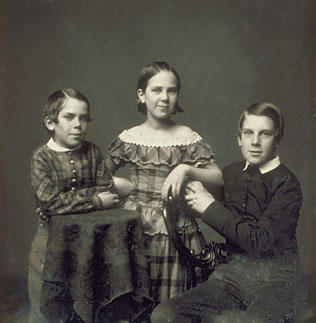
Holmes's children.
"...nothing but a gentleman is endurable in full dress." I know I would be considered one of the unendurables, but it is fun for me to imagine being able to laugh at people like myself in the absolute security of a superiority acknowledged on all sides.
Holmes refers to New Hampshire as a "queer sort of state", "in more than one sense the Switzerland of New England", and "naturally enough deficient in pudding-stone", which I take to refer to a lack of settlements large enough to have paved roads and sidewalks in comparison with Massachusetts.
Elsie Venner by the way is a ferocious and untamed girl whose condition is believed to be the result of her mother's having been bitten by a rattlesnake while pregnant. She dances wild Moorish fandangoes and sprawls on a tiger skin rug in her bedroom. This would be exciting stuff if it were going on in most New England villages now, but maybe it was not so unusual in 1860.
"The absolute tyranny of the human will over a noble and powerful beast develops the instinct of personal prevalence and dominion; so that horse-subduer and hero were almost synonymous in simpler times, and are closely related still." I do like this aspect of these old writers, that there was no mincing about on matters related to manhood and the necessity of mastery and domination over one's environment to attain a sense of fullness. This is what the education of boys should be directed to, and maybe still is at the highest reaches, if you can break through to those, it still is (and must be, because the naturally strongest will insist upon it).
I liked the comparison Holmes makes of a house to a seed-pod, its front door opening and projecting its young outwards in all directions. My house will probably take on something of this personality when the children grow up.
Elsie Venner has a wild cousin who grew up in Argentina (and who is also infatuated with her). Though he enjoys hanging out and riding on the Pampas with the native population there, at a certain point he yearns for New England and refers to his Argentinian companions as "degenerate mongrels" (it is humorous when it happens in the book).
"The clergyman, the physician, the teacher, must be paid; but each of them, if his duty be performed in the true spirit, can hardly help a shiver of disgust when money is counted out to him for administering the consolations of religion, for saving some precious life, for sowing the seeds of Christian civilization in young ingenuous souls." I laughed at this too, and wrote, 'where does this come from?', but I think there is something of sincerity in the sentiment, even though ordinarily Holmes was one of the greatest champions of'getting on in the world of his time. There is nonetheless a vulgarity in getting paid for doing truly noble things that I believe most noble men feel, and this is why aristocrats and certain deeply cultured people were so long loth to accept money in exchange for services. But it is hard to reconcile democratic society, the American version anyway, with the damnation of money.
"Elsie was naturally what they call a man-hater..." This sounds like a term people at the time would have used for people exhibiting lesbian tendencies. It is not really indicated that Elsie Venner is a lesbian so much that her sexuality and intelligence are of a more masculine quality, to the point that she is way too much woman for almost all of the ordinary mortal men with whom she comes into contact.
"Always handle any positively electrical body, whether it is charged with passion or power, with some non-conductor between you and it, not with your naked hands."
Referring to one of the harried teachers at the school: "Why does not somebody come and carry off this noble woman, waiting here all ready to make a man happy?" I have had similar thoughts about certain people, and the reminiscence of them made me happy. Not many people, mind you, but every few years you will run across someone fitting the description.
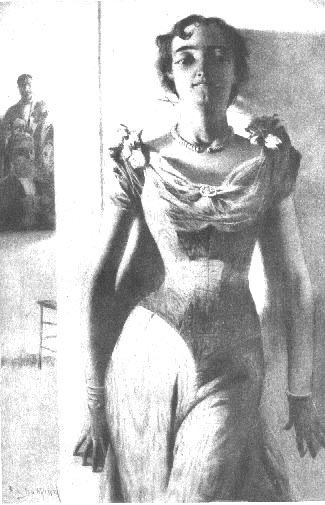
Helen is the woman who ought to be carried off to make some man happy.
"So it is that in all the quiet bays which indent the shores of the great ocean of thought, at every sinking wharf, we see moored the hulks and the razees of enslaved or half-enslaved intelligences." Now we getting back to what people like Holmes do very well, exposing the cold reality of the mental lives of the likes of me. Such as this:
"The magnificent constituency of mediocrities of which the world is made up,--the people without biographies, whose lives have made a clear solution in the fluid menstruum of time, instead of being precipitated in the opaque sediment of history--" What separates Holmes from other writers in this vein is that there is no sense with him of having been especially fortunate, or thoughts that the uninspired, servile life could ever have been his lot. No, the idea of himself existing in such a state, not being at the forefront of things, having dull thoughts and no ability to hold intelligent conversation, is unfathomable.
I have not finished the book yet, so I don't know how certain medical conditions are going to resolve themselves. While Holmes, the physician, admonishes amateur medical scholars, who were doubtless abundant in that age, and does it pretty well, it is curious that the main theme of his book seems to rest on a rather fantastic and dubious condition both of body and soul.
"He had entered that period which marks the decline of men who have ceased growing in knowledge and strength: from forty to fifty a man must move upward, or the natural falling off in the vigor of life will carry him rapidly downward." There is no letting up with Holmes.
"It takes too long to describe these scenes where a good deal of life is concentrated into a few silent seconds."
Oliver Wendell Holmes, physician, poet, Harvard professor, coiner of the word "anesthesia", the term "Boston Brahmins", and all around best-selling author, along with his son, Oliver Wendell Holmes, Jr, the famed longtime Supreme Court Justice of the early 20th century (perhaps most famous nowadays for his "three generations of imbeciles is enough" statement in upholding a case of forced sterilization), were the most prominent members of one of the dominant American families of their age, and New England families of any age. Due to both father and son living long and active lives, their age lasted close to a century (Holmes, Jr, who died in 1935 at the age of 94, does not appear to have had any children. I am not sure whether the family lives on to this day or not). Holmes Senior's most famous book, The Autocratic of the Breakfast Table, was still prominent enough in the 1960s to make it onto my 'B' list. As I am reading those books in alphabetical order and am currently in the AGs, I should be getting to it within the next few years at least, and I cannot say that I am dreading it.
Elsie Venner is an odd book, not uninteresting, overwordy and padded in the typical Victorian style. It has an old New England setting, in a New England old, or young, enough to still be suggestive of 'wildness', presumably in contrast with the more ancient civilizations of Europe, that is of interest to me, as a longtime resident of this part of the country. When Holmes gets around to presenting actual scenes, and has his characters speak for themselves, the book is not so bad. But the introductions and descriptive passages, while typical for their time, are more noticeably so in their extravagance than in those authors contemporary to Holmes whose fame has carried through to our own. The chapter I am in now, for instance, is titled, "The Widow Rowens Gives a Tea Party". I am anticipating that the scene of the actual tea party will be entertaining enough; but at seven pages into the chapter we are still being introduced to the Widow Rowens, her mode of dress, her attitude towards remarriage, speculation on her ancestry, and so on, following several pages devoted to a recap of her late husband's military career and how his eye for a worthy horse carried over into a similar sense for women. It is also worth noting that while Holmes seems to have been devoted to American democracy and a believer in political equality, he was also acutely conscious of his personal superiority, and that of his class, to the mass of the population. While he does not harp on this to the point of overkill, it is a pretty consistent theme running through the book, and it comes up enough that he gets off some pretty driving sentences about the differences between the energetic, achieving, ruling portion of society and that occupied by lackluster slavish types.
The most famous part--probably the only famous part--of this book is on the very first page, in the second paragraph, in which Holmes describes "The Brahmin caste of New England", a passage that one still sees quoted sometimes even now, especially the part about how this class "gives parties where the persons who call them by the above title are not invited, and have a provokingly easy way of dressing, walking, talking, and nodding to people, as if they felt entirely at home, and would not be embarrassed in the least, if they met the Governor, or even the President of the United States, face to face." In the early chapters of the book and intermittently thereafter there is a first person narrator who, like Holmes, is a professor at Harvard, though he does not play any part in the main action of the story other than writing a recommendation for one of his favorite scholars that enables him to get a teaching job in an academy for teen-aged girls. The professor is the author of an as yet unpublished book about Anglo-American Anthropology in which the physical characteristics of the various types of that race are no doubt rigorously investigated. His pet student is like himself, obviously a specimen of the highest type of their kind, and the professor/Holmes writes with regard to him that "I have great confidence in young men who believe in themselves, and are accustomed to rely on their own resources from an early period. When a resolute young fellow steps up to the great bully, the World, and takes him boldly by the beard, he is often surprised to find it come off in his hand, and that it was only tied on to scare away timid adventurers".
Holmes's house on Beacon Street.
With regard to the approach of this superior type of man to marriage:
"By the time he was thirty, he would have knocked the social pawns out of the way, and be ready to challenge a wife from the row of great pieces in the background...I would not have him marry until he knew his level...remember that a young man, using large endowments wisely and fortunately, may put himself on a level with the highest in the land in ten brilliant years of spirited, unflagging labor." I think something like this is the arc your life is supposed to take after you graduate from St John's, if you have properly absorbed the course of study during your time there.
"Silas Peckham was a thorough Yankee, born on a windy part of the coast, and reared chiefly on salt-fish". I just thought this was funny.
"You cannot get together a hundred girls, taking them as they come, from the comfortable and affluent classes, probably anywhere, certainly not in New England, without seeing a good deal of beauty." Wow. I agree, but I don't think I've ever seen anyone else actually express this sentiment with regard to New England.
Speaking of New England beauty, the title character Elsie Venner finally appears on page 73, as a notable student at the girls' school. After which she promptly disappears again for another thirty or forty pages.
Holmes's children.
"...nothing but a gentleman is endurable in full dress." I know I would be considered one of the unendurables, but it is fun for me to imagine being able to laugh at people like myself in the absolute security of a superiority acknowledged on all sides.
Holmes refers to New Hampshire as a "queer sort of state", "in more than one sense the Switzerland of New England", and "naturally enough deficient in pudding-stone", which I take to refer to a lack of settlements large enough to have paved roads and sidewalks in comparison with Massachusetts.
Elsie Venner by the way is a ferocious and untamed girl whose condition is believed to be the result of her mother's having been bitten by a rattlesnake while pregnant. She dances wild Moorish fandangoes and sprawls on a tiger skin rug in her bedroom. This would be exciting stuff if it were going on in most New England villages now, but maybe it was not so unusual in 1860.
"The absolute tyranny of the human will over a noble and powerful beast develops the instinct of personal prevalence and dominion; so that horse-subduer and hero were almost synonymous in simpler times, and are closely related still." I do like this aspect of these old writers, that there was no mincing about on matters related to manhood and the necessity of mastery and domination over one's environment to attain a sense of fullness. This is what the education of boys should be directed to, and maybe still is at the highest reaches, if you can break through to those, it still is (and must be, because the naturally strongest will insist upon it).
I liked the comparison Holmes makes of a house to a seed-pod, its front door opening and projecting its young outwards in all directions. My house will probably take on something of this personality when the children grow up.
Elsie Venner has a wild cousin who grew up in Argentina (and who is also infatuated with her). Though he enjoys hanging out and riding on the Pampas with the native population there, at a certain point he yearns for New England and refers to his Argentinian companions as "degenerate mongrels" (it is humorous when it happens in the book).
"The clergyman, the physician, the teacher, must be paid; but each of them, if his duty be performed in the true spirit, can hardly help a shiver of disgust when money is counted out to him for administering the consolations of religion, for saving some precious life, for sowing the seeds of Christian civilization in young ingenuous souls." I laughed at this too, and wrote, 'where does this come from?', but I think there is something of sincerity in the sentiment, even though ordinarily Holmes was one of the greatest champions of'getting on in the world of his time. There is nonetheless a vulgarity in getting paid for doing truly noble things that I believe most noble men feel, and this is why aristocrats and certain deeply cultured people were so long loth to accept money in exchange for services. But it is hard to reconcile democratic society, the American version anyway, with the damnation of money.
"Elsie was naturally what they call a man-hater..." This sounds like a term people at the time would have used for people exhibiting lesbian tendencies. It is not really indicated that Elsie Venner is a lesbian so much that her sexuality and intelligence are of a more masculine quality, to the point that she is way too much woman for almost all of the ordinary mortal men with whom she comes into contact.
"Always handle any positively electrical body, whether it is charged with passion or power, with some non-conductor between you and it, not with your naked hands."
Referring to one of the harried teachers at the school: "Why does not somebody come and carry off this noble woman, waiting here all ready to make a man happy?" I have had similar thoughts about certain people, and the reminiscence of them made me happy. Not many people, mind you, but every few years you will run across someone fitting the description.
Helen is the woman who ought to be carried off to make some man happy.
"So it is that in all the quiet bays which indent the shores of the great ocean of thought, at every sinking wharf, we see moored the hulks and the razees of enslaved or half-enslaved intelligences." Now we getting back to what people like Holmes do very well, exposing the cold reality of the mental lives of the likes of me. Such as this:
"The magnificent constituency of mediocrities of which the world is made up,--the people without biographies, whose lives have made a clear solution in the fluid menstruum of time, instead of being precipitated in the opaque sediment of history--" What separates Holmes from other writers in this vein is that there is no sense with him of having been especially fortunate, or thoughts that the uninspired, servile life could ever have been his lot. No, the idea of himself existing in such a state, not being at the forefront of things, having dull thoughts and no ability to hold intelligent conversation, is unfathomable.
I have not finished the book yet, so I don't know how certain medical conditions are going to resolve themselves. While Holmes, the physician, admonishes amateur medical scholars, who were doubtless abundant in that age, and does it pretty well, it is curious that the main theme of his book seems to rest on a rather fantastic and dubious condition both of body and soul.
"He had entered that period which marks the decline of men who have ceased growing in knowledge and strength: from forty to fifty a man must move upward, or the natural falling off in the vigor of life will carry him rapidly downward." There is no letting up with Holmes.
"It takes too long to describe these scenes where a good deal of life is concentrated into a few silent seconds."
Friday, February 15, 2013
Deep Adulthood (Warning: Major Midlife Crisis Post)
It took a while, but most people my age seem within the last couple of years--around attaining the age of 40--to have finally entered the realm of consciousness that impresses itself on me as Deep Adulthood. In certain of these instances such frivolities and other immature tendencies as may have lingered into the middle and even later thirties have all of a sudden, if not disappeared, become far less pronounced or significant as characteristics than they were formerly. This effect is most pronounced in women who both work and have children and men who have very serious jobs, though it is discernible in most people who occupy a position in which a plausible degree of responsibility for the maintenance and functioning of society is implied.
Needless to say I have not attained, as an overall character, to this state of being. I might not even have noticed this if my circumstances frequently put me in social settings with other middle-aged child-men or women, but they do not, and my complete inability to sit with the grown-ups and talk about the business/ career landscape, real estate and home maintenance, the various abilities and excellences and successes I am inculcating and spurring in my children, and the like, is becoming even more conspicuous than it already was. In my formative years I doggedly dedicated myself to avoiding most of the experiences and challenges that lead people to this character in middle age, both because I lacked the wherewithal at the time to begin combating with them effectively, and also because I was certain I was 'above' needing to cultivate such qualities. This is how such people as I am, who intuitively seem inexplicable, can come to exist.
(My 'b' and 'm' keys are sticking, so that hitting 'b' usually either results in nothing or 'bbbb' and I have to go back and make a correction in either case. This is also causing me to be extra irritable).
For educational purposes, the following are some the major avoidances I made in the past to arrive at my present state:
1. Failure to assert any positive or strong character in my natural/childhood family (i.e., parents, siblings and other near blood relatives). I have opted instead since the age of 16 on to keep distant from them as much as possible. The problem is not that I did this, but that it originated out of a consciousness of weakness and inability to thrive in my native surroundings rather than strength or superiority. I thought that over time events would mitigate this impression of weakness and reveal the truth to have been, if not other than this, than at least more complicated than what it seemed. But this has not occurred. Probably it never does.
2. Resisting all training and other practical education. I don't know why I could never commit to this or focus in on anything I might be able to do. I don't want to give the lie that I was any kind of swaggering rebel, but it is true that I never ingratiated myself with my teachers and bosses or anybody else likely to be a mentor because I was lazy, sullen, lacked personable qualities, and had nothing interesting to say to anybody. Consequently I had no leads to getting on any kind of interesting career track. Obviously I was warned about this, but it made little impression on me, or I interpreted it as somehow hostile to my amour-propre. It is true that the options usually presented to me as realistic were never very appealing, so it was easier to brush them aside.
3. Avoidance/inability of dealing with competent/demanding men. This is probably the biggest and most damning one. In my 20s I was so ill-equipped, and even ashamed, to contend with serious men, especially where the work world was concerned that I evidently decided that I just couldn't do it at the time--because I was an artist, or something--took a job where essentially everyone else was female, and figured I could work through my issues by reading more, or something. This problem never quite resolved itself, though various developments seem to have worked somewhat in my favor to enable me in the ensuing years to pass as not quite so obviously execrable. First, and this is no small matter, the dramatic, and frankly shocking, increase in sad-sack males in the population since 1997 has made everyone who is not utterly wretched look less bad than they in fact are. Similarly, the ongoing recession and employment crisis since 2008 have I think made most people, men in particular, somewhat more forgiving of people in low and unexciting professions, especially if these have been able to stay off public assistance, primarily due to terror that they (the judgers) could find themselves in a similar position. Also my wife and children give me a certain amount of credibility as a real person that I lacked as a 25 year old. I could probably handle the screaming and cursing and personal criticism of a more manly work environment better now than I could have then; but I still don't have any of the kind of hard skills that would make other men like me, or that would allow me to ever rise much above the bottom of the organization. The main appeal I can make at this point is something like, 'I've proven over time that I'm not a complete fuckup,' which is at least more than I could have persuasively said 20 years ago.
I was going to tell a couple of stories to illustrate where mistakes were made in developing my character but they are rather involved and I am on the eighth day of this post and need to wrap it up tonight so I am going to skip them.
4. There is a scene in The Best Years of Our Lives which as I grow older becomes much more damning and devastating to me. Peggy (Teresa Wright, the dead actress that I have a crush on almost as if she were a real person), is defending the guy she's in love with, Fred (played by Dana Andrews), who at the time is working as a soda jerk at the drug store, saying something like (I can't find either a video or transcript of the scene right offhand) "He won't be satisfied with working at the soda fountain all his life' delivered with the unstated but utter assurance that of course she would never tolerate such low ambition, and that Fred surely knows and expects this. It actually is hard for me to watch this scene now. Of course we don't know how the future plays out in the movie, nor, it should be added, did the filmmakers know that in 1946. However, now that we have nearly 70 years of intervening American social and economic history to guide us, I think we can safely project that: I. Peggy will be a good wife. II. Assuming Fred does not become an abusive alcoholic who becomes incapable of holding a job, enough opportunities should be opening up within a few years that he should easily be able to support a family and raise his social status, make his wife proud and maybe even earn the respect of his in-laws. He has a chance anyway.
Seeing as it's Valentine's Day, I think I ought to send out a few Valentines:
Oh, Dianne. You are slaying me, girl. The Lennon Sisters might not be Tiger Mother types when it comes to academic prowess, but I bet they don't have much tolerance for blatant underachievement either. Especially Dianne.
Eyds.
Yes, you too.
Sybil Seely!
And Sybil Seely taking a bath! Oh my God.
Friday, September 14, 2012
You Don't Even Want to Know What This Post is About
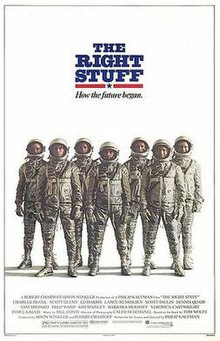
The Right Stuff (1983)
I had not seen this previously. I confess to finding it passably entertaining. Americans in the pursuit of grand and heroic achievements. For an almost 30 year old movie, it looks as though it could have come out last week, which suggests that it has been more influential than is usually acknowledged. Its narrative language, its fastidious concern with clothing and interior design, its reliance on cultural iconography, its attitude towards history, that is with fitting characters within the historical framework rather than having the historical setting serving as a background or added interest, are in line with what is still prevalent today. Its stylized depiction of the 50s is very much the same 50s we have all come to know and love over the intervening thirty years, though it is a departure from the usual way that decade had been presented theretofore. This has doubtless been a reflection of the prevalent zeitgeist, which is often skeptical of the possibility of autonomy and is obsessed with institutional power, media manipulation, the engines of bureaucracy and the like.
The early astronauts, it is noted in passing in the film, for all their remarkable efforts and sacrifices and risks, were not paid anything beyond their normal modest military salaries. Nor does it seem to have been much of an issue.
I've never read the book by the famous author Tom Wolfe, nor any of his other books. He is considered a great, or at least important writer by some people--with himself, it seems, often occupying the vanguard of this faction--though the official intelligentsia does its best to tamper any encroachment of this strident enthusiasm into those areas of literary taste over which it wields the most influence. Excerpts from Wolfe's books and interviews frequently appear in the popular press. He does come across to me as more pleased with himself than most of his purported insights, satire, iconoclasm, and so forth, would merit. I know he has been industrious and successful, and that cannot be taken away from him.Still, he does strike me as for the most part tiresome and not particularly revelatory. Given the theme of the movie I was anticipating a more obnoxious, in-your-face brand of machismo to be ascendant in it, but for the most part the swagger was depicted as contributing to healthy competition among men of near equal strength in the pursuit of noble ends, which even I do not have a problem with. Any such totally inferior contenders as were destroyed, dismissed and humiliated in the course of this process were left out of the film; I think this was for the best.
There was a actress in this I took a liking to, named Pamela Reed--that's a kind of name I like too--who played one of the wives. I think she has been in a lot of TV-movie type things over the years. I don't like any of the photographs of her that I could put up here though. She may be one of those people who looks better in motion.
My sixth-grade teacher claimed to be Chuck Yeager's cousin. This is not apropos of anything, since I don't know how tight their connection was or what, if any, similar qualities she benefited from. She was kind of the tough old broad type, and she did not favor me, as most of my early teachers did, so I did not like her. Obviously, seeing that Chuck Yeager was her cousin, she could probably tell I was not made of the good sort of stuff that the film celebrates. Alan Shepard, the first American in space, was from New Hampshire, though that is not mentioned in the movie. I only note this because it is very unusual for anybody born and bred in New Hampshire (or Maine, or Vermont), to attain elite status in any nationally or internationally hypercompetitive field, especially one involving any extreme degree of physicality. (Chuck Yeager was from West Virginia, which is also, nowadays at least, an unusual place of origin for world class talent.)
Entre Nous (1983)
Written and directed by a woman (Diane Kurys), and based on her own memoir, about a pair of friends who reject the stifling bourgeois life of 1950s France which, as artists are fond of reminding us, was a pretty staid and rigid period in that country's social history, in contrast with our usual image of a land awash in sophisticated and hedonistic intrigue from one end to the other. This started well, and for the first half I thought we might be getting somewhere interesting, but I didn't like how the movie played out. The Isabelle Huppert character and that of her husband I did not think developed in a way consistent with what I came to expect through the first half of the movie. The husband especially got an unnecessarily bad rap. It is perhaps true that she never loved him, though it is not clear to me why she should never have liked him, or felt any loyalty to him. The presentation of him is that he is not especially cultured or sensitive, but he is not a weakling. He runs a prosperous business--a garage, which I guess has prolish connotations, which obviously we are intended to feel sympathy with his put upon wife about. He is very personable socially, and can get along with other men. He is certainly a doting father by the standards of 1950s France that I have heard about. He also by marrying her in the first place saved her from going to Auschwitz--granted they did not know each other and he doubtless only made the offer because he found her pretty. But her character as developed was not especially dynamic or so blatantly superior to his that one felt she had a good reason for abandoning him and breaking up their family to take up with her unstable female artist friend. Also the Isabelle Huppert husband character begins to act in violent and inappropriate ways, presumably to show she is justified in leaving him, which are however completely inconsistent with everything else we are shown about this man in the movie. So in my opinion there is that weakness in it.
Chariots of Fire (1981)
Perhaps the ultimate false nostalgia movie, though I do love it. I am going to give it its own post to sort out all the middlebrow traps I know are coming at me from the beginning of the picture, and my powerlessness to avoid falling into them.
Jaws (1975)
I had never seen Jaws until the other day, because I am a wuss and I didn't want to be scared. I grew up well acquainted with the tales of theatergoers having to run out into the lobby and vomit during the middle of the film and of grown men who were terrified to climb into bathtubs for several years after seeing the movie and my reaction was always, Do I need this in my life? Thus I was disheartened when this legendary film turned up on my list. As I plowed inexorably back towards the 70s I began to dread its approach. Finally it arrived in the mail. My wife assured me there was no pressing need for me to watch this movie. Yes, but the sanctity of my system...and also the experts it seemed had slowly begun, in recent years, to treat it not merely as a historically important summer blockbuster but worthy of respect as a work of art. The New Yorker just published such a piece within the last few weeks. My trusty video guide had rated it 5 stars. Everybody and his grandmother has seen it twenty times, and it was even, to my admitted astonishment, rated PG, so how bad could it possibly be? Everything seemed to be indicating that I ought to see it. I was ready.
The good news was that it was not as terrifying as I expected. Obviously we have become accustomed to much higher degrees of gruesomeness since 1975. Most of the scariness comes from the anticipation of something about to happen in an alarming, terrifying and unforeseeable way that however does not come about most of the time; this is I think a trademark technique of Steven Spielberg's, though in middle age I find it rather tiresome.
The promotion of this as a great movie is a stretch. There is nothing about it that I can discern that would be interesting to a intelligent person above the age of about twelve, and there aren't even any pretty girls in it, though the main character's (too little seen) wife is decidedly MILFy in the best way. The recent critical reassessments in the direction of greater praise strike me as similar to the arguments put forth for A Hard Day's Night being in fact underrated as work of cinema. Both of these films were monuments of popular culture, made a lot of people in the entertainment industry rich on a scale that evidently is difficult to duplicate, emotionally if not in terms of strict cold finance, nowadays, they remind both writers and Hollywood players of a certain age of the golden years of life, when work was joyous, the world overflowed with 19 year old white girls in memory more beautiful and gettable than what it offers now, substance abuse was socially acceptable anyplace anybody would want to be, art mattered, money was not the be all and end all of every aspect of existence...but let's not get carried away. Also the mechanical shark, which Spielberg and other people have admitted they never achieved perfect mastery, looks really fake. All my swaggering aside, had I seen the movie as a 16 year old in the summer of '75, I'm sure I would have screamed in terror and run out of the theater with my high cut shorts soaked through, and guaranteed myself at least two more long years without getting a sniff of the wild 70s free love raging all around me, putting all my hope into College...
Baby Boomer Magic Moments: Besides the opening scene where a top-heavy blonde at a beach party spontaneously flings all her clothes off while running into the ocean, the big one of course is at the end when the World War II vet and survivor of the USS Indianapolis disaster who has spent his entire life dedicated to killing animals on the water gets his comeuppance for mocking Richard Dreyfuss's Phd by becoming Jaws's last meal. I'm going to cut them a little slack on this one, because the old salt also brought up the soft hands issue, which was a particular obsession of grandfather and numerous other old guys of his generation, where they would disparage the feminine hands of the younger men because of course they had not spent any good number of years, or not enough, doing manual labor to have that coarse effect. To me as a 10-year old I was anxious about growing up to have womanly hands though I was also anxious about there being an expectation I should be spending a considerable part of my youth slaving away on a farm or in some industrial place, because of course I did not really want to do that; but if you were 30 and had to listen to old guys constantly passing commentaries about the manliness of your hands, it must have been annoying as hell. In my grandfather's case, and that of most of his friends, while many of them grew up on farms and were in World War II, after they were about 23 they all worked in offices and lived the suburban lifestyle themselves. But I guess they still had their hands to prove that they had been serious men once, and you didn't. Anyway, having rough hands doesn't seem to confer much status in current society; at least I never hear anyone bringing it up anymore.
I had not seen this previously. I confess to finding it passably entertaining. Americans in the pursuit of grand and heroic achievements. For an almost 30 year old movie, it looks as though it could have come out last week, which suggests that it has been more influential than is usually acknowledged. Its narrative language, its fastidious concern with clothing and interior design, its reliance on cultural iconography, its attitude towards history, that is with fitting characters within the historical framework rather than having the historical setting serving as a background or added interest, are in line with what is still prevalent today. Its stylized depiction of the 50s is very much the same 50s we have all come to know and love over the intervening thirty years, though it is a departure from the usual way that decade had been presented theretofore. This has doubtless been a reflection of the prevalent zeitgeist, which is often skeptical of the possibility of autonomy and is obsessed with institutional power, media manipulation, the engines of bureaucracy and the like.
The early astronauts, it is noted in passing in the film, for all their remarkable efforts and sacrifices and risks, were not paid anything beyond their normal modest military salaries. Nor does it seem to have been much of an issue.
I've never read the book by the famous author Tom Wolfe, nor any of his other books. He is considered a great, or at least important writer by some people--with himself, it seems, often occupying the vanguard of this faction--though the official intelligentsia does its best to tamper any encroachment of this strident enthusiasm into those areas of literary taste over which it wields the most influence. Excerpts from Wolfe's books and interviews frequently appear in the popular press. He does come across to me as more pleased with himself than most of his purported insights, satire, iconoclasm, and so forth, would merit. I know he has been industrious and successful, and that cannot be taken away from him.Still, he does strike me as for the most part tiresome and not particularly revelatory. Given the theme of the movie I was anticipating a more obnoxious, in-your-face brand of machismo to be ascendant in it, but for the most part the swagger was depicted as contributing to healthy competition among men of near equal strength in the pursuit of noble ends, which even I do not have a problem with. Any such totally inferior contenders as were destroyed, dismissed and humiliated in the course of this process were left out of the film; I think this was for the best.
There was a actress in this I took a liking to, named Pamela Reed--that's a kind of name I like too--who played one of the wives. I think she has been in a lot of TV-movie type things over the years. I don't like any of the photographs of her that I could put up here though. She may be one of those people who looks better in motion.
My sixth-grade teacher claimed to be Chuck Yeager's cousin. This is not apropos of anything, since I don't know how tight their connection was or what, if any, similar qualities she benefited from. She was kind of the tough old broad type, and she did not favor me, as most of my early teachers did, so I did not like her. Obviously, seeing that Chuck Yeager was her cousin, she could probably tell I was not made of the good sort of stuff that the film celebrates. Alan Shepard, the first American in space, was from New Hampshire, though that is not mentioned in the movie. I only note this because it is very unusual for anybody born and bred in New Hampshire (or Maine, or Vermont), to attain elite status in any nationally or internationally hypercompetitive field, especially one involving any extreme degree of physicality. (Chuck Yeager was from West Virginia, which is also, nowadays at least, an unusual place of origin for world class talent.)
Entre Nous (1983)
Written and directed by a woman (Diane Kurys), and based on her own memoir, about a pair of friends who reject the stifling bourgeois life of 1950s France which, as artists are fond of reminding us, was a pretty staid and rigid period in that country's social history, in contrast with our usual image of a land awash in sophisticated and hedonistic intrigue from one end to the other. This started well, and for the first half I thought we might be getting somewhere interesting, but I didn't like how the movie played out. The Isabelle Huppert character and that of her husband I did not think developed in a way consistent with what I came to expect through the first half of the movie. The husband especially got an unnecessarily bad rap. It is perhaps true that she never loved him, though it is not clear to me why she should never have liked him, or felt any loyalty to him. The presentation of him is that he is not especially cultured or sensitive, but he is not a weakling. He runs a prosperous business--a garage, which I guess has prolish connotations, which obviously we are intended to feel sympathy with his put upon wife about. He is very personable socially, and can get along with other men. He is certainly a doting father by the standards of 1950s France that I have heard about. He also by marrying her in the first place saved her from going to Auschwitz--granted they did not know each other and he doubtless only made the offer because he found her pretty. But her character as developed was not especially dynamic or so blatantly superior to his that one felt she had a good reason for abandoning him and breaking up their family to take up with her unstable female artist friend. Also the Isabelle Huppert husband character begins to act in violent and inappropriate ways, presumably to show she is justified in leaving him, which are however completely inconsistent with everything else we are shown about this man in the movie. So in my opinion there is that weakness in it.
Chariots of Fire (1981)
Perhaps the ultimate false nostalgia movie, though I do love it. I am going to give it its own post to sort out all the middlebrow traps I know are coming at me from the beginning of the picture, and my powerlessness to avoid falling into them.
Jaws (1975)
I had never seen Jaws until the other day, because I am a wuss and I didn't want to be scared. I grew up well acquainted with the tales of theatergoers having to run out into the lobby and vomit during the middle of the film and of grown men who were terrified to climb into bathtubs for several years after seeing the movie and my reaction was always, Do I need this in my life? Thus I was disheartened when this legendary film turned up on my list. As I plowed inexorably back towards the 70s I began to dread its approach. Finally it arrived in the mail. My wife assured me there was no pressing need for me to watch this movie. Yes, but the sanctity of my system...and also the experts it seemed had slowly begun, in recent years, to treat it not merely as a historically important summer blockbuster but worthy of respect as a work of art. The New Yorker just published such a piece within the last few weeks. My trusty video guide had rated it 5 stars. Everybody and his grandmother has seen it twenty times, and it was even, to my admitted astonishment, rated PG, so how bad could it possibly be? Everything seemed to be indicating that I ought to see it. I was ready.
The good news was that it was not as terrifying as I expected. Obviously we have become accustomed to much higher degrees of gruesomeness since 1975. Most of the scariness comes from the anticipation of something about to happen in an alarming, terrifying and unforeseeable way that however does not come about most of the time; this is I think a trademark technique of Steven Spielberg's, though in middle age I find it rather tiresome.
The promotion of this as a great movie is a stretch. There is nothing about it that I can discern that would be interesting to a intelligent person above the age of about twelve, and there aren't even any pretty girls in it, though the main character's (too little seen) wife is decidedly MILFy in the best way. The recent critical reassessments in the direction of greater praise strike me as similar to the arguments put forth for A Hard Day's Night being in fact underrated as work of cinema. Both of these films were monuments of popular culture, made a lot of people in the entertainment industry rich on a scale that evidently is difficult to duplicate, emotionally if not in terms of strict cold finance, nowadays, they remind both writers and Hollywood players of a certain age of the golden years of life, when work was joyous, the world overflowed with 19 year old white girls in memory more beautiful and gettable than what it offers now, substance abuse was socially acceptable anyplace anybody would want to be, art mattered, money was not the be all and end all of every aspect of existence...but let's not get carried away. Also the mechanical shark, which Spielberg and other people have admitted they never achieved perfect mastery, looks really fake. All my swaggering aside, had I seen the movie as a 16 year old in the summer of '75, I'm sure I would have screamed in terror and run out of the theater with my high cut shorts soaked through, and guaranteed myself at least two more long years without getting a sniff of the wild 70s free love raging all around me, putting all my hope into College...
Baby Boomer Magic Moments: Besides the opening scene where a top-heavy blonde at a beach party spontaneously flings all her clothes off while running into the ocean, the big one of course is at the end when the World War II vet and survivor of the USS Indianapolis disaster who has spent his entire life dedicated to killing animals on the water gets his comeuppance for mocking Richard Dreyfuss's Phd by becoming Jaws's last meal. I'm going to cut them a little slack on this one, because the old salt also brought up the soft hands issue, which was a particular obsession of grandfather and numerous other old guys of his generation, where they would disparage the feminine hands of the younger men because of course they had not spent any good number of years, or not enough, doing manual labor to have that coarse effect. To me as a 10-year old I was anxious about growing up to have womanly hands though I was also anxious about there being an expectation I should be spending a considerable part of my youth slaving away on a farm or in some industrial place, because of course I did not really want to do that; but if you were 30 and had to listen to old guys constantly passing commentaries about the manliness of your hands, it must have been annoying as hell. In my grandfather's case, and that of most of his friends, while many of them grew up on farms and were in World War II, after they were about 23 they all worked in offices and lived the suburban lifestyle themselves. But I guess they still had their hands to prove that they had been serious men once, and you didn't. Anyway, having rough hands doesn't seem to confer much status in current society; at least I never hear anyone bringing it up anymore.
Monday, April 11, 2011
More (Hopefully) Brief Observations on the Current Scene/////
There is some problem with this website where my paragraph divisions are not always being saved or honored or what have you and I cannot figure out why. So in case it doesn't work the slanting lines represent where paragraph breaks are supposed to be./////
I spent a not insignificant part of my day today trying to remember the word "corroborate". This sort of thing happens all the time now. This incident ended happily in that the word came to me about 30 minutes after I gave up trying to think of it, but increasingly that which I am looking for, often so far even having a sense of its syllabic and musical relation to the other words I intend to use it with, does not come. I seem to be reverting, as most people seem to as they age, to only really possessing the vocabulary I had when I was 14, which is about the time I set out consciously to improve it. Evidently you can improve it somewhat during your late teens and twenties for the sake of establishing your place in life, but then around 35, being, like physical attractiveness, presumably no longer needed, it begins to atrophy./////
Before I go on I thought I should address an objection which sometimes is brought up when taxation of the wealthy is under discussion, that being the global society argument, wherein I am (hypothetically) asked if I would be willing to see my own standard of living suffer to redistribute wealth to the masses of the third world, and, if not, how that is any different from the situation the Forbes 400 is in in relation to me. I of course have not yet assimilated fully to the globalist outlook that the people out on the frontiers of current thought and perception move in so easily, so this is to me like the argument that even though I live in a region of the world where the number of children under 18 is declining considerably (N.H-Maine-Vermont-Massachusetts-Upstate N.Y.; if you throw in Quebec and the Canadian Maritimes which adjoin these states the decline is even more dramatic, and over an enormous expanse of territory) I should have myself refrained from having more than one preferably, and more than two absolutely, because in Yemen and Niger the birth rate is still around 8 children per woman and the resources are not present there to support them all. Regarding the original question however, while I would not be willing to adjust my standard of living to slums of Rio levels, I would certainly be able to live, and it could be argued that I have lived, easily enough at a considerably lower level of material consumption, as could many Americans. A great deal of our overconsumption and constant need to be generating money is built into the system and is largely unavoidable compared to many countries that get by on more modest GDPs. I have written many times on this site that I was quite happy when I lived in Prague with its per capita income of $6,000 a year, and I certainly did not have or spend much more than that. Of course the price scale for things like housing and food was commensurate with the local incomes, and the offerings in the market meager compared with advance economies, but I at least found these limitations not unbearable. Other goods and services such as heating, public transportation, health care, and education were heavily subsidized by the government, doubtless at far cheaper rates than is or could be done here, and apart from the upper ends of our population providing as good or better quality as similar efforts achieve in the United States./////
Indeed, the major obstacle that the United States faces in convincing its people to give up anything for any kind of common good is the absolute horror people have of losing whatever precious amount of social status they can lay claim to having, because they cannot count on the general tenor of life at any level of the pyramid beneath their own (which is frequently unsatisfactory enough) to be bearable. In Prague and similar expat locales and in certain other places of refuge, such as graduate school, reduced circumstances are more bearable to intelligent people mainly because there is still a critical mass of people there of comparable intelligence at a similar level of income and consequently interesting and accessible social and cultural opportunities. This has never been the case in mainstream American life however and only seems to be getting worse./////
The two rackets--the Scylla and Charybdis, if you will--that are currently getting the most blame for the current demolition of the former American middle class, are the costs of Health Care and education, which of course in almost every other advanced country are heavily subsidized, if not administered, by the government. Having worked in the health care industry and long followed the world of academia with longing eyes from afar, I can tell you that the executives and administrators and other top professionals in both hold a similar view where the public is concerned. Both regard having a plan in place to pay for their services should be after food and maybe clothing (your house is seen as something you could transfer into cash to give to them) the number one financial priority any person has. Health care executives affect astonishment that more people haven't stashed away a couple hundred grand at least to deal with unforeseen medical expenses in old age. Personally, I would prefer that both of these enterprises be considered as public goods with broadly agreed upon standards governing accessibility and restrictions to accessibility, because I think these would be indicators of a more coherent and politically healthier society, which is the main problem of course underlying almost every issue in American life today. Of course there would be some limitations compared to what is available now, though if you are below the 80th or so percentile of wealth, do not have extraordinary health issues, and are not a hypochondriac, I do not see that such limitations would be likely to affect the typical consumer much. I actually have thought for a long time that we would eventually move back more in that directions, but now I am not so sure. I do not see how either can survive in its current form either however./////
Other problems that are underscored, which I don't have time to expand on this week: the disparity of pay, as well as opportunity for any advancement or even wage increases, between the ever-shrinking numbers of decent to high-paying jobs and the mass of dead end jobs, and how this distorts both civil society and the economy, and is almost certainly unsustainable; entrepreneurship as an increasingly unrealistic solution given the numbers of underemployed and deeply indebted people and the size of the market in which entrepreneurs have to compete; the problem of what to do with all the unemployable liberal arts graduates who imagine themselves (incorrectly) to belong to some kind of intellectual/professional class, a topic especially dear to me. I know there is a movement to try to direct these mush headed people (at least the male contigent of them) into more masculine pursuits, which are also seen as needed and in short supply in our civic and economic life--the military, plumbing, carpentry, oil-drilling, engineering maybe if they have legitimate academic aptitude--where they can be productive, useful, strong members of society and leaders in their homes and communities, instead of the effeminate, cowardly, useless parasites we are all so familiar with in our own time./////
Our standard, and overly literary, narrative of childhood, largely English in origin though with a dose of good old irreverent common sense Americanism (think Tom Sawyer or Penrod) mixed in, wherein childhood is a largely whimsical time to wander freely about the streets or fields or riding the trains taking in life, finding wonder in some of it, perhaps picking up some useful skills and knowledge by the by, in the worst case scenario honing one's sensitivity in preparation for an adult life as an author, is, it is implied in so many words, outdated, and is getting us clobbered in this new age by the likes of the tiger mother and the ferociously developed quantitatitive abilities of the technology overclass and their offspring. I'll have to expand on this another time too.
There is some problem with this website where my paragraph divisions are not always being saved or honored or what have you and I cannot figure out why. So in case it doesn't work the slanting lines represent where paragraph breaks are supposed to be./////
I spent a not insignificant part of my day today trying to remember the word "corroborate". This sort of thing happens all the time now. This incident ended happily in that the word came to me about 30 minutes after I gave up trying to think of it, but increasingly that which I am looking for, often so far even having a sense of its syllabic and musical relation to the other words I intend to use it with, does not come. I seem to be reverting, as most people seem to as they age, to only really possessing the vocabulary I had when I was 14, which is about the time I set out consciously to improve it. Evidently you can improve it somewhat during your late teens and twenties for the sake of establishing your place in life, but then around 35, being, like physical attractiveness, presumably no longer needed, it begins to atrophy./////
Before I go on I thought I should address an objection which sometimes is brought up when taxation of the wealthy is under discussion, that being the global society argument, wherein I am (hypothetically) asked if I would be willing to see my own standard of living suffer to redistribute wealth to the masses of the third world, and, if not, how that is any different from the situation the Forbes 400 is in in relation to me. I of course have not yet assimilated fully to the globalist outlook that the people out on the frontiers of current thought and perception move in so easily, so this is to me like the argument that even though I live in a region of the world where the number of children under 18 is declining considerably (N.H-Maine-Vermont-Massachusetts-Upstate N.Y.; if you throw in Quebec and the Canadian Maritimes which adjoin these states the decline is even more dramatic, and over an enormous expanse of territory) I should have myself refrained from having more than one preferably, and more than two absolutely, because in Yemen and Niger the birth rate is still around 8 children per woman and the resources are not present there to support them all. Regarding the original question however, while I would not be willing to adjust my standard of living to slums of Rio levels, I would certainly be able to live, and it could be argued that I have lived, easily enough at a considerably lower level of material consumption, as could many Americans. A great deal of our overconsumption and constant need to be generating money is built into the system and is largely unavoidable compared to many countries that get by on more modest GDPs. I have written many times on this site that I was quite happy when I lived in Prague with its per capita income of $6,000 a year, and I certainly did not have or spend much more than that. Of course the price scale for things like housing and food was commensurate with the local incomes, and the offerings in the market meager compared with advance economies, but I at least found these limitations not unbearable. Other goods and services such as heating, public transportation, health care, and education were heavily subsidized by the government, doubtless at far cheaper rates than is or could be done here, and apart from the upper ends of our population providing as good or better quality as similar efforts achieve in the United States./////
Indeed, the major obstacle that the United States faces in convincing its people to give up anything for any kind of common good is the absolute horror people have of losing whatever precious amount of social status they can lay claim to having, because they cannot count on the general tenor of life at any level of the pyramid beneath their own (which is frequently unsatisfactory enough) to be bearable. In Prague and similar expat locales and in certain other places of refuge, such as graduate school, reduced circumstances are more bearable to intelligent people mainly because there is still a critical mass of people there of comparable intelligence at a similar level of income and consequently interesting and accessible social and cultural opportunities. This has never been the case in mainstream American life however and only seems to be getting worse./////
The two rackets--the Scylla and Charybdis, if you will--that are currently getting the most blame for the current demolition of the former American middle class, are the costs of Health Care and education, which of course in almost every other advanced country are heavily subsidized, if not administered, by the government. Having worked in the health care industry and long followed the world of academia with longing eyes from afar, I can tell you that the executives and administrators and other top professionals in both hold a similar view where the public is concerned. Both regard having a plan in place to pay for their services should be after food and maybe clothing (your house is seen as something you could transfer into cash to give to them) the number one financial priority any person has. Health care executives affect astonishment that more people haven't stashed away a couple hundred grand at least to deal with unforeseen medical expenses in old age. Personally, I would prefer that both of these enterprises be considered as public goods with broadly agreed upon standards governing accessibility and restrictions to accessibility, because I think these would be indicators of a more coherent and politically healthier society, which is the main problem of course underlying almost every issue in American life today. Of course there would be some limitations compared to what is available now, though if you are below the 80th or so percentile of wealth, do not have extraordinary health issues, and are not a hypochondriac, I do not see that such limitations would be likely to affect the typical consumer much. I actually have thought for a long time that we would eventually move back more in that directions, but now I am not so sure. I do not see how either can survive in its current form either however./////
Other problems that are underscored, which I don't have time to expand on this week: the disparity of pay, as well as opportunity for any advancement or even wage increases, between the ever-shrinking numbers of decent to high-paying jobs and the mass of dead end jobs, and how this distorts both civil society and the economy, and is almost certainly unsustainable; entrepreneurship as an increasingly unrealistic solution given the numbers of underemployed and deeply indebted people and the size of the market in which entrepreneurs have to compete; the problem of what to do with all the unemployable liberal arts graduates who imagine themselves (incorrectly) to belong to some kind of intellectual/professional class, a topic especially dear to me. I know there is a movement to try to direct these mush headed people (at least the male contigent of them) into more masculine pursuits, which are also seen as needed and in short supply in our civic and economic life--the military, plumbing, carpentry, oil-drilling, engineering maybe if they have legitimate academic aptitude--where they can be productive, useful, strong members of society and leaders in their homes and communities, instead of the effeminate, cowardly, useless parasites we are all so familiar with in our own time./////
Our standard, and overly literary, narrative of childhood, largely English in origin though with a dose of good old irreverent common sense Americanism (think Tom Sawyer or Penrod) mixed in, wherein childhood is a largely whimsical time to wander freely about the streets or fields or riding the trains taking in life, finding wonder in some of it, perhaps picking up some useful skills and knowledge by the by, in the worst case scenario honing one's sensitivity in preparation for an adult life as an author, is, it is implied in so many words, outdated, and is getting us clobbered in this new age by the likes of the tiger mother and the ferociously developed quantitatitive abilities of the technology overclass and their offspring. I'll have to expand on this another time too.
Tuesday, September 28, 2010
Deliverance 3
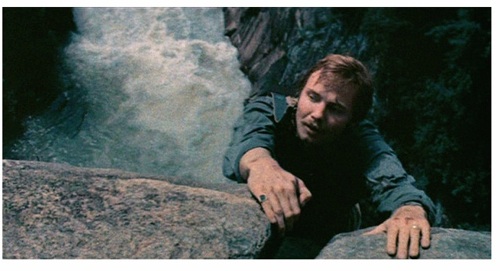
The emphasis on our (postmodern man's) being out of touch with our bodies, while it seems to be a ubiquitous theme throughout the culture, is more obsessively pursued here than it is in most discourses which take up the subject. I generally think this problem is overstated; that is, it would be my position that our intellects and spirits, relation to language and art and reason and so on, being equally out of sync, and all of these estrangements being problems and deficiencies of the mind above all, that a hyper-increased physicality in itself is unlikely to restore one to a more interesting or complete sense of self.
p.184: "I was aided by a totally different sense of touch than I had ever had, and it occurred to me that I must have developed it on the cliff." The book has a great belief in unrealized abilities that the circumstances of contemporary life have dulled in us, but that necessity, or adversity, could awaken if we found or put ourselves in a position to experience it. I do believe that when literal survival is at stake, such as in war, that something of this hyperacute awareness and sensibility does instinctively arise, and perhaps these realizations insinuate themselves permanently into consciousness. It is not my impression however that they contribute substantially to a permanent strength of mind if the foundation for such a mind be not already in place.
I interpret the story as supposed to be ultimately uplifting when the main character, Gentry, discovers his power to kill. I was taken along for some ways by this idea, though I was concerned about my health and mental fitness. Among the book's other main lessons is that somebody has to be in charge, has to take charge, and of course in the state of nature or even sometimes in advanced stages of civilization that often involves having to be willing to kill someone.
"Cornholed". There's a nice word. "...a man who had held a gun on it while another one cornholed him..."
The primal energy of the water was remarked upon numerous times. The means writers make of and the importance they attach to water symbolism--and almost all do--is the intellectual equivalent of Gentry's heightened sense of touch when scrambling for his life up the rocks. It ought to be second nature to a properly developed and highly functioning intellect.
The book on the whole, believe it or not, is very understated (quiet, modest, etc).
I wonder how these guys would have handled 3rd world immigration. Probably not well.
The emphasis on our (postmodern man's) being out of touch with our bodies, while it seems to be a ubiquitous theme throughout the culture, is more obsessively pursued here than it is in most discourses which take up the subject. I generally think this problem is overstated; that is, it would be my position that our intellects and spirits, relation to language and art and reason and so on, being equally out of sync, and all of these estrangements being problems and deficiencies of the mind above all, that a hyper-increased physicality in itself is unlikely to restore one to a more interesting or complete sense of self.p.184: "I was aided by a totally different sense of touch than I had ever had, and it occurred to me that I must have developed it on the cliff." The book has a great belief in unrealized abilities that the circumstances of contemporary life have dulled in us, but that necessity, or adversity, could awaken if we found or put ourselves in a position to experience it. I do believe that when literal survival is at stake, such as in war, that something of this hyperacute awareness and sensibility does instinctively arise, and perhaps these realizations insinuate themselves permanently into consciousness. It is not my impression however that they contribute substantially to a permanent strength of mind if the foundation for such a mind be not already in place.
I interpret the story as supposed to be ultimately uplifting when the main character, Gentry, discovers his power to kill. I was taken along for some ways by this idea, though I was concerned about my health and mental fitness. Among the book's other main lessons is that somebody has to be in charge, has to take charge, and of course in the state of nature or even sometimes in advanced stages of civilization that often involves having to be willing to kill someone.
"Cornholed". There's a nice word. "...a man who had held a gun on it while another one cornholed him..."
The primal energy of the water was remarked upon numerous times. The means writers make of and the importance they attach to water symbolism--and almost all do--is the intellectual equivalent of Gentry's heightened sense of touch when scrambling for his life up the rocks. It ought to be second nature to a properly developed and highly functioning intellect.
The book on the whole, believe it or not, is very understated (quiet, modest, etc).
I wonder how these guys would have handled 3rd world immigration. Probably not well.
Tuesday, August 24, 2010
James Dickey--Deliverance (1970) (I)
I had planned to start this essay with a joke, saying that I identified deeply with this book because its most famous episodes were as if lifted directly from my own life, at which point I was going to say, oh wait, no, forget it, that was the opening to my essay on David Copperfield, or something of that sort. However I have not been feeling too jokey lately, so my attempts at writing it straight seemed to me to be falling flat. I don't have the spirit either to mock, even half-heartedly, or to confront directly--let alone triumphantly--what the story would have me confront. Nonetheless it does not strike me as being beyond my capacity to offer a commentary on what I think it purports to say.
This is another book I would have been willing to put off reading forever if it had never come up on my list. This was mainly on account of all the references to the infamous scene in the movie, which I had also contentedly avoided seeing until recently. The novel was a minor sensation around the time I was born, so I had some interest in seeing what kinds of things were preoccupying the collective mind at that time. Was there other value in it? It was written by a poet, and has a kind of fantastic viewpoint and story, and at various points the writing gives the effect of being a prose-poem. That is worthwhile for seeing what kinds of things can be done with the form. The story did not stir me much, though the execution of it was admirable enough in most points. It is purposefully and tautly written. It is not overly short--there is a lot of explanation of what exactly characters are doing at any given time, of their material baggage, the terrain through which they are moving, all of which however is economically achieved and always serves to move the narrative forward. So that is good.
The movie is almost identical to the novel, and adds really nothing to it if you have already read the latter--even the famous "duelling banjos" scene is conveyed quite skilfully in the book, as another commentator, whom I will discuss more later, has observed just this week. The most infamous scene is far scarier and better developed in the book. The movie is quite highly regarded as a movie, but the book is much superior in pretty much every way, and while I admire the book, it left me pretty cold for the most part. My impression would be that the movie is generally overrated.
As I alluded to earlier, another commentary on this book was published in the New York Times the other day commemorating the 40th anniversary of the novel's publication. Like most of the book writing in that publication it is rather strikingly pedestrian and uninformative. Since I was about to begin an essay of my own on the same subject, I thought I ought it might be of interest to refer to it for some comparisons. The Times author likes the book more than I do, and takes the opportunity to get in some swipes at the men, writers and otherwise, of the present midlife generation for not showing much of a taste for engaging with the great themes that are the main preocuupations of the novel--danger, mortality, or anything else remotely discomfiting in general. This is perhaps true--complaints about the passive, stupefied, low testosterone state of modern manhood have been a pretty constant theme throughout my life--but I think he both exaggerates the significance of Dickey's engagement with these spectres in Deliverance and does not seem to grasp the substantial underlying reasons why issues would have even less immediate resonance with the man-children of generation X than they did with the more conventionally hardened, accomplished and actualized men of 40 years ago.
If current writers are not writing about the kinds of themes which are prevalent in Deliverance--and I am not sure that no one is (are there not novels about, say, migration from Central America across the dangerous deserts of Mexico and Arizona? Is not this unflinching grappling with the elemental nature of existence what Cormac McCarthy is celebrated for?)--it is probably because they do not feel them to be especially pressing concerns. Why they do not is perhaps one of the keys to understanding the age.
I had planned to start this essay with a joke, saying that I identified deeply with this book because its most famous episodes were as if lifted directly from my own life, at which point I was going to say, oh wait, no, forget it, that was the opening to my essay on David Copperfield, or something of that sort. However I have not been feeling too jokey lately, so my attempts at writing it straight seemed to me to be falling flat. I don't have the spirit either to mock, even half-heartedly, or to confront directly--let alone triumphantly--what the story would have me confront. Nonetheless it does not strike me as being beyond my capacity to offer a commentary on what I think it purports to say.
The movie is almost identical to the novel, and adds really nothing to it if you have already read the latter--even the famous "duelling banjos" scene is conveyed quite skilfully in the book, as another commentator, whom I will discuss more later, has observed just this week. The most infamous scene is far scarier and better developed in the book. The movie is quite highly regarded as a movie, but the book is much superior in pretty much every way, and while I admire the book, it left me pretty cold for the most part. My impression would be that the movie is generally overrated.
As I alluded to earlier, another commentary on this book was published in the New York Times the other day commemorating the 40th anniversary of the novel's publication. Like most of the book writing in that publication it is rather strikingly pedestrian and uninformative. Since I was about to begin an essay of my own on the same subject, I thought I ought it might be of interest to refer to it for some comparisons. The Times author likes the book more than I do, and takes the opportunity to get in some swipes at the men, writers and otherwise, of the present midlife generation for not showing much of a taste for engaging with the great themes that are the main preocuupations of the novel--danger, mortality, or anything else remotely discomfiting in general. This is perhaps true--complaints about the passive, stupefied, low testosterone state of modern manhood have been a pretty constant theme throughout my life--but I think he both exaggerates the significance of Dickey's engagement with these spectres in Deliverance and does not seem to grasp the substantial underlying reasons why issues would have even less immediate resonance with the man-children of generation X than they did with the more conventionally hardened, accomplished and actualized men of 40 years ago. The introduction of Jon Krakauer's Into Thin Air as an example of non-fiction authors' moving onto the soil which novelists have chosen to abandon by the way is bizarre and nothing to the point. I have read this book, which is entertaining in a finding-out-what-kinds-of-weird-things-are-going-on-in-the-world-nowadays kind of way, and while the various catastrophes delineated in its pages may have suggested various contemplations on mortality, vanity and so on to certain readers, they don't appear to have done so to Krakauer himself, whose standout characteristic to me as a writer is how 95% of the questions and matters of interest that would have suggested themselves to most good writers do not seem to do so with him. It is even almost fascinating to read someone who is in many ways so unaffected by metaphysical concerns to any serious extent. (Greg Mortensen, The Three Cups of Tea guy, whose literary method has a similar odd lack of general intellectual or historical underpinning that seems to consciously inform his interpretation of his experience). Camus, or even Maurice Herzog, would have come at the material from a totally different conception of human existence. The lesson of Into Thin Air, as Krakauer saw it, was that too many people were climbing Mt Everest who were not anywhere near prepared or experienced enough for the rigor of such an expedition; those who did survive the catastrophes which befell the expeditions written about in the book were for the most part lucky, helpless to save themselves but being people of privilege and high self-regard expectant that efforts must be undertaken to save them. There was the usual indignation about environmental effects, Western incursion on indigenous communities, culturally obnoxious behavior and so on. The book's concerns are about forms and practical training and knowledge, which it takes to speak for itself when attained.
If current writers are not writing about the kinds of themes which are prevalent in Deliverance--and I am not sure that no one is (are there not novels about, say, migration from Central America across the dangerous deserts of Mexico and Arizona? Is not this unflinching grappling with the elemental nature of existence what Cormac McCarthy is celebrated for?)--it is probably because they do not feel them to be especially pressing concerns. Why they do not is perhaps one of the keys to understanding the age. James Dickey was by most accounts consumed with living, and giving the appearance of living, a macho life. Despite having solid credentials to the title of acceptable manliness by most contemporary standards--played college football, served in World War II, had a successful career as an advertising executive, a more successful and acclaimed career as a writer, was an accomplished archer, guitarist and woodsmen, drank like a fish and bedded scores of women--he evidently felt the necessity of exaggerating the details of these accomplishments. I will not speculate on the deep causes of this insecurity or obsession or whatever one wishes to call it, but judging by the characters in his book, something in the effect which the easy security and comfortable status of postwar suburban life had on men was repulsive to his higher nature, he detected something of the same effect at work, even if mildly upon himself, and he reacted against it in an exaggerated manner; which was not unusual amongst male artistic types in his generation.
People my age may indeed have this same instinctive repulsion towards the type, especially if they are of it or even proximate enough, but it takes a different form. Life appears to be more competitive all around now; one's pool of competitors is much larger, and meaningful achievement that will incline the people around you to feel basic respect, let alone admiration for you harder to attain. The characters in Deliverance are presumably in their 30s, and we are supposed to take them as soft and mild--even the muscular Lewis character (played by Burt Reynolds in the movie), who is a workout fanatic and dedicates himself to all manner of weapons and outdoor adventure training, is portrayed as a somewhat ridiculous version of an authentic man. Nonetheless they all have jobs that easily support families and pay for homes, and their relative status at work is pretty high (above all women and black people at the minimum). At home, though the suggestion is that modern domesticity has drained all the vital spirit out of them, by present educated class standards they largely ignore their wives and children, are never expected to change diapers or babysit, and spend pretty much every weekend playing golf or going fishing with their male friends. My guess is that the typical 40 year old male or male writer today, not secure enough in having met the minimal requirements of adult manhood in the context of his own society, cannot presume to devote a lot of worry to how he would fare if confronted with mortality in the form of extreme violence or elemental adversity. Probably, he has little choice but to figure, not well. It might be difficult to convince him, if he cannot even achieve fairly simple desires, and feels no imminent threat of such violence, that it matters...
I'm bringing this to an end here. I may continue it later. In some sense.
Monday, April 19, 2010
I Am Having Trouble Getting My Beta/Gamma Male Piece Going.
This story is well-covered, though for the most part not in a way that I find satisfying, which is why I intend to take a stab at it myself. As the (hypothetical) reader is probably aware, the perception is that there is a serious and ever-increasing shortage of useful, dynamic, well-educated and properly developed men comparative to women at every level of contemporary society apart from perhaps the top 5% or so, as well in all age groups to some extent up to about age 50, though especially acute in the under 30 cohorts, where apart from the elite 10 or 15% of men who retain enough ambition, will, intellect, personality and ability to hold the attention of a woman to be generally acceptable, everyone else is increasingly resigning themselves to a largely celibate life of inferior status both to these alpha males and the 40 to 60% or so most able and desirable women who are visibly too good for them. This is an unhappy state of affairs to say the least, and one that has many aspects to it that will be hard to account for succinctly, such that I am not even going to attempt to address more than a couple of them.
First I suppose I had better define my understanding of the general categories of males. The alphas are of obviously the energetic leaders, achievers, and sexual heroes prominent in every human society. From their point of view there are really only two categories of men worth distinguishing, themselves (the winners), and everyone else, which in a sense is certainly true. As everyone seeks to procure as much status for himself as he can however, men just one notch or two down the scale like to add numerous gradations to put some sense of distance between themselves and the bottom, which is why in most systems of this type beneath alpha you have beta men, sometimes further divided into three fairly permeable levels, and beneath these gamma and omega men. Omega men consist essentially of the very dregs of maledom, the homeless, the severly mentally ill or learning disabled, the guys who are more likely in the next six months by a factor of at least +50 to be the object of an intervention by Richard Simmons than they are to go on a date; in short, men whose lives pass largely outside of all contact with women whosever, who indeed would cause women either to leave at once or demand the removal of the intruder if they were to wander into a confined public area where any happened to be. The gammas would be the guys who are more generally functional but don't relate to or appeal to women at all, and are therefore largely shunned by them, in many cases apparently remaining virgins against their desires well into their late 20s and beyond. The rise of the internet and techno-culture have given these men a wide forum and more of a psychic presence in society than they used to have, which I believe may be helping to feed the widespread impression that the number of losers is far higher than it used to be. They may have a working class counterpart in the doughy, unattractive and not too bright guy who in the old days could still support a beastly wife and a passel of thick-necked cretin children as a butcher or delivery driver or something that was still a definite place in society, but who has really nothing to offer anybody in today's world. The majority or near-majority of men are still classic betas, which means marriage to a reasonably desirable woman out of the very limited selection who will consider having them, and a largely boring and unimaginative existence grounded in the routine of propriety, work, earnest child rearing and so on. The loose divisions of greater, middling and lesser beta are determined by a algorithim which I have not precisely formulated yet consisting of the man's general competence/value to society, the appealingness of his wife, and the extent to which said wife actually likes him as against her level of bitterness and constant reminiscing about not having been able to nab one of the 50 or so alpha males she slept with in her teens and twenties while her future husband was relegated to video games, porn, perhaps getting lucky once every couple of years or so and pining after the likes of her as an impossible dream. The theory is that in the good old days when women were dependent on having a husband for their financial support and respectability in social station and having children, the beta men were in a much more favorable position, indeed they were considered the normal sort of man most women could reasonably expect to date and marry, if they themselves were worthy enough, could keep house and cook and were relatively sexually virtuous, that sort of thing, but that now that women don't need the (usually weak)financial support and pallid respectability that betas used to be able to offer, the top 40-60% or so discussed earlier have thrown over this massive pool of men entirely and are going all in during the prime years of their beauty to snag one of the coveted alphas, a quest of course in which most are doomed to not achieve their goal. The consequences of this on Society in the future, many sober and mature voices warn, are not going to be benign.
I had the good fortune to know in my youth a few women who were willing to offer men honest, direct, and sometimes brutal assessments of their worth and place in the world, and from the collation of these assessments I pretty consistently come up with a percentile ranking of myself vis-a-vis my other men, with 0 representing a guy lying half-conscious on a sewer grate stewing in his own excrement and 100 representing a Warren Beatty or Bill Clinton level of development, of around 66. This translates nicely to around 6.5 on the more popular 1-10 scale, which, though nothing anyone could be proud of, long experience has confirmed as a pretty accurate reading, and one which has never seemed to change or improve across a period of several decades now. This is the great difference between now and when I was younger, because while I knew I was a 6.5, I honestly believed until I was maybe even over 30 that if I really tried hard, bought better clothes or exercised seriously or read a lot and became smarter, that I would improve by leaps and bounds, even all the way to 10. I think it has been starkly exposed that it doesn't really work this way, and that it is very difficult to raise your comparative value, especially once you are already making a real effort to do so. That is, if you are really fat and really ignorant or have really bad clothes, in other words have not been making any effort at all comparative to your potential, you probably can pick up a couple of points fairly easily, and I think at one point in my late 20s I myself may have pushed the needle as high as 7 for a few months, perhaps there were a few days or even a week or two where I got to 7.5, though I have definitely fallen back now to my natural level. What seems to be happening now is that more and more people are realizing as teenagers and certainly as young adults that their inferiority to their alpha competitors is something innate that it will be virtually impossible for them to improve substantially enough to make any kind of impression on women or powerful men who could further their development, and they see no scenario where their mediocre qualities possess any value, so they are giving up, which response I will address a little further on.
On the education question, where women are now receiving 60% of the bachelor's degrees and so on and therefore, since they don't like to marry down, further exacerbating the marriageable mate shortage, I am of two minds. I do think there is something wrong with the way men are relating to and absorbing education these days, and that includes myself. An education, if you have a decent one, should I would think by the time you are in your 40s be somewhat manifest in your person so that you project a certain amount of maturity and authority that is acknowledged and respected by other people, not as a matter of submission but merely as courtesy. A lot of men, including myself, who are nominally educated at least to the point of having a bachelor's degree, do not carry ourselves in a way that projects these kinds of qualities to the same extent that modern women do. My wife is a good example of this, though she has a master's degree and is thus officially more educated than I am. Her second degree was in an education program that was 95% female, many of whom she noted had the poise, attitude and lingo of the professional classes down cold while being in numerous instances shockingly ignorant of things such as what the Cold War was or that one could buy printed books in foreign languages like Spanish or Russian. I am not suggesting that this level of knowledge is typical of either our female advanced degree holders or our public school teaching corps, but it was something I did take care to file away for further reference. I also think there is at work with regard to the graduate population that even men who like school after a certain age are going to be less cheery about returning to the classroom for the mere purpose of obtaining credentials. I know that my own feeling is that at my age I oughtn't to still be requiring training, but should be ready to assume a leadership role in whatever area of society I operate in. If I, who am a pretty low testosterone kind of guy, feel this way, then I am pretty sure the transition to the new societal model of lifelong re-tooling is not going to be a smooth one for men.
The internet has been full of stories about the dating scene at large universities that are already 60% women, most of whom are empowered to the max and determined to get what they deserve in a man, where a small number of superstuds maintain virtual harems, often openly, leaving the girls resigned to the reality that they have to share to get an occasional night of the life they want, while the majority of the guys are completely ignored and left to play video games and so on. I am not too familiar with this kind of social dynamic, which seems however to be the dominant one in our society, where the alpha males form their own exclusive groups and draw almost all of the most eligible women to their circle, reducing all the other man to ever more remote spectators. At SJC there were not a great number of real alpha types, and these tended to prefer to form their own groups with themselves at the center rather than band with their fellow alphas to form one babe-hoarding supergroup (though a few entertained such a vision). The pickup scene as it was at parties and so on became in its best moments a competition between the leaders of the various groups and what they represented, which was much more interesting for the betas because it both got them into parties and much closer to such action as took place, and as such afforded them the opportunity to occasionally try to do a little scrapping themselves, as even the girls who are interested in them don't want to go to parties where there are no cool people present. I am probably presenting a rosier picture of things than really existed, but again, however much some people complained about the general unworthiness and inferiority of the men--and that probably went on even in the 50s when the male/female ratio was 65-35--the contemporary desperation/contempt of the capable and aspiring women and the lack of hope and any sense of fight in the subalpha men seems a more advanced stage of societal disease than what I knew.
I have reached my deadline, so while I have probably left out twenty things I meant to comment on, I am going to try to wrap this up by asking the great question of the moment, which is, Is a Man's Life Worth Living If He is Not an Alpha Male? As somebody with four sons, though I am confident they all have a good chance to reach a higher level than 66 anyway, I don't want to come out and say "No", but it is very frustrating to have to live for decades with badly mismatched or unevenly developed capacities. All things considered, I have in the end a reasonably good mind, but a mind that has always been hampered by a comparative lack of good looks, personality, identifiable talent towards which to direct itself, energy, and myriad other important qualities from engaging in the world at anything near what seems to be its full potential, so I have often been unhappy and not been able to use my mind in any really productive manner. But if your qualities and abilities achieve some kind of harmony amongst themselves even at a middling or lower level of comparative value, I think it is still possible to lead a respectable, honorable and contented life.
This story is well-covered, though for the most part not in a way that I find satisfying, which is why I intend to take a stab at it myself. As the (hypothetical) reader is probably aware, the perception is that there is a serious and ever-increasing shortage of useful, dynamic, well-educated and properly developed men comparative to women at every level of contemporary society apart from perhaps the top 5% or so, as well in all age groups to some extent up to about age 50, though especially acute in the under 30 cohorts, where apart from the elite 10 or 15% of men who retain enough ambition, will, intellect, personality and ability to hold the attention of a woman to be generally acceptable, everyone else is increasingly resigning themselves to a largely celibate life of inferior status both to these alpha males and the 40 to 60% or so most able and desirable women who are visibly too good for them. This is an unhappy state of affairs to say the least, and one that has many aspects to it that will be hard to account for succinctly, such that I am not even going to attempt to address more than a couple of them.
First I suppose I had better define my understanding of the general categories of males. The alphas are of obviously the energetic leaders, achievers, and sexual heroes prominent in every human society. From their point of view there are really only two categories of men worth distinguishing, themselves (the winners), and everyone else, which in a sense is certainly true. As everyone seeks to procure as much status for himself as he can however, men just one notch or two down the scale like to add numerous gradations to put some sense of distance between themselves and the bottom, which is why in most systems of this type beneath alpha you have beta men, sometimes further divided into three fairly permeable levels, and beneath these gamma and omega men. Omega men consist essentially of the very dregs of maledom, the homeless, the severly mentally ill or learning disabled, the guys who are more likely in the next six months by a factor of at least +50 to be the object of an intervention by Richard Simmons than they are to go on a date; in short, men whose lives pass largely outside of all contact with women whosever, who indeed would cause women either to leave at once or demand the removal of the intruder if they were to wander into a confined public area where any happened to be. The gammas would be the guys who are more generally functional but don't relate to or appeal to women at all, and are therefore largely shunned by them, in many cases apparently remaining virgins against their desires well into their late 20s and beyond. The rise of the internet and techno-culture have given these men a wide forum and more of a psychic presence in society than they used to have, which I believe may be helping to feed the widespread impression that the number of losers is far higher than it used to be. They may have a working class counterpart in the doughy, unattractive and not too bright guy who in the old days could still support a beastly wife and a passel of thick-necked cretin children as a butcher or delivery driver or something that was still a definite place in society, but who has really nothing to offer anybody in today's world. The majority or near-majority of men are still classic betas, which means marriage to a reasonably desirable woman out of the very limited selection who will consider having them, and a largely boring and unimaginative existence grounded in the routine of propriety, work, earnest child rearing and so on. The loose divisions of greater, middling and lesser beta are determined by a algorithim which I have not precisely formulated yet consisting of the man's general competence/value to society, the appealingness of his wife, and the extent to which said wife actually likes him as against her level of bitterness and constant reminiscing about not having been able to nab one of the 50 or so alpha males she slept with in her teens and twenties while her future husband was relegated to video games, porn, perhaps getting lucky once every couple of years or so and pining after the likes of her as an impossible dream. The theory is that in the good old days when women were dependent on having a husband for their financial support and respectability in social station and having children, the beta men were in a much more favorable position, indeed they were considered the normal sort of man most women could reasonably expect to date and marry, if they themselves were worthy enough, could keep house and cook and were relatively sexually virtuous, that sort of thing, but that now that women don't need the (usually weak)financial support and pallid respectability that betas used to be able to offer, the top 40-60% or so discussed earlier have thrown over this massive pool of men entirely and are going all in during the prime years of their beauty to snag one of the coveted alphas, a quest of course in which most are doomed to not achieve their goal. The consequences of this on Society in the future, many sober and mature voices warn, are not going to be benign.
I had the good fortune to know in my youth a few women who were willing to offer men honest, direct, and sometimes brutal assessments of their worth and place in the world, and from the collation of these assessments I pretty consistently come up with a percentile ranking of myself vis-a-vis my other men, with 0 representing a guy lying half-conscious on a sewer grate stewing in his own excrement and 100 representing a Warren Beatty or Bill Clinton level of development, of around 66. This translates nicely to around 6.5 on the more popular 1-10 scale, which, though nothing anyone could be proud of, long experience has confirmed as a pretty accurate reading, and one which has never seemed to change or improve across a period of several decades now. This is the great difference between now and when I was younger, because while I knew I was a 6.5, I honestly believed until I was maybe even over 30 that if I really tried hard, bought better clothes or exercised seriously or read a lot and became smarter, that I would improve by leaps and bounds, even all the way to 10. I think it has been starkly exposed that it doesn't really work this way, and that it is very difficult to raise your comparative value, especially once you are already making a real effort to do so. That is, if you are really fat and really ignorant or have really bad clothes, in other words have not been making any effort at all comparative to your potential, you probably can pick up a couple of points fairly easily, and I think at one point in my late 20s I myself may have pushed the needle as high as 7 for a few months, perhaps there were a few days or even a week or two where I got to 7.5, though I have definitely fallen back now to my natural level. What seems to be happening now is that more and more people are realizing as teenagers and certainly as young adults that their inferiority to their alpha competitors is something innate that it will be virtually impossible for them to improve substantially enough to make any kind of impression on women or powerful men who could further their development, and they see no scenario where their mediocre qualities possess any value, so they are giving up, which response I will address a little further on.
On the education question, where women are now receiving 60% of the bachelor's degrees and so on and therefore, since they don't like to marry down, further exacerbating the marriageable mate shortage, I am of two minds. I do think there is something wrong with the way men are relating to and absorbing education these days, and that includes myself. An education, if you have a decent one, should I would think by the time you are in your 40s be somewhat manifest in your person so that you project a certain amount of maturity and authority that is acknowledged and respected by other people, not as a matter of submission but merely as courtesy. A lot of men, including myself, who are nominally educated at least to the point of having a bachelor's degree, do not carry ourselves in a way that projects these kinds of qualities to the same extent that modern women do. My wife is a good example of this, though she has a master's degree and is thus officially more educated than I am. Her second degree was in an education program that was 95% female, many of whom she noted had the poise, attitude and lingo of the professional classes down cold while being in numerous instances shockingly ignorant of things such as what the Cold War was or that one could buy printed books in foreign languages like Spanish or Russian. I am not suggesting that this level of knowledge is typical of either our female advanced degree holders or our public school teaching corps, but it was something I did take care to file away for further reference. I also think there is at work with regard to the graduate population that even men who like school after a certain age are going to be less cheery about returning to the classroom for the mere purpose of obtaining credentials. I know that my own feeling is that at my age I oughtn't to still be requiring training, but should be ready to assume a leadership role in whatever area of society I operate in. If I, who am a pretty low testosterone kind of guy, feel this way, then I am pretty sure the transition to the new societal model of lifelong re-tooling is not going to be a smooth one for men.
The internet has been full of stories about the dating scene at large universities that are already 60% women, most of whom are empowered to the max and determined to get what they deserve in a man, where a small number of superstuds maintain virtual harems, often openly, leaving the girls resigned to the reality that they have to share to get an occasional night of the life they want, while the majority of the guys are completely ignored and left to play video games and so on. I am not too familiar with this kind of social dynamic, which seems however to be the dominant one in our society, where the alpha males form their own exclusive groups and draw almost all of the most eligible women to their circle, reducing all the other man to ever more remote spectators. At SJC there were not a great number of real alpha types, and these tended to prefer to form their own groups with themselves at the center rather than band with their fellow alphas to form one babe-hoarding supergroup (though a few entertained such a vision). The pickup scene as it was at parties and so on became in its best moments a competition between the leaders of the various groups and what they represented, which was much more interesting for the betas because it both got them into parties and much closer to such action as took place, and as such afforded them the opportunity to occasionally try to do a little scrapping themselves, as even the girls who are interested in them don't want to go to parties where there are no cool people present. I am probably presenting a rosier picture of things than really existed, but again, however much some people complained about the general unworthiness and inferiority of the men--and that probably went on even in the 50s when the male/female ratio was 65-35--the contemporary desperation/contempt of the capable and aspiring women and the lack of hope and any sense of fight in the subalpha men seems a more advanced stage of societal disease than what I knew.
I have reached my deadline, so while I have probably left out twenty things I meant to comment on, I am going to try to wrap this up by asking the great question of the moment, which is, Is a Man's Life Worth Living If He is Not an Alpha Male? As somebody with four sons, though I am confident they all have a good chance to reach a higher level than 66 anyway, I don't want to come out and say "No", but it is very frustrating to have to live for decades with badly mismatched or unevenly developed capacities. All things considered, I have in the end a reasonably good mind, but a mind that has always been hampered by a comparative lack of good looks, personality, identifiable talent towards which to direct itself, energy, and myriad other important qualities from engaging in the world at anything near what seems to be its full potential, so I have often been unhappy and not been able to use my mind in any really productive manner. But if your qualities and abilities achieve some kind of harmony amongst themselves even at a middling or lower level of comparative value, I think it is still possible to lead a respectable, honorable and contented life.
Wednesday, November 25, 2009
Literature--Real Literature--is Still a Man's Game.
The expression 'man' here refers more to certain qualities of hardness, pitilessness and such that I, who lack them, tend to think of as extreme masculine characteristics. There are certainly plenty of women who have them in one degree or another. The great delusion of so many is that the fields of genuine literature and the other arts are some kind of refuge for soft, sensitive people, a cheap and painless route to the acceptance and esteem they have always craved but never merited. Such beauty as exists in life and art largely depend on the extent to which it rewards hardness and rigor and punishes softness and laziness...
I Am Not Going to Presume to Give Financial Advice But...
I am not the first person to notice this, but it has always struck me as an especial peculiarity of American life that in certain areas the more spectacular the problems of one's own making that one has at least temporarily escaped, the more credibility one has in guiding others away from or out of the same pitballs. Thus it is considered reasonable to hire or anoint people who have had the most extreme problems with drugs themselves to counsel others on the best ways to avoid or overcome similar habits, as opposed to someone who never had such problems in the first place. Likewise there is an American mutation of Christianity in which the extent of sin in which the preacher wallowed in the days before he developed a greater intimacy with Jesus is a far greater selling point with potential congregates than the rigor of his theological training. Of late we have seen the rise of the Dave Ramsey/Suze Orman style financial guru who once had six figure credit card debt but now earn fortunes browbeating the hapless middle and lower middle classes with such brilliant insights as "don't buy the plasma TV if you can't do it in cash". One thing most of these pop money managers seem to be in agreement about is that spending any more money on education than the minimal amount necessary to get certified in some kind of practical skill leading to an immediate upgrade in pay is a cardinal sin. This assumes an attitude towards education of course that I know a lot of people have, but which is a symptom of a wider trend among a lot of middle class non-Jewish whites that I can't see not having increasingly unhappy consequences for them as a group moving on through the next fifty years or so.
It seems to me that families and groups who expend a large percentage of their resources and energy on education for their younger members--a population in which certain foreign and, in our country, foreign-born groups are disproportionately represented--are thriving comparatively well, and in institutions and fields that increasingly seem to be failing to engage or develop the talents of the native born. I do not downplay the expense involved even in obtaining decent schooling (or the ridicule that some fortunate and superbrilliant members of the creative and intellectual elite have the luxury of pouring out on formal schooling), but if it is one's primary commitment, I think it is not yet so far beyond the reach of even the moderately ambitious or talented (and certainly not of the indisputably so). The amount of student loan debt people have now, especially when combined with the dissatisfaction so many express with the results of their educations, is a concern. Still, though I can't find the figures readily, the last report on the subject I read indicated that the schools with the highest rate of loan defaults by far were places like cosmetology schools and community colleges which one assumes tended to attract more people with a pretty desultory approach to education and finances than would be regarded as normal by the well-meaning and not so well-meaning factions of the establishment. The $50,000 a year private colleges much ridiculed by the pop financial advisors had comparatively low rates of student loan default. I suspect this may be because they take more concern not to bury their students with cruel levels of debt than what frankly seem to me to be the somewhat shady operations at the fringes of the education complex. As to whether the expensive private colleges are too much of a burden on the students' parents, assuming they have the resources to pay for them, is of course something they have to decide. I confess that because I am only partially well-educated myself, I tend to believe there is some great secret or nirvana that having more through knowledge, accomplishments, talents, exclusively super-intelligent friends, co-workers and family members, etc, will bring you that must make life something spectacular on a day to day basis, and without which it is rather dull, so my instinct is to overspend on things like schools, which are the best access to the secrets that seem to be available, to see what it is there. Other people obviously do not feel this emptiness within them and don't need the psychic healing that such tokens of experience may or may not bring.
I got a little off course there. I still think it is a concern that so many mainstream white Americans are becoming turned off or disillusioned by the education system, to the point in many instances of abandoning it intellectually if not literally. Jews, Indians, Chinese, Koreans, do not seem to suffer this kind of disillusionment in anywhere near comparable numbers. Why? Some will say it is because they are inherently smarter, but even if this is so, among gentile whites the really smart people have often been among the most likely to be disillusioned/dissatisfied and to rebel in some way, which does not seem to be on the whole the case among these other groups (obviously there are exceptions to every generality).
Given that it has been a long time since I have posted and I don't have a lot of open hours for posting in my immediate future I am going to put this up and use the rest of the material I had for this post later on.
The expression 'man' here refers more to certain qualities of hardness, pitilessness and such that I, who lack them, tend to think of as extreme masculine characteristics. There are certainly plenty of women who have them in one degree or another. The great delusion of so many is that the fields of genuine literature and the other arts are some kind of refuge for soft, sensitive people, a cheap and painless route to the acceptance and esteem they have always craved but never merited. Such beauty as exists in life and art largely depend on the extent to which it rewards hardness and rigor and punishes softness and laziness...
I Am Not Going to Presume to Give Financial Advice But...
I am not the first person to notice this, but it has always struck me as an especial peculiarity of American life that in certain areas the more spectacular the problems of one's own making that one has at least temporarily escaped, the more credibility one has in guiding others away from or out of the same pitballs. Thus it is considered reasonable to hire or anoint people who have had the most extreme problems with drugs themselves to counsel others on the best ways to avoid or overcome similar habits, as opposed to someone who never had such problems in the first place. Likewise there is an American mutation of Christianity in which the extent of sin in which the preacher wallowed in the days before he developed a greater intimacy with Jesus is a far greater selling point with potential congregates than the rigor of his theological training. Of late we have seen the rise of the Dave Ramsey/Suze Orman style financial guru who once had six figure credit card debt but now earn fortunes browbeating the hapless middle and lower middle classes with such brilliant insights as "don't buy the plasma TV if you can't do it in cash". One thing most of these pop money managers seem to be in agreement about is that spending any more money on education than the minimal amount necessary to get certified in some kind of practical skill leading to an immediate upgrade in pay is a cardinal sin. This assumes an attitude towards education of course that I know a lot of people have, but which is a symptom of a wider trend among a lot of middle class non-Jewish whites that I can't see not having increasingly unhappy consequences for them as a group moving on through the next fifty years or so.
It seems to me that families and groups who expend a large percentage of their resources and energy on education for their younger members--a population in which certain foreign and, in our country, foreign-born groups are disproportionately represented--are thriving comparatively well, and in institutions and fields that increasingly seem to be failing to engage or develop the talents of the native born. I do not downplay the expense involved even in obtaining decent schooling (or the ridicule that some fortunate and superbrilliant members of the creative and intellectual elite have the luxury of pouring out on formal schooling), but if it is one's primary commitment, I think it is not yet so far beyond the reach of even the moderately ambitious or talented (and certainly not of the indisputably so). The amount of student loan debt people have now, especially when combined with the dissatisfaction so many express with the results of their educations, is a concern. Still, though I can't find the figures readily, the last report on the subject I read indicated that the schools with the highest rate of loan defaults by far were places like cosmetology schools and community colleges which one assumes tended to attract more people with a pretty desultory approach to education and finances than would be regarded as normal by the well-meaning and not so well-meaning factions of the establishment. The $50,000 a year private colleges much ridiculed by the pop financial advisors had comparatively low rates of student loan default. I suspect this may be because they take more concern not to bury their students with cruel levels of debt than what frankly seem to me to be the somewhat shady operations at the fringes of the education complex. As to whether the expensive private colleges are too much of a burden on the students' parents, assuming they have the resources to pay for them, is of course something they have to decide. I confess that because I am only partially well-educated myself, I tend to believe there is some great secret or nirvana that having more through knowledge, accomplishments, talents, exclusively super-intelligent friends, co-workers and family members, etc, will bring you that must make life something spectacular on a day to day basis, and without which it is rather dull, so my instinct is to overspend on things like schools, which are the best access to the secrets that seem to be available, to see what it is there. Other people obviously do not feel this emptiness within them and don't need the psychic healing that such tokens of experience may or may not bring.
I got a little off course there. I still think it is a concern that so many mainstream white Americans are becoming turned off or disillusioned by the education system, to the point in many instances of abandoning it intellectually if not literally. Jews, Indians, Chinese, Koreans, do not seem to suffer this kind of disillusionment in anywhere near comparable numbers. Why? Some will say it is because they are inherently smarter, but even if this is so, among gentile whites the really smart people have often been among the most likely to be disillusioned/dissatisfied and to rebel in some way, which does not seem to be on the whole the case among these other groups (obviously there are exceptions to every generality).
Given that it has been a long time since I have posted and I don't have a lot of open hours for posting in my immediate future I am going to put this up and use the rest of the material I had for this post later on.
Tuesday, October 20, 2009
More Reasons for my Stunted Development Revealed
One day recently, stumbling home after happy hour or wherever it was I had been, I entered the domestic sanctuary, where I was greeted by the voice of Carol Channing explaining that when we see a cheerful, beaming woman doing housework on a television commercial, to keep in mind that we are watching an actress. "What the hey is this?" I demanded authoritatively.
"You don't recognize it?" responded the ever alert lady of the house. "This is your record."
"It most certainly is not," I replied, indignant at this association of such rubbish with my exalted person.
"I'm sure it is," the lady, who, never having to, never does concede an assertion once she has made it, "I found it in a box of your old childhood possessions." I insisted that the sleeve of this record be produced at once. (Note: I have not mastered control over the flash on my camera--ed)
"I have never seen this thing in my life," I proclaimed, the swell of triumph flooding into my breast. "What is this nonsense? Alan Alda!? Mel Brooks!? Rosey Grier!? Rosey Grier was big when I was a wee child. Well, he was always big. He was a defensive tackle for the Giants back in the stone ages. He played at Penn State back when Joe Paterno was an assistant coach in his 20s. He weighed 285 pounds, which in the 50s and early 60s made him like Refrigerator Perry crossed with a sumo wrestler on the field. Then in the 70s he was on TV all the time. Doing commercials. Doing needlepoint. Guest starring on hit shows (he's the enormous sensitive black guy). Then around 1978 he suddenly dropped off the face of the earth and was never heard from again. I wonder if he's even still alive." (ed--he is)
"Yes, he's the guy who sings 'It's All Right to Cry.' It's the children's favorite song. I knew you would like it."
"No!" I said, trying to disguise the note of horror in my voice.
"Except for Georgie. He likes 'William's Doll' the best."
(Flipping album over furiously) "Alan Alda & Marlo Thomas. Good lord. Marlo Thomas. She was kind of a babe, wasn't she? She fell in the same hole Rosey Grier did in my consciousness (hopefully Rosey was on the bottom wherever they landed). And that smarmy Alan Alda. What a slimeball! You know what he was thinking. Oh, sure, Marlo, I'll do all I can to help to help with your project, you...you sassy, liberated, free love advoc--"
"Now stop it. Is that all you can ever think about? I think it is very sweet that you listened to this record as a little boy. I can just see you sitting there with your legs crossed in your little mustard turtleneck with your white hair falling over your eyes and ears and collar earnestly absorbing the messages of equality and common humanity."
"I absorbed no such lessons. Not in the least. Yes, and that reminds me. I have been researching some right wing websites which explain how a man should properly manage his wife, and it was a real eye-opener. Things are going to have to change around here starting immediately."
"Are they indeed?"
"Yes. Indeed. I'd no idea what disgrace I have been living in these many years, and what contempt other men must hold me in. It has been a great shock to my system. For example, I am never to let another man who is not a relative speak directly to my wife, but I must speak for the family on all occasions. This signifies weakness to other men, and leads them to believe they can have their way with either of of us whenever they wish. One of the writers had just returned from a trip to those Sodom and Gomorrahs of the East, Vermont and Massachusetts--right in our neighborhood--and seen unspeakably disgusting things there, people, men and women alike, who have lost any sense of shame or self-respect."
"Unspeakable things? In Vermont? Where?"
"Well--I don't know exactly where. The point is, the men were weak and shuffling, not ready to defend themselves or their children or their property, without honor, enthusiastically supporting socialistic policies, bearing noncompetitive postures, pushing strollers, allowing their nominal wives and girlfriends to make purchasing decisions and dictate the terms of their lifestyle. I can't help but think he must have seen me that it is really I he is talking about. After all, I have been in both of those states within the past few weeks."
"You are a fool. Haven't you seen those old photographs from the depression, and earlier, of men rocking babies and pushing strollers. We have one of my great-grandfather himself around 1918, still wearing his work suit, taking my grandmother out for a spin in the pram. And he isn't carrying a gun with him either."
"We don't know that he hasn't stuck a piece in the baby carriage. But anyway, it was different back then. He was a man of proven respectability and capacity. Being shot by a thug or a madman on the street would not have been interpreted as a judgement on his fundamental inadequa--"
"Stop. Listen, it's time for Rosey Grier's number."
"You know, this can't be good for boy children. They may not have known better in 1974, but I do. And I still say, this is not my record."
(Yes, this is my faux-retro made in China $50 record player. Laugh all you want. I like it.)
One day recently, stumbling home after happy hour or wherever it was I had been, I entered the domestic sanctuary, where I was greeted by the voice of Carol Channing explaining that when we see a cheerful, beaming woman doing housework on a television commercial, to keep in mind that we are watching an actress. "What the hey is this?" I demanded authoritatively.
"You don't recognize it?" responded the ever alert lady of the house. "This is your record."
"It most certainly is not," I replied, indignant at this association of such rubbish with my exalted person.
"I'm sure it is," the lady, who, never having to, never does concede an assertion once she has made it, "I found it in a box of your old childhood possessions." I insisted that the sleeve of this record be produced at once. (Note: I have not mastered control over the flash on my camera--ed)
"Yes, he's the guy who sings 'It's All Right to Cry.' It's the children's favorite song. I knew you would like it."
"No!" I said, trying to disguise the note of horror in my voice.
"Except for Georgie. He likes 'William's Doll' the best."
(Flipping album over furiously) "Alan Alda & Marlo Thomas. Good lord. Marlo Thomas. She was kind of a babe, wasn't she? She fell in the same hole Rosey Grier did in my consciousness (hopefully Rosey was on the bottom wherever they landed). And that smarmy Alan Alda. What a slimeball! You know what he was thinking. Oh, sure, Marlo, I'll do all I can to help to help with your project, you...you sassy, liberated, free love advoc--"
"Now stop it. Is that all you can ever think about? I think it is very sweet that you listened to this record as a little boy. I can just see you sitting there with your legs crossed in your little mustard turtleneck with your white hair falling over your eyes and ears and collar earnestly absorbing the messages of equality and common humanity.""I absorbed no such lessons. Not in the least. Yes, and that reminds me. I have been researching some right wing websites which explain how a man should properly manage his wife, and it was a real eye-opener. Things are going to have to change around here starting immediately."
"Are they indeed?"
"Yes. Indeed. I'd no idea what disgrace I have been living in these many years, and what contempt other men must hold me in. It has been a great shock to my system. For example, I am never to let another man who is not a relative speak directly to my wife, but I must speak for the family on all occasions. This signifies weakness to other men, and leads them to believe they can have their way with either of of us whenever they wish. One of the writers had just returned from a trip to those Sodom and Gomorrahs of the East, Vermont and Massachusetts--right in our neighborhood--and seen unspeakably disgusting things there, people, men and women alike, who have lost any sense of shame or self-respect."
"Unspeakable things? In Vermont? Where?"
"Well--I don't know exactly where. The point is, the men were weak and shuffling, not ready to defend themselves or their children or their property, without honor, enthusiastically supporting socialistic policies, bearing noncompetitive postures, pushing strollers, allowing their nominal wives and girlfriends to make purchasing decisions and dictate the terms of their lifestyle. I can't help but think he must have seen me that it is really I he is talking about. After all, I have been in both of those states within the past few weeks."
"You are a fool. Haven't you seen those old photographs from the depression, and earlier, of men rocking babies and pushing strollers. We have one of my great-grandfather himself around 1918, still wearing his work suit, taking my grandmother out for a spin in the pram. And he isn't carrying a gun with him either."
"We don't know that he hasn't stuck a piece in the baby carriage. But anyway, it was different back then. He was a man of proven respectability and capacity. Being shot by a thug or a madman on the street would not have been interpreted as a judgement on his fundamental inadequa--"
"Stop. Listen, it's time for Rosey Grier's number."
"You know, this can't be good for boy children. They may not have known better in 1974, but I do. And I still say, this is not my record."(Yes, this is my faux-retro made in China $50 record player. Laugh all you want. I like it.)
Labels:
1970s,
alan alda,
child rearing strategies,
manliness,
sports
Wednesday, April 15, 2009
Caesar
I recently visited one of my second-rank favorite places, the scrap-metal yard. If you are familiar with the old book or movie The Magnificent Ambersons, which is about the decline of a once-flourishing family and the small town where they formerly lorded it over everyone, the Amberson's house and that town are where I live, only with 70 additional years of decline. The property having been in the family for a long time, and there being an enormous catacomb-like cellar and decrepit carriage house which serve no vital purpose to a modern household, several generations of broken tools, appliances, motors, radiators, and the like have accumulated, enough to periodically gather up a haul of good old 20th century heavy, rusted iron that has a value of $100 or more on the scrap metal market. The scrap metal yard itself is a fantastic dislocation from the present to the atmosphere of the beginning-to-teeter industrial America of 1970 or so, scarcely a sensation of any plastic or other synthetic materials in sight, corrugated-metal sheds, enormous front loaders and bulldozer-like machines roving all over the site, the earth a permanently torn up and disfigured slough of mud, and of course piles of discarded metal, our national inheritance as it were, heaped up everywhere you turn.
This has nothing to do with Caesar except that when I tried to think of associations that Caesar's name invokes in me, I thought of the scrap metal yard, and when I am at the scrap metal yard I think of Rome, or probably more precisely the Roman and Roman-inspired literature that used to be the heart of the course of study at the finest and most beautiful private schools, and the nodding, romanticized ideas of olive groves and temples overlooking the warm seas that often come to people who encounter such works for the first time in such a setting.
Sculptural representations of Caesar strike me as more consistently beautiful works of art than those of other great men. The pictures of these others are often uncompelling apart from the association of their work or other feats, but the depictions of Caesar radiate a palpable strength and superiority that manifests itself in the physical person as much as the mind. He is usually shown as having a perfectly-shaped head, neither too round nor too long, but achieving a happy proportion between the two, with a very lean lower half of the face over the expressions and twitches of which his mind appears to have perfect muscular control, always in perfectly orchestrated unison or counterpoint with his eyes. It is, perhaps deceptively, a reassuring face. Samuel Beckett closer to our time had one with a similar effect. It is reassuring because it strikes one as what a man's head and bearing ought to look like, and gives us a higher view of our nature than we ordinarily possess.
Like Napoleon, Caesar's historical reputation seems to me to have been consistently quite positive, or at least his greatest qualities and achievements are seen as offsetting the negative effects of his ascent and imdomitable will, such as for example the extermination of entire nations of people in his Gallic campaigns. He was one of the great generals, or at any rate one of the most important ones, in history. His administration of the Empire when dictator is widely admired, though his skill in this may be oversold by people, and there are many such, who live in more democratic or less centrally organized states and have a strange unmet craving for more competent and efficient administration. Assuming that he wrote the books that have been published under his name for the last 1000 years, he is still, I think, a canonical, or near-canonical author, his writings both seminal documents of ancient history and models of terse prose composition. He appears to have had no small amount of sexual virility either, and enjoyed substantial and enviable success with beautiful women. Aside from a very few stout and hyper-confident iconoclasts like Samuel Johnson, I think there has been historically a general sense among scholars and artists alike that such accomplishments and such stature in the specific time and society in which he lived, with its unique set of political and cultural conditions, and the intellectual talent which abounded in and about it, demands respect. I think a more classical approach to understanding human beings and history, if it does not require this, strongly pressures one to lean in that direction. Caesar becomes in this view a repository for the whole Western tradition, its learning, its outcome, its mythology and narrative flow, for the tradition has gone too far down the particular path that he, along with others, set it on, and if Caesar is not actually "great" in the substantial ways he has been honored as great, the traditon becomes at the least unreliable, and there is a good chance as well that it is an abomination altogether. Of course a truly developed post-modernist intellect--(well, I was getting on a roll but at this point I was interrupted--I forget for what reason--and I forget what a truly developed post-modern intellect would know--probably that the tradition is irrelevant, or that Caesar was just another person like anybody else, who snored and had to clip his toenails and so on, but happened to be a hyper-privileged, overconfident bully type).
I have often thought that people who care about such things are not as emotional about particular events and episodes in the history of the Roman Empire as they are with that of other peoples and periods. One reason I suppose is that Roman life and the Roman spirit, so to speak, never wholly died or were irretrievably lost to us. Rome was a practical, adaptable, and universal state and culture, its achievements and organization familiar and really the basis for all of Western civilization that followed it. No one has the sense that Rome died too soon, or that it might have, with some different luck, achieved or advanced humanity to any higher level than it did. Unlike the Athenians or the medieval Florentines or the seventeenth century French or other outbursts of spectacular and unreproduceable brilliance among a smaller and chronologically limited set of people, one doesn't think with even the greatest Romans that he has missed something he can't get a fair way up to speed on. Thus I do not think that the thought of Caesar as an usurper of the tradition and laws of his country, and as one who in large part opoosed its collective will, upsets anyone too much. Either they don't love the ideal of the Republic, and its traditions, its meaning, or they think after 700 years it perhaps had gotten a little stale and it was time for someone to shake things up a little and grab the reins of the state. I think there is a consensus that Caesar was probably wrong, and that we should not like to be so ruled ourselves, but we know enough to feel that nothing so grand for us is really at stake...
I recently visited one of my second-rank favorite places, the scrap-metal yard. If you are familiar with the old book or movie The Magnificent Ambersons, which is about the decline of a once-flourishing family and the small town where they formerly lorded it over everyone, the Amberson's house and that town are where I live, only with 70 additional years of decline. The property having been in the family for a long time, and there being an enormous catacomb-like cellar and decrepit carriage house which serve no vital purpose to a modern household, several generations of broken tools, appliances, motors, radiators, and the like have accumulated, enough to periodically gather up a haul of good old 20th century heavy, rusted iron that has a value of $100 or more on the scrap metal market. The scrap metal yard itself is a fantastic dislocation from the present to the atmosphere of the beginning-to-teeter industrial America of 1970 or so, scarcely a sensation of any plastic or other synthetic materials in sight, corrugated-metal sheds, enormous front loaders and bulldozer-like machines roving all over the site, the earth a permanently torn up and disfigured slough of mud, and of course piles of discarded metal, our national inheritance as it were, heaped up everywhere you turn.
This has nothing to do with Caesar except that when I tried to think of associations that Caesar's name invokes in me, I thought of the scrap metal yard, and when I am at the scrap metal yard I think of Rome, or probably more precisely the Roman and Roman-inspired literature that used to be the heart of the course of study at the finest and most beautiful private schools, and the nodding, romanticized ideas of olive groves and temples overlooking the warm seas that often come to people who encounter such works for the first time in such a setting.
Sculptural representations of Caesar strike me as more consistently beautiful works of art than those of other great men. The pictures of these others are often uncompelling apart from the association of their work or other feats, but the depictions of Caesar radiate a palpable strength and superiority that manifests itself in the physical person as much as the mind. He is usually shown as having a perfectly-shaped head, neither too round nor too long, but achieving a happy proportion between the two, with a very lean lower half of the face over the expressions and twitches of which his mind appears to have perfect muscular control, always in perfectly orchestrated unison or counterpoint with his eyes. It is, perhaps deceptively, a reassuring face. Samuel Beckett closer to our time had one with a similar effect. It is reassuring because it strikes one as what a man's head and bearing ought to look like, and gives us a higher view of our nature than we ordinarily possess.Like Napoleon, Caesar's historical reputation seems to me to have been consistently quite positive, or at least his greatest qualities and achievements are seen as offsetting the negative effects of his ascent and imdomitable will, such as for example the extermination of entire nations of people in his Gallic campaigns. He was one of the great generals, or at any rate one of the most important ones, in history. His administration of the Empire when dictator is widely admired, though his skill in this may be oversold by people, and there are many such, who live in more democratic or less centrally organized states and have a strange unmet craving for more competent and efficient administration. Assuming that he wrote the books that have been published under his name for the last 1000 years, he is still, I think, a canonical, or near-canonical author, his writings both seminal documents of ancient history and models of terse prose composition. He appears to have had no small amount of sexual virility either, and enjoyed substantial and enviable success with beautiful women. Aside from a very few stout and hyper-confident iconoclasts like Samuel Johnson, I think there has been historically a general sense among scholars and artists alike that such accomplishments and such stature in the specific time and society in which he lived, with its unique set of political and cultural conditions, and the intellectual talent which abounded in and about it, demands respect. I think a more classical approach to understanding human beings and history, if it does not require this, strongly pressures one to lean in that direction. Caesar becomes in this view a repository for the whole Western tradition, its learning, its outcome, its mythology and narrative flow, for the tradition has gone too far down the particular path that he, along with others, set it on, and if Caesar is not actually "great" in the substantial ways he has been honored as great, the traditon becomes at the least unreliable, and there is a good chance as well that it is an abomination altogether. Of course a truly developed post-modernist intellect--(well, I was getting on a roll but at this point I was interrupted--I forget for what reason--and I forget what a truly developed post-modern intellect would know--probably that the tradition is irrelevant, or that Caesar was just another person like anybody else, who snored and had to clip his toenails and so on, but happened to be a hyper-privileged, overconfident bully type).
I have often thought that people who care about such things are not as emotional about particular events and episodes in the history of the Roman Empire as they are with that of other peoples and periods. One reason I suppose is that Roman life and the Roman spirit, so to speak, never wholly died or were irretrievably lost to us. Rome was a practical, adaptable, and universal state and culture, its achievements and organization familiar and really the basis for all of Western civilization that followed it. No one has the sense that Rome died too soon, or that it might have, with some different luck, achieved or advanced humanity to any higher level than it did. Unlike the Athenians or the medieval Florentines or the seventeenth century French or other outbursts of spectacular and unreproduceable brilliance among a smaller and chronologically limited set of people, one doesn't think with even the greatest Romans that he has missed something he can't get a fair way up to speed on. Thus I do not think that the thought of Caesar as an usurper of the tradition and laws of his country, and as one who in large part opoosed its collective will, upsets anyone too much. Either they don't love the ideal of the Republic, and its traditions, its meaning, or they think after 700 years it perhaps had gotten a little stale and it was time for someone to shake things up a little and grab the reins of the state. I think there is a consensus that Caesar was probably wrong, and that we should not like to be so ruled ourselves, but we know enough to feel that nothing so grand for us is really at stake...I am really tired, and I am done this post. I don't even know what I wrote at the end, but obviously the hypothetical students whose emotions are not fired by the real story of Caesar per se but by...yeah, it's me. I have to stop.
Labels:
decline of the west,
julius caesar,
manliness,
roman empire
Subscribe to:
Posts (Atom)


:max_bytes(150000):strip_icc()/Coup_de_foudre_poster-57c5b42c5f9b5855e5cf861d.jpg)