I can't keep up a regular writing schedule.
This was to be the main object around which I organized my life, for which I neglected even acquainting myself with other pursuits, and I cannot even do it.
I had a momentary throb of pain in my head the other day and thought I might be having a stroke, or even dying. Fortunately it appears to have been nothing and I have another chance to make more efficient use of such remaining time as I have left, blah, blah, blah, but if the mind and the soul remain empty this is of little use.
Greece being in the news this past week (the elections there inspired the media to remind us numerous times that "After all, Greece is the birthplace of democracy"), I was reminded of the Elgin Marbles and the controversy to have them restored to their native soil. This is exactly the sort of thing right thinking people and bad but strong thinking people have a decided opinion on and that I never am able to work up much passion about and if I feel anything have sympathies that lie with the side generally considered by anyone with a 21st century mentality to be obviously the wrong one. All this is to say that in my heart of hearts I kind of hope they will always remain in England, which looks as if it is going to happen anyway, even though the geographical specificity of Ancient Greek civilization resonates more strongly with the modern student than that of maybe that of any other ancient people, and I suspect that the means of getting them out of Greece in the first place was obnoxious in every possible way. Nonetheless they have been in London now for more than 200 years, and their presence in the upper end of English speaking culture anyway has grown substantial during that time. Giving them up will be a greater loss in this sense than I think is widely perceived, even though I know all upper end culture is global now and their being in Athens would constitute no barrier, or even any noticeable difference, to modern educated people. Of course I saw them in London myself in the same mid-20th century mindset through which I see everything and I remember the occasion as one of the more memorable days in what has been a mostly drab and uninspired existence passed in waiting around for something to happen. This means nothing and everything at the same time, but I have no doubt that their presence in London has been a boon to mental life even in its diffusion throughout the Anglophone world, which was after all one of the unstated purposes of founding the British Museum, as well as the National Gallery of Art, with its famous collection of mostly foreign paintings. Also there is no shortage, comparative to the rest of the world, of Greek antiquities available to be seen in Greece itself. I would not want to give them back if I were the British, even if it would be a magnanimous gesture, even if somehow it could be proven beyond a doubt to be the right thing to do.
Perhaps no small part of the appeal of the collection of the British Museum is the thought of some imperial man perhaps biologically not so different from ourselves deciding that he would like possession of something of the grandeur of antiquity, and rather than appealing weakly and invariably futilely to editors and professors and museum curators and other professional experts to be admitted to its mysteries as those of us who have had all their physical and mental dynamism drained out of them would do, just went and literally ripped one of the finest specimens of all Greek art off the facade of the Parthenon and had it shipped home. Of course Byron and the Romantics, as well as Rosetti and the pre-Raphaelites were not impressed by this plundering of the treasures of antiquity, but these were poets and great lovers of women, comparatively sensitive and empathetic to foreign peoples, and everything grand in life in a sense belonged to them as the honest due of their vigor and talent as artistic beings. But for others to whom this sensibility and overall talent for life was not accessible the plunder itself, or in any event the possession of it, by whatever unexplained means, occasionally is a more forceful symbol of societal strength, ambition and sense of place in the world than constant sensitivity and empathy for anybody but one's own people. Even though I am a Democratic party voter and generally prefer their policies, even when they are awful, to those espoused by their enemies, I do not like the direction of sarcasm, flippancy, smugness and air of total disrespect and even disdain for most of the accomplishments and history of this country and the western world himself that their sense of superiority towards their ideological antagonists have taken. Not that those antagonists (again) are not even worse, but who wants to be aligned with these weak, useless modern, sarcastic little liberal men especially who are totally predictable and can't stand behind or express enthusiasm for a single legacy or tradition or episode of western history that has not first been totally cleansed and neutered for modern progressive sensibilities? Not that I am ultimately much better, or that anybody likes me--my Sunday brunch days with the mixed-sex educated liberal set are far, far in the past, and were fleeting enough while they lasted--but I at least have some sense of shame in my diminished state of humanity.
Showing posts with label the Game of Art. Show all posts
Showing posts with label the Game of Art. Show all posts
Thursday, June 21, 2012

Sunday, September 25, 2011
The Game of Art APPENDIX B(?): Household Art Edition
What do the art displays of disaffected provincial petit-bourgeois bloggers tell us? Today we are going to explore that very question.
Picture #1: Title unknown. Artist is the father of an acquaintance.
 One of the few actual paintings in this collection, the small canvas hangs in the attic on some paneling near a chimney, and the whole arrangement gives that softly lit part of the room a cheerier appearance. It has been up there ever since I moved into the house, and for all these years I thought it had been left behind by some former tenant, an anonymous work, but now that I have been discovered/caught snapping photos of all the pictures in the house, the true identity of the artist has been revealed to me.
I assume that the painting depicts a New Hampshire scene. The rust on the roofs of the barn is the most intimate detail of place. The seasonal appearances of the natural elements--sky, grass, trees, light--strike me as perhaps more incongruent than one would like. Still, I find something in the picture reassuring. It projects an idea of existence as more or less benign, which is a sentiment I confess to being open to.
2. Renoir--Flowers in a Vase
 I am not making up the title. On the pouring shelf in the refrigerator/pantry area, formerly known as the interrogation room for its charmlessness, lack of windows, and single severe lightbulb dangling from the ceiling. The fingerprints and other smudges on the glass make for a nice symbol of our current familial relation to the fine arts. Almost all of the pictures here are not mine, either by original ownership or inspiration by the way. I do not know what the origin of this particular print was, though the original is supposed to be in the National Gallery in Washington so perhaps it is a souvenir of a visit there. If I were decorating myself I would almost certainly have neglected any flower pictures and wondered what touch of delicacy or other the establishment was missing.
3. Gustave Dore, Illustration from the Inferno, Canto XIII (about the suicides)
 In the upstairs "office", where I spend less and less time as the years go on. We had to pay some homage to the Great Books, I guess--it's a part of the household narrative. Back in the late 90s a used book store in our town that has long since gone out of business had an art section from which they sold color plates and illustrations that had been torn from or removed from books singly, almost as prints. These Dante pictures were from that stash. I recall at the time that we got and framed four of them. There is a second one further down on this page but I don't know what happened to the other two.
4. Harald Sahlberg--From Roros (Side Street)
 Souvenir from our trip to Norway in 2000. We did not go to the actual town of Roros, famed for its copper mines, which is quite far north. Norway was a fairly poor country and was not even independent until late in the 19th century, so its art museums do not have much in the way of major foreign collections and are heavily domestic in orientation. This was good, as besides the considerable amount of Munch there was to see, I liked their old pre-World War I realist/academy school well enough at the time.
 Poster from an exhibit that we actually saw in London in 2001 (this painting is normally in Amsterdam, which I have never been to, though I once stood in a train station in Paris contemplating buying a ticket there and possibly seeking out a Dutch girl I had been pen pals with. It was only a couple of hours away. But, of course, I allowed the costs and practical difficulties for which I had not planned deter me from this romantic and possibly--why not?--fruitful plan). This is in the refrigerator room, on the wall opposite the Monet flower picture. I'm kind of surprised it's still up, though I guess it does have a kind of kitchen theme and it is a reminder that even I once had a different life before I had to fill out paperwork for kindergarten assuring my kid's 25 year-old teacher, that Yes, we have books in our home.
6. Alfons Mucha, Poster for Sokol Festival, which is a Czech Gymnastics-Calisthenic type thing.
 Not one of my favorite efforts by this painter, whom I wrote about in one of my old "Favorite Women of Art" posts (#6 or 8, if I remember correctly). This poster had a companion, which was the illustration I used for that other post, but that picture was put away some years ago and I don't know where it is at present. This one is hanging up in the downstairs bathroom, or powder room, as we used to call it in Philadelphia (that would be the old Philadelphia). That wallpaper dates from the 1940s or 50s and is peeling badly in places, but I am going to cling to it as long as possible because whatever replaces it will never be as cool.
What do the art displays of disaffected provincial petit-bourgeois bloggers tell us? Today we are going to explore that very question.
Picture #1: Title unknown. Artist is the father of an acquaintance.
 One of the few actual paintings in this collection, the small canvas hangs in the attic on some paneling near a chimney, and the whole arrangement gives that softly lit part of the room a cheerier appearance. It has been up there ever since I moved into the house, and for all these years I thought it had been left behind by some former tenant, an anonymous work, but now that I have been discovered/caught snapping photos of all the pictures in the house, the true identity of the artist has been revealed to me.
I assume that the painting depicts a New Hampshire scene. The rust on the roofs of the barn is the most intimate detail of place. The seasonal appearances of the natural elements--sky, grass, trees, light--strike me as perhaps more incongruent than one would like. Still, I find something in the picture reassuring. It projects an idea of existence as more or less benign, which is a sentiment I confess to being open to.
2. Renoir--Flowers in a Vase
 I am not making up the title. On the pouring shelf in the refrigerator/pantry area, formerly known as the interrogation room for its charmlessness, lack of windows, and single severe lightbulb dangling from the ceiling. The fingerprints and other smudges on the glass make for a nice symbol of our current familial relation to the fine arts. Almost all of the pictures here are not mine, either by original ownership or inspiration by the way. I do not know what the origin of this particular print was, though the original is supposed to be in the National Gallery in Washington so perhaps it is a souvenir of a visit there. If I were decorating myself I would almost certainly have neglected any flower pictures and wondered what touch of delicacy or other the establishment was missing.
3. Gustave Dore, Illustration from the Inferno, Canto XIII (about the suicides)
 In the upstairs "office", where I spend less and less time as the years go on. We had to pay some homage to the Great Books, I guess--it's a part of the household narrative. Back in the late 90s a used book store in our town that has long since gone out of business had an art section from which they sold color plates and illustrations that had been torn from or removed from books singly, almost as prints. These Dante pictures were from that stash. I recall at the time that we got and framed four of them. There is a second one further down on this page but I don't know what happened to the other two.
4. Harald Sahlberg--From Roros (Side Street)
 Souvenir from our trip to Norway in 2000. We did not go to the actual town of Roros, famed for its copper mines, which is quite far north. Norway was a fairly poor country and was not even independent until late in the 19th century, so its art museums do not have much in the way of major foreign collections and are heavily domestic in orientation. This was good, as besides the considerable amount of Munch there was to see, I liked their old pre-World War I realist/academy school well enough at the time.
 5. Vermeer, Milkmaid
 Poster from an exhibit that we actually saw in London in 2001 (this painting is normally in Amsterdam, which I have never been to, though I once stood in a train station in Paris contemplating buying a ticket there and possibly seeking out a Dutch girl I had been pen pals with. It was only a couple of hours away. But, of course, I allowed the costs and practical difficulties for which I had not planned deter me from this romantic and possibly--why not?--fruitful plan). This is in the refrigerator room, on the wall opposite the Monet flower picture. I'm kind of surprised it's still up, though I guess it does have a kind of kitchen theme and it is a reminder that even I once had a different life before I had to fill out paperwork for kindergarten assuring my kid's 25 year-old teacher, that Yes, we have books in our home.
6. Alfons Mucha, Poster for Sokol Festival, which is a Czech Gymnastics-Calisthenic type thing.
 Not one of my favorite efforts by this painter, whom I wrote about in one of my old "Favorite Women of Art" posts (#6 or 8, if I remember correctly). This poster had a companion, which was the illustration I used for that other post, but that picture was put away some years ago and I don't know where it is at present. This one is hanging up in the downstairs bathroom, or powder room, as we used to call it in Philadelphia (that would be the old Philadelphia). That wallpaper dates from the 1940s or 50s and is peeling badly in places, but I am going to cling to it as long as possible because whatever replaces it will never be as cool.
7. 1980s Tourism Poster, Limousin, France
 This probably shouldn't count as 'art', but I tend to regard it as part of the visual collection. This is also in the attic, just below painting #1 and, as you can see, approaching the floor, or at least the top of whatever pile is stacked against this wall. As noted elsewhere, I am a bit of a nostalgist for the days when countries were a bit more a world onto themselves, less globalized, slightly fewer people speaking English and walking around with degrees from American and other great universities that get indigestion at the mere thought of people like me setting foot on their campuses even as a tourist. I regard France in this light maybe more than anywhere else. It had a lot of glamour and romance to lose by adapting more efficient and convenient modern habits, as well as becoming generally more accessible and accomodating to the global economy, and to my imagination it has lost a bit of it, but then again how reliable of a source am I on these sorts of things? The attic is a very suitable place for the poster.
 This is a print of one of my father's illustrations. Naturally it is in the children's room. This artist is not afraid of producing a busy composition, as you can see. I suppose I have inherited something of this same quality in my own outlook--my instinct is to pile up facts or names or other people's ideas and mistake them for detail. Detail is more akin to penetration. It is honing in on what is most significant, and that is why it is considered an important property of high art.
 Yes, I believe the title in English is "Chess Players". Unfortunately I could not get a good picture of this. If I turned the flash off it was too dark. Bear in mind I had a break of about 10 minutes in which to go around the house and take all these pictures or I probably could have figured it out. Here is a link to the picture as it is supposed to look. The flash notably obscures the tasty-looking mug of beer set beside the board.
 The simonists. Those guys get it good and hard in hell. Also in the office. Everything framed in that room is small in size, no larger than a standard sheet of typing paper. There are also barometers and such kinds of things as people like to look at and be surrounded by when they are taking refuge from their actual lives.
 This probably shouldn't count as 'art', but I tend to regard it as part of the visual collection. This is also in the attic, just below painting #1 and, as you can see, approaching the floor, or at least the top of whatever pile is stacked against this wall. As noted elsewhere, I am a bit of a nostalgist for the days when countries were a bit more a world onto themselves, less globalized, slightly fewer people speaking English and walking around with degrees from American and other great universities that get indigestion at the mere thought of people like me setting foot on their campuses even as a tourist. I regard France in this light maybe more than anywhere else. It had a lot of glamour and romance to lose by adapting more efficient and convenient modern habits, as well as becoming generally more accessible and accomodating to the global economy, and to my imagination it has lost a bit of it, but then again how reliable of a source am I on these sorts of things? The attic is a very suitable place for the poster.
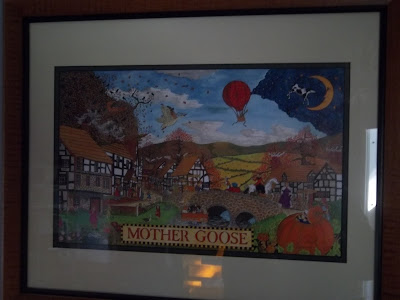
8. The World of Mother Goose.
 This is a print of one of my father's illustrations. Naturally it is in the children's room. This artist is not afraid of producing a busy composition, as you can see. I suppose I have inherited something of this same quality in my own outlook--my instinct is to pile up facts or names or other people's ideas and mistake them for detail. Detail is more akin to penetration. It is honing in on what is most significant, and that is why it is considered an important property of high art.
9. Gustav Wentzel, Sjaakspillere
 Yes, I believe the title in English is "Chess Players". Unfortunately I could not get a good picture of this. If I turned the flash off it was too dark. Bear in mind I had a break of about 10 minutes in which to go around the house and take all these pictures or I probably could have figured it out. Here is a link to the picture as it is supposed to look. The flash notably obscures the tasty-looking mug of beer set beside the board.
This is the other print brought back from the Norway trip. Its appeal, formerly its air of a kind of gentlemanly bohemianism, is now augmented by that of leisure and relaxation, but still in a cultivated context, all of which is largely inaccessible to me at the moment. The picture's placement contains one interesting coincidence, in that as you can see our own chessboard is stored right beside it--and it does get a good amount of use, though as yet our games are not very relaxed affairs--and one irony, in that the major item of furniture beneath it, atop which all of these miscellaneous items are sitting, is an antique piano, which however, no one in our house knows how to play, and which is so badly out of tune that even people who come over to the house who can play cannot play it, because the sound is too painful to them.
10. The other extant Dante illustration, from Inferno XIX
 The simonists. Those guys get it good and hard in hell. Also in the office. Everything framed in that room is small in size, no larger than a standard sheet of typing paper. There are also barometers and such kinds of things as people like to look at and be surrounded by when they are taking refuge from their actual lives.
11. Covered Bridge, Somewhere in Pennsylvania.
 This is one of my father's early pictures from the 60s, when he was taking after the style of Andrew Wyeth. I am about to contradict what I wrote in my last entry, in that this picture is also in the office but is somewhat bigger than an ordinary leaf of paper. However it is set atop an enormous and nearly immovable wardrobe that is in the corner of the room, so that if one is sitting down in the room he does not notice it too readily.
 Doesn't this remind you of the painting in Mr. Rogers's kitchen? This, along with at least one other picture in the same style, decorated the paneling in my grandparents' basement for around 35 years. Now we have it up in the children's playroom. I don't know what happened to the rest of the set.
 The figure in this picture bears some resemblance to Mrs Bourgeois Surrender. It was given to us as a gift for that reason. It currently hangs in one of the niches of the dining room, above a couple of items I did not include in this survey, one a framed, waterstained tableau of some antiquity featuring a black and white image of some woods with the oft-maligned Joyce Kilmer poem "Trees" incscribed beneath them, the second a poster of Neuschwanstein Castle, which I have never been to, but which the children like. If it helps them develop an interest in learning about/traveling to Europe someday--apparently nowadays getting boys especially interested in anything traditionally associated with learning or culture has become a Herculean labor--then it will have served us well.
 This is one of my father's early pictures from the 60s, when he was taking after the style of Andrew Wyeth. I am about to contradict what I wrote in my last entry, in that this picture is also in the office but is somewhat bigger than an ordinary leaf of paper. However it is set atop an enormous and nearly immovable wardrobe that is in the corner of the room, so that if one is sitting down in the room he does not notice it too readily.
 This picture was around during my childhood, and then it came into my possession after an interval of some 10-15 years through a third party whose hands it had fallen into. I don't know what it represents to me, other than a time--which the tendency is to imagine as a happy one though in reality it was no more or less happy than any other time--before I was born to which I have some relation. My father is not like me where his painting is concerned, angst-ridden and constantly suffering from crises of confidence and inferiority complexes. He paints not in a desperate attempt to become vital but because he is actually is vital, and as a celebration of that vitality. Obviously I can't really relate to that mindset.
12. Constable, Dedham Mill, Essex
 Doesn't this remind you of the painting in Mr. Rogers's kitchen? This, along with at least one other picture in the same style, decorated the paneling in my grandparents' basement for around 35 years. Now we have it up in the children's playroom. I don't know what happened to the rest of the set.
I have written elsewhere about my affection for this school of painting. It shares an attitude in common with other things I like, which is a kind of hopefulness or even optimism judiciously larded with a sense of authentic melancholy. As ways to understand existence go this seems to me a reasonable and comforting one, especially if a grander understanding is inaccessible due to limitations of the intellect or spirit which prove impossible to overcome.
13. A print, but who the artist is or anything else I do not know.
 The figure in this picture bears some resemblance to Mrs Bourgeois Surrender. It was given to us as a gift for that reason. It currently hangs in one of the niches of the dining room, above a couple of items I did not include in this survey, one a framed, waterstained tableau of some antiquity featuring a black and white image of some woods with the oft-maligned Joyce Kilmer poem "Trees" incscribed beneath them, the second a poster of Neuschwanstein Castle, which I have never been to, but which the children like. If it helps them develop an interest in learning about/traveling to Europe someday--apparently nowadays getting boys especially interested in anything traditionally associated with learning or culture has become a Herculean labor--then it will have served us well.
14. Postcard of our house, circa 1905
 It is largely obscured by the elm trees, which unfortunately of course all died in the great elm blight of the 60s which devastated this quintessential New England tree (it is still the state tree in Massachusetts) all over the region. We have planted one. It remains rather frail-looking even after a couple of years, but it is still alive.
A curious note for baseball fans, the house next door to us on the left, which is not visible in this postcard, was, I have been told, the boyhood home of Red Rolfe, who was the 3rd baseman for the Yankees from 1934-42, played on five championship teams, had several outstanding years, especially 1939 when he led the leagues in hits, runs scored and either doubles or triples, and was arguably the best player at his position in the history of that storied franchise (though granted, he would have batted 8th in the lineup of that all-time team) until the arrival of Alex Rodriguez.
 The bourgeois family extraordinaire. To be honest, I flatter myself by insuinating that I am bourgeois. Real bourgeois are actually quite rich by the standards of the median income or wealth. Five years ago when I began this page my ego, believe it or not, was still nowhere near deflated to a level correspondent to the truth; it still is not all the way there, nor am I ready for it to arrive at that point, though it continues to make a slow and grinding progress. Anyway, I thought at the time that by being bothered with conventional things like jobs and children meant that one was bourgeois, which seemed bad enough. That the truth is, in fact, probably even worse is something that will take a further number of years to come to terms with.
 This is the other picture from the library fire sale. This is the 3rd picture in the very artsy refrigerator room, above the Vermeer.
 One of my father's prints--such money as there is in this type of art is the ability to sell prints. I have a reputation for being fond of travel, so I received one of these as a present. It is true, I have never been much of a homebody. I like to get out of the house, especially if I am not going to be able to read or write. This is probably the main reason I always envisioned myself living in a big city and renting, so I wouldn't have to be bothered with the responsibility of upkeep on a house, for which so many other people seemed to me so much better suited than myself, while I seemed so well suited for bohemianism and reflection and sensualism and all that.
 It is largely obscured by the elm trees, which unfortunately of course all died in the great elm blight of the 60s which devastated this quintessential New England tree (it is still the state tree in Massachusetts) all over the region. We have planted one. It remains rather frail-looking even after a couple of years, but it is still alive.
 A curious note for baseball fans, the house next door to us on the left, which is not visible in this postcard, was, I have been told, the boyhood home of Red Rolfe, who was the 3rd baseman for the Yankees from 1934-42, played on five championship teams, had several outstanding years, especially 1939 when he led the leagues in hits, runs scored and either doubles or triples, and was arguably the best player at his position in the history of that storied franchise (though granted, he would have batted 8th in the lineup of that all-time team) until the arrival of Alex Rodriguez.
This item hangs in the dining room above the china cabinet.
15. Degas, Portrait of the Belilli Family
 The bourgeois family extraordinaire. To be honest, I flatter myself by insuinating that I am bourgeois. Real bourgeois are actually quite rich by the standards of the median income or wealth. Five years ago when I began this page my ego, believe it or not, was still nowhere near deflated to a level correspondent to the truth; it still is not all the way there, nor am I ready for it to arrive at that point, though it continues to make a slow and grinding progress. Anyway, I thought at the time that by being bothered with conventional things like jobs and children meant that one was bourgeois, which seemed bad enough. That the truth is, in fact, probably even worse is something that will take a further number of years to come to terms with.
This picture is big and used to hang on the large wall in the staircase. It has since been replaced by photographs of the children and has been retired to the attic.
The public library in our town used to have a collection of framed copies of famous artworks they would allow you to check out for 28 days. Sometime in the early 2000s they ended this service and had a sale of the pictures. This is one of them. There is another directly below.
16. Henri Rousseau, Family Outing
 This is the other picture from the library fire sale. This is the 3rd picture in the very artsy refrigerator room, above the Vermeer.
I admit I was not a particular fan of Henri Rousseau, but my wife finds a lot of joy and life in his paintings, especially this one, and she is not somebody who goes around liberally declaring enthusiasm for artworks.
17. "Travel"
 One of my father's prints--such money as there is in this type of art is the ability to sell prints. I have a reputation for being fond of travel, so I received one of these as a present. It is true, I have never been much of a homebody. I like to get out of the house, especially if I am not going to be able to read or write. This is probably the main reason I always envisioned myself living in a big city and renting, so I wouldn't have to be bothered with the responsibility of upkeep on a house, for which so many other people seemed to me so much better suited than myself, while I seemed so well suited for bohemianism and reflection and sensualism and all that.
18. The Prophet Jeremiah from the Sistine Chapel Ceiling.
 In the dining room. I like it, though it does not really fit in with the rest of the collection.
 In the dining room. I like it, though it does not really fit in with the rest of the collection.
19. Postcard of the Former Union Station, Portland, ME
 I doubt I need to tell you what my opinion of the destruction of so many of America's great railroad stations is. A few years ago I saw a calendar/postcard type book featuring pictures of various stations in New Hampshire alone that were no more...but time is up. I will save my ruminations on America's lost train culture and how that may or may not have negatively affected my life in another post. It is 9 days since I started this, and it is time to move on.
 I doubt I need to tell you what my opinion of the destruction of so many of America's great railroad stations is. A few years ago I saw a calendar/postcard type book featuring pictures of various stations in New Hampshire alone that were no more...but time is up. I will save my ruminations on America's lost train culture and how that may or may not have negatively affected my life in another post. It is 9 days since I started this, and it is time to move on.
 Sunday, September 11, 2011
The Price of Art?
I am going to open this posting--every new one holds, at the beginning at least, the promise of attaining its aims, which are, tritely, liveliness, interest, and a suggestion of timelessness--with a very short excerpt I have read recently. The story, fictitious as far as I know, though perhaps it was based on a similar 'real' legend, regards the history of a piece of fine art, a spectacular ebony statuette of a turbanned, muscular moorish slave:
"Two hundred years ago (note--the time intended would have been circa the 1460s) there was a Venetian lady--very beautiful, as all ladies in legends are--and she owned a gigantic black slave whom her husband imagined to be a eunuch. But he was not and when the lady bore his black child she had the infant killed and a white one put in its place. The midwife, from some motive of jealousy or revenge, told the husband of his wife's infidelity and he killed the slave before her eyes. She had the ebony statue made, secretly of course, in her lover's memory."
This passage occurs about three-quarters of the way into Kathleen Winsor's scandalous 972 page 1944 novel, Forever Amber, a Gone With the Wind-style blockbuster set in the first decade of Restoration England which was my bathroom/poolside reading for much of the summer. This was from my "B" reading list, which consists of things I take up that have piqued my interest for whatever reason and which I do not feel compelled to read all the way through if I don't want to. Sometimes I write about these books here, though usually I do not. Forever Amber is not quite refined and penetrating enough in its perceptions to be literature, I suspect, but there is nonetheless some skill and vision in it that approach to being enviable. It is not a book that I would always pick up eagerly, but I did find often upon getting started that it was easy to become absorbed in the frequently outrageous story and be carried for 20 or 30 pages at a stretch without being conscious of keeping up an effort either to follow the author's genius or endure her banality. I suspect that Kathleen Winsor, a 28-year housewife, and evidently a rather boisterous one, at the time of the book's publication, was plenty bright; as a normally adjusted middle, probably professional class, midwestern American of her time, subtlety and the inclination to experience life as something which primarily took place in one's own head were perhaps not overly developed in her. As can be seen below, she was quite conventionally attractive, and by most accounts enjoyed, and was capable of having, a good time in the conventional sense of parties, drinking, dancing, flirting with men and so forth. This book is almost certainly most famous for all of the sex in it, almost all of which occurs in a very direct, matter of fact manner, that is much in accordance with the probable way most men, and to judge by the sales of the book, apparently many women as well, dream that their own sex lives were like, though far contrary to the way they usually actually are. To cite some statistics, the attorney general of Massachusetts, in banning the book, noted 70 references to sexual intercourse, 39 illegitimate pregnancies, and 7 abortions (as well as 10 descriptions of women undressing in front of men). It seemed like there were a lot more than 70 instances of the Grand Act that to so many people is for the most part something not quite real. Sex in this book is bluntly understood to be for men a token of and duty paid to their personal power, and for the women a currency through which to obtain resources and position. Such people as do develop tender feelings for particular individuals are quickly made to suffer for them, frequently onto the point of death. Amber is supposed to be "in love" with Carlton, but it seems more that she is obsessed with the glamour he represents that, by the end of the book practically alone, she can never have. It's not surprising that such themes resonated deeply with the mass American public.
Kathleen Winsor appears to have had an even more extreme than usual hunger for what are known in contemporary parlance as alpha males, in her case the highest of the high, as well as a complementary eagle eye and searing contempt for male weakness or inferiority in any form, and delight in its exposure. She would have fit in well at Duke or Southern California or any of our other contemporary universities where the social competition is especially noted for its ruthlessness and lack of pity towards losers. Bruce Carlton of course is the ultimate male of this story--the recent civic disturbances in Britain would have been very short-lived if men like Lord Carlton and his pals still predominated in the upper ranks of that nation. He is a noble born cavalier, he recoups his fortune privateering, he is the greatest swordsman in England, and probably the world, he has rock hard abs and a gorgeous dark complexion. He does not come on to a single woman, that I remember, in the book; they beg him to ravish them, heedless of all possible consequences. He promises them nothing and openly goes to bed with whomever he wants, and the women remain powerless to do anything but nurture irrational hopes that somehow he will be moved one day to commit to them more or less exclusively while expending their fury on the rivals with whom they share his love. When he does get married it is to the most beautiful and purest virgin of the noblest birth imaginable, who lives for nothing but to serve her husband's happiness. The other main alpha males in the story are the "sexually driven" (as the book's introduction, written by a woman, approvingly puts it) King Charles II, who gets to pretty much order up whomever he takes a fancy to to his bedchamber, though those receiving an invitation are invariably delighted with the honor, unless they're supposed to be getting it on with Lord Carlton that same night; and the sadistic, brilliant and impeccably, for social purposes, educated and bred Lord Buckingham, who also has his way with pretty much whomever he wants, sexually and otherwise, and makes them feel his domination of them to the innermost core of their psyche. These are thus our role models of what a man should be.
The great book I suppose for getting a sense of what English society, and particularly London, was like during this period, is Pepys' Diary, which I have not however read to this point. Forever Amber attempts to paint an idea of this world within a fairly wide, if not deep, scope, and I think it is handled pretty well. The different aspects, of nature, of social classes, of historical events and personages, of amusements, of the idea that the various characters and customs in the book constitute a single people or nation, do not hold together at all times in the reader's mind, as complex ideas are supposed to be able to do in superior works of literature, and often are temporarily forgotten about or neglected all together, which is doubtless a flaw in the composition. Still, I was reminded at many instances in the book of the flow of history, and of the rise and decline of peoples and generations and institutions and beloved customs, set against a background, in some cases more or less permament than others, but all at least longer lasting than a single generation or even three, of nature, climate, geography (including human settlements, roads, etc), language and human lineage. Perhaps the picture produced was an especially superficial and inaccurate one, but the effect at least was produced.
I have strayed a bit from the opening question, as it were, of the post, which was essentially whether the capability of producing great art, clear thought, and an overall high level of culture required long centuries of hard and dispassionate action with severe and frequently deadly consequences for weakness and failure as the working ethos of a society. This idea was very popular in the 1940s--it is redolent of Orson Welles's famous cuckoo-clock speech in The Third Man--and can be found as well in numerous 20th century works chronicling (sympathetically) the passing of the old aristocratic Europe. This was doubtless a result of some insecurity on the part of the more sensitive and astute representatives of the New Order, with the comfortable and self-consciously 'nice' masses of America leading the way, both with regard to the desire to live up to the cultural achievements of their predecessors, as well as justification for the brutality of the wars and harshness of other political and economic policies they had undertaken to maintain and expand their newfound power. The main problem with modern culture, America perhaps especially, is not that they are too nice and naive to produce art, but that at the mass level there are too many nice and naive people who want to produce art, without having any idea what they are about. There are people at the heart of the culture who know exactly what is going on and what being a human being in present day society really means, and some of them doubtless are expressing this artistically and beautifully, but is there a substantial and coherent enough audience for this work to make it influential in any social milieux?
 Linda Darnell as Amber in the 1947 Film Version of FA.
The movie of Forever Amber is not supposed to very good, and I regret to report that this is an accurate assessment. Given my usual affinity for the period and the fact that Linda Darnell, whom I wrote about positively in these pages for her role in the Letter to Three Wives ('49), was starring, I thought it was worth a try. In the first place, the length of the book necessitated cutting out 80-90% of the story right off the bat, and otherwise often combining two or more episodes into one scene. Various characters make a single 60-second appearance whom, if you had not read the book, you would have no idea who they were.The sex also had to be toned down quite a lot, though not to the extent that it was not still more than a little tawdry; the effect that was needed however was that of total and unrelenting moral dissipation, which is not achieved. The prolific and ubiquitous (not in a good way; rather in the way girls who were tired of seeing me at beer parties in my youth used to say that I was ubiquitous) Otto Preminger was given the assignment to direct the movie by 20th Century Fox--this is getting scary, I am finally starting to pay attention, in the old movies anyway, to which studio was behind each project, like a real film scholar--which was envisioning a possible Gone With the Wind-like success. Preminger apparently hated the book and called the movie the worst one he ever made, but compared to the greats and very goods I have been concentrating on these last few years, the clunkiness of the direction really stands out. The material is not perhaps ideal, but no one involved with the movie seemed to have much of a feel for it. It seems that someone could have wrung some spirit or magic out of it, but it is for the most part just dead on the screen.

Bruce and Amber Seeking Refuge in London During the Plague of 1665
Unlike, apparently, most people with a pulse, I did not feel much emotion with regard to the 10th anniversary commemorations that were everywhere in the media this past week, and wherever I found them I usually skipped over them or changed the station. I do not handle talking about that kind of thing well, and neither, quite frankly, does almost anyone else. That said, the event for whatever reason does not seem to have had the same impact on me as it has on other people. Of course I did not personally know anyone who died, nor am I a New Yorker or a fireman or any of the other people who felt the impact of this in a personal way which is hard for me to understand. To me the whole episode felt extremely random and impersonal, and perpetrated by people who knew very little about either America or New York City. While at the moment the event was certainly terrible and shocking, I did not find it surprising that such an event should ever have happened, as evidently most people did, and still do. I was surprised by the form, bordering at times on hysteria it seemed to me, which the emotion aroused by the event took. I had not recognized it as such a predominant character in the American people up to that time. I suspect a good number of my countrymen would take great issue with my fairly blase response to these phenomena and would feel compelled to question what was so horribly neglected in my upbringing, education, and so forth, to leave me so devoid of ordinary human feeling and instinct, and I do feel a lack in this area which does bother me; which is why I felt compelled to write anything about the matter at all.
Some good searches found their way to the site this week. My favorite was "females being taught to surrender sexually", a subject on which I thought there would be more expert information than that which I offer here, though "what did they wear for clothing in norway in the early 1900s" a subject which to my knowledge I have never addressed here or anywhere else, was also inspired.
I am going to open this posting--every new one holds, at the beginning at least, the promise of attaining its aims, which are, tritely, liveliness, interest, and a suggestion of timelessness--with a very short excerpt I have read recently. The story, fictitious as far as I know, though perhaps it was based on a similar 'real' legend, regards the history of a piece of fine art, a spectacular ebony statuette of a turbanned, muscular moorish slave:
"Two hundred years ago (note--the time intended would have been circa the 1460s) there was a Venetian lady--very beautiful, as all ladies in legends are--and she owned a gigantic black slave whom her husband imagined to be a eunuch. But he was not and when the lady bore his black child she had the infant killed and a white one put in its place. The midwife, from some motive of jealousy or revenge, told the husband of his wife's infidelity and he killed the slave before her eyes. She had the ebony statue made, secretly of course, in her lover's memory."
This passage occurs about three-quarters of the way into Kathleen Winsor's scandalous 972 page 1944 novel, Forever Amber, a Gone With the Wind-style blockbuster set in the first decade of Restoration England which was my bathroom/poolside reading for much of the summer. This was from my "B" reading list, which consists of things I take up that have piqued my interest for whatever reason and which I do not feel compelled to read all the way through if I don't want to. Sometimes I write about these books here, though usually I do not. Forever Amber is not quite refined and penetrating enough in its perceptions to be literature, I suspect, but there is nonetheless some skill and vision in it that approach to being enviable. It is not a book that I would always pick up eagerly, but I did find often upon getting started that it was easy to become absorbed in the frequently outrageous story and be carried for 20 or 30 pages at a stretch without being conscious of keeping up an effort either to follow the author's genius or endure her banality. I suspect that Kathleen Winsor, a 28-year housewife, and evidently a rather boisterous one, at the time of the book's publication, was plenty bright; as a normally adjusted middle, probably professional class, midwestern American of her time, subtlety and the inclination to experience life as something which primarily took place in one's own head were perhaps not overly developed in her. As can be seen below, she was quite conventionally attractive, and by most accounts enjoyed, and was capable of having, a good time in the conventional sense of parties, drinking, dancing, flirting with men and so forth.
This book is almost certainly most famous for all of the sex in it, almost all of which occurs in a very direct, matter of fact manner, that is much in accordance with the probable way most men, and to judge by the sales of the book, apparently many women as well, dream that their own sex lives were like, though far contrary to the way they usually actually are. To cite some statistics, the attorney general of Massachusetts, in banning the book, noted 70 references to sexual intercourse, 39 illegitimate pregnancies, and 7 abortions (as well as 10 descriptions of women undressing in front of men). It seemed like there were a lot more than 70 instances of the Grand Act that to so many people is for the most part something not quite real. Sex in this book is bluntly understood to be for men a token of and duty paid to their personal power, and for the women a currency through which to obtain resources and position. Such people as do develop tender feelings for particular individuals are quickly made to suffer for them, frequently onto the point of death. Amber is supposed to be "in love" with Carlton, but it seems more that she is obsessed with the glamour he represents that, by the end of the book practically alone, she can never have. It's not surprising that such themes resonated deeply with the mass American public.Kathleen Winsor appears to have had an even more extreme than usual hunger for what are known in contemporary parlance as alpha males, in her case the highest of the high, as well as a complementary eagle eye and searing contempt for male weakness or inferiority in any form, and delight in its exposure. She would have fit in well at Duke or Southern California or any of our other contemporary universities where the social competition is especially noted for its ruthlessness and lack of pity towards losers. Bruce Carlton of course is the ultimate male of this story--the recent civic disturbances in Britain would have been very short-lived if men like Lord Carlton and his pals still predominated in the upper ranks of that nation. He is a noble born cavalier, he recoups his fortune privateering, he is the greatest swordsman in England, and probably the world, he has rock hard abs and a gorgeous dark complexion. He does not come on to a single woman, that I remember, in the book; they beg him to ravish them, heedless of all possible consequences. He promises them nothing and openly goes to bed with whomever he wants, and the women remain powerless to do anything but nurture irrational hopes that somehow he will be moved one day to commit to them more or less exclusively while expending their fury on the rivals with whom they share his love. When he does get married it is to the most beautiful and purest virgin of the noblest birth imaginable, who lives for nothing but to serve her husband's happiness. The other main alpha males in the story are the "sexually driven" (as the book's introduction, written by a woman, approvingly puts it) King Charles II, who gets to pretty much order up whomever he takes a fancy to to his bedchamber, though those receiving an invitation are invariably delighted with the honor, unless they're supposed to be getting it on with Lord Carlton that same night; and the sadistic, brilliant and impeccably, for social purposes, educated and bred Lord Buckingham, who also has his way with pretty much whomever he wants, sexually and otherwise, and makes them feel his domination of them to the innermost core of their psyche. These are thus our role models of what a man should be.
The great book I suppose for getting a sense of what English society, and particularly London, was like during this period, is Pepys' Diary, which I have not however read to this point. Forever Amber attempts to paint an idea of this world within a fairly wide, if not deep, scope, and I think it is handled pretty well. The different aspects, of nature, of social classes, of historical events and personages, of amusements, of the idea that the various characters and customs in the book constitute a single people or nation, do not hold together at all times in the reader's mind, as complex ideas are supposed to be able to do in superior works of literature, and often are temporarily forgotten about or neglected all together, which is doubtless a flaw in the composition. Still, I was reminded at many instances in the book of the flow of history, and of the rise and decline of peoples and generations and institutions and beloved customs, set against a background, in some cases more or less permament than others, but all at least longer lasting than a single generation or even three, of nature, climate, geography (including human settlements, roads, etc), language and human lineage. Perhaps the picture produced was an especially superficial and inaccurate one, but the effect at least was produced.
I have strayed a bit from the opening question, as it were, of the post, which was essentially whether the capability of producing great art, clear thought, and an overall high level of culture required long centuries of hard and dispassionate action with severe and frequently deadly consequences for weakness and failure as the working ethos of a society. This idea was very popular in the 1940s--it is redolent of Orson Welles's famous cuckoo-clock speech in The Third Man--and can be found as well in numerous 20th century works chronicling (sympathetically) the passing of the old aristocratic Europe. This was doubtless a result of some insecurity on the part of the more sensitive and astute representatives of the New Order, with the comfortable and self-consciously 'nice' masses of America leading the way, both with regard to the desire to live up to the cultural achievements of their predecessors, as well as justification for the brutality of the wars and harshness of other political and economic policies they had undertaken to maintain and expand their newfound power. The main problem with modern culture, America perhaps especially, is not that they are too nice and naive to produce art, but that at the mass level there are too many nice and naive people who want to produce art, without having any idea what they are about. There are people at the heart of the culture who know exactly what is going on and what being a human being in present day society really means, and some of them doubtless are expressing this artistically and beautifully, but is there a substantial and coherent enough audience for this work to make it influential in any social milieux?
Linda Darnell as Amber in the 1947 Film Version of FA.The movie of Forever Amber is not supposed to very good, and I regret to report that this is an accurate assessment. Given my usual affinity for the period and the fact that Linda Darnell, whom I wrote about positively in these pages for her role in the Letter to Three Wives ('49), was starring, I thought it was worth a try. In the first place, the length of the book necessitated cutting out 80-90% of the story right off the bat, and otherwise often combining two or more episodes into one scene. Various characters make a single 60-second appearance whom, if you had not read the book, you would have no idea who they were.The sex also had to be toned down quite a lot, though not to the extent that it was not still more than a little tawdry; the effect that was needed however was that of total and unrelenting moral dissipation, which is not achieved. The prolific and ubiquitous (not in a good way; rather in the way girls who were tired of seeing me at beer parties in my youth used to say that I was ubiquitous) Otto Preminger was given the assignment to direct the movie by 20th Century Fox--this is getting scary, I am finally starting to pay attention, in the old movies anyway, to which studio was behind each project, like a real film scholar--which was envisioning a possible Gone With the Wind-like success. Preminger apparently hated the book and called the movie the worst one he ever made, but compared to the greats and very goods I have been concentrating on these last few years, the clunkiness of the direction really stands out. The material is not perhaps ideal, but no one involved with the movie seemed to have much of a feel for it. It seems that someone could have wrung some spirit or magic out of it, but it is for the most part just dead on the screen.
Bruce and Amber Seeking Refuge in London During the Plague of 1665
Unlike, apparently, most people with a pulse, I did not feel much emotion with regard to the 10th anniversary commemorations that were everywhere in the media this past week, and wherever I found them I usually skipped over them or changed the station. I do not handle talking about that kind of thing well, and neither, quite frankly, does almost anyone else. That said, the event for whatever reason does not seem to have had the same impact on me as it has on other people. Of course I did not personally know anyone who died, nor am I a New Yorker or a fireman or any of the other people who felt the impact of this in a personal way which is hard for me to understand. To me the whole episode felt extremely random and impersonal, and perpetrated by people who knew very little about either America or New York City. While at the moment the event was certainly terrible and shocking, I did not find it surprising that such an event should ever have happened, as evidently most people did, and still do. I was surprised by the form, bordering at times on hysteria it seemed to me, which the emotion aroused by the event took. I had not recognized it as such a predominant character in the American people up to that time. I suspect a good number of my countrymen would take great issue with my fairly blase response to these phenomena and would feel compelled to question what was so horribly neglected in my upbringing, education, and so forth, to leave me so devoid of ordinary human feeling and instinct, and I do feel a lack in this area which does bother me; which is why I felt compelled to write anything about the matter at all.
Some good searches found their way to the site this week. My favorite was "females being taught to surrender sexually", a subject on which I thought there would be more expert information than that which I offer here, though "what did they wear for clothing in norway in the early 1900s" a subject which to my knowledge I have never addressed here or anywhere else, was also inspired.
Tuesday, December 08, 2009
Excerpt
I am not going to do this very often, but I think the site needs a little more stylized, fictive content on it.
"I had an unusual day today," Erlsegaard said. "At moments it was among the happiest I have ever known, though nothing that happened is uncommon in normal human experience. I felt a distance between myself and the mundanities of ordinary existence. I felt elevated. I felt distinguished. I felt our city was as important and beautiful as any in the world when one had the time to go about and look at it calmly. It is hard for me to understand why we can't become one of those cities by which outsiders are humbled and awed. Why our minds are not more often concentrated to those finest points at which human life is only ever worth living, as they seem to be, or have been, in those other places."
"All this occurred to you this morning walking through the back alleys of Fairmount?"
"Some of it only occurred to me just now." Erlsegaard rose to a sitting position, with his back against the bathtub and his knees up. "You remember that old lady who spoke at school about St Petersburg and the beauties and profundities one's mind absorbed as a child there, the sensibilities bespoke in the placement of the stones in the walls and the layout and activity of the streets? And of course how we in our lives are ever cut off from this subtle, essential--and yes, sometimes dark humanity, because its presence has been eradicated, sanitized if you will, from our experience?"
"I do. Though I haven't thought about it since around the time we started drinking that night. I remember thinking that even if she had a point, it doesn't seem to be doing her much good. The old bag. What were we supposed to do exactly, be ashamed? You and I, Erlsegaard? I know other people were duly ashamed and suicidal; but the masses and big business and all that, which is all all these people are ever really talking about, all they care about, will never be tormented by how puny and ignorant they are the way these old intellectuals want them to. It's only you who believe it, Erlsegaard. It's only you who thinks art and philosophy and cathedrals and great cities and beautiful girls don't belong to you as much as anybody else. That you don't deserve to show your face around them. Old Germans and Russians, they'll never give you credit for understanding anything. Oh, and those Austro-Hungarians, they're the worst. That's the only satisfaction they have in this country, finding suckers like us, who give them the benefit of the doubt they've got something to tell us. I wouldn't take them all that seriously."
"I am skeptical you know about anybody who believes the last golden age happened to take place wherever it was they happened to be when they were twenty-two. Who ever recognized a golden age, in philosophy anyway, to have risen up when he was in his fifties? And suddenly all that essential humanity these places had, dies the moment it comes among us, can have no meaninful influence whatsoever? I want to know, if Petersburg and Berlin were such fruitful soil for men's brains, how could they have become so unbearable and impossible to live in? Of course, that is probably the whole secret, the necessity of ideological and personal tension that is only good so far as it is a matter of life and death. The pattern does seem to repeat itself in all the most genius-crossed societies. Nonetheless I am sure I have had glimpses of all these tantalizing possibilities and truths here. I'm sure I have had one today. Why wouldn't our winter air and light direct the mind's eye to those possibilities just as much as the beating sun and desert winds do for the Mediterranean peoples?"
"Perhaps. But then again, it's taken you twenty-five--what are you now, twenty-six? Jesus, Erlsegaard, you're getting old!--twenty-six years of looking and how many dozens of people whom you want to be like telling you what to look for just to get to this point of thinking you see what they knew they were seeing as children. They were just smart children who happened to live in a world more casually literate and replete with the conviction that the greatest existential dramas and advancements of the day were emanating from it alone than ours is, all of which no doubt makes a heavy impression on children. And now they've ended up somewhere comparatively peaceful and uninterested in philosophy, so they wince at all our pursuits, only no one except a few earnest students and social outcasts are impressed. I think that even if we have no secrets of our own to discover, future high civilizations will be mining us for material like crazy. I do wish I knew what they will find of importance. All will not be lost, anyway. But for ourselves, we can start by learning not to become impotent at the slightest suggestion that Genius might be in the room."
I am not going to do this very often, but I think the site needs a little more stylized, fictive content on it.
"I had an unusual day today," Erlsegaard said. "At moments it was among the happiest I have ever known, though nothing that happened is uncommon in normal human experience. I felt a distance between myself and the mundanities of ordinary existence. I felt elevated. I felt distinguished. I felt our city was as important and beautiful as any in the world when one had the time to go about and look at it calmly. It is hard for me to understand why we can't become one of those cities by which outsiders are humbled and awed. Why our minds are not more often concentrated to those finest points at which human life is only ever worth living, as they seem to be, or have been, in those other places."
"All this occurred to you this morning walking through the back alleys of Fairmount?"
"Some of it only occurred to me just now." Erlsegaard rose to a sitting position, with his back against the bathtub and his knees up. "You remember that old lady who spoke at school about St Petersburg and the beauties and profundities one's mind absorbed as a child there, the sensibilities bespoke in the placement of the stones in the walls and the layout and activity of the streets? And of course how we in our lives are ever cut off from this subtle, essential--and yes, sometimes dark humanity, because its presence has been eradicated, sanitized if you will, from our experience?"
"I do. Though I haven't thought about it since around the time we started drinking that night. I remember thinking that even if she had a point, it doesn't seem to be doing her much good. The old bag. What were we supposed to do exactly, be ashamed? You and I, Erlsegaard? I know other people were duly ashamed and suicidal; but the masses and big business and all that, which is all all these people are ever really talking about, all they care about, will never be tormented by how puny and ignorant they are the way these old intellectuals want them to. It's only you who believe it, Erlsegaard. It's only you who thinks art and philosophy and cathedrals and great cities and beautiful girls don't belong to you as much as anybody else. That you don't deserve to show your face around them. Old Germans and Russians, they'll never give you credit for understanding anything. Oh, and those Austro-Hungarians, they're the worst. That's the only satisfaction they have in this country, finding suckers like us, who give them the benefit of the doubt they've got something to tell us. I wouldn't take them all that seriously."
"I am skeptical you know about anybody who believes the last golden age happened to take place wherever it was they happened to be when they were twenty-two. Who ever recognized a golden age, in philosophy anyway, to have risen up when he was in his fifties? And suddenly all that essential humanity these places had, dies the moment it comes among us, can have no meaninful influence whatsoever? I want to know, if Petersburg and Berlin were such fruitful soil for men's brains, how could they have become so unbearable and impossible to live in? Of course, that is probably the whole secret, the necessity of ideological and personal tension that is only good so far as it is a matter of life and death. The pattern does seem to repeat itself in all the most genius-crossed societies. Nonetheless I am sure I have had glimpses of all these tantalizing possibilities and truths here. I'm sure I have had one today. Why wouldn't our winter air and light direct the mind's eye to those possibilities just as much as the beating sun and desert winds do for the Mediterranean peoples?"
"Perhaps. But then again, it's taken you twenty-five--what are you now, twenty-six? Jesus, Erlsegaard, you're getting old!--twenty-six years of looking and how many dozens of people whom you want to be like telling you what to look for just to get to this point of thinking you see what they knew they were seeing as children. They were just smart children who happened to live in a world more casually literate and replete with the conviction that the greatest existential dramas and advancements of the day were emanating from it alone than ours is, all of which no doubt makes a heavy impression on children. And now they've ended up somewhere comparatively peaceful and uninterested in philosophy, so they wince at all our pursuits, only no one except a few earnest students and social outcasts are impressed. I think that even if we have no secrets of our own to discover, future high civilizations will be mining us for material like crazy. I do wish I knew what they will find of importance. All will not be lost, anyway. But for ourselves, we can start by learning not to become impotent at the slightest suggestion that Genius might be in the room."
Tuesday, March 17, 2009
News of the World
I Think I Get That Hitler Was a Philistine. If you read The New York Times alone, in the last couple of months you would have had the opportunity to discover that the infamous dictator had "shocking" table manners, an expensive phonograph on which he was fond of listening to recordings of Wagner and Beethoven "with great emotion, if not artistic appreciation", and a library of 16,000 books arrayed in cases--"...handsome piece(s) of furniture with scalloped molding"--in which Anti-Semitic screeds and artless paeans to German nationalism were more favored and read than the serious works of literature, history, philosophy, etc, that one would expect to find on a real book lover's shelves. An internet search turns up lots more damning revelations of the Fuhrer's intellectual destitution, including this gem by the always reliable Francine Prose--who has displayed an unusual concern with the way people behave in art museums on several occasions during the course of her career--in which we find out that not only did the imbecile Hitler think Michelangelo and Caravaggio were the same person, but(though he famously aspired to be a painter, and might therefore be supposed to have some passing interest in technique) lied to his guide that he was admiring the play of light and shadow in the works on display, when in fact he was oscillating between being turned on--inappropriately so it is implied--by an erotic depiction by Corregio of Leda and the Swan and seeking reassurance of Rembrandt's disdain for Jews. Hitler's own paintings of course are predictably skewered not merely as the strangely sterile nonentities they are (strange given the popular image of their producer as in great part a raving lunatic), but as the productions of a singularly mean, hidebound, profoundly talentless and unimaginative intellect by every respectable person who considers them. Even his drinking habits--he would have a glass of beer or two with dinner, and nothing more--were cast in a dubious light by his guests and other commenters, whom one must assume were more accustomed to dinners where the Veuve Clicquot, as well as the joviality, the pretty girls, the cross-dressing and so on flowed freely all the way through dessert (at which by the way it was reported the Fuhrer frequently ate plates of cake which contributed to his having an unflattering physique), which was apparently not the case when dining with Hitler.
My problem with this is not that people are piling on Hitler, though I have always thought there were some rather unpleasant implications in this eagerness to emphasize Hitler's inferior background, education and understanding of beautiful things and difficult ideas to the person doing the emphasizing, as if his lack of suavity, bad taste in books, and inability to paint and properly appreciate music were identifiable causes and giveaway symbols of his unfortunate character. It is a convenient and self-serving means, for intellectuals especially, to disassociate themselves from him, and any taint of his ideology, but how important was it really? Yes, some real humanism properly grasped of the Thomas More variety would have made a great difference in him; it would with most people, I presume. I wonder though if it had only been some attractive trappings of humanism, if it would not have had some effect on the view of his legitimacy, which I always take to be one of the great issues people have with Hitler, as opposed to other murderous despots. Understood as an inherently inferior person, especially one who seems to have sought some level of culture and conventional social acceptance and failed to achieve it, his ascension to and abuse of power is seen as that much more illegitimate, and compounds the sickness people feel at his rule. This creep was easily enough denied a place in art school, popularity, love, etc, as a private citizen; how could he have gained the power of state machinery, armies, etc, so absolutely?
World Baseball Classic Semi-Defense. Not that I am following it. The format is clunky, the whole concept has been way too forced, the participation is oddly reluctant--there is too much adult supervision in general--but the constant sarcasm and negativity of the American sporting press directed at the event is getting on my nerves. There is nothing inherently wrong with the idea of an international baseball competition. I would prefer the event were a lot more organic, and had less of the stink of marketing about it, that some measure of enthusiasm had preceded organization too. What really is angering me about the whole event--and it is probably worse in New England than anywhere else--is the obsession on the part equally of fans, management and media with potential injuries and overworking pitchers. When did this idea that strong and healthy men in the prime of life are at constant risk of hurting themselves if not carefully monitored take such hold in the culture. I understand that guys make too much money now to be completely inattentive to the possibility of a serious injury, but until very recently it was not unusual for pro ballplayers, including stars and pitchers, to play a decent amount of competitive baseball in the off-season. Besides things like all-star tours of Japan, which date back to the days of Babe Ruth, the Caribbean winter leagues featured lots of big league talent, including almost all of the players who were natives of that region. The U.S. media for the most part didn't pay much attention to "winter ball", but it was a real thing, and I don't recall a lot of established players getting hurt in these leagues. Going back even further of course to the pre-World War II era, various teams of big leaguers would barnstorm around the countryside in the offseason playing games against local teams, college teams, The House of David, black teams. Dizzy Dean and Satchel Paige once pitched against each other in one of these exhibitions that ended 1-0 in 18 innings, both pitchers of course going the whole way (the mere thought of this would be enough to give a modern GM a coronary). Again, I don't recall reading about too many established players getting seriously hurt in these games. Anyway, I suspect life was understood to be generally more hazardous in that era. The fear of injuries was not as pervasive as it is now; and I don't think it had occurred to the executives of that time that they could forbid a grown man to do a whole list of activities wherein he might get hurt, as is standard in contracts today, unless they paid him more, which they were also far less willing to do. It is really the paranoia that has taken root among the fans that a guy might get injured in a non-major league game (or in one, for that matter) that I don't get. It's time to back away from ESPN, the Sons of Sam Horn.com, Curt Schilling's blog (he's against the WBC, by the way) whatever. This business of reporting on television if a guy was favoring his ankle during infield or skipped batting practice--it's ridiculous. Until a guy misses at least three games in a row, or two starts as a pitcher, I don't consider that to be an "injury" that needs to be reported.
Demise of the Pub/Tavern/Hospoda Such as Everyone Supposedly Loves so Much. This week it is the genuine Irish pub whose position has reached the critical stage. The British pub has moved beyond that threshhold for some time, and the kind of hard-drinking, happy hour lasts all day-type American bar that was once ubiquitous in our urban areas and familiar from a thousand black-and-white movies has been slowly grinding to extinction, and the moment may have already arrived. There weren't many left twenty years ago, and those were accidental, a matter of old ownership that hadn't bothered to update the decor or menu since 1958. The raw numbers of bars are in decline too. According to one study, there are 1,321 taverns currently in Chicago today, down from nearly 7,000 in 1947, and the numbers of bars in Philadelphia has declined 33% since 1971 (I can vouch for this personally. When I was a kid if there was an intersection with a traffic light, there was almost guaranteed to be a bar, if not two, on the corner. Spotting the corner bars was actually a game we used to play while driving around in town). The traditional Czech pub, which is a wonderful place that is even less organized to bring in the necessary 21st-century levels of income flows than these other dying sorts of establishments, must be hearing the footsteps of the grim reaper (though it must have the lowest overhead/set-up cost of any business I've ever seen. A large room, a few tables and chairs and ratty tablecloths, a couple of shelves with about ten bottles of hard liquor, a rack for glasses, and a small counter to set your one beer tap--the beer is always good, so it doesn't matter that you've only got one kind--and you're in business). And oh yes, the number of French cafes has declined from 600,000 or so in the mid-20th century to 41,000 today and dropping. What the hell are people doing with their lives?
I want to end the post, so while I would like to delve more into the causes of these, in my opinion, catastrophic developments, I think the main reason has to be that unfortunately their model, as solo establishments especially, just isn't economically viable anymore. Even a handful of alcoholics or bohemians sitting around for hours nursing $2 drinks and sipping 60 cent coffees might have sufficed to pay the bills in 1910, or 1960--and in the Czech Republic, which still has a pretty primitive economy, or at least did in the mid to late 90s, this kind of low-level economic activity still provides some value--but it can't compete on the (macro-level?) in 2009.
Addendum: Upon further rumination, some of the statistics cited in the last section are either misleading or do not pass the muster of probability. While the number of bars in Philadelphia may well have decreased 33% since 1970, the city's population has decreased about the same percentage in that period, from around 2.1 million to 1.4 million, where it appears for the moment at least to have stabilized. The effect of this decreased population, as well as the consequent decrease in the number of bars, is obviously noticeable however to anyone who has been familiar with the city over this span of years. The numbers on the French cafes in the heyday of that institution have to be way too high. When there supposedly 600,000 cafes in France the population of the entire nation was around 40 million tops. One cafe for every 65 people? The same article I linked to states there were 200, 000 cafes in Paris alone. The current population of the city of Paris proper is around 2 million, and I don't think it has shrunk appreciably in the last century. That would mean there was 1 cafe for every 10 residents of the city, not to mention that one or two people at least would always have to be working. There is no way that figure can be accurate.
I Think I Get That Hitler Was a Philistine. If you read The New York Times alone, in the last couple of months you would have had the opportunity to discover that the infamous dictator had "shocking" table manners, an expensive phonograph on which he was fond of listening to recordings of Wagner and Beethoven "with great emotion, if not artistic appreciation", and a library of 16,000 books arrayed in cases--"...handsome piece(s) of furniture with scalloped molding"--in which Anti-Semitic screeds and artless paeans to German nationalism were more favored and read than the serious works of literature, history, philosophy, etc, that one would expect to find on a real book lover's shelves. An internet search turns up lots more damning revelations of the Fuhrer's intellectual destitution, including this gem by the always reliable Francine Prose--who has displayed an unusual concern with the way people behave in art museums on several occasions during the course of her career--in which we find out that not only did the imbecile Hitler think Michelangelo and Caravaggio were the same person, but(though he famously aspired to be a painter, and might therefore be supposed to have some passing interest in technique) lied to his guide that he was admiring the play of light and shadow in the works on display, when in fact he was oscillating between being turned on--inappropriately so it is implied--by an erotic depiction by Corregio of Leda and the Swan and seeking reassurance of Rembrandt's disdain for Jews. Hitler's own paintings of course are predictably skewered not merely as the strangely sterile nonentities they are (strange given the popular image of their producer as in great part a raving lunatic), but as the productions of a singularly mean, hidebound, profoundly talentless and unimaginative intellect by every respectable person who considers them. Even his drinking habits--he would have a glass of beer or two with dinner, and nothing more--were cast in a dubious light by his guests and other commenters, whom one must assume were more accustomed to dinners where the Veuve Clicquot, as well as the joviality, the pretty girls, the cross-dressing and so on flowed freely all the way through dessert (at which by the way it was reported the Fuhrer frequently ate plates of cake which contributed to his having an unflattering physique), which was apparently not the case when dining with Hitler.
My problem with this is not that people are piling on Hitler, though I have always thought there were some rather unpleasant implications in this eagerness to emphasize Hitler's inferior background, education and understanding of beautiful things and difficult ideas to the person doing the emphasizing, as if his lack of suavity, bad taste in books, and inability to paint and properly appreciate music were identifiable causes and giveaway symbols of his unfortunate character. It is a convenient and self-serving means, for intellectuals especially, to disassociate themselves from him, and any taint of his ideology, but how important was it really? Yes, some real humanism properly grasped of the Thomas More variety would have made a great difference in him; it would with most people, I presume. I wonder though if it had only been some attractive trappings of humanism, if it would not have had some effect on the view of his legitimacy, which I always take to be one of the great issues people have with Hitler, as opposed to other murderous despots. Understood as an inherently inferior person, especially one who seems to have sought some level of culture and conventional social acceptance and failed to achieve it, his ascension to and abuse of power is seen as that much more illegitimate, and compounds the sickness people feel at his rule. This creep was easily enough denied a place in art school, popularity, love, etc, as a private citizen; how could he have gained the power of state machinery, armies, etc, so absolutely?
World Baseball Classic Semi-Defense. Not that I am following it. The format is clunky, the whole concept has been way too forced, the participation is oddly reluctant--there is too much adult supervision in general--but the constant sarcasm and negativity of the American sporting press directed at the event is getting on my nerves. There is nothing inherently wrong with the idea of an international baseball competition. I would prefer the event were a lot more organic, and had less of the stink of marketing about it, that some measure of enthusiasm had preceded organization too. What really is angering me about the whole event--and it is probably worse in New England than anywhere else--is the obsession on the part equally of fans, management and media with potential injuries and overworking pitchers. When did this idea that strong and healthy men in the prime of life are at constant risk of hurting themselves if not carefully monitored take such hold in the culture. I understand that guys make too much money now to be completely inattentive to the possibility of a serious injury, but until very recently it was not unusual for pro ballplayers, including stars and pitchers, to play a decent amount of competitive baseball in the off-season. Besides things like all-star tours of Japan, which date back to the days of Babe Ruth, the Caribbean winter leagues featured lots of big league talent, including almost all of the players who were natives of that region. The U.S. media for the most part didn't pay much attention to "winter ball", but it was a real thing, and I don't recall a lot of established players getting hurt in these leagues. Going back even further of course to the pre-World War II era, various teams of big leaguers would barnstorm around the countryside in the offseason playing games against local teams, college teams, The House of David, black teams. Dizzy Dean and Satchel Paige once pitched against each other in one of these exhibitions that ended 1-0 in 18 innings, both pitchers of course going the whole way (the mere thought of this would be enough to give a modern GM a coronary). Again, I don't recall reading about too many established players getting seriously hurt in these games. Anyway, I suspect life was understood to be generally more hazardous in that era. The fear of injuries was not as pervasive as it is now; and I don't think it had occurred to the executives of that time that they could forbid a grown man to do a whole list of activities wherein he might get hurt, as is standard in contracts today, unless they paid him more, which they were also far less willing to do. It is really the paranoia that has taken root among the fans that a guy might get injured in a non-major league game (or in one, for that matter) that I don't get. It's time to back away from ESPN, the Sons of Sam Horn.com, Curt Schilling's blog (he's against the WBC, by the way) whatever. This business of reporting on television if a guy was favoring his ankle during infield or skipped batting practice--it's ridiculous. Until a guy misses at least three games in a row, or two starts as a pitcher, I don't consider that to be an "injury" that needs to be reported.
Demise of the Pub/Tavern/Hospoda Such as Everyone Supposedly Loves so Much. This week it is the genuine Irish pub whose position has reached the critical stage. The British pub has moved beyond that threshhold for some time, and the kind of hard-drinking, happy hour lasts all day-type American bar that was once ubiquitous in our urban areas and familiar from a thousand black-and-white movies has been slowly grinding to extinction, and the moment may have already arrived. There weren't many left twenty years ago, and those were accidental, a matter of old ownership that hadn't bothered to update the decor or menu since 1958. The raw numbers of bars are in decline too. According to one study, there are 1,321 taverns currently in Chicago today, down from nearly 7,000 in 1947, and the numbers of bars in Philadelphia has declined 33% since 1971 (I can vouch for this personally. When I was a kid if there was an intersection with a traffic light, there was almost guaranteed to be a bar, if not two, on the corner. Spotting the corner bars was actually a game we used to play while driving around in town). The traditional Czech pub, which is a wonderful place that is even less organized to bring in the necessary 21st-century levels of income flows than these other dying sorts of establishments, must be hearing the footsteps of the grim reaper (though it must have the lowest overhead/set-up cost of any business I've ever seen. A large room, a few tables and chairs and ratty tablecloths, a couple of shelves with about ten bottles of hard liquor, a rack for glasses, and a small counter to set your one beer tap--the beer is always good, so it doesn't matter that you've only got one kind--and you're in business). And oh yes, the number of French cafes has declined from 600,000 or so in the mid-20th century to 41,000 today and dropping. What the hell are people doing with their lives?
I want to end the post, so while I would like to delve more into the causes of these, in my opinion, catastrophic developments, I think the main reason has to be that unfortunately their model, as solo establishments especially, just isn't economically viable anymore. Even a handful of alcoholics or bohemians sitting around for hours nursing $2 drinks and sipping 60 cent coffees might have sufficed to pay the bills in 1910, or 1960--and in the Czech Republic, which still has a pretty primitive economy, or at least did in the mid to late 90s, this kind of low-level economic activity still provides some value--but it can't compete on the (macro-level?) in 2009.
Addendum: Upon further rumination, some of the statistics cited in the last section are either misleading or do not pass the muster of probability. While the number of bars in Philadelphia may well have decreased 33% since 1970, the city's population has decreased about the same percentage in that period, from around 2.1 million to 1.4 million, where it appears for the moment at least to have stabilized. The effect of this decreased population, as well as the consequent decrease in the number of bars, is obviously noticeable however to anyone who has been familiar with the city over this span of years. The numbers on the French cafes in the heyday of that institution have to be way too high. When there supposedly 600,000 cafes in France the population of the entire nation was around 40 million tops. One cafe for every 65 people? The same article I linked to states there were 200, 000 cafes in Paris alone. The current population of the city of Paris proper is around 2 million, and I don't think it has shrunk appreciably in the last century. That would mean there was 1 cafe for every 10 residents of the city, not to mention that one or two people at least would always have to be working. There is no way that figure can be accurate.
Wednesday, February 18, 2009
"The Passionate Shepherd to His Love"--Marlowe
I have been away, thus the lag between postings--it is even more hopeless for me to try to get on a computer on vacation than it is at home. I hope the break has had some kind of refreshing effect on my brain. Feeling that one has written something decent every now and then may be the cheapest of all thrills, but it is one I have not been having much of lately, and I find my being strangely empty to have to do constantly without it.
I lay out in the sun for two days, albeit with my shirt on, but for the first time in my life I have what might plausibly be called a tan, as well as a few blond highlights in my hair. The tan would look a lot better if I had remembered to take my sunglasses off--the coloring of my face currently resembles that of a raccoon--but being, in private anyway, the utter narcissist that I am, I am taken with the effect of it. It at least looks different, something of which sort I realize I have been craving for at least ten or eleven years but could not quite think or determine on what exactly to do, and how to bring it about.
This Marlowe poem is one of a set of three, the other two, Ralegh's "The Nymph's Reply to the Shepherd", and Donne's "The Bait", being direct responses to the first. I was going to kill them all in a single posting, but as I don't have anything really to say about them--wonderful little concoctions of words and thought though they all are--each one will get a separate, and hopefully short, post, primarily about something else. I do care about the poems though, and all that they stand for. It gives me great satisfaction to think about them, not 'in themselves', but as little monuments of history that I have came upon, as upon an engraved stone in some windswept field or other, and must record the encounter with a snapshot of myself in some undefined proximity to the stone. This is primarily what literature is to me, but this approach still can dominate your life in myriad ways, which are not fully appreciated by the crowd that actually understands what all the books and pictures and historical developments actually are about
When I was in Florida I went one afternoon by myself to the Ringling Art Museum in Sarasota. I had been there once before but I had had my children with me and had only made it about halfway through the collection before it closed. I had not seen any such old art in person for several years, since one of my sons climbed up onto an Empire bed with a satiny-looking green and gold coverlet at the MFA in Boston, which you are not supposed to do. While I felt in pretty good spirits in the early rooms, among the Rubenses and the medieval triptychs and the Renaissance both early and late and the Dutch masters and the Poussins, seeing one of which--there were two on display this time--had so excited me on my previous visit there, I was not really at ease, and felt somewhat estranged both from the pictures and the scene in my current state of mind. It was much more crowded than it had been the other time I was there, with almost everyone in the place being over 60, and giving off much more of a vacationing/wintering/sightseeing vibe than an "art vibe", whether pretentious or earnest or edgy. The exception was a high school group of very conservative-looking but gentle-seemed, well-groomed Christians (they were earnest). I had the thought that perhaps I could not really look at art and enjoy it anymore, as I often think I should stop reading too and focus more on my lawn or something for a few years, that a person has to have attained some degree of coherence within himself and in his relation to the world to be able to encounter books and artworks and people and get--or give--anything out of it. When I was the age of a student I was credible enough as one to get away with reading poems and thinking about artworks to some extent, that it seemed natural enough to think them, as well as my own relationship to them, to be matters of real importance, to be meaningful. I still believe that they are meaningful, in their most developed senses--I was not sure, however, whether they were any longer meaningful to me.
As I moved along however the crowd thinned somewhat and I came on some rooms dedicated to nations and time periods that were more in line with my own current feelings and desires. First there was a picture by a Dutch artist, Nydacker I believe was his name, one of those 18th-century evocations of the sublime featuring a wooded and vaguely wild-looking mountain in Italy, which sentiment appealed to me. Then there was the Spanish room, which had a portrait of Philip IV by Velasquez, who never fails to rouse my excitement with regard to human possibility, and two crucifixions by El Greco, which also hit me right where I was standing--why I cannot seem to forumalte--so to speak. After this was a room devoted to 18th century French painting, which I have to think must be one of my favorite schools, though I never have put much thought into the matter, based on the placid mood in which paintings from this time ever put me. Unfortunately Vigee LeBrun's portrait of Marie Antoinette in her salon holding a partially closed little book after the French manner of little books was covered with a plastic sheet; but you could still sort of see it. This was a very good painting. After this was a room with 5 floor to ceiling wallpaper-like panels featuring Arcadian scenes, also from the 18th century, which is also the sort of thing I love, and finally there was a room devoted to the era of the Grand Tour--Venetian cityscapes, outrageous interpretations of scenes from Homer and classical antiquity set amongst modern architecture and landscaping, evocations of civilized and learned adventure. All of these 18th-century attitudes served to prop up my sense of being connected to some nobler experience and conception of humanity for a few hours, which is what I had come for, and always "come for" to speak more broadly, though certainly different attitudes and periods and types of paintings have this effect on me at different times. 18th century art is quite fantastical even when it was not necessarily trying to be. The portraits and landscapes of the age are wonderful, but they are not convincing as resembling any man or place that ever really existed. This is the need that evidently requires feeding in me right now. My feeling about the poem sticks upon the simplicity--the at the same time highly artful simplicity--of the expression of the desires that are what it is about. Simplicity and clarity of expression of generally complicated conceptions as much as is possible, are I believe--at least to some portion of one's audience--the ultimate aims of all serious artistic efforts. What is most notable to me in this poem is the number and organization of images evoking earthly romantic bliss that are introduced and contribute to the overall sense of the poem in a limited space. That is the brilliance, the art, the purpose of the exercise. There doesn't need to be anything more to it than that.
Here is a soothing little video which features a recitation of the poem at the end.
I have been away, thus the lag between postings--it is even more hopeless for me to try to get on a computer on vacation than it is at home. I hope the break has had some kind of refreshing effect on my brain. Feeling that one has written something decent every now and then may be the cheapest of all thrills, but it is one I have not been having much of lately, and I find my being strangely empty to have to do constantly without it.
I lay out in the sun for two days, albeit with my shirt on, but for the first time in my life I have what might plausibly be called a tan, as well as a few blond highlights in my hair. The tan would look a lot better if I had remembered to take my sunglasses off--the coloring of my face currently resembles that of a raccoon--but being, in private anyway, the utter narcissist that I am, I am taken with the effect of it. It at least looks different, something of which sort I realize I have been craving for at least ten or eleven years but could not quite think or determine on what exactly to do, and how to bring it about.
This Marlowe poem is one of a set of three, the other two, Ralegh's "The Nymph's Reply to the Shepherd", and Donne's "The Bait", being direct responses to the first. I was going to kill them all in a single posting, but as I don't have anything really to say about them--wonderful little concoctions of words and thought though they all are--each one will get a separate, and hopefully short, post, primarily about something else. I do care about the poems though, and all that they stand for. It gives me great satisfaction to think about them, not 'in themselves', but as little monuments of history that I have came upon, as upon an engraved stone in some windswept field or other, and must record the encounter with a snapshot of myself in some undefined proximity to the stone. This is primarily what literature is to me, but this approach still can dominate your life in myriad ways, which are not fully appreciated by the crowd that actually understands what all the books and pictures and historical developments actually are about
When I was in Florida I went one afternoon by myself to the Ringling Art Museum in Sarasota. I had been there once before but I had had my children with me and had only made it about halfway through the collection before it closed. I had not seen any such old art in person for several years, since one of my sons climbed up onto an Empire bed with a satiny-looking green and gold coverlet at the MFA in Boston, which you are not supposed to do. While I felt in pretty good spirits in the early rooms, among the Rubenses and the medieval triptychs and the Renaissance both early and late and the Dutch masters and the Poussins, seeing one of which--there were two on display this time--had so excited me on my previous visit there, I was not really at ease, and felt somewhat estranged both from the pictures and the scene in my current state of mind. It was much more crowded than it had been the other time I was there, with almost everyone in the place being over 60, and giving off much more of a vacationing/wintering/sightseeing vibe than an "art vibe", whether pretentious or earnest or edgy. The exception was a high school group of very conservative-looking but gentle-seemed, well-groomed Christians (they were earnest). I had the thought that perhaps I could not really look at art and enjoy it anymore, as I often think I should stop reading too and focus more on my lawn or something for a few years, that a person has to have attained some degree of coherence within himself and in his relation to the world to be able to encounter books and artworks and people and get--or give--anything out of it. When I was the age of a student I was credible enough as one to get away with reading poems and thinking about artworks to some extent, that it seemed natural enough to think them, as well as my own relationship to them, to be matters of real importance, to be meaningful. I still believe that they are meaningful, in their most developed senses--I was not sure, however, whether they were any longer meaningful to me.
As I moved along however the crowd thinned somewhat and I came on some rooms dedicated to nations and time periods that were more in line with my own current feelings and desires. First there was a picture by a Dutch artist, Nydacker I believe was his name, one of those 18th-century evocations of the sublime featuring a wooded and vaguely wild-looking mountain in Italy, which sentiment appealed to me. Then there was the Spanish room, which had a portrait of Philip IV by Velasquez, who never fails to rouse my excitement with regard to human possibility, and two crucifixions by El Greco, which also hit me right where I was standing--why I cannot seem to forumalte--so to speak. After this was a room devoted to 18th century French painting, which I have to think must be one of my favorite schools, though I never have put much thought into the matter, based on the placid mood in which paintings from this time ever put me. Unfortunately Vigee LeBrun's portrait of Marie Antoinette in her salon holding a partially closed little book after the French manner of little books was covered with a plastic sheet; but you could still sort of see it. This was a very good painting. After this was a room with 5 floor to ceiling wallpaper-like panels featuring Arcadian scenes, also from the 18th century, which is also the sort of thing I love, and finally there was a room devoted to the era of the Grand Tour--Venetian cityscapes, outrageous interpretations of scenes from Homer and classical antiquity set amongst modern architecture and landscaping, evocations of civilized and learned adventure. All of these 18th-century attitudes served to prop up my sense of being connected to some nobler experience and conception of humanity for a few hours, which is what I had come for, and always "come for" to speak more broadly, though certainly different attitudes and periods and types of paintings have this effect on me at different times. 18th century art is quite fantastical even when it was not necessarily trying to be. The portraits and landscapes of the age are wonderful, but they are not convincing as resembling any man or place that ever really existed. This is the need that evidently requires feeding in me right now.
My feeling about the poem sticks upon the simplicity--the at the same time highly artful simplicity--of the expression of the desires that are what it is about. Simplicity and clarity of expression of generally complicated conceptions as much as is possible, are I believe--at least to some portion of one's audience--the ultimate aims of all serious artistic efforts. What is most notable to me in this poem is the number and organization of images evoking earthly romantic bliss that are introduced and contribute to the overall sense of the poem in a limited space. That is the brilliance, the art, the purpose of the exercise. There doesn't need to be anything more to it than that.Here is a soothing little video which features a recitation of the poem at the end.
Thursday, September 25, 2008
Ruskin--Part XII
There is some especially good material today.
On the topic of marble, still in the chapter called "Early Renaissance": "Over the greater part of the surface of the world, we find that a rock has been providentially distributed, in a manner particularly pointing it out as intended for the service of man." The more I study the past, the better I am able to grasp that this really was the mindset of even many of our most intelligent ancestors. I suppose many people still have feelings akin to this regarding oil, or diamonds, or uranium, and so on, though perhaps not so finely formulated. Such an attitude doubtless contributes to the vigor, invention, violent struggle, and even romance which continue to be associated with those industries, however.
Fig. 1--Santa Maria della Salute by Turner. Ruskin was an especial champion of Turner, as was Kenneth Clark, to such an extent that I think he is broadly regarded by most people who take an interest in such rankings as the greatest of all English painters. He is quite good. The famous light in his pictures does most definitely capture the perceived light of the mind in a moment of high feeling as well as anyone's does; for while it truly looks nothing like any real light really ever looked, yet it strikes one as a more accurate portrayal of things than what the eye ordinarily sees in them.
 Various forms of the word "noble", including its negatives, ignoble, etc, I noted as being particular favorites of the author's.
On the discernment of the difference between real and imitation marble: "And the whole field of this knowledge, which nature intended us to possess when we were children, is hopelessly shut out from us." This argument, which I think everyone instinctively feels, that exposure to cheap imitations of superior materials contributes in no insignificant way to preventing us from fully realizing our manhood, is worth being reminded of, especially as it is put here in a fairly forceful manner. On the other hand, taking this tenet too much to heart would force any readership this blog might have to abandon their patronage and seek more substantial nourishment for their minds. But it is our foremost duty to ourselves, and to others, to raise ourselves up to the highest state of personhood we can attain, not merely to humor ourselves and everyone around us in lives of darkness and folly. This does not mean I will abandon the blog however, though it must be divested of its readership; for it remains my duty to seek my own improvement, however meager, wherever I honestly consider I have the most reasonable expectation of finding it.
Figure 2--Example of Italian Marble. I don't know specifically what building this is. It looks decidedly Florentine however. "Nature has supplied other materials,--clay for brick, or forest for timber,--in the working of which she intends other characters of the human mind to be developed, and by the proper use of which certain local advantages will assuredly be attained..." I would not put it in quite these terms, although I don't think the underlying idea is as ridiculous as it initially seems. I do conceive of existence, perhaps foolishly but nonetheless it is so, both my own as well as that of all the natural world, as necessarily having a purpose, though what it may be and what is directing it are entirely inscrutable to me, as well as, I suspect most of the time, not commensurate with most of the more grandiose conceptions of the human ego. Man having sprung from and being in fact part of what is referred to as Nature, of course his relations to it, his responses to its limits and recognitions of its possibilities, have shaped every step of his evolution and progress; and a certain level of conscious engagement with and consideration of the natural/material world does seem to have uncannily positive effects on the development of the mind. My belief is that this is because such considerations encourage the welling up of strong feelings of a beneficent quality, which I must make it a point to define more clearly; for obviously some people are aroused by strong feelings in libraries or particularly luxurious department stores, though these feelings are, I would argue, of a different character, supplementary, and perhaps even fortifying, but not, I think, sustaining in themselves.
"I know not anything so humiliating as to see a human being, with arms and limbs complete, and apparently a head, and assuredly a soul, yet into the hands of which when you have put a brush and palette, it cannot do anything with them but imitate a piece of wood." He is still railing against the concept of imitation materials here. This thought reminds me of a place I once worked for two days when I was employed by a temp agency. It was in a large 1960s-ish building that resembled an old factory, which is probably what it was--high windows with large metal fans in them, enormous flourescent lights, pipes, tubes, wires, exhausts, various loud machines, etc, on the ceiling, lemon and pale green lead paint on the walls, cold concrete floors, locker rooms, heavy doors with windows of wired glass, etc, etc. The business of this factory was essentially assembling the contents of junk mail, though much of this was done by machine (you had to feed the machine) so the noise was similar to being in a factory. Loud bells rang when it was time for breaks, and when it was time to go back to work. It employed hundreds of people, very grotesque people, unintelligent, vulgar, very ugly, very badly dressed; the kind of people one sees at places like Wal-Mart and thinks "Who are these people? Where do they come from? What do they do?" Apparently a lot of them work at places like the envelope stuffing factory. During the breaks at this place it was not uncommon to see five or six different couples among the employees--usually fat and often well north of 30 years old--getting in ten minutes of fairly serious making out and groping each other in a hallway or a corner of the break room or in a phone booth (this was quite a few years ago). I suppose there was some concession to the idea of discretion, but all of this was certainly well within sight of anyone who chose not to willfully ignore it. The bosses evidently did not care that this went on, though obviously it would be well beyond scandalous to even think about carrying on in such a manner at most bourgeois workplaces. My idea I guess was that if Ruskin thought the artisans of artificial wood were degraded men...
Figure 3--This medal is awarded annually by the Geological Society of London, which august organization features in one of the sentences below. I imagine it must be no too minor thrill for most of its recipients to win one of these. When I went to see the career counsellor a few years back I lamented at one point that I ought to have studied geology (no reason other than that I had never met anyone who had actually studied geology and I imagined one got to do jobs in Mongolia or on the Black Sea, working side by side with earnest and sexy young research assistants, sleeping in tents and grilling wild boar at night for weeks at a time, all while contributing to the store of human knowledge) but the counselor told me she had just had a distraught unemployed geologist in to see her a couple of days before. We have now moved on to the chapter titled "The Spite of the Proud."
Ruskin attempts to defend art as a superior means for gaining insight than science. "Science studies the relations of things to each other; but art studies only their relations to man...Art does not represent things falsely, but truly as they appear to mankind..." What a thing has to say to men, and what it can become to them, is "a field of question just as much vaster than that of science, as the soul is larger than the material creation." This conception of the centrality of human existence in the universal order is a fight that it is pretty clear educated modern first world men, despite his rampant personal egomania, has lost. This more objective viewpoint however seems not to be, as currently formulated, to the long-term or even temporal benefit of human self-interest. The admission, in high language, of individual hope or vital essence beyond triumphing in competition, now mainly among one's fellow humans, seems not to be present in many contemporary breasts.
There is a section of decent length on the nature of an artist. "...the kind of truth with which art is exclusively concerned...is to be ascertained and accumulated...only, by perception and feeling. Never either by reasoning or report. Nothing must come between Nature and the artist's sight; nothing between God and the artist's soul...There is no great painter, no great workman in any art, but he sees more with the glance of a moment than he could learn by the labour of a thousand hours...God has made every man fit for his work: he has given to the man whom He means for a student, the reflective, logical, sequential faculties; and to the man whom He means for an artist, the perceptive, sensitive, retentive faculties." This is a little too simplistic, I think, though it at least acknowledges the very real existence of different mental types, which though certainly studied and categorized to death is scholars, is still not much accepted by us in our day-to-day dealing with people, and I have to include myself as being ever inpatient and irritated with those who reveal themselves to be of an especially opposed type to myself. The idea of God suiting us to our particular line of work (assuming one even has one) I do not find a comforting proposition.
Figure 4--The College of Surgeons, London. The lamp makes it look like a stage set for a musical.
 "...for as soon as we try to put our knowledge to good use, we shall find that we have much more than we can use, and that what more we have is an encumbrance." Now there's an insight for you.
There is some especially good material today.
On the topic of marble, still in the chapter called "Early Renaissance": "Over the greater part of the surface of the world, we find that a rock has been providentially distributed, in a manner particularly pointing it out as intended for the service of man." The more I study the past, the better I am able to grasp that this really was the mindset of even many of our most intelligent ancestors. I suppose many people still have feelings akin to this regarding oil, or diamonds, or uranium, and so on, though perhaps not so finely formulated. Such an attitude doubtless contributes to the vigor, invention, violent struggle, and even romance which continue to be associated with those industries, however.
Fig. 1--Santa Maria della Salute by Turner. Ruskin was an especial champion of Turner, as was Kenneth Clark, to such an extent that I think he is broadly regarded by most people who take an interest in such rankings as the greatest of all English painters. He is quite good. The famous light in his pictures does most definitely capture the perceived light of the mind in a moment of high feeling as well as anyone's does; for while it truly looks nothing like any real light really ever looked, yet it strikes one as a more accurate portrayal of things than what the eye ordinarily sees in them.
Various forms of the word "noble", including its negatives, ignoble, etc, I noted as being particular favorites of the author's.On the discernment of the difference between real and imitation marble: "And the whole field of this knowledge, which nature intended us to possess when we were children, is hopelessly shut out from us." This argument, which I think everyone instinctively feels, that exposure to cheap imitations of superior materials contributes in no insignificant way to preventing us from fully realizing our manhood, is worth being reminded of, especially as it is put here in a fairly forceful manner. On the other hand, taking this tenet too much to heart would force any readership this blog might have to abandon their patronage and seek more substantial nourishment for their minds. But it is our foremost duty to ourselves, and to others, to raise ourselves up to the highest state of personhood we can attain, not merely to humor ourselves and everyone around us in lives of darkness and folly. This does not mean I will abandon the blog however, though it must be divested of its readership; for it remains my duty to seek my own improvement, however meager, wherever I honestly consider I have the most reasonable expectation of finding it.
Figure 2--Example of Italian Marble. I don't know specifically what building this is. It looks decidedly Florentine however.
"Nature has supplied other materials,--clay for brick, or forest for timber,--in the working of which she intends other characters of the human mind to be developed, and by the proper use of which certain local advantages will assuredly be attained..." I would not put it in quite these terms, although I don't think the underlying idea is as ridiculous as it initially seems. I do conceive of existence, perhaps foolishly but nonetheless it is so, both my own as well as that of all the natural world, as necessarily having a purpose, though what it may be and what is directing it are entirely inscrutable to me, as well as, I suspect most of the time, not commensurate with most of the more grandiose conceptions of the human ego. Man having sprung from and being in fact part of what is referred to as Nature, of course his relations to it, his responses to its limits and recognitions of its possibilities, have shaped every step of his evolution and progress; and a certain level of conscious engagement with and consideration of the natural/material world does seem to have uncannily positive effects on the development of the mind. My belief is that this is because such considerations encourage the welling up of strong feelings of a beneficent quality, which I must make it a point to define more clearly; for obviously some people are aroused by strong feelings in libraries or particularly luxurious department stores, though these feelings are, I would argue, of a different character, supplementary, and perhaps even fortifying, but not, I think, sustaining in themselves."I know not anything so humiliating as to see a human being, with arms and limbs complete, and apparently a head, and assuredly a soul, yet into the hands of which when you have put a brush and palette, it cannot do anything with them but imitate a piece of wood." He is still railing against the concept of imitation materials here. This thought reminds me of a place I once worked for two days when I was employed by a temp agency. It was in a large 1960s-ish building that resembled an old factory, which is probably what it was--high windows with large metal fans in them, enormous flourescent lights, pipes, tubes, wires, exhausts, various loud machines, etc, on the ceiling, lemon and pale green lead paint on the walls, cold concrete floors, locker rooms, heavy doors with windows of wired glass, etc, etc. The business of this factory was essentially assembling the contents of junk mail, though much of this was done by machine (you had to feed the machine) so the noise was similar to being in a factory. Loud bells rang when it was time for breaks, and when it was time to go back to work. It employed hundreds of people, very grotesque people, unintelligent, vulgar, very ugly, very badly dressed; the kind of people one sees at places like Wal-Mart and thinks "Who are these people? Where do they come from? What do they do?" Apparently a lot of them work at places like the envelope stuffing factory. During the breaks at this place it was not uncommon to see five or six different couples among the employees--usually fat and often well north of 30 years old--getting in ten minutes of fairly serious making out and groping each other in a hallway or a corner of the break room or in a phone booth (this was quite a few years ago). I suppose there was some concession to the idea of discretion, but all of this was certainly well within sight of anyone who chose not to willfully ignore it. The bosses evidently did not care that this went on, though obviously it would be well beyond scandalous to even think about carrying on in such a manner at most bourgeois workplaces. My idea I guess was that if Ruskin thought the artisans of artificial wood were degraded men...
Figure 3--This medal is awarded annually by the Geological Society of London, which august organization features in one of the sentences below. I imagine it must be no too minor thrill for most of its recipients to win one of these. When I went to see the career counsellor a few years back I lamented at one point that I ought to have studied geology (no reason other than that I had never met anyone who had actually studied geology and I imagined one got to do jobs in Mongolia or on the Black Sea, working side by side with earnest and sexy young research assistants, sleeping in tents and grilling wild boar at night for weeks at a time, all while contributing to the store of human knowledge) but the counselor told me she had just had a distraught unemployed geologist in to see her a couple of days before.
We have now moved on to the chapter titled "The Spite of the Proud."Ruskin attempts to defend art as a superior means for gaining insight than science. "Science studies the relations of things to each other; but art studies only their relations to man...Art does not represent things falsely, but truly as they appear to mankind..." What a thing has to say to men, and what it can become to them, is "a field of question just as much vaster than that of science, as the soul is larger than the material creation." This conception of the centrality of human existence in the universal order is a fight that it is pretty clear educated modern first world men, despite his rampant personal egomania, has lost. This more objective viewpoint however seems not to be, as currently formulated, to the long-term or even temporal benefit of human self-interest. The admission, in high language, of individual hope or vital essence beyond triumphing in competition, now mainly among one's fellow humans, seems not to be present in many contemporary breasts.
There is a section of decent length on the nature of an artist. "...the kind of truth with which art is exclusively concerned...is to be ascertained and accumulated...only, by perception and feeling. Never either by reasoning or report. Nothing must come between Nature and the artist's sight; nothing between God and the artist's soul...There is no great painter, no great workman in any art, but he sees more with the glance of a moment than he could learn by the labour of a thousand hours...God has made every man fit for his work: he has given to the man whom He means for a student, the reflective, logical, sequential faculties; and to the man whom He means for an artist, the perceptive, sensitive, retentive faculties." This is a little too simplistic, I think, though it at least acknowledges the very real existence of different mental types, which though certainly studied and categorized to death is scholars, is still not much accepted by us in our day-to-day dealing with people, and I have to include myself as being ever inpatient and irritated with those who reveal themselves to be of an especially opposed type to myself. The idea of God suiting us to our particular line of work (assuming one even has one) I do not find a comforting proposition.
Figure 4--The College of Surgeons, London. The lamp makes it look like a stage set for a musical.
 Ruskin says, disdainfully, that it took the Geological society 50 years of labor to ascertain "those truths respecting mountain form which Turner saw and expressed with a few strokes of a camel's hair pencil fifty years ago, when he was a boy." The astronomers' knowledge of planetary laws and the curves of the motion of projectiles would not enable them to draw a waterfall or a wave; "and all the members of Surgeon's Hall helping each other could not at this moment see, or represent, the natural movement of a human body in vigorous action..." This ragging on scientists for their inability to draw a great picture of course would not be considered at all important by anyone in our day, would be laughed at. Still, it is an interesting perspective on the lack of deep value which we place on the talent for drawing, and the insight which it reveals in a person. Ruskin advocates in another of his writings for drawing being made as major a part of the school curriculum as reading and mathematics, for the capacities of the mind, particularly those of seeing, that this would hopefully develop. I thought it was an interesting idea.
"...what we want art to do for us is to stay what is fleeting, and to enlighten what is incomprehensible, to incorporate the things that have no measure, and immortalize the things that have no duration...this, the beginning and the end of the aim of all noble art, we have, in the ancient art, by perception; and we have not, in the newer art, by knowledge." The first part of this is pretty much in accord with my own sensibilities. I am sympathetic with the premise of the second part as well, though I don't have quite the confidence of Ruskin to bash knowledge, the cult of which I don't think set out expressly to destroy the artistic capacity of man at all, though at times it certainly seems that it had this result, mostly by making the effort of high artistic creation--which was physically much more labor-intensive in the past, even leaving aside the mere fact of procuring and making the very materials--paint, writing implements, paper, musical instruments-- increasingly unnecessary.
Fig.5--This is an especially nice-looking photo of the climactic confluence of the Venetian experience.
"...for as soon as we try to put our knowledge to good use, we shall find that we have much more than we can use, and that what more we have is an encumbrance." Now there's an insight for you.
Sunday, September 14, 2008
Ruskin Part XI
Ruskin--Part XI
Still speaking of the qualities found in the capitals of the Doge's Palace: "...their perfect, pure, unlabored naturalism; the freshness, elasticity, and softness of their leafage, united with the most noble symmetry and severe reserve,--no running to waste, no loose or experimental lines, no extravagance, and no weakness." The praising of "no experimental lines" is the choice kernel in this sentence. Can he possibly really mean it? Certainly, in the sense that, at this particular instant in human history, they were not necessary for producing beautiful and profound artistic effects, such a high state of psychological vitality had the society in which they originated attained.
This idea suggests a particular contrast with the well-known writer who killed himself the other day, David Foster Wallace, who could be said to represent an idea of art and artists almost completely opposite to that espoused here. The primary broad impression I got from the few pieces and interviews of this author's that I read or saw was that he did not experience human life as something that made a lot of sense, or at least not in a way that was capable of sustaining, for lack of a better word, the spirit, and most especially perhaps when taken all together. When I read that he had killed himself--and I should add, I am not someone who had followed his career closely--I was at once certain that he had become convinced that his writer had no justifying object, and that therefore he could no longer do it; and as he could not persuade himself that life in general had no justifying object either, he thus could not continue to endure life. No intelligent man can carry on without a sense of some purpose to his existence, even if it is only the poorest excuse for one, such as drinking. Wallace does not seem to have had any children. That does not stop some people from killing themselves either, of course, but the sense of having such an obviously vital relationship such as that of a parent to a young child has probably prevented more suicides on the grounds of the pointlessness of existence than it has caused, even if the desponder considers the children to be the primary cause of his woe. This author had a reputation for bedding an enviable (by the standards of failed writers) number of young English major type women attracted by his literary notoriety and, doubtless, the aloof, sometimes cutting nature of his intelligence when deployed in the social arena, but it is not hard to imagine these conquests based on the tenor of his writing as rather joyless, nihilistic affairs. He neither looked nor carried himself like a spiritually vigorous person, and like most Americans of an intellectual inclination, seems to have regarded most of the actual life taking place around him as something with which he really had very little to do. Ruskin would insist that this doleful mindset was the antithesis of that found in the old Venetian sculpters.
Figure 1--Tintoretto's Paradise. Occupying the entire wall of the main room of government business in the Doge's Palace. It will be referred to in a item below.


 It has been a long time since I posted last. Though it seems to be nothing, this post took me longer to compose than is usual anyway, and then when I had finished it I somehow erased it, and had to write out the whole thing over again. However, as I like to pretend that I am some kind of professional, serious person, this mishap was good practice for me.
"The fact is, that the greater number of persons or societies throughout Europe, whom wealth, or chance, or inheritance has put in possession of valuable pictures, do not know a good picture from a bad one, and have no idea in what the value of a picture really exists." There is much more added to this opening salvo, but I won't copy it out. The repetition of "valuable/value" is what interests me here. The "valuable" could be referring in part to monetary worth--certainly it is suggested--while the "value" clearly refers entirely to something else. This value is clearly something that can be transferred to the mind, can indeed "enrich" it, if the possessor or student of it knows what to make of it, which, however, very few do. Also the serious concern that the possessors of art could not appreciate their real value, to the extent that it is implied that someone else ought therefore actually to have them, seems to me to be a relatively new development in 1850, such an open avowal that one will not show deference to rank in aesthetic matters, I mean. It is a pose that separates the value of art itself from the value of the people or the society that owns it, which I think was a pretty radical step.
He then goes on to denounce the practice of "restoring"--in this time apparently more like re-painting--pictures: "Nearly all the gallery pictures in modern Europe have been more or less destroyed by one of these operations...the contents of many of our most celebrated galleries are by this time, in reality, of very small value (ed--there it is again) indeed." My impression is that cleaning paintings at least is a necessary evil, or was anyway for such paintings as were hanging on walls exposed to dust for hundreds of years before the invention of modern climate/air quality control devices. He has a point however that restoration in whatever form it takes places at least some further layer, some step, behind the modern perception and the original essence of the artwork, which latter is the primary value it would ever have possessed.
Figure 2: A Capital. I don't know which one.
"...the 'Paradise'...which is yet in tolerable condition--the largest work of Tintoret, and the most wonderful piece of pure, manly, and masterly oil-painting in the world." See Fig. 1. I always love such declarations of superlatives and try to note them wherever I come across them. I remember reading a similar assessment somewhere else in later years, long after I missed seeing it when I was actually there. It looks rather similar in conception to the "Last Judgement" in the Sistine Chapel, which is a more famous work, if not perhaps more celebrated by the cognoscenti.
At the end of the first volume (we have reached it!) there is a short note from the 1879 edition, in which Ruskin notes that the old capitals, which we have been reading about in methodical detail for the previous 86 pages are "now for ever removed, in process of the Palace restoration, from their life in sea-wind and sunlight, and their ancient duty, to a museum-grave." Ha! I don't know if you can still see the originals anywhere now or not, but obviously those adorning the building now are copies. I had forgotten about this tidbit when doing the other commentary.
Fig 3--The Statue of Bartolomeo Colleone, by Verrochio. The significance of this will be revealed below.
We are now in Volume II of the 1900 edition, in the chapter titled "Early Renaissance".
Here is a characteristic sentence: "Renaissance architecture is the school which has conducted men's inventive and constructive faculties from the Grand Canal to Gower Street; from the marble shaft, and the lancet arch, and the wreathed leafage, and the glowing and melting harmony of gold and azure, to the square cavity in the brick wall." Carlyle also once wrote an essay in which he compared the beauty of the Tudor-era brick wall in his back garden (there is a lovely photograph of Sabrina fondling this very wall in her young days), with its handmade bricks, each one solidly and carefully formed, each distinct from the other, etc, with the inhuman, lifeless, brutal walls built by culturally stunted men from uniform, factory-made bricks of his and Ruskin's own Victorian era. Cultural and moral decay was as popular a theme at the time as it is in our own.
Eventually he does acknowledge that while the general trend of civilization over the previous 500 years has been that of decline, there remain instances of individual excellence, though they are growing increasingly rare through time: "When it (i.e. Renaissance art--ed) has been done by a truly great man, whose life and strength could not be oppressed, and who turned to good account the whole science of his day, nothing is more exquisite. I do not believe, for instance, that there is a more glorious work of sculpture existing in the world than that equestrian statue of Bartolomeo Colleone, by Verrochio..."
Figure 4--View of the Grand Canal
"It is the great principle of Brotherhood, not by equality, nor by likeness, but by giving and receiving; the souls that are unlike, and the nations that are unlike, and the natures that are unlike, being bound into one noble whole by each receiving something from and of the others' gifts and the others' glory." All men seek universal and unifying principles around which to organize their lives and the societies to which they belong (or, in our time, to which they perceive themselves as belonging). All "culture wars" are rooted in the dispute over what are the true universal and unifying principles necessary for a thriving communal life, and which are appropriately left to individual discretion.
"...in whatever has been made by the Deity externally delightful to the human sense of beauty, there is some type of God's nature or of God's laws; nor are any of His laws, in one sense, greater than the appointment that the most lovely and perfect unity shall be obtained by the taking of one nature into another." It almost sounds as if he means to talk about Barack Obama here.
Fig 5--The Rio Facade of the Ducal Palace, which, "though very sparing in colour, is yet, as an example of finished masonry in a vast building, one of the finest things, not only in Venice, but in the world...it still retains one pure Gothic character, which adds not a little to its nobleness, that of perpetual variety. There is hardly one window of it, or panel, that is like another..." This is hard to discern from this photograph, but Ruskin assures us that "there are few things in Italy more impressive than the vision of it overhead, as the gondola glides from beneath the Bridge of Sighs." All right.
It has been a long time since I posted last. Though it seems to be nothing, this post took me longer to compose than is usual anyway, and then when I had finished it I somehow erased it, and had to write out the whole thing over again. However, as I like to pretend that I am some kind of professional, serious person, this mishap was good practice for me.Friday, March 30, 2007
The Game of Art: APPENDIX: Homage to Favorite Painted Ladies
That the dictum that beauty is truth and truth beauty applies more forcefully in art than in life, one need seek no further demonstration than that it is not absolutely necessary to have a beautiful human being or setting or scene to make a beautiful artwork, but a great artist who is able to penetrate in some way to the truth of his subject. I find the girl in the Chapeau de Paille beautiful or desirable because the artist has seen and given her qualities, has maximized her humanity in a sense, beyond herself, and often beyond the self of the person viewing the picture as well. If one has some affinity with an artist it is not impossible that one will see in actual life what the artist sees and is able to capture. With most artists however, and Rubens is such a one for me, there is no deep affinity of mind, personality, sentiment, etc; thus the beautiful women of his paintings must remain for me exclusively works of art, without any corresponding existence in actual life.
When one does encounter an artist with whom one has more affinity, however, this enables him, among other things, to fall into love primarily with the subject of the painting, and not the painter. This is a noble goal, not merely in art but in literature and music as well, where the cult of the master artist as often as not forms a barrier between the receptive human brain and the work that in a truly perfectly realized and executed production should, in the immediate moment at the very least, be forgotten. I wanted to conclude my little series of art ravings with a commemoration of some such pictures as had this effect on me, in which are depicted such women as made me wish I had known their like in life--yes, indeed, been such a commanding lover as they and all beautiful women doubtless require--at the first encounter, rather than moving immediately from the subject of the picture to the comtemplation of the artist's genius. Not that the contemplation of genius is not a worthwhile and ultimately more important pursuit, but I think ideally, as I have indicated in other essays on poetry and the like, that the awareness of it should quietly complement rather than overhwelm the experience of the actual work.
Some brief notes before I move on to the pictures: I am far from being widely learned in art history, and thus my selections are drawn from a very small pool of paintings that I have once seen either in museums or books and happened to remember. Having culled ten pictures out of my memory as having made an impact on my sensibilities when I first saw them, I have doubtless forgotten a few, and am ignorant of many more images that I would find far superior if I knew about them. I may add supplementsin the future if I come across any new pictures of the type.
My intention is to display the pictures in chronological order. It may be objected of some of the earlier ones, that they depict very high aristocratic ladies with whom I must have nothing in common to discuss or otherwise connect in an intimate manner; however, I counter that in the pre-democratic, pre-bourgeois era, sophistication was only relative to classes of people--rustics, artisans--who were completely uneducated, and therefore likely had intellectual and sensual predilections more similar to that of modern bourgeois than those that later sophisticates developed. All the women in these paintings look to me like people I might have thought about approaching at a college dance, which means their sophistication must be within parameters that I can relate to.
I confess that the working title while I mused on this series was "Come, Come Ye Babes of Art", but I really didn't want it to be, so I didn't use it. It just insinuated itself in my brain and I could not banish it for several weeks.
That the dictum that beauty is truth and truth beauty applies more forcefully in art than in life, one need seek no further demonstration than that it is not absolutely necessary to have a beautiful human being or setting or scene to make a beautiful artwork, but a great artist who is able to penetrate in some way to the truth of his subject. I find the girl in the Chapeau de Paille beautiful or desirable because the artist has seen and given her qualities, has maximized her humanity in a sense, beyond herself, and often beyond the self of the person viewing the picture as well. If one has some affinity with an artist it is not impossible that one will see in actual life what the artist sees and is able to capture. With most artists however, and Rubens is such a one for me, there is no deep affinity of mind, personality, sentiment, etc; thus the beautiful women of his paintings must remain for me exclusively works of art, without any corresponding existence in actual life.
When one does encounter an artist with whom one has more affinity, however, this enables him, among other things, to fall into love primarily with the subject of the painting, and not the painter. This is a noble goal, not merely in art but in literature and music as well, where the cult of the master artist as often as not forms a barrier between the receptive human brain and the work that in a truly perfectly realized and executed production should, in the immediate moment at the very least, be forgotten. I wanted to conclude my little series of art ravings with a commemoration of some such pictures as had this effect on me, in which are depicted such women as made me wish I had known their like in life--yes, indeed, been such a commanding lover as they and all beautiful women doubtless require--at the first encounter, rather than moving immediately from the subject of the picture to the comtemplation of the artist's genius. Not that the contemplation of genius is not a worthwhile and ultimately more important pursuit, but I think ideally, as I have indicated in other essays on poetry and the like, that the awareness of it should quietly complement rather than overhwelm the experience of the actual work.
Some brief notes before I move on to the pictures: I am far from being widely learned in art history, and thus my selections are drawn from a very small pool of paintings that I have once seen either in museums or books and happened to remember. Having culled ten pictures out of my memory as having made an impact on my sensibilities when I first saw them, I have doubtless forgotten a few, and am ignorant of many more images that I would find far superior if I knew about them. I may add supplementsin the future if I come across any new pictures of the type.
My intention is to display the pictures in chronological order. It may be objected of some of the earlier ones, that they depict very high aristocratic ladies with whom I must have nothing in common to discuss or otherwise connect in an intimate manner; however, I counter that in the pre-democratic, pre-bourgeois era, sophistication was only relative to classes of people--rustics, artisans--who were completely uneducated, and therefore likely had intellectual and sensual predilections more similar to that of modern bourgeois than those that later sophisticates developed. All the women in these paintings look to me like people I might have thought about approaching at a college dance, which means their sophistication must be within parameters that I can relate to.
I confess that the working title while I mused on this series was "Come, Come Ye Babes of Art", but I really didn't want it to be, so I didn't use it. It just insinuated itself in my brain and I could not banish it for several weeks.
Subscribe to:
Posts (Atom)


