Showing posts with label 1960s. Show all posts

Thursday, May 08, 2014

The Woman in the Dunes (1964) and a Teaser

I had recently read the book, which is considered an important enough work of 20th century Japanese literature to have been translated into English and reprinted numerous times in this country. I liked the deliberate style, and some aspects of the spare atmosphere and nature of the story, though in other instances I found it a little too spare, and was desirous of more meat, or at least a denser broth. I am aware that the Japanese are masters of subtlety and it is probably impossible that I could pick up on the multitudinous things that were really going on in the story; however I also did not have the sense of missing things of great import that I get sometimes in other books. I decided near the end that the story was an allegory about marriage, though probably it is a more general statement about contemporary life, in which marriage, especially at that time, was an overwhelming force in the lives of ordinary people.

The premise by the way is that a fairly regular man, a schoolteacher, though possessed of a certain amount of ego and self-regard about his abilities and status among men, while on a weekend insect collecting expedition to the seaside, is fooled into allowing himself to be lowered into a very deep hole in the sand where there is a house, occupied by a woman who is of the man's general age and not unattractive, from which hole he cannot afterwards get out.


The movie, which I had not heard of previously, is highly rated by the experts. It did not take long for me to accept it into my mental category of "1960s foreign art house masterpieces (as determined by other people)". It has that atmosphere through and through. I thought the material would translate well to film when I was reading the book, and the movie is highly faithful to the source (the author, Kobo Abe, wrote the screenplay). The director was Hiroshi Teshigahara, about whom I otherwise know nothing. The dominant motifs here are nihilism and alienation, and the atmosphere with the sand and the woman whom one is willing to relate to in an animal way but does not have much of a spritual bond with conveys this state of being well. There is also that very particular atmosphere of 1964 film productions here--a pivotal year, the spirit of which apparently carried across disparate nations, and one that has been important to me. In addition to all of the other major transitions during that year and the one after it--the Civil Rights act and reform of immigration law in America, the last year of high birthrates across the Western world, which have never recovered since, etc--it has always felt to me like the last year of black and white movies and television being the norm, and color being the departure. I know that there continued to be a number of landmark black and white movies in 1965 and '66, particularly overseas, but most of those have to me an archaic sense to me now, as if they were projects already in progress when everything went over to color, that the directors were allowed to finish. One thing about film is that technological advancements have often rather quickly brought an end to eras that artistically had not seemed to exhaust themselves. As time progresses in its still relatively young history, these eras grow shorter and more constricted within that history. The silent era now appears very brief, and silent movies as art were starting to get really outstanding in the last couple of years just as the form was becoming obsolete. I would not say that the same thing was happening with black and white movies or the studio system (which latter may indeed have exhausted itself), but I find it interesting to think that when I was a boy, in the 1970s, color television and movies were still somewhat new, and most of the history of these mediums, and a substantial number of the reruns that played on televison were in black and white, whereas now it is almost rare to find anything in black and white there. But anyway, the atmospheres of the famous black and white '64 films--Dr Strangelove and A Hard Day's Night are two examples that come to mind in addition to this one--all give off something of the vibe of the new era having arrived, the recovery from World War II being over, there is all this new technology and media, we are going to start addressing really egregious social problems and injustices because our conscience is kind of demanding it, etc, however, we are still wearing the clothes and acting in the attitudes of the era that we are moving out of (including black and white film) and then of course there is also the circumstance that the to me highly attractive social and cultural era that the 60s seemed to be building towards in these films was very short-lived, and was completely exploded by 1968. But I have to stop here.


I was going to offer some commentary on the Junot Diaz-writing workshops suck are too white controversy but I will save that for the next post.

Thursday, December 12, 2013

Music Videos, Depression, Christmas in the 1960s and Even Some Pat Boone!

I never thought I would become that cranky middle-aged man who dreaded the approach of Christmas as too burdensome in its expense and other obligations to be enjoyable anymore. For about three days, including most of this past weekend, I seemed to have become that person however. I was not excited about Christmas, or much else in what remained of life for that matter. I was even getting agitated at the thought that my children would likely wake up at 5:30 on Christmas day and I would not be able to go back to bed the whole long morning because that would not be in the 'spirit' of the holiday. Even this morning when I woke up I was still depressed and unenthusiastic about anything with regard to my situation or anything that loomed in the day ahead. The weather did not look any too promising for relieving ennui either, though it was the sort of day I had liked when I was younger--approximately 28 degrees and overcast with occasional snow showers, the earth covered with about a inch of snow from the previous day--however as the day went on I found I felt a little better. I read a chapter of the 19th century warhorse classic novel that I am re-reading, which always cheers me, and then I went outside and shoveled the walk and built three rows of an igloo, which was not my first choice of activities but it seemed to have a good effect on my general mood. The day was calm, and no great costs arose or had to be immediately addressed in the course of it, which I probably needed as well.

I am almost ready to play some Christmas videos.

"Silent Night"--(Deanna Durbin) 


From Lady On a Train. The attitude of the camerawork and the circumstance of her lolling on a luxurious bed singing this particular song were mildly scandalous in 1945.

"Christmas Waltz" (1968) "Silver Bells" (1959)


I haven't put up any Lennon Sisters videos since February. But I have been saving these. The above clip is from (I believe) a Bing Crosby Christmas Special. You see what could happen when they were able to get away from Lawrence Welk and work with some real Hollywood hairstylists, makeup artists and fashion experts. I think it can be admitted that they are a little ravissantes here. I've spent much of my life in places (New England; St John's) where the women are considered by the greater world to be, on average, uglier than in other places. There is a joke in New England about trying to describe your own or somebody else's girlfriend's looks in a favorable light by saying, "She's a Vermont ten, a New Hampshire nine, and a Maine three hundred". That said, there are of course plenty of women even in these places who are plenty attractive, but it is true that in most instances these do not maximize their potential for strikingness of look with regards to wardrobe, makeup, and so on not merely on a daily basis, but much more than a handful of times in their entire lives. I of course find this kind of endearing, as I can hardly identify with the kinds of people who are to some extent glammed up all the time, but I also take a certain pleasure in someone I consider to be coming from where I'm coming from in this regard to show that they can look more conventionally or glamorously beautiful.


I had wanted to put a version of this up several years ago, but it was taken down, and seems to have returned only recently. This is another non-Lawrence Welk appearance (the Welk show at this time was not in color) but still being young and in the 50s, the girls remain in character. When Dianne gives the gift-bearing man a kiss on the cheek at the end of the second song, i thought, if that were me I probably would have had a heart attack. Like other mid-20th century, secular Christmas Songs ("Christmas Waltz", "Marshmallow World"), that the Lennons do especially endearing versions of, this is one of my favorite Christmas songs, probably in part because I feel like it is not played to death, and never has been.

"Sleigh Ride" (1963)


There is another group of older songs that I don't recall ever hearing on the radio in the 70s and 80s that since sometime in the 90s have become extremely popular and are in danger of being played to death. This is one; "Santa Baby" and "Baby, It's Cold Outside" are two others of this class that come immediately to mind. When I was at college, there was a guy on my floor who had the Phil Spector Christmas Album and played it regularly during the revelrous few weeks of the season when you are still at school (we didn't have exams at our school, so the opportunity for parties, dinners, egg nog tastings, etc, of a universal nature was considerably expanded). Never having heard any of the songs, I declared to somebody, whether the owner of the record or someone else I don't remember, "this is great", and the other person replied, "Yes. Everybody loves the Wall of Sound". But now everybody knows this record and this year especially I sense that "Sleigh Ride" is being overplayed, which ultimately kills the pleasing effect of the song.


As you can probably tell, my idea of Christmas is, and probably always will be, rooted in the ever receding 1960s, even though I wasn't alive in that time. But most of the Christmases of my childhood, being spent mostly at my grandparents' houses, were stylistically reprisals of Christmas as it had been in 1965 with only slight changes that did not begin to become noticeable at all until the late 80s; the same artificial tree, the same ornaments, the same door decorations, the same music, the same candy dishes, etc and etc. Neither of my grandparents' households contained much in the way of books, so my idle time was passed looking endlessly through the old photo albums that were deposited in the cabinets of all the endtables, which were heavily weighted towards the legendary Christmases of the years immediately predating my birth, before the old neighborhood broke up and various of the riotous neighbors had moved away and Wild Uncle Bill had had his unfortunate coronary at age 46, and the witty, endlessly entertaining family friend who looked just like James Joyce had had his embarrassing embezzlement scandal and ceased to come around anymore. These larger than life characters had been replaced by me, a neurotic eight year old with thick glasses, and my mother, who in 1970s party people terms was kind of like Karen Carpenter without any singing or entertainment component at all. As you can imagine, things were not what they had been. But I still like to think I was able to absorb something of the flavor of the time, at second hand.  

"Love Letters in the Sand" (Pat Boone)


So we're getting away from the Christmas theme a little bit. I am not a Pat Boone fan, although I do like this song. When I was young of course, Pat Boone was widely regarded as the most awful person in the history of music, primarily because he was a soulless white guy who made millions of dollars by ripping off black geniuses, who never got to make the money that was rightfully theirs (This is an aside, but whenever I read some lament about genius musicians who are living in poverty while Pat Boone and various oleaginous record producers are the lords of financial empires looted from the work of these impoverished geniuses, I always wonder why the National Endowment of the Arts or some similar body cannot at least provide some kind of pension to these contributors to the cultural life of the nation similar to that which Samuel Johnson received from the Crown. The obvious answer is that King of England could decide arbitrarily to give one guy a pension and not another, and that was the final word on the matter, while in our system the fighting over who deserved the money and who didn't, and how much was just and so on wold be neverending. But it seems like somebody could have set up a private foundation at some point to try to address this issue that everyone indignantly complains about but are apparently impotent to resolve). Anyway, I've always been mildly fascinated with Pat Boone, for the hatred he inspires among a certain type of person for being more or less like me and 90% of the people I know. He is goofier and more discomfiting than the people I know because he is comparatively unselfconsciousness about who he is and what he represents and how repulsive that is to basically everyone who is cool, but I recognize the instinct.

One of the comments on this video--Pat Boone videos draw a lot of heated commentary, because of what he symbolizes and the emotions this produces--began "I am a 57 year old black man, and I love Pat Boone." It could be trolling, but I actually think it is real, because the guy went on to talk about being a Christian and so on. It is just funny, because it is the sort of thing the Official Narrative had always led me to believe could never happen. 


Tuesday, January 24, 2012

Anticlimax: Greatest TV Themes of All Time #s 1-5 (!!!)

I am combing my brain trying to think of a way to make this worth the exercise of both doing and reading it, but I am forced to admit at this point that that likely cannot be achieved.

5. Hogan's Heroes


For the drumroll alone. Reminiscent to me also of the opening theme to Closely Watched Trains. Both have a similarly punchy mock-martial style. Obviously his program was ridiculous on numerous levels, but it did have a kind of raucous quality about it that I like, and that I don't encounter much in my own life. It is not so much that I am (other people are) deadly serious, but I (they) seem to have become deadly humorless. Real time instances of any kind of spontaneous or irreverent mirth are few and you know the rest...

4. The Munsters


I never cared for the show, the reruns of which old Philadelphians will remember to have aired on the now defunct WKBS-TV Channel 48 for many years. I associate this song with the quiet and retired life of my childhood, old people, the momentary illusion of mischief or the promise of some kind of youthful assembly or party, goldfish crackers, glasses of ginger ale, and a fleeting sense of freedom and relief from the peculiar oppressions which I have always felt to dog my life.

Al Lewis, who played Grandpa, lived in Maine for some part of his retirement, which coincided with the years I lived there in high school. He was a devoted fan of high school basketball and was often spotted at big games all over the state, though as my team was terrible and did not play in any of these, I never ran into him personally. I believe he may also have held some important official position, such as grand poobah of referees or some such thing, though my memory as regards this is hazy, and I cannot find any confirmation of this on the internet, which with regard to his involvement in youth basketball only mentions that he was a "scout". Though seeing as there is not really anyone to scout in Maine, I am not sure what kind of scouting he could possibly have been doing.

3. The Mary Tyler Moore Show


I was too young to develop the emotional attachment to this much-beloved show that the late Silent and early Baby Boomer generational cohorts did, but the song makes one remember those 70s as an almost heady time. Its anxieties were not our anxieties, and indeed the problems which dominated those years seem in hindsight either so trivial or so easily resolved that we look back at things like the comparative economic security, the ease of obtaining health insurance, the cheapness of real estate, the more carefree attitudes to eating and drinking, with more longing than perhaps they merit. It's still a great song though.

2. I Dream of Jeannie


A great number. I have added words to it to sing to all of my children and bounce them around after I've changed one of their filthy diapers and made them smell like they're supposed to smell again, which is close to what Barbara Eden no doubt smelled like when she came out of the bottle. If there is a TV hall of fame, Barbara Eden should be a first ballot inductee. There were multiple 1960s, the serious civil rights/Vietnam 1960s, the indulgent Woodstock/LSD 1960s, etc, but how about the insipid content but with really gorgeous babes 1960s? I find I'm starting to like that 1960s a lot lately.

1. All in the Family


It was not a clear-cut number 1, but the sentiments in the lyrics are timeless all around. I almost identify with them myself now. I have always found it interesting that Carroll O'Connor was only 46 when the show started, and, I am pretty certain, was supposed to be around that age in it. I am 42 and I still often feel like I am not fully accepted as a real adult by most people around me, and that my life could still take some unforeseen positive and rewarding direction that I just have not become aware of yet (unlikely). The program worked of course because he was not atypical of his generation. People who were 45 and 50 were 'older' than people are now at that age, and of course their station in life, even if it were a modest one, was also well established and conveyed meaning, which also seems a rarer occurrence nowadays. I feel (yes, I am emoting here) like people my age have little solid ground on which to relate to anyone else. Everything is discounted except for professional station, which a good many people do not have, or do not have in anything like the degree required. At least I feel that way myself.

Carroll O'Connor was almost a dead ringer for my father-in-law. The latter gentleman had many similarities of habit at least to his television counterpart, though he was staunchly liberal in his politics, far more than almost anybody I know in my own generation who is possessed of any sense where such matters are concerned.


The last video is a bonus track. Remember a few months back when I determined that 1964 had been a really good year for attractive women? I've been mining the archives of Youtube to find some further proofs for this position (I confess I've been contemplating a Dianne Lennon versus Marianne Faithfull 1964 smackdown post in which I argue, against overwhelming sentiment, the case of Dianne, which I believe to be a strong one; I fear I won't be able to carry it off in such a way as will allow those confused in the business to see the light however). As a kid and even a teenager I never thought Elizabeth Montgomery to be especially sexy--she always came across as a kind of generic 30ish mom/wife who was like to nag you to death; but boy does she look good to me now. As well as very: 1964, which was, as we have established earlier, a great year in the annals of feminine beauty.

Tuesday, November 22, 2011

How Good Was the Economy in 1965?

I was doing some light researches into how the sudden collapse in the season referenced above of the New York Yankee baseball dynasty that had dominated the sport for the previous 45 years was perceived at the time, which has always seemed to me a more interesting event in sports history than I have found to be reflected in the existing literature regarding it, when I came upon this Sports Illustrated article of June 21, 1965. The issue featured a weary-looking Mickey Mantle on the cover with the pulsating headline "New York Yankees End of an Era". Mid-June is fairly early in the season to be writing the post-mortem on a team that had won the pennant 14 of the last 16 years, including the most recent 5 in a row, which indicates that they must have looked really spent, though a few of the baseball people interviewed for the piece were still wary of their making a run for the pennant, "if their (aging, in some instances washed-up) stars got healthy" (this did not happen). The article is pretty pedestrian. It identifies the team's obvious problem, namely that their remaining longtime superstars were suddenly in decline, and, for the first time in the modern era, they did not have any young players of comparable talent to replace them. The speculations on the reasons and social forces behind why this had happened appear wild and ridiculous when reading about them now, but there are various inadvertent commentaries in them about the economic and social world that Americans, particularly men, lived in, or perceived themselves to be living in, at the time, which caught my interest and formed the germ of this posting.

To get a couple of asides out of the way first, it is remarkable how well the economy functioned in the 1960s, given that none of the grown men involved in this article, including the writer and the ownership and management of professional baseball teams, seemed to possess what we could consider a sophisticated understanding of economics. Related to this, the way baseball organizations were run in the 1960s were laughably amateurish by our standards, when single-A minor league teams have full time marketing departments and corporate strategies in tandem with the cities they play in. Among the odder circumstances which emerges from the various scouts and general managers interviewed for the article is the seeming conviction that there was in 1965 a shortage of available talent...i.e., the Yankees couldn't replace their star players because unlike in 1938 there weren't dozens of Yankee-caliber prospects emerging from the sandlots and cornfields every year to replenish the farm system. This is ironic in part of course because in 2011 our society is supposedly in dire condition due to severe talent shortages in numerous areas, math and science most famously, but also entrepreneurship, diplomacy, the mechanical trades, even to a certain extent in cultural areas. One area in which we perceive ourselves to be far superior to the past however is in the development of athletes, apart from a few exceptions like boxing that have extreme lower class connontations and have lost popularity with the social classes and institutions that have resources to pour into athletic training. In most sports no one believes that the top competitors or teams in 1965 would stand a chance against their contemporary counterparts--indeed, even I believe that, albeit grudgingly. Baseball's management class in the 1960s appeared to have no idea where they might reasonably find or encourage the development of baseball players if they did not emerge organically from the soil of middle America. Though the sport had integrated in the 1940s and the tapping of the immense talent pool of Latin America was underway to a small degree at this time (60s), as was the case in the other major sports it was simply assumed that having more than 5 or 6 black or foreign players on a team was not commercially viable; hence the primary source of talent by necessity, as was perceived to be the case in most areas of national life at the time, had to be the white American male population. And although no one in baseball at least seemed to be thinking all the way through the ramifications of it yet, there was a growing sense, though not consciously perceived as such, that this group on its own was not up to the task any longer to the extent that the age required.

I must get on with the quotations however. First here is Johnny Johnson, the (evidently inept) director of the farm system, after declaring in the previous sentence that Roger Repoz was going to be the team's next superstar*, "...we don't have the quality of player we used to have. But neither does anyone else, because it just isn't there anymore...kids are getting married younger, some of them at 18. They give baseball a year or two shot, and if they haven't made the big leagues by then they want to quit; their wives are putting pressure on them to make more money...They find out there's better money in industry. They all want security, or their wives do."

Next. a despairing Joe E Brown, GM of the Pirates--who, unlike now, were actually a pretty good team through most of this decade--chimed in with "These days everybody is security-conscious. A boy takes a job and his first question is, what is your pension plan?"

Looking back to the apex of Yankee organizational supremacy, 1938, when their top two farm teams were stacked with major league level talent, the author writes that while in those days "Minor league pay was a pittance...it beat the CCC camps and it was easier to swing a bat than an ax," after the war "the G.I. Bill of Rights began to convert second basemen into certified public accountants". That is rather horrible to contemplate.

I don't know how much of this would hold up to close scrutiny--I suspect very little, especially on the baseball side of things, (i.e., I doubt many major league-caliber 18 year old talents were really passing up chances at baseball careers to become accountants)--but the perception of the possibilities open to ordinary, unspectacularly educated 18-20 year old American boys at the time from the vantage of 2011 is to be thrust back into a different world from that we have known in our time. To be honest, it starts to seem almost incredible that such a state of society could ever have existed, so conditioned are we to suppose that the economy that exists now is somehow more natural and even more just than the affluent society of the postwar era.

Mickey Mantle played four more seasons, '65-'68, after the collapse of the Yankee dynasty, finally retiring because, as he put it, "I just can't hit anymore", and indeed, especially looked at with the naked eye, these seasons were a significant decline from his standards up to that point. However, in the context of the league at the time, which saw offense drop to levels unseen since the deadball era of the 1910s, he was still a well above average hitter, and certainly the best on his own team in most of those seasons. He was limited by injuries to 122 and 108 games in '65 and '66. In '66 he hit .288/.389/.538 with 23 home runs in 2/3 of a season. In '67 and '68--the depths of the neo-deadball era--he moved to 1st base, which enabled him to play 144 games, during which he walked 107 and 106 times respectively, numbers more appreciated now then they were then. While his batting averages of .245 and .237 in these years looked weak, though they were still higher than the league averages (and the '68 Yankees as a team hit .214, which I am pretty sure is the lowest team batting average in any season since 1920), his on-base percentages were .391 and .385, which were the 5th and 3rd highest (respectively) numbers in the league in those seasons. He also finished 10th and 9th in the league in OPS in those years, which though obviously a decline from his peak, when he finished 1st or 2nd in that category 9 times, shows that he was still a very skilled offensive player even on his last legs. His 22 home runs in '67 were 8th in the league. His runs scored and RBI totals were in the 55-63 range in these seasons, doubtless limited by playing in one of the weakest offensive lineups in one of the weakest offensive eras of all time. I'm not arguing that these were great seasons, but I do think they are underappreciated, as the perception I have from what I have read about this decline phase is that it was painful to watch him play out his career when in fact he was still the best offensive player on the team when he retired.

*Roger Repoz was traded early in the 1966 season to Kansas City after amassing 63 hits, including 12 home runs, in his 127 game career with the Yankees. He went on to play 9 seasons in the big leagues, admittedly in a pitching-dominated era, in which he compiled a .224 batting average, 480 hits, 82 home runs, and for the modern stat-hound, an OPS+ of 105. His best season was probably with the Angels in 1970, hitting .238 18 47 in 137 games, with 41 extra base hits. He did lead the American League in sacrifice flies in 1968, with 8.

Friday, August 19, 2011

Greatest TV Themes of All Time #s 10-6

#10 Car 54, Where Are You?


I went through various periods in my teens where I would watch a certain TV show, or sometimes two, every day for what seemed like several months, though maybe it was as little as 4-6 weeks, as part of my daily routine, and then something would happen where the routine would be broken, or changed, either on my part or that of the programming station, and I would never watch the show again. "Car 54" which originally aired in the early 60s, was one of these shows. On the surface it seems to be an even more than usually silly show, yet there was an exuberance in its absurdity that my young self found satisfying, and which was of a quality that is not much prevalent in the current culture. My favorite episode was the one where Gunther confesses to not having read a book in his entire life and everyone nags him about it until he agrees to try The Robe, which proceeds to consume him to the point that he ceases temporarily to be the guy everyone loves such that by the end of the show they are begging him not to read any more books.

When I was a very young child, my grandmother had a dog named Gunther J Toody, so I gather the program was popular in that household as well.

It is worth noting that despite the show's protagonists being New York City policemen, its storylines rarely centered around any actual crimes, and when they did I cannot recall anything much more serious than petty fraud or running red lights, though it is possible my memory is faulty in this.

#9 Dallas

They aren't letting me embed the themes from any of the early seasons, so I will have to link to it here.

As far as embedded material goes, I can offer some footage of the great Victoria Principal disco dancing.
http://youtu.be/Bmv3SIzuTL4

Dallas was to me the opposite of Car 54 in terms of the emotional reassurance it offered, and I often wonder if it did not mark a significant stage in the decline of the overall morale and spritual well-beings of the mass of Americans during this period. This was the first television show I can remember that openly reveled in the total ruthlessness and moral depravity of wealthy and powerful people rather than affecting to be appalled by it, indeed even presented it as a central component of their success. And make no mistake, compared to the average schlub viewer, they were indisputably successful, and the schlub viewer was not so gently warned that if he should ever run across people of this type he had best get the hell out of their way as quickly and unobtrusively as possible, unless he has a taste for seeing the entire edifice of his pitiful life collapse in humiliation and ruin in a matter of seconds that those inflicting the pain upon him probably would not even notice. I am quite certain that the show scarred me at an impressionable age when I ought not to have been watching it. There was in particular one episode in which J.R. had just finished financially destroying a minor rival in the oil business and giddily delivered the news by telephone from bed after ravishing the rival's woman. I realized all at once that this was what serious people were really like; and all the years of optimistic and supposedly uplifting movies and books and TV programs about adhering to the bourgeois virtues were swept away in a single blow, and I don't think I have ever had true faith in them again.

#8 The Jeffersons

Whoever owns the rights to the Jeffersons theme song is adamant that no one be allowed to hear it without a royalty, hence the silent video.

Obviously one of the great songs of all time in this category.

#7 Green Acres

While I don't remember it, Green Acres apparently vied with Petticoat Junction as my favorite TV show when I was four. I would love to be able to figure out why these 2 programs appealed to me so strongly as they did, but thus far I cannot do so.

#6 The Odd Couple


I've been having one of my retro-crushes lately on New York in the early 70s, or more precisely from around 1969-73, roughly the apogee of the Joe Namath and Tom Seaver era. In the case of New York it seems to be especially true that the heyday of sporting icons roughly parallel a particular character in the epoch of the city, and they start to fade when the character of their time fades, or perhaps vice versa--for while the changes in the city's character are fairly easy to mark through most of the 20th century, and the 1965-1980 period can almost be identified season by season, I find I have lost track of any sense of the subtleties of such changes since the late 90s--perhaps until Derek Jeter and Mariano Rivera fade from the scene and are replaced by new heroes everything will seem to me fundamentally the same as they were then. As far as New York in the 70s goes, it is only this early part that I have as yet come around to finding somewhat attractive. The disco era, perhaps because I have some actual memories of it, I still have not been able to warm up to, and the Death Wish/Taxi Driver-era New York of the mid-70s, and even of the later seasons of this show, while fascinating, also seem yet a little too dark and despairing, as well as representing the period when certain appealing aspects of the old New York that were still lingering into the early 70s seem to have been, if not entirely killed off, stifled to the point that they became overwhelmed by other qualities and difficult, or at least more difficult, for people like me who are perpetually starved for them, to imbibe at second or fifth hand as perhaps it was possible to do formerly. What were these mystical qualities of which I speak? I am going to have to try to identify what it is I mean, only because it is an important matter to me, and I experience it when I do sense its presence as some absent or lost vigor that I should be partaking in, but am not. But this will have to be saved for a future post.

Sunday, March 06, 2011

Musical Interlude (i.e., a Cheap Post)

I stumbled upon this while doing my researches for the TV theme song openings. It made me laugh. The early 1960s were a good time to be a clever young man. This movie always reminds me of all kinds of cool things--ideas, jokes, aesthetic statements, music and the like--that I have always suspected I maybe didn't just miss, but missed less widely than most attractive casts of mind, incorporating into my own persona.

There is of course no time that it is bad to be a clever young man, the legitimate ones as a rule rarely suffer from neglect, or fail to draw followers and admirers in any age. I suppose my intention was to say that the early 1960s seemed to especially foster this kind of young male cleverness that people find so attractive more than most eras. The Elizabethan period of the 1580s and early 90s and of course the Romantic era are even more obvious examples of ages where young men flourished and set a distinct cultural tone for their time.

Monday, February 21, 2011

Greatest TV Show Openings of All-Time: #s 21-16

Yes, the greatest wave of revolutions since 1989 is sweeping across the Caliphate, the question of the purpose of human life in 21st century society is still (I believe) very much unsettled, and the resources that support all the comforts of contemporary life that most people least want to give up are being rapidly depleted. So I am not going to try to defend myself for this topic.

I should note that I have not watched much television since the early 90s, so my selections are heavily skewed towards the shows of the 60s and 70s that were in syndication during my youth. My impression is that those were the golden years of TV theme songs anyway.

#21--Bonanza. I have a top 21 instead of a top 20 because I forgot one show and had to fit it in after I started. I thought there ought to be a Western, and I thought that this opening was overall the coolest. The genre was mature by this time, and the whole presentation has an unforced self-assurance about it that is appealing in these more uncertain times.


#20--Welcome Back Kotter. Not an inspired choice, but the song is catchy and footage of 70s era New York always carries some interest. When I first saw this opening as a kid I was distressed by the sign proclaiming Brooklyn as the 4th largest city in America. "No!" I thought, and nearly declared, emphatically, "Philadelphia is the 4th largest city in America!" It was the fourth largest city at the time, when one did not count Brooklyn separately, though now it is down to 6th or maybe even 7th. As I grew up there and was always conscious from an early age of being dominated by New York--now Washington and even Boston have emerged as further more substantial rivals, but in the 70s neither seemed as significant as they have become since--one of my great desires as a child was to find a way to increase the population of Philadelphia so that it could supplant New York in the battle for national supremacy and magazine writers and television commentators and producers would have to suck up to us, our teams, our eccentric characters and all the rest the way they always did to New York and Los Angeles.

One of the commenters on Youtube stated that the El in Brooklyn is no longer there. Is this true? I went out to Coney Island sometime in the late 90s and I am positive it was still there then. That would be a sad development.


This was an odd show for fans of ethnic and racial stereotypes. I mean Kotter is obviously Jewish, and then you have the black guy who plays basketball and the Italian guy who is popular with the ladies, but then there is the Puerto Rican Jew, which I suppose is probably an actual type, but one which, if the show was any indication, seemed to be seriously cut off from Jewish culture as most people think of it despite living in the heart of New York City. And Horshack I guess was supposed to be Polish, and perhaps Jewish as well, though that would seem to be an awfully high percentage of Jewish characters for a show set in a remedial history class in a 1970s high school. I don't know any ethnic Poles who are dweeby little guys with screechy voices however. Poles are like Lithuanians, in modern personality/dynamism terms lumbering and slow-witted perhaps compared to people from more vibrant climates, but physically they tend to be built more like middle linebackers than classic nerds.

#19--Hawaii Five O. Some people think this is #1. It makes a good first impression. The tone is urgent, the images, coming rapidly, suggest decadence and exoticism and mild danger, not usually enough to put a damper on your social life. I never watched the show.


#18--Good Times. I did a lot of research on these Good Times openings--they changed it almost every year--and settled on one of the later years when they showed clips from the show. In the early seasons the opening was scenes from the tough streets of 1970s Chicago (were any streets ever tougher than those of American cities in the 1970s?)--I remember reading that the family's apartment was supposed to be in the truly legendary and infamous Cabrini Green housing project, since demolished with great fanfare--but I don't have any personal connection to Chicago, so the effect of the vintage footage on me is not the same as when eastern cities are featured. Of course it is flat, with long, perfectly straight streets, and the buildings are not set as closely together as in eastern cities. It frankly looks a little weird to me.


If only ghetto life were really like this--well, actually it still looked pretty bad. The characters on the show were not especially dysfunctional--plenty of marriages, nobody dropping out of school, other than JJ everybody's work ethic/desire to hold a job seemed pretty high, everybody living together. It's kind of disturbing that they were never able to substantially improve their situation.

#17--Get Smart. If the dominant form of our current age is, or has been, reality television, this must represent a kind of opposite pole from the dominant paradigm of the 1960s, which seemed to be to think up the most ridiculous and unserious premise for a storyline one possibly could. Numerous examples of this will be found throughout these rankings. Much TV is always aimed at young people, and some of the more 'successful' concepts of the 60s were those which took a mocking view of various aspects of society and the culture as a teenager would have likely perceived them. This is why they are so silly, though in some instances mildly amusing. It is hard to say that the adults of the time did not take themselves as seriously as they do now, because obviously in many ways they did, but I do think people who wrote and produced TV shows in the 1960s were a little more open to the idea of the process being fundamentally absurd than people who write equally silly shows are now.


#16--The Beverly Hillbillies. Another example of the 60s' peculiar genius for totally absurd plotlines. Great song, with its twanging banjo, ludicrous lyrics, and mock serious presentation. The studios used to have guys in-house who would bang out these little ditties apropos of nothing on assignment. Of course back in the 30s and 40s they would have to come up with six of seven songs for an upcoming musical within a month or two. Does anybody do this anymore, other than John Williams and Randy Newman, who aren't exactly writing the kinds of things I'm talking about anyway? It can't be that hard, we've just fallen out of the habit of making people do it.


Granny has to be one of the five greatest characters in the history of television.

I won't be doing these all in a row, so it will probably be two weeks before I put up the next set.

Friday, August 20, 2010

Armies of the Night (V)

Looking back at a distance of 43 years now, the real anger and audacity of the 60s middle class rebels appear quite remarkable. Objectively it is easy enough to pooh-pooh their stances and complaints as insignificant, but what forcefulness there was in the wills of individual people! One feels nothing like that among all but a very few people, or at least intelligent people, one encounters now in ordinary life.

I get to flavor my blog with some summer of love type quotes now. Heady times, those 60s.

"Augustus Owsley Stanley, III...His statement was that LACE (hippie group, name a takeoff on MACE, which was some kind of military acronym) makes you want to take off your clothes, kiss people and make love...They would try to kidnap LBJ and wrestle him to the ground and take his pants off." Of course it is very silly but it is clear that at this time people were still taking a kind of childlike delight in just expressing the thoughts and uttering the words, which thrill unfortunately wore off rather quickly.

"This was to be the first of many speeches to be made to them...some professional, some--girls, for instance, opening buttons on their blouses--improvisational." Yes, I am very easily titillated. I like to think that this keeps me somewhat young, however. I can't pretend, like all the cool people my age, to have long done and seen it all. Indeed, I have seen virtually nothing.

The problems of the American Middle Class--in short, that it is wimpy, spiritless and has no real power besides--are laid out at such length that one is almost relieved at the prospect that the current economic reorganization is going to do away with most of it altogether and give the offspring of those falling out of it a shot at the 'easy confident virility' and 'physical courage' that the working class is supposed to have retained and which causes the soft sons of the suburbs so much unease. Of course the social gulf between these classes has gotten so big since the late 60s that I would venture very few suburban types view anything about the working class with much admiration at all, even (in those people who still have it) physical courage. The soft middle class doesn't play the same sports, doesn't join the military, is not for the most part in competition for the same women, in effect sees themselves as living a completely life in a more or less different society.

Jerry Rubin shows up. Mailer called him a "revolutionary mystic, whose roots were in Bakunin". I didn't know who Bakunin was. He was a 19th century Russian philosopher and active revolutionary whose ruling theory was Collectivist Anarchism. I certainly believe there are people who have genuine revolutionary-oriented personalities, and I find them extremely interesting, though I don't on the whole have any desires to follow such people. I don't know whether Jerry Rubin was such a character to the core or not, but he does seem to have had something of the type in him.

There should be more effective intellectual-oriented opposition to the ruling interests in our time. Even if it is the case that all of the most talented and capable people are co-opted into the service of the entrenched powers, which I don't believe, some kind of radical opposition should emerge from at least the fringes of that world. One assumes it will, that we are currently going through a very culturally dispirited cycle the lethargy of which will have to break eventually. I admit responsibility for my own part both in being unable to formulate and mount a credible alternative or challenge to the status quo, and for not allowing this to disturb my general tranquility as much as it ought to. "...they would be a new breed of American soldiers if they did not laugh." On the Army's potential response to the irreverant signs of the protestors. One feels there is something true in the sentiment here, though the wording or perhaps the example is not precisely right. The attitudes of soldiers towards certain large swathes of civilian society was I think something new, but so too were the circumstances of a publically unpopular war and a broad critique of many of the values that the army was supposed both to be defending and to exemplify. Mailer's own World War II generation of soldiers, or at least that part of it that became writers, tended to view themselves as more wary of the military establishment and other claimants to authority than their historical reputation would suggest. My guess would be that that is not literally true, but the circumstance that a lot of people of the time were concerned with and turned their most specific attentions to this attitude shows that whatever it signified was considered meaningful.

The middle class boy burns his draft card, his stomach churning with equal parts anxiety and revolutionary fervor. "He looks for a girl to kiss in reward." Ignoring the entitlement issues our young man is betraying, there is a beautiful simplicity in these old stories where one can perform a single feat, and in many instances not an especially onerous one, and immediately expect such a sweet payoff. When I set out looking for girls to kiss, the strategy was more along the lines of a five-year plan.

"There are very few on the Left who do not live with a partial belief their own life will end in such a way..." He happens to be referring in this instance to gas chambers but I assume the sentiment is meant to apply to any brutal extermination method governments have access too. I suppose from time to time thoughts of this sort fluttered into my head. I don't have them much now. I'm much more worried about...but I don't want to jinx myself by writing it. I does not involve being put to death in an disrespectful manner by a government or military tribunal or anything of that kind.

"The spokesman was speaking in totalitarianese, which is to say, technologese, which is to say any language which succeeds in stripping itself of any moral content...There are negative rites of passage as well. Men learn in a negative rite to give up the best things they were born with, and forever." This leads to the great question posed by the end of this book, which is Would I have been a hippy or a square? I would doubtless have been a square, and I would also doubtless have believed I really wanted to be a hippy. This would have led me to go halfway on the clothes and hair which would only have further exasperated my main problems at the time.

It is a fairly common opinion, I think, that some American form of totalitarianism is inevitable. Anticipating its appearance in the very near future--often within the next 5 years--is a favorite pastime of doomsdayers. Many of these doomsdayers also agree that the American strain of fascism is likely to be among the worst yet seen in the history of the world. I'm going to take a kind of mellow conservative view of this and predict that it will not happen within the next 5 years. Too many really bad things would need to coalesce before which the overwhelming majority of the population, which I am not in the least afraid of, would be powerless to stop. I don't see it coming to that. There are a lot of people on both of the main political sides who seem to attribute some motive of evil, pure and unfathomable of origin, to their enemies. But this is generally wy exaggerated.

I forgot to comment on the various Noam Chomsky sightings during the book. Chomsky didn't have much to do with Mailer. He is presented as very serious, and would neither join in any kind of banter nor discuss the linguistics works for which he was already becoming well known when Mailer tried to engage him on those subjects.

Wednesday, July 21, 2010

Armies of the Night 3

"...his New York fever, that ferocious inflammation which New York always seemed to encourage: envy, greed, claustrophobia, excitement, bourbon, broads, action, ego, jousts, cruelty and too-rich food in expensive hateful restaurants." When I was on the 8th grade basketball team, I never got into games except at garbage time--even at that I may have gotten into 4 of the 10 games we played. Our team was involved in one very intense game, on the road, against a school from a relatively poor town which famously hated all the other schools in the league and took sports very seriously. The crowd was raucous and hostile, and there were several near fights due to rough play on the court. In spite of all this our team pulled away in the last few minutes and won the game by 10 or 12 points because we were considerably better than they were. The next day several of my more important teammates and various other people, including cheerleaders, were discussing the details of the game with one of our more jockish male teachers, and being always on the alert for a social in I placed myself near the edge of this discussion and, though I had not played a minute in the game, hoped that this fact would somehow be overlooked by the company and I would somehow appear as one of the actors in this drama that was being so eagerly rehashed. As this did not happen I said something, doubtless inane, at which of all people the teacher cut right to the chase and said, rather harshly, though with what I believe was intended as jesting laughter, "(Surrender), you didn't want to be anywhere near that court." This was not true. Now it is true that I would likely have failed miserably and looked ridiculous had I been inserted into the game, but to say that I did not want to be in the game was denying me any kind of ambition or interest in life at all. Yet people say such things all the time to show you that they think you are nothing. What then do I want, if not life? If not to be just like you?

The leaders among the radical protestors of the 60s were somewhat different from the way one thinks of that type of person today. many of the men were brash, cool, confident with chicks, etc. They did talk about the government as if were a faceless, soulless, practically all-powerful entity to be fearful of, but this attitude had not been internalized the way it is today, where people seem to be much more resigned to their own futility and afraid of the consequences of really angering the ruling powers than they were in the 60s. The motifs of things like mass-produced white bread being the embodiment of evil, the "infiltrated enemy who had a grip on them everywhere" were already present, though Mailer seemed to find amusement and possibility in this attitude.

"Lowell made a face. He had an expression which only a fellow writer could comprehend..." It goes without saying that one wonders at what point a person becomes considered a fellow writers. "One could not communicate the horror to anyone who did not write well." Newspaper writers would seem not to qualify, as they are being castigated here for building an ever larger wall of distortion between real writers and the uneducated public, and cultivating terrible habits in the latter. Something of the same effect seems to take place in courts of law, where the unitiated public is strongly dissuaded from trying to actively participate in the refined proceedings, and is not infrequently punished for such breaches of etiquette as not hiring a proper attorney even for minor cases such as traffic court. It is the inattention to the proper subtleties that always reveals the untrained mental type, and to the expert practitioner, this is where all the substance is.

"The thousand days of John Kennedy had done much to change the style of America; nowhere perhaps more than to the sartorial sense of the liberal and Left Wing intellectuals now gathering for breakfast--some drabness had quit them since the fifties...a hint of elegance." I think it is agreed that this era, if it ever in fact existed (though I do think it did, from about 1961-'67, right when this book was written), was extremely short lived. "The whores were out: not a common sight in Washington. The Capitol was usually about as lively at 1 a.m. as the center of Cincinnati late at night..." I have memories of the Washington area just a few years after this time (the mid to late 70s), and it was just starting at that time to become less sleepy and resemble the metropolis it has since become in terms of energy, youth, wealth, and so on. At that time even coming from Philadelphia it seemed a very sedate and minor legaue place--much of the 'talent' that came to work for (or against) the government, which was far fewer people at that time than at present, remained in the area only for a few years and then when the administration changed or whatever would return to where they came from. Every time I go down there nowadays I am astounded at how much huger, richer, more crowded, more attractive to cosmopolites it has become (as well as how huge the government is). Philadelphia by comparision, or at least the parts of it I am most familiar with, though it has of course changed some and had a decent influx both of hipsters and immigrants, the latter mainly Korean and Indian (the Hispanic population in Philadelphia remains very small), is not in the same degree unrecognizable from what it was 30 years ago. Another incredible thing when one regards the state of things today is that in northern Virginia many of the schools (and presumably other public institutions) only desegregated in 1968, one of the last places in the country where this happened, and after the events of this book took place. I know this was the case in Manassas, because one of my uncles lived there for a time and married a woman from there, and also in Alexandria (Remember the Titans!), which my impression is that it is now one of the tonier and more progressive suburbs of the capitol.

"A generation of the American young had come along different from five previous generations of the middle class. The new generation believed in technology more than any before it, but the generation also believed in LSD, in witches, in tribal knowledge, in orgy, and revolution." The scary thing is, most of these people are still very much alive and many are continuing to wreak endless havoc as we tap.

"...the walking American lobotomy: the corporation office worker and his high school son." I think they're talking about me again...

I like his Cuban revolutionary theory, which is that you create the revolution first and then worry about what it is actually about, i.e. "...the revolution existed in the nerves and cells of the people who created it and lived with it, rather than in the sanctity of the original idea." This is actually common sense. Real revolutions take on lives of their own pretty quickly, and most of them, especially during the last 100 years, have reputations for turning out very badly, but this latter is not inevitable, while from time to time revolutions of a kind probably are, which is why it is always wise to try to cultivate a certain degree of civilization and humanity in the populace so as to limit the catastrophe when these convulsions occur.


Several film references were made with regard to the hippies' clothes. Have Gun, Will Travel? (This apparently was a TV show). Claude Rains in Invisible Man? Mailer was, again, quite taken by the stridency of the young people, and compared them to Crusaders, which quality they did seem to have something of, and which perhaps in the absence of material and sensual diversions and pursuits might have manifested itself even more completely.

"Mediocrities flock to any movement which will indulge their self-pity and their self-righteousness, for without a Movement the mediocrity is on the slide into terminal melancholia." There is some truth in this. I have actually been looking for such a movement for some time but unfortunately (and predictably) all the movements which might fit this description for me tend to be full of losers and lack attractive leadership. This means on the other hand that there may be good opportunities for a person or persons of real ability to do what the America intelligentsia and power elite have often expressed fears of, rouse up the demoralized and humiliated masses into a powerful following that will stifle and possibly tear apart the culture and the nation.

On his having gone for a stroll and missed Martin Luther King's "I have a dream" speech in 1963: " Mailer--trusting no one else in these matters, certainly not the columnists and the commentators--would never know whether the Reverend King had given a great speech that day, or revealed an inch of his hambone." I guess I thought the hambone bit was too funny in the moment.

Dr Spock was another celebrity protestor at the march. Mailer however "had an animus against" him, for "three of Mailer's...wives had used Spock's book on infant and baby care as their bible."

Mailer's admission of modeling his attitude at various moments after Marlon Brando in The Wild One is almost too obvious (this movie, which I have never seen, looks tremendous by the way).


I wonder if the famous episode of Ed Sanders, poet, vocalist of the Fugs and publisher of the unfortunately now-defunct Fuck You magazine, exorcising the Pentagon, remains celebrated because of this book. I had never heard of this guy. Maybe he stinks but he's a real make it happen New York kind of guy and he produces a lot of art, including, recently, 2,000 pages worth of verse constituting a history of the United States during the 20th century (I wonder if a lot of people have read that). These are exactly the kind of people I needed to know about as a young man, and for whatever reason did not. I listened to some his groups' songs; it isn't really my kind of stuff, but apparently it impressed some people worth impressing.

All the mystical gods/spirits/paganism 60s stuff, especially the various elements of it which involved naked young girls dancing and otherwise enjoying nature, does, I have to admit, seem like it was probably great fun at the time. It's no wonder that a lot of intelligent and now completely boring people have fond memories of it.

p.126--a reference to Matthew Brady's Civil War photos, which were apparently very popular at this time. I can definitely remember my father being into these, having several books on the subject, and often referring to them in his casual conversations about history or whatever with his friends as if he assumed they would be something familiar to everyone. Then suddenly Matthew Brady just totally dropped out of the public consciousness. I don't think I had heard or thought of his name in the last 25 years or so.

Wednesday, June 30, 2010

Armies of the Night (2)

Yes, my production has (once again) slowed considerably of late. Obviously I should really let the site go, but the compulsion to keep the charade going, to myself if no one else, that I lead some kind of 'life of the mind', while weaker than it has been at almost an point in the last twenty-five years, is not quite extinguished wholly yet. With my new found free time I could get to know my neighbors, mentor youth (in what exactly?), volunteer in community beautification efforts and whatever else it is ordinary dull-witted but good and honest citizens are supposed to do. Eventually I assume this ongoing identity crisis will have to resolve itself and I will become fully conscious at long last of who I actually am, what I can do, and what I really want to do, and have always wanted to do. Actually I assume nothing of the sort, and expect to go on as I am now forever, such being the postmodern condition. But no one wants to hear that. "...(Mailer) had learned from years of speaking in public that an entertainer's first duty was to deliver himself to the stage with the maximum of energy, high focus, and wit--a good heavy dinner on half a pint of bourbon was likely to produce torpor, undue search for the functional phrase..." Perhaps this was my problem. I always ate before parties.

"He was shrewd enough to know that (Robert) Lowell, like many another aristocrat before him, respected abrupt departures." We all can't be aristocrats, but it would have been nice to have been schooled in (or picked up on) a few moderately attractive or interest-piquing habits at some point in one's youth. What a disaster social life is for the majority of men.

Mailer writes about sex a lot, of course. Evidently what, or the way, he writes about it, though superficially not uninteresting, kills any enthusiasm I have for continuing on the subject myself. "...sex to Mailer's idea of it was better off dirty, damned, even slavish! than clean, and without guilt...Without guilt, sex was meaningless...Onanism and homosexuality were not, to Mailer, light vices--to him it sometimes seemed that much of life and most of society were designed precisely to drive men deep into onanism and homosexuality...Just as professional football players love sex because it is so close to football..."

There was an article making the rounds of the blogosphere last week by Camille Paglia lamenting the sexlessness of contemporary bourgeois life and culture. While I have previously identified Camille Paglia as one of that venerable school of writers who almost touchingly believes that the time and place where she herself happened to be between ages 18 and 25 or so was the last vital age of culture, learning, eros, etc, and while I thought most of her specific points in the article were rather silly, the main premise obviously is true. I have no memory of the 60s, but I do have a memory of the late 70s and 80s, and the comparison of the active virility and confidence, sexual and otherwise, of the run of 35-45 year old men of that era--who at the time were considered themselves to be rather weak compared to their own fathers and grandfathers--to those of my generation is to further emphasize just how pitiful and irrelevant most of the men my age have become. It is never entirely safe to use one's own relatives as the example, but my father was a high school teacher, as were many of his friends at the time, and while I won't say it was completely open season on female students and babysitters, to say nothing of adult women, for these guys, it was definitely not closed season, such as it is now, by any stretch of the imagination. One of my father's friends whose house we used to go to had a young female neighbor, probably 17-19 years old, who was something of an exhibitionist and when she would start prancing around in her undergarments or other scanty clothing with the shades open all the men would have to make their way over the window to have a look, regardless of their wives and children being present or not, and this was considered, as far as I could tell, natural and not unreasonable behavior. Apparently a good part of the work day for white collar men in this era was spent flirting with and propositioning the various comely females in the office, which to be honest would not be an unpleasant change from time to time from compulsively surfing the internet and maintaining a constant facade of neutered (and not only sexually) amiability. So people my age are pouring themselves into raising their children in my opinion because public life has become so sterile and boring that their only hope to somehow break through to a revivified mental and aesthetic environment is through their children's developing more regularly human intellects and personalities. But I have lost my train. I had the whole section on how men had to project authority or competence, fullness in some sense, and how this generation at 40 has been completely revealed to have very little of this in them. However I will leave that out. My ultimate point, which I noted in my earlier writings on the "White Negro" essay, is the fairly obvious observation that any society which embraced Norman Mailer's approach to sexuality in any sizable degree would be neither socially nor culturally stable enough to support itself. That does not mean that everybody ought to live as if he were a eunuch however.

Now we're up to page 34, and Mailer is contrasting the vigorous and manly section of society--soldiers, cops, football players, mill workers, politicans--which he assumes to support the conflict and Vietnam, with the "Freud-ridden embers of Marxism...the urban middle class with their...secret slavish love for the oncoming hegemony of the computer and the suburb..." Hey, he's talking about my people now. Sure, it looks like it should be a total mismatch, and I suppose ultimately it always is, but I certainly grew up drinking the Kool-Aid that the militant suburban left had, after nearly a decade of ever-waning struggle, brought the military-industrial complex to its figurative knees and put an end to American involvement in the Vietnam War. Indeed, I think that is still the official story. Yes we can.

On page 35 we're back to talking about "real orgies... with murder in the air", the MC's ignorance of which, in Mailer's opinion, at the rally the night before the demonstration, necessitates him taking over that position in a putsch at the conclusion of the sexless man's speech. There is a lot of funny material in this, I have to admit. Again, I think for my generation, because the time of our childhood and adolescence was one of rather extreme and uncontrolled public violence compared to most times in history, including today, that this fascination with introducing it into the routine of life which seems to have afflicted a lot of intelligent people in the late 1960s is one that we have largely gotten over. My readings into the much celebrated edgy sex of the 1965-1980 period as against the comparatively maligned 1950-65 era haven't convinced me that apart from increased availability, the former time was qualitatively much better, though the early baby boomers especially, one must admit, have collectively an envious ability to believe in the excitement and superiority of their own experiences, educations, abilities, etc, to other people and times. Mailer, as I will comment on further in another place, unlike most of his own generation was very impressed with the irreverence and edginess of the young hippies in this book by the way, which no one seems to have seen coming after the bland, well-behaved and at the time frequently maligned kids of the 50s.

Quotes relating to literature: "'The one mind a novelist cannot enter is the mind of a novelist superior to himself' said once to Mailer by Jean Malaquais." "'...if novelists come from the middle class, poets tend to derive from the bottom and the top.'" I think I knew or believed that already. Mailer was writing, or as it were speaking, at length about the poet Robert Lowell, who also took part in the rally, and whose patrician background and manners, combined with his talent, seemed to have an effect of awe on the normally unfazeable Mailer. He noted that a few years earlier Lowell had refused an invitation from President Johnson to attend a White House party for artists and intellectuals, the "only invited artist of first rank who had refused. Saul Bellow, for example, had attended the garden party" (nice dig at a rival by the way). Mailer admitted that he probably would not have been able to refuse such an invitation himself, though he "assured the audience he would not probably have ever had the opportunity" which provoked "hints of merriment in the crowd". The parts where Mailer admits his social and professional weaknesses, jealousies and so on have the unfortunate effect of being rather endearing after all the bombast. You think maybe he's not such a bad guy after all, that he's maybe on your side even, whatever that even is. There is something in this writing though which I cannot put my finger on which is definitely repulsive though, even though this particular book I think is quite good, and very entertaining. Maybe I will figure out what it is before I finish this.


More on Lowell: "One did not achieve the languid grandeurs of that slouch in one generation--the grandsons of the first sons had best go through the best troughs in the best eating clubs at Harvard before anyone in the family could try for such an elegant note." Mailer went to Harvard too by the way, though you wouldn't know it from this passage; obviously it was not the same Harvard that he is talking about here. I saw one of Mailer's son's on TV (C-Span) once. He appeared to be a few years younger than I am--Mailer has many children spanning several decades--and although the son had written a book of some kind, he did not have anything like the social graces or elegant expressive speech such as one would imagine a person who was the son of a famous literary author and (one would assume) had gone to expensive schools and had considerable exposure to serious intellectual company from an early age would have. If anything, he seemed to be a bit of a lout.

Indeed, Mailer loved obscenity. He claims to have come to love regular Americans while in the army in World War II, and it was primarily their obscenity that he credits with securing his affection to the type. "...the American corporation executive, who was after all the foremost representative of Man in the world today, was perfectly capable of burning unseen women and children in the Vietnamese jungles, yet felt a large displeasure...and disapproval at the generous use of obscenity in literature and in public." I suspect he believed obscenity was the primary means by which the language of the time sought and expressed truth, conventional speech having been so manipulated by corporate and political interests through mass media, etc, for its eternal horrid ends. Now of course conventional obscenity been co-opted by the authorities and had whatever vigor it once had tamed out of it, though we still have forbidden or inappropriate speech. Howard Stern, to name one obvious example, is completely uninteresting when he is being merely obscene, but will occasionally say something inappropriate that is slightly amusing.

Film reference!--"ever since seeing All the King's Men years ago he had wanted to come on in public as a Southern demagogue." That was supposed to be good (the 1949 version), wasn't it? I've never seen it. How about a link to the trailer!

Mailer stayed at the Hay-Adams hotel in Washington. Here is their current website. Unfortunately they are at the moment closed until October. Writers tend to travel in more style than I had been wont to believe.

"One may wonder if the Adams in the name of this hotel bore any relation to Henry; we need not be concerned with Hay who was a memorable and accomplished gentleman from the nineteenth century (then Secretary of State to McKinley and Roosevelt) other than to say that the hotel looked like its name, and was indeed the staunchest advocate of that happy if heavy style in Washington architecture which spoke of a time when men and events were solid, comprehensible, often obedient to a code of values, and resolutely nonelectronic."

The hotel's web page announces that the high temperature in Washington today was 101 degrees. Yikes. I am heading in that direction on Wednesday.

I can't believe how many hours over a period of about a week it took me to write this post.

Tuesday, June 15, 2010

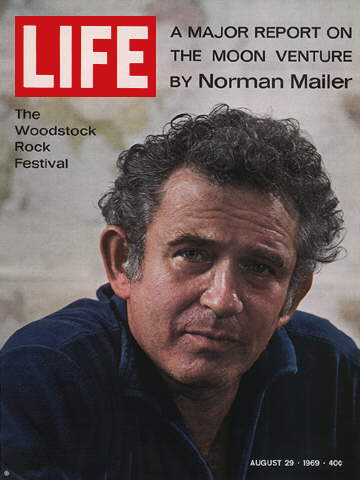
Norman Mailer--The Armies of the Night (1968)--Part 1 Norman Mailer is one of those writers that I used to hope very much would turn out not to be so good in the end, because I knew even as a teenager that if he were the model of what it took to be a great writer in our society, that I was doomed. I had always regarded him as a kind of personal bete noire, and experienced feelings of great relief whenever someone who seemed to be both well-placed and reasonably knowledgeable about literature would excoriate one of his efforts. When I finally read some of his work--the essay "The White Negro" in particular, and some of the other selections from Advertisements For Myself--I was buoyed by the idea that there was a good probability that was essentially ridiculous, though the tone was not as off-putting and sneering as I had anticipated, and there was a sense of humor in it. I was still not looking forward to The Armies of the Night, and so deeply ingrained is this ancient sense of aversion towards the man that I will probably never look forward with excitement to any Mailer book; however, I have to say it is quite a good book, or at least the first 3/4ths of it is, the "history as a novel" section. The final part, 'the novel as history', is written more in the dry style of a newspaper report and obviously is meant to make a point but is not memorable in the way the rest of the book was.

What Norman Mailer did well in this book was to illuminate and explain in a clear, considered and entertaining manner the real nature behind what he saw as the genuinely disturbing political problems in America, which were not specific policy questions so much as that the modern technological state had seriously affected people's ability to be autonomous and individual both in body and mind. One can argue that people have always been subject to mind control, through priests or the sophistication of their masters, but the idea I suppose is that in a small and isolated community a man of real strength and individuality of thought will still be able to challenge the system, which the modern mass technoculture is largely able to control and mitigate the influences of dissenting and differently alive voices. Mailer manages at least to write like a sensible person whose opposition to the government, the war and corporate domination over society has a certain not inelegant logic about it, which he was not always successful in doing elsewhere.

If you are not familiar with the premise of the book, it is an account of an actual event, a protest march in Washington D.C. that took place October 21, 1967. In the main body of his book Mailer wrote about it in the style of a novel, but the characters are all actual people (including 'Norman Mailer') and the places and events presumably the places Mailer went to and the things that actually happened to him.

Mailer introduces himself as a character by reprinting an account of the rally from the next week's Time magazine, is which he is described as "slurping liquor from a coffee mug...Mumbling and spewing obscenities as he staggered about the stage--which he had commandeered by threatening to beat up the previous M.C.--...described in detail his search for a usable privy on the premises." It continues in that same strain of bravado, expletives and scatological talk. Although Mailer disputes the accuracy of his portrayal in this article, one gets the sense that he also enjoys it. The account was further lightened for me by a Dwight Macdonald sighting--you may remember him as a New Yorker writer, and one of the more ferocious middlebrow-despisers of the 50s and 60s, though like most such people how he was able to ascend to the ranks of the highbrows where so many others have failed was always left unexplained. Anyway he seems to be quite forgotten today, though 50 years ago he was a mainstay of the New York literary establishment.

There are a lot of humorous quotes in this I am going to let pass. Ones of literary interest I will include such the description of a friend with "a profound air of defeated gloom " looking "the way J.D. Salinger would have looked if J.D. Salinger had been tall enough and beefed-up enough to play football, and had fumbled Catcher in the Rye." Norman Mailer apparently loved football by the way, at least in the 1960s (it was a lot cooler then). He refers to it quite a lot in the course of this book, and found it noteworthy to mention several times that taking part in the protest was causing him to miss watching the pro games on TV that weekend.

I've been quite depressed lately--the typical middle age ennui and sense of declining vigor, which I did not have an excessive supply of to start with--which is why my postings have been dragging somewhat. The most celebrated examples of postwar American writing, I have to admit, even when I think it is good, do not on the whole enhance my mood. I think I am not suited for the impermanence and lack of solidity of everything in modern American life, relationships, institutions, communal traditions. Norman Mailer especially I find insuperably depressing even when I have some admiration for his book. There is no identifiable pattern or rhythm or sense of rootedness to any profound idea or habit of life present in his writings. I find that very hard to take.

Back on the subject of celebrities, I thought it interesting that then vice-president Hubert Humphrey appeared at the 1967 National Book Awards festivities to address the assembled literati, where he was snubbed by a small group of protesting writers who walked out while he was giving his speech (Mailer was boycotting the event generally on principle). Writers are so far off the radar of powerful politicians and other people nowadays of course as any kind of serious force in society that the idea of their speaking at the National Book Awards--and being snubbed into the bargain--seems comical. This is also comical: "Jules Feiffer (a writer of some kind-- apparently not a pal of Mailer's) walked out with the demonstrators, then sneaked back to go to a party for Humphrey."

p.8 "Mailer hated to put in time with losers...there had been all too many years when he had the reputation of being a loser; it had cost him much." The untidy and ever-fluctuating necessity of constantly producing losers whose purpose in life is to serve as the bland and faceless opposition to the master class is the curse of America.

p. 14 "Mailer was a snob of the worst sort." After reading the Brideshead book, I assure you, Mailer only wishes he were a snob of the worst sort..."New York had certainly wrecked his tolerance for any party but a very good one." I like that line, and it's probably true. My goal for this immediate year in fact is to wrangle an invitation to some kind of New York party. I deserve it.

I going to cut it short and stop again for a few days.

Sunday, May 16, 2010

The Lennon Sisters--October 1966


Watching these old Lawrence Welk shows from around '66 and '67 you can just feel the cultural tension rising. Welk wasn't cool and he apparently was a crummy musician, but as long as he had the Lennon Sisters on every week, he could go toe to toe with any program or cultural movement on the air in raw babe hour, and you better believe he knew it, and that even as an old Republican it put a little bite in his step, to mix a couple of metaphors. When they finally left him either in '68 or '69 he fought like a rabid dog to prevent them, and apparently remained bitter for years afterwards for, for as you can imagine it killed his show deader than the ascendance of rock of roll could ever have dreamed of doing. All right I know it's late at night and I'm probably a little out of my head but God damn, look at these girls!!

Wednesday, December 23, 2009

Christmas With the Czech New Wave

Christmas is very busy this year, hence the paucity of new postings.

A few days ago for some reason I got excited about this subject. That excitement has been tempered by the unfortunate circumstance that I can't find any selections of my featured films which have English subtitles, along with the usual effects that the passing of a couple of days has on a momentary enthusiasm. I am going to go ahead with it anyway.

This is the opening of Closely Watched Trains. As noted earlier there are no subtitles, and the theme music/credits get cut off before they are finished. This is too bad, as this is one of my favorite openings to a movie of all time, right up there with The Third Man, which is the only other favorite I can think of offhand. It kind of comes out of nowhere while at the same time feeling and looking to me more like what what actual life really is than almost all of ordinary experience. The tone, the pace and the energy of the writing and action, as in most of the movies I like best, are such to depict a world I find interesting, perhaps such as I could see myself inhabiting with some degree of engagement. This movie of course is set during the Nazi occupation of Czechoslovakia, so I do not mean to intimate that I would have wanted to inhabit or enjoyed inhabiting that aspect, or really any other, of this depiction; only that certain of its attitudes and preoccupations strike me as being in some sympathy with what I might feel, or want to feel, in some instance myself.


This is the infamous stamping scene. As you can imagine, this girl is of the type of which most of my youthful dreams were made, only to find that her like, alas, is not so common in real life as in the movies.


Here is the beginning of another favorite, Loves of a Blonde, directed by Milos Forman, who later went on to achieve great success in Hollywood with such hits as Hair, One Flew Over the Cuckoo's Nest, Amadeus, and The People Versus Larry Flynt. Like Closely Watched Trains, this film has a perfectly human-scale feel to it that is rare in movies. Now that I think of it, the very geography of that part of the world, both natural and man-made, tends to be almost uncannily human-scaled, certainly in comparison with the United States. The towns and cities, the landscape, the transport systems, when one is there, feel wholly the proper size for human use, certainly not larger. If you are a really gigantic mind or personality I suppose this would be brutally confining to you; of course most people are not. Another reason I feel an affinity with these films is that they are never quite wholly serious, in the way a heavy delving into the darkness of the human soul a la such Eastern Bloc contemporaries as Tarkovsky, or Wajda or Polanski would be. I know there are subtle and pointed commentaries on the system in them under the surface and all, but a sense of unconscious moral stridency or confidence is missing. The Czech people tend to strike outsiders as unusally amoral. It is not that they have no code of right and wrong, and certainly there are rules and customs that it is expected people will observe at a certain personal level, but on the biggest, potentially most dangerous and destructive questions, it is almost taken for granted that people will act as they please and as they are able, and not according to any universal code of justice. This is a weakness undoubtedly, though being honest about it makes for some interesting forays in the arts, moreso than either pretending to have ironclad moral convictions when one doesn't, or to have moral convictions the implications of which one doesn't understand.

This nicely-done and beautifully human-scaled scene is not one in which it is hard to figure out what is happening. In a capitalist system there is no way the table with the cute girls would be hanging out at this kind of low key party attended by lots of not so good-looking people. However under communism their options for more exclusive, higher end fun are severely curtailed, the authoritarian regime compels them to associate with and belong to groups which consist of large numbers of average to below-average looking people. From the point of view of a person for whom finding parties where it was even possible to sit and talk or dance with reasonably attractive girls was a handful of occasions in a lifetime kind of experience, this limited mobility system is awfully appealing.

This looks like it may have been filmed at the Lucerna Ballroom in Prague. I went to a dance there once. That was a great time, civilized, and many attractive women with recognizably human-scaled egos. Why in the world are such scenes so comparatively rare?