Showing posts with label norman mailer. Show all posts

Friday, August 20, 2010

Armies of the Night (V)

Looking back at a distance of 43 years now, the real anger and audacity of the 60s middle class rebels appear quite remarkable. Objectively it is easy enough to pooh-pooh their stances and complaints as insignificant, but what forcefulness there was in the wills of individual people! One feels nothing like that among all but a very few people, or at least intelligent people, one encounters now in ordinary life.

I get to flavor my blog with some summer of love type quotes now. Heady times, those 60s.

"Augustus Owsley Stanley, III...His statement was that LACE (hippie group, name a takeoff on MACE, which was some kind of military acronym) makes you want to take off your clothes, kiss people and make love...They would try to kidnap LBJ and wrestle him to the ground and take his pants off." Of course it is very silly but it is clear that at this time people were still taking a kind of childlike delight in just expressing the thoughts and uttering the words, which thrill unfortunately wore off rather quickly.

"This was to be the first of many speeches to be made to them...some professional, some--girls, for instance, opening buttons on their blouses--improvisational." Yes, I am very easily titillated. I like to think that this keeps me somewhat young, however. I can't pretend, like all the cool people my age, to have long done and seen it all. Indeed, I have seen virtually nothing.

The problems of the American Middle Class--in short, that it is wimpy, spiritless and has no real power besides--are laid out at such length that one is almost relieved at the prospect that the current economic reorganization is going to do away with most of it altogether and give the offspring of those falling out of it a shot at the 'easy confident virility' and 'physical courage' that the working class is supposed to have retained and which causes the soft sons of the suburbs so much unease. Of course the social gulf between these classes has gotten so big since the late 60s that I would venture very few suburban types view anything about the working class with much admiration at all, even (in those people who still have it) physical courage. The soft middle class doesn't play the same sports, doesn't join the military, is not for the most part in competition for the same women, in effect sees themselves as living a completely life in a more or less different society.

Jerry Rubin shows up. Mailer called him a "revolutionary mystic, whose roots were in Bakunin". I didn't know who Bakunin was. He was a 19th century Russian philosopher and active revolutionary whose ruling theory was Collectivist Anarchism. I certainly believe there are people who have genuine revolutionary-oriented personalities, and I find them extremely interesting, though I don't on the whole have any desires to follow such people. I don't know whether Jerry Rubin was such a character to the core or not, but he does seem to have had something of the type in him.

There should be more effective intellectual-oriented opposition to the ruling interests in our time. Even if it is the case that all of the most talented and capable people are co-opted into the service of the entrenched powers, which I don't believe, some kind of radical opposition should emerge from at least the fringes of that world. One assumes it will, that we are currently going through a very culturally dispirited cycle the lethargy of which will have to break eventually. I admit responsibility for my own part both in being unable to formulate and mount a credible alternative or challenge to the status quo, and for not allowing this to disturb my general tranquility as much as it ought to. "...they would be a new breed of American soldiers if they did not laugh." On the Army's potential response to the irreverant signs of the protestors. One feels there is something true in the sentiment here, though the wording or perhaps the example is not precisely right. The attitudes of soldiers towards certain large swathes of civilian society was I think something new, but so too were the circumstances of a publically unpopular war and a broad critique of many of the values that the army was supposed both to be defending and to exemplify. Mailer's own World War II generation of soldiers, or at least that part of it that became writers, tended to view themselves as more wary of the military establishment and other claimants to authority than their historical reputation would suggest. My guess would be that that is not literally true, but the circumstance that a lot of people of the time were concerned with and turned their most specific attentions to this attitude shows that whatever it signified was considered meaningful.

The middle class boy burns his draft card, his stomach churning with equal parts anxiety and revolutionary fervor. "He looks for a girl to kiss in reward." Ignoring the entitlement issues our young man is betraying, there is a beautiful simplicity in these old stories where one can perform a single feat, and in many instances not an especially onerous one, and immediately expect such a sweet payoff. When I set out looking for girls to kiss, the strategy was more along the lines of a five-year plan.

"There are very few on the Left who do not live with a partial belief their own life will end in such a way..." He happens to be referring in this instance to gas chambers but I assume the sentiment is meant to apply to any brutal extermination method governments have access too. I suppose from time to time thoughts of this sort fluttered into my head. I don't have them much now. I'm much more worried about...but I don't want to jinx myself by writing it. I does not involve being put to death in an disrespectful manner by a government or military tribunal or anything of that kind.

"The spokesman was speaking in totalitarianese, which is to say, technologese, which is to say any language which succeeds in stripping itself of any moral content...There are negative rites of passage as well. Men learn in a negative rite to give up the best things they were born with, and forever." This leads to the great question posed by the end of this book, which is Would I have been a hippy or a square? I would doubtless have been a square, and I would also doubtless have believed I really wanted to be a hippy. This would have led me to go halfway on the clothes and hair which would only have further exasperated my main problems at the time.

It is a fairly common opinion, I think, that some American form of totalitarianism is inevitable. Anticipating its appearance in the very near future--often within the next 5 years--is a favorite pastime of doomsdayers. Many of these doomsdayers also agree that the American strain of fascism is likely to be among the worst yet seen in the history of the world. I'm going to take a kind of mellow conservative view of this and predict that it will not happen within the next 5 years. Too many really bad things would need to coalesce before which the overwhelming majority of the population, which I am not in the least afraid of, would be powerless to stop. I don't see it coming to that. There are a lot of people on both of the main political sides who seem to attribute some motive of evil, pure and unfathomable of origin, to their enemies. But this is generally wy exaggerated.

I forgot to comment on the various Noam Chomsky sightings during the book. Chomsky didn't have much to do with Mailer. He is presented as very serious, and would neither join in any kind of banter nor discuss the linguistics works for which he was already becoming well known when Mailer tried to engage him on those subjects.


Saturday, August 07, 2010

Armies of the Night 4

p.127--"Mailer had then that superimposition of vision which makes descriptions of combat so contradictory when one compares eyewitness reports." Remember the hubbub during the last election about Hilary Clinton's false memory of being fired on by snipers during a trip to Bosnia?

p.138 A Fran Tarkenton reference--we always like those. The arresting marshal is described, when his rage has subsuded, as having "an intelligent, clean-featured American face, not...unlike the pleasant modest appearance of Mr. Fran Tarkenton, quarterback for the New York Giants." I only remember him at the tail end of his career with the Vikings, '76, '77 when he broke his leg late in the season and everybody figured he was finished, and the last year in '78, when the expanded schedule and a number of rule changes seemed to my young eyes to dramatically alter the league almost overnight. The Vikings of that time were very representative of the old league that was being superseded, as they had lots of really old players, an old school but conscipuously intelligent-seeming coach (Bud Grant), they played in a decrepit stadium where it was snowing and below 10 degrees for about half the season, and they were very good but always got upended by some speedier or flashier or just plain better team in the end. Naturally I liked them a great deal.

p. 139--while being transported to jail. This is a good description of how I feel (on the increasingly rare occasions) when I wake up unprompted in an immediate stillness: "...seeing objects now with the kind of filtered vision which sometimes comes to a man on drugs in the bleak hour when he is coming down--a glimpse is had of everyday things in their negative aspect, the truth of the object...stripped of all love, sentiment, or libido."

Mailer reports, after triumphing in an eye-staring contest with a Nazi, that he regularly got into such confrontations "and rarely lost them". Like much else in this writer, the line between silliness and vitality is probably crossed for the worst here. Not that Hemingway or someone else would not have written about this type of encounter, but they would have been able to load its occurrence and outcome with more literary significance than seems worth the while here.


"As the power of communication grew larger, so the responsibility to educate a nation lapped at the feet...a new responsibility...one had become a writer after all to find a warm place where one was safe--responsibility was for the pompous...writers were born to discover wine." The ability to genuinely educate a nation as a writer is a rare ability, and probably one that cannot be consciously cultivated any more than writing about wine or suburban angst in ways that will be meaningful and uplifting to a good cross-section of intelligent people are, to name two other examples of things many people would like to be able to do well, but few succeed in accomplishing. Good books are never, I don't think, the result of someone consciously fulfilling a perceived responsibility to educate or repudiate the mass public. They tend, if anything, to be an expression of their times' most ascendant spirits and characteristics in a form that gives them a relation to the beautiful, the eternal, the true that will crystalize the questions under consideration for a contemporary, and that a reader in a later age will be able to recognize as meaningful at whatever point in history he takes it up. If the masses don't read/relate to the world through reading in this way, I am not sure that beyond introducing the subjects in a reasonable degree during formal schooling that there is any greater responsibility to make them do so.

I have already said something of my own memories of Northern Virginia in this general period. It was very slow outside of Monday to Friday working hours, very quiet, little traffic. Government employees, much less numerous in those days then they are now, had a well-deserved reputation for being boring. Even in the 70s the D.C. area had not yet become a place where many young people came looking to do anything besides work--people in search of an exciting lifestyle were heading west in those days, especially to California and Colorado (New York was generally considered a nightmare by bourgeois people when I was a child, and I didn't know anybody who moved there in that period, though now lots of people who were young and cool and survived it consider 70s New York to have been a glorious time. But any time you are young and cool and you actually find other people who you think are young and cool to share your youth and coolness with it is going to seem glorious). My parents had friends who had an apartment somewhere very near in, Alexandria or Arlington maybe, and my parents being quite young none of these people they knew ever had any children and were still into smoking pot and so on, all of which however is quite boring for a four or five year old (there were never any toys at these places and apparently it didn't occur to my parents to bring any of ours with them) so I used to entertain myself by staring out the window of the high apartment building and counting the cars that passed through the traffic light at the intersection below. On a Saturday or Sunday afternoon you could easily count every car that passed through. Maybe it's the same now, but I get a different feeling when I am back there; it was always a depressing and psychically unhealthy place but now there is a lot of bustle and aggression and encouragement of stress whereas before it was just dead and devoid of any sense of community or culture. It was in contrast with today shockingly uncosmopolitan, certainly beneath the highest levels of the governing classes. It is actually much preferable now to what it was before, questions of whether the incredible increase in the size of the government over the last 40 years is desirable or not aside.

It doesn't require much genius these days to lay out a list of reasons why the Vietnam war was bad, as it doubtless won't require much genius 40 years from now to explain why fighting for 9+ years in Iraq and Afghanistan was a poor idea, but at the time it does take a strong amount of moral conviction to even propose that the war should not be carried on, and have anyone take it seriously. I won't lay out Mailer's case against the Vietnam conflict but I thought many of his points very good, fairly and clearly explained.

p. 186--Karl Marx's mind is described as "perhaps the greatest single tool for cerebration Western man had ever produced". Karl Marx was a legitimately interesting writer, and I have no doubt he was a remarkable man who would have made his mark somewhere under almost any circumstances. I don't have a good sense however of where he would exactly rank in the annals of the very greatest thinkers of all time.


Mailer didn't want to plead Nolo Contendere to the charges on which he had been arrested becuase it seemed squishy and defeated the purpose of the gesture but the "Legal Defense Committee" talked him out of it easily enough as he didn't feel like spending more time in jail. The lawyers always want you to plead Nolo Contendere. The right wing moralists are always exhorting people to show some magnanimity and accept full responsibility for their actions, but unfortunately the public has figured out that that just gets you slammed in court, and being squirrelly is the prudent alternative. This actually made me feel better, since Great Men and Women of the past such as Socrates, Jesus, Joan of Arc, Ben Franklin, Samuel Johnson, etc, (as well as many wicked ones such as numerous of the Nazis at the Nuremberg trials), even if, as usually happened, their case went against them, were always able to run mental circles around the professional legal class whenever they had to deal with them and expose them as having the weaker minds. But no layman in modern times that I have found has proven able to swat them down in any substantial manner.
There was a point about the prison wardens re-enacting their poor southern childhoods in their jobs that I thought was interesting. I like psychological analysis as a tool of understanding. There is art and real life in its best insights, which unfortunately most working practitioners don't seem to have the right mental instincts to recognize. I certainly seem to be perpetually re-enacting various aspects of my own childhood, namely my relations with my father and school, in both of which areas my standing was so inferior that I have never proven able to move beyond them into the life of a highly functioning and serious adult.

p 202--in jail: "They spent time idly, pitching pennies to a line in the composition floor." They take all your money from you now.

Mailer really has the habit of describing people according to what their role/type would be in television or pro football. He is more into that than comparable (i.e. other famous literary-approved) writers of his time would be. Thomas Pynchon does things like that, but it always comes across as joking, as pointing out how absurd someone or some aspect of life is.


p. 216 "He wrote of necessity at a rate faster than he had ever written before, as if the accelerating history of the country forbade deliberation." I've tried this in the past (writing quickly and without deliberation) but the results were not good. It must be a wonderful sensation to write thus and have something reasonably pleasurable and intelligent as the result.

That was the end of the "History as a Novel" section, which was the better part of the book. Now we are in the part taking the opposite tack.

p. 233 "Without one such fierce element of the fantastic, middle class life is insupportable. The same may be said of the old Left Wing life." This may be true.

p. 227 "...by no measure can anyone claim that the taxpayer's money is being wasted for extravagant interior decoration in the Pentagon."

Wednesday, July 21, 2010

Armies of the Night 3

"...his New York fever, that ferocious inflammation which New York always seemed to encourage: envy, greed, claustrophobia, excitement, bourbon, broads, action, ego, jousts, cruelty and too-rich food in expensive hateful restaurants." When I was on the 8th grade basketball team, I never got into games except at garbage time--even at that I may have gotten into 4 of the 10 games we played. Our team was involved in one very intense game, on the road, against a school from a relatively poor town which famously hated all the other schools in the league and took sports very seriously. The crowd was raucous and hostile, and there were several near fights due to rough play on the court. In spite of all this our team pulled away in the last few minutes and won the game by 10 or 12 points because we were considerably better than they were. The next day several of my more important teammates and various other people, including cheerleaders, were discussing the details of the game with one of our more jockish male teachers, and being always on the alert for a social in I placed myself near the edge of this discussion and, though I had not played a minute in the game, hoped that this fact would somehow be overlooked by the company and I would somehow appear as one of the actors in this drama that was being so eagerly rehashed. As this did not happen I said something, doubtless inane, at which of all people the teacher cut right to the chase and said, rather harshly, though with what I believe was intended as jesting laughter, "(Surrender), you didn't want to be anywhere near that court." This was not true. Now it is true that I would likely have failed miserably and looked ridiculous had I been inserted into the game, but to say that I did not want to be in the game was denying me any kind of ambition or interest in life at all. Yet people say such things all the time to show you that they think you are nothing. What then do I want, if not life? If not to be just like you?

The leaders among the radical protestors of the 60s were somewhat different from the way one thinks of that type of person today. many of the men were brash, cool, confident with chicks, etc. They did talk about the government as if were a faceless, soulless, practically all-powerful entity to be fearful of, but this attitude had not been internalized the way it is today, where people seem to be much more resigned to their own futility and afraid of the consequences of really angering the ruling powers than they were in the 60s. The motifs of things like mass-produced white bread being the embodiment of evil, the "infiltrated enemy who had a grip on them everywhere" were already present, though Mailer seemed to find amusement and possibility in this attitude.

"Lowell made a face. He had an expression which only a fellow writer could comprehend..." It goes without saying that one wonders at what point a person becomes considered a fellow writers. "One could not communicate the horror to anyone who did not write well." Newspaper writers would seem not to qualify, as they are being castigated here for building an ever larger wall of distortion between real writers and the uneducated public, and cultivating terrible habits in the latter. Something of the same effect seems to take place in courts of law, where the unitiated public is strongly dissuaded from trying to actively participate in the refined proceedings, and is not infrequently punished for such breaches of etiquette as not hiring a proper attorney even for minor cases such as traffic court. It is the inattention to the proper subtleties that always reveals the untrained mental type, and to the expert practitioner, this is where all the substance is.

"The thousand days of John Kennedy had done much to change the style of America; nowhere perhaps more than to the sartorial sense of the liberal and Left Wing intellectuals now gathering for breakfast--some drabness had quit them since the fifties...a hint of elegance." I think it is agreed that this era, if it ever in fact existed (though I do think it did, from about 1961-'67, right when this book was written), was extremely short lived. "The whores were out: not a common sight in Washington. The Capitol was usually about as lively at 1 a.m. as the center of Cincinnati late at night..." I have memories of the Washington area just a few years after this time (the mid to late 70s), and it was just starting at that time to become less sleepy and resemble the metropolis it has since become in terms of energy, youth, wealth, and so on. At that time even coming from Philadelphia it seemed a very sedate and minor legaue place--much of the 'talent' that came to work for (or against) the government, which was far fewer people at that time than at present, remained in the area only for a few years and then when the administration changed or whatever would return to where they came from. Every time I go down there nowadays I am astounded at how much huger, richer, more crowded, more attractive to cosmopolites it has become (as well as how huge the government is). Philadelphia by comparision, or at least the parts of it I am most familiar with, though it has of course changed some and had a decent influx both of hipsters and immigrants, the latter mainly Korean and Indian (the Hispanic population in Philadelphia remains very small), is not in the same degree unrecognizable from what it was 30 years ago. Another incredible thing when one regards the state of things today is that in northern Virginia many of the schools (and presumably other public institutions) only desegregated in 1968, one of the last places in the country where this happened, and after the events of this book took place. I know this was the case in Manassas, because one of my uncles lived there for a time and married a woman from there, and also in Alexandria (Remember the Titans!), which my impression is that it is now one of the tonier and more progressive suburbs of the capitol.

"A generation of the American young had come along different from five previous generations of the middle class. The new generation believed in technology more than any before it, but the generation also believed in LSD, in witches, in tribal knowledge, in orgy, and revolution." The scary thing is, most of these people are still very much alive and many are continuing to wreak endless havoc as we tap.

"...the walking American lobotomy: the corporation office worker and his high school son." I think they're talking about me again...

I like his Cuban revolutionary theory, which is that you create the revolution first and then worry about what it is actually about, i.e. "...the revolution existed in the nerves and cells of the people who created it and lived with it, rather than in the sanctity of the original idea." This is actually common sense. Real revolutions take on lives of their own pretty quickly, and most of them, especially during the last 100 years, have reputations for turning out very badly, but this latter is not inevitable, while from time to time revolutions of a kind probably are, which is why it is always wise to try to cultivate a certain degree of civilization and humanity in the populace so as to limit the catastrophe when these convulsions occur.


Several film references were made with regard to the hippies' clothes. Have Gun, Will Travel? (This apparently was a TV show). Claude Rains in Invisible Man? Mailer was, again, quite taken by the stridency of the young people, and compared them to Crusaders, which quality they did seem to have something of, and which perhaps in the absence of material and sensual diversions and pursuits might have manifested itself even more completely.

"Mediocrities flock to any movement which will indulge their self-pity and their self-righteousness, for without a Movement the mediocrity is on the slide into terminal melancholia." There is some truth in this. I have actually been looking for such a movement for some time but unfortunately (and predictably) all the movements which might fit this description for me tend to be full of losers and lack attractive leadership. This means on the other hand that there may be good opportunities for a person or persons of real ability to do what the America intelligentsia and power elite have often expressed fears of, rouse up the demoralized and humiliated masses into a powerful following that will stifle and possibly tear apart the culture and the nation.

On his having gone for a stroll and missed Martin Luther King's "I have a dream" speech in 1963: " Mailer--trusting no one else in these matters, certainly not the columnists and the commentators--would never know whether the Reverend King had given a great speech that day, or revealed an inch of his hambone." I guess I thought the hambone bit was too funny in the moment.

Dr Spock was another celebrity protestor at the march. Mailer however "had an animus against" him, for "three of Mailer's...wives had used Spock's book on infant and baby care as their bible."

Mailer's admission of modeling his attitude at various moments after Marlon Brando in The Wild One is almost too obvious (this movie, which I have never seen, looks tremendous by the way).


I wonder if the famous episode of Ed Sanders, poet, vocalist of the Fugs and publisher of the unfortunately now-defunct Fuck You magazine, exorcising the Pentagon, remains celebrated because of this book. I had never heard of this guy. Maybe he stinks but he's a real make it happen New York kind of guy and he produces a lot of art, including, recently, 2,000 pages worth of verse constituting a history of the United States during the 20th century (I wonder if a lot of people have read that). These are exactly the kind of people I needed to know about as a young man, and for whatever reason did not. I listened to some his groups' songs; it isn't really my kind of stuff, but apparently it impressed some people worth impressing.

All the mystical gods/spirits/paganism 60s stuff, especially the various elements of it which involved naked young girls dancing and otherwise enjoying nature, does, I have to admit, seem like it was probably great fun at the time. It's no wonder that a lot of intelligent and now completely boring people have fond memories of it.

p.126--a reference to Matthew Brady's Civil War photos, which were apparently very popular at this time. I can definitely remember my father being into these, having several books on the subject, and often referring to them in his casual conversations about history or whatever with his friends as if he assumed they would be something familiar to everyone. Then suddenly Matthew Brady just totally dropped out of the public consciousness. I don't think I had heard or thought of his name in the last 25 years or so.

Wednesday, June 30, 2010

Armies of the Night (2)

Yes, my production has (once again) slowed considerably of late. Obviously I should really let the site go, but the compulsion to keep the charade going, to myself if no one else, that I lead some kind of 'life of the mind', while weaker than it has been at almost an point in the last twenty-five years, is not quite extinguished wholly yet. With my new found free time I could get to know my neighbors, mentor youth (in what exactly?), volunteer in community beautification efforts and whatever else it is ordinary dull-witted but good and honest citizens are supposed to do. Eventually I assume this ongoing identity crisis will have to resolve itself and I will become fully conscious at long last of who I actually am, what I can do, and what I really want to do, and have always wanted to do. Actually I assume nothing of the sort, and expect to go on as I am now forever, such being the postmodern condition. But no one wants to hear that. "...(Mailer) had learned from years of speaking in public that an entertainer's first duty was to deliver himself to the stage with the maximum of energy, high focus, and wit--a good heavy dinner on half a pint of bourbon was likely to produce torpor, undue search for the functional phrase..." Perhaps this was my problem. I always ate before parties.

"He was shrewd enough to know that (Robert) Lowell, like many another aristocrat before him, respected abrupt departures." We all can't be aristocrats, but it would have been nice to have been schooled in (or picked up on) a few moderately attractive or interest-piquing habits at some point in one's youth. What a disaster social life is for the majority of men.

Mailer writes about sex a lot, of course. Evidently what, or the way, he writes about it, though superficially not uninteresting, kills any enthusiasm I have for continuing on the subject myself. "...sex to Mailer's idea of it was better off dirty, damned, even slavish! than clean, and without guilt...Without guilt, sex was meaningless...Onanism and homosexuality were not, to Mailer, light vices--to him it sometimes seemed that much of life and most of society were designed precisely to drive men deep into onanism and homosexuality...Just as professional football players love sex because it is so close to football..."

There was an article making the rounds of the blogosphere last week by Camille Paglia lamenting the sexlessness of contemporary bourgeois life and culture. While I have previously identified Camille Paglia as one of that venerable school of writers who almost touchingly believes that the time and place where she herself happened to be between ages 18 and 25 or so was the last vital age of culture, learning, eros, etc, and while I thought most of her specific points in the article were rather silly, the main premise obviously is true. I have no memory of the 60s, but I do have a memory of the late 70s and 80s, and the comparison of the active virility and confidence, sexual and otherwise, of the run of 35-45 year old men of that era--who at the time were considered themselves to be rather weak compared to their own fathers and grandfathers--to those of my generation is to further emphasize just how pitiful and irrelevant most of the men my age have become. It is never entirely safe to use one's own relatives as the example, but my father was a high school teacher, as were many of his friends at the time, and while I won't say it was completely open season on female students and babysitters, to say nothing of adult women, for these guys, it was definitely not closed season, such as it is now, by any stretch of the imagination. One of my father's friends whose house we used to go to had a young female neighbor, probably 17-19 years old, who was something of an exhibitionist and when she would start prancing around in her undergarments or other scanty clothing with the shades open all the men would have to make their way over the window to have a look, regardless of their wives and children being present or not, and this was considered, as far as I could tell, natural and not unreasonable behavior. Apparently a good part of the work day for white collar men in this era was spent flirting with and propositioning the various comely females in the office, which to be honest would not be an unpleasant change from time to time from compulsively surfing the internet and maintaining a constant facade of neutered (and not only sexually) amiability. So people my age are pouring themselves into raising their children in my opinion because public life has become so sterile and boring that their only hope to somehow break through to a revivified mental and aesthetic environment is through their children's developing more regularly human intellects and personalities. But I have lost my train. I had the whole section on how men had to project authority or competence, fullness in some sense, and how this generation at 40 has been completely revealed to have very little of this in them. However I will leave that out. My ultimate point, which I noted in my earlier writings on the "White Negro" essay, is the fairly obvious observation that any society which embraced Norman Mailer's approach to sexuality in any sizable degree would be neither socially nor culturally stable enough to support itself. That does not mean that everybody ought to live as if he were a eunuch however.

Now we're up to page 34, and Mailer is contrasting the vigorous and manly section of society--soldiers, cops, football players, mill workers, politicans--which he assumes to support the conflict and Vietnam, with the "Freud-ridden embers of Marxism...the urban middle class with their...secret slavish love for the oncoming hegemony of the computer and the suburb..." Hey, he's talking about my people now. Sure, it looks like it should be a total mismatch, and I suppose ultimately it always is, but I certainly grew up drinking the Kool-Aid that the militant suburban left had, after nearly a decade of ever-waning struggle, brought the military-industrial complex to its figurative knees and put an end to American involvement in the Vietnam War. Indeed, I think that is still the official story. Yes we can.

On page 35 we're back to talking about "real orgies... with murder in the air", the MC's ignorance of which, in Mailer's opinion, at the rally the night before the demonstration, necessitates him taking over that position in a putsch at the conclusion of the sexless man's speech. There is a lot of funny material in this, I have to admit. Again, I think for my generation, because the time of our childhood and adolescence was one of rather extreme and uncontrolled public violence compared to most times in history, including today, that this fascination with introducing it into the routine of life which seems to have afflicted a lot of intelligent people in the late 1960s is one that we have largely gotten over. My readings into the much celebrated edgy sex of the 1965-1980 period as against the comparatively maligned 1950-65 era haven't convinced me that apart from increased availability, the former time was qualitatively much better, though the early baby boomers especially, one must admit, have collectively an envious ability to believe in the excitement and superiority of their own experiences, educations, abilities, etc, to other people and times. Mailer, as I will comment on further in another place, unlike most of his own generation was very impressed with the irreverence and edginess of the young hippies in this book by the way, which no one seems to have seen coming after the bland, well-behaved and at the time frequently maligned kids of the 50s.

Quotes relating to literature: "'The one mind a novelist cannot enter is the mind of a novelist superior to himself' said once to Mailer by Jean Malaquais." "'...if novelists come from the middle class, poets tend to derive from the bottom and the top.'" I think I knew or believed that already. Mailer was writing, or as it were speaking, at length about the poet Robert Lowell, who also took part in the rally, and whose patrician background and manners, combined with his talent, seemed to have an effect of awe on the normally unfazeable Mailer. He noted that a few years earlier Lowell had refused an invitation from President Johnson to attend a White House party for artists and intellectuals, the "only invited artist of first rank who had refused. Saul Bellow, for example, had attended the garden party" (nice dig at a rival by the way). Mailer admitted that he probably would not have been able to refuse such an invitation himself, though he "assured the audience he would not probably have ever had the opportunity" which provoked "hints of merriment in the crowd". The parts where Mailer admits his social and professional weaknesses, jealousies and so on have the unfortunate effect of being rather endearing after all the bombast. You think maybe he's not such a bad guy after all, that he's maybe on your side even, whatever that even is. There is something in this writing though which I cannot put my finger on which is definitely repulsive though, even though this particular book I think is quite good, and very entertaining. Maybe I will figure out what it is before I finish this.


More on Lowell: "One did not achieve the languid grandeurs of that slouch in one generation--the grandsons of the first sons had best go through the best troughs in the best eating clubs at Harvard before anyone in the family could try for such an elegant note." Mailer went to Harvard too by the way, though you wouldn't know it from this passage; obviously it was not the same Harvard that he is talking about here. I saw one of Mailer's son's on TV (C-Span) once. He appeared to be a few years younger than I am--Mailer has many children spanning several decades--and although the son had written a book of some kind, he did not have anything like the social graces or elegant expressive speech such as one would imagine a person who was the son of a famous literary author and (one would assume) had gone to expensive schools and had considerable exposure to serious intellectual company from an early age would have. If anything, he seemed to be a bit of a lout.

Indeed, Mailer loved obscenity. He claims to have come to love regular Americans while in the army in World War II, and it was primarily their obscenity that he credits with securing his affection to the type. "...the American corporation executive, who was after all the foremost representative of Man in the world today, was perfectly capable of burning unseen women and children in the Vietnamese jungles, yet felt a large displeasure...and disapproval at the generous use of obscenity in literature and in public." I suspect he believed obscenity was the primary means by which the language of the time sought and expressed truth, conventional speech having been so manipulated by corporate and political interests through mass media, etc, for its eternal horrid ends. Now of course conventional obscenity been co-opted by the authorities and had whatever vigor it once had tamed out of it, though we still have forbidden or inappropriate speech. Howard Stern, to name one obvious example, is completely uninteresting when he is being merely obscene, but will occasionally say something inappropriate that is slightly amusing.

Film reference!--"ever since seeing All the King's Men years ago he had wanted to come on in public as a Southern demagogue." That was supposed to be good (the 1949 version), wasn't it? I've never seen it. How about a link to the trailer!

Mailer stayed at the Hay-Adams hotel in Washington. Here is their current website. Unfortunately they are at the moment closed until October. Writers tend to travel in more style than I had been wont to believe.

"One may wonder if the Adams in the name of this hotel bore any relation to Henry; we need not be concerned with Hay who was a memorable and accomplished gentleman from the nineteenth century (then Secretary of State to McKinley and Roosevelt) other than to say that the hotel looked like its name, and was indeed the staunchest advocate of that happy if heavy style in Washington architecture which spoke of a time when men and events were solid, comprehensible, often obedient to a code of values, and resolutely nonelectronic."

The hotel's web page announces that the high temperature in Washington today was 101 degrees. Yikes. I am heading in that direction on Wednesday.

I can't believe how many hours over a period of about a week it took me to write this post.

Tuesday, June 15, 2010

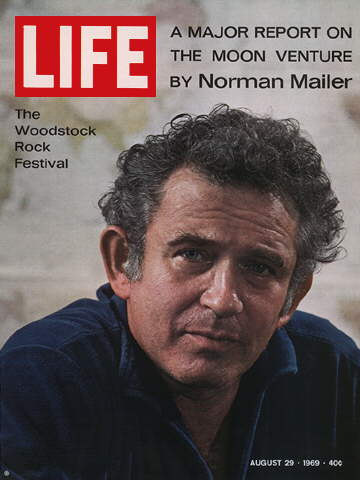
Norman Mailer--The Armies of the Night (1968)--Part 1 Norman Mailer is one of those writers that I used to hope very much would turn out not to be so good in the end, because I knew even as a teenager that if he were the model of what it took to be a great writer in our society, that I was doomed. I had always regarded him as a kind of personal bete noire, and experienced feelings of great relief whenever someone who seemed to be both well-placed and reasonably knowledgeable about literature would excoriate one of his efforts. When I finally read some of his work--the essay "The White Negro" in particular, and some of the other selections from Advertisements For Myself--I was buoyed by the idea that there was a good probability that was essentially ridiculous, though the tone was not as off-putting and sneering as I had anticipated, and there was a sense of humor in it. I was still not looking forward to The Armies of the Night, and so deeply ingrained is this ancient sense of aversion towards the man that I will probably never look forward with excitement to any Mailer book; however, I have to say it is quite a good book, or at least the first 3/4ths of it is, the "history as a novel" section. The final part, 'the novel as history', is written more in the dry style of a newspaper report and obviously is meant to make a point but is not memorable in the way the rest of the book was.

What Norman Mailer did well in this book was to illuminate and explain in a clear, considered and entertaining manner the real nature behind what he saw as the genuinely disturbing political problems in America, which were not specific policy questions so much as that the modern technological state had seriously affected people's ability to be autonomous and individual both in body and mind. One can argue that people have always been subject to mind control, through priests or the sophistication of their masters, but the idea I suppose is that in a small and isolated community a man of real strength and individuality of thought will still be able to challenge the system, which the modern mass technoculture is largely able to control and mitigate the influences of dissenting and differently alive voices. Mailer manages at least to write like a sensible person whose opposition to the government, the war and corporate domination over society has a certain not inelegant logic about it, which he was not always successful in doing elsewhere.

If you are not familiar with the premise of the book, it is an account of an actual event, a protest march in Washington D.C. that took place October 21, 1967. In the main body of his book Mailer wrote about it in the style of a novel, but the characters are all actual people (including 'Norman Mailer') and the places and events presumably the places Mailer went to and the things that actually happened to him.

Mailer introduces himself as a character by reprinting an account of the rally from the next week's Time magazine, is which he is described as "slurping liquor from a coffee mug...Mumbling and spewing obscenities as he staggered about the stage--which he had commandeered by threatening to beat up the previous M.C.--...described in detail his search for a usable privy on the premises." It continues in that same strain of bravado, expletives and scatological talk. Although Mailer disputes the accuracy of his portrayal in this article, one gets the sense that he also enjoys it. The account was further lightened for me by a Dwight Macdonald sighting--you may remember him as a New Yorker writer, and one of the more ferocious middlebrow-despisers of the 50s and 60s, though like most such people how he was able to ascend to the ranks of the highbrows where so many others have failed was always left unexplained. Anyway he seems to be quite forgotten today, though 50 years ago he was a mainstay of the New York literary establishment.

There are a lot of humorous quotes in this I am going to let pass. Ones of literary interest I will include such the description of a friend with "a profound air of defeated gloom " looking "the way J.D. Salinger would have looked if J.D. Salinger had been tall enough and beefed-up enough to play football, and had fumbled Catcher in the Rye." Norman Mailer apparently loved football by the way, at least in the 1960s (it was a lot cooler then). He refers to it quite a lot in the course of this book, and found it noteworthy to mention several times that taking part in the protest was causing him to miss watching the pro games on TV that weekend.

I've been quite depressed lately--the typical middle age ennui and sense of declining vigor, which I did not have an excessive supply of to start with--which is why my postings have been dragging somewhat. The most celebrated examples of postwar American writing, I have to admit, even when I think it is good, do not on the whole enhance my mood. I think I am not suited for the impermanence and lack of solidity of everything in modern American life, relationships, institutions, communal traditions. Norman Mailer especially I find insuperably depressing even when I have some admiration for his book. There is no identifiable pattern or rhythm or sense of rootedness to any profound idea or habit of life present in his writings. I find that very hard to take.

Back on the subject of celebrities, I thought it interesting that then vice-president Hubert Humphrey appeared at the 1967 National Book Awards festivities to address the assembled literati, where he was snubbed by a small group of protesting writers who walked out while he was giving his speech (Mailer was boycotting the event generally on principle). Writers are so far off the radar of powerful politicians and other people nowadays of course as any kind of serious force in society that the idea of their speaking at the National Book Awards--and being snubbed into the bargain--seems comical. This is also comical: "Jules Feiffer (a writer of some kind-- apparently not a pal of Mailer's) walked out with the demonstrators, then sneaked back to go to a party for Humphrey."

p.8 "Mailer hated to put in time with losers...there had been all too many years when he had the reputation of being a loser; it had cost him much." The untidy and ever-fluctuating necessity of constantly producing losers whose purpose in life is to serve as the bland and faceless opposition to the master class is the curse of America.

p. 14 "Mailer was a snob of the worst sort." After reading the Brideshead book, I assure you, Mailer only wishes he were a snob of the worst sort..."New York had certainly wrecked his tolerance for any party but a very good one." I like that line, and it's probably true. My goal for this immediate year in fact is to wrangle an invitation to some kind of New York party. I deserve it.

I going to cut it short and stop again for a few days.

Thursday, March 27, 2008

The White Negro--Part 3
This one should be short. With authors of one's own country, particularly one's own general native region, there are always so many little points or flourishes, even trivial ones, that one notices and wishes to comment on.
There are a few more sentences in this essay of which the ultimate sense is questionable but that are nonetheless remarkable in their conception, execution and bombast:

"It is this adoration of the present which contains the affirmation of Hip, because its ultimate logic surpasses even the unforgettable solution of the Marquis de Sade to sex, private property, and the family, that all men and women have absolute but temporary rights over the bodies of all other men and women--the nihilism of Hip proposes as its final tendency that every social restraint and category be removed, and the affirmation implicit in the proposal is that man would then prove to be more creative than murderous and so would not destroy himself."

I am not terribly intimate with the writings of the Marquis de Sade, but my impression is that he is mainly considered remarkable for the singularity of his character in contrast to anyone's usual conception of what is standard, which I take to be the appeal of "Hipsters" also, rather than for the actual desirability of implementing any of his ideas on a broad scale. There is too great a portion of humanity--most old people and children for beginners--to whom the obsessions of essentially oversexed people--of whom, don't get me wrong, I am deeply envious at some moment almost every day of my life--just don't apply.

"...the organic growth of Hip depends on whether the Negro emerges as a dominating force in American life. Since the Negro knows more about the ugliness and danger of life than the white, it is probable that if the Negro can win his equality, he will possess a potential superiority...Like all conservative political fear it is the fear of unforeseeable consequences, for the Negro's equality would tear a profound shift into the psychology, the sexuality, and the moral imagination of every white alive." I believe "shift" in this sentence is used in the sense of a faultline in an earthquake, which is a usage I don't believe I have ever employed myself (hence the note).

Some ideas along these lines, or close variations of them, were very influential when I was growing up, even for me, though in any case I was certainly slow to get my head around them or adapt to their implications. The idea, frequently proclaimed, of the outsized influence, and even superiority, of blacks in serious American artistic and cultural matters, and the implied hopelessness of whites, or at least dead-normal whites like me, in the same, was of especial interest to me, since I had hopes of contributing something to the national life in this area from a fairly early age. I am pretty sure I believed that this superiority, if it did indeed exist, must be in large part the result of this greater knowledge of the ugliness and danger of life, and if I was not so desperate to have or give the appearance of having a great deal of this same knowledge as other kids from my background were, I did spend a not infinitessimal amount of time brooding over having been so ignominiously cut off from any serious hope of attaining it, if it was that important. This was, no doubt, the wrong approach to take. The idea, especially if one was white, I think, was that one ought to free oneself from racial self-consciousness and ideally open one's mind and senses to the extraordinary alternative talents and understandings that people from different backgrounds, culture, etc, had to offer without, for once, trying to compete with them or worse, insist on asserting one's, and by extension one's group's, own primacy. This will to assertion of course is hard to smother unless a person's ego is completely shattered, and will simply seek some other means of manifesting itself, unconsciously and even with the best intentions of not provoking or offending other people. As to the shift being torn "in the psychology, sexuality and moral imagination of every white alive" by black equality, I think "every white alive" while making for a grand gesture, is obviously an exaggeration. This may well happen in instances where people with large emotional investments in white supremacy are struck all of a sudden with some visceral, undeniable awareness that they are not by mere virtue of being white greater than "blacks" are, and are actually pscyhologically, sexually, morally, etc inferior to many of them; I guess this sort of thing did happen on a pretty wide scale in the 1960s and 70s. There does seem even now with many middle to working class white people to be a gigantic hole where some kind of personality or joie de vivre ought to be, but I cannot believe it is all attributable to some lost sense of racial superiority.

In a section about the intellectual antecedents of the current (1950s) generation, Mailer gave us a list of figures--I love these kinds of things--that included Hemingway, D.H. Lawrence, Henry Miller and Wilhelm Reich. I had never heard of Wilhelm Reich, but I deduced that he must have something to do with sex, albeit in some twisted Mitteleuropean sense that would probably be unhealthy for Americans raised on chewing gum and Tarzan movies to try to dive into too much. I was not going to pursue the matter further but, in one of those weird coincidences that happens in life the very next time I got in my car the radio station that was on happened to be doing a profile on this very Wilhelm Reich. There is even a Wilhelm Reich museum in Maine in the Rangeley Lakes area, the centerpiece of which is the Orgone Energy Observatory, where I guess one observes orgone, a physical, biological energy in all living matter that Reich is said to have discovered in the 1930s. There are cabins you can stay in for as low as $525 a week if you are seriously into this program.

This essay is included the collection titled Advertisements For Myself, which is essentially like reading Norman Mailer's blog from the 1950s, including reader comments (i.e. letters), most of which appeared in the Village Voice. There was one somewhat amusing page that had two columns Hip and Square, with various items underneath, i.e Hip: wild, Square: practical, etc. Other examples include Hip: Heidegger/Square: Sartre, H-Catholic/S-Protestant (?), H-call girls/S-psychoanalysts, H-T-formation/S-Single Wing (ironically a variation of the Single Wing, in the form of the Spread Offense, has been making a comeback in college football in recent years), H-Thelonius Monk/S-Dave Brubeck. This one really slayed me. I knew a guy in college who as much of a real jazz aficiondo as I am who used to break out Thelonius Monk's Straight, No Chaser whenever it was time to clinch some romantic deal--we would stand out in the hall and lay bets as to how long it would be before the Thelonius Monk started up whenever a girl went in there. I think it was the only jazz record the guy even had but of course it worked 80-90% of the time because most suburban girls don't know enough either to call you out on it; they want action and they want to feel cool, maybe a little light danger but nothing violent or criminal above a misdemeanor. I didn't get this of course until much later and imagined that when I had amassed a music and liquor and picture and bar glass collection above middlebrow criticism--a moment which never arrived--that then I would be ready to go into action. This is one of the lessons I hope to impart to my sons.

All right. This is the end of Norman Mailer for the time being, I promise.

Wednesday, March 19, 2008

The White Negro--Part 2
I am writing more about this essay because the author in the course of it eventually got around to offering some definitions of "cool"; and as gaining some insight into the mysteries of this almost unimaginably exalted state of existence is one of the raison d'etres of my entire literary career, I thought I could not let these pass without commentary.

I am however going to pass over the lengthy section in which it is determined that the hipster "is a psychopath, and yet not a psychopath but the negation of the psychopath, for he possesses the narcissistic detachment of the philosopher", all of which however is distinguished from the psychotic, who is a different beast altogether (not surprisingly, I determined from this essay that I am much more psychotic than psychopathic, psychopathy being presented as the much more desirable condition). Later in this same he section he lambastes psychoanalysis as "no more than a psychic blood-letting" that leaves the patient "worn out--less bad, less good, less bright, less willfull, less destructive, less creative," as well as "able to conform to that contradictory and unbearable society which first created his neurosis". This is one of the clearer descriptions in the whole piece, and as such suggests itself as being at least plausibly accurate depending on one's particular point of view regarding the case. That human beings are only realized insofar as they live as constantly as possible at the extremes that their thought, consciousness, instinct, sensation and so on will allow them, free from all restraint, while not the most reassuring prospect to someone like me, is not one that I can easily dismiss either; this certainly seems to be Norman Mailer's peculiar vision of life's potentiality, as well the source of both his energy and his fairly vigorous following.

"What makes Hip a special language is that it cannot really be taught--if one shares none of the experiences of elation and exhaustion which it is equipped to describe...For example, there is a real difficulty in trying to find a Hip substitute for 'stubborn'. The best possibility I can come up with is: 'That cat will never come off his groove, dad.' But groove implies movement...There is really no way to describe someone who does not move at all. Even a creep does move--if at a pace exasperatingly more slow than the pace of the cool cats...To be cool is to be equipped, and if you are equipped it is more difficult for the next cat who comes along to put you down." It seems like it should be easy either to make fun of all this or take offense at it--as pure idea even apart from its surface absurdity it is a shallow conception of life, having nothing of a sustaining quality, let alone the foundation of anything really meaningful. The bit about elation was interesting --exhaustion less clear as a source of unique experience; exhaustion from living at the extremes, and in constant opposition to the oppressive pressures of square society I suppose. I never feel even viscerally that I want to "be" Norman Mailer, in the sense of occupying his exact position in the intellectual, literary, even sexual world, as often happens to me with prominent figures, but I am always aware that he has in many areas of existence, and writing actually perhaps the least of them, succeeded where I have failed. At least where real life, social life, was concerned, Norman Mailer seems to have caught on at a pretty early age--which more earnest people never do--that generally no one, especially Bohemian intellectual types, cares whether anything you say is actually correct, or about the depth and thoroughness of your knowledge on general topics of conversation, so much as that you speak about them in a provocative and exciting manner. Most people don't know or care about anything much more than anyone else does, but they want to believe in the importance of certain things nonetheless. When Mailer died recently, all the obituaries lamented that he "had made literature seem important, and there is no one like that left." This seemed rather silly to me, but apparently a lot of people felt this way.

I don't how popular Norman Mailer is among black people who care about things like essays written for alternative newspapers while smoking marijuana but my general impression is that this piece is regarded with at least as much bemusement as disdain. Mailer seems to have hung out in Harlem at certain points seeking certain experiences and conducted himself in such a manner at these times as to procure him a certain low-level degree of credibility among at least some of the natives. There is something to admire in this, I think, though I am not certain it can be proven that any noble issue was actually involved in the case.

I am just too tired to write these essays. I have to stop.

Thursday, March 13, 2008

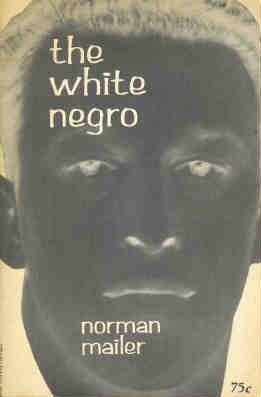
Norman Mailer--"The White Negro" (1958) Part 1I was not looking forward to reading this. I have never developed much of a sense of Norman Mailer either as a great pure writer, or as one who could be trusted to hit reasonably close to important truths on any kind of consistent basis. The prospect which this particular essay presented to me seemed even more than usually wince-inducing in these regards, and by wince-inducing I do not mean in the tough and challenging way that is generally thought to be beneficial to overly comfortable and placid people. I concede that he is sometimes amusing, and I acknowledge that at least compared with the likes of me he had some genuine audacity which actually got him somewehere; he is far more frequently tiresome, and this is just in his writing. As to the general outrageousness of his life--the provocative political and social stances, the punchouts, the nine children by six different women (all legal wives at the time I should note for the sake of the bourgeois segment of my audience, though really who cares?), the greater than ordinary boasting and self-promotion--I make no claims to being, or desiring to be, a moralist, and I can appreciate what he was trying to get at. To my mind however he simply did not do an effective enough job of getting at it.

Every age has its peculiar obsessions. In many instances these fade or resolve themselves over time, but those of the 1950s are notable both for how pervasive they are in almost all the literature of the period as well as how the most emphasized and dreaded conditions--conformity, infantilism, emasculation--appear from our point of view to be far more advanced in our own time than they were in that decade, which, indeed is now frequently hearkened back to as an era where traditional independence, maturity and masculinity were both flourishing and expected of every adult male. It is true that the ordinary men of that era seem from a distance to have been collectively a little tougher, have been more likely to have and be willing to use guns, been more comfortable exercising authority, been more adept at mechanics and other basics of home maintenance such as plumbing and electrical wiring (women seem to me to complain about their men's lack of this a lot nowadays). It is often claimed that there was a generally stronger work ethic among men at this time, though I am skeptical of this; there were many more physically demanding, industrial-type jobs in the economy of that time, which gave the appearance of an overall much more industrious society, though it seems on the surface that white-collar professionals work a lot harder today, or at least with more visible strain, than they did in the 50s. It is worth noting, I think, that many critics of today's society enthusiastically promote the idea that military service functioned in the past as an antidote to infantilism and emasculation, and serves the same purpose today for the statistically small percentage of men who still respond to their nation's call to arms. I am not certain however that military culture in many instances does not exacerbate these conditions for such men as are molded by it. A far greater percentage of men in Norman Mailer's generation, including himself, had been in the army--in a colossal war, no less--than in almost any other. These same men then moved on to the 1950s, which to men of my generation (though only, I assure you, in moments of weakness when they are especially bored) looks like a veritable sexist paradise, and perceived the forces of emasculation to be devouring their very innards. My guess is that because nearly everyone had been in the Army, that this A) did not confer any special status or feeling of manliness on most of the men who had been in it, and B) tended to expose men's shortcomings vis-a-vis other men in a harsher, more open manner than is ordinarily the case in civilian life. One of my grandfathers was born in 1923, the same year as Mailer, and was also a WWII combat veteran, but he never referred to this experience as having made him a more virtuous or even a braver than usual man, and certainly no one seems to have regarded him as such. My other grandfather, whom I never met, received a Purple Heart in the same conflict, but was universally regarded as a scoundrel and regarded by his own children as one of the worst people in the entire world, not worthy the name of a man at all. I do not say that his military experience is to blame for his deficient character, but he does not appear to have benefited from it much either.

With regard to the work at hand, the general premise is that the combination of societal conformity and existential angst brought upon by the horrors of World War II and the spectre of atomic annihilation has drained all the vitality and courage out of mainstream white America, and that if such people want to reclaim a portion of their souls they are going to have to adopt something of the more dangerous approach to life which in Mailer's view only black men in America have in any appreciable numbers. As a composition it is a bit of a mess. Mailer does not present his ideas at all in a clear way, which, considering the heavy air of dubiousness which surrounds even most of the more intriguing ones, is crippling for his purposes. By the standards of any author who wrote clean and precise sentences--Swift, Addison, Turgenev, DeMaupassant come immediately to mind--Mailer is a terrible writer. He is, as I acknowledged earlier, sometimes amusing, but I cannot make out why anything he did is considered literature. His thought and his writing are not tight; his ideas wander. For example his formulation that the ideological oppressions of the Cold War era had made being a radical so risky that everyone had become afraid to proclaim any radical positions I found to be rather awkward; I had always considered that putting one's neck at risk was implied in the definition of being a radical. Similarly a sentence like "Indeed if one is to be a man, almost any kind of unconventional action often takes disproportionate courage" seems to me not to be harmonious in any of its parts. "Disproportionate courage" I don't like as a condition for either being a man or taking an unconventional action--one has courage that is worth something, that is based on some kind of core principle that it cannot waver from, or one doesn't. The construction of the sentence also suggests that being a man consists entirely in taking unconventional actions, which strikes me as a confusion of two separate problems. Mailer's conception of what it is to be a man, as far as I can tell, is that it is actually an escape from normal life, that it is not in itself a normal condition, but is achieved by "new kinds of victories" which "increase one's power for new kinds of perception" and the avoidance of "the wrong kind of defeats", which "attack the body and imprison one's energy until one is jailed in the prison air of other people's habits, other people's defeats, boredom, etc." I know where he is coming from with this, and certainly many people in America, including me, perceive the struggle of life to be in fact as he has described it; however the man who views every action or non-action in terms of victory or defeat, strength or decay, admits to having no essential, semi-permanent self at all. It is this that is the problem, and one isn't going to find that hanging out and doing unconventional things with hipsters, or blacks, or French people or anybody else if it hasn't been developed to any extent before.

There are many more such overstuffed sentences which could be examined for a wide range of incongruities of language and thought, but I will spare you them here. The "jazz is orgasm..." sentence is one, the observation on the atheist's "eschewing the limitless dimensions of profound despair has rendered himself incapable to judge the experience" is another. As the essay goes on, one begins to take it all as more or less equally goofy

I guess I will do two posts on this. I feel I ought to write some comments about the later parts of the essay.