Showing posts with label novels--20th cent US. Show all posts

Friday, June 17, 2016

A Bunch of Pointed Film Reviews

I'm very far behind on recording my movie impressions. So I'm just going to take this batch and make bullet points as to what I remember about them.

A Prophet (2010)

1. French prison movie, which I have gotten the impression over the years is a surprisingly robust genre.

2. Very well made, compelling movie--one might call it the Paris movie Woody Allen didn't even think about making, though apparently many people in France thought the degree of violence in it was exaggerated and the filmmakers were too much influenced by Hollywood.


3. It felt like it was dealing with things that are real and important happening in the world that a certain segment of the population such as myself is largely sheltered from, and does not particularly want to know about. Somehow I always feel personally implicated for the condition that these guys find themselves in, not directly, but because my general lukewarm and retiring temperament is accepted as being within the normal range, which puts these more naturally violent people in contrast with mainstream society, which is then biased and discriminatory against them.

4. Pretty much the entirety of the prison population are people who are not "French" as most people would have considered that term in 1968 or so, mostly being of Arab/North African or sub-Saharan African origin. The only old style European people in the prison are a gang of Corsicans, most of whom are pretty old (over 50) themselves, with the kid of that group maybe able to pass for 35. There are no traditional French people under the age of about 50 in the entire film, and the only older ones who appear are judges and lawyers and prison administrators who might as well have descended from outer space in the world of this movie. I wonder if this is not a trend in European films, where young people of native stock have either vanished more or less entirely from the picture, or you have the Amelie-(or Midnight in Paris) style escapist fantasy where all of the angry Muslims have disappeared and it's all about Marcel and Fabienne drinking wine at the cafe again.

The English Patient (1996)

1. I remember this being a big movie for the somewhat sophisticated adult set when it came out (it won the Oscar for Best Picture in its year) which I was probably interested in but never got around to seeing at the time and now twenty years have passed.

2. Having come out just before, to my mind, the internet broke big, it still has an underlying pre-internet mentality that I recognize, and am in many ways fond of, but which also in other dates the film considerably.


3. One example of what I mean by the pre-internet mentality is in the general book-informed mental makeup of some of the characters, which is a little contrived, but the filmmakers and the actors both have an idea of and appreciation for the kind of person they are trying to depict. I don't know if a character of this type holds any similarly vivid place in the imagination, let alone the esteem, of people who have come along in the ensuing years.

4. I went back and forth several times in the course of watching this movie between liking it and not liking it. The best parts are those that evoke pre-war nostalgia, upper-class British variety, music, cocktails, black tie dinners, walking through the Cairo bizarre like you own the place. The movie's raison d'etre however is in its romances and those did not work for me. It is well-established that I am a sentimental person and am very fond of certain romantic movies whose situations move me, but that was not the case here. The premise of the Ralph Fiennes romance was that he was a prickly man but possessed of a dominating intellect and the ability to wield it with both charm and severity who would require a mental equal to even consider the possibility of romance entering his life, which seemed unlikely to happen up until it did. I found this relationship to be a bit of a snooze though, despite the objective superiority and even perfection of the involved parties. They were lacking the qualities of actual real people, which I guess was one of the themes of the movie, seeing as the main character ended up suffering injuries which caused his face to be unrecognizable and he also claimed to have forgotten his name, where he came from, and his life's history, though he continued to speak an clipped and elegant English and to retain in his possession a well-thumbed antique volume of Herodotus so that we know is not just some ordinary guy.

Kommisar (1968)

1. Deep Soviet-era movie set during the Russian Civil War which followed the 1917 Revolution. I had read the book And Quiet Flows the Dow, which deals with the same period, not long before I saw this, and it was on my mind while I watched this.

2. It was banned in the Soviet Union upon completion and not seen there, or anywhere else I think, until the late 80s. I forget why (according to Wikipedia the censors wanted more heroic realism which the director, Aleksandr Askoldov, refused to accommodate, and was banned from film-making for the remainder of the Soviet era, which was a great loss to the profession.


3. The movie stars Nonna Mordyuka, whom I had never heard of, though a major British film publication named her one of the 10 greatest film actresses of the 20th century (sadly, I cannot easily find the rest of the list).

4. The movie conveys with some success the psychology of being caught up as an ordinary and unaffiliated citizen in the midst of a war.

5. It's very good, the work of serious people who are able to think about things in a multitude of aspects and from all kinds of sides, which is the striking strength of the great Russian novelists as well. It is not like other movies, even European ones, in a way that I am having some difficulty conveying. It is not stylized, but has a more tactile and unvarnished atmosphere, that still manages to impress the viewer with its beauty.

I Married a Witch (1942)

1. There was some talent on this movie, starting with the usually high-toned French director Rene Clair, who was serving his wartime exile in Hollywood when he made this (I enjoyed his 1945 effort And Then There Were None a few years back, recorded in these pages). It starred the always capable Frederic March. 1920s and 30s New York creative world legend Robert Benchley acts in the movie, as does future Oscar-winner Susan Hayward.


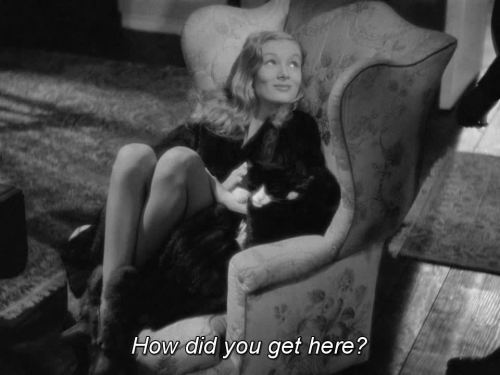
2. Veronica Lake plays the witch, who went by the then somewhat unusual name of Jennifer. Having never seen her in a movie before I had an image in my mind of her as a rather vapid, over-the-top blonde bombshell type, but in this she looks and even talks like what I imagine the more attractive girls at Middlebury or Williams to be like (sorry that I use colleges for reference so much when talking about women, but I really don't have any other references for where one might expect to encounter intelligent ones socially in any kind of concentrated numbers). She was extremely tiny--4' 11", and a wisp of a figure. Her ancestral background was similar to mine, and especially to my children's, mostly Irish with some German on one side. Her career and eventually her life were cut short by alcoholism and mental illness.

3. I cannot remember a lot of the details of this rather odd film, but I like the time period, I found Veronica Lake to be very appealing, and Rene Clair's directorial style seems to tend towards a kind of understated, even spare gentility that is pleasing to me. So I liked it.


The Anna Movies

This is not even including The King and I, which I have not yet seen. I saw these because I had recently read Margaret Landon's 1944 novel, which I wrote about on my other blog.

Anna and the King of Siam (1946)

With Irene Dunne as Anna and the distinctly non-Asiatic Rex Harrison as the king.

1. It is not the greatest movie from 1946, and its seems a little overlong--though the overlong part was more in the beginning and middle I thought--I liked it more as it went on.

2. I did find Rex Harrison to be amusing and to have some presence as King Mongkut. That he was obviously English does not upset me too much. The story is very much in the tradition of encounters with exotic peoples through Western eyes, the more so as I believe the book and the various movies made about it are still banned in Thailand to this day, and the more Western one's eyes are, the less necessary it is that the King or anybody else be played by non-Western actors.
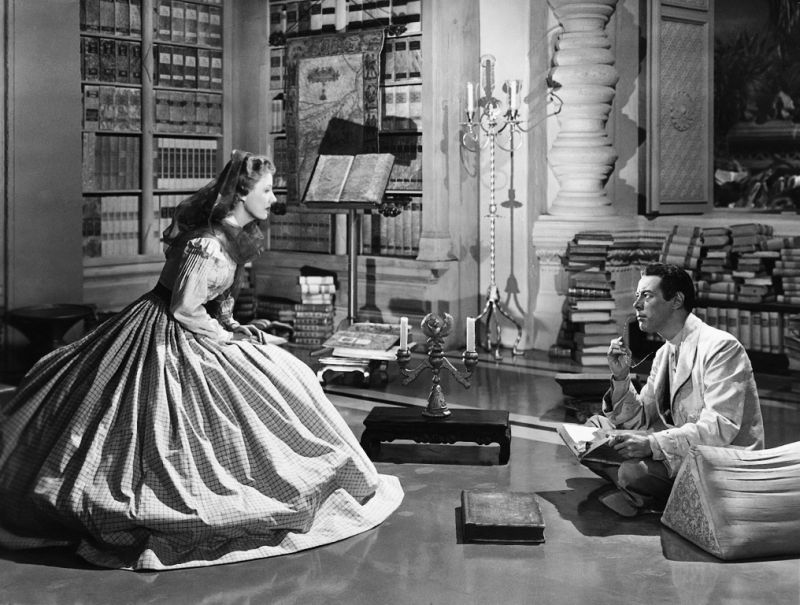


3. Irene Dunne as Anna strikes me as being very much as she comes across in the book. This is also why I usually find film versions of books that come out close upon the book's publication to be more satisfying as interpretations of the book, as opposed to pure films. They are invariably more attuned to the vision that the author was probably working from in the book.

4. Like the book, the movie is episodic (and several incidents were changed--Anna's son did not die in the book for example) but as is often the case, the interest for me is not largely in these episodes as in the king's and Anna's and to a certain extent the Kralahome's (the King's chief minister's) individual eccentricities in how they respond to situations, as being the people with the only really autonomous and interesting minds in the story.


Sultry Linda Darnell awaiting her execution for disloyalty and defiance while being a wife of the king.

Anna and the King (1999)

More modern version starring Jodie Foster (whom I generally like a little more than most stars of her generation). The king is played by Chow Yun-Fat, who is from Hong Kong.

1. I did not finish the whole movie here. This was not willful, it was just that with about half an hour left in it, the disc froze and I couldn't get it to start up again. This version is pretty long (about 2 1/2 hours) and I think I saw enough to get the idea of where it was going.

2. This version was very beautiful in a meticulous way. The wonder of modern production values and all that. It was not particularly joyous.
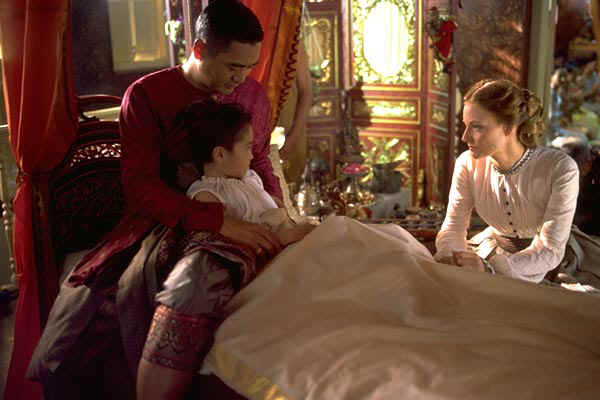


3. Like all modern movies based on the past, the West cannot be allowed to hold any inherent cultural superiority or moral authority over a non-Western culture. Whereas the book managed to balance a certain respect and affection for the king especially while obviously considering most of the customs of his kingdom barbaric, this film version, while regarding the various atrocities carried out in King Mongkut's name as legitimate atrocities, it takes care not to present them as contrasting with the more enlightened societies of the West, or in need of an infusion of those Western values. Ironically, for a modern movie, more effort is made to emphasize Anna's naivete as a negative quality than in the older versions of the story, where it is perhaps seen as abetting her considerable pluck. Also in this film, all of the British officials and businessmen who turn up are awful people, racist, sexist, condescending, scheming against the indigenous population, etc, while in the book the staff of the British consulate especially, as well as various Americans who happen to be in Bangkok, tend to be a helpful and reassuring presence, at to Anna (it is the book it is the French who are awful, condescending, scheming and all of that).

This is all for now.

Sunday, May 03, 2015

Movies 1945-1949, One From Each Year

All the Kings' Men (1949)

I had read the book recently. Here is my report on that from my other blog. The movie version won the Best Picture Oscar in its year. It isn't bad, though it is definitely one of the weaker Best Picture choices of the 40s. I haven't seen a ton of 1949 movies so I don't know how strong a year it was overall, but The Third Man came out that year at least (in England anyway) and seems to have been the movie of that year, though it got very little attention from the Academy other than an award for best black & white cinematography in 1950, which is when it was released in the United States.

Back to All the Kings' Men, it is pretty faithful I think to the general spirit of the book, but it is lacking something in the way of power or anything else that would make it compelling in the way the great classics of its era are. It doesn't have any iconic stars or otherwise interesting movie figures of the time among its cast. The director was Robert Rossen, with whose other work I am not familiar, though other than The Hustler, which came out twelve years afterwards, none of his other titles are widely referenced in the day-to-day discussion of the history of cinema. The noir-ish aspects of the film, in keeping with the fashion of the time, are noted in most of the literature on the movie, but I cannot say that I found that these affected me one way or the other. My opinion on the character of Willie Stark, which I hinted at in my report on the book and mostly refers to that, is that he is the only person in the story who seems to exert any agency of his own, who is even able to respond aggressively to and not be completely destroyed by the threat of shame, or disgrace. It is hard to judge him as someone who assumed more power than it was his right to do, because he seems to be surrounded by people who are largely incapable of effectively exercising basic personal freedom, let alone direct institutions and events. Maybe it is a flaw in the story, that there is no opposing power, and certainly no moral counterpart, anywhere in it to contrast with Stark.


I have seen it noted that All the Kings' Men is the last adaptation of a Pulitzer Prize-winning novel to win the Best Picture Oscar. Since the Oscars were only about twenty years old in 1949, I figured it couldn't have happened that often, and indeed, Gone With the Wind was the only other instance of this happening. I had thought The Grapes of Wrath was a third, but it did not win the Best Picture Oscar. As I have noted elsewhere on this blog the prestige of the Pulitzer was higher among the general public at least prior to about 1960 than it is today, and there have actually been a number of Oscar-quality adaptations made among its winners, though more so in the early days of the award. Just looking down the list of winners, notable films were made of The Magnificent Ambersons, The Age of Innocence (albeit decades later), Alice Adams, Tales of the South Pacific, The Caine Mutiny, and To Kill a Mockingbird. In more recent years The Color Purple and The Hours seem to have gotten some Oscar attention, and a few of the other winners were at least adapted into major movies or television serials. But not really that many.

The Search (1948)

A fairly difficult to find choice--it is available on DVD from Warner Brothers as part of a Classics series, but I had to buy it to get it--this stars Montgomery Clift in what I believe was his debut as an American soldier in postwar Germany who takes in a ragged, uncommunicative child, one of the legions of displaced and orphaned children who were all over Europe in those years and attempts to nurse him back to a state of some trust in humanity and ability to participate in civilization. At the same time the child's mother, a concentration camp survivor, is crisscrossing central Europe on foot in desperate hope of finding the boy alive. It is quite good, and I am surprised it is not better known and celebrated. It acknowledges the existence of what was a very serious issue at the time in the mass displacement of people in Europe. Granted, the Czechs and Hungarians and other eastern nationalities, assuming they returned to their countries of origin, which I think was still taken to be the ideal scenario in 1948, would be going right back to another politically repressive situation, though perhaps the extent and the permanent nature of this in some of the countries with more traditional ties to the West was not yet clearly discerned in the immediate aftermath of the war. Clift, whom I did not like all that much in the other two films I have seen him in, A Place in the Sun and Judgment at Nuremberg (also, oddly enough, set in a bombed out landscape in postwar Germany), is much better here. Apparently he had not imbibed the teachings and philosophical outlook of the Method so fully yet. The director was Fred Zinnemann, who would go on to direct a number of famous movies over the next thirty years, including A Man For All Seasons. Zinnemann, who was Jewish, was, like many of the golden age Hollywood directors, born in Austria-Hungary, in the part that is now Poland, and went to university in Vienna before leaving for Paris and eventually Hollywood. While this family of directors generally did not express a great deal of sentimental feeling for the country of their youths in their work, the European milieu depicted in this movie has a much more naturalistic feel about it, to the point of being unobtrusive, than Hollywood might have been thought capable of at this time. I  suspect this was in large part the work of Zinnemann.


I need to remind myself to take the time to see this again someday, since there is a good chance it will never come up of itself in the course of events, but it does have some qualities about it that are important to understanding the character of the era, in my view.

Life With Father (1947)

Based on the once famous New Yorker stories by Clarence Day, Jr about his childhood as the son of a Wall Street mover and shaker in 1880s and 90s New York. The book is on one of my reading lists--the most ancient and politically naive one--though I probably won't get to it for a long time, if ever. The movie is interesting as a nostalgia piece looking back from the 40s to the 1880s, a time that has now receded too far out of the living memory even of people our oldest acquaintances may have known for us to have nostalgia for. I believe the Days are supposed to have lived on either Park or Madison Avenue, and the street, at least as depicted in the film, was a wide, blissfully uncrowded boulevard along which trolley cars and orderly carriages passed leisurely, lined with handsome and spacious but comparatively low rising (three or four storeys, tops) mansions, though without much in the way of shady tree cover. Of course New York in the 1880s was never really so sedate or orderly as it is made to be in this movie, though if this idea of it came from the book I will grant that it probably gave some sensation of that kind to the memoirist in his youthful goings about, perhaps for reasons peculiar to himself, though the tone he hit on in his writings did resonate with many readers. I am willing to trust people's memories of their experiences rather than what I might think their memories of those experiences should have been.

Compared to what we read of families similarly situated in contemporary New York City, the Day children seem to lead an almost blissfully unharried and carefree existence. Day, Sr was certainly an energetic and hard-driving man, but he is not depicted as being manic or possessed nearly beyond the limits of recognizable human desire by the drive to succeed and make money and be number one and mold his sons into equally aggressive dominant men such as is the popular image of Wall Street brokers in our time. Of course this is almost certainly the nostalgia of 1947 seeping through the filmmaking.


The extremely prolific and apparently indefatigable Michael Curtiz directed this. William Powell and Irene Dunne were the attractive and substantial leads. The 15 year old Elizabeth Taylor appears at her most simpering as the teenage romantic interest of Day, Jr.

By the way, in case you couldn't tell, I did like this.

Peter and the Wolf (1946)

A fifteen or so minute cartoon, this one barely counts, but it did turn up on the list so I will put it in here. It didn't blow me away, but it is diverting for what it is. I am more favorably inclined to Disney's work in the 1940s and 50s than I am in other periods.


A Tree Grows in Brooklyn (1945)

I have written previously that 1945 is my personal favorite year for movies, and this moving film about family life, childhood, school, death, the past, the immigrant experience during the great wave of the last century, all against the hyper-somber backdrop of the stub end of World War II that characterizes all of the movies of that year that I like so much, fits in with the rest of these. I had recently read this book, too, which impressed me as having much merit, particularly with regard to our collective memory of the details of what things and experiences in our past were like. Like any movie, this one had to leave a lot of significant incidents and developments and characters out, but on the whole it is a good adaptation of the basic aspects of the story, and it is even better I think as a movie than it is as an adaptation. This was the directorial debut of Elia Kazan and the atmosphere and the development of the major characters and the way they inhabit the movie are its strong points. The ending is a much truncated version of what happened in the book, doubtless done to not be left with an ending in nothing is resolved or seems to be progressing for the better, but the movie really did not need to be tied up this way. In this it is similar to Life With Father, which operated on an even thinner plotline that was not all that essential to such interest as the film possessed.

The family at the center of this story is an Irish-German union, much like my own family, with both parents being the first generation born in America--and it was emphasized in the book that theirs was the only household Francie knew of in their neighborhood where both parents were actually American born. Despite their status as citizens and immersion in the culture and language of the United States since birth, Johnny and Katie Nolan had not gotten very far by 1912. Johnny of course was fairly hopeless, at least in economic terms, though a highly lovable guy. The circumstance of Katie's being German-descended does not play into my theory of the peculiarity of Irish romance, in which, comparative to more traditionally prosperous peoples, the long term career prospects of a potential husband do seem to be regularly taken into consideration. I feel myself to be in certain ways something of a modern day version of Johnny Nolan, only minus the charm. I suppose one could say minus the alcoholism also, but it is only the greater effectiveness of social control exerted on modern men that prevents me from following that mode of life, as I remain greatly attracted to it. The other characteristics--the inability to perceive the world and my place in it realistically, the endless empty promises to improve myself, the natural inclination toward squalor with regard to living arrangements--are there.


One of the other parts of this story that I relate to is the episode where Francie desires to transfer to a more beautiful and dignified-looking school without knowing much else more about it, since I did the same thing when I lived in Maine. I was not supposed to go to the school I went to, the one that was built in 1924 and had busts of famous white male giants of literature and history lining the hallways and a venerable history as perhaps the premier large public school in the state, but when I saw it I became consumed by a desire to go there as if it were owed me as the natural end of my development to that point to go to such a school, and it was arranged that I was able to go there, and I loved it dearly the whole time I was there, though it is hard to explain why, because in terms of the other students it was just a regular public school, I did not have any very close friends, and when I go back for my reunions most of the people don't remember who I am, and some of them act almost perturbed at my being there, as if I am crashing a party where I really don't belong. But at the time the atmosphere, not merely of the school but of the equally antique neighborhood and city around it, gave me something that I desperately needed to imbibe the air of, even if I was unable to make any very deep connection with it. I have not pushed for very much in my life, but I have a couple of times when it comes to schools. I was determined as well to go to a particular kind of college--residential, preferably somewhat old, average test scores above a certain level, an atmosphere of study that was acceptably masculine without being reactionary or arch-conservative, though this last I would not have been able to articulate in such terms at the time--and I was pretty dogged at not getting pushed into the community college, taking computer classes route that well-meaning people were trying to steer me towards and getting to go to the kind of place I wanted in the end, even though I guess most people would say, given my subsequent career, that the wisdom of those who advised community college has been vindicated.


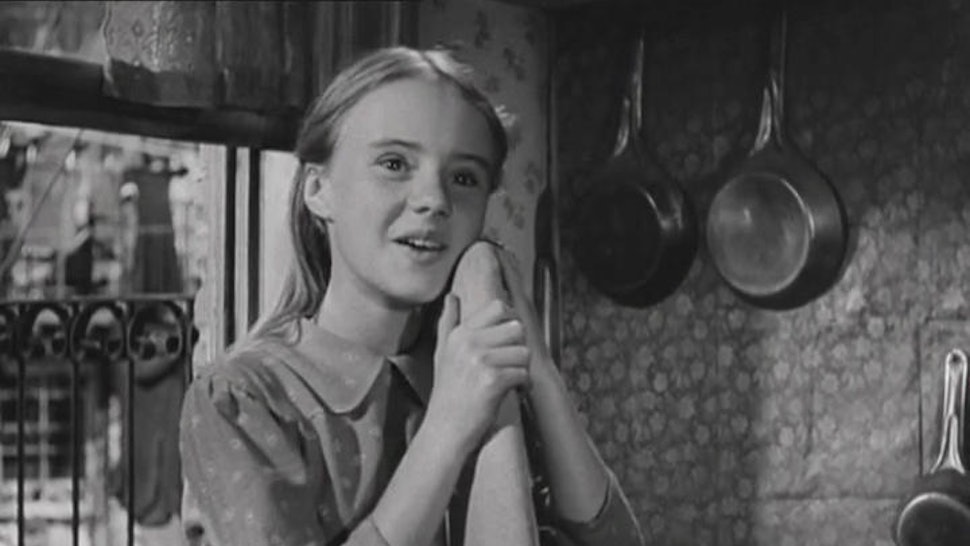
Dorothy McGuire, who plays Katie, has a lovely voice, and is the easy choice for the honor of favorite 40s girl/woman for this set of reports from that era.

Monday, August 18, 2014

Edith Wharton--The Custom of the Country (1913)

I have been reading a lot of Edith Wharton lately--I wrote a couple (here, and here) of things recently on The Age of Innocence for my other blog, and here is another archival bit on her, with some commentary on Ethan Frome, which I read a few years ago. The Custom of the Country I take to be considered in the second rank of her novels, as I had never heard of it before. I do think the other books are a little better, they are more tightly written and focused, the settings are more vividly evoked, the dialogue is sharper. This book is about a beautiful and already super rich American woman with voracious and ultimately insatiable appetites for ever greater wealth and social success. She marries four times, to a scion of one of New York's most established families, a French marquis, and a billionaire who is reckoned America's sixth wealthiest man (she married him twice--he was not a billionaire yet the first time, just a cocky and abrasive striver she ran off with, and her parents forced her to divorce him). She was divorced three times. Her New York society husband, with whom she had a son she was not much interested in (but demanded and received custody of in order to maintain her respectability for future husband-hunting and social climbing) ended up killing himself. The sacred ancient possessions and household customs of her French husband did not escape from his marriage to her without enduring some substantial dimunitions either.


The biggest problem with the book is that Undine (the man-eating beauty) is such a relentlessly awful and shallow person that it is not clear why her New York and French husbands, secure in high social statuses and pretty substantial wealth, and who are portrayed as intelligent and cultivated men, would be so eager to marry her. She is described of course as beautiful, but it is not a beauty that the reader is made to feel, and be persuaded that it is worth all of the trouble that comes with procuring it. Being a patriot, I was sympathetic to her struggles against the austere restrictions her French husband and mother-in-law and their army of enforcing relatives would put on her social energies, but only because it was so ridiculous to expect an American millionairess not born into decrepit European aristocratic society to be capable of adhering to them. Among the other characters, Undine's billionaire husband goes from being a decidedly menacing figure through the early parts of the book to being mildly jovial at the end when he has made his fortune and has finally gotten his destined bride. Are we supposed to like him then? It also is not consistent that Undine's parents could have forced her to dissolve the earlier marriage, since whenever they appear in the rest of the book they are cowering to every demand she makes of them, all of which involve spending exorbitant amounts of money. The characters in this book are on the whole cruder and less truly wealthy than those in The Age of Innocence, so some of their exorbitant expenditures on flowers, apartment furnishings, seasons in Paris, opera boxes, and so on, come off as more desperate (and consequently offensive), I suspect because there is a deficiency of harmony between the possessors of these luxuries and privileged positions and the possessions themselves, which the observer/fantasist never likes to see.

In one of the biographical notes in my edition of the book (The Library of America), it stated something to the effect that Wharton was impressed or experienced pride in the successes of the American forces during World War I. I suppose I knew that there was skepticism on the part of some of the old guard of Europe that Americans could really have what it took to fight toe to toe with the great nations of Europe with their ancient and glorious military traditions and cultures, but I had never heard it hinted that any Americans possessed such doubts. I also suppose it caught me by some surprise that Edith Wharton should identify at all with the American army, and take a keen interest and pride in its performance.


I only took down two quotes from the book. I found relevance to my own idea of life in both of them.

"...but perhaps another stroke of luck might befall him: he was getting to have the dependence on 'luck' of the man conscious of his inability to direct his life." This was the guy who later killed himself.

"Raymond de Chelles, who came of a family of moderate fortune, lived for the greater part of the year on his father's estates in Burgundy; but he came up every spring to the entresol of the old marquis's hotel for a two months' study of human nature. applying to the pursuit the discriminating taste and transient ardour that give the finest bloom to pleasure." This seems like a life I was, if not meant to lead, perhaps suited for, as much as any.


Since finishing Wharton I have gone on to Emerson's "Divinity School Address", which I take to have lain down the primary tenets of the transcendental school to a not terribly appreciative audience at Harvard (30 years later, when the likes of Oliver Wendell Holmes had become the ruling spirits of the University--and Emerson had attained international stature--he was invited back). I have written here before that I enjoyed Emerson's journals, but had never taken much to his essays. This one has not really set me on fire either. Near the end it gets a little better, when he exhorts the auditor or reader to in effect be self-directing in religious matters, that the follower or imitator of established forms or doctrine can never attain to the insight or intensity of the originator of those forms. However much of it suffers from the usual Emersonian problems of his words and ideas not having enough clarity and solidity to focus the mind of the reader on their flow. I don't think his thoughts and his general organization are good enough to hold his essays together in any kind of pleasing whole. When I read this my mind is not moving with his, nor is it moving in any firm direction at all. It may be that I am always catching his essays at a bad time, or perhaps it is his writing that sends me into these periods when my focus becomes poor and my thoughts sluggish, because I had for the past couple of months felt generally sharper and more engaged with what I was reading, until the past few days. I ought to take more interest in what he says about God being present and alive and within every one of us, but I can't seem to find it very interesting, as he writes about it. 


"The third floor chapel in Divinity Hall where Emerson delivered his Divinity School address in 1838".

Saturday, May 18, 2013

The Smiths, Bulwer-Lytton, Raymond Carver and a Cameo by Flannery O'Connor


An old friend of mine, after expressing incredulity that I did not as yet have a kindle or other high-tech reading apparatus, had a actual 600+ page hardcover book sent to me in the mail.

The book was a new biography of the Smiths, called A Light That Never Goes Out.

We had once been fans together at an important juncture of life--the one where you clamber over the roofs of buildings in the dead of night after listening to the Smiths for several hours in order to find an open window or courtyard door by which to access the cigarette machine--and seeing it must have inspired in him a sentimental memory of those days, which affliction he expresses mainly though these kinds of gestures, for in his personal interactions, written or oral, he is generally a blunt, present-oriented, bottom line-focused man who is not always able to spare the feelings of the emotionally brittle even when he is trying to.

As such, it was the least I could do to read the book.

Big biographies are one genre of letters I have never much taken to as far as reading through entire volumes.

The details of the lives of even the greatest people seem not to be fascinating enough in themselves to command, in the hands of most biographers, my attention for more than about 300 pages of narrative.

Ancient and early modern writers seemed to have a instinctive knowledge of this.

Perhaps it was only due to a dearth of material to record, but they kept their biographies, such as they were, brief, to the point that even the lives of people like Julius Caesar, Alexander the Great and Jesus Christ are rarely commemorated by more than 100 pages of prose from any single source, though an essence of these characters is captured all the same.

I was a fan of the Smiths during the emotionally important years of my late teens and early 20s. (I still am, but the present years are not emotionally important ones).

Their best songs do hit upon a mixture of despair, sexual repression/dysfunction /failure, nostalgia and melancholy romanticism that very closely mirrors the general mental atmosphere through which some number of people, including obviously myself, tended to have experienced life in their formative years.

This does not seem to translate to 600 pages about their sessions with producers and would-be managers and tour promotors and record executives, the music and fashion scene in Manchester in the late 1970s and early 1980s, or the lives of any of the members of the group themselves, being a good read.

There have been 3 or 4 attempts at Smiths biographies now. One that was satisfying insofar as explain/relating what was pertinent or interesting about the group, would appear at this point to have an upper limit of around 75 pages.

Morrissey (who did not co-operate with the author on this book) comes across as a strange, childish man (though of a genuinely artistic/creative spirit) whose life is devoid of friendship or serious relations with other human beings of any kind, including, strikingly, Johnny Marr and his other bandmates. One suspects he is frequently witty or is capable of interesting conversation, but there is very little evidence of it recorded in this book; and if you don't have a lot of humorous or provocative Morrissey material, or there actually is not very much such material to begin with, then there almost is no point in writing such a book.

Morrissey aside, there are hints throughout the book of heavy partying, drug use, and presumably sex by the other members of the group, mainly on tour, which in the absence of anything better is curious to read about for people who have never had the opportunity to experience this lifestyle. But the author shies away from describing any of this in much detail either.


It is remarkable how much romantic/nostalgic feeling is inspired by these old British kitchen sink films, since the later lives and marriages in the milieu in which they were set are generally considered among the most doomed and miserable in human history. Obviously there were a lot of exceptionally good-looking actors in these films--Albert Finney, Richard Burton, Shirley Ann Field, Claire Bloom, Julie Christie, etc--who made the squalor and the working class clothes look cool, and evidently make the genre something people identify with strongly. I myself have said about Look Back in Anger, that I felt like the characters in it, nasty and grim though they are, were also like long lost friends I ought to have had. There is no logical reason why I would think this, other than I must have some latent desire to be angry, violent, alcoholic, rude, really good-looking and irresistible to movie-star level women. Which desire I obviously do have.

I don't usually read two 'literary' books at the same time, but I sort of am at the moment; the contrast between them is such that the moods and thought processes one enters into in reading them do not much overlap. The first, which is for my stodgy reading list, is Lord Edward Bulwer-Lytton's long-forgotten 1849 novel--I don't think it has been in print since before World War II--The Caxtons: A Family History. This book was not, I am pretty sure, intentionally referenced by the source of my reading list. It was a passage from an obituary of Edgar Allan Poe that was referenced. However, the passage in question that was used to describe that author was itself a quotation from The Caxtons. Figuring that The Caxtons would be both difficult to get a copy of and a poor book, I attempted to find some reason to excuse myself from having to read it, or make an earnest effort to read it, because some obscure books do come up in this way and are impossible to find. However, there was no way I could do so within the rules established by my system. If it was reasonably available to read, I must read it; and it was thus available.

Bulwer-Lytton was a prominent novelist of his period and his book The Last Days of Pompeii was still included in family collections of great literature as late as the middle of the last century. He seems to be remembered now as a kind of patron saint of bad writing, author of the infamous opening line "It was a dark and stormy night", his name given to a contest celebrating awful sentences. The Caxtons however is not a half-bad book so far (I am about 130 pages in, out of 530). It is in the mainstream of pre-1900 English novels set in a comfortable upper middle class house in the provinces, with the familiar cast of characters: the amateur gentleman-scholar with his pleasant library, the younger brother who went to the military, the in-laws endlessly speculating and endlessly on the brink of ruin, the beauty a level or two higher up the ladder of rank and wealth than the novel's resident earnest schoolboy. There has not been a great deal of notable action to this point either, at least as far as the main characters are concerned, but the expression of thoughts and descriptions of ordinary activities such as walks or meals often strike me as being near to some truth in some essential way. I have lifted one such quotation for the "About Me" sidebar on this page. Here is another, the young male protagonist and first person narrator responding in his thoughts to being mocked by some rougher boys for always doing what his father tells him:

"Why we should be ashamed of being taunted for goodness, I never could understand; but certainly I felt humbled."

I like the way that is put. Certainly I am familiar with the feeling, though I would not have been able to use the word "goodness" so directly, because especially by the time I was an adolescent, I did not believe in goodness and badness, only strength and weakness, intelligence and stupidity, attractiveness and ugliness. So because of my crimped moral sense, I would never have had the ability to write such a sentence.

Here is another little sentence I like, because of the particular qualities contrasted:

"It is not study alone that produces a writer; it is intensity." 

Yes, this is probably generally known, but in the book, where it is used to describe a particular character, who has been built up as both a good and legitimately intelligent and educated man, and realized by his son, it has a little more bite to it than is perhaps evident here.

The copy of the book I got is from 1902, part of a series for the edification of the general reader called "The English Comedie Humaine". I have dominated this series. Out of the 14 books contained in it, The Caxtons will be the 9th I have read. It is a pretty good series, and would make for a decent years reading. Here are the titles, and my history with them:

1. Addison and Steele, Sir Roger de Coverley. From The Spectator, which was one of the happier reading experiences of my life, especially in the last 10 years. It was what I was reading when I started this blog, and was in fact the impetus of my starting it. Quite a few of my early posts reference it, though I tended to be quite hysterical and even less certain about how to write blog posts at that time than I am now.

2. Goldsmith, The Vicar of Wakefield. I have not read this yet, but I think it comes up eventually. I have two copies of it in waiting. I enjoyed She Stoops to Conquer.

3. Mackenzie, The Man of Feeling. Read it, but wasn't impressed by it. I did a blog post on it here.

4. Richardson, Pamela. Yes. It is a truly great book, though quite a bit more padded with words than it needs to be. It is much better than Clarissa, which I did several posts on here.

5. Fielding, Joseph Andrews. Fielding is obviously a favorite author of mine, and this was a first-rate exercise of writing, though I have read it a long time ago and don't remember as much of it as I would like to.

6. Smollett, Humphry Clinker. Entertaining book, maybe a little goofy, I don't remember much of it other than that the characters travel all over 18th century England and Humphry Clinker is rather Forrest Gump-like.

7. Austen, Pride and Prejudice. (For the record, I have no heterodox opinions on Pride and Prejudice. I suspect it is securely among the top 100 novels of all time, at least, and I thought Elizabeth Bennett was a dreamboat even before I saw the 6 part 1992 TV adaptation).

8. Scott, Guy Mannering. Never read this, nor any other Scott, but I think he is coming in a big way, though I may have to live another 15 or 20 years to get to him.

9. Disraeli, Coningsby. No. I did read Vivien Grey by Disraeli, and I thought it was incoherent and generally didn't go anywhere. Based on this, I would have to rate him a much inferior novelist than Bulwer-Lytton.

10. The Caxtons.

11. C. Bronte, Jane Eyre. This was the 4th book I read for this list, back in 1995. It was good, though Wuthering Heights, which I read almost at that same time, seemed to me the greater of the two famous productions from that household.

12. Charles Reade, It is Never Too Late to Mend. I have to say I have missed this one.

13. G. Eliot, Adam Bede. I did read this. I would put it as the third of the three George Eliot books I have read behind Middlemarch and The Mill on the Floss, an excellent book which I think is underrated now, but Adam Bede has the same George Eliot thoroughness and seriousness of style, and is very good in that way, though the characters and story are inferior to those of the other two books.

14. Trollope, Barchester Towers. I have never read any Trollope either, but he will come eventually, and I am excited about it, because he seems to have an appeal among grumpy middle-aged male readers of our times whose desire for encountering intelligence in their reading few novelists of any era, and especially the Victorian, are capable of satisfying (Stendhal, another author I have not read, seems to be the champion of this category of seriousness, penetration, and unblinkered understanding of the way the world; Trollope is a lesser artist and smaller all around man, but perspicacious enough to be acceptable).

The other book I was reading, which I actually finished (sort of) in the time it has taken me to write this post, was What We Talk About When We Talk About Love, Raymond Carver's celebrated (and heavily edited, but more on that below) short story collection from 1981. I had never read any Raymond Carver, or knew much about him at all, other than that his style was revered by the writing workshop/MFA crowd as very close to their ideal, which predisposed me not to like him. And indeed, through the first few stories, I persisted in this dislike, egged on by passages like these:

"I was going over to my mother's to stay a few nights. But just as I got to the top of the stairs, I looked and she was on the sofa kissing a man. It was summer. The door was open. The TV was going...My mother is sixty-five."

or:

"Things are better now. But back in those days, when my mother was putting out, I was out of work. My kids were crazy, and my wife was crazy. She was putting out too. The guy that was getting it was an unemployed aerospace engineer she'd met at AA..."

The book (in the Library of America edition of Carver's Collected Stories; he wrote around 90 of them, no longer pieces) is 104 pages, all short paragraphs and lots of white space. You can easily read an entire story, sometimes two, in a single visit to the bathroom. It might take two weeks to read 104 pages of Golden Bowl-era Henry James, but you could read this in two hours if you wanted to. As the book went on, the style started to grow on me, and I liked the stories better, became more interested in them. They also, it seemed to me, became, or seemed to become, less gimmicky. "The Bath", "After the Denim", "The Third Thing That Killed My Father Off", I thought were good stories. "A Serious Talk", while especially unpleasant, recalls pretty accurately the poisonous vibe that hung over middle American family life in the 1970s. There are a lot of stories about drinking and affairs. Raymond Carver was no stranger to either. The Library of America books always provide an informative chronology. Here was Raymond Carver's year in 1975, when he was 37 years old:

"Out of work, unable to write, and morbidly ill, Carver lives with his wife and teenage children in Cupertino (California). His drinking and extramarital affairs continue, leading to domestic turmoil and occasional violence..."

He was not the only person living this lifestyle in 1975. Of course I am fascinated by the scenarios by which all these married, alcoholic, middle-aged men were constantly finding willing sex partners. In the stories, the male characters just sort of inevitably stumble into spontaneous sex with co-workers, women selling things door to door, wives of friends, and no one has any real desire to stop it. Further demonstrating his untameable artistic soul, Carver continually lived beyond his means, and had to declare bankruptcy twice by the age of 36. Almost every year refers to the persistence of his "affairs"--obviously numerous girls every year. I am sure I once imagined my life would be something like this. I was child in the tumultuous 70s and figured I would move in these literary or collegiate circles and alcoholism and writing and academic/literary parties and affairs would essentially be my life. It would be a strain on any primary relationships I might have, but one would have to learn to deal with it. All the real artists did, one way or the other, and being an ordinary stupid bourgeois with no connection to publishing or the cultural world at all--that was a fate too horrible to contemplate.

What We Talk About When We Talk About Love was, as noted above, heavily, and in some circles famously, edited by Gordon Lish, who was a central figure in the literary world at the time, which, like all times, and in defiance of all assessments and predictions made during the era, will be remembered and studied and inspire fascination to some measurable and significant degree. Check this cat out:


Carver was not completely happy with the changes, though the power dynamic in place at the time effectively required him to submit to them; and the book did make his career, or certainly took it to a higher plane than it had been on before. However, the controversy and the alterations were dramatic enough that the Library of America felt compelled to include the original manuscripts of the stories that Carver submitted. These run over 200 pages, or twice as long as the book that came out. I'm mulling whether to go back and read those too. I'm sucked in enough to this Raymond Carver world of the Pacific Northwest and fishing and hunting and drinking and fellowships and writers colonies and adultery and darkness that I think may go ahead and do so.

A couple of months ago I also read Wise Blood by Flannery O'Connor, which is probably the best book I have read in the last several years, certainly the best fiction book, and I was going to write about that too, but that could take another week, so I won't. I am trying to pin down what makes Flannery O'Connor's books work so well and what accounts for their humor, and I think the main thing is that her books depict what the world would be like if no one in life was mailing it in, but was constantly charging ahead according to their own inclinations. All of the characters in Flannery O'Connor books possess powerful self-generating energy that is inevitably at odds with everybody else's energy. But she is so consistent in this that the world she depicts is thoroughly believable. The effect is quite brilliant.

Sunday, September 11, 2011

The Price of Art?

I am going to open this posting--every new one holds, at the beginning at least, the promise of attaining its aims, which are, tritely, liveliness, interest, and a suggestion of timelessness--with a very short excerpt I have read recently. The story, fictitious as far as I know, though perhaps it was based on a similar 'real' legend, regards the history of a piece of fine art, a spectacular ebony statuette of a turbanned, muscular moorish slave:

"Two hundred years ago (note--the time intended would have been circa the 1460s) there was a Venetian lady--very beautiful, as all ladies in legends are--and she owned a gigantic black slave whom her husband imagined to be a eunuch. But he was not and when the lady bore his black child she had the infant killed and a white one put in its place. The midwife, from some motive of jealousy or revenge, told the husband of his wife's infidelity and he killed the slave before her eyes. She had the ebony statue made, secretly of course, in her lover's memory."

This passage occurs about three-quarters of the way into Kathleen Winsor's scandalous 972 page 1944 novel, Forever Amber, a Gone With the Wind-style blockbuster set in the first decade of Restoration England which was my bathroom/poolside reading for much of the summer. This was from my "B" reading list, which consists of things I take up that have piqued my interest for whatever reason and which I do not feel compelled to read all the way through if I don't want to. Sometimes I write about these books here, though usually I do not. Forever Amber is not quite refined and penetrating enough in its perceptions to be literature, I suspect, but there is nonetheless some skill and vision in it that approach to being enviable. It is not a book that I would always pick up eagerly, but I did find often upon getting started that it was easy to become absorbed in the frequently outrageous story and be carried for 20 or 30 pages at a stretch without being conscious of keeping up an effort either to follow the author's genius or endure her banality. I suspect that Kathleen Winsor, a 28-year housewife, and evidently a rather boisterous one, at the time of the book's publication, was plenty bright; as a normally adjusted middle, probably professional class, midwestern American of her time, subtlety and the inclination to experience life as something which primarily took place in one's own head were perhaps not overly developed in her. As can be seen below, she was quite conventionally attractive, and by most accounts enjoyed, and was capable of having, a good time in the conventional sense of parties, drinking, dancing, flirting with men and so forth. This book is almost certainly most famous for all of the sex in it, almost all of which occurs in a very direct, matter of fact manner, that is much in accordance with the probable way most men, and to judge by the sales of the book, apparently many women as well, dream that their own sex lives were like, though far contrary to the way they usually actually are. To cite some statistics, the attorney general of Massachusetts, in banning the book, noted 70 references to sexual intercourse, 39 illegitimate pregnancies, and 7 abortions (as well as 10 descriptions of women undressing in front of men). It seemed like there were a lot more than 70 instances of the Grand Act that to so many people is for the most part something not quite real. Sex in this book is bluntly understood to be for men a token of and duty paid to their personal power, and for the women a currency through which to obtain resources and position. Such people as do develop tender feelings for particular individuals are quickly made to suffer for them, frequently onto the point of death. Amber is supposed to be "in love" with Carlton, but it seems more that she is obsessed with the glamour he represents that, by the end of the book practically alone, she can never have. It's not surprising that such themes resonated deeply with the mass American public.

Kathleen Winsor appears to have had an even more extreme than usual hunger for what are known in contemporary parlance as alpha males, in her case the highest of the high, as well as a complementary eagle eye and searing contempt for male weakness or inferiority in any form, and delight in its exposure. She would have fit in well at Duke or Southern California or any of our other contemporary universities where the social competition is especially noted for its ruthlessness and lack of pity towards losers. Bruce Carlton of course is the ultimate male of this story--the recent civic disturbances in Britain would have been very short-lived if men like Lord Carlton and his pals still predominated in the upper ranks of that nation. He is a noble born cavalier, he recoups his fortune privateering, he is the greatest swordsman in England, and probably the world, he has rock hard abs and a gorgeous dark complexion. He does not come on to a single woman, that I remember, in the book; they beg him to ravish them, heedless of all possible consequences. He promises them nothing and openly goes to bed with whomever he wants, and the women remain powerless to do anything but nurture irrational hopes that somehow he will be moved one day to commit to them more or less exclusively while expending their fury on the rivals with whom they share his love. When he does get married it is to the most beautiful and purest virgin of the noblest birth imaginable, who lives for nothing but to serve her husband's happiness. The other main alpha males in the story are the "sexually driven" (as the book's introduction, written by a woman, approvingly puts it) King Charles II, who gets to pretty much order up whomever he takes a fancy to to his bedchamber, though those receiving an invitation are invariably delighted with the honor, unless they're supposed to be getting it on with Lord Carlton that same night; and the sadistic, brilliant and impeccably, for social purposes, educated and bred Lord Buckingham, who also has his way with pretty much whomever he wants, sexually and otherwise, and makes them feel his domination of them to the innermost core of their psyche. These are thus our role models of what a man should be.

The great book I suppose for getting a sense of what English society, and particularly London, was like during this period, is Pepys' Diary, which I have not however read to this point. Forever Amber attempts to paint an idea of this world within a fairly wide, if not deep, scope, and I think it is handled pretty well. The different aspects, of nature, of social classes, of historical events and personages, of amusements, of the idea that the various characters and customs in the book constitute a single people or nation, do not hold together at all times in the reader's mind, as complex ideas are supposed to be able to do in superior works of literature, and often are temporarily forgotten about or neglected all together, which is doubtless a flaw in the composition. Still, I was reminded at many instances in the book of the flow of history, and of the rise and decline of peoples and generations and institutions and beloved customs, set against a background, in some cases more or less permament than others, but all at least longer lasting than a single generation or even three, of nature, climate, geography (including human settlements, roads, etc), language and human lineage. Perhaps the picture produced was an especially superficial and inaccurate one, but the effect at least was produced.

I have strayed a bit from the opening question, as it were, of the post, which was essentially whether the capability of producing great art, clear thought, and an overall high level of culture required long centuries of hard and dispassionate action with severe and frequently deadly consequences for weakness and failure as the working ethos of a society. This idea was very popular in the 1940s--it is redolent of Orson Welles's famous cuckoo-clock speech in The Third Man--and can be found as well in numerous 20th century works chronicling (sympathetically) the passing of the old aristocratic Europe. This was doubtless a result of some insecurity on the part of the more sensitive and astute representatives of the New Order, with the comfortable and self-consciously 'nice' masses of America leading the way, both with regard to the desire to live up to the cultural achievements of their predecessors, as well as justification for the brutality of the wars and harshness of other political and economic policies they had undertaken to maintain and expand their newfound power. The main problem with modern culture, America perhaps especially, is not that they are too nice and naive to produce art, but that at the mass level there are too many nice and naive people who want to produce art, without having any idea what they are about. There are people at the heart of the culture who know exactly what is going on and what being a human being in present day society really means, and some of them doubtless are expressing this artistically and beautifully, but is there a substantial and coherent enough audience for this work to make it influential in any social milieux?

Linda Darnell as Amber in the 1947 Film Version of FA.

The movie of Forever Amber is not supposed to very good, and I regret to report that this is an accurate assessment. Given my usual affinity for the period and the fact that Linda Darnell, whom I wrote about positively in these pages for her role in the Letter to Three Wives ('49), was starring, I thought it was worth a try. In the first place, the length of the book necessitated cutting out 80-90% of the story right off the bat, and otherwise often combining two or more episodes into one scene. Various characters make a single 60-second appearance whom, if you had not read the book, you would have no idea who they were.The sex also had to be toned down quite a lot, though not to the extent that it was not still more than a little tawdry; the effect that was needed however was that of total and unrelenting moral dissipation, which is not achieved. The prolific and ubiquitous (not in a good way; rather in the way girls who were tired of seeing me at beer parties in my youth used to say that I was ubiquitous) Otto Preminger was given the assignment to direct the movie by 20th Century Fox--this is getting scary, I am finally starting to pay attention, in the old movies anyway, to which studio was behind each project, like a real film scholar--which was envisioning a possible Gone With the Wind-like success. Preminger apparently hated the book and called the movie the worst one he ever made, but compared to the greats and very goods I have been concentrating on these last few years, the clunkiness of the direction really stands out. The material is not perhaps ideal, but no one involved with the movie seemed to have much of a feel for it. It seems that someone could have wrung some spirit or magic out of it, but it is for the most part just dead on the screen.


Bruce and Amber Seeking Refuge in London During the Plague of 1665

Unlike, apparently, most people with a pulse, I did not feel much emotion with regard to the 10th anniversary commemorations that were everywhere in the media this past week, and wherever I found them I usually skipped over them or changed the station. I do not handle talking about that kind of thing well, and neither, quite frankly, does almost anyone else. That said, the event for whatever reason does not seem to have had the same impact on me as it has on other people. Of course I did not personally know anyone who died, nor am I a New Yorker or a fireman or any of the other people who felt the impact of this in a personal way which is hard for me to understand. To me the whole episode felt extremely random and impersonal, and perpetrated by people who knew very little about either America or New York City. While at the moment the event was certainly terrible and shocking, I did not find it surprising that such an event should ever have happened, as evidently most people did, and still do. I was surprised by the form, bordering at times on hysteria it seemed to me, which the emotion aroused by the event took. I had not recognized it as such a predominant character in the American people up to that time. I suspect a good number of my countrymen would take great issue with my fairly blase response to these phenomena and would feel compelled to question what was so horribly neglected in my upbringing, education, and so forth, to leave me so devoid of ordinary human feeling and instinct, and I do feel a lack in this area which does bother me; which is why I felt compelled to write anything about the matter at all.

Some good searches found their way to the site this week. My favorite was "females being taught to surrender sexually", a subject on which I thought there would be more expert information than that which I offer here, though "what did they wear for clothing in norway in the early 1900s" a subject which to my knowledge I have never addressed here or anywhere else, was also inspired.

Wednesday, October 06, 2010

Richard Wright--Native Son (1940)

Another slow week on the site. The days when I don't feel like writing seem to grow ever more frequent, and ever more likely to run together in sets of twos or threes and fours. Yet there is still no contending passion or interest, such as cheesemaking or boatbuilding, or even political activism, that is taking its place. It is not unfathomable to me that this should be happening, but I wish I were experiencing it as the result of increasing, or at least deepening, rather than rapidly diminishing, mental strength.

As the copy of this that I read was an old first edition, albeit not one in very good condition, that I found on some neglected shelves at the Vermont cabin, I did not write my notes in the book itself, but on separate slips of paper, which I have happily lost, meaning that this will not be the typical bloated and torturous literary appreciation characteristic of this site.

White readers have always liked this book, even though it is certainly condemnatory of them and the society that they have built. As literature, it may almost in a sense be too good; I often found my admiration for the literary composition distracting me from the social questions which the book one assumes is primarily intended to raise. The scenes and atmosphere in this are among the most vividly depicted, or at least impressed, that I have ever come across. Part of that, doubtless, is that much of the physical atmosphere and mental consciousness of an American city in 1940--Chicago in this case--is not entirely remote from certain aspects of my own experience, especially in my childhood in the 1970s and 80s. However I find the vividness here to be much greater than that of other books with an urban American setting from the same time period or later. I can instantly call up myriad concrete impressions and images from its pages two years after reading it with no reference to the *text*: The jail-like apartment with its little iron beds and irons all together in one room, the adults fornicating in full view of the children; the constant grayness and whiteness of the winter sky, both as felt outside and seen from various windows throughout the book; the particular wind-whipped deep cold of the northern American winter; the classic prewar four leveled gabled and porched and bow-windowed house where the wealthy white people lived; the effect of the mass newspapers and advertisements of urban American life on the thought process even of the seemingly disaffected and isolated impoverished black population; the trial and jail scenes. These effects are created in a most matter of fact style, which in no way calls attention to itself except in the extraordinary vividness with which one recalls them later. While the book was a calling out of white America for the destruction it perpetrates on the souls of Bigger Thomas and millions of other human beings just like him, there is a sense of hopelessness about it that probably has a soothing effect on any kind of threatening edge that even the most sensitive white readers might have perceived. In 1940 America white domination--and extreme racism--are depicted in numerous instances as being so omnipotent as to be probably beyond hope of contending against in any significant way. White society may be hated to an extent, but it is also feared, and the stinging contempt and ridicule and genuinely heartfelt expressions of black vitality and strength against white sterility and weakness that were to come later and which undoubtedly grabbed the attention and shook the self-confidence of wide swathes of the white literary/humanistic intelligentsia at least are not yet able to convincingly assert themselves here.

Back to considerations of literary technique...Almost all of the characterizations in this are also outstanding, again using a remarkably understated and unassuming manner of writing, but the people and their come 'alive' on the page, as odd a choice of word as alive may seem to be for this book. Bigger and the other people in his life, his mother and the gang he runs with, but especially Bigger himself, are not easy characters to write the way that they are. By the usual conventions of literary writing, Bigger is not bright, he is almost wholly inarticulate, he participates in crimes, about which he has a confused sort of conscience, though not so much to effect the general course of life. In short there is not a lot of pretense that he has a prodigious amount of unrealized potential. Richard Wright himself was about 85% not this character, and the character does not superficially offer a lot to the reader other than a pain and sensitivity that he cannot express in any language to any person but which is conveyed very forcefully to the reader. It is an example of writing of which I think a lot.

That is enough for now.

Tuesday, September 28, 2010

Deliverance 3


The emphasis on our (postmodern man's) being out of touch with our bodies, while it seems to be a ubiquitous theme throughout the culture, is more obsessively pursued here than it is in most discourses which take up the subject. I generally think this problem is overstated; that is, it would be my position that our intellects and spirits, relation to language and art and reason and so on, being equally out of sync, and all of these estrangements being problems and deficiencies of the mind above all, that a hyper-increased physicality in itself is unlikely to restore one to a more interesting or complete sense of self.

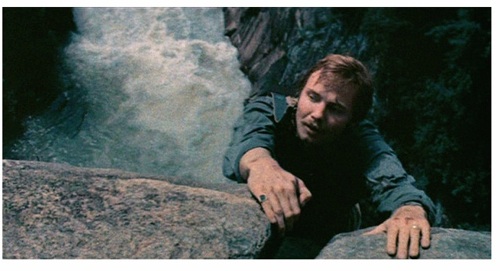
p.184: "I was aided by a totally different sense of touch than I had ever had, and it occurred to me that I must have developed it on the cliff." The book has a great belief in unrealized abilities that the circumstances of contemporary life have dulled in us, but that necessity, or adversity, could awaken if we found or put ourselves in a position to experience it. I do believe that when literal survival is at stake, such as in war, that something of this hyperacute awareness and sensibility does instinctively arise, and perhaps these realizations insinuate themselves permanently into consciousness. It is not my impression however that they contribute substantially to a permanent strength of mind if the foundation for such a mind be not already in place.

I interpret the story as supposed to be ultimately uplifting when the main character, Gentry, discovers his power to kill. I was taken along for some ways by this idea, though I was concerned about my health and mental fitness. Among the book's other main lessons is that somebody has to be in charge, has to take charge, and of course in the state of nature or even sometimes in advanced stages of civilization that often involves having to be willing to kill someone.

"Cornholed". There's a nice word. "...a man who had held a gun on it while another one cornholed him..."

The primal energy of the water was remarked upon numerous times. The means writers make of and the importance they attach to water symbolism--and almost all do--is the intellectual equivalent of Gentry's heightened sense of touch when scrambling for his life up the rocks. It ought to be second nature to a properly developed and highly functioning intellect.

The book on the whole, believe it or not, is very understated (quiet, modest, etc).

I wonder how these guys would have handled 3rd world immigration. Probably not well.

Monday, September 13, 2010

Deliverance Part 2

I seemed to think that the prose poem type style employed in this book was big at the time. What else could I have been thinking of? John Gardner's Grendel? Margaret Drabble's The Waterfall? The works of Donald Barthelme? It does seem to be characteristic of the kind of writing that was praised in university writing programs of the period, the better examples of which I have begun to find more tolerable in recent years.

The woods in the north are not as scary as what we find in this book, though judging by my trip to the Blue Ridge and Smokies this summer, even much of Appalachia has largely been tamed and brought within the pale of semi-respectable civilization.

Page 28, some married, mature adult sex talk (My initial response was 'yucky'). "I knelt and entered her, and her buttocks rose and fell. 'Oh,' she said, 'oh yes.'" Hey, I'm sure he did. Good for him.

On page 37, a reminiscence of vomiting after the office Christmas party. One thing I am truly jealous of the 60s for is that it had awesome Christmas parties, both at the office and in private homes, the like of which seem unlikely to return before I am too far gone into my dotage to enjoy them any longer.


These guys really are suburban if they can't recognize different kinds of trees, never see deer, and so on. Of course at this time, and throughout my earlier childhood certainly, one did not see nearly as many animals out by the highway as one does today. Deer especially, though one occasionally saw them in the country, but turkeys, skunks, foxes, porcupines, I don't recall ever seeing at all until I was in my twenties at least, and now they seem to be quite numerous even in well-populated areas.

P. 69: "He went down the other side as I came up, feeling dirt on my hands for the first time in years." This has to be an exaggeration. His wife never wanted him to dig or pull up any roots or trees in the backyard?

On page 76 there is a discussion of plastic, how it does not decompose and go back to its elements. Plastic is a good example of a evil that people at the time when it began its ascendence recognized and denounced almost at once, and of which everyone was more or less powerless to stop the proliferation anyway. Was much in the collective thought of the era.

What is the word for what this story is trying to be? A fable? It is trying to do the kind of thing I really like, which is to write about something quite implausible in such a way that it seems, or becomes for the time anyway, as believable and 'real' as anything else one's mind has encountered, but I don't think it quite makes it.

The kind of male-bonding that is a big part of this book is not really done much anymore, at least among urban/overcivilized types, of which group I am kind of a member. Personally I would prefer the Mr Chips style male bonding holiday, where one discusses theories of art or geological discoveries with a mental and social equal rather than carrying weapons and fighting with either wild animals or savage men, though it looks like neither is very likely to happen anytime soon.

The theme of the book, I venture, is that we should always assume trouble. It is the normal condition of life. We have let our guard down in comfortable modern life--life is supposed to be fairly horrible a good deal of the time, and we try to skirt that at our own peril.

This is definitely a pre-cell phone adventure.

The narrator, on the unfortunate friend who got raped, after the fact: "None of this was his fault, but he felt tainted to me. I remembered how he had looked over the log, how willing to let anything be done to him, and how high his voice was when he screamed." Yes Abby, we're a long way from Wordsworth now.

Is the book optimistic about human capability even when the proper manly spirit and knowledge have atrophied? I think it is on the fence.

I wa surprised at the brevity of the famous scene. The rest of the plot--about 150 pages--seems dictated by necessities that are predictable based on the length of the book.

Beholding (as opposed to seeing) the river is presented as having some kind of relevance to life. Nature in this book is always presented as being rather alien to the most refined human qualities. On page 171 alone it is described as "blank", "mindless", "icy" and "uncomprehending". It offers no guidance to a man. Compare this with some lines from John Denham on the Thames River, written in 1655:

"O could I flow like thee, and make thy stream
My great example, as it is my theme!
Though deep, yet clear; though gentle, yet not dull;
Strong without rage, without o'erflowing full."

This is culturally, I think, a more serious and useful way of engaging with nature.

Tuesday, August 24, 2010

James Dickey--Deliverance (1970) (I)

I had planned to start this essay with a joke, saying that I identified deeply with this book because its most famous episodes were as if lifted directly from my own life, at which point I was going to say, oh wait, no, forget it, that was the opening to my essay on David Copperfield, or something of that sort. However I have not been feeling too jokey lately, so my attempts at writing it straight seemed to me to be falling flat. I don't have the spirit either to mock, even half-heartedly, or to confront directly--let alone triumphantly--what the story would have me confront. Nonetheless it does not strike me as being beyond my capacity to offer a commentary on what I think it purports to say.

This is another book I would have been willing to put off reading forever if it had never come up on my list. This was mainly on account of all the references to the infamous scene in the movie, which I had also contentedly avoided seeing until recently. The novel was a minor sensation around the time I was born, so I had some interest in seeing what kinds of things were preoccupying the collective mind at that time. Was there other value in it? It was written by a poet, and has a kind of fantastic viewpoint and story, and at various points the writing gives the effect of being a prose-poem. That is worthwhile for seeing what kinds of things can be done with the form. The story did not stir me much, though the execution of it was admirable enough in most points. It is purposefully and tautly written. It is not overly short--there is a lot of explanation of what exactly characters are doing at any given time, of their material baggage, the terrain through which they are moving, all of which however is economically achieved and always serves to move the narrative forward. So that is good.

The movie is almost identical to the novel, and adds really nothing to it if you have already read the latter--even the famous "duelling banjos" scene is conveyed quite skilfully in the book, as another commentator, whom I will discuss more later, has observed just this week. The most infamous scene is far scarier and better developed in the book. The movie is quite highly regarded as a movie, but the book is much superior in pretty much every way, and while I admire the book, it left me pretty cold for the most part. My impression would be that the movie is generally overrated.


As I alluded to earlier, another commentary on this book was published in the New York Times the other day commemorating the 40th anniversary of the novel's publication. Like most of the book writing in that publication it is rather strikingly pedestrian and uninformative. Since I was about to begin an essay of my own on the same subject, I thought I ought it might be of interest to refer to it for some comparisons. The Times author likes the book more than I do, and takes the opportunity to get in some swipes at the men, writers and otherwise, of the present midlife generation for not showing much of a taste for engaging with the great themes that are the main preocuupations of the novel--danger, mortality, or anything else remotely discomfiting in general. This is perhaps true--complaints about the passive, stupefied, low testosterone state of modern manhood have been a pretty constant theme throughout my life--but I think he both exaggerates the significance of Dickey's engagement with these spectres in Deliverance and does not seem to grasp the substantial underlying reasons why issues would have even less immediate resonance with the man-children of generation X than they did with the more conventionally hardened, accomplished and actualized men of 40 years ago.

The introduction of Jon Krakauer's Into Thin Air as an example of non-fiction authors' moving onto the soil which novelists have chosen to abandon by the way is bizarre and nothing to the point. I have read this book, which is entertaining in a finding-out-what-kinds-of-weird-things-are-going-on-in-the-world-nowadays kind of way, and while the various catastrophes delineated in its pages may have suggested various contemplations on mortality, vanity and so on to certain readers, they don't appear to have done so to Krakauer himself, whose standout characteristic to me as a writer is how 95% of the questions and matters of interest that would have suggested themselves to most good writers do not seem to do so with him. It is even almost fascinating to read someone who is in many ways so unaffected by metaphysical concerns to any serious extent. (Greg Mortensen, The Three Cups of Tea guy, whose literary method has a similar odd lack of general intellectual or historical underpinning that seems to consciously inform his interpretation of his experience). Camus, or even Maurice Herzog, would have come at the material from a totally different conception of human existence. The lesson of Into Thin Air, as Krakauer saw it, was that too many people were climbing Mt Everest who were not anywhere near prepared or experienced enough for the rigor of such an expedition; those who did survive the catastrophes which befell the expeditions written about in the book were for the most part lucky, helpless to save themselves but being people of privilege and high self-regard expectant that efforts must be undertaken to save them. There was the usual indignation about environmental effects, Western incursion on indigenous communities, culturally obnoxious behavior and so on. The book's concerns are about forms and practical training and knowledge, which it takes to speak for itself when attained.


If current writers are not writing about the kinds of themes which are prevalent in Deliverance--and I am not sure that no one is (are there not novels about, say, migration from Central America across the dangerous deserts of Mexico and Arizona? Is not this unflinching grappling with the elemental nature of existence what Cormac McCarthy is celebrated for?)--it is probably because they do not feel them to be especially pressing concerns. Why they do not is perhaps one of the keys to understanding the age.

James Dickey was by most accounts consumed with living, and giving the appearance of living, a macho life. Despite having solid credentials to the title of acceptable manliness by most contemporary standards--played college football, served in World War II, had a successful career as an advertising executive, a more successful and acclaimed career as a writer, was an accomplished archer, guitarist and woodsmen, drank like a fish and bedded scores of women--he evidently felt the necessity of exaggerating the details of these accomplishments. I will not speculate on the deep causes of this insecurity or obsession or whatever one wishes to call it, but judging by the characters in his book, something in the effect which the easy security and comfortable status of postwar suburban life had on men was repulsive to his higher nature, he detected something of the same effect at work, even if mildly upon himself, and he reacted against it in an exaggerated manner; which was not unusual amongst male artistic types in his generation.
People my age may indeed have this same instinctive repulsion towards the type, especially if they are of it or even proximate enough, but it takes a different form. Life appears to be more competitive all around now; one's pool of competitors is much larger, and meaningful achievement that will incline the people around you to feel basic respect, let alone admiration for you harder to attain. The characters in Deliverance are presumably in their 30s, and we are supposed to take them as soft and mild--even the muscular Lewis character (played by Burt Reynolds in the movie), who is a workout fanatic and dedicates himself to all manner of weapons and outdoor adventure training, is portrayed as a somewhat ridiculous version of an authentic man. Nonetheless they all have jobs that easily support families and pay for homes, and their relative status at work is pretty high (above all women and black people at the minimum). At home, though the suggestion is that modern domesticity has drained all the vital spirit out of them, by present educated class standards they largely ignore their wives and children, are never expected to change diapers or babysit, and spend pretty much every weekend playing golf or going fishing with their male friends. My guess is that the typical 40 year old male or male writer today, not secure enough in having met the minimal requirements of adult manhood in the context of his own society, cannot presume to devote a lot of worry to how he would fare if confronted with mortality in the form of extreme violence or elemental adversity. Probably, he has little choice but to figure, not well. It might be difficult to convince him, if he cannot even achieve fairly simple desires, and feels no imminent threat of such violence, that it matters...

I'm bringing this to an end here. I may continue it later. In some sense.