Showing posts with label socialist fantasies. Show all posts

Monday, February 10, 2020

It's Time For My Quadrennial Primary Post

As a resident of the first primary state, in an era when many people believe that not only the quality of their lives, but in some instances their very continuance, are directly affected by the outcome of Presidential elections, I feel some obligation to explain my present mindset and make an account of what I am likely to do next Tuesday tomorrow. But I am going to warm up for this by recalling an election year from a long time ago, when I did not feel any obligation to account for myself, or even to vote at all.


In the fall of 1992 I was a junior in college and it was in this season when I was, I suppose you could say wooing, but at least beginning to talk to my eventual wife. I do remember this election as a background to the romance but apart from a few people whom I at least tended to regard as a little fanatical the emotional intensity and absolute horror of the opposing side was not in evidence to anything like the same degree that it is now. As almost all of my family and most everyone else I knew were Democrats I associated that faction and its supporters with being generally good and the Republicans and their followers as otherwise, and as I was 22 years old and other than the one term of Jimmy Carter, who was regarded as something of an aberration from the great history of the Party in the 20th century, there had not been a Democratic President the entirety of  my life, I imagined that if one were ever to be elected again that it would be a tremendous boon to the quality of life of the non-business-driven people like me whom the Republicans, in their avarice and indifference to the quality of public life, were not allowing to thrive as they should have been. But on the whole the level of antagonism was not that pronounced. A couple of members of the faculty at school held a debate on the question of allowing gays in the military--one of whom actually took the side opposing it!--and while there was one forerunner of today's progressives who made a show of storming out of the hall in disgust at this, my sense was that most of the audience regarded this as drama queen behavior and not helpful in promoting his favored position. Clinton won that year, of course, over the first George Bush, in what now we see was a very significant and transitional election, to an extent that I did not perceive at the time. When I think that my grandparents and their World War II generation era cohorts were still alive and not actually "that old" (my three living ancestors were 68, 69, and 71 that year), and how quickly after that they seemed to grow incapacitated and die, you realize what a demographic shift is coming in the decade ahead now as all of the Baby Boomers just entering their 70s begin departing the scene en masse. I don't know what I was doing on election night (probably drinking), but whatever it was I was not paying much attention to the results. I was with some of my friends and I remember we walked by or perhaps stopped briefly in a room where some people were gathered watching the coverage on television and the supporters of Clinton on the TV were solemnly holding hands and singing "The times they are a-changin'". When we moved on from this scene one of my friends quipped that if the times were changing, why are we still singing the same songs we sang thirty years ago? Of course the times did change very much, but nothing much like the way I imagine the people singing that night thought they were going to change.


I am going back to this memory in part because I am a total loss as to how to vote in this primary. I feel like I am only a Democrat at all anymore because I am obviously not a Republican, or don't feel that I would be able to become one at this point, but almost all of the people running on the Democratic side I don't really recognize as sharing a lot of my political values either. By process of elimination I can say I am definitely not going to go for Mayor Pete or Yang (too alienated from their worldview), no on Steyer (who is he? what exactly does he believe in that is of any interest to me? Sorry, I can't pretend I care enough about climate change for it to have any effect on my voting). I don't really want to vote for Bernie Sanders and heaven knows I am being warned on all sides, by intelligent and presumably well-informed quarters as well as hysterical ones, not to dare even thinking of doing so for myriad reasons, all of which lead to catastrophe. But I admit, he talks my language more than any of the other candidates do, and as I often do feel unsuccessful and excluded I am drawn to his expressions of anger towards the wealthy and powerful. At the same time I feel that I am supposed to try to resist this and be stronger but there is a real issue surrounding social acceptance, or more the lack of it, that is causing people on all sides to make these reckless, irresponsible votes. But I have to be stronger.


Warren is similar to Bernie Sanders, right, but more socially acceptable, perhaps because she has a more responsible and professional base? I was leaning towards her at the beginning. She has not been particularly inspiring on the campaign trail and the ranks of her supporters have turned out to be a crowd that is by and large almost as distasteful to me as the much-derided "Bernie Bros" (none of whom I have ever actually encountered in real life, however) are to a sizable segment of the Democratic electorate. She is still in play though. I can't see a way to vote for Biden in good conscience, and while I know where he comes from, both geographically and "culturally", more than any of the other candidates, he's never come off as either a great intellect or a great leader, and especially now. Bloomberg, never. Who is left? Klobuchar, I don't know anything about her. What has come out in the campaign to me (and I have not been following as closely as I could have) is that she is a centrist, she is smart, she'll know how to run the bureaucracy; I need something more specific. "Smart" means almost nothing in itself nowadays, especially where Democratic women are concerned, other than perhaps Gillenbrand, who was seen as flaky, they're all smart enough, there just isn't enough differentiation to make me feel that this person's particular smartness matters in some way that I can't get from any other smart person. I am tempted to vote for Klobuchar because a lot of sensible people seem to like her and it would be for me kind of an unorthodox, risky vote. But nothing she says or that I read about her makes any impression on me. I'd have no idea what I was voting for.


Oh Tulsi (Gabbard--she just goes by Tulsi on her signs though) is still on the ballot. All the respectable people seem to hate her, which makes her interesting, and I have watched some of the videos of her working out--she'd certainly be the fittest president we've ever had, given that Washington, Jackson, Eisenhower et al, were older men by the time they ascended to that office. But the media blackout of her has done its work, as I had forgotten about her until I just looked at the ballot, and obviously had not been considering voting for her.


So I guess for me it really is between Sanders and Warren, and maybe Klobuchar if I can find anything she has ever said or done or any position she has that has any appeal to me at all. But this is really not a great set of candidates to try to take down the most hated and dangerous President of all time (though I still think George Bush II may have been worse, and certainly I got more worked up over him than I do over Trump--I've kind of emotionally checked out at this point).


Tuesday, March 21, 2017

Notes on Movies Continued

As I am months behind in this, I am going to have to do a few of these. The good news is that I have not seen too many movies either, so three (posts) might do the trick. Of course at my rate that could take another two months.


Anna Karenina (2012)

I admit I liked what they did with this. They got Tom Stoppard to write the screenplay, and his vision was to take episodes from the book and put them in a theater setting, but the theater is usually just a starting off point for a good deal of clever filmwork. I remarked at the time that the movie makes a lot of assumptions that viewers have read the book and have a good recollection of it. Many minor characters for example make appearances without any introduction or explanation of who they are, you have to recognize them from the novel, and a similar dynamic is applied to various of the situations that the major characters are involved in, they appear or are alluded to in the course of the movie without being any further developed. As in often the case with modern productions that have some money to work with, the colors and sets and clothes and most of the people are lustrously beautiful. I was not enamored some of the casting, in particular Keira Knightley as Anna, though she does seem to fit with many people's idea of what Anna is. Older men (by which I mean older men than me) in the business love her, she is an ideal art-world sex goddess for them. Personally I don't detect much of a soul there, or an appealing mind either, though reputedly she is very smart. Maybe I don't like her, or Anna, because they are too superior to me all around, or at least there is no opening for me to approach them in a way that is pleasing to me. Even in the book there is with Anna much of a sense that her mental and emotional life, more as the result of cultured habit and upbringing than intellectual development, are inaccessible, certainly to the lowlier sort of reader.


I didn't like the actor they had playing Levin either, who played him as more of a goober than I think was merited. I thought it was widely known, or understood, that Levin was modeled in large part after Tolstoy himself, and in the book he had some cachet in Moscow society even if he was regarded as a bit of an oddball.
I do remember thinking that Vronsky was well-cast.


The King's Speech (2010)


I had seen this a few years back and I gave it another try. It still strikes me as a weak Oscar best picture winner. The material is too slight, the class dynamic strikes my American sensibility as rather gross, not that we do not have problems of our own in this regard; some of the particular forms of the British system are still alien enough to strike me as strange. The uninspiring George VI is not one of my favorite British royals. I was always partial to his disgraced brother, mostly on account of his clothes. I suppose the film had some appeal for me as a period piece, given my general affection for this period, though even in this I thought the effect was overly drab. Not in the physical sense--I like drab as an aesthetic in that--but in its animating forces.


It appears from reading this that I think it is dreadful and was rolling my eyes and generally not enjoying myself throughout the movie, but I am not fierce enough to denounce anything that thoroughly. Some of the performances are quite good. Still, overall I found it a disappointment.


The Hurt Locker (2009)


The second of the back to back Oscar winners from the turn of the current decade, and I suppose the best-known movie to deal with George Bush II's Iraq War. What I remember most about it was that it was filmed in videotape, and its overwhelming aura of alienation and nihilism. Compared with World War II movies or even to some extent Vietnam movies it is striking to me how little emphasis is placed on the connection of the soldiers with the greater society back home, effectively there is not much of one, and this is of course one of the themes of the movie. While I am partial to some landscapes more than others, I usually am able to feel some sense of beauty in most places. Iraq in this movie at least looks to be oppressively unlovable and alien in a geographic sense. The barracks--trailers I guess--where the soldiers reside are equally devoid of any tribute to aesthetics or positive cultural associations. We are reminded that there are still men in the world--I don't remember there being any women soldiers in this movie, which was somewhat famously directed by a woman--who take to the life of soldiering and war as their calling, though perhaps there are not as many being produced in the Western nations as there used to be, for good or ill, I am not clear in my own mind on this point. The Iraq War is presented in this movie as a somewhat endless series of military exercises and maneuvers, which, however skillfully executed, do not seem to be leading towards any obvious end, at least from the American point of view. Perhaps I should see it again sometime. It is not an enjoyable or hopeful movie in any way however.


Top Gun (1986)


Another military-themed movie, of a sort, though immersed in late Cold War Reagan-era jingoism rather than the fractured confusion that in the public mind at least has characterized the more recent conflicts. What a difference 30 years makes! I was not looking forward to seeing this, but I enjoyed it more than I thought I would, not because of anything to do with the story, but because I found it (as I have on several of the rare occasions when I take up movies from these particular years) so much fun to be back again in the oddly lost world of the mid-1980s, which were my high school years and the details of which therefore I recollect very vividly and which belong to me--not that I was myself doing anything very exciting compared to most people at the time--much more than the present does. There is a lack of oppressiveness in the atmosphere of this movie compared to pretty much everything about life in the present that does ring true in my memory. The look and demeanor of the women in the 80s were so comparatively pleasing too. Of course it is easy to be gulled by movie stars, but with the NCAA basketball tournament being on this week I was looking on the internet at some of the old games of the 80s and when the cameras scans the crowd or shows the cheerleaders they look a lot happier and like they are having a lot more fun, and are therefore cuter, than what I feel when I look at similarly aged people today, though perhaps I am partial to my own time. And then of course the lively, beautiful young women of the 80s are the 40 and 50-somethings who seem to be not especially happy with circumstances in the present.


And Quiet Flows the Don (1957)

3 part, 6 hour Soviet adaptation of the Sholakhov novel about Cossacks during the period of World War I and the Revolution. I found it to be very poignant. Why would this be, given all of the horrible things that not only take place in this story, but that we know are going to happen in the future to anyone who is surviving at the end as well? To begin with I am emotionally susceptible to the historical events of the period under consideration more than most others. I am as well susceptible to certain of the particular sensations which cinematic evolution had become adept at projecting by the 1950s, so much so that much that the default or base of most my ideas about geography and how the natural world especially is supposed to look like date from this time. I had also read the book, and the story is moving and stirring, in the sense of having sweep and movement. Even though they were a wicked regime and our enemies and they stifled entrepreneurship the circumstance that it seems to have been a prestige project in the Soviet Union may have made some impression on me also, the idea of the existence of this whole other film industry completely cut off from Hollywood certainly, but even Western Europe, full of actors and directors most people in the West know nothing, who if they ever had occasion to speak English, did not do so professionally. The movie was shot in bright and unsubtle color that makes it appear somewhat cartoonish at first but I found it grew on me.


I have written in the past about my time in Prague in the 90s and how I found certain lingering aspects of the lifestyle and organization of the era appealing, namely in the form of (certain of) the kinds of shared experiences that people had with one another, which seemed to me superior to the weak shared experiences, if there are any at all, that I at least have with anyone in the United States. This called some of that to mind too.


This came with a 4th disc exclusively devoted to some of the oddest special features I've ever seen. There was a droning interview with a modern day Cossack ataman (something like a chief), who was a balding, heavyset, rather unwarlike middle aged man wearing a medal-covered blue dress uniform and sitting behind a desk in what looked like an office in a community center. There was about a twenty minute segment devoted to traditional Cossack songs and dances which I was going to take a quick glimpse at and move on, but I found I was drawn into and rather uplifted by it, because, at least during the performance, the people were so proud and comfortable in their own skin not merely as awesome or superior individuals but as members of a community with some sense of positive identity and purpose. I know this sort of thing is discouraged nowadays among us because it often ends in conflict and people getting killed, but it is very attractive when you see it. The anomic life spent in shuffling about with one's head down, unable to drawn strength from or commune with such vitality as does exist around you is pitiful in comparison. This was what I was thinking while watching the dances anyway.


Tuesday, October 25, 2011

Movie Set (Common Theme: Oscar Winners, Especially Foreign Category)

These are all pretty good. I confess to being a benevolent judge, and am heavily influenced by my sense of how difficult it is to produce something which can be generally said not to be a failure even on mechanical grounds alone.

The Official Story--(1985)

From Argentina, won the Oscar for best foreign language movie in its year. It is about a politically naive, or at least willfully oblivious history professor married to a right wing businessman who discovers that their adopted daughter is likely the biological child of a communist agitator/leader shot during the country's infamous "Dirty War" of the late 1970s and early 1980s. I admit that I know virtually nothing about this war. The internet reference sites describe it as a near decade-long period of state-sponsored violence against the citizenry, presumably concentrated on the political opponents of the ruling regime. Between 10,000 and 30,000 people are estimated to have been killed. The movie, all of whose characters have recently lived through this upheaval, is serious and adult in tone. Conversations, relationships, political beliefs, professions, eating, dress, are engaged with an impressive, even almost unnerving, purposefulness. Characters are brusque, direct, knowing, competent, composed, and full of conviction. Even the main female character who is nagged by doubts and whose naivete is shattered during the course of the movie was an accomplished and put together professional, if politically and socially too submissive to the influence of her husband.

To an American sensibility the depth of conviction of the filmmaker's leftist/Communist sympathies is practically breathtaking. Hollywood people, however left wing they are supposed to be, have never been able to muster up this degree of heartfelt and unconditional hatred of the wealthy bourgeoisie, let alone the 0.1% or whatever precise stratum qualifies one as one of the truly rich. There is one scene where the plodding and increasingly successful businessman has Sunday lunch with his father and brother, socialists who cling to the woefully outdated small family concern that has no hope of being competitive in the modern international economy that even in the 80s was beginning to be recognized by more astute people. In the course of a political argument that becomes heated the successful brother calls them both out as losers and lays out for them how capitalism and the modern world works, how they would be foraging for roots and living in hovels without people like him, how he creates more economic value before lunch they have done in the last 40 years, and in general the rest of the standard argument that we have heard countless times from Republican party media and politicans over the last 30 years. Having had it deeply impressed on me that no one, no matter what they do, will ever be conceded to have won a political or economic argument in opposition to the core principals of capitalist enterprise on the merits of his case by anyone in a position of real authority, my impression of the scene was that while the socialist relatives might have been more endearing humans, the businessman had effectively demolished them, and demonstrated his strength, seriousness of purpose, and superiority over them to the extent that they, and the audience, must confess as much, at least when confronted by thriving capitalists of similar power and ambition. It was not until much later in the movie that I realized that we were actually supposed to hate the businessman, and that his speech, far from being conceived by the director as containing any force of truth, was intended to be despised for its grasping and petty conception of human affairs.

I gather that the characters in the movie represent a fairly privileged and elite class--even the professors and high school teachers work in more intellectually rigorous schools that most middle class Americans will ever have been exposed to--but the picture of Argentine society as depicted here looks more sophisticated and interesting at the ground, day to day level than ours does.

Madame Rosa (1977)


French, won the foreign language best picture Oscar in its year. It stars French cinema legend Simone Signoret, whom, incredibly I am seeing for the absolute first time, in one of her most acclaimed roles. Despite all of this that it has going for it the movie does not appear to be presently available on DVD, so I had to dredge up a copy on videotape. Simone Signoret is a retired prostitute (and Auschwitz survivor) who lives by taking in the children of active practitioners of her former occupation that they cannot, or don't want to, take care of themselves. They are supposed to send Madame Rosa money for this. The movie is about her relations with these children, one in particular, as well as the household's general relation to the bohemian-multicultural-immigrant neighborhood where they live. It is characteristic of its era and nation of origin: pretty original conception, good plot/character development through the first half of the film, retrospectively attractive cityscapes and people--the Parisian neighborhood where Madame Rosa lives is a little run down but vibrant and still recognisably connected with the French cultural tradition, and French people below middle age in the 1970s always strike me as being extraordinarily healthy looking even with the ridiculous fashions of the time. It is somewhat marred by a unsatisfying Godardesque ending that is also endemic to the period. I used to presume that these endings, being obviously symbolic of something, were possibly profound, and that my inability to make any sense of them was a tremendous loss of life-quality to me. I suspect now that they may be merely intended to be challenging or illustrate a quality of nihilism which is only pleasing, as well as accessible to, people of exceptionally refined intellects. I would still like to be such an intellect, and qualify myself for inclusion into a more desirable segment of society, of course, though I no longer believe that dutifully straining my wheezing brain for another 20 years to try to figure out the meaning of this class of inscrutable ending is an especially productive use of that organ.


Simone Signoret in her younger days. She was a commanding presence on the screen even in her dotage, but I was curious to see what the vintage version looked like. Not surprisingly, very like what I take to be the average attractive Frenchwoman's idealized self-image. Will have to get around to seeing some of her old movies.


The French Connection (1971)


Won Oscar for regular Best Picture in its year. I had never seen it, though it is certainly one of the iconic movies of its time, which time being my early childhood is one whose attitudes have effected an especial influence on my development. For a long time the combination of the 1970s, drug dealers, car chases (there is a very celebrated car chase scene in the film) and Gene Hackman, while not wholly turning me off from seeing it, did not encourage me to make a special point of doing so either. So I was pleasantly surprised by how much fun it is--and as with The Godfather, fun is really the right word for the experience, despite the circumstance that the movie is filled with all manner of violence and blood and criminal activity--when I finally saw it.


It is very similar to The Godfather, which of course came out the next year (and also won the Best Picture Oscar) in the formula of its success. Besides the highly stylized killing, the plot has the same kind of classic construction that for whatever reason had a brief revival in the early 1970s and then largely vanished again, although Steven Spielberg I must say has maintained something of this talent even up to the present, which is doubtless one of the secrets of his continued success. The individual scenes, many of them become classics in themselves (the car chase scene lives up to the hype; it is legitimately thrilling, probably not least because such a scenario, indeed most of the scenarios in the movie, would be impossible to even conceive of with contemporary communications and surveillance technology in play) are highly vivid either in action, setting or dialogue and always clearly build further on what the viewer knows to be going on in the movie and continually move the story in the direction of the climax. This sounds elementary, but hardly anyone active in mainstream filmmaking seems to have a sense of how to do this, let alone with any mild interjection of vigor. Also, again like The Godfather, there is a certain amount of sardonic humor even in murder scenes that can be irresistible--the part where the French hitman after gunning down the Marseille cop in the hallway of his apartment in cold blood breaks off a piece of his victim's fresh baguette to snack on on his way out of the building comes immediately to mind.


As noted in a previous post, I've lately become more interested in the era around when this film was made ('68-'74 or so, which also happens to be the time right when I was born) than I had been previously. Indeed, for most of my life, it had been one of the periods of the 20th century I was least interested in. This disinterest was perhaps because the media focus on this era has always been on the extreme political and social turmoils and movements that defined it, which usually being depicted in broad and sweeping images never captured my imagination. It may also have been because the time, much of it my own childhood, struck me as not a particularly good one to be a child in. It also did not strike me in my 20s as a great time to have been in one's 20s, though the people who were that age, as people always do, certainly liked it well enough. It does strike me now however as not a bad time to have been a 40 year old man. The economy up until '73 was strong--you pretty much had to assault your boss with a baseball bat or embezzle money to lose your job--you weren't expected to do a lot of housework apart from mowing the lawn and simple repairs, you could still drink and smoke anywhere you wanted and not be the only person doing so, there seemed to be more leeway as far as flirting with women went, not that I would have been able to do that anyway, but the knowledge that some such possibility existed might have added a certain excitement to the day to day prospect of existence. Of course at the time all of this would have seemed so unremarkable that it would not have been any relief of depression anyway.


The city looks great in this movie too, even when it is supposed to be shabby and/or dingy. There seem to be so many interesting things for regular people to do, whereas the sense is that now this is not the case, that Manhattan at least is wholly the province of mega-millionaires and even nightclub life is become wholly organized around their status games. Against this backdrop, 1970-era New York suddenly looks less chilly than we remember it, though I know one must be wary against being taken in by appearances.


This is Arlene Farber as Angie Boca, the girlfriend of the small time middleman trying to make his first big score on the French drug deal. I thought Angie Boca was pretty sexy (she often disguised herself in blonde wigs as a 22-year old) and was taken with the idea of her for several days after watching the movie. I even posted on my Facebook status that "Angie Boca is the real dream NYC girlfriend", which observation alas garnered no responses, not even a like.


William Friedkin, the director, followed up this, which I believe was his first feature, with the Exorcist, after which he attempted a remake of the great 1950s French film Wages of Fear which proved disastrous, and after which his career never really recovered. He was evidently so arrogant and obnoxious in the period where he was successful, not least towards film studio executives, that many took pleasure in his downfall. I listened to his commentary on the film and he is obviously pretty intelligent, with some sense of humor, as well as at times rather self-deprecating. Probably he was on his best behavior.


Hud (1963)


Did not win the Oscar for Best Picture in its year. In fact, it was not even nominated, which, especially as foreign language films don't seem to have been under any consideration at that time, seems almost a travesty now. While '62 saw a number of big time classics hit the screen, '63 was kind of a wide open year for the awards. There was no dominant English-language film casting a shadow over the rest of the field (Foreign-wise, I know 8 1/2 and Jules and Jim at least came out in '63; I can't remember anything else offhand). The winner was Tom Jones, which is sometimes listed among the worst Best Picture winners, and is detested by lots of serious film watchers. I have written elsewhere that I actually like it, though today at least I am pretty sure I would have voted for Hud over it for the Academy Award. I haven't seen any of that year's other nominees, but none of them stand out to me as anything highly regarded as great movies today: America, America, Cleopatra, How the West Was Won, and Lilies of the Field. Anyway, Hud is a real American movie with a lot of poignancy, it's from the tail end of the old days before the general personality of the country underwent the dramatic change that still informs it to a certain extent today, it's got Paul Newman in his prime years as a star taking on a role that requires him to play a rather small and unsympathetic man, it's got Texas in its full epic grandeur mode that Larry McMurtry, who wrote the source novel for this movie as well as that for The Last Picture Show, which has a very similar atmosphere to this, seems to have been able to tap into so well. There's a lot to like.


While the idea of the traditional rural Midwest in the collective national as well as international imagination seems to grow ever fainter, Texas seems to have retained something of that mythology of the remote place set amidst the vast open spaces, distant from population centers or other significant physical contact with the wider mainstream culture at all. The idea seduces you with the promise of its purity, you can feel the landscape and the tumbleweeds rolling down the main street of the town, uncorrupted by extreme postmodern developments, though you can still get Coca-Cola and toothpaste at the 1950sish drugstore. Professional cynics think it's a lie, just as they doubtless think the quaint New England village motif is a lie. They are not, not wholly however, at least if you have the imaginiative power to see them.


I haven't said much about the actual movie. It's heavy on the midcentury Freudian-type themes, the conflicts between fathers and sons, sibling rivalry, the mysteries and deep significances of female sexuality. We largely avoid these themes altogether in our generation, as well as the one behind us; such relationships as we do manage to have seem to be small by the traditional standards of the humanistic tradition, and do not involve a very substantial engagement with the question of how to live. I didn't take much from the story, which struck me as a framework in which to express more sweeping general themes--the dying of old ways of life, the ever more elusive quest to attain fully realized manhood, the (supposedly) elusive depths both of female desirability and desire--in a picturesque setting, with exquisite-looking people. I usually try to take things on their own terms, and I have a certain degree of sympathy with these terms, so I liked it well enough.


I do not want to go on a long aside about Paul Newman's sideline of above average food products (I just had his raspberry vinaigrette salad dressing tonight and I think it has a temporarily positive effect on the sharpness of my thinking), but I do think that the emphasis on the labels on how all the proceeds go to charity is illustrative of the broad change in our society's attitudes towards wealth over the last 30 years, which younger people will never have known and a lot of older people claim to have no memory of. Nowadays if a celebrity opens a clothing line or a fine wine division it is regarded a savvy move promoting the brand or whatever, and no one expects the entrepreneur to give the money to charity. This would not have been the case in the mid-80s, which if I remember correctly is when the Newman products first appeared. People like my grandparents, whom it should be noted were Archie Bunkeresque welfare-hating Republicans, would have somehow thought it bad form for a presumably already very rich celebrity to be able to muscle in by virtue of his name recognition on a lucrative but traditionally unglamorous market. Frankly it is difficult now to try to remember or conceive what the rationale against Newman's making himself a pile of money was, because nobody thinks this way anymore, but obviously Newman himself had something of a similar mindset, because customers were assured right from the start that any money earned from the sales of his salad dressing and salsa would not be going directly to him.


I had a Contemporary Bonus as well, but I think I will save that for another post, as we are already over a week on this one.

Tuesday, November 30, 2010

Food is Culture, Part MCCXXII

This is a topical post, in response to the recent Newsweek cover story (* & **) about the increasing class divide as it plays out in the diets of various sets of people loosely identifiable by their incomes and the types of education and jobs that they have. I 'eat up' these kinds of stories because, as in many areas of life, I superficially have some of the characteristics of the most desirable group--here those who put the most thought and effort into putting the best possible food, ethics-wise, health-wise, and taste-wise, into their bodies, on every occasion--but am ever aware that I am lacking some vital quality, which, even if I tried much harder than I do to imitate and make one of the select, will never enable me to do so.

Of all the markers which have sprung up like so many single family housing developments over the last few decades to enable the various tribes of the middle and formerly middle classes to distinguish themselves ever more finely from the sorts of people they don't want to be identified with, food militancy is perhaps the one I was least prepared for, and it has always struck me as one of the cruelest as a basis for social rejection, though I know most people would vehemently deny that they consider the matter in this light at all. Do not imagine that I do not like many developments of the food consciousness revolution. It is one of the modest thrills of my existence to go to Brattleboro or Portsmouth or Cambridge or one of the other oases of enlightenment in my general neighborhood and partake of fresh and palatable versions of familiar foods amongst the kinds of people I do not necessarily want to be identified with but still crave acceptance by. I also still like greasy pizza parlors and diners however (though I accept that others do not), and find most of the people who go to them decent enough as well. It is the evident revulsion the foodies harbor not only towards the food itself that they don't like but the actual people who eat it that saddens me. To me there are enough issues in personal relations that making another barrier out of others' diets, assuming these to be within bounds that would traditionally be considered reasonable, strikes me as ungenerous at the very least.

When I was at college there were a lot of people--especially people from New York--who devoted a great deal of energy to bitching about the poor quality of the food, not only at the school itself, but of that available in the town generally. This always bothered me, not because I was madly in love with the food myself, though I found it perfectly acceptable, but because I came out of an environment, I guess, where the idea of an 18 year old complaining about the food available to him would have been regarded as an ungrateful snot who needed to have some age-appropriate humility knocked into him. No one seems to think this way anymore however. This is an area where my pitiful socialist tendencies really come out strongly too. Because I saw these students, many of whom were highly intelligent, interesting and attractive people whose company I should have liked to have partaken of more often, as abandoning the common table out of exalted notions of diet, I frequently fantasized about a return to rationing or other compulsory controls on extravagance of taste to force them back nearer my orbit, though happily of course no one rational would ever advocate imposing such measures on our better classes of people, and even I deep down would not want them to, for then they should just be very angry and resentful, and not take the thing at all in the spirit intended.

Unlike the generations that will follow me (most likely), I at least had the good fortune in my mid-20s to be able to spend an idyll in a land where people still experienced food the way Americans did circa 1958--heavy, meaty and largely devoid of alternatives even in the imaginations of cool and extremely good-looking people. To culinary sophisticates from the global elite it was a misfortune, a horror even. Some poor souls were reduced so far as to literally weep after a few weeks of deprivation from what they regarded as decent meals. For me--although even I at times grew tired of the limitations of the Bohemian diet, there only being about 5 regular dishes, and 3 or 4 sides--it was practically nirvana. To attend parties and go on excursions where plates heaped with sausages and potatoes are routinely dished out and distributed to everyone, even the prettiest girls, and no one complains or expects anything different, but simply eats and goes on talking about music or communist theory or how to learn languages or whatever that is far more interesting than hearing about their private food fetishes--this was a quite wonderful arrangement. Needless to say I am sure in the 13 intervening years it has completely broken down and the people's diets readjusted to their places in the social hierarchy.

*There is a photo gallery which accompanies the online presentation of this article. I am more than a little dismayed however that of the various contents-of-refrigerator shots shown in this gallery the one that most resembles mine is that of the black single mother whose situation and family the reader is invited to feel the deepest concern about the likely unpleasant future of in the article. I even eat real butter and not Country Crock, which I believe officially makes mine worse, although my wife, who is going to live to be 95 years old at least, is adamant that anything real must be better for you than anything artificial that is trying to imitate it, and I believe her.

**The husband of the locavore-committed Park Slope family is evidently hitting Wendy's on the sly, because he looks to be in even worse shape than I am. When my first thought on seeing your picture is, Christ, I could take out that guy with one hand tied behind my back, you are not a good advertisement for anything. My wife and children look better and more robust than that family's too (Goddammit!)

Some say that nothing good can come of allowing your wife to watch Mad Men (i.e., don't expect her to thank you for being comparatively enlightened--the credit lies elsewhere than with you personally) but mine became inspired to make rib-eye in a pan with butter after one of the episodes, so there is some hope there

Saturday, November 07, 2009

Counsellor at Law

I saw this swell movie the other day and thought I would put in a word for it on the internet. It's a fairly early (1933) work of the director William Wyler, who is evidently one of my favorite directors as I have several of his films on my favorites list, though I was not aware of this until I was looking into the matter just the other day. This guy directed an unbelievable number of blockbusters and movies that are beloved of middlingly sophisticated cinephiles such as myself--the Laurence Olivier Wuthering Heights, Jezebel, Mrs Miniver, The Best Years of Our Lives, Roman Holiday, Ben-Hur, just for an initial sampling--while the critical elite tends to be considerably less enthusiastic. Even among these however this film, I suspect because it is comparatively uncelebrated, has lesser known stars, is modest in scale and pretension and so on, tends to be favorably regarded, and deservedly so.

The screenplay was written by Elmer Rice, a major playwright of the time whose work I am not otherwise familiar with, and adapted from his own play. It has that quality I often praise in old movies of using energetic dialogue almost without breaks to propel the story forward. This movie with its office setting also uses it quite impressively as a means of establishing an atmosphere of bustle and heady activity. The woman who plays the switchboard operator for example is not central to the main action of the plot, but her manner of chirping and rapid-fire patter in the center of the office while the other characters come and go on their ways around her is an excellent effect. The liveliness of the law office depicted in this movie, with its dramatic situations, colorful characters continually passing through the office, grovelling underlings and clients and attractive and worshipful secretaries actually had me thinking it wasn't too late to go to law school after all for a hour or two afterwards, though after I had sobered up I considered that this was probably not what being a lawyer on a day-in day-out basis was really like, and that even if it was, I wouldn't have the energy of the lead character/star attorney in the film to make it happen myself.

This movie had a great cast, though I had never seen any of the principals before: John Barrymore, who is kind of famous, and Bebe Daniels were the two main stars, but there were a lot of minor roles that I thought were outstandingly played, the receptionist being one, the brilliantly credentialed but socially inept young lawyer Weintraub (I think that was the name) who keeps unsuccessfully asking out the Bebe Daniels character, the other young guy who is some kind of intern and has to fill in for the women when they eat lunch and so forth. The accounts of the filming of this movie ironically depict Barrymore as frequent drunk and unable to remember his lines and Wyler as unpleasant and borderline abusive to the minor cast members, which is not anything like the feeling one gets from the finished product. But such is the case, it seems, with a lot of quality art.

There was a very good dialogue that I wish were available on Youtube between the great lawyer and an unrepentant young communist agitator whom the lawyer has agreed to help for the sake of the man's mother. The communist goes on a rampage against the rich and privileged, to which the lawyer responds forcefully that he came to this country in steerage himself and scraped and clawed his way to the top and that anyone else had the opportunity to do the same, at which the communist was not cowed but went on to denounce him as a class traitor, all through which, and this is what I found most interesting, the lawyer made no attempt to cut him off or throw him out of the office or personally denigrate his accuser, but let him have his say, without, however, backing down from his own point of view. There was no attempt to resolve the question one way or another. Similarly the lawyer himself was presented as being rather morally ambiguous in his myriad business, but sympathetic and attractive nonetheless because of his great appetite for work, his personal attitudes towards people in accordance with each's authentic merits, and so on. Seeing this movie, in concordance with watching the World Series and reading the New York Times coverage of it and other events, reiterated one of the fundamental tenets of American life which was not properly conveyed to me as a young man, which is that if you haven't made something of yourself in New York (or maybe California), you really don't matter, at least as far as any kind of publicity or literary assessment of you is concerned. Do not get me wrong. I love New York. I am resentful every day toward my immigrant ancestors who were evidently intimidated by all the cool and ambitious people getting on the New York boats and shambled off to the safer and less threatening Philadelphia boat instead, dooming their descendant to grown up in a realm where apparently nothing rising to the level of culture significance ever transpires, or ever can transpire. It was idiotic of me, as it would be of any young person of my particular interests, not to have done anything to try to live there and make a go of something when I was young. That said, the self-congratulation of the current crop of New Yorkers and New York writers and other public figures mainly for being New Yorkers and New York writers irrespective of the ultimate quality of their work or being in any other way especially interesting is getting to be a little tough to take. I know this happens because NY people are, in their daily relations with other NY people who outrank them, envious, insecure and perhaps often unhappy, so they make themselves feel better by imagining that, say, Philadelphia is populated more or less exclusively by knuckle-dragging cretins, and that if said commentator were to move there himself he would stand out almost grotesquely as by far the smartest, most sophisticated and socially dominant person in the whole city (a prospect of personal greatness which is surprisingly quite terrifying to most people), and I have to remind myself of this.

Friday, August 22, 2008

My Personalized Reading List

My Personalized Reading List I had started to write something else about the Olympics--the blogosphere, of which I make such an indispensible part, was abuzz with various articles describing the rampant sex that starts to break out in the Olympic village towards the end of the games when most people's events are finished, for one thing--but what can one say about it? After all, the original Olympians were naked the whole time? Wish I were there, (or rather had once been there?) The idea of personally indulging in some Olympian love--I think a good German or Canadian girl would have been ideal for me, they seem the most likely to be susceptible to the release of the kind of emotion that I am drawn to at thinking themselves part of a great event--is undoubtedly appealing. That confessed, the idea of being in the midst of a great orgy, particularly one where English and Australian boys are the ones indulging themselves the loudest and most frantically, and without my highly refined romantic sensibility, makes me a bit squeamish. And really, I'm sure whatever sex happens at the Olympics is pretty milquetoast compared to what the serious sex connoisseurs do. My battle-cry has always been "There are some genuinely interesting and beautiful people out there who have milquetoast sex lives," and I still sort of believe it, though I don't think I would be able to say so with composure on television, because when I think about the people I have in mind the idea (that they are either really interesting or beautiful while devoid of compelling sensual qualities, or, that people with compelling sensual qualities could really have milquetoast sex lives) seems preposterous. So, having gotten that out of the way, I am going to write about a personalized book list I received from Alibris.com (a bookselling service) in a recent e-mail. Unlike the personalized suggestions one gets from Amazon.com or other such sites which obviously correspond to one specific book or other that one has ordered on the site in the past, there was no obvious connection I can think of directly with most of the books on this list. The first and most curious recommendation was the notorious Marxist historian Eric Hobsbawm's 1993 tome Age of Extremes: A History of the World 1914-1991. I have never read any of this author's work, but he is frequently evoked by conservative pop intellectuals/journalists as a much more than run-of-the-mill bogeyman, almost approaching the Noam Chomsky level. The stuffy and rather mean-spirited (in both senses of the word mean, I think) polemicist and editor of the New Criterion magazine, Roger Kimball--who is on the Board of Visitors and Governors of St John's College--what is his connection?--who appears to spend a considerable proportion of his life in varying degrees of apoplexy aroused by the activities and postures of leftists in positions either of or blessed by authority, evokes the specter of Hobsbawm on a regular basis as one of the most noisome human beings on the planet. Among that segment of the intelligentsia for whom hatred of communism is one of the two or three animating characteristics, Hobsbawm is regarded as absolute scum, practically the equivalent of a Ku Klux Klan member. This was so strongly impressed on me in fact that I was a little surprised both to find an as far as I can tell reputable and dignified firm promoting this book as if it were something completely normal and generally inoffensive, and to me, especially. What did they take me for? Hobsbawm's most frequently-quoted--or at least referred to--statement is his affirmation that 20 or 30 million deaths, perhaps even more, would have been tolerable and justifiable if communism had ultimately emerged triumphant as the normal paradigm on which human society was henceforth to be constructed. This is not a nice idea to express but I am pretty sure we are supposed to understand it in the sense of ideological purpose which sees its potential and actual victims, however wrongly, as legitimate enemies. My point is not that this is good, but that there is little reason to believe that as a practical matter the capitalist/corporate interests (whatever one calls the rich people who run the economy of the modern world) would not consider 20 to 30 million lives an acceptable, even an insignificant price for the preservation of their system, though they probably would not be quite so uncouth as to express themselves thus baldly, to discuss numbers, etc, and, being already ascendant and at the forefront of trends in public relations, would likely be more persuasive in painting and writing off their enemies/victims/challengers as losers, for people have no instinctive sympathy with losers. These generally have to find a way to present themselves, or be presented skillfully, forcefully, and attractively, before any effective indignation and opposition begins to percolate among such as have any ability to contend against the dominant power.


Had I been in circumstances at all propitious for the conversion, I have little doubt that I would have been a communist in the 1930s. Probably not to any extreme point, certainly not to that of moving to the Soviet Union, as apparently thousands of Americans did (and then weren't able to get out again, at least not until the end of the Stalin era, with all the atrocities that came with living in that time and place). I might have been talked into going to the Spanish Civil War if one of the cool people, or especially one of the free-loving, brunette-bobbed, not to be resisted commie girls of the era had personally encouraged me to go. These femmes fatales of the left devoured legions of what might be politely called beta male writerly types (especially Jewish ones, whether in New York, Paris, or the capitals of Central Europe) throughout the era. It is easy to detect in the literature of the time that their radical politics, bohemianism, sexual liberality and desirability must have been absolutely devastating to stammering soft intellectuals. There seems to be nothing equivalent now--I mean there is no political movement where good-looking women will feel an urge to sleep with you as a kind of expression of the cause. Of course many of the writer types, those of a sensitive disposition anyway, fell in love with these women, because they were sexy and had paid them some attention, and wished to be married to them and dreamt of having these women cook and iron and support them in their endeavors for literary immortality in the most conventional bourgeois way. This was not in the proper spirit of the movement. Anthony Powell, for example, staunch Tory he, did not abstain (or at least the narrator in his magnum opus who is basically his stand in) from an adventure in communist free love, getting with the actually somewhat gross Gypsy Jones character in the artist's studio after the funeral of its former occupant; as the narrator only owned having gotten with 3 girls, and that counting his wife, over the course of 3,000 pages covering a time span of 50 years, and this being the only one that would have qualified as a "one-night stand", this leaves me to believe that the occasion, or one similar to it, must have ranked among the high points of this author's life. But I am making a joke of all this, and communism, even when advocated by misguided, ineffectual and insignificant Americans, is not really a proper subject for mirth. If I appear to flirt at times with an affinity for this ideology I assure you it is almost certainly out of pure social desperation, not out of a desire to enshroud the nation, or civilization itself, in a dark age; if a socialist movement existed that really could offer me more intellectual camaraderie, more hints of intrigue, less sheer boredom, a sense of a place in the world more befitting my self-perception, I would be receptive to it the same as anyone else would. That is all.


Another book on the list was Goldsmith's She Stoops to Conquer, which I have read, and remember thinking had much that was humorous in it. It is one of the better 18th century plays, though I actually rather like that category of literature more than most people seem to. The third book was Carlyle's History of Friedrich II of Prussia. Another doozy. Literary-wise, I was raised on the Victorians, and while I can still think of at least ten of them that I still like a lot because they are superior writers, Carlyle isn't one of them, and overall I have not been in close sympathy with the general Victorian mind in some years. The last book was an Einstein biography. I erased the message without writing down which one, and of course there are about 50 Einstein biographies. I think this one was from the 70s though. It wasn't the most recent one that was a good seller. Many of the Einstein biographies are good sellers, which indicates to me that they don't require a particularly intensive knowledge of physics, but focus on relationships, rivalries, academic politics, quirky personal habits. My father used to know someone who as a kid had lived on the same block as Einstein in Princeton in the late 40s/early 50s (apparently the greatest mind of the 20th century lived out his days in a suburban neighborhood, though whether this was in a tract house or on a more dignified Victorian-type residential street, I don't know). She didn't have too many titillating stories, other than that the great man was said to forget to do banal things like put socks on before going out of the house, or to eat at regular mealtimes. Of course he was quite old by that time.
I rode in an elevator today with John Sununu, the junior senator from New Hampshire, for whom I have long nurtured an intense dislike (I of course did not mention this to him during the ride; I did not smile either, however). My dislike has lately been tempered by the seeming likelihood that he will not win re-election this fall due to the state's rapidly changing political demographics, but still, his father was the governor and later the chief of staff under the first George Bush, and the family apparently remains popular, though certainly no one I know well and whose judgement I would consider reliable likes him. Both father and son are supposed to be brilliant, super-educated, have stratospheric IQs, etc, though the People are not often treated to a display of this intellect commensurate with the reputation (though to be fair, this is the case with almost all politicans nowadays). During the Republican ascendancy of 2002-04 the senator was most proficient in the condescension and disdain aimed towards anyone skeptical of the Presidential agenda that was favored by the Party in that period, but since both of the state's Republican congressmen were voted out in favor of relative nobodies in 2006 I notice he has toned down this attitude considerably. The senator is of average height, and while he gives off an air of affluence and privilege, he does not have a particularly imposing bearing in person given his position in the government. He looks like a typical moderately succesful 40-something lawyer. I suppose he looked more genuinely intelligent close-up than he comes across on television, and he wasn't smirking, which would have been unbearable. He looked to be going to a meeting with some executives at the place where I work, and I suppose he had the capacity to engage meaningfully at some level with them in this meeting, and they, or at least some of them, had the capacity to engage equally meaningfully with him. I am fascinated by capacity of this sort, for I have so little of it, and yet there seems to be no obvious reason why this should be so utterly so.

Friday, May 23, 2008

Miscellanies (Mostly British)

I do not write much about the unpromising-looking global economic situation because the subject is so thoroughly covered elsewhere, but I have started to notice some unsettling signs, the most telling one being that I spotted Mad Dog 20/20 and Wild Irish Rose on the shelves of the wine section in the upwardly mobile grocery store I have been going to for the last ten years for the first time ever today--and there was only one bottle of Mad Dog ($1.49) left in stock. I held off on getting it for now however.

On to real estate. This item is a month old, and may only be of interest to me, but I thought it was worth passing on to any interested buyers that Evelyn Waugh's house--which is still owned by the family--is on sale for 2.25 million pounds. This looks liked a pretty good price to me, at least compared to say, Ray Lewis's or Shaquille O'Neal's houses as they appeared on Cribs, both of which cost considerably more.

This book, which gets a very good review in the Atlantic, looks like it might be worth checking out just for the photographs. My fascination with this not usually too fondly remembered (in England) time period is kind of a recurring theme on the blog. I certainly have a decided affection for many of the familiar images of it, the dinginess, the cold, the bad potato-based meals, the warm beer, the dark, greasy, steam-windowed pubs (quite a few of which, at least as late as the mid-90s, remained in apparently unaltered condition from that era, among the few living relics of that time) the spare, direct style of both the prose and poetry of the period, which I think of as having a kind of rail station elegance about it. The strong consensus now seems to be that one ought not to romanticize this era, especially from the vantage point of modern comfort and prosperity, for the Austerity age was marked by inconveniences almost unfathomable to us now--for one example the number of British households with indoor plumbing did not climb above 50% until well into the 1950s--and we should not imagine that we would ever find anything enjoyable in that similar circumstances. The photographs however do act forcefully on the mind. The impression is of a world in which a person with a decently-developed mind would have much opportunity to think--life did not appear to move with much speed or urgency in these years--and much matter to think upon (people in this era, especially educated ones, it must be pointed out in fairness, also seemed to drink far more than their counterparts do today). The other main factor in this attraction, which just came to me the other night, was that of course from 1945-1951 Britain had a socialist government, almost certainly the most stridently socialist government in its history; and I have always had a perverse, but nonetheless consistent attraction to societies in the throes of a socialist experiment, especially in its earliest phases. My socialist sympathies go back a very long way, and no doubt have their origins in the social frustrations that have crowded out most other memories of my youth. By high school, when so many of the most desirable students, the girls in particular, were availing themselves of social options not available to me--going to dances and sporting events and concerts at other schools, or cities, or colleges, and so on, that were more exciting than what was available in our school and our neighborhood--I used to fantasize that somehow these interesting and successful kids could be trapped and forced to go to the same hangouts and social events that I went to. This is very much, I think the attitude of a socialist, especially when found in intellectuals; it is a fear of being totally abandoned and left far behind by all the best and smartest people, so that the latter practically are gone from all view. This certainly does happen. When I would be sitting in class, instead of paying attention to the lesson I would concoct ridiculous scenarios--which I am sure are not that uncommon--in which some unpredictable and sudden disaster, such as an earthquake or an aerial bombardment, would bury the school under mounds of rubble, but with me and some reasonably good-looking girl--I was not terribly picky as to whom, indeed the idea of randomness was one the more exciting aspects of the whole possibility--trapped alone, but alive, in the basement, in which the electricity and the plumbing would still be functioning, and there would also be a food supply--the home ec rooms were down there, after all, as well as a couple of vending machines. I had no illusions that the girl would let me do anything to her that I would have wished to do while there remained any hope of rescue. I figured we would have to be down there for five to ten days before she would come to the realization that I was going to be the only truelove she was ever going to have in this world, at least from this point on, and submit to me. I must say, that as a teenager the obvious option, forcible coercion, never entered my mind; I wanted my prisoner, or fellow prisoner, as it were, to fall in love with me, rather like in the story of the Beauty and the Beast, and I did not think that a clumsy attempt at violent assault was the way to bring that happy ending about. This mindset also explains I am sure my youthful nostalgia for my parents' Catholic upbringing. The most able people in this group, who were most aware of the existence of wider options, naturally found this world impossibly stifling, and when they were able to throw it off and assume important positions in society emphasized this idea of repression so much that many have come to regard "Catholic upbringing" and "repression" as synonymous. To someone who wasn't going to be doing anything that required to be repressed anyway however, the requirements of that kind of community would have served to keep some smart, exciting people close to hand at all time, people who had far more ability to make something tolerable and memorable out of a situation they had unwillingly to endure than the average person did; in the event too raising the self-worth of the other members of the group as feeling themselves members of a community with some vibrancy instead of one that shuffled about in endless and insuperable lifelessness. This at least is how it worked in my imagination.

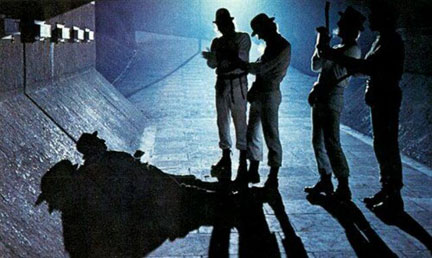
As to my movie watching, recent weeks have seen me undergo a heavy dose of Malcolm McDowell. It was only two movies, O Lucky Man and A Clockwork Orange, but as they time out combined at over five hours, both offer variously unhinged and unpleasant visions of early 1970s England, and both indulge luxuriantly and exclusively on the character played by the star, the effect of watching them back to back is that one feels that he has covered this particular epoch (British film 1971-73, approx) and star pretty solidly and can color them in on his map of cultural knowledge, if you will. O Lucky Man is not, that I can see, the great work some cinephiles claim it is, though since I had never heard of it before it offered a certain degree of unanticipated interest, which is always pleasant. It is dated, sometimes in an interesting, sometimes in a distracting way. The animating premise, widely held at the time, seems to be that society is about equal parts absurd and wicked, and even anything delightful is a surface illusion thinly covering an appalling foundation. I like the device of the road trip all around the provinces and various economic and cultural pursuits of Britain. This was a popular device in the 18th and early 19th centuries in that nation but I hadn't seen a modern update that came immediately to mind. Malcolm McDowell I must admit I kind of like, although he is exactly the type of person whose own animating premise, or one of them, seems to have been unveiled antagonism and contempt towards people like me (dull, ultimately complacent bourgeois). This is why of course he was so good for these types of movies, and why he became famous and popular in his own time He would be one of the exciting people--clever, charming, good-looking, not ridiculously so but enough to distinguish him from almost everybody else while being at the same time enough like everybody else that they could easily identify with him--that I referred to earlier in the section on socialism.

I had seen A Clockwork Orange--or at least the first hour of it, for I had not remembered anything that happened after that point--some years ago, probably when I was in college. I hadn't "gotten" it at the time; I certainly could not adequately explain what its purpose as entertainment might be. I considered myself at the time, and still do, a fan of Stanley Kubrick's movies--they are very entertaining for people who have a sort of general, haphazard, largely autodidactic, reference-book informed education such as I do. Kubrick himself was a high school dropout but seems to have read a lot of library books, looked at pictures and objects in museums, and listened to musical recordings, and interpreted them not with the privilege and authority of the scholar/expert but with that of the bohemian/artist. A Clockwork Orange is not, I am guessing, a movie of the sort that this director imagined in 1960 he would ever be making; that is one regard in which it is interesting, for I suspect most people in the arts have some vision of what forms their life's work is likely to take, ten years into the future anyway, and of very specific projects that they hope to complete. There are numerous demonstrations of course of filmmaking prowess that even I could appreciate. Having so many scenes of shocking violence and depravity follow in rapid succession right at the beginning, to be the narrative rather than the point to which the narrative was moving was a very effective technique, as these are the most memorable scenes in the film. I have not read the book, so I don't know whether that is how the plot unfolds there too. Not having any of his characters talk like a normal person, or even like ordinary affected actors, is something of a Kubrick tradmark which I am sure has been commented upon elsewhere. It is one of the secrets of his success I think, in tandem with other things, but the constant exaggeration and distortion of human speech serves to draw one into the psychic atmosphere of the movie and out of that of life. The depictions of sexual violence and rape offer a number of quite disturbing challenges to me. One of the effects of them is to be reminded of classical paintings and sculptures, of the rape of the Sabines, or of Europa, which Stanley Kubrick doubtless saw in many variations in museums and books, translated to modernity and its action developed in celluloid instead of the imagination inspired by marble. The second is to be reminded how relentless sexual pressure is on desirable young women as to constitute in many instances the primary issue of their lives, (and how in my own life I have applied approximately none of it) and how much indeed of the story of the whole world revolves around this kind of rape and violence which to others--to me--is just wholly foreign. I can't imagine what else he is trying to get at by showing it as he does.

When I finished this movie, which so reveled in its relentless depravity, and the Gene Kelly version of "Singing in the Rain" came on over the final credits I was once again impressed by the slickness of the director--if I am sitting in the theater I am thinking I guess I don't want to throw myself off a rooftop now--artifacts of optimism and innocent gaiety still exist--or am I supposed to be laughing wickedly while looking for some weakling to kick in the teeth? Are we supposed to be happy that the world turned in such a strange direction that this movie could come into existence, or oughtn't we to be happy? Does Stanley Kubrick believe in moral value, or only artistic value? Do I?