Showing posts with label golden ages (universities). Show all posts

Sunday, September 23, 2012

Chariots of Fire


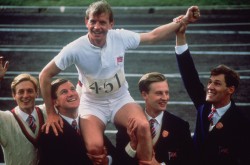
This was probably my favorite movie when I was a teenager. I know that I said it was in writing on at least one occasion, though this was more an instance of its being what occurred to me at the moment than the result of long and careful meditation. I don't know how many times I saw it--I would guess within the bounds of four and eight--and even at that age I was exposed to enough criticism to be aware that there was a substantial portion of the intelligent population that immediately recognized it as rubbish. I remember one particularly dismissive reviewer calling it a tribute to the human spirit inspired by Barry Manilow (Here is the actual quote, along with a number of other cold assessments I still remember from that increasingly distant time). Such assured evisceration, especially when combined with the suggestion of a tirelessly combative edginess, always makes an impression on me, for such attitude and clear perception are perhaps what I have always most desperately needed, but have never been able to develop. In spite of these persuasive denunciations, and my increased awareness of the lies and false assurances that the movie continues to put over on unreflective audiences, I find that I still like it. These lies and false assurances were certainly of a nature that I had a pointed hunger for in my adolescence, and doubtless still do now, for in matters of taste nothing ever comes to any kind of resolution with me, and thus I never 'move on' from even the most childish affections.

To address first off some of the more common criticisms, namely that the movie plays loose with the historical facts, that it pretends to be critical of the British ruling establishment of the 1920s and the society they lorded over while offering one of the most highly romanticized depictions of it ever to appear on celluloid, and that any depiction of this odious world as at all attractive is offensive to anyone with the most modestly developed moral sensibility, I have to admit that none of these objections has much resonance with me. Most of the alterations to the historical record are decidedly minor and were made in the service of telling a more interesting story. This has only been done thousands of times in biographical dramas and literary works dating back to The Iliad and the Book of Genesis. I suppose it could be argued that the ready availability to writers of much more accurate historical records in modern times renders the practice of expanding liberally from a basic framework in dramatic works archaic, though I think over-adherence to the exact record in small matters is to miss the point of art; though in the case of Chariots of Fire, and probably most movies, most of the critical disapproval in this area is really aimed at the unpalatable (to the critic) aesthetic or political attitude in the service of which the alteration was made. With regard to the second point, it is true that such criticisms of upper class attitudes as are to be found in the movie have more of the air of an intra-fraternal disagreement than an assault from a representative of the legitimately aggrieved. That is the personality of the movie. The two main characters are highly talented and strong-willed, what used to be referred to as 'coming' men. They are certainly developed enough in character, and the society in which they are operating tolerant and flexible enough, that it is impossible they would be entirely crushed by it. The movie depicts a lovely world whose most infuriating quality is not only that not everyone who wants badly to partake of it is able to, but, even more damning, that being left out they are usually unable to reproduce anything resembling its attractive qualities on their own. In a sense the movie serves as a reminder, though I think a pretty gentle one, that some people really are winners, really do make the most of their opportunities and talents, achieve goals and develop into accomplished people who contribute in a positive manner to the character of their society. Though on the other hand perhaps part of the offense is that the movie gives a misleading impression of the glamour of upper class life and the apparent ease, even effortlessness with which the heights of success can be attained, which is one of the primary characteristics distinguishing the second-rate from the first-rate. Nothing that happens in the movie--holding one's one against the snooty elite at Cambridge, leading a serious Christian life that manages to be both noble and unimpeachable, winning gold medals at the Olympics--is presented in a way that seems, or is, inaccessible to the typical middle class audience member, and therein is the film's primary failure, and the reason it cannot hold the interest of sophisticated people who operate at a world class level in at least one area of life (though usually once you attain that status in one pursuit, the difficulty of mastering others appears to be considerably reduced). Great things are hard, they are rare, their secrets are frustrating and obscure. To give the impression that they are otherwise is to misrepresent such real value to the human race as they have. And above all else, the person of middling intelligence and accomplishment must know this, if he is to avoid being an even greater buffoon than he already is.

All that acknowledged, whenever I come back to thinking about the actual film it seems to me to have something in it more than a bunch of pretty but empty gestures designed to manipulate the anglophilic and conservative tendencies of half-educated people. There is a good deal in it that suggests how to live a more vital life, how to maximize one's potential, what kind of people to seek out and surround oneself with, if possible, how to offer something to society on your own behalf. The movie covers a short time in the early part of much longer lives of two dead and, were it not for this movie, largely forgotten men who lived now close to a century ago, culminating in a pair of races that lasted 10 and 47 seconds, respectively, but every life depicted in any detail in the film is presented as purposeful and worth having lived, and I have always found that very reassuring, even though by the standards of the most rigorous modern thought this is almost certainly a lie.

Some footage of the real Liddell and Abrahams in their gold-medal winning races in 1924:


I haven't been able to make the case for it that I wanted to, but I also think a week is enough time to put into the effort.  

Saturday, January 28, 2012

A Few More Notes on 'Poirot', a Modern Book Review, and a Telephone Poll


Still going through the Poirot programs; now up to 32 of the 36 episodes seen, including, most recently, "Triangle at Rhodes", which is often named as one of the highlights of the series. I did learn something I had not known before in this episode, which was that Rhodes, along with a number of other islands in the eastern Aegean, was a possession of Italy from 1912 until World War II (prior to that it had belonged to the Turks since 1522), and has only been a territory of Greece since 1947. I don't how I missed this--of all things I thought my knowledge of 20th century European territorial changes was airtight and whole. Had I actually discovered it on the internet I probably would have been annoyed, but once the program was over I pulled down my 1938 atlas, laid it open on the dining room table in the late night stillness and saw that sure enough, marked out by a fair-sized circular crimson blob with the chalklike texture of 1930s colored ink, the islands commonly known as the Dodecanese were outposts of the Italian Empire, and the aesthetic and private aspects of this discovery proved highly satisfying to me in a way that I cannot foresee the computer will ever be able to duplicate.

My favorite episodes tend to be those which pack the most extensive and various examples of my preferred types of persons, events and scenes of life into them, irrespective of the ingenuity of the plot. I like trains and train stations, art galleries, theatres, chop houses, London parties, nightclubs, the seaside, especially Brighton, explorations of high and low representative cuisine; outstandingly pretty girls don't hurt either. I suppose a top 5 to date would be (in no particular order): "Four and Twenty Blackbirds" (Artist who won't sell his coveted paintings murdered, main clue revealed in chop house); "The Mystery of the Spanish Chest" (murder at a posh London house party, jealousy over a beautiful noblewoman at center of case); "The Affair at the Victory Ball" (really awesome Venetian carnival-themed costume party, caustic show business people, and one of the foremost collections of 17th and 18th century continental porcelain in the world); "Yellow Iris" (great looking English tourist babe murdered amidst the chaos of a military coup in Argentina); and "Dead Man's Mirror" (obnoxious art snob murdered at his castle, theosophy, and a secret love-child).

Like all sidekicks, Poirot's Captain Hastings leads a most enviable lifestyle when viewed through the eyes of such as possess a similar lack of cleverness or useful job skills and have to pay for this with lower occupational status and a dull social existence (Hastings does appear to have some mechanical ability, but practices strictly at the amateur level). By tagging along with Poirot Hastings is able to scoot around an England uncrowded by motor traffic in his sports car, travel 1st class by rail, golf, shoot and ride horses while staying at country estates, eat fine dinners for he always has a tuxedo, or more likely several, to hand, lounges around Poirot's apartment reading the papers and listening to cricket matches, travels on ocean liners, visits Egypt--again always with the appropriate attire for every activity and locale. If I weren't married--for it does not appear they can be married--I might be tempted to advertise for a position as a sidekick myself.

Regarding the last bit above, I say tempted because I suppose these men of genius/sidekick of pedestrian ability relationships always suggest a homosexual connection, that, more often than not when they occur in real life anyway, does indeed seem to turn out to be the case. Poirot has an appreciation for well-executed feminine style that he is able to cloak in a Gallic dress, and upon meeting a great diva of the theater or opera he will even succumb to gushing; but his admiration is purely upon artistic grounds; there is clearly nothing recognizable as sexual or romantic interest at work. Hastings at times seems to be more affected by women of overpowering (i.e., unsubtle) physical charms, and will take a more aggressively chivalric attitude than Poirot does; however he has even less real rapport with them, or the nature of the mental world which they inhabit. It is not clear to me how aware Hastings is of the true nature of his friendship with Poirot. He's a pretty unsophisticated guy who tries hard to be agreeable to almost everyone. Acknowledging the sort of thing under consideration here even to oneself would not do.

My latest off-topic reading project, which took me about two and a half months to get through, was a rather clunkily executed work called A Guinea Pig's History of Biology by an Englishman named Jim Endersby. I finished it because I always try to finish books on subjects that I do know not know a good deal about. The premise of the book is to give an outline of the history of genetic studies especially, with each chapter devoted to a particular plant or animal or virus that had has been instrumental in moving these sciences forward--oenothera, drosophila (fruit flies), phage, maize, silverfish, a type of cress whose scientific name I have already forgotten. One cannot help but be impressed with the progression of this work, both the results and thought processes leading to the results of which contain much of great beauty and elegance, which are always the identifying characteristics of perceived truth. Unfortunately the processes of determining which plants or tiny animals might be suitable for experimentation, collecting and breeding various specimens of them, making meticulous records of their traits, isolating certain desired traits and breeding these apart from the rest, making more meticulous records, and so on, while the essential part of the science and doubtless important to work into the narrative, grows rather tedious over the course of a 432 page book to read about.

I have to confess that I greatly appreciated the all too brief interludes when we were given peeks into the more prosaic aspects of the scientific life. As most of the people featured in this book were identified as serious talents early in life, career progression for them was a relatively orderly affair--not everyone was always supportive of their aims, but most were able to procure good university or foundation positions--even if they themselves made the positions better than they at first appeared to be, the opportunity to do so had still been present. There was not a ton of romance--a few guys ended up marrying women who had worked as their lab assistants, but in all of these instances there appears to have been a prolonged relationship strictly relegated to the intellectual realm before evidence of a more animal attraction presented itself. While Cal Tech is not known for its party scene in most of the outside world, if you are a legitimate science genius it is a social as well as intellectual mecca; Nobel Prize winners host spaghetti and wine dinners where lighter but worthy topics such as Shakespeare and serious high level music are often discoursed upon as well as current mathematical and scientific conundrums. Scientists who complete their course of study in Pasadena and depart to take up positions in cultural backwaters where social life resolves around football such as the University of Oregon naturally long for this camaraderie and often have a great struggle to recreate some semblance of civilized intellectual life in their new locale, though, being energetic geniuses, they often succeed. Indeed it is one of the great disappointments of my own life, even moreso in some ways than the lack of having an interesting vocation, though both of these states I suppose are of a piece, that I have been unable to recreate anything like the charged and elevated mental atmosphere one can find, in pockets anyway, at a decent college even in my own home, let alone the wider community where I live. I have enough of the props--books, musical recordings, an antique house and furniture, a decent liquor cabinet--that our life need not be totally devoid of connection to the higher realms of activity and understanding; however I am not capable of transmitting the spirit of these realms in the least degree via my own agency, especially by way of discourse.

* * * * * * * * * * * * * * * * * * * * * * * * * * * * * * * * * * * * * * * * * * * * * * * * * * * * * * * *

I received an automated phone call the other day that was administering a political poll. I usually go along with these polls until they come upon a question I don't like or for whatever reason don't want to commit myself to an answer for. On this particular poll I was done at the first question, which was "Do you believe marriage should be between one man and one woman?" I did not want to answer yes, because the way the question is framed annoys me--you just know that whoever decided that this was the proper form to present the matter think that they are clever as hell--how about just coming out and asking if you support gay marriage, since that is all this is about? However I could not bring myself to say 'no' either, because, even at the risk of being hateful, I just cannot muster any enthusiasm for gay marriage and the prospect of coming out publicly for it in any way makes me feel ridiculous. If it were to come up as a plebiscite in my state--which I do not believe however that it can--I suppose I would abstain from voting on it. Pretty much everyone I know is virulently pro-gay marriage and talks as though anyone who harbored any reservations about it must be completely deficient both of brains and human decency. I do not agree with this position, but one must recognize that it is how people seem to regard the matter, and to me it is not worth losing friends and family members over. It is already the law in my state as it is, and no, it has not as yet noticeably affected my life, (though neither to this point have the laws regarding abortion, torture, capital gains taxes, eminent domain and many others which we are nonetheless expected to take positions on). Yet I cannot feel any sympathy for it or take it as an institution as seriously as I would doubtless be expected to. I suspect the sense that I am being browbeaten into claiming to hold a viewpoint I would prefer not to hold, or at least am not yet ready to embrace, or risk total ostracism from such respectable society as I know feeds into this resistance a little. It will be suggested that I have not given any reasons for even this emotional opposition I seem to feel, and that therefore the opposition is groundless. I suppose someday, if I cannot come around on this issue, I will have to examine with a finer eye the basis of my attitude on this subject. But right now I am going to leave that examination for a later day.

Saturday, May 21, 2011

Essay Concerning Human Understanding Part 3

It is important to me to remember to try to imagine the spirit of inspiration and ferment in which so many men of realized and energetic humanity in the eighteenth century received the writings of Locke; not necessarily Jefferson or Franklin, the strain of attempting to enter whose singular spirits would likely throw the entire enterprise off course, but some among the largely forgotten figures, the men of leisure and enterprise who had somehow managed to obtain good enough schooling to retain a lively interest in humanistic developments throughout life, the diffusion of which characters was so crucial to the history of that era. In short, I need to keep in the front of my mind the remembrance that the writings of this particular author set some of the most interestingly developed and ideally educated men found in all of history to consider and write long interpretations and opinions of his arguments, largely as personal correspondence, and to regard the material in a manner as commensurate with this history as possible.

This is off-topic, but I came across this 1883 passage from Henry James the other day regarding Oxford, which he frequently lamented his ill-fortune at not having been able to attend in his youth (he did go to Harvard, but he considered it, like the rest of America, to be crude, modern, devoid of poetry, tradition, meaning, etc. He wrote of his years there as if they constituted a several years quarantine from beauty and civilization that scarred him for life):

"(Oxford) typifies...the union of science and sense--of aspiration and ease. A German university gives a greater impression of science, and an English country house or an Italian villa a greater impression of idle enjoyment; but in these cases, on the one side, knowledge is too rugged, and on the other, satisfaction is too trivial. Oxford lends sweetness to labour and dignity to leisure."

I cannot testify as to whether this is an accurate assessment of Oxford in 1883 or not, but there is much in this that corresponds with my own ideas of what school should ideally be like which I have been having some trouble expressing, ideas which are very much out of fashion, to say the least. The last sentence, particularly the bit about 'sweetness' captures well what I often have perceived to be missing from many contemporary attitudes towards learning and accomplishment, which Henry James, needless to say, would have found beyond barbaric. Not that anyone can be expected to care much what he said in 2011, he being a fellow of extreme privilege for whom having to attend Harvard College (where his brother, incidentally, now probably regarded as the greater of the two, was on the faculty for most of his career) ranked as a major calamity in his life. He did think a great deal about the cultivation of the mind for reasons other than professional advancement, it was perhaps the most important consideration in the world to him, and I think he had many good ideas where it was concerned, even if he was not able to, or interested in, making their development applicable to the needs of the economy.

Henry James of course is not the best role model for the likes of me. It was not imperative on him to have a career as a means of sustaining his physical existence in the way that it is for most people. I still seem somehow to think of myself as a man of leisure, though I have not had more than two consecutive weeks off from paid labor since 1997. I still haven't any idea what practicable career that is both necessary, realistic of attainment, and which would identify me as belonging in some way to the more generally educated class of people I might have liked to have pursued. I have been working in the health care industry for a long time and one cannot help but observe the gulf in status and general social presentableness between the actual MDs and the other medically trained professionals (The administrators/business class type people in the organization are a whole other category, which I cannot relate to at all however). I probably did not have the focus to complete the training properly, but I suppose at this point I can see myself getting up every day and being a doctor, whereas I still cannot envision myself doing most regular high-paying respectable jobs that I am aware of. People warned me all my life that I needed to be serious about this, so I cannot complain that nobody explained the hard cruel realities of the world to me, but it just doesn't sink in when you're 25--let alone 18--and you think you still have some life in you on a modestly grand scale and people are badgering you to become an accountant. I thought I had enough general talent that I could eventually make my way into the life and the circles where I would recognize myself as belonging and making the best use of my abilities. I don't really think that has happened, but as it still is not clear to me what exactly I should have done to produce a more desirable outcome, this particular aspect of my sluggishness (apart from the sluggishness itself) does not bother me that much.

The will is determined mainly by uneasiness. This is something I picked up from the reading. It would explain in great part the persistence with which I pursue my mainly fruitless endeavors, such as this site.

From the section "Idea of Power": "...the will being the power of directing our operative faculties to some action, for some end, cannot at any time be moved towards what is judged at that time unattainable..." This would explain why nerds never try to bird-dog hot chicks.

"God Almighty himself is under the necessity of being happy; and the more any intelligent being is so, the nearer its approach to infinite perfection and happiness." I.e., free will is overrated in the grand scheme.

"...we should take pains to suit the relish of our minds to the true intrinsic good or ill that is in things; and not permit a...possible great and weighty good to slip out of our thoughts, without leaving any...desire of itself there, till...we have formed appetites in our minds suitable to it, and made ourselves uneasy in the want of it..." The quotation is rather unwieldy, but I think it contains good advice.

Torture on the rack is offered as an example as a cause of uneasiness in the will. I thought it was funny at the time. Possibilities for humor can be rare in philosophy books.

Montaigne is quoted in the notes on numerous instances, which was also a source of momentary excitement. This one struck me as particularly elegant: "Si la douleur de teste nous venait avant l'ivresse, nous nous garderions de trop boire; mais la volupte', pour nous tromper, marche devant, et nous cache sa suite." ("If the unhappiness of the result came to us before the drunken state, we would keep from drinking too much; but the pleasure, in order to deceive us, walks before us, and hides from us what follows.")

After I had an inconclusive grapple with the wager as regards eternal happiness that men who determine to be good are said to make, I quickly moved on to the section "Our Complex Ideas of Substances". Of these, "Powers therefore justly make a great part". What a thing does is what it is. This pretty much applies to all of life as far as it is lived by most people.

"...were our senses altered, and made much quicker and acuter, the appearance and outward scheme of things would have quite another face to us; and, I am apt to think, would be inconsistent with our being, or at least wellbeing, in this part of the universe which we inhabit." I seemed to think that the expansion of modern knowledge, including the increased possibilities of body modification/enhancement, might offer some kind of test of this statement. But under soberer consideration I have reverted to the opinion that these changes in the modern condition are cosmetic and trivial in comparison with the conception of the original sentiment.

Black swans apparently had not been discovered in 1690. (There is a passage in the section on ideas of substances where among the characteristics identified with the word "swan" was whiteness of color. A footnote explains that "Black swans have since been found").

I like the way this is put. It strikes me as elegant:

"For putting together the ideas of thinking and willing, or the power of moving or quieting corporeal motion, joined to substance, of which we have no distinct idea, we have the idea of an immaterial spirit; and by putting together the ideas of coherent solid parts, and a power of being moved, joined with substance, of which likewise we have no positive idea, we have the idea of matter."


"...it seems probable to me, that the simple ideas we receive from sensation and reflection are the boundaries of our thoughts; beyond which the mind, whatever efforts it would make, is not able to advance one jot; nor can it make any discoveries, when it would pry into the nature and hidden causes of those ideas." According to the notes, this is the main thesis of the Essay. It seems intuitively wrong, since some people anyway must have the ability to push beyond existing boundaries. Perhaps he is saying that even these expansions of existing ideas are dependent on this basic procedure however, and that we are not capable of generating ideas via different means.

"The ideas, then, of relations, are capable at least of being more perfect and distinct in our minds than those of substances." Ideas of substances would be truer and deeper knowledge however.

"But the sun and stars, though they have outlasted several generations of men, we call not old, because we do not know what period God hath set to that sort of beings." More scientific improvements.

I wish I had more time to think and write about these various things that I like. I suppose I do neither well, but I used frequently to feel that I did them well, which is something I rarely feel when doing anything else.

Monday, May 24, 2010

Fiddling Until Computer Implodes

I'm supposed to be being attacked by 5 viruses at the moment, one critical. My intention was to try to write a post of snippet-items anyway.

Boxing no longer generates the interest it once did in this country though one would learn much about interpersonal relations by studying it, for the techniques people use in argument, particularly those between husbands and wives, are akin to the styles or non-styles used by boxers. My mother, for example, unfortunately had a Gerry Cooney like style of arguing, wherein she would plant herself in a single spot, cover her face with her hands, and allow her opponent to rain blow after (verbal) blow on her with very ineffective resistance, hoping for the bell to ring, or, in some instances, for her opponent to leave the premises in complete triumph, often for days, with her still rooted and dazed on the same spot, the equivalent of a TKO. It thus caught me quite by surprise when my wife's style of argument turned out to be more akin to that of Sugar Ray Robinson, landing well-placed and stinging blows, frequently in combination, and then moving from room to room under the guise of "being busy", and never allowing herself to be drawn into a toe-to-toe exchange of punches in the center of the ring. I believe this method is more instinctive than studied with her, but it is brilliantly effective, for it is not easy for a lumbering fellow like myself to fight, hurl invectives, etc, against a moving target with a quick mind.

Applying the theory further, one sees how here too Mike Tyson was a bad role model for Americans, especially since he remains the last boxer to be widely recognizable across all strata of society. Tyson's method of fighting at its most impressive was to march straightforward into the center of the ring and pound his overmatched opponents senseless, often in spectacular fashion such as knocking them through the ropes or lifting them off the ground and sending them airborne several feet backwards. A good portion of the American public seems to have adopted this technique in their approach to debate. Once people with a modicum of skill figured out how to sustain Tyson's initial fury, he was exposed and began to lose, as no doubt would also happen to most of the bullies and demagogues who hold much of our public discourse in thrall. Unfortunately most people, including myself, when encountering a person of this type end up playing the role of one of Tyson's hapless early opponents--Marvis Frazier perhaps--who had to be carried out of the ring on a stretcher 30 seconds after the bell rang.

That ability to sting in conversation and dealings with other people is a crucial skill that I never developed--not so that I should be able to unload indiscrimately on everybody I came across, but just to keep people wary of me, make them have to be a little respectful, not get too comfortable. As it is, people pretty much dig in and occupy all the ground they want up to the very boundaries of my person, and I can do little about it without expending pretty much all of my force, which I am understandably reluctant to do in routine social encounters. I hope dearly that at least some of my children have enough light, quickly deployed mental power they can carry about with them to be able to establish some kind of presence in such situations. I am putting a lot of hope in my dear wife's excellent genetic qualities as far as the social fate of the next generation goes, myself having little to offer in that regard other than height, which I have have always considered more of a non-negative than a positive quality, though I have had several men express to me, and apparently believed it whole-heartedly, that if they possessed my height in combination with their other outstanding qualities they would be making six figures and dating beauty pageant contestants, or at the very least Hooters waitresses.

I am currently reading a book which is giving me a great deal of ninth hand pleasure, The Brideshead Generation, by an Englishman named Humphrey Carpenter. Everything I read about them further persuades me that this crowd--the Bright Young People of 1920s London--were unspeakably awful, but at the same time I can read about them all day and never weary of them. Their style of life is as close to my ideal as I have found, especially among the English-speaking peoples, though I do also like the coffeehouse and tavern haunters of the 18th century. They drank a great deal, they traveled, they wrote, they chased women (and boys, I concede), they were witty, they had an excellent taste for characters and scenes. The Oxford Railway Club, for one example, was a group of aesthetes, homo- and heterosexual (in the womanless world of 1920s Oxford these distinctions did not impose the social boundaries among men that they seem to today), dedicated to taking midweek excursions around the rails of England, having a five course dinner on the outbound train, jumping off at Leicester or some such place and riding back in the bar car to make the midnight curfew, accounts of which excursions were dutifully written up for one of the myriad campus publications. Of course if you are on the railway club outing on a Tuesday night that means you aren't studying. But it's 1923, and you are of the right class, so you can still recover from getting a third in history, or not managing to get your degree at all, and manage to do something fairly interesting and prestigious. These guys struggled a little to get their careers going in their mid-20s, and of course some of the most brilliant ones never panned out as writers or anything else, but the ones who really made it big, at decisive moments in their development were able to produce something of reasonable value, and were close enough to the sources of power and influence to have a fair chance of having someone in a position to aid them take on their projects. One of the notable circumstances of the Oxford chapters are the confidence that as every generation must have its writers and poets, it is taken for granted that a good number of those in the rising one are surely present, and that therefore their little college poems and general literary education are in fact serious matters. There appears to be something of a similiar attitude at Harvard and other Ivy League schools, perhaps not so much in literature, but the expectation that numerous of the young people sitting in your class at any given time are going to be prominent and influential--of what degree of quality is not for the moment in the question--seems to be in operation from what I know of their graduates.

It is clear that someone in our family--evidently it isn't going to be me--is going to have to buckle down somewhere and figure out how to make a pile and push us into that realm of society where our more talented members have access to people who can show them how to really get on in life. In my family we are on at least the third or fourth generation of capable enough intellectual ability that never seems to amount to anything because they don't know how to work or ingratiate themselves with the right people or something. I came across my three year old son the other day essentially teaching himself to read--he had a little book open and was sounding out j--a--m--and I thought, well, he'll end up a little office clerk like his father, being spoken to by people with 8 week correspondence course certificates as if he were seven steps beneath them on the class scale, and deservedly so, but why? How does this keep perpetuating itself, and why can no one make that leap to the next stratum?

But I digress. There is some dispute as to how fun the parties of the 20s actually were--some people are fastidious as to detail--but since I am reading here in May of 2010 about, among numerous other fetes, Babe Plunkett-Greene's and Elizabeth Ponsonby's Swimming-Pool party of 13 July 1928, I am going to guess that it was at least as much fun as anything most people who are interested in this scene will have ever known themselves. "Bathing costumes of the most dazzling kinds and colours were worn by the guests," the Daily Express reported, "Dancing took place to the strains of a negro orchestra, and the hardy leaped into the bath, of which the water had been slightly warmed...A special cocktail, christened the Bathwater Cocktail, was invented for the occasion." Further, back to the main narrative of the text: "...the women one met at such parties were not especially sexually liberated; they 'expected to have passes made at them', but were well able to fend these off. One heard stories of debs who could be got to bed, but...such sexual contacts as were achieved at or after these parties (being) brittle and transitory...They might bruise and press each other's flesh...No hearts to break and nothing to linger afterwards behind." This doesn't sound all that bad. One remarkable thing about this group is that while they went nuts with affairs and freaky sex in their 30s, 40s and even beyond, many if not most of them appear to have remained virgins as far the opposite sex was concerned for several years beyond college age, 23 and 24 and 25. That certainly was not healthy for them. The best age for that sort of thing seems to be 17, as far as your best chance of being well-adjusted and healthy down the line goes, some people probably handle 16 and some would be best advised to hold off till 18, but beyond that I really think you start to see unnecessary derangement.

Humphrey Carpenter views Waugh as the central figure of this group of writers, not merely socially but from the literary; personally I would be inclined to disagree, but I have only read Brideshead Revisited, which seemed to me the weakest of all the books I have read from this general group, which includes Anthony Powell, Graham Greene and Henry Green, not to mention Orwell, who is not part of this crowd socially but was the same age and was at school with many of them. I can go along with the premise though because the book is so damn entertaining. Carpenter also was "a musician and the founder of Vile Bodies, a band that recreates the music of the Evelyn Waugh era at the Ritz Hotel in London." I don't know if this is still going on (this was written in 1990), but I think it might be too much even for me to take. (Note: Carpenter died in 2005. The band does not appear to play anymore). The Ritz is so prominent in the literature of this era especially, which I have been gorging on and living vicariously through for much of the last decade now that I am thinking I may have to make a splurge and have dinner there if I ever make it back to London (which dinner will probably cost more than my plane ticket, at current rates anyway).

Of Mice and Men (movies--1939 & 1992)

I've seen both of these versions lately, as each is rated a top rank film by various major publication or other, the '39 one more frequently, though the '92 has its fans as well. The two movies are quite similar, and almost look at times like they were filmed on the same sets. You would think I would be partial to the '39, but I am leaning towards the '92 which seemed to me a little better acted (Gary Sinise & John Malkovich in the main roles versus Burgess Meredith and Lon Chaney Jr, and Sherilyn Fenn has it all over the simpering ninny they had in '39 as the girl). The '39 has the advantage of being contemporary with the book and it had a very capable director in Lewis Milestone, who did All Quiet on the Western Front. I don't love either of them, and as such it is actually interesting to see two versions of the same story.

The story seems to have been regarded almost since its first appearance as being profoundly and vitally American. Like many such American stories, it features a prominent character who is retarded, in this instance one who is a tireless worker ignorant of his own strength, which I presume is supposed to be symbolic of the vast American proletariat. An agreeably sinister stand-in for corporate America, and the American dream, more modest but no less elusive than it is in our era, are also portrayed. I have to say the story has never resonated too much with me--the characters and milieu are not the type that I am really drawn to, especially since there is not much humor in them. I find it hard to love people who are both earnest and ragged--the combination doesn't work for me.

In short I think if you haven't read the book at least one of the films is worth seeing (they are by no means bad--I just wouldn't think of them as great) just to become more familiar with the story and the place it occupies in American culture, where for whatever reason it has become recognized as a classic by many influential people.

Wednesday, January 27, 2010

Brideshead Revisited (1945)--Part IProbably because of the popular television dramatization that was made of it during the 80s, which I have not gotten around to seeing yet, I had been aware of and interested in reading this book someday for most of my life. Waugh remains a highly regarded writer in many circles, especially certain rightish ones, to this day, and he was a member of that celebrated generation of English authors that included Orwell, Graham Greene, Anthony Powell, and numerous other well-known names, whose careers and writing styles I have often applauded in these pages. I was anticipating a spare, wry, surgical, casually erudite and consistently funny read. I am still not exactly sure what it was that I got; for while it was all of these things in places, there was also an astonishing amount of flaccidness in it, and many parts of it did not hold together at all. Overall while I was reading it I thought it was one the more unattractive portrayals of this milieu. Much has been written about the brand of Catholicism which the Flytes affect. I am not a real Catholic myself, but I didn't like it, and I think it is insulting in some way to the many people, however misguided or ignorant one may think them, who have lived very strictly and sincerely in accord with what they believe to be Catholic teaching. The characters here strike me as being too spiritually damaged, too ultimately comfortable with their behaviors in the past that led to this damage, and not at all transformed by their religious practices in any kind of biblical or medieval sense. It is Catholicism as a purely aesthetic or philosophical entertainment, and adornment. I am surprised the author seems to mistake it for something else because the characters are sophisticated and socially attractive. Waugh himself seemed in later years to regard great swathes of the book with regret--the edition I read actually was the revised edition of 1959, in which apparently the revisions were not minor, the original book thus being even more indulgent and oddly deficient in a sense of being the product of a mature and considered intellect.

Nonetheless Brideshead has always been his most popular book by far with the general public; indeed it may be the only one that is widely known therein. I enjoyed it too though I don't think it is great literature, especially the second half. Still, it is a nostalgic book about a way of life that, largely because of literature, has meaning for hundreds of thousands of people, including me, who have nothing to do with it except at fourth or fifth hand. That is in great part why I still think there will always be a role for this kind of fictional writing, if it is done well enough. Some say the novel is dead, but why should it not come back again? Can any art form be said to be dead absolutely, never to be revived in any kind of interesting new way? The drama, to name one example, has appeared to die any number of times, not only during the entire millenium between the decline of secular high Roman culture and the stirrings of revival with the morality and mystery plays in the late Middle Ages, but between the retirement of Sheridan in 1780 and the emergence of Shaw and Wilde in the 1880s I cannot think of one spoken (as opposed to operatic) drama written in English that is considered important literature now. And the European theater had been almost equally moribund for 30-50 years when Ibsen emerged around 1860. The novel does too many important things better than other forms of expression that have been devised for humanity to discard it entirely. Writers will learn how to employ the medium as real communication to real readers again, and it will suddenly appear as if reborn.

If I am one of this party, a suave London writer up for the weekend, whose desirability to the ladies is a fact long-established, going all the way back to Harrow even, whose bedroom am I going into in the middle of the night once the rest of the house has fallen silent? I guarantee you at least half the people in this picture were total sex maniacs until well into middle age. I'm thinking maybe the second one on the left. The one beside her on her left, our right, looks like she was probably the most good to go overall, but she isn't really my type.


Another surprise, given the affection right-wing culture aficiondos such as the crew at the frequently interesting and always breathtakingly virulent New Criterion often express for Waugh, was what a rather pathetic specimen of a human being the celebrated character Sebastian Flyte turned out to be. Call me American for reducing everything to utilitarian terms, but he is utterly useless. Dissipated. Luxurious. Idle. Whiny. Sickly. He exhausts most of what remains of many centuries' worth of his family's wealth, and does nothing to generate more. At least he doesn't support socialism--he does abhor the vulgar classes and laments their rise--and he was charming in school, which I guess if you go to the right schools, especially in England and France at least, carries a great deal of weight all through life. In Powell there is a similar witty and good-looking school friend, Charles Stringham, that being a product of modern America the reader like me projects into adulthood as being a dynamic fellow in a glamorous position where he is utterly comfortable and revered. In 1920s and 30s England, however, he too ends up, rather inexplicably given his apparent talents, a drunken and feeble loser, though always retaining the affection of his more aristocratic friends.


There is a funny or otherwise quotable line on almost every page of this. I promise I will be choosy and try to pick only the very funniest. This is for example from the Preface to the revised 1959 edition, page 1:


"It was a bleak period of present privation and threatening disaster--the period of soya beans and Basic English--and in consequence the book is infused with a kind of gluttony, for food and wine, for the splendors of the recent past, and for rhetorical and ornamental language, which now with a full stomach I find distasteful."


Prologue, p.5 "Here at the age of thirty-nine I began to be old." Oh God.


Sebastian Flyte of course is famous for, among other things, the teddy bear he always carries around with him. This made a bigger impression in 1945 than it would now, I suppose.


After giving some other reasons for keeping certain overwrought passages intact in the new edition (I have returned to the Preface now) he adds that "also...many readers liked them, though that is not a consideration of first importance."


Book I, Chap. I. Oxford: "In her spacious and quiet streets men walked and spoke as they had done in Newman's day; her autumnal mists, her grey springtime, and the rare glory of her summer days--such as that day--when the chestnut was in flower and the bells rang out high and clear over her gables and cupolas, exhaled the soft airs of centuries of youth." In another writer this might come across as a bit mushy, but Waugh having established himself already as a bit of a crank, it comes off as genuine feeling, and therefore beautiful.


"Does anyone feel the same kind of emotion for a butterfly or a flower that he feels for a cathedral or a picture?" I admit, I don't. Why? Because the things of nature are more accessible to me? I think it is because I have been trained to think of really lofty human accomplishment as an incredibly rare triumph, requiring centuries of cultural development matched to the individual geniuses that are the culmination of that development. This is something in which most people have no part whatsoever. Oxford in the 1920s was at the very least much closer to that level of human achievement and possibility than all but the most creative and energetic scenes that are known to us.


"'I like this bad set and I like getting drunk at luncheon;' that was enough then. Is more needed now?...Looking back, now, after twenty years, there is little I would have left undone or done otherwise." I bet the real social elite still talks like this. Or if they don't, they should.

Monday, May 11, 2009

Cleopatra--Samuel Daniel (1594)
This is a closet drama in verse. Samuel Daniel (1562-1619) was considered an important poet in his time, which was not a weak one for poetry. He was right in the thick of the literary scene/cultural dialogue, what have you, that included Spenser, Sidney, Ralegh, Marlowe and Shakespeare, and he had the patronage of the queen. There is even a "tradition" that he was named Laureate, which in those days was a sinecure hotly contested among good poets for the income that came with it, upon the death of Spenser in 1599, though his monographer Cecil Seronsy (professor at Bloomsburg [Pa] State College [now University] 1967) says this is "extremely doubtful"; the position went to Ben Jonson instead. His biography makes for a somewhat interesting comparison point with that of Shakespeare, who was his exact contemporary. Of his boyhood, "nothing is known". There was a rumor that his father was a music master, though "no evidence has been found to support" this claim. Once he turns up at Oxford he begins to leave more of the paper trail that Shakespeare did not, mainly through publications of his poetry. It also appears that, like Spenser and other poets, he was received by and moved comfortably among people of rank and wealth, though he does not appear to have had much cash of his own. There is a letter to him from an unknown correspondent from 1582 that makes note of his retiring personality, which is the sort of thing we so desperately want to find about Shakespeare or his puppeteer. It is known that he went to France and Italy for five years and delivered dispatches from the ambassador to Paris at Windsor Castle. Skimming ahead there is an impressive amount of contemporary information available about the progession of his literary career, though his family circumstances and background are never made clear. As noted earlier, he appeared to spend much time as a guest at various wealthy people's estates, which sounds like nice work if you can get it, especially as he does not appear to have been particularly socially entertaining. Daniel had quite a bit of early success before the Shakespeare juggernaut got really rolling so that although he is only two years older than Will he often seems to be categorized as a predecessor to him as much as a contemporary, particularly as his Cleopatra is mostly thought of now as one of the source materials that influenced the later Antony and Cleopatra. Interestingly Daniel made a revision of his play in 1607 after Shakespeare's had appeared which Professor Seronsy speculates was "possibly under the influence" of the later and superior version.

This Cleopatra, a verse tragedy in which the characters make alternating long expository speeches, is pretty good read as a long poem. We think--or maybe it is just I who tend to think this--that the quantity of really good-quality English verse produced over the last 700 years is shockingly small, but a lot of these old forgotten poets who wrote thousands of lines and told all manner of accounts through the poetic medium are not bad, though obviously they lack the power and consistent metaphorical brilliance of Shakespeare and other major poets. I doubt that many people outside of graduate school can have read this, given the effort I had to go to to obtain a single copy of it. As I will be one of the few people on the internet to have written anything about it at some length, I want to do it as much justice as I can, as it is a worthy piece of literature. Scholars seem to like him. Professor Seronsy's book has a six page bibliography, though the most recent edition of Daniel's actual collected works (5 vols.) is listed as 1896, and the text is "frequently untrustworthy". The University of Louvain published an edition of Cleopatra alone in 1911, which apparently was unobjectionable. In any case I couldn't find any of these editions, or any other ones, available either for sale or in a library that I had access to. Thanks to the wonders of the Google book project however I discovered that this play was printed in full in Volume V of the 1964 King's College of London compendium of the Narrative and Dramatic Sources of Shakespeare. Though I could have then read the play on the computer if all else failed, I haven't taught myself to like doing that yet, and I found someone who was actually selling a copy of this book, which is most handsome and impressive in that very self-important 1950s and 1960s university press way, as you can see below:

This series has seven volumes in all, "in which the major sources and analogues of Shakespeare's plays will be reprinted, with discussions on the way he used them." And you thought my blog was a labor out of all proportion to any readership on which it might ever produce a significant effect. Volume V is dedicated to the Roman Plays. Among the materials included are 6 of Plutarch's lives (in the North translation), Pescetti's Il Cesare, Cinthio's Cleopatra, the anonymous Caesar's Revenge, and the Countess of Pembroke's Antonie, along with Daniel and many smaller excerpts from Roman, medieval and Renaissance authors.

Having gone on so long with my introductions, I think I will hold off on my notes on the actual play until the next post(s).

Some might be curious about the St John's College paperweight shown in this photo. It was a graduation gift from a family member who obviously did not foresee the coming digital revolution and obsolescence of books and paper any more than I did. I actually got two St John's College paperweights as gifts, the other one was a glass star with the seal of the college cut into it. I don't know where that one is now.

Friday, June 27, 2008

Ruskin-The Stones of Venice (1851)--Part I

I took eleven pages of notes on this book, or such of it as I was able to find, but for my own sake as well as any potential reader's I am going to try to pare my observations down as much as possible. Having somewhat introduced the subject in the last post I will just briefly touch upon the main theme of the book, which is that the art and architecture of Venice from the origins of the city as a distinct society up until the early 1400s, if perceived properly, testifies to the ever-increasing wisdom, virtue, piety and good government of that society, and that that art and architecture which came after these qualities began to fall into disuse, however technically skillful, betray the ever-increasing emptiness and wickedness of the society that in turn produced it. Having never read Ruskin but only knew his reputation, I had expected him to be more of the prissy, phelgmatic type of scholar-author, who is generally resigned to unending cultural rot as the fate of the species and consoles himself with classical art and imported delicacies and wines. His style however is actually rather angry, and his book takes its inspiration at least as much from the contempt that is aroused in him by pretty much every development of the previous 400 years of history, and the worthless people who promote and accede to it, as from his love of the higher beauties to which he is trying to call our attention.

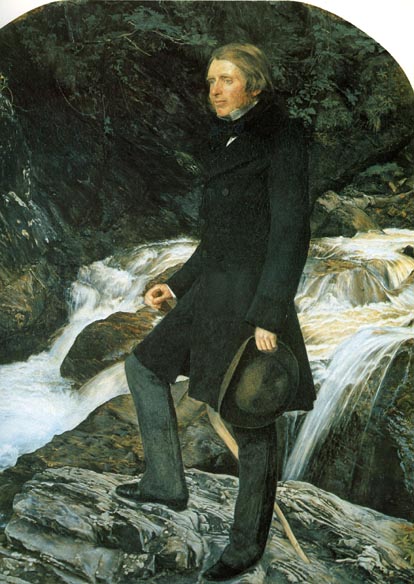
I made reference above to the difficulty I had in finding a complete, or "official text" of this book. It was orignally published, as far as I can tell, in three volumes in 1851, when Ruskin was 32 years old; while most authorities seem to consider this original work as worth reading in whole it is not readily available in any edition that I have found. It seems that there may have been a reprint of this edition a few years back--there is some fairly recent (i.e., post-1960) multi-volume edition--but what copies were available for sale on the Internet were $300 and up. Ruskin did at least one major revision, in 1879, in which large sections of the original book, particularly the third volume, were eliminated. There was another edition put out in 1900, a reprint of which, numbering 582 pages plus an index, was the version that I read, plus an additional 10 pages that were reprinted in the Norton Anthology of English literature that appeared in the 1851 edition but apparently did not make the cut for the 1900 edition. The New Hampshire State Library, which is a remarkable institution and resource right in my town that I stumbled upon by accident after I had already been living here some time, has a twenty-volume set of Ruskin's works from the late 1800s which includes a version of this book which seems to include several chapters which also did not make it into my edition. However, books older than the very arbitrary age of 100 years do not circulate (this is becoming increasingly unfortunate, as they appear to have been especially vigorous in building up their collection during the 1900-1910 period) and I do not have the time to sit in their reading room, though it would certainly be pleasant to do so (this building is all circa-1900 marble and porcelain and quartersawn oak and sycamore), and go through it. I did not find much of it scanned on the Internet either. So I have not read the entire book at least as it once existed but as much of it as I could cobble together. Ruskin of course is more famous nowadays in some circles for his sexual problems than for his writing. The oft-repeated story that he froze in terror at the sight of his wife's pubic hair on their wedding night because he had expected it to bear a more exact resemblance to classical marble statuary is fiercely refuted by the majority of the most respectable scholars on the subject, but that this marriage was annulled after six years on the grounds that it had never been consummated is a matter of no dispute at all. His wife, Effie, who was "considered a great beauty", proceeded to marry the painter Millais (who painted the portrait above of Ruskin, incidentally), with whom, one book I have or once read which I cannot find now assures its readers, she went on to enjoy healthy sexual relations. Ruskin then fell desperately in love with a 9-year girl, to whom he unsuccessfully proposed marriage when she turned 18 (he would then have been about 50). He was also infatuated for a time with the teenage Alice Liddell, the daughter of the famous Greek lexicographer, and Lewis Carroll's very same Alice, a few years older (she must really have been something else). If he ever molested these girls rather than merely adored them hopelessly from a (psychological) distance, the historians do not seem to have any definite evidence of it. He is recorded as having suffered recurrent mental breakdowns over the last 30 years of his life.

This last little scene involving three famous and decidly brilliant and interesting people (and members of their immediate family) who were on what we would call the faculty at Oxford University at the time, I want to comment a little on the intellectual environment which flourished in Oxford during the high Victorian period, from the 1860s to 1880s. We are left, it is true, mostly with the record of the most entertaining anecdotes and personalities, the most brilliant writings and advancements to human knowledge that were attained in the age, and the most stirring monuments to contemplate; the constants of university life such as pedants imprisoned rather than liberated by their knowledge, the lack of appropriate curiosity towards and work in certain subjects (Indian and Eastern Studies generally, technology, in this age--who knows what it will turn out to be in ours?) that have been leveled at the English Universities of this time by modern scholars, the stifling tediousness of official intellectual life imposed by the supposedly outdated traditions and program of study (i.e. unimaginative emphasis on classics) do not always recur so readily to the romantic's imagination. It appears to me however to have been a pretty lively atmosphere, in which what are broadly known as the Humanities carried a great deal of meaning and force to people possessed of the imagination and intellectual strength to make a world out of them. The students of this period tended I think to look back on their college days with more unequivocal fondness and to acknowledge the influence of their tutors deeper into life that at any other period in English history. Among the students at Oxford in this period who later wrote with affection of the place (an affection that other generations were more inclined to temper a little) were Oscar Wilde, the poet Housman, Max Beerbohm; I suppose Arnold and his friend Clough were a little earlier but the beautiful poem set in Oxford, "Thyrsis" (this is actually one of my all-time 10 or 15 favorite poems) was published in 1867 amidst this general mood. Besides the three mentioned above, famous teachers of the time included Wilde's guru Walter Pater and the famous Platonist Ben Jowett (I think the now-eclipsed Cornford may have been there too). Jowett was apparently a great prig but the spirit and acuity of the student body at the time was able to succeed in turning his lasting reputation into that of a quasi-ridiculous figure. I sure there are even better examples but offhand I cannot think of them.

As the quotes in this book are of such a provocative and interesting nature that they stand alone well, and also as they provide a good overview of a subject--the rise and decline of the Venetian Republic as visible through its arts--that I think is not well known, I think I will just print the ones I like the best as they are, accompany them with illustrations if that can be managed, and comment on the quotes if I feel moved to. Here is what I wrote back on January 23:

...His arguments are so unique as to be persuasive taken on his precise terms. Obviously his apparently fervent religious feeling which is the basis for much of his thought does not have much resonance w/us (sic. who do I mean by us?); also his classism. Nonetheless as a critic of art & architecture--the objects themselves--he is suberb.


Sunday, December 02, 2007

Edmund Spenser--The Faerie Queene (1590, 1596) Part 1

According to the 1966 Illustrated World Encyclopedia's supplemental section "Library of the Literary Treasures", which has had such a singular influence in my life, Bliss Perry, professor of English at Yale (there's a blast from the past for you) estimated at one time that "there were no more than a dozen men living who had read the Faerie Queene through, though it is acknowledged to be one of the greatest works in English poetry". This seemed preposterous to me even at a young age, and I continued to be dumbfounded as I grew older and repeatedly encountered estimates by scholars of the living readership of classic books that numbered no higher than the mid double digits. It was only very recently that I finally caught on that when such people say that only twelve people alive have read a book they do not mean to include in that group all the people such as myself who might at some point have managed to fix their eyes upon and mouth over every word from page 1 to the last of the surviving fragments, but only such as have the education, intelligence, experience and understanding of the human condition to be able to read the book properly, with a mind that bears some measurable proportion to what is at work in it. I have little doubt that the Faerie Queene is much less read than other famous books such as Proust, or Ulysses, or Don Quixote, which according to scholars and pop authors and journalists of the ironic school no one is supposed to have read either, though I suspect the number is higher than twelve, and is probably closer to a thousand, even with the more stringent criteria. I also suspect that many, if not most of these thousand are spread out at great removes from each other, from the camaraderie and even love which the mutual possession of any exalted and refined understanding promises to offer. The idea at least appeals to me.

Though only half-completed according to the original plan, the Faerie Queene is a massive and complicated edifice of poetry that one could easily write about for months without getting anywhere near the actual point of it. It contains over 3,800 stanzas and 34,000 lines of very tight, mostly technically faultless verse, all in the famous Spenserian stanza, nine lines with a rhyme scheme of ababbcbcc, with the ninth line having an extra foot (i.e. two syllables, making twelve altogether). As reading this book is in some ways as much a test of endurance as of skill such that it resembles a heavyweight fight, I think it is not bad form to ease my way into an attempted description of it by the use of statistics. The poem is routinely described as an allegory, though I admit I have found any great allegory hard to keep in clear view, and experienced it more as comprised of various allegorical episodes. The well-known Internet writer Spengler at the Asia Times website, who appears to be learned after the German manner (languages, philosophy, no hint of anything "light" being allowed to have influence; this guy considers Shakespeare overrated and frivolous compared against Goethe and Lope de Vega), but like many of his countrymen has more than a bit of the inflexible fanatic about him where his pet subjects are concerned, once opined that Americans could not recognize an allegory if one were eating them alive. This idea interested me--I was not sure what being eaten alive by an allegory would even mean, and why one should have an especial appetite for Americans, or any other sorts of people, as victims to be devoured. Each book (Booke) is divided into 12 cantos, each of which is comprised of around 50 stanzas, and (each Booke again) is represented by a quality, which a different knight, usually one of long renown relevant to the topic such as Arthur or St George, undertakes a quest in the course of the Booke to attain. The theme of Booke I is holinesse, of Booke II is temperaunce, etc. The construction and execution of the poem itself into a kind of unassailable castle of awesome correctness unfolds very much as a parallel to these quests, and succeeds to a large extent in embodying many of the qualities it champions. The Faerie Queene herself is of course supposed to be Elizabeth I.


My impression is that there is currently very little real taste for this poem afoot in the general culture. Some Renaissance Faire types indicate a mild interest from time to time in what it might be about, but I don't know how far they get in their investigations. While undeniably impressive, the book is more than a bit of a slog to get through, and I don't know that I have ever read of or heard anyone lamenting that the poet died before he could complete the remaining 35,000 lines he had projected. I can find no evidence that the literature scholars and grad students currently bedding the most desirable women (or who are currently the most desirable women) pay it any attention at all. Spenser was held in enthusiatic regard in the 19th century by the Romantics, especially Keats, who recognized in him a poetic sensibility and talent both natural and masterful. Ruskin too considered him a giant of true imaginative literature from a much grander and more serious age than that of human degeneration which he considered to mark the Victorian era. The Faerie Queene seems to have been a standard part of university English curriculums throughout the Anglosphere up until the 50s and 60s, around which time, and I fear not coincidentally, the boozing, womanizing, irreverent postwar generation of British poets and novelists were invited for teaching assignments in American colleges. These were given to ridiculing their earnest American colleagues and students for various innocences and pretensions, among the foremost of which was claiming to like, or believing anyone else liked, or ought to like, books like the Faerie Queene. The enviable (to the Americans) professional, social and sexual successes, these latter frequently with the wives and denoted girlfriends of the duller natives, that these swaggerers were able to effortlessly achieve no doubt contributed to making the diligent study of such an enormous and not easily accessible work seem even more pointless and unsexy than it probably already had. The nearly universal neglect of it among people who have other literary options continues unabated to this day.

It should be acknowledged that in the same postwar period another faction of Britons, represented by C.S. Lewis and his ilk, continued to trump up the greatness of medieval allegorical poetry, which tradition Spenser certainly pays much homage to, though he is more than half, if often resistant to it, a man of the Renaissance. Lewis seems to be mainly popular nowadays among practitioners of a kind of gentle Christianity and nerdy fantasists, sometimes found in confusion in the same person. I actually think most of these people understand at some level that his idea of Christianity is actually something rather intense that it is difficult for modern intellectuals, including I am quite certain himself, to tap into. Understanding something of a poet like Spenser especially, but probably any very good poet, requires getting into a similar mindset. This was a man who spoke and wrote in a young language that did not yet have a vast literature or, apparently, well-worn ruts and grooves in its spoken form that it was difficult to find one's way out of. His experience of the English language was as something that in all its forms, including the simplest, was rapidly and continually evolving all around him throughout his life. The Elizabethans experienced their language almost the way we do certain areas of technological advancement. They did not have to strain to 'make it new', because one did not have to go terribly far to come to a point where it was necessary to do so. Happily in literature they 'seized the moment', which can only arise at certain junctures in the history of any language, though English is perhaps at such a juncture now where it is coming into widespread use in places and among peoples who can experience it as something brand new.

I am not satisfied with this last thought but as I will have several posts on this poem maybe I will take it up again another time.