Showing posts with label golden ages (culture). Show all posts

Saturday, December 28, 2019

Tourism Nostalgia Part 1

The older I get, it looks less and less like I am ever going to be able to do the kind of extended, leisurely touring that I have long dreamed of doing and have sunk a considerable amount of time in my life in plotting lists and itineraries for. But even if I were to go, I have the sense that the mid-level European travel world of my imagination, of train station hotels and walk-up pensions with faded carpets and curtains and 1960s amenities, of afternoons and evenings lolling about in cafes on the town square and taverns and small wood-paneled restaurants gawking at, if not the beautiful people, more than adequately attractive ones, all at prices manageable for the possessor of American dollars, may largely have ceased to exist even compared to what remained of it in the 90s, especially in the most famous locations. Now of course it is possible that I would find the new contemporary Europe much more exciting and vital than this old one that I am talking about, and certainly it would make my time there more interesting and myself a more attractive figure than if I were reduced to lamenting to just lamenting all of the things that were not there or that I could not afford to do anymore. It is a real disappointment in my life that I am not a more adaptive person. By the time I could study or absorb enough to have any sense of how to enjoy the culture of the present day, it will have long changed into yet something else.
I guess it is difficult to explain to anyone who did not grow up before the internet the imprint that certain books and certain pictures looked upon hundreds and hundreds of times over a period of many years would make on one's mind. That is obviously a common theme of my blogs, the strange desire I seem to have to keep up my relation to these books from my childhood that I looked up to and aspired to enter the world of in some way. This post has a bunch of pictures of Great Historical Sites of Europe taken from my college Western Civilization textbook which was published in the early 1960s. For some reason I have always loved these rather simple pictures, which I imagined was what these places looked like through the eyes of a cultured person who was really respected for his intelligence, which I have had some idea since an early age was the truly highest state that I had any realistic hope of attaining to. I thought I should look at them side by side with some picture of what they look like now, and record my thoughts on it.

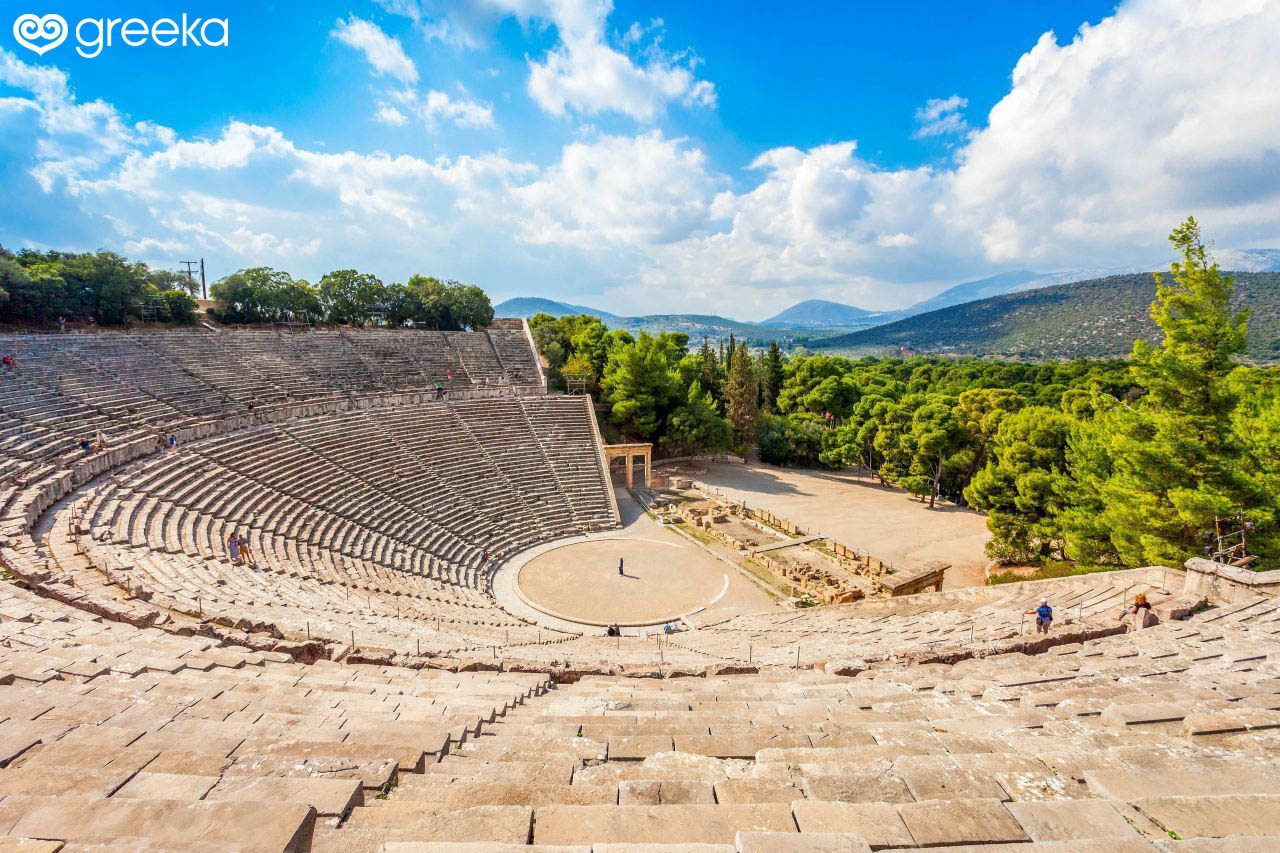
1. Ancient amphitheater at Epidaurus. Everything, for me, has to start with Greece, or the Greek world. Look at those dried out, ancient looking hills in the background, and the sense that a traveler trekking across an empty country could just stumble upon this grand, perfect ruin.


I actually cannot find a modern picture of the place where it is overrun with vulgar tourists, commercialism, etc, so maybe it actually is not ruined, and my whole project of lamentation is going to be defeated.

I have seen more stirring old pictures of the Parthenon, but I'm trying establish a mood here.  


This is more like it, although most of these people at least look young, which is more bearable. Still, the romance of communing with the glory that was Athens is probably hard to achieve when there are this many people.


Aqueduct at Segovia. There's a nice little crowd here even in the 50s, but manageable. You're still going to get that centrally-located room and night of outdoor dancing with comparatively elegant people without too much hassle if you want it.


This is the most crowded modern picture I could find, and at least one blogger has written a post describing Segovia as "That Idyllic European Town You've Been Looking For" so maybe there is still hope for me to live out my European fantasies, or some of them anyway, and this will be an optimistic rather than a pessimistic post.


Mausoleum of Theodoric the Ostrogoth at Ravenna. Those trees. I feel like I'm at the end of a classic movie.


I like the 1950s approach better. The whole setting in the modern picture makes the tomb look less substantial, it looks a little like a CCC-era public restroom in a city park.


Image result for mausoleum of theodoric in ravenna overrun tourists


The cloth hall at Ypres. This building was rebuilt from 1933-1967 after the medieval structure was destroyed during World War I. This picture may be of the original, I can't tell. The solitary man in this picture decked out for an Alpine expedition as he crosses the square is one of my oldest tourism role models. The spirit embodied in this enthusiastic pilgrim will be mine too, someday, I can imagine myself thinking.


More cars now.


Walled Town of Carcassone. Another picture to arouse the leisure-lover's imagination. Another sleepy afternoon in the village just as it's been for the last 600 years. And a long-haired girl sitting on the wall...


I'm just not finding the nightmarish scenes I was hoping for. 


No nightmare here.


Cologne Cathedral. I'm pretty sure this picture must predate World War II.


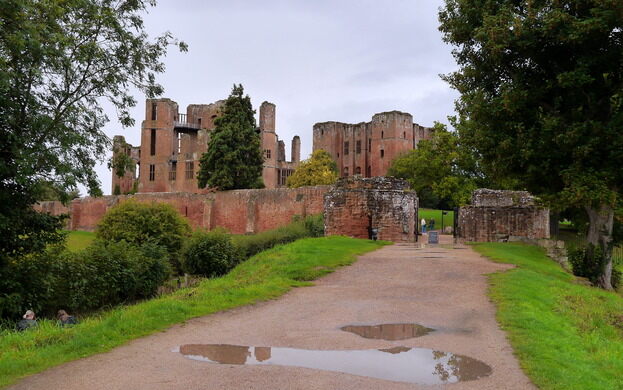
Kenilworth Castle, England. I love the muddy approach here.


The modern picture somehow always lacks the romance of the older ones, but this place seems to have stayed pretty true to itself. 

Reims Cathedral. I'm going to bet this is still pleasant and civilized. But the neighboring areas, the nightlife, the cafes, those are all dead now, right? It's not possible that I could still find something of what I imagine I have always wanted, is it? 


This is the most crowded picture of Reims Cathedral I could find. Once again, the older picture makes it look so much more grand, but I am sure that it is pretty exciting to see in real life. Most of the famous places I have been to generally were.


Gratuitous Notre Dame picture. One of the central loci of the old Western European dream that so many today are successfully weaning themselves off of. 


Abbey at Cluny


This place is looking just as good as it did before.


This is the most important of these pictures, the one I came back to the most because it is the one that projects, in those who can make some claim to possession of its ultra-superior qualities, the most authority and self-assurance, and of course it is that that I have always lusted after with complete and shameless abandon. 


I would definitely still go and see this if I were able. It's got too much lore and connection to classic Europe to be too diminished in my eyes.


Well, maybe.

House of Jacques Coeur, Bourges


The Doges Palace always has had a little bit of a crowd--no one dreams of going to empty cities, even generally misanthropic intellectuals.


Now it's the poster child for overtourism. They are getting very close to implementing a fee to enter the city.


Medici-Riccardi Palace. I had to get something from Florence in here. It's another one of the old standbys of the touristic imagination that sounds like it has become somewhat more difficult at least to partake of the feeling of being somewhere very special and great. Perhaps this is not true. I was there in '97, pre-Euro,and the numbers of visitors, while lamented at the time, were certainly much smaller than now, and I felt that I found a great deal of what I was looking for. 


I'm going to publish this now. I was almost finished on the 23rd but I had a bit of a health incident on Christmas Eve so I don't know if I'm going to be up to polishing this for a few weeks. However I may do a short end of year type post in a couple of days because I am laid up for a few days.

Monday, March 14, 2011

Middlebrow Surrender

This front in the struggle for the sort of mind I was to carry through the bulk of life was hopelessly lost a long time ago, but I have not conceded to a formal cessation of operations against the core truths of my natural abilities and inclinations until today.

This essay by Bret Easton Ellis on the significance of Charlie Sheen, though not by any means the decisive blow alerting me that I have been burrowing down the wrong path for the last 25 years, encapsulates the forces I have been up against nicely. This is not to say that I am as yet impressed with the thought process at work here, but the undeniable reality is that Bret Easton Ellis is cool, while I am lame, and as he would say, I don't 'get it', neither at one end nor the other. And it has always been thus.

Among the miscellaneous books that come into one's possession by various means during the period of the late teens and early twenties, I had one of those mid-century compendiums containing various intellectuals' frettings about the phenomena of mass culture and mass man, from the scourges of which however, the writers themselves, practically alone among living people, always seemed miraculously to feel themselves to have escaped. Heavily represented in this volume, and in my opinion easily its star contributor, was Theodor Adorno, the deadly serious emigre German philosopher-musicologist who to my knowledge never conceded a single positive development in civilization in the entirety of his life (I believe he is the guy who said that to write poetry after Auschwitz would be obscene). I was most struck of course by his absolute sense of his own mental superiority, however ultimately useless, to modern mass men, which included all Americans, and unrelenting contempt for the same. My favorite essay was his assessment of Elvis Presley's ascension onto the cultural landscape in 1956; taking a surprisingly eqananimous tone, the Frankfurt and Vienna-trained pianist and composer declared that at least it was impossible to imagine that any culture, even that of America, could sink any lower than this; that the bottom having clearly been reached, while there was no reason to expect regeneration towards an acceptable level of civilization within the lifetimes of our great-great-grandchildren, there was no conceivable further degradation of it that he could anticipate as capable of causing anguish. In this analysis he seems to have been correct. Such intact pre mass-society intellectuals as still remained after the mid-50s increasingly began to write off new cultural developments and the lives and minds of the human beings under the influence of them as insubstantialities devoid of any collective interest or meaning and in which nothing real was at stake whatsoever.

This mindset, perhaps unfortunately, though I remain wholly unconvinced of that as yet, was the dominant intellectual atmosphere that hovered over most of my formal, and subsequently, as I seem to lack the flexibility to adjust to alternative environments, informal education. Adorno of course was a product of the last, and in some senses the most perfectly realized, hurrah of European classical education. It was not simply the nature and extent of knowledge and the organization of mind that he and his like had but the circumstance that nearly everyone and every experience with which he came into contact in his formative years seemed to be restricted to this same high plane. In the same way that if one lives in a social universe where everyone is a doctor or some kind of Phd one tends to be able to attain to the same level in almost a matter of fact manner, if everyone one associates with has a thorough knowledge of Greek and other European languages, has had serious musical training, knows wide swathes of the literature of his own country and the major works of the other prominent national literatures practically by heart, and converses in a philosophical dialectic style as second nature, he will have no sense of these being unusual pursuits and habits, and such as over time, if cultivated with true thoroughness, seem to develop in one such a sensibility as can admit no pleasures, no seductions, no rationalizations, no diversions in study or thought beneath a standard that seems, and almost surely is, impossibly high to anybody who has come of age immersed in an European society probably since 1940 or so and in America even before that. This onslaught of mass low culture has affected nearly everyone now alive. Jacques Barzun, who is 103, may be the only remaining exception. Obviously there are still brilliant men, and dogged men, and the occasional lonely upholder of high standards scowling down at the sordidness of what passes for intellectual life in modern times; even the minds of these people, however, are of a very different quality from those I am talking about. Their brilliance usually does not somehow encompass the entire man and inform every aspect of their interactions with others; it is as a uniform they take on and off and which strangely fails to exert the same commanding, assured and assuring influence of the old school. It actually has long been my belief that once people were able to identify highbrow culture as a species of art or thought apart from the main channel of life the ability to possess it quickly died, probably because the ever-present dread of mediocrity became too great a distraction. People like Virginia Woolf and Adorno, who were able to possess themselves of the characteristics of high thought and sensibility before they became conscious of differentiating themselves from classes of intellect that were repulsive to them, were able to carry on relatively effectively, but they were not successful in passing their particular sensibilities to proteges of their own, as their mentors had done with them. And it is next to impossible to attain this thorough a level of cultivation from a state of consciousness of not having it. Then there are so many pratfalls the unsuspecting middlebrow inevitably falls into, myself not least among them--confusing the development of personality, which is ideally merely the expression of character, with the development of character itself; getting caught up in the collection of facts and information, and rarely any truly important facts and information, as opposed to cultivating a deep understanding of processes and relations and what constitutes substantiality in the same; the semi-paradox that one must form one's own taste and conclusions about books, music, etc, and not be slavish to authority, but yet must somehow come to more or less the same conclusions, or the same kind of conclusions, only in one's individual way, about the same. Perhaps 90% of the people who navigate this education with apparent success are merely posing--I know some are, and suspect others--but I have become convinced that there really is an elect who have attained such a degree of mastery of this system that the working of their minds must be at times a source of great pleasure to them to contemplate, as it is a wonder for others to contemplate them. This is what I have encountered in the course of my education and decided for whatever reason that this is the mind I want, though it is impossible I should ever attain it, and no one has yet been able to persuade me against it.


This above is an image of how people who follow this route, or any route with which they never attain a sense of fusion between the spirit and the pursuit, end up in middle age.

Friday, March 26, 2010

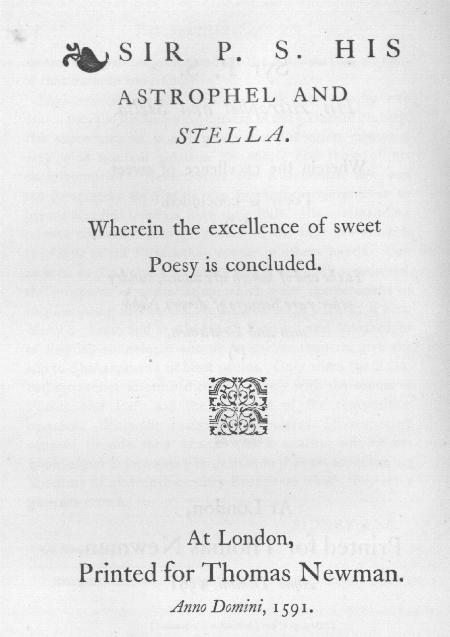
Sir Philip Sidney--Astrophil and Stella #49 (1581-3)

Back now to subjects that really matter, and whose relevance will never fade; of course I am referring to Elizabethan poetry.

I wrote about Sir Philip Sidney's spectacular career in an earlier which I can't find at the moment. You may have noticed that I have slowly been going back and assigning labels to some of the old posts--eventually there will be a Sir Philip Sidney category. Sidney died at age 31 of an infection after being shot in the thigh fighting against the Spanish in Holland; in contrast to Laurence Sterne (whom I wrote about last week) however, his biography is packed with action and brilliant accomplishment. Obviously it helped that he was very well born, but plenty of people are well born and disturbingly never progress beyond mediocrity in any field. He entered Oxford at 13 and was graduated by 18. A portion of his recorded travels include Paris, Strasbourg, Frankfurt, Heidelberg, Vienna, Venice, Padua, Genoa, Florence, Poland, Brno, Prague, Dresden, Antwerp, and all over Ireland and England as well. At 22 he was named Cup-bearer to the queen, about the significance of which post I can't find much satisfactory hard information right at hand, but it appears to have been considered desirable. At 23 he was sent to Prague as ambassador. Member of parliament at 27. Appointed governor of Flushing in the Netherlands, which involved leading English troops in battle. Wrote hundreds of poems ("The Major Works") is 329 pages long, about 215 of which are poetry. Astrophil and Stella, a sequence of love poems, consists of 108 sonnets and 11 songs. As he did not publish his poems during his lifetime, it is considered by scholars unclear why or for whom he wrote them.

Since I have known about him, I have always regarded Sir Philip Sidney as a person whose development, preparation, experience and activity in his adolescence and twenties were pretty close to the ideal. It is one thing, and an admirable thing, to learn to cut fat out of your schedule, not waste time, be purposeful, and all that. I know many people who have succeeded in doing this however, without attaining the ideal level of development that one feels with regard to Sidney. Sidney seems to have been able either to cut the fat from his thinking or perhaps, living in the age he did, to prevent it from ever insinuating itself there in the first place. These things seem likely to be ever-increasingly harder to do in our age, though they are the most vital quality the imaginative writer of poetry especially can possess. I read the entire Astrophil and Stella sequence back in April of 2004; as with Tristram Shandy, I was astonished by how long it had already been, for it seemed to me something I had read recently. The books I read before I had children I can place very neatly in memory with other things that were going on simultaneously in my life, seasons, outings, trips, the jobs or variety of idleness I had at the time, what rooms I lived in, bars and restaurants I went to, whether I read part of the book in the library or and what chair I sat in. Since the children were born and I have lived in the same house and had the same job everything runs together in a kind of eternal sameness. Evidently I was depressed or something at the time I read this book. My notes largely consist of sighs and 'too distracted to write about today' types of entries. Still I definitely had the impression that Sidney was a great poet, like many of the Elizabethans perhaps too great; their writing expressed their meaning and the process of thought by which they attained that meaning in such precise and perfect English that there seemed nothing really to say about them. As with Spenser, any sign of real struggle or conflict where impression, or truth, is concerned is difficult to detect. Language and perceptions are not with them, as they are to most people, further obstacles to truth, but its servants. This is what makes one find them so beautiful I think but also difficult to write about.

The book I use for my reading list had a question on some lines from the 49th sonnet, so that is why I am going to write my commentary today on that one rather than on any other one.

I on my horse, and love on me, doth try
Our horsemanships, while by strange work I prove
A horseman to my horse, a horse to love;
And now man's wrongs in me, poor beast, descry.
First off, the conceit is a good one, having not merely the usual duality of images, but with a common component between them which occupies the opposite position in the second that it does in the first. The fourth line is a little tricky, but as it is emphasized again later on that he is simultaneously riding and being ridden I believe he is encouraging his horse to expatiate on the various cruelties and other indignities he is inflicting on it, as he is about to do with regard to his own hard master.
The reins wherewith my rider doth me tie
Are humbled thoughts, which bit of reverence move,
Curbed in with fear, but with gilt boss* above
Of hope, which makes it seem fair to the eye.
boss-metal knob on the bit.
The humbled thoughts are the part I have the most trouble getting the sense of here. Humbled probably has a slightly different connotation than it does in our modern usage, though I am not sure what it would be. The original root from Latin via Old French, humilis, would translate as low, or lowly, from humus, ground. Certainly there is a hint of baseness, the whole image bespeaks a total degradation and loss of proper manhood on the lover's part. Also we are told directly that the bit of reverence only seems fair. Delusion and denial of one's proper state abound.
The wand is will; thou, fancy, saddle art,
Girt fast by memory; and while I spur
My horse, he spurs with sharp desire my heart;
He sits me fast, however I do stir;
I am not quite clear on the wand image. I assume it refers to the switch which one lashes the horse with. But then what is meant by will? The rider's will? Or the beast's, to be driven and overmastered by his rider.
And now hath made me to his hand so right
That in the manage myself takes delight.
I guess this clarifies a little my question about the wand.
The GRE questions on this poem were:
1. The poet's portrayal of "Love" (l.1) is an example of:
A. personification B. metonymy C. synecdoche D. apostrophe E. dead metaphor.
Uh...I'm going to go with A. Gut instinct and all that.
2. Horsemanships (l.2) is plural because:
A. love rides the speaker while the speaker rides his horse. B. the speaker has committed more than one wrong. C. love exercises many forms of control over the speaker. D. love controls him better than he controls love. E. love appears in many forms.
Dare I suppose that the answer is 'A' again?
These were too easy. I got both right.
What I'm getting out of the Elizabethans is not much in the way of philosophy or ethics for the most part, but their imaginative approach to language and understanding the world was developed to a far greater degree than in any other period of English literature, the use of language to elevate and expand the possibilities of what are, in many instances, fairly common thoughts and impressions. This is the secret of all great literature and art I guess, and every age is to an extent seeking the means to figure out how to do this freshly and as the times require. If we don't remind ourselves of this out loud from time to time however we won't even remember what it is we are looking for.

Tuesday, October 27, 2009

Yeats--"Sailing to Byzantium" (1927)

I am breaking my usual pattern by doing two literary posts in a row, but I am not in the right frame of mind to address anything having to do with contemporary life this week, so much so that books and even literary theory appear to become attractive again. Sometimes my mood is the other way around, usually because I have for a time taken to approaching the books in the wrong spirit rather than that I feel any great affinity with actual life. While poetry is, in its finest manifestation, an attitude meant to be absorbed by and live through the actions of a vital spirit, the person who undertakes to read it and attempt to grope his way to an understanding is clearly seeking some intimacy with this type of vital spirit greater than that accessible to him by other means. My attitude towards anything is pretty much determined by my perception of the current degree of this accessibility. For some reason that I cannot make out right now, I am better disposed towards poetry this week than I have been in some time, and I want to take a shot at exploring therein.

As I noted in my rather flippant last post on Yeats, I have found in the past that I am not as stirred by him as I perceive many other people are. Since his reputation for high greatness does not seem to be going away, I think I owe it to myself to try harder to see what is there, and at least examine why his brilliance has failed upon me so far. That means I am going to have to take this line by line and tease it out for myself.

Title--There is a note in my edition which reveals that, as Ruskin did 14th century Venice, Yeats considered Byzantium circa 535 A.D. to have been perhaps the era in history when human beings were most wholly developed in all of their aspects, when ordinary craftsmen were able un-self-consciously to create artistic masterpieces such as would be beyond the capacity of the most celebrated geniuses of the present, when religious and aesthetic understanding were both perfectly realized and widely shared. Man in general could almost have been said to be an admirable creature. The "Sailing" I believe, is an appeal to the muse to convey us towards some insight as to what this rich intellectual and artistic atmosphere must have consisted of.

That is no country for old men.

This line, of course, has become very famous and frequently alluded to. Old, I am assuming, refers to anyone who has allowed the vital elements of his humanity to remain undeveloped or to wither and die within him, regardless of chronological age. The modern world is frequently spoken of as a place where would be men remain figuratively children until they are 30 or 35 and then progress immediately to old age without any period of capable dynamism in the prime of life. Many of the early modern poets and novelists seem to have been obsessed by this debasement of life.

The Young
In one another's arms, birds in the trees
--Those dying generations--at their song,
The salmon-falls, the mackerel-crowded seas,
Fish, flesh, or fowl, commend all summer long
Whatever is begotten, born and dies.

Images of fecundity, obviously. So much that death ceases to be haunting, or dreaded, because the life that preceded it was a full and worthy one. The reference to seas teeming with fat fish also conjures up images of a younger period of human history before nature's abundance had been depleted, and men intellectually and spiritually exhausted by increased understanding of the implications of his thought.

Caught in that sensual music all neglect
Monuments of unageing intellect.

I take this to mean that in such an environment present life is so vital that one lives in the moment, without nostalgia, or lament, or incomprehending idolatry of past mental achievements far beyond what is accessible to oneself.

An aged man is but a paltry thing,
A tattered coat upon a stick, unless
Soul clap its hands and sing, and louder sing
For every tatter in its mortal dress,
Nor is there singing school but studying
Monuments of its own magnificence;

Soul here I take to be an assertion, as it were, of one's essential dignity as a human, in spite of the obvious drawbacks (constant threat of mortality physical and spiritual, etc). The "singing school" reference I suppose means that this soul is not something that is transmitted through formal lessons and training from a master but is an intuitive response to one's surroundings if one is sufficiently alert (and of which the actualization in fact can be hindered by over-intellectualization).

And therefore I have sailed the seas and come
To the holy city of Byzantium.

The symbolic importance of sailing the seas and coming to a 'holy city' ought not to be overlooked in these otherwise primarily functional lines.

O sages standing in God's holy fire
As in the gold mosaic of a wall,
Come from the holy fire, perne in a gyre,
And be the singing-masters of my soul.
First, two notes. The gold mosaic image was inspired by the frieze of the holy martyrs in the church of San Apollinaire Nuovo at Ravenna, which Yeats had visited 20 years before he wrote this poem (at which time he had been 42. These kinds of biographical/chronological facts are not relevant to any art object's importance as an object of art, of course, but I am personally curious about them). I should try to find a picture of this. I think this is part of it.
The second note is that the word "perne", which is a kind of spool, means here "to spin round".
I like the Blakean conceit of the 'holy fire', fire being ordinarily being considered as being a defining characteristic of God's main enemy and all of that, though Yeats is never quite convincing (to me) that this is something he really perceives in his soul. I suppose this is why he is calling on the martyrs to reveal its sense to him however.
Consume my heart away;
The heart as mortal symbol and weak point of the human superstructure is not a radical concept, but the sense in which it is cited here, as utterly disconnected from and unnecessary to the refinement of man's higher parts, I have not often seen asserted so decisively.
sick with desire
And fastened to a dying animal
It knows not what it is;
The "dying animal" line is the other really celebrated one in this poem. That said, you need the contrast with the martyred saints appealed to previously for it to have its intended effects. If you don't believe there is anything to the saints, or even in the concept of something like saints, you don't really have anywhere to go. Which I guess is why you have to figuratively go to Byzantium, or medieval Venice, because they accepted these more ennobling (and therefore, the poet suspects, more true) conceptions as the terms of life, which modern people are largely incapable of doing.
and gather me
Into the artifice of eternity.
Artifice is the important word here. Do we take this to mean that there is no objective sense of reality other than that which men make for themselves, and that they have, in a broad sense, some choice in the matter? He is expressing a preference for what he takes to be the Byzantine world view, which, however, he cannot believe in. He is thus a man not in harmony with his understanding of the world, which was certainly the dominant motif of his age, and would be of ours if we bothered to care about such things any longer; it is ultimately a serious and pretty insuperable problem for a poet however, I think.
Once out of nature I shall never take
My bodily form from any natural thing,
But such a form as Grecian goldsmiths make
Of hammered gold and gold enamelling
To keep a drowsy Emperor awake;
An assertion of the primacy of (good) art/imagination/cultivation over man in his natural uncultivated state? Yes, assuming the cultivation is bringing out truly extraordinary human qualities. My general impression of Yeats is that he was inclined to be a true believer in the desirability of truly high culture. Hence his desire to set up respectable cultural institutions and promote the flourishing of semi-official artistic movements in his own country.
Or set upon a golden bough to sing
To Lords and Ladies of Byzantium
Of what is past, or passing, or to come.
It is a little bit of a confusing metaphor to see a poet express a desire to be a goldworked bird in some potentate's collection, but I suppose that is what even a poem such as this ultimately is--a glittering, speaking ornament that in its way defies the normal material and imaginative limitations of existence.
I haven't even touched on things like the meter and other matters of form. I am not really good at that. The poem I think reads very nicely, there are no awkward transitions or anything. Likewise there is nothing in the language that stands out as off, or not quite right, or forced. Still, Yeat's language, even where it impresses, never does excite me. Never is there an instant in these poems where I find myself saying, 'Yes, that is it, that is just what it is', or 'I love the way this is laid out, the means of expression, and the point to be expressed'. I think for one thing I find him too strident in his poetic nature. At the same time despite the theme developed in this poem he commits the double sin of having a tendency to over-intellectualize while not really having the pure intellectual habit--the chops, as it were--to do this in the convincingly natural way a poet must have. He lacks humor entirely. This is perhaps not a serious problem, but I am very partial to the sort of humor, even unintentional humor in the service of rhyme, that the likes of Byron and most of the 18th century poets inserted into their verses. I find his poems to possess neither the brilliance of conception that I admire in Wallace Stevens, the outrageousness that I find interesting in Pound, or the understated modesty of presentation that is attractive in the work of R. Frost. He is a good poet, certainly, but he leaves me cold.

Wednesday, October 15, 2008

Ruskin--Part XIV

How many Ruskin posts are there going to be? I don't know. The sections "The Spite of the Proud", and the one after it, "The Street of the Tombs" were both outstanding after their manner and very persuasive. This is not to say that I am completely won over to a preference for the Gothic over the Renaissance, and will forever shun the false pleasures of the latter, but, unless I can be even more persuasively shown that Ruskin understood nothing about any of this, I will probably always be more wary of their real sensibilities than I would have been otherwise. Ruskin really starts to break out with specific superlatives in these chapters. "The perfect type of the Gothic tomb" in general, he proclaims, was reached in the thirteenth century, and the Italian style superior to that developed in England, those of Italy "kept massive, smooth and gloomy,--heavy-lidded dungeons, of stone, like rock tombs,--but bearing on their surface, sculptured with tender and narrow lines, the emblem of the cross, not presumptuously nor proudly, but dimly graven upon their granite, like the hope which the human heart holds, but hardly perceives, in its heaviness."

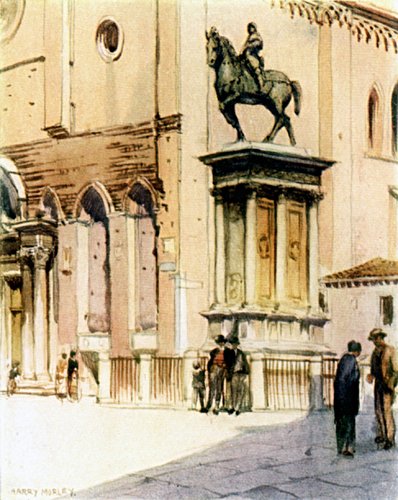
Fig. 1--Church of St Paul & John, Venice. Where the most interesting examples of the simple sarcophagus tombs are to be found in that city.


These are just notes for me to refer to should I have occasion to return to that part of the world as a tourist some day, especially as I will probably be past the age at that point where I can expect to do a lot of damage in the area of nightlife:

"...the consummate form of the Gothic tomb occurs in the monument of Can Grande della Scala in Verona."

Another perfect tomb of the Gothic style is cited in "the second chapel counting from right to left, at the west end of the Church of Frari (Venice)...It is a knight's; but there is no inscription upon it, and his name is unknown."

Fig 2--Monument of Can Grande della Scala, Verona

"...the tomb of the Doge Andrea Dandolo in St Mark's...and that of St Isidore in another chapel of St Mark's...are, on the whole, the best existing examples of Venetian monumental sculpture." I was unable to find any pictures of these. If I were really diligent I would do searches in the Italian language, which would probably turn up more than I am able to find doing it this way, but that is something I really don't have time for at this stage.

Four pages later however we find, in the choir of the Church of St John and Paul, "the richest monument of the Gothic period in Venice; that of the Doge Michele Morosini, who died in 1382."

Fig 3--If you do a photo search for "John Ruskin girls" this comes up. Upon further inquiry, I have discovered that this woman is a Canadian film actress named Liane Balaban. After the first two pictures I saw of her I thought I was in love, but being able nowadays to pull up anybody you want on Youtube--though I only found about 5 'hits' for Liane, her career has not really taken off--I did not like her quite so much. She is trying, but she comes off as being pretty much just like everyone else of her particular type--sort of urban, sort of cosmopolitan, sort of educated, sort of artistic, sort of clever, sort of sexy, all without quite being any of these things enough to the core to knock one backwards. Her mother is Catholic and her father is a Jewish emigrant from Uzbekistan, which sounds like a vigorous combination, and she is from Toronto, which for some reason I always think is promising. I think all Canadian women are promising when I find out where they are from, but have any ever come through for me and lived up to my imagination? No! Yet the place maintains an aura of romance for me that I cannot destroy.

Ruskin refers in so many places to the greatness of Carlo Zeno in the history of Venice--he dates its decline practically from the moment this leader drew his final breath--that I thought I ought to do a whole piece just on him. At the very least I should issue a formal statement regarding my thoughts on such a personage. I don't have a good sense of who he was, however, beyond being an almost perfectly-realized representative of a culture that had reached an especially realized fullness of time in his youth and maturity. Such people are to my mind more worth studying than any other kind; they are what every civilization is, or ought to be, working towards the attainment of, the type of which every great artist and scholar awaits the arrival. That said, I haven't been able to get around to doing the research for this analysis.

I made a very cryptic note, which I believed is intended to be a comparison with our own present situation, regarding the expectation of the wealthy to devote their fortunes to the war effort (in times of such crises), not profiteer. Michael Morosini, who was chosen as Doge over the Carlo Zeno himself and set the decline of the republic in motion, had tripled his fortune during a war that had recently concluded by speculating in real estate during the period of uncertainty.

Fig. 4--Inside the Church of the Frari, Venice. This is not the tomb that Ruskin liked though.

Ruskin speaks with such intimate feeling about these people from the 14th century, and in a way that makes them seem so civilized and and advanced and fully-rounded as characters, that one begins to forget that they didn't exactly live yesterday. The 1300s was a long time ago.

With regard to the changes in attitude and feeling that Ruskin so laments in art history, surely he knew it would be inevitable that artists would eventually want to do something different, even if it were inferior (or maybe not. Perhaps this idea is a prejudice of us moderns, and there is no inherent reason why human beings should ever try to do thing differently, especially if there possibility of its being an improvement on what came before it. Some sensible people do think this way, too, and do their best to imitate the style of their masters. However, the fine in fine arts hints at a delicacy and subtlety in perception and experience and knowing that changes and transmits itself through the form, and from which the form must take its life or fail. Right?)

Fig. 5--This Is One of Liane Balaban's movies. I was still crushing on her at this point. Then I watched a little preview of this movie on the Internet. My interest was piqued because it's about teenage girls in some nowhere town in Newfoundland where its freezing and there is a significant Catholic population, which has some similarities to parts of my own life, but it looked pretty badly written, and it looks like Liane can't act much either, certainly not enough to give a mediocre film some respectability. (The reason she came up on the search by the way is because this film appears on a list on the same page with a film called "The Passion of John Ruskin"--God only knows what that is about--which does not seem to gotten much of a release, even on video.

A subtle, but symbolic development in the transformation of Venice from virtuous to decadent state is demonstrated by the changing nature of the battle-shields of the nobility. In the earlier period, of course, the shields were actually used in war, "and therefore there was no need to add dignity to their form by external development", but as firearms rendered this equipment obsolete in the 15th and 16th centuries shields became fields for elaborate decoration and engraving, usually regarding the glory of their owners' family. Ruskin thought that this ornamentation greatly diminished the dignity which had belonged to the formerly much plainer but more useful shields.

Sunday, July 06, 2008

The Stones of Venice--Part III

From Volume I, Chapter II: "The Throne":

The first sentence of this chapter is long, but it is pertinent to the major themes of the book:

"In the olden days of travelling, now to return no more, in which distance could not be vanquished without toil, but in which that toil was rewarded, partly by the power of deliberate survey of the countries through which the journey lay, and partly by the happiness of the evening hours, when, from the top of the last hill he had surmounted, the traveller beheld the quiet village where he was to rest scattered among the meadows beside its valley stream; or, from the long-hoped-for turn in the dusty perspective of the causeway, saw, for the first time, the towers of some famed city, faint in the rays of sunset;--hours of peaceful and thoughtful pleasure, for which the rush of the arrival in the railway station is perhaps not always, or to all men, an equivalent,--in those days, I say, when there was something more to be anticipated and remembered in the first aspect of each successive halting-place, than a new arrangement of glass roofing and iron girder, there were few moments of which the recollection was more fondly cherished by the traveller, than that which, as I endeavored to describe in the close of the last chapter, brought him within sight of Venice, as his gondola shot into the open lagoon from the canal of Mestre."

I like 1850s-ish modernity of course--it has had time to be formed, packaged, what have you for my romantic imagination. That said, I also agree with the idea that speed and noise and crowds are not optimal conditions for beautiful and profound thinking, at least for certain types of highly sensitive and easily distractable people--obviously plenty of people have been able to thrive, at least artistically, to some degree in the new conditions. Still, lately I have been moving towards the viewpoint that museums, say, at least as they are used by most people, are not optimal settings in which to place good art, unless one is able to go to the museum repeated times, and to devote at least a couple of hours on every occasion to revisiting various works until they really insinuated themselves permanently into one's consciousness. I suspect when the first public museums opened in the late 18th and 19th centuries that it was anticipated that this was how they would work, and probably it is how they do work still for some people.
In his revisions later in life, Ruskin made many footnotes derogating the silly and foolish sentences he had written as a younger man. I can understand why he did not delete them though; a generally successful work (this does not apply to undisputed world masterpieces, but such works of course are extremely rare) often depends on a certain tone, or attitude, in its thinking, and sometimes to correct the occasional overexuberant or ill-considered thought in the sobriety of older age would be detrimental to the overall effect of the whole.

It is sometimes difficult for me to remember that Ruskin, and other authors who are like him (such as Proust), are not, despite their psychological problems and flirtations with romanticism, really people like me, but come from extremely wealthy and cultured backgrounds, the pervasive mental atmosphere of which would be something entirely foreign to me. While Ruskin makes it pretty clear in his writings that he thinks the elite owe it to the lower orders to create an aesthetic and spiritual environment for them in which their basic human natures are not degraded any more than they need to be, and even founded some institutions (which can still be seen today) which the intention of uplifting the common people, his intention seems to be to make them more pious men, better craftsmen, and so on, within the intellectual limitations that the mass of men are bound by. This is not an unsensible idea on the whole--its assumptions however are a little too off-puttingly aristocratic for me, since I interpret it as unequivocally excluding people like me from getting the full, the high view, the high education, the intellectually wider sense of life, the idea of which has seduced me, and probably not for the proper reasons. As it turns out I haven't gotten these things anyway, and I lack the simple piety and capacity to work nobly and skillfully at some beneficent task which is every man's proper lot.

"...though the noble landscape of approach to her can now be seen no more, or seen only by a glance, as the engine slackens its rushing on the iron line; and though many of her palaces are for ever defaced, and many in desecrated ruins, there is still so much of magic in her aspect, that the hurried traveller, who must leave her before the wonder of that first aspect has been worn away, may still be led to forget the humility of her origin, and to shut his eyes to the depth of her desolation."

"The impotent feelings of romance, so singularly characteristic of this century, may indeed gild, but never save, the remains of those mightier ages to which they are attached like climbing flowers; and they must be torn away from the magnificent fragments, if we would see them as they stood in their own strength."

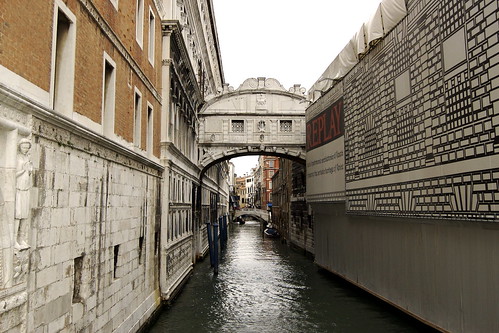
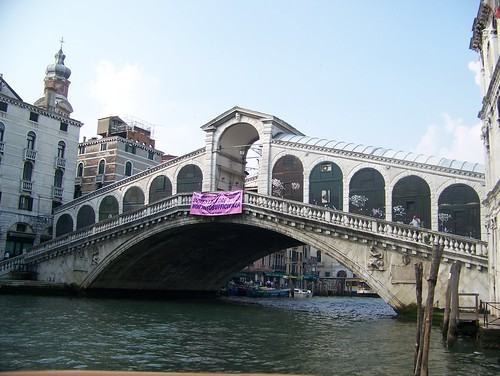
"No prisoner, whose name is worth remembering, ever crossed that "Bridge of Sighs", which is the centre of the Byronic ideal of Venice; no great merchant of Venice ever saw that Rialto under which the traveller now passes with breathless interest: the statue which Byron makes Faliero address as of one of his great ancestors, was erected to a soldier of fortune a hundred and fifty years after Faliero's death..." O.K., I am sobered--a little. I still think there are worse things in the world than revelling in the Byronic ideal of Venice, especially if you have clearly distinguished it in your mind from the actual, or rather the more solidly demonstrable history. The point however is that this ideal is not merely a fiction, but it is vastly inferior in substance to what it obscures, which is its real crime. This I, perhaps more than most, should know better.

"The remains of their Venice lie hidden behind the cumbrous masses which were the delight of the nation in its dotage; hidden in many a grass-grown court, and silent pathway, and lightless canal, where the slow waves have sapped their foundations for five hundred years, and must soon prevail over them for ever. It must be our task to glean and gather them forth, and restore out of them some faint image of the lost city; more gorgeous a thousandfold than that which now exists, yet not created in the day-dream of the prince, nor by the ostentation of the noble, but built by iron hands and patient hearts, contending against the adversity of nature and the fury of man..."

I will have to remember that I can't steal pictures from the Gutenberg site.

On the unique and fortuitous circumstances of Venice:

"Had deeper currents divided their islands, hostile navies would again and again have reduced the rising city into servitude; had stronger surges beaten their shores, all the richness and refinement of the Venetian architecture must have been exchanged for the walls and bulwarks of an ordinary seaport. Had there been no tide, as in other parts of the Mediterranean, the narrow canals of the city would have become noisome, and the marsh in which it was built pestiferous. Had the tide only been a foot or eighteen inches higher in its rise, the water-access to the doors of the palaces would have been impossible..."

Tuesday, July 01, 2008

The Stones of Venice--Part II

The Stones of Venice--Part II From Volume I, Chapter I, "The Quarry": "Let the reader therefore conceive the existence of the Venetian state as broadly divided into two periods: the first of nine hundred, the second of five hundred years, the separation being marked by what was called the 'Serrar del Consiglio'; that is to say, the final and absolute distinction of the nobles from the commonalty, and the establishment of the government in their hands to the exclusion alike of the people on the one side, and the authority of the Doge on the other." A familiar pattern. "To him no matter, or to her; the real question is, not so much what names they bore, or with what powers they were entrusted, as how they were trained; how they were made masters of themselves, servants of their country, patient of distress, impatient of dishonour; and what was the true reason of the change from the time when she could find sviours among those she had cast into prison, to that when the voices of her own children commanded her to sign covenant with Death." "Venice (i.e. Venice circa 1200)is superficially and apparently commercial;--at heart passionately heroic and religious; precisely the reverse of modern England, who is superficially and apparently religious; and at heart, entirely infidel, cowardly, and dishonest." "There had indeed come a change over Venetian architecture in the fifteenth century; and a change of some importance to us moderns; we English owe to it our St. Paul's Cathedral, and Europe in general owes to it the utter degradation or destruction of her schools of architecture, never since revived." "This Roman Christian architecture is the exact expression of the Christianity of the time, very fervid and beautiful--but very imperfect; in many respects ignorant, and yet radiant with a strong, childish light of imagination, which flames up under Constantine, illumines all the shores of the Bosphorus and the Aegean and the Adriatic Sea, and then gradually, as the people give themselves up to idolatry, becomes corpse-light." The physical strength or enervation of nations are often referred to, and how the rising strong absorb in some degree the culture of the lands they have usurped or inherited, which thenceforth live and mutate under the energy of the dominant nation. By physical strength Ruskin means an irresistible energy and will to live in and master the Earthly realm without, in the beginning at least, a blatant intellectual component. It is not the product of technological advantage, nor is it a capacity for mindless and undisciplined violence, but a sense of purpose disseminated through a vast swathe of the people. Though European intellectuals have a hard time comprehending the United States as a nation with any cultural continuity of substance across generations, the United States was practically the definition of a body politic propelled by physical strength leavened with absorbed and mutated culture for at least 300 years; most conservative consternation as regards matters of culture is a reaction to the sense of this physical strength being weakened and the people therefore degraded, and the more intellectual the critic is the more inclined he will be to add, and degraded before we have been able to properly marry the development of our intellects and our bodily vigor at the very highest levels. "The Ducal Palace of Venice contains the three elements in exactly equal portions--the Roman, Lombard and Arab (see strength above: "...the fierce swords of the Lombard and Arab were shaken over its [the religion of the Roman Empire's] golden paralysis'"). It is the central building of the world."


"...in his intense love of excitement (the Arab) points the arch and writhes it into extravagant foliations; he banishes the animal imagery, an invents an ornamentation of his own (called Arabesque) to replace it." I do not whether this development is related to the Arab's intense love of excitement or not, but I thought it was a nice observation on some basic, but still subtle differences between two schools of art. "The noblest buildings of the world, the Pisan-Romanesque, Tuscan (Giottesque) Gothic, and Veronese Gothic, are those of the Lombard schools themselves, under its close and direct influence; the various Gothics of the North are the original forms of the architecture which the Lombards brought into Italy, changing under the less direct influence of the Arab." I suspect this is all somehow completely wrong, not that I have any idea what form the truth would take--a serious problem for me--but because all Victorian theories of history seem to be held to be wrong, or at least wildly inaccurate, now. "I dated (Venice's) decline from the year 1418; Foscari became Doge five years later, and his reign the first marked signs appear in architecture of that mighty change...the change to which London owes St Paul's, Rome St Peter's, Venice and Vicenza the edifices commonly supposed to be their noblest, and Europe in general the degradation of every art she has since practised... This change appears first in a loss of truth and vitality in existing architecture all over the world." "Gods without power, satyrs without rusticity, nymphs without innocence, men without humanity, gather into idiot groups upon the polluted canvas, and scenic affectations encumber the streets with preposterous marble." One could go on and on for some time with quotes in this vein. "Claude and the Poussins were weak men, and have had no serious influence on the general mind...they may be left without grave indignation to their poor mission of furnishing drawing- rooms and assisting stranded conversation." I have expressed some affection for Nicolas Poussin elsewhere on this blog. I am not familiar with any of the work of the other painters, though I am sure I would like them too given this description of the sort of mind to which they appeal. Ruskin needless to say was a very unhappy person--life and art only kept getting more depraved and gruesome, to his mind (he lived until 1900), and I think his arguments, while interesting and perhaps containing a morsel of truth in them, are a little extreme. The strength/weakness critique when judging works of art and artists is a valid one, and I can see where Poussin could be said not to project a great deal of strength, in the sense of a true and vivid and undeniable representation of life, in his paintings; but I personally do not require this effect from art, indeed if anything I probably recoil from it and examine it as though it were a trifle, admiring the pretty parts.

"...dominant evils of modern times--over-sophistication and ignorant classicalism; the one destroying the healthfulness of general society, the other rendering our schools and universities useless to a large number of the men who pass through them." The very end result of such a system must be people like me, who imitate over-sophistication and ignorant classicalism more poorly than these other offenders imitated the genuine manifestations of those things.

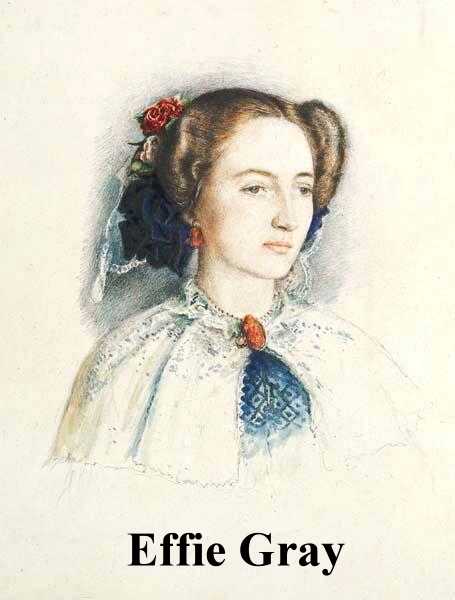
"I must again refer to the importance which I have above attached to the death of Carlo Zeno and the Doge Tomaso Mocenigo." Who knew? By the way I looked for a picture of either of these gentlemen to put up in this place but I was unable to find any. So I put up Effie instead.

On the law of right: "...it must enable us to reject all foolish and base work, and to accept all noble and wise work, without reference to style or national feeling; that it must sanction the design of all truly great nations and times, Gothic or Greek or Arab; that it must cast off and reprobate the design of all foolish nations and times, Chinese or Mexican or Modern European; and that it must be easily applicable to all possible architectural inventions of human mind." Obviously I cannot reasonably claim to appreciate Ruskin and still link to Youtube clips of American movie stars and pop songs. The two states of activity are not reconcilable. I am not sure what Ruskin's reasons are for considering China and (presumably pre-Columbian) Mexico to be foolish nations. He probably thought they did not properly understand their gods, or otherwise were lacking in the physical strength that gives art the sort of power he liked.