Showing posts with label cinema--low countries. Show all posts

Tuesday, January 15, 2019

I Guess I'll Continue on With More Movie Reviews (Almost Caught Up!)

Willard (2003)


Remake of a 1971 movie, starring professional eccentric Crispin Glover as a sort of proto-incel who lives in a nice Victorian house he has, at least temporarily, inherited from his parents which gets taken over by especially vindictive rats. It's pretty terrible and disgusting. The non-rat parts of it, the character's inability to function in the workplace or the modern world in general, and his anachronistic house, held my interest briefly, but they were minor aspects of the plot. At the end of this movie I determined that it wasn't necessary for me to watch anything that wasn't a widely renowned classic all the way through any more if I didn't want to. Some stuff is really irredeemable, but it took me a long time to come to the point where I felt myself entitled/qualified to say so.


Casino (1995)


Famously interminable Scorcese movie about the mob in Las Vegas. Everything that happens in this is completely morally repugnant, with no redeeming qualities. You probably knew that, but there are films with similar overarching themes that manage to be more interesting. Sharon Stone's performance in this was pilloried at the time and marked at least the beginning of the end for her as a headlining star, but I have to say her acting did not stand out to me as any worse than anyone else's did. I know I am not differing much from consensus opinion on this movie. My recent belief, or at least curiosity, garnered mainly from reading the movie blogs of very clever film fans, is that there are infinite delights to be mined from films that are comparatively uncelebrated by the critical consensus. Doubtless there are many instances where this is the case, however my somewhat random approach to trying to find examples has hit a cold streak lately.


Vampyr (1932)


The first sound movie from the great Danish-born, but really pan-European director Carl Theodor Dreyer, made in France but with dialogue primarily in German. The style decidedly shares characteristics with the scary German expressionist movement that was coming to its final culmination at the time. With this at least I had the comfort of knowing I was watching a real European classic of impressive age from a master artist. The dialogue, such as it is, is minimal, and it is a little difficult to follow and sleep-inducing to watch at home. The most memorable scene is shot from the point of view of a corpse looking out through the window of his coffin at the sky, branches, steeples, etc, as he is being carried to his burial. That is what stands out to me about this film.


The Disappearance of Eleanor Rigby (2013)


For reasons that I am still trying to tease out, because the plot and the characters don't have any particularly outstanding appeal in themselves, and in fact are rather depressing, I quite liked this at the time that I saw it. Annoying and neurotic and over-privileged as most of the characters are, the general level of intelligence, cultural references, topics of conversation and so on which permeates the atmosphere of the picture is in the range where it holds my interest, which is something you know is increasingly lacking in my regular life. Most of the people in this movie belong to the higher end of the academic/well-traveled/urban liberal class, which is the class I certainly for better or for worse identify with, mainly because my IQ and general education level are commensurate with the average for this group I think, though I don't really belong to it, especially in the judgment of its actual members. Of course that none of these people are happy, their relationships are all disasters and they are inevitably professionally unfulfilled and disappointed, albeit their failures occur at a higher level than mine do. This is all true. There is nonetheless a relief in being in the company of people with mental outlooks and experiences that one can somewhat relate to.



The Vanishing (1988)


Oh boy. They (actually, my wife) told me not to watch it, but naturally I said, 'it's a 5-star movie. I have to watch it.' I'm not sorry I watched it--the chance to revisit the scenes and pastimes of late 80s France alone make it worthwhile for me (this is the Dutch version, not the Hollywood remake that came out a few years later and apparently was not very good)--but the ending is definitely a downer. While I realize now that the movie is full of all kinds of creepy foreshadowing, it has the kind of languid pace and pointed, unfrenetic construction that I like when I see it, though if too many movies were made in that way I would grow tired of it. And as noted above, the atmosphere is congenial to me.
The General (1926)


As someone who at least went through a phase a few years back where I really went in for silent movies, with the works of Buster Keaton (naturally) prominent among my favorites from that period, I was anticipating this, considered by many to be his masterpiece and which I had never seen before, with considerable excitement; however my attempts--for I made two--to watch this and absorb something of the frisson that often accompanies a viewing of such a universally-acclaimed classic, were failures on this occasion. As with so many similar experiences of late, I am chalking it up in part to where I am currently in life, in which my constitution as well as my brain are undergoing another transitional period with regard to how they process and respond to things like art. I have at present no other time to see movies but in the evening--my family doesn't allow me to get through so much as a football game when they are awake--and I simply cannot stay awake, at home anyway, for something like this at that hour, with the only sound being repetitive silent movie music. Besides this though, any resemblance of the old thrill that I would at times feel when confronted with a film of this class and stature was lacking entirely. At no point was I pulled in in any aspect. Perhaps (hopefully) this phase of my sensibility will pass and a future version of myself will be able to encounter this again and be moved by it in the way that its acclaim promises is possible. It has happened before.

Far and Away (1992)


I have not been averse to certain of Ron Howard's crowd-pleasing films, namely Cocoon and A Beautiful Mind, and thought at the least that this mini-saga about Irish immigrants in America might share some similarly comforting qualities, but I found it to be emotionally flat and distant on top of a story that was oddly un-engaging and pedestrian. I've never been enamored of Tom Cruise in any movie that I've seen; his longtime stardom, even accounting for his handsomeness, is a mystery to me. Nicole Kidman I never generally liked either, though once she stopped appearing in so many movies with Tom Cruise and occasionally wore her hair in an appealing style, she grew on me, a little. My opinion of this duo has further doubtless been colored by a wild story about them told to me by a woman I worked with back in the 90s who had gone on a vacation to a resort where, she said, Tom Cruise and Nicole Kidman were also staying and that it was "known to all the other guests" that Nicole went to bed every night in her trainer's room while Tom was shacking up with a younger gentleman friend. Of course I completely believe this. Anyway this movie was a dud. It had top end Hollywood production values and a reasonably competent team working on it, but it never picked up or came alive.

Monday, August 18, 2014

Part 2 of the Previous Movie Post

Soldier of Orange (1977)


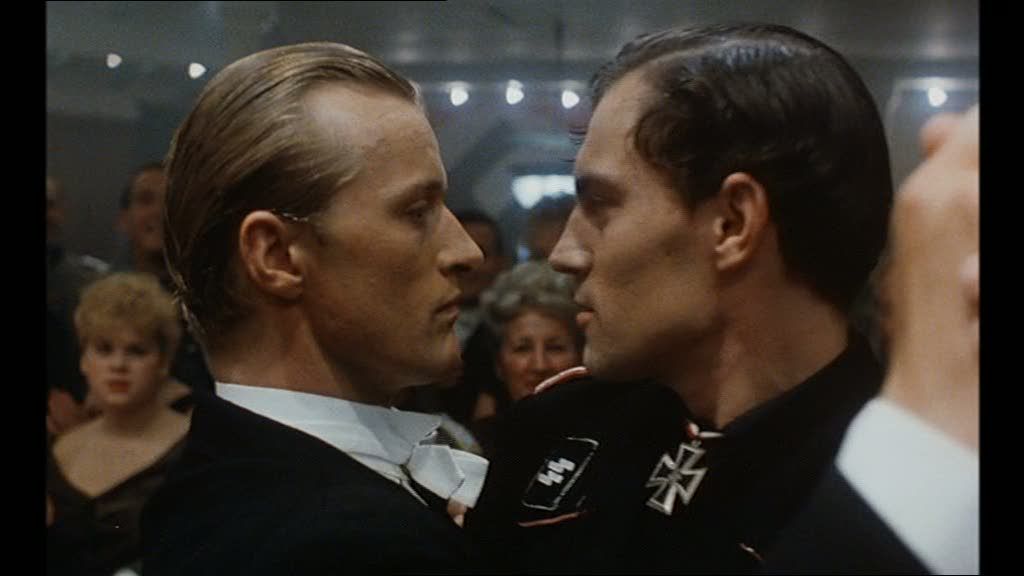
The first Dutch movie (I think) to have made its way into the record here, made in the densely plotted novelistic style that was prevalent in Europe at the time. It is a style that I like whenever and wherever it recurs. I also like the story here (as a cinematic device), which is about a group of friends who formed at university in 1938 and whose schooldays were interrupted by the Nazi takeover of the Netherlands in May of 1940, after which the history of their youths and friendships play out in the arena of World War and occupation. With the exception of the main character every one of the group dies (this is not a huge surprise in any World War II movie about young men), so the film has that poignant doomed and beautiful youth aspect going for it as well. Still, unlike in other Nazi movies, these guys are not, or at least do not come off as, completely powerless victims who are humiliated and murdered without having been able to assert any agency on their own parts. Most of them die as a result of some manner of resistance or at least trying to escape. There is one who turns collaborator (and therefore is working directly against his friends) when his underground activities are discovered. There is another who ends up with the German army in Russia, though I think we are supposed to believe that he is not really into the war and the Nazis and so on. The dangers they undergo are leavened with interludes of romance, sex, riding motorcycles and attending galas while wearing tuxedos, elegant European coffee and liqueur-drinking and educated conversation. This last sentence sounds flippant, but it accounts for much of the appeal of the movie.

The opening scene takes place at the Dutch equivalent of a fraternity house rush. To people like myself who have not undergone this particular trial of male bonding and initiation, the torments and physical abuses that are inflicted on the new pledges seem on the surface little less humiliating and excessive even than what we know is coming in the war. You would think that nothing is worth enduring this hazing, certainly not gaining admission to a society of sadistic jerks who treat you as subhuman scum for the first six months or whatever that you know them. However, the main character (played by Rutger Hauer in what would be his breakout role) eagerly submits to this and the chief tormenter and president of the secret society, who in the first scene you believe to be about the most horrible person in the world, a soul brother of Hitler himself, eventually becomes his closest friend and comrade in war and everything else. I assume the mayhem and violence of this first scene in the dinner club is supposed to refer in some way to the much greater mayhem and violence of the war years which follow. One of the strengths of this movie for me is its portrayal of friendship among men who have some traditional masculinity and competitive drive but also have refinement and intelligence. I largely missed out on this in my own life, and certainly our society on the whole suffers from the lack of it. So I find it very attractive when it is depicted in books and movies.


Netflix Availability: You can "save" it, which means that they acknowledge that it exists, but that they don't actually have it. Availability is unknown. I ordered a copy on VHS. When I have more time I would like to see it again.

Sauve Qui Peut (La Vie)  (1979)


Jean-Luc Godard is one of the great men of our age in the arts, so great that it clearly requires one not only to be of genius level intelligence but almost devastatingly cool to really even follow his movies, let alone get what is really going on in them. I am forty-four and I don't really have much idea of how to watch or what to take from his movies. Effusive and strident and confidently knowing as they are, I don't find professional critics to be particularly helpful either with regard to Godard either. With other movies you can read something pointed out in a review and it strikes you as just so, and perhaps you even wonder how you were so dull as not to have picked up on it. But most Godard reviews, especially the deeper you go into his career, are not convincing or illuminating in this way at all. I have no more sense of what the film is supposed to be about or wherein its real claim to greatness lies after reading one than I did before. There is supposedly all of this incredible, innovative, challenging greatness, yet whatever it is defies persuasive articulation, and does not affect a discernible influence on those who supposedly grasp it other than perhaps to accentuate already obnoxious tendencies (which would make sense, because what I can make out of Godard's general worldview would seem to indicate a singularly obnoxious person in his core). I'm not saying it isn't there. Obviously it is there. Perhaps in time I will be able to develop some sense of the man's mind, what he most deeply cares about and sees about him. I do think I am starting to get somewhere in this vein with Bunuel. Not at the level of intellect of course, but of recognizing feelings and symbols and themes that he favors.

What do I make of Sauve Qui Peut? By this point it has been two weeks since I saw it and it is slipping away from me. Prostitution is a theme, so to speak, running through it, and the prostitutes, to my surprise are treated rather brusquely, given sharp orders to do this or that. I think this is because in American movies the person using these services is usually some kind of nerd who is terrified of the prostitute because of her superior experience and knowledge of harder men. But in this there is no respect towards the sex worker as a person at all, she is merely a body. Most of the men in the movie are pretty vulgar as a rule, though one could say Godard is simply showing them as they essentially are, with the facade of any kind of social niceties stripped away. Beautiful women sit in large windowsills opened to let in the country air while languidly perusing books or doing writing of some kind or another (this was reminiscent of Celine and Julie Go Boating, another 70s French classic). There is a suave-looking character named Godard, who is played by another actor however. Godard is divorced and has a twelve year old daughter to whom he seems reasonably well-intentioned in the way a suave French creative type would be, but is probably a little aloof. The world in general is a cold place if you were hoping to develop closeness with other people. The film is great to look at. Apart from the various genius and coolness that only Godard could have contributed to its outcome, the 70s in Continental Western Europe (this was apparently shot in Switzerland) seem on film at least like a pretty great time to have been there, as far as culture, girls, cheap food and lodging and so on.

Netflix Availability: No. This has not been released in any form in the US as far as I can see. I shelled out for a Korean-made DVD (it did have English subtitles), and I will, I hope, have occasion to study this masterpiece again at some point in the future. Another addition to the ever-growing list of highly rated French movies from 1974-1990 that are not readily available in this country.