Showing posts with label canadian girls. Show all posts

Wednesday, October 30, 2019

Generation X Actresses I Have Followed on Twitter--The Rundown

It isn't as many as I thought it might be at first, though it is still embarrassing that I ever followed any of them at all. They were the whims of a series of fleeting moments


1. Mira Sorvino (b. 1967)


I had forgotten about her, but then I saw her in a movie from 1999 and was reminded that I had thought she was cute and that she was supposed to be fairly smart too, so I thought why not catch up with what she is doing? She is mostly concerned with matters of great seriousness these days, women's rights, defending immigrants, hating Trump, etc. She's on the self-evidently right side of all of them, of course, and fiercely, as is called for (though her fierceness at least is more in support of the righteousness of her causes than in seeking the personal evisceration of her opponents). Even though their positions on everything and even their way of expressing them are utterly predictable, I have to admit I have always kind of loved girls like this. They are what I know, and they generally really do want to be good people and unlike the relentlessly militant types, they can be pleasant enough if they like you. The fierceness is regarded as a necessary attitude to adorn to demonstrate one's seriousness, but I don't think it is really their nature. My wife, as I have noted before, is more of a throwback to the 1940s, or even the 20s, in her manner of speaking and approach to political questions, and puts a more original spin on why she believes what she does than most people are able to muster, but I have only met a handful of women remotely like that in my life.


2. Meredith Salenger (b. 1970)


Meredith Salenger gave up acting at 18 to go to Harvard, so I guess we can assume she is fairly smart. She certainly regards herself as such. She too takes a fair amount of jabs at Trump, sexists, racists, and the usual objectionable suspects, though with less straining and earnestness, and more of an assured air of repulsed superiority. Otherwise her internet persona is more or less polite, though one suspects that she probably gets some good zings in at people, even those who are purportedly her friends, in her private life. I can't say that I am getting a lot either emotionally or intellectually from following her either though she is an attractive enough person.


3. Liane Balaban (b. 1980)


Liane Balaban has appeared mainly in Canadian indie-type movies, so she isn't very well-known (it also makes me wonder why it never occurred to me to follow Parker Posey [b. 1968]). I followed her after finding an attractive picture of her drinking wine on the internet and watching a YouTube clip from her movie The New Waterford Girl. When she does tweet, she is about half a regular person and half a public figure. Needless to say, she loves all of the progressive things that are happening in Canada and the rest of the West, and hates the troglodytes who want them all to go away and for life to be horrible and ugly again.


4. Zooey Deschanel (b. 1979)


Zooey doesn't tweet much anymore now that her TV show is no longer on the air. Being the closest of this group to the height of her career she comes off as having an especially vacuous-seeming Hollywood lifestyle, though she is the only one of these people who has ever written anything that I found remotely funny or endearing. Other than occasionally showing support for LGBT issues, she never mentions politics, and as her stage persona is rather retro in an implicitly 1960s white-bread manner, some male commentators on the evil fringes of the political right have expressed the hope that in some areas at least she may be sympatico with their views. However I would be surprised if she actually did not support the Democratic party.


5. Christina Applegate (b. 1971)


I not sure what possessed me to follow her. She is pretty sexy in a it's-hard-for-me-to-turn-the-channel-off-of-her kind of way, but she was so disturbingly stupid on Twitter that I just couldn't take it and had to stop following her, which takes a lot for me.


6. Winona Ryder (b. 1971)


In a fashion befitting her status as perhaps the quintessential Generation X person who is indifferent to everyone except selected cool personal friends who are never you, Winona Ryder never sent out a single tweet for years after I started following her, and eventually deleted her account altogether.


Nowhere in Africa (2001)


This is somewhat notable for my imagined readership for having won the Academy Award for best foreign film (it's from Germany). It is also directed by a woman (Caroline Link), which perhaps is worth something as well, since, unlike in literature and other artistic forms, there are still not a great number of really renowned movies that I notice having had female directors (My personal favorites off the top of my head are Lena Wertmuller and Vera Chytilova, if you to get an idea of what I would like). This has a World War II/Nazi theme, though in this case the story is about a Jewish family with a young daughter that left Germany to go live out the war in Kenya. They were cultured people, and the father was a lawyer/intellectual type, but they were not able to get out of Germany with much money, so they have to make a go of it in Africa by farming and living off the land, which did not suit his temperament/skill set, especially at first. The mother's happiness, not helped by her neurotic personality, was tested by this displacement both geographically and culturally and the sharp decline in social status, which she acted out by seeking and in at least one instance having extra-marital relations with European men more acclimated to the new environment. It is based on a memoir written by the daughter, who is from around aged 6 to 14 or so in the course of the movie. I don't usually explain so much of the plot outline, but I'm not quite sure what to say about this. It isn't bad, but it is kind of joyless in that stiff Germans-trying-to-interact-with-(well, anybody who isn't them) way, even if the characters in this instance are Jewish. Also, though it is set in wartime (albeit the war itself is remote), and the upheaval of the family because of it is the basis of the family, this circumstance does not create the sense of overwhelming societal drama that is what makes the best civilian-centered war movies so effective. The African natives of course have no real stake in the European war at all, and while the British do, the movie is not especially concerned with them. At the end of the war (and the film and in real life) the family actually returned to Germany and seem to have lived out their lives there--the author of the memoir, Stefanie Zweig (no relation to Stefan or Arnold) died in Frankurt in 2014 at the age of 82--which seems like it could be the subject of an interesting book or movie itself.


Get Shorty (1995)


As I have often stated here, I am not much of a fan of 90s Hollywood. I have a soft spot for early 90s European cinema, and I suppose I like some of the American "indie" stuff from that era (though I haven't seen any of it in a long time), but the work of The Industry through most of this era seems to me regrettable to say the least.


Get Shorty is based on one of the best-known novels by the pretty highly regarded author Elmore Leonard, so I am assuming it is better than this movie (I haven't read it). If I remember correctly this was John Travolta's first big starring role after his comeback in Pulp Fiction (which I actually have never seen). It has a lot of famous Hollywood-insider type people of that era in it hamming it up for the camera and making annoying name-dropping movie and Industry references--Bette Midler is in this, Danny DeVito, Gene Hackman who was in every other movie in this period, Penny Marshall. Billy Crystal oddly is not in it, though I kept expecting him to turn up. Rene Russo, who probably would have annoyed me at the time, is also in it, but now that I'm nearly 50 her look in this is the kind most men my current age would find attractive in a 40 year-old.


I really did not like this.


Daylight (1996)
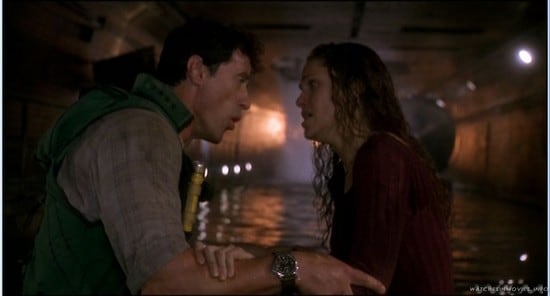


This movie concerns a group of people who get trapped in the Holland Tunnel due to an explosion of nitroglycerine or something like that and have to be rescued by Sylvester Stallone. I adopted a new system a few years back that was supposed to generate different kinds of movies which are sometimes of interest because they are better than their reputations, or they provide an interesting window into a time that is now past. This one, alas, was not any of those things.

Wednesday, October 15, 2008

Ruskin--Part XIV

How many Ruskin posts are there going to be? I don't know. The sections "The Spite of the Proud", and the one after it, "The Street of the Tombs" were both outstanding after their manner and very persuasive. This is not to say that I am completely won over to a preference for the Gothic over the Renaissance, and will forever shun the false pleasures of the latter, but, unless I can be even more persuasively shown that Ruskin understood nothing about any of this, I will probably always be more wary of their real sensibilities than I would have been otherwise. Ruskin really starts to break out with specific superlatives in these chapters. "The perfect type of the Gothic tomb" in general, he proclaims, was reached in the thirteenth century, and the Italian style superior to that developed in England, those of Italy "kept massive, smooth and gloomy,--heavy-lidded dungeons, of stone, like rock tombs,--but bearing on their surface, sculptured with tender and narrow lines, the emblem of the cross, not presumptuously nor proudly, but dimly graven upon their granite, like the hope which the human heart holds, but hardly perceives, in its heaviness."

Fig. 1--Church of St Paul & John, Venice. Where the most interesting examples of the simple sarcophagus tombs are to be found in that city.


These are just notes for me to refer to should I have occasion to return to that part of the world as a tourist some day, especially as I will probably be past the age at that point where I can expect to do a lot of damage in the area of nightlife:

"...the consummate form of the Gothic tomb occurs in the monument of Can Grande della Scala in Verona."

Another perfect tomb of the Gothic style is cited in "the second chapel counting from right to left, at the west end of the Church of Frari (Venice)...It is a knight's; but there is no inscription upon it, and his name is unknown."

Fig 2--Monument of Can Grande della Scala, Verona

"...the tomb of the Doge Andrea Dandolo in St Mark's...and that of St Isidore in another chapel of St Mark's...are, on the whole, the best existing examples of Venetian monumental sculpture." I was unable to find any pictures of these. If I were really diligent I would do searches in the Italian language, which would probably turn up more than I am able to find doing it this way, but that is something I really don't have time for at this stage.

Four pages later however we find, in the choir of the Church of St John and Paul, "the richest monument of the Gothic period in Venice; that of the Doge Michele Morosini, who died in 1382."

Fig 3--If you do a photo search for "John Ruskin girls" this comes up. Upon further inquiry, I have discovered that this woman is a Canadian film actress named Liane Balaban. After the first two pictures I saw of her I thought I was in love, but being able nowadays to pull up anybody you want on Youtube--though I only found about 5 'hits' for Liane, her career has not really taken off--I did not like her quite so much. She is trying, but she comes off as being pretty much just like everyone else of her particular type--sort of urban, sort of cosmopolitan, sort of educated, sort of artistic, sort of clever, sort of sexy, all without quite being any of these things enough to the core to knock one backwards. Her mother is Catholic and her father is a Jewish emigrant from Uzbekistan, which sounds like a vigorous combination, and she is from Toronto, which for some reason I always think is promising. I think all Canadian women are promising when I find out where they are from, but have any ever come through for me and lived up to my imagination? No! Yet the place maintains an aura of romance for me that I cannot destroy.

Ruskin refers in so many places to the greatness of Carlo Zeno in the history of Venice--he dates its decline practically from the moment this leader drew his final breath--that I thought I ought to do a whole piece just on him. At the very least I should issue a formal statement regarding my thoughts on such a personage. I don't have a good sense of who he was, however, beyond being an almost perfectly-realized representative of a culture that had reached an especially realized fullness of time in his youth and maturity. Such people are to my mind more worth studying than any other kind; they are what every civilization is, or ought to be, working towards the attainment of, the type of which every great artist and scholar awaits the arrival. That said, I haven't been able to get around to doing the research for this analysis.

I made a very cryptic note, which I believed is intended to be a comparison with our own present situation, regarding the expectation of the wealthy to devote their fortunes to the war effort (in times of such crises), not profiteer. Michael Morosini, who was chosen as Doge over the Carlo Zeno himself and set the decline of the republic in motion, had tripled his fortune during a war that had recently concluded by speculating in real estate during the period of uncertainty.

Fig. 4--Inside the Church of the Frari, Venice. This is not the tomb that Ruskin liked though.

Ruskin speaks with such intimate feeling about these people from the 14th century, and in a way that makes them seem so civilized and and advanced and fully-rounded as characters, that one begins to forget that they didn't exactly live yesterday. The 1300s was a long time ago.

With regard to the changes in attitude and feeling that Ruskin so laments in art history, surely he knew it would be inevitable that artists would eventually want to do something different, even if it were inferior (or maybe not. Perhaps this idea is a prejudice of us moderns, and there is no inherent reason why human beings should ever try to do thing differently, especially if there possibility of its being an improvement on what came before it. Some sensible people do think this way, too, and do their best to imitate the style of their masters. However, the fine in fine arts hints at a delicacy and subtlety in perception and experience and knowing that changes and transmits itself through the form, and from which the form must take its life or fail. Right?)

Fig. 5--This Is One of Liane Balaban's movies. I was still crushing on her at this point. Then I watched a little preview of this movie on the Internet. My interest was piqued because it's about teenage girls in some nowhere town in Newfoundland where its freezing and there is a significant Catholic population, which has some similarities to parts of my own life, but it looked pretty badly written, and it looks like Liane can't act much either, certainly not enough to give a mediocre film some respectability. (The reason she came up on the search by the way is because this film appears on a list on the same page with a film called "The Passion of John Ruskin"--God only knows what that is about--which does not seem to gotten much of a release, even on video.

A subtle, but symbolic development in the transformation of Venice from virtuous to decadent state is demonstrated by the changing nature of the battle-shields of the nobility. In the earlier period, of course, the shields were actually used in war, "and therefore there was no need to add dignity to their form by external development", but as firearms rendered this equipment obsolete in the 15th and 16th centuries shields became fields for elaborate decoration and engraving, usually regarding the glory of their owners' family. Ruskin thought that this ornamentation greatly diminished the dignity which had belonged to the formerly much plainer but more useful shields.

Friday, August 22, 2008

My Personalized Reading List

My Personalized Reading List I had started to write something else about the Olympics--the blogosphere, of which I make such an indispensible part, was abuzz with various articles describing the rampant sex that starts to break out in the Olympic village towards the end of the games when most people's events are finished, for one thing--but what can one say about it? After all, the original Olympians were naked the whole time? Wish I were there, (or rather had once been there?) The idea of personally indulging in some Olympian love--I think a good German or Canadian girl would have been ideal for me, they seem the most likely to be susceptible to the release of the kind of emotion that I am drawn to at thinking themselves part of a great event--is undoubtedly appealing. That confessed, the idea of being in the midst of a great orgy, particularly one where English and Australian boys are the ones indulging themselves the loudest and most frantically, and without my highly refined romantic sensibility, makes me a bit squeamish. And really, I'm sure whatever sex happens at the Olympics is pretty milquetoast compared to what the serious sex connoisseurs do. My battle-cry has always been "There are some genuinely interesting and beautiful people out there who have milquetoast sex lives," and I still sort of believe it, though I don't think I would be able to say so with composure on television, because when I think about the people I have in mind the idea (that they are either really interesting or beautiful while devoid of compelling sensual qualities, or, that people with compelling sensual qualities could really have milquetoast sex lives) seems preposterous. So, having gotten that out of the way, I am going to write about a personalized book list I received from Alibris.com (a bookselling service) in a recent e-mail. Unlike the personalized suggestions one gets from Amazon.com or other such sites which obviously correspond to one specific book or other that one has ordered on the site in the past, there was no obvious connection I can think of directly with most of the books on this list. The first and most curious recommendation was the notorious Marxist historian Eric Hobsbawm's 1993 tome Age of Extremes: A History of the World 1914-1991. I have never read any of this author's work, but he is frequently evoked by conservative pop intellectuals/journalists as a much more than run-of-the-mill bogeyman, almost approaching the Noam Chomsky level. The stuffy and rather mean-spirited (in both senses of the word mean, I think) polemicist and editor of the New Criterion magazine, Roger Kimball--who is on the Board of Visitors and Governors of St John's College--what is his connection?--who appears to spend a considerable proportion of his life in varying degrees of apoplexy aroused by the activities and postures of leftists in positions either of or blessed by authority, evokes the specter of Hobsbawm on a regular basis as one of the most noisome human beings on the planet. Among that segment of the intelligentsia for whom hatred of communism is one of the two or three animating characteristics, Hobsbawm is regarded as absolute scum, practically the equivalent of a Ku Klux Klan member. This was so strongly impressed on me in fact that I was a little surprised both to find an as far as I can tell reputable and dignified firm promoting this book as if it were something completely normal and generally inoffensive, and to me, especially. What did they take me for? Hobsbawm's most frequently-quoted--or at least referred to--statement is his affirmation that 20 or 30 million deaths, perhaps even more, would have been tolerable and justifiable if communism had ultimately emerged triumphant as the normal paradigm on which human society was henceforth to be constructed. This is not a nice idea to express but I am pretty sure we are supposed to understand it in the sense of ideological purpose which sees its potential and actual victims, however wrongly, as legitimate enemies. My point is not that this is good, but that there is little reason to believe that as a practical matter the capitalist/corporate interests (whatever one calls the rich people who run the economy of the modern world) would not consider 20 to 30 million lives an acceptable, even an insignificant price for the preservation of their system, though they probably would not be quite so uncouth as to express themselves thus baldly, to discuss numbers, etc, and, being already ascendant and at the forefront of trends in public relations, would likely be more persuasive in painting and writing off their enemies/victims/challengers as losers, for people have no instinctive sympathy with losers. These generally have to find a way to present themselves, or be presented skillfully, forcefully, and attractively, before any effective indignation and opposition begins to percolate among such as have any ability to contend against the dominant power.


Had I been in circumstances at all propitious for the conversion, I have little doubt that I would have been a communist in the 1930s. Probably not to any extreme point, certainly not to that of moving to the Soviet Union, as apparently thousands of Americans did (and then weren't able to get out again, at least not until the end of the Stalin era, with all the atrocities that came with living in that time and place). I might have been talked into going to the Spanish Civil War if one of the cool people, or especially one of the free-loving, brunette-bobbed, not to be resisted commie girls of the era had personally encouraged me to go. These femmes fatales of the left devoured legions of what might be politely called beta male writerly types (especially Jewish ones, whether in New York, Paris, or the capitals of Central Europe) throughout the era. It is easy to detect in the literature of the time that their radical politics, bohemianism, sexual liberality and desirability must have been absolutely devastating to stammering soft intellectuals. There seems to be nothing equivalent now--I mean there is no political movement where good-looking women will feel an urge to sleep with you as a kind of expression of the cause. Of course many of the writer types, those of a sensitive disposition anyway, fell in love with these women, because they were sexy and had paid them some attention, and wished to be married to them and dreamt of having these women cook and iron and support them in their endeavors for literary immortality in the most conventional bourgeois way. This was not in the proper spirit of the movement. Anthony Powell, for example, staunch Tory he, did not abstain (or at least the narrator in his magnum opus who is basically his stand in) from an adventure in communist free love, getting with the actually somewhat gross Gypsy Jones character in the artist's studio after the funeral of its former occupant; as the narrator only owned having gotten with 3 girls, and that counting his wife, over the course of 3,000 pages covering a time span of 50 years, and this being the only one that would have qualified as a "one-night stand", this leaves me to believe that the occasion, or one similar to it, must have ranked among the high points of this author's life. But I am making a joke of all this, and communism, even when advocated by misguided, ineffectual and insignificant Americans, is not really a proper subject for mirth. If I appear to flirt at times with an affinity for this ideology I assure you it is almost certainly out of pure social desperation, not out of a desire to enshroud the nation, or civilization itself, in a dark age; if a socialist movement existed that really could offer me more intellectual camaraderie, more hints of intrigue, less sheer boredom, a sense of a place in the world more befitting my self-perception, I would be receptive to it the same as anyone else would. That is all.


Another book on the list was Goldsmith's She Stoops to Conquer, which I have read, and remember thinking had much that was humorous in it. It is one of the better 18th century plays, though I actually rather like that category of literature more than most people seem to. The third book was Carlyle's History of Friedrich II of Prussia. Another doozy. Literary-wise, I was raised on the Victorians, and while I can still think of at least ten of them that I still like a lot because they are superior writers, Carlyle isn't one of them, and overall I have not been in close sympathy with the general Victorian mind in some years. The last book was an Einstein biography. I erased the message without writing down which one, and of course there are about 50 Einstein biographies. I think this one was from the 70s though. It wasn't the most recent one that was a good seller. Many of the Einstein biographies are good sellers, which indicates to me that they don't require a particularly intensive knowledge of physics, but focus on relationships, rivalries, academic politics, quirky personal habits. My father used to know someone who as a kid had lived on the same block as Einstein in Princeton in the late 40s/early 50s (apparently the greatest mind of the 20th century lived out his days in a suburban neighborhood, though whether this was in a tract house or on a more dignified Victorian-type residential street, I don't know). She didn't have too many titillating stories, other than that the great man was said to forget to do banal things like put socks on before going out of the house, or to eat at regular mealtimes. Of course he was quite old by that time.
I rode in an elevator today with John Sununu, the junior senator from New Hampshire, for whom I have long nurtured an intense dislike (I of course did not mention this to him during the ride; I did not smile either, however). My dislike has lately been tempered by the seeming likelihood that he will not win re-election this fall due to the state's rapidly changing political demographics, but still, his father was the governor and later the chief of staff under the first George Bush, and the family apparently remains popular, though certainly no one I know well and whose judgement I would consider reliable likes him. Both father and son are supposed to be brilliant, super-educated, have stratospheric IQs, etc, though the People are not often treated to a display of this intellect commensurate with the reputation (though to be fair, this is the case with almost all politicans nowadays). During the Republican ascendancy of 2002-04 the senator was most proficient in the condescension and disdain aimed towards anyone skeptical of the Presidential agenda that was favored by the Party in that period, but since both of the state's Republican congressmen were voted out in favor of relative nobodies in 2006 I notice he has toned down this attitude considerably. The senator is of average height, and while he gives off an air of affluence and privilege, he does not have a particularly imposing bearing in person given his position in the government. He looks like a typical moderately succesful 40-something lawyer. I suppose he looked more genuinely intelligent close-up than he comes across on television, and he wasn't smirking, which would have been unbearable. He looked to be going to a meeting with some executives at the place where I work, and I suppose he had the capacity to engage meaningfully at some level with them in this meeting, and they, or at least some of them, had the capacity to engage equally meaningfully with him. I am fascinated by capacity of this sort, for I have so little of it, and yet there seems to be no obvious reason why this should be so utterly so.

Saturday, August 09, 2008

Olympics

Unlike people who have attained lives of more or less pure, and mostly clear-minded, thought, I still like the Olympics--or at least the idea of them--so I was going to try to put in a good word for them. However I came to the conclusion that putting in good words for things is perhaps not always what is called for. My main reason for liking the Olympics nowadays, apart from the various traditions and events of it that evoke appealing historical associations, is that there are a lot of healthy, attractive young women in and around it. It attracts them. People who live and work always among such beings cannot comprehend how much of the world, how much of life, does not attract them, and is devoid of their presence. The effect of this, especially in the modern physical environment, on how one views the world as far as its possessing meaning or beauty must be far stronger than is widely acknowledged.

Ethel Catherwood, "The Saskatoon Lily". Gold medal, high jump 1928 (Amsterdam). Remains to this day the only Canadian woman to win a gold medal in track and field (although it was later revealed that she was actually born in North Dakota). Was voted "prettiest athlete" of the games by one of the New York papers (this award has unfortunately been discontinued). She apparently used to sit on the infield grass in an oversized sweater when she wasn't jumping and pout dreamily with an expression of intense boredom on her face.

Swimmers, both male and female, having the best, and, formerly anyway, the most visible bodies, have tended to be considered in general the sexiest competitors. Good-looking champion swimmers, as opposed to say, good-looking champion 1500 meter runners, seem to be especially outgoing and undepressed, which makes it hard for me to relate to them. That's why I didn't put up any pictures of swimmers.

The Olympics also encourage in me the idea, which I have recently been toying with, that I ought to move to California, since so many beautiful athletes, as well as beautiful singers, beautiful chefs and winemakers, beautiful scientists, even beautiful schoolteachers and bookshop employees, are from there, along with their beautiful parents, and brothers and sisters and girlfriends. Tom Brady is from California. If Tom Brady had grown up in Massachusetts, or, God forbid, Maine or New Hampshire or Vermont, he almost certainly would not have been Tom Brady. He might not even have been Doug Flutie. Perhaps he would be a lawyer, but that is not quite the same thing as being Tom Brady. California seems to be a place where if you are a winner, your winningness is magnified to an even more glorious level than ordinary, though if you are a loser, your aura of failure likewise stands out all the more starkly. This might not be the best place for me personally, but I worry that my children, or at least one of them even, might have it in them to be winners, and winners should be where any potential greatness a person possesses has some hope of being nurtured and realized, which it doesn't appear can be accomplished around here. Of course there is still a little time to get to such places during the crucial 18-25 year range, but eighteen years of life in our village and of me as a primary mentor will probably leave them little room for error if they even try to make their way in the big time.

Lyudmila Tourischeva--Even when I was six, and watching the Montreal Olympics on television, I wondered why the American public had such terrible taste in Eastern bloc gymnasts. Olga Korbut? Nadia Commaneci? Well, if you don't have anything nice to say...I was not, to be precise, smitten with Tourischeva (may I call her Lyudmila?) at the time. I was properly terrified of anything having to do with the Soviet Union, due mostly to my encyclopedias which credited them with statistical domination over the United States in just about every category--besides the basics of raw area and population, there was the size of their army, manufacturing output, cabbage harvesting, tungsten mining, and Olympic medals to be dejected about (the Ci-Cz volume was the most reassuring in the whole set because the U.S. was actually ranked number 1 in both corn and cotton, which was a source of great satisfaction to me). Tourischeva (who in 1976, it should be pointed out, was 24 years old--her big Olympics was actually in '72) did not smile or make love to the TV cameras, and was usually described in grudging terms as highly disciplined and competent. She did not send the least signal of friendliness or accomodation to Western sensibilities, and seemed to be perfectly content to be a Communist despite being an apparently intelligent person. I assume this last is why she was not more widely admired by American sports fans. She won 4 gold medals, she was pretty good-looking in my opinion, she wasn't a child, and she emanated an aura of mental/psychological seriousness that is rare in top athletes. Needless to say, she is my all-time favorite gymnast.

I was always impressed by the British tradition that has been able to produce numerous world-class track and field athletes who also have above-average to good humanistic educations. You can go back to the Chariots of Fire guys in the 20s, to Bannister and the other outstanding Oxbridge distance runners of the 50s, Coe and Ovett in the 80s. There are numerous others I haven't mentioned. The last great athlete to emerge from this general line was the triple jumper Jonathan Edwards, who won the gold medal in 2000 and still holds the world record. He had studied physics at Durham University and his father was a vicar of the Church of England, an unusual background for an athletic champion, at least in this country. Among the other people I have mentioned, Harold Abrahams became a lawyer, Roger Bannister a doctor, Coe had studied economics and became a member of parliament. Though many American athletes have impressive academic credentials and go on to become things like Orthopaedic surgeons, they seem to have more of the super high energy, pure achievement-oriented approach to their learning than an intellectual, tradition and language-based one that appeals to me. I know these are great people who get things done and make our country what it is (better, better, better), but I find them rather boring.

Here is a brief film about Ethel Catherwood. There is a very brief clip of her smiling, or shaking her head, where you can really see what a babe she was.

If you have a glancing interest in or fascination with the bleak world of the 1960s-70s Soviet Union you might want to peak at this Russian documentary about Lyudmila Tourischeva.

One of the greatest races of all-time, at least that was won by an American. 1964 10,000 meters.

Since I can't get any sitecounter/monitor devices to work I can only count the visitors to my personal info page to get any idea if anyone has been around. 4 people visited the profile page this weekend, which is a big weekend for this site. I have no doubt that this readership constitutes a very desirable demographic too. Cosmopolitan. Attractive. Tech-savvy. Well above average but not socially stifling median IQ. Important.