Showing posts with label communist girls. Show all posts

Monday, September 29, 2014

1960s BBC and the Czech New Wave Revisited

Wuthering Heights (1967)

BBC television production, in glorious black and white. Though I was taken enough with the whole effort, the highlight was the epically gorgeous 1967 hairdos worn by the lead actresses, who were both named Angela*; which hairstyles, imaginatively at least, translated well to the 1840s. One of the Angelas played Cathy Earnshaw as a brunette in the first two parts of the series, and Cathy Linton (the first Cathy's daughter; the mother of course died in childbirth) as a blonde in the last two. The other Angela played Isabella. The male leads were decent enough too, I guess, especially the guy who played Hindley was good. Ian McShane, who is something of a name, was Heathcliff. He did not to my mind emit to the full the masculine ferocity that this character so famously and belovedly exhibits in the book, though it does not seem as if anyone has managed to capture that on the screen (I have not seen the Olivier version, but supposedly he is an even milder Heathcliff than McShane). The sets and outdoor camerawork are simple but evocative, and one never feels that something would have been better if more money had been spent. Once again it is demonstrated that a little atmosphere, a few good-looking girls, supporting players with some presence and a good story can go a long way.

Regarding the story--like the Idiot, this is in my opinion one of the great stories of the post-renaissance era. It always works for me. I had the good fortune to read the book at a pretty young age, before I was fully cognizant of my mind's inability to keep up with my ambitions for it--it was the very first book I took up when I started reading again after I had been out of college for a while--so I remember it quite well. It is extremely funny, and all of the characters have either well above average verbal intelligence irrespective of their stations, or are so freakishly absurd in some way that their presence serves to stimulate rather than stifle the more intelligent characters. I think that the book resonates with as many people as it does because it does have all of this humor and intelligence while taking place far out of the way of great events or anything resembling intellectual ferment or heightened social stimulation or even economic and societal churn. To recreate this type of scene would seem to be more attainable to the socially isolated modern reader than those found in other books which either require extraordinary talents, years of high level training, or even generations of cultural indoctrination as their basis. Also, the characters that possess no inconsiderable amount of sex appeal (and any amount is not inconsiderable to me)--even Heathcliff--are not exactly surrounded by people equipped to properly appreciate and quench it, which does have the effect I suppose that its edge is never wholly dulled. I suspect a lot of people imagine this to be the case with themselves too and sympathize with the circumstance in the book.


Angela Scoular as Cathy Earnshaw (with Heathcliff)

*I have always liked the name Angela a lot and have brought it up as a possible baby name but my wife always immediately shoots it down as having trailer park-ish conntations for her. Perhaps this is more the case around here (New England). In the suburban mid-Atlantic area in which I grew up, I associate it more with energetic, slyly nice but maybe also slyly naughty daughter of an orthodontist types. My idea of trailer park names falls more in the direction of Crystal, Brenda, Tammy, and the like, though I associate Tammy as being usually the good-looking one from this pool and therefore have some fondness for that name as well.

The Report on the Party and the Guests (1966)
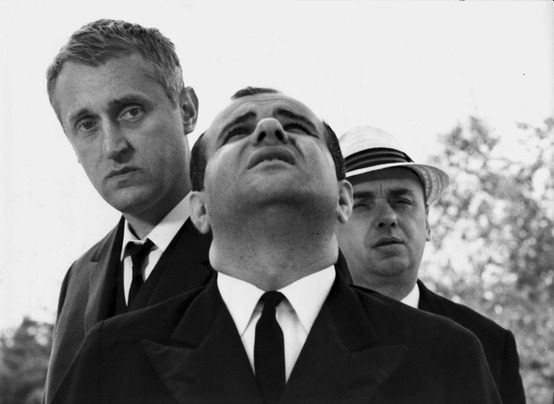


This is a somewhat hard movie to find. I ended up doing something I don't usually do, which is shell out for a four-DVD Criterion Collection set of "Pearls of the Czech New Wave", which includes six movies from 1966-69, one feature by each of five different directors, plus one collective effort in which each the featured directors contributed a short movie based on a story by the important and very good Czech writer Bohumil Hrabal. The Report on the Party and the Guests is only 70 minutes long, so I watched it twice. I don't think it is a great movie, but one has to grant that it took some cojones to make it (and I would think to be involved with it at all) in 1966 Czechoslovakia. The plot is that a group of vaguely bourgeois adults out on a picnic in a place that looks like it could be the Sumava forest are surrounded while strolling through the woods by a large band of unfriendly men who do not pointedly hurt or even threaten the picnickers but nonetheless make it clear that their movements are restricted, that they will not be allowed to leave the area, that they will have to submit henceforward to the authority of the men who have interrupted their walk; apart from a few weak and half-hearted attempts at protest and rebellion, the picnickers accede and become resigned to their new condition relatively quickly. In the second half of the movie they are brought to a large outdoor banquet like a wedding dinner along the wooded shore of a lake, and a number of odd things happen--for example, the guests all realize they are not sitting in their assigned places at one point and move en masse to find them. The meaning of a lot of what went on the second part admittedly was not clear to me. One of the picnickers, who had remained silent and sullen, does slip away from the table during the banquet; a search party is raised to go bring him back, and his wife (who is kind of attractive in a matronly late 30s way, but does not possess much character to oppose any convention or authority) apologizes to the leader for his antisocial behavior. Another picnicker, flattered by the new authorities' assurances that he is a reasonable and intelligent man, spends the banquet trying to ingratiate himself with them. As happens to me a lot with Czech movies, something will appear on the screen--some kind of food or utensil or mannerism or even the odd word or phrase which I can still pick out--which reminds me of when I was there and sends me into a reverie which distracts me from following the movie. Still, on the whole, I have a much easier time getting into these Czech New Wave movies than I do the likes of Godard and some of the other French avant-gardistes, even when the narrative does not take an easily-deciphered form, because I feel I have some sense of at least the material world these movies inhabit. Also even the most talented Czech artists--and this seems to extend even to major international figures such as Dvorak or Smetana--tend to see themselves and their countrymen more as underdogs and subversives trying to cut a few slivers through the massive quantity of baloney weighing people down to expose any fleeting flash of truth than as people in a position to make grand pronouncements and discoveries about the state of civilization or the nature of universal man that will take the average person a few generations to catch up to and absorb anyway.

When the picnickers are first taken into power by the mysterious band their leader is a rather clownish guy who looks and kind of behaves exactly like Adam Sandler. Eventually a more distinguished gentleman shows up to conduct the captives to the party who is revealed as the real leader. 


The Adam Sandler Guy

The women in all of these films are variously quite attractive without being classically movie star beautiful. In this one they all seem to be in the 32-37 range for age--of course that is young to me now. I have gotten to the point where I at least am finding some 32 year olds as beautiful as I once thought women ten to fifteen years younger to be. Anyway these are the kind of women I imagined I would have hung out with a lot if I had ever been able to establish my artsy credentials. Of course our imagination always outstrips reality. As I have written before, I imagined myself before I went to college hanging out with women of a certain type that I thought, and congratulated myself for thinking, reasonably realistic, whom I found upon arriving at school barely existed at all, and when they did had far more desirable social and physical options than I could offer at the time. 


The Women I Found Attractive Despite Their Being Rather Weak and Stupid in the Movie

I have watched a couple of the other films in the collection. The first was Pearls of the Deep, which is the collection of shorts based on the Hrabal stories. It is a superb mixture of quirky Hrabal stories, imaginative and beautiful film-making, and documentation of the Czech life and personality. The directors were Jiri Manzel (Closely Watched Trains), Jan Nemecs (The Report on the Party and the Guests), Evald Schorm, Vera Chytylova (Daisies), and Jaromil Jires. If I had to rate the shorts, I would say Schorm's ("The House of Joy") about a butcher and amateur artist who covered every bare surface in his house with his painting, is the most interesting idea, Chytylova's (The Restaurant The World) is the most cinematically arresting, Jires's ("Romance") the most evocative of what it is like to be out and about in Prague. Menzel's ("Mr Baltazar's Death") is also very good--I wonder if it was not the most effective as a literary story--and had many ingenious images and directions that it took. The Nemec ("The Imposters") was good too, though the simplest and most straightforward of the set. I also saw the somewhat famous Daisies, which I liked for a while but of which I eventually grew a little tired. In its story of two anarchic girls running wild, rejecting conventional romance and other girlish concerns, cutting up penis-shaped fruits and meats, putting old men on trains they don't want to be on, and smearing food and various other things all over their beautiful young bodies, I was reminded a lot of Celine and Julie Go Boating. How much was I reminded of it you say?


Sedmikrasky (1966)


Celine et Julie Vont en Bateau (1974)
Quite a few other people on the internet have noted the similarities between these two films. It is not my special insight. 

At one point of the girl's names in Daisies was Julie too, but their names kept changing. 

The Adam Sandler guy was briefly in this also, as a hopeless sap in love with the more extreme 60s chick of the duo, the one with the rust-colored hair. I thought they were both sexy, but I suppose if I had to pick I have a slight preference for the brunette.    

Monday, May 17, 2010

Invisible Man--Part 2

Chaper 13: "Men grow old and types of men grow old." I guess I thought my type had grown old. I still believe there is hope for regeneration, hopefully in the next generation but at least somewhere further down the line. Confidence, ability, success, determination, vitality, involvement with the prevailing spirits of the day, now for some inexplicable reason all dead to the world, must be lying there in some latent form, waiting for the imagination to suddenly comprehend again to what uses its strongest qualities need to be put to, and how to use them, which is what seems to be most lacking now.

There is a litany of "old heroes" named--I am always interested when capable authors reel out lists of superlatives, or what they perceive others to believe to be superlatives. Here we get "Jefferson, Jackson, Pulaski, Garibaldi, Booker T Washington, Sun Yat-sen, Danny O'Connell, Abraham Lincoln..." Not sure how Jackson fits in with this crowd. I guess he was the first man from the common rabble to become president. Also his ungenteel followers were empowered and became a more meaningful force in the national political life than they had been before. That is the official story anyway, not the Noam Chomsky/Howard Zinn version.

One of the white communist women is referred to as having a "thin New England face". Now there is a type that is dying out, or at least is being driven, like the Basques and Bretons, into remote and thinly populated enclaves in the main out of common view.

"One thing about the people at the Chthonian (i.e., the white communists), they all seemed able to say just what they felt and meant in hard, clear terms." My own inability to ever develop this skill rates as one of the 5 or so greatest disappointments of my life. On page 332--the end of chapter 15--out of 581, I finally betray myself as beginning to lose a little faith in the book. "Do black people really like this book," I asked, "or is it white people?" The book's literary sensibility struck me as more self-consciously after the 'white' (Euro) model than I was expecting.

"I stumbled in a stillness so complete that I could hear the gears of the huge clock mounted somewhere on the balcony gnawing upon time." I like that sentence. Another example of the sense of the world in this period being a giant mechanism, with these great clocks as the primary symbol (See also films "The Clock" and "Modern Times").

In Chapter 16 there is a discussion on Joyce and the infamous line about creating the uncreated conscience of his race which is a recurrent theme in the life of everybody who encounters insuperable problems creating individuals and a serious culture out of his available materials, and thereby can never feel intellectually secure.

The super-seriousness, paranoia and backstabbing of 1930s communist intrigue was a whole lot of possibility and fun that as usual most Americans got left out of.

Around page 360 I make a note that 'the pace/direction of this book are very odd.'

"He take one them strumpets and tell the black mahn his freedom lie between her skinny legs..." Ras, the dynamic black activist who it is my impression is a much-studied character in this novel, is explaining one of the means by which blacks get manipulated by whites. The love in question here is white girl love.

"On the day of the parade they drew crowds faster than a dogfight on a country road." Dogfighting was in the news ceaselessly at the time as one of the most horrible things that went on in the world, so I had to take note the reference to it that is obviously intended to be at least some way comic.

Around page 440 I scribbled a note that that this was 'not as good as Salinger. Just not as good. Same year, not as romantic. A different city.' Obviously I really feel this. Of course it has nothing to do with what Ellison is trying to write about, but effective art is very much about presenting a spirit, a picture, a sensation that resonates strongly with people, and this book for the most part failed grandly to accomplish this with me.

This is a Sculpture Commemorating The Invisible Man. It seems to be in Harlem.

I did like his comment on the blues. "Was this all that would be recorded? Was this the only true history of the times, a mood blared by trumpets, trombones, saxophones and drums, a song with turgid, inadequate words?" The stuff I listen to is at least as bad, and most would say worse, so it's not like I'm feeling triumphant or anything. I actually wish everything were more adequate, especially music, if for nothing else that to make the music people happy. When they are unhappy because there is no good music coming into their ears, they tend to be quite mean and assume your lame self must have a great part in the whole sorrty state of affairs.

I have to do one more on this anyway and I'm tired, so I'm going to cut it short.

Wednesday, December 23, 2009

Christmas With the Czech New Wave

Christmas is very busy this year, hence the paucity of new postings.

A few days ago for some reason I got excited about this subject. That excitement has been tempered by the unfortunate circumstance that I can't find any selections of my featured films which have English subtitles, along with the usual effects that the passing of a couple of days has on a momentary enthusiasm. I am going to go ahead with it anyway.

This is the opening of Closely Watched Trains. As noted earlier there are no subtitles, and the theme music/credits get cut off before they are finished. This is too bad, as this is one of my favorite openings to a movie of all time, right up there with The Third Man, which is the only other favorite I can think of offhand. It kind of comes out of nowhere while at the same time feeling and looking to me more like what what actual life really is than almost all of ordinary experience. The tone, the pace and the energy of the writing and action, as in most of the movies I like best, are such to depict a world I find interesting, perhaps such as I could see myself inhabiting with some degree of engagement. This movie of course is set during the Nazi occupation of Czechoslovakia, so I do not mean to intimate that I would have wanted to inhabit or enjoyed inhabiting that aspect, or really any other, of this depiction; only that certain of its attitudes and preoccupations strike me as being in some sympathy with what I might feel, or want to feel, in some instance myself.


This is the infamous stamping scene. As you can imagine, this girl is of the type of which most of my youthful dreams were made, only to find that her like, alas, is not so common in real life as in the movies.


Here is the beginning of another favorite, Loves of a Blonde, directed by Milos Forman, who later went on to achieve great success in Hollywood with such hits as Hair, One Flew Over the Cuckoo's Nest, Amadeus, and The People Versus Larry Flynt. Like Closely Watched Trains, this film has a perfectly human-scale feel to it that is rare in movies. Now that I think of it, the very geography of that part of the world, both natural and man-made, tends to be almost uncannily human-scaled, certainly in comparison with the United States. The towns and cities, the landscape, the transport systems, when one is there, feel wholly the proper size for human use, certainly not larger. If you are a really gigantic mind or personality I suppose this would be brutally confining to you; of course most people are not. Another reason I feel an affinity with these films is that they are never quite wholly serious, in the way a heavy delving into the darkness of the human soul a la such Eastern Bloc contemporaries as Tarkovsky, or Wajda or Polanski would be. I know there are subtle and pointed commentaries on the system in them under the surface and all, but a sense of unconscious moral stridency or confidence is missing. The Czech people tend to strike outsiders as unusally amoral. It is not that they have no code of right and wrong, and certainly there are rules and customs that it is expected people will observe at a certain personal level, but on the biggest, potentially most dangerous and destructive questions, it is almost taken for granted that people will act as they please and as they are able, and not according to any universal code of justice. This is a weakness undoubtedly, though being honest about it makes for some interesting forays in the arts, moreso than either pretending to have ironclad moral convictions when one doesn't, or to have moral convictions the implications of which one doesn't understand.

This nicely-done and beautifully human-scaled scene is not one in which it is hard to figure out what is happening. In a capitalist system there is no way the table with the cute girls would be hanging out at this kind of low key party attended by lots of not so good-looking people. However under communism their options for more exclusive, higher end fun are severely curtailed, the authoritarian regime compels them to associate with and belong to groups which consist of large numbers of average to below-average looking people. From the point of view of a person for whom finding parties where it was even possible to sit and talk or dance with reasonably attractive girls was a handful of occasions in a lifetime kind of experience, this limited mobility system is awfully appealing.

This looks like it may have been filmed at the Lucerna Ballroom in Prague. I went to a dance there once. That was a great time, civilized, and many attractive women with recognizably human-scaled egos. Why in the world are such scenes so comparatively rare?

Friday, August 22, 2008

My Personalized Reading List

My Personalized Reading List I had started to write something else about the Olympics--the blogosphere, of which I make such an indispensible part, was abuzz with various articles describing the rampant sex that starts to break out in the Olympic village towards the end of the games when most people's events are finished, for one thing--but what can one say about it? After all, the original Olympians were naked the whole time? Wish I were there, (or rather had once been there?) The idea of personally indulging in some Olympian love--I think a good German or Canadian girl would have been ideal for me, they seem the most likely to be susceptible to the release of the kind of emotion that I am drawn to at thinking themselves part of a great event--is undoubtedly appealing. That confessed, the idea of being in the midst of a great orgy, particularly one where English and Australian boys are the ones indulging themselves the loudest and most frantically, and without my highly refined romantic sensibility, makes me a bit squeamish. And really, I'm sure whatever sex happens at the Olympics is pretty milquetoast compared to what the serious sex connoisseurs do. My battle-cry has always been "There are some genuinely interesting and beautiful people out there who have milquetoast sex lives," and I still sort of believe it, though I don't think I would be able to say so with composure on television, because when I think about the people I have in mind the idea (that they are either really interesting or beautiful while devoid of compelling sensual qualities, or, that people with compelling sensual qualities could really have milquetoast sex lives) seems preposterous. So, having gotten that out of the way, I am going to write about a personalized book list I received from Alibris.com (a bookselling service) in a recent e-mail. Unlike the personalized suggestions one gets from Amazon.com or other such sites which obviously correspond to one specific book or other that one has ordered on the site in the past, there was no obvious connection I can think of directly with most of the books on this list. The first and most curious recommendation was the notorious Marxist historian Eric Hobsbawm's 1993 tome Age of Extremes: A History of the World 1914-1991. I have never read any of this author's work, but he is frequently evoked by conservative pop intellectuals/journalists as a much more than run-of-the-mill bogeyman, almost approaching the Noam Chomsky level. The stuffy and rather mean-spirited (in both senses of the word mean, I think) polemicist and editor of the New Criterion magazine, Roger Kimball--who is on the Board of Visitors and Governors of St John's College--what is his connection?--who appears to spend a considerable proportion of his life in varying degrees of apoplexy aroused by the activities and postures of leftists in positions either of or blessed by authority, evokes the specter of Hobsbawm on a regular basis as one of the most noisome human beings on the planet. Among that segment of the intelligentsia for whom hatred of communism is one of the two or three animating characteristics, Hobsbawm is regarded as absolute scum, practically the equivalent of a Ku Klux Klan member. This was so strongly impressed on me in fact that I was a little surprised both to find an as far as I can tell reputable and dignified firm promoting this book as if it were something completely normal and generally inoffensive, and to me, especially. What did they take me for? Hobsbawm's most frequently-quoted--or at least referred to--statement is his affirmation that 20 or 30 million deaths, perhaps even more, would have been tolerable and justifiable if communism had ultimately emerged triumphant as the normal paradigm on which human society was henceforth to be constructed. This is not a nice idea to express but I am pretty sure we are supposed to understand it in the sense of ideological purpose which sees its potential and actual victims, however wrongly, as legitimate enemies. My point is not that this is good, but that there is little reason to believe that as a practical matter the capitalist/corporate interests (whatever one calls the rich people who run the economy of the modern world) would not consider 20 to 30 million lives an acceptable, even an insignificant price for the preservation of their system, though they probably would not be quite so uncouth as to express themselves thus baldly, to discuss numbers, etc, and, being already ascendant and at the forefront of trends in public relations, would likely be more persuasive in painting and writing off their enemies/victims/challengers as losers, for people have no instinctive sympathy with losers. These generally have to find a way to present themselves, or be presented skillfully, forcefully, and attractively, before any effective indignation and opposition begins to percolate among such as have any ability to contend against the dominant power.


Had I been in circumstances at all propitious for the conversion, I have little doubt that I would have been a communist in the 1930s. Probably not to any extreme point, certainly not to that of moving to the Soviet Union, as apparently thousands of Americans did (and then weren't able to get out again, at least not until the end of the Stalin era, with all the atrocities that came with living in that time and place). I might have been talked into going to the Spanish Civil War if one of the cool people, or especially one of the free-loving, brunette-bobbed, not to be resisted commie girls of the era had personally encouraged me to go. These femmes fatales of the left devoured legions of what might be politely called beta male writerly types (especially Jewish ones, whether in New York, Paris, or the capitals of Central Europe) throughout the era. It is easy to detect in the literature of the time that their radical politics, bohemianism, sexual liberality and desirability must have been absolutely devastating to stammering soft intellectuals. There seems to be nothing equivalent now--I mean there is no political movement where good-looking women will feel an urge to sleep with you as a kind of expression of the cause. Of course many of the writer types, those of a sensitive disposition anyway, fell in love with these women, because they were sexy and had paid them some attention, and wished to be married to them and dreamt of having these women cook and iron and support them in their endeavors for literary immortality in the most conventional bourgeois way. This was not in the proper spirit of the movement. Anthony Powell, for example, staunch Tory he, did not abstain (or at least the narrator in his magnum opus who is basically his stand in) from an adventure in communist free love, getting with the actually somewhat gross Gypsy Jones character in the artist's studio after the funeral of its former occupant; as the narrator only owned having gotten with 3 girls, and that counting his wife, over the course of 3,000 pages covering a time span of 50 years, and this being the only one that would have qualified as a "one-night stand", this leaves me to believe that the occasion, or one similar to it, must have ranked among the high points of this author's life. But I am making a joke of all this, and communism, even when advocated by misguided, ineffectual and insignificant Americans, is not really a proper subject for mirth. If I appear to flirt at times with an affinity for this ideology I assure you it is almost certainly out of pure social desperation, not out of a desire to enshroud the nation, or civilization itself, in a dark age; if a socialist movement existed that really could offer me more intellectual camaraderie, more hints of intrigue, less sheer boredom, a sense of a place in the world more befitting my self-perception, I would be receptive to it the same as anyone else would. That is all.


Another book on the list was Goldsmith's She Stoops to Conquer, which I have read, and remember thinking had much that was humorous in it. It is one of the better 18th century plays, though I actually rather like that category of literature more than most people seem to. The third book was Carlyle's History of Friedrich II of Prussia. Another doozy. Literary-wise, I was raised on the Victorians, and while I can still think of at least ten of them that I still like a lot because they are superior writers, Carlyle isn't one of them, and overall I have not been in close sympathy with the general Victorian mind in some years. The last book was an Einstein biography. I erased the message without writing down which one, and of course there are about 50 Einstein biographies. I think this one was from the 70s though. It wasn't the most recent one that was a good seller. Many of the Einstein biographies are good sellers, which indicates to me that they don't require a particularly intensive knowledge of physics, but focus on relationships, rivalries, academic politics, quirky personal habits. My father used to know someone who as a kid had lived on the same block as Einstein in Princeton in the late 40s/early 50s (apparently the greatest mind of the 20th century lived out his days in a suburban neighborhood, though whether this was in a tract house or on a more dignified Victorian-type residential street, I don't know). She didn't have too many titillating stories, other than that the great man was said to forget to do banal things like put socks on before going out of the house, or to eat at regular mealtimes. Of course he was quite old by that time.
I rode in an elevator today with John Sununu, the junior senator from New Hampshire, for whom I have long nurtured an intense dislike (I of course did not mention this to him during the ride; I did not smile either, however). My dislike has lately been tempered by the seeming likelihood that he will not win re-election this fall due to the state's rapidly changing political demographics, but still, his father was the governor and later the chief of staff under the first George Bush, and the family apparently remains popular, though certainly no one I know well and whose judgement I would consider reliable likes him. Both father and son are supposed to be brilliant, super-educated, have stratospheric IQs, etc, though the People are not often treated to a display of this intellect commensurate with the reputation (though to be fair, this is the case with almost all politicans nowadays). During the Republican ascendancy of 2002-04 the senator was most proficient in the condescension and disdain aimed towards anyone skeptical of the Presidential agenda that was favored by the Party in that period, but since both of the state's Republican congressmen were voted out in favor of relative nobodies in 2006 I notice he has toned down this attitude considerably. The senator is of average height, and while he gives off an air of affluence and privilege, he does not have a particularly imposing bearing in person given his position in the government. He looks like a typical moderately succesful 40-something lawyer. I suppose he looked more genuinely intelligent close-up than he comes across on television, and he wasn't smirking, which would have been unbearable. He looked to be going to a meeting with some executives at the place where I work, and I suppose he had the capacity to engage meaningfully at some level with them in this meeting, and they, or at least some of them, had the capacity to engage equally meaningfully with him. I am fascinated by capacity of this sort, for I have so little of it, and yet there seems to be no obvious reason why this should be so utterly so.

Saturday, August 09, 2008

Olympics

Unlike people who have attained lives of more or less pure, and mostly clear-minded, thought, I still like the Olympics--or at least the idea of them--so I was going to try to put in a good word for them. However I came to the conclusion that putting in good words for things is perhaps not always what is called for. My main reason for liking the Olympics nowadays, apart from the various traditions and events of it that evoke appealing historical associations, is that there are a lot of healthy, attractive young women in and around it. It attracts them. People who live and work always among such beings cannot comprehend how much of the world, how much of life, does not attract them, and is devoid of their presence. The effect of this, especially in the modern physical environment, on how one views the world as far as its possessing meaning or beauty must be far stronger than is widely acknowledged.

Ethel Catherwood, "The Saskatoon Lily". Gold medal, high jump 1928 (Amsterdam). Remains to this day the only Canadian woman to win a gold medal in track and field (although it was later revealed that she was actually born in North Dakota). Was voted "prettiest athlete" of the games by one of the New York papers (this award has unfortunately been discontinued). She apparently used to sit on the infield grass in an oversized sweater when she wasn't jumping and pout dreamily with an expression of intense boredom on her face.

Swimmers, both male and female, having the best, and, formerly anyway, the most visible bodies, have tended to be considered in general the sexiest competitors. Good-looking champion swimmers, as opposed to say, good-looking champion 1500 meter runners, seem to be especially outgoing and undepressed, which makes it hard for me to relate to them. That's why I didn't put up any pictures of swimmers.

The Olympics also encourage in me the idea, which I have recently been toying with, that I ought to move to California, since so many beautiful athletes, as well as beautiful singers, beautiful chefs and winemakers, beautiful scientists, even beautiful schoolteachers and bookshop employees, are from there, along with their beautiful parents, and brothers and sisters and girlfriends. Tom Brady is from California. If Tom Brady had grown up in Massachusetts, or, God forbid, Maine or New Hampshire or Vermont, he almost certainly would not have been Tom Brady. He might not even have been Doug Flutie. Perhaps he would be a lawyer, but that is not quite the same thing as being Tom Brady. California seems to be a place where if you are a winner, your winningness is magnified to an even more glorious level than ordinary, though if you are a loser, your aura of failure likewise stands out all the more starkly. This might not be the best place for me personally, but I worry that my children, or at least one of them even, might have it in them to be winners, and winners should be where any potential greatness a person possesses has some hope of being nurtured and realized, which it doesn't appear can be accomplished around here. Of course there is still a little time to get to such places during the crucial 18-25 year range, but eighteen years of life in our village and of me as a primary mentor will probably leave them little room for error if they even try to make their way in the big time.

Lyudmila Tourischeva--Even when I was six, and watching the Montreal Olympics on television, I wondered why the American public had such terrible taste in Eastern bloc gymnasts. Olga Korbut? Nadia Commaneci? Well, if you don't have anything nice to say...I was not, to be precise, smitten with Tourischeva (may I call her Lyudmila?) at the time. I was properly terrified of anything having to do with the Soviet Union, due mostly to my encyclopedias which credited them with statistical domination over the United States in just about every category--besides the basics of raw area and population, there was the size of their army, manufacturing output, cabbage harvesting, tungsten mining, and Olympic medals to be dejected about (the Ci-Cz volume was the most reassuring in the whole set because the U.S. was actually ranked number 1 in both corn and cotton, which was a source of great satisfaction to me). Tourischeva (who in 1976, it should be pointed out, was 24 years old--her big Olympics was actually in '72) did not smile or make love to the TV cameras, and was usually described in grudging terms as highly disciplined and competent. She did not send the least signal of friendliness or accomodation to Western sensibilities, and seemed to be perfectly content to be a Communist despite being an apparently intelligent person. I assume this last is why she was not more widely admired by American sports fans. She won 4 gold medals, she was pretty good-looking in my opinion, she wasn't a child, and she emanated an aura of mental/psychological seriousness that is rare in top athletes. Needless to say, she is my all-time favorite gymnast.

I was always impressed by the British tradition that has been able to produce numerous world-class track and field athletes who also have above-average to good humanistic educations. You can go back to the Chariots of Fire guys in the 20s, to Bannister and the other outstanding Oxbridge distance runners of the 50s, Coe and Ovett in the 80s. There are numerous others I haven't mentioned. The last great athlete to emerge from this general line was the triple jumper Jonathan Edwards, who won the gold medal in 2000 and still holds the world record. He had studied physics at Durham University and his father was a vicar of the Church of England, an unusual background for an athletic champion, at least in this country. Among the other people I have mentioned, Harold Abrahams became a lawyer, Roger Bannister a doctor, Coe had studied economics and became a member of parliament. Though many American athletes have impressive academic credentials and go on to become things like Orthopaedic surgeons, they seem to have more of the super high energy, pure achievement-oriented approach to their learning than an intellectual, tradition and language-based one that appeals to me. I know these are great people who get things done and make our country what it is (better, better, better), but I find them rather boring.

Here is a brief film about Ethel Catherwood. There is a very brief clip of her smiling, or shaking her head, where you can really see what a babe she was.

If you have a glancing interest in or fascination with the bleak world of the 1960s-70s Soviet Union you might want to peak at this Russian documentary about Lyudmila Tourischeva.

One of the greatest races of all-time, at least that was won by an American. 1964 10,000 meters.

Since I can't get any sitecounter/monitor devices to work I can only count the visitors to my personal info page to get any idea if anyone has been around. 4 people visited the profile page this weekend, which is a big weekend for this site. I have no doubt that this readership constitutes a very desirable demographic too. Cosmopolitan. Attractive. Tech-savvy. Well above average but not socially stifling median IQ. Important.

Monday, March 31, 2008

I Think It Is Time For Another Music Post

N.W.A.--During the height of my recent Kenneth Clark period, as if I needed an antidote to so much refinement, I would unwind by playing Straight Outta Compton in my freezing, paper-cluttered office, safe from the rain of machine-gun fire--back in the day one was supposed to feel a little sheepish about this--before repairing to a peaceful slumber. I have always felt that this song was a sort of masterpiece of perverse genius; it seems mostly humorous now, but these people really did move in a scary, totally nihilistic world where a lot of appalling things happened, not infrequently at their own instigation one suspects. Nonetheless I am not aware of a more successful poetic effort in the language that relies so heavily on the F-word; there is nothing like it even in Shakespeare of which I am aware of. P.S. I know it became fashionable in after years to trash the late Eazy-E, but his solo is in my opinion by far the best part of the song.

The Floaters--Float On. I hadn't heard this song since about the time it came out, when, thanks to the marvels of satellite radio, it re-entered my life. There is not much that expresses the general atmosphere that was 1977 so entirely as this song. I was only 7 years old in 1977; it was a strange time, I think, to be a child. I was aware that certain major conditions of life in those years had only recently emerged among normal people--shameless cohabitation, lots of divorce, lots more crime, lots less church, inflation--but being a child I took these new conditions to be the normal state of existence, and everything that had presaged this upheaval to be irrecoverably lost. Indeed I still tend to view the world through this lens. In the back of my mind I always expect inflation and crime to return to the levels of the 1970s, I view religion observance as a curious but somehow artificial activity, and so on.

The rest is going to be divided between bubble gum and wistfulness.

Nancy Sinatra--Sugar Town. This is another one I had not heard in years; indeed, I can't say for sure that I had ever heard it, though I think I must have. I guess this song about drugs, though there is some dispute as to whether heroin or LSD is the experience being celebrated. Who cares? Whatever drug was the inspiration, it worked for me on this occasion. Sometimes--often I suspect in music--it pays more to be nonsensical than to strain to be clever. Nancy Sinatra, whose name is almost never invoked anymore without being accompanied by the tag "Diva of 60s Rock" gives off strong pherenomes of a particular character of that period involving a combination of leopard-skin underwear and artificially seasoned heavy breathing that is generally too much for me to handle, though the memory of it still seems to drive guys of a certain age wild with desire. On a further curious note, Nancy Sinatra at one time within the past ten years or so was the next door nieghbor of Morrissey in Los Angeles and frequently took tea at his house.

Here is a Czech version of the same song. This video is mostly nauseating but I like the umbrella sequence in the middle. The Czechs recorded their own versions of many famous anglophone hits during the Communist era which were still played regularly on the Czech oldies station, which was much my favorite station when I was there (though I know Eastern Bloc Communism was one of the blights of the whole 20th century, I personally would probably have been a pretty good, docile little communist). If you liked the moc krasna Zuzana Norisova--and I don't see much reason not to--here is her version of "Downtown". There is apparently an entire musical, "Rebelove", dedicated to the peculiar Czech dream of having had the 1950s American high school experience that was denied them. I don't think this is entirely a joke either. The Czech-language production of "Grease" was hugely popular when I was there (of course, so was "Jesus Christ Superstar"), and one of the schools at which my wife worked, and which is still in operation, was named the Elvis school of English, that great singer having been a hero of the school's founder.

If we are going to be on a foreign oldies kick, of course all roads eventually lead to Kyu Sakamoto and his immortal hit, Sukiyaki. What a tremendous chance hit it was! We as a culture at the present moment are in desperate need, in my opinion, of this exact kind of winsome foreign language hit, maybe from Turkey, or India, or Kazakhstan--someplace in a similar cultural transition from profound and esoteric local tradition to flashy globalized materialism as Japan was in the 50s and early 60s. This song has many of the same attractive qualities that the Japanese films of the period which were sent in contemporary times have; there was one in particular which I cannot remember the name of, it didn't have a big plot--the family was getting a television or something like that, and how this changed life for the boy--it had a lot of remarkable shots, very subtly placed, almost as background, of the power lines, high rise apartments, rail lines and stations, etc, being raised all over and around what is left of the traditional Japanese villages and landscape. This sounds like a cliche, but it was done very effectively, and it was not in the attitude of a protest or an aesthetic assertion so much as an elegy for a death, that, like all deaths, was inevitable. This song makes me feel something of the same.

George Hamilton IV--Abilene. Exquisite specimen of what Americans can do when they give a simple but pleasing impression some time to work on their minds. Ever since I have heard this I have thought Abilene would be a good name for a girl, or least a girl character in a book. One of the many brilliant things working in the favor of this song is that despite all of the trends shrinking the globe, in information, travel, etc, to most people in the Northeast U.S., even if they've been to Singapore 50 times, Abilene, and West Texas generally, still seem like remote, isolated places that have only a hazy reality. I know dozens of people who have been to India, but I don't anyone who has ever been to Abilene, where the women, many of whom are probably pretty darn good-looking, don't treat you mean, and the average high temperature in the summer is 94 degrees.

Tammy--The movies may demonstrate only too well why a lot of people were ready to blow up the whole society by the mid-60s, but I love the song. Alas, I had a Tammy of my own, too. I was not normally given to having crushes on older, married women when I was young, but there was one instance where I had occasion to experience this rather satisfying manifestation of love. We worked in the same office--everyone else in it except for her was dreary--and she was about eight or nine years older than I was. Her husband was a big hairy truck driver, quite the opposite of me. She was very into God, and talked about Him a great deal, but she was so pretty one did not mind--I would rather such a person talked to me about God anyway than about George Clooney's love life or going to casinos or any of the other topics which constitute most people's conversation. One night (we worked in the evening) I had had a few drinks before going to the job--alas, this was not unknown with me--and as I was feeling rather despondent about the state of the world except for a few people like Tammy I had the impulse to pluck some flowers out of a garden on the way--I think they may have been lillies--and present them to her when I arrived, which, unlike my usual practice, I actually did, such ease did the beauty and holiness of this lady set me at. She accepted them in a most gracious spirit, with a slight blush of momentary embarrassment perhaps, but I believe she understood my meaning in some degree of fullness, which has happened to me only a very few times in all my life. Besides which I think she may have liked me a little after her own manner.

I have even more songs but I will hold them off for another time.