These are from 1999, randomly chosen with the exception of Pope's birthplace site and the last one.
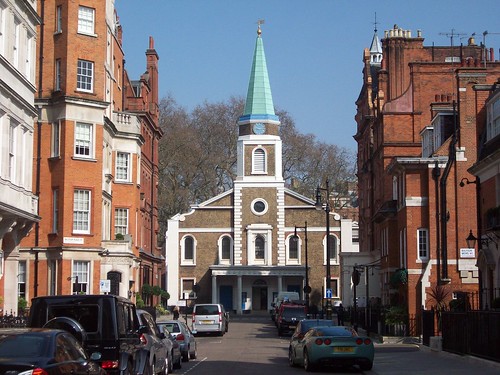
 1. Plough Court, off Lombard Street, City of London. Birthplace of Pope. Plough Court is an alley of which the black wall in the above picture constitutes one side. There is a plaque on this wall commemorating Pope but unfortunately it did not come out in the picture. The sunny street to the right with the old-looking church (many of the old-looking churches in this part of town are actually reconstructions, the originals having been bombed out; I don't know whether this one is a reconstruction or not) is Lombard Street.
The area known as the City, which is now the financial district and has hardly any residents, was until about 1800 pretty much the whole of London, and thereafter constituted the more downmarket but heavily populated Cockney homeland until the bombing wipeout in 1940-41. As a result, it is an area that was home to tons of writers and numerous legendary historic places, including pretty much everyone and everything before the 19th century, most physical reminders of which, however are gone. Nonetheless, a few things are still around, such as St Paul's Cathedral and other churches, Samuel Johnson's house, the Cheshire Cheese Tavern, etc. Many of these are dismissed as tourist traps I guess, though if you have some feel for the 18th century atmosphere these relics can still speak something to you.
 2. Rye, Sussex. Plaque Commemorating the Former Position of Henry James's Garden House, Destroyed by Bombs, 1941. Not a flattering portrait, but you can't run from the truth forever. I was 29 here. By 29, or thereabouts--the 30th birthday is not an absolute deadline, but it seems to be pretty close to one--you have either become a genuinely serious, more or less realized person or that destiny has at last become inaccessible to you, and you are effectively marking the hours--thanks to the advances of modern medicine hideously many hours--until you come to your physical end. I am pretty sure I still harbored hope I was going to be able to sneak in under the wire at this point, but now I look at this picture and see it was pretty much...
Despite the unfortunate fate of the garden house, the actual Georgian House where Henry James lived, to the perpendicular right of the wall in the photo here, still stands, and is sometimes open to the public, though it was not when we were there.
 3. 39 Cornhill, City of London, With Steeple of St Michael's Church in Background. This building, formerly, and perhaps presently, a bank, was built on the site of the poet Thomas Gray's birthplace (1716). Gray was commemorated on one the lower floors with a nice embossed plaque and a few lines from the "Elegy Written in a Country Courtyard".
 3. 39 Cornhill, City of London, With Steeple of St Michael's Church in Background. This building, formerly, and perhaps presently, a bank, was built on the site of the poet Thomas Gray's birthplace (1716). Gray was commemorated on one the lower floors with a nice embossed plaque and a few lines from the "Elegy Written in a Country Courtyard".
We took this little walk around the City on a Sunday morning, when the place was more or less deserted. The plane had landed around 6 or 7 am and we weren't able to check into our hotel until sometime after noon. Very little was open--in the 90s at least, Europe was still effectively closed on Sunday, especially before mid-afternoon/evening--even the ATM machines didn't work for our bank cards until noon--so although we were very tired we passed the time by walking around the old City and yes, crossing a few items off one of my myriad lists, but there is supposed to be a purpose to the lists, they are intended to arouse my curiosity and awareness of more elevated modes of living by placing me among scenes which have spawned or inspired or impressed great cultural and historical figures...Oh well.  4. View From the Bell Tower in the Old Church (St Mary's?) in Rye, Looking Over a Field of Sheep in the Direction of the English Channel, Which May or May Not be Faintly Visible in the Distance. Rye is perhaps a little too perfect of a quaint old English town to be perfectly enjoyable--it's very wealthy, has a preponderance of shops selling jam and teapots and such, has no edge, the whole presentation seems stilted--but it was still pretty.
 5. Canterbury Cathedral. Worth the trip. I liked Canterbury town too. More lively and stimulatingly laid out than Rye. I think there might be a university of some kind, or perhaps just the cathedral's tony high school. Anyway, there were a lot of vaguely academic-seeming young people around.
 6. In the Penthouse Suite in Portsmouth, England. Not right on the strand, but the Channel was only a few blocks away--Can't you smell it? The room is humble but as you can see it was fairly clean by the standards of a cheap English seaside hotel. Portsmouth is more of a city, population of 200,000 or so, and while there is a long promenade with fish and chip shops and the like and a sort of small rocky beach, I didn't notice much sand, at least near where we were. The holiday crowd tended towards the hooligany side but I didn't encounter any difficulties with them, and I actually enjoyed it there. We did see a few things there and then caught the overnight ferry to Le Havre in France (arriving there on Sunday morning as well, which is even deader than Sunday morning in England, and again with no access to cash until after noon).
 4. View From the Bell Tower in the Old Church (St Mary's?) in Rye, Looking Over a Field of Sheep in the Direction of the English Channel, Which May or May Not be Faintly Visible in the Distance. Rye is perhaps a little too perfect of a quaint old English town to be perfectly enjoyable--it's very wealthy, has a preponderance of shops selling jam and teapots and such, has no edge, the whole presentation seems stilted--but it was still pretty.
 5. Canterbury Cathedral. Worth the trip. I liked Canterbury town too. More lively and stimulatingly laid out than Rye. I think there might be a university of some kind, or perhaps just the cathedral's tony high school. Anyway, there were a lot of vaguely academic-seeming young people around.
 6. In the Penthouse Suite in Portsmouth, England. Not right on the strand, but the Channel was only a few blocks away--Can't you smell it? The room is humble but as you can see it was fairly clean by the standards of a cheap English seaside hotel. Portsmouth is more of a city, population of 200,000 or so, and while there is a long promenade with fish and chip shops and the like and a sort of small rocky beach, I didn't notice much sand, at least near where we were. The holiday crowd tended towards the hooligany side but I didn't encounter any difficulties with them, and I actually enjoyed it there. We did see a few things there and then caught the overnight ferry to Le Havre in France (arriving there on Sunday morning as well, which is even deader than Sunday morning in England, and again with no access to cash until after noon).