Showing posts with label Sidney poitier. Show all posts

Tuesday, October 22, 2019

Idle Movie Post

De-Lovely (2004)


I had seen this before, back when I was going through a phase where I was especially into Cole Porter songs. It hadn't come up on the "official" record yet so when it did I felt obligated to see it again. If you like the music and the time period it is fun enough to see once--at least I found it to be so when I was ten years or so younger than I am now. I didn't find this second viewing of it to add anything to the initial experience. This modern movie naturally puts a lot of emphasis on Porter's luxurious lifestyle as well as his homosexual inclinations and the strain it put on his marriage, which don't hold much interest for me. In the absence of genius filmmaking, I honestly would have preferred to have seen scenes set at Yale, his more youthful years in Paris, his musical upbringing. While I didn't pay much attention to it the first time, I wasn't enthralled by the modern pop stars performing their versions of the famous songs. Elvis Costello was all right, I like him as an act himself, besides that I think he has a more visceral feeling for the traditions in which those songs were composed and are meant to be presented. The other singers seemed to be doing the songs in their own styles, which is what they naturally would do--I just don't happen to be a fan of these particular artists, as they are called.


Will Penny (1968)


Late stage classic period western starring Charlton Heston as an illiterate cowhand approaching middle age who can see his life options beginning to narrow. Perhaps it is a metaphor for the genre as a whole. It is pretty well-regarded, especially the script, though I found it to be kind of strange in many ways--the antagonists are a sadistic, almost proto-Manson family (without the orgies) led by a father who speaks in the language of a 17th century religious fanatic. I was hoping it would grab me, but it never did, really. The female lead was played by Joan Hackett, a woman of the type I am often interested in without any noteworthy reciprocation, whom I had never seen before. She reminded me of someone I knew who died of cancer when she was 41. Joan Hackett herself died of cancer when she was 49, which I found out in looking her up for this article, which is kind of a downer.


This is notable in my personal history as the first time I've had to turn on the subtitles in a movie made in English because I couldn't make out the spoken dialogue. This was in part because I watched this on a very hot night during the summer when I had on a window air conditioner that was difficult to hear over. But still.


I guess the most interesting aspect of this was the consideration of its aforementioned place in the timeline of the old style Western in film history, as well as that of Charlton Heston's run as a star leading man, which was also kind of at the end of the line here. It has a subdued, pensive atmosphere about it, not emitting a great amount of energy.


I'm clearly in a part of my life where movies are not speaking to me very much, at least not the ones I am seeing. I'm not putting in a lot of time on them, being down to about one or two a month now, but as I formerly got some enjoyment from the habit and there are still a lot of the types of classics that I like that I have never seen, I don't want to give it up entirely. I might be looking into re-tweaking my method of choosing films to get the kind of stuff I like to pop up more frequently however.


Edge of the City (1957)


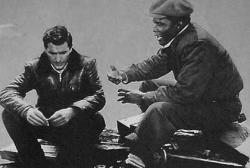
Another one that I saw a few years back which finally became available via the Netflix CD service. Here's what I wrote about it 3 years ago. It's a stripped down, basic movie, but poignant, saturated with that quality of yearning that was peculiar to the 1950s and comes across today, to me at least, as appealing. I know there is some ambivalence, especially from more fiery or progressive observers, with regard to the career and film persona of Sidney Poitier, but it seems to me he is pretty dynamic in this, and is in general one of the major presences of the 50s and 60s. The objections to him, I gather, are that he is too watered down and therefore acceptable to white people, such as me, such that even when he is angry or decrying some injustice he is not threatening or existentially terrifying to the mainstream Caucasian ego in the manner that one might wish it to be. His character in this, as well as in numerous of his other movies, is something of a mensch, the only man to consistently display much in the way of what are thought of as admirable qualities (the John Cassavetes character is sympathetic, but is a weak and confused young man), so it is hard to dislike him.


I have a few more but I will put those in a second post.


Wednesday, October 31, 2018

Going to do a Few Movie Posts Now

I'm still about 31 behind even though I haven't seen too many in the past few months. Needless to say I don't remember most of these very well now. I will do these accounts in a formulaic fashion and see if anything comes of them:


The Westerner (1940)


Director--William Wyler


Notable star(s) (to me; every character actor in old Hollywood has his own cult on the internet): Gary Cooper. Dana Andrews apparently had a small role in this but I don't remember him
.
Did I like it? Yes. I didn't love it, but it's a Golden Age Hollywood Western, it's William Wyler, I have been weaning myself away from so many old movies because they are too comforting so any time one comes up now it is a great treat.


What do I remember most about this? The bar at the saloon and the bedroom off of it which I believe they have to shoot themselves out of at one point.'


Associated in my mind with: The Gunfighter; Destry Rides Again.


That's Entertainment III (1994)


Director--Bud Friedgen and Michael J Sheridan


Notable Stars--Many fixtures of MGM musicals. A lot of Cyd Charisse, Lena Horne, Ann Miller, etc


Do I like it? Yes. As the third installment of reminiscences about the glory days of MGM, my impression is that That's Entertainment I and II covered most of the true watershed moments in the studio's history and that this one is mopping up with its coverage of the June Allyson era and other now lesser known films. I was (am) supposed to be seeing the first two compilations as well, but they haven't come up available in my Netflix queue yet (yes, I still get DVDs mailed to me), which is what I have been working off of exclusively for about a year now, with a long backlist of stuff, mostly old, that they don't have.


What do I remember most about this? It's got a decent amount of old Hollywood "movieness" about it if you are the kind of person who has romantic ideas about Grauman's Chinese Theater and Schwab's Drug Store. At the time that they made it in the 90s a lot of the old stars of the 40s and 50s were still alive and were able to be interviewed, almost, in fact probably all, of whom have since died.


Associated in my mind with--The Band Wagon; On the Town.


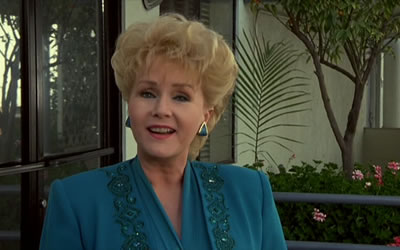
No one evoked Old Hollywood nostalgia like Tammy herself, Debbie Reynolds


For Love of Ivy (1968)


Director--Daniel Mann


Notable Stars--Sidney Poitier, Carroll O'Connor, Beau Bridges


Do I like it? I found some of it morbidly fascinating.


What do I remember most? Evokes what a weird time 1968 was as well as recalling what is now very much a lost world, one that I have some memories of though from my childhood. The white family makes its comfortable living by owning a suburban department store of a type that I do remember hanging on as late as the 70s at least. The repeated attempts of Beau Bridges and his sister (the young people) to talk to Sidney Poitier in some kind of jive is equal parts painful and bizarre, but it doesn't seem to be intended as particularly satirical and emphasizes how the average sheltered white person evidently had no idea how to go about talking to black people in any kind of regular way at that time. Lauri Peters, who plays the sister, did not go on to have much of a film career but her look, clothes, voice, etc, were quite striking to me in this as being a perfect 1968 suburban babe. I was quite taken with her. All of the period touches. The loud trucks, the gas guzzling cars, the pollution, the lounge lizard inspired basements, the New York skyline looking rather grimy and shabby in an orange-ish light. I have to confess, the romance between Sidney Poitier and Ivy, Carroll O'Connor's family's black maid, which is ostensibly the point of the movie, did not excite me that much.


Associated in my mind with--Diary of a Mad Housewife. It is similar in its unintentional late 60s-early 70s weirdness.


Yes, posting a picture of the white girl is too predictable, but this chick is such a quintessential 60s babe I could not resist.


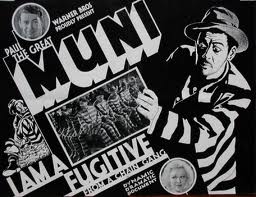
I Am a Fugitive From a Chain Gang (1932)


Director: Mervyn Leroy


Notable Stars: Paul Muni. A highly respected actor of the 30s, I think this is the first movie of his I've ever seen.


Do I like it? Yes, it's great.


What do I remember most? As I frequently note, classics from the 30s, particularly the early 30s, have the most extreme variation with me with regard to holding up across the years or communicating in a cultural idiom which has become completely incomprehensible. This is an example of the former, as the major themes in it, corruption and injustice in the legal system and the brutal indifference of the greater society, are equally pressing problems today. But even aside from this realism the tone and psychological approach to the material seem much more modern than what is usual in that time. It's an unnerving movie.


Associated in my mind with: The Bicycle Thief.


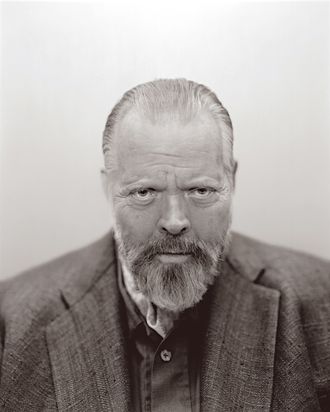
It's All True (1942--released 1993)


Director: Orson Welles, primarily


Notable Stars: Welles, I guess


Do I like it? It's an unfinished documentary. The footage is interesting.


What do I remember most? Not very much. It's Orson Welles set loose in Brazil with a camera. There is a carnival, old time South American beach scenes, fishermen. The impetus behind the movie was that it was going to contribute to the war effort, Brazil being one of the Allies. I'd like to see it in a theater. It is worth seeing, but at home I found it to be somewhat sleep-inducing.


Associated in my mind with: Mutiny on the Bounty, Cruise of the Zaca.


Here Comes Mr. Jordan (1941)


Director: Alexander Hall


Notable Stars: Claude Rains


Do I like it? I found it disappointing. Given the era in which it was made, the presence of Claude Rains, and its status as a classic, I was especially looking forward to seeing it, but I couldn't get into it.


What do I remember most? This disparate ingredients of it failed to coalesce for me. I never understood whatever it was I was supposed to be getting. Maybe I'm too eternally tired to do this anymore.


Associated in my mind with: Carousel


L'Argent (1983)


Director: Robert Bresson


Notable Stars: No one I am very familiar with.


Do I like it? Yes. This was the third time I have seen it. I did not get much out of it the first time, but on both the second and third viewings I have been able to appreciate more and more how good it is.


What do I remember most? Though not exactly what the movie is about, it is always great to see Paris in the early 1980s, which is very much the city I encountered when I first went there in 1990, and which I suspect is not very much at all the city that one encounters today. There was an excellent little extra on the Criterion DVD called "Bresson A to Z" which elaborates on a number of common themes in his work, as well as a lively Q & A session from Cannes. The darkness, for lack of a better word, since Bresson would probably argue that the truths portrayed in the movie are just truths that are morally ambiguous, weighs more on me with each viewing.


Associated in my mind with: Sauve Qui Peut (La Vie), French in Action TV Show.


Friday, August 19, 2016

Five Movies 1949-1977. Two Golden Age Foreign Classics, One Golden Age Hollywood Comedy, One Neglected Classic, and One Exhibition of Edgy Modern Nihilism

Abigail's Party (1977)


British teleplay, written and directed by a young Mike Leigh, whose work I have always found a little too relentlessly unflinching and vicious. This might be the most depressing movie I have ever seen that didn't involve child rape, or the Holocaust or something. I didn't know anything about it, apart from the blurb on the sleeve, which made it sound like a comedy in which working class British people drink too much with socially disastrous results. Based on this, I induced my wife to watch it with me. She did not find it uninteresting, though at several intervals she did ask "What is this?" and "Where are you finding these things?" It is a comedy, of sorts, though of an extremely uncomfortable variety. It is not uproarious.


This work is better-known in England than it is in the U.S., and seemingly well-regarded there. I guess it is the sort of thing they like, and it speaks to their uniqueness as a people. For all of its artistic and literary virtues, I see it still as a story about vulgar, animalistic people who are neither bright nor virtuous nor original with and to and around whom nothing good or positive happens. It is almost a ne plus ultra of spiritual nihilism.


My wife thought it was the kind of thing certain people at St John's would have gotten into on account of its ironic, passive-aggressive edginess and alienation. Perhaps.


The Hidden Fortress (1958)


Now we are back in the sunny days of the first flowering (in terms of popular success in the West) of the golden age of the great international directors, whose fame I suspect will continue on and occupy the position in the history of cinema that the famous novelists of the 19th century (Dickens, Twain, Austen, Balzac, Tolstoy, et al) do in the history of that genre, even if certain of their attitudes and concerns and even techniques become outdated or superseded. Everyone will still know them, better than they will most of their worthiest contemporaries, and will probably still like them to some degree because their films, especially the earlier ones, have many likeable qualities.


Kurosawa has at present perhaps the strongest cult following among this group, Bergman, Fellini, various other new wavers, et al, at least among important people. Maybe this is because he is not European. Sometimes it seems like it, that certain Western people want to respond to a vision that is more definitively other. I greatly admired Kurosawa's version of The Idiot, but that is to this point the only one of its films that has strongly resonated with me. There is a lot of fun and high spiritedness in this movie, and it conveys an optimism, about the direction of the art of cinema if nothing else that was characteristic of a lot of these celebrated foreign movies (though I think it picks up as well on certain other positive attitudes that were widespread in the later 50s even if brooding artistic types denied sharing in them). However, and this is about the third time I have watched it, my mind always wanders about during it, thinking about the terrain, and the sunlight on the rocks, and maybe the sweep of the vista in certain shots, and I lose track of the characters for minutes at a time. In truth, they are not as compelling to me. Of course, I have never been able to get through Star Wars either, large parts of the plot of which George Lucas has confessed to lifting from this movie. So there is something in the story that does not connect with me.


Edge of the City (1957)


I liked this one very much, perhaps because it is not especially well known, and thus a pleasant surprise for me (I had never heard of it before), though there is no especial reason for it not to be known at this point in time. It was the directorial debut of Martin Ritt, who went on to make many well-known films, the only one of which I have seen is  Hud, which however I also liked very much as an American movie with something of the atmosphere and sensibility of the European art films. This one has something of that as well. It also reminds me of Paths of Glory, which came out the same year. Sidney Poitier stars in what I think probably should be one of his more celebrated roles, along with John Cassavetes, who is one of those people the edgy art-film crowd always talks about but whom I had never managed to encounter until now. It has a lot to recommend it besides being a solidly made movie: New York in the 50s, even some of the redeeming aspects of America in the 50s, a jazzy contemporary soundtrack of the sort that was criminally underexploited at the time, Poitier's character is extremely likeable, though perhaps primarily to whitebread types, as some prominent studies by black writers have been dismissive of the character. One example given in the Wikipedia article on the movie calls the character a "colorless black" with "little ethnic juice in his blood", who acts in the tradition of "the dying slave content that he has served the massa". I think this is a little harsh (To be honest, I also find it humorous. Why I do, since I am sure it was not intended for me to find it so, I think is because there is something of truth in it, though only partial truth, and I am pretty certain the effect that the film inspired in the critic was entirely unintentional). The Poitier character does not seethe with anger every second that he is around white people, though I don't think he lacks ethnic juice, nor is he in a totally submissive role relative to any of the white characters, though perhaps this aspect was somewhat sugar-coated for 1957. In the first scene when his light-skinned wife, played by Ruby Dee, appeared, I thought for a moment that she was actually white; but I knew there was no way that would have flown at the time. In fact I have seen several claims that this was the first American movie to depict a genuine interracial friendship, and one of the reasons it did not make a lot of money or otherwise have much of a national impact was because the studio didn't even bother trying to show it in the south. There is a lot here that I found moving. There is an undercurrent of anger in it, but it is understated and low-key and allows for a lot of fine impressions to come through.


Not available via Netflix. I bought a cheap DVD (around $1.99) on the internet, well worth it.


Pather Panchali (1954)


I had seen this probably three times already, but not in ten or fifteen years, and as it is to me one of the greatest of all movies, I was glad for the excuse its coming up in my system afforded for seeing it again. I cannot say much about it beyond what has already been said a million times, that it is so moving because it is really a very simple, ordinary story out of which great secrets and other depths have been pulled. This is not the whole of art, but it is a substantial and in terms of power usually underdeveloped part of it.


The night after I saw the movie I had a dream about the toothless, ancient "Auntie" who is one of the more visually memorable characters in all of cinema. I am usually rushed in the morning but I took a couple of seconds to jot down what I could remember of it:


"Twice came across Auntie blocking road while driving, once legless body, second time just a head still breathing. Both times waited for another guy to move her out of the way, set her up on the side of the road. Second time she stared at me hard in disgust. I couldn't think of what else to do. I was in New Hampshire, not India..."


Adam's Rib  (1949)


One of the famous Tracy/Hepburn "battle of the sexes" comedies that judging by this don't appear to have dated very well. Since I usually love just about anything from this time I watched it through twice just to make sure, but I could not get into it. Besides the changes in the male/female dynamic in our day that have rendered most of the jokes stale when they are not actively wince-inducing, the writing and direction in general I did not find strong enough to be able to overcome the contrivedness of the plot and the artificiality of the situations, including the marriage. The screenplay was written by women, which I suppose was somewhat unusual at the time, though many famous female writers of the 20s and 30s, such as Dorothy Parker, Anita Loos, Lillian Hellman, Mary Chase (author of Harvey), etc, received paychecks from Hollywood during this era, so it wasn't completely unheard of.


The most interesting character in this movie to me is the Cole Porter-esque piano-playing, always tuxedo-clad song and dance man who lives in the apartment across the hall from Hepburn and Tracy. He is interesting mainly because he was a type who was a staple in these kinds of entertainments who has largely faded away. What was the cause of his demise? Rock and roll, perhaps, or television, or the decline of the cocktail party in general, or the movement towards music-playing among those who could do so as exclusively an instrument for self-aggrandizement rather than shared camaraderie and joie de vivre? Yes, I wonder.