Showing posts with label Food Studies. Show all posts

Monday, October 19, 2015

St John's College Dining Hall, Annapolis, MD

I had lunch here with five of my children on the last Saturday of September, while my wife, who was attending her class reunion, hung out at the $20 a head luncheon out on the back lawn. The dining hall was around $8 per person for all you can eat as well as ice cream and other dessert included, so it was as good of an option as anywhere else within walking distance, as we had already gone to the (in)famous Chick and Ruth's diner the night before. I had not been in the dining hall in more than twenty years. Not surprisingly, it had changed.


The Scene at Chick and Ruth's. This must be early in the day. Everything looks too clean.

The Ride. I was looking forward to the trip, as I had not gone further afield than Boston in the entire year previously. The way down was not at all onerous, and even pleasant, as we took two days in coming, stopping the first night in Philadelphia, and after some visiting in the morning, having a fast (for us) three hour ride down to Annapolis, including an obligatory stop for snacks at a Wawa in an especially flat and treeless part of Delaware. Since we seem to want very much to be conscientious workers and parents of schoolchildren, we had to return all the way home on Sunday in order to be ready for Monday morning. Besides having to leave abruptly right after partaking of the farewell brunch, this inevitably takes about twelve hours to get back home. As I get older I do care more about convenience as well as the ability to travel more leisurely. My last two times in Annapolis I have spent extra money, quite a lot of it really, to stay within walking distance of school and the center of town, and I find that it is worth it in terms of my overall mood, especially given that I am only taking such trips once or twice a year now, if that. Now I am reaching the point where I don't want to have to rush back on an extremely long ride in one day. Our trip home also coincided with the last day of the Pope's visit in Philadelphia, with the attendant closure of half the highways around that city, so we went up through York, Lancaster, Allentown and Scranton and then across I-84 to Connecticut. The first half of this ride, during the daylight, was very pleasant. on mostly empty roads through the interior of Pennsylvania. When we got to Connecticut there were three separate occasions where we got stuck in construction back-ups for at least 45 minutes. It was also, as always, considerably colder and darker and gloomier once we got back into the New England evening. It is home, but it is a dark and lonely place to drive across at night. In any case we did not get home until around 2:30 in the morning, and it took us most of the week to recover our sleep. But the trip was still worth it!


I love the Pennsylvania Turnpike's eternally empty Northeast extension

Location. St John's is an old school in the old section of an old town, so it is pretty much where it should be. Most of the students in my time had little use for Annapolis, and the cool kids especially were merciless in their evisceration of the local scene. It is true that the dominant character of the local population has never meshed well with the culture of the college, though I am surprised by how unfavorably the town seems to be considered with locales of roughly similar colleges, many of which are in far more isolated locations and have much colder weather, winter lasting in many instances (such as almost all of New England) nearly the entirety of the school year. But I have written about all of this before. Predictably, the surrounding neighborhood has become desirable and incredibly expensive compared to what it was in the early 1990s. Students, including those from the regular middle classes, used to rent well-worn rooms or apartments in the historic district within a few blocks of campus in those days, but these places have been renovated for more upmarket purposes, and I don't think too many students live in town anymore, unless they are from wealthy families. The college had to build a couple of new dormitories for the first time since perhaps the 1950s to address this issue.


The main building of the college, dating from 1743.

Day. The weather was wonderful, overcast with temperatures in the low 70s. I could comfortably wear long pants outdoors. As I had primary children-minding responsibilities I mostly hung out near the play areas during the day instead of meandering from scene to scene of social action, and, sadly, I was unable to attend any of the parties later in the evening.

Ambiance. Back now to the dining hall, the main room is largely the same as it was, with the exception of a buffet line at the front manned by two or three employees of the catering service, which I have to admit I found kind of intrusive, though this may have been because I was sitting at the front table right beside it. The booths in the smaller room that had been the smoking section in my day had been ripped out and replaced by a double row of drink and ice dispensers, not an improvement to my mind. I cannot say I got any real feel for what the social atmosphere is like now. It seemed kind of subdued. It was Saturday afternoon, and the crowd is always lighter on the weekend, and is usually absent the most intense and energetic students, who tend to be more vigorously and productively occupied elsewhere on the day off.


This is it. I guess the full length portrait of William of Orange must be at the other end (behind the photographer)

Crowd. Mostly students obviously. I only noticed a couple of other older people in there, though there is no objection to their going in. I sat facing away from most of the students and was pre-occupied with prodding my children through the meal so I actually did not have much opportunity to observe the students.

Food. I had fired my children for this dining option beforehand with promises of chicken patties or fishwiches with fries being on the menu. Times have changed however, and the type and apparent quality of the food being served is of a much higher standard than I actually ever encounter in my own current life. Indeed, it is in this matter of food and diet that I most worry that our family may have dropped out of the college-going classes, or at least those classes that attend colleges like St John's (I confess that, never having gone to the kind of school that the Buffalo Wild Wings crowd went to, I am mildly terrified of them). They had whole grain pasta, potato latkes,good quality pastrami on a fresh onion roll. They did have some French fries, though these too looked to be more of some kind of modern hand-crafted variety rather the old freezer burned crinkle cut model that we used to know. It was all very good, and I know that these offerings are hardly exotic, but the whole presentation, remodeling of the serving area and so on struck me as riffing on some kind of San Francisco, i-pod, vaguely exclusive aesthetic, in the sense of, some people have the mannerisms, thought processes, etc, that assure you that they belong in this environment, and other people, like me, really do not. Incongruously, there was one of those flip-over waffle irons that they always have at the continental breakfast at hotels along the interstate. My children were most grateful to see this, and I think it was the main part of the lunch for the younger ones.


Latkes

Friday, September 18, 2015

Cherrybombs Diner, Dover, NH

The Ride. Dover is located off the path of most of my main routes, being almost due east, right on the border with Maine, but away from the coast. I thought I had only been there once before, some years ago to check out a library sale, but as I came into the town past the handsome late Victorian/early 20th century houses on Route 9 I realized I had been there numerous times, and indeed I had forgotten that the New Hampshire Children's Museum was located there, to which I used to go quite frequently, though usually on rainy or exceedingly frigid days, when my older children were smaller. I don't think my current small children, who are 6 and 4, have ever been there, because now everything we do is geared as much towards the edification of junior high schoolers as it is little boys and girls. As noted above, Dover has a well-preserved older central core and a surprisingly lively Main Street, with few vacant storefronts and a lot of bars. The population is around 30,000, which is comparable to Portsmouth and Concord, and much larger than I would have thought, since it is a pretty anonymous city even within New Hampshire. I am curious to know what accounts for all the bars. Durham, where the University of New Hampshire is located, is only about five miles away, though I have never heard that trekking over to Dover to go drinking was something that was done. For the main ride, I went down on US-4 again to NH-155, which was about seven miles of country road past woods and farms until running into the intersection of NH-9 and 16 (the mysterious Spaulding Turnpike, which due to my awkward location relative to it I have never had occasion to take an extended ride on) on the outskirts of Dover proper. On the return trip I took route 9 back on its way in that part of the state until it joined with US-4--a winding road, that passed a mildly diverting looking general store that retained some slight air of authenticity only because it had not quite attained its ambition to be a known destination on the tourist trail, a lake, and a lakefront community. But other than that I do not remember much distinctly.


Location. Interesting. This establishment is located in a low slung, warehouse type building in a clearing surrounded by woods on a side road beyond the town center towards the Maine state line. The only signal visible from the road indicating its existence is a hand-lettered folding wooden sign sitting on the ground under a tree at the edge of the driveway. It is unlikely many people who do not know it is there or are not looking for it will stumble across it, even if they are completely lost. There is a beaten up hulk of a car from the 1950s sitting near the sign that upon closer inspection is a further piece of advertising for the restaurant. But as ancient, rusting cars are common sights along country roads in this part of the world, it is nothing anyone passing through would take any especial notice of. The wooded setting, especially looking out away from the building, is peaceful and pretty however.

The Day.  The weather had called for heavy rain most of the day, but this held off at least for the duration of the outing. It was overcast, but bright, and warm, around 80 degrees. A good day to be about.

The Ambiance. Weird. The place gave off an amateurish, even half-hearted vibe. The ruling idea, clearly, is to create a 50s, Americana type diner atmosphere, though this aim is somewhat incongruous with the circumstance that the space with which they are working is a 1970s or 80s industrial park structure with cinder block walls. There are a few items of memorabilia affixed to the walls here and there--single pictures of the usual suspects, Elvis, Marilyn, & Jimmy, a plate featuring Dwight and Mamie Eisenhower, a few records and advertisements for cars, soap, soft drinks, as well as a steady soundtrack of 50s hits being piped into the mostly empty and energy-less room.


The Crowd. When I first arrived the crowd consisted of two old guys sitting silently at separate tables and the waitress, who was doing something with her back turned behind the counter and did not notice I had come in for over five minutes. Later on though, a couple of other people trickled in, one a younger (late 20s, early 30ish) man who was on friendly terms with the waitress, and a mother/daughter/baby party who were a little livelier. Everyone in the place appeared to be local and decidedly working class, since no one appeared to have an important or lucrative job and most of the conversations, once they got going, kept coming back to depressing themes like not having any money, haphazard and decidedly non-50s family arrangements and such. With regard to sociability the lunch progressed in a stereotypical New England manner, with everyone, including the waitress, being dead silent and outwardly not very friendly towards me or anyone else for half an hour (and I being I suppose the same towards them), in my case I think until they could get some kind of a read on who I was, a strange middle aged man in a button down shirt and toting a baby. But some tentative comments and questions were offered with regard to my baby by the waitress and the family of females and it was established that we were not innately hostile to each other, and it could almost be said that we were on fairly friendly terms by the end.

I think it is worth noting, or at least a curiosity, that so many of the long established family dining restaurants along the coast and in other tourist spots seem to employ exclusively young foreign students nowadays while 10 miles inland at some hole in the wall where six people show up for lunch all of the employees are kind of tough-looking local people of a certain background that does not keep up to date with the fashion in education or food or politics or allows for much evolution in those realms. I know the tourist restaurants are seasonal and I guess they cannot find a workforce adequate to their specific needs among the local population, though it seems strange that the latter are willing enough to work in any number of dingy grease joints and fast food restaurants in Dover when they live ten, fifteen, twenty miles from a busy tourist area that has a desperate need for restaurant workers.

The Food. The menu kept pretty close to the spirit of the 50s--they even offered grilled liver! I got the chili dog, I had never had a chili dog before, mainly because I was always averse to dealing with the inevitable messiness of this dish. It was all right, though it tasted more like something an undistinguished amateur cook would produce in his home kitchen. The fries were good though, and tasted like real restaurant fries. I wanted to help them out a little by ordering dessert, but the pies and cupcakes on the tray again looked more fattening and unfulfilling than inspiring, as if they had been made from a mix by someone who had little experience even with that. In addition they were drooping a little in the warm weather so I had to pass on them.

I am not going to rush back, but I would be willing to try it again to see if different circumstances, crowd, etc, brings out a more satisfying atmosphere. 

Saturday, September 05, 2015

The Goldenrod--York Beach, ME

Taking a break from the movie write-ups to recount my outing for lunch this past Thursday. I am thinking about doing a series of 'cheap restaurants of New England' posts, at least through the fall, as all of the children are back in school now except for the baby, and it gives me an excuse to get out of town and take a ride once a week during this really lovely season of the year. Of course I have to be back by 2:30 to hand the baby off to her mother and go to work so I cannot go very far away or linger in a place for very long, but I can manage anywhere within 90 minutes if I leave by 10 am, which given my location covers a fair amount of good territory, including most of the state of New Hampshire. I have also devised some internet word search games to generate restaurant possibilities, though for this initial excursion I opted to finally go to a place that I have had a hankering interest in going to for many years, but which has not been practical because it was either too crowded or I have had too many children with me, and which I also mentioned in my summer vacation post, the old-fashioned luncheonette attached to the Goldenrod taffy-candy-gift store, both because of this interest and because I thought they might be closing for the season after Labor Day (though in fact they are remaining open through Columbus Day; maybe I will go down again before then).

I am going to set these posts up in the category style, which has always been popular with consumers of ephemeral media.


The Ride

Usually when going to Maine from Concord I take US-4 to Portsmouth and pick up I-95, or if I am really not in any hurry, US-1. This is a pleasant ride, 50-55 mph the whole way, minimal stoplights, antique stores, book stores, old barns and churches, lakes and lake houses, woods, farms, the famous New Hampshire Trojan horse (said to have been built by a disgruntled old isolationist Yankee in the 50s as a protest against the U.N.), and it takes a hair over an hour to get to the Maine state line, and a further 15-20 minutes to get to York Beach. However all of the internet mapping sites claim that the fastest way to get to the ocean from Concord is to take the interstate south to Manchester and go east on NH-101, which is a highway on that stretch, so I tried that, but that way took me 90 minutes (and route 101 from Manchester to Hampton is for New Hampshire an unusually blah road as far as scenery goes, though the part of it that runs west to Keene, a humbler two-lane blacktop, is a quite beautiful, if plodding route). I took Route 4 home and it was the usual 75. I have really come to love the old U.S. highways in recent years, most of which outside the congested Boston-D.C. corridor you can keep up a good speed on most of the time (and even in some places in it, such as US-301 from Wilmington to Annapolis, and even US-1 between Philadelphia and the Verrazano Bridge and Holland and Lincoln tunnels is usually just as fast as taking the turnpike) and I try to take them now whenever possible.

The Location

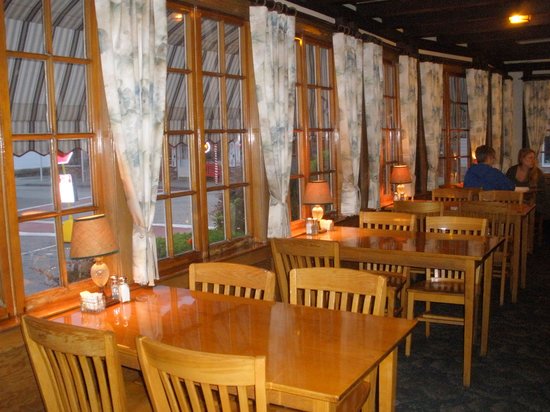
I think it is perfect, 100 yards from the beach, but as the beach isn't visible the view out the curtained windows gives the sense of being in a densely built little city through which a constant stream of pedestrians are moving, a really charming effect that, due to the rarity of it anywhere in this country, I had forgotten about in recent years.

The Day

It was nearly 90 degrees, so it still felt like summer, though with school being back in session the beaches on a Thursday had only about half the crowds they would normally have, and the amusement arcades, though still open, were practically deserted. I am guessing they will close up after the Labor Day weekend. As I left home an hour later than I wanted to, I was only able to take a quick peek at the beach before I had to hurry off home.

The Ambiance

Well, I'll read to you from their brochure: "Step back in time to when things were simpler...the classic New England dining room...The heavy beamed ceilings, oak tables and stone fireplace set the stage." It's a great space. It is one big room, but it has a long, not entirely straight perimeter, with a little alcove in the back that I actually could not see. I was given probably the worst table (as I usually am, I guess because I am so ugly and unimportant looking), in the middle area right next to where the people stand when they are waiting to be seated. My ambition for my next visit is to get a seat by one of the windows. The bathrooms are up an interior, dark, narrow, carpeted, wood-paneled staircase lit by yellow light bulbs in sconces, reminiscent of one of the better old bars in Boston. The bathroom itself was more modern, but it did have nice dark-wood doors, both at the entry and in the stalls, that looked legitimately old.


The Crowd

Due to the absence of school-age children, it was mostly older people and people with very young (pre-preschool age) children. I was with my own 7 month old daughter, who is so well-behaved that I do not have the slightest pause about bringing her out with me on these excursions. There were a couple of 20ish New England rocker chicks out for the day with their biker-looking parents, and one MILFy type, petite and wearing glasses, long curly-ish hair, who was giving off a moderately "I'm not dead in that way yet" vibe. I did overhear an overweight, slovenly dressed, doofus-y looking family discussing having seen The Philadelphia Story recently, with the mother claiming it as one of her favorite movies and expostulating a little on the appeal of Cary Grant, which surprised me, especially as in appearance she looked about as far from the Cary Grant style ideal as it is possible to get. As at an increasing number of restaurants in touristy areas around here, the wait staff consisted entirely of young people from non-western countries--the ones here looked to me to be Russian or elsewhere in the former Soviet Union.   

The Food

My waitress was the cutest one of the bunch, though by 'cute' I mean in the way a serious, mildly severe Russian girl would be cute, not like a cheerleader. She was not especially friendly, but she was not unfriendly either. Neither was she terribly conscientious, though she was not completely indifferent. She was busy, I guess (the dining room was about 60% busy) and her mind was elsewhere. The first time she came to take my order I was not quite ready, so she went away and didn't return for 20 minutes. I began to wonder whether this was deliberate, that the hard Russian girl was going to amuse herself by ignoring me and making me have to loudly call after her or make some public complaint which she would know at a glance someone like me would be inherently loath to do. However, I think she just forgot about me, as she did apologize, sincerely if not weakly or obsequiously, when she came back. I just ordered a BLT, but I am happy to report that it was a extremely good one, the lettuce and bacon and even the side pickles, which I usually skip, were of a perfect crispness. So I am a believer in the product now, whatever I get the next time. Due to my late start and the additional 20 minute delay in taking my order, I was up against it for time and was unable to linger any longer to have coffee or dessert, which of course I love to do, because I really don't have anything important to do in my life, ever, or anywhere to get to accomplish amazing things, unless someone else has arranged for me to have to be somewhere. But I had frittered away all of the time that was my own and I had to get back. But I will return now, for certain.

Thursday, October 09, 2014

Were Freaks Really What Made New York City Great?

I have links to a few other blogs in the right hand column of this page, but this has been a rather desultory process. Some of these have not published new material in upwards of a year, and the quality of some of the others, after my initially finding something in them that piqued me, has not remained consistently engaging. I suppose I will keep adding to the list whenever I find something that both publishes relatively regularly and has the sort of intelligence or humor or interests that I like. I come across very little that fits this description however, though I am sure there is a lot I would like out there, if I could manage to find it. I have not exactly cast any very large nets in this regard; it is more that I have turned over a few things that happen to have washed up on my little shore and seen something that made me want to put them on the shelf for a time. The links have never been a strength of the page and I almost never refer to them in my posts.


Today however I am going to refer to the 'Vanishing New York" blog, which is written by a guy named Jeremiah Moss, some of whose work has actually been published in real newspapers and magazines, including the New York Times. For those who are unfamiliar, the blog chronicles old-style Manhattan places, mostly restaurants and other small businesses such as barber shops and newstands, that are being/have been steamrolled by the ongoing gentrification and transformation of that island to its new identity as a luxury playground for the global elite. Moss deplores these changes. I find the economic forces at play in them unsettling, and as my affections for the city are mainly directed by a kind of patriotic nostalgia, change of the sort that is happening now threatens to make me feel even less at home and happy there than I have always been (and actually I almost never go there in real life. Still, I imagine there will be a time when my children are not little or I will have enough money and time to be able to go down for a few days a couple of times a year and go out to dinner and do other things I have always imagined I wanted to do there, though probably this will never be the case). I will admit to being impressed on recent visits with how clean the steets and parks are compared to the 80s and early 90s (let alone the infamous 70s), when one of my main impressions, doubtless from the circumstance that on those visits I didn't have anywhere to stay or any money to spend and therefore spent about eighteen hours a day walking everywhere in between catching the occasional nap on a park bench, was of the overwhelming amount of garbage and filth and the seeming physical impossibility that it could ever be eradicated. But Moss seemingly cannot bring himself to find much cheer or romance even in the lovely prospects that the restoration and brightening-up of older and architecturally preserved streets and landmarks offer, because he is too conscious of the costs, mainly in accessibility and character, that have made it possible.


One of Moss's primary laments is how the forces of ruthless wealth on such a scale that for a normal person to try to contend against it is the economic equivalent of trying to fight a tank attack and aerial bombardment with a bicycle corps, and the development that accompanies it, are clearing the city of freaks and any other free-thinking and challenging people with an eye toward making it attractive to tourists and other people devoid of personality who are more conducive to following the cues the corporate interests set out for them and expediting the processes of money-making.* He longs (along with many, many other people) for the days when the freaks were setting the tone in certain parts of New York City and keeping the kind of people who didn't get them, tourists and otherwise, where they belonged, which was decidedly not there. I have friends who had a similar attitude. If they walked into a diner or bar and there were a few transvestites sitting at the counter it was a great joy to them, a reassurance that they had found a place that was all right, and real. I never felt this exhilaration, I had good 1960ish liberal values, that tolerance was necessary and people should be free to be themselves and not persecuted, and I even had some sense that this was a part of why New York had become and was so great--but still, on a personal level, I found most of the extreme freakishness unattractive and not especially fascinating. Certainly they did not make New York. In the dream New York of my imagination, which is pretty much the 1920-1965 era, the lifeblood of the city are really normal people, some of whom end up doing great things, but most of whom are regular workaday family type people, who are maybe, stimulated by the environment and the institutions and their daily interactions with each other, just a little smarter, a little funnier, and a little more energetic than a similar collection of people would manage to be somewhere else, the cumulative effect producing the possibility that we identify as our own personal dream. I suppose we are all inclined to regard scenarios where people most like ourselves seem to have the most favorable circumstances for professional and social relevance and success, romance of our preferred type, etc, as the ideal, not merely for ourselves but for society as a whole. As indeed it is, from our own point of view.


*Complaining endlessly about tourists is of course a favorite pastime of a certain kind of New York City person, usually one who did not actually grow up there themselves, and whose personal contribution to the city's economic strength or cultural vitality and prowess seems as if it is not above questioning, if they are going to insist upon holding such attitudes. I say this as a person who has been largely relegated to dreaming even about going there as a tourist at this point. All this aside, I have never felt the presence of people who were obviously tourists to be anywhere near as overwhelming as it is in any of the famous cities of Europe. Maybe in the new post-2000 Times Square, but even there it was neither as crowded or as obvious as it is in most popular travel destinations. Even when I went to the Statue of Liberty about 80-90% of the other people on the boat were either orthodox Jews or very diverse school groups who seemed to be from pretty close by, if not perhaps Manhattan itself. And I did not see a single middle-aged fat couple from Iowa. I guess one of the complaints is that the tourists, who are extremely numerous, love chains and bad food generally which drives independent places out of business and causes the most popular areas to proliferate with characterless restaurants serving garbage. I don't think it is quite that simple. I believe most people, tourists or otherwise, want to have meals and experiences, especially in places like New York or Paris or Italy, that make them feel they are living a higher kind of life than they or almost anyone else is accustomed to, as often as they can. Most people have to eat several times a day, and if they have to work, or are on a tight schedule, or have children with them, or, as often happens in great cities, are timid about whether they will be welcomed at a place that looks to be of some quality or even that is populated by cool-looking people, they will probably, statistically, on average (i.e., not you, the way above average, sophisticated reader of exquisite taste) at some point in their life or vacation will for convenience's sake settle for a meal or two at the kind of establishment designed to accomodate this particular reality. Maybe you are pretty good, and you only go to the brand name places (I will include coffee shops in this as well) 3 out of 10 times. But of course if this ratio is repeated among 100,000 tourists, in the aggregate the individual chain locations will do much more business than the scattered and more individually numerous authentic/human places.


Thursday, March 20, 2014

Not About Catholics and the Global Economy, Nor My Masculinity

As you can see I am not writing much anymore. I am hoping to get a new computer soon, that will 1) not be slow, and 2) not crash every ten minutes. Both of these situations cause me to write in a more anxious mood than I would like. So perhaps this will happen and I will write more often soon.

The real problem of course is that I don't have much to say about anything anymore.

A few days ago I was going to do a post on "Catholics" (meaning people, whether religious or not, who grew up in households and communities where a certain mindset and approach to the world characteristic of that where Catholicism was the dominant cultural influence) and the global economy, my theory being that people who grew up in these kinds of communities did not have the understanding of and attitude towards money that one really needs to have to thrive in the current world. I was going to use as illustration the entire French and Italian nations, which, at least according to news reports, appear to be suffering in various degrees collective nervous breakdowns at the necessity of having to compete for their livelihoods twenty-four hours a day and seven days a week with people from foreign cultures, most of them vulgar or otherwise unbearable. But this article would have seemed to be another negative lamentation from me about a world I cannot thrive in, about a group I am identifying with which would not allow that I ever had anything to do with them, and without persuasive references or numbers. So I shelved that and tried to think of something positive and interesting to write.

I couldn't do this.

I had to listen the other day to a woman who was not very interesting go on at some length about the health benefits of eating a vegan diet. I am not especially unhealthy, I don't really care about animals, and cutting into a steak or a piece of a pork chop every couple of days are among the few real pleasures I am consistently able to enjoy in my current life now that my enthusiasm and capacity for reading and learning seem to have dried up completely, but I listened politely and didn't say this, though I probably should have. I said something rather stupid about having a lot of boys and that I considered boys especially to need protein to develop physically in a way that I would could consider desirable and so on--I was only half alert to the subject, and my thoughts reverted vaguely to books I had read about people who were starving in World War II and that sort of thing who were desperate to find any kind of live animal at all (including, in some cases, humans) that by eating it they might have a temporary sensation/restoration of strength and energy. The response to this of course was "So where's all the masculinity then?" referring to me. I walked into that, I admit. I forget that that is the image I probably project to most people. I feel masculine enough most of the time, but of course I am not pressed very hard most days. I know in the back of my mind that something bad, some kind of outright humiliation or degradation might happen someday, or perhaps I will really be placed in some kind of moral dilemma that I will be unable to avoid where it will be inconvenient or fatal for me to do what I will sense to be the right action, though my judgement of what the right action will be almost wholly determined by my attitude as regards the justness and goodness of the individual parties pressing the case on me. This almost certainly means my conscience will think it proper that I aid and defend the put upon, less powerful side in the dispute.

People keep waiting for the social revolution to start, in opposition to the general degradation of economic and civil life that has overcome the country in the last ten to twelve years. I think something along these lines will happen within this decade; at the moment I sense that no one really wants to be in that first big group (or first few groups) that gets mown down by the swat team, even if they sense that such a disaster might be necessary to restore some sense of equilibrium in society. Everybody wants to be around to enjoy the good times, and possibly have a hand in dictating the parameters of the new society that they anticipate coming into being once the threats of poverty, personal obsolescence, sinister surveillance, Christian theocracy, socialism, etc, have been overcome. They are anticipating perhaps that some other angry group unrelated to them will strike the first blow to set things in motion--a band of armed Tea Partiers storming an IRS office, or some fanatical Christians or gay rights activists having a pitched battle with firearms in a major city somewhere--and get involved once everyone is society is more or less aware that it's 'on'. People today are too self aware to be content to give up their lives in a fruitless massacre that resulted in nothing. They will at least need to feel  they are in a real struggle, with dire consequences for losing.

I was also going to predict in my post on Catholics and the global economy that at least one major western European country--France seems to be the most obvious candidate, with Italy a close second--will reject the modern economy more aggressively than it has done already and try to return to its more "traditional" (as in circa 1945-1975) national life. The economists more or less claim that this is impossible, and it is impossible in the sense of growing the economy, attracting and retaining top human talent, and so on. Countries sometimes come to a point where they no longer care very much about this, for a time anyway. I don't expect this to be permanent, but I could see a period of a generation or so where it is the case.

With twenty-one pages to go in The Woman in the Dunes, I have realized that the book is essentially a metaphor about marriage, and the general resignation of men to their fate as they age in their 30s  and beyond. The plot of the book concerns a man, who is around 32, who goes to a beach for the weekend in order to collect insect samples who is unwittingly captured and placed in a hole in the sand which contains a house and a woman from which, he eventually discovers, escape is impossible. It should be said that he does develop a certain fondness for the woman and the rather pointless routine of their lives, which involves shoveling away enough sand each day to keep it from collapsing the house, but it is pretty depressing.

That's enough for today. I hope that new computer is coming soon. Putting up a blog post has begun to border on a minor ordeal. All I want to do is be able to write just a little. I ask for nothing compared to what I used to ask for, and the fates respond by giving me ever less. I must have terrible equipment. I had a much easier time getting on the internet and getting anything accomplished ten years ago.

Thursday, July 04, 2013

Notes on the Class of '88

or cerchi se io

I went to my 25th high school reunion last weekend. Here are my impressions:

The self-consciously "smart" people--I would loosely define this group as the people who cared and thought very much about which good college they were going to go to, or in a few rebellious cases, which good college they were assiduously not going to go to--were largely absent. I would probably not have been considered to belong to this group of people, and certainly would not be now, but I would have liked to have seen more of them make an appearance. Those who had been most notable in their school days for partying constituted the dominant group in attendance. Most of these seem to still live in the area. I don't have a great rapport with most of the party people either. I was exceptionally immature in high school. Most of my real male friends were a year behind me; I suspect that even now it would be considered bad form for me to crash that reunion however. I did not have any real girl friends in school, but if any exist who would remember me with any degree of friendly feeling, they would have been two years behind me at least. This is not unusual, I don't think, and as such it shouldn't really matter that the girls exactly your own age never liked you that much; but somehow it always does.

The class of '88 missed being part of the Tattoo Generation, if not by much. I did not see a single person who was sporting any visible ink, which is unusual in any social setting nowadays, and there were certainly those present who if they were ten, or even five years younger, you would scarcely be able to see much of their actual flesh by this point. If I remember accurately the trend of widespread tattooing really got rolling sometime around '96 or '97, which indicates to me that if you are able to make it to twenty-five without succumbing to this ridiculous temptation, you are not going to be easily seduced by it thereafter, even if you are an incurable knucklehead. Perhaps future generations will even consider us early 70s birth cohorts to be possessed of a certain old school elegance, as we will apparently be the last group of people for a long time to enter old age on the whole tattoo-free.

People born in the early '70s are also the last group to get through a lot of their formative experiences--school, college, early dating, early jobs, living abroad or otherwise away from home--before the technology explosion which has so altered people's relationships to information. Although being exclusively with people around your own age is common during one's school years and I suppose again in the nursing home, when you are 43 it is unusual to be somewhere where everyone else is exactly the same age as you. So while of course people had their i-phones with them and a few people pulled them out from time to time--mostly to read messages from their children--they were not ubiquitous, nor did they interfere with conversation, that I noticed. I even found another guy, indeed someone who had been a pretty good friend of mine, who hated phones and refused to carry one, which has not happened to me in a long time.

As I have very little to say for myself I appear to not be very social at these kinds of events and periodically have to go and sit down or step out on the balcony alone for a few minutes. Some people get the impression I am not having a good time; if asked I will usually say that if I really didn't have a good time at these reunions, I wouldn't come to them, though that is not exactly true. Other people I sense are annoyed or even, if not 'uncomfortable' (a loaded and increasingly unsatisfactory word nowadays), discomfited by my being there without any identifiable role or place in the proceedings. I do feel more and more after each of these reunions that maybe I shouldn't go anymore, no one really knows me, I don't look forward to having to try to explain who I am and what I have done with my life, and every brief exchange is a bit of an ordeal. On the other hand, I still want to keep up some connection with the old town and the school--I have not, to my mind, so far transcended them that the connection has ceased to be meaningful--and I also think that, if I am 43 and am uncomfortable telling other people what I am or do, maybe I need to go through more such ordeals, then perhaps sometime  something might happen that motivates to do something about this problem.


The most unpleasant conversation I had was with a woman to whom I had never spoken before. I think she was one of those discomfited by my general appearance of purposelessness and took it upon herself to question me about it. It went badly. There is a certain level of condescension with regard to social status, personality, intellect, general adult substantiality, etc, that I have grown accustomed to and can usually either maneuver around or at least dig in and hold fast at a certain point in a short conversation, but I was wholly unsuccessful in pressing any case for myself as a man possessed of even a modicum of human worth. Everything I tried to say to her questions about my life, she would not accept, but would want to know more precisely what I meant, and would proceed to call it what it really was. And of course all of her answers to my questions in return were unassailable, in part because I chose not to assail them, but really I could see no way to do so that would be seen as acceptable. I am sure she was a fairly miserable person, but it was quite established that I was nobody to suggest such a thing. It would have looked like an aggression on my part against a person to whom I must be crushed by a massive sense of inferiority. So I was in a bind. Because I said I worked in a hospital she kept threatening--under a veneer of politeness, of course--to introduce me to her husband, who was an attorney who specialized in hospitals so that we could talk together about the changes, the doom, as it were, that were coming to the industry--this really was vicious--but fortuitously we were interrupted at this point by the arrival of one of her old friends and I was able to slip away.

At that point, even though I had told myself beforehand that I was going to endure, as a kind of penance, whatever judgements, spoken or unspoken, were cast upon me, I did think for a few minutes that perhaps I really did have no business there, that my presence was offensive to people, and that I ought to go back to my hotel and call it a night. However, I decided to go back in the direction of the bar, which is so often curative in itself in such circumstances, and a couple of hail fellow well met types with whom I had drunk on a few occasions in the past assailed me, and I was brought back into the fold of conviviality once more.

You tend to talk to the most successful people at these kinds of things earlier in the evening, for a variety of reasons, one being that most successful people are by nature gregarious, and also because the obvious conversation opener at a class reunion is one's career, and people who have good ones are naturally more eager to have that conversation than those who don't. One such person had made a lot of money off four patents he had filed and was now involved in redeveloping old warehouses. He told us that "entrepreneurship is the number one way to achieve financial security; and number two is so far behind it doesn't even matter". I thought it was a good quote.

Later on I talked to a guy who was the manager of a strip club. I was a little taken aback, but it was a public school, so why shouldn't there be a strip club manager in the class? It isn't a glamorous life. Twelve hour workdays. The base pay is criminally low though I guess they make up for it with a cut of the tips ('I have strippers paying me. Am I a genius or what?') I had always thought of strip clubs from the purely business standpoint as quaint, fly-by-night deals, probably connected with the mob in waterfront cities, but for the most part, locally owned. The one this guy worked at was owned by a corporation based somewhere in the midwest. The person over him was a less than scintillatingly talented relative of the CEO's who, it was surmised, had been sent to Maine as a means of getting rid of him. I have heard this theory expressed before by people in this godforsaken part of the country, with regard to an incompetent but well-connected boss who has been shipped in from Dallas and has no understanding of our peculiar market and its conditions (i.e., raising prices in September). I wonder if there isn't something to it.

I had planned to leave as early as possible the next day because my two older sons were going away to camp, but I had left my car in a garage that, I had neglected to note, was locked up until noon on Sunday. So having a few hours to kick around Sunday morning and having skipped the breakfast at the hotel, I decided to have brunch at one of the numerous hipsterish eateries that have sprung up in town since my era. Having had a chance to survey a bunch of them on the mile walk from my hotel to the garage, I went back to the one which had had the most attractive liberals arts type girls sitting outside; though the original girls had gone by the time I got back, their replacements were no less pretty or liberal artsy. I don't where these girls/women came from, or why they decided to come to Portland. It is a well-situated town with lots of beautiful old buildings, but it had been that way for 200 hundred years without being known to attract good-looking and reasonably refined young women in any sizable numbers. Certainly it was not the case when I lived there. Anyway, despite all the lovelies sitting in the outdoor cafe area, it was 85 degrees and I was hung over, so I opted for an inside seat. At first I couldn't see anything but a bunch of low tables surrounded by sofas and I had a slight moment of panic; but they had a few tables set off in the corner for the odd traditionalist, and I gladly accepted one of those. I had a good view of the room, with its red and green crushed velvetlike sofas, its ceiling fans, its plant boxes and artwork and the front opened up to the street, its collection of eclectic dishes and glassware. I rarely have the opportunity to go to such places, and it seemed to me both gorgeous and decadent and even mildly sinister. It was full of the kinds of people I should have been friends with, as well as reminiscent of the blithe summer of 1914 or even the British Raj. I couldn't help thinking that surely in a few years something is going to happen that is going to sweep all of this away (What will happen to all of the pretty liberal arts girls?). Because I was hungover I was craving an ice cold Coke, but you can't get one of those at a place like this, so I had a mimosa and about four glasses of water. Thankfully they had a old-fashioned eggs, hash browns and english muffin plate on the menu. As the place reminded me of the Raj so much, I had to order my eggs poached, because that's how the British in India always have their eggs in the old novels, or at least that was my memory. The meal was a little heavy, given the heat of the day and my overall condition, but I think it was pretty good.

Here is the place, the Local 188 on Congress Street, across the street from the Longfellow statue.

Thursday, August 02, 2012

Mini-Post 4: Obnoxious Liberals

These people make me really unhappy. I've been trying to write this post for a week, and I cannot seem to get down what it is that is so hateful to me about them. I have touched on this topic here before, most unsuccessfully. Yes, they are sarcastic, condescending, histrionic, tiresomely selective in their historical memory and inveterately ungenerous in their projection of their enemies' motivations and intellectual capacities--so much after the model of their counterparts of the opposite persuasion that has been so effective and demoralizing over a long period that I suppose eventually such a development must have become inevitable--but that in itself is not my real problem with them. My real problem with them is that their contempt is phony and unearned. They may well believe in what they say to an extent, but they can't believe it deeply enough to warrant the attitudes that they affect, because neither their intellectual nor moral development is developed to a point anywhere near the fullness of a serious person. What joy or noble governance can result from the tone of civic discourse being directed by such squalid people, from whichever side of the political spectrum? Any moral adolescent knows, or should know, that the most strident and loyal wings of any political faction that arises in any country, and especially this one as currently constituted, will inevitably be supporting and covering for, even if tacitly, numerous policies that millions of rational and objective people will view, with legitimate reason, as morally horrific. One would think that the realization of this alone might promote a more sober tone of political discourse among the nominally intelligent than what passes currently, but to be honest, that is not actually how the most severely brilliant people seem to think; they believe ferociously in the conclusions that they arrive at, they insist upon them doggedly, and they are impervious to any attempt at contradiction unless it comes from a mind both uniquely glittering and in some way sympathetic to their own, which is an exceedingly rare occurrence.

Obviously I have real problems with some of the issues that to my mind have done more than their part to inspire this ramping up of what I experience as snark and ugliness, the main one being gay marriage, which, while I am politically indifferent enough to it (i.e., I am not motivated to actively oppose it), I also cannot generate any passion or outrage on its behalf. I don't really understand why I can't embrace it wholeheartedly--yes, because I am a fundamentally horrible person, but God knows there are plenty of terrible people who can pretend to be what they know they ought to be--I suspect I will in time, only just now I am irritated that everybody else was able, after being collectively in the dark for thousands of years of recorded history alone on this issue, to transition to a perfect understanding that gay marriage is a civil right that is essentially the same thing as male/female marriage, and get to feel indignant at other people's not doing so, which latter is my real lifelong dream, so quickly, while I was not. I'm just not there yet. And not only am I sort of old, but I have an especially antiquated mindset, points of reference, and so on, compared to most people my age. So coming around to the point where I really feel deep down that this is all as natural and proper as that August follows July is going to require some mental exertion which I don't however think anyone else can do for me; unless they happen to be of a uniquely glittering and sympathetic mind.

One might be tempted to ask why I just don't become a Republican and go revel in hatred with them. For one thing, I am not socialized to be a Republican. I am not comfortable among them, and it is even immediately obvious to them that I am not one of their number, my whiteness and five children and fondness for bad pop music aside. Also I don't share their enthusiasm for a low wage, vastly unequal society with no strong and competently managed public institutions. Unfortunately I seem to be socialized to be a 1940s Democrat, and there aren't too many of these people left, especially that are my age. Due to my background and temperament and my life experience, however, it is pretty much unthinkable for me to become a Republican. And if I were ever to have any kind of social life and friends again, especially living where I do, these friends would almost certainly be staunchly liberal--ideally I suppose I could meet some intelligent and engaging people who adhered to the old custom of steering away from heated political expostulating in social settings, but certain issues have become so important now that many people need some assurance of what your position on them is, tacitly if not explicitly, before they are willing to engage with you.
  
One last aside, the food snobbery of this class of people I have been raving against is always good for arousing my bile. People might get the idea that I don't like good food, and prefer eating hot dogs on Wonder Bread to something made with art and passion and reverence for earth and the body and the sensation of being alive and all of that. Nothing could be further from the truth, though unfortunately I rarely have the opportunity at this time especially to have this kind of meal. I do think that the obsessiveness some people have about this food, especially when it is accompanied by snobbery, is frequently not maintained within appropriately tasteful bounds. One of the angry rants which set me off on this post in the first place was some (male) wit's disparagement of the awful 1950s--which all reactionaries presumably want to go back to, but only so they can openly practice racism, sexism, homophobia, anti-Semitism, etc, etc (while there is a degree of truth in this of course, people's motivations for such nostalgia are usually a little more complex than merely the desire to express their racism; but that is a topic for another post). After checking off this catalogue of offenses associated with the 50s, which decade the commentator himself had evoked for the purpose of reminding us how awful it was, he added at the end, whether as a joke or a partial joke I could not make out, that by the way, the food was terrible.There are legitimate reasons to feel superior to 1950s suburbanites, I suppose, but doing so because of the way they ate makes you a twerp. And that is all I am going to say about the matter at this time because I want to finish this post.

One of these days I am going to have to purge myself here of the effects of my indoctrination in the cult of Penn State football, which, mild though that was, I still found myself instinctively bristling at some of the harsher castigations and demands for punishment coming from 'outsiders', even though I actually have no connection to the school and I guess they deserve the extreme hatred and contempt that is being directed towards them. But that definitely will have to wait for another day.

Wednesday, October 19, 2011

The Anatomy of Melancholy III

The Anatomy of Melancholy II was a weak post, with little elaboration or personal input on my part, so I am going to take up III straightway as a corrective to that barren effort.

Fairy sightings: "Pauli, in his description of the city of Barcino in Spain, relates how they have been familiarly seen near that town, about fountains and hills." There is lots of stuff like this throughout the book.

"...prodigies frequently occur at the deaths of illustrious men...as in the Lateran Church in Rome, the Popes' deaths are foretold by Sylvester's tomb." The tomb of Sylvester II (999-1003) is still marked by a memorial, which dates from 1910, in this church. According to this informative web page with regard to relics, this monument "is said to 'cry' before a pope dies (its marble becomes moist)."

"Men's miseries, calamities, and ruins are the devil's banqueting dishes."--Lactantius. To be honest, the ideas at work in most of these quotations are at such a remove from my usual thought processes that I am hard put to say much of anything about them. As they are so different and imaginative after a fashion however, I like to have such expressions around me to a degree.

Stories of possession: "A nun did eat a lettuce without grace or signing it with the sign of the cross, and instantly possessed...Durand...relates that he saw a wench possessed in Bononia with two devils, by eating an unhallowed pomegranate, as she did afterwards confess, when she was cured by exorcisms." Bononia appears to be the Roman name for several different cities, including Bologna, Italy, Boulogne-Sur-Mer, France, Vidin, Bulgaria and Banostor, Serbia. I am guessing Durand was referring the one in France. Burton is obviously fascinated by any incident or story which introduces to human life some element outside of ordinary existence, the cause both of the interest and the invention I suspect he would take to be Melancholy. The section on palm-reading and astrology went over my head because I was unfamiliar with and could not get a good grasp of the terms.

Witches are said to have carnal copulation with the devil, after which their brains are crazed. The devil of course being the ultimate bad-boy alpha male.

"...in all ages there should be (as there usually is) once in six hundred years a transmigration of nations, to amend and purify their blood, as we alter seed upon our land...to alter for good our complexions, which were much defaced with hereditary infirmities, which by our lust and intemperance we have contracted." Well, here we are. Burton was looking for the Northern Goths and Vandals, innocuous, and free from riot and diseases, to come and reinvigorate the faltering stock of mainstream Europe. There is a lot of circulation of peoples in our time of course. I am not sure yet which carry the freshest and most vigorous reinforcements of blood however. I don't think it is supposed to be people like however, and indeed, I am almost certainly a double-barreled transmitter of the melancholy gene.

"...if a drunken man gets a child, it will never likely have a good brain, as Gellius argues..." I love to think of myself as a drunken man--it would give some texture and the possibility of unpredictability to my existence--but I really have not been one in a long time, and compared to serious drinkers, never.

The chapter on Bad Diet as a cause of melancholy is one of my favorites in the whole book, as numerous of my favorite foods, and the damage they do to one's body and mind, are investigated at length. For example: "Carp is a fish of which I do not know what to determine. Franciscus Bonsuetus accounts it a muddy fish. Hippolytus Salvianus, in his book de piscium natura et praeparatione, which was printed at Rome in folio, 1554, with most elegant pictures, esteems carp no better than a slimy, watery meat." They eat a lot of carp in the Czech Republic, especially fried--it is even the traditional Christmas dinner. There are ponds stocked with them all over the country. For home dining the custom is to bring home a live one--and they are rather large fish--as we do with lobster, and have it swim around in the bathtub until dinner time, at which one kills it by clubbing it in the head with a mallet. My impression is that having this huge fish swimming around in your tub makes it less of a bother to beat it to death, if one is queasy about such things, by the same principle that one doesn't have a problem setting traps for or setting loose a cat to feast on the mice that share one's abode. You are highly motivated to get it out of there.

"Among herbs to be eaten I find gourds, cucumbers, cole-worts, melons, disallowed, but especially cabbage." What? Cabbage is bad too? here is a poem, translated from Plautus:

"Like other cooks I do not supper dress,
That put whole meadows into a platter,
And make no better of their guests than beeves,
With herbs and grass to feed them fatter."

Another translated poem, from an author called Crato, on the black Bohemian beer of middle Europe:

"Nothing comes in so thick,
Nothing goes out so thin,
It must needs follow then
The dregs are left within."

"Venus omitted produceth like effects...some from bashfulness abstained from venery , and thereupon became very heavy and dull; and some others that were very timorous, melancholy, and beyond all measure sad. Oribasius...speaks of some, 'that if they do not use carnal copulation, are continually troubled with heaviness and headache; and some in the same case by intermission of it'...Villanovanus...saith. he 'knew many monks and widows grievously troubled with melancholy, and that from this sole cause'."


"Felix Plater, in the first book of his observations, tells a story of an ancient gentleman in Alsatia, that 'married a young wife, and was not able to pay his debts in that kind for a long time together, by reason of his several infirmities: but she, because of this inhibition of Venus, fell into a horrible fury, and desired every one that came to see her, by words, looks, and gestures, to have to do with her..." Among the charms of Burton is that he writes as if he is talking to himself, oblivious to any kind of outside audience, which has the effect for the reader who can find some commonality with him of having a greater intimacy than is usual. It also has the effect of making all of the incidents and reactions that appear in the book seem as if they could happen to anybody at any time, and in an atmosphere of exalted intelligence such as is extremely rare in real life but is strongly desired by the most desperate readers.

We move on to another favorite chapter, that on Bad Air. This sentence regarding the effects of heat is nothing I can really gloss on, but it is the sort of sweeping anecdote packed illustration of a facet of human experience that gives a lot of pleasure, (even where it depicts things that are actually extremely unpleasant): "At Aden in Arabia, as Lodovicus Vertomannus relates in his travels, they keep their markets in the night, to avoid extremity of heat; and in Ormus (located in what is now southeastern Iran, on the Persian Gulf), like cattle in a pasture, people of all sorts lie up to the chin in water all day long. At Braga in Portugal, Burgos in Castile, Messina in Sicily, all over Spain and Italy, their streets are most part narrow, to avoid the sunbeams. The Turks wear great turbans, to refract the sunbeams; and much inconvenience that hot air of Bantam in Java yields to our men that sojourn there for traffic; where it is so hot, 'that they that are sick of the pox lie commonly bleaching in the sun, to dry up their sores'."

We are reminded that cold air is almost as bad as hot however, and the list of places condemned for having air both cold and bad is too long to fruitfully include in the post here. Lithuania was among those locales singled out however, a very rare reference in literature to the land of 25% of my ancestors. If you follow food trends at all, you have probably observed that the Mediterrenean diet, especially favored by persons with ancestral roots in those countries, wins a good deal of approval. Unfortunately the Baltic Diet favored by my generations of my people--centered around whitefish, sausage products, heavy breads, beer by the hogshead, cabbage, potatoes, cream sauces, etc--does not seem likely to be embraced by the global foodie community any time soon. Which is kind of a shame.

Thursday, June 30, 2011

Anatomy of a Failed Dinner

So tonight I went to the Olive Garden--why is not important, but it was a combination of not being dressed properly to go somewhere else, wanting to eat a meal the rhythms of which resembled that of a real dinner but without requiring me to do a lot of thinking, and laziness.

It did not go as I had hoped.

Most of this was my fault, though in most of the offending incidents I could twist the facts enough to cast some of the blame on the establishment.

My main problem was that I was not prepared to concentrate on what I was doing and be 'in the moment' to the extent that it was necessary for me to be until it was too late, and my good time was irretrievably lost. Granted, I went to the Olive Garden largely because I wanted to think about other things and not have to pay close attention to the progress of my meal, but that is beside the point.

I was alone, which is unusual for me. My family went to Vermont for the weekend but I stayed behind because I had to work. This may, as it turned out, have thrown me off, because I have become unaccustomed to going out alone. My first disappointment, albeit it a mild one, came when I was given a cocky male server instead of the attractive, or at least young, lady I had been subconsciously expecting, and which is (admittedly sadly) one of the main reasons one goes to such places. I would have gotten over this disappointment easily enough, but the guy immediately began trying to manipulate me to buy a more expensive wine than I had been planning to do.

Being the kind of person who spends a lot of time getting in a stew over my various failures to broach the realm of high level drinking, the thought of getting worked over or embarrassed in wine etiquette and knowledge on the floor of the Olive Garden caused my ego to circle every wagon at its disposal (which unfortunately was not many). Immediately after dropping the menu he whips out a bottle of some cabernet and asks me if I would like a sample. I should have cut it off right there, because my intention was, as it always is, to order the house wine, as I am foremost a quantity-oriented drinker, and require at least two glasses to properly enjoy myself, preferably three. However, I agreed to try the sample, still imagining I would easily be able to control the exchange to my satisfaction. A glass was set before me and a small portion of wine was poured into it, I imagine approximately like they do in a real restaurant, though it has been so long since I have been to one that I forget. As I do not remember all the parts of the wine-tasting ritual exactly, I merely took it up and emptied it in a draught, which is anyway my impression of how Samuel Johnson and company dealt with their wine in the 18th century. It was tasty enough to me, enough that I made my first big mistake, which was to distract myself by trying to scan the menu to see what the price of it was.

It was $8.25 a glass, so I was not having it, and I thanked the man for the sample and said I would stick with the house wine.

He was uncertain about whether I would like the house wine--many people found it strong, even overpowering--and strongly encouraged me to try a sample of that before I committed to ordering.

I should definitely have refused the sample here but I still felt myself to be in command of the situation and regarded the offer as an opportunity to steal an extra mouthful of drink at no charge. Yes, I said, bring it on. He had to step away for a moment to fetch the bottle, which time I used to make a cursory examination of the menu.

At his return with the other bottle I had to confess that it was not very good in comparison with the wine that was $8.25 a glass, and my eyes began to flit over the menu again in search of a possible substitute, though I refused to succumb to the product he was pushing on me. I felt myself becoming more and more uncomfortable however and said, probably in an irritable voice, that I was going to stick with the house wine. I was now distracted however, and, though I did not realize it at the time, I became careless. I ordered fettucine alfredo when I actually wanted, and meant to ask for, chicken alfredo. Though there were four soup choices, I did not bother to inquire about what they consisted of, and quickly ordered minestrone, and when asked if I wanted a bowl of some sauce or other to dip my breadsticks in, said yes without thinking about it.

All of these distracted orders led to mild but frustrating little incidents which accrued to the point that I could not repair my mood and ability to enjoy the meal.

Campbell's minestrone soup, I believe, is made up of little chunks of beef, the little white noodle-like things that share a common shape with Sugar Crisps cereal, small carrots and pieces of potatoes and beans, etc. Anyway, a heartier version of that was what I was expecting. What I got was a meatless stew filled with enormous quantities of vegetables, such as crunchy beans and zucchini, that I don't like. This was not the fault of the restaurant of course, but as it represented an anticipated pleasure that failed to achieve fruition, it had the effect of lowering my mood, as well as my ability to resist further disappointments, the next of which came when the fettucine alfredo I had ordered arrived without chicken in it as I had expected. My inward overreaction to this disappointment was no doubt the result of its being the second dish within ten minutes to arrive which I had anticipated to contain meat which turned out to contain none, on top of the sting with which I was already agitated after my blundering during the ceremony with the wine.

At this point, especially as I knew that if I ate the meal before me without the chicken I was craving that the whole enterprise would be irretrievably ruined, I know I should have explained my situation to the waiter and requested a change in my order. However, I knew that technically I had ordered the plate they had brought me, it was a busy Saturday night, I did not want to come across as a dick when I was the one who had made the mistake, and so on. So I ate my plate of noodles, rather miserably, out of all proportion to what the circumstances called for, and though I had intended to have a full dining experience with dessert and coffee, decided before I had finished to just give up after the main course and get out of there.

When the check came there was a $3.50 charge on it for the bowl of sauce that had been brought me to dip my bread sticks in.

This was the breaking point. I knew that if I did not offer some official protest that I would have no inner peace for the next week. My immediate thought was to deduct the sauce charge from the tip, which would have reduced that sum to a quarter. It occurred to me that my waiter would likely have no idea why I was stiffing him in this way, so I thought to write a note on the blank side of the check approximating the substance of this post in explanation. But as that not only would have taken too long, but seemed weaselly, I resigned myself to having to declare my intentions, and the reasons for them, aloud upon the man's return.

I commenced by informing him solemnly, as I handed him the settlement of my account, that I would not be able to leave him a tip.

He was practically enthusiastic at the reception of this news and assured me it was no problem at all.

I asked him if he did not want to know my reasons for taking what seemed to me this rather momentous decision.

Not at all, he said, it did not matter, whatever I wanted to do was fine with him.

This obfuscation of my gravity and its intended effect annoyed me and I stated directly that I wished to tell him my reasons, at which he consented to hear them.

It was at this point that my most egregious failure was realized. No, they did not laugh at me--indeed, the $3.50 charge for the dipping sauce which I felt I should have been informed of was immediately struck from the bill, though the spirit was much more "please don't come back and shoot me, O.K." than submission to my overpowering will. Midway through my retracing of my various complaints with the entire evening's progression, I became incoherent and I could feel my voice quavering. I am in my 40s. And I cannot dress down, let alone dominate, the staff at an Olive Garden in New Hampshire without faltering. I had once imagined by this point of my life to be able to enter any establishment or social setting in the world and be able to hold my own with anyone present. This was ridiculous, obviously, but not being able to take control over my dinner at Olive Garden represents a serious failure of development, that at this point probably cannot be corrected. As I wrote in my novel when I was 25 years old: "He had sunk his head and asked how his parents, his schools, his country could have allowed such a boy as he to have drifted into that degree of useless and cowardly adulthood under its auspices." If anything, I have only gotten worse since then, though I acknowledge that that is my own fault, as anybody over a fairly young age--fourteen maybe--is responsible for directing his own further development.

I view this as a snapshot illustration of why our country is in such a mess. People like me who are reasonably intelligent and in the prime of life who should be helping to resolve some of the problems besetting us cannot command a simple situation in a forking fifth rate restaurant. It's very frustrating.

Tuesday, November 30, 2010

Food is Culture, Part MCCXXII

This is a topical post, in response to the recent Newsweek cover story (* & **) about the increasing class divide as it plays out in the diets of various sets of people loosely identifiable by their incomes and the types of education and jobs that they have. I 'eat up' these kinds of stories because, as in many areas of life, I superficially have some of the characteristics of the most desirable group--here those who put the most thought and effort into putting the best possible food, ethics-wise, health-wise, and taste-wise, into their bodies, on every occasion--but am ever aware that I am lacking some vital quality, which, even if I tried much harder than I do to imitate and make one of the select, will never enable me to do so.

Of all the markers which have sprung up like so many single family housing developments over the last few decades to enable the various tribes of the middle and formerly middle classes to distinguish themselves ever more finely from the sorts of people they don't want to be identified with, food militancy is perhaps the one I was least prepared for, and it has always struck me as one of the cruelest as a basis for social rejection, though I know most people would vehemently deny that they consider the matter in this light at all. Do not imagine that I do not like many developments of the food consciousness revolution. It is one of the modest thrills of my existence to go to Brattleboro or Portsmouth or Cambridge or one of the other oases of enlightenment in my general neighborhood and partake of fresh and palatable versions of familiar foods amongst the kinds of people I do not necessarily want to be identified with but still crave acceptance by. I also still like greasy pizza parlors and diners however (though I accept that others do not), and find most of the people who go to them decent enough as well. It is the evident revulsion the foodies harbor not only towards the food itself that they don't like but the actual people who eat it that saddens me. To me there are enough issues in personal relations that making another barrier out of others' diets, assuming these to be within bounds that would traditionally be considered reasonable, strikes me as ungenerous at the very least.

When I was at college there were a lot of people--especially people from New York--who devoted a great deal of energy to bitching about the poor quality of the food, not only at the school itself, but of that available in the town generally. This always bothered me, not because I was madly in love with the food myself, though I found it perfectly acceptable, but because I came out of an environment, I guess, where the idea of an 18 year old complaining about the food available to him would have been regarded as an ungrateful snot who needed to have some age-appropriate humility knocked into him. No one seems to think this way anymore however. This is an area where my pitiful socialist tendencies really come out strongly too. Because I saw these students, many of whom were highly intelligent, interesting and attractive people whose company I should have liked to have partaken of more often, as abandoning the common table out of exalted notions of diet, I frequently fantasized about a return to rationing or other compulsory controls on extravagance of taste to force them back nearer my orbit, though happily of course no one rational would ever advocate imposing such measures on our better classes of people, and even I deep down would not want them to, for then they should just be very angry and resentful, and not take the thing at all in the spirit intended.

Unlike the generations that will follow me (most likely), I at least had the good fortune in my mid-20s to be able to spend an idyll in a land where people still experienced food the way Americans did circa 1958--heavy, meaty and largely devoid of alternatives even in the imaginations of cool and extremely good-looking people. To culinary sophisticates from the global elite it was a misfortune, a horror even. Some poor souls were reduced so far as to literally weep after a few weeks of deprivation from what they regarded as decent meals. For me--although even I at times grew tired of the limitations of the Bohemian diet, there only being about 5 regular dishes, and 3 or 4 sides--it was practically nirvana. To attend parties and go on excursions where plates heaped with sausages and potatoes are routinely dished out and distributed to everyone, even the prettiest girls, and no one complains or expects anything different, but simply eats and goes on talking about music or communist theory or how to learn languages or whatever that is far more interesting than hearing about their private food fetishes--this was a quite wonderful arrangement. Needless to say I am sure in the 13 intervening years it has completely broken down and the people's diets readjusted to their places in the social hierarchy.

*There is a photo gallery which accompanies the online presentation of this article. I am more than a little dismayed however that of the various contents-of-refrigerator shots shown in this gallery the one that most resembles mine is that of the black single mother whose situation and family the reader is invited to feel the deepest concern about the likely unpleasant future of in the article. I even eat real butter and not Country Crock, which I believe officially makes mine worse, although my wife, who is going to live to be 95 years old at least, is adamant that anything real must be better for you than anything artificial that is trying to imitate it, and I believe her.

**The husband of the locavore-committed Park Slope family is evidently hitting Wendy's on the sly, because he looks to be in even worse shape than I am. When my first thought on seeing your picture is, Christ, I could take out that guy with one hand tied behind my back, you are not a good advertisement for anything. My wife and children look better and more robust than that family's too (Goddammit!)

Some say that nothing good can come of allowing your wife to watch Mad Men (i.e., don't expect her to thank you for being comparatively enlightened--the credit lies elsewhere than with you personally) but mine became inspired to make rib-eye in a pan with butter after one of the episodes, so there is some hope there

Monday, September 20, 2010

Some Movies From the 80s & 90s That Are Supposed to be Great

Nothing subversive here. Nothing especially exciting here either, even to me.

Howards End (1992)

I saw this back when it first came out and thought it was solidly good, no grounds for me to give reproach at the very least. Seeing it again 17 or 18 years later, something about it seemed a little more off--such as none of the characters or the world they inhabit seeming believable any longer. This is in part the fault of the book, which I have happened to read in the interval, and which the movie follows pretty closely (and which shares many of the problems I now sense with the movie). The scope of the story seems too narrow and the lives depicted too constricted to make the points it wants to make. There are a lot of symbols of the desire and inner lives of the characters but in the movie these symbols never acquire the animating spirit they need from the characters to achieve realisation.

I wrote the above paragraph late last night. Looking at it now it strikes me that the concern with the story's scope, or smallness, is a very middle class college-educated American's way of critiquing literature, especially. I read a piece characteristic of this mindset recently by one such (presumably middle-class) product of a pre-revolutionary 60s humanities education, a writer named Steven Millhouser whose books have received generally good notice, including a Pulitzer Prize I think, but does not seem either to be much read or to be considered in the ranks of major authors. To get back to the main point, in this story the narrator has a dream of being taken though an endless enormous library which contains all the lost books of antiquity, such as the 150 lost plays of Aeschylus and Sophocles, all the volumes lost in the fire at Alexandria, the missing works of Aristotle, etc (one of the humorists among the students at my college opined that there was doubtless a lost treatise "On Doggy Style", that had been destroyed by monks into whose hands it had fallen in the middle ages); the lost epic poems of the early Middle Ages; the endings of various unfinished works such as Don Juan, Edwin Drood and The Castle; The later works of great authors who died early; ambitious works planned but never written, such as Milton's planned epic poem about the Arthurian legends; books about Don Quixote's childhood or Hamlet's years at the university; not to mention all the millions of books that were written and have been forgotten. Eventually the gimmick was carried too far, but for a while it was effective in making one consider the hopeless pointlessness and insignificance of writing anything. Most English writers of the past century don't seem to have been too oppressed by such worries. They also seem to have a different, and more natural attitude towards writing and the work of making literature than the more strident and earnest model that has prevailed in America. It is sometimes stated that England has not produced a 'major' novelist--major in the sense of depicting a kind of totality of life and experience--since Dickens, which may be true in the most stringent sense, which I suppose is the only one I ought to care about. But on the whole the limited and more finely focused scope has served many English writers well over the last century or so, and Forster is very much a writer in this vein.

The movie is still technically very well made. The pacing is smooth, and I noticed several times, a specific example of which I unfortunately can't remember, that the camera had been unobtrusively placed in a position that was not the obvious place for it but which greatly improved the effect of the scene.


E.T.: The Extra-Terrestrial (1982)

I had never seen this before. I wasn't overly excited to see it, though I suspected I might be taken in by it, as Steven Spielberg is famous for his ability to manipulate the masses, even those who should know better, but, to my surprise, I had a hard time getting through it. In fact I couldn't get through it on my own, and it was only when I let my older sons watch the last two-thirds of it with it that I could finish it, and with some pleasure. I am not a knee-jerk Spielberg basher. As almost everyone knows, he does some things extremely well, and other things, usually those involving some level of acceptable intellectual sophistication, not so well, but I am not the kind to hold that against. This movie, I know, is just a sweet kids' film, but I found quite slow and hard to pay attention to.

It is my impression that this movie, which was a huge hit when first released, is not as well known today. My children, who now that they are in school hear all about everything, had never heard of it, and while I think they enjoyed being able to watch a movie with me and were interested in various things that were going on, neither has mentioned it since, and they are at the age where if something makes an impression on them they talk about it incessantly for weeks and months afterwards. I would not rate it as one of the master's better efforts.

Babette's Feast and Au Revoir, Les Enfants (both 1987)

I am putting these together because they have a number of things in common which interest me. Obviously both were made in the same year. Although Babette is a Danish movie, there is a good deal of Frenchness interlarded in it. Both are set in an earlier time, Babette from approximately the 1830s-70s, and Au Revoir in World War II. Most importantly both are well-steeped in, and to a certain extent take for granted, though not wholly unself-consciously, what we think of as the traditional European culture. Christianity and its traditions are a ubiquitous force in life, regardless of whether the filmmakers are believers themselves, young people are drilled in Euclid and study serious music, the rituals of meals and tea that date back for centuries are observed with attentiveness. The directors, Gabriel Axel (b. 1918) and Louis Malle (b.1932) both had some experience of life before World War II and were well into adulthood before the tumults of the 60s and the more international and high tech society of the last 30 years especially--to say nothing of post-1990 mass immigration and globalization--began eroding the longstanding ways and characters of the ancient nations of Europe. I note this because while 1987 is not that long ago, this generation of filmmakers and artists has passed on, and I do not see the same cultural sensibility at all in the films of the last 15 years especially, with regard to religion, music, literature or other intellectual achievements, in some instances, as I pointed out in my bit about The Best of Youth, even the national film legacy. This is what Americans are getting at when they say that Europe is Dead. The feeling that there is a profound link to the past, to civilization, that our sensitive types have been accustomed to looking to Europeans for, seems not to be there anymore, and we (or at the very, very least I) find we are taking this role on ourselves with regard to our own more recent but still somewhat distinguished and relevant history.


I was actually dreading Babette's Feast, but it was better than I thought it was going to be. While I do love eating French meals, listening to people talk about French meals in a self-satisfied manner--French people especially--I find rather tiresome, and my impression was that that was what this movie was largely about. But in fact it is mainly about severe Scandanavians who are determined to resist earthly pleasures, which was a theme that appeals to me much more. While I am not of such a disciplined cast myself, I might as well be for all the sensualism I actually have indulged in over the years.

I used to think that someday before I died I wanted to go to one of these world class French restaurants and have, once, one of these incredible seven course meals. This was largely presuming my developing into a different person however, and, not having been abroad or been to any kind of serious restaurant now in nearly 10 years due to my having so children it simply does not seem realistic anymore. I don't have the practice eating in quality places, having quality drinks and so on, and while up to about age 30 I was kind of on a trajectory to not be terribly out of place in such establishments, but I have fallen off that badly now and at this point the whole idea seems kind of unrealistic, barring a Tony Bennett-like resurrection of my general culturedness in middle age.


Au Revoir Les Enfants is a good movie, and I would recommend it to anybody who wants to see a well made, sensitive film and does not require a lot of provocation or outrage with the experience. I think I might have seen it before, 20 years ago, but I had largely forgotten it, or gotten it confused with Europa, Europa, which is also about a Jewish schoolboy trying to wait out the war by posing as a gentile, though that one, which I also don't remember well, was set in the east. I have a weakness for both school movies and movies that depict Catholic priests as genuinely intelligent and decent men, and this satisfies both of those impulses, so I like it.

My main observation on this movie is that I wonder, as more years go by, and the Nazi era fades wholly from living memory, if people will be able to find it believable, or wonder if certain aspects of it have not been exaggerated. In this movie for example, the main tension, is that the school is sheltering several Jewish boys who are pretending to be Christians. The boys in question are 11-12 years old, and I admit that I found myself saying, is it really plausible that the Nazis are going to devote all this energy to tracking down and imprisoning a handful of children? And when they are losing the war to boot? And I know that it actually happened, but from the viewpoint of the world as we know it today, it does not make any sense, even acknowledging that they hate the children and want to kill them, from our position it's a waste of resources, not to mention that any official policy involving cruelty towards children, though not uncommon even in this country until the last 40-50 years, is just unfathomable to us. I think if trends of acceptable attitudes continue as they are, the Nazi history will become something that people have a hard time really believing, and will tend to presume it either has been exaggerated or is not anyhow relevant to them, in the same way that we don't get worked up about the atrocities committed by the ancient Persians or Romans.