The original idea when I read this poem nearly concurrently several months ago with the two recent works I just wrote about was that this would be a companion piece to the other one. I don't remember the intention now, but it was not to try to purposefully beat down the newer books by contrasting them with an old classical English poem. Believe it or not over the years I have come to feel bad, even guilty that I usually only like older things. I don't know why I should respond to them, since I have no more really to do with them than I do with all the wonders and glories of modern life that I don't relate to, for which reason I actually have a certain respect for them. The advantage an author like Dryden has with me is that I associate him with nostalgia for the time when all this literature was exciting and seemed to offer hope and promise everything else. Anyway, at the time I wanted to write something about this poem, but I don't remember what it was now.
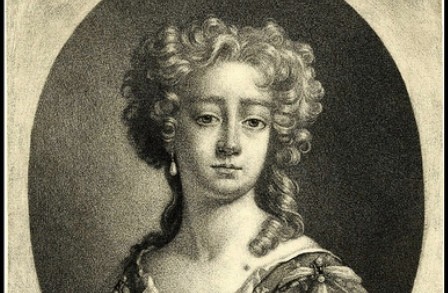
The beautiful Anne Killigrew
The occasion of this ode of course is the death of a young lady otherwise of little interest to history. My only marginal comment on it is "amusing and fun". Yes, well it is those things. Are you telling me that such sequences as
"Whatever happy region is thy place,
Cease thy celestial song a little space;
Though wilt have time enough for hymns divine,
Since heaven's eternal year is thine."
when you consider that he is addressing a dead person, are not funny? Maybe they aren't. I laugh at inappropriate and poorly understood things a lot . How about this comment on one of Miss Killigrew's paintings, crowded with satyrs, flocks of sheep, Roman ruins and other trappings of the Classical world:
"So strange a concourse ne'ver was seen before
But when the peopled ark the whole creation bore."
How about this one, on a portrait the dead lady had executed on King James II:
"The scene then changed: with bold erected look
Our martial king the sight with reverence strook;
For, not content to express his outward part,
Her hand called out the image of his heart:"
I have written about Dryden and the decline of his reputation and influence over the centuries before, one of the reasons for this being the frequently absurd and consequently hilarious effect he has when writing about somber topics. His writing abounded in exuberance and bombast, which I have a taste for when done in a somewhat clever style. And perhaps there is some value in being familiar with this type of literature in one's youth, it does enhance the perception and color one's experiences in a generally positive way for a time. But there seems to be a limit to the period when it has this value if one is not moving in some positive direction oneself. If you are moving as your force these works can move with you in a kind of parallel or complement, but when you are not then the books will take on that air of stagnation and deadness, for you at least and for the people you would extol them to.
"Now all those charms, that blooming grace,
The well-proportioned shape, and beauteous face,
Shall never more be seen by mortal eyes:
In earth the much-lamented virgin lies!"

Showing posts with label john dryden. Show all posts
Wednesday, August 30, 2017
Saturday, June 20, 2009
John Dryden--All For Love (or, The World Well Lost) (1678)
This is the last of the Cleopatra plays. As I had read this one not too many years earlier I just skimmed over it, and did not take a lot of notes. The first time I had read it, I had liked it quite a bit, thought it reminiscent of Shakespeare, on whose own Cleopatra play it was modeled, perhaps even a sparer, cleaner version of it, or, at least, was my impression. Looking over it again just after having read the Shakespeare though, as well as the Daniel and the Shaw, I did not like it quite as much.
For one thing his Antony struck me as perhaps overly romantic ("One look of hers should thaw me into tears,/And I should melt, till I were lost again...If I should hear she took another love,/The news would break my heart--now I must go;/For every time I have returned, I feel/My soul more tender..."). Shakespeare's Antony, it goes without saying, is much manlier than this. For that matter, his Lepidus is manlier than this too.
The poetry of the speeches I have marked in several places as "so-so" ("And while she speaks, night steals upon the day/Unmarked of those that hear: Then she's so charming/Age buds at sight of her, and swells to youth...), "humorous" ("Even I, who hate her/With a malignant joy behold such beauty/And, while I curse, desire it") and "kind of silly" ("And then he grew familiar with her hand/Squeezed it, and worried it with ravenous kisses") .
There is some bawdiness thrown in for the Restoration crowd ("Your Cleopatra/Dolabella's Cleopatra; every man's Cleopatra...You know she's not much used to lonely nights...ANTONY: Though heaven and earth should witness it/I'll not believe her tainted. VENTIDIUS: I'll bring you then, a witness/From hell, to prove her so...")
Octavia (Antony's wife)'s pain gets more play in this version of the story than it usually does, though there still isn't a lot of sympathy for her.
"Sure that face/Was meant for honesty; but Heaven mismatched it/And furnished treason out with nature's pomp/To make its work more easy." This makes little sense, on the part of Heaven.
Antony does show stirrings of being a genuine man later on though, when he declares "I do not know how long I can be tame" and "my justice and revenge/Will cry so loud within me, that my pity/Will not be heard for either."
Overall not as impressive as I remembered; characters are not grand or even particularly interesting. Mirrors the age I suppose. Much too soppy-romantic. Images, poetic tension better elsewhere.
Of all the figures in English literary history who have been the dominant force in their own epoch, as Dryden was in the 1670s and 80s, he is really the only one whose works don't arouse much excitement in anybody nowadays. Pope doesn't seem to be read all that much, but most of his work is at least in print, while of the twenty or so plays Dryden wrote it is difficult to find more than 2 or 3 in a common edition (Pope is also still broadly considered to be a very good poet, I think). I am also not aware of any of these plays being revived theatrically, if ever. Dryden does not, compared to the other authors of this class, including his own rough contemporary Milton, seem to have either the same quality of ideas, or the same control over such ideas and other material he does have. He was a very shaky literary dictator, often in a defensive mode in his public political and philosophical disputes, and was even suffered to be beaten up in the street by thugs on account of a book review, all of which it is hard to imagine happening, or being allowed to happen to, the likes of Milton or Samuel Johnson or Dickens.
This is the last of the Cleopatra plays. As I had read this one not too many years earlier I just skimmed over it, and did not take a lot of notes. The first time I had read it, I had liked it quite a bit, thought it reminiscent of Shakespeare, on whose own Cleopatra play it was modeled, perhaps even a sparer, cleaner version of it, or, at least, was my impression. Looking over it again just after having read the Shakespeare though, as well as the Daniel and the Shaw, I did not like it quite as much.
The poetry of the speeches I have marked in several places as "so-so" ("And while she speaks, night steals upon the day/Unmarked of those that hear: Then she's so charming/Age buds at sight of her, and swells to youth...), "humorous" ("Even I, who hate her/With a malignant joy behold such beauty/And, while I curse, desire it") and "kind of silly" ("And then he grew familiar with her hand/Squeezed it, and worried it with ravenous kisses") .
There is some bawdiness thrown in for the Restoration crowd ("Your Cleopatra/Dolabella's Cleopatra; every man's Cleopatra...You know she's not much used to lonely nights...ANTONY: Though heaven and earth should witness it/I'll not believe her tainted. VENTIDIUS: I'll bring you then, a witness/From hell, to prove her so...")
Octavia (Antony's wife)'s pain gets more play in this version of the story than it usually does, though there still isn't a lot of sympathy for her.
"Sure that face/Was meant for honesty; but Heaven mismatched it/And furnished treason out with nature's pomp/To make its work more easy." This makes little sense, on the part of Heaven.
Antony does show stirrings of being a genuine man later on though, when he declares "I do not know how long I can be tame" and "my justice and revenge/Will cry so loud within me, that my pity/Will not be heard for either."
Overall not as impressive as I remembered; characters are not grand or even particularly interesting. Mirrors the age I suppose. Much too soppy-romantic. Images, poetic tension better elsewhere.Of all the figures in English literary history who have been the dominant force in their own epoch, as Dryden was in the 1670s and 80s, he is really the only one whose works don't arouse much excitement in anybody nowadays. Pope doesn't seem to be read all that much, but most of his work is at least in print, while of the twenty or so plays Dryden wrote it is difficult to find more than 2 or 3 in a common edition (Pope is also still broadly considered to be a very good poet, I think). I am also not aware of any of these plays being revived theatrically, if ever. Dryden does not, compared to the other authors of this class, including his own rough contemporary Milton, seem to have either the same quality of ideas, or the same control over such ideas and other material he does have. He was a very shaky literary dictator, often in a defensive mode in his public political and philosophical disputes, and was even suffered to be beaten up in the street by thugs on account of a book review, all of which it is hard to imagine happening, or being allowed to happen to, the likes of Milton or Samuel Johnson or Dickens.
Subscribe to:
Posts (Atom)


