I haven't done a song post in a while. "Lacking wit or originality" anymore as the expression goes, I offer with complete earnestness some of the tunes I have been firing up of late in idle moments.
Vance Joy--"Riptide"
I'll even start with a relatively contemporary one (2013). My eight year old son started taking guitar lessons last year, and this was the first song he learned to play that was recognizable. He has moved on from this and is actually pretty good for his age, but I have developed a fondness for this song whenever I hear it in the grocery store or wherever. Indeed I have come to think it's a great pop song, and I hear very little recent music that appeals at all. I like the retro style of the video as well.
Hugo Winterhalter--"Canadian Sunset"
Having paid some tribute to the current decade though, I have to retreat right away all the way back to 1954. The much-loved radio station I used to listen to on my drives around the old and lonely roads of New Hampshire before the entirety of its listenership with the exception of me finally died off was very strong in the neglected area of popular 50s era instrumentals, none of which I ever managed to learn the names of apart from a few movie themes. Even on satellite radio I cannot find a station that reliably plays these numbers. This one overall being my favorite I was able to track it down on the internet despite not knowing the title by trial and error. It evokes numerous images and memories for me, including my grandparents, lunch at old-fashioned roadside inns, the day after a snowstorm when the sun shines so brilliantly, the days when my oldest boys were little before they went to school and we went on day trips all over our area. A highly sentimental song.
Pat Boone--"Moody River"
Pat is a smarmy dork, but along with "Love Letters in the Sand", this belongs to my personal List of Shame, consisting of songs by crummy singers that I have always liked, though in the instance of the two Boone songs and the next one, I genuinely did not realize that the songs were performed by these inferior artists until I was past 40 years old! This also reminds me a lot of my grandparents, mainly of their dining room, into which the flicker and sounds of their television, which was always on, would eternally faintly penetrate from the adjacent living room with the sounds of programming such as this.
The Monkees--"A Little Bit You, A Little Bit Me"
Written by Neil Diamond as well for bonus schmaltz points, but a very catchy song. The Monkees in my childhood were one of those seemingly random phenomena that my father despised so vehemently that there was no question of ever admitting any aspect of their existence to have any possible redeeming quality whatsoever. This particular song somehow escaped my attention as being theirs until it turned up as part of the soundtrack on the video yearbook one of my children's classes put out.
Billy Joel--"Rosalinda's Eyes"
This one I knew all along was a Billy Joel song, so I have no excuse. I heard it at Rite Aid one afternoon when it was pitch dark at 4:30 and thought, this isn't that bad of a song, really. And this video is pretty cheerful.
Buddy Holly--"True Love Ways"
My current favorite Buddy Holly song. Wistful late 50s vintage Americana. Makes me think of leaning against a kitchen sink in front of a closed blind drinking a class of milk late at night after getting home from my last date with Phyllis before she called it off. Deep stuff.
Bob Welch--"Ebony Eyes"
Another forgotten song that seemed pretty great to me when I listened to it again, at least the first few times. Our society doesn't seem to be producing a lot of guys like Bob Welch, whether for good or ill. I would wager that he committed what would now be considered sexual harassment at some point in his life, though blissfully unaware of the fact, and thought of his actions as a "move" or something of that sort. The quality of the video is not great, but I recognize some of those late 70s type women whose mantra was something like "live fully in the moment now, become angry later". I don't know, the party looks fun comparative to what we can hope for in the present.
Jo Stafford--"Try to Remember the Kind of September"
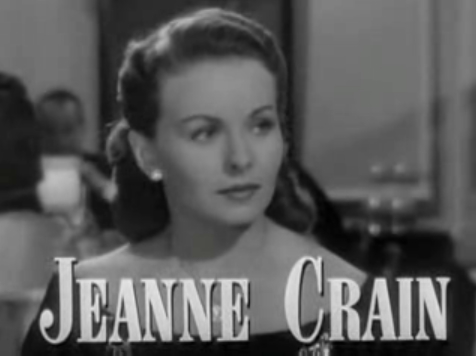
Tribute video featuring the truly delectable Jeanne Crain and many of her wonderful underrated movies (Margie is an especial favorite). I don't necessarily want to be taken back, but I don't want to be taken completely away either.
Andy Williams--"Can't Get Used to Losing You"
Just because...To be honest there will be probably never be a hit song like this again.
Showing posts with label Jeanne crain. Show all posts
Showing posts with label Jeanne crain. Show all posts
Thursday, January 18, 2018

Sunday, November 24, 2013
A Very Long Movie Post Because It Concerns My Favorite Years (1945-46)
During my survey of the history of movies, I have identified a few especially favorite years, 1962 being one, and 1951, perhaps unexpectedly, has proven to be a year with a lot of things that I like. There are other years, such as 1949, 1966, 1971, that occasionally pop up and seem possibilities, with a couple of more hits, to join this exalted group. I think however that my all time favorite year in cinema history is 1945, with 1946 just behind it. The first year especially does not seen to usually be considered by experts as one of the all time great ones. As I have noted in other posts, the films from that year, particularly from Hollywood, have a somber, gentle, unfrenetic aspect about them that likely does not appeal to people who like their life and art to be as edgy and exciting as possible, but clearly I love them. There was a rather academic-sounding book written about these two years in film which makes an argument for them indeed being the best of all time. Here is a review of it. There are two sentences from the review that resonate for me, the first a quote from the actual book, the second a follow-up comment with regard to the quote:
"For many moviegoers the time coincided with their own 'best years'; for others who came later, the movies of this period mirror an extraordinary chapter in the nation's saga they regret having missed."
"Alluding to the nostalgia associated with the immediate postwar period, the Affrons colorfully suggest that generational memories of 1945-46 have sunk deeply into the U.S. subconscious, so much so that those of us born after the fact feel compelled to relive the best years vicariously through the film camera's misty-eyed lens."
There is certainly something in this that applies to me, even if I would not describe the effect these movies have on me in exactly these terms. I would also say that the people for whom the generational memory of 1945 has sunk deeply into their subconscious constitute a decided minority, even among the sensitive. Most people seem to be able to resist the nostalgia without too much of a struggle.
La Belle et La Bete (1946)
It is often referred to by its French title, not only because that title is so great, but also in later years to distinguish it from the Disney movie. Like Les Enfants du Paradis, this was made at the very end of World War II and remains beloved in France to this day. There were numerous special features that came with the film, many interviews or short documentaries taken from French television, in which an aged actor or makeup artist or cinematographer would be presented and a resume full of said person's involvement in classic movies by iconic directors would be recited; but always at the very end the announcer would say some variation of "but so-and-so will always be most remembered for his work in Cocteau's La Belle et La Bete." This period at the end of the war was probably the most emotional time in recent memory, in every country that was involved in it. This emotion was not of the hysterical, irrational quality that the word seems to have come to mean in recent years, but, when applied to the classic films of the era, that in which people express, in a controlled and even subdued, but very direct way, those things which they most deeply love and desire and feel.
Apart obviously from Germany and Japan (and Austria), no one receives less sympathy in this country for what they endured during World War II than the people of France. The Italians, despite actively being on the other side during the most tenuous part of the conflict, my sense is are thought of, if they are thought of at all in relation to that period, as having been poor and wretched and suffered considerably, while with the French the emphasis is forever on collaborators, defeatists, women who consorted with the Nazis, and a general sense that the mainstream population was comparatively living it up while everyone else on the continent was starving and being subjected to torture on a routine basis. I don't know how important the films which emerged from these two countries in the immediate aftermath of the war were in confirming these impressions, but I suspect they had some influence; the Italians of course producing the neo-realists, who in the beginning at least had a somewhat underground quality about them, and movies like The Bicycle Thief and Open City (the former of which at least I do think is still one of the greatest of all time, for the record) in which, however one wants to color it, the predominant attitude is "We are desperate. We are on our knees. May some fate or power or something have mercy on us."--while the French in contrast brought out numerous titans of their pre-war artistic establishment and produced a couple of films, also among the very greatest of all time, in which the message being conveyed, to themselves, the rest of the nation, and that portion of the greater world that cared about such things, was "Our self-esteem has been shaken, but we are still who and what we always have been, and we are still great." This is an example too of what I was referring to earlier by the depth of emotion that these movies carry, and which gives them a power that is doubtless hard to duplicate in ordinary instances. The insistent pride which undergirds them, in spite of the more complicated and interesting emotions which move the work, nonetheless will always I fear tend to work against a real understanding and feel for what these movies are about in some instances.

I have had the Georges Auric musical soundtrack for years, though I had not seen the movie before. I got it back in the 90s when I was a member of the Columbia Record Club. It was one of their monthly selections that you got sent if you forgot to mail in the card saying that you didn't want it. Of course you were supposed to pay for the CD or send it back, but...I used to listen to it fairly often for a time. All-instrumental movie soundtracks are probably an underappreciated genre, especially as background music. I don't like to move about in a silent house (of course this was more of an issue before I had a lot of children), especially if I am not writing, but opera and some of the more intense classical composers can be a bit much first thing in the morning, with one's eggs and toast....
My general thoughts about this movie, about which entire books have been written--I think it does what it sets out to do, which is roughly to connect a modern avant-garde sensibility with a specifically French classical story (this was something of a specialty of Cocteau's, who frequently used ancient stories and themes in all his arts); it uses what it has--its material, and the emotions and allusions suggested by this material--expertly. It feels classical, in the sense that the story feels elementally spare yet expansive and significant in all of its parts. The actors, as they always are in French movies of this time, are excellent, fully inhabit their roles, seem as if they completely understand what the movie is about, and so on...
The Lost Weekend (1945)
A 1945 movie directed by Billy Wilder that is about drinking would probably be impossible for me not to like. And I had never seen it before. I have known about it for a while, of course, but I was waiting for it to come up in my system, as something to look forward to. It does contain pretty much everything I like in movies. I suppose one could pick apart the script and the acting and find numerous flaws, but I found it moving and disturbing enough in about equal measure that the flaws don't concern me that much.
I like what Jane Wyman does here as the girlfriend--I suppose this is in keeping with my general love of women in movies in this era. People don't like the character because she won't drop the drunken loser, but it's good for the movie's emotional thrust that the protagonist has this normal, likable and yes, sad and deluded woman who loves him and feels such devotion to him. It may not matter to the alcoholic, but the idea of that degree of loyalty and affection in a woman even when one has hit bottom appeals strongly to the imagination of the audience. And it is not as if women don't love alcoholics, or at least enough of them do. They may not love the alcoholism itself, exactly, but there is in many instances some characteristic which is indicative of tendencies in that direction that appeals to them that is absent from the makeup of the computer genius. Though she will never admit it, I'm quite sure my wife liked me better when I drank more than she does now. I was more work, and more unpredictable, and much more interesting, and there was some drama, or the possibility of it, because I had more delusions about being alive and a real person than I do now, and women do like that, even if they don't always realize it.

I note a number of people in online reviews saying the ending was too Hollywood. I did not see it as being too Hollywood at all. If anything I thought it was ambiguous, and quite well played. There is absolutely nothing in the ending that indicates he won't be back at the bar begging for more rye by four o'clock that same afternoon. Sure, he puts the gun down and his girlfriend who looks pretty from being out in the rain hugs him in tears and he says he is going to stop and begin writing again...I go through this routine about three times a week, it means absolutely nothing. The ending is fine, I think it is quite good, actually.
I love the old 40s and 50s style alcoholics' bars, better even than the old nightclubs. The kind that are always uncrowded and a little melancholy, plenty of room at the bar, booths, wood or veneer-paneled walls. They're all just about gone now. I don't know of any still in operation that fit the type. When I was young there were still a few up in the Northeast Philadelphia area. My grandfather used to take me to them for lunch. The Little Campus in Annapolis was another, now gone. There is still a bar there, under a different name, but a recent travel book I have describes it as "the epitome of a power-broker bar". I'm pretty sure there was no power broking going on at the Little Campus.
This is one of those movies (Who's Afraid of Virginia Woolf? is another--I haven't seen The Days of Wine and Roses, which I guess is the third part of the trinity of drinking movies) where you have to stop the film somewhere in the middle, go and get a bottle of some real stuff--I always drink beer when I watch movies, but that doesn't cut it in these instances--and drink along with it. Like Don Birnum also, I was carfeul to hide my bottle and shotglass from my wife, who was floating around the house doing work, having opted out of seeing the movie due to the grim subject matter (and perhaps the subject matter hit too close to home?) I do identify too strongly with alcoholics. I once thought maybe I would become one--if you had told me twenty years ago what my life would be like now, I would have assumed I must become one to preserve any sense of self I might have--but as in most things, I didn't have it in to be that extreme, and upset and disturb people. But I do feel like I understand characters like this and their lives and why they have no great desire to change better than I do most other types of people.
I do worry that the world, or at least America, is being taken over more and more by people for whom the mentality on display would not even begin to make any sense. That is perhaps good for America but it is bad for me, who always found society and the environment all around me alien enough as it was. But it only seems to be getting worse.
Leave Her to Heaven (1945)
I thought this might finally be the 1945 movie I wasn't going to like. Described as "slick trash" even by people writing favorably about it, it is a technicolor melodrama with a lot of stilted acting and dialogue set in the kind of bland, sterile, expensive rooms that one forgets were fashionable around this time (indeed, my grandparents were still betraying signs of this influence into the 80s). Yet there was enough to interest me and keep me going. These points briefly were:
1. Jeanne Crain! I love Jeanne Crain. I wrote a little about her in Letter to Three Wives here. I will comment more on her in this movie below.
2. Though filmed entirely on sets and around the Lake Tahoe area and not having anything in particular that really reminds one of anything about Maine, most of the movie is set at Deer Lake or Bar Harbor. The glow of having gone to Bar Harbor for the first time this past summer is still fresh with me, and I found the thought of wandering around the village there and coming upon Jeanne Crain hoeing in the garden rather captured my fancy.
3.Vincent Price. In a supporting role, as Gene Tierney's jilted fiance. I had never seen him in a movie before. He is only really in two scenes, though the second one is long and crucial to the movie. He's an interesting figure. He seems to have been well-liked, and was widely regarded as a cultivated man. He had majored in art history at Yale. He famously lent his name and expertise to the Sears Roebuck company's line of fine art for home furnishings in the 60s, which apparently was a serious enterprise, and included work by people like Picasso and Salvador Dali. He came at his career from many different angles, and was at least adequate in all of them. He also was noted for his cooking and gourmet taste in food back when this was a less widespread interest than it is now, and he wrote several cookbooks.
4. The script must be better than it seems on a first impression, because somehow the thing held my interest, though apart from the courtroom scene where Price plays a rather manic lawyer, nothing in it much stands out.
5. Gene Tierney is the star. She is extremely beautiful. I don't think she is more beautiful than Jeanne Crain, but then I like the more wholesome types. Gene Tierney plays a psychopath who lures a cripple into the middle of the lake and looks on detachedly while he drowns because he is too weak to swim anymore, throws herself down a flight of stairs to self-induce an abortion, and arranges her own suicide in such a manner as to implicate her innocent half-sister (Crain) as having murdered her. According to the commentary she was not much more emotionally responsive in real life.

About that commentary...it was weak. I endured it because I wanted to go through the movie again. The commentators were the veteran film critic Richard Schickel and the former child actor who had played the cripple who drowned. This is the third movie I've gotten where Richard Schickel has been the commentator. Along with the woman who did Lola Montes, his commentaries are the most useless I have come across. The first two I gave up after ten minutes, but as I said, I wanted to go through this one again and try to figure out what it was about it that worked. Schickel started off on the wrong foot for me when he quickly dismissed Jeanne Crain as a subject of any interest, observing that she was a beauty queen with limited acting abilities who 'lacked fire'. However true this ultimately may or may not be, I have to admit my immediate response at this instant was "is this guy gay?" I couldn't find a definite answer to my question, but my guess is "probably". If Richard Schickel's general knowledge and capacity for thought, his aesthetic sensibility, his sense of humor, were interesting and worthy of my admiration and emulation, I don't think the question of his possible gayness would have pressed itself upon me so crudely. However, since I already did not like his commentaries, or any of the directions where his perceptions lead him, and presumably would, or should, lead us, and he begins speaking flippantly of my favorite 1940s actresses, a situation arose where I reached a sort of breaking point.
Speaking of all which, The Lost Weekend didn't have a commentary. I'll do one for it if no one else wants to, though I would have to get paid for it.
Other interesting Wikipedia tidbits about Jeanne Crain:
She achieved notoriety as an teenager for her ice skating.
She had seven children.
She was nicknamed "Hollywood's number one party girl" in the late 40s and early 50s, though this appears to refer to her rate of attendance rather than wildness of behavior.
She was married to her husband for 57 years, though they appeared to live apart for most of that time and they nearly divorced in the 50s, with each party claiming the other had been unfaithful. The details on this are not very satisfactory.

She was an active advocate for conservative Republican causes during the 1960s. Again, details are not forthcoming as to which causes she was especially fervent for. Another site notes merely that 'unlike the humanistic, progressive-thinking Margie (reference to one of her roles), Crain was a conservative Republican who supported Richard Nixon". Horrors! This page fills us in further that Crain's husband beat her brutally, that she never divorced him because she was Catholic, that she became a severe alcoholic, and two of her children predeceased her due to alcohol and drugs. Maybe I shouldn't do any more research...
Lady on a Train (1945)

In many ways a perfect 1945 movie--inveterately scruffy, pace very deliberate, at times scarcely discernable, plot simple and not especially the point of the movie in any case, good-spirited in a somber, muted way, has some wry humor mixed in with more telegraphed humor, a distillation, I think, of the national mood and general character at that particular time. It stars a very likeable Deanna Durbin who is fun, fun, fun and decidedly livens up what could otherwise be a dreary wartime atmosphere. Deanna Durbin was a four or five tool star: good-looking, could sing, was intelligent, was very funny in her own perky way. Not everybody liked her of course. She probably was not considered to have a lot of fire either, which quality seems to be especially treasured in women by my father's (early baby boomer) generation regardless of their sexual orientation. Earlier in her career she was famous for playing the Ideal Daughter (as that role was perceived at the time) in a series of teenybopper movies. I haven't seen any of these ideal daughter films (Three Smart Girls seems to be regarded as the most vital one of the group). Personally I think the ideal daughter is an aspirational ideal that society could embrace more widely that it does at present without overly sinister results, but perhaps I am showing my naivete again.
Deanna Durbin for some reason is always described as Canadian. It is true that she was born in Winnipeg but her parents moved to Los Angeles when she was a year old (that would be age 1). Even all of her singing instruction appears to have been done in this country. I don't mind the Canadians claiming her, but if, as we are often told, people who move here as full adults, especially if they have a work ethic and entrepreneurial or other high level career skills, are more fundamentally American that most of the people who happen to be here by mere accident of birth, then I am not sure why Deanna Durbin would not automatically be considered an American first.
Lady On a Train spoofs, albiet gently, a number of tropes of 1940s film--noir, Orson Welles, the outlandish kinds of nightclubs that are ubiquitous in movies of this era (and which I have often extolled myself in these pages), the entire murder-mystery genre of novels and movies, which was obviously flourishing at the time.
Thursday, January 20, 2011
Movies 1942-1950
Love them and extol them as my favorite era in cinematic history though I do, I actually have not even seen that many of the classic films of these years. Today's group includes three I had never heard of previously and another that I had confused with something else. So I was pretty excited at the likelihood of discovering at least one unsuspected pleasure in the bunch, which kinds of pleasant surprises of course grow more infrequent with the inexorable advance of age.
The Asphalt Jungle (1950)
This is the one I had confused, thinking of Blackboard Jungle, the famous film about 50s juvenile delinquents who came to school chewing gum, flashing switchblades, and generally not bearing a mindset conducive to effective learning (Thank goodness we have gotten those problems under control). The one is a film noir directed by the legendary John Huston, with whose work however I am just beginning to become acquainted. Indeed I am just starting to distinguish his career from that of fellow legend (and John) John Ford, with whose work I am even less familiar, though the latter's legend is if anything even bigger at the highest levels of cinephilia than Huston's is--doubtless at this very moment some avant-garde Japanese director with pink hair that I have never heard of is declaring with complete sincerity that John Ford is one of the major influences on his work. Back to Huston, last year I watched and reported briefly on The African Queen, which came out the year after this, and which I was entertained but not much absorbed by. Some years ago I saw 1948's Treasure of the Sierra Madre, which I remember, albeit hazily, as more substantial, and probably great. I also saw his 1987 version of Joyce's The Dead even more years ago, which at the time however did not strike me as adding anything to the original story. My feelings on The Asphalt Jungle are again somewhat mixed--I have yet to make that connection with Huston's peculiar vision, or genius, that makes one an especially devoted admirer.
As noted, The Asphalt Jungle is another film noir, of which genre we have been on a bit of a run these past few years. Huston also made The Maltese Falcon and Key Largo, which I have not seen but which I take to be in the film noir spirit, though as they featured actors who were A-list stars at the time and had bigger budgets and promotion they are sometimes not included among the classic B-movie, harshly lit, ugly mug strain of classic film noir. This one had lots of ugly mugs and no established superstars (though it did feature several people who later on became stars, including, most notably, Marilyn Monroe), so it is often considered the most purely noir picture Huston made. Film noir story arcs all being largely the same, the style, characterization, idiosyncratic plot elements, sex appeal of the women, etc, etc, of this family of movies are especially important. These elements in Asphalt Jungle are not terrible, but they are not on the level of Double Indemnity or The Third Man, both of which have more evocative settings and sophisticated characters (and consequently dialogue), somewhat more developed criminal schemes, more interesting clothes and other props, as well as (to me) more appealing women. Of course both of those screenplays were written by celebrated literary authors (Raymond Chandler and Graham Green), a connection I had previously failed to make, and the significance of which clearly shows in these instances.
 I have written before that I am not the greatest Marilyn Monroe fan who ever lived. She plays what most people would think of as a prototype Marilyn Monroe character in this movie. She is 23 or 24 here, and even I her detractor grant that she is eminently squeezable. There is nothing else in her persona here that particularly excites me however. The humor and warmth that she allegedly brought to her later celebrated roles is yet in evidence. She and the other main female character, played by Jean Hagen, are perhaps illustrative of a general transition in the depiction of womanhood as the 40s moved into the 50s, certainly in the realm of film noir. Both of the women in this are rather passive, weak and stupid compared to their mid-40s noir counterparts, either the famed femme fatales, who were hard, scheming, usually unsentimental agents of destruction, or, if they were virtuous, intelligent and forceful enough to assert their personalities with some effect against the evil that threatens to engulf them on all sides. The change I am describing is probably exaggerated here--from what I have seen and heard of Huston, he was a man's man whose genius did not lie in his depictions of women or male/female relations--but I most people have always sensed that something of the sort did broadly occur.
Sterling Hayden, who I just saw recently further on in his career in The Godfather (he's the Irish cop who gets it in the Italian restaurant), was the lead in this. He was six foot five, which is unusually tall for a movie star. He's not one of my favorites either. It's not clear whether he is really kind of dense, or if he just got assigned to play a lot of dense characters. In any event, he played them perhaps a little more literally densely than was called for.
There is a trope in the movie that each of the characters in on the heist has a weakness that ultimately leads directly to his downfall. I thought this was a rather hokey element that didn't really add anything to the movie, especially the Sam Jaffe character, who is the mastermind of the operation but is supposed to be an incurable old lecher who gets mesmerized watching a girl dancing to a jukebox in the kind of roadside tavern I am always searching for in my own travels and ending up shuffling into Friendly's twenty minutes before closing time after several fruitless hours of searching. I am coming off as down on the movie, but it has its good points, and it is fun to talk about. It did not grab me as great however.
The Life and Death of Colonel Blimp (1943)
I am going a little out of order due to the way the pictures arranged themselves in the loading.
There is a considerable amount of awesomeness in the myriad parts of this movie, which, if they do not perfectly cohere into a completely staggering whole, still make for a uniquely great film after a manner. This was made in the midst of the war and is nominally a propaganda movie, but it is more sophisticated than the usual specimens of that genre. Colonel Blimp was a newspaper caricature which was supposed to represent the chauvinistic, tiger-hunting, war and empire-loving, intellectually obtuse, conservative element of society whose attitudes were relics of the increasingly remote Victorian era--i.e., he was not conceived with flattery in mind. The irrepressible, up to date, and rather brilliant filmmaking duo of Michael Powell and Emeric Pressburger, whose work I am encountering for the first time, decided to make this restless and generally likeable (at least to people with some affection for the old British ruling classes), though frequently clueless creature the hero of their wartime epic; and it worked. The story, after a jazzy opening sequence in the (1943) present which is repeated and clarified at the end of the movie, finds the aged though still commisioned Colonel Blimp (who actually is a general and is named Clive Candy in the film) in the Turkish bath at his London club, where in the midst of a tussle with a young whippersnapper who has come to play a prank on him, we are transported back to the same scene 40 years earlier, when Blimp is a dashing young officer. Colonel Blimp, by the way, is played by the superb actor Roger Livesey, who was apparently a last second replacement for Laurence Olivier. Olivier's presence is not missed, which should give an idea of how good Roger Livesey is. We then follow Blimp/Candy through the ensuing forty years, which include numerous scenes of interest including a rollicking beer hall and a duel in imperial Germany, an abbey in World War I France, a dinner party at Blimp's house in 1919 with a (now) ridiculous gallery of pompous guests with important titles, and a visit to the underground bunker housing the BBC's wartime studios. Gaps, or, as Christopher Fry more elegantly put it in one of the bonus materials, lacunae, in the story, usually the periods between wars, are marked by a striking device which is remarked upon by every commentator on the film, in which the heads of the victims of Blimp's hunting expeditions throughout the British Empire appear, following the sound of a rifle shot, mounted upon the wall in his study, accompanied by a placard with the name of the country and the year of the kill. The study was actually looking like a pretty cool place to hang out by the latter stages of the movie.
This is a Criterion Collection film, and as such features a pretty good commentary, by Martin Scorcese and Michael Powell, the director of the picture himself. Powell died in 1990 at age 84, so his portion was evidently recorded some time back. He sounds quite aged in it. Scorcese's part is a little too film geekish for me, but Powell's is most enjoyable. Though he refers to his origins as middle class several times in the course of the monologue, he comes across as one of those old timers who was deeply educated and immersed in the European art tradition from an early age--perhaps that is an upper middle class signifier. While there is some technical movie directing talk, he also talks a lot about his Savile Row tailor, the fashions in ladies' hats through the early part of the 20th century, the etiquette of duelling in Germany, and things like that. When discussing actors, he noted that Deborah Kerr (pronounced "car") was intelligent, which was unusual in that profession. He did not say this in a perjorative way however, as we have being accustomed to take such statements, but as if there were numerous qualities of equal value that a good actor, or a good person, could possess. He clearly held the abilities of Richard Livesey, to whom he attributed the quality of unusual honesty, in high regard, though he did not praise him as intelligent, this the more pointedly as the discussion of his honesty came within five minutes of the comment about actors generally not being intelligent. There is a part at the end where he lucidly explains the impressiveness with which the Austrian actor and refugee from Nazism Anton Walbrook--I can't believe he wasn't intelligent--carries off a long speech, in English, a foreign language for him and in a different tradition, which makes Scorcese's and all contemporary people's gushings and conversation on interesting matters seem utterly inarticulate.
This movie was made in gorgeous Technicolor. On one of my old posts I wrote that I had never seen a British film in color prior to 1965 or so, and was only aware of the 1951 festival-commissioned The Magic Box, which for some reason is not available in North America, as having been shot in it. Evidently British Technicolor films constitute an entire genre of cinephile fetishism. Scorcese, in the most interesting observation he made on the movie, noted that British Technicolor films were widely considered more beautiful than Hollywood's offerings of the same, because the muting effects of the continually overcast English light made for a more delicate and striking effect, and after seeing this, I am inclined to believe him. Why don't they make movies in Technicolor anymore? Is it expensive? Because when done well, it looks better than whatever kind of color treatment is usually used now.
Deborah Kerr, best known among us for such 50s Hollywood classics as From Here to Eternity, The King and I, and An Affair to Remember, was, for lack of a better word--I am too tired to come up with one at the moment--a revelation to me in this movie. She played three different girls, one in 1902, one in 1918-19, and one in 1943. Her 1919 persona was pretty fetching--I like the style of that time too--but the 1943 version of her as Colonel Blimp's driver just about laid me out. It's the hair. There is no amount of exposure to 1943-44 women's hairstyles that is possible to weary me of them--and if you can believe it there are many creditable people who think those were the absolute worst years for women's hair in the whole 20th century!

 I am going to talk about the actresses a little, because I like to do that.

 The final shot, which involves a car with about seven children in it, in their 1942 kiddie outfits, none of them in car seats, several sitting in front and one sitting on the driver's lap, with the announcement that a bigger car will be needed next year--I thought it was charming.
Love them and extol them as my favorite era in cinematic history though I do, I actually have not even seen that many of the classic films of these years. Today's group includes three I had never heard of previously and another that I had confused with something else. So I was pretty excited at the likelihood of discovering at least one unsuspected pleasure in the bunch, which kinds of pleasant surprises of course grow more infrequent with the inexorable advance of age.
The Asphalt Jungle (1950)
This is the one I had confused, thinking of Blackboard Jungle, the famous film about 50s juvenile delinquents who came to school chewing gum, flashing switchblades, and generally not bearing a mindset conducive to effective learning (Thank goodness we have gotten those problems under control). The one is a film noir directed by the legendary John Huston, with whose work however I am just beginning to become acquainted. Indeed I am just starting to distinguish his career from that of fellow legend (and John) John Ford, with whose work I am even less familiar, though the latter's legend is if anything even bigger at the highest levels of cinephilia than Huston's is--doubtless at this very moment some avant-garde Japanese director with pink hair that I have never heard of is declaring with complete sincerity that John Ford is one of the major influences on his work. Back to Huston, last year I watched and reported briefly on The African Queen, which came out the year after this, and which I was entertained but not much absorbed by. Some years ago I saw 1948's Treasure of the Sierra Madre, which I remember, albeit hazily, as more substantial, and probably great. I also saw his 1987 version of Joyce's The Dead even more years ago, which at the time however did not strike me as adding anything to the original story. My feelings on The Asphalt Jungle are again somewhat mixed--I have yet to make that connection with Huston's peculiar vision, or genius, that makes one an especially devoted admirer.
As noted, The Asphalt Jungle is another film noir, of which genre we have been on a bit of a run these past few years. Huston also made The Maltese Falcon and Key Largo, which I have not seen but which I take to be in the film noir spirit, though as they featured actors who were A-list stars at the time and had bigger budgets and promotion they are sometimes not included among the classic B-movie, harshly lit, ugly mug strain of classic film noir. This one had lots of ugly mugs and no established superstars (though it did feature several people who later on became stars, including, most notably, Marilyn Monroe), so it is often considered the most purely noir picture Huston made. Film noir story arcs all being largely the same, the style, characterization, idiosyncratic plot elements, sex appeal of the women, etc, etc, of this family of movies are especially important. These elements in Asphalt Jungle are not terrible, but they are not on the level of Double Indemnity or The Third Man, both of which have more evocative settings and sophisticated characters (and consequently dialogue), somewhat more developed criminal schemes, more interesting clothes and other props, as well as (to me) more appealing women. Of course both of those screenplays were written by celebrated literary authors (Raymond Chandler and Graham Green), a connection I had previously failed to make, and the significance of which clearly shows in these instances.
I have written before that I am not the greatest Marilyn Monroe fan who ever lived. She plays what most people would think of as a prototype Marilyn Monroe character in this movie. She is 23 or 24 here, and even I her detractor grant that she is eminently squeezable. There is nothing else in her persona here that particularly excites me however. The humor and warmth that she allegedly brought to her later celebrated roles is yet in evidence. She and the other main female character, played by Jean Hagen, are perhaps illustrative of a general transition in the depiction of womanhood as the 40s moved into the 50s, certainly in the realm of film noir. Both of the women in this are rather passive, weak and stupid compared to their mid-40s noir counterparts, either the famed femme fatales, who were hard, scheming, usually unsentimental agents of destruction, or, if they were virtuous, intelligent and forceful enough to assert their personalities with some effect against the evil that threatens to engulf them on all sides. The change I am describing is probably exaggerated here--from what I have seen and heard of Huston, he was a man's man whose genius did not lie in his depictions of women or male/female relations--but I most people have always sensed that something of the sort did broadly occur.Sterling Hayden, who I just saw recently further on in his career in The Godfather (he's the Irish cop who gets it in the Italian restaurant), was the lead in this. He was six foot five, which is unusually tall for a movie star. He's not one of my favorites either. It's not clear whether he is really kind of dense, or if he just got assigned to play a lot of dense characters. In any event, he played them perhaps a little more literally densely than was called for.
There is a trope in the movie that each of the characters in on the heist has a weakness that ultimately leads directly to his downfall. I thought this was a rather hokey element that didn't really add anything to the movie, especially the Sam Jaffe character, who is the mastermind of the operation but is supposed to be an incurable old lecher who gets mesmerized watching a girl dancing to a jukebox in the kind of roadside tavern I am always searching for in my own travels and ending up shuffling into Friendly's twenty minutes before closing time after several fruitless hours of searching. I am coming off as down on the movie, but it has its good points, and it is fun to talk about. It did not grab me as great however.
The Life and Death of Colonel Blimp (1943)
I am going a little out of order due to the way the pictures arranged themselves in the loading.
There is a considerable amount of awesomeness in the myriad parts of this movie, which, if they do not perfectly cohere into a completely staggering whole, still make for a uniquely great film after a manner. This was made in the midst of the war and is nominally a propaganda movie, but it is more sophisticated than the usual specimens of that genre. Colonel Blimp was a newspaper caricature which was supposed to represent the chauvinistic, tiger-hunting, war and empire-loving, intellectually obtuse, conservative element of society whose attitudes were relics of the increasingly remote Victorian era--i.e., he was not conceived with flattery in mind. The irrepressible, up to date, and rather brilliant filmmaking duo of Michael Powell and Emeric Pressburger, whose work I am encountering for the first time, decided to make this restless and generally likeable (at least to people with some affection for the old British ruling classes), though frequently clueless creature the hero of their wartime epic; and it worked. The story, after a jazzy opening sequence in the (1943) present which is repeated and clarified at the end of the movie, finds the aged though still commisioned Colonel Blimp (who actually is a general and is named Clive Candy in the film) in the Turkish bath at his London club, where in the midst of a tussle with a young whippersnapper who has come to play a prank on him, we are transported back to the same scene 40 years earlier, when Blimp is a dashing young officer. Colonel Blimp, by the way, is played by the superb actor Roger Livesey, who was apparently a last second replacement for Laurence Olivier. Olivier's presence is not missed, which should give an idea of how good Roger Livesey is. We then follow Blimp/Candy through the ensuing forty years, which include numerous scenes of interest including a rollicking beer hall and a duel in imperial Germany, an abbey in World War I France, a dinner party at Blimp's house in 1919 with a (now) ridiculous gallery of pompous guests with important titles, and a visit to the underground bunker housing the BBC's wartime studios. Gaps, or, as Christopher Fry more elegantly put it in one of the bonus materials, lacunae, in the story, usually the periods between wars, are marked by a striking device which is remarked upon by every commentator on the film, in which the heads of the victims of Blimp's hunting expeditions throughout the British Empire appear, following the sound of a rifle shot, mounted upon the wall in his study, accompanied by a placard with the name of the country and the year of the kill. The study was actually looking like a pretty cool place to hang out by the latter stages of the movie.
This is a Criterion Collection film, and as such features a pretty good commentary, by Martin Scorcese and Michael Powell, the director of the picture himself. Powell died in 1990 at age 84, so his portion was evidently recorded some time back. He sounds quite aged in it. Scorcese's part is a little too film geekish for me, but Powell's is most enjoyable. Though he refers to his origins as middle class several times in the course of the monologue, he comes across as one of those old timers who was deeply educated and immersed in the European art tradition from an early age--perhaps that is an upper middle class signifier. While there is some technical movie directing talk, he also talks a lot about his Savile Row tailor, the fashions in ladies' hats through the early part of the 20th century, the etiquette of duelling in Germany, and things like that. When discussing actors, he noted that Deborah Kerr (pronounced "car") was intelligent, which was unusual in that profession. He did not say this in a perjorative way however, as we have being accustomed to take such statements, but as if there were numerous qualities of equal value that a good actor, or a good person, could possess. He clearly held the abilities of Richard Livesey, to whom he attributed the quality of unusual honesty, in high regard, though he did not praise him as intelligent, this the more pointedly as the discussion of his honesty came within five minutes of the comment about actors generally not being intelligent. There is a part at the end where he lucidly explains the impressiveness with which the Austrian actor and refugee from Nazism Anton Walbrook--I can't believe he wasn't intelligent--carries off a long speech, in English, a foreign language for him and in a different tradition, which makes Scorcese's and all contemporary people's gushings and conversation on interesting matters seem utterly inarticulate.
This movie was made in gorgeous Technicolor. On one of my old posts I wrote that I had never seen a British film in color prior to 1965 or so, and was only aware of the 1951 festival-commissioned The Magic Box, which for some reason is not available in North America, as having been shot in it. Evidently British Technicolor films constitute an entire genre of cinephile fetishism. Scorcese, in the most interesting observation he made on the movie, noted that British Technicolor films were widely considered more beautiful than Hollywood's offerings of the same, because the muting effects of the continually overcast English light made for a more delicate and striking effect, and after seeing this, I am inclined to believe him. Why don't they make movies in Technicolor anymore? Is it expensive? Because when done well, it looks better than whatever kind of color treatment is usually used now.
Deborah Kerr, best known among us for such 50s Hollywood classics as From Here to Eternity, The King and I, and An Affair to Remember, was, for lack of a better word--I am too tired to come up with one at the moment--a revelation to me in this movie. She played three different girls, one in 1902, one in 1918-19, and one in 1943. Her 1919 persona was pretty fetching--I like the style of that time too--but the 1943 version of her as Colonel Blimp's driver just about laid me out. It's the hair. There is no amount of exposure to 1943-44 women's hairstyles that is possible to weary me of them--and if you can believe it there are many creditable people who think those were the absolute worst years for women's hair in the whole 20th century!
One of the sites which had posted this picture noted that redheads look best in technicolor.
To further emphasize my point about the style and spirit of the babes of World War II (Anglo-American version) the women drivers employed by the British military have been much celebrated in literature and movies. One has to think they contributed not a little to the triumph. Perhaps I am exaggerating, but I feel like this is the 3rd or 4th time in the last few years I have come across this. The Pamela Flitton character in Anthony Powell, although not a sweetheart, entered the story as one of these drivers. She inspired fanatical, even insane, love in dozens of men, was vigorous, and certainly was not intimidated by the Nazis. I cannot remember any other examples right off hand--I believe Evelyn Waugh's characters in Brideshead were driven about by men, though of course Julia was a great motorer in the 20s. I will definitely be alert to it in the future.
Among the many delights of this film, there are a couple of brief sequences shot from a moving car on the real streets of 1943 London, the area around Hyde Park, Marble Arch, Berkeley Square, the street that runs along the north end of the park, which I believe is Bayswater (evidently this neighborhood was spared major bomb damage). If you have been reading about between-the-wars London, and especially this part of it, all your life, but have never seen any vintage color film of it, it is practically breathtaking. The traffic, both vehicular and pedestrian, in the movie, is probably artificially much reduced from what it normally would have been, even in wartime, but the real reason the effect is so gorgeous of course is because of the absence of all the postwar architecture which mars and bludgeons the charm of most of the city now. If I could freeze architecture at any point in history and spend the prime years of my life in that environment, I would probably actually pick 1928, but 1943 would still be acceptable (John Ruskin would have gone with 1418).
This movie had the coveted weekend before Christmas slot on my schedule this year. It was a winner.
Letter to Three Wives (1949) This movie has an unorthodox construction and overall feel to it which are interesting though not exhilirating. It was directed by Joseph Mankewicz, whose hand we saw at work recently in another unorthodox picture, the later Sleuth, and who is probably best-known for All About Eve. I had not paid much attention to his career before, but I suppose I should be alert to him whenever he pops up from now on. The premise is that the three wives, who are all friends in the prosperous small city where they live, and not only they themselves are friends but their respective husbands are all friends with all the other wives and husbands as well though all are from disparate backgrounds and have widely disparate careers and interests, are spending Saturday chaperoning a bunch of girl scout types on an outing which requires an hour long ride each way in a ferry, after which they will all be meeting up with the husbands for some big dinner dance that is taking place at the country club. This apparently is how people lived at the time. As the boat is about to leave for the outing, a letter is delivered to the three wives as a group from a fourth woman, a glamorous type who also formed part of their social circle, informing them that she is running off with one of their husbands, the unlucky victim to learn her fate when she arrives at the club that night and her husband is nowhere to be found. Each of the wives in turn then flashes back to scenes from the marriage looking for clues/proofs as to whether her husband is more or less likely the scamp who is absconding. Some of these episodes are better than others. Kirk Douglas, at that time not well-known, has a rather ridiculous role as one of the husbands, a culture-loving but impecunious English teacher whose wife outearns him writing melodramas for the radio--the other two guys are a lawyer from an already wealthy family and the owner of a chain of successful department stores, so his ego is getting battered from all sides. He goes on a rant against the low quality of radio serials as opposed to Shakespeare and Mozart, which is rather bizarre in that this screenplay is certainly nearer in substance and ambition to a radio soap opera than it is to the tragedies of Aeschylus. The third episode, featuring the courtship and marriage of the furniture magnate, who is rich but rough-edged, with the equally rough-edged but socially ambitious stockroom girl who lives five feet from the railroad tracks, probably on the wrong side of them, is the best one.
This is the kind of movie where the man will be sitting in a chair reading the paper, on Saturday afternoon, wearing a tweed jacket and a tie, and his wife will come in and scream at him, "Aren't you going to get dressed? The company will be here in an hour."
I am going to talk about the actresses a little, because I like to do that.
Jeanne Crain is the most obviously my type, wholesome, All-American, still has good 40s hair even though the fashion was starting to change by '49. She is supposed to be from a farm in Kansas or somewhere is this movie--the other women have to teach her how to dress and put on make-up. Due to the stress of her new social condition for which she is unprepared, she tends to drink too much at the country club parties and make a wholly adorable spectacle of herself (This is bad?). Other Notable Roles: Cheaper by the Dozen (1950) & State Fair (1945). My Love Level: High. 9.89 or so. I would like to see a little more distinctive personality or mental acuity, but the way she played the drinking, I have to say, was a major turn-on.
Here we have Linda Darnell. She's the one who married the furniture store owner. I was not initially too excited about her but she does a good job in the movie and she grew on me a lot as being sexy, the way she talked and smoked, mannerisms, etc. I wonder whether actresses were coached more in these kinds of nuances more in the past or if they simply had more of these alluring qualities to begin with. This woman knew in what forms and dosage to dole them out. Other Notable Roles: My Darling Clementine, The Mark of Zorro (1940) My Love Level: Pretty high, but guarded. She's still got that tough exterior, and don't believe she won't use it. 7.93.
I don't have a picture of Ann Sothern, the third wife--Kirk Douglas's--in the film. She had a platinum dye job that made her look 10 years older than probably actually was. When the camera panned in you could tell that she still had good skin, a youthful glow in her eye, and a nice bosom. I don't remember much else specific about her voice or speech, though in the movie she was supposed to be the smart one of the group. Other Notable Roles: Panama Hattie? Crazy Mama? My Lovel Level: 7.24. Good-looking enough, but I need to see something more.
The love levels for Deborah Kerr in Blimp, by the way: 1902 Deborah--9.68. 1919 Deborah--9.90. 1943 Deborah--10.00.
Roxie Hart (1942) A short movie that was a remake of the 1927 silent farce Chicago! about a dancing girl who advances her career by pretending guilt in the murder of her husband's mistress and basking in the attendant publicity. The story has been successfully revived on at least one occasion since. I thought this version was essentially silly, though it was not a chore to get through and like most Hollywood productions from the 40s had some period touches, such as the scenes at the bar, the juke box, the setting for the courtroom scene, that were able to hold my peculiar interest. It had quite a cast. Ginger Rogers, in a non-dancing role, was the star, though without Fred she really is too brassy and low class for my liking. The great Adolphe Menjou, who was actually from Pittsburgh, puts in an appearance as Roxie Hart's celebrity lawyer. William Frawley, who went on achieve fame as Fred on I Love Lucy, plays the bartender. Phil Silvers, the TV personality of the 50s and 60s, is also among the players, though I don't really know who he is, the reruns of his TV show not having been in heavy rotation in my youth. The director is William Wellman, who, while he doesn't seem to be legendary, made a lot of films of which the titles are recognizable to me. As I have not seen any of them however, I will refrain from forming any kind of thesis about him until some future time.
The final shot, which involves a car with about seven children in it, in their 1942 kiddie outfits, none of them in car seats, several sitting in front and one sitting on the driver's lap, with the announcement that a bigger car will be needed next year--I thought it was charming.
Subscribe to:
Posts (Atom)

