Friday, September 09, 2016
Olympics Wrap-Up (Disclaimer: Has Lots of Babe Pictures)
In spite of all the brilliant points that are constantly made against it, I remain an Olympics fan, and if anything am becoming more of one as I get older. It is cheering to see so many healthy and flourishing young people gathered in one place. Sadly, this too is, or has become, a rare spectacle in most of actual life outside of certain exclusive and expensive locales, the goings-on in which are not usually televised. I didn't get to see a lot of the Games because I work in the evenings and am generally busy during the day, and I also went on a three day vacation over the middle weekend. So I mostly caught the late night coverage, which was mildly festive, though it only gave a taste of what was going on. I saw no wrestling, or weightlifting, or boxing, or modern pentathlon, or other of the traditional Olympic sports that contribute to the grandeur of the event. I ended up seeing what seemed like mostly volleyball, both of the indoor and beach variety, and diving, as well as track and swimming heats and a few replayed highlights. Apart from a few of the classic events I don't care too much about the results or even the competition. I like the idea of Being that is embedded in the Olympics. Since I am so swamped with children and keeping my life in semblance of order I do not go out very much--I have never been to a steakhouse, for example, or a winery, and I haven't gone to a bar or hotel that any educated adult would find mildly exciting or interesting in years. I've noted here several times that I have not flown on an airplane since 2001. So the Olympics on television gives something of an opportunity to vicariously immerse oneself in that kind of elite life, being part travel video, part collegiate atmosphere (or post-collegiate, given that the typical age of participants seems to be going up; on several occasions I heard a competitor described as being "only" twenty-five, which during the era of the amateur ideal would have been considered about the upper limit for Olympic participation in most cases). It is tiring to always feel. or be, completely out of place everywhere that is semi-desirable, not counting one's own home of course.
I don't have enough moral indignation on one side or the other to weigh in much on the various "controversies" that arose during the games. I admit that I kind of liked Ryan Lochte. He doesn't appear to be terribly smart, but I like that he is open about his desire to enjoy his life and have fun, of course while still managing to be good at something. Is he a jerk? Probably, in the sense that a lot of cool people come off as jerks to those not as socially blessed. I will concede that he may be a little too old to be vandalizing gas stations. I probably did or took part in something somewhat similar on at least one occasion (as Lochte attempted to explain, with little avail, when you are very intoxicated it is hard to remember the details), though I was probably more like 22 than 32. This theme of the older, or professional Olympian I will be returning to later.
The controversy of the (possibly) intersex 800 runners running as women, particularly Castor Semenya, was arousing the ire of progressives in my Facebook feed to the point that people were announcing the throwing of symbolic bleach in the face of intrepid commentators who merely indicated that they were entertaining the possibility that there might be a legitimate cause for the controversy, without committing themselves to the position that there was one. (The bleach throwers were not my friends though it was one of those threads you can see anyway. I can't figure out who one of the people is, though I must know her, since she is friends with all the people I knew at school. People who are that insanely progressive always hated me from the start for being so insipidly normal and morally limited. However I am beginning to think we are getting to that part of the revolution where the left begins to devour its own. People are beginning to demand behaviors and submissions and ideological adherences that normal people who want to live in any kind of reasonable human society will not be able to accept). I admit I don't have a strong opinion on this with regard to the competition. I gather they did away with the old sex testing for too high testosterone levels, and no one has made the argument I don't think that these runners are in fact men, so it appears legitimate for them to compete in the women's race. Of course their hormonal composition seems to give them a huge advantage over more traditionally distinct women, not that physical disparities and advantages are not endemic to sports competitions at all levels in the first place. If the question is whether the scale for who is a "woman" and who isn't for Olympic purposes needs to be narrowed (again), I don't know. But other people know (do they ever). However, if I had to rule, I would say that besides that the world isn't moving in that direction anyway (banning people from competitions for things which are not their fault), it should not be, unless the testosterone levels involved are outliers to such an alarming extent compared with even regular world class female athletes that it is unreasonable to claim that the competition as a women's competition is any longer meaningful. Got that?
What else was there? Hope Solo? I don't have anything constructive to say about her. I actually like meanness to an extent, but maybe she is overindulged. There was some other scandal but I don't remember what it was already.
I didn't get to see too many finals in the Track and Field, other than the last weekend. Among the men I missed all of Bolt's races, except for the relay. Also the 400 and 800, which seem to have been exciting races. I did see the relays, the 1500, which, incredibly, an American won for the first time since 1908, albeit in an extremely slow race, and the marathon, which being traditionally the last event, or at least held on the last day, I always find to be stirring. I don't think I saw any women's finals other than the relays and the 5,000 meters.
Dafne Schippers, the World's fastest white girl (5th in the 100, Silver Medal in the 200). Yes, I am terrible for even taking note of these things, but hey, besides being fast she is pretty cute too.
In laying out a sort of outline for this post I had this section labeled 'Intro to babe talk'. This is the part where I discuss certain women of the games who caught my attention for reasons only tangentially related to their performances. This is a little bit frustrating since one only sees a fraction of the participants, many of the events require equipment or move too rapidly or involve teams that make it difficult to identify or focus on anyone long enough (and I don't need much time) to identify them as a television romantic interest. Thus athletes in a handful of drawn out individual events are at a distinct advantage, which, liking to be as thorough as possible, is unsatisfying to me.
If anyone considers this a somehow inappropriate objectification of women, I just can't care. Man cannot live on feminist manifestos alone. It is too great a pleasure to see healthy, athletic and for the most part attractive young women, especially when one lives in a social environment that is largely devoid of them.
Though I still consider beach volleyball to be something of a sham event and am annoyed that it gets so much television coverage, especially in the late night hours when I am able to watch it, it did provide me with my primary Olympic crush, Isabelle Forrer, a 34 year-old Swiss player. When her team was eliminated in the round of sixteen I felt her absence so keenly that I took to following her on Twitter (by the way, if you want to follow me on Twitter, my address is @Michael29024447. I only have 27 followers and feel that I deserve more. Not a lot more, but some more. I do not tweet very often, admittedly, only around 180 in four years). She mostly tweets in German about all the volleyball tournaments she goes to. Her physical beauty is augmented by a soulful and mature European demeanor that the Olympics ideally were at one time intended to showcase. Doubtless she knows numerous culturally important languages, knows how to eat, is at home in all the great cities, etc, etc.
Isabelle Forrer a little glammed and cheesecaked-up. I wouldn't say that she does not photograph well, but I couldn't find any photographs that precisely captured the quality that catapulted her to such a prominent position in this article.
As the Olympics wound down in the second week I became so desperate to find someone to fixate on before the show ended that I developed interest in the 38 year-old ex-diver turned commentator Laura Wilkinson, who won a gold medal in Sydney in 2000 and finished in 2004. She is (and always was) mildly goofy-looking, and she was, I thought, a pretty bad commentator, but I supposed the circumstance that she looked into and spoke at the camera like a Montessori preschool teacher fascinated me, since it was such a contrast with the rest of the announcing team. Laura W. is from Texas and is a devout Christian who is into saving children and things like that, which sounds like the kind of person I would zero in on to try to hook up with (hopelessly) at the final party at the end of the school year or some other cathartic event. I looked at her Twitter account but decided I couldn't stomach following her.
Laura Wilkinson, probably in much younger days.
Here is the more recent mom version.
This is a 21 year-old American diver named Kassidy Cook. This is the kind of person one probably needs to be able to hook up with if one wants to ever do so successfully and manfully with all of these more complicated and mature women, though I doubt they realize as much. They may be the culmination, but culmination requires groundwork.
She is another Stanford person though(!)
This one really takes the cake.
Last but not least there was a swimmer named Maya Dirado from Stanford who was getting a rather inordinate amount of attention because she was retiring from swimming after the Olympics to begin working as an analyst for the McKinsey consulting company in Atlanta. She was not a particular love interest of mine, though of course she was intelligent and personable and seemed a lot older than the other twenty three year-olds. Here are a few of her California/Napa Valley wedding pictures which include, presumably, friends of hers from Stanford or that milieu. These people are all like gods, especially when combined with the setting:
I mean, for real. I had seen more in the same vein before, but I can't find them now.
This was of interest to me because it seemed like there was a big deal made about the job, and the retirement from sports competition. Of course, this was in contrast to many of the other athletes who seem to be hanging on to the sports into their thirties because they don't know what else to do with themselves or there isn't anything out there for them. And these are young people who have a lot going for them and have the experience of years of dedicated serious training and the absorption of instruction from world class adult mentors. You would think this would translate long term to adult success, however one wants to define that, though work in a field that pays respectably is a part of that in most cases. I didn't really get across what I wanted to here, but it's a complicated subject and I've been working on this post for how long? Maya Dirado may have started her job by now.
Saturday, January 17, 2015
Battle of the Broadcasting Erins
Of course there is no actual battle here. That is entirely the creation of my fancy. Doubtless if these two seasoned professionals met they would embrace cordially and agree that they would never let that silly Bourgeois Surrender pit them against each other.
For some time now when I have a fifteen minute break at my work I often go and sit in an empty meeting room in the dark and watch television. There is never anything on that interests me, but I'll still sit there and flip through the channels figuring there must be some cute girls on somewhere, if nothing else. In spite of supposedly knowing better I find some of the Duggar girls to be cute (the ones old enough to get married, obviously), so I've watched five or ten minutes of that show a few times. Their lifestyle and belief system would not be my ideal, but evidently they have some qualities I find appealing. I assume they fit in much better in Arkansas than they would in the east, where there is a lot of company it would be problematic to bring them into. They are not in themselves weird in the least; if anything, they are the very product that the culture they grew up in desired them to be, and the projection of that inner sense of success probably contributes to my perceiving them as attractive. It is the people who end up completely at odds and unable to connect with their own native environment that develop the most characteristics of pure weirdness.
There was another night, however, when I noticed that the woman doing the news, or some kind of news-driven program, on CNN was more than usually attractive to me. I lingered for a minute or so and moved on, as the topic on the show was terrorists or racism or immigration or some other subject that never gets resolved or even produces interesting conversation on television. But afterwards I came across the same lady on a few other occasions and thought each time 'she is really quite pretty', I made a point of finding out her name so that I could at least look her up on the Internet. This proved to be *Erin Burnett*, which is a very good 90s-era liberal arts girl kind of name. I could relate to that. Of course the substance of her interviews with leading experts on major international financial and political events was always so far above where my mind was in the moment that I never even bothered trying to analyze or otherwise make sense of it.
Erin Burnett seems to be an identifiable representative of the .01 percent, certainly of the northeast meritocracy division of that club. She grew up in Maryland (albeit on the eastern shore, which is not a region at the white hot center of the production of these kinds of people), went to a boarding school in Delaware and to Williams College, in my lifetime always considered one of the only real contenders (out of a field of about three) for the title of American's best liberal arts college. She got a job at Goldman Sachs, and not as a secretary either, right out of school before getting into television, it seems through connections acquired through the Goldman Sachs job. Seeing what is at the end of that gauntlet, socially, of trampling all the competitors of your generation for admission to the best schools, the best graduate programs, the best internships, the best jobs, in traveling and athletic prowess and financial acumen, is interesting to me. I don't know these people at all naturally, though I admit that if the king were to tell young me before I set out to try to achieve something worthwhile that my reward on coming back successful would be the best-looking (or even the second or third best-looking) girl on the Williams College field hockey team, I would have been pretty pleased with that prospect without even needing to know who the person was as an individual. And it will always be curious to clueless people that individual persons not of immediately obvious and overwhelming superiority should occupy particular positions at such commanding heights, and to possess a value in monetary terms that would appear impossible of attainment to most onlookers.
Erin Burnett acts out the course of her life trajectory vis-a-vis the author
Here are the students of Williams College on the annual day when they hike their mountain. They don't look that intimidating, but nearly all of them will make their way to being high end adults. Not too many of them are very fat either. From what I have seen of other top schools in my neck of the woods (Dartmouth, Middlebury, Bates, Bowdoin) they seem to do some kind of screening to weed out fat people, and the slovenly and unkempt in general. Coming from St John's, the total absence of this element (which includes a lot of highly intelligent people, by the way) on these campuses strikes one immediately.
For all that I don't really 'like' Erin Burnett all that much, though my response to her indicates to me that her type is representative of one of the especially important missing pieces of my youthful experience and attempts to participate actively in Life, the paucity of success in which I have never been able to overcome. Also I can only take her show in very small doses. Fortunately her program often runs opposite The New Hampshire Chronicle on WMUR-TV channel 9, an ABC affiliate that is New Hampshire's only non-PBS broadcast station. One of the stars of the Chronicle, and also WMURs news anchor, keeping us informed on a nightly basis of all the crimes, fires, car crashes, wild animal incursions and other perils of living in the Granite State, is Erin Fehlau, the other half of our battling Erins. In contrast to Erin Burnett's nightly powwows with potentates of finance and government policy breaking down the state of the world, Erin Fehlau, in her NH Chronicle incarnation, travels around to the hidden corners of our tiny state visiting apple farms and outposts of the Appalachian Mountain Club. It is truly a Main Street versus Wall Street confrontation.
Erin Burnett was born in 1976, and Erin Fehlau in 1973, the same year as my wife. 1973 was a great year for women, though the vintage is a rare one, 1973 being the year with the lowest total number of births in the United States of any since 1945, and the only one in which the total number of births dropped below 3 million (by comparison, the current number is around 3.9 million, and it was over 4 million in the years before the recession). I was born in 1970; the birth rate crashed noticeably in 1972, bottomed out in '73, and remained low all the way through the remainder of the decade. Like many men, since I was and remain fairly immature it was evident from a fairly early point that if I were ever going to get any women they were going to have to be from one of the younger age cohorts--age cohorts that turned out to be considerably smaller than my own, causing a squeeze in the competition for these ladies. I have always clung to the theory that this shrunken pool of women in the key years for my fishing for them was a leading cause of my restricted success in getting to date many of them. Because even admitting my many shortcomings, I am still far enough above the true average in most areas that I should have been able to do a little better than I did.
Like most successful people in New Hampshire, Erin Fehlau actually grew up in Massachusetts. I wonder if there is any other state in the union where the majority of the most prominent citizens originate not only from another state, but from one particular state, as if it were a de facto colony of that state. I guess Vermont seems to largely run by people from New York (Howard Dean, Bernie Sanders, Ben & Jerry; J.D. Salinger, ever the contrarian, managed to end up in New Hampshire, though the town where he lived was right across the river from Vermont, and is culturally more like that state), and I suspect there is a state or two in the west that has been taken over by settlers or refugees from California. Whatever native talent there is in New Hampshire usually finds it necessary to leave. Anyway Erin Fehlau went to Syracuse, which (along with Northwestern) is a school people actually go to to study how to be in television media. She has three children (Erin Burnett, though she is married to a Wall Street trader who presumably has genes nearly as spectacular as hers are, as well as hundreds of millions of dollars to boot, has just one, which lends credence to my theory that people who perceive that they have attained kind of maximization or perfection of their genetic potential do not feel as great a need to have children as people who do not think they have done this). I actually know very little about her, and I don't even have much of an idea of how smart she is, but I enjoy seeing her on television, she doesn't annoy me, and I think she is cute, so she must have some kind of brains going for her.
Sunday, December 23, 2012
The Duke Sex Dream
(Don't worry, the sex does not involve me, and it is only implied anyway).
I had a dream a few days ago where I was visiting the famous and in some ways infamous Duke University in North Carolina, a place to which I have never been. No reason of course for my presence there was given, nor can I think of anything that had particularly happened the previous day that would have called this institution to the attention of my subconscious. I was exactly the person, the same age, same personality, same station, as I am in life, so I had no professional or social excuse to be there, and if a rich and good-looking student of a harsh temperament had desired to question and insult my being there I would have been hard put to defend myself. However at the beginning I was all alone with a couple of Gothic buildings, a lawn that looked like a golf course that was being watered by sprinklers, and a wooden groundskeeper's lodge set at the edge of a small group of trees, in the shade of which I was standing, somewhat nervously hoping to avoid getting challenged and ridiculed by sexy rich people, of whom I am obviously completely terrified, though I try to keep a lid on this fear in my ordinary life. At length a rather gruff old-timer--mid to late 60s, completely bald, much-wrinkled head, neither muscular nor obese, wearing a polo shirt the color of broccoli--came out of the groundskeeper's chalet and motioned that I was to come with him to be shown around. We went into the lodge and I saw a couple of richly furnished and decorated rooms, one a library, the other more of a lounge or ballroom--it had expensive chairs and carpeting and chandeliers and wallpaper, but no books--such as someone like me at least would expect to find at any old college that thought highly of itself. After this we went upstairs to tour some more rooms, windowless rooms that were dimly lit only by large flat screen televisions, beer signs and lava lamps. We had entered upon the living quarters of various athletes; these athletes were at home; they had company; and my guide was leading me right through them, apparently oblivious to the presence of their inhabitants and the private nature of the activities they were engaged in. I was naturally too abashed to look back at the people we had intruded upon after an initial glimpse, so I did not see much. There was a form like a contented man, but one who exuded latent physical energy lying prone on a sofa, probably reveling in the contemplation of his personal awesomeness--that's what I would be doing if I were such a person--fortunately not facing me, and either beside or above him a thin female, visible from the waist up from the back only, with perfectly groomed hair, was frantically covering her naked breasts, which I could not see anyway, with a blanket. Upon going into a second room I encountered an essentially identical scene--the hair coloring of the frantic and bare-backed thin young woman may have been slightly different, but its grooming was equally impeccable--at which point the strain on my nerves must have become too great, for I had to rouse myself out of the dream.
While this dream doubtless reveals a number of unhealthy trends at work in my current state of mind, I thought that a number of things about it were curious:
The first is the alignment of my actual age and station with that of my dream self. For many years in my 20s and 30s this was not the case--I was always five to ten years younger, or at least doing things I had done when I was five to ten years younger, in dreams. I continued to have dreams that I was playing on the high school basketball team, and contributing much more than I had done when I had actually been in school, until I was around 28. Usually in the middle of these dreams I would be overtaken by some sense that it was not legal for me to be playing, that something was wrong, though I could never quite express what it was and it also seemed that nobody else was aware of my secret except me. For about about ten years after I finished college I would dream that I had started over as a freshman and was going through all the coursework again, even though in this instance I knew I had done the whole thing before and was certain that someone in the faculty or administration had to know this too. In this I was also doing much better work the second time through. My dreams often found me reading War and Peace, which for me at least was one of the emotional high points and transitional guideposts of those years. I often seemed in the course of one of these dreams to race through a year or two's worth of readings and other activities--I also checked my mailbox and went to the library to read the newspaper frequently, as I had done in real life, during which intervals often an entire semester would pass--but I never made it all the way to a second graduation. War and Peace, which was the book you read over the summer before your senior year, was the farthest I would get.
I also used to have Prague dreams a lot for 6 or 7 years after I left there. All of these stopped around the time I was 33 or 34, which coincides with my children being born and a sharp reduction in my hours of sleep. I rarely have any dreams that I remember anymore.
Wednesday, July 25, 2012
Mini-Post III: Where the Boys Are
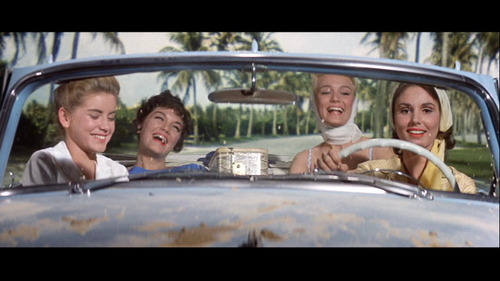
One night while I was winding down another unproductive day by taking a Youtube trip down a memory lane that predates my own actual memory, I was directed to the colorful preview for this 1960 film, which is linked below, and determined that I had to see it. It is not from any of my lists of classics, but it is better and more fun than you would think it would be. The appeal of the female stars, in particular Dolores Hart and to a lesser extent Paula Prentiss, to me is very high, and a surprisingly peppery Connie Francis belts out several tunes, which in itself would be more than enough to make the movie a Bourgeois Surrender instant classic. When you throw in beatniks, dialectic jazz, a college course (for the women) titled Courtship and Marriage, footage of a to us scantly developed Fort Lauderdale, and George Hamilton (recently maligned in these very pages for his thin body of work post-1965 not being commensurate with even the modest celebrity he has continued to maintain) cruising for girls on the beach donned in his Brown University blazer, the richness of delights for me to contemplate threatens a very lengthy post, which however as I could not deliver it in less than another month, will probably not be forthcoming.
Dolores Hart is probably best known for retiring from Hollywood at age 25 and becoming a nun (really), in which calling she remains to this day, having attained to the title of Mother Superior. Her role in Where the Boys Are is as the beautiful but brainy girl who studies Russian on the beach and questions aloud during the Courtship and Marriage class if playing house before marriage is really so terrible (though she has not acted upon the possibility yet). She pulls it off about as convincingly as it can be done. I thought her part was well-written--her intelligence was not presented by a series of accomplishments or the ability to triumph in verbal one-upsmanship, but was embedded into the character by approaching every circumstance and interaction she had with others in a sensible and considered way, which is how I find highly intelligent women to actually be. Dolores Hart never has to oversell the fact that she is as smart as she is supposed to be, either through her physical expression or her dialogue, because neither what she has to say or the manner in which she carries herself suggests that she isn't. She is a delight throughout the movie.
There is an interesting scene where the Dolores Hart and George Hamilton characters discuss their IQs (hers is 138, his 140, for the record). Some feminist commentators--of which this film has many, though not all derogatory (Camille Paglia, for one, is a fan)--howl about the circumstance that the man's IQ just had to be 2 points higher, but in reality I don't think it is uncommon for intelligent women to desire a romantic interest to ideally be at the very least at her level, with the possibility of some mental superiority either displayed or hinted at. I liked the conversation because it fit my idea about what the conversation of smart young people--or at least young people with high IQs--should be like. There seemed to be something intimate about it--the idea of expressing to another person that one has a certain kind of mind as part of one's nature, independent of more concrete signifiers of worth, not that these were missing either in the context of the film--however they played a secondary role in the moment to the acknowledgement of a sympathetic general intelligence passing between two attractive young people.
While Dolores Hart's main obstacle to romance was her superior brain, Paula Prentiss's handicap was her 5'11" stature, this area also apparently always requiring superiority in the male partner if ideal romantic satisfaction is to be attained. Her character also maintained a good spirit and sense of humor until unfortunately relapsing into some desperation and clinginess at the end, but on the whole I liked her. She did the commentary for the DVD, which was a little sparse, but likable, and still often funny, especially when you remember that she is over 70 years old now. Her father was a college professor at the University of the Incarnate Word in San Antonio, which I had never heard of until recently, though I read something else which featured one of their graduates who seemed intelligent in a kind of offbeat, St John's-ish way, so my impression of it is that it must be all right in some way, whether their alumni are accomplishing anything worthwhile or not.
Connie Francis's obstacle to romance by the way is that she is supposed to be unattractive, or at least plain and invisible to men. She is rather short I suppose, but I don't generally think of this as a huge problem, and it is hard to figure out anything else that could be causing the boys to ignore her so willfully. All of the girls except for Dolores Hart are pretty desperate to meet someone, and even to get married, and Dolores herself gets picked up pretty easily on the beach, lasting all of five minutes the first day before she's heading off for a drink. I would like to take part in this kind of dating scene.
It should be noted that the number of black people in this movie is exactly zero; which given the way bit-part black characters were depicted in even good mainstream films at this time, is probably for the better.
Among the song titles of the dialectic jazz band are "A Meeting Between Shakespeare and Satchel Paige on Hampstead Heath" and "Don't Litter the Streets of Philadelphia". Goofy, yes, but funny in the context of the movie because they come out of nowhere.
This was made near the end of the old studio era at MGM, the most opulent and meticulous of the classic studios, famous for its musicals and other lavish technicolor extravaganzas. Paula Prentiss in the commentary touched on the sense one got, especially as a young person, of working in an environment where no expense seemed to be spared and craftsmanship of a particular kind--the MGM formula or package--had been advanced to a state of perfection. It sounds like the money was on the whole not thrown around or lavished indiscriminately but well spent on things like clothing designers and carpenters and in-house musicians who were very good but much of whose goodness also consisted in knowing exactly, or almost exactly, what was expected of them, all of which was course could be bought much cheaper and for arguably more pleasing results than similar talent could be today.
Paula Prentiss also noted that she and the other women and numerous of the men in the cast become close friends and remained so to the present, though a couple of the men have died, even to the point of having recently returned from hanging out with Dolores Hart at the convent. This close-knitness among people of the Silent Generation has been kind of a recurring theme lately--Shirley Jones mentioned in the commentary for Carousel that she had been good friends and even roommates with various people in the cast of that film and still did things like take vacations with these friends and their children on occasion. Moving to sports, I read recently that when Mickey Mantle, who was probably the biggest baseball star in this generation, was dying, a significant number--like ten--of his old teammates had a final reunion at his bedside (it is almost impossible to imagine this last scenario occurring with anyone on the contemporary sports scene. I think it is endearing. People as a whole seemed to have more in common with each other, or something which enabled them to make long-lasting friends at that time.
Though there is a seriously dark episode at the end involving the fourth girl (played by an exquisitely pretty blonde named Yvette Mimieux, whom I have neglected to reference thus far), this did not prevent the number of college-aged kids descending on Florida for spring break the year after the movie came out from increasing fourfold or more, women, doubtless in expectation of meeting a suave George Hamilton type rather than a boorish jock (or maybe not) included.
Wednesday, May 23, 2012
Songs: Would-Be Intellectuals and Sophisticates Should Definitely Take a Pass
This is about the farthest foray into cheesecake that any of the Lennon sisters ever attained. Sadly, such explorations of the possibilities of their latent sexiness were pulled back sharply after this enchanted Indian summer of warmth and almost-exuberance. This seems to have been the best opportunity to take a gander at Dianne's legs ever afforded to the public as well. In the episodes after this season (this is another clip from '64) severe restrictions on the girls' movements, such as a total ban on anything hinting at sensuality more explicit than some occasional suggestive eye-batting, appear to have been implemented, and the more constrained, exacting Dianne emerges upon the scene.
While I like her rendition of this song because it is hers, it does not measure up to that of the frequently awesome Eydie Gorme:
If Dianne Lennon is my wife and Judy Garland is the girl I like but who is just too unstable to become emotionally involved with, Eydie Gorme is the girl I see secretly on the side and actually like a lot but don't really want the whole world to know about. She combines Ethel Merman's ability to hit the back wall of the auditorium with Judy Garland's sense of how to deliver a song--not that Ethel Merman is lacking in this regard either but Eydie Gorme's delivery reminds me more of Judy Garland's, patiently drawing it out at a relaxed but purposeful pace, guiding the listener through its inherent character and building up to a rollicking climax without being overdramatic or losing the bond with the audience. I feel like this particular approach is something of a lost art. It isn't that these old singers didn't like to show off and get a lot of attention, but they are able to convey a sense of excitement and being caught up in some dynamic current of real life that is very exhilarating to hear.
Speaking of Judy G, somebody working on her behalf is very assiduous at taking down all her old movie footage almost as soon as it appears. However, there are still any number of generic song postings, such as her version of "Stomping at the Savoy" which was recorded when she was 14. As with most of her renditions of songs, this is the definitive "Stompin'" for me now:
Her voice was expressive of the times in an artistically good way right up through the end of World War II, but those last pre-war years, '36-'41, she was really attuned to something essential in the spirit of the age that was also perhaps its most admirable as well as important characteristic. I admit I have not yet figured out what this might be, at least not so as to present it concisely--I think it has something to with being unapologetic, unconscious of this unapologetic quality, dissatisfied, restless, eager for life and capable of enjoying it earnestly, for a moment at least, all at the same time. But these are as yet vaguely gathered impressions.
Coming back down to earth with a ridiculous Lennon Sisters video from 1967:
The poor dears had to endure the indignity of growing more and more infantile in their act as they got older, for which their singing suffered tremendously. Indeed, as far as the quality of their songs went, their peak was attained around 1956-59, when they were still children and teenagers. All that said, they still look so good I just don't care how lame they are, or submit to being. They're probably also pretty staunch Republicans of some kind. If so, at least they are a somewhat appealing advertisement for adhering to that ethos. I doubt they are Nazi Sympathizers or anything really bad. While I genuinely am turned on by girls who are fiery socialists if I shied away from falling in love with Republicanettes in my youth it was secondarily to do with their beliefs; I'm sure I instinctively figured I didn't have enough money or swaggering dominance (at that time, of course; not now) to meet what I perceived to be their exacting requirements.
I could never quite get into Fleetwood Mac, though they sure have a heck of a lot of famous songs. More than Journey even. This one was a radio hit when I was in 11th grade, and it reminds me of the incredible desperation I had to engage in life in those days and the accompanying limited ability to act upon that desperation in any adequate way, and not just with regard to sexual and romantic things, but pretty much everything. I had not been aware until recently that the video was an adaptation of the famous school-poem "The Highwayman".
Thursday, April 08, 2010
Buster Keaton was among the foremost of that race of performers, who flourished especially in the early days of Hollywood, who possessed such a singular collection of talents that his films are necessarily organized around their display, and are not conceivable without him in the lead role. Charlie Chaplin, Fred Astaire, the Marx Brothers and Judy Garland are other people who fit this type of the indispensible star, which is one that doesn't really seem to exist anymore; movies featuring rock stars as themselves I suppose are a relation to these types of movies, but even these are more reliant on the stars' pre-existing celebrity cult than any unique talents employed in the movie. There are of course famous acting performances without which it is difficult to imagine the movies having the impact they have on people--Brando in Streetcar, James Dean's movies, many of Jimmy Stewart's celebrated roles, Schwarzenegger in Conan the Barbarian--but all of these films, even Conan, would still have been written and made even without the stars with whom they are so closely identified. Buster Keaton movies do not exist, and are probably not conceived of as existing, without Buster Keaton. When one considers how repetitive and done to death most things in the arts are, the remarkable thing about the Keaton movies 85 years on is that even when you have something kind of like it, and you sort of know what is coming, you still have not quite seen anything exactly like it, that is exactly as satisfying, which is why he continues to have an impressively wide appeal among serious people and naifs alike even in our time.I did not enjoy The Navigator quite as much as I did College, which is the only other Buster Keaton movie I have seen to date. I think this is due in part to the circumstance that I have a terror of boats and water generally, so the comic possibilities of drowning or being adrift at sea which the movie has to play upon come off to me perhaps somewhat darker than they do other people. Of course where I live there are ponds and lakes and rivers everywhere, often coming very close up by the road, especially during the rainy seasons such as now and in late fall, where there are also often no guardrails, so I have frequent occasion for Ted Kennedy-style flashbacks and apprehensions. I am a little better on ferries, which I sort of like to take, though I still worry slightly when I am on deck about myself or one of the children falling overboard. The film starts off with two inspired jokes right off the bat, the line where he turns to his valet and says "Wilson (or whatever), I've decided I want to get married. (pause). Today." Of course he has no girlfriend but he has someone in mind to propose to, so he calls for the car, which pulling up to the curb, he gets into it with great ceremony, at which the car pulls out, does a U-turn in the middle of the blissfully empty Los Angeles street (internet photos reveal that the street and the house are still there today, but traffic is much heavier, and pulls up in front of the house directly across the street. At this point I was thinking, this is going to be really great. And it is good, but the various gags on the ship, while often ingenious, don't always strike me as being as funny as other situations do.
To this point also I have to say I am more of a Chaplin than a Keaton fan--these two camps forming one of those strange divisions of life across which there seems to be little commonality or fraternization. Chaplin to me is the fuller human, and brings more of it really is like to be a person into his movies. Keaton may better represent some vision of modernity though. I know he was admired by Samuel Beckett, as well as other modernist intellectual types. His face really was striking, and a work of art in itself, which I don't have to tell you is rare, though it is a quality one notices in celebrated actors. Laurence Olivier's face made something of a similar impression, that of having been deliberately worked by the mind above all into the rather extraordinary and specific appearance it made on the screen.
The tape I had of this movie also included two shorts that kept with the maritime theme, The Boat and The Love Nest. The Boat is about a husband, a wife and their two sons who are a boat that springs a leak in the middle of the night during a tempest. It is actually kind of scary. The Love Nest is set on some kind of cargo ship. The captain is a tyrant who grabs people by the collar and tosses them overboard for things like spilling coffee while pouring it. Which is actually kind of funny.
I often think when watching these old films that my wife missed her true calling, which was to be a 1920s silent film actress, since about half the starlets of this time are of a similar height and body type, and have similar hairstyle and facial structures, which for the most part you don't see so much on television today. Now I don't want to come off as being like either one of those born-again Christians or nerds with a mail order bride from the third world that everyone makes fun of, the guys who are always proclaiming on the internet how hot and incredible their wives are and thanking Jesus for sending them an angel from heaven and so on. As was said of Samuel Johnson's mother, "she knew her son's value" but apparently did not talk about it much. And besides, perhaps not everyone will think it a wonderful thing to look like a 1920s movie star, though I will admit I do think it so. Now among the actresses I have seen lately that reinforced this impression that was made on me some time ago, Lya Da Putti looks like Mrs Bourgeois Surrender/Sabrina/Sarah whatever you want to call her while moving about and doing things in Variete, though not so much in the stills, but the dear one's real doppelganger is the lady who plays the wife in The Boat and several other Buster Keaton classics, the beautiful Sybil Seely, whom one internet commentator I have read considers to be "a whole world of hot" even today. In the film, and other clips available on the internet the resemblance sometimes is really uncanny. I realize this is of little interest to the general public, but some may like the comparison of the pictures. So first we have Sybil Seely, circa 1920:
Sunday, October 28, 2007
Between Halloween--a major undertaking requiring many hours of preparation with three little children--staying up late watching the baseball playoffs, and consequently having to catch up on my sleep at any opportunity, as I was falling asleep at work and while driving, it has been a lost week as far as writing goes.
I was writing an interminable essay here but on the eighth day of composition, with the end nowhere in sight I decided to bag it.
What happened was that after I put up my little bit on Uta of Naumberg I remembered that I had been struck some years ago that one rarely encountered German girls who were cute in the perky American sense. Very beautiful women who were almost devastatingly (to the likes of me) sophisticated and polished, or more steely, unapologetic, but still formidably handsome pragmatists, yes. Others whose inclinations to plainness or homeliness were carried out in a rigid linear fashion to almost extremes by a serious cast of mind unsoftened by any humor or willful frivolity, certainly. Vivacious, playful sorts however who have the capacity even to torture or detest or be indifferent to you in a pleasing manner without bludgeoning you with a direct and precise assessment of your worth are not so easily found.
I determined that in German society the barriers to perkiness were a combination of cosmopolitanism, a more thorough and exacting educational program, especially for pupils of good intelligence, and the greater awareness and emphasis on humans' essential darkness that remains pervasive in the worldview of people in that part of the world. Now doubtless any German-bred person reading this they would say this is wrong. I find I am always wrong when taking up any matter with Germans, particularly anything that directly relates to themselves, as though the nature of all the world, or at least everything in it requiring some degree of intelligent perceptiveness, were completely inscrutable to me. Nonetheless I determined to plug away and decided that cuteness as I was thinking of it was an utterly bourgeois phenomenon, albeit one requiring a fairly high level of intelligence and material comfort to develop its full glory, as well however as a general innocence of evil and most of the hardest truths about existence which logic and science have come to, and, perhaps most importantly, a surplus of mild (though not unredeemably woeful) men for whom this kind of beauty and personality are ideal. Women of this type after all do not flourish in all times and places. The men of the Taliban, for example, seem to have little use for them. Indeed, the most impressive thing I have read about this group is that they seem to be utterly unaffected by the prospect of being in the presence of, or even getting personal attention from, the sort of highly desirable babes that cause most American men to wilt on sight. One article I read claimed that the University of Miami cheerleading squad could be sent in their skimpiest costumes into the Taliban camp and the men would express no more arousal than to throw burqas over them and order them into the kitchen. I am cutting out the disclaimer I had originally written distancing myself from this attitude. I don't think it is really necessary.
I then argued that the main strongholds of cuteness in the contemporary world were still the United States and Canada, the middle and upper middle classes of Latin America, increasing the further south one went, and East Asia, particularly Japan and Korea. I posited that like the red squirrels of Britain losing ground to the gray, the classic cutie-pie type in the U.S. was under increasing assault on the lower end from its related but more feral and less intelligent nemesis, the more attractive type of skank, and on the upper end from the increasing reliance the serious professions and academic fields have on clever young women to fill their ranks, which tends to dampen cuteness because, unlike staggering beauty, cuteness is dependent on there being a fairly substantial pool of men who can reasonably expect to compete for the cutie, which is difficult to have when one is also competing with her for worldy honors and positions, and frequently losing. I also argued that, like so much of the modern world, the origins of cuteness could be traced to England.
I then said that in most ancient history, literature, mythology, art, etc, the women that the male characters were interested in were uniformly supposed to be beautiful, with no caveat that anyone's height or breasts or hair or whatever were only 7.5s while otherwise she was a solid 9.6. If a hero likes her, or she is of good birth, you can be sure she is always going to be portrayed as a 10. I noted that to obtain these beautiful women required real exertion too, and that one had to visibly crush, usually violently, one's competitors, all the while demonstrating one's superior nobility and mental refinement. A lot was at stake, and there could be no doubts allowed that the women fought over so brutally were not worth every drop of blood spilled.I then wanted to point out that human life continually grew more comfortable and soft, and that in time, as trade and the professions developed it became possible for men to live in some style and attract pretty women without having first to put large numbers of potential rivals to the sword. I said that while many of the choicest women continued to demand demonstrations of the aristocratic and martial virtues, even in artificial form, another group, generally satisfied to live in a prosperous manner if a heroic one was to be out of reach, developed the type of attractions that would be irresistable to the pragmatic bourgeois man; unthreatening prettiness, general enthusiasm for the sorts of comforts and mode of life such a man could provide, enough spirit to enjoy and have no mean success in social competition. I had thought that in England this personality evolved as an imitation of the upper class French coquettes of the ages of the King Louises, which however took a much milder form across the channel, the reputation of the French ladies of this period having come down to us as being by comparison thoroughly chilling, heartless and amoral, eager not merely to tease their victims but to humiliate and skin them alive. I suppose this is a form of cuteness, but it is not one that really applies to democratic society.
I then attempted to relate something of the literary history of cuteness, starting with the coquettes of the Spectator papers and Pope, and the appearance of the type in Jane Austen's novels (not approved however), especially the wild and frivolous Lydia in Pride and Prejudice, (the 15-year old sister who ran off with a soldier). As he did with Christmas, Charles Dickens may have largely invented our modern conceptions of cuteness, as his novels are choc-a-bloc with cute girls, whether pampered bourgeois (Dora Spenlow, David Copperfield's child-wife and cutie-pie par excellence), debtor's prison inmate (Little Dorrit), would-be femme fatale (Estella from Great Expectations--she is unattainable the way the cheerleaders in eighth grade suburban schools are to nerds--not so much if you can pull yourself together a little and succeed in something) or even royalty (Queen Victoria). I noted that Tolstoy had several prominent characters who could only be described as bourgeois-style cute (Natasha from W & P, Levin's wife in Anna Karenina) which I thought unusual among the Russians. The closest thing to a cute girl in Dostoevsky is Sonya in Crime & Punishment, who is a prostitute who becomes the girlfriend of a murderer. Then I went on to talk about Coca-Cola advertising, and the Oz books, magazines, co-ed schools and colleges, movies, etc, in America. There wasn't time to find and tie together the grand point.
Friday, April 27, 2007
The 1920s, I sometimes think, have become something of a forgotten decade with regard to the many high points in our history that occurred in this period. Our cities and towns had attained what we now think of as their iconic states, alike in architectural and arboreal beauty, as well as cleanliness and liveliness. Have you ever seen photographs of New York City in the 1920s? It is actually gorgeous, and I am talking about at the street level, things like gas stations and drugstores and dance halls and fences and lampposts. The national efforts in literature and music had arguably their greatest and most important decade in the 1920s, both domestically and internationally, even if this fact was not appreciated at the time, and the country was of course at the forefront of the exciting new spectacles of the modern age, cinema, sports, radio and cars. Male dress reached, in my opinion, its all-time peak in the decade, in Britain as well as the U.S. (I know the Prince of Wales at the time, later Edward VIII, is widely regarded as a simpering twit and chum of the Nazis in his country`s hour of need [though even his enemies acknowledge that he had a Bertie Woosterish kind of droll wit], but the wardrobe the man possessed circa 1924 was incredible. If it is preserved in a museum somewhere, it would be well worth seeing). Even lively and imaginative conversation, never a strong American characteristic, seems to have enjoyed a vogue in certain urbane circles during this period. Prohibition would have been hard on me personally, because I would probably not have been either cool or enterprising enough to procure booze for myself very often (and I like booze) and I also would probably have lived in one of the five places in the country where the local authorities were actually zealous about enforcement if I ever did manage to concoct or come into possession of a bottle of gin and gone to the clink for it. But for the people who made the age it was apparently the best, and certainly the most fun time for partying in our national history as well.Where then does Norman Rockwell fit into all this? He was just there, man, and if he wasnt the right man for the job on the Michelangelo/Shakespeare standard, he is nonetheless a force in history, in many ways a positive if not an irresistible one. I take him quite seriously. Having grown up in a time when Americans understood what pretty girls looked like, he drew lots of them, and ensured that the taste for a certain kind of American female persona would not be entirely extinguished. The reproduction of this picture came out poorly, which is too bad, because the girl in it is a perfect specimen of this all-American type. You see her and your thoughts immediately turn to scoring touchdowns and walking her home after the next dance. This picture by the way encapsulates a lot of Norman Rockwell`s strengths and faults as an artist. The girl seems to me to be done perfectly; the details of stockings, shoes, dishes (I love the dishes) are exquisite. However he has to make the boy a silly figure, an unworthy subject in comparison with the dirty dishes, let alone the girl. He follows the same pattern throughout his career, creating a background or frame for his pictures that are truly ingenius and subtle, then spoiling it with a frivolous or just too-overwrought subject.
Fitzgerald is traditionally the author most particularly identified with this time in the U.S., at least for the Northeast/prep schools and Ivy League set, and while he is often dismissed as a lightweight by powerful intellects or overwhelmed by the same when they attempt to interpret him, or else is blown up beyond his proper proportion by his philistine American fans (I do not know that he is widely read or admired outside the homeland) he sees in his miniature way what is going on in this often very beautiful though ultimately monstrous country, to my mind, better than any other writer, with the exception of maybe Melville, Faulkner being good on the monstrosities but his beauties being usually as of a foreign country to me. Here is a note I made on Gatsby on July 24, 2005:
*I agree that dreams properly belong to youth, and cannot be exactly lived even then, (but are only the province of mind and memory). The poignancy of Gatsby--and America--is its openness in craving to achieve in maturity or years after the time some state it craved in youth, which seems to be unique to our society. In this viewpoint the future is invariably an illusion and not the theater of great moment, though it deceives us by thinking it will change us. The whole appeal of the Gatsby character lies in his past and his rather adolescent behaviors. His actual adult self is by comparison a rather empty and insignificant figure. This relates broadly to most of the main characters in the story. I love FSF`s images as always. He is one of the few Amer. authors with the ability to see and describe what is really beautiful and poignant in America in a beautiful and poignant manner*
Poignancy is a very important idea to me.
I am going to include a passage of some of those images I profess to *love* because I am in that kind of a mood:
"One of my most vivid memories is of coming back west from prep school and later from college at Christmas time. Those who went farther than Chicago would gather in the old dim Union Station at six oclock of a December evening with a few Chicago friends already caught up into their own holiday gaieties to bid them a hasty good-bye. I remember the fur coats of the girls returning from Miss This or That`s and the chatter of frozen breath and the hands waving overhead as we caught sight of old acquaintances and the matchings of invitations: `Are you going to the Ordways`? the Herseys` the Schultzes`` and the long green tickets clasped tight in our gloved hands. And last the murky yellow cars of the Chicago, Milwaukee & St Paul Railroad looking cheerful as Christmas itself on the tracks beside the gate.
"When we pulled out into the winter night and the real snow, our snow, began to stretch out beside us and twinkle against the windows, and the dim lights of small Wisconsin stations moved by, a sharp wild brace came suddenly into the air. We drew in deep breaths of it as we walked back from dinner through the cold vestibules, unutterably aware of our identity with this country for one strange hour before we melted indistinguishably into it again.
"That's my middle-west--not the wheat or the prairies or the lost Swede towns but the thrilling, returning trains of my youth and the street lamps and sleigh bells in the frosty dark and the shadows of holly wreaths thrown by lighted windows on the snow..."
This is my lost America too, or at least what I have always imagined to be my lost America, and that, that imagined part, is what Fitzgerald understands, what he gets right more than anything else. The 1920s was America`s post adolescent early youth, and now from the vantage point of encroaching middle age we see that she was beautiful and exciting and full of promise then, promises and beauty that have been long lost, and perhaps never were in any reality...
I am quitting for the night.