Showing posts with label vincente minnelli. Show all posts

Saturday, April 25, 2015

First of Three Movie Posts

I have a backlog of about ten movies, all from the favored period from 1936-1963, to write up. I am going to break those up into three posts, one for the 50s-60s, and one each for the other two decades cited

Charade (1963)

I knew nothing about this movie going in other than that it starred Cary Grant and Audrey Hepburn at a time when both were long established stars with definite celluloid personae. I surmised that it would likely be 'stylish' after the fashion of the time. I did not anticipate however quite how relentlessly and even absurdly stylish it is--it goes well beyond anything that ever transpires, or that probably would ever even be desirable to transpire, in actual life, from the theme music and the opening titles to the settings and clothes and the glossy smoothness of the impossible plot.


Despite my socialist tendencies. I still like Audrey Hepburn, who besides did have to flee her native Belgium as an early adolescent during the Second World War and spend her teenage years in England in a situation of some hardship. 

But I actually like it, because I sense that everybody involved was to some extent in on the joke. For all of the beautiful clothes and beautiful people and the ridiculously chic Paris of the early 1960s, all projected in glorious technicolor to an even more exaggerated pitch of these qualities, it retains the feel of being something of a lark, of not really taking itself all that seriously. Being apparently an inveterate socialist by inclination, I have always found the Audrey Hepburn fashion show which is always a big part of her movies to be annoying, lovely though even my shrunken socialist heart finds her to be. In Charade it makes up a considerable part of the character of the movie, yet, as its director and writer also conceded, it is also absurd, since in the very opening scenes we are shown that Audrey Hepburn's character's husband, before being mysteriously being murdered on a train, had completely cleaned out their apartment, and afterwards she spends much of the rest of the film rushing around and darting into the phone booths and taxicabs and subway stations of Paris avoiding a gang of thugs who are trying to get at some money they believe she has, yet she is decked out in a different fabulous designer outfit in every scene.

Forward thinking people, especially from the tech and finance worlds, are fiercely insistent about how much better across the board life is now than it was fifty years ago, and that most of us would find living under the conditions of the 1960s unbearable now. This is probably true if we talking about the suburban life of that time vis-a-vis that of the affluent modern day professional, for whom the thought of having no alternative to the food and coffee alone that he would have to endure if transported back to that time and place would cause him to wake up in the middle of the night in a cold sweat, but it still seems to me that life in the great cities of the west, perhaps especially Paris, would have been at that time close to the peak of their enjoyability as places to live. But then again I am looking at the case through a very middle class perspective, and am oblivious to the finer points of life in these cities accessible to elite types today.

Party game for sophisticates, early 1960s


The Band Wagon (1953)


A, to my mind, somewhat forgotten musical near the end of MGM's legendary run of them in the years following the second world war, directed by Vincente Minnelli, many of whose movies I am fond of, and starring an older Fred Astaire, to whom I always pay due homage for being the great star and showman that he was, playing a past-his-prime movie star kind of like himself who is taking a shot at Broadway. While there are bits and pieces of it that I like, and while all of the commentaries that come with the DVD try very hard to persuade the vacillating viewer that this is truly one of the greatest musicals of all time, I don't think it holds together. The songs are O.K., though there are none that I think of as immortal ("That's Entertainment" is probably the most famous). Fred Astaire is Fred Astaire, and I always find it uplifting to see him, though this uplift is a separate emotion from whatever is actually going on with the movie. The time was one of mild transition, from the immediate postwar Truman years to the (seemingly) psychologically less intense and decompressing Eisenhower era, and perhaps the classic Hollywood musical could not withstand this relaxing of the general tension in the culture, certainly without really great songs. I remember that I did not like On the Town all that much on the first viewing, and did not think much of its songs either, but it had an optimistic energy that grew on me the more I recollected and considered it. That has not happened overall with the Band Wagon, though I do like some of the atmosphere. I also don't really like the leading women in this, Cyd Charisse and Nanette Fabray, that much. They seem to have begun to be affected by the limp, rather gusto-less quality that became all too characteristic of traditional musicals during the 50s.

"That's Entertainment". The shoeshine number, "All By Myself", and the beer and pretzel song (ed--"I Love Louisa") are all decent, but nothing exhilarating. This is the first Minnelli film I have seen where I have not come away thinking that what he was able to do with the material was somewhat underrated (The others I am thinking of are Meet Me in St Louis, The Clock, Father of the Bride and An American in Paris). 

I guess I have nothing else to say about this.


Alice in Wonderland (1951)


This wasn't actually on my list but I had recently read the book and thought I should like to see one of the older movie versions, and could not find a copy of the 1933 Paramount movie featuring W.C. Fields, Cary Grant, Gary Cooper and others that devotees of the books seem to have at least found interesting, I settled on the Disney cartoon. While I tend to find especially the modern Disney cartoons tiresome, I often like the ones from this era. I thought this Alice was excellent, imaginative, captured some of the manic intelligence of the story (particularly the parts voiced by the very talented ex-vaudevillians Sterling Holloway and Ed Wynn), interesting and vivid drawings. Compared to some of the other Disney films I think it is underrated today. It is also very short, 75 minutes according to the internet. This voice of Alice was done by a 13-year old English girl and cartoon Alice lookalike named Kathryn Beaumont who appears (via several extras on the DVD) to have been every American's, and certainly my, ideal of what a properly brought up thirteen year old English girl ought to be. She would also do the voice of Wendy in Peter Pan two years later.


The memory of the Disney Alice seems to have been hurt by her not qualifying as one of their proper princesses, though as far as female characters go, she would seem to be a much more acceptable object of identification for impressionable young ladies in our modern age than the unfortunately named (and fated) Snow White or Sleeping Beauty. But she does not seem to be one of their more popular characters, despite the circumstance that the adorable cartoon depiction of her is even more exaggeratedly Aryan-looking than the Tenniel illustrations, and as we all know, Disney, much to the dismay of all right-thinking people, tends to cash in when they go full-on Aryan with their female characters, as in Frozen, which features an ur-Scandinavian princess named Elsa who is so unvibrant that everything she touches becomes encased in ice. Somebody out there cannot get enough however.

There were a couple of Disney produced television programs from 1950 and 1951 not too subtly promoting the upcoming Alice release that I must say I found kind of charming. The first one was a show that aired on Christmas Day and featured a bunch of kids, including Disney's teenaged daughters and the aforementioned Kathryn Beaumont quaffing Coca-Cola along with Edgar Bergen, Charlie McCarthy, and the great Mortimer Snead. Now that I have children near this age (13) and am given to sentimentality over them when their energies are not negatively directed, I found this rather endearing. In the second program Beaumont and Sterling Holloway, who was a show business person, appeared as guests on some orchestra leader's program, as a number of musical pieces from Alice were performed. This also had I believe the footage of Ed Wynn acting out and doing the recording for the Mad Hatter, which was very impressive to see.   


Wednesday, April 17, 2013

Generic Movie Post That Took 2 Weeks to Write

valour kinds say time have think begin country

The goal with these, rarely attained, is always economy.

Avatar (2009)


They should have made the movie about her.

My beautiful wife did not watch this movie with me, but she came and sat in the living room for a few minutes while it was on, in the midst of working on a project and observed, with an air of mild bemusement, "Wow. This is not a typical Bourgeois Surrender movie." "No", I admitted, my body rigid in equal parts embarrassment and perplexity at the direction the world has gone in since 1995, "That it is not."

This one came recommended from Roger Ebert's 2012  Movie Yearbook, which I picked up at a discount without realizing that it only rated movies from the years 2009-2011. So I will probably be seeing more movies from those three years, though this book is the last in order which I refer to. [Roger Ebert's death was announced while this post was underway, but I don't know what to say about such things. He appears to have had a fulfilling and fortunate professional life in writing and the arts, which seems to me a rare happiness]. In recent years Ebert began to display an extreme strain of contemporary liberalism that I had not noted him to have before and he evidently found this movie to have cast a great blow for the causes of environmentalism, anti-militarism, anti-greed, etc. Perhaps these attitudes were driving creative forces behind the movie but they made little impact on me.

All of the characters in this movie are alpha males, including the women and the tree-hugging natives of the planet Zoltran. Every sentence of dialogue is confrontational, challenging and conveys the attitude that the speaker has attained a perfect competence in his calling and overall superiority of person and that no one else is worthy of being spoken to with even basic respect. One suspects this is not merely how the director, famed egomaniac James Cameron, deals with people--dominant artists and leaders usually seem to have to be this way--but how he actually views the general nature of human relations, which is not reassuring to me.

It is worthy of notice (to me--maybe this trend has been in motion for a while) that after a long tradition of stories about beings from other planets being smarter/more technologically advanced/militarily superior than Americans--interestingly, extraterrestrial life never seems to make its way to Pakistan--the popular liberal imagination at least now envisions interplanetary conflict as the American military in concert with rapacious corporations on the offensive in distant reaches of outer space. It says a lot about the mindset of a lot of people at this cultural moment with regard to how powerful and uncontestable the big companies and the high-tech military, and the individuals who have high positions in these entities, are perceived to be.

What was the big deal about this movie again? The special effects? The story, apart from a few adultish trappings, was about at the level of something my children would have watched, minus the humor. I can be impressed by computerized special effects in a movie where I can see something that strikes me as imaginative, like A Bug's Life, for example. I didn't think the concepts here were very imaginative at all--as my wife pointed out after watching the movie for five minutes, several things were ripoffs of Star Wars, and even I did not notice anything particularly futuristic other than the alienating anti-human headquarters of the space station and the Michael Jackson oxygen chamber where your soul left your regular body and was transferred to that of a space-creature--and both of these appeared in the first five minutes of the movie.

The Enigma of Kaspar Hauser (1975)

Sometimes called The Mystery of Kaspar Hauser. Also sometimes called by a more literal translation of the German title, Every Man For Himself, and God Against All; but somebody must have decided they wanted to try to sell some tickets in America, so for purposes of commercial release, that title was scrapped.


This is a European art movie--from a "New Wave", no less--about a curious historical incident and set in the 1820s or 30s. It is predictable that I would imagine I liked it. It was a comfort after the unrecognizable depiction of existence that was Avatar.

The aesthetic is very much of its time. There are a lot of leisurely outdoor scenes in gardens and fields and orchards kind of after the Bergman manner. The whole movie is comparatively restrained and 'unbusy' for a Werner Herzog film. There is almost no dialogue at all for the first half-hour, and until about the halfway point of the movie Kasper Hauser himself does not speak in more than monosyllables, though people begin talking about him. The second half is composed of a series of short scenes, vignettes almost, that do good service in keeping up interest in the story while maintaining the enigmatic effect. It is great, but it is also very suited to my particular sensibility.

Being a German movie, it is not surprising that a logic professor is brought in at one point to investigate the development of Hauser's reasoning capacity. I had to replay the professor's question and answer a second time before I 'got' it, but I am satisfied at least that I did get its particular elegance. I rarely get anything like that anymore.

There was a commentary on this featuring Werner Herzog himself, who, not surprisingly, speaks English well.  It was not a great commentary though, as Herzog kind of went all over the place and the moderator, who sounded like a fairly callow American, was not especially effective at asking questions or guiding the conversation, indeed engaging Herzog in conversation at all. The typical exchange was what you might expect when you pair up an earnest and totally overmatched American with a vigorous and highly experienced European artist:

American Moderator: So what you are trying to show in this scene is how Kaspar has no preconceptions about anything that a normal person would take for granted as a basis of society?

Herzog: Actually no (or yes, then talks for five minutes on some entirely different topic).

I am trying to figure out what some of the formulas are for a good commentary. Some lapse of time, usually a  long one, seems necessary. If the commentary features people who were actually involved in the movie, they should either be retired or long past the phase of their career/life in which they made the film. The film should not require promotion, unless it is a plausibly good old movie of which the reputation has languished.

Good commentaries are able to reproduce something of the atmosphere and intelligent mindset which vitiated the film, assuming of course that the film is so vitiated. There has to be a good correlation between the intelligence of the commentator and that of the film. It also helps for the commentator to have a somewhat engaging conversational style. Scholars and critics especially tend to be hit or miss on these points. Directors for obvious reasons are usually strong on the first criterion, but some flail on the second. I cannot say that Werner Herzog was one of these flailers, but it would have been better if he had had somebody a little more up to the task of engaging with him and directing him in more focused channels. Actors and actresses are usually decent enough at conversing but their intelligence levels vary widely--by which I do not refer to their scores on IQ tests so much as things like sense of humor, ability to discern between things that are more noteworthy and interesting of observation than other things, and ability to tell a story/explain something that the typical video drone would not know about but might find curious.

Father of the Bride (1950)

If I were a normal, well-adjusted, forward-looking denizen of the present day, or were even consistent with my criticisms and dislike of nearly everything about that same present, I would be able to eviscerate this movie for its silliness, triviality, and almost unbelievable self-contentedness at its vulgar bourgeois materialism with a full heaping of (seemingly appropriate) self-satisfaction of my own. But predictably my apparently incurable sentimentality for almost any production of this time period won out and I found myself enjoying the movie against all of my better instincts, to say nothing of the wasted decades of attempted training of my intellect. I think it was Spencer Tracy's devotion to martinis and dogged consumption of the same, as well as the overflowing ash trays, all carried off in the unaffected manner of the time, that allowed me the freedom to enjoy myself. Also my wife, who doesn't care for most of the movies I get anymore, actually watched it with me and enjoyed it, and it is after all fun to have a good time with other people once in a while, if you can manage it. She pointed out that numerous items for this wedding in 1950 cost multiples of times in constant dollars what was spent on our own nuptials in 1997.

We haven't seen much of Spencer Tracy so far in this program of mine. He was, as his Wikipedia page asserts, one of the truly major stars of Hollywood's golden age. He is an interesting figure to me, but as there are a few other of his films coming up imminently, I will say more about him later.

Most capsule summaries of this movie mention as a big selling point that it features 'Elizabeth Taylor at her most beautiful'. I would say that she looked better in A Place in the Sun myself, but in any instance she generally looks better in newsreel/paparazzi footage from this time then she does in either of these movies. Not that I think she is ugly or anything, but I have never thought she was notably that much more desirable than thrity or forty other stars of her generation. Not that I know anything about the matter. Clearly she made men hungry--and the nearer they got to her the hungrier they became--in a way that even most beautiful do not quite do. Acknowledging all that, she was still a surprisingly minor presence in this movie, given all the hype about how beautiful she is supposed to be in it.

This was directed by Vincente Minnelli, who has been turning up a lot in these reports (The Clock, An American in Paris). He had a good run as a director, especially from around 1944 to '54. Mostly famous for his musicals, but he had, as a studio man anyway, the gift of touch or something. All three of his films that I have reviewed here have seemed from the critical point of view to suffer from some weakness or triviality but in the end impressed upon me some quality that made it impossible for me to dismiss them and indeed even inspired affection; though overall I have less affection for Father of the Bride than the others.


Despite all evidence to the contrary, even I don't really believe life was superior in 1950 to what it is now. Apart from the obvious abominations of the era, if I were actually forced to go back and live in it on a daily basis I would probably find it boring and stifling, especially if I had to live somewhere outside a major, New York-Los Angeles-London level city. It's not surprising to me that people drank a lot more than they do now. Still, there must have been something legitimately appealing about it compared to the present day, right? Something that is superior to life now? Let me try to think of a few possibilities.

1. There were far less people in jail at this time than there are now, both overall and per capita. This is well-documented. For most of the population there was much less of a police state/security atmosphere than what we are subjected to now as well. Even in New Hampshire, having a cop in public schools is de rigueur now. When I go back to Philadelphia there are security guards at the doors of supermarkets even in the inner suburbs. This at least hasn't come to northern New England yet.

2. I like the girls/music/literature/art of that era, most of which however I probably would not have been aware of had I lived at the time, and that obviously includes anything exciting that might have happened with the girls. I actually like the Girls of the 80s too, but even though I was actually alive in that era I might as well not have as far as socializing with any were concerned

3. I have mentioned in past posts that the bars/nightclubs/house parties of this time as depicted in movies look a lot more jovial than most of what I have known. St John's parties, like a lot of other things there, did often have a little bit of this retro feeling about them, which I obviously liked. Unfortunately I have to live the rest of my life in a more assertively post-1965 environment, which is a shame as far as partying goes at least.

This is not a point in favor of the 1950s but an aside regarding the sense I pick up sometimes in the present that back in those bad old days rapists and child molesters must have been running wild and commiting their crimes at will. This may have been so in some unfortunate cases but I am not certain that the volume of these kinds of crimes was any higher than it is now. Most older people I knew in the 70s and 80s, and by this I refer mainly to women, seemed to think children and girls were in much more danger of being subjected to these abuses and violences than had been the case when they were young. Also the general movement for women during the 60s and 70s was towards more freedom from parental/societal constraint in regard to relations with men rather than more protection from them. I know these are two different things, but they are probably not unrelated. One does hear and read the stories from this era of course about the extremely aggressive and brusque assaults (what we would call assaults certainly) that men would spring a la Mad Men upon women at cocktail parties or in offices. Those kinds of things obviously still go on today, but I am guessing among the professional classes anyway they are less frequent or are at least instigated by a much smaller number of men than formerly. Some men who would have behaved in this boorish way back in the 50s probably have actually become more enlightened in the matter of how to treat women appropriately, others probably would not be able to resist the temptation had they any longer enough power to safely risk nothing more in the attempt but a cold reception. Most men of course don't understand what they are supposed to do when no women seem to want anything to do with them at all, but obviously want all variety of pleasurable-sounding things from certain other men. One obvious response is to waste your life dreaming about being one of those winners and getting to do all the things the winners get to do with women, because let's face it, most of the time nothing else really matters. Indeed, the irony is that the less substantial and important and intelligent a person you are or become, the more your mind is probably taken up with sensualistic fantasies, because you literally have nothing else to think about...

Thursday, January 24, 2013

1951 Movies


Five of them here (though it looks like one might really have been from 1952). I don't remember this year being often mentioned as one of the landmark years in cinema history, but it produced a hogshead's worth of classics. I have already noted here in passing having seen, from that year, A Streetcar Named Desire, The African Queen, A Place in the Sun, and the Alistair Sim Christmas Carol. Besides those featured in today's post, there are still quite a few more celebrated titles from this year presumably to come. Based on my listkeeping, it looks to date like the champion year for the number of individual movies that have merited the highest rating in mainstream publications.

An American in Paris


Won the Oscar for Best Picture in that highly competitive year. The choice seems to have been considered an upset at the time, Streetcar and A Place in the Sun being the favorites going in. I enjoyed the movie very much, though of course I am a mush-brain. I am surprised by how well-regarded it still seems to be by many people who seem to be demanding, the sort who not only talk about things like the Real Paris, but have intimate knowledge of it. Obviously there is a sophisticated way to appreciate it requiring legitimate mental seriousness as well as a mindless one; however, all that I am able to get from it seems inconsistent with all my sense of what sophisticated people would be impressed by. And the film certainly has its share of detractors, though again, mainstream opinion seems to have accepted it as a classic on its own terms. My own take is that it is better than its detractors, most of whose arguments against it are almost too obvious to be convincing, would have it, but it is not Great great.

The saying that all good Americans, when they die, will go to Paris, is no less pointed because it is over-quoted. Indeed, I suspect that this promise is likely is not true, and am rather downtrodden in mood because of it. I suspect we are not talking about the Real Paris, especially that of the present day, that alternate place which has the genuine good food and is supposed to be far more interesting, because everything and everyone in it is held to and lives always by high standards in which Truth is the dominant governing element; but of something more like the Paris of this movie, though hopefully a little more populated and less stagy. The opening sequence of real footage--from a distance, aloft--of the city circa 1950 with its sparse auto traffic, slightly less worn out monuments and suggestive glimpses at the miles of streets and boulevards of (for Americans) dirt cheap rents and endless carafes of wine, is getting pretty close to the fantasy. What do I ask of Paris but to give me a few sensations. That I am an artist, or at least that I appreciate beauty and all of those wonderful things. That I have a mind. That I like to drink and eat well and enjoy life, without the necessity of being a prig about it because I can take it for granted that my victuals are of acceptable quality. That I am capable of being a subject of romantic interest. This is the whole extent of it really. Is it such a joke to desire these things? Well, yes, if they haven't any grounding in truth, it is. The experience of "Paris" is not a gift or reward given for earnestness and good behavior, especially to outsiders.


Forbidden Games


This is the one I think is in fact from 1952. My book said '51 but everything else says otherwise.

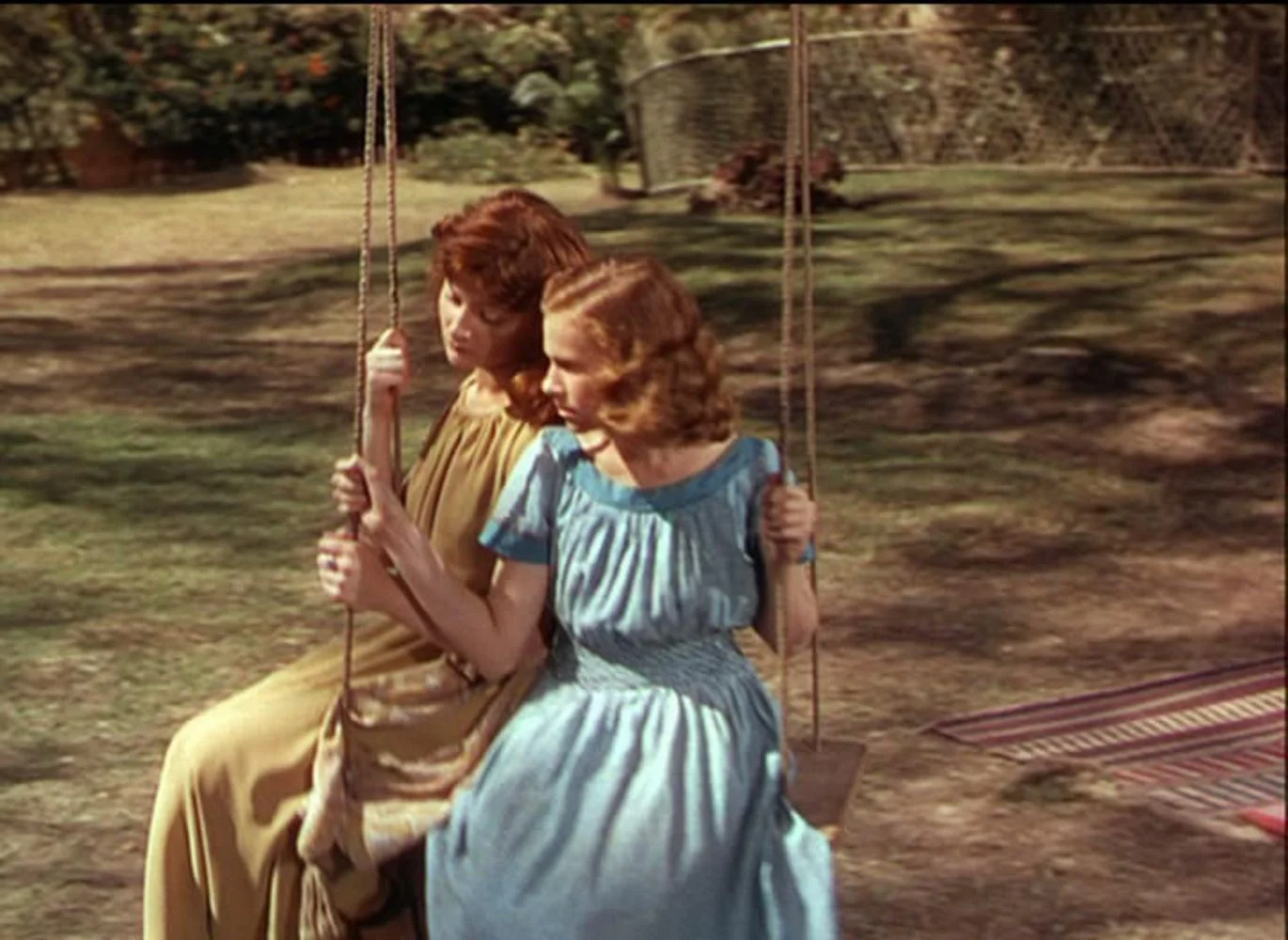
This is a French movie, very different, not only from the image of France depicted in American in Paris, but even from most other famous French movies, that I have seen anyway. It reminds me more of an earlier or mid-career Ingmar Bergman movie like The Virgin Spring as far as its themes and cinematography go than anything else I can think of. It also takes for a direct subject the death and destruction, indeed the fact itself, of World War II, then still quite recent and in France especially painful to have to recall. I probably should have watched it a second time. There was nothing obviously wrong about it, and I am sure it is as great a film as it is supposed to be, but nothing about it absorbed me or made any kind of emotional connection with me either. The affection that developed between the children would have been the likeliest route to my heart and sensibility but I just wasn't up to feeling it on this occasion. I will have to try to see it again. Sometimes the second viewing is the charm.

The Idiot


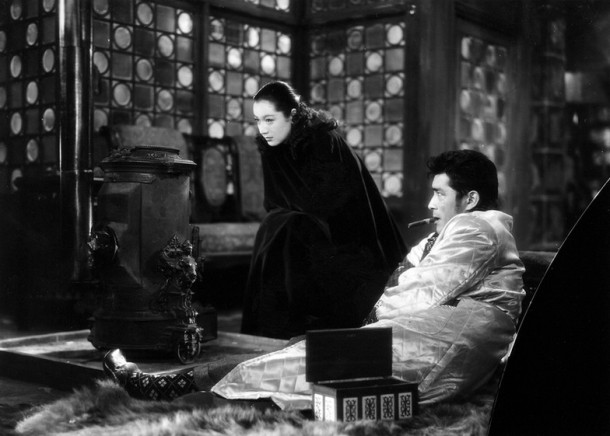
This, on the other hand, was exactly the kind of thing I was looking for, the more so as it was completely unanticipated. Despite the presence of cinema legends Akiru Kurosawa and Toshiro Mifune in the project, it must not be among their top 6 or even 10 most celebrated collaborations in this country, as I was previously unaware of it. And then upon discovering that it was an adaptation of Dostoevsky, I just assumed it was set in Samurai times, another two hours and 46 minutes of the rituals and other formal cultural trappings of that genre, which I am learning, I think, to appreciate more as the years go by, though it still involves some work for me. However the movie is set in the modern world, in Hokkaido, the big northern island of Japan, where, as I remember from one of Paul Theroux's travel books in which he went there, it really does snow as much as it does in Switzerland or pre-global warming Vermont. It has great atmosphere, and a deliberateness of pace that however never fails to be interesting and makes for a pointed counterpart to hyper-distracted contemporary digital life. I should have kept it a little longer and watched it a second time, so taken with it I was.

The Idiot is one of the great stories of the post-1500 world, I believe. The dramatic background of the saintly man who is not insipid, the sickly man who is not (entirely) weak, the innocent man who is not wholly ignorant of the world, who indeed at the outset of the story is himself returning from abroad, where he has presumably been engaging with life at some serious level after his own fashion, I find to be highly affecting to the imagination. All of its main characters, and most of its minor ones, are superior representations of humanity than their counterparts in actual life, as are the incidents and settings of the plot. While the story is ultimately unhappy, I suppose, the experience of it as art marks a high point in one's mental biography that is usually to be but too rarely replicated, especially it seems as one ages. I recommend it (the book, but the film gives something of the same sense in miniature) to anyone unfamiliar with it, particularly in the dregs of mid-life, who is feeling sluggish and disengaged mentally from all of the higher currents in life.

The Magic Box


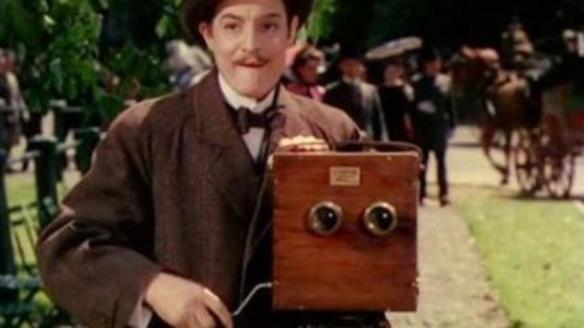
Almost four years ago I wrote about how I was unable to find this movie anywhere. Finally I discovered a couple of months back that someone had uploaded a copy of a television broadcast of it, presumably from England, to Youtube, where in exactly 1 year (January 24, 2012) it has received the rather paltry total of 738 views. So I have now seen it on the computer at least.

I noted on the other post that this was the British film industry's contribution to the 1951 Festival of Britain, that it was shot in Technicolor, that it starred the great actor Robert Donat and featured cameo appearances by numerous other British acting luminaries of the day including Laurence Olivier, and that its subject matter is a man named William Friese-Green who may or not have been the inventor of the movie camera but who according to the film at least invented a machine that produced moving pictures independently of whatever else was proceeding in that area at the time. The film is good, especially in its depiction of the main character's obsessiveness regarding his inventions, to the point of ruining his finances, his and his family's social position, both of his marriages, and any relationship with his sons, the elder three of whom feel obligated by the family's circumstances to enlist in World War I, which in British movies especially is so readily understood to be a death sentence that they don't even have to insert a scene later on in which the mother gets the bad news or refer at all to it having happened; the boys just don't return to the movie. And Robert Donat as William Friese-Green doesn't seem to be affected by any of this in his pursuit of invention. He repeatedly borrows large sums of money from anyone he can get to lend it to him, with no real effort undertaken to ever pay it back, and clearly thinks it an injustice when one of his creditors finally cuts him off. There is a tradition, that this is the attitude visionary and creative people have to have, and that normal types can't understand what goes on in the mind of such a person. In Europe especially that the visionary dies unappreciated in poverty and obscurity is almost preferable. Americans generally want to see some kind of payoff or vindication in the end, at the very least recognition, or reconciliation with friends and loved ones. Otherwise, how do we know the person is worth celebrating with a movie?

I am obviously not a visionary, but I did have, and still have, a certain amount of this impractical nature. It is quite amazing how long into my adult life, almost until I was in my mid-30s, that I believed I would eventually  be accepted by the greater world as some kind of writer or other intellectually-oriented line of work and be paid for it in line with other middle class professionals. Even today I don't really know or have a clear sense of how I am likely to come by money enough to live reasonably on for the rest of my life. Though the alternatives eventually happen and take on a life of their own, they always remain to some degree unthinkable, and to this day I cannot really face the reality of my situation and acknowledge it as anything significant. As this, I have noted many times here, it has rendered completely unable to function socially. In this I am completely the opposite of the Idiot.

Both of the actresses who play the beleaguered wives of William Friese-Green are of exceptional attractiveness in this particular movie, especially the one who plays the first, the Viennese-born Maria Schell.


The River


In keeping with the (loosely) overarching French theme here, this was a later project of directing icon Jean Renoir, though in English and set in India, based on a novel by a writer named Rumer Godden, with whose work I am not familiar but who I am guessing falls quite distinctly into the category of 'colonialist literature'. It was notable at the for being, I am pretty sure I remember this correctly, the first Western feature film shot in India. It is a strange and often discordant movie, which combined with the fame of its director's genius, persuades one that its art value must be high in a way that is inaccessible to the casual viewer, which I assure you is a disappointment for him. None of the actors in this movie that I am aware of when on to achieve much notoriety, and several of them are actually quite awkward in their performance. I don't know how comfortable Renoir was with English but he does not appear to have been deeply intimate with this language's spoken theater traditions (which a few short minutes of the Magic Box will serve to refresh your acquaintance with). The attitudes towards things like European colonialism and the place and nature of women vis-a-vis men are pretty close to what was consensus mainstream opinion at the time. A little English boy is killed by a cobra he is trying to charm. There was a very British Colonial speech made in the wake of the boy's death that did not go in for the sentimental or woebegone view but emphasized the duty of those surviving to move forward. I thought it made some sense at the time but obviously the argument hasn't stuck with me.

There was a mid-90s documentary included on the DVD about the then 88 year old Rumer Godden, who grew up in the English community in what is now actually a part of Bangladesh, but returned to India, or so it said, for the documentary, which I also found strange and in fact I did not finish it. I didn't like Rumer Godden. I grant that she was really old and having to go around an India that she really didn't recognize or have much affinity with by that time, but still, there was a deeper than usual air of coldness and cynicism about her. She was a real artist and turned in completed and well-received books on a regular basis, which should be more than satisfactory to me, and it is. Still, she had the air of someone who had some number of bad nights too many at the English club...

Saturday, April 10, 2010

The Clock (1945)

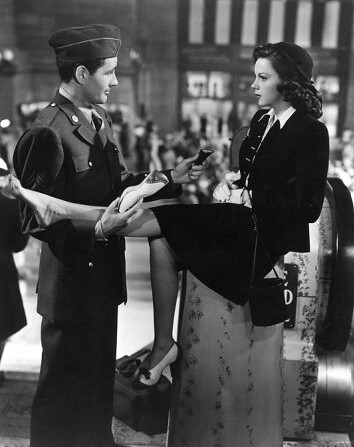
This is a deviation from my usual adherence to lists of movies rated as great by one source or another, as it is unlikely this will appear on any such lists. I was intrigued however by the things James Agee wrote about it at the time it came out, of course I like Judy Garland as a movie star, and I am emotionally partial to many of the sentiments that informed all the arts in this time period, so I made an exception to my usual patterns to see it. It tends to get written about very enthusiastically on the internet--it is the 4th highest rated movie of 1945 by the reviewers at Amazon.com for example--but this is because it is the kind of movie that only people who will be inclined to like it in the first place are going to bother seeing it. It's a saccharine wartime romance about a soldier and an office girl he meets while on two days leave in New York City. The combination of Judy Garland in New York in 1945 is enough to draw me in however.

Like It's a Wonderful Life, this film was not a big hit at the time it came out. It was released as the war was winding down in May of 1945 and the critical consensus seems to be that people were starting to transition out of the mood for this kind of overly reassuring picture, perhaps looking forward towards a more materialistic postwar mindset, I am not sure. The settings where this movie takes place--offices, restaurants, train stations, apartments, hotel lobbies--tend to be cramped and crowded and well-worn and shabby, though enlivened by the energy and purpose which the war has unleashed, especially in the young people. This is one of the things I like about it, though in reality getting away from this urban shabbiness and bustle, which looks somewhat attractive after sixty years of suburban living, was one of the first things people were determined to do once the war ended. I have read that the whole movie was filmed on Hollywood sets, but the recreation of New York is very believable. There was even a facsimile made of the Grand Concourse in the interior of the old Penn Station for $66,000. Why, one may ask, would I be attracted to shabbiness? I wonder sometimes if it is not my natural element, since I am always uncomfortable in any kind of any kind of overly efficient and sanitized environment. Any depiction of shabbiness populated by moderately intelligent, or attractive, or even upstanding people--narratives of the bohemian Paris sort being the epitome of this genre--is almost like an affirmation for my existence, though I actually have nothing to do with such scenes in my own life.

Judy Garland is really very good in this. I don't know how intelligent she was--certainly she was not educated, and seems like somebody who even today would be an indifferent student in school--but she was truly gifted as a performer. It is common on the internet to suggest that if Judy Garland were to go on American Idol she would not win for whatever reason, but in fact the great unconscious dream of this contest is that somebody like Judy Garland is going to turn up on it, which, however, appears unlikely to happen, because, leaving aside the question of singing talent, the instinct for stagemanship and having to relate to an audience that is obvious in these old stars is not something that people seem to have anymore. Frances Gumm does not sing in this movie however, which was the first time she had ever had such a role, and she is great. She is wholly convincing as an average working woman that an average soldier would have met and fallen in love with in the mood of 1945. This is in part no doubt because aside from her unusual singing and acting talent, she was that kind of person. She is attractive enough to fall in love with on a good day, but is not anyone who was ever going to be mistaken for Ingrid Bergman. She pulls off the clothes, makeup, hair, conversation, etc, of the class of person she is supposed to be portraying to a very fine point of detail. When you watch some of the clips from her TV show in the 60s, when her speaking voice had become rather grating, and she cackles jarringly at bad jokes, and her eyes had an odd harsh/sad but at the same time not unkind expression, it is just like so many of the women of that wartime generation that I knew growing up. It is not a stretch to imagine that the appearance and temperament of Judy Garland in this movie is not far from what they were like themselves in 1945.

My grandparents were all born in the 1921-24 window, making them ground zero Generation GIs, and my parents were born in 1948 and 1950, which made them ground zero Baby Boomers, so I was exposed early to the conflict between those generations. As you have probably guessed, my sympathies have tended to lie with the World War II crowd from pretty early on. This is probably more a circumstance of chronological juxtaposition than anything else. If I'd been born in 1948, I probably would have had a lot of issues with them too. I know that my father had a very difficult upbringing, his own father, a WWII vet who left the scene for good around the time I was a baby and of whom I have no memory, being by all accounts a very wicked man, and the Catholic church and schools in that era, which accounted for most of the portion of his life outside of the house, appear to have been largely run by sadists who considered it their duty to be brutal and cruel children to a degree that it is unfathomable today. On the other hand, he also spoke critically and hardly about other older people I knew, relatives and family friends, in a way that seemed completely out of proportion to what they deserved. It is true, these people were politically and socially hidebound, many of them were alcoholics and had very troubled familial relations of their own--for example one of my mother's uncles, a foaming at the mouth Republican type who refused to cash his social security checks on principal, had a son in 1969, the story goes, who refused to get his hair cut, a situation which nowadays would probably blow over before dinner, but then my uncle threw him out of the house and they never spoke to each other again, though the father lived another thirty years. When I was a little boy however, these kinds of things didn't carry a lot of meaning for me, and I mostly related to how people made me feel; and my parents and their friends their own age always made me nervous, while the WWII-aged people for reasons that I have never quite figured out, did not. For one thing while the GI crowd would often be critical of children and young people in general, the baby boomers I knew tended more towards sarcasm, which I now realize has no effect on children, who don't understand it, except to confuse them. My perception was that my grandparents and their friends and the teachers I had who were that age were more accepting of me and had more faith in my competence and value to society, and also did more of the kinds of things that would be helpful to a young person. So now that they are largely gone I find I miss them.

A lot of the time I write as if I wished I lived at some past time and place which actually I would find miserable to endure if I were suddenly transported there. But New York in the 40s I really think I might like. Most of the technology I would least want to give up was already in place--electricity, refrigeration, central heat, radio, trains, cars, Coca-Cola. Music, for me at least, was at least as good as it is now, and nightclubs certainly better. I'm sure I could handle the food. Though I see it claimed otherwise (usually by women themselves), it wouldn't surprise me if there were as many attractive women in New York in 1945 as there are now, certainly who would be datable to anyone who wasn't a non grade-A alpha male. I'm guessing investment bankers weren't quite making 300-400X the income of the average worker. More like 10-20 maybe? Of course speculating on living in the past with a mind formed for a world 50 or 2,000 years in the future is not a proper use of said mind, and one ought not to indulge in it.

The scene with the aggressive drunk at the diner was good. I've heard that same tirade many times. Perhaps I have even given it once or twice.


This movie has in some regards nothing and in others seemingly a great deal in connection with the atom bomb, which was in production at the same time. The film has a very subtly, perhaps even largely unconsciously modernist undertone that I did not pick up on myself until several days afterwards. It is kind of taken for granted that the world is a big machine which has to be kept running on schedule, and that everybody in it had better conform to that schedule or they'll caught in the shredder. Throughout the movie the characters are constantly under the constraints of clocks and schedules, curfews, trains, buses, delivery routes, closing hours of museums and offices. The Clock of the title refers to the place they agree to meet for their date, for which Alice is actually a half hour late. Joe's persistence in waiting almost against hope as the clock moves well past the appointed time and life continues to rush on all around him becomes almost poignant. The atom bomb, probably the most awful of all man's inventions, certainly of his stupendous ones, seems to be in some ways the logical conclusion of this kind of society, a society though for which I yet feel a strong affection.

A confluence of circumstances culminating in the chaos into which so much of the populated world had descended by 1944-45 made the building of the atom bomb in the United States probably inevitable and by extension necessary. Using it was perhaps neither, but when wars reach the stage that had been reached at the beginning of August, 1945, a state that thankfully the western world has not experienced since that time, when there is no prospect of ending the hositilies without killing a whole lot of people one way or another, it is highly unlikely that a weapon possessing that much power is not going to be used. For this reason I have little doubt that they will be used again. I also think that the power most likely to use them again is still the United States. The risk of doing so will still be seen by it among all the potential users as the least. No one has really inflicted catastrophic, generation-destroying type destruction or casualties on this nation ever, and we don't seem to have a sense that that really could happen.

All right, I have to end this. I could ruminate more on the bomb, but I suspect it will come up again, and maybe I will think more about it before that time. I am trying to figure out the source of my strong attraction to and good feeling about the time period of the 1940s especially while accounting for all the awful stuff that was going on at that same time.