Showing posts with label painting-france. Show all posts

Tuesday, March 13, 2012

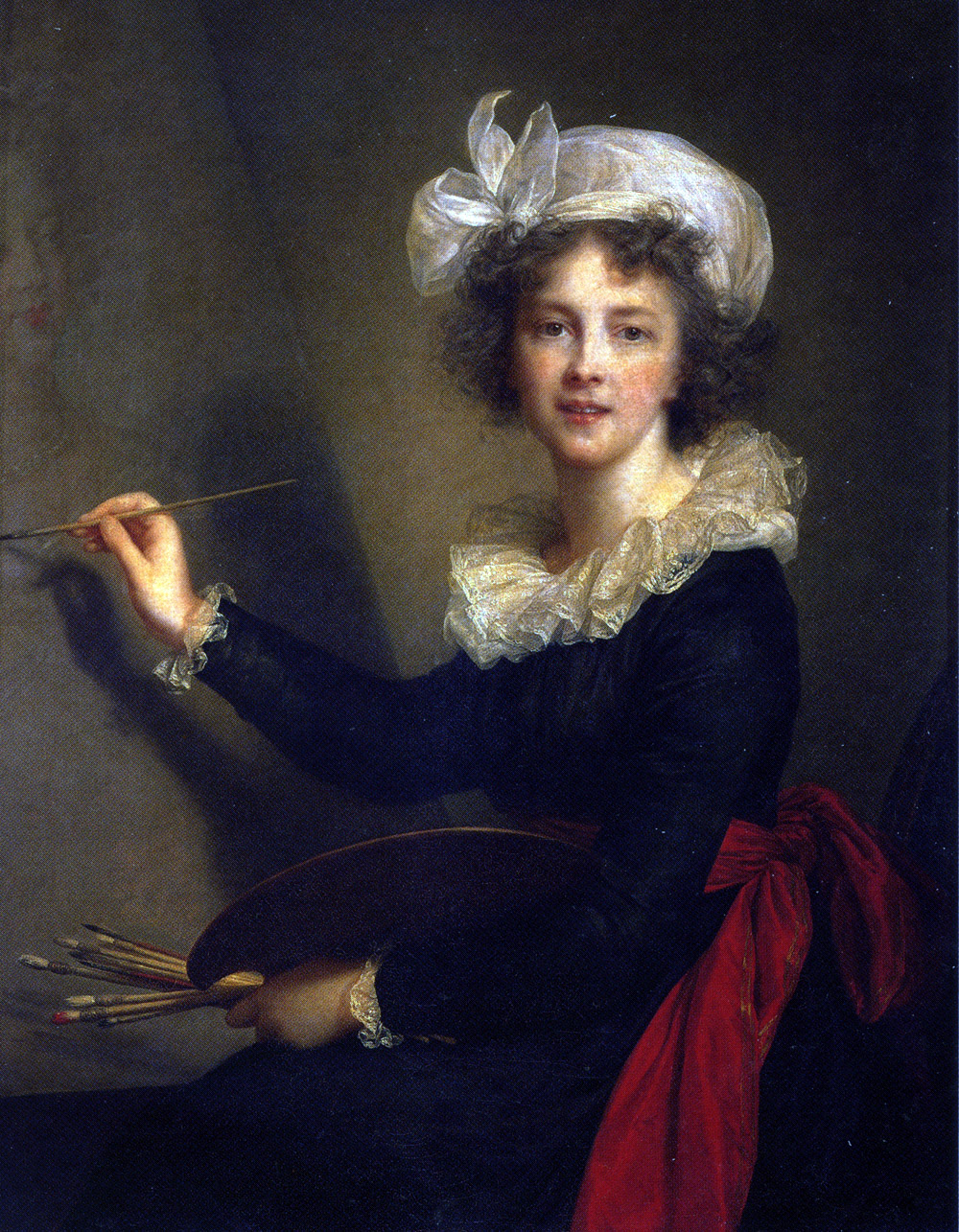
Favorite Women of Art #14--Elisabeth Vigee-LeBrun
I think the time has come for an occasional revival of this series. My art writing is undoubtedly among the best work I do, besides that it invariably puts me in a positive state of mind in spite of all the objections which might be argued against its doing so. I had the good fortune to have formed romantic ideas about various subjects, including most of the arts and even much of history before I was exposed to the more realistic and exacting interpretations and scholarship, either of the exalting beyond the reach of my understanding or too thoroughly eviscerating variety. The sense of the sublime, or the ideal, or even the merely sensuously better never died entirely within me; and it still seeps through the myriad unpleasant to contemplate truths in most instances.

Elisabeth Vigee-LeBrun seems to me an excellent painter. She was primarily a portraitist (portraitiste? portraitess?), and not just of run-of-the-mill and now forgotten aristocrats and wealthy merchants either, but royalty and the elite of the elite of her age. She was fond of doing flattering self-portraits as well--talk about controlling the image--of which this is my favorite example, at least of the ones that I am aware of. I like the hand full of paint brushes--it says, I am serious, and I like to work, but I am not grim about it. I like the prim petite black dress with the red sash--I don't exactly know what it says, but I think it is something like, I favor a slightly understated look that is still feminine and attractive. The headgear with the greater part of a head full of ebullient curls still out and framing the face, says, I am a 18th century French lady du monde, I really understand what titillates the more refined type of male brain, and there is pleasure in having the capacity to do so. The single visible row of teeth, and the eyes lazily open and completely exposed to the viewer says, I cast rather than bore for artistic truth. Illumination holds for me the primary appeal, obscurity very little.

Has there ever been a time when the greatest artist in a particular age, or country, or school, was a woman? It has occurred in literature; Jane Austen for example was almost certainly the best novelist working in English from 1800-17 (her death), and some would argue that Emily Dickinson was the greatest poet active during the 1860s and 70s, in America at least (I am less certain about this, though I am as yet skeptical of the supposed greatness of Whitman). It is true that neither was, or probably would have been, recognized as such at the time, but the retroactive recognition demonstrates that obviously the possibility exists at any time. Going way back I suppose most Greek scholars consider Sappho the best lyric poet of her generation. One would think it would have happened in painting at some point. In England anyway I had the impression that drawing was one of the major components of the education of young ladies of means going back to the 1700s. I realize that in most of these instances intense training was not received yet there are always instances throughout history where people who would not appear to have received world class preparation in a subject have managed to burst through with works or acts of original genius which altered the historical course of their nation's culture. I suppose the great artists have by tradition been a physically robust and combative lot, very competitive, energetic, quick to disparage the work of rivals and pour contempt on that of inferiors. When men of this combination of personality traits mixed with serious artistic abilities and a serious intellect, working in a culture that understands, cultivates and highly values the especial talents that they possess, you get something like Periclean Athens or the Italian Renaissance, in English literature perhaps the Elizabethan period, hyper-male ages of male cultural achievement, in which the contributions of female artists seem to be even more conspicuously absent than in ordinary eras, as if when highly realized male energy and power are set loose in the artistic arena, the best efforts of women are simply for a time overwhelmed? I don't know where I am going with this. Women are of course highly prominent in the art world at present not only as artists but as curators and scholars, where my suspicion is that among the under-50 set they are dominant, and as big money patronesses as well. When you get into the money and the higher refinements of true taste I kind of lose the thread because there is a disconnect with that side of the business from my romantic view. Now we're talking about who controls art, how it is presented, what one is supposed to think about it, etc, and it does seem like in many ways there is a class of woman that definitely has a strong say in that...

I don't have much time to write reviews on Amazon.com--I think I have gotten nine up in two years. No one has commented on any of my reviews yet and only 8 of 14 people have found my pieces helpful, 3 of 9 when you take out the one review I published (of the silent film Variete) that was popular. This is a matter of no interest and little meaning, but I thought I'd throw it out there.

Winter was short this year, I was busy, and I think I might have missed Maple Sugaring season. I've grown to like Maple Sugaring season, and I find myself looking forward to it, so hopefully it will still be going on somewhere. But I doubt it.

Sunday, September 25, 2011

The Game of Art APPENDIX B(?): Household Art Edition

What do the art displays of disaffected provincial petit-bourgeois bloggers tell us? Today we are going to explore that very question.

Picture #1: Title unknown. Artist is the father of an acquaintance.


One of the few actual paintings in this collection, the small canvas hangs in the attic on some paneling near a chimney, and the whole arrangement gives that softly lit part of the room a cheerier appearance. It has been up there ever since I moved into the house, and for all these years I thought it had been left behind by some former tenant, an anonymous work, but now that I have been discovered/caught snapping photos of all the pictures in the house, the true identity of the artist has been revealed to me.

I assume that the painting depicts a New Hampshire scene. The rust on the roofs of the barn is the most intimate detail of place. The seasonal appearances of the natural elements--sky, grass, trees, light--strike me as perhaps more incongruent than one would like. Still, I find something in the picture reassuring. It projects an idea of existence as more or less benign, which is a sentiment I confess to being open to.

2. Renoir--Flowers in a Vase

I am not making up the title. On the pouring shelf in the refrigerator/pantry area, formerly known as the interrogation room for its charmlessness, lack of windows, and single severe lightbulb dangling from the ceiling. The fingerprints and other smudges on the glass make for a nice symbol of our current familial relation to the fine arts. Almost all of the pictures here are not mine, either by original ownership or inspiration by the way. I do not know what the origin of this particular print was, though the original is supposed to be in the National Gallery in Washington so perhaps it is a souvenir of a visit there. If I were decorating myself I would almost certainly have neglected any flower pictures and wondered what touch of delicacy or other the establishment was missing.

3. Gustave Dore, Illustration from the Inferno, Canto XIII (about the suicides)


In the upstairs "office", where I spend less and less time as the years go on. We had to pay some homage to the Great Books, I guess--it's a part of the household narrative. Back in the late 90s a used book store in our town that has long since gone out of business had an art section from which they sold color plates and illustrations that had been torn from or removed from books singly, almost as prints. These Dante pictures were from that stash. I recall at the time that we got and framed four of them. There is a second one further down on this page but I don't know what happened to the other two.

4. Harald Sahlberg--From Roros (Side Street)


Souvenir from our trip to Norway in 2000. We did not go to the actual town of Roros, famed for its copper mines, which is quite far north. Norway was a fairly poor country and was not even independent until late in the 19th century, so its art museums do not have much in the way of major foreign collections and are heavily domestic in orientation. This was good, as besides the considerable amount of Munch there was to see, I liked their old pre-World War I realist/academy school well enough at the time.


5. Vermeer, Milkmaid


Poster from an exhibit that we actually saw in London in 2001 (this painting is normally in Amsterdam, which I have never been to, though I once stood in a train station in Paris contemplating buying a ticket there and possibly seeking out a Dutch girl I had been pen pals with. It was only a couple of hours away. But, of course, I allowed the costs and practical difficulties for which I had not planned deter me from this romantic and possibly--why not?--fruitful plan). This is in the refrigerator room, on the wall opposite the Monet flower picture. I'm kind of surprised it's still up, though I guess it does have a kind of kitchen theme and it is a reminder that even I once had a different life before I had to fill out paperwork for kindergarten assuring my kid's 25 year-old teacher, that Yes, we have books in our home.


6. Alfons Mucha, Poster for Sokol Festival, which is a Czech Gymnastics-Calisthenic type thing.


Not one of my favorite efforts by this painter, whom I wrote about in one of my old "Favorite Women of Art" posts (#6 or 8, if I remember correctly). This poster had a companion, which was the illustration I used for that other post, but that picture was put away some years ago and I don't know where it is at present. This one is hanging up in the downstairs bathroom, or powder room, as we used to call it in Philadelphia (that would be the old Philadelphia). That wallpaper dates from the 1940s or 50s and is peeling badly in places, but I am going to cling to it as long as possible because whatever replaces it will never be as cool.


7. 1980s Tourism Poster, Limousin, France


This probably shouldn't count as 'art', but I tend to regard it as part of the visual collection. This is also in the attic, just below painting #1 and, as you can see, approaching the floor, or at least the top of whatever pile is stacked against this wall. As noted elsewhere, I am a bit of a nostalgist for the days when countries were a bit more a world onto themselves, less globalized, slightly fewer people speaking English and walking around with degrees from American and other great universities that get indigestion at the mere thought of people like me setting foot on their campuses even as a tourist. I regard France in this light maybe more than anywhere else. It had a lot of glamour and romance to lose by adapting more efficient and convenient modern habits, as well as becoming generally more accessible and accomodating to the global economy, and to my imagination it has lost a bit of it, but then again how reliable of a source am I on these sorts of things? The attic is a very suitable place for the poster.


8. The World of Mother Goose.


This is a print of one of my father's illustrations. Naturally it is in the children's room. This artist is not afraid of producing a busy composition, as you can see. I suppose I have inherited something of this same quality in my own outlook--my instinct is to pile up facts or names or other people's ideas and mistake them for detail. Detail is more akin to penetration. It is honing in on what is most significant, and that is why it is considered an important property of high art.


9. Gustav Wentzel, Sjaakspillere


Yes, I believe the title in English is "Chess Players". Unfortunately I could not get a good picture of this. If I turned the flash off it was too dark. Bear in mind I had a break of about 10 minutes in which to go around the house and take all these pictures or I probably could have figured it out. Here is a link to the picture as it is supposed to look. The flash notably obscures the tasty-looking mug of beer set beside the board.


This is the other print brought back from the Norway trip. Its appeal, formerly its air of a kind of gentlemanly bohemianism, is now augmented by that of leisure and relaxation, but still in a cultivated context, all of which is largely inaccessible to me at the moment. The picture's placement contains one interesting coincidence, in that as you can see our own chessboard is stored right beside it--and it does get a good amount of use, though as yet our games are not very relaxed affairs--and one irony, in that the major item of furniture beneath it, atop which all of these miscellaneous items are sitting, is an antique piano, which however, no one in our house knows how to play, and which is so badly out of tune that even people who come over to the house who can play cannot play it, because the sound is too painful to them.


10. The other extant Dante illustration, from Inferno XIX


The simonists. Those guys get it good and hard in hell. Also in the office. Everything framed in that room is small in size, no larger than a standard sheet of typing paper. There are also barometers and such kinds of things as people like to look at and be surrounded by when they are taking refuge from their actual lives.


11. Covered Bridge, Somewhere in Pennsylvania.


This is one of my father's early pictures from the 60s, when he was taking after the style of Andrew Wyeth. I am about to contradict what I wrote in my last entry, in that this picture is also in the office but is somewhat bigger than an ordinary leaf of paper. However it is set atop an enormous and nearly immovable wardrobe that is in the corner of the room, so that if one is sitting down in the room he does not notice it too readily.


This picture was around during my childhood, and then it came into my possession after an interval of some 10-15 years through a third party whose hands it had fallen into. I don't know what it represents to me, other than a time--which the tendency is to imagine as a happy one though in reality it was no more or less happy than any other time--before I was born to which I have some relation. My father is not like me where his painting is concerned, angst-ridden and constantly suffering from crises of confidence and inferiority complexes. He paints not in a desperate attempt to become vital but because he is actually is vital, and as a celebration of that vitality. Obviously I can't really relate to that mindset.


12. Constable, Dedham Mill, Essex


Doesn't this remind you of the painting in Mr. Rogers's kitchen? This, along with at least one other picture in the same style, decorated the paneling in my grandparents' basement for around 35 years. Now we have it up in the children's playroom. I don't know what happened to the rest of the set.


I have written elsewhere about my affection for this school of painting. It shares an attitude in common with other things I like, which is a kind of hopefulness or even optimism judiciously larded with a sense of authentic melancholy. As ways to understand existence go this seems to me a reasonable and comforting one, especially if a grander understanding is inaccessible due to limitations of the intellect or spirit which prove impossible to overcome.


13. A print, but who the artist is or anything else I do not know.


The figure in this picture bears some resemblance to Mrs Bourgeois Surrender. It was given to us as a gift for that reason. It currently hangs in one of the niches of the dining room, above a couple of items I did not include in this survey, one a framed, waterstained tableau of some antiquity featuring a black and white image of some woods with the oft-maligned Joyce Kilmer poem "Trees" incscribed beneath them, the second a poster of Neuschwanstein Castle, which I have never been to, but which the children like. If it helps them develop an interest in learning about/traveling to Europe someday--apparently nowadays getting boys especially interested in anything traditionally associated with learning or culture has become a Herculean labor--then it will have served us well.


14. Postcard of our house, circa 1905


It is largely obscured by the elm trees, which unfortunately of course all died in the great elm blight of the 60s which devastated this quintessential New England tree (it is still the state tree in Massachusetts) all over the region. We have planted one. It remains rather frail-looking even after a couple of years, but it is still alive.


A curious note for baseball fans, the house next door to us on the left, which is not visible in this postcard, was, I have been told, the boyhood home of Red Rolfe, who was the 3rd baseman for the Yankees from 1934-42, played on five championship teams, had several outstanding years, especially 1939 when he led the leagues in hits, runs scored and either doubles or triples, and was arguably the best player at his position in the history of that storied franchise (though granted, he would have batted 8th in the lineup of that all-time team) until the arrival of Alex Rodriguez.


This item hangs in the dining room above the china cabinet.


15. Degas, Portrait of the Belilli Family


The bourgeois family extraordinaire. To be honest, I flatter myself by insuinating that I am bourgeois. Real bourgeois are actually quite rich by the standards of the median income or wealth. Five years ago when I began this page my ego, believe it or not, was still nowhere near deflated to a level correspondent to the truth; it still is not all the way there, nor am I ready for it to arrive at that point, though it continues to make a slow and grinding progress. Anyway, I thought at the time that by being bothered with conventional things like jobs and children meant that one was bourgeois, which seemed bad enough. That the truth is, in fact, probably even worse is something that will take a further number of years to come to terms with.


This picture is big and used to hang on the large wall in the staircase. It has since been replaced by photographs of the children and has been retired to the attic.


The public library in our town used to have a collection of framed copies of famous artworks they would allow you to check out for 28 days. Sometime in the early 2000s they ended this service and had a sale of the pictures. This is one of them. There is another directly below.


16. Henri Rousseau, Family Outing


This is the other picture from the library fire sale. This is the 3rd picture in the very artsy refrigerator room, above the Vermeer.


I admit I was not a particular fan of Henri Rousseau, but my wife finds a lot of joy and life in his paintings, especially this one, and she is not somebody who goes around liberally declaring enthusiasm for artworks.


17. "Travel"


One of my father's prints--such money as there is in this type of art is the ability to sell prints. I have a reputation for being fond of travel, so I received one of these as a present. It is true, I have never been much of a homebody. I like to get out of the house, especially if I am not going to be able to read or write. This is probably the main reason I always envisioned myself living in a big city and renting, so I wouldn't have to be bothered with the responsibility of upkeep on a house, for which so many other people seemed to me so much better suited than myself, while I seemed so well suited for bohemianism and reflection and sensualism and all that.


18. The Prophet Jeremiah from the Sistine Chapel Ceiling.


In the dining room. I like it, though it does not really fit in with the rest of the collection.


19. Postcard of the Former Union Station, Portland, ME


I doubt I need to tell you what my opinion of the destruction of so many of America's great railroad stations is. A few years ago I saw a calendar/postcard type book featuring pictures of various stations in New Hampshire alone that were no more...but time is up. I will save my ruminations on America's lost train culture and how that may or may not have negatively affected my life in another post. It is 9 days since I started this, and it is time to move on.

Monday, December 17, 2007

FQ-5

I did not know many women when I was young, but among those in whose presences I chanced on occasion to find myself, quite a few claimed that their favorite movie was "Harold and Maude". When I finally saw the movie, which is watchable more for the fascination of the enormous 1971-era cars and dreary landscape (leaves, and vegetation in general, as well as bright sunlight, seem to have been in short supply around the years 1969-71, judging from the films of the period) and the Cat Stevens soundtrack, which sounds great in the actual movie, than the excruciating plot, which centers around a geek who has a love affair with a octogenarian, my reaction was "How the hell can this be anybody's favorite movie, especially a young girl's?" Meanwhile other men were regularly meeting attractive and volatile women who told them their favorite movies were "Betty Blue" or "Henry and June", and behaved accordingly (these films, as far as I could tell, were about women who required, and got, constant stimulation and high-intensity sex). Always slow to catch on to the most blatant codes (perhaps this is what is meant by being unable to recognize an allegory even when it is swallowing you alive), it just occurred to me a few days ago that the alleged favorite films were nothing but a means of informing you in what regard you were held, certainly as far as your sexual prospects went, by reference to the fate of the leading male characters in the films named. Subconsciously one always knew this; when my future wife claimed to be partial to uplifting and wholesome American films from the 1940s (to me; who knows what she would have said had a pulsating superman been present at the conversation, which thankfully, one was not), I knew that I had some hope, though being me I did not make out what form that hope must inevitably take, and therefore made no preparations for it. The point in all of this relating to the Faerie Queene is that it is possible I may be struck by more penetrating insights about what it really means in 10 or 15 years, and I will be able to add those too late epiphanies to the compendium of worldy wisdom I hope to accumulate for my sons to give them a little more advantage when they embark upon the great contest of life than I blundered into battle with.

The advantage to someone like me, who is a rather plodding scholar, of a longer work over a shorter one is that the longer one becomes a very distinct part of your life for the period in which you are reading it. Impressions have a greater chance of penetrating even the dull mind. One senses a degree of companionship with the author has been attained by the mere virtue of having been confined in the same carriage or boarding house with him for so many weeks. A lot of readers apparently don't care for this, and consider it presumptuous, especially in a multimedia age, for any person to demand twenty, or more, hours of another person's life to read his book, but I have always found that illusion of intimacy--the author cannot really escape my company either without my willing it--to be the primary reward of the habit.

III. viii. 42 (1-5) The theme of the third booke by the way is chastitie:
"Eternall thraldome was to her more liefe,
Then losse of chastitie, or chaunge of love:
Die had she rather in tormenting griefe,
Then any should of falsenesse her reprove,
Or loosenesse, that she lightly did remove."

III. ix. 30 This is a difficult part to make out exactly (I believe Cupid may just be working his perfidious effects on a pair of lovers with the aid of alcohol), but the poetry, as far as both language and the artfulness of the images, is remarkable:
"Thenceforth to her he sought to intimate
His inward griefe, by means to him well knowne,
Now Bacchus fruit out of the silver plate
He on the table dasht, as overthrowne,
Or of the fruitfull liquor overflowne,
And by the dancing bubbles did divine,
Or therein write to let his love be showne;
Which well she red out of the learned line,
A sacrament prophane in mistery of wine."

III. x. 48 A cuckold watches his wife in action:
"At night, when they all went to sleepe, he vewd,
Whereas his lovely wife emongst them lay,
Embraced of a Satyre rough and rude,
Who all the night did minde his joyous play:
Nine times he heard him come aloft ere day,
That all his hart with gealosie did swell;
But yet that nights ensample did bewray,
That not for nought his wife them loved so well,
When one so oft a night did ring his matins bell."

There are a large number of female warriors (as well as monsters) in the poem, which brings to mind that allegory in itself is entirely, as Blake pointed out, a pagan form, and is in fact antithetical to Christianity, which is revealed truth.

This painting is David's Death of Sappho, with Phaon. It too has nothing to do with the Faerie Queene (there is a Phaon character in the poem, but there is no allusion to this story). However, it came up when I was searching for a picture and I decided I wanted it in my collection. I have expressed my fondness for David, albeit largely unexamined, on this site before. This painting looks to be in the collection of the Hermitage in St Petersburg, which I still have a hope of getting to someday, though for what serious purpose at this point I could not pretend to say. It looks increasingly unlikely that that will happen anyway however.
III. xii. 18 (1-5) Displeasure is like me. Pleasance, of course, must be Mrs Bourgeois Surrender:

"After them went Displeasure and Pleasance.
He looking lompish and full sullein sad,
And hanging downe his heavy countenance;
She chearefull fresh and full of joyance glad,
As if no sorrow she ne felt ne drad..."

III. xii. 24 (3-5), 25 Catalogue of unsettled spirits:
"Repentance feeble, sorrowfull, and lame:
Reproch despightfull, carelesse, and unkind;
Shame most ill-favourd, bestiall, and blind...
"And after them a rude confused rout
Of persons flockt, whose names is hard to read:
Emongst them was sterne Strife, and Anger stout,
Unquiet care,and fond Unthriftihead,
Lewd Losse of Time, and Sorrow seeming dead,
Inconstant Chaunge, and false Disloyaltie,
Consuming Riotise, and guilty Dread,
Of heavenly vengeance, faint Infirmitie,
Vile Povertie, and lastly Death with infamie."

IV. i. 21-22 On discord. This could be sung over legs of mutton and ale, like a real epic poem. The theme of the 4th Booke is Friendship, by the way.
"And all within the riven walls were hung
With ragged monuments of time forepast,
All which the sad effects of discord sung:
There were rent robes, and broken scepters plast,
Alters defyl'd, and holy things defast,
Disshivered speares, and shields ytorne in twaine,
Great cities ransackt, and strong castles rast,
Nations captived, and huge armies slaine:
Of all which ruines there some relicks did remaine.

"There was the sign of antique Babylon,
Of fatall Thebes, of Rome that raigned long,
Of sacred Salem, and sad Ilion,
For memorie of which on high there hong
The golden Apple, cause of all their wrong,
For which the three faire Goddesses did strive:
There also was the name of Nimrod strong,
Of Alexander, and his Princes five,
Which shar'd to them the spoiles that he had got alive."

IV. i. 51 (5) Good line:
"All things not rooted well, will soon be rotten."

IV. ii. 27 (1-4) Western civilization in a nutshell:
"And of them all she that is fayrest found,
Shall have that golden girdle for reward,
And of those Knights who is most stout on ground,
Shall to that fairest Ladie be prefard..."


Sunday, April 22, 2007

Favorite Women of Art #10: Amour--Maurice Denis (1899)

This is almost "modern", but it speaks to me. I think it is the combination of the hair (I love it), and the slender, delicate, childlike figure, which do remind me of (grown) women I have actually seen, though the type is rare, as well the slumbery blueness and stars. It also reminds me--is really of a piece with--the famous and, to me, haunting musical compositions of Debussy and Satie that date from the same period and of which, though I make no profession to being a musical man, I am extremely fond. The direction in which certain aspects of the arts appeared to be moving at this time, needless to say, from my present vantage point, appeals to me greatly, and it is not clear to me why, among several competing paths, this particular one seems to have been so thoroughly snuffed out. Its worldview is still something that informs, and I think necessarily and fortuitously so, my dealings and engagements with the various great matter outside my own skull, though doubtless hampered by the twin curses of sensitivity and a sentimental rather than intellectual nature.
As my knowledge of this picture is courtesy of a little book of poems and artworks called "Art & Love" published by the Metropolitan Museum that I picked up somewhere in the course of my wanderings (I think I may gotten it in Brattleboro. I find I am often inexplicably inspired to buy things in Brattleboro that I would not think of buying anywhere else), I have always associated it with New York and the romantic notions I used to carry of that city, but really the associations could be of any ideally exciting cultural place full of beautiful and intelligent and, yes, sensitive young people like one's self, or rather one's ideal would-be, or would-have-been self. This is all very melancholy and self-pitying, and perhaps is an argument against the artwork by the more hardheaded and warlike among us, but the fact is that the picture does induce a sensation in me of great loneliness and sadness, albeit a very pleasing and beautiful and whimsical loneliness and sadness, to which I am admittedly too susceptible. Nonetheless I cannot leave it off the list.
I recently watched a film with my wife called "The Music Teacher" ("Le Maitre de Musique" for those who require original titles whenever possible). It is a Belgian movie about opera singers set around 1900. The "pitch" as given on the box of the film itself is "Amadeus meets Rocky". To give a quick review, the plot, writing and characters are pretty weak, and the governing POV of what it means/takes to be a great artist or to associate with the same, is Gallic to the core, or at least that which seems to have held sway in the official intellectual and high-middlebrow circles which have dominated the French cultural atmosphere for most of the last century, which I generally think is crap. On the pro side however, there are many beautifully filmed scenes and wonderful, even rather merry-sounding songs from the opera repertoire with which I was not previously familiar (if I can figure out what they were, I might list them here in a later post). The point of this digression, however, is that at one point in the film, late the night before the big singing competition that provides the `Rocky` element of the story, the 18-year old ingenue enters unnoticed and unchaperoned the room of her fellow pupil and budding star (who was discovered while picking pockets at a train station) to complete the last necessities of her artistic training, as the French mind would have it, in a horizontal position. (Some back story is necessary here: she had previously fallen in love with the old master, which everyone, including the master himself, had deemed beforehand to be necessary to her singing education. The master however being practically on his deathbed, was not up to the requirements this entailed on him, which occasioned the necessity for his finding the pickpocketing protege.) While I was enraptured by the glories of the classical artistic life, the inimintably sensible Mrs. S said `Pause the tape right there!` (Yes I still watch tapes. My children have broken both of the DVD players I have owned within a month.) She pointed out that modern movies cannot seem to help themselves in making well-bred and upper class young women from remote time periods as devoted to the practice of free love as modern shopgirls on package vacations to Ibiza, citing `Titanic` and a recent adaptation of `Mansfield Park` (in which some incest that is probably only even suggested in the book by the luridness of the modern imagination is presented in fully consummated glory by the edgy modern director) as other examples of the type, though she expected better from the French-speaking world (Why?). Her point was that if women, especially wealthy women, even intelligent and strong ones, had had such freedoms, even in matters of speech, let alone sensual ones, and such human regard as are depicted in these modern movies, the feminist movement would have been considerably less fervent, and perhaps would not have occurred at all. All the while I was thinking naturally of my current infantile romanticizing of the conceptions of feminine beauty which persisted in this time that was in fact highly unenlightened and chauvinistic, and wondering, as I often do in the face of my wife`s mature observations on all matters, first, `why am I so infantilized?` and second, `It is really because I did not spend enough time in my childhood handling and using firearms and engaging in brutal physical contest with other boys (for noble and educational purposes), as so many conservative thinkers seem to attribute the current crisis in American manhood to?`
Just last week it was snowing, but today it was 85 and the girls, as the song goes, were out dressed in their summer clothes. 2 pictures left.

Monday, April 16, 2007

Favorite Women of Art #8: The Toilet of Esther--Theodore Chasseriau (1842)

I feel that I have begun to go off the rails a little in my series, which after all was supposed to be fun, not a demonstration of my psychological estrangement from normal human society. I thought about taking a break from the series and writing a few nontaxing posts about watching music videos from the 80s on Youtube. For example, I had forgotten that Swing out Sister had a second song ("Twilight World") released in the US. Seeing it again made me rather melancholy. Here were people who clearly thought themselves, circa 1988, to be very clever, fashionable, creative, progessive, international--in a word nearly at the extremity of the cutting edge of world civilization itself. Moreover, they had broken through and made some figure in the great world; the possibility, even the probability, that they were in some way important could not but have flitted across their consciousnesses a few times. And then of course, as quickly as they came, they dropped off the face of the earth again, immediately becoming a relic of those very last dregs of the 80s, of the Cold War era, a time that in media and technology and politics and economics at least often feels no less remote than that of the big bands. I had utterly forgotten about them. I remember their song coming on my car radio back when it was new and feeling that it was a harbinger of some excitement coming to happen in my life, I suspect because I was alone, temporarily freed from the dreariness of family life. I was on I-84 somewhere in eastern Connecticut, probably on my way to have lunch at McDonald's and then right through New York City without stopping and on to my mother's in Philadelphia to watch television and evoke pity or scorn from all the regular hard-working people and wander fruitlessly around the neighborhood in search of...? This is what else I have looking at to carry me back to that time:

"Domino Dancing"--The Pet Shop Boys
"Joe le Taxi"-- Vanessa Paradis--terrible video and she is about 13, but it was a big hit when I was first in Paris, and everybody like me always thinks Paris is perfect the way it was when they were first there, and is never quite so wonderful ever after.

"Basketball"-Kurtis Blow

Morrissey--`Suedehead` and `Everyday is Like Sunday`--the essence of Morrissey on video

"Here`s Where the Story Ends"--The Sundays. Harriet Wheeler of course was my dream north-of-England dark rainy evening at the pub date circa 1990.

"Just a Friend"--Biz Markie. Don`t ask. Some things, like my fascination with this song and this performer, defy explanation.

"Wonderwall"--Oasis. I know this is years later, but it was the raging hit the 1st time I was in London, and I didnt make it to London until I was in my mid-20s.

Esther, as she is presented either in the Bible or in this painting, is not a woman of the type with whom I historically have had any success, even so far as getting her to say hello (if she were forced to do so) without a clenched jaw and hostility in her eyes, but this is nothing if not an aspirational web site, and neither artists nor writers seem to able to take her up as a subject without convincing the audience that she is hot-t-t-t-t-t-t-t. Esther was the sexiest female character in the Bible by far. I wish there was a better way I could say it without sullying one of the greatest productions of the human race, but having once read the whole thing straight through there is really no getting around it when you hit that story; it is what is most memorable when you read it. (I always considered Leah to be the second sexiest, by the way; the text insisting that she was inferior to Rachel in every way and was unloved, her story has always interested me, as she was still frequently entered into and impregnated, probably with a certain amount of relish despite not being the dreamgirl or the mother of a race of heroes. There is a lesson in that somewhere.) I dont have a very vivid idea of what Esther might have looked or been like (and her beauty is important, or at least might have been, if the literature is to be believed, to the course of human history.) The intellect suggests that to become the favorite of the King of Persia, a line of men renowned for their sensual appetites even among other Asiatic despots, she must have been a tall, poised, raven haired girl with the body of a college swimmer, though I tend to imagine her as one of the rather small but energetic, motormouthed (and pretty) Jewish girls I knew and loved, deservedly unrequited as it turned out, in my youth. But of course for us gentiles and non-Greeks all these characters and events of antiquity are just symbols that we use, that we only can really use, for our own purposes however petty or great, are they not. The modernists probably set Western art down that same path. We have been knocked loose from the moorings of the past as far as their being to us what they say or suggest they are or are supposed to be. What, after all, are Esther or Theodore Chasseriau to me? I am not of their race nor kind.


Monday, April 02, 2007

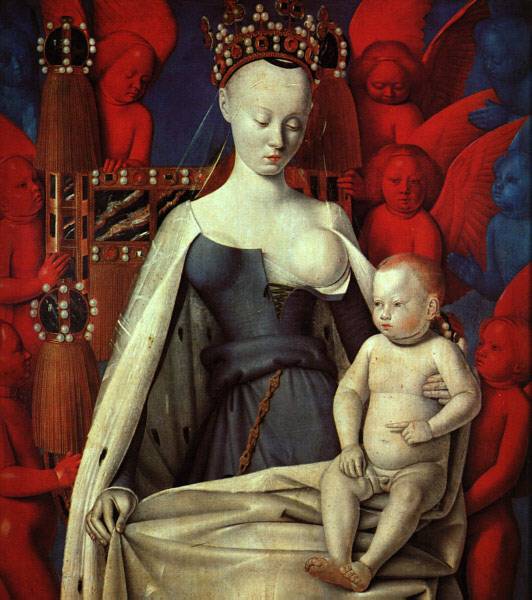
Favorite Women of Art #1 Melun Diptych (1454)--Jean Fouquet
I have taken some grief in the past over my fascination with this painting. When I showed a plate of it to Mrs Bourgeois Surrender once she immediately got to the heart of the matter. "You like that girl, eh?" she asked, a little doubtfully, not particularly impressed with the subject. "She has a very, er, natural-looking body." But it is really a very remarkable picture, I pointed out, I have never seen anything remotely like it in its time period, and as to the lady, well...I've never seen anyone remotely like her either, yet...she is rather attractive...she seems as if she really could have existed...This greeted with a half-bemused, half-exasperated look and a pat on the head as if sense and insight were not to be expected in conversation with me.

Most critics comment on the improbable spacing of the lady's breasts and excessively melanin-challenged skin. I have not come across any who have anything to say about her hair.

As this is ostensibly supposed to be a representation of the Virgin, it could be argued that there was a failure of execution in the artist's purpose; for this lady makes one think of Mary mother of Jesus about as much as Kenny G does of Ivan the Terrible. One story has it that the lady is really Agnes Sorel, whom we recently encountered in the Joan of Arc stories, the reputed most beautiful woman in France and mistress of Charles VII. I would be satisfied with that.

Jean Fouquet seems to be the largely consensus choice for the greatest French artist of the 15th century. I don't know how much of an intellectual he was, but he certainly had a brilliant talent for painting, as well as a sensibility for the way painted objects might look that was well in advance of his contemporaries. The allure of his Marie/Agnes to me I think is the combination of the truly gorgeous and ostentatious clothing, including the crown, setting off the pleasing form, or importantly the idea of a pleasing female form that is insisted upon strongly here. The vivid colors of the cherubs that dominate the background contribute to this effect too; but none of it works if the temper and poise and suggested nature of the quaverings of the various parts of the lady's person are not right, and these are all right in this picture.

Monday, March 19, 2007

The Game of Art--Part 6


By the time I have arrived at the high moderns my connection, both emotional and cognitive, to museum art, is already grown feeble. After them it evaporates entirely. Abstract expressionism, Postmodernism, Pop Art, whatever came after those things (I have a hard time even reading about anything that has happened since about 1970, so impossible is it to find a neutral or at least reasonably phlegmatic account about what is supposed to have actually happened and why it is important) have no resonance with me. Whatever particular delights or aspirations motivate its admirers to seek it out and try to lay claim to an identity with this work remain beyond my ability even to experience them, cold and inscrutable and indifferent as most of the world and most of life becomes.

Though we have reached the end of the game for me both chronologically and with regard to the height of the social levels I can glimpse, at the end I do not remain confused and despondent among the teasing Picasso and his uptight sensualist-wannabe fans, but decamp back a few centuries in time to a moderately high ground, 2/5ths of the distance from the center to the remote edge of the landscape, an excellent position from which to view nearly all the other hills populated by Westerners anyway, from the Sumerians to the last of the pre-1945 modern Europeans. My hill is fairly sparsely populated, mostly men in proper dinner dress with a scattering of good-looking but forbidding women, all in appearance rich, capable, expensively and carefully educated, possessed of frigid taste, stridently conservative in politics and social behavioral ethics, nastily disdainful of almost everything that does not approach the (not very) various personal standards they have set for themselves. Though they are formally polite enough to me I do not enter into serious conversations with any of them but observe them from a distance. I listen in on them because they speak more often about the things I am interested in than any of the other groups, though they are rarely able to get through a whole relation of anything without encountering a particularly unsavory specimen of their ideological enemies, who must be intellectually skinned and flayed and rendered wholly impotent before they can return to the story of the expatriate poets of 1950s Alexandria or Henry Green's half-decades lost to drink or whatever had been engaging my attention. The totemic painters of this my hill, approved heartily by all my fellows, are Poussin and Tiepolo. I had never heard of either of these artists, and probably would not to this day consider them any more special than dozens of others of their stature at the just sub-Rembrandt/Leonardo/VanGogh level of fame, until I was confonted by each's having a substantial part to play in Anthony Powell's A Dance to the Music of Time (painting by Poussin which inspired the title, above). It is not that I consider Powell or the supremely self-satisfied men and women on my hill paragons of taste, but it is clear that they have had such an education as both makes them capable of having it, and of having a fairly indomitable confidence in such opinions as they do form.

These painters have achieved a most comfortable and, to the confirmed bourgeois, enviable position in the art-stature game by the mores of early 21-century technocentric culture, though they are never set in the very highest niches of the pantheon; they are nonetheless largely unassailable by any force that the most rigorous current criticism seems to have at its disposal. Their technical proficiency is exemplary; their taste in and execution of their subject matter is uniformly of a high and thoroughly intellectually considered nature; in them, man is a more dignified creature in his degradation than moderns are generally able to conceive him in his triumphs. Their works appear, albeit by my very limited anecdotal evidence, to be relatively rare; Poussin's scattered a painting or two at a time around many minor and major museums, though with a decent concentration in London; Tiepolo having the bonus advantage (for snob value) that many of his finest works are on the not easily transportable ceilings of Venetian palaces, many of which remain in private hands and therefore inaccessible to the general public. Indeed I do not know that I have ever seen any of Tiepolo's work--certainly not since I became conscious of who he was, and the fresco of Candaules and Gyges that Powell writes about at such length I have not even been able to find any other reference to in my researches, though I find it strange that if he does refer to an actual work that there should be any difficulty in finding out basic factual information about it. In the Game of Art that I have been writing about however this (very intimate familiarity with and understanding of a painter's work) is often not so important of course, if a certain artist, or certain works or types of works fill an obvious symbolic need in the persona that the player wants to adopt to attract the potentially superior admirers/friends/contacts he seeks by engaging in it. Certainly there are other artists who occupy a similar position with me, especially some of the hyperbolical French romantics, David and Delacroix and the like, many English painters such as Constable and Hogarth, and all manner of academic painting, which I think it is not so hard to find charming if one can find television commercials charming, which doubtless in certain conditions most people probably do in spite of themselves. All these however are vulnerable to attacks in various major points of intellectual or even artistic weakness or failure, where the other two seem on stronger ground, only lacking that highest sublimity which is so rare that very few are in a position to attack it without making themselves more ridiculous than it is possible for their intended target to be. This kind of solidity of mind and competence has always fascinated me because it is the very remotest state to my current existence--sometimes more remote than genius I think.
Thus ends the game of art.

Wednesday, August 02, 2006

The Game of Art Part I

The last time I entered an art museum, sweaty in short sleeves and hunched over a baby stroller, the distracted, no longer young man emitting the air of a person not at peace with himself who was working the front desk took one look at me, handed me a brochure and an audio recording and said "Rembrandts to the left, Impressionists to the right. We close in half an hour". Perhaps if I had been a few years younger I would have protested that in fact I had just come in, having waited even for my little boy to fall asleep and all, to take a quick perusal of the Fragonards and Watteux of which I was pretty certain this museum (it was the National Gallery in Washington) had several particularly famed examples. However I forewent responding to this challenge, and declined as well to attempt to inflame the atmosphere with any of that danger and intensity of an antagonistic personality such as serious art appreciators are supposed to crave above all else, and dutifully went to wander through the Impressionist rooms as was expected of me. Naturally within ten minutes I was as unthinkingly soothed and comforted as the director of the gift shop could have expected me to be, with only an occasional passing flurry before my mood that to be soothed and comforted so breezily without the electricity an encounter between a pair of superior minds could be expected to generate was to be missing the greater purpose behind the production of such work. Badly.

After this I became interested in the hierarchical designations which certain artists represent to the general museum-going public, as that is no doubt a large part of the pleasure of the experience. The range of my examinations of this game extends from that part of the middle class which has a certain pride in being humanistically educated but for whom doing anything that one might think typical of a humanistically educated person (such as being attentive to rules of grammar, or studying) appears singularly uninstinctive, to that portion that has actually attained a highly refined aesthetic life, without quite having taken on a truly artistic one. True artists of course have their own exquisite games, being marked however by the highly individual personality and taste of such people, which are virtually impossible for those who are not of their number to get at well enough to explain. But as several astute commentators have pointed out, there are enough quasi-hip and attractive singles hanging around the cafes and string quartet performances at the MoMa to make the effort to become a reasonably well-informed aesthete not entirely a waste of time.

The Impressionists, I believe, are generally the first painters other than Norman Rockwell and famous children's book illustrators with which the earnest, perpetually nonplussed type of American bourgeois inquisitive about culture engages with some enthusiasm. The common explanation for this is that compared with almost everything else in the European tradition, the Impressionists do not require much in the way of either education or knowledge of the world to feel that they are kind of sexy and that one has gotten somewhere with them right away. As those of us who enjoyed limited sensual affection in our adolescence and early manhood are forever loyal to those couple of pretty girls who allowed us to touch them whatever dreadful things the world may say about them, Americans of a certain kind are loyal to the Impressionists, as anyone who has attended a Manet exhibition or attempted to tour the grounds of Giverny can certainly attest. All this popularity, needless to say, cannot but make the truly sophisticated wary, to the point that even purchasing an original Degas for millions of dollars invites a certain condescension in serious art circles, such expense often being explained away as the flailing about of new money in a milieu which it is only interested in and can only understand upon its own terms of investment and dollar value. In all of this of course it is not so much that the painters themselves whom one wishes to degrade and distance oneself from, but the grossly voluptuous, substantially empty wine and madeleine-misted Francophilia that they have a tendency to inspire. I myself used to be convinced that if I could ever become fluent in speaking the French or any other major cultural language I would impress sophisticated people and beautiful women and that my life would change, and it is still one of the disappointments of my life that I was never able to do this. It is however typical of the half-developed ridiculousness of mind that creates a market for Vincent Van Gogh playing cards, and which actually brings a certain happiness to the purchaser of said cards upon seeing them in his desk drawers nearly ten years after his purchase.