Showing posts with label letters-18th c.. Show all posts

Wednesday, January 07, 2015

Notes on Dead End Reading

The Pilgrimage to Parnassus; The Return from Parnassus (c. 1598-1602)

A series of plays put on at St John's College, Cambridge around the end of the Elizabethan period, as part of their Christmas festivities, though they are not about Christmas. They are about a couple of students who decide to make their way in the world as poets, and the predictable indifference, humiliation, and poverty that befall them when they set out to do this. There is some comfort in being reminded that the problem of impractical young people with liberal arts degrees leaving school without any prospects for obtaining an income, nor any realization of how one might ever go about developing any did not just spring up in the last 20 years. Maybe these kinds of schools, which ironically seem to be most emotionally necessary as a pleasant refuge during youth from the otherwise pitiless business of real life for the less successful of their graduates, will continue to sputter along in some form, in spite of even the most well-meaning, though mistaken efforts to kill them off and spare these more hopeless graduates from what is perceived to be the source of all of their perceived subsequent misery.


The plays themselves are hard going at times to read--I guess they have not been edited so as to be made intelligible to modern readers, assuming that can be done, and there are lots of references to people and inside jokes and slang that doubtless meant something to the assembled audience but can signify nothing to me. There are numerous references to contemporary as well as historical English poets (i.e. Chaucer), including Shakespeare, which accounts in some part for its historical interest. Shakespeare is identified only as a poet and the author of the Rape of Lucrece and Venus and Adonis. His plays I did not notice as being referenced at all, though even by 1598 a good part of the comedies and histories would already have been written.

It could be interesting if it could be made more intelligible, I guess, though even most of the experts seem to be of the opinion that only the middle play (the first part of The Return) contains any real literary value.

Philippics--Cicero (44-43 B.C.)

This was the first Cicero I had ever read, and I am well into my forties. My education has been light on the Romans, so he is not the last of them that I have yet to read either (all in translation, of course, which I know scarcely counts anyway). These writings, being purportedly the transcripts of orations, are much different in tone from those of other classical authors with which I am familiar, having much more raw agitation and hostility in them. Of course Cicero here is an active partisan politician who has to sway the wavering opinions of, if not precisely a mob, a body of senators. I suppose I was expecting the style of delivery and the subject matter to be grander, less earthbound.
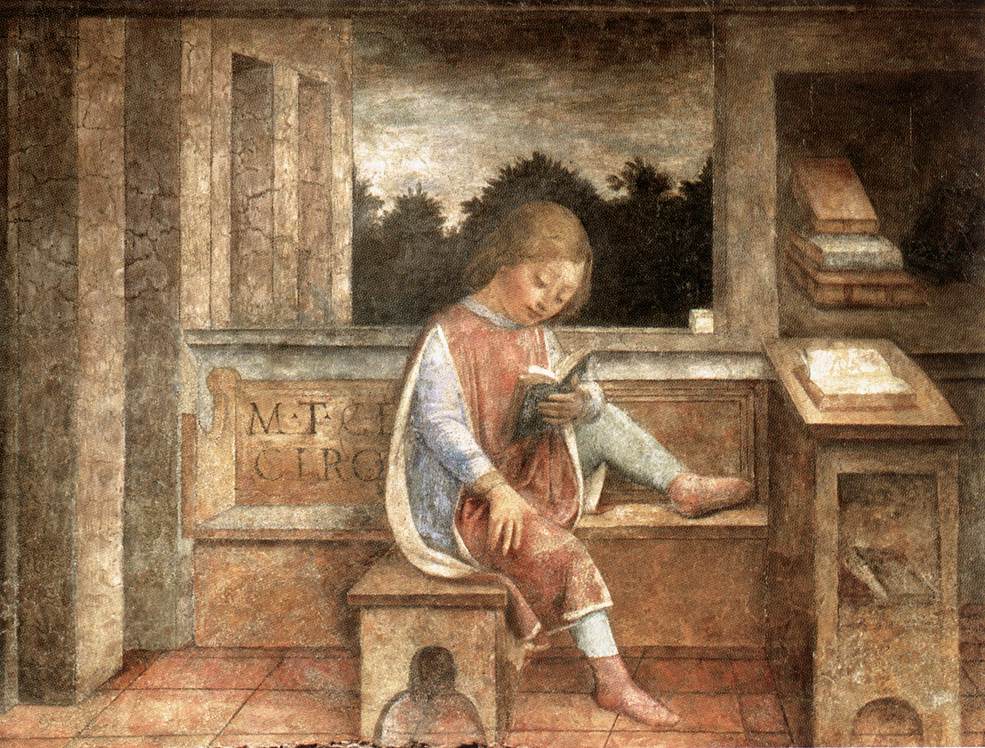

The Young Cicero Reading--Vicenzo Foppa (1464)

The fourteen Philippics are denunciations of Mark Antony, who at this time following the assassination of Julius Caesar was out of the city seeking military allies and in Cicero's opinion carrying on the worst of the dead Caesar's transgressions against the traditions of the old Republic. It is a different view of Antony than we usually get from both classical and post-renaissance literature. His arrogance, which in other depictions is usually presented with a heavy emphasis on vanity, here is expressed as of a more dangerous and willful quality. He is ambitious, a driver of events and a leader, of sorts anyway. I didn't previously think of him (based mainly on Plutarch and all the Shakespeare and Cleopatra plays) as a man capable of rousing this degree of anger and condemnation as a main target in himself, separate from his association with other people or events that are greater than he is.

I did not read this all that well. I suppose it is possible that the entire book is not great as a whole (various of the individual Philippics, especially the second, seem to be considered more important than the whole collection), maybe the translation did not perfectly capture the mood of high excitement and historical seriousness. I also have the sense that the Orations against Catiline (which Cicero himself, reliving that glory, references dozens of times in the course of the Philippics) are the essential Ciceronian reading. In any case he demands a more serious consideration than I seem to be able to give him at present.

Ben Jonson's Conversations with Drummond of Hawthornden (1618-19)

There is not much conversation here, on Drummond's part anyway, and what was recorded was mostly snippets--what would become popularly known as table talk--of Ben Jonson's observations, which amounted to 58 printed pages, most of which were more than half taken up with footnotes. The impression given is that there was not much in the way of give and take between Drummond and his guest, but that their talk consisted mostly of Jonson making pronouncements in a vaguely bullying manner. I don't remember much of this, either. Obviously I have reached the point where it is pointless for me to read any more. I am struck by so little of it, and as you can see I have trouble even putting my most simple general observations into words at this point. But I would have to take up some other pursuit to fill the time--I still can't just spend all my waking hours doing laundry and dishes, but maybe I am being ground down to the state where that is all I will be capable of doing--and I still desperately want to have some communication with the reasonably intelligent (and socially relevant) part of the world, and I don't know how else I can achieve this than by some attempt at producing content.


Drummond of Hawthornden

Tour of the Hebrides--Boswell (1773)

Not included in most editions of the Life of Johnson, this comparatively under-celebrated work is a book-sized bonus treat for people like me who are fans of this lively duo and their exploits in the social and literary society of their day. Johnson wrote his own account of this famous trip as well, which is one last further treat for me to look forward to, assuming I ever get around to reading it.


This is the edition I read.

I ordered my copy of this book online, and as sometimes happens with older memoir-type books, the edition I received was not the edited and polished standard one that all of the professors and other critics who have promoted the book as great are primarily thinking of, but the rougher version of the tour as it appeared in Boswell's journals. Nothing was left out as far as the major episodes of the trip went; on several occasions where pages of the journal had gone missing, the editors filled in the missing parts with the text from the printed Tour. These finished excerpts were far superior from a reading standpoint to the journal account, giving off much of the same high-spiritedness and humor of the Life itself, and I kind of wish now I had abandoned my edition entirely and found a copy of the traditional printed Tour. The journal was by no means a bad read, and almost certainly was more representative of what the trip was like on a day to day basis. There were numerous passages in it detailing parts of the trip where Johnson especially was bored and restless on account of the inferior level of education and dull conversation of many of the people they encountered, which provoked in him some rather harsh and decidedly unforgiving observations with regard to the limitations that several of their hosts and new acquaintances had revealed. My impression from the scholarly notes is that most of this material was either left out of the published version, or softened so as to appear more in a humorous and flattering light. And I think this was a good idea, as much of the special quality of these Johnson books come from the atmosphere of heightened intellectual alertness and drama that the scenes in them evoke. The life and conversation in them is far more entertaining and captivating than anything that ever occurs in real time, while plausibly resembling reality (if nothing else, the contrast between the journal and the published book reminds the reader of the art that is essential even in the production of a ostensibly non-fiction account to give it this sheen of heightened reality); but I realize more and more that it is these appearances of life heightened and made more consistently intense and significant and exhilirating that I seek in reading and other artistic entertainment.   

Sunday, December 24, 2006

Thoughts on Boswell

Boswell's reputation--he was once called the stupidest man ever to write a great book--is well known. Indeed I suspect he was a more likeable man in person that he comes across in print--or even than he came across in person to many people who ran across him. The publication of his journals with the salacious details of his adventures with women of the town, which as you can imagine have not been neglected by modern scholars, when contrasted with his strident and at times rather buffoonish adherence to conservative positions and religious propriety in his published writings, does not contribute to his making an attractive figure in the eyes of posterity. Even the portraits and drawings of him which remain make him look a little ridiculous, some no doubt by design; he is often drawn as stiff-necked man of unimposing height with a three-cornered hat rather overwhelming his oddly bland-featured, unprofound face. Even when he complains of melancholy, it appears he is really complaining of boredom, for he only appears to be afflicted by it when he has to work or is apart from the social life of London. When he is at a dinner party or a romp he always seems to be in excellent spirits, which certainly is not usually the case with people given to what I would consider severe fits of depression.

On the other hand he had some genuinely unique qualities in an author, as well as good luck in his subject, that served him well in his undertaking. He obviously had what we would now call personality, and if his learning was considered only so-so among the highest circles, he must have possessed a fair degree of amusing quick-wittedness at least, as he maintained intimate ties with a very intellectually and socially demanding crowd for many years. He reminds me in many ways of one of my own old friends, who was not the most diligent student but was intelligent, witty, had legitimate and serious intellectual interests if not the work ethic to make a figure in academia, loved pleasure and had the ability to converse with almost anyone who had some interest in common with him in an entertaining manner regardless of background. I suspect Boswell had many of these qualities. Boswell also seemed to have the combination, very rare among educated men in our time, of social skills without needing to be the Great Man or the center of attention in every instance. By all appearances Johnson loved him, a little bit like a son perhaps, as much or more so as a comrade or fellow adventurer in the life of the mind, as well as the life of the world. I cannot think of another prominent biographer (though I am sure there must be some) who held such personal status in his relationship with his subject. Of course it helped considerably that Johnson was so socially accessible for a great man, and not too much committed to grand undertakings as to sever his connection to the activities and rhythms of ordinary but still vital life, as great people often appear to be today.

I was surprised in reading the book at how much attention was given to Johnson's illnesses and the rather excruciating treatments he underwent in the last few years of his life, which demonstrate if nothing else how much it takes to kill a human being, or at least one with a strong native constitution. These accounts take up a sizable portion of the book.

The passage where Johnson takes his last leave of Boswell in the carriage the summer before his death and totters solemnly down the alley to his apartment is extremely affecting and in fact caused me to cry a little. The only other time tears have overcome me in such reading is during the deathbed scene in Don Quixote, which is interestingly another book largely about the friendship of grown men, one of whom is this case is known mainly for his addiction to reading. I wonder if I sense some kind of void in my own life. Certainly the vigor and largely shared spiritedness of the Johnson/Boswell relationship accounts for the success of that work down to our time above any other feature.

There was one more topic I wanted to address with regard to Johnson. There was a recent novel (1999) called England, England by Julian Barnes, the premise of which is that some large swath of old Blighty has been turned into a historical theme park with thatched roofs, afternoon tea, cricket, black cabs, etc, which naturally all the tourists, as well as many English people, prefer to the real, modern, relevant, messy England that exists outside the park. Among the attractions of the park is an actor in the character of Samuel Johnson that drinks with the tourists in a traditional pub and presumably regales them with colorful examples of English wit. The choice of Johnson for this character is quite an interesting, and a telling one. One could readily think of other possibilities for this entertainment: Dickens, Dylan Thomas, Oscar Wilde, Tennyson, perhaps a Byron character who drank and seduced women, maybe even a watered-down Americanized or globalized Shakespeare. All of these authors have been or remain to a certain degree popular abroad, especially perhaps in America, often as much for their personalities or what they represent as for a deep understanding of their work. Johnson, who is often viewed in the U.S. as something of a counterpart to Benjamin Franklin, who was his exact contemporary, appears to have attained somewhat to this iconic status without his work or his nature being particularly well known, and even among those who have studied him, I suspect our author Mr Barnes would say, many rush to make a claim of intellectual and temperamental affinity with the man that is, to say the least, most implausible. Many of the famous quotes--"A man who is tired of London is tired of life"; "to be a hero, one must drink brandy"; "patriotism is the last refuge of a scoundrel"--are deployed quite frequently, and often by people who give little indication of either deep learning or interest in the subjects addressed (And regarding the London quote: it is 230 or so years old. London happily remains a vital place, but I'm sure somebody once said the same thing about Babylon). What is more, I sense that Johnson's status, or maybe it is just the sense of his relevance, is at an all time low among his own countryman, who seem to see him, especially when repeating one of his aphorisms, as much a blubbering, sententious old fool as one of the sages of the nation. When I went to Johnson's birthplace the man working at the desk (there is some kind of tension going on between me and the people who work at these museums; See "The Game of Art, Part I) asked me why Americans liked Johnson so much, and said that Americans were the only people who ever came in the place. He did not betray any warm feelings for the great lexicographer himself. I had not been aware of this phenomenon at the time, and had to say that I knew nothing about it, that I was merely a fan of an old book. But going back to the Barnes novel, I think there is a sense that Johnson, who once represented something substantial and real, has been allowed to become via certain American and global, Non-European appropriation of the stories and the mythology of European and more specifically English literary and cultural history a cartoon figure of a literary man, by a world that hasn't the foggiest idea of what that entails. I have certainly felt a part of such processes myself, though in fairness these have also always been present in literary history, and the English of Johnson's time into the Romantic and Victorian periods, vis-a-vis the Greeks and Romans and their primitive forbears in Britain, were among the more extravagant makers of caricatures who ever lived, yet still produced worthwhile achievements of their own driven by these imperfect understandings of the past. We like in our age to have, or have access to, full philosophical and historical understanding of figures and societies of the past; that an artist need only detect something beautiful or noble in the composition of a story or a ruin and have it still be of great value to him, and direct him to interesting and pleasing works of his own though at a far remove from intellectual pureness or authenticity as regards his influence, seems to be a difficult idea for us to accept. However I think there is evidence that our non-acceptance of it is strangling our ability to see ourselves as artistic beings and to "create" new works certainly in the traditional forms.

This idea is not really brought to a conclusion but I am tired now and wish to let it go.

Sunday, December 17, 2006

Reflections on Johnson 2

Johnson being now established as one of my very favorite authors, I was especially excited when I returned to London in 2001 to finally go and see the house in Gough Square where I could imagine myself imbibing something of the atmosphere of 18th century London, which I consider myself as being able to do without too elaborate a concatenation of circumstances. I entered Johnson's Court and found the house, along with the famous statue of Hodge the cat (though Hodge almost certainly never lived in the house at Gough Square). However it was closed for renovations. We eventually carried on to Lichfield, where Johnson's birthplace was open, and which I will recapitulate in a later section.

In 2004 I 'studied' the Preface to Shakespeare and the poem "The Vanity of Human Wishes". (I have read other essays and poems of Johnson's too for purposes of general amusement, without attempting, I suppose, to engage them as objects of study. I am especially fond of "The Prologue at the Opening of Drury Lane Theater, 1747", though I like all his poetry generally.) This is from the notes I took on the Preface at the time:

Clear and even inspiring little treatise on the excellences and spirit (best spirit) of literature. Humor and wisdom augmented by learning and understanding are so much more attractive than mere dogged cleverness. He is able to admire and appreciate Shakespeare while still relating to him as a man, acting himself a man and giving the reader the benefit of the doubt as to being something of the kind as well. This in large part accounts for his (Johnson's) attractiveness as a writer. For W.S.'s excellence does lie primarily in his naturalness and liveliness rather than as a chiseled, precariously preserved intellect of the high modernist/post-modernist model.

I will add that in his prose, though Johnson says many times that the object of writing is to instruct and inform, he does not to my mind ever come across as condescending to his reader, certainly compared to almost all modern writers, though I am aware he had somewhat of this reputation in his own time. However, I think perhaps due to the rigor and high quality of his social intercourse, he was able to develop a style in which he is able to imagine and address the reader as a person at a level of understanding and knowledge comparable to himself, or at least to that of people who were actually his friends. American writers in particular, many of whom probably have gone through their entire lives without having a natural, easy social type conversation as an equal with another human being on the intellectual matters most dear to them, are prone to write as if most readers were not merely idiots, but scarcely conceivable to the author as members of the same human species. They write ever for authorities instead of for men and women.

As a poet I do not think it can be said that he is underrated or undervalued, his poetry still being readily available in print, but it (the poetry) is also not much talked about. His longer efforts build up a tremendous head of steam and pull one along through them with great force. In his best poems his lines, images, narrative and ideas are in each separate part almost uniformly strong, which is an exceedingly difficult effect to produce. A comparable strength of intellect and handle on the form of a poem and the English language as well as the histories of both combined in the same author is rare. Stevens or Pound would be the most recent English language poets that I would confidently say had similar levels of skill in all these various particulars. I suppose it is true that Johnson lacks sublimity, which is not an inconsiderable deficiency, though many of his points are notable for the elegance of their conception (as well as the force of their execution).

I was going to reproduce some favorite quotes from the Preface that I notated but I am not at home and I left the book there so I will skip it and move on to something else.

Wednesday, December 13, 2006

Reflections on Johnson 1

Having finished the Life of Johnson on Sunday, I am going to clog up cyperspace a bit with my own history with this legendary duo. Parts 1 and 2 will be devoted to me and Johnson, Part 3 to Boswell, and Part 4 to a account of my 2001 pilgrimage to Lichfield, perhaps even with my very own tourist photos if I can figure out how to do that.

I do not remember exactly when I became conscious of the figure of Samuel Johnson. He was not particularly well-known or prominent in our household, and I don't think it was much before I was twelve or fourteen that I became aware that he was the subject of a famous, but very long and very old biography, and I still did not have any idea why anyone would have written about him anyway. This was before I had even read Dickens or knew any basic English history, so the impression I had of Johnson, if any at all, was that of a stuffy, scholarly type from a faraway time and place. His very name struck me, in the early 1980s, as hopelessly and embarrassingly whitebread (mine being nearly as bad in that regard I was extra sensitive about the matter). He aroused no interest in me. I am not sure how much my father knew about him, but as his tastes ran more towards political history, war, exploration, etc I am pretty certain he hadn't read either Johnson or Boswell. I remember asking him once who Samuel Johnson was, since the Life was a part of most series of classics that I liked to collect at flea markets and the like at that time, which he scoffed at dismissively, saying "No one reads that anymore," adding too that Johnson had not liked Americans, which, being a great patriot, especially where the generation of the founding fathers is concerned, he took as a personal offence. I have heard him on other occasions denounce English books of the period as being unreadable because there is "too much damn Latin" in them, which would certainly apply to Boswell, though he never failed on the other hand to extol the likes of Jefferson and Hamilton on the grounds of their superior learning and deep understanding of the Greek and Roman classics compared to modern leaders.

Having passed through high school without ever perusing a page or handling a volume of either Johnson or his biographer, I proceeded on to a college that if it is well-known for anything is well-known for an almost perverse and willfull anachronistic biblophilia, where I don't believe I heard either the name of Johnson or Boswell uttered once in four years, though the English literature section of the library at least had much material on and many editions of the works of both. Since I killed a lot of time in that section over the years after dinner waiting for it to be late enough to start drinking it is probable that I at least looked into one or other of the books then, though I do not remember anything gripping me. They had the Yale edition of Johnson's complete works with illustrated plates on the title pages. I remember looking at the famous Reynolds portrait of the elephantine Johnson in one, and in another I believe an illustration of the great man leaving the drawing room on the occasion of his perceived snubbing by Lord Chesterfield (seeing as I am referring to this episode 250 years after the fact, by way of an artwork, is it any wonder why otherwise rational people harbor ambitions of literary fame?).

I graduated, and then began my current reading list the year I was 24, though it would yet be 4 years before I would get to anything by Johnson. When I was 26 I finally made it to London for the first time, where, in wandering about the City, I could not help taking note of the signs for Johnson's house in Gough Square, though not having read him at the time I did not venture to even look at the house, intending to preserve that pleasure for a time when it would have more moment to me, though even then I still did not have a clear idea of the massive figure Johnson still makes in the English literary imagination. In 1996 the London of my imagination was primarily Dickensian, with a little Bloomsburyan/Edwardian channeling around Hyde Park and Marylebone and Victoria, and what I knew from the Restoration and 18th century authors coming to life only in the City churches and oddly enough in walking along the banks of the river. Finally, on March 6, 1998, I commenced reading The Lives of the English Poets.

The Lives of the Poets is one of the most entertaining, as well as instructive books, both historically and literarily speaking, that I have ever read. By instructive I do not mean that Johnson is the most accurate recorder of facts or that his criticism is perfect upon all occasions. He does something that is perhaps equally as important, demonstrates what a collectively shared history and literature of an outstanding quality means to a society, and the men in it, over a fairly extended period; that England would not be England, and all that proceeded from this circumstance even after the age of Johnson, without its poets; and that any human mind ignorant of poetry and the poetic heritage of his own language at the very least can make little claim to wholeness.

Here are a few favorite quotes and word choices/phrases from the Life of Cowley:

'the mist of panegyric'
'The true genius is a mind of large general powers, accidentally determined to some particular direction.'
'the morose Wood'
'the courtly Sprat'
'...instead of seeking shelter in America, wisely went only so far from the bustle of life that he might easily find his way back, when solitude should grow tedious.
'a race of writers that may be termed the metaphysical poets'
'The metaphysical poets were men of learning, and to show their learning was their whole endeavor.'
'...the reader, far from wondering that he missed them, wonders more frequently by what perverseness of industry they were ever found.' (regarding the thoughts of the metaphysical poets)
'nature and art are ransacked'
'wrote rather as beholders than partakers of human nature'
'Their wish was only to say what they hoped had never been said before'
'confused magnificence'
'A lover, burnt up by his affection, is compared to Egypt'
'The lover supposes his lady acquainted with the ancient laws of augury and rites of sacrifice'
'Who but Donne would have thought that a good man is a telescope?'
'A coal-pit has not often found its poet; but that it may not want its due honor, Cleveland has paralleled it with the sun.
'Their expressions sometimes raise horror, when they intend perhaps to be pathetic.'
'unnecessarily and unpoetically subtle'
'I know not whether Scaliger himself has persuaded many readers to join with him in his preference of the two favorite odes, which he estimates in his raptures at the value of a kingdom.'
'His elegy on Sir Henry Wotton is vigorous and happy, the series of thoughts is easy and natural, and the conclusion, though a little weakened by the intrusion of Alexander, is elegant and forcible.'
'even the morality is voluptuous'
'Finding himself able to live in the greatest extremities of love, he concludes the torrid zone to be habitable.'
'sluggish frigidity'
'The same thought is more generally, and therefore more poetically, expressed by Casimir'
'The rights of antiquity were invaded, and disorder tried to break into the Latin'
'Every reader feels himself weary with this useless talk of an allegorical being.'

I will break this post off here.

Friday, November 17, 2006

Literary Interlude

For about the past month I have reading Boswell's Life of Samuel Johnson, as may have been discerned by several references on this blog. I am generally only able at this time to read 25-30 pages of literature a day due to my young children, the constraints of paid employment and so forth though to be honest I do not mind going at a leisurely pace through such books. I have been wanting to read this book, and to have read it, for many years, especially since I read some of Johnson's own work and visited his birthplace at Lichfield, but I waited for its turn to come up on my list. I intend to write a couple of long and indulgent essays with regard to my thoughts about these men and books later on, but being now a little more than halfway through I wanted to put down some impressions I have had.

Before the age of 17 or so I had no real sense of what made a book Great or not great, though I was interested in the idea that certain books were supposed to be better than others, and sought them out. Still, I primarily judged them by how amusing I found them. For about 10 years starting around age 17 I became more receptive to the qualities of a Classic and I was frequently, for the lack of a better expression, deeply impressed by many masterpieces I came across in this time. Since turning 30, however, I have found much abatement in the intensity of these experiences. I believe that in part this has to do with the anticipation I have for Classics now. When I read Plato or War and Peace as a 20 or 23 year old I had no expectations of what I was going to get. I knew nothing substantial about either the authors, or the contents or nature of the books. I had done enough reading however, and was at a receptive enough age that I was conscious of my understanding of the possibilities of life, of language, of morality, of virtue, constantly expanding and improving. I had the good fortune to encounter very many excellent works before this sense of expansion and improvement began to be exhausted.

I was 34 when I finally got around to tackling Remembrance of Things Past. We had translated the first couple of pages of Swann's Way in my college French class, when I had been very innocent even of mainstream canonical literature and susceptible to its impressions, and I was anticipating an elevating experience of the first order. And indeed I did get one; only, to my mind, confined to particular episodes and isolated images. As I read further and further into it I thought the book repeated itself too much and could have easily lost 500-1000 of its 3000 pages without regret. It is still a superior book, full of brilliant dialogue and many unforgettable scenes and images that I will carry with me forever. The hotel and beach at Balbec, the conversation of St-Loup and Monsieur de Charlus, the sight of the airplane over the bluff where they have taken an outing, the earnest digression over whether the fashions people wear to go motoring will improve--these are all wonderful delights for people like me who to a certain extent live to find life portrayed in such terms. Yet I could not help throughout having a nagging sense that I had missed the great point, the real brilliance of the whole. The parts about the book I found to be enjoyable were nothing that would excite a real philosopher or intellectual much, and yet such people have been excited by the book. I understood it as an attempt to transform actual human experience, through the ostensible vehicle of the memory, as wholly as possible into art. He succeeds in this to a high degree too, though like all literary authors he can only rise to such heights as his imagination ultimately will bear him, and his imagination at times is unable to support his memory. Still, there is imagination of such an extent, and so relatively near to our own time, as to induce an acute nostalgia for the manner of life which it describes. I feel its absence heavily in my own life, for all the prodigious goods and achievements that our society has produced just in the short span of my adulthood. I genuinely find it rather depressing however to live in a society where the smartest and wisest people are reckoned to be economists, and the sign of an educated man is the ability to think like one as closely as possible. As a civilization, what we once sought with art we are apparently now going to attempt with biology, the results of which I am somewhat curious to see, though the early returns as regards things like plastic surgery and steroid enhancement do not indicate that we stand to gain as much wisdom or aesthetic sensibility as might be hoped. And while cognitive enhancements sound tantalizing, what does this mean? I have read something of the contents of computers being downloaded into people's brains, which has if any advantages a utilitarian one, though I suspect most people would just as soon do without it, and I have also read about gene selection or upgrading for IQ (and I suppose other vital qualities like willpower, energy level which are the supports of the thriving intellect). I have a lot of skepticism about this though, for reasons which I hope will be hinted at in my bit about Sam Johnson, which I will get to now.

To return to an earlier theme, Boswell's Johnson is one of those Classics--and there aren't too many left for me at this point--that I really anticipated as possibly affecting my life even at age 36 before I read it. I still felt that, despite everything else I have read over the last 12-20 years, I could not fully consider myself really and truly a serious devotee of English Literature, but that having read this book, I would really be pretty much there. I had quite loved what I had read of Johnson's own writing (perusing his Preface to Shakespeare the other day I was struck by how many of his points I had internalized and put forth in my own recent essay about that author), and this was supposed to be better than any of his work. As such, I found myself on page 400, enjoying the reading but at the same time ominously questioning whether this were really one of the Greatest Books of All Time, or, as the dust jacket of my edition states, one of the four pillars of the literary tradition of the anglophone world, along with the King James Bible, Shakespeare, and the Pilgrim's Progress. The book is dependent on the vividness of the Johnson character and the particular milieu that he inhabits for its charm, and it takes a long time for that to begin to be established, a lot longer, to be honest, that most modern readers are probably willing to endure, especially if they have no extensive familiarity with or affection for 18th century England and its literature and culture, or if they are women (this is a man's book about men). A lot of very great books build themselves up so slowly and so minutely such that their greatness does not really seize you fully until you are 700 or 800 pages in. I suppose this harbors ill for the continued significance, or assuming this to be already gone, revival of literature as a major force in the lives of the best minds of the future.

There are certain periods in English history--the Elizabethan, the 18th century, the Greene-Waugh-Powell-Orwell between the wars generation--when the nation's educated classes burst forth with a particularly attractive combination of confidence and wit vis-a-vis both other nations and the weight of history. In these eras even the national efforts in music and painting are not regarded with the same oppression of inferiority that they inspire in other periods, and likewsie the general system and results of the national education do not produce the sense of horror and despair (mainly regarding the rest of one's fellow citizens). Whenever I read an author from one of these periods I always regard it as an antidote to the damning, dismissive, insuperably learned and logical works of modern Germanic authors which I have an unhealthy attraction to and which nearly convince me that there is absolutely no point in continuing to live, for the likes of me especially (this may enhance their value in the minds of some readers). Here is Boswell on Good Friday in London, 1778:

"It was a delightful day: as we walked to St Clement's church, I again remarked that Fleet Street was the most cheerful scene in the world. 'Fleet Street (said I) is in my mind more delightful than Tempe.' JOHNSON. 'Ay, sir; but let it be compared with Mull.'

There was a very numerous congregation to-day at St Clement's church, which Dr Johnson said he observed with pleasure."

It is a simple passage, but it gave me a certain joy and restored to me a hopefulness about the prospects of life that I rarely find even interspersed in the writings of modern intellectuals. It even inspired me to seek deals for a brief jaunt to London to restore my spirits in the Boswellian fashion (I can't go, but Go-Today.com has some excellent combined air and hotel packages for the budget tourist, especially when one factors the price of London accomodation [Poor Uncle Giles from Powell would be hard-pressed even to maintain his shabby hotel room in Bayswater nowadays]. Round-trip flight, transport to and from the airport and 6 nights hotel for $500-$600 a person for a double, $700-$800 for a single through the winter). Of course there are the passages where Boswell defends the African slave trade, and Johnson offhandedly dismisses the Indians and Chinese as barbarians, and the indigineous peoples of America and the East Indies as savages, where the collective feminine intellect is regarded as incapable of undergoing serious study or thought; these positions will surely render the book's authentic delights impenetrable to most modern readers, as probably the positions staked out by many of the modern European as well as various anti-western intellectuals render their particular glories impenetrable to me. And I do doubt whether Boswell or Johnson, remarkable as the latter was, have a universal appeal, but merely a limited one, to a type of person whose cultural position in the world, at least, appears to be on the decline.

The other observation I wanted to make was that much of the appeal of Johnson is that he leads what we would call a collegiate lifestyle while being undoubtedly a serious and substantial adult in his society. By this I mean he rises late, lives with a number of housemates who are not related to him, lingers over meals and sits late into the evening talking with friends and various interesting people, spends several hours every day in a library or other study, as well as walking in town, has the time in the summer to go touring or stay with friends for weeks or months at a time. This is not apparently an uncommon lifestyle among European and Middle Eastern intellectuals even today, and I must say I am a little jealous of them, as I have not been able to do most of these things, and the others only in severely truncated spaces of time, in many years. Of course I went to the writer's conference, but I failed to make any figure there and was disappointed in the social aspect of the thing.

I will close this too long essay (my inability to be concise has already been my death, and I must accept the fact) with some more wisdom from Johnson.

"You may be wise in your study in the morning, and gay at a company at a tavern in the evening. Every man is to take care of his own wisdom and his own virtue, without minding too much what others think."

Thursday, September 28, 2006

What Lord Chesterfield Taught Me About Child Rearing

The unread classics of literature are not, I dare say, Ulysses, War & Peace, Remembrance of Things Past and Don Quixote. Though one sometimes sees observations published such as that only fifty or so people living have finished, for example, all of Proust this is obviously nonsense. There must be alone at least fifty critics alive who have published books of their own about these novels, as well as hundreds more who have taken them up in Master's theses or as part of PhD studies. I, who know almost no one, probably know twenty people who have read it on account of the unignorable attraction of its cultural status even in this postliterate age. There are numerous websites on which others have recorded their efforts, generally successful, to conquer this iconic mountain of literature. The little village of Illiers-Combray apparently attracts enough tourist traffic through its Proust associations that cool people don't want to go there and snobs (who have presumably read the book) feel compelled to sneer or complain about it. Most importantly all of these books are easily available on the shelf at any remotely decent bookstore, with competing translations and editions, as parts of series of classics, sometimes with companion volumes of notes (as in the case of Ulysses) approximately as long as the actual book itself. This leads one to assume that even in the provinces there is enough of a market for and interest in these dinosaurs to make it worth the while to keep putting them out, which must translate, though unfortunately in geographic diffusion compared to the more cosmopolitan cultural concentration enjoyed by other peoples and other ages, into a fairly large audience for them.

It makes more sense that the classics--and yes, they still are classics--nobody reads anymore are those that require a considerable effort just to find a copy of, especially if one does not have privileges at a university library. The internet obviously has assuaged this problem a little for anyone actively searching for such books, but the chances of the general would-be educated or merely curious man at large stumbling across any of them and taking them up, which is still I believe the way many people come into possession of books, remain quite low. Works of this class, some of which are fairly monumental in the history of English literature at least, include Johnson's Lives of the Poets, The Spectator, Coleridge's Biographia Literaria, most of the plays of Dryden other than All For Love, Pope's Dunciad, and the letters of Lord Chesterfield to his son. (As a side note many of the Greek and Roman classics are only available now in the lovely Loeb bilingual editions, which can get expensive, and are not exactly ubiquitous unless you happen to be in the neighborhood of a college where Greek is widely studied. If you do want to pick up, say, the twelve surviving volumes of Diodorus Siculus's Library of History--the only ancient source for much information regarding the Sicilian Greeks, and one of the handful to give an extensive account of the career of Alexander, another section on Egypt that inspired Shelley's "Ozymandias", etc--it will set you back $240. But to get on with the point of the article).

That the Lord Chesterfield book has languished out of print, at least in a mass market edition that I know of, for 50 years, I find the most surprising. Its contents being intended as it were for a child and adolescent, it is eminently readable and is in fact extremely informative in an offhand way about many aspects of 18th-century culture and politics that are sometimes obscured in works in which knowledge of certain events and systems are assumed. For example, the tour of the various courts, particularly in Germany and Italy, which young Philip is sent on, gives a certain vividness both to the political situation of the day and the character of the cities in which these courts formerly existed even now that other books had failed to impress upon me. It was also here that the identities, particular adventures, dates, representative factions, etc, of those ubiquitous 18th-century characters the Old Pretender and Bonny Prince Charlie finally attained a degree of clarity in my understanding. Chesterfield is famous of course for his elegant and easy English style, as well as his amorality in social matters, of which the model of his prose is probably of more interest to the modern reader. His Lordship being who he was, his attitude and relationship towards his language and his motivations for writing as he did were considerably different than those a desperate American middle-class writer of the present day such as myself is going to be able to harness for the purposes of composition. Being near the pinnacle of his nation, from which in his time the language had just begun to disperse to all the ends of the earth where one finds it today, he very reasonably saw himself as one of its primary guardians, for whom the setting and adherence to rules and manners of expression were something of a duty and necessity for the continued health and vigor of the country. His position was such as to be nearly as capable of bestowing stature and validation on the literature of his nation as to seek the same for himself from the pursuit of it, and it is only when one is able to reach this point, in any artistic or scholarly undertaking, that interesting work can begin to be produced. (Note--In reading Boswell's Life I have come across the passage where he says that Chesterfield was eager for literary distinction. I still believe his case is significantly different than that of the completely obscure scribblers of the present day, to whom attaining such stature appears to require a much more miraculous series of events).

Chesterfield's great weak point however, was that he had but one (illegitimate) son, whom he quite naturally and reasonably attempted to form into an even more perfect version of himself, and it is said, suffered a great disappointment in the utter failure of this plan. Indeed, his poor son has gone down in literary history as one of the greatest dolts ever to play so prominent a role in its action, though his real shortcomings appear to have been more in the way of being a less than sparkling conversationalist and of a saturnine disposition rather than being actually stupid; scholars forming a race of men apparently so inured from ever having to encounter any truly stupid and ignorant people that any figure from history who falls far short of greatness in current estimation is considered an appropriate target for ridicule, though in 99% of the cases the object of mirth was a more significant figure as well as better educated in relation to his own age than his critics. In any event young Chesterfield appears to have been at least accomplished in languages, Latin, French and German certainly, possibly Greek and Italian too, with regard to both the spoken and literary aspects of these tongues, and his education in math, music, history, literature, probably made a greater impression upon his dull mind than that of most modern college graduates has had on theirs due, if nothing else, to the persistence and effort and time bestowed on it by his tutors. Nonetheless he was an unqualified disappointment, who not only failed to make any figure in Europe's better circles either social or intellectual, but ended up marrying a barely literate water-carrier or something of the sort, and died around the age of 30, predeceasing his father. If he was truly the loser his reputation makes him out to be, naturally I have to wonder what, if anything, can be made of my own male offspring, even should some remarkable circumstance of genetics reveal one or another of them to have superior ability in any serious adult endeavor? My personal resources and access to the upper reaches of learning, competitive athletics, business, beautiful women, etc, which prevail in my own age are hardly, after all, to be compared to Lord Chesterfield's.

One possible mitigation of this inevitable and generally hopeless problem of parental ambition may be to simply have more children, as a means both of relieving the pressure that (in my particular instance) an only son must feel to attain all of the qualities and successes his father impresses upon him as desirable in a man, as well as increasing the possibility of some of those various desirable successes being attained by one son or another. What, the philosophers will ask, might these successes be, and why are they important anyway? Naturally they are those which the father considers his own deficiency in to have been most crippling to his own enjoyment and experience of life. I am certain that my life would be much more satisfying if I were a master of the classical Greek language, if I spoke French or Russian or any other important language (including English) well enough to engage in intrigues and vigorous contentions at dinner parties, if I were proficient enough in advanced mathematics, physics and chemistry that at least I could remember how basic instruments work and phenomena are explained, if I could play piano, if I had been more aggressive and vigorous and confident in my youth on the athletic field, if I were able go to Paris or Istanbul and actually contribute to the vitality and brilliance of such places rather than be a sapper of their most charming qualities, if I had a real profession in which I was accomplished, if I had well-made shoes and pants, if I could generate a lively scene on my own rather than be forever having to fruitlessly seek for one. If I would not wish them to be ruthless and amoral ladykillers, I certainly desire for them, when they get into the later years of high school and college, and on their travels and other youthful adventures, to be competitive for such women as interest them as erotic companions whether the attractions are of an intellectually seasoned or more purely animal nature. I can hardly think of a point that, in the type of society we live in, would have a greater power at those ages of transforming one's experience of life entirely, yet this charming state of being in constant communication and interaction with a variety of desirable women is reserved to but a very small number of men, the majority being lucky if in the prime of their health and vigor they can latch on to one cutie (and hopefully that, at least) and eagerly submit to whatever particular slavery their mistress favors in return for the wholly undeserved pleasures she is gracious enough to provide them. The young man who is in a constant state of worry over either the supply or security of his nookie--especially when everyone around him is actively participating in the game to some extent--is generally of little ornament to his college and little interest to his society. The virus of erotic failure eventually renders modest but still worthwhile quantities of native wit, vigor, education, good cheer, handsomeness irrelevant and calls their very existence into question, until they do wither and are found no more.

In short, the man who expects himself or is expected to be the master of too many qualities beyond his capacity may end up developing none at all to his satisfaction.