Showing posts with label germany. Show all posts

Tuesday, April 14, 2020

Tourism Nostalgia Part 2

There was going to be a series of these posts. I was going to include all of my favorite pictures, and make some kind of personal claim on the places in them, and make some reference to the overcrowding and other vulgar changes brought about in them by our modern age, if I could not quite join in on the lamenting of them. Now of course the crowds are gone from all of these places, perhaps never to return in the numbers that had become common in recent years, which of course would be a positive development, other that it may further decrease the chance of my ever going to any of them again. The photos in this group are from the second volume of the Catholic history survey, which covers the Western story from 1600 to about 1960, so the sites are more modern. They loaded from my phone somewhat out of order, but that does not matter enough that I am going to bother fixing it. 


The scene around the Arch of Triumph doesn't look that different from the old days, at least from the air, though the Elysian Fields I guess has been effectively Times Square for at least forty years now. It's still too iconic a site to leave out of the post.


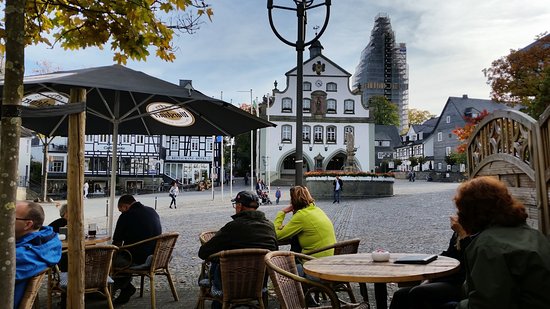
Brilon, Westphalia, Germany


I admit that I don't know anything about this place, but the old scene at least reminds me of the kind of town in the Czech Republic that we would ride into on our bicycles and drink beer and eat soup and wiener schnitzel in. Which I loved.


Church of St Peter and St Paul, St. Petersburg


Everything looks so clean and restored nowadays. So many experts and culture lovers swarming over and caring for everything. I think I miss the days when everything was neglected and run down and I could imagine I, and a few other earnest and sexy but not especially enterprising people, were the only ones who really cared about all of this stuff.


The view from the other side still has some trees in the picture, but all of the ones I've been able to find aren't allowing me to steal them.


Such a big deal was made of the U.N. in all of my childhood reference books, and it seems so comparatively passe and not a big part of where the world is going now, that I have always kind of wanted to go visit it, especially while it is still an active organization. However I haven't gotten around to doing it yet.


I should note here that this was the very last photograph in the book, the most up-to-date representation of Western Civilization as it appeared in 1962. 


Wall Street, 1929. Probably more crowded then than now.


I can remember walking past Wall Street but I don't think I have ever been on it. It is one place I definitely don't belong anyway, but at the time (I was still in my 20s) I'm sure I felt like I couldn't go there, that somehow I would be exposing myself to existential danger (my upbringing to that point had instilled in me an idea that Wall Street was one of the vortexes of evil in all the world to a would-be artist or serious thinker).


Osnabruck. Another one of these German places from the Thirty Years' War that I do not know that much about but would probably be interested in


That's the place. It is one of my weaknesses, and probably the major real cause of my dissatisfaction thus far with the whole coronavirus episode, that there is all this fun to be had out there in the world that I have largely missed out on, or that I am constantly being prevented from taking part in, in which European and big city traveling plays an outsized part, especially now that I am too old to go partying in places like Ibiza or Thailand or the more decadent Greek Islands. While it is true, as my wife would argue, that spending all your afternoons and evenings lounging around drinking beer even in the most picturesque setting would be a waste of your life, it is also true that some of the happier memories of my life involved doing just this. And as it's been over 20 years now since I have been able to indulge myself in this way I do have a hankering to do it again (as I have a hankering to see a real classic or good adult movie in an actual cinema, or even an auditorium again, which I haven't done in 20 years either). 

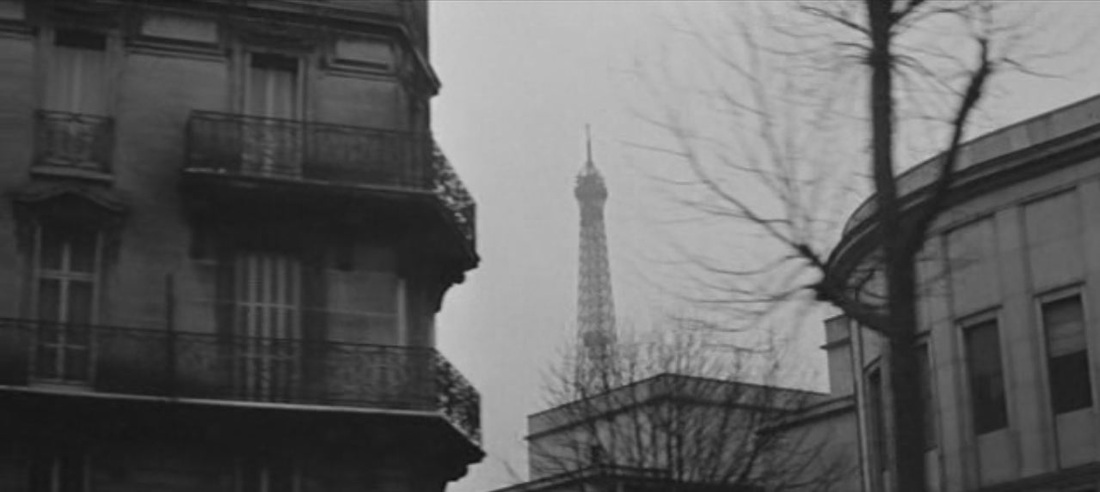
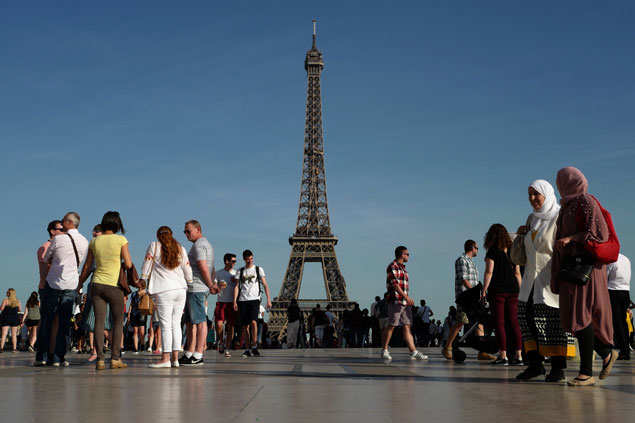
In 1990, on my first trip abroad, I did go up in the Eiffel Tower like a typical chump, however I did manage to strike up a conversation with a couple of really beautiful Israeli girls on this occasion. They were in truth such a leap up in glamor from anyone who had ever talked to me on a friendly basis up to that time that I unfortunately was not quite ready to follow through with laying out some appealing post-Eiffel Tower plans that might interest them, as I didn't haven't any, though they did give me an opening to bring the subject up. At the time I thought, well, I was caught off-guard this time, but the next time I find myself chatting up such babes at one of these tourist attractions, I'll be prepared. Of course I never would find myself chatting up any such babes at any tourist attraction or anywhere else ever again.   


How it really is.

How we imagine it (below)

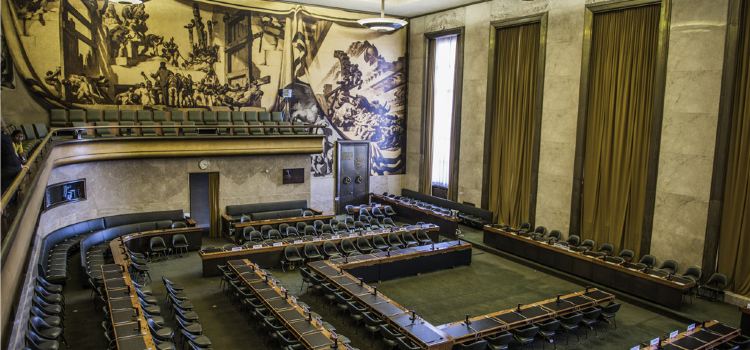
League of Nations Building, Geneva. The idea of international organizations, provided they were Western-dominated, had a hold on the imagination of leaders and educated men in the decades following World War II, even when they were epic failures.


This building still exists, and looks about the same as it did in past days. The inside of it looks to have something of an old European grandeur that the present U.N. lacks (though I also have a certain weakness, entirely rooted in nostalgia, for 1950s American modernism).


Admittedly, this place was built to hold crowds, and attract even the dregs of humanity (to some extent). I love it there, and the whole area around it. A lot of excitement.


Red Square, long view.
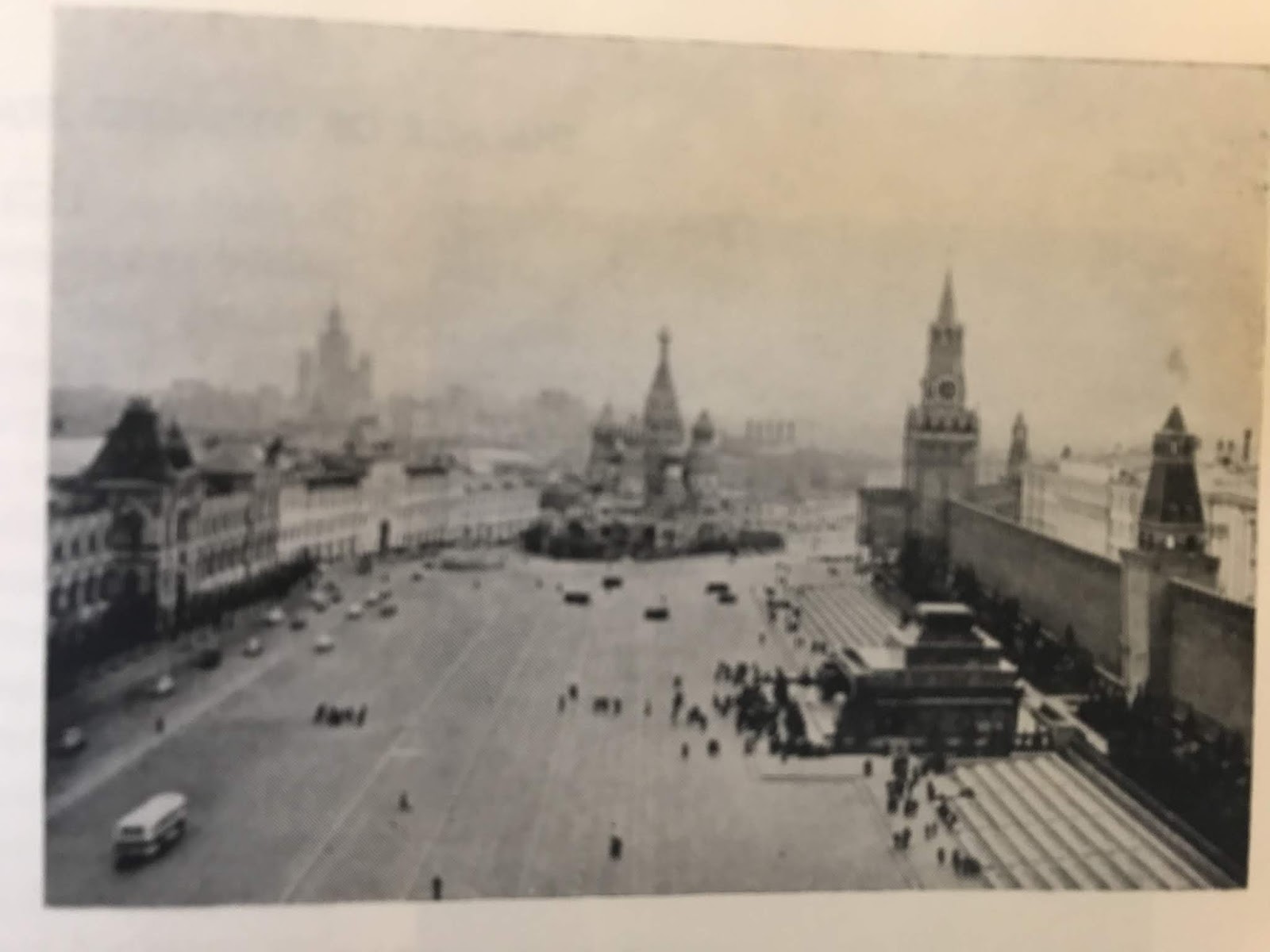


I know I have no place to be a snob, but Red Square isn't quite the same now that people who shop at Whole Foods can go there (and come back again to their office park jobs a few days later).


Modern cameras, or perhaps modernity itself, seems to have diminished the effect that many of these monuments have in these old photos.


Maison Lafitte, France


French castles are not one of my particular areas of expertise. 


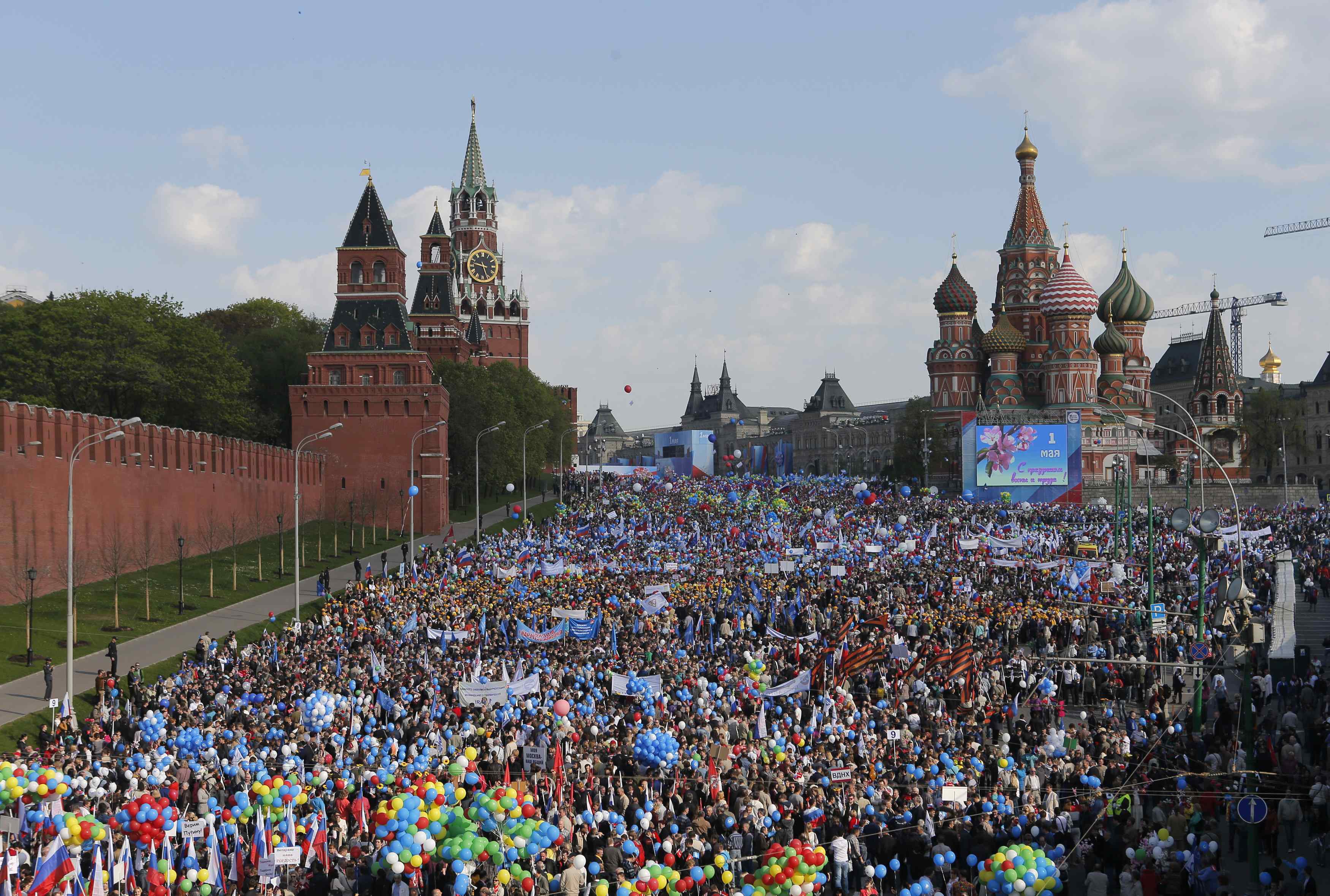
May Day Parade, Red Square Again!


These epic events did end after 1991 (there is still a military parade on May 9 every year to commemorate the end of World War II), but there was an (apparently?) one-time revival in 2014 that drew 10,000 people.


This Catholic history textbook I got all these pictures from unabashedly hated the International Communist Party and all that they stood for and didn't skip any opportunity to excoriate them in print.

Palace of Versailles


I haven't actually been here. When the crowd is this big, we're all tourist scum, unless maybe you are really good-looking. I hope there is some time of year when it isn't like this. 


St Martin's-in-the-Fields, London. 


This is the church that is right off Trafalgar Square, across the street from the National Gallery, so I have seen it, but I haven't visited it. Due to its location and the fortune of its not having been bombed out during World War II (which fate befell a great many of the 17th and 18th century London churches recognizable to students of English literature) it is one of the most prominent 18th century buildings remaining in the city.


Belvedere Palace, Vienna. 


I have been to a number of the secondary palaces of the Hapsburg family, including Franz Ferdinand's cottage at Konopiste in Bohemia, and Franz Joseph's hunting lodge in Bad Ischl, but I have never made it to Vienna. The treeless, relatively unadorned approach to the gigantic Viennese palaces (Schonbrunn presents similarly in photos) has always struck me as strange, but perhaps the effect is different in person. 

I don't know how to end these kinds of posts, so I'm just going to say "This is the end."


Friday, December 06, 2013

Vivien Grey II

1. Stock character of (Euro?) literature--the impish dwarf/(unintelligible word) feather ruffler. Where is this type now?

2. Loveliness of Ems noted. I like to record these things.


3. p.157. "Her features were like those conceptions of Grecian sculptors which, in moments of despondency, we sometimes believe to be ideal."

4. Not much differentiation between characters, flow (flaw?) to (unintelligible word).

5. p. 174. Raptures on outing to Nassau Castle.


6. p. 203. Grey gets off from gambling trap(?) too easily. Not convincing.

7. p. 213. This is a picnic at the end of a long hike. No wonder so many servants were necessary.

8. p.217. White Anglo-Saxons dancing in the woods. Divine.


This picture came up in a search for "white anglo saxons dancing in the woods".

9. p. 227. This book starts to get weird--in a good way--at the castle where the Duke of Johannisberger breaks out the bottle of his namesake liquor. "'And now', continued the Grand Duke, 'having introduced you to all present, sir, we will begin drinking'".

10. Whenever I am reading one of these books and lament that I haven't acted in a situation as a 19th-century German aristocrat would, my wife explains with admirable rationality why we don't need to.

11. Is this a satire on aristocratic custom generally or just Germans? (Germans a popular subject of humor at this time).


12. p. 257. "...at your age, if, in fact, we study at all, we are fond of fancying ourselves moral philosophers, and our study is mankind. Trust me, my dear sir, it is a branch of research soon exhausted; and in a few years you will be very glad, for want of something else to do, to meditate upon stones." He goes on to encourage him to take up geology. "...for the geologist is the most satisfactory of antiquarians, the most interesting of philosophers, and the most inspired of prophets; demonstrating that which has passed by discovery, that which is occurring by observation, and that which is to come by induction." I used to wonder if geology were not one of my lost careers (i.e., something requiring some intelligence that I might have been able to do competently). It seemed like something I could have done when I was young, though everything is so complex and requires so much innovative and restless thinking to be able to contribute to it now that if I had gone into it I probably would not have been able to keep pace with ongoing developments and been obsolete by this point anyway.

13. p.264. I like Beckendorff's periodic sweeps of all 'philosophers' from the royal presence.

14. Sciolist: One who exhibits a pretentious attitude of scholarliness, superficial knowledgeability. I identified with the idea of this word.

15. p. 280. Beckendorff's Italy tip: "Well, then, when either of you go, you will, of course, not miss the Lago Maggiore. Gaze on Isola Bella at sunset, and you will not view so fair a scene as this!"


I have to confess, I don't have a lot to say with regard to the passing of Mandela, whom most thinking people have felt moved to pay their respects to over the past few days. I am not being a contrarian in this instance, I simply have not followed or studied his struggles and the progression of his life enough to have the strength of feeling for him such as other people seem to have. I am certainly persuaded by the general narrative and other superficial impressions that he was a superior and historically important man. I'm suspicious of the depth of sincerity and understanding of many most of his white upper class American admirers with regard to the type of man he was, since they do not seem to me to partake any too strongly, if at all, of the great qualities of which he is supposedly representative, beginning with humility, which admittedly does not come naturally to most people who have gotten anywhere in this society; but I could very well be wrong in this, and besides it has nothing to do with Mandela himself. And I will leave it at this.

Sunday, October 06, 2013

Vivian Grey (1826-7)--Benjamin Disraeli Part 1

basis porch gathering alone 1834 undergraduates


I started this May 6, 2009. I scarcely remember anything about it, except that the title character went to Germany and hung out in several bizarre castles belonging to various of the petty princelings there, and that there was not a plot that was intelligible to me over the last 2/3rds of the book. So I am going to have to rely on my largely illegible notes to see what my impressions of it were.

This is a 393 page Victorian novel written by a 21-year old. It shows in over-elaborate constructions (I presume sentence constructions), and 100-something something, (maybe 100-pound words)?

I could have used a glossary for all the school terms and slang (I have still not really learned to use the internet as a real-time reference while reading, though I will go to it if there is a question that I simply must have the answer to).

Someone's eyes gaze 'in all the vacancy of German listlessness." This was the stereotype for a long time. Of course most people in the West wold have considered the Chinese and the Indians to have been listless as recently as the 1960s. I wonder what happens at certain points of history to kick large groups of people into gear where in the course of a generation they come to be seen as just about the antithesis of listless (and apply the discovery in my own family).

I was musing at one point about Vivian's being a member of the famous family of literary Greys--Dorian, Agnes, et al--I did not check the spelling on these names, and besides bohemian English people are at liberty to spell their names any way they want. This probably tells you something about how scintillating the story was.

It only took to page 57 to find the Minor Character Who is Just Like Me for this book: "Mr Boreall (nice name) was one of those unfortunate men who always take things to the letter."

Goethe was still alive at the time this book was published. For some reason this struck me as remarkable when I considered it at the time.

Party Girls in Warsaw (see below)


It also struck me as remarkable that the author of such a juvenile novel could go on to have the political career that Disraeli had without constantly being attacked about the thoughts he revealed in it. Maybe he was, but it doesn't seem to have hurt him if it did happen.

I also noted on the same page that Disraeli was obviously of the type that has no sympathy for timid hem-hawers, people who don't know their own minds.

It only took as far as page 79 to find the one sentence Anti-me of this book: "Frederick Cleveland was educated at Eton and at Cambridge; and after having proved, both at the school and the University, that he possessed talents of a high order, he had the courage, in order to perfect them, to immure himself for three years in a German University."

B.D. is more of a teller than a shower (as in one who shows, not a fall of water under which one cleans oneself, which is how I was trying to read it before I could decipher "teller").

This is a strange book. Mrs Felix Lorraine is strange. The scene of the midnight meeting evokes the college atmosphere well though, via rustles, shadows, odd silence and the unnatural stillness of objects. This is all one note, and I don't have the slightest idea what I meant by it.

Smart people (really smart people) have so much attitude and easy superiority. It gets to be a bit much for me however.

Of course they have to talk about Byron. His role in the civilizational imagination at this time cannot be overstated. He was a presence that people could not get around. When Byron's admiration of Bolivar is referenced, it is spoken of as if Bolivar's personal greatness is confirmed as much by Byron's opinion of it as by the man's own actions. Frederick Cleveland, already shown to be a superior being himself, said of the poet, "He was indeed a real man; and when I say this, I award him the most splendid character which human nature need aspire to."

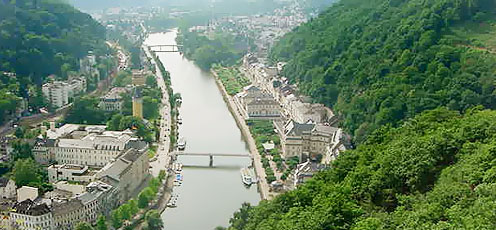
Heidelberg is described as 'a place of surpassing loveliness, where all the romantic wildness of German scenery is blended with the soft beauty of the Italian." I haven't been there.


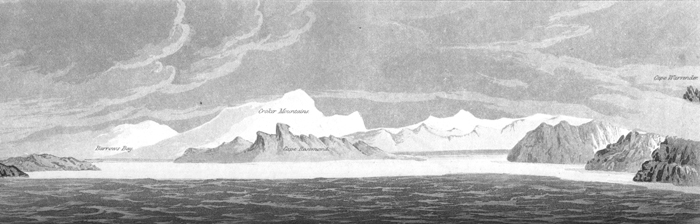
Warsaw is described as a 'Paradise of women' by the Baron Julius von Konigstein. I suspect that it is. The Baron was a great traveler, and claimed that the only places he hadn't seen were "In Europe...the miracles of Prince Hohenlohe. In Asia, everything except the ruins of Babylon; In Africa, I have seen everything but Timbuctoo; and in America, everything except Croker's Mountains." Croker's Mountains were a mirage reported as being seen near Baffin Island in Arctic Canada by a British explorer who was searching for the Northwest Passage, the non-existence of which were demonstrated shortly before this book was written.


Wednesday, October 24, 2007

Favorite Women of Art #13--Uta of Naumburg Cathedral (1200s)One of the central reference volumes in my library is a two volume textbook from 1962 put out by a trio of professors at St Louis University and enigmatically titled A History of Western Civilization. I have had it forever. I think must have been one of my father's textbooks from college (He went to Villanova, which, like St Louis U, is a Catholic university; in those days Catholic schools did not need to look outside the faith any more for reference books than they did for students). This book is pretty good on the general set-up of history, is weaker on maps, and is inspired in its choices of illustrations and quotations with which the book is peppered. Uta appears in Chapter 21 "The Medieval Empire in the West: Failure of the Imperial Dream", which is introduced by a fairly pedestrian quote from Liutprand of Cremona on Otto the Great. Her picture is just kind of stuck in, with the dry caption of "A Margrave of Meissen and His Wife" (She is depicted with her husband as a unit on the actual church) and a general reference to the lifelike realism of Gothic art. I don't read this chapter very much, I admit, so when I was flipping through the book recently and came upon this striking lady, who is what we all imagine the ladies of the middle ages to look like though reason tells us that they were almost certainly all hideous, I knew she had to go on my list. I did not realize that she was actually something of an icon, and that all the heavy hitters and Alpha art lovers and Germans who don't believe anyone who hasn't grown up in the German culture and language can understand the meanings of their art have already long weighed in on this lady's merits and significance. Supposedly even the Nazis had to get involved and declare her one of the embodiments of all that is most exalted in Aryan womanhood and civilization, which seems to have made her a little more dangerous, even given her something of the air of a bad girl in some corners of the art and history establishments.

So in the end it was one of those situations where my hopes got raised when I thought she was kind of my own private discovery but when I realized she had not gone unnoticed and that the big players were all jostling for position near her in hopes of being the one to conquer something in that frigid and beautiful exterior I had to kind of pull back and wonder what I was thinking. Besides, I needed a entry, preferably a short one, before the weekend.

Wednesday, September 12, 2007

The Gustloff

I read about the sinking of the Gustloff the other day, which was the first time I had ever heard of it. It appears by general consensus to be the worst maritime disaster of all time, with as many as 9,000 or more dead. The circumstances of the voyage were wretched enough as it was to begin with. Built by the Nazi government in 1937 as a cruise ship, it set off in January of 1945 from the city of Gotenhafen (now Gydnia in Poland, near Gdansk) packed with 10,000 Germans, mostly civilians, fleeing from the advancing Soviet Army. It was torpedoed by the Russians in the Baltic Sea, which is never warm, and is reported has having been icy on the occasion of the disaster. Around 1200 survivors were rescued. The event, of which the significance was downplayed or muted for many years even in Germany, remains a subject of controversial, obsessive and wounded interest among many people there today. It is not difficult to understand why. Many vivid impressions of terror, misery, dislocation, ignominy, and nihilism press upon one just in reading a dry account of the matter. Much of this is of course due to the fact of the victims being Germans at the end of World War II, not a sympathetic group, and the sense that goes with any account of that period of history that the members of that group in general deserved suffering far worse than anything that was able to be inflicted on them. This includes the children, perhaps not personally, but as symbols, as a necessary debt owed by the elders of their people before the cataclysm could finally exhaust itself and any hope or sense of light enter the civilizational consciousness once again.

The last convulsions and accompanying absolute devastation of the German nation in early 1945, the last months of the war--fittingly named "year zero" in the classic movie about the time--is increasingly striking me as the most interesting and crucial aspect to understand about that whole period. Unlike in 1918, the society subjected as well as dedicated itself to so much death and destruction in the last months of the war--on both counts seemingly pointless and unnecessary--the pitch of both being raised and raised, almost hysterically so, until the very, very last possible instant, until the day the head of the body harboring the demonic agent was finally cornered and forced to cut its own head off. To the artistic imagination, the Gustloff incident is a nearly perfect encapsulation of the chaos and catastrophic state that the whole society, the whole culture, had come to, and from which it seemingly cannot ever spiritually recover. It crystallizes a real end point, a real break between past and future from which certain major traits/qualities do not move on, but simply cease to move altogether.

While it is to a certain extent surprising to me that I have not been familiar with this particular event before, with World War II one is always either stumbling across enormous violences, movements of peoples, political crises, etc, that one had either never previously been aware of or had not properly begun to grasp the magnitude of either with regard to the loss of life, destruction of culture and history, or general collective insanity therein revealed. This, too, though the conflict is probably the most documented, filmed, written about, referenced, etc, historical event of all time. The number of 500,000+ populated cities in Russia alone that were just razed to the ground and that even today most people outside that nation are barely aware of the existence of staggers the mind when one begins to try to consider it. I mentioned in a prior post the eviction of entire populations from other cities such as Breslau and Konigsberg, and the repopulation of them with entirely different people that took place under the Soviet occupation. This does not even take into consideration all the minor disgraces, the small-time fascists and opportunists in small towns and small countries like Romania and Hungary and Slovakia, eagerly delivering up their neighbors and countrymen, already in desparate enough positions as it was, for petty, and seemingly meaningless preferments.

The darkness out of which all this emerged was obviously very deep-seated, and the atmosphere of most of Europe was thick with it for the better part of 30 years, England perhaps slightly less so, or at least with less insistent negative force until 1930 or so. In the art of the period it can be said the sun itself did not partake of any gloriousness, nor did the beautiful young girls, unless, as in Joyce and Proust, they clearly belonged to the pre-1914 world. That does not mean that the art of the modernist period does not have serious attractions for me. I am as much if not moreso in spirit a descendant of that period that of eras with more positive energy. And art, as an engagement with actual life and actual human mental activity, seemed still to be a comparatively more natural and instinctive process among such as retained their sensibilities, an old habit not quite shaken entirely out of the cultural personality, than it has become in our inceasingly anomic age.

Monday, February 19, 2007

Joan of Arc Part 2

Now I will write my impressions of the four Joan of Arc plays I have recently read. Although I am not connecting on a very immediate level with the whole Joan of Arc legend, and do not have anything to say about it that promises to contribute to the vast existing body of knowledge on the subject, there is always a fascination and thrill, you must understand, for people like me in declaiming on such classical stories as have continuous and widespread popularity among people with pretensions. When I was looking for these pictures, there were tens of thousands of images of the Maid to choose from: statues, movie stills, handkerchiefs, salt shakers, posters, medals. And yet in all my life I have never talked to anyone about this subject, or encountered one Joan enthusiast to my knowledge.

Anouilh--L Alouette (The Lark) 1952

(Note: the apostrophe on my home keyboard all of a sudden does not work. This is the one of course for quotation marks also)

I can only consider that I have half-read this, as I read the American adaptation by Lillian Hellman, which struck me as, at the very least, not getting the authorial voice of a midcentury French playwright and penseur accurately enough. Five years ago I would have made a day of going down to Cambridge, having lunch at John Harvard's ale house or one of those places that serious intellectuals and cool people never set foot in, buying a few liter-bottles of imported mitteleuropeen beer at the gourmet market and picking up a copy of the original. Now however I dashed into a second-hand store on the way to Brattleboro (I do like Brattleboro though. If it were a woman I would both desire to dance with it and feel that it was attainable to me to do so) for New Year s Eve dinner, wife and babies sitting in the still running car, grabbed the questionable adaptation and endured a witty observation from the bearded fellow at the cash register that I must have known what I was looking for. So you see how tenuously I am clinging to maintain the forms even of a provincial pseudo-intellectual.

Of the four plays delineated here, The Lark has the virtues of appearing to correlate most with the actual events of history, or such of them as seem verifiable, as well as being more about the actual figure of Joan (Arc?) herself in a more signifigant proportion than the other plays. Her trial forms the structure of the play, the great events of her career being recalled in flashbacks. The tone of the action and dialogue, while somber, is rendered rather gently overall despite the threatening and grisly circumstances; I wish I could trust my adaptress more, however. I did like that rather than ending with Joan reduced to a pile of cinders on the stage, in the translated version at least, there is a flashback to the hour of her greatest triumph, the coronation of the Dauphin at Reims. In this American version the play comes off as, if not affirmative, at least offering hope that life contains nobility, or the possibility of it, after all, which strikes me as an unusual and rather too neat position for a French artwork of that era. It is the sort of thing that would probably cause me satisfaction and comfort if I were to see it as a playgoer, and any theater that enables the likes of me to be comfortable...well, you know what must be said about that. If I ever make it back to a big city, I will have to keep my eyes peeled for a copy of the original. I know I can order it off the Internet, but...it isn t urgent.

Schiller--Die Jungfrau von Orleans-1801

Though Schiller is, as far as I can tell, still regarded in the German speaking world as one of their very greatest authors--as high as number 2 in some polls--he is hardly read at all, and even that I suspect in a very desultory manner, in the Anglosphere. His power, or perhaps it is his Romanticism (the Germans going to much further artistic extremes in this movement than the English generally did) do not register strongly in English to my mind. Five to ten years ago again I probably would have tried to at least struggle through the original to try to get some feel of the poetry; especially as I love plays written in verse, which is a method I think is ripe for a revival, and which frankly I am surprised has lain dormant so long. It gives a dignity and a grandeur, and, if done at all skillfully, a pleasure, to one's story that is much harder gained by plainer dialogue.

To give an idea of how big Schiller is in Germany, there are I believe 7 or 8 museums dedicated to him, mainly in houses where he lived, which incidentally would not constitute a bad basic tour of that important and to my thinking still largely mysterious nation: 2 in Marbach-am-Neckar, where he was born, 1 (plus his grave) in Weimar, one in Jena, one in Leipzig, 1 in Dresden, one in a town called Bauerbach. Here is the Schiller-National Museum in Marbach. This is not just a Schiller museum, but an archive of German literature generally (I think; I cannot find any substantial information in English on this institution), but still, it is named after him, it is in his hometown, there is at least one large statue of him on the grounds. The edifice is certainly most impressive. In Portland (Maine), where I went to high school, there is a very dignified late Victorian statue of Longfellow presiding over one of the major intersections downtown. This might be the only real monumental-type public statue of a poet, I mean where he is elevated and large and dressed extravangantly and is sitting in an expensive chair and so forth, that I am aware of in the United States. I cannot think of any others at the moment. I am not going to argue that there ought to be more. Such things are as they are. Our American poets perhaps do not strike us as grand or good enough to be statue-worthy, but then again good monumental statuary has the effect of making people and events more likable. On the other hand, how many Schiller museums will Germany be supporting and how many Schiller monuments maintaining in a hundred years? It is hard to imagine as many as it does now.

But to address the play: the liberties and Romanticism--Joan's falling desperately in love with one of the English leaders, her dying in battle instead of the stake--as are noted in every modern critique of this play, become too much by the end to hold the reader's confidence. The first half, before one is certain where things are leading, is engaging enough. I like the extended emphasis on the heroine's family and village life, and the nature of the setting in which she receives her visions, which was passed over more quickly or disposed with altogether by the other authors. I think a more sober or tempered Romantic treatment would work well on this story. Although Joan is more brilliant than everyone she encounters, she is not an intellectual, nor learned, nor anguished, nor emotional, nor in way real way intimately accessible in point of her actual character. She has always been understood as a symbol of a number of desirable and usually impossible human qualities, which is the essence I suppose of true Romantic art, as well as religious iconography, which ought to be taken into consideration in any treatment of this subject. The play is not rated highly among Schiller's works, and I did not get much more out of it than what I have related, so I will let it go and move on to the next.

Brecht--Die Heilige Johanna der Schlacthofe (St Joan of the Stockyards)--1929

For those not familiar with this play, it is actually set in the meatpacking district and stock exchange of contemporary Chicago, and deals rather obliquely at best with the Joan legend. The Joan character actually resembles Major Barbara more than the Maid of Orleans, and the scenes of her proselytizing the wretched and the unemployed in exchange for a cup of soup are almost as if lifted from that other play, which, however, had the advantage over this one of being much funnier and having some cleverer ideas and twists of the plot. The various, neverending business scheming and manipulation of prices made my eyes glaze over pretty quickly, and reminded me of why the calls one increasingly hears from conservative and high-testosterone American critics for a new race of manly novelists to address the world of high-powered, ultra-competitive business rather than their own sensitive feelings and petty grievances is likely to go unheeded. The day to day action and conversation of the respectable business world, as well as its etiquette, its publications and the apparent inner lives of its protagonists are not simply uninteresting; most of this is deadly and inhuman, and as if willfully so. The realm of art has apparently not yet found the form or the attitude--or the necessity--to raise its players and issues to the level of high culture, such as great minds recognize when confronted with it. This is not something I am just throwing out. I have worried about this for many years, given the centrality and ascendance of business values in our society as well as the widespread sense that modern American would-be writers have holed themselves up in their bedrooms, terrified of and overwhelmed by the very vitality of their nation. Now I don't think it is wholly true that authors have ignored business altogether, though I concede the entrepreneur or corporate ladder climber is rarely depicted as a hero deeply admired by the author. And secondly, I have to say that the more time I spend as an adult around corporate and other self-consciously professional-type people, the Kafkaesque or absurdist approach to understanding the ethos of this world seems the most plausible option, which is I suppose what our author (Mr Brecht) is saying at some level too, though I wouldn't really know from reading him. I would be curious to see one of his plays performed sometime, in Germany (I have realized that I can best endure live drama, as well as opera, in the country and language of origin, in a setting that I can imagine to resemble that in which the play was originally performed; thus I enjoy the faux-Globe that was put up in London and the Statny opera-house in Prague [formerly in Austria, remember!], however inferior the experts assure me their actors and singers are, as if I could tell anyway). I am positive I would glean more of what I am supposed to be gleaning from that than from further reading in translations of this author. I am not of the school, as should be discerned by now, that lower and even minute levels of understanding, in inferior minds, of great works of art, are utterly worthless, least of all to the mind concerned, as some apparently hold.

Brecht still has his fans. Someone should get hold of her and have her write a guest piece about why she likes Brecht. I am old and conventional and not especially good-looking, so it's unlikely she would respond to me. (If my link doesn't work, which it probably won't, go to the meet-me page on Hotornot.com and search for women with the keywords "Bertolt Brecht". There is only one).


Shaw--St. Joan-1924

This was the most enjoyable to read of the four, probably because it was the only one originally written in English. I thought the preface a very good piece of writing, both as an overview of Joan s career and for the many ideas about the type and quality of mind she possessed that duller or inattentive writers either missed entirely or grasped at inexactly or without succintness. George Bernard Shaw always had very distinct, pet ideas about the world, such as that well over 99% of the human population in any age and level of society were incontestable morons whose thoughts or troubles were of no real significance, and he could not resist topical jokes at the expense, as he imagined, of the lesser end of his audience (one of the English adjuncts at Joan s trial for example argues as proof of her heresy that she claims her saints spoke to her in French and not English). Pound, comparing his writings about his native Ireland to Joyce, thought it necessary to call him a ninth-rate coward. This type of declamation is a characteristic of a certain brand of hot and quick mind that I have always been envious of; for my own part I can only say that Shaw's work has not, compared to the other, the sensibility of the totality of a human being, or an atmosphere, of, shall I just say it, the spiritual influences at work in human society and culture. How far that is a matter of courage I do not pretend to know, but it probably has more to do with it than it seems at first appearance, or that most people--most bourgeois, certainly--would want to admit.

I would write more, but it has already taken me fifteen days to write this bloody report, and I can't even remember the damn play anymore. Granted, I was away for ten of those days, but come on. My life is slipping away while I try to write one coherent idea about what I am supposed to make of Joan of Arc. And I'm not done with her yet either! I am going to give this up and start on something else. This will all eventually lead somewhere if there is enough accumulated mass in it, that I believe.