I have been reading a lot of Edith Wharton lately--I wrote a couple (here, and here) of things recently on The Age of Innocence for my other blog, and here is another archival bit on her, with some commentary on Ethan Frome, which I read a few years ago. The Custom of the Country I take to be considered in the second rank of her novels, as I had never heard of it before. I do think the other books are a little better, they are more tightly written and focused, the settings are more vividly evoked, the dialogue is sharper. This book is about a beautiful and already super rich American woman with voracious and ultimately insatiable appetites for ever greater wealth and social success. She marries four times, to a scion of one of New York's most established families, a French marquis, and a billionaire who is reckoned America's sixth wealthiest man (she married him twice--he was not a billionaire yet the first time, just a cocky and abrasive striver she ran off with, and her parents forced her to divorce him). She was divorced three times. Her New York society husband, with whom she had a son she was not much interested in (but demanded and received custody of in order to maintain her respectability for future husband-hunting and social climbing) ended up killing himself. The sacred ancient possessions and household customs of her French husband did not escape from his marriage to her without enduring some substantial dimunitions either.
The biggest problem with the book is that Undine (the man-eating beauty) is such a relentlessly awful and shallow person that it is not clear why her New York and French husbands, secure in high social statuses and pretty substantial wealth, and who are portrayed as intelligent and cultivated men, would be so eager to marry her. She is described of course as beautiful, but it is not a beauty that the reader is made to feel, and be persuaded that it is worth all of the trouble that comes with procuring it. Being a patriot, I was sympathetic to her struggles against the austere restrictions her French husband and mother-in-law and their army of enforcing relatives would put on her social energies, but only because it was so ridiculous to expect an American millionairess not born into decrepit European aristocratic society to be capable of adhering to them. Among the other characters, Undine's billionaire husband goes from being a decidedly menacing figure through the early parts of the book to being mildly jovial at the end when he has made his fortune and has finally gotten his destined bride. Are we supposed to like him then? It also is not consistent that Undine's parents could have forced her to dissolve the earlier marriage, since whenever they appear in the rest of the book they are cowering to every demand she makes of them, all of which involve spending exorbitant amounts of money. The characters in this book are on the whole cruder and less truly wealthy than those in The Age of Innocence, so some of their exorbitant expenditures on flowers, apartment furnishings, seasons in Paris, opera boxes, and so on, come off as more desperate (and consequently offensive), I suspect because there is a deficiency of harmony between the possessors of these luxuries and privileged positions and the possessions themselves, which the observer/fantasist never likes to see.
In one of the biographical notes in my edition of the book (The Library of America), it stated something to the effect that Wharton was impressed or experienced pride in the successes of the American forces during World War I. I suppose I knew that there was skepticism on the part of some of the old guard of Europe that Americans could really have what it took to fight toe to toe with the great nations of Europe with their ancient and glorious military traditions and cultures, but I had never heard it hinted that any Americans possessed such doubts. I also suppose it caught me by some surprise that Edith Wharton should identify at all with the American army, and take a keen interest and pride in its performance.
I only took down two quotes from the book. I found relevance to my own idea of life in both of them.
"...but perhaps another stroke of luck might befall him: he was getting to have the dependence on 'luck' of the man conscious of his inability to direct his life." This was the guy who later killed himself.
"Raymond de Chelles, who came of a family of moderate fortune, lived for the greater part of the year on his father's estates in Burgundy; but he came up every spring to the entresol of the old marquis's hotel for a two months' study of human nature. applying to the pursuit the discriminating taste and transient ardour that give the finest bloom to pleasure." This seems like a life I was, if not meant to lead, perhaps suited for, as much as any.
Since finishing Wharton I have gone on to Emerson's "Divinity School Address", which I take to have lain down the primary tenets of the transcendental school to a not terribly appreciative audience at Harvard (30 years later, when the likes of Oliver Wendell Holmes had become the ruling spirits of the University--and Emerson had attained international stature--he was invited back). I have written here before that I enjoyed Emerson's journals, but had never taken much to his essays. This one has not really set me on fire either. Near the end it gets a little better, when he exhorts the auditor or reader to in effect be self-directing in religious matters, that the follower or imitator of established forms or doctrine can never attain to the insight or intensity of the originator of those forms. However much of it suffers from the usual Emersonian problems of his words and ideas not having enough clarity and solidity to focus the mind of the reader on their flow. I don't think his thoughts and his general organization are good enough to hold his essays together in any kind of pleasing whole. When I read this my mind is not moving with his, nor is it moving in any firm direction at all. It may be that I am always catching his essays at a bad time, or perhaps it is his writing that sends me into these periods when my focus becomes poor and my thoughts sluggish, because I had for the past couple of months felt generally sharper and more engaged with what I was reading, until the past few days. I ought to take more interest in what he says about God being present and alive and within every one of us, but I can't seem to find it very interesting, as he writes about it.
"The third floor chapel in Divinity Hall where Emerson delivered his Divinity School address in 1838".
...I went inside my TV and met the Honeymooners. Ralph wanted me to bust a few rhymes But I had my eyes on Alice's behind. --LL Cool J
People love the Honeymooners. At the very least a lot of old New York people do--most personal reminiscences of the show that I can find recount that the reruns played at 11:30 on Channel 11 (WPIX) through most of the 70s and 80s--and their cultural weight, no matter who they are, is of course multiple times that of any ordinary person from anywhere else. I never watched the Honeymooners as an adolescent or young adult. I don't think it was on in Philadelphia. When we first got cable, around 1983 or '84, WPIX & WOR in New York were two of the channels we got, but other than watching the occasional baseball game (the first of these stations carried the Yankees, the other the Mets) I didn't take the opportunity to connect with New York life that having these channels offered. I was still pre-occupied at the time with trying to connect to Philadelphia life, which, as I lived there, must have seemed more relevant. Plus all of the real to the bone Philadelphia people, of which everyone I knew other than myself was one, hate New York City, so there was no one to try to persuade me otherwise. One of the minor consequences of this was that I made it to my forties without ever having seen the Honeymooners.
As you have probably guessed, I have been catching up with this iconic artifact of popular culture over the course of this winter. I've gone through four of the five DVDs on which the series is preserved, 32 of the famous 39 episodes. The first episode I didn't like too much. I thought it was silly and that Norton especially was more or less retarded. The second and the third were a little better, the likable or interesting aspects of the characters began to become more defined. By the fourth show, which was an Alice-centric one, I began, sort of, to see what the hype was about. It is quite poignant for a television show. Much of this has to do with the circumstance that it only ran for a year. It is absolutely frozen in a particular moment in time, not only its year of 1955-56, which itself was on the cusp of changes in society, New York City, and the economic situation of the white working classes that are of especial relevance to the themes of this program, but also in the ages and personae of the three main actors, and the rather hopeless seeming situation of the characters (fourteen years into her marriage and Alice can't even get a curtain for the window, let alone furniture, a vacuum cleaner, wallpaper, a refrigerator, a telephone, a nicer apartment, etc). Suburbanization and the abandonment of the cities by characters like this, while underway, was still far from complete in the mid-50s. My own grandparents, for example, did not make the move from Philadelphia out to Cheltenham and Elkins Park until '57 in the one case and '59 in the other. For the generations who were small children when this big break from the city occurred, or were born after it, there is often a nostalgia for aspects of the old city life, especially the idea that there was a sense of community or camaraderie, with attendant simpler pleasures, in it, that have been denied to us. I feel something of this when Ralph and Norton go to the raccoon lodge (it is widely known that The Flintstones is more or less a cartoon version of the Honeymooners, but the homage was lost on me until I saw these shows; it is notable that even by the time of the Flintstones--who were clearly resident in the suburbs, it should be added--the lodge membership was showing signs of being dated). It would be fun to drink beer and tell jokes and laugh uproariously with other grown men who have more or less the same level and kind of education, and broadly the same kind of occupation and income (probably necessarily low, however), and where no one is complaining that there is too much coriander in whatever it is people put coriander into. It is true that among this general equality of station Ralph always seems to be a few dollars worse off than everyone else--and not insignificant dollars either, but these signifiers do not seem to be the barriers to social life in this program that they are in our time, with their minute and finely shaded gradations of achievement and quality. Of course it is illusory, people were at least as miserable in the 50s as they are now, certainly my own relatives were more miserable than I am (though maybe they only seemed that way because they had more expressive personalities), most grown-ups had no more close friends or any more of a social life than people have ever had. There were gradations of rank among people on the same assembly line that were no keenly felt by all parties. Still, the idea appeals, even at the social level depicted here.
The series is often lauded for its superior writing. I wouldn't say that the writing ever approaches real literary brilliance, though some of the episodes do strike me as having more to them they look, and it is no longer a question of whether I could produce anything better; I just like to display some restraint in my praises. There is an obvious charm about the world of this program that must in some part be due to the writing though I think it is probably mostly due to the three primary stars. The characters do attain more depth over the course of the 39 (in my case, 32) episodes than most television characters ever do, but I don't know that that depth would be conveyed by the written script alone.
The poignancy of the show, of course, is that its situation is almost ludicrously sad and hopeless--Ralph and Alice have been married for fourteen years, they have no children, no furniture or new appliances or any other accoutrements of married life, Ralph's job status is never going to improve, as he seemingly lacks the qualities to rise a step above the bottom rung of the career ladder--yet there is a sense of genuine affection in their life that most programs and movies are not able to duplicate. Also Ralph's various failures are largely those of a lack of social and intellectual experience and preparation in juxtaposition to people who have more of these things, which is exaggerated for the purpose of the program, but which shortcomings and failures in crucial moments define the mass of people's existences, so you have the pain of this recognition followed, usually, by the consolation that Alice, and Norton (who one realizes as the show goes on is something of an idiot savant) too, are loyal in their affection, and (and this is the crucial point) they possess enough admirable qualities that their affection is worth having, that it means something.
Jackie Gleason (in addition to writing the theme music for the Honeymooners) put out a number of jazz/mood music record albums, which sold remarkably well (his first ten albums all sold over a million copies!) His inspiration for this enterprise came from watching Clark Gable work on the ladies in the movies. "Gleason reasoned 'If Gable needs music, a guy in Brooklyn must be desperate.'"
In Honor of the Super Bowl
So I've actually missed the Super Bowl. I was going to mark the occasion by posting these highlights from the broadcast of a Giants-Redskins game in 1970:
Didn't that look like it was about a hundred times more fun to watch on TV than the games are now? I think the only reason I remain something of a football fan is because I was introduced to it in the more low-key era of the 1970s. I think if I were a kid now I wouldn't like it, it would be too overwhelming. My sons, the two oldest of which are now 11 and 10, don't have the same interest in professional sports that I had at that age. They watched the Super Bowl with me, but that's because we had a party, with shrimp and crackers and chips and other snacks that they like, and they like the commercials and the halftime show probably more than the game. I think the overkill of media coverage is suffocating all of the joy out of football. One of the reasons the game was so exciting back in the glorious 70s was that the game itself (and the half-hour pregame show) was about the only media coverage you had access to. There would be the write-up in the newspaper on Monday and maybe a recap show with the local sportscaster on Monday after the evening news, but after that it really went away until the next Sunday, and everybody went on with their lives.
1970 was pre-George Allen for the Redskins, and they were not very good, yet they already had a lot of the players in this who be central on those teams--Pat Fischer, Chris Hanburger, Brig Owens (and who were still playing for them when I began watching games, around '75 or '76). I'm getting so old, and I have not really watched much football in the last 20 years, that if I am watching a game with the Cowboys or the Giants or the Redskins, I'll often see a guy wearing a certain number and automatically associate it for about five seconds with whoever had the number in 1980, before I realize, no, the guy I'm thinking of would be about 60 years old now.
We get to see Fran Tarkenton with the Giants, in that odd five-year interlude in the prime of his career where he played in New York, and was apparently good there too, but never got into the playoffs, before returning to Minnesota, where I remember him at the tail end. Doesn't it seem like there were a lot of guys who came into the league in the early 60s who lasted forever? Besides half the 1970s Redskins roster there were lots of Vikings, Marshall, Eller, Hilgenberg, Tarkenton, etc. Merlin Olsen was old, Jackie Smith the tight end. Roger Staubach was in this age group, though he started five years later due to his naval commitment.
We also see Tucker Frederickson, a white running back who was the number one pick in the entire draft in 1965 or 1966 whose selection ahead of the likes of Gale Sayers and Dick Butkus was frequently held up in the 1970s as one of the main triggers of the Giants being a putrid team during the whole of the 1964-80 period. My impression of him was that he was a colossal bust, but 1970 would have been his fifth or sixth year in the league and he was still on the roster. Moreover he had at least two big plays in this game, and looked like he actually had some speed and talent as a runner. That said, his stats were not impressive. 1970 was one of his better years, especially receiving, and he only managed about 750 yards from scrimmage. He played into the 1971 season, when his career was ended by a knee injury.
When you are in your 20s it is beauty, and the people who possess it, who fill your dreams and seem hopelessly remote from you. In your 30s and 40s the remote ones are those who are genuinely intelligent and have managed to achieve something of substance. I don't know what possesses the entirety of the waking thoughts of failed people in their 50s, but I suspect it is money. If that is the case I am really not looking forward to my 50s
Brunetiere
"A few years ago an eminent French litterateur, Brunetiere, declared science bankrupt. This was on the eve of the discoveries of radio-activity which have opened up great vistas of possible human readjustments if we could but learn to control and utilize the inexhaustible sources of power that lie in the atom. It was on the eve of the discovery of the function of the white blood corpuscles, which clears the way for indefinite advance in medicine. Only a poor discouraged man of letters could think for a moment that science was bankrupt. No one entitled to an opinion on the subject believes that we have made more than a beginning in penetrating the secrets of the organic and inorganic worlds."--Robinson, The New History, quoted by Irwin Edman, Human Traits and Their Social Significance, 1920.
Ferdinand Brunetiere (1849-1906) was a writer, primarily a critic, and a member of the Academie Francaise, holding seat number 28. I was not aware until this particular research that the members of this body were identified by their seat numbers, and I am still not clear as to what these numbers signify, but Wikipedia and other internet sites have graphs and lists showing who has held each seat through history (the most famous occupant of # 28 from my viewpoint appears to have been the writer Charles Augustin Sainte-Beuve, who rocked the house from 1844-1869; but then he is the only person on the list whose name I recognize). Brunetiere was noted, according to his English Wikipedia article, for his intolerance, his sledge-hammer method of (intellectual) attack, and his dry pedantry. His claim about the bankruptcy of science is not referenced in the article, though it did mention his essay "Apres une Visite au Vatican" in which he argued that 'science was incapable of providing a convincing social morality' which sounds like a more nuanced explanation of what he might have meant in calling science bankrupt. His French Wikipedia page paints him as something of a reactionary, noting that he wrote frequent articles against the likes of Flaubert, Zola and Baudelaire, and was an anti-Dreyfusard at the time of that crisis. With regard to science, it states that (trans. mine) "He was equally hostile to dominant scientism, ce qui l'a rapproche un temps d'un anarchiste comme Octave Mirbeau" (I am stumped by the grammar in the second part of this sentence. I cannot determine whether the subject is Brunetiere and the object scientism, or vice versa) and "Brunetiere upheld a theory of evolution of literary genres, inspired by the theses of Darwin." So it appears he was often congenitally wrong-headed, as well as personally obnoxious, and that he was badly out of step with the direction that knowledge and thought were headed in by the time he was elected to the academy (in 1893). That acknowledged, it doesn't appear that he was actually an idiot, or at least was not mentally and emotionally weak enough that anybody below the level of groundbreaking genius could laugh in his face and humiliate him without absorbing a few wounds of his own in the blowback. Still, if he really did think science had reached a technical (as opposed to a moral) dead end by the 1890s--which I cannot find corroborated--that would be hard for an intellectual in our society to ever really live down; though I think the French are more tolerant of outrageous or even wrong views, if you present them elegantly or dynamically enough.
Brunetiere failed the entrance exam of the Ecole Normale as a young man due to his deficiency in Greek.
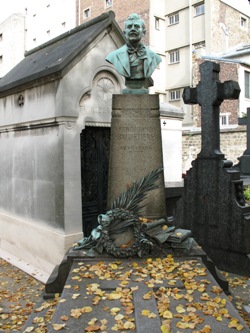
Brunetiere's grave, Cimitiere du Montparnasse
Tuesday, March 08, 2011
You Knew This Was Coming
The consolation is that I think this will be the last set of pictures of this type for a while. For now however we are going to once more journey to a time and among scenes in their way more distant and dead to us than certain locales of the high middle ages. Yes, it is my visit to Concord, Mass in the summer of 1997.
1. Morning Glories on the Main Road Into Town, Near the Entrance. This is the main approach to this venerable town, which remarkably, given the serenity and evocation of a less crowded and busy time that is evident in the photograph, is just 16 miles from downtown Boston.
2. Thoreau Birthplace Marker. Of the big 4 Concord writers, Thoreau was the only one who was actually born in town (For information lovers: Emerson was born in Boston, Hawthorne in Salem [Mass], and L. M. Alcott in Germantown [now part of Philadelphia], PA). I do not mean to introduce more vanity into this site than it already has, but man do I look good to myself in this picture. This was when I was exactly 27 and a half years old, which Bill James and other sports historians have shown pretty convincingly is the age when a substantial plurality, and maybe even a majority, of male athletes have their peak seasons, after which most continue to maintain a reasonably high level of performance for an additional 3-5 years and then start to fall off a cliff around age 32-33. It really is rather an oddity about life that this physical prime--and in most cases mental prime, as well--which takes at least 20, and in my case about 26, years to grow into, is so brief, and the decline so long--one can be old and irrelevant, but still existing, now for 40 or 50 years. Clearly in the state of nature the kind of society we have now, with such a large percentage of old, declining, or otherwise useless people, would be unsustainable--the proportion of adults at the height of their physical and mental and sexual powers and general usefulness would have to be much higher, and as that window is so brief, surely it is intended for us to live more intensely and tumultously, realize our potential at an age when it matters, pass on our seed in vigorous rather than antiseptic conditions, and pass quickly, a well-earned early death brought on by the exhaustion of a properly lived life, when our powers begin to wane in what is now but the beginning of an interminable middle age.
3. Memorial at Walden Pond State Park, Sense of the Woods There. This is supposed to be the vicinity of where the cabin was. Archaeologists have apparently found a lot of mangled nails and other evidence of carpentering incompetence of the part of Thoreau in their excavations on the site.
4. View of Walden Pond. I don't look quite as much like a regular person with potential here as in the other picture, but I still have a BMI that is not officially overweight at least.
There are obviously more spectacular lakes than Walden in New England but it is a pleasant afternoon outing and I found its atmosphere, with the literary and historical associations and all, to be to my liking. I am not such a fool as to imagine by going to some place that has been written about in a famous book that I am going to have any profound experience of my own or accrue any benefit from it whatsoever. I like to feel some association with smart people and higher levels of civilization even if I have no hope of ever comprehending anything which they really signify. It seems to be one of the few things in which I am able to find any happiness.
5. Another View of the Pond. All these pictures of course were taken with an old film camera. I have no knack for the photographer's art, or any art really. It would have been odd that I set myself up in my mind as some kind of artist, but there were in truth no other alternatives any more plausible that were in any way desirable. Many sober adults seem to want young people to be sensible and come to the realization that they haven't got the talent, personality, etc to do anything that might earn them either respect or income, and just resign themselves to a life of mediocrity and deference to their betters, the source and real nature and extent of whose superiority to them is usually truly a mystery until one is well into his thirties.
6. The Thoreau Family Plot at Sleepy Hollow Cemetery. The four writers are conveniently buried all together.
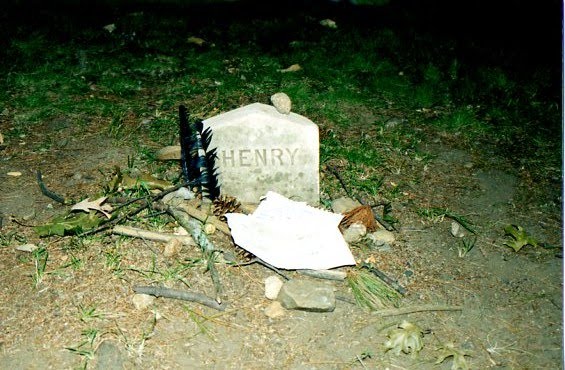
7. Headstone of the Author. The notes and quills and other offerings by the stone were the work of other fans, though whoever these people were, we kept missing them, assuming they were making their ways around to all the sites that we were.
8. What Is This? Fine Dining? Compared to the kinds of places I go to now at least. The water glasses and cloth napkins alone are things that I had almost forgotten existed. This picture aside though, I have no memory of what this place was, what I had, why I thought it was a good idea to wear that shirt, etc.
9. After this visit I did not return to Concord for nearly 13 years! Which is really pitiful, since it's only about an hour, maybe an hour and fifteen minutes, from where I live, and it's a neat old-fashioned place with lots of things to look at and see, and I do like it there. So I went down again last May, shortly after making myself a reminder to do so I believe in these very pages. It was exciting to be back. On this occasion we eschewed the literary sites and did a little walking along the Minuteman trail or whatever it is called. Below, as any fan of 18th-century English novels will recognize, is the sign of a tavern, which while well preserved and offering numerous educational presentations and other opportunites, did not alas actually serve up any ale or other spirits. Still, if it were not for that cone and police tape intruding upon the scene, one would hardly know it was not indeed 1775 with this vision set before him.
10. Here Is a Short Movie. My non-focused, uncoordinated style of parenting is on modest display here, where as you can see the effect is that of a kind of organic, undirected immersion in experience, sort of set the children down in the historic field and see what they do. This is at the end, or near an end, of the walking trail, near the Concord visitors center. When the camera pans the field I think you can see the reconstruction of the Old North Bridge and the monument commemorating "The Shot Heard Round the World" in the background.
Tuesday, March 01, 2011
Walden (1854)
It is believed, in at least one tastefully-furnished corner of the world that shall remain unnamed, that this is one of my favorite books of all time. This conclusion was reached based upon a feeble attempt I once made to put in a good word for it at a meal where its naivete, inconsistencies and general infantilism were being heartily trashed by the host and another guest. My 'argument', as it was, was not that the book contained the wisdom of the world--least of all in any kind of practical sense--but that it was the work of a highly interesting and surprisingly refined mind, not to mention an American and a New Englander, one of ourselves, practically, among whom the particular type is rare. For example, I have never been much of an admirer of Thoreau's great friend Emerson, who is usually depicted as the adult in the relationship--his writings have always struck me as easily picked apart, second rate forays into philosophy, as if he were forever trying to think very hard, and never succeeding in doing so in a satisfactory manner. What he writes does not give one much that he did not have before, or can not find better somewhere else. Thoreau is much more singular, and even if many of his ideas are foolish, which I am not convinced that they are, he gives you a thought process and world view that I haven't quite found in any other author. The effect that computers are having on our ability to read real books is a popular topic not just with me but with many people who perceive that the intellectual cosmos in which they grew up, which seemed to be constituted of fairly solid stuff even if most people failed to appreciate it properly--that which consisted of books, libraries, universities and journals written for small but select audiences, all strictly vetted and overseen by legitimate authorities--is rapidly disintegrating. While I do still read books, it is true I don't read them in the same way as I did before computers. Most of this I still believe is due to time constraints, but that has traditionally been one of the penalties of choosing, or being condemned to lead, a bourgeois life, and have to consume (or in the case of blogging, "produce") snippets of knowledge or cultivation in 20 minute, 7-10 page (reading), 1-2 paragraphs (writing) blocks once or twice a day. If you want to be a real intellectual you have to organize your life so that tedious tasks and other various appointments and necessities do not distract you from serious pursuits more than 30% of the day or so, and I have totally failed in achieving this. When my children are older, will I be able to go back to the calmer, more attentive style of reading, where one becomes immersed in the sensibility and rigor of a serious book for several hours at a stretch such that it serves as a real fortification of the nourishment of the brain as against the steady rush of sugar and other empty calories that is mental life online? I think possibly so; for one thing I will be practically an old man myself by then, and will likely have totally abandoned all hope of figuring out and playing some kind of active role in contemporary life; for another I have done it in the past, it still feels more natural to me than reading in short snippets, and I will probably be even more nostalgic for those former times, of youth and possibility and all that, than I am now. While I still do go on the internet a lot in my day to day life, I don't have any of those portable devices for accessing it which allow you to check all your accounts, favorite pages, etc, obsessively when I am not sitting at a desk, and if I go away for the weekend or even a 10 day vacation I manage easily enough without. In short I am not quite as far gone as other people seem to be. On the other hand the temptation that the blog offers of instant publication and feedback, though I almost never receive any of the latter, have definitely impaired my ability to focus on more literary projects that simply require more time and concentration than I ever feel I have, and that is something that especially as I get older I will have to come to terms with if I ever want to accomplish anything remotely literary ever again.
The point I mean to introduce by all this is that when I first read Walden, which I believe was around 1995, I read it in this old-style and properly superior manner. I was sort of living the dream of the 90s, though I did still work. However I kept odd hours, never had to be anywhere, had lots of time to kill, knew few people with whom I could socialize, and the internet and its various temptations were still unknown to me, so I could read books largely undisturbed for sizable stretches of time. Certainly the books that I read at that time I recall the general outlines and textures of much better than those I have read in 15 minute snatches before nodding off in recent years, but much of that is the effect of youth, the comparative freshness of every significant experience and encounter, and such. Yes, I have learned a great many things since turning 30, but they are of a different nature from the things I learned prior to that age. The holes one fills in may not be substantially any smaller than those filled in previously, but as age increases the annoyance at continually finding more and more begins to outweigh the pleasures one felt in youth of furnishing and plenishing one's relatively unadorned mind. In later years the sensation is more like having to repair structural damage one had been ignorant of up to that point; it is costly, and invariably promises further unpleasant revelations of the same kind.
What of the book itself? As stated earlier, I once at least had some affection for it, and while the impression on my second, more recent and more harried reading was not as deeply felt as on the earlier occasion, I did not feel that any kind of blinders had been taken off due to greater maturity or knowledge of the world either. Thoreau still struck me as a good writer and an interesting thinker--more so certainly than the majority of the people denouncing him at dinner parties and on the internet. He has the gift of the genuinely unique and distinctive point of view, and the ability to express it coherently. Whether or not he is 'right' or 'accurate' in his depictions and diagnoses of the world--and I obviously do not myself adhere to hardly any of the tenets he puts forth in more than a haphazard and passively considered manner, as if wondering whether such things as he says are true and hoping they are not (nor, in a certain sense, does he himself)--I doubt the book could hold the interest it does if he were absolutely wrong. No, we cannot literally all go and live in the woods and contemplate our existences and give over all thoughts of money, not all at the same time at any rate--but this is not really the source of the book's interest either. It is in the way he sees aspects of nature, relates to and thinks about people and institutions and technology, which thoughts and visions are richer and more imaginative than what we usually find and thus seem to contain aspects of truth.
So much time has lapsed that I am just going to put down some of my notes on the book in pensee form, with additional commentary if anything suggests itself.
...the undesirability of company, or at least the preference of solitude.
Large crowds and fancy dinners distract a man from his proper business.
One ought to remember that eating is a bad excuse for a visit and not treat it as (a legitimate one).
Most of Thoreau's metaphors have a seasonal, ecological, biological nature about them.
Passage from Homer to emphasize concerns of a true man, and what esteem is to such a man (The passage reads "Why are you in tears, Patroclus, like a young girl?/Or have you alone heard some news from Phthia?/They say that Monoetius lives yet, son of Actor/And Peleus lives, son of Aecus, among the Myrmidons/Either of whom having died, we should greatly grieve.") I am no longer sure what I meant by this interpretion (In the book, Thoreau was reading the passage to a natural, unsophisticated woodchopper, who replied "That's good").
Begs the question (sorry) 'What is a man?' and also "How is one fully natural but spiritually dead?' This is further on in Thoreau's analysis of the mental life of the woodchopper.
The mental activities of advanced man are so foreign and perhaps unnecessary for the workman, which hints at the meanings of brute life.
No spiritual or intellectual development needed to be a math genius?
The second time the woodchopper says "it is good" like God in Genesis.
A man's work necessarily takes him away from other things.
The moral of the Plato story (in Thoreau's view) is that it has taken a lot to reduce man, who is by nature a noble creature, to a plucked chicken. (Plato's definition of a man--a biped without feathers).
Can one be tricked into taking the spiritual view?
He (the woodchopper) was only original and only possessed genius because he was so uncommonly uncorrupted.
Note closeness in spelling and meaning of "founded" and "funded".
To the sentence "there were some curious specimens among my visitors" I remarked 'as opposed to himself?'
Regarding another simple-minded man he encountered, who admitted himself deficient in intellect. "The Lord had made him so, yet he supposed the Lord cared as much for him as for another." Ought he not have?
Simplicity connected with truth here, with naturalness earlier.
Though talking to an honest idiot may be better in some circumstances, it is not by any means the most desirable way. (?)
The townspeople fear death, evidently, in proportion to the totality of their estrangement from life. The people are ashamed of their suspected emptiness, but such sacrifices are necessary to sustain society. Is society necessary? Does it have a noble purpose at all or has that purpose merely been subverted? Do men so desire society that they prefer to conform to a bad one rather than seeking a solitary existence?
His well-known account of the battle of the ants had some funny, though not exactly pertinent, lines. "It was evident their battle-cry was 'Conquer or die." "I have no doubt that it was a principle they fought for, as much as our ancestors, and not to avoid a three-penny tax on their tea; and the results of this battle will be as important and memorable to those whom it concerns as those of the battle of Bunker Hill, at least."
"I comprehended...how an ardent, serious, inquiring mind, struggling into passion under the load of knowledge, had, with that stimulus sadly and abruptly withdrawn, sunk into the quiet of passive, aimless study." Bulwer-Lytton, "The Caxtons: A Family Picture"