Showing posts with label john locke. Show all posts

Thursday, August 11, 2011

Robert Burton--The Anatomy of Melancholy (1621) {I}

Often extolled as one of the most remarkable books in all of European literature, I think I may have come to this at the wrong time of life. Like Thomas Browne, Burton's most ardent admirers tend to be men past the age of 50 who have a lifetime of committed reading behind them and are tired even of most of the classics. Among the testimonials left by fogies of this class, Anthony Burgess, a noted linguist and composer of music as well as the author of dozens of books, A Clockwork Orange being perhaps the most famous, stated that "Most modern books weary me, but Burton never does"; gruff middle-aged male man of letters extraordinaire Samuel Johnson declared it "the only book that ever took him out of bed two hours sooner than he wished to rise"; Llewelyn Powys, whose late Victorian son of a clergyman to Cambridge to Africa to country retirement biography is practically the template for the kind of reader who has traditionally found Burton most engaging, called it "the greatest work of prose of the greatest period of English prose-writing". In addition Anthony Powell in the 10th volume of Dance to the Music of Time (Books Do Furnish a Room), which is set in the couple of years just after the conclusion of World War II, has the world-weary character who is supposed to be the stand-in for himself undertake a book about the Anatomy as his means of finding some bearings again in a world gone mad. Thus I will leave open the possibility of reading this again when I attain that time of life and have more time to bestow on it the concentration it evidently deserves. This is not to say that I did not to some extent enjoy the book this time around. For a 1,132 page tome written in the 1620s it was not too much of a slog nor took an unusually long time to get through, and it is full of interesting and ingenious anecdotes and stories and observations, enough to fill up 11 pages of notes, which is much more than I usually take down. My problem was that I could not keep the overarching structure of the book, and the way that these anecdotes were supposed to be relating to each other, straight in my mind, so that all of the amusing and interesting parts I was experiencing in isolation, and not as part of this highly fascinating personality and worldview that one presumes these other celebrated readers were commiserating with. Now it is possible that this aspect of the book was simply over my head as far as being able to appreciate it went, but the truth is I did not put in the necessary effort to grasp Burton's very complicated system of melancholy in all its types with their origins and effects and treatments, presented in the form of a medical treatise, which besides being difficult seemed too ridiculous to expend the energy to keep properly straight in my mind, assuming the real brilliance of the book to lie elsewhere. Apparently the exquisiteness of this system and the peculiar genius of the man who conceived it are where a considerable amount of the beauty and appeal are to be found, and I, reading under the constraints of time and the various distractions which afflict me in my current state of life, was not able to focus my concentration on these with the attention they required.
If I had read this when I was 26 or 27, I probably would have put in more of the required effort, or at least would have been able to more easily. Whether my overall understanding of the book would have been good, or better, I am not certain, but I would have been able probably to enjoy a more unified and coherent sense of reading.


I'm really going to try to keep the transcribing of quotes and half-legible observations from my notes to a minimum here. With Locke I allowed myself to get carried away, in part because I did not think his book worked on the level that a "Great Book" properly ought to--which I thought I had become pretty adept at over the years, especially with English language authors--and could not think of how else to to demonstrate my meaning, in part because I probably will never read anything else by him again and wanted to have some sense of why he was, and sometimes still is, considered great, but I need to show some restraint here.


Unfortunately for my purposes he gets off to a good start with a lawyer joke in the introductory poem: "Should crafty lawyer trespass on our ground/Caitiffs avaunt! disturbing tribe away!"


Another poem follows immediately after, titled "The Argument of the Frontispiece", which refers to the illustration above depicting various types of melancholics. which hopefully is still visible. This was a inspired and helpful idea. Of the Inamorato (pictured middle left), for example, it is pointed out that "His lute and books about him lie,/As symptoms of his vanity." Of his own picture (middle panel below the title), the author notes:


"It was not pride, nor yet vainglory

(Though others do it commonly)

Made him do this: if you must know,

The printer would needs have it so."


This is followed by yet a third poem, "The Author's Abstract of Melancholy", which features these choice lines:


"Now desperate I hate my life,

Lend me a halter or a knife..."


There is very little I derive more enjoyment from in literature than the hilarious rhymes of 17th and 18th century verse.


After these poems comes the "Introduction to the Reader", which is 106 pages long, and is full of riotous sentences and thoughts, of which I will give a sample below:


"I am insignificant, a nobody, with little ambition and small prospects".


"So that oftentimes it falls out (which Callimachus taxed of old) a great book is a great mischief." The concise quotation referred to ("Mega biblion. mega kakon.") was included in one of the early exercises of the Greek manual at SJC, at the stage before most people began giving up any hope of learning that language to any substantial degree, and as such was a favorite phrase there, especially among people like myself who scarcely knew any other fragments of Greek thought to toss about in company.


Referencing Proverbs XXX.2--Burton was a walking encyclopedia of quotations, perhaps rivaled only by Montaigne among authors I am familiar with--"Surely I am more foolish than any man, and have not the understanding of a man in me."


I think I will stop there for now.

Sunday, July 31, 2011

Going to Close Out John Locke (#6)

Book IV, Chap. XVI ("Degrees of Assent"). There is a section on the difficulty of changing or giving up one's opinion (try doing this on the internet), as well as an observation about the most thoroughly instructed people being less imperious towards others, which latter argument however I think, speaking as a less thoroughly instructed person, is dubious. The older I get, the more I am inclined to think the real reason it is difficult for people to change their opinions about anything is less stubbornness than because they no longer trust their brains' capacity to perceive any ideas, especially new ones, with the degree of clarity and totality needed to embrace an understanding of existence completely opposite to what has informed them previously, however airtight the arguments in its favor are laid not. I certainly cannot.

Locke on the subject of miracles (quotation from a footnote, from a work called Discourse on Miracles): "A miracle I take to be a sensible operation, which being above the comprehension of the spectator, and in his opinion contrary to the established course of nature, is taken by him to be divine." This seems a reasonable definition, or did to me at the time I read it. Now I think it is not solid enough, unless "the spectator" refers to the entirety of humanity.

This chapter closes with the assertion that faith was "nothing else but an assent founded on the highest reason", which is complemented in the notes by a quote attributed to Coleridge ("Christian faith is the perfection of human intelligence"). Would that it were that easy, "easy" striking me here as an ugly thought, in the face of these fine and very beautiful sentiments. I mean this sincerely, and I even believe it is possible that religious faith may in fact be the perfection of human intelligence, especially if ultimate 'truth' is either unknowable or fails to rise above what the most refined minds would consider to be prosaic. Or perhaps these are two of those deceptive statements, at which the naive reader, reassured perhaps, or at least satisfied that he grasps the author's intent, is content to stop considering the matter, while the real intent of the words lies behind this apparent meaning. Or at least one hopes so.

Book IV, Chap XVII ("Reason"): "Secondly, another way that men ordinarily use to drive others, and force them to submit their judgements, and receive the opinion in debate, is to require the adversary to admit what they allege as proof, or to assign a better. And this I call argumentum ad ignorantiam". This is an excellent point.

Book IV, Chap. XIX ("Enthusiasm"): "Hence we see, that, in all ages, men in whom melancholy has mixed with devotion, or whose conceit of themselves has raised them into an opinion of a greater familiarity with God, and a nearer admittance to his favour than is afforded to others, have often flattered themselves with a persuasion of an immediate intercourse with the Deity, and frequent communications from the Divine Spirit." Hmm...No, it is just that I would have had a lot of these traits I'm sure if I had lived in that age.

Book IV, Chap XX ("Wrong Assent, or Error") "Take an intelligent Romanist, that, from the first dawning of any notions in his understanding, hath had this principle constantly inculcated, viz. that he must believe as the church...believes, or that the pope is infallible, and this he never so much as heard questioned, till at forty or fifty years old...how is he prepared easily to swallow, not only against all probability, but even the clear evidence of his senses, the doctrine of transubstantiation? This principle has such an influence on his mind, that he will believe that to be flesh which he sees to be bread." The further we move from an intellectual universe where Anglo-Saxon antipathies toward Catholic doctrine and culture constitute one of the primary energies and points of contention--and we seem to have gone a long way down that road just in the last 25 years--the more passages like this, which are to be found all through the major strains of English literature and even philosophical writings, from the Elizabethans up to World War I at least, will serve to call into question the seriousness and even cognitive abilities of the authors who fall into these kinds of traps, especially of course if their powers of reasoning are supposed to be the main basis of their fame. Questioning Catholic beliefs and their origins, or those of other systems one finds distasteful, mind you, I do not see as the problem, but rather to do so, especially as a philosopher, from an attitude that takes for granted one does so within an inherited belief system of his own that is superior without making it clear why this is so that is unacceptable.


"Tell a man passionately in love that he is jilted; bring a score of witnesses on the falsehood of his mistress, it is ten to one but three kind words of hers shall invalidate all their testimonies."

Monday, July 25, 2011

John Locke 5

Book III, Chapter X ("Abuse of Words"): "...he that will look into that sort of learned writings, will find the words there much more obscure, uncertain, and undetermined in their meaning, than they are in ordinary conversation." There are some good points in this section about idle, useless pedants, as well as something useful, which word unfortunately I can no longer make out in my scribblings, which I too often forget.

"He that hath words of any language, without distinct ideas in his mind to which he applies them, does, so far as he uses them in discourse, only make a noise without any sense or signification; and...is not much more advanced thereby in knowledge, than he would be in learning, who had nothing in his study but the bare titles of books, without possessing the contents of them." O.K., they have me figured out.

Book III, Chapter XI ("Remedies of the Abuse of Words"): "This exactness will, perhaps, be judged very troublesome; and therefore most men will think they may be excused from settling the complex ideas of mixed modes so precisely in their minds." The "excused" is well-chosen here.

I believe I have already mentioned that the guy who wrote the footnotes is more obscure than Locke, but he must have been really bad, seeing as I felt the need to note it a second time in the course of the reading.

Book IV, Chapter I ("Of Knowledge In General"): "Nobody, I think, can deny, that Mr Newton certainly knows any proposition that he now at any time reads in his book to be true; though he has not in actual view that admirable chain of intermediate ideas whereby he at first discovered it to be true." Perhaps not the whole view, but I would guess that he had a lot of it.

Book IV, Chapter IV ("Reality of Knowledge"): "...the truth and certainty of moral discourses abstracts from the lives of men, and the existence of those virtues in the world whereof they treat: nor are Tully's Offices less true, because there is nobody in the world that exactly practises his rules, and lives up to that pattern of a virtuous man which he has given us, and which existed nowhere when he writ but in idea." Morality as an abstraction comparable to mathematics. Or art.

"...where God or any other law-maker, hath defined any moral names, there they have made the essence of that species to which that name belongs..." The influence of lawgivers and other authorities is a serious matter with Locke.

In Book IV, Chapter VII ("Of Maxims") Locke discusses unlocking and opening the "secrets of knowledge". For the most part it is all just a big secret, isn't it?

"The Schools having made disputation the touchstone of men's abilities, and the criterion of knowledge, adjudged victory to him that kept the field: and he that had the last word was concluded to have the better of the argument, if not of the cause." Someday wisdom is really going to have to learn how to project itself better.

Book IV, Chapter X ("Our Knowledge of the Existence of a God"): "If, therefore, we know there is some real being, and that nonentity cannot produce any real being, it is an evident demonstration, that from eternity there has been something; since what was not from eternity had a beginning; and what had a beginning must be produced by something else." Pretty clever, I guess. It caught me napping at first, but on a closer look you can see all the assumptions that are embedded in it.

There's a translated quote from Cicero, or as Locke refers to him, Tully, on the same subject: "What can be more sillily arrogant and misbecoming, than for a man to think that he has a mind and understanding in him, but yet in all the universe beside there is no such thing?" I believe much of this line of thinking with its fairly wild range of generalities was later clarified by Hume and perfected by Kant. Not that I would know.

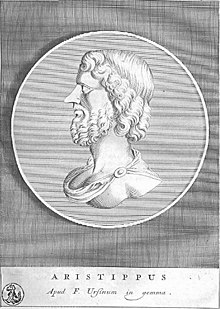
Remember Aristippus, who placed happiness in bodily pleasure? I was a terrible philosophy student and would be hard pressed to name ten general principles running through the history of the pursuit if my life depended on it, but you sure will never be able to persuade me that happiness lies in bodily pleasure. That teaching I cannot seem to forget.

"Hence I think I may conclude, that morality is the proper science and business of mankind in general,...as several arts, conversant about several parts of nature, are the lot and private talent of particular men, for the common use of human life, and their own particular subsistence in this world." I have never developed an effective program of my own for how to live/approach life as an active agent in its course. This being after all the purpose of philosophy, I would have to say that my education was really not a success. This is besides that it is hard to participate in any kind of social intercourse requiring a decent level of thought when one does not have (or does not wish to reveal) a coherent explanation of why one's existence is playing out the way it is in any way and in what directions one might wish to direct it in the future.

Locke does not appear to be one who is especially impressed by nature (as in outside, the natural world) as something more interesting or grand than the human mind. One would have spent a lot more time grappling with it in the 17th century than we do today, and it doubtless seemed less wondrous than the possibilities of rigorous thought to the intellectuals of that time. It is a tone that I think few thinkers would take, and maybe even feel, today.

Monday, July 04, 2011

Human Understanding--Part the Fourth

***(Picture, see below)


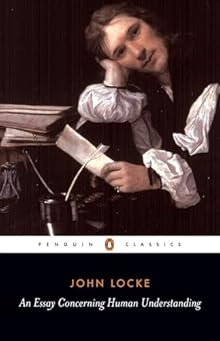
I seem to have already exhausted all the pictures of John Locke that are in circulation, so this post will be words only. Not even any girls today. I could not find anything that fit the mood.


Book II, Chap. XXVII (Idea of Personal Idenity): "...I once met with one, who was persuaded his had been the soul of Socrates." I think I met that guy too.


Chap. XXVIII (Idea of Moral Relations): "...mankind have fitted their notions and words to the use of common life, and not to the truth and extent of things." Yes, but if you do not have something of the thought process of a philosopher, this idea will have no meaning for you.


Chap XXXI (Of Adequate and Inadequate Ideas): "And so each sensation answering the power that operates on any of our senses, the idea so produced is a real idea, (and not a fiction of the mind, which has no power to produce any simple idea)..." I like the clarity of this. I have very few distinct ideas which would contribute in any way to a general understanding or world view. This sounds correct to me, but I have a very hard time adhering to any singular, precise viewpoint where abstractions are concerned.


"Thus by having the idea of a figure with three sides meeting at three angles, I have a complete idea, wherein I require nothing else to make it perfect." The perfection of the idea of the triangle is one of the pillars on which my old school was built, and the extent to which you are able to internalize this idea and allow it to become a guiding tenet of your life plays a great role in determining the nature of your experience there. Not necessarily the quality of your actual learning, but definitely the nature of your experience.


I thought that the breakdown of true and false ideas was clear and sensible.


I am finally through my tidbits from Volume 1. I am pretty sure I have much fewer notes on Volume 2.


Book III, Chap IV (Of the Names of Simple Ideas). "I say that the names of simple ideas, and those only, are incapable of being defined." His reasoning was that a definition is an explanation of the meaning of one word by the use of other words, but these cannot describe a basic idea that is not a composite of other ideas but has only a single attribute that it signifies, and is in fact meaningless itself until brought into relations. My impression is that this difficulty has been overcome.


Old philosophers in general are concerned with (......? I cannot make out my note here. It is a big word too) the mind, which is not only the locus of knowledge but the most important repository of it. I am not certain that going forward this is going to be regarded as the case.


***Chap VI (Names of Our Ideas of Substances) "...and our idea of any individual man would be as far different from what it is now, as is his who knows all the springs and wheels and other contrivances within of the famous clock at Strasburg, from that which a gazing contryman has of it, who barely sees the motion of the hand, and hears the clock strike, and observes only some of the outward appearances." I would have liked to have gone to Strasbourg. Some major segment of the EU governing apparatus operates out of there, so it is modernized and trendy to a greater degree than I am usually comfortable with, but the cathedral and the old quarter are still reputed to be remarkable, and the food is supposed to be very special as well, the Alsatian cuisine being as far as I can make out something like the marriage of Germanic ingredients and Gallic sensibility, both of which I like.


I thought that the bit about necessity applying to ideas rather than things themselves uncontemplated was ingenious. Of course without mind, what does the entirety of creation signify? It is preposterous.


"There is not so contemptible a plant or animal, that does not confound the most enlarged understanding." I know these forays into high Civilization must be profoundly boring and singularly uninstructive to everybody else, but they restore my equilibrium.


There is a reference in this same chapter to Thomas Aquinas's "ordines angelorum"--gradations of angels. This evidently invoked a reminiscence at the time, though unfortunately I forgot to record what it was.


Personal anecdote: 'November 19, 2008--Oscar (my oldest son, then 6 1/2) said "Is everything I do something?" A Lockean question. I answered, "If your mind is capable of perceiving the action, it is something."' I would never have remembered this if I had not jotted it down hastily in the margin of my book.


Locke quotes a story from a French miscellany of anecdotes and bons mots that I think will make a good end for this post:


"When the abbott of St Martin was born, he had so little of the figure of a man, that it bespake him rather a monster. It was for some time under deliberation, whether he should be baptized or no. However, he was baptized, and declared a man provisionally [till time should show what he would prove]. Nature had moulded him so untowardly, that he was called all his life the Abbot Malotru; i.e. ill-shaped. He was of Caen." Caen is not so distinctive and remarkable as Strasbourg, but I should have liked to have gone there too. I believe it is a run down old seaside resort in Normandy, and was frequented by many of the Impressionist painters. It sounds like my kind of place.

Saturday, May 21, 2011

Essay Concerning Human Understanding Part 3

It is important to me to remember to try to imagine the spirit of inspiration and ferment in which so many men of realized and energetic humanity in the eighteenth century received the writings of Locke; not necessarily Jefferson or Franklin, the strain of attempting to enter whose singular spirits would likely throw the entire enterprise off course, but some among the largely forgotten figures, the men of leisure and enterprise who had somehow managed to obtain good enough schooling to retain a lively interest in humanistic developments throughout life, the diffusion of which characters was so crucial to the history of that era. In short, I need to keep in the front of my mind the remembrance that the writings of this particular author set some of the most interestingly developed and ideally educated men found in all of history to consider and write long interpretations and opinions of his arguments, largely as personal correspondence, and to regard the material in a manner as commensurate with this history as possible.

This is off-topic, but I came across this 1883 passage from Henry James the other day regarding Oxford, which he frequently lamented his ill-fortune at not having been able to attend in his youth (he did go to Harvard, but he considered it, like the rest of America, to be crude, modern, devoid of poetry, tradition, meaning, etc. He wrote of his years there as if they constituted a several years quarantine from beauty and civilization that scarred him for life):

"(Oxford) typifies...the union of science and sense--of aspiration and ease. A German university gives a greater impression of science, and an English country house or an Italian villa a greater impression of idle enjoyment; but in these cases, on the one side, knowledge is too rugged, and on the other, satisfaction is too trivial. Oxford lends sweetness to labour and dignity to leisure."

I cannot testify as to whether this is an accurate assessment of Oxford in 1883 or not, but there is much in this that corresponds with my own ideas of what school should ideally be like which I have been having some trouble expressing, ideas which are very much out of fashion, to say the least. The last sentence, particularly the bit about 'sweetness' captures well what I often have perceived to be missing from many contemporary attitudes towards learning and accomplishment, which Henry James, needless to say, would have found beyond barbaric. Not that anyone can be expected to care much what he said in 2011, he being a fellow of extreme privilege for whom having to attend Harvard College (where his brother, incidentally, now probably regarded as the greater of the two, was on the faculty for most of his career) ranked as a major calamity in his life. He did think a great deal about the cultivation of the mind for reasons other than professional advancement, it was perhaps the most important consideration in the world to him, and I think he had many good ideas where it was concerned, even if he was not able to, or interested in, making their development applicable to the needs of the economy.

Henry James of course is not the best role model for the likes of me. It was not imperative on him to have a career as a means of sustaining his physical existence in the way that it is for most people. I still seem somehow to think of myself as a man of leisure, though I have not had more than two consecutive weeks off from paid labor since 1997. I still haven't any idea what practicable career that is both necessary, realistic of attainment, and which would identify me as belonging in some way to the more generally educated class of people I might have liked to have pursued. I have been working in the health care industry for a long time and one cannot help but observe the gulf in status and general social presentableness between the actual MDs and the other medically trained professionals (The administrators/business class type people in the organization are a whole other category, which I cannot relate to at all however). I probably did not have the focus to complete the training properly, but I suppose at this point I can see myself getting up every day and being a doctor, whereas I still cannot envision myself doing most regular high-paying respectable jobs that I am aware of. People warned me all my life that I needed to be serious about this, so I cannot complain that nobody explained the hard cruel realities of the world to me, but it just doesn't sink in when you're 25--let alone 18--and you think you still have some life in you on a modestly grand scale and people are badgering you to become an accountant. I thought I had enough general talent that I could eventually make my way into the life and the circles where I would recognize myself as belonging and making the best use of my abilities. I don't really think that has happened, but as it still is not clear to me what exactly I should have done to produce a more desirable outcome, this particular aspect of my sluggishness (apart from the sluggishness itself) does not bother me that much.

The will is determined mainly by uneasiness. This is something I picked up from the reading. It would explain in great part the persistence with which I pursue my mainly fruitless endeavors, such as this site.

From the section "Idea of Power": "...the will being the power of directing our operative faculties to some action, for some end, cannot at any time be moved towards what is judged at that time unattainable..." This would explain why nerds never try to bird-dog hot chicks.

"God Almighty himself is under the necessity of being happy; and the more any intelligent being is so, the nearer its approach to infinite perfection and happiness." I.e., free will is overrated in the grand scheme.

"...we should take pains to suit the relish of our minds to the true intrinsic good or ill that is in things; and not permit a...possible great and weighty good to slip out of our thoughts, without leaving any...desire of itself there, till...we have formed appetites in our minds suitable to it, and made ourselves uneasy in the want of it..." The quotation is rather unwieldy, but I think it contains good advice.

Torture on the rack is offered as an example as a cause of uneasiness in the will. I thought it was funny at the time. Possibilities for humor can be rare in philosophy books.

Montaigne is quoted in the notes on numerous instances, which was also a source of momentary excitement. This one struck me as particularly elegant: "Si la douleur de teste nous venait avant l'ivresse, nous nous garderions de trop boire; mais la volupte', pour nous tromper, marche devant, et nous cache sa suite." ("If the unhappiness of the result came to us before the drunken state, we would keep from drinking too much; but the pleasure, in order to deceive us, walks before us, and hides from us what follows.")

After I had an inconclusive grapple with the wager as regards eternal happiness that men who determine to be good are said to make, I quickly moved on to the section "Our Complex Ideas of Substances". Of these, "Powers therefore justly make a great part". What a thing does is what it is. This pretty much applies to all of life as far as it is lived by most people.

"...were our senses altered, and made much quicker and acuter, the appearance and outward scheme of things would have quite another face to us; and, I am apt to think, would be inconsistent with our being, or at least wellbeing, in this part of the universe which we inhabit." I seemed to think that the expansion of modern knowledge, including the increased possibilities of body modification/enhancement, might offer some kind of test of this statement. But under soberer consideration I have reverted to the opinion that these changes in the modern condition are cosmetic and trivial in comparison with the conception of the original sentiment.

Black swans apparently had not been discovered in 1690. (There is a passage in the section on ideas of substances where among the characteristics identified with the word "swan" was whiteness of color. A footnote explains that "Black swans have since been found").

I like the way this is put. It strikes me as elegant:

"For putting together the ideas of thinking and willing, or the power of moving or quieting corporeal motion, joined to substance, of which we have no distinct idea, we have the idea of an immaterial spirit; and by putting together the ideas of coherent solid parts, and a power of being moved, joined with substance, of which likewise we have no positive idea, we have the idea of matter."


"...it seems probable to me, that the simple ideas we receive from sensation and reflection are the boundaries of our thoughts; beyond which the mind, whatever efforts it would make, is not able to advance one jot; nor can it make any discoveries, when it would pry into the nature and hidden causes of those ideas." According to the notes, this is the main thesis of the Essay. It seems intuitively wrong, since some people anyway must have the ability to push beyond existing boundaries. Perhaps he is saying that even these expansions of existing ideas are dependent on this basic procedure however, and that we are not capable of generating ideas via different means.

"The ideas, then, of relations, are capable at least of being more perfect and distinct in our minds than those of substances." Ideas of substances would be truer and deeper knowledge however.

"But the sun and stars, though they have outlasted several generations of men, we call not old, because we do not know what period God hath set to that sort of beings." More scientific improvements.

I wish I had more time to think and write about these various things that I like. I suppose I do neither well, but I used frequently to feel that I did them well, which is something I rarely feel when doing anything else.

Tuesday, April 26, 2011

John Locke II

Unlike us, Locke didn't think much of babies' mental abilities, which he compared to vegetables.

Another philosopher who is quoted a lot in the notes, and who seems to be a much clearer writer and better thinker than Locke, is Hume. Though the standard narrative at St John's, as far as I could make out, was that the extremely clever but in some sense facile Hume threatened to lead philosophy down a dangerous, materialistic path but was overcome by Kant, who restored the emphasis in the discipline to metaphysics where it belonged, and beautifully so, Hume at least offered evidence that a high order of philosophical thought could find expression in a mind formed within the confines of the English language, about which many people through the centuries have expressed varying degrees of doubt, including myself. Boy was he cocky though. I seem to have neglected to mark any specific examples of what I am talking about however, so I will have to hunt them up.

"The variety of smells, which are as many almost, if not more, than species of bodies in the world, do most of them want names." Surely now there are people who do this professionally.


Somewhere around page 167 I decided that the notes explaining Locke's ideas were harder to understand than his own sentences, that they were impeding my reading, and that I would stop. Then on page 185 (during the section on "Faculty on Perception") I wrote that I was having to read every sentence 4-5 times, while at that point having 813 pages to go.


"And how covetous the mind is to be furnished with all such ideas as have no pain accompanying them, may be a little guessed by what is observable in children new-born; who always turn their eyes to that part from whence the light comes, lay them how you please." A pleasant observation about babies in the midst of all this straight theoretical philosophy, though this instinct is probably not the most perfect illustration of his idea upon which he could have fallen.

Moving onto the "Faculty of Retention" chapter, a good illustration of my own mind, and my attitude towards it: "Thus the ideas, as well as children, of our youth, often die before us: and our minds represent to us those tombs to which we are approaching; where, though the brass and marble remain, yet the inscriptions are effaced by time, and the imagery moulders away."

On having a faulty memory: "This, if it be to a great degree, is stupidity; and he who, through this default in his memory, has not the ideas that are really preserved there, ready at hand when need and occasion calls for them, were almost as good be without them quite, since they serve him to little purpose." Real intellectuals are a pitiless crowd. "The dull man, who loses the opportunity, whilst he is seeking in his mind for those ideas that should serve his turn, is not much more happy in his knowledge than one who is perfectly ignorant." True.

A Great name comes up that I have not had occasion previously to reference on the site: "It is reported of that prodigy of parts, Monsieur Pascal, that till the decay of his health had impaired his memory, he forgot nothing of what he had done, read, or thought, in any part of his rational age." There is a footnote, however, which says that "This about Pascal must be taken with allowance. That he never forgot anything 'which he tried to retain' is what Madame Perier records of him."

There is a long section about the existence of space and body, which in brief asserts that man's capacity to conceive the extension and multiplication of distance, mass, space and so on is crucial to his ability to think, that can be skimmed, I believe.

Another Great man turns up at the beginning of Chapter XIV ("Idea of Duration and Its Simple Modes"), St Augustine, in reference to the time he was asked what Time was, which strikes me as a fitting question for a Great man, and a poor one for anyone who is not Great. The giant of Western thought replied "Si non rogas intelligo" which looks roughly to me to translate as "If you don't ask, I understand", but is explained by Locke as "The more I set myself to think of it, the less I understand it". Locke is willing to attempt some definitions, albeit of a more prosaic and technical nature than the Saint would likely have found it worthwhile to do. Locke did not however anticipate science's ever increasing ability (instant replay!) to measure and control very precise amounts of time--the comparison of two periods of equal duration, for example, he thinks ultimately impossible, because no two parts of it can be certainly known to be equal. This does not strike me as a concern that would afflict most scientists or philosophers today.

Going to leave this one off a little short.

Wednesday, April 13, 2011

John Locke--Essay Concerning Human Understanding (1689) Part 1

Having become somewhat more aware in recent years of what studying an academic discipline such as philosophy both really entails and signifies to people who have hard-earned degrees in a subject, I am careful now never to declare myself as having studied anything at a quasi-serious level. This is the type of thing that we used to read quite a bit at my old school, however, so while I do not often plow through 17th century philosophical tomes anymore, I was able to settle in comfortably right away and was transported back to those days, which, seemingly having suppressed all of the unpleasant memories, which latter experiences at the time I am quite certain ran quite neck and neck at the least with the more fortifying ones, was productive of what I took to be an unusually fruitful reading. Something of the form and spirit of the Great Books--among which Locke is always accounted a member with a minimum of controversy--must have managed, after all, to insinuate itself in me, for I felt as though an aspect of my brain and indeed entire existence that had long been closed off was (at least) temporarily opened.

While we did read John Locke at school, I have no recollection of the specific titles. If we did read any of this--and I have no memory of it--it would merely have been excerpts, as my edition of the book is two volumes and 996 pages, though without the extensive footnotes it would probably be slimmed down to 600-700 or so. There was also a 140 page prolegomena (introduction) which I skipped. In spite of my overall enjoyment at engaging with the Enlightenment again, my armchair St. Johnsian impression of the philosophy in it was that it was not especially persuasive or airtight by the standards of the greatest practitioners of the field that I am aware of anyway--i.e. the Greeks and the Germans--whom I would be quickly exposed as having no understanding of if put to the test but whose presentation and arguments I know at least try to account for every contigency or objection to them that might arise that even a dull reader could conceive of, which Locke seemed to me to fail to do. Given the general extensiveness and thoroughness of the book in general, and contemplating the task of attempting to arrange a work of the intellect on such a scale and with the necessity of such thoroughness and precision of thought myself, this led me to the conclusion that writing a successful work of philosophy might be the most difficult of all mental/literary tasks to achieve, though at the time I was forgetting about epic poems, which may actually be harder.

Locke was renowned in England for his extreme seriousness. There was one story in particular that I remember, I believe it was in one of the books from the Samuel Johnson-o-sphere, in which Locke was invited somewhere for dinner and could not be brought to sit and fritter away an evening of his life at the card-table, and went home the instant the conversation dropped beneath a level that was acceptable to him. Unlike places such as Germany and Russia where almost all writers and intellectuals maintain this level of seriousness at all times and on all subjects by our standards, this attitude was pretty rare in Restoration England. The poets and dramatists of Locke'e age, and the novelists of the next, Pope not least among them, give the impression that a substantial portion of the life of the elite centered around the card-table, and indeed depict these sessions so vividly that one wonders whether the video game will perhaps find its poet in the coming years. As well the Cavalier poet and anthology favorite Sir John Suckling was long attributed as the inventor of the game of cribbage, though, as is their wont, in recent years the scholars of card games have dug deeper into this legend and found it not to hold water.


On page 10 of 996, our author states: "...when I put pen to paper, I thought all I should have to say on this matter would have been contained in one sheet of paper..." That was a serious underestimation of the vastness of his subject, I'd say.

A note on page 31 (still in the Introduction) on the sentence "Our business here is not to know all things, but those which concern our conduct" suggests that it could serve as the motto of English philosophy generally. I should add that the notes appear to date from 1894, so they are not exactly current either, though I am certainly willing to give them a fair hearing.

Classical philosophers in general have little use for children, considering them incapable of reason among other deficiencies. Perhaps we would not be unwise to remember this sometimes in our assessments of their development, especially at early ages (The first section of the book is spent establishing Locke's contention that there are no such things as innate universal principles in the mind, of which the crudity of children's natural understanding and consequent behavior, in Locke's view, is a prime illustration).

After using the examples of rampaging armies and cannibals in Peru who reputedly ate the children they begot on their female captives (and indeed kept them for that purpose) to demonstrate the absence of innate moral principles, caps the argument with "The saints who are canonized among the Turks, lead lives which one cannot with modesty relate."

Locke's Victorian editor--Alexander Campbell Fraser--did not wholly like this idea of principles, moral ones especially, not being innate and offered the suggestion that while perhaps these do not involve "actual realisation in the consciousness of each individual from birth," they might be "potentially innate, and only evoked in the consciousness of the few who are highly educated, morally and intellectually." He then further goes on to declaim that "to awaken a response in individuals to the principles on which human life reposes is the aim of the higher education", and that "from Socrates onwards this has been recognized by teachers of religion and philosophy." I would have to say that the peculiar biases of his generation and culture are negatively affecting his reading here, as doubtless mine do my reading, and almost everyone else theirs too. Indeed almost half of almost every page is given over to notes either contradicting or refuting Locke's arguments, and the case would probably be the same if I were to annotate my own edition, which after a time led me to wonder why exactly it was (is?) considered so great. Is it asking the right questions? Are there specific points that are so well expressed and so well important that they compensate for the many seemingly weaker parts of the work?


In addendum to the previous note, Locke's definitions and the other grounds/postulates of his arguments are also far from impregnable. Among other issues he seems to accept a God very like the Christian God as an absolute fact, "He Is," though he puts forth the argument that as most people have but "odd, low and pitiful" ideas about God's actual nature, this is an indication that even this knowledge is not innate though "wise men of all nations have come to it". I would venture to say that modern philosophy, perhaps even modern life, has made the Christian God appear no more natural or logical than any other deity, and all real believers of specific faiths to be peculiar above anything else.

"Nor is it a small power it gives one man over another, to have the authority to be the dictator of principles, and teacher of unquestionable truths; and to make a man swallow that for an innate principle which may serve to his purpose who teacheth them." One of my own obsessions.

"And how great a mass of knowledge soever he imagines to be lodged there, he will, upon taking a strict view, see that he has not any idea in his mind but what one of these two (ed--the objects of his senses or the operations of his mind) have imprinted;--though perhaps, with infinite variety compounded and enlarged by the understanding, as we shall se hereafter." Didn't Shakespeare already break all this down, and more pithily?


"But he that would not deceive himself, ought to build his hypothesis on matter of fact, and make it out by sensible experience, and not presume on matter of fact, because of his hypothesis, that is, because he supposes it to be so; which way of proving amounts to this, that I must necessarily think all last night, because another supposes I always think, though I myself cannot perceive that I always do so." I included this somewhat inscrutable quote because it seems to me that I do this myself all the time, and that it is a major factor in my being essentially philosophically weak, which among other tragedies, hinders one from having any hope of ever being a true St Johnny, which having had few other potential associations which ever struck me as particularly desirable, would have meant something to me. It seems to me there must be some consolation in talking of intricate matters one has some degree of mastery over with a mind of nearly equal status and development, though I suppose everything always seems magical to those outside the pale. This is merely routine thought and human intercourse for the people I am aspiring to be, and signifies nothing exciting to them.

Liebniz, who apparently addressed many of the same ideas Locke is concerned with in this book, is much excerpted in the notes where the comparison of his perception with Locke's suggests itself. Gottfried seems to be the better thinker of the two by no insignificant margin. He is certainly the clearer thinker at least.