Showing posts with label mark antony. Show all posts

Wednesday, January 07, 2015

Notes on Dead End Reading

The Pilgrimage to Parnassus; The Return from Parnassus (c. 1598-1602)

A series of plays put on at St John's College, Cambridge around the end of the Elizabethan period, as part of their Christmas festivities, though they are not about Christmas. They are about a couple of students who decide to make their way in the world as poets, and the predictable indifference, humiliation, and poverty that befall them when they set out to do this. There is some comfort in being reminded that the problem of impractical young people with liberal arts degrees leaving school without any prospects for obtaining an income, nor any realization of how one might ever go about developing any did not just spring up in the last 20 years. Maybe these kinds of schools, which ironically seem to be most emotionally necessary as a pleasant refuge during youth from the otherwise pitiless business of real life for the less successful of their graduates, will continue to sputter along in some form, in spite of even the most well-meaning, though mistaken efforts to kill them off and spare these more hopeless graduates from what is perceived to be the source of all of their perceived subsequent misery.


The plays themselves are hard going at times to read--I guess they have not been edited so as to be made intelligible to modern readers, assuming that can be done, and there are lots of references to people and inside jokes and slang that doubtless meant something to the assembled audience but can signify nothing to me. There are numerous references to contemporary as well as historical English poets (i.e. Chaucer), including Shakespeare, which accounts in some part for its historical interest. Shakespeare is identified only as a poet and the author of the Rape of Lucrece and Venus and Adonis. His plays I did not notice as being referenced at all, though even by 1598 a good part of the comedies and histories would already have been written.

It could be interesting if it could be made more intelligible, I guess, though even most of the experts seem to be of the opinion that only the middle play (the first part of The Return) contains any real literary value.

Philippics--Cicero (44-43 B.C.)

This was the first Cicero I had ever read, and I am well into my forties. My education has been light on the Romans, so he is not the last of them that I have yet to read either (all in translation, of course, which I know scarcely counts anyway). These writings, being purportedly the transcripts of orations, are much different in tone from those of other classical authors with which I am familiar, having much more raw agitation and hostility in them. Of course Cicero here is an active partisan politician who has to sway the wavering opinions of, if not precisely a mob, a body of senators. I suppose I was expecting the style of delivery and the subject matter to be grander, less earthbound.
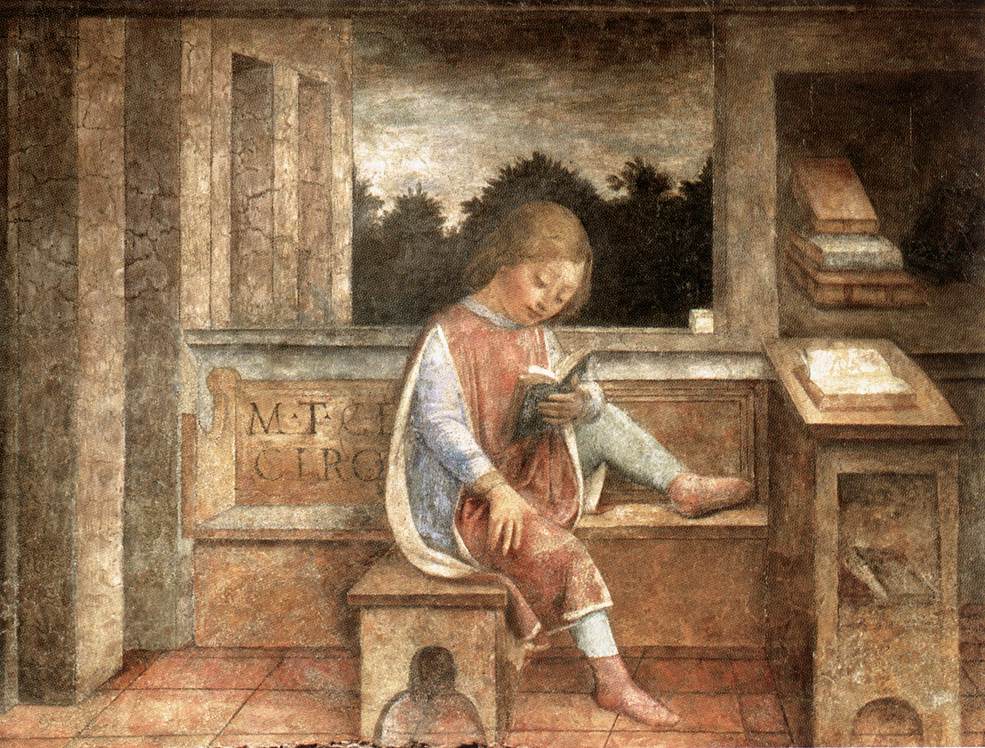

The Young Cicero Reading--Vicenzo Foppa (1464)

The fourteen Philippics are denunciations of Mark Antony, who at this time following the assassination of Julius Caesar was out of the city seeking military allies and in Cicero's opinion carrying on the worst of the dead Caesar's transgressions against the traditions of the old Republic. It is a different view of Antony than we usually get from both classical and post-renaissance literature. His arrogance, which in other depictions is usually presented with a heavy emphasis on vanity, here is expressed as of a more dangerous and willful quality. He is ambitious, a driver of events and a leader, of sorts anyway. I didn't previously think of him (based mainly on Plutarch and all the Shakespeare and Cleopatra plays) as a man capable of rousing this degree of anger and condemnation as a main target in himself, separate from his association with other people or events that are greater than he is.

I did not read this all that well. I suppose it is possible that the entire book is not great as a whole (various of the individual Philippics, especially the second, seem to be considered more important than the whole collection), maybe the translation did not perfectly capture the mood of high excitement and historical seriousness. I also have the sense that the Orations against Catiline (which Cicero himself, reliving that glory, references dozens of times in the course of the Philippics) are the essential Ciceronian reading. In any case he demands a more serious consideration than I seem to be able to give him at present.

Ben Jonson's Conversations with Drummond of Hawthornden (1618-19)

There is not much conversation here, on Drummond's part anyway, and what was recorded was mostly snippets--what would become popularly known as table talk--of Ben Jonson's observations, which amounted to 58 printed pages, most of which were more than half taken up with footnotes. The impression given is that there was not much in the way of give and take between Drummond and his guest, but that their talk consisted mostly of Jonson making pronouncements in a vaguely bullying manner. I don't remember much of this, either. Obviously I have reached the point where it is pointless for me to read any more. I am struck by so little of it, and as you can see I have trouble even putting my most simple general observations into words at this point. But I would have to take up some other pursuit to fill the time--I still can't just spend all my waking hours doing laundry and dishes, but maybe I am being ground down to the state where that is all I will be capable of doing--and I still desperately want to have some communication with the reasonably intelligent (and socially relevant) part of the world, and I don't know how else I can achieve this than by some attempt at producing content.


Drummond of Hawthornden

Tour of the Hebrides--Boswell (1773)

Not included in most editions of the Life of Johnson, this comparatively under-celebrated work is a book-sized bonus treat for people like me who are fans of this lively duo and their exploits in the social and literary society of their day. Johnson wrote his own account of this famous trip as well, which is one last further treat for me to look forward to, assuming I ever get around to reading it.


This is the edition I read.

I ordered my copy of this book online, and as sometimes happens with older memoir-type books, the edition I received was not the edited and polished standard one that all of the professors and other critics who have promoted the book as great are primarily thinking of, but the rougher version of the tour as it appeared in Boswell's journals. Nothing was left out as far as the major episodes of the trip went; on several occasions where pages of the journal had gone missing, the editors filled in the missing parts with the text from the printed Tour. These finished excerpts were far superior from a reading standpoint to the journal account, giving off much of the same high-spiritedness and humor of the Life itself, and I kind of wish now I had abandoned my edition entirely and found a copy of the traditional printed Tour. The journal was by no means a bad read, and almost certainly was more representative of what the trip was like on a day to day basis. There were numerous passages in it detailing parts of the trip where Johnson especially was bored and restless on account of the inferior level of education and dull conversation of many of the people they encountered, which provoked in him some rather harsh and decidedly unforgiving observations with regard to the limitations that several of their hosts and new acquaintances had revealed. My impression from the scholarly notes is that most of this material was either left out of the published version, or softened so as to appear more in a humorous and flattering light. And I think this was a good idea, as much of the special quality of these Johnson books come from the atmosphere of heightened intellectual alertness and drama that the scenes in them evoke. The life and conversation in them is far more entertaining and captivating than anything that ever occurs in real time, while plausibly resembling reality (if nothing else, the contrast between the journal and the published book reminds the reader of the art that is essential even in the production of a ostensibly non-fiction account to give it this sheen of heightened reality); but I realize more and more that it is these appearances of life heightened and made more consistently intense and significant and exhilirating that I seek in reading and other artistic entertainment.   

Saturday, June 20, 2009

John Dryden--All For Love (or, The World Well Lost) (1678)

This is the last of the Cleopatra plays. As I had read this one not too many years earlier I just skimmed over it, and did not take a lot of notes. The first time I had read it, I had liked it quite a bit, thought it reminiscent of Shakespeare, on whose own Cleopatra play it was modeled, perhaps even a sparer, cleaner version of it, or, at least, was my impression. Looking over it again just after having read the Shakespeare though, as well as the Daniel and the Shaw, I did not like it quite as much. For one thing his Antony struck me as perhaps overly romantic ("One look of hers should thaw me into tears,/And I should melt, till I were lost again...If I should hear she took another love,/The news would break my heart--now I must go;/For every time I have returned, I feel/My soul more tender..."). Shakespeare's Antony, it goes without saying, is much manlier than this. For that matter, his Lepidus is manlier than this too.

The poetry of the speeches I have marked in several places as "so-so" ("And while she speaks, night steals upon the day/Unmarked of those that hear: Then she's so charming/Age buds at sight of her, and swells to youth...), "humorous" ("Even I, who hate her/With a malignant joy behold such beauty/And, while I curse, desire it") and "kind of silly" ("And then he grew familiar with her hand/Squeezed it, and worried it with ravenous kisses") .

There is some bawdiness thrown in for the Restoration crowd ("Your Cleopatra/Dolabella's Cleopatra; every man's Cleopatra...You know she's not much used to lonely nights...ANTONY: Though heaven and earth should witness it/I'll not believe her tainted. VENTIDIUS: I'll bring you then, a witness/From hell, to prove her so...")

Octavia (Antony's wife)'s pain gets more play in this version of the story than it usually does, though there still isn't a lot of sympathy for her.

"Sure that face/Was meant for honesty; but Heaven mismatched it/And furnished treason out with nature's pomp/To make its work more easy." This makes little sense, on the part of Heaven.

Antony does show stirrings of being a genuine man later on though, when he declares "I do not know how long I can be tame" and "my justice and revenge/Will cry so loud within me, that my pity/Will not be heard for either."

Overall not as impressive as I remembered; characters are not grand or even particularly interesting. Mirrors the age I suppose. Much too soppy-romantic. Images, poetic tension better elsewhere.

Of all the figures in English literary history who have been the dominant force in their own epoch, as Dryden was in the 1670s and 80s, he is really the only one whose works don't arouse much excitement in anybody nowadays. Pope doesn't seem to be read all that much, but most of his work is at least in print, while of the twenty or so plays Dryden wrote it is difficult to find more than 2 or 3 in a common edition (Pope is also still broadly considered to be a very good poet, I think). I am also not aware of any of these plays being revived theatrically, if ever. Dryden does not, compared to the other authors of this class, including his own rough contemporary Milton, seem to have either the same quality of ideas, or the same control over such ideas and other material he does have. He was a very shaky literary dictator, often in a defensive mode in his public political and philosophical disputes, and was even suffered to be beaten up in the street by thugs on account of a book review, all of which it is hard to imagine happening, or being allowed to happen to, the likes of Milton or Samuel Johnson or Dickens.

Sunday, April 12, 2009

Antony & Cleopatra Part 2

I have a poor edition of the collected works of Shakespeare for someone who tries to present himself as whatever it is I hope to present myself as, something called the Cambridge Edition Text of 1936, with "The Temple Notes" which are quite the most useless notes I have ever encountered, and illustrations by the 1930s Socialist-Realist artist Rockwell Kent. I actually don't mind Kent, but I have been present when others of great knowledge and strong opinions regarding art and the world in general have sneered at the drawings and critical writings of this artist, and thus suspect that any project which had an association with him must smack of second-rateness through and through. This edition doesn't even seem to agree in its scene breaks with most of the ones in common use, Act III of Antony and Cleopatra for example having 13 scenes in this book, which does not appear to be the case elsewhere. I really ought to get something better, at the very least something more attractive, or less cumbersome, or with easier to read print (this book having the dreaded old-fashioned small print double-column type). Currently I am not getting even a modest visceral thrill from pulling down and fondling the family volume of Shakespeare, something of which sort I think should be the case to some degree in the life of a person such as I am.

Act III Scene xiii: ANTONY: "I found you as a morsel cold upon
Dead Caesar's trencher; nay, you were a fragment
Of Cneius Pompey's; besides what hotter hours,
Unregister'd in vulgar fame, you have
Luxuriously pick'd out..."
These are some cold words. Wherever we love with any especial fervency or significance to ourselves, we can never forgive the object of our passion for coming to us in any but a completely undefiled state. So long as our beloved is wholeheartedly engaged in attending to our happiness, and ignoring all else, we can forget these harder sentiments, but they must ever rear themselves at the slightest neglect or other disappointment.

Act IV Scene iv: Beautiful line:
ANTONY: "This morning, like the spirit of a youth
That means to be of note, begins betimes."

Artist's Conception of What Cleopatra May Have Looked Like. That's what it says anyway. Obviously I would be content enough to imagine it were so. Antony does not really come off too good to me in this play, either. I guess I just can't warm up to him. His character is kind of an arrogant jerk, all the while he's getting worked over by both Cleopatra and Octavian. This play is usually listed with the tragedies, so I assume the title characters are supposed to have tragic flaws. Cleopatra is pretty much synonymous, fairly or not, with sensualism and vanity, and I can't see that Antony's downfall is morally the result of anything more direct than that. Being more obtuse than the people one is contending with does not seem to qualify one as a tragic figure.

ACT IV SCENE xv, CLEOPATRA: "...then is it sin
To rush into the secret house of death,
Ere death dare come to us?..."

A lot of legendary Romans fell on their swords, or had swords thrust into them by others, in a comparatively short period of time, as noted above: Pompey the Great, Caesar, Cicero, Cato, Antony, Brutus. Whatever one thinks of these people, that was by our standards a considerable collection of intellect, energy and talent to be consumed in internecine struggle, though of course their involvement in that struggle was in most cases what caused their great abilities to attract so much attention and renown. Still, the general attitude of Roman society at that time certainly was not that talented people were such precious resources as to be unexpendable. Indeed, the greater ability you showed in some instances, the more likely you were to pass a significant portion of your life with that life imperiled. This seems to be a common trait among well-developed aristocratic castes, the to bourgeois sensibilities shocking indifference to exposing the most brilliant, capable and highly refined young men to a casual death, the willingness to do which, is, I suppose, expresses in the plainest manner what is known as a sense of tragedy, which most intellectuals seem to consider a very desirable thing to possess in one's person.

Millenial Generation Antony and Cleopatra, I Presume. Chicks like this, you can argue, aren't worth getting worked up about, but I have always sensed that figuring out how to get in favor with this general type would have been the key for me, given the era in which I lived, social environment I had some possibility of hovering around, etc, to have had a more satisfying social and romantic life in my youth. Of course I never came close to figuring it out, and women like this, who would seem to be the nearest thing I have to a natural reasonably attractive, opposite-sex peer group, always held me off at such a great distance that I am not sure I managed to get the ball even past midfield in my entire youthful career.

ACT V SCENE ii, CLEOPATRA: (Good example of poetic power) "...If your master
Would have a queen his beggar, you must tell him,
That majesty, to keep decorum, must
No less beg than a kingdom: if he please
To give me conquer'd Egypt for my son,
He gives me so much of mine own as I
Will kneel to him with thanks."

Later in the same scene, more good lines, also from Cleopatra:

"...saucy lictors
Will catch at us like strumpets , and scald rhymers
Ballad us out o' tune: the quick comedians
Extemporally will stage us and present
Our Alexandrian revels; Antony
Shall be brought drunken forth, and I shall see
Some squeaking Cleopatra boy my greatness
I' the posture of a whore."

I am guessing that Shakespeare, being an actor and writer of dialogue, would have spoken in a somewhat similar manner to that in which he wrote. One of my great mistakes in undertaking to be a writer was to completely discount the relation between one's talking, in which area by the way I am wholly incapable, and one's writing. Given enough time--weeks, months--one can untangle and hammer out one's impressions and thoughts enough on the page to make a somehwat coherent idea, but the problem of course is that the person in the real time of life who requires such an amount of time to make any sense of the impressions he has and the people who speak with him is simply going to have a very constricted experience of life and other men, and certainly cannot be a novelist, which requires its practitioners to comprehend and record the world at a rate somewhat akin to the pace at which it actually happens. The person such as myself who carries single assertion or exchanges from much larger and forgotten conversations about in his mind such as I do, and in some instances comes upon a potential response to an assertion made by the other 20 years--20 years!--after the actual assertion was made in real time is going to be at a real handicap in trying to create a fictional world that has enough life and fullness in it to be interesting to any reader.

Thursday, April 02, 2009

Shakespeare--Antony and Cleopatra (Part 1)

I was always partial to the Roman plays. Not that everyone else isn't, or that I hold the other ones in any lesser esteem, but these have always been especial favorites of mine, along with the Henrys. Possessiveness, jealousy, haughtiness, exclusivity, and the like, are conditions to which many are susceptible where Shakespeare is concerned, and as these are attitudes which I am particularly ill-suited to carry off well, I try to keep a certain emotional distance from most of the more beloved and contended-for plays, feeling, I suppose, that they can never really be mine anyway. The Roman plays, such as this one and Coriolanus, even Julius Caesar, seem comparatively to inspire a lower level of general intensity and rapture. If the Bardosphere could be conceived as a beer garden, I would likely be sitting at one of these stately but relatively sedate tables--perhaps alongside a Victorian era faux-ruin of some Roman gate or other--at a safe remove from the tumult, high-spiritedness and glamour of those devoted to the Dane, the Star Crossed Lovers, the Crookbacked Usurper or other of the grittier and more naturalistic heroes of the repertoire.

When I first looked into it some years ago, I thought Antony and Cleopatra just as good as any of the other major tragedies, with the exception perhaps of Hamlet, which doesn't resemble the other plays in the same ways that most of them do each other, and that opinion was not shattered, and was if anything enforced, by this latest misreading. The writing, the construction, the economy, the characterization, is so very expert and smooth, that one almost has the impression that the author's mastery of this particular form, and way of understanding the great issues of man's existence, is so thorough, that he is not properly challenging himself, or the audience, by insisting on pressing on to a more dangerous and scary level, which, if we have been properly bred up as thinkers, is what we crave most.


What would become of a person like Shakespeare today? Who would he hang out with? In what form would our noticing them, assuming such could even exist, consist of? Surely poetry in the contemporary world would strike a man of such dominating talents as too sluggish, effeminate, devoid of genius and culturally irrelevant a pursuit to be worth taking up; he would naturally want to direct those talents to some contemporary arena that was worth dominating. Would he find one though? Some have suggested that this class of person manages hedge funds or directs scientific research now, as if genius were of such a general and unsuppressible quality that anyone who possesses it must be apparent, and easily direct and establish itself it whatever area of activity currently most requires and rewards it. This reminds me a little of the American sports commentators who used to opine that if Allen Iverson and Michael Vick had been adopted or kidnapped as infants and raised in France they would be the greatest soccer players in the world because of their innate athleticism. I used to wonder if there was not something in this, that business and technology were dynamic, and the literary and teaching professions moribund because the former had siphoned off all the exciting talent that used to fill prep school faculties and the great urban literary scenes of the past. I was even convinced for a time that the qualities of mental talent, energy, and personality in the truly successful author were generally the same as those in any successful man of affairs, and if such men were to direct their fervor and appetites and primary means of understanding the world towards literature rather than commerce, etc, that humanistic studies and accomplishments would be flourishing again, and the masses as eager to idolize and follow the lead and outlook of these great men in matters of learning as they are in matters of economics. But obviously there is something more to it than just that. I will go more into that another time.

My commentary the other day on Mark Antony was of course preposterous. I am casting grand judgements on his abilities and character as if I were the one who was one of the great figures of my generation, and he the typical slavish sort of fellow. That is part of this game of pursuing literature that people like me play, the reader little less than the writer to a certain extent has to imagine himself raised to a level of equality, in some instances even superiority, to the subject under contemplation, however comparatively exalted. Success in writing or any art is to a great degree success in pulling off this conceit of elevation, making some ill-fed debtor scribbling lines in a garrett possess a historical stature equal to or greater than that of an emperor. If Antony was lacking of the finest qualities, what does one say of Lepidus then? You will remember he was the unfortunate third member of the triumvirate along with Antony and Octavian, who was snuffed out rather quickly with apparently little exertion and without arousing any protest from a potent camp. Shakespeare presents him as a loser and weakling whom the other prominent Romans are comfortable insulting to his face and making plans to dispose of as casually as they would make plans for their next orgy. We all know and many accept that if the comparatively weak put themselves in the way of the strong and don't recognize their inability to contend and attempt to resist, it is going to end badly and humiliatingly for them. I think people with any kind of well-developed spirit like it in high art productions when weakness and inferiority in men are not tolerated and punished severely. It is fearful, but also genuinely exhilirating to know that real demands might be made of your brain and character, failure to live up to which will cost you not merely your life, but any illusion of respect from your countrymen, your friends, and your foes.

This play does have two of my favorite classic Shakespeare quotations, the "infinite variety" speech, which is of course about Cleopatra, and the "O happy horse, to bear the weight of Antony!" tribute to his godlike appearance and bearing.

Though I was trying to read this more closely and seriously so as to glean some insight as to what our author is really saying, I still came to the conclusion that he was in fact emphasizing the sexy parts at the expense of more serious geo-political analysis, and that that was actually the stuff he liked the most about the story. It can't possibly be true, but it was what I kept thinking, after my ever too easily entertained misled manner.

Octavius Caesar I thought comes of rather badly in this play compared with his depiction in Plutarch (who always refers to him as young Caesar), where it is difficult, given the pre-occupations of that author, not to feel some admiration for him. In that book his extreme youth--he seems to have been in his early twenties at most--lack of military credentials compared to all his rivals, and the manner in which most of those same did not take him very seriously when this crisis broke out are much more palpably felt. Yet he ended up the last man standing atop a large mound of very famous corpses and ruled the Roman Empire pretty much unmolested for the remaining 40 years of his life. In Plutarch he is presented as calm, prudent, possessed of self-control, steely of purpose without being given over to the bombast and grand gestures of the previous generation. Obviously much is left out of the Plutarch account, such as who/what sort of men formed this young man's army/base and how did he win their support? but I am simply noting an impression. Being a dramatist and a man of the hottest spirits both of body and mind, Shakespeare most likely found his dry, only too successful pragmatism and efficiency boring and cold. Overall the reign of Augustus has not offered much batter that writers wanted to make confections of compared either to his predecessors or successors.

Cleopatra is called a whore on several occasions in the play, and not in a means meant to induce sympathy. (Caesar: "...He hath given his empire up to a whore...", etc). Whether the result of this affair was a real, and if so staggering shift in the whole course of human history, or its significance has been overblown by art, how could Antony have flown the battle and given up all, including in some sense a last remnant of the spirit of the old Rome which in literary accounts he is often made to embody, for a woman? Yes, I would probably do the same, but even I would know it was a stupid thing to do. I wrote at the end of Act III, 'a sad juncture of the story. Antony (& C) are diminishing to ever more human dimensions, as is the essence of tragedy though in S. 'human' is invested with grander meaning than usual. Enobarbus only voice of accurate perception,' etc.

Some other notes:

On Antony, "that would make his will Lord of his reason" I wrote 'contrast with Iago.' Apparently I took the latter as taking the opposite approach.

I noted again that the 'language in this one superlative' next to "The itch of his affection should not then have nick'd his captainship...half to half the world opposed...leave his navy gazing."

Antony 'always underestimating young C' next to "...he wears the rose of youth upon him, from which the world should note...his coin, ships, legions, may be a coward's, whose ministers would prevail under the service of a child as soon as i' the command of Caesar..."

I'll have to do a short second post on this.

Friday, March 27, 2009

Mark Antony ConsideredOf all the Great Romans of his time whose exploits and persons are written about in Plutarch and other ancient authors, Julius Caesar, Cicero, Cato the Younger, Pompey the Great, even the arrogant and ill-fated Crassus, Mark Antony was always the one I found least impressive. My favorite was Pompey the Great, who in his youth and early manhood was the golden boy of this generation, and had the misfortune, as it were, to live too long. Cicero came off as an intellectual who foolishly got mixed up in disputes with the wrong crowd without having anybody at his own back; in his natural sphere of action he was a singular talent, however. Cato had one of the most remarkably developed, and disciplined, consciences of all time, wholly free from any taint, so far, it seems, as he could make out according to his own rigorous processes, either of impure motive or illusion. He went to his death, the books say, with the edifice of his mind unbroken in all its parts, and raised even then to the most complete and superior state it had ever to point attained. Antony, on the other hand, seemed to lack any particularly distinguishing spark of mind, an able, perhaps even likable, second banana, and manager of campaigns, enterprises, etc, in cooperation with or under the direction of men of greater talents, but intellectually rather out of his league at the extreme levels of society, culture and politics where he ultimately found himself. His end, at least as it has been traditionally conveyed, was pitiable. To fall under the spell of sensualism so recklessly! I do not begrudge indulgences in such exertions if one is of an irresistibly lusty constitution, indeed I stand in awe of them, so long as the sensualist does not deplete his strength, that quality which is the source of his greatness, in his debaucheries. The first Caesar, if legend is to be believed, came upon the teenaged Cleopatra, infused her with his love, and progeny, and one imagines contributed to the formation of her ultimate character that was found so marvelous and attractive, and returned to the arenas of war and politics twice as robust, which lends credence to the theory that such kinds of sexual affairs, where a man acts as a sensual and worldly teacher to a young girl/woman, are generally invigorating to men of parts at least and a spur to dynamic actions and achievements in the public sphere. Antony meanwhile found himself infatuated with a woman whose character and intellect were already as it were formed beyond anything he could contribute further, and his hopeless determination to defy this limitation drained him of all his force and heat. Mark Antony himself does not stir up much more feeling in my imagination, so I will write something of my feelings about the Roman world generally. Because this blog is not about thought of course, but is about the struggle to give feelings something of the form of thought.

On the rare occasions when I dare to peek at the writings of modern scholars with a serious background in Greek or Roman studies, I usually become depressed within a few sentences, so great, I discover, is the gulf between any real knowledge of those times and peoples, and what the general mass of the public has been told about them. As seems to be the case in most areas of study in our times also, at the same time that the knowledge and work of a tiny cadre of experts is vastly superior to that of generations of predecessors and amateurs in their fields, the level of accurate, semi-thorough basic knowledge in these areas among the ranks of the nominally educated but non-expert seems to be dropping. Hence the scholarly understanding of say, the Latin language, its origins, the translations of its literature, etc, are heaps more accurate, supposedly, than they were in 1750, despite the circumstance that a more than working knowledge of Latin was taken for granted in all writings aimed at educated people at that former period, and hardly anyone who is not a specialist could decipher so much as the Vulgate Bible in it today. When John Stuart Mill's father set out to teach him Greek at the age of three, there was not even any such thing as a Greek-English lexicon (that did not appear until the 1840s or 50s), the father himself had to serve as his own lexicon, with reference to a Latin-Greek dictionary if he happened to forget the meaning of one of the words in Homer or elsewhere that only has one or two known appearances in the whole of Greek literature. With such handicaps it is doubtless certain that Mill and his father knew much less about the real nature of Greek history and culture than modern research reveals to us. The question of course is why the general dissemination of knowledge such as the Greek language, which would appear to be so much easier to teach to a far wider range of learners now, and would seem to be no less useful a foundation for acquiring all sorts of other knowledges and cognitive skills than it ever was, appears to have actually declined among the identifiably bright? Surely it is not taught well enough in most instances, perhaps not infused enough with the right spirit/conviction when it is competently taught? I suspect that if one really learned the languages, and really read the literature, all of the things--music, economics, women's status, history--it is argued, that an education based solely on reading, leaves out, you would find yourself as immersed in the actual nature of these subjects about as accurately as it is possible to get. The more knowledge you have, the more facts you know, the more other knowledges you will find yourself coming into contact with, the more insights are likely to come to you. Far from ignoring or closing off aspects of Greek life or the Greek mind that lay outside the acceptable narrative of Greatness!, Greatness!, Greatness! the interpretations and conclusions of former scholars, their understanding regarding these matters concerning the whole of Greek or Roman society I suspect are underestimated, because they understood certain aspects of life differently than we do, and took others for granted that we don't. We, or I should say many modern scholars, seem to make it a point of honor not to allow themselves to take this into consideration.

This reminds me of the 13 volume set of Will Durant's history of civilization, which we used to have in our house, I must confess, and which books I have the general impression are laughed at by serious people, the truly intelligent, and that whole crowd, you may or may not know who they are. Anyway, it always seemed to me that if one actually read all the books, whatever the interpretations of the writers, exposure to the facts alone, which for the most part I would think are not controversial, would still make one more knowledgeable about history than probably 99% of the population--even if only 97 or 98 that is still a decent start--but I guess the argument is, everyone who is actually intelligent knew everything in the Will Durant book when he was 12, and understood it better than Will did, so the idea that sitting in your veneer-paneled basement thumbing through such books is going to do anything meaningful for your intellect is a cruel, even borderline sadistic joke to be perpetrating on the earnest American masses.

If I still had those Will Durant books I would have looked up what he said about Mark Antony and Cleopatra for you, but I don't have them.

Friday, March 20, 2009

Cleopatra Overview

If you still lie awake at night thinking about the series I did a couple of years back on the legend and literary legacy of Joan of Arc (Part 1, Part 2, and Part 3), you are in luck, for now I am going to take on, only with that much more blogging experience, her primary feminine rival for supremacy in the Western artistic imagination, the fantastic and doomed last queen of Ptolemiac Egypt.

I have started this paragraph four or five times and each time completely contradicted one of the assertions I had made in the draft before. As far as posterity is concerned Cleopatra of course is all about one thing--i.e., not her ideas about effective governance--that I am clear on, though where to go with my story once I have satisfied myself on that matter I am finding more difficult to do than it is with the likes of Joan of Arc. Joan talked to God, and took on the persona of a divinely inspired figure, which is easy to prattle on about. One may not understand it, but one has an idea of what its form would probably be like if he did understand it, and that without a heavy blow to one's self-esteem. Cleopatra, in her finest manifestation, took on the persona of an actual goddess with no pretension to any other but earthly concerns, and in a convincing and seductive manner. This should be a much more recognizable and readily comprehended human experience, even in our much-sanitized modern version of life. I am only comfortable trafficking in abstractions however. Coming thus near to such circumstances of real existence that call out for acknowledgement only causes my mind to tremble.

I have the fortune, good I think, to have not seen any Cleopatra movies such as may have influenced my impressions of her too strongly before reading the more classical literary material. The most salient impressions made upon me from the literary accounts are her intellectual superiority--in modern terms we are talking multiple Rhodes/Fulbright scholarship material, worshipped by all her professors as the penultimate dream student of their career; her apparently total comfort with employing sex full-on as a weapon in her political and social maneuvering (maneuver, by the way, is on my list of the hardest common words to remember the spelling of in the English language; I have to look it up every time), her hasty flight in the decisive battle of Actium, which incredibly drove Antony after her, abandoning the entire Roman Empire to the unflappable young Octavian (whom Cleopatra could not stir to wild desire--my theory is that, Octavian being younger, and of a more ruthlessly pragmatic generation besides--generations decidedly having temperaments--the magic of her wiles had prematurely run their course), and in the end her ultrafeminine Madame Bovary-like determination to commit suicide in as painless and unbloody and undisfiguring a manner as possible. I will elaborate on some of these points below.

1. The main account I am aware of of how brilliant she was, in the true tradition of the heir of a great high culture in its mature and declining stages (in her case, Greek), which produces a staggering overall sophistication of both mind and person, as well as sensual awareness, comfort, and ultimately, heedlessness, in anyone who is raised in such, is from Plutarch: "...her actual beauty, it is said, was not in itself so remarkable that none could be compared with her, or that no one could see her without being struck by it, but the contact of her presence, if you lived with her, was irresistible; the attraction of her person, joining with the charm of her conversation, and the character that attended all she said or did, was something bewitching. It was a pleasure merely to hear the sound of her voice, with which, like an instrument of many strings, she could pass from one language to another; so that there were few of the barbarian nations that she answered by an interepreter; to most of them she spoke herself, as to the Aethiopians, Troglodytes, Hebrews, Arabians, Syrians, Medes, Parthians, and many others, whose language she had learnt..." (Life of Antony).

2. Her arrival in a barge in the person of Venus to meet Antony, and the spectacular contrivances of lights and settings for his entertainment was one of the top 100--perhaps even top 50, or top 25, if episodes from the Bible are not included--magical moments of all antiquity for sensitive and imaginative types in all ages and in all countries. After this, Antony, Plutarch noted, "...was very desirous to outdo her as well in magnificence as contrivance; but he found he was altogether beaten in both, and was so well convinced of it that he was himself the first to jest and mock at his poverty of wit and his rustic awkwardness." Whether Cleopatra was "beautiful" or not is one of the silliest debates that has ever existed in the history of knowledge. If the stories as they have been passed down through history have any truth at all in them, then unless we are talking about people who know nothing of what makes men fall into sexual infatuation with women, which is that some quality in the woman is strongly persuading them that they are detecting some beauty so rare and extraordinary in the object of their desire that it will be as death to them, render their entire lives pointless not to possess it, it is fairly obvious that she was beautiful, and an analysis of the particular fineness of her features, skin texture, etc, is not relevant. I think there is a tendency in our time to imagine that men, especially powerful ones, in the distant past, were able to take advantage of women beneath them in rank whenever they felt like it, and that therefore the type of love-infatuation that we associate mainly with desperation, men who cannot get a woman to come within twenty feet of them and so forth, could not have been possible. Caesar and Antony had legions of slaves and conquered women and eager and willing daughters of the higher ranks of the plebians available at the twitch of a finger. Why would they waste valuable months to loll in bed with Cleopatra, if not for some geopolitical, or economic motive, which is our default real explanation for everything important that has ever occurred in human history? Egypt was not geopolitically insignificant, and yes, Rome was interested in taking it over--at that point they had just taken over a hunk of Britain that was thousands of miles from Rome and populated by what were by the standards of the day quasi-savages, so what weren't they interested in taking over? And yes, I know there were large deposits of tin there--but that it happened to be (literally) where the action was for numerous members of the Roman elite between around 50 and 30 B.C. seems to have been largely attributable to Cleopatra. Once she died the vacations and length of visits to Alexandria by emperors and leading generals seem to have dropped off dramatically, though the city still remained a dynamic intellectual center, particularly in mathematics and astronomy, and one assumes still housed a decent population of sophisticated, beautiful, culturally Grecian babes.

3. Even the horrors of battle in World Wars I and II somehow do not quite compare in the reading to accounts of ancient Greek and Roman warfare. Perhaps this is because the ancients were more effective writers, but I think too that the purer impression of the brutality of nature that is in them--the more personalized slaughter, the circling vultures, the swirling dust, the images of steel turning in a hapless body, the vastness of the plains and seas and the comparative...scale of human population and enterprise--may act upon the imagination more vividly than the often numbing and rootless, disembodied and anonymous descriptions of modern mechanized carnage. In any case it is not hard to imagine that a woman so highly refined as Cleopatra might not have much appetite for an all out Roman-style bloodbath, hence her hasty Flight from the decisive fight at Actium. It is reiterated in all the sources that her greatest dread, (and on the other side, the fervent desire of Young Caesar, i.e., Octavian) was to be taken alive and paraded in triumph through the streets of Rome. I suppose it is an indication of how thoroughly developed her nobility was that such an indignity was truly intolerable, and death welcomed, however reluctantly. Reading through Plutarch, and to a lesser extent Diodorus Siculus (whose sections dealing with this era of Roman history were largely lost), many triumphs are recounted, but it was a very rare occasion that any conquered monarch was captured and paraded alive through Rome. I can only recall one major one, the king of Macedonia when that once-vital nation collapsed before the Roman onslaught in 146 B.C. I believe his name was Perseus. Needless to say, most of his commentators were astounded that he neglected to fall on his sword and submitted to this ultimate disgrace. The account of his demeanor both in his defense of his country, his capture and his parade through the streets of Rome depicted a very indifferent, almost obtuse man who spoke little, ate such meals as were provided him as if there were nothing remarkable about his situation, and otherwise gave little impression of being terribly upset about the fate of his country, certainly, and even, by normal human standards, himself.

4. Cleopatra's suicide by immuring herself in a tower with a smuggled basket of poisonous asps was a stroke of absolute genius for her future life as one of history's legendary women. I find myself looking forward to seeing how the writer/artist/filmmaker presents that scene in every interpretation that comes up. What a way to go, and what a statement about the madness of this particular existence that is a human's lot.

The search for Antony and Cleopatra's tomb, which it is apparently believed by some respectable scholars is still lying out there somewhere in a state to be found and identified, is one of the major ongoing quests in the ranks of big time archaeology. Actually there was some excitement on that front recently, but given that the story seems to have died--I would think it would have been a bigger story than this if it had really turned out to be the tomb--I am guessing that there must have been some conclusive evidence that it was not the tomb. Hopefully, the search will go on.

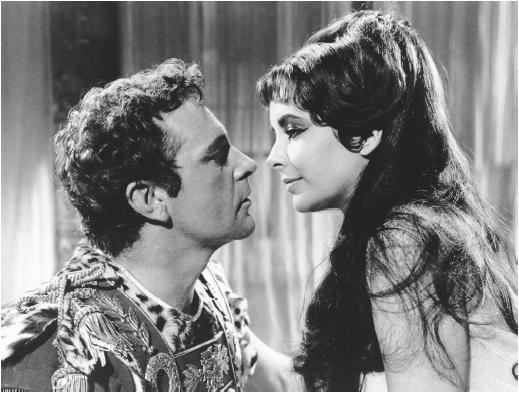
I am not ordinarily a great fan of the legendary celebrity and beauty Elizabeth Taylor, whose picture I have obviously put up at the top of this page, but I liked the look she has going on with her hair, which was a very common way for women to wear their hair when being photographed in the 1960s--frequently in Playboy type publications, it is true, but the French went in for this style, Brigitte Bardot, et al, and my own mother used to wear her hair like this too in her salad days. You hardly ever see anyone wearing their hair like this anymore. Alpha men love it. All those macho film directors and rock stars and cult writers of the 60s, who knew how to handle and turn on beautiful women in ways we don't even believe exist anymore had girlfriends with hair like this. It was the way to be sexy then, and I must say, there was something in it.