Showing posts with label modernism. Show all posts
Showing posts with label modernism. Show all posts
Wednesday, March 13, 2013
Attempt at Micropost on the Papal Conclave
Contrary to what one might glean from this blog, I am at some level cynical enough to know that almost all of the important people, institutions and pursuits in human life possess by bourgeois standards a darkness and demand a degree of ruthlessness in its practitioners that the likes of me cannot really fathom, and would not want to.
That said, obviously I enjoy the idea of the spectacle of the Papal conclave.
Mostly I enjoy the idea that there are any venerable Western European rituals left that can be considered to have some import to history going forward.
Many experts believe the era of European centrality to history and human affairs ended in 1989.
I always want the Catholics to show well and be respected, even though I am not legitimately one myself (I was christened in the Church, but my participation in its life ceased at that point). I have never since tried to become a real Catholic in any way. I probably don't, and can't, believe in God that way you would be supposed to. I do not significantly identify as a Catholic, I do not have a strong educational foundation in its tenets, and I do not partake socially of what I have perceived to be the group strength that comes with being a fully embedded member of the tribe, though in recent years, as my family life and schooling and leisure and even occupational situations have developed in somewhat of a stereotypically Popish mold, I believe certain people from the tribe to have taken an attitude with me as if they suspected me one of their fellows, and little that has happened to me in the last few years has been more flattering to me than this, though I do not deceive myself that it is so in any way.
I go to Episcopalian Church, for reasons which I have outlined in previous posts which I had not foreseen when I got married, at which time I anticipated living a completely secular life. My wife is not far removed in blood from being a real Catholic herself, and has at least half of what I think of as a Catholic soul, but she can not abide the Church's extreme patriarchal personality, and probably some of its other positions too. For my part I rarely consider the Church's actual teaching--it all seems rather beside the point. Look at the avant-gardists of the Modernist era, Picasso, Modigliani, Dali, Jean Cocteau, Chagall, etc. Did these people take the teachings of the Church seriously? Did they believe in God? Did they find its official doctrines absurd? One can say that they were not proper Catholics, though nearly all of them did extensive work in the decorating of churches, presumably with the blessing of the ecclesiastical authorities, and of course they all refer endlessly to Catholic imagery and mythology in their artworks. They could hardly have existed as themselves without it.
The pitiful thing is, I almost enjoy going to the Episcopalian Church, apart from certain days when I am overcome with a sense of my total phoniness and lack of propriety in being there and quiver in an ashamed rage at the fraud that is in fact my entire life of which this particular instance is representative. Most of the time however it is a respectable service, and I like the music, and even some of the people I find tolerable, though I do not think anyone there has much of an intense religious sensibility, and I do not have any sense of any deep effects membership in this congregation has on anyone's personality. I went to a Baptist service a few weeks ago--this church is the sponsor of my son's Scout Troop, it was Scout Sunday, and he wanted to go--and it was like a remedial form of religion, although the priest (who, it may be worth noting, was a woman in her fifties) struck me by her demeanor and gentleness towards her fairly dull-appearing congregation to be intelligent and even spiritually attuned at some level. The Baptists were also far less busy than Episcopalians. After the service the parishioners, who tended heavily towards the older (over 55) demographic, were making plans to go over to each others' houses, eat casserole and cake and generally pass a pretty lugubrious afternoon as if it were 100 years ago. Everybody at the Episcopal Church under the age of 85 or so (including us) has to rush off pretty soon after the service for various errands and activities--even the 50 and 60 somethings have to do fund-raising or sit on some committee in the afternoon.
So I don't see how I can ever become a Catholic. Of course I cannot, even though I do not even think for my purposes that 'belief' in the medieval sense is the primary obstacle. I cannot really claim that I identify with them socially, though I always certainly craved their camaraderie and their women in a specific way that it would never occur to me to feel towards followers of other religions. When I love a Protestant or a Jewish girl, for example I merely love the girl; her religious affiliation does not hold for me the same magical aura that is added when the object of my affection is a bona fide member of the Church of Rome.
Priests are not as completely foolish as people want to believe. Whenever I encounter one they especially know I have nothing to do with the faith, and treat me accordingly.
I am inclined to be sympathetic to a lot of the Church's unpopular positions on various social issues, not that I adhere to them or support them politically in real life, but I believe that they have been considered on the whole fairly thoroughly, are in no way in most instances wholly devoid of wisdom, and think it would probably be a good idea if most people--I am not a fanatic, and can tolerate a certain number of outliers, (maybe even including myself) though preferably a small one--more or less held the same attitudes. But most people who matter do not anymore.
Nothing else to add.

Thursday, September 30, 2010
What Literary Age (that I am not taking part in) Are We In Now?
Major literary periods in the English-speaking world run, it is well-established, in more or less 40-year cycles. Obviously there are instances of major writers of the prior era lingering into the new one, and transitional zones of a few years from time to time which appear to be devoid of much meaningful activity, but on the whole this pattern has been remarkably consistent. The exact start and end dates of the various periods differ slightly according to who is the commentator and what is their rationale. My own preferred dates, for the eras I am primarily familiar with, are as follows:
Elizabethan/Shakesperean: c.1580 (first efforts of Spenser & Sidney) to 1616 (death of Shakespeare). Sometimes the reign of James I (1603-25) is referred to as a distinctive Jacobin era, but I tend to regard the years up to Shakespeare's death as still dominated by the spirit of the Elizabethan generation.
Civil War/Miltonian Era: 1621 (publication of the Anatomy of Melancholy) to 1660. Paradise Lost, which was published in 1667, is a good example of a carryover from one period to another.
Restoration: 1660-1700 (death of Dryden). Not my favorite literary era. This was a golden age of science.
Augustan/Neo-Classical Era: 1702 (Ascension of Queen Anne, battle of Blenheim)--1744 (death of Pope).
Enlightenment/Age of Johnson: 1744 (publication of Life of Savage) to 1791 (Publication of Life of Johnson). These dates may run a little long. The start date could be pushed back to 1749 (Tom Jones) or 1750 (start of The Rambler) to keep the theory consistent.
Romantic: c.1795 (Wordsworth, Coleridge, Austen, et al begin writing) to 1832 (death of Scott). Most date the beginning of this era either to 1789 or 1798 (the publication of Lyrical Ballads). I think the earlier date is a little too early. In Germany the romantic era is sometimes said to have been kicked off at least as far back as the Sorrows of Werther in 1774.
Early Victorian/Dickensian: 1832 (first Tennyson poems) to 1870 (death of Dickens). Middlemarch, published in 1871, is kind of a last capstone to this era.
Late Victorian/Edwardian: 1871 (first Hardy novel, unification of Germany) to c. 1908 (rumblings of Modernity begin to grow substantial on all fronts). I've read a lot from this era over the last year or so. While I find the time period rather interesting as the bridge between the really pre-modern world and an environment and mindset that is fairly recognizable even now, it was kind of a bland time for literature. Even the acknowledged great writers of the period, such as Conrad and Henry James, are not terribly exciting and rather a chore to get through, and its renowned iconoclasts like Shaw and Oscar Wilde still wrote within a psychic and cultural atmosphere that seems very narrowly bound and static compared to everything which broke out at the end of the period.
Modernism: 1910-1948. Probably overall the most influential period as far as my own life goes. I chose '48 as the closing date for a variety of reasons. First off, with the Soviets solidifying their position everywhere in Eastern Europe and the economies of the West and the United States in particular stabilizing and beginning their long periods of sustained growth, the proclamation of Israel and the beginnings of decolonization elsewhere, etc, the very different postwar world began to take recognizable shape. Secondly T.S. Eliot won the Nobel Prize that year, which was a symbolic acknowledgement of the triumph of the class of writing and the generation of writers he represented, most of the major figures of which were however already dead or past their prime by 1948.
Postmodernism: 1951 (Waiting For Godot, The Catcher in the Rye) to 1989 (death of Samuel Beckett, collapse of Communism). The Catcher in the Rye is not a characteristically postmodern book, but worldwide it was probably the most representative American book throughout the period and I think it played an influential role in the time's overall cultural imagination akin to that which Werther did during the Romantic era. Samuel Beckett, a figure with whom I have been fascinated for many years, was an embodiment of a strain of old style European bohemianism and deep humanistic learning as the core of life the transmission of which does not seem to have survived the second world war either in the (post-Soviet) East or the West. The collapse of Communist Europe, along with other factors of course, accelerated the emerging globalization trend by several degrees. As I have mentioned elsewhere, nowadays when I take up a movie or a book even from the late 1980s and even the early 90s, the life in it, especially in foreign works but in American ones too to a certain extent, frequently feels like something almost out of the quaint ancestral past.
The New Age: 1992 (Ascension of postwar Baby Boomers to dominant political and economic power across the West) to approx. 2030. So clearly whatever is going on now we are right in the middle of it, judging by the trend of the past we may even already be a few years past the cycle's most fervent & intense manifestation. So what is it? I don't know. This era feels to many people like it is very weak in all of the traditional arts, but of course most people experienced the 50s, which produced plenty of interesting and outstanding stuff, as culturally insipid, and the mainstream literary world in the 1920s considered Galsworthy and Sinclair Lewis and Booth Tarkington and Michael Arlen and people like that to be the major writers of the day, so it is likely that if by some miracle I have grandchild who is both with-it and intelligent he or she will be able to amuse his bohemian friends with tales of how benighted his earnest bourgeois grandfather was. However, I will offer a few theories:
The seed of any identifiable era's dominant tenor is usually found to be the fulfillment in one way or another of the most inisistently proclaimed desires of the previous era; the best eras, like the Romantic and Modernist periods, occur when the addressed desires take on a form that was wholly unforeseen by the articulators of those desires. To speak of the most recent periods, the main wish of the Modernist period, as far as I can deduce, was an ever more extreme, even self-cannibalising modernism, which the postmodern writers did their best to deliver. The strongest desires to emerge from the postmodern period, to my view, were the desire for the critic and scholar/theorist to emerge triumphant over the author and 'art', which could certainly be said to have happened to a certain degree, and the desire for more diversity in terms of race, gender, geography, culture, etc, at the center of the literary world, which also seems to be an identifiable phenomenon, though with the exception of the ascendance of women writers less so within the U.S. than internationally. The current desire, which I expect to manifest itself after 2030, is for literature to address what it means in the internet age, respond to the decline of the author, and the possible death, for all intents, etc, of the book.
My desire, and since I have it I presume it must be widespread, is for the artistic ethos in some kind of identifiable form to reassert itself, and I expect this to happen as well. I was reading one of those status-oriented blogs not long ago where the community was obsessed about IQs and where people went to school and careers and bashing humanities majors as morons who lack the intellect to succeed in anything serious and so on, and I wrote a brief comment to the effect of "doesn't anybody want to be an artist anymore?" Even reading about scenes and people I probably would have hated, like Berkeley in the 60s, the passion and vim and assuredness and instinct for fully indulging in the artistic gesture is enough to make one want to cry when confronted with the completely algorithim-directed and economics-dominated life most of us have to live now. At the moment, any kind of naive artistic instinct operating with something akin to abandon, doesn't seem to exist. I like the middle class kids in Brooklyn giving some semblance of the bohemian life a try today, and I often wish I were a little younger and could join them, but when it comes to making or living art in a natural and unaffected way, it just isn't coming yet. I believe it will come again, that the current intensity and extreme competitiveness of economic, academic and social life will at some point break and the artistic sensibility will be re-awakened, and I think it will be wonderful and the culture will feel very invigorated by this energy. That is my prediction.
As a closing note I am going to link to some videos by a current Brooklyn-based music group that I kind of like, Elizabeth and the Catapult. Elizabeth is good-looking, obviously pretty intelligent, and she seems to straddle the line, albeit narrowly, between being endearing in her progressivism and social correctness, and the alternative--in short, the type I once imagined I would spend a lot of time hanging out with in my twenties in New York or some other interesting place. Still, in the end, they fail. They aren't interesting, one feels they lack conviction, that they have nothing to say, or rather that there is nothing within them that they are willing to reveal.
There was another song of theirs that I thought was very good in spite of all these shortcomings but I can't seem to find it now.
Major literary periods in the English-speaking world run, it is well-established, in more or less 40-year cycles. Obviously there are instances of major writers of the prior era lingering into the new one, and transitional zones of a few years from time to time which appear to be devoid of much meaningful activity, but on the whole this pattern has been remarkably consistent. The exact start and end dates of the various periods differ slightly according to who is the commentator and what is their rationale. My own preferred dates, for the eras I am primarily familiar with, are as follows:
Elizabethan/Shakesperean: c.1580 (first efforts of Spenser & Sidney) to 1616 (death of Shakespeare). Sometimes the reign of James I (1603-25) is referred to as a distinctive Jacobin era, but I tend to regard the years up to Shakespeare's death as still dominated by the spirit of the Elizabethan generation.
Civil War/Miltonian Era: 1621 (publication of the Anatomy of Melancholy) to 1660. Paradise Lost, which was published in 1667, is a good example of a carryover from one period to another.
Restoration: 1660-1700 (death of Dryden). Not my favorite literary era. This was a golden age of science.
Augustan/Neo-Classical Era: 1702 (Ascension of Queen Anne, battle of Blenheim)--1744 (death of Pope).
Enlightenment/Age of Johnson: 1744 (publication of Life of Savage) to 1791 (Publication of Life of Johnson). These dates may run a little long. The start date could be pushed back to 1749 (Tom Jones) or 1750 (start of The Rambler) to keep the theory consistent.
Romantic: c.1795 (Wordsworth, Coleridge, Austen, et al begin writing) to 1832 (death of Scott). Most date the beginning of this era either to 1789 or 1798 (the publication of Lyrical Ballads). I think the earlier date is a little too early. In Germany the romantic era is sometimes said to have been kicked off at least as far back as the Sorrows of Werther in 1774.
Early Victorian/Dickensian: 1832 (first Tennyson poems) to 1870 (death of Dickens). Middlemarch, published in 1871, is kind of a last capstone to this era.
Late Victorian/Edwardian: 1871 (first Hardy novel, unification of Germany) to c. 1908 (rumblings of Modernity begin to grow substantial on all fronts). I've read a lot from this era over the last year or so. While I find the time period rather interesting as the bridge between the really pre-modern world and an environment and mindset that is fairly recognizable even now, it was kind of a bland time for literature. Even the acknowledged great writers of the period, such as Conrad and Henry James, are not terribly exciting and rather a chore to get through, and its renowned iconoclasts like Shaw and Oscar Wilde still wrote within a psychic and cultural atmosphere that seems very narrowly bound and static compared to everything which broke out at the end of the period.
Modernism: 1910-1948. Probably overall the most influential period as far as my own life goes. I chose '48 as the closing date for a variety of reasons. First off, with the Soviets solidifying their position everywhere in Eastern Europe and the economies of the West and the United States in particular stabilizing and beginning their long periods of sustained growth, the proclamation of Israel and the beginnings of decolonization elsewhere, etc, the very different postwar world began to take recognizable shape. Secondly T.S. Eliot won the Nobel Prize that year, which was a symbolic acknowledgement of the triumph of the class of writing and the generation of writers he represented, most of the major figures of which were however already dead or past their prime by 1948.
Postmodernism: 1951 (Waiting For Godot, The Catcher in the Rye) to 1989 (death of Samuel Beckett, collapse of Communism). The Catcher in the Rye is not a characteristically postmodern book, but worldwide it was probably the most representative American book throughout the period and I think it played an influential role in the time's overall cultural imagination akin to that which Werther did during the Romantic era. Samuel Beckett, a figure with whom I have been fascinated for many years, was an embodiment of a strain of old style European bohemianism and deep humanistic learning as the core of life the transmission of which does not seem to have survived the second world war either in the (post-Soviet) East or the West. The collapse of Communist Europe, along with other factors of course, accelerated the emerging globalization trend by several degrees. As I have mentioned elsewhere, nowadays when I take up a movie or a book even from the late 1980s and even the early 90s, the life in it, especially in foreign works but in American ones too to a certain extent, frequently feels like something almost out of the quaint ancestral past.
The New Age: 1992 (Ascension of postwar Baby Boomers to dominant political and economic power across the West) to approx. 2030. So clearly whatever is going on now we are right in the middle of it, judging by the trend of the past we may even already be a few years past the cycle's most fervent & intense manifestation. So what is it? I don't know. This era feels to many people like it is very weak in all of the traditional arts, but of course most people experienced the 50s, which produced plenty of interesting and outstanding stuff, as culturally insipid, and the mainstream literary world in the 1920s considered Galsworthy and Sinclair Lewis and Booth Tarkington and Michael Arlen and people like that to be the major writers of the day, so it is likely that if by some miracle I have grandchild who is both with-it and intelligent he or she will be able to amuse his bohemian friends with tales of how benighted his earnest bourgeois grandfather was. However, I will offer a few theories:
The seed of any identifiable era's dominant tenor is usually found to be the fulfillment in one way or another of the most inisistently proclaimed desires of the previous era; the best eras, like the Romantic and Modernist periods, occur when the addressed desires take on a form that was wholly unforeseen by the articulators of those desires. To speak of the most recent periods, the main wish of the Modernist period, as far as I can deduce, was an ever more extreme, even self-cannibalising modernism, which the postmodern writers did their best to deliver. The strongest desires to emerge from the postmodern period, to my view, were the desire for the critic and scholar/theorist to emerge triumphant over the author and 'art', which could certainly be said to have happened to a certain degree, and the desire for more diversity in terms of race, gender, geography, culture, etc, at the center of the literary world, which also seems to be an identifiable phenomenon, though with the exception of the ascendance of women writers less so within the U.S. than internationally. The current desire, which I expect to manifest itself after 2030, is for literature to address what it means in the internet age, respond to the decline of the author, and the possible death, for all intents, etc, of the book.
My desire, and since I have it I presume it must be widespread, is for the artistic ethos in some kind of identifiable form to reassert itself, and I expect this to happen as well. I was reading one of those status-oriented blogs not long ago where the community was obsessed about IQs and where people went to school and careers and bashing humanities majors as morons who lack the intellect to succeed in anything serious and so on, and I wrote a brief comment to the effect of "doesn't anybody want to be an artist anymore?" Even reading about scenes and people I probably would have hated, like Berkeley in the 60s, the passion and vim and assuredness and instinct for fully indulging in the artistic gesture is enough to make one want to cry when confronted with the completely algorithim-directed and economics-dominated life most of us have to live now. At the moment, any kind of naive artistic instinct operating with something akin to abandon, doesn't seem to exist. I like the middle class kids in Brooklyn giving some semblance of the bohemian life a try today, and I often wish I were a little younger and could join them, but when it comes to making or living art in a natural and unaffected way, it just isn't coming yet. I believe it will come again, that the current intensity and extreme competitiveness of economic, academic and social life will at some point break and the artistic sensibility will be re-awakened, and I think it will be wonderful and the culture will feel very invigorated by this energy. That is my prediction.
As a closing note I am going to link to some videos by a current Brooklyn-based music group that I kind of like, Elizabeth and the Catapult. Elizabeth is good-looking, obviously pretty intelligent, and she seems to straddle the line, albeit narrowly, between being endearing in her progressivism and social correctness, and the alternative--in short, the type I once imagined I would spend a lot of time hanging out with in my twenties in New York or some other interesting place. Still, in the end, they fail. They aren't interesting, one feels they lack conviction, that they have nothing to say, or rather that there is nothing within them that they are willing to reveal.
There was another song of theirs that I thought was very good in spite of all these shortcomings but I can't seem to find it now.
Saturday, August 01, 2009
The Hairy Ape--Eugene O'Neill (1922)
I was trying to do another post which involved scanning some pictures but I couldn't get my scanner to work (it kept saying it wasn't hooked up properly) so I am going to skip it for now. Eugene O'Neill has been a name and a set of basic facts known to me for at least twenty-five years now, in all of which time however he has not progressed much in my consciousness beyond those original facts. On only one occasion have I been present when his name has come up in conversation, and the person who made mention of him did so in a most scornful manner, with which asessment no one present had disagreed, and several had smiled wickedly at the thought of people so stupid as to believe Eugene O'Neill was a good writer.
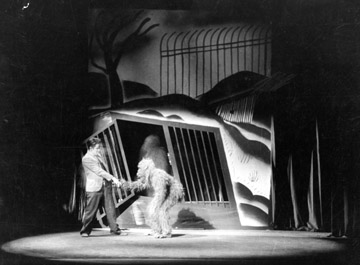 The laborers on the ship are described right in the stage directions as resembling "those pictures in which the appearance of Neanderthal Man is guessed at." There is a lot of overkill in establishing this idea throughout the play. Yank, the protagonist and hairy ape of the title, is defined as "their most highly developed individual", the strongest, fiercest, most self-assured, etc, though his level of development does not count for much as one moves up the food chain of the jungle of humanity.
 Scene Five, more stage directions (this is where much of the action is for the reader in this play) describing storefront windows on Fifth Avenue: "The general effect is of a background of magnificence cheapened and made grotesque by commercialism, a background in tawdry disharmony with the clear light and sunshine on the street itself."
I was trying to do another post which involved scanning some pictures but I couldn't get my scanner to work (it kept saying it wasn't hooked up properly) so I am going to skip it for now.
Eugene O'Neill has been a name and a set of basic facts known to me for at least twenty-five years now, in all of which time however he has not progressed much in my consciousness beyond those original facts. On only one occasion have I been present when his name has come up in conversation, and the person who made mention of him did so in a most scornful manner, with which asessment no one present had disagreed, and several had smiled wickedly at the thought of people so stupid as to believe Eugene O'Neill was a good writer.I must say, when reading Eugene O'Neill, I am often inclined to think these sneering student critics were onto something after all. He had a rather flat style joined to an opaque manner of storytelling, which tends to lie dead on the page. I find more and more as I get older how essential it is with most playwrights to actually see the work performed, but I wonder if O'Neill is not the most extreme example of this. There was an outstanding movie made of Long Day's Journey Into Night back in the early 60s that made a very strong impression where reading had produced no sensation in me at all, though why I could not envision the ways the scenes ought to be spoken and played out in reading them I still do not understand. There were a number of famous movie stars (Katharine Hepburn, Ralph Richardson, Jason Robards) in this film who demonstrated a familiarity with the play and the type of theater out of which it originated which one who only knew them from the movies would not necessarily have suspected them to have. It was, frankly, impressive. I haven't seen any other films of his plays--I think this might be supposed to be the best one, though I notice that Hepburn and Robards appear in some of the other filmed versions, such as Strange Interlude and The Iceman Cometh (never to be confused, of course, with The Diceman Cometh).
The Hairy Ape is a not especially pleasant early twentieth century play about the class struggle. I don't think it is giving away the surprise too much to reveal that the poor lose. It reads loudly. The action takes place on a huge ocean liner with lots of iron machines and fiery furnaces and in a chaotic New York full of shouting paperboys, and traffic. These are the salient details that stick out in my memory of the reading. Now I am going to look over the notes I made, which actually look more interesting than usual, though unfortunately I wrote them sloppily and am having trouble deciphering what they say.
The laborers on the ship are described right in the stage directions as resembling "those pictures in which the appearance of Neanderthal Man is guessed at." There is a lot of overkill in establishing this idea throughout the play. Yank, the protagonist and hairy ape of the title, is defined as "their most highly developed individual", the strongest, fiercest, most self-assured, etc, though his level of development does not count for much as one moves up the food chain of the jungle of humanity.Now I going to digress again to consider the history of Eugene O'Neill's reputation and where it goes from here. 1936, the year he won the Nobel Prize, I think would be a good start, because that seems to have been about when his acclaim was at its highest, and when he was regarded as a major figure in the nation's cultural life on par with the way Martin Scorcese or some similar renowned filmmaker would be today. By the time he died in 1953 he had moved a little away from the white hot center of literary fashion, but was still considered indisputably to be America's greatest playwright. This was still the case more or less in 1962, the various reference books I have from that year indicating the opinion that any well-educated American would be expected to have some familiarity with his work, and certainly any serious stage actor at the time would have had to have a more than passing knowledge of his oeuvre. The edition of the book in the picture at the top of the page is part of an attractive multivolume set put out in 1964 by Random House apparently for mass market sale, which even had the internet never come into existence is almost unfathomable for a collection of plays not by Shakespeare. By my childhood and youth, the 1980s, mainstream America had largely lost contact with what was going on in the theater, and its reading classes being cut off from any relation to that context, O'Neill's style and the construction of his plots no longer had much resonance; and as to the intellectuals, I assume that during the heyday of postmodernism and deconstruction his concerns and manner of expressing them must have seemed a bit dull and simplistic, hence the ridicule of him I encountered among the students in the early 90s. Today there seems to be some interest in him of a historical nature, people who are curious about what was hot in 1930, that sort of thing. I don't detect a big O'Neill influence on contemporary literature or theater, though I could be wrong about that.
I have a bunch of notes the meaning of which I have no longer any idea:
1. Theory on feminism held back (women on boats/death in (lakes?), etc) Socialist? I have no clue what this is supposed to mean.
2. Symbol of hell, (obv.?), & can I bring down to upper expectations also? I assume that the stokehole is the symbol of hell. The second part of this makes no sense.
3. Atmosphere of industrial life such part of USA, (underlined word, illegible, here) now. The illegible word may be 'done'. The working-class bustle one imagines to have been formerly such a constant feature in the life of our now largely hollowed-out city centers when reading these old books stirs an unsavory and emotional nostalgia, for what exactly I would be hard-pressed to either explain or defend, I am sure.
The comparison of the laborers' voices to phonograph horns followed by a chorus of hard, barking laughter (in the stage directions) is repeated numerous times in Scene Four, I assume for a point. The obvious suggestion is that these men have taken on an industrialized, mass-produced, anti-human quality as a result of the environment in which they have to exist.
Scene Five, more stage directions (this is where much of the action is for the reader in this play) describing storefront windows on Fifth Avenue: "The general effect is of a background of magnificence cheapened and made grotesque by commercialism, a background in tawdry disharmony with the clear light and sunshine on the street itself." The socialist agenda is laid on in a more or less similiarly heavy fashion throughout the rest of the play. The art, or other greatness quality in it I admit are very elusive to me.
In Scene Seven, after his apelike persona results in his getting tossed out even of an I.W.W. office, Yank sits in the middle of the street in the pose of Rodin's "The Thinker" and reflects, "Steel was me, and I owned de woild. Now I ain't steel, and de woild owns me." I thought this was important because it reveals that his consciousness has now been awakened, but not in the usual positive sense with which we identify this event, because he is a shattered man who cannot recover what he had been formerly, which was a man sufficient at least unto himself. One could interpret it as an analysis about the entire modern human condition.
Eugene O'Neill, as I'm sure you know, had a gorgeous daughter, Oona, who married Charlie Chaplin when she was 18, after which her father apparently never spoke to her again, and went on to have 8 children. I'm very interested in gorgeous literary-connected people.
Wednesday, September 12, 2007
The Gustloff
I read about the sinking of the Gustloff the other day, which was the first time I had ever heard of it. It appears by general consensus to be the worst maritime disaster of all time, with as many as 9,000 or more dead. The circumstances of the voyage were wretched enough as it was to begin with. Built by the Nazi government in 1937 as a cruise ship, it set off in January of 1945 from the city of Gotenhafen (now Gydnia in Poland, near Gdansk) packed with 10,000 Germans, mostly civilians, fleeing from the advancing Soviet Army. It was torpedoed by the Russians in the Baltic Sea, which is never warm, and is reported has having been icy on the occasion of the disaster. Around 1200 survivors were rescued. The event, of which the significance was downplayed or muted for many years even in Germany, remains a subject of controversial, obsessive and wounded interest among many people there today. It is not difficult to understand why. Many vivid impressions of terror, misery, dislocation, ignominy, and nihilism press upon one just in reading a dry account of the matter. Much of this is of course due to the fact of the victims being Germans at the end of World War II, not a sympathetic group, and the sense that goes with any account of that period of history that the members of that group in general deserved suffering far worse than anything that was able to be inflicted on them. This includes the children, perhaps not personally, but as symbols, as a necessary debt owed by the elders of their people before the cataclysm could finally exhaust itself and any hope or sense of light enter the civilizational consciousness once again.
The last convulsions and accompanying absolute devastation of the German nation in early 1945, the last months of the war--fittingly named "year zero" in the classic movie about the time--is increasingly striking me as the most interesting and crucial aspect to understand about that whole period. Unlike in 1918, the society subjected as well as dedicated itself to so much death and destruction in the last months of the war--on both counts seemingly pointless and unnecessary--the pitch of both being raised and raised, almost hysterically so, until the very, very last possible instant, until the day the head of the body harboring the demonic agent was finally cornered and forced to cut its own head off. To the artistic imagination, the Gustloff incident is a nearly perfect encapsulation of the chaos and catastrophic state that the whole society, the whole culture, had come to, and from which it seemingly cannot ever spiritually recover. It crystallizes a real end point, a real break between past and future from which certain major traits/qualities do not move on, but simply cease to move altogether.
While it is to a certain extent surprising to me that I have not been familiar with this particular event before, with World War II one is always either stumbling across enormous violences, movements of peoples, political crises, etc, that one had either never previously been aware of or had not properly begun to grasp the magnitude of either with regard to the loss of life, destruction of culture and history, or general collective insanity therein revealed. This, too, though the conflict is probably the most documented, filmed, written about, referenced, etc, historical event of all time. The number of 500,000+ populated cities in Russia alone that were just razed to the ground and that even today most people outside that nation are barely aware of the existence of staggers the mind when one begins to try to consider it. I mentioned in a prior post the eviction of entire populations from other cities such as Breslau and Konigsberg, and the repopulation of them with entirely different people that took place under the Soviet occupation. This does not even take into consideration all the minor disgraces, the small-time fascists and opportunists in small towns and small countries like Romania and Hungary and Slovakia, eagerly delivering up their neighbors and countrymen, already in desparate enough positions as it was, for petty, and seemingly meaningless preferments.
The darkness out of which all this emerged was obviously very deep-seated, and the atmosphere of most of Europe was thick with it for the better part of 30 years, England perhaps slightly less so, or at least with less insistent negative force until 1930 or so. In the art of the period it can be said the sun itself did not partake of any gloriousness, nor did the beautiful young girls, unless, as in Joyce and Proust, they clearly belonged to the pre-1914 world. That does not mean that the art of the modernist period does not have serious attractions for me. I am as much if not moreso in spirit a descendant of that period that of eras with more positive energy. And art, as an engagement with actual life and actual human mental activity, seemed still to be a comparatively more natural and instinctive process among such as retained their sensibilities, an old habit not quite shaken entirely out of the cultural personality, than it has become in our inceasingly anomic age.
I read about the sinking of the Gustloff the other day, which was the first time I had ever heard of it. It appears by general consensus to be the worst maritime disaster of all time, with as many as 9,000 or more dead. The circumstances of the voyage were wretched enough as it was to begin with. Built by the Nazi government in 1937 as a cruise ship, it set off in January of 1945 from the city of Gotenhafen (now Gydnia in Poland, near Gdansk) packed with 10,000 Germans, mostly civilians, fleeing from the advancing Soviet Army. It was torpedoed by the Russians in the Baltic Sea, which is never warm, and is reported has having been icy on the occasion of the disaster. Around 1200 survivors were rescued. The event, of which the significance was downplayed or muted for many years even in Germany, remains a subject of controversial, obsessive and wounded interest among many people there today. It is not difficult to understand why. Many vivid impressions of terror, misery, dislocation, ignominy, and nihilism press upon one just in reading a dry account of the matter. Much of this is of course due to the fact of the victims being Germans at the end of World War II, not a sympathetic group, and the sense that goes with any account of that period of history that the members of that group in general deserved suffering far worse than anything that was able to be inflicted on them. This includes the children, perhaps not personally, but as symbols, as a necessary debt owed by the elders of their people before the cataclysm could finally exhaust itself and any hope or sense of light enter the civilizational consciousness once again.
The last convulsions and accompanying absolute devastation of the German nation in early 1945, the last months of the war--fittingly named "year zero" in the classic movie about the time--is increasingly striking me as the most interesting and crucial aspect to understand about that whole period. Unlike in 1918, the society subjected as well as dedicated itself to so much death and destruction in the last months of the war--on both counts seemingly pointless and unnecessary--the pitch of both being raised and raised, almost hysterically so, until the very, very last possible instant, until the day the head of the body harboring the demonic agent was finally cornered and forced to cut its own head off. To the artistic imagination, the Gustloff incident is a nearly perfect encapsulation of the chaos and catastrophic state that the whole society, the whole culture, had come to, and from which it seemingly cannot ever spiritually recover. It crystallizes a real end point, a real break between past and future from which certain major traits/qualities do not move on, but simply cease to move altogether.
While it is to a certain extent surprising to me that I have not been familiar with this particular event before, with World War II one is always either stumbling across enormous violences, movements of peoples, political crises, etc, that one had either never previously been aware of or had not properly begun to grasp the magnitude of either with regard to the loss of life, destruction of culture and history, or general collective insanity therein revealed. This, too, though the conflict is probably the most documented, filmed, written about, referenced, etc, historical event of all time. The number of 500,000+ populated cities in Russia alone that were just razed to the ground and that even today most people outside that nation are barely aware of the existence of staggers the mind when one begins to try to consider it. I mentioned in a prior post the eviction of entire populations from other cities such as Breslau and Konigsberg, and the repopulation of them with entirely different people that took place under the Soviet occupation. This does not even take into consideration all the minor disgraces, the small-time fascists and opportunists in small towns and small countries like Romania and Hungary and Slovakia, eagerly delivering up their neighbors and countrymen, already in desparate enough positions as it was, for petty, and seemingly meaningless preferments.
The darkness out of which all this emerged was obviously very deep-seated, and the atmosphere of most of Europe was thick with it for the better part of 30 years, England perhaps slightly less so, or at least with less insistent negative force until 1930 or so. In the art of the period it can be said the sun itself did not partake of any gloriousness, nor did the beautiful young girls, unless, as in Joyce and Proust, they clearly belonged to the pre-1914 world. That does not mean that the art of the modernist period does not have serious attractions for me. I am as much if not moreso in spirit a descendant of that period that of eras with more positive energy. And art, as an engagement with actual life and actual human mental activity, seemed still to be a comparatively more natural and instinctive process among such as retained their sensibilities, an old habit not quite shaken entirely out of the cultural personality, than it has become in our inceasingly anomic age.
Friday, December 01, 2006
The Game of Art SUPPLEMENT: The Cult of Picasso
Pablo Picasso is, unless I have badly missed something, the man most widely considered to have been the greatest painter in the Western World during the twentieth century. It also seems to be widely considered that no one comparable to him in stature has emerged since his death, which, though not that long ago yet, still with every passing year nourishes the idea that perhaps no one so great ever will emerge again. As I have noted in an earlier post, he seems since my childhood to have replaced Rembrandt as the demonstrative model for serious art writers when they are trying to explain to the philistines in mass market publications why the likes of Andrew Wyeth are mediocrities. I cannot contest Picasso's greatness, though for the most part I must admit it remains elusive to me. I think I am not completely in the dark regarding what he was doing; I have read Freud, and seen vividly the connection in his writings to Joyce, and have discerned the definite Cubist sensibility, whether intentional or not, in Hemingway, as well as, I think, being reasonably sensible to the general movements in history and the arts at the time. When it comes to Picasso however I have clearly failed to put together the various parts and impressions and feel the awe. That the awe is there to be felt however, it is futile to dispute, since it was widespread among his contemporaries and immediate followers in his own field, as well as the wider artistic community, which was a few hundred times more educationally and socially interconnected in the France and Spain of 75 years ago than anything we know of here. In addition it was of a level and intensity that is truly rare in any human endeavor, such that I must take it on faith that there were legitimate reasons for the respect.
Picasso's fans, especially in the United States, are another matter however. They are the most obnoxious of any of the artists in the Game. They are not the snootiest, though I don't know that I've met one who wouldn't like to be; but for this one would have to exclusively build up artists and genres as the only ones that are worthwhile which he is certain the people he intends to intimidate have never heard of, and he has to be impeccably correct that the person concerned has never heard of them in each individual case. Caravaggio fans are nearly as obnoxious on a number of levels, first in their assumption that because they did not discover their man until they were already adults, neither has anyone else, but mostly because they affect to identity with and revel in the raw sensuality and violence depicted in the art while being the kind of people who would frantically call the police if anybody remotely similar to the painter or his models ever came within thirty feet of them. Unironic Impressionist fans have been universal objects of ridicule for some time. Generally few people want to sleep with hardcore Dutch Master fans either. Michelangelo/DaVinci/ Raphael are too universally admired to contribute much to a distinct social or intellectual identity unless one has written a well-regarded book on the subject. Klimt fans are pretentious but often adorable. Modigliani fans are too cool and good-looking to ever encounter losers on a frequent basis anyway (case in point: I have never actually met one. I have only read about them in books and articles that are beyond the reach of middlebrow criticism). Middle class Picasso fans and hagiographers tend to be wannabes with mean streaks, which is not an attractive combination.
It is said of Picasso that if he got an inclination to work during dinner or a social visit, he would simply leave his company abruptly and go to it. This is reported not infrequently and with approval of great artists and other successful egomaniacs, and we are accustomed to acknowledge that great results justify any amount of mere rudeness, though with Picasso my impression always suggests to me that this had no small share of gamesmanship in it and served to make a specific point of insulting his company, who were presumably his friends and supporters. Though perhaps much of this is simply the nature of emphasis in modern biography and memoir, which is obsessed with the details of who dominated and more importantly, who was dominated. At any rate, perhaps because he did not linger over dinner, Picasso was an incredibly prolific painter, so that besides every museum worth its name in the Western world having enough original works to have its own Picasso room, besides there being numerous entire museums dedicated exclusively to the work of the great man, it is not uncommon in the United States even among people of relatively modest wealth to possess an original Picasso of one's own. I have even been in a couple of such houses myself, though in one I did not bear enough status to be allowed into the gallery. In the other the owner had hung it in his bathroom on the wall beside the toilet. It was a framed cocktail napkin sized piece of cardboard or paper with a couple of broad black strokes like eyebrows encasing on three sides a few other shorter black marks and streaks. The owner had hung it in his bathroom on the wall beside the toilet. I don't have the slightest idea what its subject was supposed to be, and if the owner did he kept it to himself, besides which that was secondary to its being a PICASSO of course. He had not bought the thing to instruct or entertain as an object of art in itself, and having it had brought him some local notoriety. This all strikes me as quite bizarre. Perhaps it is not really as I see it, perhaps there was some communication of joy or insight which this man received from the painted figure and not just from the signature beneath it but if so this was a joy that stifled itself quickly upon turning again to engage the world.
Another trait of Picasso lovers is that they become very quickly defensive if they feel their position is being questioned or trivialized. I remember in school once an irreverent but very sharp fellow declared that Pink Floyd's "The Wall" was a more meaningful work of art than anything by Picasso but that he would be glad to be set right if people would undertake to explain to him how it was not so. The response was interesting. The pro-Picasso faction was mostly indignant that somebody who could pose such a question in a class had been admitted to the college in the first place, though several were so stunned, or sickened, or enraged at the insinuations which had been proposed, that I observed several heads to redden, veins to throb, and fists to clench. It was evident to me that these people had acquired some idea that to be the sort of person and to live among the sort of society they aspired to, the greatness of Picasso was accepted as a given, and appreciation of the master one of the tests and qualifications for acceptance therein. Even at eighteen they were ferociously defensive of their claim to this position, and did not care for any reminder that they might not have attained to it.
But why Picasso? Why for that matter all these modernists who arouse such contempt in their adherents towards those who criticize or attack or simply don't get them? Charles Dickens fans I daresay do not get so ruffled when their man is ridiculed, and there is certainly a case to be made that many modern intellectuals don't get him. The excessive cleverness of the modernists, the strict refusal to give sentiment or the consolations of religion or tradition or public experience (i.e. school) an inch of ground, their ruthless exclusivity where even the consumers of their productions are concerned (intellectually speaking) all contribute to a cultural worldview where to misstep, or be led or tricked into a misstep by a representative of the masses becomes akin to the death of one's intellectual pretensions, in instances where money and other types of status are absent to one's very self-identity. To which I can only ask, is this what art (or life) is really supposed to be about?
I can never think of Picasso without recurrence to an experience I had once at the Philadelphia art museum, which was for many years my "home" art museum and in which I had therefore a greater proclivity to wander about without maps and so forth. It happened that after passing through the regular 19th century European galleries, pleasant seaside and garden pictures and so forth, I wandered wholly unconsciously into the Picasso room and thought "these pictures have nothing beautiful about them," amending my thought when I realized what I was looking at to "though I sense they are the work of someone exceedingly clever, doubtless infinitely moreso than I am." This is not a pleasing sensation to have, and I can see why a person attuned to these sorts of goings-on would rather be able to say "I perceive the brilliance of these pictures and my intelligence is of a rather similar cast to that of the artist." To appear in a position where others can gleefully declare you to be intellectually intimidated is one of the supreme social calamities of the age, though this can never be but a secondary or tertiary purpose of any succesful artwork, if it be one at all. But of course the Game of Art has very little to do with the consideration or understanding of artworks in isolation (which actually only become cause for intimidation the greater one's understanding of the processes and mind of the artist), otherwise hardly anyone in the bourgeoisie would have the interest or the capacity to play it.
P.S. We are almost to the end of the Game as far as I am involved in it.
P.P.S. No one has visited my profile in 2 months now. I expected to have a limited readership but 4 people?
Pablo Picasso is, unless I have badly missed something, the man most widely considered to have been the greatest painter in the Western World during the twentieth century. It also seems to be widely considered that no one comparable to him in stature has emerged since his death, which, though not that long ago yet, still with every passing year nourishes the idea that perhaps no one so great ever will emerge again. As I have noted in an earlier post, he seems since my childhood to have replaced Rembrandt as the demonstrative model for serious art writers when they are trying to explain to the philistines in mass market publications why the likes of Andrew Wyeth are mediocrities. I cannot contest Picasso's greatness, though for the most part I must admit it remains elusive to me. I think I am not completely in the dark regarding what he was doing; I have read Freud, and seen vividly the connection in his writings to Joyce, and have discerned the definite Cubist sensibility, whether intentional or not, in Hemingway, as well as, I think, being reasonably sensible to the general movements in history and the arts at the time. When it comes to Picasso however I have clearly failed to put together the various parts and impressions and feel the awe. That the awe is there to be felt however, it is futile to dispute, since it was widespread among his contemporaries and immediate followers in his own field, as well as the wider artistic community, which was a few hundred times more educationally and socially interconnected in the France and Spain of 75 years ago than anything we know of here. In addition it was of a level and intensity that is truly rare in any human endeavor, such that I must take it on faith that there were legitimate reasons for the respect.
Picasso's fans, especially in the United States, are another matter however. They are the most obnoxious of any of the artists in the Game. They are not the snootiest, though I don't know that I've met one who wouldn't like to be; but for this one would have to exclusively build up artists and genres as the only ones that are worthwhile which he is certain the people he intends to intimidate have never heard of, and he has to be impeccably correct that the person concerned has never heard of them in each individual case. Caravaggio fans are nearly as obnoxious on a number of levels, first in their assumption that because they did not discover their man until they were already adults, neither has anyone else, but mostly because they affect to identity with and revel in the raw sensuality and violence depicted in the art while being the kind of people who would frantically call the police if anybody remotely similar to the painter or his models ever came within thirty feet of them. Unironic Impressionist fans have been universal objects of ridicule for some time. Generally few people want to sleep with hardcore Dutch Master fans either. Michelangelo/DaVinci/ Raphael are too universally admired to contribute much to a distinct social or intellectual identity unless one has written a well-regarded book on the subject. Klimt fans are pretentious but often adorable. Modigliani fans are too cool and good-looking to ever encounter losers on a frequent basis anyway (case in point: I have never actually met one. I have only read about them in books and articles that are beyond the reach of middlebrow criticism). Middle class Picasso fans and hagiographers tend to be wannabes with mean streaks, which is not an attractive combination.
It is said of Picasso that if he got an inclination to work during dinner or a social visit, he would simply leave his company abruptly and go to it. This is reported not infrequently and with approval of great artists and other successful egomaniacs, and we are accustomed to acknowledge that great results justify any amount of mere rudeness, though with Picasso my impression always suggests to me that this had no small share of gamesmanship in it and served to make a specific point of insulting his company, who were presumably his friends and supporters. Though perhaps much of this is simply the nature of emphasis in modern biography and memoir, which is obsessed with the details of who dominated and more importantly, who was dominated. At any rate, perhaps because he did not linger over dinner, Picasso was an incredibly prolific painter, so that besides every museum worth its name in the Western world having enough original works to have its own Picasso room, besides there being numerous entire museums dedicated exclusively to the work of the great man, it is not uncommon in the United States even among people of relatively modest wealth to possess an original Picasso of one's own. I have even been in a couple of such houses myself, though in one I did not bear enough status to be allowed into the gallery. In the other the owner had hung it in his bathroom on the wall beside the toilet. It was a framed cocktail napkin sized piece of cardboard or paper with a couple of broad black strokes like eyebrows encasing on three sides a few other shorter black marks and streaks. The owner had hung it in his bathroom on the wall beside the toilet. I don't have the slightest idea what its subject was supposed to be, and if the owner did he kept it to himself, besides which that was secondary to its being a PICASSO of course. He had not bought the thing to instruct or entertain as an object of art in itself, and having it had brought him some local notoriety. This all strikes me as quite bizarre. Perhaps it is not really as I see it, perhaps there was some communication of joy or insight which this man received from the painted figure and not just from the signature beneath it but if so this was a joy that stifled itself quickly upon turning again to engage the world.
Another trait of Picasso lovers is that they become very quickly defensive if they feel their position is being questioned or trivialized. I remember in school once an irreverent but very sharp fellow declared that Pink Floyd's "The Wall" was a more meaningful work of art than anything by Picasso but that he would be glad to be set right if people would undertake to explain to him how it was not so. The response was interesting. The pro-Picasso faction was mostly indignant that somebody who could pose such a question in a class had been admitted to the college in the first place, though several were so stunned, or sickened, or enraged at the insinuations which had been proposed, that I observed several heads to redden, veins to throb, and fists to clench. It was evident to me that these people had acquired some idea that to be the sort of person and to live among the sort of society they aspired to, the greatness of Picasso was accepted as a given, and appreciation of the master one of the tests and qualifications for acceptance therein. Even at eighteen they were ferociously defensive of their claim to this position, and did not care for any reminder that they might not have attained to it.
But why Picasso? Why for that matter all these modernists who arouse such contempt in their adherents towards those who criticize or attack or simply don't get them? Charles Dickens fans I daresay do not get so ruffled when their man is ridiculed, and there is certainly a case to be made that many modern intellectuals don't get him. The excessive cleverness of the modernists, the strict refusal to give sentiment or the consolations of religion or tradition or public experience (i.e. school) an inch of ground, their ruthless exclusivity where even the consumers of their productions are concerned (intellectually speaking) all contribute to a cultural worldview where to misstep, or be led or tricked into a misstep by a representative of the masses becomes akin to the death of one's intellectual pretensions, in instances where money and other types of status are absent to one's very self-identity. To which I can only ask, is this what art (or life) is really supposed to be about?
I can never think of Picasso without recurrence to an experience I had once at the Philadelphia art museum, which was for many years my "home" art museum and in which I had therefore a greater proclivity to wander about without maps and so forth. It happened that after passing through the regular 19th century European galleries, pleasant seaside and garden pictures and so forth, I wandered wholly unconsciously into the Picasso room and thought "these pictures have nothing beautiful about them," amending my thought when I realized what I was looking at to "though I sense they are the work of someone exceedingly clever, doubtless infinitely moreso than I am." This is not a pleasing sensation to have, and I can see why a person attuned to these sorts of goings-on would rather be able to say "I perceive the brilliance of these pictures and my intelligence is of a rather similar cast to that of the artist." To appear in a position where others can gleefully declare you to be intellectually intimidated is one of the supreme social calamities of the age, though this can never be but a secondary or tertiary purpose of any succesful artwork, if it be one at all. But of course the Game of Art has very little to do with the consideration or understanding of artworks in isolation (which actually only become cause for intimidation the greater one's understanding of the processes and mind of the artist), otherwise hardly anyone in the bourgeoisie would have the interest or the capacity to play it.
P.S. We are almost to the end of the Game as far as I am involved in it.
P.P.S. No one has visited my profile in 2 months now. I expected to have a limited readership but 4 people?
Tuesday, November 28, 2006
The Game of Art, Part 5
At the next level of the game we get to the high moderns, Matisse, Modigliani, Picasso, perhaps Chagall. These painters have the status of being names widely known to the more conscientious end of the general museum-going and Europe-touring public though how accessible their actual art is to the intellects and sensibilities of the same is even more widely thought than usual by the experts to be open to conjecture. It is not uncommon to overhear people express excitement upon reading that a certain church they are going to see has a Chagall window or a museum a substantial Picasso collection, though in many instances the works inspiring these effusions would appear to be among the least of the artistic attractions at these sites. I cannot disparage them however, for with the exception of Chagall, whose horses and circuses rather annoy me, I become excited myself at the prospect of intimacy with the aura of this generation of painters. Not, I am afraid, for the works themselves (we are well past that part of the Game for me), but because I anticipate that I will find a crowd that is by my standards very good-looking, affluent and elegantly dressed, excellent hors-d'oeuvres wrapped in grape leaves, and perhaps even port, wherever these works, or a strong association with these artists are to be encountered.
Whatever their youthful struggles may have been, I think most people associate the high modernists, and certainly those who catapulted them to undying fame, with a very desirable mode of living, in many ways a sort of bourgeois heaven. Prime ocean view real estate on the Riviera before the masses (or was it the Americans?) ruined it. Your mistress and your second mistress (your wife being conveniently back in Paris)--both beyond gorgeous and intellectually beyond any humanities grad student currently living--grappling and pulling each other's hair in contest for your affection on the carpet at your feet. The apartment on the Quai--I forget what Quai exactly, but you know what I mean. Dissipation and free love with the Bohemian crowd in the same (maybe this is only my heaven). Food and drink of excellent quality at all times, taken among scenes and with beautiful people who can appreciate it. Lovemaking of a titanic quality. And, of course, there is still something tantalizing about Art tangibly embodied in persons, or environments, or scenes, and the modernists were very gifted at presenting this image in every aspect of their lives.
The peculiarly insidious strand of professionalism that has infected the collective psyche of the western world over the last twenty years, combined with the apparent decline of humanistic education, appears to have killed off this very attractive spirit, which has not gone unmissed. Many professionals, including some at a very great level of wealth, amuse themselves by attempting to re-create such lively and satisfying scenes as the lives of the Artists were thought to have consisted of, mainly through gourmet dinners, stylish furnishings, select and attractive company, expensive pictures and other objets. Perhaps they are even well-satisfied with their efforts; the accounts one reads in the papers indicates that they are, though evidences of deep learning, artistic achievement or sensibility, or wit are always in scant supply in them in comparison with those of professional and material success. These latter have come almost to be accepted as surrogates for any other type of quality, at least in the realm of culture, that a person wishes to be possessed of. This is why the French protest so vehemently when 55-year old American millionaires decide to set themselves up as gourmets and wine connoiseurs. These are qualities of one's mind, of one's entire approach to and outlook on life, that must be lived and immersed in and thought upon from early youth. One may acquire a taste, or study the matter as a hobby later in life, of course, one may even become a patron and a very respected and knowledgeable one relatively, but one cannot become the thing itself, however much money one spends, and it is ridiculous to imagine otherwise. This is an attitude, I know, that Americans find obnoxious, and maybe money and the willpower that accompanies it is too strong to brook protest on the matter, but I think there is something in it, which the whole cult and culture of Art especially seems to bear out.
I wanted to do a bit on the Cult of Picasso among a sizable part of the elite college/business crowd in the U.S. which has always struck me as rather odd, but I think I will publish that in a bonus supplement.
At the next level of the game we get to the high moderns, Matisse, Modigliani, Picasso, perhaps Chagall. These painters have the status of being names widely known to the more conscientious end of the general museum-going and Europe-touring public though how accessible their actual art is to the intellects and sensibilities of the same is even more widely thought than usual by the experts to be open to conjecture. It is not uncommon to overhear people express excitement upon reading that a certain church they are going to see has a Chagall window or a museum a substantial Picasso collection, though in many instances the works inspiring these effusions would appear to be among the least of the artistic attractions at these sites. I cannot disparage them however, for with the exception of Chagall, whose horses and circuses rather annoy me, I become excited myself at the prospect of intimacy with the aura of this generation of painters. Not, I am afraid, for the works themselves (we are well past that part of the Game for me), but because I anticipate that I will find a crowd that is by my standards very good-looking, affluent and elegantly dressed, excellent hors-d'oeuvres wrapped in grape leaves, and perhaps even port, wherever these works, or a strong association with these artists are to be encountered.
Whatever their youthful struggles may have been, I think most people associate the high modernists, and certainly those who catapulted them to undying fame, with a very desirable mode of living, in many ways a sort of bourgeois heaven. Prime ocean view real estate on the Riviera before the masses (or was it the Americans?) ruined it. Your mistress and your second mistress (your wife being conveniently back in Paris)--both beyond gorgeous and intellectually beyond any humanities grad student currently living--grappling and pulling each other's hair in contest for your affection on the carpet at your feet. The apartment on the Quai--I forget what Quai exactly, but you know what I mean. Dissipation and free love with the Bohemian crowd in the same (maybe this is only my heaven). Food and drink of excellent quality at all times, taken among scenes and with beautiful people who can appreciate it. Lovemaking of a titanic quality. And, of course, there is still something tantalizing about Art tangibly embodied in persons, or environments, or scenes, and the modernists were very gifted at presenting this image in every aspect of their lives.
The peculiarly insidious strand of professionalism that has infected the collective psyche of the western world over the last twenty years, combined with the apparent decline of humanistic education, appears to have killed off this very attractive spirit, which has not gone unmissed. Many professionals, including some at a very great level of wealth, amuse themselves by attempting to re-create such lively and satisfying scenes as the lives of the Artists were thought to have consisted of, mainly through gourmet dinners, stylish furnishings, select and attractive company, expensive pictures and other objets. Perhaps they are even well-satisfied with their efforts; the accounts one reads in the papers indicates that they are, though evidences of deep learning, artistic achievement or sensibility, or wit are always in scant supply in them in comparison with those of professional and material success. These latter have come almost to be accepted as surrogates for any other type of quality, at least in the realm of culture, that a person wishes to be possessed of. This is why the French protest so vehemently when 55-year old American millionaires decide to set themselves up as gourmets and wine connoiseurs. These are qualities of one's mind, of one's entire approach to and outlook on life, that must be lived and immersed in and thought upon from early youth. One may acquire a taste, or study the matter as a hobby later in life, of course, one may even become a patron and a very respected and knowledgeable one relatively, but one cannot become the thing itself, however much money one spends, and it is ridiculous to imagine otherwise. This is an attitude, I know, that Americans find obnoxious, and maybe money and the willpower that accompanies it is too strong to brook protest on the matter, but I think there is something in it, which the whole cult and culture of Art especially seems to bear out.
I wanted to do a bit on the Cult of Picasso among a sizable part of the elite college/business crowd in the U.S. which has always struck me as rather odd, but I think I will publish that in a bonus supplement.
Subscribe to:
Posts (Atom)

