Showing posts with label theater--us 20th c.. Show all posts

Saturday, August 01, 2009

The Hairy Ape--Eugene O'Neill (1922)

I was trying to do another post which involved scanning some pictures but I couldn't get my scanner to work (it kept saying it wasn't hooked up properly) so I am going to skip it for now.Eugene O'Neill has been a name and a set of basic facts known to me for at least twenty-five years now, in all of which time however he has not progressed much in my consciousness beyond those original facts. On only one occasion have I been present when his name has come up in conversation, and the person who made mention of him did so in a most scornful manner, with which asessment no one present had disagreed, and several had smiled wickedly at the thought of people so stupid as to believe Eugene O'Neill was a good writer.

I must say, when reading Eugene O'Neill, I am often inclined to think these sneering student critics were onto something after all. He had a rather flat style joined to an opaque manner of storytelling, which tends to lie dead on the page. I find more and more as I get older how essential it is with most playwrights to actually see the work performed, but I wonder if O'Neill is not the most extreme example of this. There was an outstanding movie made of Long Day's Journey Into Night back in the early 60s that made a very strong impression where reading had produced no sensation in me at all, though why I could not envision the ways the scenes ought to be spoken and played out in reading them I still do not understand. There were a number of famous movie stars (Katharine Hepburn, Ralph Richardson, Jason Robards) in this film who demonstrated a familiarity with the play and the type of theater out of which it originated which one who only knew them from the movies would not necessarily have suspected them to have. It was, frankly, impressive. I haven't seen any other films of his plays--I think this might be supposed to be the best one, though I notice that Hepburn and Robards appear in some of the other filmed versions, such as Strange Interlude and The Iceman Cometh (never to be confused, of course, with The Diceman Cometh).

The Hairy Ape is a not especially pleasant early twentieth century play about the class struggle. I don't think it is giving away the surprise too much to reveal that the poor lose. It reads loudly. The action takes place on a huge ocean liner with lots of iron machines and fiery furnaces and in a chaotic New York full of shouting paperboys, and traffic. These are the salient details that stick out in my memory of the reading. Now I am going to look over the notes I made, which actually look more interesting than usual, though unfortunately I wrote them sloppily and am having trouble deciphering what they say.
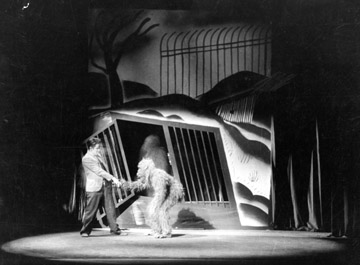
The laborers on the ship are described right in the stage directions as resembling "those pictures in which the appearance of Neanderthal Man is guessed at." There is a lot of overkill in establishing this idea throughout the play. Yank, the protagonist and hairy ape of the title, is defined as "their most highly developed individual", the strongest, fiercest, most self-assured, etc, though his level of development does not count for much as one moves up the food chain of the jungle of humanity.

Now I going to digress again to consider the history of Eugene O'Neill's reputation and where it goes from here. 1936, the year he won the Nobel Prize, I think would be a good start, because that seems to have been about when his acclaim was at its highest, and when he was regarded as a major figure in the nation's cultural life on par with the way Martin Scorcese or some similar renowned filmmaker would be today. By the time he died in 1953 he had moved a little away from the white hot center of literary fashion, but was still considered indisputably to be America's greatest playwright. This was still the case more or less in 1962, the various reference books I have from that year indicating the opinion that any well-educated American would be expected to have some familiarity with his work, and certainly any serious stage actor at the time would have had to have a more than passing knowledge of his oeuvre. The edition of the book in the picture at the top of the page is part of an attractive multivolume set put out in 1964 by Random House apparently for mass market sale, which even had the internet never come into existence is almost unfathomable for a collection of plays not by Shakespeare. By my childhood and youth, the 1980s, mainstream America had largely lost contact with what was going on in the theater, and its reading classes being cut off from any relation to that context, O'Neill's style and the construction of his plots no longer had much resonance; and as to the intellectuals, I assume that during the heyday of postmodernism and deconstruction his concerns and manner of expressing them must have seemed a bit dull and simplistic, hence the ridicule of him I encountered among the students in the early 90s. Today there seems to be some interest in him of a historical nature, people who are curious about what was hot in 1930, that sort of thing. I don't detect a big O'Neill influence on contemporary literature or theater, though I could be wrong about that.

I have a bunch of notes the meaning of which I have no longer any idea:

1. Theory on feminism held back (women on boats/death in (lakes?), etc) Socialist? I have no clue what this is supposed to mean.
2. Symbol of hell, (obv.?), & can I bring down to upper expectations also? I assume that the stokehole is the symbol of hell. The second part of this makes no sense.

3. Atmosphere of industrial life such part of USA, (underlined word, illegible, here) now. The illegible word may be 'done'. The working-class bustle one imagines to have been formerly such a constant feature in the life of our now largely hollowed-out city centers when reading these old books stirs an unsavory and emotional nostalgia, for what exactly I would be hard-pressed to either explain or defend, I am sure.

The comparison of the laborers' voices to phonograph horns followed by a chorus of hard, barking laughter (in the stage directions) is repeated numerous times in Scene Four, I assume for a point. The obvious suggestion is that these men have taken on an industrialized, mass-produced, anti-human quality as a result of the environment in which they have to exist.
Scene Five, more stage directions (this is where much of the action is for the reader in this play) describing storefront windows on Fifth Avenue: "The general effect is of a background of magnificence cheapened and made grotesque by commercialism, a background in tawdry disharmony with the clear light and sunshine on the street itself."

The socialist agenda is laid on in a more or less similiarly heavy fashion throughout the rest of the play. The art, or other greatness quality in it I admit are very elusive to me.

In Scene Seven, after his apelike persona results in his getting tossed out even of an I.W.W. office, Yank sits in the middle of the street in the pose of Rodin's "The Thinker" and reflects, "Steel was me, and I owned de woild. Now I ain't steel, and de woild owns me." I thought this was important because it reveals that his consciousness has now been awakened, but not in the usual positive sense with which we identify this event, because he is a shattered man who cannot recover what he had been formerly, which was a man sufficient at least unto himself. One could interpret it as an analysis about the entire modern human condition.

Eugene O'Neill, as I'm sure you know, had a gorgeous daughter, Oona, who married Charlie Chaplin when she was 18, after which her father apparently never spoke to her again, and went on to have 8 children. I'm very interested in gorgeous literary-connected people.

Sunday, July 26, 2009

A Streetcar Named Desire--Part 2

A Streetcar Named Desire--Part 2


Scene 8 Stage Directions: "A torch of sunlight blazes on the side of a big water-tank or oil-drum across the empty lot toward the business district which is now pierced by pinpoints of lighted windows..." I thought this was a nice bit of Americana.

STANLEY: ...what I am is a one-hundred-per-cent American, born and raised in the greatest country on earth and proud as hell of it...

Stanley is a character who, while uneducated and coarse, seems to have a purpose behind everything he says, and also to have a certain amount of logical consistency, so this statement isn't merely just tossed off as an example of his simplicity, it means something. I think he feels himself to be a free and unconstrained man, with a part, large in its own way, to play in the life in which he finds himself. I suppose he credits something of the idea and particular way of life of America as he knows them, and for which he is more suited in many ways to make a figure in than he would be elsewhere, for this.

BLANCHE: The opposite (of death) is desire.

Obviously this is the big idea of the play. Where it has to succeed, and I think it largely does, is in making the reader/watcher feel this in his visceral responses to what is written and said.

I do think this is a very consciously "American" story, and that Blanche and Stanley represent two extremes of the American character and the directions in which the development of those types have been and are going.

Water is highly symbolic in this play. The stage directions frequently specify that the sound of it is heard running somewhere off stage.

STELLA: I couldn't believe her story and go on living with Stanley.

EUNICE (a neighbor): Don't ever believe it. Life has got to go on. No matter what happens, you've got to keep on going.

This is a rather strange exchange, though I guess the implication is that if she believes the story she is in danger of shutting down, becoming one of the living dead. I actually have always thought that in the written play there was some ambiguity as to whether Stanley really raped Blanche, or if it was somewhat more complicated, or perhaps even her imagination (she becomes inert and is carried to the bed while a trumpet and drum from outside play loudly in the scene where this incident happens). Blanche comes out and says "I want an explanation of what's happened here"--a sign of evident confusion. She talks of being "buried at sea sewn up in a clean white sack", cleanliness, or the image or illusion of it being another continual theme. She also screams when Stanley rips off the paper lantern and holds it out to her "as if it was herself".

Did Shep Hartleigh really once want her? Or is that not important? I guess he is probably not supposed to even exist. This is quite embarrassing, publicly struggling to figure out what is going on in these second and third tier artworks, which a well-ordered mind would be able to seize and disseminate in whole at a glance. Penance, penance.

So what I think is going on here is this, right?: Blanche effectively "died" when she lost her sense of purity that she had in girlhood. Her desire was in one sense to return to that unspoiled state, or at least cling to the illusion of it, which took the form however of rather opposite behaviors, many indeed involving actual schoolboys, which game--both of them--Stanley ruthlessly exposed and refused to humor, which proved to be more than she could endure.

The movie is written about exhaustively elsewhere, and I don't have anything to add, other than that it would have been exciting if more American films in the 50s had followed in this kind of direction, because it's very different from most of what seems to have lasted from that era--the Honeymooners actually is kind of similar to it as far as setting, but somehow the effect isn't quite the same.

Monday, July 20, 2009

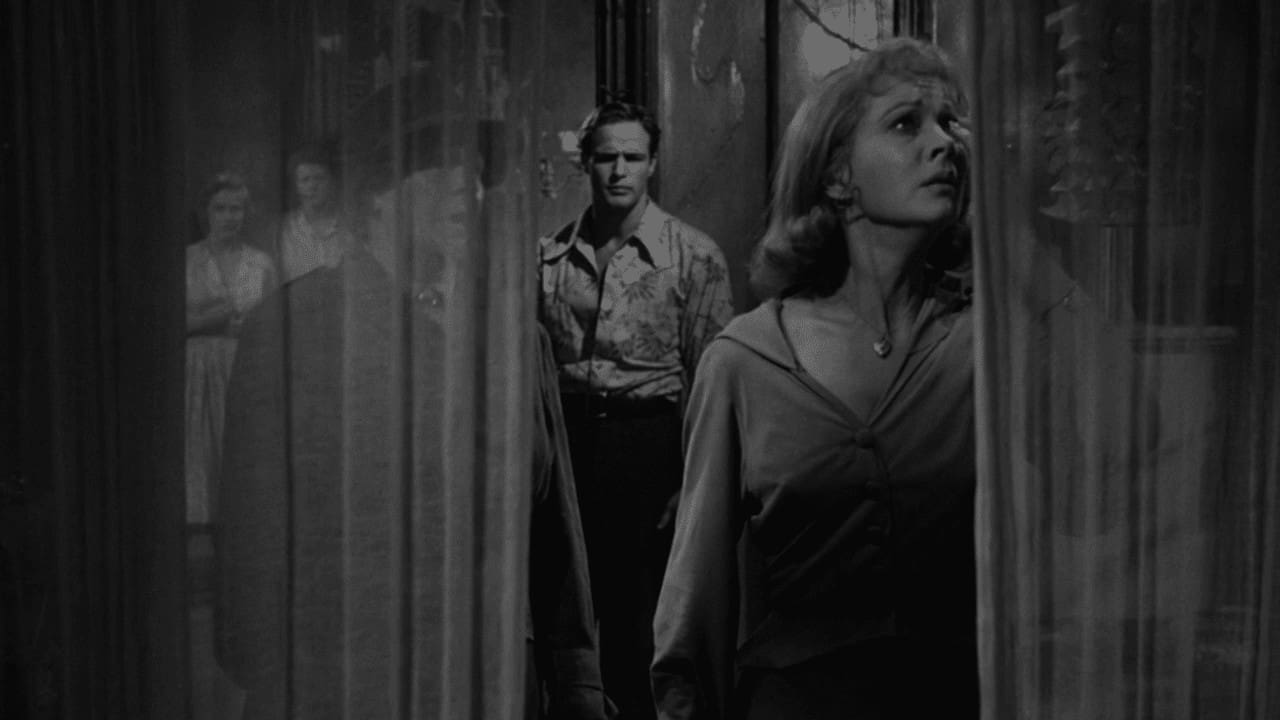
A Streetcar Named Desire (1947)--Part 1 You knew these pictures would be coming (assuming they make it to post).

I like this. It speaks to me. The mental and emotional world in this play is recognizable to me, which is not always, indeed is actually rather rarely, the case in most of the literature I read. The passions of course are much subdued in me compared to what they are in this writing, but the sentiments which support are, however faintly, still there.

The somewhat heavy-handed nature of the imagery starts right in with the opening stage directions: "quaintly ornamented gables", "faint redolences of bananas and coffee", "a tinny piano being played with the infatuated fluency of brown fingers". However the effect is felt.

I wondered while reading this if acting with so much short dialogue (The Method!) were not actually more difficult in many ways than reciting the longer speeches, often in verse, of the traditional theater. Not many people seem to think so, or that the modern theater is ultimately comparable in quality or in its demands on actors as the classical is. Still, the thought occurred to me, and in reading, not by watching a labored performance by inferior actors and comparing to that of polished ones, so there might be something in it. It might explain one of the reasons why the modern theater seems in some way inadequate compared to the classical if nothing else.

As you will know if you have seen this play, or the film of it, it doesn't take long to get to the first whiskey time, about three pages. The rest of the sentient part of this country has long moved on, I know, but I do like these old midcentury books where people eat and drink the same stuff I do, or would like to if I were more organized in my dissolution; of course they do it far more instinctively. For my own part I have not discovered/adapted any new drinks into my repertoire in many years. More evidence of the effects of social isolation. I hope people like me hold on in the future to the opportunity to go to real residential colleges rather than the moneysaving trade school/community college/online courses plan of life many people are promoting now as preferable alternatives for the middling classes. I was probably predestined to live a life of stale and minimally developed habits anyway, but these doubtless would have been far worse had I been compelled to spend my twenties living at home.

(Stage Directions) "Since earliest manhood the center of his life has been pleasure with women, the giving and taking of it, not with weak indulgence, dependently, but with the power and pride of a richly feathered male bird among hens." And what has been the center of your life again?

(S.D.) "He crosses through drapes with a smoldering look". Things I think are funny I mark with a drawing of a horn.

I thought old Vivien Leigh was quite good as Blanche (apparently there is some debate about this). I guess I kind of like old Vivien Leigh. She reminds me as one of those girls from school who wasn't always in the forefront of your consciousness that when you look in the yearbook decades later you think "Why didn't I like her?"

STANLEY: I never met a woman that didn't know if she was good-looking or not without being told, and some of them give themselves credit for more than they've got. I once went out with a doll who said to me, "I am the glamorous type, I am the glamorous type!" I said, "So what?"

That's pretty good.

I guess I had better try to do some kind of analysis here. So what are we supposed to make of Stanley? What does he represent? We know that Blanche's poetic soul is crushed by his brute realism. Indeed, Blanche is already more or less dead, her identifying possessions--the house, her letters, her nerves--either have or are literally about to crumble to bits, relics of a life long lost. Stella on the other hand, the star, she has vitality, some life-force about her ("there are things that happen between a man and a woman in the dark--that sort of make everything else seem--unimportant"). I suspect we are supposed to be dealing with the circumstance that romanticism has very little to do with actual existence, and indulging in it properly shouldn't even interest us that much.

Blanche does an astrology assessment at one point in she reveals herself as having the same birthday as my son Charles (they are Virgos). Stanley is a Capricorn, also an earth sign. Everyone in my family also, rather oddly, is an earth sign. My wife and I are both Capricorns, sons #1 and 4 are Tauruses, #s 2 & 3 are Virgos. I don't believe in astrology of course, but I like to keep abreast of what it is supposed to say about me and the people who live with me in case some stubborn and otherwise inexplicable shortcoming or barrier to successful advancement or relations should arise.

BLANCHE: I never was hard or self-sufficient enough...When people are soft...they've got to put a--paper lantern over the light...You've got to be soft and attractive...I'm fading now." Blanche and I sort of have a lot in common psychologically, though I am much more tamed in my social behaviors, which makes me appear even less serious of a person than she is.

I should try again to inject some analysis here. Is this play really that great? While we're at it, I may as well ask if the film is really that great too, since the two are unusually intimately connected, not only in proximity of time but in that the stage director and at least one of the actors, and I believe several others, from the original stage production worked on the film as well. While it isn't quite Faulkner, it does have a lot going for it. Blanche and Stanley are two of the more iconic and recognizable characters in American theater, and quite a lot of the dialogue has seeped into the common consciousness to some degree. The story arc featuring the gradual revelation of a "dark secret" seems to me a typical American type. I guess such stories are common in every culture, but somehow the secret is always more horrible in its effects among us because we are so extremely dependent on our cultivated facades to get through life even more than other peoples.

It is a matter of no importance, but I have had almost no time this month to sit and write a blog post or anything else. These posts are nothing in themselves, but every one of them means something to me at the time, that I was able to sit down for a few minutes and make something resembling an object out of some portion of my thoughts. The next two days I won't be near a computer at all. I can't finish a thought now, have to go...