The Pilgrimage to Parnassus; The Return from Parnassus (c. 1598-1602)
A series of plays put on at St John's College, Cambridge around the end of the Elizabethan period, as part of their Christmas festivities, though they are not about Christmas. They are about a couple of students who decide to make their way in the world as poets, and the predictable indifference, humiliation, and poverty that befall them when they set out to do this. There is some comfort in being reminded that the problem of impractical young people with liberal arts degrees leaving school without any prospects for obtaining an income, nor any realization of how one might ever go about developing any did not just spring up in the last 20 years. Maybe these kinds of schools, which ironically seem to be most emotionally necessary as a pleasant refuge during youth from the otherwise pitiless business of real life for the less successful of their graduates, will continue to sputter along in some form, in spite of even the most well-meaning, though mistaken efforts to kill them off and spare these more hopeless graduates from what is perceived to be the source of all of their perceived subsequent misery.
The plays themselves are hard going at times to read--I guess they have not been edited so as to be made intelligible to modern readers, assuming that can be done, and there are lots of references to people and inside jokes and slang that doubtless meant something to the assembled audience but can signify nothing to me. There are numerous references to contemporary as well as historical English poets (i.e. Chaucer), including Shakespeare, which accounts in some part for its historical interest. Shakespeare is identified only as a poet and the author of the Rape of Lucrece and Venus and Adonis. His plays I did not notice as being referenced at all, though even by 1598 a good part of the comedies and histories would already have been written.
It could be interesting if it could be made more intelligible, I guess, though even most of the experts seem to be of the opinion that only the middle play (the first part of The Return) contains any real literary value.
Philippics--Cicero (44-43 B.C.)
This was the first Cicero I had ever read, and I am well into my forties. My education has been light on the Romans, so he is not the last of them that I have yet to read either (all in translation, of course, which I know scarcely counts anyway). These writings, being purportedly the transcripts of orations, are much different in tone from those of other classical authors with which I am familiar, having much more raw agitation and hostility in them. Of course Cicero here is an active partisan politician who has to sway the wavering opinions of, if not precisely a mob, a body of senators. I suppose I was expecting the style of delivery and the subject matter to be grander, less earthbound.
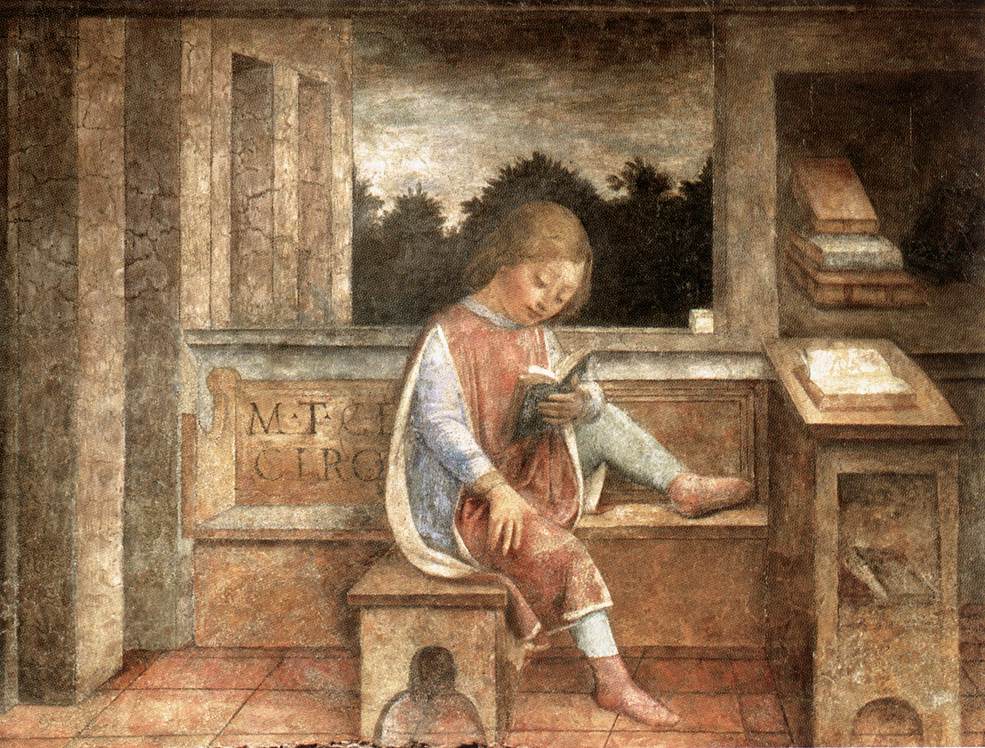
The Young Cicero Reading--Vicenzo Foppa (1464)
The fourteen Philippics are denunciations of Mark Antony, who at this time following the assassination of Julius Caesar was out of the city seeking military allies and in Cicero's opinion carrying on the worst of the dead Caesar's transgressions against the traditions of the old Republic. It is a different view of Antony than we usually get from both classical and post-renaissance literature. His arrogance, which in other depictions is usually presented with a heavy emphasis on vanity, here is expressed as of a more dangerous and willful quality. He is ambitious, a driver of events and a leader, of sorts anyway. I didn't previously think of him (based mainly on Plutarch and all the Shakespeare and Cleopatra plays) as a man capable of rousing this degree of anger and condemnation as a main target in himself, separate from his association with other people or events that are greater than he is.
I did not read this all that well. I suppose it is possible that the entire book is not great as a whole (various of the individual Philippics, especially the second, seem to be considered more important than the whole collection), maybe the translation did not perfectly capture the mood of high excitement and historical seriousness. I also have the sense that the Orations against Catiline (which Cicero himself, reliving that glory, references dozens of times in the course of the Philippics) are the essential Ciceronian reading. In any case he demands a more serious consideration than I seem to be able to give him at present.
Ben Jonson's Conversations with Drummond of Hawthornden (1618-19)
There is not much conversation here, on Drummond's part anyway, and what was recorded was mostly snippets--what would become popularly known as table talk--of Ben Jonson's observations, which amounted to 58 printed pages, most of which were more than half taken up with footnotes. The impression given is that there was not much in the way of give and take between Drummond and his guest, but that their talk consisted mostly of Jonson making pronouncements in a vaguely bullying manner. I don't remember much of this, either. Obviously I have reached the point where it is pointless for me to read any more. I am struck by so little of it, and as you can see I have trouble even putting my most simple general observations into words at this point. But I would have to take up some other pursuit to fill the time--I still can't just spend all my waking hours doing laundry and dishes, but maybe I am being ground down to the state where that is all I will be capable of doing--and I still desperately want to have some communication with the reasonably intelligent (and socially relevant) part of the world, and I don't know how else I can achieve this than by some attempt at producing content.
Drummond of Hawthornden
Tour of the Hebrides--Boswell (1773)
Not included in most editions of the Life of Johnson, this comparatively under-celebrated work is a book-sized bonus treat for people like me who are fans of this lively duo and their exploits in the social and literary society of their day. Johnson wrote his own account of this famous trip as well, which is one last further treat for me to look forward to, assuming I ever get around to reading it.
This is the edition I read.
I ordered my copy of this book online, and as sometimes happens with older memoir-type books, the edition I received was not the edited and polished standard one that all of the professors and other critics who have promoted the book as great are primarily thinking of, but the rougher version of the tour as it appeared in Boswell's journals. Nothing was left out as far as the major episodes of the trip went; on several occasions where pages of the journal had gone missing, the editors filled in the missing parts with the text from the printed Tour. These finished excerpts were far superior from a reading standpoint to the journal account, giving off much of the same high-spiritedness and humor of the Life itself, and I kind of wish now I had abandoned my edition entirely and found a copy of the traditional printed Tour. The journal was by no means a bad read, and almost certainly was more representative of what the trip was like on a day to day basis. There were numerous passages in it detailing parts of the trip where Johnson especially was bored and restless on account of the inferior level of education and dull conversation of many of the people they encountered, which provoked in him some rather harsh and decidedly unforgiving observations with regard to the limitations that several of their hosts and new acquaintances had revealed. My impression from the scholarly notes is that most of this material was either left out of the published version, or softened so as to appear more in a humorous and flattering light. And I think this was a good idea, as much of the special quality of these Johnson books come from the atmosphere of heightened intellectual alertness and drama that the scenes in them evoke. The life and conversation in them is far more entertaining and captivating than anything that ever occurs in real time, while plausibly resembling reality (if nothing else, the contrast between the journal and the published book reminds the reader of the art that is essential even in the production of a ostensibly non-fiction account to give it this sheen of heightened reality); but I realize more and more that it is these appearances of life heightened and made more consistently intense and significant and exhilirating that I seek in reading and other artistic entertainment.
Showing posts with label ben jonson (o rare). Show all posts
Wednesday, January 07, 2015
Sunday, March 24, 2013
Back to the Books
justice past mother
I'm up to about March of 2009 in my reading updates. That's pretty good, but I am going to try to pick up the pace a little anyway, though not so much in this post. I am adapting some new rules. My observations and quotation excerpts, however brilliant, are going to be limited to a reasonable amount maybe five for every 100 pages or so. We can still feel like we are celebrating literature and the life of the mind, in however microscopic a way.
As the readings come straight from an old GRE test booklet, there is frequently a set of related books, often five. Today I will just deal with the remaining two books from the question which has already given us Browne, Locke and Burton. These two are much shorter than the last two that I picked over here.
John Milton, Areopagitica (1644)
Begun March 10, 2009. It came up in another question and per a technicality in the rules I have set for myself which I will spare you here I read the piece (which runs 41 pages) a second time and wrote the following comment in the margin on August 14, 2010:
I think there is a bit of overkill with some of his arguments here, but there are certainly frequent demonstrations of the inimitable Miltonian brilliance, learning and mastery of the language. The prose is in places really exquisite and exemplary. The language is visibly being formed and turned to a more elevated use. The ingenuity of his arguments/examples/references more noteworthy than their ultimate susbstance. JM is as always a little self-serving in his motivations, as well as the unwitting captive of serious prejudices.
Aren't we all, I guess it could be countered.
This pamphlet, an indignant protest against a censorship law that had been passed in 1643, during the tense period of the English Civil War, is sometimes invoked as one of the pillars of the Anglophone tradition of freedom of speech. I have to confess it did not make a deep impression on me, and I do not readily remember any specific details about it. I made several notes about the prose being extremely elaborate, and remarked that people had more time (or perhaps just greater concentration) in those days to lay out their arguments at great length. I am always a little taken back, acknowledging what must strike anyone who reads him, that he is such a smart and learned man, that he is apparently so convinced of Protestant righteousness as against Catholic error. His tolerance does not extend to the Romish faction, I presume because they speak nothing but lies.
"For this is not the liberty which we can hope, that no grievance ever should arise in the Commonwealth--that let no man in this world expect; but when complaints are freely heard, deeply considered and speedily reformed, then is the utmost bound of civil liberty attained that wise men look for." This was well-said.
"What advantage is it to be a man over it is to be a boy at school, if we have only escaped the ferula to come under the fescue of an Imprimatur..." Milton was a man who had high self-confidence and was not afraid of conflict and dispute. Combined with his intellectual and especially linguistic talents, I am sure this was overall an important and good thing for society in the long term, if not perhaps so much to his contemporaries.
I enjoy reading Milton's poetry. I am well past the time of life where I can either impress English professors or gain anything by sucking up on them, and it is pretty well documented that no one has ever induced a woman out of her knickers by professing his predilection for this poet, so I hope my assertion can be accepted at face value (this also reminds me of an episode of Love Connection where a male contestant was looking for a woman, preferably possessed of that singular southern California beauty no doubt, who shared his appreciation of Milton, among other similarly antique poets, and Chuck Woolery, the urbane host of the program, had to cut him off and offer him the chance to say he was really kidding and give him the chance to take another tack, but the guy foolishly insisted he was serious. His date, which, and I can't believe I can recall it, was with a fairly perky but sarcastic blonde, and was predictably a disaster). But back to Milton, he is not someone that I took to right away of course, but over time, and some immersion in the various traditions of which his work constitutes a part, I began to welcome him and find pleasure in reading him, though as Chuck Woolery knew instinctively, it is pleasure of a lonely and not especially sensual sort. There is no other poet in English like him. He seems to me to be somewhat like Tolstoy in this matter of style. the heaviness of his words density and knack for setting on the correct words and details and phrasing to make his effect...
Ben Jonson--Timber (1641--published posthumously, Jonson died in 1635)
Begun March 12, 2009. This was a nice little book (87 pages of 'text', but 74 of footnotes, and 19 of worthwhile introductory materials). It was an internet reprint--an unusually readable copy for a book of that class--of an 1892 edition edited by Prof. Felix E Schelling of the University of Pennsylvania. Considering the quality and interest of the book and the important status of its author in English literary history I am surprised by the dearth of more recent editions. The book is subtitled Discoveries Made Upon Men and Matter and it would seem to belong to that category of books that I would think of as pensees, short entries or meditations on subjects of general interest, given greater interest of course by the distinction both of thought and person of its author. Typical topics would include fortune, the envious, Shakespeare, untalented authors, Francis Bacon, etc.
The section de Shakespeare nostrat[i] is brief, but even so, as one of the few personal accounts, however sparse, of the man I can remember reading, I would think it would be more famous and constantly referred to, though other than the "I loved the man, and do honor his memory, etc" part in the middle, I haven't noticed that it is. Perhaps it lacks some credibility that I don't know about? It would certainly seem to lend support to the argument that Shakespeare was an theater full-timer who was known in the business and about town generally rather than the Earl of Oxford or Francis Bacon. I know, the person known as "Shakespeare" was a front for those other guys--"Shakespeare" was living a lie. I think the Shakespeare reminiscence is interesting enough to include in its entirety:
"I remember the players have often mentioned it as an honor to Shakespeare, that in his writing, whatsoever he penned, he never blotted out a line. My answer hath been, 'Would he had blotted a thousand,' which they thought a malevolent speech. I had not told posterity this but for their ignorance, who chose that circumstance to commend their friend by wherein he most faulted; and to justify mine own candor, for I loved the man, and do honor his memory on this side idolatry as much as any. He was, indeed, honest, and of an open and free nature; had an excellent fancy, brave notions, and gentle expressions, wherein he flowed with that facility that sometime it was necessary he should be stopped. 'Sufflaminandus erat,' (trans. given as "He ought to have been clogged") as Augustus said of Haterius. His wit was in his own power; would the rule of it had been so too. Many times he fell into those things, could not escape laughter, as when he said in the person of Caesar, one speaking to him: 'Caesar, thou dost me wrong.' He replied: 'Caesar never did wrong but with just cause;' and such like, which were ridiculous. But he redeemed his vices with his virtues. There was ever more in him to be praised than to be pardoned."
"Such are all these essayists, even their master Montaigne. These, in all they write, confess still what books they have read last, and therein their own folly so much, that they bring it to the stake raw and undigested; not that the place did need it neither, but that they thought themselves furnished and would vent it." Hmm...
Bacon was praised as "one of the greatest men, and most worthy of admiration, that had been in many ages," and the Novum Organum "though by the most of superficial men...not penetrated nor understood, it really openeth all defects of learning whatsoever..." I like to make a point of noting when something is praised by someone who scarcely praises anything, and even spends the majority of his remembrance of Shakespeare picking out what he considered flaws in the work.
"They say princes learn no art truly but the art of horsemanship. The reason is the brave beast is no flatterer. He will throw a prince as soon as his groom."
"No more would I tell a green writer all his faults, lest I should make him grieve and faint, and at last despair. For nothing doth more hurt than to make him so afraid of all things as he can endeavor nothing." Ben Jonson was a pretty hard guy--he killed a man in a duel and went to prison, though it doesn't seem to have been for a very long time. Still, this was at the outset of his career, and he was able to get past this crisis both professionally and socially. That is why the apparent sensitivity and desire to be compassionate here are perhaps unexpected.
"To judge of poets is only the faculty of poets; and not of all poets, but the best." I think I generally agree with this.
Further notes: I don't know enough about Latin authors (Terence, Plautus, Seneca, etc). By which I mean I don't know enough to be the person I once wanted to pass myself off as, the person whom I thought becoming would cause me to be happy. I actually would still like to be that person, I just do not have the illusions that it will bring me the happiness, love, social status, intelligence, talent, etc, that I once believed it would anymore.
One of my great problems (when I wrote I obviously was still regarding myself as some kind of working writer)--not making my stories cohere, tend to one end. It is one of the main tasks of composition that I found harder to do than I had anticipated.
I'm up to about March of 2009 in my reading updates. That's pretty good, but I am going to try to pick up the pace a little anyway, though not so much in this post. I am adapting some new rules. My observations and quotation excerpts, however brilliant, are going to be limited to a reasonable amount maybe five for every 100 pages or so. We can still feel like we are celebrating literature and the life of the mind, in however microscopic a way.
As the readings come straight from an old GRE test booklet, there is frequently a set of related books, often five. Today I will just deal with the remaining two books from the question which has already given us Browne, Locke and Burton. These two are much shorter than the last two that I picked over here.
John Milton, Areopagitica (1644)
I think there is a bit of overkill with some of his arguments here, but there are certainly frequent demonstrations of the inimitable Miltonian brilliance, learning and mastery of the language. The prose is in places really exquisite and exemplary. The language is visibly being formed and turned to a more elevated use. The ingenuity of his arguments/examples/references more noteworthy than their ultimate susbstance. JM is as always a little self-serving in his motivations, as well as the unwitting captive of serious prejudices.
Aren't we all, I guess it could be countered.
This pamphlet, an indignant protest against a censorship law that had been passed in 1643, during the tense period of the English Civil War, is sometimes invoked as one of the pillars of the Anglophone tradition of freedom of speech. I have to confess it did not make a deep impression on me, and I do not readily remember any specific details about it. I made several notes about the prose being extremely elaborate, and remarked that people had more time (or perhaps just greater concentration) in those days to lay out their arguments at great length. I am always a little taken back, acknowledging what must strike anyone who reads him, that he is such a smart and learned man, that he is apparently so convinced of Protestant righteousness as against Catholic error. His tolerance does not extend to the Romish faction, I presume because they speak nothing but lies.
"For this is not the liberty which we can hope, that no grievance ever should arise in the Commonwealth--that let no man in this world expect; but when complaints are freely heard, deeply considered and speedily reformed, then is the utmost bound of civil liberty attained that wise men look for." This was well-said.
"What advantage is it to be a man over it is to be a boy at school, if we have only escaped the ferula to come under the fescue of an Imprimatur..." Milton was a man who had high self-confidence and was not afraid of conflict and dispute. Combined with his intellectual and especially linguistic talents, I am sure this was overall an important and good thing for society in the long term, if not perhaps so much to his contemporaries.
I enjoy reading Milton's poetry. I am well past the time of life where I can either impress English professors or gain anything by sucking up on them, and it is pretty well documented that no one has ever induced a woman out of her knickers by professing his predilection for this poet, so I hope my assertion can be accepted at face value (this also reminds me of an episode of Love Connection where a male contestant was looking for a woman, preferably possessed of that singular southern California beauty no doubt, who shared his appreciation of Milton, among other similarly antique poets, and Chuck Woolery, the urbane host of the program, had to cut him off and offer him the chance to say he was really kidding and give him the chance to take another tack, but the guy foolishly insisted he was serious. His date, which, and I can't believe I can recall it, was with a fairly perky but sarcastic blonde, and was predictably a disaster). But back to Milton, he is not someone that I took to right away of course, but over time, and some immersion in the various traditions of which his work constitutes a part, I began to welcome him and find pleasure in reading him, though as Chuck Woolery knew instinctively, it is pleasure of a lonely and not especially sensual sort. There is no other poet in English like him. He seems to me to be somewhat like Tolstoy in this matter of style. the heaviness of his words density and knack for setting on the correct words and details and phrasing to make his effect...
Ben Jonson--Timber (1641--published posthumously, Jonson died in 1635)
Begun March 12, 2009. This was a nice little book (87 pages of 'text', but 74 of footnotes, and 19 of worthwhile introductory materials). It was an internet reprint--an unusually readable copy for a book of that class--of an 1892 edition edited by Prof. Felix E Schelling of the University of Pennsylvania. Considering the quality and interest of the book and the important status of its author in English literary history I am surprised by the dearth of more recent editions. The book is subtitled Discoveries Made Upon Men and Matter and it would seem to belong to that category of books that I would think of as pensees, short entries or meditations on subjects of general interest, given greater interest of course by the distinction both of thought and person of its author. Typical topics would include fortune, the envious, Shakespeare, untalented authors, Francis Bacon, etc.
The section de Shakespeare nostrat[i] is brief, but even so, as one of the few personal accounts, however sparse, of the man I can remember reading, I would think it would be more famous and constantly referred to, though other than the "I loved the man, and do honor his memory, etc" part in the middle, I haven't noticed that it is. Perhaps it lacks some credibility that I don't know about? It would certainly seem to lend support to the argument that Shakespeare was an theater full-timer who was known in the business and about town generally rather than the Earl of Oxford or Francis Bacon. I know, the person known as "Shakespeare" was a front for those other guys--"Shakespeare" was living a lie. I think the Shakespeare reminiscence is interesting enough to include in its entirety:
"I remember the players have often mentioned it as an honor to Shakespeare, that in his writing, whatsoever he penned, he never blotted out a line. My answer hath been, 'Would he had blotted a thousand,' which they thought a malevolent speech. I had not told posterity this but for their ignorance, who chose that circumstance to commend their friend by wherein he most faulted; and to justify mine own candor, for I loved the man, and do honor his memory on this side idolatry as much as any. He was, indeed, honest, and of an open and free nature; had an excellent fancy, brave notions, and gentle expressions, wherein he flowed with that facility that sometime it was necessary he should be stopped. 'Sufflaminandus erat,' (trans. given as "He ought to have been clogged") as Augustus said of Haterius. His wit was in his own power; would the rule of it had been so too. Many times he fell into those things, could not escape laughter, as when he said in the person of Caesar, one speaking to him: 'Caesar, thou dost me wrong.' He replied: 'Caesar never did wrong but with just cause;' and such like, which were ridiculous. But he redeemed his vices with his virtues. There was ever more in him to be praised than to be pardoned."
"Such are all these essayists, even their master Montaigne. These, in all they write, confess still what books they have read last, and therein their own folly so much, that they bring it to the stake raw and undigested; not that the place did need it neither, but that they thought themselves furnished and would vent it." Hmm...
Bacon was praised as "one of the greatest men, and most worthy of admiration, that had been in many ages," and the Novum Organum "though by the most of superficial men...not penetrated nor understood, it really openeth all defects of learning whatsoever..." I like to make a point of noting when something is praised by someone who scarcely praises anything, and even spends the majority of his remembrance of Shakespeare picking out what he considered flaws in the work.
"They say princes learn no art truly but the art of horsemanship. The reason is the brave beast is no flatterer. He will throw a prince as soon as his groom."
"No more would I tell a green writer all his faults, lest I should make him grieve and faint, and at last despair. For nothing doth more hurt than to make him so afraid of all things as he can endeavor nothing." Ben Jonson was a pretty hard guy--he killed a man in a duel and went to prison, though it doesn't seem to have been for a very long time. Still, this was at the outset of his career, and he was able to get past this crisis both professionally and socially. That is why the apparent sensitivity and desire to be compassionate here are perhaps unexpected.
"To judge of poets is only the faculty of poets; and not of all poets, but the best." I think I generally agree with this.
Further notes: I don't know enough about Latin authors (Terence, Plautus, Seneca, etc). By which I mean I don't know enough to be the person I once wanted to pass myself off as, the person whom I thought becoming would cause me to be happy. I actually would still like to be that person, I just do not have the illusions that it will bring me the happiness, love, social status, intelligence, talent, etc, that I once believed it would anymore.
One of my great problems (when I wrote I obviously was still regarding myself as some kind of working writer)--not making my stories cohere, tend to one end. It is one of the main tasks of composition that I found harder to do than I had anticipated.
Labels:
ben jonson (o rare),
letters-17th c.,
milton,
shakespeare
Subscribe to:
Posts (Atom)