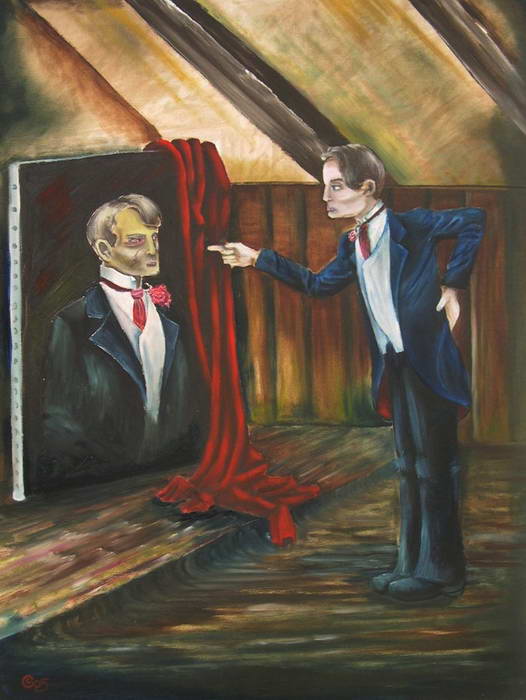
Showing posts with label oscar wilde. Show all posts

Sunday, February 08, 2009

Dorian Gray--Part 3

In Chapter 14 there is a little rapture about Venice, with a nod to Oxford thrown in at the end of it, that I take to be an homage to Ruskin. Really, Wilde, for such a supposed iconoclast and fastidious upholder of artistic standards, seems to have held an unusually large number of his contemporaries, and their work, in high esteem. Gray, the morning after murdering Hallward, is turning over the pages of a volume of Gautier's poems--Wilde gushes about the beauty, exquisiteness, etc, of these too--when he comes to one about Venice. "Devant une facade rose/Sur le marbre d'un escalier." "The whole of Venice (he thought) was in those two lines." Of course it isn't--not for an aesthetic ingenu anyway--though perhaps the goal of education and experience is to be able to comprehend a great deal of meaning in such clear and concise terms. But the point of the book I think is either that it is not, or that Gray/Wilde has not absorbed the totality of the intellectual environment is which he moves to make such distinctions in a meaningful way. "...Venice, like Oxford, had kept the background for romance, and, to the true romantic, background was everything, or almost everything." Literature would not exist without sentences like this--I do believe that, too--but again the foreground must be somehow commensurate with the background, for the background to have any meaning. The novel Dorian Gray itself, for all its abundant charms and the cleverness of its conceit, is lacking the high purpose and understanding that a work of art must possess to be a world masterpiece; it is not good that way, and its author I believe is aware of this at a pretty conscious level; it is one of those books of which it will always be said 'it is one of the finest things of its kind'. Oh yes, regarding the trip to Venice: "Basil had been with him part of the time, and had gone wild over Tintoret." If the world gains nothing else from this blog, I hope that somebody might be reminded that if he should ever go to Venice, he needs to see the Tintorettos. This has become in the space of a year a pleasure I was not aware of having missed to the 11th or 12th greatest regret of my life; and that rank may rise yet if I keep being reminded of it. Chapter 15: "It was a small party, got up rather in a hurry by Lady Narborough, who was a very clever woman, with what Lord Henry used to describe as the remains of really remarkable ugliness." Same party: "...Lady Alice Chapman, his hostess's daughter, a dowdy dull girl, with one of those characteristic British faces, that, once seen, are never remembered..." Something tells me I probably would have thought this girl was hot in some indefinable way and been agitated all through dinner. Something of the sort happened to me once. I was seated across the table at some dinner from a girl with a singularly homely face--it was as if during the formation of her features they had not set at the proper time, though whether too early or too late I could not make out--and who was quite boring to boot, eating salad and vegetables only, along with water, and talking of nothing the whole time but how she got up at five every morning and went on a four-mile run (to her credit, she did appear to be of well-above average fitness); alas, I found myself distracted for much of the meal, wondering if she did not have any interest in me as a lover, etc. (Chapter 17) This one is kind of famous, but it is good: "The man who could call a spade a spade should be compelled to use one. It is the only thing he is fit for." Chapter 18: "Success was given to the strong, failure thrust upon the weak. That is all." This is essentially the theme of this whole blog, so in theory it should shut itself down now, having long established what side of the muscular equation it lies on, but as we all know the weak only cease to talk under direct compulsion or intimidation; then you won't hear a peep from them, they do as they are ordered, but given enough leeway to pretend to substance, they will indulge in it every chance they get. This of course is the great curse of the internet. Some of the Background for Romance, Oxford. "It would not look well to go on." Lord Henry regretfully calling off the day's hunt after one member of the party has accidentally shot and killed a beater. Lord Henry is one of those amoral and contemptuous characters who is at the same time clever and highly amusing, his social skills a template for anyone who aspires to be cool, knowing, and in demand, and never is. He is at the same time undeniably wicked, but this does not seem to bother anyone of importance and influence, perhaps the occasional eccentric genius or virtuous millionaire can look coldly upon him with some sting, but for the normal person it is hard to know how to take him. As your disapproval of his behavior is meaningless, and as his social qualities are so desirable to you, you of course must train yourself not to covet them, which is supposed to be one of the aims of a proper humanistic education, anyway; which is why the widespread denunciation of the liberal arts as outdated and useless that is afoot in the republic is a disturbing trend for its moral and psychological health. Chapter 19: "It is an odd thing, but everyone who disappears is said to be seen at San Francisco. It must be a delightful city, and possess all the attractions of the next world." I don't know where this came from, but I find the coincidence (I wanted to say karma, but the dictionary indicates that that implies a transmigration of souls, which I don't think applies here) interesting, since I was just mentioning San Francisco, a place to which I have never been and rarely think about, in another recent post (about the Caine Mutiny). Here is how it would have looked in Oscar Wilde's day. One is tempted to say he'd be more at home there now, but the Victorians may have had more of a appetite for the rough and tumble of life than we give them credit for. Compared to similarly privileged and sexually-inclined characters in later books like Brideshead Revisited, the fops in Dorian Gray are like Greek warriors in the manly energy of their artistic and social pursuits. (Note that we have a hint of 'heavy industry' in the picture). "...I always contradict the aged. I do it on principle. If you ask them their opinion on something that happened yesterday, they solemnly give you the opinions current in 1820, when people wore high stocks, believed in everything, and knew absolutely nothing." Absurd, but it still amuses in many instances. I confessed at the end that I didn't know how to take this book morally. Our age, with the exception of a few extreme, mainly sexual, vices, has strayed so far from presenting any very comprehensive moral code by which the individual might be expected to govern himself that Gray by comparison, though his code is more of an anti-code against moral (but fastidious in its observation of social) propriety, comes across as a man of principle. People's political affiliations, and the dogmas attached to these, I suppose provide the equivalent of moral codes, but a political movement cannot properly appeal to any idea of universal absolute right without making a mockery of itself. It is pretty clear that Dorian Gray is seen as having transgressed against essentially immutable and universal laws, and that that is why he, morally, and his picture, become grotesque. Yet am I not long gone down the same path myself, by any reasonable estimate, if not with the same excess and abandon? Or was Gray's immersion in vice far worse because he was given such an exquisite intelligence and beauty, genuine talents? You see I have no idea how to move about in such a room. Chapter 20: "There was purification in punishment. Not 'Forgive us our sins', but 'Smite us for our iniquities' should be the prayer of a man to a most just God." I think many highly intelligent people must instinctively feel this. It requires real religious genius to be both intellectually able and honestly come to embrace the prospect that you, or your soul, will be entering into some variety of no-strings-attached eternal bliss in which you will know constant ecstasy being anything imaginable on earth. From the Pre-Blog Archives: I was curious to go back and see what I had written when I read The Importance of Being Earnest a few years back. It was not one of my better analyses. From July 11, 2004: "(Wilde) is perhaps the most optimistic and reassuring of all authors really, one never suspects there is anything to be troubled about in the world, that good humor and amusement suffice. It begs the question (sorry--pretentiousness alarm going wild) of his 'importance' which seems to be that of the shining light or comet. I had not realized how much his method relies on irony. That, and an especial delight for the (painlessly) outrageous declaration and his unique personality. Almost more a great literary character than author."

Tuesday, January 27, 2009

Dorian Gray--Part 2

I think I will start with a joke. "And now I must bid goodbye to your excellent aunt. I am due at the Athenaeum. It is the hour when we sleep there." "All of you, Mr Erskine?" "Forty of us, in forty armchairs. We are practising for an English Academy of Letters." It would be vaguely amusing if anyone in real life were to ever actually talk like this on a regular basis, though I probably would not want to live with the person.

You will remember that Dorian Gray "falls in love" with the actress Sibyl Vane, or rather her portrayals of classic characters ("Lips that Shakespeare taught to speak have whispered their secrets in my ear. I have had the arms of Rosalind around me, and kissed Juliet on the mouth."), only to reject her coldly when her love for him betrays her into behaving as her actual self with him, at which she goes on to commit suicide. It is of course overwrought by the conventional standards of literature, but it is pulled off well enough for the purpose it serves here: Wilde/Gray is socially and artistically ruthless according to his personal code. Live up to the standard, or expect ridicule and scorn, and forget about any idea of collegiality you may have had. This also renders him impervious to ordinary love, which, especially in our competitive age, is increasingly seen as a trait giving his possessor extraordinary social, and probably academic, advantages. Thus while the book contained much of interest in the style and technique, and was a good deal of fun to read through, it never gripped me. The scene in Chapter 7 where he walks in the dead of night all through the sleeping organism of the city of London after ceasing to love Sibyl Vane was quite eerily reminiscent of some similar jaunts I had there in the 1990s (usually after some hours fruitlessly passed in trying to find an exciting nightclub after the pubs shut down at 11), even down to ending up in Covent Garden. Walking around London at 3 or 4 in the morning is unlike doing so anywhere else, because, first, compared to every other city of comparable size I have ever been to, for the most part no one else is out on the streets at all, and second, because every few blocks you are coming upon a world famous, in some cases legendary street or building or square or bridge, and at that moment it is as if you alone possess it of all the world, which I find a very odd sensation to have.

The idea of the "world-spirit" is of especial significance in this book, by which I mean to say, that it is always significant to a certain degree even when people aren't aware of its influence, but Wilde is always aware of its influence, and I think it is clear he does not think of it as being at all positive in his generation. He is no nostalgist though, unless it is for a certain kind of style or attitude or aesthetic sensibility; he does not believe people in the grip of past manifestations of the world-spirit were any nobler or more moral than men have ever been, and are today. The use of this often-hazy concept to characterize what it is that makes Gray Gray--his fascination with the psychological novel about the Parisian "who spent his life trying to realise in the nineteenth century all the passions and modes of thought that belonged to every century except his own, and to sum up, as it were, in himself the various moods through which the world-spirit had ever passed..." is very deftly and admirably done from a writing standpoint. The world-spirit as it pertains to men is both ultimately trivial and of the utmost importance in the forming of men's characters and souls at the same time, which about captures Oscar Wilde's worldview at the peak of his career.
Ch. 11. On concerts featuring the music of exotic lands such as Tunisia, Peru, Chile, and Mexico, which were all the rage in London at the time: "The fantastic character of these instruments fascinated him, and he felt a curious delight in the thought that Art, like Nature, has her monsters, things of bestial shape and with hideous voices." We may not regard, or at least wish to regard, the productions of the Aztecs and other non-Western cultures in this simplistic and insensitive light in our time, but the idea of art having its own monsters surely is not controversial. Indeed in my own novel I referred to Art as a "demoness" as if it were the outstanding feature of her nature, quite unconscious of this passage, though I doubtless picked up the idea from some Romantic poet or early Modernist or other.

On men who give bad dinners: "Even the cardinal virtues cannot atone for half-cold entrees, as Lord Henry remarked once, in a discussion of the subject; and there is possibly a good deal to be said for his view." He then of course goes on to compare the canons of good society, the necessity of form, etc, with art, which with Wilde, though he famously asserted that all of it is quite useless, is always equivalent to life itself.

Chapter 12 opens on the eve of Gray's 38th birthday, which on the day I read the passage made him exactly 12 days younger than I was. Spooky! No, not really of course, but I thought it was an interesting coincidence.

Someone's Bedside Reading. I can't make out the book in the middle now.


As this point in the book Gray has ruined the reputations of a slew of well-born men by his debauched lifestyle. Obviously contemporary readers had to know what was inferred by all this, beyond cavorting with dancing girls and streetwalkers. Those crafty, subtle Victorians, not letting on all they knew about the seedy side of life, quite the opposite of us, who mostly know very little about it but chatter on incessantly as if we understood it all! Hallward: "What about Lord Kent's only son, and his career? I met his father yesterday in St James's Street. He seemed broken with shame and sorrow."...Dorian: "If Kent's silly son takes his wife from the streets what is that to me?"

The scene ends darkly however as Gray murders Hallward, who is the genuine artist in the book, and the painter of the picture which gives the book its title. I thought the passage where he opens the window of his loft and scans the absolutely calm and silent surrounding streets (those eerie late night London streets again) was very well done and apropos, that the effect is probably exactly what one who was highly conscious and unaccustomed to murdering would feel like after committing one in the dead of night, with there being no likelihood of detection or suspicion falling upon one for several hours to come. Very disturbing to contemplate.

My oldest son's name is Oscar, and naturally a lot of people thought I had named him after Oscar Wilde. This was not specifically true. I was paranoid with the oldest child of burdening him with a name that just screamed "boring suburban mediocrity" which, as I have a very common and unaristocratic last name and a completely generic and anomic first name for my generation I had always felt to be the case with myself; indeed, a girl even once told me that I was not only boring and mediocre in myself, but that these qualities announced themselves in my name. "Oscar", evoking as it did a world before television and the suburbs and the consolidated high school that has culturally impoverished so many of us, a world of witty dinner conversation and singing around the piano and ginny, smoke-filled jazz joints, at least said to the world, the next generation is coming to the battle ready to fire a few shots before succumbing to complete social and intellectual evisceration. I calmed down a little after this though and gave the next two kids slightly more conventional, though still old-fashioned names.

There should only be one more post on this book.

Friday, January 09, 2009

The Picture of Dorian Gray--Part 1

I had never read this before. At the time--I started it January 10, 2008, so you see I am hopelessly behind in my journal-keeping and will probably never come current--it had been a while since I had read a regular old novel, especially one that goes down as easy as this one more or less does. One feels while reading it about literature the way one feels about life on a visit to New York or London or some such place after a long confinement in the hinterlands of civilization: that one has somehow rejoined the mainstream of it for a short time, even if he does not have as perfect mastery over the experience as he would like. For a great many people have actually read Dorian Gray, and everyone has heard about it and alludes to its central plot device freely, from Rush Limbaugh to Brent Musberger to my mother-in-law.

As such I anticipate I can afford to write about it more sparingly than has become my habit. Quotes from the book are already nearly ubiquitous, so the famous ones--and there are at least fifty of those--I will refrain from repeating here. Wilde's attitude and various pronouncements on art tend to set the critical faculty at its ease; The reader at least does not sense that there is a coded Straussian message embedded deeper in the text than he can ever hope to penetrate wherein the real story and real meaning of the book are contained; he anticipates a reward that is out in the open, visible right on the surface. Ultimately of course, I had to find fault with this--really earnest bourgeois like me tend to grow uncomfortable at the idea that genuine literature could ever be something we experience as fun, or natural, or easy. No, it can't. As I wrote last year:

'There are a few worthwhile observations here. O.W. does (I believe there should be a "not" inserted here) get sidetracked by or sucked into "profundities". He paints his scenes according to the attitude he lays out and they work as objets to be admired. Though he largely perceived no problems beyond beauty worthy of addressing, this attitude in fact became his subject.'

Picture 1--I think if nothing else I am getting a little better in selecting pictures for these posts. I have been spending more time on it, searching through multiple pages of possibilities and trying to wait until something grabs me as a true winner before I pounce.
The scent of flowers coming through open windows as we go through our mail and take our tea, even in town, seemed to be a stronger and more noticeable presence in novels back in those days before World War I than they generally have been since. People still write about it, but receiving and describing the sensation requires much more concentration and detachment from other mental activity that it did in this earlier period. For my part I almost never am conscious of smelling flowers or trees, other than cut grass, even when I am at the house in Vermont, which is set in the midst of vegetation, mainly trees, at least as copious as would have been found there in 1890. My suspicion is that we are somehow less attuned to this and therefore it usually fails to make the impression on us it should. On the other hand this may be a peculiar characteristic of the landscape of England, for it is in their writers where its presence is most strongly noted.

The style of the writing struck me as containing many echoes of Henry James of all people, mostly with regard to the manner of the psychological quivering and probing. This was odd of course because these two authors are generally thought of as opposites both in personality and writing: Wilde outrageous and witty but ultimately jejeune, James deadly serious, the most boring and impenetrable writer conceivable to many, the profound Master of the workings and motivations of the human mind through pure language to others (personally I think there is a great deal to be learned about the mechanical aspects of fiction writing in studying his work; beyond that I cannot assert anything with real confidence or conviction about his merits. I do not dislike it, but I don't love it either, and my sensibility is not fine enough to understand what fires and repulses his characters, and why). On the other hand both had similar obsessions with aesthetics, art, social class, even if these manifested themselves in different ways.

I don't know if it is recorded anywhere that little Henry and William James at the ages of 5 and 6 were in the regular habit of screaming at each other, fistfighting, and talking about the other's bodily functions, though I doubt any of this ever happened in the presence of their father at least, who knew how to keep the level of discourse on a very high plane at all times. I have tried to introduce the subject of the James family (as well as other renowned intellectual families) on occasion at my own dinner table, as if they were our well-behaved and studious contemporaries, neighbors even, and competitors for future honors and the affections of teachers in the hope of impressing upon my sons that much of the human species by their age has already turned its attention to more advanced subjects than those favored by them, but my intentions are misunderstood, and the topic usually shouted down on all sides at once.

Picture 2--I was not familiar of this picture of our author before. I think it's a good one. He really looks like himself in it.
The homoerotic imagery in the book is quite overt to anyone living in this depraved age. One would think it would have caused a scandal in 1890, but Wilde appears to have avoided much widespread suggestion of that sort of thing until he was more or less caught in flagrante delicto with Lord Douglas, the Marquis of Queensbury's boy, several years after the publication of this book. Either the Victorians were more sophisticated in these matters than they are usually given credit for, or they were obtuse regarding them probably beyond our ability to conceive.

The degree of vanity which the main characters own to openly is also fairly shocking and outrageous, especially for the time, and especially as I don't think there is supposed to be anything tongue-in-cheek about it. These guys are flat-out divas.

Not surprisingly perhaps, the book reads very much like a play, even the descriptions of the scenery and settings are more like stage directions for the character to ask against the background of than the delineating of a world in which it is the character's fate to exist, which is the more common attitude of novels.

Picture 3--There are many film and TV versions of the book, none of which I have seen, and of which the advertisments for and stills from the modern ones, at least, look extremely annoying to me, but this is probably due in great part to my sense of personal estrangement from the whole current age. This beautiful gelatinous looking title from, I believe, the 1945 Hollywood version, was just too good to pass up. There are whole web sites (of course) devoted exclusively to title shots from movies. I don't dislike the idea in itself, and the pictures are fun to look at, however, I haven't found one that is accompanied by any particularly interesting writing or insight as to why the poster chose this format to be the theme of his website.
p. 47--Regarding a scandal: "The thing was hushed up, but, egad, Kelso ate his chop alone at the club for sometime afterwards." Chop references are like Helen Keller jokes to me. No matter how I try to resist, they kill me every time.

At the time I read the book, I made a note that I was learning from Oscar Wilde what was uncool in conversation, as if I were anticipating some kind of big social breakthrough after I had finished the whole thing. Whatever those lessons were, I have apparently forgotten all of them now.

Tuesday, November 13, 2007

Writers/Works People Have Said My Literary Efforts Remind them Of

Writers/Works People Have Said My Literary Efforts Remind Them Of 

Garrison Keillor

Woody Allen 

Oscar Wilde 

James Joyce-"The Dead" 

Thomas Pynchon-V 

Jean-Paul Sartre-No Exit (this is the one in which the famous line "Hell is other people [l'enfer, c'est les autres] appears)


In the comparative fire of my youth I inwardly took great offense at the Garrison Keillor comparison and fantasized momentarily about spraying the person who made it with machine gun fire but I have cooled off since that time. The resentments, jealousies, indignations, etc, with which authors are commonly supposed to be consumed towards their superior or more successful fellows don't make a lot of sense from the point of view of production once one is well past adolescence. I understand that if one is protecting a professional livelihood or a precarious spot on the rolls of fame it would be easy enough to be emotionally affected by the recognition of one's inferiority, but I think it is made too much of, and treated by the more secure authors as an amusing occupational hazard when dwelling on it really does no one any good. Also Keillor's attempts at reviving poetry by reading Eugene Field and Edward Arlington Robinson and so forth on his radio program make me think we are probably on the same team in the great existential struggle for America's soul. I doesn't look like it's going to be a winning team, but if one is on it one has to accept the mission to a certain degree.

Joyce's stories, along with Dickens's earlier and effusive efforts, were the first conscious models I took for my own writing, so it is not surprising that one could find hints in them in what I do.

Superficially I don't write anything like Thomas Pynchon--he's so zany and brilliant and all of that--but actually it seems like most American male authors under 45 or so ending up writing a little bit like Thomas Pynchon whether they want to or not--the over the top contrivances, the mishmash of cultural references pulled from anywhere, the sense that modern life as experienced by any human sensibility is actually insane. These attitudes, relationships towards language and knowledge and society, etc, seem to permeate the atmosphere.

Like a lot of modern French writers, Sartre seems to me to have a much more instinctive talent for writing novels and imaginative works than philosophy but seems to have considered himself more of a philosopher, especially as he got older. In Nausea, for example, which is a novel whose pages are mostly taken up with philosophical ruminations, I am confident in asserting that the more novelistic, imagistic, etc, parts, are by far the better parts of the book. Kierkegaard, for the sake of offering a counterpoint, does some similar experiments where the philosophy is more clearly the stronger component. I actually have more of a formal academic background in philosophy than literature, and people in the field who have primarily BAs in English and MFAs complain that this influence tends to, in their opinion, negatively intrude upon my fiction writing.