The third of the group of really old European classics that I had never seen but have been conscious of going back thirty years, to the time when I used to flip through the pages of a 1970s Edition of the Oxford History of World Cinema that I had, which singled each of these out, among others, as especially great and worthy efforts in what was at that time the pretty short history of the art, the silent era being, at the time of the book's publication, less than fifty years gone. As with many of the histories and surveys that influenced me as a young person, I am sure it is due to my memories of this book that my ideas about movies have a sharp divide around 1970, with everything that came afterwards, too late to be included, and perhaps more importantly, judged by the standards of the book, not able to be regarded by me in the same aura.
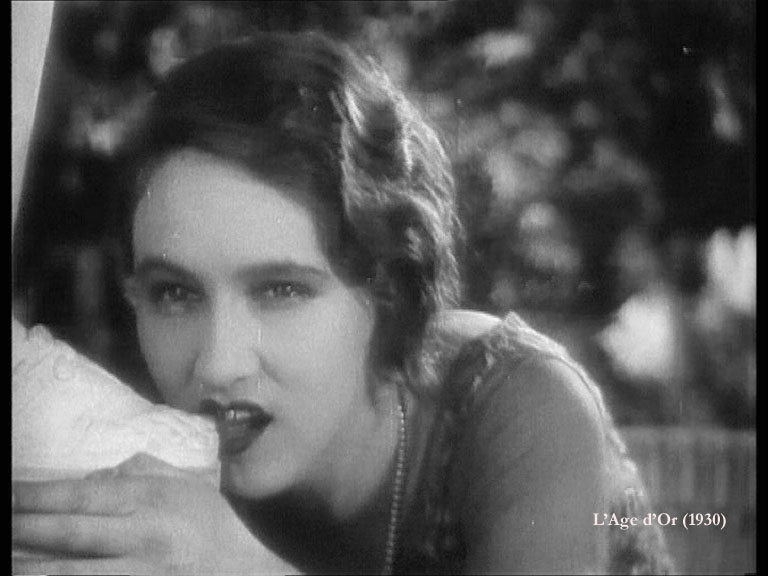
L'Age d'Or, Luis Bunuel's second major work, after the short but legendary Andalusian Dog he made with Salvador Dali in 1929, was firmly included in the pantheon of films that promised, or seemed to promise, that the mere act of seeing them would be transformative enough to make one more like a character in one of these movies and less like the kind of person book authors and critics appeared to hold in contempt. There may even have been some truth in this in the days before home video, when any public showing of these films would required some physical concentration of sophisticated people to make the showing worth anyone's time. But now that one can see anything without the necessity of being in contact with or even seeing other people, the social benefits, especially as applied to the intellect in some kind of real time way, are less tangibly realized.
Bunuel was a cinematic genius, but I need to watch all of his movies multiple times before I begin to pick up on what is either supposed to or might be brilliant in them. Hopefully someday I will get more than 4-5 hours of sleep a night and will not be too exhausted at the end of every day to concentrate and think a little about complicated images, ideas, suggestions, and so on, but I am increasingly doubtful about this. While I have come around to find instances of real joy in Bunuel, I do have the feeling that for someone of my age, experience as an arts-consumer, and, though it has faded badly, formerly pretty high cognitive ability, getting to these points is requiring a lot more repetitive effort than it should be.
So I will have to revisit this some time in the future.
Friday, September 18, 2015
Cherrybombs Diner, Dover, NH
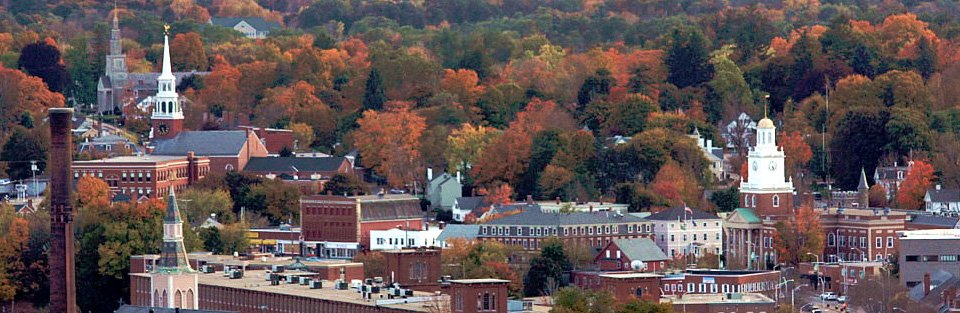
The Ride. Dover is located off the path of most of my main routes, being almost due east, right on the border with Maine, but away from the coast. I thought I had only been there once before, some years ago to check out a library sale, but as I came into the town past the handsome late Victorian/early 20th century houses on Route 9 I realized I had been there numerous times, and indeed I had forgotten that the New Hampshire Children's Museum was located there, to which I used to go quite frequently, though usually on rainy or exceedingly frigid days, when my older children were smaller. I don't think my current small children, who are 6 and 4, have ever been there, because now everything we do is geared as much towards the edification of junior high schoolers as it is little boys and girls. As noted above, Dover has a well-preserved older central core and a surprisingly lively Main Street, with few vacant storefronts and a lot of bars. The population is around 30,000, which is comparable to Portsmouth and Concord, and much larger than I would have thought, since it is a pretty anonymous city even within New Hampshire. I am curious to know what accounts for all the bars. Durham, where the University of New Hampshire is located, is only about five miles away, though I have never heard that trekking over to Dover to go drinking was something that was done. For the main ride, I went down on US-4 again to NH-155, which was about seven miles of country road past woods and farms until running into the intersection of NH-9 and 16 (the mysterious Spaulding Turnpike, which due to my awkward location relative to it I have never had occasion to take an extended ride on) on the outskirts of Dover proper. On the return trip I took route 9 back on its way in that part of the state until it joined with US-4--a winding road, that passed a mildly diverting looking general store that retained some slight air of authenticity only because it had not quite attained its ambition to be a known destination on the tourist trail, a lake, and a lakefront community. But other than that I do not remember much distinctly.
Location. Interesting. This establishment is located in a low slung, warehouse type building in a clearing surrounded by woods on a side road beyond the town center towards the Maine state line. The only signal visible from the road indicating its existence is a hand-lettered folding wooden sign sitting on the ground under a tree at the edge of the driveway. It is unlikely many people who do not know it is there or are not looking for it will stumble across it, even if they are completely lost. There is a beaten up hulk of a car from the 1950s sitting near the sign that upon closer inspection is a further piece of advertising for the restaurant. But as ancient, rusting cars are common sights along country roads in this part of the world, it is nothing anyone passing through would take any especial notice of. The wooded setting, especially looking out away from the building, is peaceful and pretty however.
The Day. The weather had called for heavy rain most of the day, but this held off at least for the duration of the outing. It was overcast, but bright, and warm, around 80 degrees. A good day to be about.
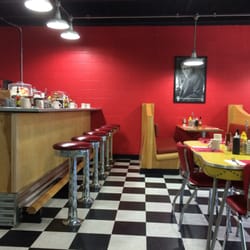
The Ambiance. Weird. The place gave off an amateurish, even half-hearted vibe. The ruling idea, clearly, is to create a 50s, Americana type diner atmosphere, though this aim is somewhat incongruous with the circumstance that the space with which they are working is a 1970s or 80s industrial park structure with cinder block walls. There are a few items of memorabilia affixed to the walls here and there--single pictures of the usual suspects, Elvis, Marilyn, & Jimmy, a plate featuring Dwight and Mamie Eisenhower, a few records and advertisements for cars, soap, soft drinks, as well as a steady soundtrack of 50s hits being piped into the mostly empty and energy-less room.
The Crowd. When I first arrived the crowd consisted of two old guys sitting silently at separate tables and the waitress, who was doing something with her back turned behind the counter and did not notice I had come in for over five minutes. Later on though, a couple of other people trickled in, one a younger (late 20s, early 30ish) man who was on friendly terms with the waitress, and a mother/daughter/baby party who were a little livelier. Everyone in the place appeared to be local and decidedly working class, since no one appeared to have an important or lucrative job and most of the conversations, once they got going, kept coming back to depressing themes like not having any money, haphazard and decidedly non-50s family arrangements and such. With regard to sociability the lunch progressed in a stereotypical New England manner, with everyone, including the waitress, being dead silent and outwardly not very friendly towards me or anyone else for half an hour (and I being I suppose the same towards them), in my case I think until they could get some kind of a read on who I was, a strange middle aged man in a button down shirt and toting a baby. But some tentative comments and questions were offered with regard to my baby by the waitress and the family of females and it was established that we were not innately hostile to each other, and it could almost be said that we were on fairly friendly terms by the end.
I think it is worth noting, or at least a curiosity, that so many of the long established family dining restaurants along the coast and in other tourist spots seem to employ exclusively young foreign students nowadays while 10 miles inland at some hole in the wall where six people show up for lunch all of the employees are kind of tough-looking local people of a certain background that does not keep up to date with the fashion in education or food or politics or allows for much evolution in those realms. I know the tourist restaurants are seasonal and I guess they cannot find a workforce adequate to their specific needs among the local population, though it seems strange that the latter are willing enough to work in any number of dingy grease joints and fast food restaurants in Dover when they live ten, fifteen, twenty miles from a busy tourist area that has a desperate need for restaurant workers.
The Food. The menu kept pretty close to the spirit of the 50s--they even offered grilled liver! I got the chili dog, I had never had a chili dog before, mainly because I was always averse to dealing with the inevitable messiness of this dish. It was all right, though it tasted more like something an undistinguished amateur cook would produce in his home kitchen. The fries were good though, and tasted like real restaurant fries. I wanted to help them out a little by ordering dessert, but the pies and cupcakes on the tray again looked more fattening and unfulfilling than inspiring, as if they had been made from a mix by someone who had little experience even with that. In addition they were drooping a little in the warm weather so I had to pass on them.
I am not going to rush back, but I would be willing to try it again to see if different circumstances, crowd, etc, brings out a more satisfying atmosphere.
Labels:
false nostalgia,
Food Studies,
new hampshire,
roads/highways
Thursday, September 10, 2015
M (1931)
Legendarily dark and disturbing Fritz Lang masterpiece about a child murderer (played by a pre-Hollywood Peter Lorre) in an impersonal and alienating modern city. It has been ranked by important critics and polls in Germany itself as the greatest film ever produced in that country, which tells something about how that nation's intelligentsia at least regards itself and the nature of existence, because there is little in it, if anything, that could be called joyous or sentimental or life-affirming. Some people prefer their movies this way, however. Certainly like many of the celebrated films of the Weimar Republic--several more of which are waiting in the wings in this set of reviews--it captures the atmosphere of foreboding and dread and despair that in retrospect is the clear precursor to the the national nervous breakdown of the Nazi era, does not look away from it or deny it to feed the public pablum and feel-good lies, etc, in this sense it is a frank and truthful art that many people in this country wish that we had, though obviously in the case of the German avant-garde of the 20s it had little practical effect on the course of history, and resulted in most of the artists themselves leaving the country, though not before they had had their substantial say in defining the character of this tumultuous and endlessly fascinating era.
As with most of these iconic movies I make notes about here, this was my first time seeing M, and afterwards I went through it again with the commentary and the other extensive special features that you get with the Criterion disk, though I cannot remember any earth-shattering revelations in these. As is often the case with me on encountering something great on a first viewing (or reading, or listening), I found it more strange than immediately compelling, but that usually indicates that the thing is good and has layers of meaning and significance that will speak to people further up on the brightness ladder than I am. So I tend to find strange things to be attractive and mildly thrilling for the connection I can imagine having to the kinds of people whose acceptance I have always fantasized about, even if when it comes down to it, I have been rather shy about really desiring it. The sets and props in this are some of the most desolate and alienating, psychologically, in a Western environment that I have ever seen.
A favorite image from M.
So now at least I have improved my basic familiarity with the filmic canon, had my initial introduction to a titanic director, and really, in this new and somewhat more alert phase of journal-keeping in these matters, to an entire major period and movement in the development of the art, all of which helps one gradually feel ever so slightly more like a real film buff, and all of the dreams of revival houses and arguments in smoke-filled taverns, and the art girls--oh, we'll never stop dreaming of the art girls--that I associate with that state of being.
Art girls here I come
Labels:
1930s,
cinema--germany,
grasping at straws,
mental confusion
Saturday, September 05, 2015
The Goldenrod--York Beach, ME
Taking a break from the movie write-ups to recount my outing for lunch this past Thursday. I am thinking about doing a series of 'cheap restaurants of New England' posts, at least through the fall, as all of the children are back in school now except for the baby, and it gives me an excuse to get out of town and take a ride once a week during this really lovely season of the year. Of course I have to be back by 2:30 to hand the baby off to her mother and go to work so I cannot go very far away or linger in a place for very long, but I can manage anywhere within 90 minutes if I leave by 10 am, which given my location covers a fair amount of good territory, including most of the state of New Hampshire. I have also devised some internet word search games to generate restaurant possibilities, though for this initial excursion I opted to finally go to a place that I have had a hankering interest in going to for many years, but which has not been practical because it was either too crowded or I have had too many children with me, and which I also mentioned in my summer vacation post, the old-fashioned luncheonette attached to the Goldenrod taffy-candy-gift store, both because of this interest and because I thought they might be closing for the season after Labor Day (though in fact they are remaining open through Columbus Day; maybe I will go down again before then).
I am going to set these posts up in the category style, which has always been popular with consumers of ephemeral media.
The Ride
Usually when going to Maine from Concord I take US-4 to Portsmouth and pick up I-95, or if I am really not in any hurry, US-1. This is a pleasant ride, 50-55 mph the whole way, minimal stoplights, antique stores, book stores, old barns and churches, lakes and lake houses, woods, farms, the famous New Hampshire Trojan horse (said to have been built by a disgruntled old isolationist Yankee in the 50s as a protest against the U.N.), and it takes a hair over an hour to get to the Maine state line, and a further 15-20 minutes to get to York Beach. However all of the internet mapping sites claim that the fastest way to get to the ocean from Concord is to take the interstate south to Manchester and go east on NH-101, which is a highway on that stretch, so I tried that, but that way took me 90 minutes (and route 101 from Manchester to Hampton is for New Hampshire an unusually blah road as far as scenery goes, though the part of it that runs west to Keene, a humbler two-lane blacktop, is a quite beautiful, if plodding route). I took Route 4 home and it was the usual 75. I have really come to love the old U.S. highways in recent years, most of which outside the congested Boston-D.C. corridor you can keep up a good speed on most of the time (and even in some places in it, such as US-301 from Wilmington to Annapolis, and even US-1 between Philadelphia and the Verrazano Bridge and Holland and Lincoln tunnels is usually just as fast as taking the turnpike) and I try to take them now whenever possible.
The Location
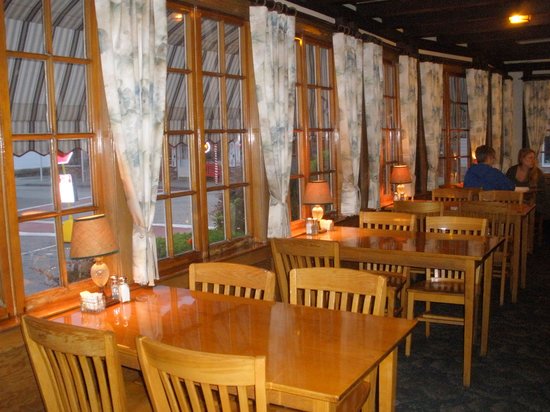
I think it is perfect, 100 yards from the beach, but as the beach isn't visible the view out the curtained windows gives the sense of being in a densely built little city through which a constant stream of pedestrians are moving, a really charming effect that, due to the rarity of it anywhere in this country, I had forgotten about in recent years.
The Day
It was nearly 90 degrees, so it still felt like summer, though with school being back in session the beaches on a Thursday had only about half the crowds they would normally have, and the amusement arcades, though still open, were practically deserted. I am guessing they will close up after the Labor Day weekend. As I left home an hour later than I wanted to, I was only able to take a quick peek at the beach before I had to hurry off home.
The Ambiance
Well, I'll read to you from their brochure: "Step back in time to when things were simpler...the classic New England dining room...The heavy beamed ceilings, oak tables and stone fireplace set the stage." It's a great space. It is one big room, but it has a long, not entirely straight perimeter, with a little alcove in the back that I actually could not see. I was given probably the worst table (as I usually am, I guess because I am so ugly and unimportant looking), in the middle area right next to where the people stand when they are waiting to be seated. My ambition for my next visit is to get a seat by one of the windows. The bathrooms are up an interior, dark, narrow, carpeted, wood-paneled staircase lit by yellow light bulbs in sconces, reminiscent of one of the better old bars in Boston. The bathroom itself was more modern, but it did have nice dark-wood doors, both at the entry and in the stalls, that looked legitimately old.
The Crowd
Due to the absence of school-age children, it was mostly older people and people with very young (pre-preschool age) children. I was with my own 7 month old daughter, who is so well-behaved that I do not have the slightest pause about bringing her out with me on these excursions. There were a couple of 20ish New England rocker chicks out for the day with their biker-looking parents, and one MILFy type, petite and wearing glasses, long curly-ish hair, who was giving off a moderately "I'm not dead in that way yet" vibe. I did overhear an overweight, slovenly dressed, doofus-y looking family discussing having seen The Philadelphia Story recently, with the mother claiming it as one of her favorite movies and expostulating a little on the appeal of Cary Grant, which surprised me, especially as in appearance she looked about as far from the Cary Grant style ideal as it is possible to get. As at an increasing number of restaurants in touristy areas around here, the wait staff consisted entirely of young people from non-western countries--the ones here looked to me to be Russian or elsewhere in the former Soviet Union.
The Food
My waitress was the cutest one of the bunch, though by 'cute' I mean in the way a serious, mildly severe Russian girl would be cute, not like a cheerleader. She was not especially friendly, but she was not unfriendly either. Neither was she terribly conscientious, though she was not completely indifferent. She was busy, I guess (the dining room was about 60% busy) and her mind was elsewhere. The first time she came to take my order I was not quite ready, so she went away and didn't return for 20 minutes. I began to wonder whether this was deliberate, that the hard Russian girl was going to amuse herself by ignoring me and making me have to loudly call after her or make some public complaint which she would know at a glance someone like me would be inherently loath to do. However, I think she just forgot about me, as she did apologize, sincerely if not weakly or obsequiously, when she came back. I just ordered a BLT, but I am happy to report that it was a extremely good one, the lettuce and bacon and even the side pickles, which I usually skip, were of a perfect crispness. So I am a believer in the product now, whatever I get the next time. Due to my late start and the additional 20 minute delay in taking my order, I was up against it for time and was unable to linger any longer to have coffee or dessert, which of course I love to do, because I really don't have anything important to do in my life, ever, or anywhere to get to accomplish amazing things, unless someone else has arranged for me to have to be somewhere. But I had frittered away all of the time that was my own and I had to get back. But I will return now, for certain.
Labels:
Food Studies,
maine,
new hampshire,
roads/highways,
summer
Wednesday, September 02, 2015
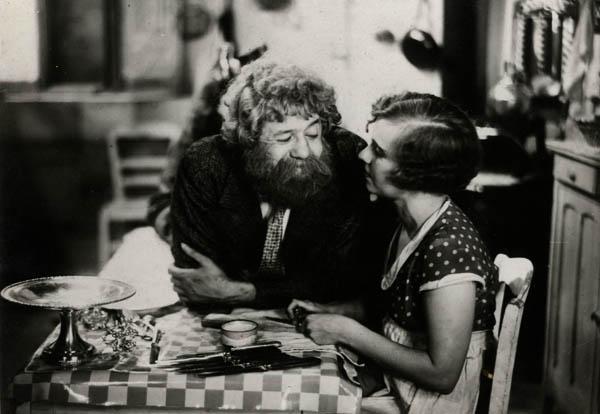
Boudu Saved From Drowning (1932)
The Jean Renoir super-classic, recognized as a landmark of the cinema from almost the earliest efforts to define a hall of honor in the form. I mostly was able to enjoy it; I suspect that as with other great French movies of the 30s, including others of Renoir--this epoch being one of my four or five favorites in the history of the art--multiple viewings over time will allow certain aspects and parts of the story to click in my mind as to what they are and how they fit in with the whole more smoothly than they did on the initial viewing, which will enable me to enjoy it much more. While naturally there are movies that require you, assuming you have the mental tools, to be more than usually alert to what is going on in them and put in some effort to see them properly, I find that these old French films will come to you to a certain extent--or at least the adjustment needed to see them more accurately is less strenuous and dependent on high intellectual capacity. The stories develop and take form, have points of emphasis, etc, in such ways as I at least seem not to be accustomed to at first, but the basic narrative language is capable of being picked up on after a few runs through, I think, by even a comparative simpleton.
I do not like it when bloggers do boring plot recaps, but as most of my comments here will not make any sense without some reference to the basic elements of the story, I will make a brief summary of these. Boudu is a vagabond who throws himself into the Seine, though in retrospect it is not clear to me why, since most of the story revolves around how much more free and alive he is than the repressed bourgeois characters all around him; I suppose it is suggested he was depressed at the necessity of living in a world completely overrun and dominated by these smug and soulless materialists. In any case, Boudu is rescued by and taken into the house of M. Lestingois, an apparently prosperous bookseller who is able to arrive quickly on the scene because his home and business have a great location on the Left Bank with a view of the river. Once in the household, Boudu, being a natural person untainted by middle-class proprieties, freely expresses and indulges all the thoughts and physical urges that occur to him, flummoxing the bourgeois males and intriguing their women. At one telling point M Lestingois, who has been carrying on an affair with the live-in maid, when he can manage it, is trying to sneak up to her room in the dead of night and wakes up Boudu, who loudly mocks him for creeping about like a mouse even to avoid being caught by himself, a homeless bum, at which the bookseller, unable to proceed boldly on after this distraction, skulks back to the bed he probably does not share with his frigid wife. This is all good fun, but as I stated earlier I am sure it will be more fun if I can get my mind to respond more in rhythm with the flow of the movie, which I experienced this time in a more herky-jerky manner.
While it is well-established among genuinely intelligent people, especially in France, that bourgeois life and people are, if not absolutely odious, at least too small in their ranges of thought and activity to be satisfactory to any man or woman of real spirit, and everybody who gets the least sniff of a real education wants little more than to be able to escape this deadly and reviled life, it is obviously much more difficult to overcome the bad habits of thought and taste with which such a upbringing permeates you, certainly as far as transcending this status to attain any level that is clearly more desirable, than one would think given the moral opprobrium that attaches to not being able to transcend it. The secrets for becoming the type of person who is accepted as being above the bourgeois, so far as they are secrets, are inscrutable to most people who don't discover that they would like to possess them until after they are around fifteen years old or so, which seems already to be too late to acquire them. As for the hatred of the bourgeois as a class or a kind of organized enemy that is antagonistic to intelligent people and artists, and proud of themselves for being so, as a mass force they would appear to be in decline in most western societies, both in regard to resources and cultural domination, to be replaced one supposes by mass lumpenproletarianism. Why this is seen as an improvement. I do not really understand, though I guess their pretensions and delusions of grandeur are more modest and less grating on the nerves of the advanced classes, not to mention less expensive to maintain overall. Some on the American right wing seem to think bourgeois cultural and behavioral norms should still be promoted for the masses on low prole incomes and employment conditions, but it should be obvious that there is no motivation to become this sort of responsible, sober, sexually chaste person without a promise of obtaining or being let into significant material benefits somewhere down the line.
This movie is also famous for its views of early 1930s Paris. Some of the shots did make me almost want to cry, to think that the particular culture and personality of the city that is so appealing in this era is probably almost all vanished now, to the delight of some no doubt and the superior insistence of others (to persuade you that you never did and never will know anything of of it), though I still was able to find something of the old magic and charm even when I was there last in 1999, though at the time it was alarmingly less than I had found in 1990, at which time Paris was still very much what I think of as its ideal self, less English spoken, the older and simpler pleasures available at reasonable prices, that sort of nonsense...
Another thing I wanted to add about these pre-World War II French classics, is that they depict the attitudes and deep culture of this great and central nation--much of which sense can be discerned in the literature of the era as well--in something of its final days, because the particular outlook on life, whether it is the unconscious confidence or sense of importance of a vital, living people, or whatever, that comes through in these movies did not wholly survive 1940. Vestiges of it hung on for a while and shined through in other books and artworks, again up until the 90s or so, but since then there is not really anyone left with a meaningful connection to this pre-1940 France, and the character one detects in these old movies--or certain aspects of its charm anyway--is largely vanished now
Sunday, August 30, 2015
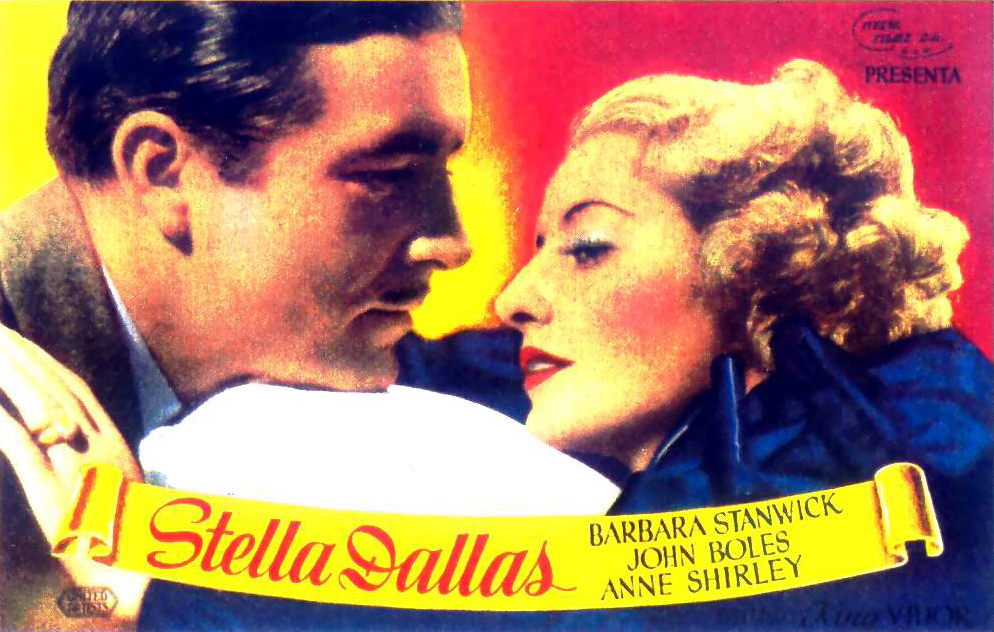
Stella Dallas (1937)
I have ten movie notes to catch up on. Rather than stuff them all into one big post that will take a month to write I am going to just do short commentaries on each one separately.
Stella Dallas had been sitting in the 'unavailable' section of my movie queue for about three years when it suddenly turned up in the mail one day. Based on a novel by the once-popular Olive Higgins Prouty, whose name has turned up in these screens (those being the ones on my site) before, the 1937 movie was the second adaptation, following a silent version that had come out in 1925. King Vidor, probably better remembered among the serious now for his silent masterpieces, was the director, and the star was the great Barbara Stanwyck, who is much-loved among internet film aficionados. There were a few moments here where I thought I might be beginning to glimpse the genius of Barbara Stanwyck, though on the whole I was still not possessed by it. I thought, for example, that she often overplayed the vulgarity and low breeding of Stella Dallas, which would have been obvious at a much lower degree, though I guess the spectacle and her contrast with the country club set would have been considered humorous at the time. Even more than other movies from the Depression era, there is no ambiguity in this one about how better it is to be rich and go to the best schools and run with the best people than otherwise, even to the point of giving up your sixteen year old daughter who is all you have in the world, and renouncing all claims to seeing her again, because your social background and position is too awful and contaminating an influence if your daughter is to have any hope of a desirable life (the plot of the story is that the son of a disgraced millionaire, temporarily self-exiled to a nondescript mill town, impulsively marries the working class Stella and has a daughter with her, soon after which however their impossibly disparate backgrounds cause them to drift far apart. Stephen Dallas eventually re-unites with his old horseback-riding flame, who is conveniently widowed as well as possessed of her own millions, and the latter part of the movie concerns Stella coming to realize that of course she must give up her daughter to go and live her father and his new wife and partake in the superior life they know). This attitude is consistent with Olive Higgins Prouty's other work that I know, all of which involves to some degree the Boston Brahmin circles in which she moved, and involves a character, or multiple characters, who are the inheritors of this exalted blood, or spirit, but due to one circumstance or other need time and the undergoing of some ordeal before they can rise to the exalted level where they inherently belong.
This movie has a lot of the expected studio charms of its era, music, sets, the sense, especially pronounced in this, that there are some people out there who have pretty swell lives, and the idea that these exist should give you some twinge of happiness even if one personally is not capable of living that way himself. They really understood social humiliation back in the 30s. Modern scenes of humiliation where someone is getting mercilessly taunted and laughed at by a mob or having his manhood, either physically or intellectually, eviscerated by some alpha male or female, tend to annoy me, but the scene of the 10th (?) birthday party where none of the classmates showed up because the other families did not accept the mother, Stella, as worthy of their patronage really got to me. And the scene at the end, Laurel (the daughter)'s wedding, where Stella is forced to stand outside in the cold looking in on the service though a window, and the new rich mother demonstrates her humanity by asking the butler to leave the shades open, is incredible, because it is played as though this would be the absolutely natural thing to do in such a circumstance.
Wednesday, August 05, 2015
The Annual Vacation Picture Post (Only Without Any Pictures)
I don't have easy personal access to (others') saved photos at the moment. Our various stand alone digital cameras have either ceased to work, been lost by being left in public bathrooms, or fallen into stone crevasses on mountains from which they could not be extracted, and the other members of the family now have their own camera-equipped tablets now which they scarcely ever relinquish their tight grips upon, even in sleep. So no pictures from me. Given the ridiculousness of my computer situation--especially when given my status as a significant blogger--being reduced at home to the use of a wheezing 8-year old Acer setup with the aforementioned kale-strength childproof block on the internet, I have promised myself that someday soon, perhaps when certain bills are paid off, I am going to get my very own little computer device with a camera on it, mainly because I am irritated that circumstances related to my equipment are causing me to be a less prolific producer of social media and blog content than I might be.
We did not go very far afield for vacation this year. Besides the matter of there being a baby, we have to go everywhere in two cars now, as we cannot fit the whole family in one anymore. Going anywhere also requires hours of preparation, making lunches, filling water bottles, filling multiple bags with bathing suits, towels, toys, etc. Also as the children get older and more numerous the threat of socially unacceptable behavior, conflict, etc, breaking out at any time seems to increase, and while I am somewhat accustomed/resigned to enduring social mortification if I ever want to leave the sanctity of my bedroom, my dear spouse is not. So our vacation mainly consisted going to our camp in Vermont and taking day trips.
Not counting the first day spent packing, cleaning the house, fixing the lawnmower/cutting the grass, doing laundry and finally around 7pm driving over to Brattleboro, the days of the vacation were passed thus:
Day 1: Drive on Route 9 West (VT) to the Hogback Mountain overlook and gift shop, and then onward 3 miles further to Molly Stark State Park and a 0.8 mile climb up Mt Olga. We had done this once before a few years back. We have actually climbed almost all of the easier mountains within an hour of Brattleboro at this point. The group had to be coaxed through this activity, as the younger children especially would prefer to be taken somewhere with amusements and junk food. I like those places too, but unfortunately it costs a lot of money to go to them with five children. After the hike my car was nearly out of gas, so rather than risk not making it back to Brattleboro (about 20 miles), I went a few miles further west and got the people who were with me got donuts or popsicles at the gas station, which seemed to be the highlight of their day.
The gift shop at Hogback Mountain
Day 2: Drive to Manchester, VT, about an hour to 75 minutes through the Green Mountain National Forest. Manchester is popular with the affluent, and consequently there are a lot of attractive restaurants, shops, inns, and restored/kept up hundred year old houses. We were not able to go into any of these places, though I had hoped to go the Northshire bookstore, which I had been to before and which is one of those places where you know you are surrounded by the right people, the ones who have achieved some mastery over the modern economy and education system. Their children's area, which takes up most of the upper floor, is considered by some to be the best in New England. But as it turned out, it was too late in the day and everyone was too tired and fussy at the end of the day's main activity, which was visiting Hildene, the summer estate of Robert Lincoln, son of the revered sixteenth president, and, as president (himself) of the notorious Pullman Railroad Corporation, a considerably wealthier man than his father, though one destined to be eternally dogged with the reputation of a lightweight in comparative character. His too open enthusiasm for golf--he served for a while as president of the local country club--expensive automobiles and (apparently) exploitative capitalism could not have been worse calculated to endear him to his father's most fervid admirers. As a tourist attraction, I was most impressed by the size of the grounds--the amount of land that they retain strikes me as huge, and the house, in its approach, layout, design, portal, furnishings, etc, are handsome in that 1910s-1920s way that is suggestive of weekend parties or endless summer days of lounging in windows reading or writing letters and waiting for it to rain. However, unless you paid extra for a guided tour, which, as it was already fairly expensive to get in, I opted not to do, you walked through the house and garden yourself, which normally I think I would like, but in this instance I did not know very much about the occupants of the house and what happened there, and there was no very informative written information to help with this, and also I had most of my children with me as I went through the house and was distracted by having to watch them (usually if there is a guided tour my wife and I will go on alternate sessions, leaving such children as are too twitchy to endure the ordeal to run around in the surrounding grounds). So I did not feel like I learned anything or had the satisfaction of an encounter with anything pleasingly intelligent, which was disappointing.
Hildene in the snow
They had a farm on the grounds with goats, sheep, cows, chickens, etc. The barns where these animals were kept were tended by young and very serious girls, whom I took to be college students who were studying something in the agricultural way because of this seriousness and because they were intelligent-looking in the college rather than the traditional country wisdom kind of way. I noted this because there are lot of girls of this type in these parts, in Vermont especially, and they reminded me of the kinds of girls I thought I might have been able to get along with when I was that age (because they were smart but not evidently fixated on clothes or money, which were areas of life that seemed at the time especially beyond any abilities I had to gain mastery over) but could never quite puzzle out either where they were or how I might ingratiate myself with them. Now that my oldest son is going into eighth grade I can already see that any verbal advice one might offer on these subjects is neither going to be welcome or adhered to--but I think the parent can still steer and expose the child as much as possible to the kinds of environments and activities where the parent thinks he will be most likely to meet the kinds of people whose association has a positive influence on him (assuming the parent is a competent arbiter of taste and his child's nature in these matters, of course).
Day 3: We went to Boston on day 3. I would have rested after the Hildene trip and gone another day, but this was a Wednesday, which is the day the MFA is free after 4pm. Since it is impossible for us to get out of any house before noon, the afternoon was well along by the time we got there. We stopped first at the Common, which was a hotbed of activity. There was some kind of festival going on (The Outside the Box Festival, the internet informs me) in various locations all around the grounds, which seemed to be celebrating diversity, tolerance, and left-wing politics, all things that are certainly outside the box for me (just kidding, though the credibility of any man with six white children can only be stretched so far with all of the matters and peoples that demand enlightened tolerance now). I took my older two sons to visit the Massachusetts State House, which we had never made it into before, while my dear wifey stayed with the younger children around the Frog Pond and the playground nearby. The sky appeared to be threatening thunderstorms all afternoon, which made for a great atmosphere, though potentially stressful with so many little children, but other than a few drops nothing ever came of it. The Massachusetts State House, or at least the older part of it anyway, was very pretty and inspiring in the classic state house style, and most of the people and events from the state's history memorialized in paintings or statues are readily recalled, certainly by me, and many even by the children. In contrast with the usual state capitols that are located in smaller cities (and less self-important states), the politicos, media people, and government employees milling about the building tended to move and scowl a little more urgently and brusquely than we are used to certainly in Concord, where the idea of the state house as the possession of the People still holds some sway. The scene in Boston was more like a mini-Washington D.C., especially with all of the television crews around (Even though we get all kinds of television crews in New Hampshire during the primary season, there is always a carnival atmosphere about it that was decidedly missing from the clench-jawed reporter we saw breaking down the day's political activities for one of the local TV news broadcasts). The contrast between the names and pictures all over the walls and staircases and ceilings and the current occupants of the building was hard not to remark upon. The Puritan strand, and even the old Boston Brahmin strand were nowhere in evidence among the living, at least those whom we saw.
The MFA is always something of a challenge with the children, but it is one of the better art museums in the country, and if I only get to really look closely, by whatever confluence of circumstances, at two or three things on a visit, it is usually worth it to me. I am actually thinking of becoming a member, since coming down on Wednesday nights is inconvenient most of the year now, and paying the full admission price for a single day's visit, for us, puts a certain amount of pressure on the visit, in the event that someone is unable to behave that day or whatever. Family membership is not that much for the year, for us barely more than two regular visits (I think I won't mention how many children I have).
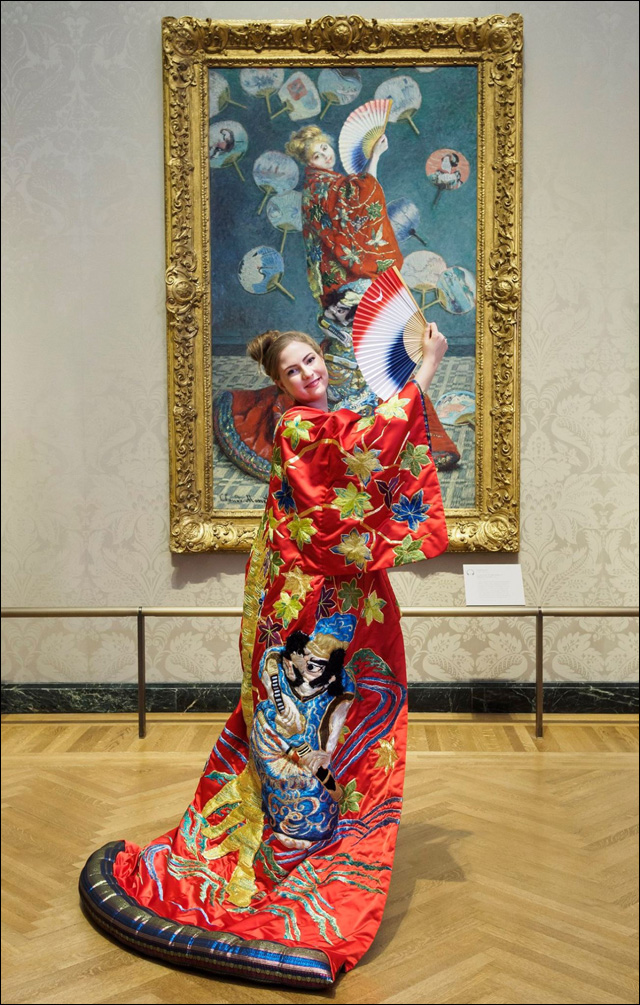
I did make it up to the Impressionist room to check out the Monet painting of his wife wearing a geisha that was the source of controversy earlier in the summer (in case you missed it, to recap, the museum, in some kind of marketing stunt that I don't really understand, was encouraging people to try on replicas of the geisha in the painting and pose for a *selfie* with it [the painting]. Some people protested that this was racist or imperialistic and the museum promptly ditched the promotion. I should note that when I arrived in the room, there was a twenty something man wearing a geisha with a group of about five other young people--they all looked Japanese to me but I don't really know--posing in front of the picture and getting a big laugh out of it. Unfortunately we could not stay long in that area because our mortal MFA enemy, the guard who looks like somebody sort of famous whose name I can't remember now** and who hates children, was working in the room and yelling at my children every two seconds for talking too loud, wandering off, reaching a hand threateningly in the direction of an exhibit. The last time we went he was working in the modern art area, which I thought the children would like but which was actually a bad idea because everything there looks to them like something you can touch. On that occasion I actually thought the guy might pull out a revolver and start shooting my four year old he was so worked up. But he obviously loves art, knows art, feels art, lives and breathes art, and we are really little better than a pack of animals descending on this sanctuary of real civilization, the symbol of everything most abhorrent to this man. There is no middle ground there. I wish I could describe this guy. He's pretty young, though he might be getting on to thirty by now. Very styled wavy froofy blondish hair, stylish black-rimmed 1962 glasses, knows how to wear a blazer. Excellent posture. Gay, I would suppose. And boy, does he hate us.
This was what the controversy was about.
Day 4: We stayed home and hung around the pool at the camp (the pool is a small in-ground pool that dates from the 1960s). I suppose I should note, for the sake of thoroughness, that there was swimming every morning and, if time permitted, in the evening after returning from our outings as well.
Some of the unamused protestors.
Day 5: By this late phase of the vacation people were ceasing to get along. Even under normal circumstances all of our games and activities, even when eagerly anticipated and nominally enjoyed, end in tears, accusations of cheating and deception, death threats; the early part of Day 5 featured all of this, but much more extreme than usual. It was decided that the group needed to be broken up, so I ended up taking a group of three to Mt Ascutney State Park, an easy hike that I discovered that was only 40 minutes from Brattleboro that we had not been to yet. Ascutney is one of the older state parks, dating from the 1930s, and consequently there is an auto road to within 0.7 miles of the summit, families, or at least women and children, one supposes, not being expected in those days to devoting the better part of a day in scaling a mountain. As with other of our activities, the increase in the family has had the result of our having to cut down on our ambitions with regard to hiking, at least for the time being. When my two oldest sons were four and five even we used to take on 2+ mile climbs, Mts Monadnock and Major in New Hampshire, Haystack in Vermont and a few others, but the younger children as yet have not demonstrated that kind of stamina, 1.3 miles being about the outer limit of what we can ask of them, besides that it is impossible for us to get out early enough in the day now to undertake a longer hike anyway. That said, the 0.7 mile stroll up the immaculately maintained and public-friendly Mt Ascutney trail after driving up the auto road past the numerous fitness warriors who are running or bicycling up the same feels about equivalent to going down into the cellar to retrieve a beer from the reserve fridge (I don't have a wine cellar per se. That is, my cellar would actually be an excellent wine cellar, only I don't have any actual wine in it). The mountain and trail are very pretty however, cool and shaded, lots of moss and northern birds such as woodpeckers and a bluish-blackish mountain bird that is attractive though I don't know what its name is. There is an observation tower at the top with illustrated signs telling you what other mountains and natural features are in view, and unlike what often happens in such instances, I really could make out the outlines of the other famous mountains. The summit gave me some satisfaction also, with its electric wires, communications towers and the abandoned bases of (presumably) a former fire tower playing off against the natural beauty. In the evening, after dinner back at the camp, we went home for the night.
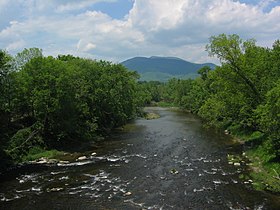
Mt Ascutney at a distance
Day 6. The vacation was not quite over yet though, as when we got up in the morning we had another fun trip ahead of us, to Wells Maine for an overnight camping trip. Our time there on Day 6 was taken up with meeting some relatives of mine from Pennsylvania whom I had not seen in several years who were passing through the area. This social interaction put a little strain on me but the other people enjoyed seeing the children, whom they allowed to use the pool at their hotel and bought pizza, and I got to hear some of the gossip from the extended family and the old social network, which I otherwise do not get news apart, as I do not have any of these people as Facebook friends, if they are even on there.
This guy is doing something right.
Day 7. This social visit out of the way, the last day was spent battling to find parking spots and then with the high tide at Wells Beach. My children got to go to the amusement arcade with an allowance of $10 in quarters apiece, and we also explored several of the gift shops near the beach, which made everybody temporarily happy, as that is all some of them wanted to do anyway, and the tension of not knowing whether or when these events were going to happen was the cause of excessive stress in the others. There is a large used book store on Route 1 that I keep intending to go to every time we go down there but there is never time. I went to it one time back in 1986 when I lived in Maine as a teenager, just a few weeks after I moved there, and bought a number of old classic type books from collectible sets that I still have, so the place has positive associations for me. We are going back for four more days this weekend, so maybe we will get there. One of my children (the sensitive one) did say that he felt bad when I did not get to go the last time. I took some consolation in getting a very fresh, crisp and vacation-y fried shrimp dinner from the to-go window of a restaurant on Route 1 before starting out for home. One thing I do miss with having all of these children is that we really cannot go out to restaurants at all, even apart from the expense. I am susceptible to videos like this one the New York Times put up about Martha's Vineyard the other day--how nice it would be, I imagine, to go to a gastropub, or some place exuding prosperity and brains and good looks in its patrons, or to a bar after dark (!) though my wife pooh-poohs all of these supposed social yearnings I have as vanities not properly considered. My shrimp was the only meal I had 'out' the whole week. When we to Boston we took one group of children to Subway and another to Sal's Pizza. I was supposed to get something at one of the cafes when we went to the MFA--that was going to be my special treat*, to indulge my ego and play the part of the kind of guy who eats light meals at museum cafes, complete with miniature wine bottle or $5.50 bottle of microbrew ale, but there was an issue with parking the two cars and the two parts of the group not meeting up for some time--for of course we don't have cellular telephones, though with each bumbling of this kind, my wife threatens to make us get them. It has come to the point now where it is something of an inconvenience not to have them, just because everyone expects you to, but it's also another expense, and I just can't take any more expenses.
The inside of the book store at Wells that I have not been able to get in to see
We were here.
While it is sad to depart from Maine on a Sunday night in the rain at the end of one's vacation, we live near enough (about 90 minutes) that it is always there for us to go back to, and indeed when it was over 90 degrees the following Friday my wife took the children back down (to York Beach) for the day. When school starts again I might even be able to sneak down to York for lunch and be back in time to go to work at 3. There is an old-style luncheonette there that looks like the kinds of places my grandparents took me to when I was a child, square tables with four chairs set around, paper place mats, wood paneling, lamps with yellow light bulbs in sconces on the walls, heavy curtains framing the windows. I've had a desire to go there for a number of years, but it has never been convenient. I know, I know, the real man makes sure everyone else is committed to making things convenient for him, or their presence is not tolerated. But I'm going to try to make it down there one day in early fall before it closes for the season.
Goldenrod Kisses, York Beach. Object of planned pilgrimage
*Doubtless some suspicious types will say: What about your wife? Doesn't she get to eat? But I assure you, my wife eats whenever and wherever she feels moved to do so. Lately she has taken to bringing her own food everywhere both for health reasons and not to be at the tyranny of whatever limits the food situation in unfamiliar locales might present her.
**Just remembered. The guard looks like Jonathan Franzen, the writer.
We did not go very far afield for vacation this year. Besides the matter of there being a baby, we have to go everywhere in two cars now, as we cannot fit the whole family in one anymore. Going anywhere also requires hours of preparation, making lunches, filling water bottles, filling multiple bags with bathing suits, towels, toys, etc. Also as the children get older and more numerous the threat of socially unacceptable behavior, conflict, etc, breaking out at any time seems to increase, and while I am somewhat accustomed/resigned to enduring social mortification if I ever want to leave the sanctity of my bedroom, my dear spouse is not. So our vacation mainly consisted going to our camp in Vermont and taking day trips.
Not counting the first day spent packing, cleaning the house, fixing the lawnmower/cutting the grass, doing laundry and finally around 7pm driving over to Brattleboro, the days of the vacation were passed thus:
Day 1: Drive on Route 9 West (VT) to the Hogback Mountain overlook and gift shop, and then onward 3 miles further to Molly Stark State Park and a 0.8 mile climb up Mt Olga. We had done this once before a few years back. We have actually climbed almost all of the easier mountains within an hour of Brattleboro at this point. The group had to be coaxed through this activity, as the younger children especially would prefer to be taken somewhere with amusements and junk food. I like those places too, but unfortunately it costs a lot of money to go to them with five children. After the hike my car was nearly out of gas, so rather than risk not making it back to Brattleboro (about 20 miles), I went a few miles further west and got the people who were with me got donuts or popsicles at the gas station, which seemed to be the highlight of their day.
The gift shop at Hogback Mountain
Day 2: Drive to Manchester, VT, about an hour to 75 minutes through the Green Mountain National Forest. Manchester is popular with the affluent, and consequently there are a lot of attractive restaurants, shops, inns, and restored/kept up hundred year old houses. We were not able to go into any of these places, though I had hoped to go the Northshire bookstore, which I had been to before and which is one of those places where you know you are surrounded by the right people, the ones who have achieved some mastery over the modern economy and education system. Their children's area, which takes up most of the upper floor, is considered by some to be the best in New England. But as it turned out, it was too late in the day and everyone was too tired and fussy at the end of the day's main activity, which was visiting Hildene, the summer estate of Robert Lincoln, son of the revered sixteenth president, and, as president (himself) of the notorious Pullman Railroad Corporation, a considerably wealthier man than his father, though one destined to be eternally dogged with the reputation of a lightweight in comparative character. His too open enthusiasm for golf--he served for a while as president of the local country club--expensive automobiles and (apparently) exploitative capitalism could not have been worse calculated to endear him to his father's most fervid admirers. As a tourist attraction, I was most impressed by the size of the grounds--the amount of land that they retain strikes me as huge, and the house, in its approach, layout, design, portal, furnishings, etc, are handsome in that 1910s-1920s way that is suggestive of weekend parties or endless summer days of lounging in windows reading or writing letters and waiting for it to rain. However, unless you paid extra for a guided tour, which, as it was already fairly expensive to get in, I opted not to do, you walked through the house and garden yourself, which normally I think I would like, but in this instance I did not know very much about the occupants of the house and what happened there, and there was no very informative written information to help with this, and also I had most of my children with me as I went through the house and was distracted by having to watch them (usually if there is a guided tour my wife and I will go on alternate sessions, leaving such children as are too twitchy to endure the ordeal to run around in the surrounding grounds). So I did not feel like I learned anything or had the satisfaction of an encounter with anything pleasingly intelligent, which was disappointing.
Hildene in the snow
They had a farm on the grounds with goats, sheep, cows, chickens, etc. The barns where these animals were kept were tended by young and very serious girls, whom I took to be college students who were studying something in the agricultural way because of this seriousness and because they were intelligent-looking in the college rather than the traditional country wisdom kind of way. I noted this because there are lot of girls of this type in these parts, in Vermont especially, and they reminded me of the kinds of girls I thought I might have been able to get along with when I was that age (because they were smart but not evidently fixated on clothes or money, which were areas of life that seemed at the time especially beyond any abilities I had to gain mastery over) but could never quite puzzle out either where they were or how I might ingratiate myself with them. Now that my oldest son is going into eighth grade I can already see that any verbal advice one might offer on these subjects is neither going to be welcome or adhered to--but I think the parent can still steer and expose the child as much as possible to the kinds of environments and activities where the parent thinks he will be most likely to meet the kinds of people whose association has a positive influence on him (assuming the parent is a competent arbiter of taste and his child's nature in these matters, of course).
Day 3: We went to Boston on day 3. I would have rested after the Hildene trip and gone another day, but this was a Wednesday, which is the day the MFA is free after 4pm. Since it is impossible for us to get out of any house before noon, the afternoon was well along by the time we got there. We stopped first at the Common, which was a hotbed of activity. There was some kind of festival going on (The Outside the Box Festival, the internet informs me) in various locations all around the grounds, which seemed to be celebrating diversity, tolerance, and left-wing politics, all things that are certainly outside the box for me (just kidding, though the credibility of any man with six white children can only be stretched so far with all of the matters and peoples that demand enlightened tolerance now). I took my older two sons to visit the Massachusetts State House, which we had never made it into before, while my dear wifey stayed with the younger children around the Frog Pond and the playground nearby. The sky appeared to be threatening thunderstorms all afternoon, which made for a great atmosphere, though potentially stressful with so many little children, but other than a few drops nothing ever came of it. The Massachusetts State House, or at least the older part of it anyway, was very pretty and inspiring in the classic state house style, and most of the people and events from the state's history memorialized in paintings or statues are readily recalled, certainly by me, and many even by the children. In contrast with the usual state capitols that are located in smaller cities (and less self-important states), the politicos, media people, and government employees milling about the building tended to move and scowl a little more urgently and brusquely than we are used to certainly in Concord, where the idea of the state house as the possession of the People still holds some sway. The scene in Boston was more like a mini-Washington D.C., especially with all of the television crews around (Even though we get all kinds of television crews in New Hampshire during the primary season, there is always a carnival atmosphere about it that was decidedly missing from the clench-jawed reporter we saw breaking down the day's political activities for one of the local TV news broadcasts). The contrast between the names and pictures all over the walls and staircases and ceilings and the current occupants of the building was hard not to remark upon. The Puritan strand, and even the old Boston Brahmin strand were nowhere in evidence among the living, at least those whom we saw.
The MFA is always something of a challenge with the children, but it is one of the better art museums in the country, and if I only get to really look closely, by whatever confluence of circumstances, at two or three things on a visit, it is usually worth it to me. I am actually thinking of becoming a member, since coming down on Wednesday nights is inconvenient most of the year now, and paying the full admission price for a single day's visit, for us, puts a certain amount of pressure on the visit, in the event that someone is unable to behave that day or whatever. Family membership is not that much for the year, for us barely more than two regular visits (I think I won't mention how many children I have).
I did make it up to the Impressionist room to check out the Monet painting of his wife wearing a geisha that was the source of controversy earlier in the summer (in case you missed it, to recap, the museum, in some kind of marketing stunt that I don't really understand, was encouraging people to try on replicas of the geisha in the painting and pose for a *selfie* with it [the painting]. Some people protested that this was racist or imperialistic and the museum promptly ditched the promotion. I should note that when I arrived in the room, there was a twenty something man wearing a geisha with a group of about five other young people--they all looked Japanese to me but I don't really know--posing in front of the picture and getting a big laugh out of it. Unfortunately we could not stay long in that area because our mortal MFA enemy, the guard who looks like somebody sort of famous whose name I can't remember now** and who hates children, was working in the room and yelling at my children every two seconds for talking too loud, wandering off, reaching a hand threateningly in the direction of an exhibit. The last time we went he was working in the modern art area, which I thought the children would like but which was actually a bad idea because everything there looks to them like something you can touch. On that occasion I actually thought the guy might pull out a revolver and start shooting my four year old he was so worked up. But he obviously loves art, knows art, feels art, lives and breathes art, and we are really little better than a pack of animals descending on this sanctuary of real civilization, the symbol of everything most abhorrent to this man. There is no middle ground there. I wish I could describe this guy. He's pretty young, though he might be getting on to thirty by now. Very styled wavy froofy blondish hair, stylish black-rimmed 1962 glasses, knows how to wear a blazer. Excellent posture. Gay, I would suppose. And boy, does he hate us.
This was what the controversy was about.
Day 4: We stayed home and hung around the pool at the camp (the pool is a small in-ground pool that dates from the 1960s). I suppose I should note, for the sake of thoroughness, that there was swimming every morning and, if time permitted, in the evening after returning from our outings as well.
Some of the unamused protestors.
Day 5: By this late phase of the vacation people were ceasing to get along. Even under normal circumstances all of our games and activities, even when eagerly anticipated and nominally enjoyed, end in tears, accusations of cheating and deception, death threats; the early part of Day 5 featured all of this, but much more extreme than usual. It was decided that the group needed to be broken up, so I ended up taking a group of three to Mt Ascutney State Park, an easy hike that I discovered that was only 40 minutes from Brattleboro that we had not been to yet. Ascutney is one of the older state parks, dating from the 1930s, and consequently there is an auto road to within 0.7 miles of the summit, families, or at least women and children, one supposes, not being expected in those days to devoting the better part of a day in scaling a mountain. As with other of our activities, the increase in the family has had the result of our having to cut down on our ambitions with regard to hiking, at least for the time being. When my two oldest sons were four and five even we used to take on 2+ mile climbs, Mts Monadnock and Major in New Hampshire, Haystack in Vermont and a few others, but the younger children as yet have not demonstrated that kind of stamina, 1.3 miles being about the outer limit of what we can ask of them, besides that it is impossible for us to get out early enough in the day now to undertake a longer hike anyway. That said, the 0.7 mile stroll up the immaculately maintained and public-friendly Mt Ascutney trail after driving up the auto road past the numerous fitness warriors who are running or bicycling up the same feels about equivalent to going down into the cellar to retrieve a beer from the reserve fridge (I don't have a wine cellar per se. That is, my cellar would actually be an excellent wine cellar, only I don't have any actual wine in it). The mountain and trail are very pretty however, cool and shaded, lots of moss and northern birds such as woodpeckers and a bluish-blackish mountain bird that is attractive though I don't know what its name is. There is an observation tower at the top with illustrated signs telling you what other mountains and natural features are in view, and unlike what often happens in such instances, I really could make out the outlines of the other famous mountains. The summit gave me some satisfaction also, with its electric wires, communications towers and the abandoned bases of (presumably) a former fire tower playing off against the natural beauty. In the evening, after dinner back at the camp, we went home for the night.
Mt Ascutney at a distance
Day 6. The vacation was not quite over yet though, as when we got up in the morning we had another fun trip ahead of us, to Wells Maine for an overnight camping trip. Our time there on Day 6 was taken up with meeting some relatives of mine from Pennsylvania whom I had not seen in several years who were passing through the area. This social interaction put a little strain on me but the other people enjoyed seeing the children, whom they allowed to use the pool at their hotel and bought pizza, and I got to hear some of the gossip from the extended family and the old social network, which I otherwise do not get news apart, as I do not have any of these people as Facebook friends, if they are even on there.
This guy is doing something right.
Day 7. This social visit out of the way, the last day was spent battling to find parking spots and then with the high tide at Wells Beach. My children got to go to the amusement arcade with an allowance of $10 in quarters apiece, and we also explored several of the gift shops near the beach, which made everybody temporarily happy, as that is all some of them wanted to do anyway, and the tension of not knowing whether or when these events were going to happen was the cause of excessive stress in the others. There is a large used book store on Route 1 that I keep intending to go to every time we go down there but there is never time. I went to it one time back in 1986 when I lived in Maine as a teenager, just a few weeks after I moved there, and bought a number of old classic type books from collectible sets that I still have, so the place has positive associations for me. We are going back for four more days this weekend, so maybe we will get there. One of my children (the sensitive one) did say that he felt bad when I did not get to go the last time. I took some consolation in getting a very fresh, crisp and vacation-y fried shrimp dinner from the to-go window of a restaurant on Route 1 before starting out for home. One thing I do miss with having all of these children is that we really cannot go out to restaurants at all, even apart from the expense. I am susceptible to videos like this one the New York Times put up about Martha's Vineyard the other day--how nice it would be, I imagine, to go to a gastropub, or some place exuding prosperity and brains and good looks in its patrons, or to a bar after dark (!) though my wife pooh-poohs all of these supposed social yearnings I have as vanities not properly considered. My shrimp was the only meal I had 'out' the whole week. When we to Boston we took one group of children to Subway and another to Sal's Pizza. I was supposed to get something at one of the cafes when we went to the MFA--that was going to be my special treat*, to indulge my ego and play the part of the kind of guy who eats light meals at museum cafes, complete with miniature wine bottle or $5.50 bottle of microbrew ale, but there was an issue with parking the two cars and the two parts of the group not meeting up for some time--for of course we don't have cellular telephones, though with each bumbling of this kind, my wife threatens to make us get them. It has come to the point now where it is something of an inconvenience not to have them, just because everyone expects you to, but it's also another expense, and I just can't take any more expenses.
The inside of the book store at Wells that I have not been able to get in to see
We were here.
While it is sad to depart from Maine on a Sunday night in the rain at the end of one's vacation, we live near enough (about 90 minutes) that it is always there for us to go back to, and indeed when it was over 90 degrees the following Friday my wife took the children back down (to York Beach) for the day. When school starts again I might even be able to sneak down to York for lunch and be back in time to go to work at 3. There is an old-style luncheonette there that looks like the kinds of places my grandparents took me to when I was a child, square tables with four chairs set around, paper place mats, wood paneling, lamps with yellow light bulbs in sconces on the walls, heavy curtains framing the windows. I've had a desire to go there for a number of years, but it has never been convenient. I know, I know, the real man makes sure everyone else is committed to making things convenient for him, or their presence is not tolerated. But I'm going to try to make it down there one day in early fall before it closes for the season.
Goldenrod Kisses, York Beach. Object of planned pilgrimage
*Doubtless some suspicious types will say: What about your wife? Doesn't she get to eat? But I assure you, my wife eats whenever and wherever she feels moved to do so. Lately she has taken to bringing her own food everywhere both for health reasons and not to be at the tyranny of whatever limits the food situation in unfamiliar locales might present her.
**Just remembered. The guard looks like Jonathan Franzen, the writer.
Wednesday, July 29, 2015
A Few Oddities About My Childhood Baseball Team
The team referenced would be the Philadelphia Phillies, particularly the years from 1979-83, when I was age nine to thirteen, and followed the sport most intently.
In 1979, the Phillies signed a soon to be 38 year old Pete Rose to a 5-year, 4 million dollar contract (a huge number at the time). This goes against every tenet of sound modern baseball analytics, according to which Pete Rose even in his prime probably would not be regarded as a superstar player. Yet looking back 35 years later, with all of the sober maturity and wisdom that developments in understanding baseball statistics have brought us, I still regard that signing as a great triumph, for the first two years alone. In '79 he was still the same Pete Rose he had been in Cincinnati for the previous 15 years--162 games played, .331 average (2nd in the league), 208 hits. In '80 his numbers slipped some, but the Phillies won their first ever World Series, which is what he had been primarily signed for in the first place, and as somebody who followed nearly every game that season I don't believe they would have accomplished that without Pete Rose. I have expanded more on this below. '81 was the strike year, and as such kind of a waste of time, but Rose still hit .325 and finished 2nd in the batting race at age 40. In '82 he began to drift towards mediocrity, but was still a plausible everyday player. It was only in the last year of the contract that the fans began to perceive that he might be a liability, and the team managed to win the pennant anyway.
While a lot has been written over the years about what an awful person Pete Rose is in addition to details of his crimes and sleaziness and moral offenses, I have always retained my affection for him as a ball player. I have no doubt that he has never cared much about other people's feelings or dignity, but as with a lot of successful people, I'm sure he would consider that those things are not his department. If you can't uphold your dignity on your own, better lie low in life and don't try to run with the big dogs, that sort of thing. I may well have hated him if my 9-13 year old window had coincided with his glory days with the Reds (as it was, I hated Gary Carter and Steve Garvey above all other players in this 1979-83 era, though I have had the satisfaction of seeing Garvey, aside from all the ridicule he later endured for impregnating too many women while still married, which I don't care about, have his regard as a great player thoroughly squashed by modern analysis). As a player on your team, Rose was very exciting, because he was a star with credibility, and he made every game feel like it was an important event because he was in it.* He also always made me feel like if the Phillies lost or failed it at least would not be because he was not inherently a choker or loser, as had been demonstrated over his long career with Cincinnati.
*(I say a star with credibility because he was regarded as such, or seemed to be, by the national media, even though the Phillies at the time he joined the team had two established superstars in the midst of Hall of Fame careers. Mike Schmidt had probably already been the best player, or in the top three anyway, in the National League for 4 or 5 years going into the 1979 season, but no one in the national media, and especially in the Philadelphia media, seemed to know this, at least that I could pick up on, the dominant narrative surrounding the team then being how they kept losing in the playoffs (and then finishing a dismal 4th in '79). Steve Carlton, the ace pitcher, who we will discuss later on, was generally acknowledged to be really good (though seemingly not as good as Tom Seaver or Catfish Hunter or other pitchers from more glamorous franchises), but he was a weirdo, and there seemed to be skepticism both in Philadelphia and around the league as to whether he could deliver in a playoff or World Series setting).
I Never Heard My Baseball Team's Ace Pitcher During the Entirety of My Childhood Speak One Single Time. When one considers the current media environment and oversaturation of sports coverage, this is almost amazing, but it is true. Steve Carlton stopped doing interviews and talking to the press in 1974, well before my time, and he never went back on this while he was with the Phillies (later on some stories came out about him in which he revealed himself to be one of these paranoid people who built his house in an underground bunker and openly admits to believing that the world is controlled by a small clique of Jewish bankers, but this is irrelevant to my posting here). Of course every game was not on television in those days. Home games were only on on Sundays, and usually one game in each road series would be left off also. I listened to a lot of the games that weren't televised on the radio however, and through all of those years, the voice of by far the best pitcher on the team, and by that point in the entire league, was never heard, and by the late 70s it was so accepted that no one talked about it much anymore.
This Phillies at this time by the way had one of the all time great broadcasting teams, Harry Kalas and Richie Ashburn, who had been a star for the team during the 50s and would later be elected to the Hall of Fame. Both of these guys were still working when they suddenly died in the middle of the season, Ashburn around 1997 and Kalas in 2009. By all accounts the team has never been able to adequately replace them. In fact, the last time I was in Philadelphia during the baseball season, which was a couple of years ago, there was a big story in the paper about how especially with the team declining, following the games on radio or TV for all the fans who grew up on Kalas and Ashburn was almost brutal. At that time, they had three former players calling games on TV, at least two of whom struck me as being decidedly of the meathead type. (Ashburn, though an ex-jock, always exuded a relaxed, mature persona, I would say grandfatherly, because he actually talked a lot like my grandfather, who was also from the midwest and was about the same age, etc).
Back in the 70s Especially Teams Used to Keep Older Players on the Roster Who Were Most Notable For Being Clowns, or Friends of the Manager, or Whatnot. This has almost completely gone away due to costs and the emphasis/importance on always building for the future in all areas. No one has 38 year old bench players around anymore, though this used to be common, perhaps especially in the National League, where you usually need a pinch hitter at least once a game. Among the many ancient players long past their days as regulars who put on uniforms for the Phillies in this era were Jay Johnstone, Tim McCarver (Steve Carlton's personal catcher), Del Unser, Jose Cardenal and Tony Perez (Joe Morgan also joined the team at age 41 but he started at second base, with the 42 year old Rose as the other regular on the right side of the infield. That team still won the pennant). Tommy Lasorda and the Dodgers also always had guys of this ilk: Manny Mota, Mickey Hatcher, Rick Dempsey, who hit .179 and .195 at age 39 and 40, though I suppose he was still a serviceable catcher. Johnstone went and played for Lasorda after leaving the Phillies. The Mets had Rusty Staub, who had been good in the early 70s, but by the time I came along was an exceptionally fat and almost immobile pinch hitter (who could admittedly still work a walk).
I've got other topics I could bring up, but I'll save them for another occasion. A few clips on parting. First, Harry and Richie get warmed up for the decisive Game 5 against Houston in the 1980 NL Playoffs:
This is from the Chicago network, but these are highlights from the famous 23-22 game the Phillies won at Wrigley Field in May of '79. That's my team out there in about its purest state.
Labels:
1970s,
false nostalgia,
memories of misspent youth,
sports
Saturday, July 11, 2015
Maybe the Most Classic Movie Post Yet (1933-1940)
The Grapes of Wrath (1940)
I have never gotten around to reading the book yet (though it appears on all of my lists eventually), nor had I seen the movie until now. It was probably time for one of them. The film was satisfying to me. John Ford of course directed it, though I have still not had that moment of profound, I-see-the-light connection with his personal style. It is more that I like most of the studio productions I see from this specific period, the prewar pinnacle from '38 to '41 or so. The images and sensibility they present, of the landscape, of the people, of history, of literature, still inform the ideas of much of the common mind with regard to all of these subjects. It was a transitional period, which will be a theme throughout this post. For me at least, the people in movies in 1930 and the world they inhabit seem quite remote and foreign, but by 1940 these have become very recognizable--in many instances almost more so than the present.
I liked the presentation of the road trip--Route 66, passing the state capital in Oklahoma City, how the road was unpaved when crossing into Arizona, the roadside diner, the bridge at Needles, the desert. Some hardcore critics have complained, as someone always must, that the real hardships and poverty of the Okies were softened to be palatable for the public, but I think their circumstances as presented here are plenty grim. Movies that insist on being relentlessly miserable also tend to kill in me any hopefulness that improvements can be effected. I liked the beginning scenes in Oklahoma too, they they are reminiscent of the Kansas portions of the Wizard of Oz. I thought the tone was a good one to take, the emphasis on these people being Americans and having cultural and linguistic affinity with both the filmmaker and the audience, and the confidence that the government, representing the greater nation, could have a positive role in mitigating some of the really ugly consequences of the economic situation (as represented by the much more pleasant and competently organized government camp--with showers!--that the family is able to stay at near the end of the movie).
Mutiny on the Bounty (1935)
Another real monument, eminently watchable and crowd pleasing. an early realization of the finely polished Hollywood product that we all know. We also have the irrepressible Charles Laughton starring as Captain Bligh, though while he still gets some good lines ('Clear the deck of this r-rrrabble"), he does not have quite the free range to completely take over the character of the film the way he does in many of his other roles. I really notice in this movie and the two below the jump, or break, as some might see it, that took place in film production from 1933 to 1935--those in the latter year seeming so much more modern in terms of dialogue, mood (superficially at least much less dark), humor, what constitutes attractiveness in women, the stars such as Laughton and Clark Gable still have a general resonance with modern audiences whereas some of the earlier stars do not. I mentioned in an earlier post (on Baby Face, I think) how I was struck by the general crassness and slatternliness of the pre-code era films in contrast with anything that has come since, even the self-consciously edgy movies of the post-1970 era. The Code doubtless is responsible for a lot of these changes, but perhaps, in certain areas, it had a positive influence. It did raise the tone of movies, and one suspects of public discourse in general, as far as the mass mind was concerned.
The part where the daily log is read when Bligh and those loyal to him in the castaway boat have been several weeks on the open sea and are out of food and water, with no immediate prospect of finding land, essentially dead men floating, and it is noted that all there is left to do is to pray to the Almighty for deliverance struck me as noteworthy, for this is precisely the kind of situation at which modern intellectuals, or the more comfortable ones at least, are fond of pointing out as a demonstration of the absurdity of the idea of a higher power, conscious or otherwise, that takes the slightest hand in human affairs. Yet it makes perfect sense that if a man were really reduced to the woeful state that the castaways found themselves in, that prayer, or something akin to it, would be almost the instinctive response. That does not mean that it is 'true' or that it proves the material or objective supernatural existence of anything, but the impulse in such instances is a profound one and means more in terms of the human experience than perhaps some people appreciate.
This was based on an at one time famous book as well, though I don't think it is read much anymore.
Dinner at Eight (1933)
Now in two years we are back practically in another era, not just in the movies of course but in American history, as doubtless along with the code the Rooseveltian political ascendance and the more hands-on, technocratic approach to governing and its underlying aims that Americans began to accept after 1933 had no small influence on the character of films. Based on a hit play by George S. Kaufman and Edna Ferber, who were big name writers at the time, the movie was an extravaganza full of huge stars who were at the peak of their fame at the time, most of whom however would be facing has-been status within a couple of years. John Barrymore, one of the greatest American actors ever and in my top ten favorite male stars, though I had only seen him before this in two movies (Grand Hotel and Counsellor at Law), in both of which he was magnetic, is in this, though he was not his usual awesome self such as I was expecting. And indeed, many historians of the movies note this particular film, in which he plays an alcoholic has-been actor having an affair with a woman half his age that apparently was a mirror of his own place in life at that time, as the beginning of his decline. This is my first time seeing Marie Dressler, a blowsy, overweight, middle-aged vaudeville veteran who was the number 1 box office star in the country in 1932 and 1933. Her persona in this was as a wise-cracking, seen it all, worldly wise artistic mother hen with a big heart. My impression was that her shtick was a little overplayed, but that was the vaudeville style. She actually died of cancer in 1934 at the height of her fame, but it is hard for me to see her maintaining her status as a top draw as the 30s wore on. Jean Harlow, who was one of the major 'sex symbols' (I thought today that this was an odd expression; but then as I don't especially like most of the people who are designated as symbolic in this way, it is perhaps because the term does not strike me with significant meaning) of the 30s, famous for her pussycat pouting, platinum hair, and the pointedly underdeveloped intellects of most of her characters, is also here. Not really my type. She died (at age 26!) in 1937, at which time she was still a pretty big star, though I have not heard of most, if any, of the movies she was in.
The story in this, as well as its tone, definitely belong to that side of the 1930s cinema that I find to be strange, of enormous doors and lavishly furnished rooms that look as if no one ever occupied them, of naked social climbing and social misery, and a certain blunt honesty about people's sexual and financial interests. The movie is of interest as a glimpse of its time, and of all of its so soon to be vanished megastars, and if Netflix ever sends me a DVD of it (I had to check it out on early 90s era VHS from the library) I will certainly watch it again and see if I can get anything more from it.
King Kong (1933)
Probably more important and epic for the sci-fi/monster/special effects aficionado, but it is certainly historically iconic, and I feel like I have achieved the next level in my progression as a movie buff in having seen it. Speaking of seeing it, have the PC police checked this out lately? I would advise them to skip it, but I get the sense that a lot of them feel a thrill of righteousness and vindication in seeing what they know all white people really perceive exotic peoples and countries to be like anyway depicted on the screen.
There was quite a bit of material in the extras about the director, Merian Cooper, who was the kind of daredevil, hyperenergetic, independent, endlessly resourceful and creative American male specimen that seems to have especially flourished in the early decades of the 20th century, at least I am discovering more and more individuals who broadly fit the type. A fighter pilot in World War I, Cooper was shot down and taken prisoner, knocking him out of action for the remainder of the war. His appetite for fighting not quenched (thus joining Hitler as the only men I am aware of who did not get enough of World War I), he went and joined the Poles in their fight for independence against the fledgling Soviet Army, in which conflict he was taken prisoner again. He escaped from Soviet prison, where his life was only spared because they did not realize who he really was, and made his way back to the United States, where he and his friend and collaborator Ernest Schoedsack took up documentary filmmaking, making intrepid ventures to places like Iran and Thailand and Sudan that were scarcely on anyone's radar in the United States in the 1920s. In addition to producing many films, especially numerous of John Ford's classics, he became an off and on executive at MGM and other companies. When the United States entered World War II he immediately re-enlisted in the Air Force and directed numerous bombing raids in Japanese held areas of China, rising to the rank of brigadier general. One could go on, but you get the general idea. And this guy is not someone who is really all that well-known, even as the director of King Kong, which is what he is most famous for.
I also watched Odd Man Out again, as Netflix finally sent me a disc of it, from the Criterion Collection too. My second impressions are, above all, that it is one of the most gorgeous movies I have ever seen, which is all the more remarkable when you consider that much of it was shot in Belfast (with the remainder in London) in 1947, a time and place not thought of at the time as being beautiful, but in contrast with today's world there is an elegance in day to day common speech, clothing, cityscapes, customs and the like that hold a deep attractiveness to a person like me. This atmosphere, more so than in The Third Man (which was Carol Reed's next film after this) is what makes the movie what it is.
Saturday, July 04, 2015
Some Brief Book Notes
I finished The Brothers Karamazov recently. It was very different from what I had always imagined it was. It is a fine book and all of that, especially in terms of characterization, but I was surprised by how little in the way of incident and episode the book consisted of. It did not exceed or really fulfill my expectations of it, which were extremely high, on a first full reading. Yet when I read the first 300 pages as a college student I remember feeling at every instant certain that it was the truly great book it is celebrated as being, and I did not really feel that going through this time--when I reached the 300 page mark, which is right around where the Grand Inquisitor episode starts, I noted that my sense of the book was completely different from the way I had remembered it and I wondered what had happened to me. Even the Grand Inquisitor section, so celebrated, did not resonate deeply with me. Maybe I am too cut off from the habits of life and thought needed to take in these books now, or I have grown to distrust them. I am going to be reading this again in a couple of years for my other list, and I plan on that occasion to immerse myself in it a little more deeply than I did this time, when I was more interested in seeing what effect it had on me and what I would get from it as myself, without making any special concessions or adaptations to understand it. But that proved to be not wholly satisfactory.
After finishing Karamazov I moved on to the lesser known Thomas Hardy novel A Laodicean (from 1881, almost exactly contemporary with Karamazov). I am something of a fan of Thomas Hardy at times. I like the atmosphere of the Thomas Hardy world, the slowness and almost eternal quality of it. A Laodicean is, ironically perhaps, in large part about the changes in the way life was lived during the 19th society, but the pace and scale of the change will strike the 21st century reader as modest, and, as recorded in the book, quaint and even kind of romantic. The story takes place in a castle that has been purchased from its owners since time immemorial by a railroad magnate, who has died, the possession passing to his intelligent and attractive twenty-something daughter. A telegraph line has been run into a cozy office set up in one of the castle's turrets, that comes crackling to life once or twice a day, and the young owner, since she has to live there at least part of the year, is contemplating a renovation of the decrepit castle to bring it up somewhat to a 19th century standard. The main occupants of this castle most days are the young owner, her friend and companion, who is a member of the dispossessed aristocratic family who formerly owned the castle, and the young (male) architect who has been employed to carry out the renovations, a process expected to take the better part of 2-3 years. All of these people are intelligent and attractive, and the minor characters--clergymen and other member of the local society--are reasonably bright and presentable as well. There are as yet none of the wretched, obviously doomed sort of person who occupies the more well-known Hardy books. I assume something excruciatingly awful is going to happen to someone eventually but it has not become apparent what this is going to be yet.
I am tempted to try to wrestle more with the big contemporary political issues, especially all of those that in my heart of hearts and brain of brain I am on the wrong side of (which is most of them), but hopefully a time will come where I will hit on the right ideas to make my position intelligible to someone, for it must be that at some level. (See, I am falling asleep now, and I don't want to wait a month to post this while I sort through the origins and ongoing basis for my political beliefs and reactions...)
Friday, June 12, 2015
Movies, 1969-1990: Unifying Themes: Societal Repression, The Cosmic Illogic Inherent in Money Ownership & Power Relations
Ju Dou (1990)
Early offering from the Chinese New Wave of the 1990s that produced many fine pictures in the classic art house tradition, much appreciated by me. This starred the soon to be legendary Gong Li, who amply demonstrates why she became a huge star and the international face of Chinese art cinema in that decade. I saw her in some other films (though not this one) at that now distant time, but I had not been struck by her talents as I was on this occasion. Perhaps it is because I am older or this is a better performance than the other movies I saw, or maybe having watched the social evolution of people from all over the world in the last twenty-five years I am simply nostalgic for the time and personalities of my youth. I believe this is the first Chinese movie from that 90s Wave, which I guess must be long played out by now, that I have seen since they were relatively new--judging by this, they are holding up well, but as noted above they always had a timeless, universal, classic air about them.
As you have probably discerned, this is very much the kind of movie that I like, and the kind that will always work if well-executed (ed--because it is like a literary stage play), in that it is a simple story, in which the number of characters and the actions/possibilities open to them are severely restricted due to social mores/physical disability/social status/power/duties, and so on, but several very clever and not obvious twists take place within these restrictions that besides constituting the plot heighten the interest in the story by creating possibilities and conflicts that given the bare outlines of the situation one would not have been foreseen but which are in fact the kinds of developments that do come up in life in almost every individual instance to some degree and constitute most of its drama.
I had to watch this on Youtube, as I was not able to procure a copy of any recording either free or inexpensively via the usual means (the computers I use are still plugged into a wall, and where they are is not my favorite place to have to watch a movie.
Sugarcane Alley (1983)
In French, set in Martinique in the French West Indies (which remain to this day a colony of France). The director was Euzhan Palcy, a native of the island and, as people like to note these things, a black woman, which latter fact I had not known when I saw the movie, as the style seemed to me in line with what was typical in mainstream French cinema at that time. The film is based on a novel, Rue Cases-Negres, which is usually translated as "Black Shack Alley", by Joseph Zobel, who was also a Martinique native. It is about the hard, materially impoverished lives of the black laborers who work in the sugar cane fields, and the struggle of one of the boys of the village to win acceptance to and attend the colonial school in the main city on the island.
The movie certainly has value for its atypical setting and characters, and the presentation was tasteful, though as noted above the attitudes and assumptions and aesthetics it seemed to promote I did not find noticeably different from what seemed to prevail across the general spectrum of respectable haute bourgeois French opinion in 1983. Palcy, the director, was only 25 at the time and a first time filmmaker, after having come to Paris at 17 and taken degrees in French literature, theater, Art and Archaeology, and film; so it is fair to speculate I think that her brain would, at the time she was making this film, have been pretty well saturated with the outlook prevalent in the Parisian intellectual world. I did not find any unanticipated pleasures or twists in it. As the main drive of the movie is effectively about escaping from Sugar Cane Alley and being able to lead a wholly different kind of life this prevents the viewer, I think, from taking too much of an interest in the life of the characters stuck there, apart from the usual voyeuristic one. This is in contrast to Ju Dou, which is able to generate, by zeroing in on certain pertinent aspects and and curiosities of individual situations, a considerable amount of interest and drama out of lives lived in circumstances at least as suffocatingly narrow as those in Sugarcane Alley. This bit of skill in my opinion was missing from this movie.
The Stunt Man (1980)
I probably should have watched this a second time, as I began to sense towards the end that there was something in it that might be interesting that I was not picking up on. This is a different kind of movie from a different kind of time, and a time that I have a pretty solid memory of (I was ten years old in 1980), the mores of which, probably to my detriment, probably still inform my sense of what the world must actually be like even today. As I went along with this movie my mind, which was doubtless tired to begin with, often got sidetracked by recollections of the moods and attitudes of that era and neglected to pay close enough attention to the story. So I barely even remember what it was about.
1980 of course is now clearly seen as the last year of that drifting, indulgent, minimally organized period that followed upon the social rebellions of the late sixties, and some of the signature behaviors unleashed during the period, such as drug-taking, divorce, rates of violent high crime and underachievement as a political statement had ceased to be novel energies adding excitement and subject matter for conversation to the national life but were settling in as the banal normal order of life that the dullest people could take for granted. Of course these behaviors did not end or even begin to substantially decline in 1981, but it does seem that with the election of Reagan and his immediate slashing of the highest tax rates from 70% to 28% and his general unabashed cheerleading of money-making and striving that a tighter order began once again to be imposed on society from above. It was fairly imperceptible at first and to me at least did not really come into any sharp view until the 90s, but it was enough that it made some of the drifting and indulgence that had characterized the 70s seem suddenly less desirable or likely to lead to anything really interesting.
Apropos of nothing, Peter O'Toole in his old age somehow came to look just like my grandmother.
Barbara Hershey was the babe in this movie. I haven't seen her in much and don't have much of an opinion about her, except that she gives off an aura of always expecting more from you where she is concerned while she considered herself to be perfectly sufficient as she is where you are concerned, which is obviously more than I can successfully undertake in any interpersonal relation. She was (and is) very popular as babes go among the men of the 1970s generation. They are quite devoted to her.
Butch Cassidy and the Sundance Kid (1969)
This one speaks I guess to the virtue of seeing something a second time. The first time I saw this, which was some years ago, I didn't see what the big deal was, and I especially couldn't figure out why it had been so popular. I let what I perceived to be its archness--archness being something I detest--get under my skin, and it prevented me from being able to appreciate some of the finer points of the movie. It is really quite well-made, has a good script, a very good story, is quirky, and is not, I think, so arch as I thought it was previously. In truth, it was better than I had anticipated it would be even before the first time I saw it, as I was predisposed against it because I knew the baby boomers liked it, it was seen as transgressive against old Hollywood and so on, but of course now it is obvious that it is much more in the tradition of what everybody likes about old Hollywood than almost anything being made now.
This movie has been written about ad nauseam, and I don't have anything pertinent to add to the existing body of work, but I am glad I am still capable of seeing something differently, and in a positive sense, on a second viewing.
This was supposed to be a really short post describing my most basic, even animal responses to these movies, and perhaps it is, but it once again still took a week to write.
Friday, June 05, 2015
Blogging Practice
I wanted to put a song in this post, but among the many activities I have had to (further) cut down on recently is digging around for old songs online. Also my main computer at home now has, for the benefit of the children, a gigantic security block on it which forbids access to any website that might contain anything offensive or inappropriate, which includes Youtube, Google images, and the like. Obviously I could either summon up the energy to figure out how to undo the block for my personal use and put it back on again when I am finished, or I could just buy myself a tablet (especially seeing as everyone else in the family over age 5 already has one for him or her-self) that I could theoretically do all kinds of private things on; in the second instance though I ultimately don't think the extra expense is worth the potential pleasurable reward at this point.
I went out to the movies last week with three of the children, something I only do about once or twice a year. One of my sons, the one (so far) who has been diagnosed as being 'on the spectrum' had for some reason which he never explained to me a very strong desire to see Tomorrowland, which has gotten, accurately, pretty mediocre reviews as a story, though there were some parts at least where the expensive production values saved the experience from being wholly unsatisfying. Anyway, it is unusual that any of my children express such an interest in seeing anything, so I was curious to go, besides that I always enjoy an excuse to go out among the public, going to the movies is a venerable tradition in our country, etc, etc. The children got pins associated with the movie as a promotional gimmick when we bought our tickets--silly, perhaps, and obviously intended to be manipulative, though I don't remember ever getting any kind of souvenir or door prize at the movie theater when I was a boy (though I certainly encountered plenty of references to them and wondered what they were), so I appreciated the gesture. This movie has tanked at the box office. There were about twenty people in the theater, besides us, on a Saturday night on its second weekend of release. I'm very curious as to why my son wanted to see it so much. He wouldn't tell me, even though he asked me if he could go every day for two weeks. I am guessing somebody at his school must have talked about it in a way that made it seem desirable. The children all seemed to enjoy it, at least the outing gave them something to talk about. I think the plot was a little convoluted for my six year old, but he appreciated the magic parts and got some material for jokes to be used later in the week, so the experience was not wholly lost on him either.
I had a longer exposition I was going to slip in here but I think rather than let another week go by I will just post this little bit to make the site seem as if it is still active.
Subscribe to:
Posts (Atom)