A few leftover pictures from last summer. I went to Florida in February, after a year's hiatus, and it is something of a tradition to do a couple of sets of pictures from these trips, even though they are always pretty much the same thing. However at the moment they are all still on the camera, as I don't know, or can't remember, how to load them onto the computer, and my wife has been too busy to tell me again how to do it or to do it herself. I have another week off coming up at the end of April. I don't have any plans for this, though I was hoping to go to New York for a couple of days. We really all should be going to New York at least twice a year, even though it's expensive. In truth, it would not even be that expensive if we could stay in a more or less regular hotel room, but trying to find a place that will take 7 people seems destined to catapult the rate back into the problematic range. Life is fleeting. I know, I have spent a total of about 9 hours in New York in the last decade despite continually having some plan or other for going there. Yet it always gets put off, usually for some reasonable cause, but nonetheless I am now 42 and I still have a certain number of days I would like to spend there in the ever shortening time left to me. So I hope it works out.
Tuesday, April 10, 2012
A few leftover pictures from last summer. I went to Florida in February, after a year's hiatus, and it is something of a tradition to do a couple of sets of pictures from these trips, even though they are always pretty much the same thing. However at the moment they are all still on the camera, as I don't know, or can't remember, how to load them onto the computer, and my wife has been too busy to tell me again how to do it or to do it herself. I have another week off coming up at the end of April. I don't have any plans for this, though I was hoping to go to New York for a couple of days. We really all should be going to New York at least twice a year, even though it's expensive. In truth, it would not even be that expensive if we could stay in a more or less regular hotel room, but trying to find a place that will take 7 people seems destined to catapult the rate back into the problematic range. Life is fleeting. I know, I have spent a total of about 9 hours in New York in the last decade despite continually having some plan or other for going there. Yet it always gets put off, usually for some reasonable cause, but nonetheless I am now 42 and I still have a certain number of days I would like to spend there in the ever shortening time left to me. So I hope it works out.
Friday, March 30, 2012
I had been working on a post for over a week and no matter what I did with it it kept coming out bitter, negative, and half-baked. I suppose that is indelibly what I am at this point, in all matters requiring the use of the brain at least, but no one will want to read such dreck.
(Although I want all the interesting or good-looking people I have ever known to be my friends on Facebook and to entertain me with their own pictures and piquant comments, I don't participate very much myself in return. Like most things on the internet, and modern life for that matter, it is too fast, or gives the sensation of being too fast, for me. This mode of communication works best when it can take the form of a conversation, at which form I am unfortunately even more exceptionally maladroit than I am at essay or letter-writing. Once or twice a day however I will come upon a subject on which I might be able to make some remark, and one in which I can even imagine a few people might take pleasure, though usually I refrain, and this, usually, is the proper course. I am almost never in sync with the general mood as far as my current thought process goes in any way, which is discouraging enough; but the near certainty that I would be exposed as the social media equivalent of the forkball hanging over the middle of the plate to anyone possessed of a more solid grounding in the fundamentals of either dynamic thought or social discourse--both is almost too terrifying to contemplate--is even worse. Still, sometimes, especially after a period of silence of one or two weeks, even these considerations are overruled by overweening self-love or some other inexplicable impulse to expression.)
This was the start of my post, which, while it very much inclines to negativity and bitterness, does not quite abandon itself wholly. The best that can be said for it is that it is a reasonably honest bit of introspection, which is, however, an inferior literary form in most instances. It did not take long for me to go entirely off-track:
(Such an occasion came up recently when my old school-friend [I would say school-chum but I don't think that is an approved term at our school] and avowed sometime reader Virtual Memories posted a link from the popular Marginal Revolution blog that is written by a trio [I believe] of indefatigable and intellectually and culturally omnivorous professors from the ascendant economics department at George Mason University, in particular Tyler Cowen, who is by my estimation the dominant presence personality-wise on the site. I had read this site in the past, both as it is frequently linked to by a variety of sources, and also occasionally as a general anonymous lurker, as Tyler Cowen especially often wrote about the sorts of things I am interested in. He started to annoy me rather quickly however, as I found the particular relentlessness of his expertise was making it impossible to derive even my usual pitiful quantity of enjoyment from any subject once he had had a go at it. My comment, pounded out rapidly in a rare burst of some kind of obviously viscerally felt heat, was as follows: 'I have to admit, this article encapsulates why I stopped reading this guy. I suppose it's plausible, if you are very knowledgeable and attuned to such things, that once in a while you might note something really important in a work of art that everyone else seems to have missed. With this guy it seems to happen about five times a day, even sometimes in things people have been reading or studying for 200 years, and always with absolute certainty on his part. Even if he is right in this instance, I can't stand the sneering tone towards the western critics who missed the references to Sikh theology in a Julia Roberts movie. It's petty and unmagnanimous. I know it's a characteristic of intellectuals since time immemorial, but in certain instances it is really uncalled for. We're not talking about missing blatant Hamlet references here. And as is usual with him, there is so much that the reader is supposed to take on his authority--like that he actually understands anything about Sikh theology himself--I got to stop, but the man annoys me to no end...')
It is true that I do not like the tone with which he writes, or travels, or eats, or otherwise experiences his almost unbelievably rich mental life, even if they happen to be in some manner correct, but so what? Today's smart and urbane people love the guy. He's everywhere (on the internet, anyway). He is evidently a perfect man for this time, of such a quality as I never foresaw, or recognized as the genuine article anyway, coming up in the world. He is by most expert accord not only a bona fide economist, but a very high level one in an age when a professional knowledge of economics is almost unassailable as a possession of truths that the non-specialist must accept and cannot credibly contend against, and this is not limited to me but seems to extend into the highest reaches of academia, the arts and even the government. He certainly has his messages and ideas in order, and ready to fire off at a moment's notice. I can't seem to be impressed by him, or trust that there is wisdom or important meaning in anything he says, though doubtless this is only significant of deficiency on my part. He is also an enthusiastic globalist, which perhaps is the inevitable and ultimately most desirable system for the greatest number of individual people, though as it does not seem especially suitable either to my temperament or my money-making skill-set or my social inclinations compared to a less globally-interconnected system, I cannot say that his relentless promotion of the various wonders that have resulted and will continue to result from this trend are having much of an effect on my attitude.
My friend responded to my outburst by linking to another article, about the old Allan Bloom book The Closing of the American Mind, which upset lots of people at the time it was published because, as I do with Tyler Cowen, they came to understand it as a devastating critique of their own wasted lives and lack of serious intellectual development or purpose. I obviously was, and am, a perfect specimen of the type of student of my generation that Bloom found so debased and devoid of any recognizable spark of life, though at the time I doubtless would have thought I could read or music-appreciate my way out of the worst of the cesspool easily enough. Bloom obviously was contemptuous of the general run of half-assed wannabe scholars, and I assume he would have been fairly cold to them if they had presumed a too great intellectual intimacy with him. There were a number of tutors at St John's who had studied with him either at Cornell or Chicago, one of whom at least was reputed to be one of his carefully vetted proteges, and they were fairly chilly towards me. They were cordial enough, and I suspect they adjusted their evaluations of me based on what they perceived my abilities to be, which was of course nothing too high; it was not difficult to notice that they altered the level of their conversation, their paper critiques, even humorous banter, depending on whom they were dealing with. You would think this would have torn me up more than it did, but I had to a certain extent bought into their value system where the life of the mind was concerned and knew that I was not living up to it. I did not necessarily want to be exactly like them either--though in later years I have come to realize it may have been a mistake, I had no great desire to develop personal relationships with my teachers when I was young--but I more or less accepted that they were going to judge me on terms that I was not at the time really equipped to perform up to, and sought elsewhere, among peers or the lighter realms of literature, for more realistic models to strive for.
As far as this relates to Allan Bloom, for one thing both his being dead and the ever increasing distance of time between his generation and ours makes him less personally threatening, if that is even the right word for what he is. His ability to affect my life negatively by convincing me, from a position of unassailable authority, with the whole of Greek literature ranged at ready attention at every portal of his brain, of all of the ways in which I am little better than garbage, is much weakened. (There are other traditions, multitudes of traditions of venerable standing, pre-dating and entirely free from the 20th-century, predominantly and deeply Jewish-influenced interpretation of everything of a remotely intellectual nature that has probably overinfluenced, as well as confused me, relative to what might have been a healthier and more productive way of engaging with the world for someone like me, whose personality tends more towards largely silent and solitary Baltic angst and despair...) (ed.--though when considered at a more alert hour I am forced to re-emphasize the utter deficiency of my memory and deep and thorough knowledge of any subjects compared to those most advanced in them, I still suspect that even if had attained to a much higher level of technical proficiency in language or music or mathematical studies, that it would be likely I should understand them in a different attitude than Bloom did, and that it might not be automatically wrong, [though probably everybody would think it would be].
I'm going to end this. Premature, but I'm out of days, and the general point is made.
My old teacher did have one story about Allan Bloom that I remember. When Bloom was an undergraduate at the U of Chicago, sometime in the late 40s or early 50s, T S Eliot came to the campus to give a lecture or to do something, I don't remember what. As one of the identifiably brilliant students in the school, Bloom was invited to the dinner for T S Eliot that was held at legendary U of C president Robert Maynard Hutchins's house, despite being at the time not long out of the tenement; apparently his main memory of the event was being taken aside by Hutchins's wife and sharply reprimanded for having sipped Coca-Cola from the bottle in the too near presence of the great poet.
One last Virtual Memories link. Are these people really our literati? Or any part of it? God help us.
Monday, March 26, 2012
I am putting a one or two day limit on the composition of this, even if I have to cut myself off mid-word. The subject does not merit more than this.
In fact I am not even going to write about politics, at first anyway. I am going to write about other people's old girlfriends. I have discovered, in cruising the internet in search of anything halfway good that I can relate to, that the demographic of blog-keepers most similar to myself--earnest, perhaps not entirely stupid but stagnated and leading lives largely devoid of incident, excitement and tension--really enjoy reminiscing online about old flames, sometimes in great detail. This includes everything from long ago one night stands, painful breakups, unrequited loves that were actually (and fruitlessly) pursued, the stranger at the punk rock concert who aggressively rubbed her thigh against one's own for ten minutes, the intent of which one was too dense to pick up on until about fifteen years afterwards. I cannot do this, that is with regard to anything remotely real; it does not apply to recollections of girls who once passed me on the sidewalk eating an ice cream cone for five seconds at a Fourth of July parade in 1985 and those sorts of things, which I can go on about for days. Even including such reminiscences as are still wince-inducing, or in their substance so embarrassingly scant as to hardly qualify as any kind of human interaction at all, they are so few in number that I cannot afford to waste them should I ever need to use a variation of them as material in one of my literary efforts. Nonetheless I am astonished at how many bona fide nerds of my generation have an extent of experience in matters of groping and necking and stripping of clothes and so forth that I would have at least entered into negotiations with the enemies of Heaven to have been granted access to. In the details and smaller snatches of time which produce art and most of whatever else gives a rich texture to life, I am usually in the wrong place at the wrong time.
Another common reminiscence among the Bourgeois Surrenderesque school of bloggers is of old and not unhappy family memories--dad in his recliner, the annual week at the lake in Minnesota, fishing trips, the valuable lessons of taking apart appliances together or whatever fathers in the more wholesome corners of America do with their sons. I don't do this much. Maybe a little for my grandparents, but with regard to my own parents I see almost everything through the filter of how the event under consideration contributed to my not being cool/not being prepared to thrive in the world and take the essential steps toward adult competency during what one old British writer I read recently termed "the important years of life", roughly ages twenty to twenty-five, and so even this many years on the memory of almost the whole of this nuclear family life remains distasteful and uncomfortable to me.
Whenever righteous modern Americans--and admittedly we are usually talking about women here--go off on one of their periodic denunciations of the Roman Catholic Church's positions on various matters that are dear to them, I have to confess my visceral responses are very conflicted. Obviously I am not even, nor ever have been, an active member of this church, let alone any kind of devout one, and I am pretty indifferent/wishy-washy about the issues that are usually the sources of greatest contention in America--I generally endorse/practice the mainstream liberal view while being secretly in some degree sympathetic to/persuaded by the church position, even though I could not bring myself to submit to the discipline, as well as the symbolic estrangement from the progressive part of society that I feel is where I socially most belong which following that plan of life would entail. My prejudices lead me to think that the church's current positions are consistent with, or at least more consistent with, the culture and theology and approach to life that it has developed over the last 2,000 years than adapting them whole hog to relatively recent trends in a few nations in what doubtless would appear to the Vatican hierarchy to be a state of advanced decadence. Obviously I still believe, or I want to believe, that the Pope and the other supposedly deeply educated scholars and leaders of Catholic universities and schools and so forth around the world are serious people who understand something important about humanity and its history and its nature and its basic soul and so on that has eluded the understanding of the more obnoxious of its contemporary detractors...
Saturday, March 24, 2012
It is taking me a really long time to write my next post. I hope Sunday night something will be up, though even that will be the usual thin gruel, intellectually speaking. The compulsion even to put up this announcement is odd, but very real--I imagine that I have actual fans, or perhaps I should rather say correspondents, to whom I am in some way accountable for material, though there is no evidence of this being so. I think of the people of the past who did maintain personal correspondence, in many instances on a nearly daily basis, with so many people, writing for each one a personalized letter. This is not quite the same thing, but it is in some way close to how I feel, and I attribute a terrible importance to maintaining a schedule of some kind on these blog postings, though in fact unlike correspondence with even a single person nothing is at stake at all.
Saturday, March 17, 2012
I am embarrassed that this is what my readers will have been waiting for after my Friday night appeal to their patience may have led them to expect something worth their time.
Life and Nothing But (La Vie et Rien d'Autre)--1989
This one was added late. Originally I was only going to do 3 movies for this edition but as usual I ended up taking so long that I saw a fourth in the meantime.
This is a French picture set in the area around Verdun in the aftermath of World War I. I have no memory of its original appearance, and before this recent awareness I had never heard of it. According to the movie, around 300,000 men just on the French side were still classified as 'missing'--i.e., no corpse had as yet been identified as theirs--more than a year after the war ended. The work of this identification forms the framework within which the action of the movie takes place. Being French and completely of its time in that culture, it is doubtless not just incidentally but deliberately really about the more abstract ideas that the circumstances of the plot suggest. I don't pretend to know what they are, but I presume death as it relates to time and nations and love and human geography and so on is one, or I suppose several, of them. There is some exploration of the gross immorality of the war, and references to the especial culpability of the upper class in this, but I cannot say I picked up any great insight into the nature of this on this initial viewing. The movie is interesting, albeit in a distant, formal way. What would have been to me the most interesting revelation, which is what the whole catastrophe of World War I means to people who identify as deeply French, not at the time, perhaps, but 70 years on anyway, seems to me to have either been kept at arm's length or not powerfully enough worked out. The movie has not insinuated itself into my active imagination very much.
One impression this, and other French films of any era, this time of my youth included, do make on the American viewer, is that French people seem to be comparatively very well trained both in how to occupy an identifiable station in society as well as how to conduct relations with people in other identifiable stations. Men and women, aristocrats and peasants, innkeepers and taxicab drivers, even wives and mistresses sharing the love of a single man, there are templates for how these various counterparts are supposed to interact with each other, and most people appear to be on solid ground where these are concerned. I also believe that there is a higher level of trust in and respect for the various systems for formal training existing in that country, with regard to expected degrees of competency, character types, such that when a person has spent a certain number of years in the prime of youth in the study or practice of a discipline. my impression is that is that there is a little more acceptance that this has some meaning in itself in determining what kind of a person somebody is, and should be taken into consideration in social situations. I may be exaggerating the consistency of this sentiment throughout the whole of the culture, but in the circles I have been exposed to there it is certainly more prevalent than in those I know in the United States, where nobody is interested in what kind of education you had, or considers it legitimate, apart from whatever component of it you have managed to derive an income from.
To devoted, and would-have-been devoted, art-house haunters of the late 80s and early 90s there could scarcely have been, apart from Gerard Depardieu, a more instantly recognizable male European star than the famously hangdog-visaged Phillipe Noiret, who played the lead in the beloved, sentimental, middlebrow and emotionally manipulative but nonetheless charming Italian hits Cinema Paradiso and The Postman. After the second film especially some among the sniffy crowd felt compelled to remind us naifs that Noiret was of course actually French, and a figure of no small distinction in that tradition. Hardly anyone can carry out the part of the guy who never quite knows the right stuff as expertly as I can, however, and thus I had not seen him in a French movie until now. This is apropos of nothing, only to reminisce about those old days when those Italian movies were hits. Even many of the arthouse cinema fans who usually favored more difficult and obscure fare allowed their brains a night of relaxation to see what they were all about. I'm sure not a few people thought they might have a chance to experience some romantic tension on these occasions of heightened excitement. You know I did. After the Postman I ended up going to Pizza Hut and eating an entire ham pizza (I was really skinny at the time, so it didn't matter), and then hit the bars--alone--while wondering if there would ever be another arthouse hit on that scale while I was still hovering around the scene. There would not be, as it turned out.
Though the film is supposed to take place in a state of wartime-induced austerity, the sight of even the simplest French table with its wine and its loaf of bread alone is enough to make one salivate. They are the masters of food.
Ray (2004)
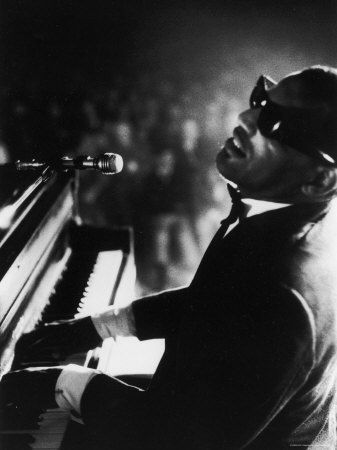
Ray Charles (Jim Morrison/Johnny Cash/Sid Vicious/Cole Porter/Wolfgang Amadeus Mozart/Muhammed Ali, etc) is born in obscurity, but through a combination of talent, charisma and being in the right place at the right time he is enabled to attain celebrity status while still a young man. This gives him access to a continuous stream of groupies, which privilege he continues to take advantage of even after he gets married, which behavior usually does not bother his wife enough that she ever gets around to leaving him. He also develops a hardcore drug and alcohol habit, which brings him to the low point of his career, at which juncture he either dies or does a stint in prison. If he lives he usually cleans up somewhat, goes back out on the road and maybe puts together one last big comeback album before gradually fading into an honored dotage (the life of James Brown I don't believe has been committed to celluloid yet). If you are Ray Charles the government of your home state, which persecuted you through the first half of your life as official policy, makes one of your biggest hits the official state song and holds a day of honor where admiration and a kind of love are officially bestowed upon you.
This is not to say I did not enjoy the movie after a fashion; however it is not much of a departure from the standard entry in this genre of biography. It is a professional, glossy Hollywood production, and since it was supposed to be so good according to several sources, I was not once agitated about my precious time being wasted. One area in which it failed for me was that I never got a sense of what was really great about Ray Charles's music, which a good many people who know what they are about consider to be very great indeed. In a film about a musician one would hope that the music will lodge itself on the brain and be inspiriting for several days afterwards. The recent cinematic take on Cole Porter's life, for example, was not particularly distinguished, but one at least came away from it reminded that the man really did write a lot of great songs. My impression of the career of Ray Charles from this movie is that he was an unusually gifted roadhouse piano player who made some interesting records with Atlantic* in the 1950s--the impact of how many, and how good, these records were was not fully conveyed in the movie however--got a huge deal to sign with ABC in 1960 where he turned out most of his familiar mainstream hits, which however come across in the movie as schmaltzy and selling out compared with his prior quality. The movie attempts to explain, if not wholly excuse, this by reminding us that Ray Charles, as a blind black man in an America before disability payments and affirmative action and anything else, was naturally obsessed with being able to take care of himself first and foremost, and that aspect of the story, how he was able to do this (in his early years he would only accept payment in one dollar bills), is pretty remarkable to contemplate. I did not come away particularly inspired to dig deeper into Ray Charles's musical archives however. It is not that I don't want to, but given the time constraints I am under it is not at the top of my list of things to look up when I have a free 20 minutes or whatever.
*Atlantic Records CEO and St John's College alum Ahmet Ertegun is a significant character in the movie. As was the case when another SJC alum (Charles Van Doren in Quiz Show) got the Hollywood treatment, the Ertegun character speaks in a rather odd--some might say hypercorrect or hyperwhite (though Ertegun was actually Turkish)--manner pointedly different from that of the other characters. Whether this is the inevitable outward result of indoctrination in the Great Books I don't know--the origins of both of these men were very near the top of the social scale in their respective nations and also both graduated over 60 years ago. However, when I first began my current job, over fourteen years ago now, I apparently had a somewhat affected manner of speaking that a few people made fun of. There was one guy (who was very popular with women) who was fond of mock-effacing himself before the ladies by saying he was not debonaire the way I was. This impression seems to have faded over time with my increasing distance from any kind of pretentious society, as no one has made any comment in this vein in many years.
Hannah and Her Sisters (1986)
As is often the case with Woody Allen movies, I was taken in by this in the moment despite the storyline's not being particularly good, nor the insights brought to the usual great themes of existence being anything special (or especial), though I appreciate that he tries to acknowledge that he is aware of them as much as he can. That it is in some sense successful without being objectively good I think can be attributed to several characteristics that for whatever reason are fairly unique to Woody Allen movies:1. He Presents a Certain Variation of the New York Dream Better Than Any Other Filmmaker. He is a little like Salinger in this regard, and unlike Salinger the effect I am sure is mostly intended. It doesn't work on everybody, of course (when I proposed this theory to my wife, who does not carry around a New York Dream within her, her response, apropos of this film was "Dream? Seems more like a nightmare to me"), but if you have ever been afflicted with the longing for an apartment on either of the Upper Sides, employment in an arts-related profession that does not make unreasonable demands on your time but gives you ample enough income to dine out frequently at good restaurants and pursue romantic affairs, and having a social acquaintance that consists entirely of what would anywhere else be considered pretentious people who name-drop old artists and painters and philosphers and musicians and filmmakers into casual day-to-day conversations as if it were the most natural thing in the world--and clearly a lot of people who know nothing like this style of life are--the presentation is unfailingly enticing, even when both you and Woody Allen know that it is shallow.
I have not seen much of his recent (post-1990) oeuvre, so I don't know how well this version of the dream is holding up, as it is my impression the economics and social dynamics of the city have changed considerably since the mid-90s, and I can't see Woody Allen characters thriving among the Wall Street/corporate titan crowd and their hangers-on. The Dream never dies though, however much the zeitgeist seems to change.
2. He Has Been Very Good at Keeping Up the Schtick of Being the Guy Who Just Is Not Quite Good Enough At the Most Crucial Times. I assume this is how most of his fans see their own lives as having predominantly played out. There is a certain amount of pressure, at least among serious adults, to mature and move beyond this way of looking at the world, but Woody Allen understands that a lot of people never get over failing at some important or desired thing in their youth, and that nothing that happens thereafter can make up for any sense of that particular sweetness that was missed or denied. Ironically this mindset probably held him back from attaining some of the heights of achievement he would have liked to reach as a filmmaker, though I do think it is one of his strengths as he is. This also probably correlates to...
3. He Is Never Really Capable, Deep Down, of Really Enjoying Anything Unabashed and Without Some Corresponding Quiver of Unhappiness or Dissatisfaction. This is also a condition that afflicts a lot of people, including me, and which is not usually addressed in any kind of redeeming way in movies. Something that is often lost upon people who have to deal with a Woody Allen type person is that he or she has a high capacity for appreciation and even love of beauty or good fortune or whatever, but because they are incapable of ever feeling that they have really possessed them, they are never able to be enjoy themselves completely in the moment the way that a Warren Beatty type-person seems to be able to, or at least feel that as masters after a sort of human experience that all of the highest manifestations of that experience properly belong to their domain, which I take to be the attitude of the typical quasi-deified European artist.
4. He Is Still Compared to Pretty Much Everybody Else a Very Talented Comic Writer and Comedian. This movie is not a laugh riot by any stretch of the imagination but there still probably ten lines in it which were pretty good, enough to at least prick my long-slumbering funny bone, which is nine or even ten more than you find in most movies (most competent screenwriters can come up with one decent joke even by accident in the course of a two hour film.
Other quick notes on this:
There was a minor subplot involving the then fairly novel phenomenon of sperm donation and artificial insemenation, in which the Woody Allen character's wife has a kid with one of his friends with desirable genes--it is emphasized that they would not need to have sex to accomplish this--because he was supposedly sterile. When you have the idea of life that Woody Allen or I have, that working up to the point where women will even begin to consider having sex with you is the only reason for at least 90% of all exertion therein, the idea of the sperm bank child from the male point of view does not really make any sense at all.
In one review I saw of Woody Allen's latest movie, the one set in Paris, the writer joked that the demographics of his Paris were just like that of his New York, 95% white with the rest mostly stylish black people. The percentage of nonwhite people in this movie is probably even lower than that. Of course in 1940, when Woody Allen was a child, the population of New York City really was around 94% white, and as his obsessions form most of the material, as well as interest, in the films, it is not surprising that his cinematic New York has a population more similar to the kinds of people he was interacting with in 1954 than what we would expect to find there today.
Dianne Wiest--whom I don't think I have ever seen outside of a Woody Allen movie--is looking pretty good here. She would have been 37 or 38 at the time (though I assume playing someone a little younger) which means she is eligible for Social Security now. I was in high school when this came out, and it doesn't seem that long ago,
Lenny (1974)

As usual the 4th movie will get the shaft as far as my insights go, though I didn't have too much to say about it.This is a biopic of a kind of the legendary comedian Lenny Bruce, whose once groundbreaking act does not strike one as terrible funny or provocative any more in itself. There is even some doubt afoot in the culture as to whether subversive speech is any more protected now, or will be in the near future, than it was when Lenny Bruce burst on the scene. Is it me, or has this film totally dropped out of the mainstream consciousness? I had never heard of it before, and God knows the important films of the 70s are talked about and celebrated ad nauseam. This was very well-received at the time, getting 6 Oscar nominations, including in all the main categories (though it did not win any of them)--Best Picture, Best Director (Bob Fosse, a pretty big name), Best Actor (Dustin Hoffman, a really big name) and Best Actress (Valerie Perrine, not so big a name among people who weren't there at the time, but well regarded among the down and dirty 70s crowd. Espeically when she spoke she made me think of a bigger-breasted Sally Field, which is not all bad, because I actually secretly like Sally Field). It is another movie that I got on VHS tape.
It's in black and white and has in its best parts a European art house tone about it. There are a lot of dingy clubs, dingy apartments, dingy hallways, car rides on rainy nights, claustrophobic telephone conversations where the speakers seem incapable of stepping an inch away from the handset; the movie is very good at creating this sensation of claustrophobia and dinginess and tightness, from which the Lenny Bruce character manages to cause stirs from time to time but never really escapes. There are drugs of course, and he seduces the pretty nurse whom he should not have been able to seduce--such a seduction makes the whole difference between an A-level life and a B-level one; or at least a B-level and a C, for sure. I never like courtroom scenes. The frame of the movie takes place after he's died, and the people who were nominally closest to him--his wife, his mother, his manager--are relating the story in flashbacks, but the sense is that they don't have any idea why he was the way he was, or why it mattered. The technique and style were interesting though, such as I wish we had more of in American movies. I give it a good mark for that alone.
Tuesday, March 13, 2012
I think the time has come for an occasional revival of this series. My art writing is undoubtedly among the best work I do, besides that it invariably puts me in a positive state of mind in spite of all the objections which might be argued against its doing so. I had the good fortune to have formed romantic ideas about various subjects, including most of the arts and even much of history before I was exposed to the more realistic and exacting interpretations and scholarship, either of the exalting beyond the reach of my understanding or too thoroughly eviscerating variety. The sense of the sublime, or the ideal, or even the merely sensuously better never died entirely within me; and it still seeps through the myriad unpleasant to contemplate truths in most instances.Elisabeth Vigee-LeBrun seems to me an excellent painter. She was primarily a portraitist (portraitiste? portraitess?), and not just of run-of-the-mill and now forgotten aristocrats and wealthy merchants either, but royalty and the elite of the elite of her age. She was fond of doing flattering self-portraits as well--talk about controlling the image--of which this is my favorite example, at least of the ones that I am aware of. I like the hand full of paint brushes--it says, I am serious, and I like to work, but I am not grim about it. I like the prim petite black dress with the red sash--I don't exactly know what it says, but I think it is something like, I favor a slightly understated look that is still feminine and attractive. The headgear with the greater part of a head full of ebullient curls still out and framing the face, says, I am a 18th century French lady du monde, I really understand what titillates the more refined type of male brain, and there is pleasure in having the capacity to do so. The single visible row of teeth, and the eyes lazily open and completely exposed to the viewer says, I cast rather than bore for artistic truth. Illumination holds for me the primary appeal, obscurity very little.
Has there ever been a time when the greatest artist in a particular age, or country, or school, was a woman? It has occurred in literature; Jane Austen for example was almost certainly the best novelist working in English from 1800-17 (her death), and some would argue that Emily Dickinson was the greatest poet active during the 1860s and 70s, in America at least (I am less certain about this, though I am as yet skeptical of the supposed greatness of Whitman). It is true that neither was, or probably would have been, recognized as such at the time, but the retroactive recognition demonstrates that obviously the possibility exists at any time. Going way back I suppose most Greek scholars consider Sappho the best lyric poet of her generation. One would think it would have happened in painting at some point. In England anyway I had the impression that drawing was one of the major components of the education of young ladies of means going back to the 1700s. I realize that in most of these instances intense training was not received yet there are always instances throughout history where people who would not appear to have received world class preparation in a subject have managed to burst through with works or acts of original genius which altered the historical course of their nation's culture. I suppose the great artists have by tradition been a physically robust and combative lot, very competitive, energetic, quick to disparage the work of rivals and pour contempt on that of inferiors. When men of this combination of personality traits mixed with serious artistic abilities and a serious intellect, working in a culture that understands, cultivates and highly values the especial talents that they possess, you get something like Periclean Athens or the Italian Renaissance, in English literature perhaps the Elizabethan period, hyper-male ages of male cultural achievement, in which the contributions of female artists seem to be even more conspicuously absent than in ordinary eras, as if when highly realized male energy and power are set loose in the artistic arena, the best efforts of women are simply for a time overwhelmed? I don't know where I am going with this. Women are of course highly prominent in the art world at present not only as artists but as curators and scholars, where my suspicion is that among the under-50 set they are dominant, and as big money patronesses as well. When you get into the money and the higher refinements of true taste I kind of lose the thread because there is a disconnect with that side of the business from my romantic view. Now we're talking about who controls art, how it is presented, what one is supposed to think about it, etc, and it does seem like in many ways there is a class of woman that definitely has a strong say in that...
I don't have much time to write reviews on Amazon.com--I think I have gotten nine up in two years. No one has commented on any of my reviews yet and only 8 of 14 people have found my pieces helpful, 3 of 9 when you take out the one review I published (of the silent film Variete) that was popular. This is a matter of no interest and little meaning, but I thought I'd throw it out there.
Winter was short this year, I was busy, and I think I might have missed Maple Sugaring season. I've grown to like Maple Sugaring season, and I find myself looking forward to it, so hopefully it will still be going on somewhere. But I doubt it.
Thursday, February 23, 2012
After reading two especially--to my sensibility--poisonous articles on the internet in near succession the other day, one about the clientele of Sotheby's auction house and the desirable young female employees carefully vetted for their discerning pleasure, and the other about Picasso's sex life, I was a little extra fed up with the whole trajectory of my own social life, and I began to ask myself, what if I just go off the reservation at some point and refuse to be my regular limpid self one minute longer (or at least take a temporary vacation from having to live constantly as that annoyingly constrained and limited gentleman)? To reiterate what is ultimately the only theme of this blog, without great talents, or at the very least intelligence and capabilities developed to a very high degree, personal power and sexual magnetism, life can be pleasant enough, and even amusing enough in places, but can it really be said to be worthwhile? I do believe there is a kind of strong serenity, and perhaps wisdom--though my confidence in this last, at least as regards people of my own time and place, is shaky--to be found in a simple existence given over to committed religious devotion, if one really grasps what that means and is able to live confident in all that would be implied by such an understanding. But I am a long way from being seriously able to undertake anything resembling this manner of life either. I am still to attracted to wealth, power, pretty girls and various epicurean and other aesthetic delights, though the enjoyment and possession of these things have been rare occasions in my life.
1. Posing By the Sign Near the Main Entrance to Great Smoky, etc, National Park, near Gatlinburg
As you can see we were there on an especially bright and verdant day.
I am also aware that I look ridiculous. I am trying to upgrade my wardrobe. Developing an instinct for taste at this late stage of life and the presumption to confidently wear clothes above my wonted social station is more difficult to pull off than one would think.
2. View From Clingman's Dome (The High Elevation Point of the Park)
3. Near the Beginning of the Path to Clingman's Dome
7. Little Girl By the Hotel Pool
8. One Version of What a Motel-Cabin in the Smoky Mtns Looks Like!
10. #'s 1-4, Inclusive, on Swings
Monday, February 20, 2012
I was on vacation for a week. Hence the especially long gap between postings.
I expect my activity here will be light for the foreseeable future--certainly for the rest of this school year. I finally seem to have reached the point where I truly do have too many children of certain ages. Writing has gone from being a futile endeavor to a pretty much impossible one. As well my head these days is still about as clear as the air on a Scottish Isle in November, and there are of course no great doings, no illustrations of virtue, or even any casual domination and terrorizing of any poor saps on my own part to relate, and I haven't the spirit to relate such instances observed in other people even if I were aware of any. If I should be doing anything on this site, it should be going back and editing and even deleting my particularly embarrassing older posts. Yet the urge to complete and publish any new thing whatsoever overcomes all. Not for me the ethos of Lord Macaulay, who "made it a rule for himself to publish nothing which was not carefully planned, strenuously labored, and minutely finished". Though of course no one reads him anymore either. Even me.
I was going to write a commentary about the recent uptick in what was already a deluge of articles circulating through the popular media and internet sites about the various failures of contemporary men, especially as far as their desirability and suitability for marriage to high-achieving modern women are concerned. This subject is already well-covered in the blogosphere, and in addition I don't seem to be up for anything requiring even a modest amount of sweep at present, so I am leaving it alone. This is already one wearisome motif, and as it does not look like the situation being lamented, from any of the various angles from which it is being lamented, is likely to improve any time soon, I am guessing it is not going to go away, and the people of the nation begin to hold our young and even middle-aged men in general admiration again. Obviously I am in many ways a prime example of one of these diminished males in terms of intellectual/career achievement, though I have to this point avoided the video games and the porn addiction (honestly!), so the subject hits close to home, and unhappily so, as it must be; given my current time constraints however any pertinent thoughts I have on the matter will probably continue to come out in little drips and draps instead of in a coherent grand survey of the contemporary scene.
Did you know that Woody Allen and Mia Farrow's natural son is an apparently authentic genius? This guy just won a Rhodes Scholarship and taking it in the flow of his biography this accomplishment strikes the reader as actually a step backward--or at least an interruption--to his already brilliant and active career. Other than his awesome resume (graduated Bard College at 15, admitted to Yale Law at same age, worked for UNICEF as an advisor to the former US Ambassador to the United Nations while still a teenager, 'director of the US government's relationship with non-governmental actors in Afghanistan and Pakistan'--this at age 21--and testimonials about his general brilliance such as those in the New York Times attributed to a former neighbor and local selectman in his home town ("extraordinary in his academic accomplishments'...'off the charts [intellectually] from the beginning'...always...operated at the highest level intellectually'--I don't actually know what these mean, but evidently they are spoken by someone qualified to make such pronouncements) it is hard to pick out the specifics of these mental qualities which repeatedly blew the minds of numerous of the most serious and importantly placed adults in the current world scene, but I guess one has to assume they are there. He does appear to be a bit humorless, which is ironic given his bloodlines, though he has been estranged from his father since he was about five years old, and appears to have adopted a hardened stance towards him.
Several dozen women at least whose pictures indicate that they are of more than acceptable attractiveness have declared him to be cute, and not a few have openly announced that they would be interested in exploring having sex with him. For whatever that is worth.
I recently received my Northern New England edition of AAA Magazine in the mail (as a studly commentator at a site devoting to gaming women once noted, before returning to the more interesting subject of the various hard-bodied young women he pleasured at will entirely on his own terms while acceding to no unpleasant demands on his side at all, all wretched beta males ought to have the grim expression "I was responsible" carved at the bottom of their tombstones). That cover featured a nighttime picture of a trenchcoated and derby-hatted man shuffling past a half-familiar haunt of mine, the Porthole Fountain diner along the one alley in the old Portland waterfront that apparently has been permitted to retain its 'gritty' look. I have never actually eaten at the Porthole, as in my day its opening hours were from like 5am to 1pm, which did not coincide with my dining schedule, but I used to walk around the atmospheric and abandoned streets surrounding it in the evenings to meditate, usually in lieu of doing schoolwork, as I was too restless at that age to sit around all alone for too long of a stretch. Anyway, after this long introduction, this picture is on the cover of the magazine because this month's main story is about the increasing popularity of Maine, New Hampshire and Vermont as settings for crime fiction. Like other prominent milieux in this genre of literature (Sweden, the British upper classes between the wars; I even suspect 1930s and 40s noir-era Los Angeles was pretty sedate on the crime front compared to what it became in later years), the actual crime rate in the region, especially violent crime, is about as low as can be found anywhere in recorded history. Best-selling writer Archer Mayor has recently put out the 22nd volume of his series whose hero is detective Joe Gunther of Brattleboro, Vermont, a city so menacing that if I happen to be walking down Main Street on farmer's market day or during a folk festival I am often realistically in contention for the most threatening looking person on the strip. One of Maine mystery writer Gerry Boyle's main characters is "a rookie cop in Portland with an old cabin cruiser, a girlfriend, and a history"--perhaps one has to have a certain youthful experience of the actual Portland police force to feel a sense of hilarity at the portentousness of this description. I certainly grasp the appeal of the region for writers (bad weather, small cities and old towns, geography at once diverse and compact, largely homogenous population that retains even now something of a common history and identity, though this has eroded noticeably even since the late 80s), much of which is touched on in the article, and the crime genre, while I find I tire of its limits fairly quickly, obviously is one of the more enduring and effective modes of storytelling in modern literature in a broad sense, but--surely there are more interesting stories and subjects to be mined from these attractive locales.
I don't recalling any of the prominent sports pundits noting that in the recent frenzy of conference expansion and league jumping among ambitious and merely desperate schools in college sports that the one league everybody supposedly would be dying to join neither expanded nor lost any members at all. I speak of course of the Ivy League. But let's say the presidents of the member schools wake up one day soon and are overcome with the desire to hold a championship game in football, which would require them to have twelve teams. Who gets added? No school whose faculties, administrators, or students would be too overly eager to receive or self-satisfied at receiving an invitation to this gilded club should be considered, Iwould think--Duke, Georgetown and Northwestern are three who come immediately to mind that will not be tapped. Stanford might seem the most obvious selection, and they essentially already have the exalted status without the affiliation, but in addition to having a really fabulous all around sports program they are also far away in California, which, like Texas, and perhaps Florida, is a country and culture onto itself, and to which Stanford has deep and symbolic ties. They should stay where they are. The first two schools I would thus bring into the Ivy League are the two old academies, Annapolis and West Point (or, in football-speak, Navy and Army). They are an obvious and natural fit, being firmly ensconced on the East Coast, having similar traditions and elegant old campuses hearkening back to the golden age of high collegiate spirit, and in many undeniable ways that of the nation itself. They traditionally have, and I assume still do produce graduates who are active, prominent and accomplished in the highest levels of national life. They should be in. The other school I would put in would be the old University of Chicago, which has been content to follow its own lonely and even anti-social path for the last 75 years, but which I think could use some allies and friendly rivals. Chicago is obviously not the best fit geographically--they'd have to fly to all the games--but they have a venerable intellectual tradition, though I know there is a lot of grumbling that they have let standards slip in recent years (haven't all these places?) and while they have long downgraded their athletic program to the Division III level, they did produce the very first Heisman Trophy winner back in, I think, 1934 or '35. Besides I don't know who else to put there. I can't even come up with an appropriate 12th team. All those good, quasi-Ivy, pretty hard to get in to for the average schlub northeastern liberal arts schools (Colgate, Bucknell, et al) are not really distinguishable enough to me from other to elevate one of them, though who knows if you couldn't subsitute Colgate for Cornell or Bucknell for Penn and have just as cool of a league. There is a missing Ivy League school in Vermont I think (Montpelier would be a really good place for it I bet) which could be formed as an amalgam of all those tiny liberal arts schools that are already there, Middlebury, Bennington, Marlboro, Goddard, etc. You would have the writing, the music, the sexual experimentation, the casual languid wealth, the eccentricity all concentrated in one place. This team would probably fight it out for last in the league in football every year with Brown and Columbia (Chicago would be able to scrounge out enough midwestern talent to win four or five games a year in this league, I think), but it would be chock full of the kinds of groovy girls so many people need but can never find because they are tightly concentrated in a few select places and not widely spread among the general population.
I hate divisions in all sports, but with my alignment you could do it very neatly, having the New England teams (plus Chicago) in the one and the Mid-Atlantic teams in the other.
Friday, February 17, 2012
After Alabama we went back to Gatlinburg and the Smoky Mountains park for four or five days (this is all last summer of course). Obviously in spite of all of the grotesque, and mostly depressing, schmaltz that stretches outside the gates of the park for twenty miles, and the circumstance that most of the more accessible trails inside the park are ridiculously crowded compared to almost any other natural preserve in the country, we had a pleasant enough time the year before to want to come back and do more. Given my social and cultural pretensions, I cannot really justify my not reacting to this place with total revulsion on several levels, however--the park and the mountains are beautiful in a way that does uplift the downtrodden spirit, and even in the pancake houses and mini-golf venues down in the town the visitors have a kind of earnest enthusiasm for these modest pleasures that is kind of infectious to be around (I was even almost tempted to pop into the giant "As Seen on TV" outlet store in Pigeon Forge, but having seen on the internet the photo reports of other visitors that it is full of nothing but the worst kind of junk, I am pleased to have resisted that temptation).
1. Along the Trail to a Falls, I Believe Grotto Falls
2 & 3. Along the Grotto Falls Trail.
These don't really give the sense of harmony that one experiences among the diffuse elements of the scene there.
4. Ripley's Amazing Mirror Maze, As Seen From Across the Parkway in Downtown Gatlinburg.
7. Approaching the Bluffs
Friday, February 10, 2012
Since the site is essentially dead as far as both readership and creativity goes, I was going to open this entry by indulging myself in an examination of the forms favored by my romantic imagination, which I suppose is more generally called fantasy, because for most people that is what being alive and attuned to the manifold physical possibilities of life is. An open-ended essay proved to be too difficult for me to rein in in my current sleep-deprived and mentally unfocused state, so I am going to present my findings in the form of categories.
Imaginative Scenarios Which Do Not Figure In My Fancy, and For the Most Part Do Not Appeal to Me: Hot tubs/scenes generally requiring me to be shirtless during the courtship phase of the relationship. Far-fetched scenarios (shipwreck onto abandoned island for long period of time with no or insignificant male competition, unlikely displays of domination on my part, etc). Very expensive or prestigious settings where my personal wealth or breeding would have to carry the day. Any time of life after about the age of 3o. I think it is actually criminal for most people to imagine themselves as a sensual being after that age; enough so that I seem to make a pointed and largely succesful effort to avoid doing so.
Scenarios Which Do Appeal to me, But Which I am Incapable of Bringing Myself to Imagine. People in movies who are supposed to be kind of dangerous are always persuading women to get it on with them in stairwells and closets and other semi-public places, frequently on a casual acquaintance. This image is a stand-in for all the relaxed, casual, routine type of encounters that most people actually never have, though it many instances the idea of it consumes thousands of precious hours of their lives, including so much of their youth as to seriously impinge upon and curtail their education. I have been able to incorporate aspects of this type of encounter into my dream-life, but always in a more surreptitous form. I cannot plausibly envision myself plunking anybody in the stairwell, however much I might want to do so.
What Does This Leave? Obviously high school and especially college scenarios, in which I am essentially myself--just slightly cooler enough to make things happen a little. Maybe a small harem of regular visitors to whom I can avoid getting overly emotionally attached. Maybe I study my math or my ancients a little harder and can offer such assistance or tutoring which leads to admiration and unforeseen escapades. The Christmas vacation fantasy has always been especially strong, suits my sensibility perfectly. This is where you are sitting around the house either the week before or the week after Christmas when out of idle boredom you decide to call up some person from your college who lives in your general area or someone from your old high school whom you did not know particularly well (or perhaps they call up you), and you make vague plans to meet, one thing leads to another, etc, etc. I heard of several instances where something along the lines of this scenario took place, and it seemed quite wonderful to me. I began to write a short story about such an encounter (happening to somebody else) once. The idea quite obsesses me. In addition to school, I also can call up a whole set of travel-related possibilities, as well as many at lower-class jobs full of sassy working-class girls who are good to go; even though I also hold these low-status jobs in these scenarios, I am somehow understood by everyone to be above them--I dress better than everyone else, am obviously smarter, my circumstances are less desperate, etc. I am really just there to amuse myself, and bring some excitement into the girls' lives, I guess.
"canis ad vomitum (like a dog to his vomit), 'tis so pleasant he cannot refrain." Great saying. Refers to melancholy.
On to the Second Partition:
St Hilary's (a male saint, by the way) bed was on display in the church in his hometown of Poitiers in western France for many centuries, and was said to cure madness in those who lay in it. It does not appear to be on display anymore. I cannot find any information as to why this is the case, though perhaps at some point it ceased to work its former effect on madness.
There is a discussion about the purity of water: "The waters in hotter countries, as in Turkey, Persia, India, within the tropics, are frequently purer than ours in the north, more subtile, thin, and lighter, as our merchants observe, by four ounces in a pound, pleasanter to drink, as good as our beer, and some of them, as Choapses in Persia, preferred by the Persian kings before wine itself." The residents of Bohemia, in particular the area around Plzen, frequently touted the unusual softness of the local water as one of the keys to the country's world-famous beer. I have noted at various times in my life that the tap water in Portland, Maine and in New York City struck me as superlative compared to that of other municipalities. These may have been sentimental impressions based upon some giddiness I was experiencing at the time, but I recall seeing my opinion as regards the surprisingly excellent taste of New York City water back up in the New Yorker magazine or some similar publication sometime back in the 90s.
"By overmuch eating and continual feasts they stifle nature, and choke up themselves; which, had they lived coarsely, or like galley-slaves been tied to an oar, might have happily prolonged many fair years." Worth considering?
"Tiberius, in Tacitus, did laugh at all such, that after thirty years of age would ask counsel of others concerning matters of diet; I say the same." O.K, that settles it. I'll stop obsessing.
I am so far behind in my book reports that in my notes the transition from considering myself as a real literary person to the vegetable I am conscious of being now has not yet been fully completed. It is almost touching to see these remnant of my old self. I would say my old earnest or naive self, but I'm sure I am still earnest and naive compared to what I need to be.

"Ficinus and Marsilius Cognatus put Venus one of the five mortal enemies of a student: 'It consumes the spirits and weakeneth the brain'." This is certainly true, but who are the other four? Later on in the same paragraph Aristotle is invoked as having determined that sparrows were short-lived due to their salacity, which makes an impression, but I am not sure it is really to the point even if true.
"I would see those inner parts of America, whether there be any such great city of Manoa or Eldorado in that golden empire, where the highways are as much beaten (one reports) as between Madrid and Valladolid..." Oh Spain, you ancient country. Little as I dare to protrude myself into experiences that should be reserved for more deserving people going forward, I would still really like to go to Spain sometime when I still have some stamina for walking long distances and staying up after dark. I am also still excited by the thought of going to the Prado, of seeing windmills, of going to Salamanca, of doing the pilgrimage to Santiago de Compostela. I am even somewhat tempted to want to go to a bullfight. The idea of my having any capacity for being affected by these things I know is ludicrous at this point to anyone with a real education or artistic sensibility, or who is even physically attractive, but we all need something ludicrous to look forward to and keep us going through the dreary grind of middle age.
"I conclude...as Munster doth of cranes and storks; whither they come, whence they go, as yet we know not. We see them here, some in summer, some in winter; 'their coming and going is sure in the night; in the plains of Asia' (saith he) 'the storks meet on such a set day, he that comes last is torn in pieces, and so they get them gone." Eh? Yet I can picture this scene and the general impression of the world which the book gives quite vividly. The thought process at work in it is in sync with the way the imagination seems to operate.
"...or Delos, as the fabulous Greeks feigned (to be the center of the world): because when Jupiter let two eagles loose, to fly from the world's ends east and west, they met at Delos." I never heard this story before. I thought the Greeks regarded the oracle of Delphi to be the center of the world, energy and spirit-wise. That is what I took the idea of omphalos to mean anyway.
"Why so many thousand strange birds and beasts proper to America alone, as Acosta demands? Were they created in the six days, or ever in Noah's ark? if there, why are they not dispersed and found in other countries?..." Uh-oh.
Are lice really instantly consumed in the Azores and other warm places by a secret virtue in the air?
There is a charming section on the restorative qualities of views of beautiful vistas that I am tempted to reproduce in full, with its myriad examples. Since I am currently in great need of spiritual restoration and uplift myself, I think I will do this:
"The citizens of Barcino, saith (Gomesius), otherwise penned in, melancholy, and stirring little abroad, are much delighted with that pleasant prospect their city hath into the sea, which, like that of old Athens, besides Aegina, Salamis, and many pleasant islands, had all the variety of delicious objects; so are those Neapolitans, and inhabtants of Genoa, to see the ships, boats, and passengers go by, out of their windows, their whole cities being cited on the side of a hill, like Pera by Constantinople, so that each house almost hath a free prospect to the sea, as some part of London to the Thames: or to have a free prospect all over the city at once, as at Granada in Spain or Fez in Africa, the river running betwixt two declining hills, the steepness causing each house, almost, as well to oversee as to be overseen of the rest. Every country is full of such delightsome prospects, as well within land as by sea, as Hermon and Ramah in Palestine, Collalto in Italy, the top of Taygetus or Acrocorinthus, that old decayed castle in Corinth, from which Peloponnessus, Greece, the Ionian and Aegean Seas were at one view to be taken. In Egypt the square top of the Great Pyramid, three hundred yards in height, and so the Sultan's palace in Grand Cairo, the country being plain, hath a marvellous fair prospect as well over Nilus as that great city, five Italian miles long, and two broad, by the river-side: from Mount Sion in Jerusalem, the Holy Land is of all sides to be seen: such high places are infinite: with us those of the best note are Glastonbury tower, Box Hill in Surrey, Bever Castle, Rodway Grange, Walsby in Lincolnshire, where I lately received a real kindness by the munificence of the right honourable my noble lady and patroness, the Lady Frances, Countess Dowager of Exeter; and two amongst the rest, which I may not admit for vicinity's sake: Oldbury in the confines of Warwickshire, where I have often looked about me with great delight, at the foot of which hill I was born; and Hanbury in Staffordshire, contiguous to which is Falde, a pleasant village, and an ancient patrimony belonging to our family, now in the possession of mine elder brother, William Burton, Esquire. Barclay the Scot commends that of Greenwich tower for one of the best prospects in Europe, to see London on the one side, the Thames, ships, and pleasant meadows on the other. There be those that say as much and more of St Mark's steeple in Venice. Yet these are at too great a distance..."
"They know not how to spend their time...like our modern Frenchmen, that had rather lose a pound of blood in a single combat than a drop of sweat in any honest labour."
The last one is supposed to be funny.