Wednesday, November 10, 2010

A Weary Appreciation of Paradise Lost

I've read over some parts of this again within the past couple of years, and, seeing as I might not have occasion or motivation to record any of my feelings about it at any later date, I am going to do something of the sort now.

The perception of Milton among even generally well-read or educated people is one of the oddest of any legitimately great poet in any language that I am aware of. He is appreciated and revered by scholars, but outside of that profession, hardly anyone seems to believe it possible that a well-adjusted person could genuinely enjoy reading him. This state of affairs is perhaps of no great moment, other than to demonstrate that Milton is a figure of private rather than communal interest more than almost any other literary figure of his stature that I can think of. His writing has been found by many confident intellects over the years to be boring, sour, pompous, dismissive of women entirely and of all but a few score of men in the entirety of history. He never condescends to approach the typical reader on his accustomed level either intellectually or morally. The famous observation of Samuel Johnson (who, having compiled an English dictionary, one presumes had an unusually high tolerance for tedium), that no one ever wished Paradise Lost a word longer than it was, is often quoted approvingly. Compared to his fellow epic and epic-quality poets, his characters and language do not, without a good deal of preparation in literary reading, it seems, inspire a powerful emotional response. That said, failing to attain the state of realizing how great Milton really is, and coming to some perception of what it is that makes him so, is to be denied a substantial pleasure, if one is susceptible to such things, of such a sort as life offers on but a handful of occasions during its duration.


I think I tried to start Paradise Lost once when I was in high school, mainly because it is always prominent and available (and books, as I have noted previously, often took the place in my early years that women fill in the lives of life's protaganists), but I could get nothing out of it since I understood nothing about either language or thought, and, as noted earlier, the poem does not appeal strongly to sentiment and emotion, which was the entire range of my mind at the time. By the time I read it in college, I knew enough of Christian history and the history of Western poetry and philosophy to be able to get some modest thrills out of the experience. Since then I have read it once more in full and parts of it on various other occasions, and it is one of the few works, and Milton one of the few writers, to consistently impress me as what is said of all great books, that it appears greater, and in a substantial way, on every new reading. I am convinced at this point that he reads more clearly and easily than Pope, to name a recent example, and indeed, most poets, and that the poem is a wondrous work of man. How does it work?

The great force of the poem to me is achieved by a tremendous uniformly accumulating momentum that displays a remarkable array of elasticity in always propelling itself forward. He manages various tiers of plot and character in ways that are appropriate to their circumstances but are clearly delineated in their relations to each other; seeming contradictions of traditional logic or theology (God's power is limited in dealing with the rebellious angels? No!) are calmly and almost immediately addressed ("...since by fate the strength of gods/and this empyreal substance cannot fail..."); even trickier conundrums such as relations of eternal beings in time he handles expertly within the terms of his own poetic world, of which he is the absolute master, this being probably one of the requirements of successful poetry at the highest level. What else is there?...Here is a passage from Book I where he displays a nearly perfect understanding of the materials of life and of words and story, and how to unite them (ll. 423-428):

"...For Spirits when they please
Can either sex assume, or both; so soft
And uncompunded is their essence pure,
Not tied or manacled with joint or limb,
Nor founded on the brittle strength of bones,
Like cumbrous flesh; but in what shape they chose..."

Of the fallen angels he lands upon the simple but ingenious conceit that they can be--and must be--anything our imagination requires to conceive of them as such. I suppose I had better give an example of what I mean (I. 562-7):

"...and now
Advanced in view they stand, a horrid front
Of dreadful length and dazzling arms, in guise (emphasis mine)
Of warriors old with ordered spear and shield,
Awaiting what command their mighty chief
had to impose..."

His renderings of nature are filtered through a thoroughly civilized humanity. The pictures that follow are always refined and dignified and at the same time immediately recognizable, which indicates to me that the high view of our own existence is not necessarily the lie it is sometimes claimed to be, but is crucial to our development as people despite the undeniable ubiquity of unpleasantness and baseness and failure that often demands our unwilling attention. This is a metaphor for the withered glory of the fallen angels as they regroup after the rebellion, and it is strikingly beautiful, and can be clearly seen even though one has likely never seen the precise picture delineated (I. 612-15):

"...as when heaven's fire
Hath scathed the forest oaks, or mountain pines,
With singed top their stately growth though bare
Stands on the blasted heap..."


Given the amount of time and the length of the essay already undertaken, I will stop here and do a short second post later. I am not going to go through the whole book, but there may be a few more points I wanted to make; if not, there will be no second post.

Thursday, November 04, 2010

Sports Old-Fogeyism Part I: Is It Time to Retire the Cy Young Award?

The timing of this question is lousy given that the recently concluded playoffs and World Series were dominated by outstanding pitching performances, but the idea for this article occurred to me about a month ago as the regular season was winding down, and I am just getting to it now. It was inspired by the circumstance that Felix Hernandez, with a won-lost record of 13-12, was widely being touted as the best candidate for the award in the American League; and this following upon last years' winners, who had 15 and 16 wins respectively. These victories are the union of the triumph of the revolution in statistical analysis and understanding that has developed over the last 25 years with the changing role of pitchers in the context of an individual game, or a season. It is more the latter than the former that leads me to think that the spirit of the Cy Young Award may have been compromised, though both have contributed to a degree.

By almost any system of statistical comparison you care to use--even the antediluvian pitching categories of the 1969-era Baseball Encyclopedia--Felix Hernandez was the best pitcher in the American League this year by a pretty comfortable margin. This both surprised and impressed me. He led the league in ERA, strikeouts and innings pitched, and was among the leaders in a couple of other basic measurements (complete games, fewest hits and most strikeouts per 9 innings). Despite this, he only managed to be credited with 13 wins. It is well reported that his run support was very poor--indeed his team was the weakest offensive outfit, in terms of runs scored, over a full season since the 1970s (or at least they were on pace for that distinction with a few weeks left in the season; I'm not sure whether they made it or not). He did throw 6 complete games and 249 2/3 innings, which are a lot for anybody in today's game, and especially for a 24-year old--he was given as much of a chance to earn wins as anybody is likely to get in 2010--and even I understand that things like official wins and complete games are not in themselves especially important indicators of current or future value in evaluating pitchers in today's game. So what argument do I have against his selection, especially in the absence of any other standout candidates by either traditional or new age measures?

Major sporting awards and honors, and the manner in which they were won, especially it seems in baseball but also in other sports such as the Heisman Trophy and all-American teams in basketball, and even the winners of major tournaments in golf and tennis, come over time to be emblematic symbols of their particular years, and park of the ensuing mythology which the various games feed on for generations afterwards. There is often a heroic or awesome aspect to the character of the feats honored (in the context of the game) even beyond the de rigueur outstanding statistics. Sandy Koufax won four 1-0 games in one of his Cy Young seasons, and over a three or four year span had a winning record when getting 0, 1, or 2 runs in support(granted, it was something like 14-13, but still). Steve Carlton in 1972, pitching for a terrible team that won 59 games the whole season, went 27-10 with 30 complete games, and won 15 games in a row at one point. Even within my memory Orel Hershiser in 1988 closed out the season with a record 59 consecutive scoreless innings, all complete games except the last, in which he pitched 10 shutout innings to break the old record of 58 2/3. Felix Hernandez's season is perhaps emblematic of where the sport is today, and he is undoubtedly an excellent pitcher, but does he merit being honored as the top pitcher in the league for pitching well but only winning 13 games?

Surely part of having a truly great season as a pitcher is outpitching the guy matched up against you to the point of victory in at least half your starts. While complete games were probably overvalued through most of baseball history, I think they are perhaps undervalued now. The game lasts nine innings, longer if tied. The inability of almost all pitchers to regularly pitch a full game even when the score is close and they are by far the best pitcher on their team is a serious flaw in the modern game. When Three Finger Brown and Christy Mathewson, or Babe Ruth and Walter Johnson, or Bob Gibson and Juan Marichal took the hill against each other, nobody said, give us seven innings and we'll turn it over to our situational relievers to decide the game. The emotional investment and interest in most games is simply not the same once the ball is handed off to a parade of nonentities.

That said, the top starters still do enough work and have enough direct impact on pennant races by historical standards to merit a major award given in their name at the end of the year. There are very few pitchers of this caliber remaining in the two leagues combined however.

Political Commentary

I find contemporary politics to be another in the long line of subjects that I am finding it difficult to become "well-informed" about, though I certainly try to expose myself to many opinions and even the occasional fact with regard to it. Though I never vote for Republicans primarily because I find that which strikes me as rotten about them to be more troublesome and destructive than the myriad things that are rotten about Democrats, I am not an unshakable true believer in either of the predominant sides and it causes me a great deal of concern to find various positions of both sides of the fence that strike me as at least reasonable to be so imperiously denounced as evil, or stupid, or malicious in their intent to destroy society. One feels yet again that something is seriously wrong with him not to comprehend what is evidently clear to myriad people of sound intelligence and the capacity for logical thought. How has this state come about, and what can one possibly do about it?

A lot of people on the "blue" side were apparently shocked by the election results. I was under the impression that it had been obvious for months that this was going to happen, and was actually surprised that the Dems managed to hold 53 senate seats. One thing that caught me off guard was the wipeout the Democrats suffered in my own state, losing both seats in Congress and having their senatorial candidate get slaughtered by 61%-36%. Official unemployment is only around 5.5% here, the state finances are in pretty good shape compared to just about everywhere else, immigration is essentially a non-issue, the schools are usually rated in the top 3 or 4 states in the country--not that they are on the level of the German gymnasiums circa 1910, or actually good at all, but they are evidently not the apocalypse-summoning disasters that the majority of our state school systems are. People in New Hampshire hate taxes, and apparently were convinced by the arguments that the Democrats have a master plan to tax them, and all productive economic activity, out of prosperity forever, though unless I have missed something I don't believe there have been any significant tax increases enacted under the Obama regime.

I admit I do not trust business interests, once given the free rein which they are increasingly demanding, to pursue ends which are broadly and substantially beneficial to the mass of the people. One thing that was harped on repeatedly in this election cycle was that business must be unshackled--from taxes, regulations, health care costs, pension commitments, and so on (dictating by the way that the government itself cannot pick up the slack in any of these areas either)--and that enacting such policies is the only hope for any kind of broad recovery. The business element, and to a lesser extent various other high-status professional elements, constitute a troublesome entitled class of their own, the entitlement being the right to a certain level of income when there is no source of money in the broader society to support those incomes. Real estate, health care, banking obviously, higher education, all are still grossly overpriced comparative to the overall societal ability to maintain them financially, and the people at or near the top of these pyramids--rather incredibly to my mind--seem not to realize this and to take the lead in adjusting their own compensation downward. The approach right now seems to be in the direction of telling 90% of the population that such are the going rates for these services, such will always be the going rates for these services, and that if they aren't prepared to pay up, they will have to forego access to them. This attitude will be political suicide within 10 years--I can't believe it isn't already--and new models, probably much more blatantly socialistic than the right's worst nightmares today, as an increasingly old population on the one hand, and a younger one that has endured a decade or more of steadily increasing impoverishment and limited opportunities for economic self-sufficiency as it set out to make its way in life demands political action in these areas.

That is my loose perception of what is going to happen. The right wing models have no chance of working for the mass of the people--a people that is in preciptitous decline on many fronts as a strong and civilized polity, not merely financially--as long as they are beholden first and foremost to corporate greed and the maintenance and enhancement of the already privileged. And yes, the establishment Democratic party is beholden to many of these same interests, but to me there is at least some hope of eventual disattachment from this position because blind worship of capitalism at any cost is not an absolute a priori requirement for membership in its ranks.

Monday, November 01, 2010

Some Old England Pictures Vaguely in Honor of Pope

These are from 1999, randomly chosen with the exception of Pope's birthplace site and the last one. 1. Plough Court, off Lombard Street, City of London. Birthplace of Pope. Plough Court is an alley of which the black wall in the above picture constitutes one side. There is a plaque on this wall commemorating Pope but unfortunately it did not come out in the picture. The sunny street to the right with the old-looking church (many of the old-looking churches in this part of town are actually reconstructions, the originals having been bombed out; I don't know whether this one is a reconstruction or not) is Lombard Street.

The area known as the City, which is now the financial district and has hardly any residents, was until about 1800 pretty much the whole of London, and thereafter constituted the more downmarket but heavily populated Cockney homeland until the bombing wipeout in 1940-41. As a result, it is an area that was home to tons of writers and numerous legendary historic places, including pretty much everyone and everything before the 19th century, most physical reminders of which, however are gone. Nonetheless, a few things are still around, such as St Paul's Cathedral and other churches, Samuel Johnson's house, the Cheshire Cheese Tavern, etc. Many of these are dismissed as tourist traps I guess, though if you have some feel for the 18th century atmosphere these relics can still speak something to you.


2. Rye, Sussex. Plaque Commemorating the Former Position of Henry James's Garden House, Destroyed by Bombs, 1941. Not a flattering portrait, but you can't run from the truth forever. I was 29 here. By 29, or thereabouts--the 30th birthday is not an absolute deadline, but it seems to be pretty close to one--you have either become a genuinely serious, more or less realized person or that destiny has at last become inaccessible to you, and you are effectively marking the hours--thanks to the advances of modern medicine hideously many hours--until you come to your physical end. I am pretty sure I still harbored hope I was going to be able to sneak in under the wire at this point, but now I look at this picture and see it was pretty much...

Despite the unfortunate fate of the garden house, the actual Georgian House where Henry James lived, to the perpendicular right of the wall in the photo here, still stands, and is sometimes open to the public, though it was not when we were there.


3. 39 Cornhill, City of London, With Steeple of St Michael's Church in Background. This building, formerly, and perhaps presently, a bank, was built on the site of the poet Thomas Gray's birthplace (1716). Gray was commemorated on one the lower floors with a nice embossed plaque and a few lines from the "Elegy Written in a Country Courtyard".

We took this little walk around the City on a Sunday morning, when the place was more or less deserted. The plane had landed around 6 or 7 am and we weren't able to check into our hotel until sometime after noon. Very little was open--in the 90s at least, Europe was still effectively closed on Sunday, especially before mid-afternoon/evening--even the ATM machines didn't work for our bank cards until noon--so although we were very tired we passed the time by walking around the old City and yes, crossing a few items off one of my myriad lists, but there is supposed to be a purpose to the lists, they are intended to arouse my curiosity and awareness of more elevated modes of living by placing me among scenes which have spawned or inspired or impressed great cultural and historical figures...Oh well. 4. View From the Bell Tower in the Old Church (St Mary's?) in Rye, Looking Over a Field of Sheep in the Direction of the English Channel, Which May or May Not be Faintly Visible in the Distance. Rye is perhaps a little too perfect of a quaint old English town to be perfectly enjoyable--it's very wealthy, has a preponderance of shops selling jam and teapots and such, has no edge, the whole presentation seems stilted--but it was still pretty.


5. Canterbury Cathedral. Worth the trip. I liked Canterbury town too. More lively and stimulatingly laid out than Rye. I think there might be a university of some kind, or perhaps just the cathedral's tony high school. Anyway, there were a lot of vaguely academic-seeming young people around.


6. In the Penthouse Suite in Portsmouth, England. Not right on the strand, but the Channel was only a few blocks away--Can't you smell it? The room is humble but as you can see it was fairly clean by the standards of a cheap English seaside hotel. Portsmouth is more of a city, population of 200,000 or so, and while there is a long promenade with fish and chip shops and the like and a sort of small rocky beach, I didn't notice much sand, at least near where we were. The holiday crowd tended towards the hooligany side but I didn't encounter any difficulties with them, and I actually enjoyed it there. We did see a few things there and then caught the overnight ferry to Le Havre in France (arriving there on Sunday morning as well, which is even deader than Sunday morning in England, and again with no access to cash until after noon).

Wednesday, October 27, 2010

Pope/Essay on Man--Part 2

This was a picture of a Bourgeois Surrender-type pretty girl (mousy black hair, black long sleeve blouse, scowling expression) drinking from a bottle of Miller High Life at a dingy bar. But I guess I am not going to be allowed to steal it. Pope takes great pains to press his argument for a supernatural power's having organized the animal kingdom in a manner designed to produce the highest good. There is another long excursion into this line of thought in Epistle III:

"Who bade the stork, Columbus-like, explore
Heavens not his own, and worlds unknown before?
Who calls the council, states the certain day,
Who forms the phalanx, and who points the way?" (ll. 105-8)

Here at least we have the questions prettily put, if angling for answers in a direction that later rigor would find unsatisfactory.

ll. 263-6. On the age of superstition which preceded the Christian era:

"Then sacred seem'd the ethereal vault no more;
Altars grew marble then, and reek'd with gore:
Then first the flamen tasted living food;
Next his grim idol smear'd with human blood..."

A flamen usually refers to a priest of an ancient, presumably false deity, especially Roman. I had to look the word up myself, which is why I note it here.

Epistle IV, ll 127-8. On the immutability of the natural laws recently enunciated by Pope's man Newton:

"When the loose mountain trembles from on high,
Shall gravitation cease if you go by?"

ll. 137-40, on the difference of human opinion:

"One thinks on Calvin Heaven's own spirit fell;
Another deems him instrument of hell;
If Calvin feel Heaven's blessing, or its rod,
This cries, There is, and that, There is no God."

ll. 149-50. It made me laugh:

"'But sometimes virtue starves, while vice is fed.'
What then? is the reward of virtue bread?"

ll. 153-6. An often-forgotten point following up the last one. Note the alpha/beta male comparison used in framing the argument:

"The knave deserves it, when he tempts the main,
Where folly fights for kings, or dives for gain.
The good man may be weak, be indolent;
Nor is his claim to plenty, but content."

ll. 167-9, 173-4. If only I could still believe it:

"What nothing earthly gives, or can destroy,
The soul's calm sunshine, and the heartfelt joy,
Is virtue's prize: a better would you fix?...
Weak foolish man! will Heaven reward us there
With the same trash mad mortals wish for here?"

ll. 219-22:

"Heroes are much the same, the point's agreed,
From Macedonia's madman to the Swede (ed.--Charles XII);
The whole strange purpose of their lives to find
Or make an enemy of all mankind!"

ll 237-8:

"What's fame? A fancied life in others' breath,
A thing beyond us, even before our death."


As I stated in the other posting, I look forward, in a mechanical sort of way, to Pope and other authors of his time even though I don't really study or think about them very earnestly anymore. The early 18th century has become almost a comfort genre for me, like teenager movies of the 1930s and 40s. I still vaguely believe that Pope is good by some standard of goodness--as well as of the significance of that goodness--that was impressed on me years ago and which I cannot yet wholly disavow, though it seems to mean ever less and less in that large part of life that exists outside of my memory. Nonetheless I continue to carry out, mainly now from habit, a form of a persona I once aspired to much and pursued fairly diligently, that of a person knowledgeable about books and European history and culture especially; all of the other models desirable to me seeming at this point even more inaccessible of attainment.

Pope is not one of your universal writers I suppose, though to me he represents an atmosphere through which the English language had the good fortune at one age to pass, especially as my sense of the course of history indicates to me that there was nothing necessitating its taking this particular passage. He has an excellent style, and one that is really not like anyone else's before or since his time, which is a rather remarkable achievement in any language, to say nothing of one with the voluminous literary history that English has. Nonetheless his stature has seemed to be continually in decline, or at least perceived to be in decline, ever since the outbreak of the Romantic era. The internet age, with its love of hard data, and seeming lack of feeling or appreciation for poetic expression, seems especially unlikely to revive the idea of him as any kind of giant. I am beginning to feel more comfortable lately regarding my suspicion (hope?) of the internet's not having a more salutary or improving effect on the intellect compared to reading good books, but the general drift of events does not seem to be towards my position. Pope still endures, albeit in a minor way, such that one isn't sure how many people feel that his poetry has contributed to a meaningful enhancement of their experience of life. I suspect not many, even in comparison to 50 years ago, and this is the main value that literature ancient or modern has to offer. So while I still look forward to Pope, and still can imagine my pleasure in contemplating and sensorially experiencing life enhanced by reading him, I also cannot help but to often suspect that these perceptions of the worlds of life and thought that I have long nourished in this naive and quaintly old-fashioned way are in fact devoid of all living substance and utility, as I have understood them anyway.

Sunday, October 24, 2010

Religious Activities Update

After the scandal of the adulterous priests which rocked the (protestant) church which I have found myself maneuvered into attending 15-20 times a year for the sake of various aspects of my children's development, the committee charged with selecting the new head priest evidently determined to hire the least exciting candidate that could be found. I have no doubt that the new reverend is exquisitely well-intentioned, and I should note that she has glorious credentials-- reading over the schools and seminaries she has been affiliated with and the positions she has held briefly provides the brain a jolt of the pleasurable imaginative agitation that her actual presence is incapable of inspiring--and certainly she has succeeded in fostering a nonconfrontational atmosphere, and I suppose a welcoming one, assuming one has the desire to be welcomed into an airless and tomblike community. Everybody besides me who I can find that is willing to offer an opinion on her however claims to think she is 'great'. Great at what? I wish the lady no ill-will, but if there is anyone I know for whom the modifier 'great' does not apply in any instance (including negative ones), it must be she. It has been explained to me that she does not like to preach. Why take up this line of work than? If you like the prestige of the position and what appears to me to be the healthy middle class--maybe even greater--income that comes with it, to my primitive mind the primary visible function of the holder of this position is to display spiritual leadership, to which end, other than a tireless Mother Teresa-like presence performing humble acts of charity, preaching is the most obvious vehicle. One can opine that modern congregations, particularly those holding a substantial number of the well-educated and well-heeled, do not require nor have any taste to be preached at on traditional moral and theological points; but it is still the minister's part in the charade to carry on somewhat as if they do, and to make an attempt at displaying leadership beyond what any stiff from the audience could carry out within the realm of the service. This is especially true if you are still going to exhort people with a straight face to give you money in terms of percentage of their income as if this were 1640 and the minister and the church represent the primary authority and institution in everyone's immediate life by a vast margin. It is almost comic. Jeremiah Wright has fifty times a more serious claim to being a religious leader than these Episcopalian ninnies.

You would think then that I must have been happy when this recent Sunday featured a guest sermon. But of course, I was not. The speaker was a lady, apparently a clergy member of some sort, who happened to be up from Haiti, where she operated a music school in addition to performing spiritual good works and whose sermon was in large part a report of the conditions there. What her connection was to the dust-dry church in Concord, NH or why she happened to be speaking there last weekend was not made clear to me. As is my wont, I took an immediate dislike to this admirable and compassionate servant of God. She was middle-aged, overweight and smug--yes, I know she has devoted her life to hard, real and significant work and recently survived an earthquake which collapsed the building she was working in and killed a hundred thousand people--love comes harder to me to feel as I get holder. She told us about the stoic Haitians singing hymns of praise to God while having their limbs amputated without anesthesia and stated out loud the question that the story already implied--whether we soft, trivial and spiritually undeveloped Americans could imagine ourselves showing such fortitude in a like event--which clumsy didacticism in speaking doubtless distracted me from the substance of her words. The answer to the question, for me of course is no, I would be crying and screaming and cursing and begging to die in the most disgraceful manner conceivable, which everyone knows already, so I probably resented having it asked out loud, as it were egregiously. My reaction then took on the character of muttering that if the Haitians are, as they seem to be, so spritually developed, and indeed, that they are culturally rich musically too, such that most knowledgable people are concerned that an increased exposure to Americans and their methods will destroy this richness and turn the beautiful-souled Haitians into generic, soulless, fat, inarticulate, imaginatively dead, etc--people rather like me and my children, in other words--then why are you there? The spiritual and cultural wasteland, we are always told, is middle-class whitebread America. It is we who need the ministry and the music school most desperately. The Haitians need doctors and engineers and economists and managers and perhaps math and science teachers, and maybe even a language arts/history teacher or so. But priests and music instructors would appear to be the two outside influences they least need.

Why, the hypothetical reader would be asking by now, am I sitting there so hateful and petty--for I admit that I was. Doubtless part of it was resentment at my own failure to make people turn to me for leadership, or to impart instruction or wisdom; part the sense that other people had figured out how to do substantial and interesting things with their lives and brains while I was tied down with a bunch of children and deteriorating in intellect more and more every week; doubtless a third part was that I was feeling a fat middle aged woman who had an obvious chip on her own shoulder had gained ascendance over me, or the generic type of me, and was in some degree revelling in it, while I had to sit there and take it. I knew even at the time that under the circumstances the response I was having was neither the mature nor the appropriate one. I admit I have still not sure what, in the ultimate sense, the object of the talk on Haiti really was--there was not any great pitch to donate money that I can recall, and these usually take on such a predominant character that I do remember them--but I have no good reason to automatically assume the basest motives merely because I operate that way myself. I need to let go of my need to be deeply respected, and looked to for leadership and instruction. No one has done this, and no one is going to do this, because the qualities which inspire this confidence and admiration in other people are not there. They failed to develop. I do not understand why they failed to develop so completely and spectacularly, and I would like to find out to some extent what different things I might have done because I do have 4 sons and I do not want them to find themselves in middle age in the unpleasant state of consciousness that I am in currently. For myself however the usefulness of the religious discipline may be in teaching me how to accept living in a condition of humility and worldly subordination to my better-trained and realized fellow citizens, which is the main struggle I have been dealing with for the past several years. I would do well to stop trying to impose my own dubious importance and insight onto both formal and informal settings, and listen to and follow the lead and good advices of others. Nietzsche of course was correct in asserting that the teachings and habits of religious life are primarily crutches for the feeble-minded, but none of these scientists and philosophers who have no use or need to learn humility in their own lives address the circumstance that denying the rituals of religion to the weak will not make them strong, it simply renders their position and state of existence even more inscrutable. It gives them no model to fall back on which holds out the possibility of dignity. I suppose the master and inferior strictly secular model can be conceived as a way to offer dignity to the inferior in the outstanding discharge of his particular function, but that entails a certain grandeur of attitude and vision on the part of the superior both to create and appreciate the role of the lesser, which is a level of cultivation and development that I do not think most contemporary superior people possess.

My current task is to cease craving and pretending to a status that I have not earned, and do not understand how to even go about earning.

Tuesday, October 19, 2010

Alexander Pope--Essay on Man (1733-4)

Time has softened much of the edge of Pope's misanthropy. We are no more happy among our fellow men than Pope was, but his talent, the beauty of his literary age with its strong, precise sentiments, and the targets of his contempt belong to a remote and particular enough milieu that I usually take a good deal of pleasure in his poetry. The world, as doubtless Pope himself knew, is not even in its delusions so neatly defined and comprehended as it is presented in this poetry. This however is its primary appeal, and the appeal of much classical art of high technical accomplishment, however short of the highest rank among human productions it falls on intellectual grounds. When I read it it takes me back to various of my own previous and now rather fondly remembered mental states, when things like existence, art, history and the like seemed real and comprehensible, which is not a confidence or attitude I have had towards anything in probably 7 or 8 years.

Like most of Pope's work this is good in parts. I found a lot of the metaphysical conceits difficult to decode and follow to their logical conclusion. This is may be because I am too distracted at this point to do so, though it may also be because Pope is not as great of a metaphysician as he is a poet. This is the poem in which he set out to "vindicate the ways of God to man", by the way, for the benefit of anyone who had forgotten. My notes are unfortunately once again very sloppily written, and don't look as if they will be much help to me. There are a lot of great rhymes though that I want to commisserate over with my worldwide network of unknown but sympathetic spirits. Before diving right into the humorous lines, I feel I ought to establish some philosophical context against which to set them. Here then to start are some highly pleasing images of early rationalistic and mathematical-inspired Deism (ll 57-60):

"So man, who here seems principal alone,
Perhaps acts second to some sphere unknown,
Touches some wheel, or verges to some goal;
Tis but a part we see, and not a whole."

From this relative seriousness we go right into an examination of man's confusion regarding the potential purposes of various beasts and how that where his own purpose is concerned must be so many times greater (63-66):

"When the dull ox, why now he breaks the clod,
Is now a victim, and now Egypt's god:
Then shall man's pride and dulness comprehend
His actions', passions', being's use and end..."

I do find these verses and images genuinely clean and pleasing.

ll. 81-2, on the wisdom of God's grand plan:

"The lamb thy riot dooms to bleed to-day,
Had he thy reason, would he skip and play?"

l. 95 is one of the dusty immortals in English poetry's Hall of Fame, "Hope springs eternal in the human breast" (its rhyme is "Man never Is, but always To be blest"), which I must confess I had thought was from Shakespeare and did not recognize as Pope's.

ll. 193-4. This is veering on absurdist territory:

"Why has not man a microscopic eye?
For this plain reason, man is not a fly."

This is in section VI of Epistle I which attempts to explain why it would not befit man to have a higher sensitivity to nature. I would have assumed that an improvement in perception would result in a proportionate adjustment of all of the other faculties in league with it, though I suppose experience suggests that increases in intellectual capacity in man actually result in decreases in that of physical attunedness.

ll. 225-8. Epigram for me:

"Remembrance and reflection, how allied;
What thin partitions sense from thought divide;
And middle natures, how they long to join,
Yet never pass the insuperable line!"

ll. 291-2. Not a modern sentiment, though probably essential for a sentient person's achieving any kind of religious acceptance:

"All discord, harmony not understood;
All partial evil, universal good."

Epistle II. My unintelligible note: Time (of history) generally bullish on (ceperites?)/feats(?) of man.


II. 31-34. Pope loves to make Newton references--Remember 'All Nature's secrets lay hidden in night/God said 'let Newton be!' and all was light'?--This one is even more outrageous.

"Superior beings, when of late they saw
A mortal man unfold all Nature's law,
Admired such wisdom in an earthly shape,
And show'd a Newton as we show an ape."

ll. 61-64. On self-love (61) and reason (62):

"Man, but for that, no action could attend,
And, but for this, were active to no end;
Fix'd like a plant on his peculiar spot,
To draw nutrition, propagate, and rot..."

Much like Crabbe's "The Village", Epistle II is not as strong as Epistle I, and indeed Epistle I is the only part of the poem reprinted in most anthologies. The ideas are not as clear and generally weaker throughout the rest of the poem.

221-224: "But where the extreme of vice, was ne'er agreed:
Ask where's the north? at York, 'tis on the Tweed;
In Scotland at the Orcades; and there,
at Greenland, Zembla, or the Lord knows where."

261-262. I don't know that everyone finds his bliss:

"Whate'er the passion, knowledge, fame, or pelf,
Not one will change his neighbor with himself."

Epistle III now, ll. 27-30. More comedy:

"Has God, thou fool! work'd solely for thy good,
Thy joy, thy pastime, thy attire, thy food?
Who for thy table feeds the wanton fawn,
For him as kindly spread the flowery lawn..."

43-44. More absurdity:

"Know, Nature's children shall divide her care;
The fur that warms a monarch warm'd a bear."

65-70. The animal rights advocates would take issue with Pope's argument that even though many animals end up as men's dinner, they are in fact treated little less beneficently than men by God:

"Nay, feasts the animal he dooms his feast,
And, till he ends the being, makes it bless'd;
Which sees no more the stroke, or feels the pain.
Than favour'd man by touch ethereal slain.
The creature had his feast of life before;
Thou too must perish when thy feast is o'er!"

He is straining to make this case, methinks, even before you factor in the necessity of shaping it into heroic couplets.

Maybe I'll do one more short post on this. I only have a few more quotations, but I want to try some kind of essay vaguely related to the various subjects suggested by this particular book.

Monday, October 11, 2010

Favorite Town, or Town I Would Most Like to Visit, In Every State?

This is sort of my own internet game, though the idea came to me because one of my co-workers was trying to win tickets online to some kind of show, participation in which contest required one to make a short statement about his favorite town in New Hampshire and why it was thus. My co-worker, being unable to think of a favorite town, asked me for help, and, not wanting to think too long, I came up with a solid, if obvious choice, which she proceeded to use (she did not win the contest). I thought it would be amusing to consider the question with regard to other states, and make a record of it (No, I admit, I really did have that thought). Major (as in pro-sports size market) metropolises are not eligible for recognition here. These are going to be provincial towns as much as possible.

Alabama--Montgomery. I've never been to Alabama and don't know much about it. I know Montgomery is the capital and that F Scott and Zelda Fitzgerald had a house there, and that's about it. Still, that is enough to give me the impression that there must be some vestige of elegance there. The other major cities--Birmingham, Selma, Mobile--still conjure up very negative connotations, without much, if any sense, of redeeming qualities about them.

Alaska--Never been, naturally. Fairbanks? I have a memory of reading back in the 80s that the girls at the University of Alaska-Fairbanks were rated the ugliest of any college in the country, which actually made me consider going there for a few weeks, to give you an idea of how bleak the chick situation at home was looking at the time. It's also large enough and so rigorously isolated as to make, I would think, for a very intense impression of the Alaska experience.

Arizona--I don't know. Probably one of the university towns (Tucson?). Word identification for Arizona for me: desert, cactuses, rocks, poor and exploited Mexican underclass, Route 66, national parks, really spectacular looking girls especially in the Phoenix and Tucson areas that are especially not well situated however to be picked up for a traveler's fling by strangers passing through town.

Arkansas--Nothing in Arkansas much excites me. Little Rock seems like one of the blander of the state capitals that has a substantial population. Even the university town (Fayetteville) doesn't really tempt me, though I'm sure if had a more definitive sense of what the typical Arkansas babes look like, I would be more raring to go.

California--I would be feeling a lot more confident about my list if it were 1950. I think of Berkeley, Santa Barbara, Monterrey, Salinas, but the impression is that these are somehow irretrievably altered, either by sprawl, or excessive wealth, or overmanipulation by tourist industry interests. Hollywood sort of counts as a smaller city, doesn't it? And Glendale and Pasadena and all those famous towns in SoCal. This state is too hard.

Colorado--Boulder is consistently rated the most militantly health & fitness-obsessed municipality in the entire country, and Colorado Springs is supposed to be something of a right-wing take on this same ethos. I'd probably stick to the National Parks if I went there.

Connecticut--The first state on the list I've been to. The problem is I can't think of what my favorite town is. Greenwich and Litchfield are reassuringly and handsomely well-preserved, but I don't have any particularly prized memories of them. The same, to a slightly less degree, can be said of East Haddam and Mystic. I went to a wedding in Waterbury once, but remember nothing about the town other than that there appeared to be an unusually high number of active Catholics there. Hartford and New Haven I found to be not as bad as anticipated, but still not places I would eagerly look forward to hanging out in again. The position is still open.

Delaware--Another state I have lived very close to and passed through probably 100 times but have spent hardly any real time in. I stopped at a Wawa in Wilmington recently when I went down to Maryland. It looks to have become somewhat less ghetto since the 70s & 80s; whether that is an improvement or not I suppose depends on the attitude of the reader. I'd be willing to check out Dover sometime--I've never been to that part of the state. New Castle is supposed to be like Annapolis--both are in the top 5 cities in America for preserved 18th century buildings I think--so maybe I'd like to go there sometime.

Florida--I am partial to Sarasota even though it is entirely artificial and overbuilt. I have pleasant memories of going there however. I also liked St Augustine, though I wish I could go sometime when it was about 1/10 as crowded as it was when I was there, which probably never happens. I like the central part of the state where the orange and grapefruit groves are quite a lot also, though there are not any particular towns which stand out. I would still like to go to Key West sometime too, even though I know it's a tourist trap and the people who live there hate outsiders. I've come to accept that I'm probably going to be relatively unpopular pretty much everywhere I go for the rest of my life, so I'm going to learn to revel in that.

Georgia--I've only passed through on I-95 en route to Florida. Savannah seems to play off that New Orleans kind of we're-wild-and-eccentric-and-we-have-awesome-and-challenging-food-too-vibe that I actually find kind of a turnoff (i.e., I'm feeling warned in advance that I'm not really cool enough to hang there), and unlike, say, New York, there doesn't seem to be anything to do there that doesn't require acknowledging someone else's coolness and eccentricity, which I hate doing. The state is quite large, so there are probably a few dusty crossroads still around that evoke the past of Flannery O'Connor and Walker Percy and people like that. I am aware obviously that was largely a bad past but the memorably evoked literary aspects of it appeal to the imagination more than the modern commercial and residential landscape.

Hawaii--Waikiki Beach, baby. That was the place back in the 40s so it's got to be cool right? Barring some unforeseen development, like one of my children moving there, I don't see myself ever going to Hawaii. Being forty and still having never been to Spain or Greece or Turkey yet, among myriad other interesting places, it's not high on my list of priorities.

Idaho--The stereotype in the east is that this state has more than its fair share of antisocial and uneducated white supremacist types. Ketchum, where Hemingway killed himself, is part of a posh resort area. I don't know enough about it.

Illinois--Haven't seen much of it, but I did like Oak Park (outside Chicago) a lot.

Indiana--Haven't seen much of it, either. The north seems better than the south. I liked Notre Dame when I visited it.

Iowa--Haven't been. Iowa City and Ames have a lot of book-loving, journal-keeping, memoirist types. I'd probably like them.

Kansas--No idea. You're supposed to look at the wheat, aren't you?

Kentucky--Nothing jumping out here either.

Louisiana--Natchitoches. I thought this place had a full on old south vibe going on, but I may be confusing that with Natchez, Mississippi.

Maine--Portland, of course. I liked it better in the 80s before it was "revitalized", and began to attract self-conscious hipsters with various personal missions--it's not 'my' city anymore, goddammit--but it's not like it won't always be important to me. Runners-up include York, the Kennebunks, Belgrade Lakes & Augusta, the Freeport/Brunswick/Bath area. The far north, Presque Isle and Caribou and all that, aren't terribly exciting in themselves, but at the time (1988 or so) they felt remote & not really a part of the world everybody else was living in, which was an interesting sensation.

Maryland--Annapolis, of course. The runner-up is Middletown on the Eastern shore, because its tiny downtown is kind of old & shabby, and when I stopped there for gas one freezing night on the Annapolis-Philadelphia run, there was an attractive artsy-looking girl working inside at the counter whom obviously I still remember many years later. This gives you an idea of what I think of most of Maryland too.

Massachusetts--Concord. One of the true all-time all-American towns. Only 16 miles from Boston but a very great deal of it feels and looks nothing like a suburb, which it is.

Michigan--There is actually a lot of cool stuff in Michigan. Some rarely-visited island National Park lands in the Great Lakes, the U.P., the Henry Ford Greenfield Village in Dearborn, which I know is probably considered kitschy by hipsters, but I would probably enjoy it, Battle Creek, the Keisler Archaeology museum in Ann Arbor (I don't know if this museum is any good, but they once lent out to my wife an enormous box of multimedia materials, games, reproductions of artifacts, slides, books, etc, on ancient Greece, so I have an association with them), Saginaw.

Minnesota--Duluth (wish the Eskimos could have outlasted the Packers for the NFL's small city slot--talk about frozen tundra; in my youth much-maligned as America's answer to Novosibirsk), Sauk Center (Sinclair Lewis's Gopher Prairie, the fate of the [female] protaganist of which story I too sadly identify with), Mankato (more earnest, library-going, memoir-writing, Midwestern good girls of my fond imagination), Grand Marais.

Mississippi--Oxford and Jackson both interest me because of the literary associations. Jackson I picture still as a sleepy old style southern capital--looking at the map every important two lane highway in the state still converges on it from, doubtless, the surrounding cotton fields--but apparently it is more like Atlanta now, a modern administrative center full of parking garages which is apparently and alienating outside business hours. I would probably go to see Natchez if I ever made it down there. I'm not a big music fanatic so I probably would be able to resist the temptation to hunt down authentic blues.

Missouri--I have been to Hannibal (Mark Twain's hometown), which does have the great location on the Mississippi River, and I enjoyed seeing the sites there, but the town itself is pretty dead. Most of Missouri that I saw seemed quite dead actually, including St Louis itself.

Montana--After my research and post of a month or so back regarding the changes in various states' largest cities, I've adopted Billings as one of my places I keep an eye peel for news items on, since there are a number of things about that are very different from typical American cities (its geographical setting, its being--at about 90,000 people--the largest city for 500 miles in every direction, its wholly natural and uncontrived western/cowboy character). I was especially disturbed therefore to see that one of the American soldiers accused of murdering civilians for sport in Iraq--it may even have been the leader of that group--was a native of this city.

Intermission. I'm at the point in the post now where I'm no longer interested in going on. But I will, for a while anyway, to try to complete the set.

Nebraska--Red Cloud. Where the Willa Cather historic site is. As you know, I liked My Antonia. I don't have any other emotional connection to Nebraska.

Nevada--I would still kind of like to see Las Vegas, though it can't see it interesting me past age 50, so I'm running out of time. The other four cities in Nevada--Reno, Carson City, Henderson, etc--I feel more or less the same about.

New Hampshire--On the original question which 'inspired' this whole exercise, my reflexive, two second response was "Portsmouth". I'll stick with that. New Hampshire has lots of sober and responsible citizens. Cities that could in any way be described as lively, on the other hand, are in exceedingly short supply.

New Jersey--I was in Rutherford once and found the old downtown part of it at least surprisingly attractive and compatible to my despondent mind. I have never been to LongBranch, but it is the birthplace of at least three well-regarded writers that I am familiar with (Dorothy Parker, Norman Mailer, & the critic M. H. Abrams) so I am curious to see how this phenomenom might have come about. I was in Princeton once. The school looked genuinely beautiful to my easily awed and manipulated senses, but nothing happened to induce any kind of intense emotional response on the occasion so my memory of it is rather vague.

New Mexico--I've been to Santa Fe--I flew out there, and it's the only place west of Missouri I've managed to get to. It seemed O.K., and of course there is another St John's College there which helps you feel somewhat at home, but on the whole I think I would need more than a week to get used to it. I will say that when I was there I felt incredibly healthy, I presume from walking around a lot in the thin air, and my skin cleared up and my hair turned blonder, so maybe if I had hung around and lived for a few years as this physically improved person my life would have taken a wholly different turn. The population of Los Alamos is frequently said to possess the highest mean IQ of any city in the United States. And while I confess to not being much of a science guy, I have always found the Manhattan Project and the atomic energy researches to be of somewhat greater interest than most of the other stuff. So I might be curious to go there too.

New York--I'm still looking for it. It was long one of my stranger convictions that upstate New York, in contrast to almost everywhere else, was dotted with reasonably attractive women who would be interested in having sex with me after a very short term acquaintance, and that my only real task was to find them, which, however, I never managed to do. This song does a excellent job expressing something of the feeling I was overcome with.

North Carolina--I have some OK memories of Nags Head, Kitty Hawk, et al from my childhood. We went there because at the time it was still quaint and not horrendously overbuilt like the Jersey shore was, but I don't think that's the case anymore. I haven't been either to Asheville or the Raleigh/Durham area, though both are rather insistently hyped as being cool places so much as to make even me wary of them.

North Dakota--Minot. I'm all about the geographic center of North America.

Ohio--I've been to Dayton. It was pretty crummy. I've also been to Toledo and Akron, which were even worse. I'll need to get out among the people for this one.

Oklahoma--Good question.

Oregon--My perception of the crowd in Portland would lend itself, if I let it, only too easily to a prominent role in my waking fantasy life.

Pennsylvania--On the surface the depressed towns in Eastern Pennsylvania look at least as bad as those in Ohio, but, perhaps because it is roughly my native area, they don't seem so bad to me. I have only liked Bethlehem, and Scranton was another one of those cities I marked out as potentially holding romance for me within its limits. When you say such things of course people always want to point out that the women are 500 times better looking in say, Santa Barbara. To which I say, of course they are, but what good is such hotness to us if we haven't a prayer of possessing it? Which we haven't. The percentage of women in Scranton who are somewhat attractive is not very high, but it is not impossibly low, either, and formerly at least there was a pretty solid middle class Catholic population base, which, though unconscious of the fact I must have sensed it, is within the socio-cognitive-economic range wherein I can at least pray to compete. In short, the co-ordinate where acceptable attractiveness, education, etc, and approachability intersected in decent quantities I always perceived to be higher for me in Scranton than in most cities; which naturally put me in a light-hearted mood whenever I happened to stop in there, even though nothing ever came of it.

Rhode Island--Pawtucket used to give me a similar vibe as Scranton. Which indicates I guess that I am more comfortable around people of a slightly lower social class (i.e. non-professional, intelligent but under-sophisticated) than that which I have mistakenly spent most of my post-adolescent life trying to ape the forms of.

South Carolina--Columbia. I've heard there are a lot of well-groomed, professional and driven babes with a hard-partying past there. Even if they are hardly my type and are in fact would probably be kind of scary in their impeccably dressed out self-assuredness, I confess myself intrigued.

South Dakota--Sioux City. I have no idea why. Just a feeling.

Tennessee--It will take a lot to dislodge Gatlinburg from the #1 position. I'm not saying it can't be done. But it will take a lot.

Texas--My romantic image of Texas is the endless flat, treeless, tumbling tumbleweed, long way from nowhere Last Picture Show kind of scene. The areas around Abilene, Amarillo, that sort of thing. I know they're supposed to be boring as hell, but if I'm going to Texas I want space, I want boredom, I want bleakness, and then, maybe, catharsis will not require such a high and difficult degree of agitation and excitement to be achieved, which seems to me to be at the crux of all of our problems in life.

Utah--Utah is probably another National Park state, although Salt Lake City seems like it might be weird enough to be worth hanging out in for a day or do if one knew where to go.

Vermont--Brattleboro. I love Brattleboro. There's no pressing reason to--it's on the river, and has some pretty old buildings, and the same pizza and sub shops and blues bars and falafel stands as every other wannabe hip town in New England--it's just my place. I own it.

Virginia--I've never liked northern Virginia very much. I have a soft spot for Williamsburg, as we used to go there quite a bit when I was young. My father worked on some archaeological excavations there during the summers with Ivor Noel Hume, who is evidently well-known in the field and the author of many books. Supposedly Hume, or somebody, offered him a full-time position down there but my mother refused to move, or so the story goes. So I could possibly have grown up there, which I'm not sure I would have liked. Charlottesville seems like it would be reasonably pleasant. On the way home from Tennessee I had dinner in Staunton, which was not exciting, though they were trying to create an illusion of vitality at least. As it is only about 20 miles from Charlottesville there were a lot of UVA types hanging around in the gourmet pizza bar/restaurant we went to (Here I was going to reveal one of my big travel tips regarding finding non-chain places to eat off the highway, which can be tough, especially once one gets out of the Northeast. However I forgot that most people have GPSs or internet access in their cars which are perfectly capable of addressing this problem should it arise. My tip on further consideration was weakly conceived anyway).

Washington--What is up there that I would like? Those Pacific Northwest states--Washington and Oregon--seem to be somewhat similiar to upper New England in that they have a mix of coffee and carbon emissions and fresh greens-obsessed earth people hives along with a somewhat more disaffected and longer-rooted white working class. It has decided possibilities. One associates Seattle as having the more pointedly ambitious and purposeful population of the two major metropolises, though perhaps under a more relaxed and politically and environmentally engaged veneer than we are used to having to deal with in the east, while one imagines Portland as having more people who are primarily interested in the depth of their being with simply being cool, with political and especially financial concerns subverted to a certain extent to the attainment of the previously stated goal.

West Virginia--As I believe I have written elsewhere, I twice went to basketball camp at the University of West Virginia at Morgantown, and I kind of liked the place. I went to camp another time at the aforementioned University of Virginia, but evidently they didn't take the basketball players anyway near the parts of it where the ghosts of Jefferson and Edgar Allan Poe can doubtless be channeled by an active imagination, because I don't have any memory of it being nicer than WVU (and that isn't because I played terribly either; I had much better game at UVA than at the other place). The food was better at West Virginia and I liked the dorms we stayed in better too. I also remember more cute girls from the West Virginia camp (obviously they were housed and fed in a separate building), though I have no reason to believe that was really the case.

Wisconsin--Madison, though I don't know much about the rest of the state. There was a Madison-based poet, William Ellery Leonard, who was active most prominently in the 1910s, whom I am fond of who often used the city as a setting for his work.

Wyoming--Wyoming is probably the state, along with Hawaii and maybe Idaho, in which I have the least general interest. However, I have no doubt that it is beautiful, and that I would very likely be taken with it if I ever made it out there.

End of Post.

Wednesday, October 06, 2010

Richard Wright--Native Son (1940)

Another slow week on the site. The days when I don't feel like writing seem to grow ever more frequent, and ever more likely to run together in sets of twos or threes and fours. Yet there is still no contending passion or interest, such as cheesemaking or boatbuilding, or even political activism, that is taking its place. It is not unfathomable to me that this should be happening, but I wish I were experiencing it as the result of increasing, or at least deepening, rather than rapidly diminishing, mental strength.

As the copy of this that I read was an old first edition, albeit not one in very good condition, that I found on some neglected shelves at the Vermont cabin, I did not write my notes in the book itself, but on separate slips of paper, which I have happily lost, meaning that this will not be the typical bloated and torturous literary appreciation characteristic of this site.

White readers have always liked this book, even though it is certainly condemnatory of them and the society that they have built. As literature, it may almost in a sense be too good; I often found my admiration for the literary composition distracting me from the social questions which the book one assumes is primarily intended to raise. The scenes and atmosphere in this are among the most vividly depicted, or at least impressed, that I have ever come across. Part of that, doubtless, is that much of the physical atmosphere and mental consciousness of an American city in 1940--Chicago in this case--is not entirely remote from certain aspects of my own experience, especially in my childhood in the 1970s and 80s. However I find the vividness here to be much greater than that of other books with an urban American setting from the same time period or later. I can instantly call up myriad concrete impressions and images from its pages two years after reading it with no reference to the *text*: The jail-like apartment with its little iron beds and irons all together in one room, the adults fornicating in full view of the children; the constant grayness and whiteness of the winter sky, both as felt outside and seen from various windows throughout the book; the particular wind-whipped deep cold of the northern American winter; the classic prewar four leveled gabled and porched and bow-windowed house where the wealthy white people lived; the effect of the mass newspapers and advertisements of urban American life on the thought process even of the seemingly disaffected and isolated impoverished black population; the trial and jail scenes. These effects are created in a most matter of fact style, which in no way calls attention to itself except in the extraordinary vividness with which one recalls them later. While the book was a calling out of white America for the destruction it perpetrates on the souls of Bigger Thomas and millions of other human beings just like him, there is a sense of hopelessness about it that probably has a soothing effect on any kind of threatening edge that even the most sensitive white readers might have perceived. In 1940 America white domination--and extreme racism--are depicted in numerous instances as being so omnipotent as to be probably beyond hope of contending against in any significant way. White society may be hated to an extent, but it is also feared, and the stinging contempt and ridicule and genuinely heartfelt expressions of black vitality and strength against white sterility and weakness that were to come later and which undoubtedly grabbed the attention and shook the self-confidence of wide swathes of the white literary/humanistic intelligentsia at least are not yet able to convincingly assert themselves here.

Back to considerations of literary technique...Almost all of the characterizations in this are also outstanding, again using a remarkably understated and unassuming manner of writing, but the people and their come 'alive' on the page, as odd a choice of word as alive may seem to be for this book. Bigger and the other people in his life, his mother and the gang he runs with, but especially Bigger himself, are not easy characters to write the way that they are. By the usual conventions of literary writing, Bigger is not bright, he is almost wholly inarticulate, he participates in crimes, about which he has a confused sort of conscience, though not so much to effect the general course of life. In short there is not a lot of pretense that he has a prodigious amount of unrealized potential. Richard Wright himself was about 85% not this character, and the character does not superficially offer a lot to the reader other than a pain and sensitivity that he cannot express in any language to any person but which is conveyed very forcefully to the reader. It is an example of writing of which I think a lot.

That is enough for now.

Thursday, September 30, 2010

What Literary Age (that I am not taking part in) Are We In Now?

Major literary periods in the English-speaking world run, it is well-established, in more or less 40-year cycles. Obviously there are instances of major writers of the prior era lingering into the new one, and transitional zones of a few years from time to time which appear to be devoid of much meaningful activity, but on the whole this pattern has been remarkably consistent. The exact start and end dates of the various periods differ slightly according to who is the commentator and what is their rationale. My own preferred dates, for the eras I am primarily familiar with, are as follows:

Elizabethan/Shakesperean: c.1580 (first efforts of Spenser & Sidney) to 1616 (death of Shakespeare). Sometimes the reign of James I (1603-25) is referred to as a distinctive Jacobin era, but I tend to regard the years up to Shakespeare's death as still dominated by the spirit of the Elizabethan generation.

Civil War/Miltonian Era: 1621 (publication of the Anatomy of Melancholy) to 1660. Paradise Lost, which was published in 1667, is a good example of a carryover from one period to another.

Restoration: 1660-1700 (death of Dryden). Not my favorite literary era. This was a golden age of science.

Augustan/Neo-Classical Era: 1702 (Ascension of Queen Anne, battle of Blenheim)--1744 (death of Pope).

Enlightenment/Age of Johnson: 1744 (publication of Life of Savage) to 1791 (Publication of Life of Johnson). These dates may run a little long. The start date could be pushed back to 1749 (Tom Jones) or 1750 (start of The Rambler) to keep the theory consistent.

Romantic: c.1795 (Wordsworth, Coleridge, Austen, et al begin writing) to 1832 (death of Scott). Most date the beginning of this era either to 1789 or 1798 (the publication of Lyrical Ballads). I think the earlier date is a little too early. In Germany the romantic era is sometimes said to have been kicked off at least as far back as the Sorrows of Werther in 1774.

Early Victorian/Dickensian: 1832 (first Tennyson poems) to 1870 (death of Dickens). Middlemarch, published in 1871, is kind of a last capstone to this era.

Late Victorian/Edwardian: 1871 (first Hardy novel, unification of Germany) to c. 1908 (rumblings of Modernity begin to grow substantial on all fronts). I've read a lot from this era over the last year or so. While I find the time period rather interesting as the bridge between the really pre-modern world and an environment and mindset that is fairly recognizable even now, it was kind of a bland time for literature. Even the acknowledged great writers of the period, such as Conrad and Henry James, are not terribly exciting and rather a chore to get through, and its renowned iconoclasts like Shaw and Oscar Wilde still wrote within a psychic and cultural atmosphere that seems very narrowly bound and static compared to everything which broke out at the end of the period.

Modernism: 1910-1948. Probably overall the most influential period as far as my own life goes. I chose '48 as the closing date for a variety of reasons. First off, with the Soviets solidifying their position everywhere in Eastern Europe and the economies of the West and the United States in particular stabilizing and beginning their long periods of sustained growth, the proclamation of Israel and the beginnings of decolonization elsewhere, etc, the very different postwar world began to take recognizable shape. Secondly T.S. Eliot won the Nobel Prize that year, which was a symbolic acknowledgement of the triumph of the class of writing and the generation of writers he represented, most of the major figures of which were however already dead or past their prime by 1948.

Postmodernism: 1951 (Waiting For Godot, The Catcher in the Rye) to 1989 (death of Samuel Beckett, collapse of Communism). The Catcher in the Rye is not a characteristically postmodern book, but worldwide it was probably the most representative American book throughout the period and I think it played an influential role in the time's overall cultural imagination akin to that which Werther did during the Romantic era. Samuel Beckett, a figure with whom I have been fascinated for many years, was an embodiment of a strain of old style European bohemianism and deep humanistic learning as the core of life the transmission of which does not seem to have survived the second world war either in the (post-Soviet) East or the West. The collapse of Communist Europe, along with other factors of course, accelerated the emerging globalization trend by several degrees. As I have mentioned elsewhere, nowadays when I take up a movie or a book even from the late 1980s and even the early 90s, the life in it, especially in foreign works but in American ones too to a certain extent, frequently feels like something almost out of the quaint ancestral past.

The New Age: 1992 (Ascension of postwar Baby Boomers to dominant political and economic power across the West) to approx. 2030. So clearly whatever is going on now we are right in the middle of it, judging by the trend of the past we may even already be a few years past the cycle's most fervent & intense manifestation. So what is it? I don't know. This era feels to many people like it is very weak in all of the traditional arts, but of course most people experienced the 50s, which produced plenty of interesting and outstanding stuff, as culturally insipid, and the mainstream literary world in the 1920s considered Galsworthy and Sinclair Lewis and Booth Tarkington and Michael Arlen and people like that to be the major writers of the day, so it is likely that if by some miracle I have grandchild who is both with-it and intelligent he or she will be able to amuse his bohemian friends with tales of how benighted his earnest bourgeois grandfather was. However, I will offer a few theories:

The seed of any identifiable era's dominant tenor is usually found to be the fulfillment in one way or another of the most inisistently proclaimed desires of the previous era; the best eras, like the Romantic and Modernist periods, occur when the addressed desires take on a form that was wholly unforeseen by the articulators of those desires. To speak of the most recent periods, the main wish of the Modernist period, as far as I can deduce, was an ever more extreme, even self-cannibalising modernism, which the postmodern writers did their best to deliver. The strongest desires to emerge from the postmodern period, to my view, were the desire for the critic and scholar/theorist to emerge triumphant over the author and 'art', which could certainly be said to have happened to a certain degree, and the desire for more diversity in terms of race, gender, geography, culture, etc, at the center of the literary world, which also seems to be an identifiable phenomenon, though with the exception of the ascendance of women writers less so within the U.S. than internationally. The current desire, which I expect to manifest itself after 2030, is for literature to address what it means in the internet age, respond to the decline of the author, and the possible death, for all intents, etc, of the book.

My desire, and since I have it I presume it must be widespread, is for the artistic ethos in some kind of identifiable form to reassert itself, and I expect this to happen as well. I was reading one of those status-oriented blogs not long ago where the community was obsessed about IQs and where people went to school and careers and bashing humanities majors as morons who lack the intellect to succeed in anything serious and so on, and I wrote a brief comment to the effect of "doesn't anybody want to be an artist anymore?" Even reading about scenes and people I probably would have hated, like Berkeley in the 60s, the passion and vim and assuredness and instinct for fully indulging in the artistic gesture is enough to make one want to cry when confronted with the completely algorithim-directed and economics-dominated life most of us have to live now. At the moment, any kind of naive artistic instinct operating with something akin to abandon, doesn't seem to exist. I like the middle class kids in Brooklyn giving some semblance of the bohemian life a try today, and I often wish I were a little younger and could join them, but when it comes to making or living art in a natural and unaffected way, it just isn't coming yet. I believe it will come again, that the current intensity and extreme competitiveness of economic, academic and social life will at some point break and the artistic sensibility will be re-awakened, and I think it will be wonderful and the culture will feel very invigorated by this energy. That is my prediction.

As a closing note I am going to link to some videos by a current Brooklyn-based music group that I kind of like, Elizabeth and the Catapult. Elizabeth is good-looking, obviously pretty intelligent, and she seems to straddle the line, albeit narrowly, between being endearing in her progressivism and social correctness, and the alternative--in short, the type I once imagined I would spend a lot of time hanging out with in my twenties in New York or some other interesting place. Still, in the end, they fail. They aren't interesting, one feels they lack conviction, that they have nothing to say, or rather that there is nothing within them that they are willing to reveal.

There was another song of theirs that I thought was very good in spite of all these shortcomings but I can't seem to find it now.

Tuesday, September 28, 2010

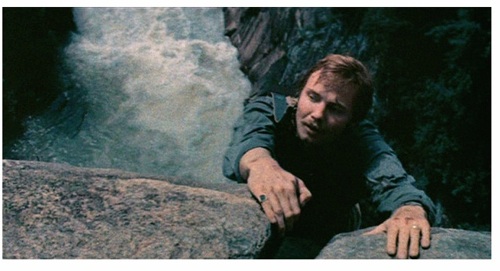
Deliverance 3


The emphasis on our (postmodern man's) being out of touch with our bodies, while it seems to be a ubiquitous theme throughout the culture, is more obsessively pursued here than it is in most discourses which take up the subject. I generally think this problem is overstated; that is, it would be my position that our intellects and spirits, relation to language and art and reason and so on, being equally out of sync, and all of these estrangements being problems and deficiencies of the mind above all, that a hyper-increased physicality in itself is unlikely to restore one to a more interesting or complete sense of self.

p.184: "I was aided by a totally different sense of touch than I had ever had, and it occurred to me that I must have developed it on the cliff." The book has a great belief in unrealized abilities that the circumstances of contemporary life have dulled in us, but that necessity, or adversity, could awaken if we found or put ourselves in a position to experience it. I do believe that when literal survival is at stake, such as in war, that something of this hyperacute awareness and sensibility does instinctively arise, and perhaps these realizations insinuate themselves permanently into consciousness. It is not my impression however that they contribute substantially to a permanent strength of mind if the foundation for such a mind be not already in place.

I interpret the story as supposed to be ultimately uplifting when the main character, Gentry, discovers his power to kill. I was taken along for some ways by this idea, though I was concerned about my health and mental fitness. Among the book's other main lessons is that somebody has to be in charge, has to take charge, and of course in the state of nature or even sometimes in advanced stages of civilization that often involves having to be willing to kill someone.

"Cornholed". There's a nice word. "...a man who had held a gun on it while another one cornholed him..."

The primal energy of the water was remarked upon numerous times. The means writers make of and the importance they attach to water symbolism--and almost all do--is the intellectual equivalent of Gentry's heightened sense of touch when scrambling for his life up the rocks. It ought to be second nature to a properly developed and highly functioning intellect.

The book on the whole, believe it or not, is very understated (quiet, modest, etc).

I wonder how these guys would have handled 3rd world immigration. Probably not well.

Monday, September 20, 2010

Some Movies From the 80s & 90s That Are Supposed to be Great

Nothing subversive here. Nothing especially exciting here either, even to me.

Howards End (1992)

I saw this back when it first came out and thought it was solidly good, no grounds for me to give reproach at the very least. Seeing it again 17 or 18 years later, something about it seemed a little more off--such as none of the characters or the world they inhabit seeming believable any longer. This is in part the fault of the book, which I have happened to read in the interval, and which the movie follows pretty closely (and which shares many of the problems I now sense with the movie). The scope of the story seems too narrow and the lives depicted too constricted to make the points it wants to make. There are a lot of symbols of the desire and inner lives of the characters but in the movie these symbols never acquire the animating spirit they need from the characters to achieve realisation.

I wrote the above paragraph late last night. Looking at it now it strikes me that the concern with the story's scope, or smallness, is a very middle class college-educated American's way of critiquing literature, especially. I read a piece characteristic of this mindset recently by one such (presumably middle-class) product of a pre-revolutionary 60s humanities education, a writer named Steven Millhouser whose books have received generally good notice, including a Pulitzer Prize I think, but does not seem either to be much read or to be considered in the ranks of major authors. To get back to the main point, in this story the narrator has a dream of being taken though an endless enormous library which contains all the lost books of antiquity, such as the 150 lost plays of Aeschylus and Sophocles, all the volumes lost in the fire at Alexandria, the missing works of Aristotle, etc (one of the humorists among the students at my college opined that there was doubtless a lost treatise "On Doggy Style", that had been destroyed by monks into whose hands it had fallen in the middle ages); the lost epic poems of the early Middle Ages; the endings of various unfinished works such as Don Juan, Edwin Drood and The Castle; The later works of great authors who died early; ambitious works planned but never written, such as Milton's planned epic poem about the Arthurian legends; books about Don Quixote's childhood or Hamlet's years at the university; not to mention all the millions of books that were written and have been forgotten. Eventually the gimmick was carried too far, but for a while it was effective in making one consider the hopeless pointlessness and insignificance of writing anything. Most English writers of the past century don't seem to have been too oppressed by such worries. They also seem to have a different, and more natural attitude towards writing and the work of making literature than the more strident and earnest model that has prevailed in America. It is sometimes stated that England has not produced a 'major' novelist--major in the sense of depicting a kind of totality of life and experience--since Dickens, which may be true in the most stringent sense, which I suppose is the only one I ought to care about. But on the whole the limited and more finely focused scope has served many English writers well over the last century or so, and Forster is very much a writer in this vein.

The movie is still technically very well made. The pacing is smooth, and I noticed several times, a specific example of which I unfortunately can't remember, that the camera had been unobtrusively placed in a position that was not the obvious place for it but which greatly improved the effect of the scene.


E.T.: The Extra-Terrestrial (1982)

I had never seen this before. I wasn't overly excited to see it, though I suspected I might be taken in by it, as Steven Spielberg is famous for his ability to manipulate the masses, even those who should know better, but, to my surprise, I had a hard time getting through it. In fact I couldn't get through it on my own, and it was only when I let my older sons watch the last two-thirds of it with it that I could finish it, and with some pleasure. I am not a knee-jerk Spielberg basher. As almost everyone knows, he does some things extremely well, and other things, usually those involving some level of acceptable intellectual sophistication, not so well, but I am not the kind to hold that against. This movie, I know, is just a sweet kids' film, but I found quite slow and hard to pay attention to.

It is my impression that this movie, which was a huge hit when first released, is not as well known today. My children, who now that they are in school hear all about everything, had never heard of it, and while I think they enjoyed being able to watch a movie with me and were interested in various things that were going on, neither has mentioned it since, and they are at the age where if something makes an impression on them they talk about it incessantly for weeks and months afterwards. I would not rate it as one of the master's better efforts.

Babette's Feast and Au Revoir, Les Enfants (both 1987)

I am putting these together because they have a number of things in common which interest me. Obviously both were made in the same year. Although Babette is a Danish movie, there is a good deal of Frenchness interlarded in it. Both are set in an earlier time, Babette from approximately the 1830s-70s, and Au Revoir in World War II. Most importantly both are well-steeped in, and to a certain extent take for granted, though not wholly unself-consciously, what we think of as the traditional European culture. Christianity and its traditions are a ubiquitous force in life, regardless of whether the filmmakers are believers themselves, young people are drilled in Euclid and study serious music, the rituals of meals and tea that date back for centuries are observed with attentiveness. The directors, Gabriel Axel (b. 1918) and Louis Malle (b.1932) both had some experience of life before World War II and were well into adulthood before the tumults of the 60s and the more international and high tech society of the last 30 years especially--to say nothing of post-1990 mass immigration and globalization--began eroding the longstanding ways and characters of the ancient nations of Europe. I note this because while 1987 is not that long ago, this generation of filmmakers and artists has passed on, and I do not see the same cultural sensibility at all in the films of the last 15 years especially, with regard to religion, music, literature or other intellectual achievements, in some instances, as I pointed out in my bit about The Best of Youth, even the national film legacy. This is what Americans are getting at when they say that Europe is Dead. The feeling that there is a profound link to the past, to civilization, that our sensitive types have been accustomed to looking to Europeans for, seems not to be there anymore, and we (or at the very, very least I) find we are taking this role on ourselves with regard to our own more recent but still somewhat distinguished and relevant history.


I was actually dreading Babette's Feast, but it was better than I thought it was going to be. While I do love eating French meals, listening to people talk about French meals in a self-satisfied manner--French people especially--I find rather tiresome, and my impression was that that was what this movie was largely about. But in fact it is mainly about severe Scandanavians who are determined to resist earthly pleasures, which was a theme that appeals to me much more. While I am not of such a disciplined cast myself, I might as well be for all the sensualism I actually have indulged in over the years.

I used to think that someday before I died I wanted to go to one of these world class French restaurants and have, once, one of these incredible seven course meals. This was largely presuming my developing into a different person however, and, not having been abroad or been to any kind of serious restaurant now in nearly 10 years due to my having so children it simply does not seem realistic anymore. I don't have the practice eating in quality places, having quality drinks and so on, and while up to about age 30 I was kind of on a trajectory to not be terribly out of place in such establishments, but I have fallen off that badly now and at this point the whole idea seems kind of unrealistic, barring a Tony Bennett-like resurrection of my general culturedness in middle age.


Au Revoir Les Enfants is a good movie, and I would recommend it to anybody who wants to see a well made, sensitive film and does not require a lot of provocation or outrage with the experience. I think I might have seen it before, 20 years ago, but I had largely forgotten it, or gotten it confused with Europa, Europa, which is also about a Jewish schoolboy trying to wait out the war by posing as a gentile, though that one, which I also don't remember well, was set in the east. I have a weakness for both school movies and movies that depict Catholic priests as genuinely intelligent and decent men, and this satisfies both of those impulses, so I like it.

My main observation on this movie is that I wonder, as more years go by, and the Nazi era fades wholly from living memory, if people will be able to find it believable, or wonder if certain aspects of it have not been exaggerated. In this movie for example, the main tension, is that the school is sheltering several Jewish boys who are pretending to be Christians. The boys in question are 11-12 years old, and I admit that I found myself saying, is it really plausible that the Nazis are going to devote all this energy to tracking down and imprisoning a handful of children? And when they are losing the war to boot? And I know that it actually happened, but from the viewpoint of the world as we know it today, it does not make any sense, even acknowledging that they hate the children and want to kill them, from our position it's a waste of resources, not to mention that any official policy involving cruelty towards children, though not uncommon even in this country until the last 40-50 years, is just unfathomable to us. I think if trends of acceptable attitudes continue as they are, the Nazi history will become something that people have a hard time really believing, and will tend to presume it either has been exaggerated or is not anyhow relevant to them, in the same way that we don't get worked up about the atrocities committed by the ancient Persians or Romans.