Friday, June 11, 2010

Prague Pictures I

I've been thinking a lot about my days in Prague lately--that was pretty clearly my Brideshead period for better or worse, and enough time has passed now (since 1996-97) that the pictures have acquired a decided air of a lost yesteryear that is never to be regained about them. I have never been back since the afternoon I left my apartment down the road from Pankrac station for the last time. By now surely the atmosphere and most of the places I frequented that made the deepest impressions on me are either gone or unrecognizable. Of course most of the coolest, or least most authoritative, people from the advanced capitalist countries considered that whatever magic the post-communist city had had offer was already finished as early as '93, by which time its interesting Milan Kunderian character had already been hopelessly compromised and trampled by Western influence. But there were still a few corners that this latter infection, or blessing, as many doubtless regard it, had not yet penetrated much at all in '96, and not all of these were entirely desolate of curiosities for the moderately intelligent inquisitor. The myriad flaws of this world have many chroniclers, and it is no interest to me to recount or much to consider them here. At the time I was looking, as many people do, for the kind of beerhall and cafe and theater and streetcar life, all at affordable prices, that the great cities of Europe offered about a hundred years ago, which the cities of the post-communist central and east, with their primitive economies and the preservation of many cultural habits since 1939 in a kind of sooty amber, approximated as closely as it was likely I would have been able to find anywhere.

There was a fair amount of talk at the time about the American expat crowd in Prague in the 90s being akin to that of the Lost Generation in Paris in the 20s, and there was some guarded expectation that this would bear artistic fruit of a kind, though as the years began to pass and no one had yet managed to emerge as a remotely viable Hemingway or F Scott Fitzgerald or even Alice B Toklas-like figure, these comparisons quickly began to be thrown about much more in sarcasm than in earnest. I mention it because I was there, and writing and other artistic pursuits were something that clearly people were doing, or at least thinking about doing, though not for the most part openly, including myself, and it is not I think an insignificant chapter in the history of the general literary failure, particularly on the part of middle class male writers, of my generation, embarrassing and humiliating as the ever growing sense of this failure is to me personally. The furtiveness of so many of the male American would-be writers is very telling, I think, in that they knew the first exposure of their 'work' or learning or approach to writing to any kind of rigorous examination would immediately blow their fragile pretensions into so many pieces that they would not even have a point from which to start anew. Better to nurse that novel like a sickly infant far from the air and light of life and at long last burst forth, unassailable with your masterpiece in your hand. But as we all understand now, with extremely rare exceptions, that is not how literature works.

I thought about putting these up on Facebook, but there is something a little too lifeless and ephemeral about the effects that seem to happen to old pictures there. There is a little more intimacy here, I have a little more control over the presentation--these pictures evoke a lot of strong feelings in me even so many years later, happiness, sadness, nostalgia, regret--apart from my schools, it is the only place I've ever lived where I really felt like I was at home. When we went to Italy for ten days or whatever it was in the middle of our time there, we returned to the city very late, around midnight on a Sunday, and we came into town, past all the gloomy junkyards and grey Soviet apartment towers, and I had really enjoyed Italy too, but I was also excited to get back to my little Prague apartment and my Metro stop and have a bottle of Czech beer and look forward to doing all the things in town in the upcoming week that I liked to do. There was a lot to be said for it.

We Are Now in Prague. The film used on this picture looks like it may have been a remainder from the communist era.
These are the Vanderbilt Sorority Girls. I believe I mentioned them once in another place. They were with the same teaching program that my wife came over with. This picture has a kind of ghostly air about it too, since I actually only met these people myself about three times, yet here they preserved forever are on a beautiful September day in Prague in 1995. This picture is taken at Vyshehrad Castle in Prague, overlooking the (Vltava) river. It was a little south of the center, within reasonable walking distance of our apartment. The castle is actually gone except for the walls which surround the hill it is on, within which there is a very striking 19th century neo-gothic church on the grounds of which many prominent Czechs are buried (I believe Dvorak is there) and a park.


Now We Have Moved Down to the Austrian Border, Somewhere in Sumava (the Bohmerwald).

It's a small country, and a lot of the people who live in Prague love the countryside and go there frequently, often several weekends a month, especially if they have cottages, which, as with the Russians and their dachas, and us and our Vermont bungalow, many people manage to do even though they are in no way wealthy.

Anyway, this building was a church more or less right on the Austrian border--it was literally fifty yards away--that the communists trashed and used for some military purpose, which I forget the exact nature of, during the cold war. As you can see it was still awaiting restoration in the mid-90s. The writing on the wall says something like "Now that life was taking shape as an endless long watch, to forget life, this was." I assume this is in reference both to the building's military function and a general statement on the various states of absurdity which the Cold War reduced individual and largely disinterested persons to.

The Outside of the Same Church


Interior of the Church


A Girl With a Blue Scarf Posing Before the Czech Lion in Petrin Park, Overlooking Prague. There are some people who just make life look--I'm not sure of the word I'm looking for, but less problematic, and certainly more pleasant, than it ordinarily appears. It is not that such people are less complicated than all the people who contribute more to the misery of the world than otherwise, but they actually possess a wonderful gift, and that is for reducing potential problems to manageable sizes so that their solutions appear much clearer and simpler.

At various low points in its history this park had the world's largest statues both of Stalin and Michael Jackson (unfortunately not at the same time) though both were eventually removed.

A Welcome Sight. This is "Michael's Tavern". Another country bike trip, this time in another section of Sumava, on the western edge of Bohemia along the border with Germany. Unlike in the United States, where the hobby of bicycling requires a lot of serious training and equipment and is primarily fitness oriented, in the Czech Republic a day of biking means gathering in one's regular outdoor clothes at the agreed upon meeting place around 9, passing the vodka bottle around a couple of times, riding in the woods or along a country roads for a couple of hours, perhaps if you come upon a village stopping to look at the old church if there is one, finding a pub around noon or one for lunch and a couple of beers, more vodka, another session of riding among the byways of rural Bohemia until 4 or so, at which time one returns to base, showers and dresses and gets ready dinner and a full evening of drinking and often music or some kind of game or other. I suppose you have guessed which country I have actively biked in and which I have never gotten around to actively biking in.

Sumava Woods. I must have an ancestral memory of these kinds of forests, because I always found them extremely calming to walk through (though I suppose they do have an eery quality as well because of the association they have with the political calamities of 1938-89 especially). Besides my Lithuanian great-grandparents someone who has recently taken up of their own volition looking into my ancestry has found a great-great-something German-speaking grandmother from Silesia, which is now primarily in southwestern Poland, and is very near the places in the pictures above and below. And then I really felt oddly comfortable when I was in that part of Poland (Wroclaw), though apart from the beautiful Polish college girls it was an unrelentingly dreary and somber place.


Castle Ruin. Between October and January the sun pretty much never comes out in that part of the world. For real.


Iconic Prague Sights in Winter. The New Town and the Prague Castle. In December there are only about 6 hours of daylight.


The Famous Charles Bridge and the Old Town. The one with the statues on it.


Charles Bridge and Vltava, with Petrin Hill (where the park is) Looming in the Background.


These last three I put in mainly to try to give a feel for what the winter looks and feels like. In Prague, and apparently in much of the world, the weather will remain exactly the same for two and three weeks at a time. When it's cold and drizzly it stays cold and drizzly, likewise when it drops below zero, or in the spring when it is beautiful and sunny.

Tuesday, June 08, 2010

More Lessons From the Brideshead Generation

This is going to be largely about writing and the process of becoming a writer, subjects which remain of great interest to me in spite of my increasingly frequent desires to leave the realm of literature behind and find something else to do and be interested in, preferably my elusive authentic and intended calling. This has not yet come about however, and it remains my intention and desire for the time being to someday write another book, and more after it. Though I have no longer any hope of having a career as an author, and very little of even producing something publishable, I really can't think of anything else that I both could do, and would be interested in doing. Psychologically this is a very depressing place to be in middle age, as one is left asking oneself the same two questions over and over, the first being Where did it all go wrong?, and the second, increasingly, Was there ever any real hope of things turning out otherwise than they have?

In studying the history of this group of writers I have been referring to lately one is immediately struck by how rapidly they were able, especially in their youth, to turn out a completed book. Waugh's and Graham Greene's 1930s and 40s novels were regularly knocked out in 3-4 months, George Orwell's not much more. 8 months was considered a long time. P.G. Wodehouse, who is increasingly considered as a great writer, was perhaps the model of a professional author in this period, and required even less time to knock out a book. To me the lesson the young writer should take from this, and indeed pretty much the whole history of letters is, get that first book done and out of the way quickly at all costs, and then, get the second one out of the way. After that, you can start to move on. The young American writer who has the misfortune of finding himself trying to navigate the contemporary literary world exclusively through the university system and workshop/ MFA circuit may not ever hear this. First of all, he probably won't understand that if he really had serious literary potential he'd already be employed in some capacity as a writer and developing a readership. As such, he'll be treated by his teachers as an ingenu and told about the importance of endless revision, and grow obsessed with the idea of the airtight, fact-checked, error-free, and ultimately lifeless book impermeable to the criticism of these same. He may also have bought into the idea that the only worthwhile end of writing is to produce a certain kind of masterpiece, and having seen two routes to this end extolled, one of which is pretty much to be a genius, and the other, seemingly more attainable one, being the Thomas Pynchon/David Foster Wallace/James Joyce/Flaubert, etc model, where one labors for a decade or more ensuring every word is in its proper place, by the end of which process our would-be author is well into his 30s and the cultural moment has long passed him by. The process and critique of writing are important, but at a certain point, especially if it is what one is ultimately interested in, so is moving one's work in the direction of getting ready for the press, and any sense of this urgency, or even of much of a connection to the actual publishing world, is largely lacking from the collegiate/MFA system.

The books of the Brideshead-era writers are loaded with imperfections, but they are on the whole smart, vigorous, funny, and oddly personable and accessible. They tended to repeat themselves in their many books, and I'm not sure how profound their engagements with the human condition were, though I do think they approach meaningful insight at intervals within most of the volumes I have read. Graham Greene published 7 short novels, one a year, from age 25 through 31, of which only two received favorable criticism and one, Stamboul Train, had even modest sales (8,000 copies, which in 1932 was a decent number I guess). His second and third novels were apparently very poor, and once he became successful he disowned them and would not allow them to be re-printed. But he finished books and got them to press, and in time he made himself into a writer. Anthony Powell, same kind of thing. Had a well-reviewed, though modest selling, debut at 26, wrote three or four more novels over the next 8 years that showed declining promise, then had a odd lacuna between ages 34 and 46 where he didn't publish any novels (the first half of this period was the war), and then emerged from this fallow period with a volume of his great Dance to the Music of Time sequence (which Waugh and some of their other friends thought was too much) every two years until he was 70. Of course, these guys had money, and connections, and a very different education and upbringing, drenched in literature and art, and moved in a world where writing and criticism were things everybody more or less did naturally, but that doesn't make the lessons on how to become a real writer any less valid.

Another refreshing side of this book is that it is nice to read (not that I can necessarily believe it) some antidote to the relentless chest thumping of the internet especially that technological progress is the greatest thing ever, that scientists and engineers and computer geeks and business owners and such value creators are the only genuine smart people in society and the other 95% of the population is essentially worthless, and certainly nothing without them. Waugh especially of course, fancying himself an 18th century style aristocrat and aesthete, regarded the whole modern project of ever increasing comfort and entertainment and shopping opportunites for the masses to be an unrelieved horror, and in his literary world at least technicians and businessmen and their like are kept in their proper places, both seen and heard as little as possible, and endured only at extremities (Graham Greene seemed to have more respect for doctors/scientists and other types of worldly men so long as they were 1) very accomplished in their fields and 2) of an existentialist kind of bent). I admit, old-fashioned European literary culture seems to me much more interesting and attractive than this supposed super high-IQ utopia that is supposed to have been created in modern America. The internet obviously is an incredible invention, and people who have never lived without it probably won't be able to imagine how anyone ever did so, and it is obviously great for things like buying airplane tickets or checking schedules or looking up one's friends even if one doesn't always quite know what to do once one has found them, or buying books--but then see, for example, before the internet took off I used to have to go to Boston several times a year to buy books that I couldn't find up here, which now I don't have to do, but the thing is, I really liked going to Boston every couple of months to buy books, and the defined nature and perceived necessity of the task ensured that I would do so. I'm not really making my point, which is that in the techno-society our intelligence and experiences seem to move primarily in a certain direction, to put it bluntly an ever geekier, less sensual, less verbal, less aesthetically conscious one, which I hate.

Thursday, June 03, 2010

Louis Armstrong--"What Did I Do to be So Black and Blue"


"I'd like to hear five recordings of Louis Armstrong playing and singing "What Did I Do to Be so Black and Blue"--all at the same time. Sometimes now I listen to Louis while I have my favorite dessert of vanilla ice cream and sloe gin...Perhaps I like Louis Armstrong because he's made poetry out of being invisible. I think it must be because he's unaware that he is invisible...Invisibility, let me remind explain, gives one a slightly different sense of time, you're never quite on the beat. Sometimes you're ahead and sometimes behind. Instead of the swift and imperceptible flowing of time, you are aware of its nodes, those points where time stands still or from which it leaps ahead. And you slip into the breaks and look around. That's what you hear vaguely in Louis' music."-- from Invisible Man.


Well, this is a good song, isn't it? It's the blues, which I know I've said in the past I don't like, but there are exceptions to everything. Ideally art is still an elevation of the ordinary banalities of feeling, and most thought, to a form where the sensation gives pleasure to the mind, even where the subject is an unhappy one. This last point has I suppose always been a point of conflict among people who prefer truths to be delivered unvarnished and discomfiting, but most consumers of art will not, after a time, return to a production that offers to the mind no pleasure along with its difficult medicine. This music sounds like the state of mind in which an astute and unavoidable melancholic would most desire to endure life, because there are contained in it consolations of greater spirits, beauties, and hopes that ordinary experience generally shows him.


A lot of people I went to school with live in New Orleans, which is famously where Louis Armstrong came from of course, and apparently they love it, the food, the culture, the diversity, the street talk, the edginess. People who move to staider places like Minnesota lament the food and street culture they've left behind for years afterwards, and I have to say, there does seem to be a level of social comraderie among what I guess you would call my demographic that is for whatever reason non-existent almost everywhere else. Still, I can't imagine I would like it there. The weather first of all would be unbearable. I start to wilt around 78 degrees, and there the air is basically soup 8 months a year and disturbingly mild in winter. The place just looks seedy and weedy and underdeveloped in a disturbing rather than comforting way. I probably wouldn't actually like the food, certainly not enough to appreciably enhance my joy in living there. I would lack the personality and verbal agility to banter with all the colorful characters there, which would make me irritable and depressed. The place is increasingly a vortex attracting disasters both natural and manmade towards it. In short, it seems like kind of a hellhole, though obviously cultural and personal magic for people with the right temperament and receptivity to its dynamic. I don't think that would be me though.

Wednesday, June 02, 2010

Barnegat Lighthouse, Long Beach Island, New Jersey

I'm on a picture frenzy right now (it's also about all I can do anymore). This was an attractive and unspoiled looking place. Of course hardly anyone was there in late April, though by New England standards it was definitely outdoor weather, if not beach weather. This is the northern end of the island. At the southern end the view is of the ominous-looking high rises of Atlantic City. Once you got past the suburbs of Philadelphia the drive over was completely sylvan and uncrowded as well. Though New Jersey is famously the state with the highest population density, no one seems to live in much of the center of it.

1. We must get our bearings at the monument. This place hasn't been a fully operating lighthouse for a long time, maybe the 1940s or so. The sea around it looks extremely dangerous even to someone like me who knows almost nothing about navigation, all kinds of shoals and shallow coves, extremely windy. 2. The Crew Climbing the Lighthouse Steps, in Shadow.


3. The Crew Again, With Flash. Look at the health on display after a turn in that brisk salt air. The effect on me is for some reason not so salubrious, and tends to bring out my old acne pits in ever sharper and harsher relief. In another twenty years I fear I'm going to look like an extra in a Hawthorne or Melville novel, and that's probably a best case scenario.


4. High Up, Buffeted by the Wind.


5. Too Heartwarming to be True.


6. Water in Abundance. Nature loves gigantism and excess.


7. This One Has the Most Hair, and Thus Gives the Best Idea of the Strength of the Wind.


8. Tackling the Rock Wall With Lighthouse Now in Distance. More expression of health and general fitness so as to be entrusted someday with the carrying on and out of civilization.

9. Apart from the Child's Clothing, There May Not be an Abomination of Modern Human Manufacture in Sight. The world as it is meant to be regarded and experienced.


10. I am Caught on the Rocks.


11. Here are Some People to be Reckoned With.


I can't think of a durn thing to write here (that isn't demented and absurd--this is why I have to try to write another novel or story--you can be absurd in them, and it not unfrequently improves the story).

Sunday, May 30, 2010

Invisible Man--Part 3

Reading about Waugh and the other amusing but rather spoiled brats of his generation as I have been recently probably does not put one in the right frame of mind for considering Ralph Ellison in the properly serious manner. However, one's perspective is always being altered and distracted by one thing or another, and while the inclinations of my attention in these sorts of matters are often disappointing from almost any point of view, I am far enough gone now that I am no longer wholly untrustful of them, and am at least equally as curious as frustrated as to why certain generally frivolous things appeal to my interest more than those of greater real import.

I find it very hard to say anything about the Ellison book, nor is there really anything I wish to say but am unable to formulate into words. I took notes, but they don't add up to anything coherent. There are clearly episodes and images that I liked scattered throughout, but they do not seem to have had the effect of "making me think" very much which is supposed, I think, to be the book's most important quality.

Chapter 21--"I won't call him noble, because what's such a word to do with one of us?" I took this 'us' as referring obliquely to all Americans, though I doubt that is what the speaker would explicitly have been referring to by it.

Rinehart represents American reality, fraud and deception, illusion.

'White women rape fantasies' I wrote. 'Everyone believes women want black ****.' I think I am referring here to the fantasies of white men who seem in great part, apart from obvious studs and other more or less secure individuals, to consider themselves incapable of sexually satisfying 'their' women and are in awe at the idea of the presence on earth of a race of men who are perceived as being able to accomplish so easily and uncomplicatedly what is a major source of angst in and drag on the white male population (black men may have many problems, but judging from their art at least, sexual inadequacy, or feelings of the same, does not appear to be one of them). I remember reading about voyeur clubs where white men get aroused (as much as it is possible for them to) by watching a black guy do things to his wife or girlfriend sexually that are supposedly beyond his physical capacities. I don't have a good sense for what form these kinds of male-female relationships can possibly take when everybody goes home. Evidently for the men who have internalized their own inferiority to such an extent there is some sort of catharsis in this experience. I often experience a masochistic desire to have authentic writers, artists and other men and women of serious accomplishment methodically and systematically savage what remains of my person and pretensions in front of an audience, not merely recommending that I be shunned by all desirable company forever after, but ensuring that this will be the collective will. In my novel the main character is incapable of imagining himself giving sexual pleasure to the woman he 'loves', but can only imagine her enjoying herself with a parade of comparatively godlike studs who have just finished destroying him in some area of human endeavor or another. This kind of mental flagellation does not really have a racial component with me however.

The depiction of the race riot in chapter 25 was good, one of the stronger scenes. The looting woman carrying a broom with a dozen dressed chickens suspended from it for some reason especially stands out to me. I have never been in a riot of course, although on the other hand it seems curious that I, indeed most people, can live for 40 years and never have had so many of the signature human experiences that make up a huge portion of the subjects of literature and the other arts.

There was, I wrote, a 'Don Quixote scene' with Ras that I believed did not work because it was trying too hard to say something serious. I thought that these kind of scenes only have a chance of working if the writer plays them as absolutely straight.

I guess a lot of people have to read this book in high school, though to be honest it is hard for me to see what they would be likely to get out of it. The motif of the 'invisible man' didn't make a searing impression on me. There is something of a disquisition in the epilogue about affirming "the principle on which the country was built, and not the men". Is this suposed to be the lesson of the book? The meaning of this philosophizing at the end is not clear to me. It neither rings true nor seems to know exactly what it wants to say. It is not self-contained and full in its expression and language. I sort of know what he means but I have to manipulate the images to what I think they might/must be rather than knowing what they are at all confidently. There are some pretty good bits on diversity and accepting the fact of one's humanity at the end. Maybe this last is the lesson of the book. I don't know.

Monday, May 24, 2010

Fiddling Until Computer Implodes

I'm supposed to be being attacked by 5 viruses at the moment, one critical. My intention was to try to write a post of snippet-items anyway.

Boxing no longer generates the interest it once did in this country though one would learn much about interpersonal relations by studying it, for the techniques people use in argument, particularly those between husbands and wives, are akin to the styles or non-styles used by boxers. My mother, for example, unfortunately had a Gerry Cooney like style of arguing, wherein she would plant herself in a single spot, cover her face with her hands, and allow her opponent to rain blow after (verbal) blow on her with very ineffective resistance, hoping for the bell to ring, or, in some instances, for her opponent to leave the premises in complete triumph, often for days, with her still rooted and dazed on the same spot, the equivalent of a TKO. It thus caught me quite by surprise when my wife's style of argument turned out to be more akin to that of Sugar Ray Robinson, landing well-placed and stinging blows, frequently in combination, and then moving from room to room under the guise of "being busy", and never allowing herself to be drawn into a toe-to-toe exchange of punches in the center of the ring. I believe this method is more instinctive than studied with her, but it is brilliantly effective, for it is not easy for a lumbering fellow like myself to fight, hurl invectives, etc, against a moving target with a quick mind.

Applying the theory further, one sees how here too Mike Tyson was a bad role model for Americans, especially since he remains the last boxer to be widely recognizable across all strata of society. Tyson's method of fighting at its most impressive was to march straightforward into the center of the ring and pound his overmatched opponents senseless, often in spectacular fashion such as knocking them through the ropes or lifting them off the ground and sending them airborne several feet backwards. A good portion of the American public seems to have adopted this technique in their approach to debate. Once people with a modicum of skill figured out how to sustain Tyson's initial fury, he was exposed and began to lose, as no doubt would also happen to most of the bullies and demagogues who hold much of our public discourse in thrall. Unfortunately most people, including myself, when encountering a person of this type end up playing the role of one of Tyson's hapless early opponents--Marvis Frazier perhaps--who had to be carried out of the ring on a stretcher 30 seconds after the bell rang.

That ability to sting in conversation and dealings with other people is a crucial skill that I never developed--not so that I should be able to unload indiscrimately on everybody I came across, but just to keep people wary of me, make them have to be a little respectful, not get too comfortable. As it is, people pretty much dig in and occupy all the ground they want up to the very boundaries of my person, and I can do little about it without expending pretty much all of my force, which I am understandably reluctant to do in routine social encounters. I hope dearly that at least some of my children have enough light, quickly deployed mental power they can carry about with them to be able to establish some kind of presence in such situations. I am putting a lot of hope in my dear wife's excellent genetic qualities as far as the social fate of the next generation goes, myself having little to offer in that regard other than height, which I have have always considered more of a non-negative than a positive quality, though I have had several men express to me, and apparently believed it whole-heartedly, that if they possessed my height in combination with their other outstanding qualities they would be making six figures and dating beauty pageant contestants, or at the very least Hooters waitresses.

I am currently reading a book which is giving me a great deal of ninth hand pleasure, The Brideshead Generation, by an Englishman named Humphrey Carpenter. Everything I read about them further persuades me that this crowd--the Bright Young People of 1920s London--were unspeakably awful, but at the same time I can read about them all day and never weary of them. Their style of life is as close to my ideal as I have found, especially among the English-speaking peoples, though I do also like the coffeehouse and tavern haunters of the 18th century. They drank a great deal, they traveled, they wrote, they chased women (and boys, I concede), they were witty, they had an excellent taste for characters and scenes. The Oxford Railway Club, for one example, was a group of aesthetes, homo- and heterosexual (in the womanless world of 1920s Oxford these distinctions did not impose the social boundaries among men that they seem to today), dedicated to taking midweek excursions around the rails of England, having a five course dinner on the outbound train, jumping off at Leicester or some such place and riding back in the bar car to make the midnight curfew, accounts of which excursions were dutifully written up for one of the myriad campus publications. Of course if you are on the railway club outing on a Tuesday night that means you aren't studying. But it's 1923, and you are of the right class, so you can still recover from getting a third in history, or not managing to get your degree at all, and manage to do something fairly interesting and prestigious. These guys struggled a little to get their careers going in their mid-20s, and of course some of the most brilliant ones never panned out as writers or anything else, but the ones who really made it big, at decisive moments in their development were able to produce something of reasonable value, and were close enough to the sources of power and influence to have a fair chance of having someone in a position to aid them take on their projects. One of the notable circumstances of the Oxford chapters are the confidence that as every generation must have its writers and poets, it is taken for granted that a good number of those in the rising one are surely present, and that therefore their little college poems and general literary education are in fact serious matters. There appears to be something of a similiar attitude at Harvard and other Ivy League schools, perhaps not so much in literature, but the expectation that numerous of the young people sitting in your class at any given time are going to be prominent and influential--of what degree of quality is not for the moment in the question--seems to be in operation from what I know of their graduates.

It is clear that someone in our family--evidently it isn't going to be me--is going to have to buckle down somewhere and figure out how to make a pile and push us into that realm of society where our more talented members have access to people who can show them how to really get on in life. In my family we are on at least the third or fourth generation of capable enough intellectual ability that never seems to amount to anything because they don't know how to work or ingratiate themselves with the right people or something. I came across my three year old son the other day essentially teaching himself to read--he had a little book open and was sounding out j--a--m--and I thought, well, he'll end up a little office clerk like his father, being spoken to by people with 8 week correspondence course certificates as if he were seven steps beneath them on the class scale, and deservedly so, but why? How does this keep perpetuating itself, and why can no one make that leap to the next stratum?

But I digress. There is some dispute as to how fun the parties of the 20s actually were--some people are fastidious as to detail--but since I am reading here in May of 2010 about, among numerous other fetes, Babe Plunkett-Greene's and Elizabeth Ponsonby's Swimming-Pool party of 13 July 1928, I am going to guess that it was at least as much fun as anything most people who are interested in this scene will have ever known themselves. "Bathing costumes of the most dazzling kinds and colours were worn by the guests," the Daily Express reported, "Dancing took place to the strains of a negro orchestra, and the hardy leaped into the bath, of which the water had been slightly warmed...A special cocktail, christened the Bathwater Cocktail, was invented for the occasion." Further, back to the main narrative of the text: "...the women one met at such parties were not especially sexually liberated; they 'expected to have passes made at them', but were well able to fend these off. One heard stories of debs who could be got to bed, but...such sexual contacts as were achieved at or after these parties (being) brittle and transitory...They might bruise and press each other's flesh...No hearts to break and nothing to linger afterwards behind." This doesn't sound all that bad. One remarkable thing about this group is that while they went nuts with affairs and freaky sex in their 30s, 40s and even beyond, many if not most of them appear to have remained virgins as far the opposite sex was concerned for several years beyond college age, 23 and 24 and 25. That certainly was not healthy for them. The best age for that sort of thing seems to be 17, as far as your best chance of being well-adjusted and healthy down the line goes, some people probably handle 16 and some would be best advised to hold off till 18, but beyond that I really think you start to see unnecessary derangement.

Humphrey Carpenter views Waugh as the central figure of this group of writers, not merely socially but from the literary; personally I would be inclined to disagree, but I have only read Brideshead Revisited, which seemed to me the weakest of all the books I have read from this general group, which includes Anthony Powell, Graham Greene and Henry Green, not to mention Orwell, who is not part of this crowd socially but was the same age and was at school with many of them. I can go along with the premise though because the book is so damn entertaining. Carpenter also was "a musician and the founder of Vile Bodies, a band that recreates the music of the Evelyn Waugh era at the Ritz Hotel in London." I don't know if this is still going on (this was written in 1990), but I think it might be too much even for me to take. (Note: Carpenter died in 2005. The band does not appear to play anymore). The Ritz is so prominent in the literature of this era especially, which I have been gorging on and living vicariously through for much of the last decade now that I am thinking I may have to make a splurge and have dinner there if I ever make it back to London (which dinner will probably cost more than my plane ticket, at current rates anyway).

Of Mice and Men (movies--1939 & 1992)

I've seen both of these versions lately, as each is rated a top rank film by various major publication or other, the '39 one more frequently, though the '92 has its fans as well. The two movies are quite similar, and almost look at times like they were filmed on the same sets. You would think I would be partial to the '39, but I am leaning towards the '92 which seemed to me a little better acted (Gary Sinise & John Malkovich in the main roles versus Burgess Meredith and Lon Chaney Jr, and Sherilyn Fenn has it all over the simpering ninny they had in '39 as the girl). The '39 has the advantage of being contemporary with the book and it had a very capable director in Lewis Milestone, who did All Quiet on the Western Front. I don't love either of them, and as such it is actually interesting to see two versions of the same story.

The story seems to have been regarded almost since its first appearance as being profoundly and vitally American. Like many such American stories, it features a prominent character who is retarded, in this instance one who is a tireless worker ignorant of his own strength, which I presume is supposed to be symbolic of the vast American proletariat. An agreeably sinister stand-in for corporate America, and the American dream, more modest but no less elusive than it is in our era, are also portrayed. I have to say the story has never resonated too much with me--the characters and milieu are not the type that I am really drawn to, especially since there is not much humor in them. I find it hard to love people who are both earnest and ragged--the combination doesn't work for me.

In short I think if you haven't read the book at least one of the films is worth seeing (they are by no means bad--I just wouldn't think of them as great) just to become more familiar with the story and the place it occupies in American culture, where for whatever reason it has become recognized as a classic by many influential people.

Saturday, May 22, 2010

Untitled With Lists

I've alluded before to the long list of literary sites I have been compiling over the years. I haven't been to see any in quite a few years now and while I haven't lost all interest in them the lists have become lopsided and unwieldy in places, as well as inconvenient to keep up. Nonetheless I have been keeping them up, and I'm going to run some of the statistics here (this only counts things I have yet to see), starting with "Nations"

1. England--216 I organized my countries according to FIFA regulations, so England, Scotland, Wales and Northern Ireland are counted as separate countries (no literary site on my current list is located on the Isle of Man)

2. United States--126

3. France--63

4. Ireland--33

5. Italy--32

6. Scotland--30

7. Greece--22

8. Russia--21

9. Israel--19

10. Turkey--16

11. Germany--14

12. Egypt--13

Obviously I need to read more German literature, and where are the Spanish? (Spain is in 14th place currently, with 7 sites) Italy's number is inflated due to the Romans and the circumstance that a lot of English authors either lived there or wrote stories and poems about specific and easily identifiable places.

"England"

1. Middlesex (London)-71

I should have stuck to the ancient county boundaries, but when I began my listings, I recorded them according to the re-organization of 1974. Apparently there was a further re-organization in the 90s however, so many of my designations no longer signify anything.

On another note, the re-organization of internal boundaries that have sufficed for centuries has been one of the obvious symptoms of a nation's decline (widespread epicureanism is another), going back at least as far as the Roman Empire. This is why emotionally at least I am against doing this in the United States (or tearing up the Constitution and writing a new one, as some have argued is necessary) even if there are valid arguments for doing so.

2. Kent--14. I am continually surprised at how well Kent, which is not thought of as a literary region, does. Canterbury is the leading point accumulator in this county; besides the oft-referenced cathedral, a lot of writers either were born or lived there (Marlowe, Fletcher, Conrad, Maugham). Henry IV, king and also Shakesperean character, is buried in the cathedral as well.

3. Dorsetshire--13. Famous for Hardy, but Shelley and his wife and her parents, all noted authors, have connections to Bournemouth.

4. Cumbria--10. The Lake District. Wordsworth, Coleridge, DeQuincey, et al.

5. Somerset(shire?)--9. No dominant town or author (Bath used to belong to this county I think, but in my system is listed under the post-70s abomination of "Avon"), just a variety of different people.

Oxford and Cambridge come in much weaker than I would have thought. All of Cambridgeshire only has 3 sites on my list.

"United States"

1. (Tie) Massachusetts/New York-24

Nearly all of these places are within easy driving distance of my house, which should be proof to you that I have not been carrying out the project of visiting the actual places with same fanaticism with which I have kept up the lists.

3. Mississippi--8. Not surprising. I was actually on my way to Mississippi once, getting as far as New Madrid, Missouri, before my wife made me turn around due to severe tornado warnings all across the area to which we were heading. That was in 2003, so I have still never made it there.

4. Ohio--7

5. (tie) Connecticut/New Jersey--6. These are mostly just birthplaces and graves, some of them obscure. For example William Ellery Leonard was born in Plainfield, NJ--I can find no other information on him, though I assume he is buried in Madison, Wisconsin. The Revolutionary War poet Philip Freneau, according to the 1904 edition of his collected works, is buried at the "Philip Freneau cemetery" in Matawan, NJ, but as I cannot find any mention of this place on the internet, I question whether it actually exists or not.

"London"

1. Westminster--15


This is mainly people buried in the Abbey.

2. City--12. The square mile. This is where pretty much everyone pre-1800 lived and died. Unfortunately not much of that era is left.

3. (tie) Bloomsbury/Unknown--4. Unknown refers to people (usually very remote, like Spenser) whose birthplace is given as simply 'London', no street or house known.

5. (tie) Marylebone/Strand--3. A lot of people seemed to live in Marylbone in the late Victorian/Edwardian period, 1880-1914 or so. It's where Sherlock Holmes lived, I'm pretty sure. I don't remember what's in the Strand.

"Scotland"

1. (tie) Ayrshire/Dumfriesshire/Midlothian--6

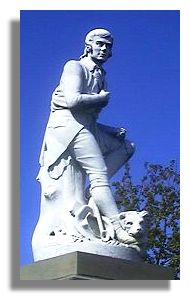
Another competitive country. Burns, who is the subject of more literary sites (10) than I think anyone (that should be another category) is resonsible for 5 in Ayrs, 4 in Dumfries, and 1 in Midlothian. Midlothian is otherwise where the very literary city of Edinburgh is located.

No other county in Scotland notched more than 2 sites.

"France"

1. Seine--23. This is obviously Paris. Again I am going by their modern departments, which date I believe back to Napoleon at least, rather than the traditional ancient regions.

2. Seine-Maritime--5. In Normandy. Rouen the major city. Joan of Arc, Flaubert, & Racine are identified with this region.

3. Vaucluse--4. In Provence. Avignon the town. Among the figures associated are Camus, John Stuart Mill, and Alain Chartier, author of the medieval love poem "La Belle Dame Sans Merci"

4. (tie)--Eure-et-Loire/Gironde/Indres-et-Loire/Loiret--3. The broken-up & famously castled and vineyarded Loire region showing some strength. Eure-et-Loire: Chartres and Proust's Cambray. Gironde is in Dordogne, capital is Bordeaux. Montaigne is the big guy there. Indres-et-Loire is the Tours (Balzac) and Chinon (Rabelais) neighborhood. Loiret is Orleans (Joan of Arc).

"Italy"

1. Lazio (Latium)-10

2. Tuscany--7

3. (tie) Campania/Emilio-Romagna--4. My impression is that Emilio-Romagna is not as overrun with tourists as the rest of Italy, but still has the kind of rich, beautiful, artistic ancient cities (Ravenna, Bologna, Parma, Ferrara, plus Rimini, the Blackpool/Jersey Shore of Italy), but on a smaller scale, that people love. Maybe I'll base myself there if I ever go back sometime.

5. Veneto--3

"Ireland"

1. Dublin--17

The capital areas are far more dominant, and the universities much less so (Germany may be an exception), in most European literatures than New York has even been in this country, though it doesn't always seem that way. I used to lament a lot that Philadelphia had never really nurtured much of a literary scene or apparent talent, and that something in the environment must be inimicable to a literary sensibility. However, Reading, a dump of an industrial city of a 100,000 people about an hour west, managed to produce both Wallace Stevens and John Updike (Philadephia's most famous authors by comparison are Ben Franklin, who grew up in Boston, Louisa May Alcott, who moved to Boston when she was about 5, and the 30s communist playwright Clifford Odets).

2. Galway--7. I forget who is responsible for all this Galway stuff. Yeats probably.

No other Irish county had more than 2 spots.

"Top Cities"

1. London--71.


2. Paris--22

3. Dublin--16

4. New York--8

5. Concord, Massachusetts--7. It's a little embarassing that this is in 5th place, but a lot of people lived there and there are a lot of museums and such. It's only about a hour from where I live, and it is a really beautiful and rich little town with delightful pastry shops and so on. I've only been there once, 13 years ago. This is the kind of place I ought to go to once every couple of years just to hang out in for a few hours and decompress from the vulgarity of most of modern life, but I never get around to it. Maybe this upcoming weekend.

6 (tie) Cambridge (Massachusetts)/Canterbury (England)/Edinburgh/ Jerusalem/Moscow/Rome/Troy (as in the Iliad)--6. That's a pretty good group there. Troy gets a point every time either one of its natives or itself is the subject of a work, usually a poem. I know there is nothing there but a bunch of stones and dirt and a reproduction of the Trojan horse. I've endured far more boring places.

Thursday, May 20, 2010

The Blog of Death (or Florida 2010, Series 2)

Overtired this week, frustrated with the outcome of the previous post, and reading in my spare minutes snatches from another book about the generation who attended Oxford in the 1920s, I was going to confess on an extravagant scale the truth that the day a person starts a blog is the day he has conceded that he has given up on life and is henceforward counting down the hours until the grave is finally reading to receive him, but, while I do think this is to a certain extent true, I have had a couple of hours to think it over and have decided not to take such an extreme line today.

My frustrating experiences, especially in recent years, in trying to compete against others in mastering ideas and perceiving the reality of events and situations in the real world has convinced me that I will never be able to do so, and has caused me to retreat into trying to find a framework by which to live ever more in forms and patterns, of writing and language, of traditions and stories, of aesthetics, of logical systems that are adaptable to my individual level while still remaining inspiring as well as possessed of meaning...Enough for today. Baby steps. My meanings will reveal themselves blatantly enough in time.

This is a Zoo/Park Featuring Exotic Animals. I will spare you more pictures of these, though there are some nice pictures of tortoises, my son holding a baby alligator, and so on. They Have a Shrine at this Zoo. Inside those windows are plaster dioramas featuring scenes from the life of Christ. I have a weakness for that kind of display, though these dioramas were especially amateurish as well as in need of some kind of cleaning/restoration.

Boat Tour of Lake Myakka, Myakka River State Park. This is a very pretty and well-maintained park about 20 miles inland from Sarasota. I think this lake might be man-made, though I forget. Though it is quite big, it is only 6 feet deep at its greatest depth. The Myakka river drains into it. The evil imported tilapila have totally infested it and have choked off the native aquatic life. The recent cold spell (note the attire of the people on the boat) meant that the edges of the lake were clogged with dead tilapila. The day that we went the sky above the lake was darkened with the circling of vultures all around it.

Alligators Out in the Sun. I saw more alligators elsewhere but it wasn't convenient to stop and gawk at them.

A Three (Five?) Story Tower Gets You Above the Treetops. This structure is buffeted terribly by the wind, so I didn't care for it too much. I'm gussing by the shadows this view is facing south. Good illustration of Florida's flat terrain. The state's highest elevation, which is up in the panhandle near Pensacola and all that, is I believe 381 feet, which I think is the lowest high elevation of any state, even Delaware! (Research confirms that this is true. The high point in Delaware is 448 feet. Florida's is actually only 345 feet.)

Probably a Hopeless Cause, But Trying to Add Scientific Activities to Our Repertoire. So far I have been moderately successful in focusing the moon clearly for about a half-second or so. The most satisfying use I have gotten from the telescope so far is turning it on distant buildings such as churches, old houses and such and examining the details of their roofs and upper storeys. We'll have to get it out in Vermont this summer and try to work on the sky again.

We Say Goodbye to the Beach. It would have been a good day for kite flying.

It Doesn't Look that Bad, But it Must Have Been Cold. Usually there are people walking back and forth up and down this beach all day.

Dinner at Sonny's Bar-B-Q Pit. More chain fun. I sort of excuse myself because for years we didn't actually have all this stuff in New England (and they still don't in Vermont) so it was kind of like seeing the real America. Sonny's isn't the best food, but my three year for some reason has developed a great love for the idea of it, so we stopped there for him. The two times I've gone the waitresses have been the kind of sensible, healthy, unpretentious and good-looking All-American girls I like, so I guess I'll have to go back until my luck runs out.

This was in central Florida on the way back. According to conventional wisdom, while the coasts have been colonized by affluent east coasters and the panhandle in the north across to Jacksonville is still the redneck south, the center area, especially away from Orlando, has been settled by people from the midwest, which accounts for that area's being friendlier and less bombastic than the rest of the state. I don't know if that is true, though I am willing to believe it, but I do like the way the center still retains a little more of an old fashioned look, more orange groves, more train tracks, more one horse towns and farms and so on. There are some older sights there I mean to get around and see some year if I can ever plan my time properly. I wanted to visit the Bok Tower Gardens, which is a large preserve left by Edward Bok, Dutch immigrant, editor of the Ladies' Home Journal and author of the once-classic but now forgotten autobiography The Americanization of Edward Bok, to the state when he died in 1931. The site is not especially well known either--I only read about it in my 1962 encyclopedia--but it's still there, still kept up, and people who have been say (on the internet) that it's really a great place. So maybe next year I'll get over there.

Monday, May 17, 2010

Invisible Man--Part 2

Chaper 13: "Men grow old and types of men grow old." I guess I thought my type had grown old. I still believe there is hope for regeneration, hopefully in the next generation but at least somewhere further down the line. Confidence, ability, success, determination, vitality, involvement with the prevailing spirits of the day, now for some inexplicable reason all dead to the world, must be lying there in some latent form, waiting for the imagination to suddenly comprehend again to what uses its strongest qualities need to be put to, and how to use them, which is what seems to be most lacking now.

There is a litany of "old heroes" named--I am always interested when capable authors reel out lists of superlatives, or what they perceive others to believe to be superlatives. Here we get "Jefferson, Jackson, Pulaski, Garibaldi, Booker T Washington, Sun Yat-sen, Danny O'Connell, Abraham Lincoln..." Not sure how Jackson fits in with this crowd. I guess he was the first man from the common rabble to become president. Also his ungenteel followers were empowered and became a more meaningful force in the national political life than they had been before. That is the official story anyway, not the Noam Chomsky/Howard Zinn version.

One of the white communist women is referred to as having a "thin New England face". Now there is a type that is dying out, or at least is being driven, like the Basques and Bretons, into remote and thinly populated enclaves in the main out of common view.

"One thing about the people at the Chthonian (i.e., the white communists), they all seemed able to say just what they felt and meant in hard, clear terms." My own inability to ever develop this skill rates as one of the 5 or so greatest disappointments of my life. On page 332--the end of chapter 15--out of 581, I finally betray myself as beginning to lose a little faith in the book. "Do black people really like this book," I asked, "or is it white people?" The book's literary sensibility struck me as more self-consciously after the 'white' (Euro) model than I was expecting.

"I stumbled in a stillness so complete that I could hear the gears of the huge clock mounted somewhere on the balcony gnawing upon time." I like that sentence. Another example of the sense of the world in this period being a giant mechanism, with these great clocks as the primary symbol (See also films "The Clock" and "Modern Times").

In Chapter 16 there is a discussion on Joyce and the infamous line about creating the uncreated conscience of his race which is a recurrent theme in the life of everybody who encounters insuperable problems creating individuals and a serious culture out of his available materials, and thereby can never feel intellectually secure.

The super-seriousness, paranoia and backstabbing of 1930s communist intrigue was a whole lot of possibility and fun that as usual most Americans got left out of.

Around page 360 I make a note that 'the pace/direction of this book are very odd.'

"He take one them strumpets and tell the black mahn his freedom lie between her skinny legs..." Ras, the dynamic black activist who it is my impression is a much-studied character in this novel, is explaining one of the means by which blacks get manipulated by whites. The love in question here is white girl love.

"On the day of the parade they drew crowds faster than a dogfight on a country road." Dogfighting was in the news ceaselessly at the time as one of the most horrible things that went on in the world, so I had to take note the reference to it that is obviously intended to be at least some way comic.

Around page 440 I scribbled a note that that this was 'not as good as Salinger. Just not as good. Same year, not as romantic. A different city.' Obviously I really feel this. Of course it has nothing to do with what Ellison is trying to write about, but effective art is very much about presenting a spirit, a picture, a sensation that resonates strongly with people, and this book for the most part failed grandly to accomplish this with me.

This is a Sculpture Commemorating The Invisible Man. It seems to be in Harlem.

I did like his comment on the blues. "Was this all that would be recorded? Was this the only true history of the times, a mood blared by trumpets, trombones, saxophones and drums, a song with turgid, inadequate words?" The stuff I listen to is at least as bad, and most would say worse, so it's not like I'm feeling triumphant or anything. I actually wish everything were more adequate, especially music, if for nothing else that to make the music people happy. When they are unhappy because there is no good music coming into their ears, they tend to be quite mean and assume your lame self must have a great part in the whole sorrty state of affairs.

I have to do one more on this anyway and I'm tired, so I'm going to cut it short.

Sunday, May 16, 2010

The Lennon Sisters--October 1966


Watching these old Lawrence Welk shows from around '66 and '67 you can just feel the cultural tension rising. Welk wasn't cool and he apparently was a crummy musician, but as long as he had the Lennon Sisters on every week, he could go toe to toe with any program or cultural movement on the air in raw babe hour, and you better believe he knew it, and that even as an old Republican it put a little bite in his step, to mix a couple of metaphors. When they finally left him either in '68 or '69 he fought like a rabid dog to prevent them, and apparently remained bitter for years afterwards for, for as you can imagine it killed his show deader than the ascendance of rock of roll could ever have dreamed of doing. All right I know it's late at night and I'm probably a little out of my head but God damn, look at these girls!!

Saturday, May 15, 2010

Music Post--Cole Porter Edition

There are a lot of similar type posts here getting bunched up together, which is the result of a confluence of various things I am doing at the moment and am also interested enough in to think about being in fact similar, combined with the inability I seem to have at the same time to come up with anything to say about fresher and more timely subjects. I know the internet scarcely needs another paean to the music of Cole Porter, which besides belongs to a time that, while it had its considerable charms, is rapidly receding into the distant past, and whose sensibilities are not terribly pertinent to the realities of the contemporary mental environment, which ought to be of more interest to any man who has not mastered it enough to comfortably see over, around, and through it; it is not my intention to give a paean. The fact is, I have been reading a book of his lyrics and seeking out some of the earlier recorded versions of the songs on the internet, and wanted to do a short and hopefully enjoyable post about these while they were still near the front of my mind. Since it looks like I may have missed that phase of life wherein one has a career in which his talents and position develop and change in an interesting and successful manner over some course of years, I have become of late more interested in the mechanics of this development in capable and celebrated people than I probably paid attention to formerly. Cole Porter seems, for a songwriter, to have been an unusually late developer as far as reaching his peak goes. In the first place, he wrote somewhere around a hundred to a hundred and fifty songs before coming up with any of the ones he is remembered for today, that being I believe "Let's Do It", at which point he was already 37, which in recent decades especially is ten years past most songwriters' prime. Porter was not unemployed and waiting around hoping to get a foot in the door before this, but had been professionally writing for Broadway shows and revues since his mid-20s, in addition to the 5 full musical shows and a dozen or so football/school spirit ditties he had written and had performed while he was at Yale. Almost all of the songs from these years have been forgotten however, as have most of the 800 songs--only half of which ever ended up being published/performed in his lifetime--that he wrote altogether. The lesson in all this I suppose is, keep working. Of course Porter had obvious musical talent from an early age, and there doesn't seem to have been a ton of controversy that he belonged in the business even before he became hugely successful, and it still took him a fairly long time to really put it together. So maybe the lesson is to give up and put your finances in order, the better to be able to offer support to somebody who might actually be able to do something inspiriting with his life.

I think it's time for a song. I like to keep it obvious, to start anyway, so how about Artie Shaw's version of "Begin the Beguine"? Artie Shaw just died a couple of years ago at age 94, one of those people you were astounded to find out had actually still been alive. He was a holy terror where women were concerned back in the 40s, a mixture of studliness and indifferent cruelty that you don't seem to see much of anymore. He retired from music at a fairly young age and turned to writing novels, which, if they weren't great, seem to have been respected. He lived and presumably died as a real artist. Here is Fred Astaire and Eleanor Powell's tapdance to the same number in the film Broadway Melody of 1940. Fred Astaire is a guy I didn't appreciate much when I was younger because I assumed that even if he was the best of all the white male dancers, he still must have been comparatively terrible beside any black person. It may sound insane, but this is what I perceived the psychic atmosphere I grew up in to be. Since real dancing was supposed to come from the soul and be a natural expression of one's coolness--i.e., it did not seem possible that lessons, say, would be of any use--I knew for myself from an early age that even attempting to get on the dance floor would be hopeless and just serve to invite ridicule which I was not emotionally equipped to receive with grace, so I never danced.

But I have a lot of songs that I want to do, so I can't keep going on these asides. Some of the earlier songs of which no recordings exist had amusing lyrics which I may sample from, such as 1930's "Say It With Gin": "Don't say it with candy,/Don't say it with flow'rs./Don't give her something high-brow to read,/Maybe she doesn't know how to read...In case to make you sweetie fall,/You find you're unable,/Our gin is guaranteed to put her under the table..." There is a whole subgenre both in Porter and other songwriters of the era of sort of Prohibition-resistance tunes, the heartfelt fervor of which is one of the many signs to me that I may have fit in better with the spirit of America's past than it's present. Of course as I have said before, if I had been alive in the 20s I probably would have been stuck out in Kansas or somewhere where everybody enthusiastically supported the policy.

Fred Astaire, "Night and Day". This seems to be considered by most historians the greatest Cole Porter song. I like it too, though it is not my favorite.

Bob Hope, "You've Got That Thing". Nice clip, though unfortunately doesn't include the best verse: "Since you first blew in like a boisterous breeze/I have often wondered, dear,/Why gentlemen all seem to fall on their knees/The moment that you appear?/Your fetching physique is hardly unique,/You're mentally not so hot;/You'll never win laurels because of your morals, But I'll tell you what you've got..."

My favorite Porter song is "Anything Goes." The Ella Fitzgerald version that was a staple of the dances at my college will probably always hold the first spot in my soft heart for sentimental reasons, but this one, where Cole Porter himself actually appears to be doing singing, is also great, has some different (and funnier) lyrics, and reveals a whole other, and almost certainly truer, more 30s-inflected aspect of the song.

Another recurrent theme in the Cole Porter ouevre was the use of communists as comic fodder, as in the song "I Still Love the Red, White & Blue" (not to be confused with the Toby Keith song): "A bunch of Bolsheviks, one day,/Were working out an easy way/To make this hellish world a perfect heaven,/And among that thickly bearded clan/To discuss the five-and-ten-cent plan/Was a pure American girl of thirty-seven./The leader rose and said to them,/'Is this the flag you love?'/As he waved a scarlet banner to and fro,/To which they all, with great success,/ Pronounced the Russian word for 'Yes'/Except the American girl, who cried 'No.'" This was from "Gay Divorce", which is the same show that gave the world "Night and Day" This number didn't make it into the movie version however.

Besides Fred Astaire, the main immediate beneficiary of Cole Porter's genius was Ethel Merman, a famously unusual talent who by the time I came along unfortunately had become considered a joke. She must have been something of a show-stopper in the 1930s however, since she was repeatedly cast as the lead on Broadway in Cole Porter musicals, of which the main problem as far as marketability went was that its core audiences were perceived as being too limited and too sophisticated. A lot of the songs associated now primarily with people like Frank Sinatra and Ella Fitzgerald were originally performed by, and in some cases written for, Ethel Merman. I admit, I am not quite sure where I stand in my feelings for Ethel Merman. Her voice really is odd, and is not exactly beautiful, though it has a ringing quality that I do like. While there isn't much footage of her on Youtube when she isn't 100 years old, you can find some of her old recordings of these songs on various internet music sites, and there is a poignancy and 1930s roughness in them that is not delectable in some of the slicker versions that came out a couple of decades later. So I'm more interested in her than I was before. Here are a couple of clips of her singing with Sinatra from a 50s TV show, I'm guessing early 50s even, because Frank is still looking pretty lean. "I Get a Kick, etc..." and "You're the Top". I had also always imagined Ethel Merman as being about four feet tall, but seeing as she seems to be about the same height as Frank Sinatra, this evidently was not the case.

"You're the Top" inspired some great parodies at the time, which were happily reprinted in the book I was reading: "You're the top!/You're Miss Pinkham's tonic./You're the top!/You're a high colonic./You're the burning heat of a bridal suite in use./You're the breasts of Venus,/You're King Kong's penis,/You're self-abuse..."

A German Expressionism inspired dance to "I've Got You Under My Skin".

Two classics from the film "Rosalie", sung by Nelson Eddy. The title number and "In the Still of the Night".

"In July 1936, dance director George Hale said at a press conference held during auditions (for "Red, Hot and Blue") that 'no bad-looking babies were wanted...Watch me come up with swell-looking bimbos...The hard type is out...So is the languid type...Men like fresh, sweet girls--peppy, talented, and untheatrical.'" This is essentially true, though I probably could have developed a weakness for languid types if necessity had prodded me to it.
Ethel Merman in 1934. She's definitely a sassy one. I'm not going to put myself out so far as to say I'm sweet on Ethel Merman, because I may be in an unreliable psychological condition, but I am intrigued.

A 1930 recording of "Love For Sale". Porter reputedly often referred to this as his favorite among his songs.

Ethel Waters, "Miss Otis Regrets", 1934. Now that I'm hearing the older versions of all these songs the snazzier postwar recordings seem to be almost out of context.

"So Near and Yet So Far", from the film You'll Never Get Rich (1941) Fred Astaire and Rita Hayworth. I only looked this up because there was a more than usually striking photograph of Rita Hayworth in the section of the book on this movie. I knew she was a celebrated bombshell of the time of course, but having never seen any of her films, I hadn't realized that she danced (the commenters on the dancing videos point out that her mother was Mexican, to which Latin origin her dancing abilities are attributed). This is going to sound odd, but she has really beautiful arms, which for some reason I always take especial note of when I see it.

I'll close off the main body of the post here with the famous Bing Crosby/Andrews Sisters "Don't Fence Me In" from 1944. I suppose I know it isn't really much compared to the high German tradition, and I know some people care a lot about that distinction, enough to determine the kind of personal and professional relationships they are willing to enter into, but I have to concede to myself that I can never attain that level of discrimination, and consequently have always liked this song.

I know there is way more stuff on here than anybody would ever go through and look at, but perhaps somebody will drop by and pick and choose something based on his or her individual taste, you never go. It will be a good reference page for me if nothing else. That said, I couldn't let the subject go without seeing what some of the notorious sirens of this site had to do with Cole Porter. The inimitable Gertrude Lawrence, as it turns out, was actually in several of Porter's early (late 20's) shows. She turns up on celluloid singing a tune called "They All Fall in Love" from a 1929 movie called The Battle of Paris. Judy Garland didn't seem to do many Porter songs during her best years. In 1948 she starred in The Pirate, a musical for which Porter, by then 57 years old, wrote most of the songs, which don't rank with his best material. Although Judy Garland was still only 26 at this time, she unfortunately had already embarked on her campy period, though to be fair so had everyone else, the decade after the war ended bringing a serious drop-off in the overall quality of musical productions both for stage and film. So nothing from her here. Then the poor, but still super dreamy Lennon Sisters seem to have been kept a great distance from any Cole Porter material whatsoever, with its myriad suggestions of drinking, staying up all night, sophisticated (for the Lawrence Welk audience) wordplay and topical subjects. Now that I've gotten onto them though I have found a doozy that I'm going to have to have to put up in the next post.

Thursday, May 13, 2010

Florida 2010--Series 1

It's been a while since I've done any picture posts. This year's Florida pictures weren't very exciting, which is why I've let them linger until the middle of May. However it has become kind of a tradition here on the site, and not having any up seemed to leave a hole in the pattern so I guess I'll do a couple.Gas Station in Georgia, About 5 Miles From the Florida State Line. At this point we are already about 24 hours into our trip, which we did without stopping to try to squeeze an extra day in, and people are holding up astonishly well.


Field Adjacent to Same Shell Station With Sorry-Looking Palm Tree. Breathing in that southern air.


Acorn Found in Parking Lot, Still Same Gas Station.


The Baby Psyched Up For Dinner at the Cracker Barrel in Melbourne, Florida. Unfortunately he was not able to drive. Miami at this point is still three or four hours away, and I had already been spent for the better part of the day.


Miami is Reached. This is supposed to be evidence of that. Move the narrative along.


Enjoying Some February Outdoor Grilling, which of course we don't do much of in New England. I am looking like the whale being stalked for the main course, though people assured me that I was not really that fat, I was still overtired from the drive down, I had not eaten well during those couple of days, the sudden change in climate had overrelaxed my flesh, rest and fresh air would revive me and similar dubious excuses. Authentically good-looking people when they come to Miami actually look better than they do normally. Their desirable qualities are enhanced. Likewise, if you are hideous, this truth will be mercilessly exposed.


Lunch in Naples. Or perhaps Venice. It was an Italian city in any case. After a couple of days in Miami we are now on the way to Sarasota. We are still anticipating that the temperature is going to be warm because we are in Southern Florida, though actually it is only in the low 60s. I learned on this trip that a team of researchers had concluded that 83% of the time one orders grouper in a restaurant in Florida, he is in fact served something else, usually tilapila, a foreign fish which has apparently taken over lakes and rivers all across that state. I am pretty confident this occasion was not one of the happy exceptions to this deception.

I know I am going to a lot of mediocre and bad, and even sinister, restaurants, in these pictures. I feel bad about it, but with the time constraints and a baby and a toddler among four young children this year I lapsed into a weak and mindless satisfaction with convenience. I will have to try a little harder in the future.


Trying to Liven Up Naples a Little. No one was much out, I suppose because it was too cold.

We Make It to the Beach! The famous white sands of Siesta Key. This was our one day that we spent on the beach. It got chilly again the next day, dropping down to the 50s, where it remained for the rest of the trip.

Another Scene However From Our One Warm and Glorious Day on the Beach.

To be continued...