*I refuse to say "Brexit".
As with so many political things, I had, like Levin in Anna Karenina, no especial emotional investment in whether the UK remained in the European Union or not, but, as you know if you have any social connections with the educated cosmopolitan internationalist crowd, they are rather enraged and seemingly fearful at this development as if it marked an ominous devolutionary movement along the road to Progress that they all seem to have seen as very clearly marked out for the achieving. Certainly this view of the world has a strong appeal to me--I devour magazines and other media detailing the lives of its adherents, and at one time I very likely would have counted myself among their number in spirit. However as this cosmopolitan lifestyle requires most preferably a substantial amount of money, or at the very least good modern credentials and education, to take full part in it, none of which I have or am at this point likely to obtain, it naturally holds less meaning for me as something that must be promoted or preserved as time goes on. I have never been much of an EU enthusiast because of what I took to be its homogenizing influences, though these did not seem to me quite as pronounced in England as in countries like France or Italy or Spain, which were formerly much more worlds onto themselves and quite foreign places that have to my view been pushed into becoming more like the United States and England and Germany more than these latter countries have had to become like them. The increased freedom of movement for work and travel purposes has been wonderful for people in the traditionally poorer countries and the upper, best-educated ranks of the wealthier countries, including many Americans, but the benefits to the more ordinary people in these societies of the constant flow of people into what used to be considered "their" countries and correlating constant changes in the social contract are obviously starting to come under question.
The enlightened media, and its sympathizers in the social media universe, have not for the most part been shy about expressing its horror at the result of the vote and what they took to be the motivations behind it (namely economic ignorance and racism, two of the deadliest sins of the new social order), and by extension their apparent inability to guide a too great segment of the electorate to think and vote properly on important issues. Seeing as a great part of the resentment against the establishment as I see it is stirred up by the way all kinds of stories are reported, and what is emphasized in them, I wonder if there are not some changes in the presentation of certain stories that might assuage some of the hysteria which is currently afflicting much of the electorate in what used to be known as the advanced countries:
1. I know it is boring, but perhaps run a story once in a while about some ordinary person who actually paid off their student loans, maybe with some detailed explanation of how they did it over a period of years.
I have a lot of questions about the current way student loans are administered--I don't understand, apart from the necessity of pandering to various forms of greed, why it is impossible, for example, to just go back to the system that was in place when I was in school, which was low interest government administered vanilla loans with clear and consistent repayment schedules--but nonetheless the overwhelming majority of people still don't default on their loans, especially if they went to any kind of legitimate school, but you certainly would not know this from reading The New York Times. People below the upper middle class in general I think need more detailed straightforward explanation, not necessarily negative, but something like in the manner that magazines like the old Saturday Evening Post or Edward Bok's Lady's Home Journal used to do, from their media about practical matters and how to navigate education, find careers suitable to their abilities, how to work effectively in general, not get taken advantage of financially, and so on. It seems clear that current media is not helpful in this way and is promoting a state of widespread fear, pessimism and panic with regard to these areas,
2, Two, related to this, it might be helpful sometime to run a story about an ordinary person who got laid off and whose life was subsequently not ruined; houses were not lost, children did not end up in jail for selling meth or abandoned single mothers, the middle aged ex-worker did not develop debilitating health problems but was able to carry through, and so on. Surely there are instances where this has happened. I don't want to make light of the real problems people in this situations can face, and this is something that I often worry about it in secret with regard to myself, though the people around me have made it very clear to me that it in the event of such a thing happening, my innate proclivities towards weakness and emotional collapse will not be indulged, and I will be expected, as a 46 year old (one person even went so far as to say 'white') man with a college degree and six children, to conduct myself in a manner appropriate to what used to be understood by that station regardless of whether some sector of contemporary society would diminish it or not. There is something to be said for maintaining an attitude of dignity in the face of adversity that the media could promote more effectively, and with better results than I think has come out of this last decade or so. The Times, Post, Atlantic, etc, seem to love to go to these towns abandoned by the modern economy and wallow in how pathetic and poor and bereft of dignity and self-respect all of the people left behind in them are.
3. It is clear that in the British election, the implied threat that if people did not vote the way the establishment wanted, they would basically be thrown into poverty almost as a punishment, backfired to some extent. This implication of punishment for incorrect voting is one of the more revolting characteristics of Hillary Clinton as a presidential candidate by the way, because there is no pretense that she cares about the actual horrible consequences that are going to fall upon the deceived voter, it's intended purely as a threat to vote for her--or else. Something of that same dynamic looks to have been at work in the British vote. The instinctive response to this kind of threat for many people, especially men d'un certain age, is to think, jeez, if it's gotten to this state that I have to support this unappealing program or direction in which everything is moving or face imminent ruin than perhaps we had better return at once to a state of things where this was not a danger and we had more agency over the course of our lives. But this mentality is a blind spot that many people in power seem to have, or are at least dismissive of.
4. I don't know how the establishment's/media's message with regard to mass immigration can be massaged to make it more palatable to their antagonists among the backward elements of the native populace, though as it looks more and more like they are never, in the near future anyway, going to relent on their demands for welcoming endless numbers of immigrants into the western nations, and are willing to fight anyone opposed to it to at least the metaphorical death, especially if they have any sense that racism is an influence in the opposition, they might want to try. There is an emphasis and tone in most current pro-immigration stories in mainstream media that are going to be off-putting to some degree, either because the immigrant(s) under consideration is written about in a far more respectful or admiring way than the writer would ever express towards a non-millionaire or high level creative/knowledge class native citizen, especially if the native citizen is white, or the premise of the reporting is completely phony, like the story I mentioned that ran in my local paper a few years ago about a pro-immigrant rally that was accompanied by a photo of a person everyone in town knows to be arrogant and disdainful of most of her fellow citizens gleefully hugging an African refugee, or an article that ran recently in the New York Times about Muslim teenagers celebrating Ramadan against the backdrop of the Orlando shootings that was basically A Tree Grows in Brooklyn with Syrians taking the place of the Irish-Germans. I actually liked the article, and thought it would be nice if it were so. But is it so? The modern propagandist is often handicapped by his or her inability either to share and express the enthusiasm for America, or the vision of it, which many immigrants still really do have, or to feel an obligation to promote its adoption and an accompanying respect for the established citizenry, at least publicly, among the new arrivals where it is perhaps lacking. Apart from the question of how many people should be continually coming into these countries in the first place there is a conflict in many western countries over whether there are norms of behavior prevalent in the existing societies that immigrant populations should be expected to conform to in some degree, or what those norms even are, that as far as large swathes of the less-influential segments of the public are concerned, are not even being addressed.
I sat up until 3:53am on Saturday night to write this post.
Sunday, June 26, 2016

Wednesday, June 22, 2016
Musing About Getting Feedback
The ten-year anniversary of this site is approaching. It has never attained much of a following. Since about 2010, I have been topping out at about one legitimate comment per year. I have some idea of how many people read this site on a somewhat regular basis, though I don't know who they are. I have tried at various points over the years to implement some of those stat counter type things onto the site that tell you where people are who are getting on the page but none of them ever work, or at least I can't figure out how they work. I am curious about a lot of things, what kind of people come to the site, why they come, what they like or don't like about it, what they think works/are strengths, what, if anything, has gotten better over the years, whether they believe I could really come up with better material and writing if I had more time.
Or maybe I don't really want those things. Because what I imagine is that there are people out there who are sympathetic to my general personality and worldview and that these can be persuaded to say kind or encouraging or enthusiastic things, or at the very least think them in secret, but in general life does not work this way, for me at least. Even when people are, I think, trying to compliment me, I usually am not able to feel it as such because my desire is for such a level of understanding or enthusiasm as I cannot produce, but that I feel others, my rivals, can produce, which naturally causes me great unhappiness. So I go on more or less, putting out my posts with the object of...what? Satisfying what at this point is left of what I once thought I was, I suppose.
Or maybe I don't really want those things. Because what I imagine is that there are people out there who are sympathetic to my general personality and worldview and that these can be persuaded to say kind or encouraging or enthusiastic things, or at the very least think them in secret, but in general life does not work this way, for me at least. Even when people are, I think, trying to compliment me, I usually am not able to feel it as such because my desire is for such a level of understanding or enthusiasm as I cannot produce, but that I feel others, my rivals, can produce, which naturally causes me great unhappiness. So I go on more or less, putting out my posts with the object of...what? Satisfying what at this point is left of what I once thought I was, I suppose.
Friday, June 17, 2016
A Bunch of Pointed Film Reviews
I'm very far behind on recording my movie impressions. So I'm just going to take this batch and make bullet points as to what I remember about them.
A Prophet (2010)
1. French prison movie, which I have gotten the impression over the years is a surprisingly robust genre.
2. Very well made, compelling movie--one might call it the Paris movie Woody Allen didn't even think about making, though apparently many people in France thought the degree of violence in it was exaggerated and the filmmakers were too much influenced by Hollywood.

3. It felt like it was dealing with things that are real and important happening in the world that a certain segment of the population such as myself is largely sheltered from, and does not particularly want to know about. Somehow I always feel personally implicated for the condition that these guys find themselves in, not directly, but because my general lukewarm and retiring temperament is accepted as being within the normal range, which puts these more naturally violent people in contrast with mainstream society, which is then biased and discriminatory against them.
4. Pretty much the entirety of the prison population are people who are not "French" as most people would have considered that term in 1968 or so, mostly being of Arab/North African or sub-Saharan African origin. The only old style European people in the prison are a gang of Corsicans, most of whom are pretty old (over 50) themselves, with the kid of that group maybe able to pass for 35. There are no traditional French people under the age of about 50 in the entire film, and the only older ones who appear are judges and lawyers and prison administrators who might as well have descended from outer space in the world of this movie. I wonder if this is not a trend in European films, where young people of native stock have either vanished more or less entirely from the picture, or you have the Amelie-(or Midnight in Paris) style escapist fantasy where all of the angry Muslims have disappeared and it's all about Marcel and Fabienne drinking wine at the cafe again.
The English Patient (1996)
1. I remember this being a big movie for the somewhat sophisticated adult set when it came out (it won the Oscar for Best Picture in its year) which I was probably interested in but never got around to seeing at the time and now twenty years have passed.
2. Having come out just before, to my mind, the internet broke big, it still has an underlying pre-internet mentality that I recognize, and am in many ways fond of, but which also in other dates the film considerably.

3. One example of what I mean by the pre-internet mentality is in the general book-informed mental makeup of some of the characters, which is a little contrived, but the filmmakers and the actors both have an idea of and appreciation for the kind of person they are trying to depict. I don't know if a character of this type holds any similarly vivid place in the imagination, let alone the esteem, of people who have come along in the ensuing years.
4. I went back and forth several times in the course of watching this movie between liking it and not liking it. The best parts are those that evoke pre-war nostalgia, upper-class British variety, music, cocktails, black tie dinners, walking through the Cairo bizarre like you own the place. The movie's raison d'etre however is in its romances and those did not work for me. It is well-established that I am a sentimental person and am very fond of certain romantic movies whose situations move me, but that was not the case here. The premise of the Ralph Fiennes romance was that he was a prickly man but possessed of a dominating intellect and the ability to wield it with both charm and severity who would require a mental equal to even consider the possibility of romance entering his life, which seemed unlikely to happen up until it did. I found this relationship to be a bit of a snooze though, despite the objective superiority and even perfection of the involved parties. They were lacking the qualities of actual real people, which I guess was one of the themes of the movie, seeing as the main character ended up suffering injuries which caused his face to be unrecognizable and he also claimed to have forgotten his name, where he came from, and his life's history, though he continued to speak an clipped and elegant English and to retain in his possession a well-thumbed antique volume of Herodotus so that we know is not just some ordinary guy.
Kommisar (1968)
1. Deep Soviet-era movie set during the Russian Civil War which followed the 1917 Revolution. I had read the book And Quiet Flows the Dow, which deals with the same period, not long before I saw this, and it was on my mind while I watched this.
2. It was banned in the Soviet Union upon completion and not seen there, or anywhere else I think, until the late 80s. I forget why (according to Wikipedia the censors wanted more heroic realism which the director, Aleksandr Askoldov, refused to accommodate, and was banned from film-making for the remainder of the Soviet era, which was a great loss to the profession.

3. The movie stars Nonna Mordyuka, whom I had never heard of, though a major British film publication named her one of the 10 greatest film actresses of the 20th century (sadly, I cannot easily find the rest of the list).
4. The movie conveys with some success the psychology of being caught up as an ordinary and unaffiliated citizen in the midst of a war.
5. It's very good, the work of serious people who are able to think about things in a multitude of aspects and from all kinds of sides, which is the striking strength of the great Russian novelists as well. It is not like other movies, even European ones, in a way that I am having some difficulty conveying. It is not stylized, but has a more tactile and unvarnished atmosphere, that still manages to impress the viewer with its beauty.
I Married a Witch (1942)
1. There was some talent on this movie, starting with the usually high-toned French director Rene Clair, who was serving his wartime exile in Hollywood when he made this (I enjoyed his 1945 effort And Then There Were None a few years back, recorded in these pages). It starred the always capable Frederic March. 1920s and 30s New York creative world legend Robert Benchley acts in the movie, as does future Oscar-winner Susan Hayward.

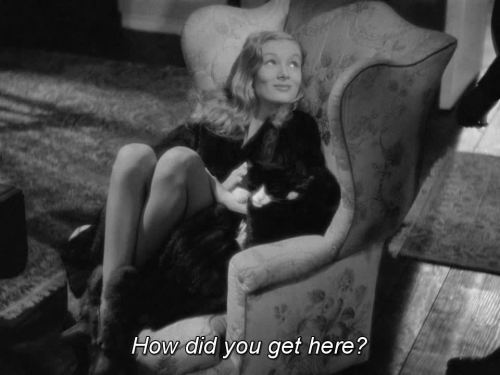
2. Veronica Lake plays the witch, who went by the then somewhat unusual name of Jennifer. Having never seen her in a movie before I had an image in my mind of her as a rather vapid, over-the-top blonde bombshell type, but in this she looks and even talks like what I imagine the more attractive girls at Middlebury or Williams to be like (sorry that I use colleges for reference so much when talking about women, but I really don't have any other references for where one might expect to encounter intelligent ones socially in any kind of concentrated numbers). She was extremely tiny--4' 11", and a wisp of a figure. Her ancestral background was similar to mine, and especially to my children's, mostly Irish with some German on one side. Her career and eventually her life were cut short by alcoholism and mental illness.
3. I cannot remember a lot of the details of this rather odd film, but I like the time period, I found Veronica Lake to be very appealing, and Rene Clair's directorial style seems to tend towards a kind of understated, even spare gentility that is pleasing to me. So I liked it.
The Anna Movies
This is not even including The King and I, which I have not yet seen. I saw these because I had recently read Margaret Landon's 1944 novel, which I wrote about on my other blog.
Anna and the King of Siam (1946)
With Irene Dunne as Anna and the distinctly non-Asiatic Rex Harrison as the king.
1. It is not the greatest movie from 1946, and its seems a little overlong--though the overlong part was more in the beginning and middle I thought--I liked it more as it went on.
2. I did find Rex Harrison to be amusing and to have some presence as King Mongkut. That he was obviously English does not upset me too much. The story is very much in the tradition of encounters with exotic peoples through Western eyes, the more so as I believe the book and the various movies made about it are still banned in Thailand to this day, and the more Western one's eyes are, the less necessary it is that the King or anybody else be played by non-Western actors.
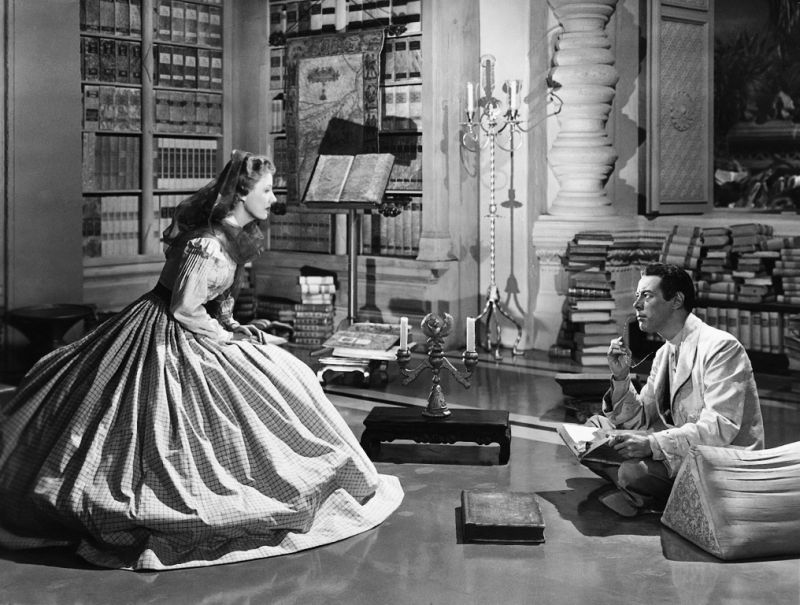
3. Irene Dunne as Anna strikes me as being very much as she comes across in the book. This is also why I usually find film versions of books that come out close upon the book's publication to be more satisfying as interpretations of the book, as opposed to pure films. They are invariably more attuned to the vision that the author was probably working from in the book.
4. Like the book, the movie is episodic (and several incidents were changed--Anna's son did not die in the book for example) but as is often the case, the interest for me is not largely in these episodes as in the king's and Anna's and to a certain extent the Kralahome's (the King's chief minister's) individual eccentricities in how they respond to situations, as being the people with the only really autonomous and interesting minds in the story.

Sultry Linda Darnell awaiting her execution for disloyalty and defiance while being a wife of the king.
Anna and the King (1999)
More modern version starring Jodie Foster (whom I generally like a little more than most stars of her generation). The king is played by Chow Yun-Fat, who is from Hong Kong.
1. I did not finish the whole movie here. This was not willful, it was just that with about half an hour left in it, the disc froze and I couldn't get it to start up again. This version is pretty long (about 2 1/2 hours) and I think I saw enough to get the idea of where it was going.
2. This version was very beautiful in a meticulous way. The wonder of modern production values and all that. It was not particularly joyous.
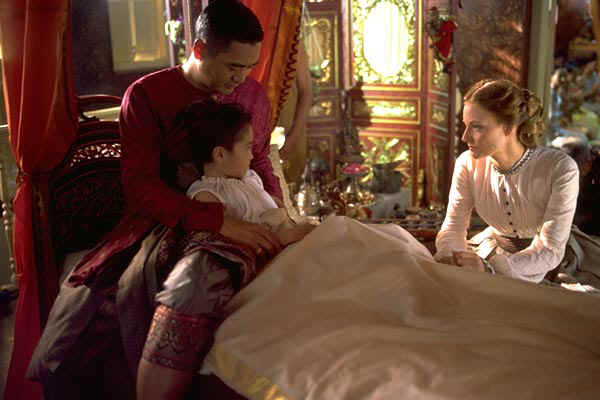
3. Like all modern movies based on the past, the West cannot be allowed to hold any inherent cultural superiority or moral authority over a non-Western culture. Whereas the book managed to balance a certain respect and affection for the king especially while obviously considering most of the customs of his kingdom barbaric, this film version, while regarding the various atrocities carried out in King Mongkut's name as legitimate atrocities, it takes care not to present them as contrasting with the more enlightened societies of the West, or in need of an infusion of those Western values. Ironically, for a modern movie, more effort is made to emphasize Anna's naivete as a negative quality than in the older versions of the story, where it is perhaps seen as abetting her considerable pluck. Also in this film, all of the British officials and businessmen who turn up are awful people, racist, sexist, condescending, scheming against the indigenous population, etc, while in the book the staff of the British consulate especially, as well as various Americans who happen to be in Bangkok, tend to be a helpful and reassuring presence, at to Anna (it is the book it is the French who are awful, condescending, scheming and all of that).
This is all for now.
A Prophet (2010)
1. French prison movie, which I have gotten the impression over the years is a surprisingly robust genre.
2. Very well made, compelling movie--one might call it the Paris movie Woody Allen didn't even think about making, though apparently many people in France thought the degree of violence in it was exaggerated and the filmmakers were too much influenced by Hollywood.
4. Pretty much the entirety of the prison population are people who are not "French" as most people would have considered that term in 1968 or so, mostly being of Arab/North African or sub-Saharan African origin. The only old style European people in the prison are a gang of Corsicans, most of whom are pretty old (over 50) themselves, with the kid of that group maybe able to pass for 35. There are no traditional French people under the age of about 50 in the entire film, and the only older ones who appear are judges and lawyers and prison administrators who might as well have descended from outer space in the world of this movie. I wonder if this is not a trend in European films, where young people of native stock have either vanished more or less entirely from the picture, or you have the Amelie-(or Midnight in Paris) style escapist fantasy where all of the angry Muslims have disappeared and it's all about Marcel and Fabienne drinking wine at the cafe again.
The English Patient (1996)
1. I remember this being a big movie for the somewhat sophisticated adult set when it came out (it won the Oscar for Best Picture in its year) which I was probably interested in but never got around to seeing at the time and now twenty years have passed.
2. Having come out just before, to my mind, the internet broke big, it still has an underlying pre-internet mentality that I recognize, and am in many ways fond of, but which also in other dates the film considerably.
3. One example of what I mean by the pre-internet mentality is in the general book-informed mental makeup of some of the characters, which is a little contrived, but the filmmakers and the actors both have an idea of and appreciation for the kind of person they are trying to depict. I don't know if a character of this type holds any similarly vivid place in the imagination, let alone the esteem, of people who have come along in the ensuing years.
4. I went back and forth several times in the course of watching this movie between liking it and not liking it. The best parts are those that evoke pre-war nostalgia, upper-class British variety, music, cocktails, black tie dinners, walking through the Cairo bizarre like you own the place. The movie's raison d'etre however is in its romances and those did not work for me. It is well-established that I am a sentimental person and am very fond of certain romantic movies whose situations move me, but that was not the case here. The premise of the Ralph Fiennes romance was that he was a prickly man but possessed of a dominating intellect and the ability to wield it with both charm and severity who would require a mental equal to even consider the possibility of romance entering his life, which seemed unlikely to happen up until it did. I found this relationship to be a bit of a snooze though, despite the objective superiority and even perfection of the involved parties. They were lacking the qualities of actual real people, which I guess was one of the themes of the movie, seeing as the main character ended up suffering injuries which caused his face to be unrecognizable and he also claimed to have forgotten his name, where he came from, and his life's history, though he continued to speak an clipped and elegant English and to retain in his possession a well-thumbed antique volume of Herodotus so that we know is not just some ordinary guy.
Kommisar (1968)
1. Deep Soviet-era movie set during the Russian Civil War which followed the 1917 Revolution. I had read the book And Quiet Flows the Dow, which deals with the same period, not long before I saw this, and it was on my mind while I watched this.
2. It was banned in the Soviet Union upon completion and not seen there, or anywhere else I think, until the late 80s. I forget why (according to Wikipedia the censors wanted more heroic realism which the director, Aleksandr Askoldov, refused to accommodate, and was banned from film-making for the remainder of the Soviet era, which was a great loss to the profession.
3. The movie stars Nonna Mordyuka, whom I had never heard of, though a major British film publication named her one of the 10 greatest film actresses of the 20th century (sadly, I cannot easily find the rest of the list).
4. The movie conveys with some success the psychology of being caught up as an ordinary and unaffiliated citizen in the midst of a war.
5. It's very good, the work of serious people who are able to think about things in a multitude of aspects and from all kinds of sides, which is the striking strength of the great Russian novelists as well. It is not like other movies, even European ones, in a way that I am having some difficulty conveying. It is not stylized, but has a more tactile and unvarnished atmosphere, that still manages to impress the viewer with its beauty.
I Married a Witch (1942)
1. There was some talent on this movie, starting with the usually high-toned French director Rene Clair, who was serving his wartime exile in Hollywood when he made this (I enjoyed his 1945 effort And Then There Were None a few years back, recorded in these pages). It starred the always capable Frederic March. 1920s and 30s New York creative world legend Robert Benchley acts in the movie, as does future Oscar-winner Susan Hayward.
2. Veronica Lake plays the witch, who went by the then somewhat unusual name of Jennifer. Having never seen her in a movie before I had an image in my mind of her as a rather vapid, over-the-top blonde bombshell type, but in this she looks and even talks like what I imagine the more attractive girls at Middlebury or Williams to be like (sorry that I use colleges for reference so much when talking about women, but I really don't have any other references for where one might expect to encounter intelligent ones socially in any kind of concentrated numbers). She was extremely tiny--4' 11", and a wisp of a figure. Her ancestral background was similar to mine, and especially to my children's, mostly Irish with some German on one side. Her career and eventually her life were cut short by alcoholism and mental illness.
3. I cannot remember a lot of the details of this rather odd film, but I like the time period, I found Veronica Lake to be very appealing, and Rene Clair's directorial style seems to tend towards a kind of understated, even spare gentility that is pleasing to me. So I liked it.
The Anna Movies
This is not even including The King and I, which I have not yet seen. I saw these because I had recently read Margaret Landon's 1944 novel, which I wrote about on my other blog.
Anna and the King of Siam (1946)
With Irene Dunne as Anna and the distinctly non-Asiatic Rex Harrison as the king.
1. It is not the greatest movie from 1946, and its seems a little overlong--though the overlong part was more in the beginning and middle I thought--I liked it more as it went on.
2. I did find Rex Harrison to be amusing and to have some presence as King Mongkut. That he was obviously English does not upset me too much. The story is very much in the tradition of encounters with exotic peoples through Western eyes, the more so as I believe the book and the various movies made about it are still banned in Thailand to this day, and the more Western one's eyes are, the less necessary it is that the King or anybody else be played by non-Western actors.
3. Irene Dunne as Anna strikes me as being very much as she comes across in the book. This is also why I usually find film versions of books that come out close upon the book's publication to be more satisfying as interpretations of the book, as opposed to pure films. They are invariably more attuned to the vision that the author was probably working from in the book.
4. Like the book, the movie is episodic (and several incidents were changed--Anna's son did not die in the book for example) but as is often the case, the interest for me is not largely in these episodes as in the king's and Anna's and to a certain extent the Kralahome's (the King's chief minister's) individual eccentricities in how they respond to situations, as being the people with the only really autonomous and interesting minds in the story.
Sultry Linda Darnell awaiting her execution for disloyalty and defiance while being a wife of the king.
Anna and the King (1999)
More modern version starring Jodie Foster (whom I generally like a little more than most stars of her generation). The king is played by Chow Yun-Fat, who is from Hong Kong.
1. I did not finish the whole movie here. This was not willful, it was just that with about half an hour left in it, the disc froze and I couldn't get it to start up again. This version is pretty long (about 2 1/2 hours) and I think I saw enough to get the idea of where it was going.
2. This version was very beautiful in a meticulous way. The wonder of modern production values and all that. It was not particularly joyous.
3. Like all modern movies based on the past, the West cannot be allowed to hold any inherent cultural superiority or moral authority over a non-Western culture. Whereas the book managed to balance a certain respect and affection for the king especially while obviously considering most of the customs of his kingdom barbaric, this film version, while regarding the various atrocities carried out in King Mongkut's name as legitimate atrocities, it takes care not to present them as contrasting with the more enlightened societies of the West, or in need of an infusion of those Western values. Ironically, for a modern movie, more effort is made to emphasize Anna's naivete as a negative quality than in the older versions of the story, where it is perhaps seen as abetting her considerable pluck. Also in this film, all of the British officials and businessmen who turn up are awful people, racist, sexist, condescending, scheming against the indigenous population, etc, while in the book the staff of the British consulate especially, as well as various Americans who happen to be in Bangkok, tend to be a helpful and reassuring presence, at to Anna (it is the book it is the French who are awful, condescending, scheming and all of that).
This is all for now.
Saturday, June 04, 2016
I Take the DNC Voter Survey
I have been without access to a computer, other than my phone, on which I am not going to write blog posts, for about two weeks. Before that I had thought I ought to write something stating my position on Trump's winning the presidential nomination, how it was affecting me, how I could convincingly express my aversion to the whole phenomenon without sounding like every other pantywaist who feels compelled to get it on the record before whatever terrible consequences resulting from a potential Trump victory ensue that They Were Against This From the Beginning...but I didn't have much enthusiasm for this, perhaps because everyone else is on the case already, albeit not terribly effectively as I can see it, but also because I can't really make any sense of it without coming to the conclusion that the country really is coming to ruin, or is about to implode socially. Obviously there is a leadership void for a sizable segment of the population which the pundits have been at great pains to try to identify, and which the Trump candidacy is evidently seen as an attempt to fill, though I don't understand it.
I received an official-looking letter in the mail the other day in which was enclosed a letter from Debbie Wasserman-Schwartz, the head of the Democratic Party National Committee, and a survey. Since I never get such personal attention from the Party, I was intrigued enough to peruse these materials. Wasserman-Schwartz immediately attempted to butter me up by telling me I was "one of a select group of local Democratic leaders"--my eyes were arrested by that phrase and I imagined for a moment that it was true, and that all the world regarded me as such a leader, before going on to complete the rest of the sentence--"chosen to participate in this (survey)". The letter went on to a recitation of this year's usual DNC boilerplate and a reminder of the terrifying policies the Republicans threaten to pursue if they get elected, followed by an appeal for money. Here the Koch brothers and their (alleged) vow to spend $889 million on the election were invoked. "The DNC needs your help NOW to counter the GOP's piles of special-interest money, mudslinging, and dirty tricks." This should give some idea of the overall tone of this missive.
The contents of the survey give a picture of the supposed mindset of the mainstream democratic voter and party operative, which mainly reveals an obsession with keeping the Republican enemy out of power and furthering various pet agendas that interest me little. I will go through the questions here in my desperate 12:30 am fatigue and try to say as nearly as possible what I really think of them.
Section I is concerned with personal information, but Section II, "The Republican Threat" asks five questions, and provides the voter/donor with a choice of answers. I had a hard time coming up with a clear answer to any of the questions on the entire survey, except one:
1. Which elements of the radical Republican agenda are most dangerous to America's future? (please choose up to three)
There were nine options for this question, some of which made me laugh ("Denying the existence of climate change"), some of which don't seem overly dangerous to America's long term future ("Dismantling the Affordable Care Act"), and none of which seem to me likely to be implemented in the degree that the most rabid Republicans would like even if they should get elected. Of the items on the list that I would even consider to be of legitimate importance to the national interest, the blowback to any extreme Republican overreach would be very severe; as I see it, the current left wing fanaticism and scorched earth tactics are an ongoing response to the arrogance and excesses of the first George W. Bush administration, which psychologically trampled on and embittered many of those who identify as left-liberals such that no revenge short of total annihilation of their enemies will suffice. I still cannot pick any of the options (Affordable Care Act, women's reproductive rights, LGBT civil rights, Social Security and Medicare, a right-wing Supreme Court, minimum wage increase, immigration reform [on the pro- side], climate change, and handling international affairs diplomatically) as anything I am truly worried about, though I did hate the Bush administration's foreign policy approach, so I guess I should go with that one. If I really thought they would be able to get away with gutting Security Security and Medicare I might choose that, though I think the possibility of that happening is pretty remote. In general, what I really don't like are their tax policies and total lack of interest in making the country a more civilized and livable place for the bulk of the citizenry, but those were not questions.
2. Which aspect of Donald Trump's and Ted Cruz's candidacies do you find most disturbing? (please choose one)
This has eight options. closely paralleling those in Question one, again, none of which exactly captures what disturbs me about them. I don't think of myself as a particularly ideological voter because I don't have a lot of passion or anger, but I am wary, and generally frightened, of people who appear too much to value money or power as great goods in themselves, and who would extrapolate that influence through the broader society even more than it is. Donald Trump has been a most unfortunate and pernicious influence in this way for over thirty years. I have difficulty perceiving how his notoriety has been beneficial to the psychological and moral health of this country over that time, and this is before he began running for President and won the Republican nomination! While also apparently an extreme narcissist, Cruz struck me as the leading edge of the type of new meritocratic man that has been emerging from the top schools over the past few decades, meticulously capable as least as far as managing his own advancement, possessed of a triumphant intelligence that has been so relentlessly reinforced at every turn so as to preclude any development of either humility or fellow-feeling for other (lesser) people. He is not a reassuring person to entrust power to either. Of course, neither is Hillary Clinton, or her would-be empowered supporters, from my vantage.
3. Which of the following election outcomes would be most catastrophic for our nation? (please choose one)
The choices were, Republicans winning the White House, tightening their stranglehold on Congress, or increasing control of state and local governments. I think Trump getting elected president is probably the worst possibility, because the potential to do damage is so great there, and also because of late who the president is has had such an effect on the overall mood of the populace. In my state we have had a few lapses in recent years where too many Democrats have stayed home during off-election years and in one instance a vindictive right-winger was elected governor and in another a cabal of Tea Party enthusiasts were able to get control of the legislature. In both instances we had to endure a couple of unpleasant years during which, in addition to the slashing of various institutional and other public funding, there was a lot of aggressive taunting of milquetoast liberal types, which impulse often unfortunately afflicts the manlier elements of the far right when they ascend to power, and tends to undermine their broad support for the next election.
4. Which group of GOP backers do you think will have the biggest impact on the 2016 elections? (choose one).
Choices are: "Right-wing billionaires, such as the Koch brothers and Sheldon Adelson"; "Ruthless political operatives, such as Karl Rove"; "Extreme far-right organizations, such as the Tea Party Nation and the Club for Growth"; and "Conservative Media Outlets." None of these dreaded collectives has been able to manipulate the voting to their liking thus far, if we are to believe what we read in the papers regarding their position toward Trump and his riff-raff supporters. I assume the billionaires, whether right wing or otherwise, will have the most influence after the election regardless of who wins.
5. How do you View the Republican refusal to even consider confirming Merrick Garland, President Obama's nominee to the Supreme Court?
I didn't like any of the options given for answers. I've written before about my confusion with regard to the obsession of political partisans with the selection of Supreme Court Justices, where the object is to determine how reliably the prospective justice will rule with one's preferred side on various issues, with the intellectual acumen to visibly humiliate the enemy's partisans in argument featuring as an especially delectable bonus. Among other things, this undermines the authority of the Court's rulings, since the "losing" side never accepts the "winning" side's arguments and decisions as the result of a serious inquiry into the truth or Constitutionality of a question by a wise and dispassionate expert. But this is what people think the court should be.
By the way, I think in the abstract that there should be a vote on Obama's nominee. Not to do so shows both a lack of confidence in and even a kind of contempt for the Republic. That said, if the same situation had occurred when Bush was president, I am sure that I would have been pleased at a show of resistance to his nominee, whom I doubtless would have thought was awful. However, that illustrates the problem with this partisan system, that the appointment of a judge by the opposite party has become terrifying to people. This is not how any court should operate in this country.
Section III involves a bunch of questions about 2016 Democratic election priorities which I am not going to go into at length. There was one question, the only one on the survey that I saw as having a sensible answer, which was Which of the below Democratic actions to level the playing field for middle-class families do you support? for which I chose 'Ensure access to basic retirement security and affordable education and healthcare", though I do think there are arguments for taxing the wealthy more, not into penury, but because there is no other viable way at present that I can see to prevent the wealth gap from continuing to widen ever more exponentially, due to the nature of capital, and I think this is becoming too much of a problem and is stifling too much of the country.
Hopefully I can get another post up before a month goes by.
I received an official-looking letter in the mail the other day in which was enclosed a letter from Debbie Wasserman-Schwartz, the head of the Democratic Party National Committee, and a survey. Since I never get such personal attention from the Party, I was intrigued enough to peruse these materials. Wasserman-Schwartz immediately attempted to butter me up by telling me I was "one of a select group of local Democratic leaders"--my eyes were arrested by that phrase and I imagined for a moment that it was true, and that all the world regarded me as such a leader, before going on to complete the rest of the sentence--"chosen to participate in this (survey)". The letter went on to a recitation of this year's usual DNC boilerplate and a reminder of the terrifying policies the Republicans threaten to pursue if they get elected, followed by an appeal for money. Here the Koch brothers and their (alleged) vow to spend $889 million on the election were invoked. "The DNC needs your help NOW to counter the GOP's piles of special-interest money, mudslinging, and dirty tricks." This should give some idea of the overall tone of this missive.
The contents of the survey give a picture of the supposed mindset of the mainstream democratic voter and party operative, which mainly reveals an obsession with keeping the Republican enemy out of power and furthering various pet agendas that interest me little. I will go through the questions here in my desperate 12:30 am fatigue and try to say as nearly as possible what I really think of them.
Section I is concerned with personal information, but Section II, "The Republican Threat" asks five questions, and provides the voter/donor with a choice of answers. I had a hard time coming up with a clear answer to any of the questions on the entire survey, except one:
1. Which elements of the radical Republican agenda are most dangerous to America's future? (please choose up to three)
There were nine options for this question, some of which made me laugh ("Denying the existence of climate change"), some of which don't seem overly dangerous to America's long term future ("Dismantling the Affordable Care Act"), and none of which seem to me likely to be implemented in the degree that the most rabid Republicans would like even if they should get elected. Of the items on the list that I would even consider to be of legitimate importance to the national interest, the blowback to any extreme Republican overreach would be very severe; as I see it, the current left wing fanaticism and scorched earth tactics are an ongoing response to the arrogance and excesses of the first George W. Bush administration, which psychologically trampled on and embittered many of those who identify as left-liberals such that no revenge short of total annihilation of their enemies will suffice. I still cannot pick any of the options (Affordable Care Act, women's reproductive rights, LGBT civil rights, Social Security and Medicare, a right-wing Supreme Court, minimum wage increase, immigration reform [on the pro- side], climate change, and handling international affairs diplomatically) as anything I am truly worried about, though I did hate the Bush administration's foreign policy approach, so I guess I should go with that one. If I really thought they would be able to get away with gutting Security Security and Medicare I might choose that, though I think the possibility of that happening is pretty remote. In general, what I really don't like are their tax policies and total lack of interest in making the country a more civilized and livable place for the bulk of the citizenry, but those were not questions.
2. Which aspect of Donald Trump's and Ted Cruz's candidacies do you find most disturbing? (please choose one)
This has eight options. closely paralleling those in Question one, again, none of which exactly captures what disturbs me about them. I don't think of myself as a particularly ideological voter because I don't have a lot of passion or anger, but I am wary, and generally frightened, of people who appear too much to value money or power as great goods in themselves, and who would extrapolate that influence through the broader society even more than it is. Donald Trump has been a most unfortunate and pernicious influence in this way for over thirty years. I have difficulty perceiving how his notoriety has been beneficial to the psychological and moral health of this country over that time, and this is before he began running for President and won the Republican nomination! While also apparently an extreme narcissist, Cruz struck me as the leading edge of the type of new meritocratic man that has been emerging from the top schools over the past few decades, meticulously capable as least as far as managing his own advancement, possessed of a triumphant intelligence that has been so relentlessly reinforced at every turn so as to preclude any development of either humility or fellow-feeling for other (lesser) people. He is not a reassuring person to entrust power to either. Of course, neither is Hillary Clinton, or her would-be empowered supporters, from my vantage.
3. Which of the following election outcomes would be most catastrophic for our nation? (please choose one)
The choices were, Republicans winning the White House, tightening their stranglehold on Congress, or increasing control of state and local governments. I think Trump getting elected president is probably the worst possibility, because the potential to do damage is so great there, and also because of late who the president is has had such an effect on the overall mood of the populace. In my state we have had a few lapses in recent years where too many Democrats have stayed home during off-election years and in one instance a vindictive right-winger was elected governor and in another a cabal of Tea Party enthusiasts were able to get control of the legislature. In both instances we had to endure a couple of unpleasant years during which, in addition to the slashing of various institutional and other public funding, there was a lot of aggressive taunting of milquetoast liberal types, which impulse often unfortunately afflicts the manlier elements of the far right when they ascend to power, and tends to undermine their broad support for the next election.
4. Which group of GOP backers do you think will have the biggest impact on the 2016 elections? (choose one).
Choices are: "Right-wing billionaires, such as the Koch brothers and Sheldon Adelson"; "Ruthless political operatives, such as Karl Rove"; "Extreme far-right organizations, such as the Tea Party Nation and the Club for Growth"; and "Conservative Media Outlets." None of these dreaded collectives has been able to manipulate the voting to their liking thus far, if we are to believe what we read in the papers regarding their position toward Trump and his riff-raff supporters. I assume the billionaires, whether right wing or otherwise, will have the most influence after the election regardless of who wins.
5. How do you View the Republican refusal to even consider confirming Merrick Garland, President Obama's nominee to the Supreme Court?
I didn't like any of the options given for answers. I've written before about my confusion with regard to the obsession of political partisans with the selection of Supreme Court Justices, where the object is to determine how reliably the prospective justice will rule with one's preferred side on various issues, with the intellectual acumen to visibly humiliate the enemy's partisans in argument featuring as an especially delectable bonus. Among other things, this undermines the authority of the Court's rulings, since the "losing" side never accepts the "winning" side's arguments and decisions as the result of a serious inquiry into the truth or Constitutionality of a question by a wise and dispassionate expert. But this is what people think the court should be.
By the way, I think in the abstract that there should be a vote on Obama's nominee. Not to do so shows both a lack of confidence in and even a kind of contempt for the Republic. That said, if the same situation had occurred when Bush was president, I am sure that I would have been pleased at a show of resistance to his nominee, whom I doubtless would have thought was awful. However, that illustrates the problem with this partisan system, that the appointment of a judge by the opposite party has become terrifying to people. This is not how any court should operate in this country.
Section III involves a bunch of questions about 2016 Democratic election priorities which I am not going to go into at length. There was one question, the only one on the survey that I saw as having a sensible answer, which was Which of the below Democratic actions to level the playing field for middle-class families do you support? for which I chose 'Ensure access to basic retirement security and affordable education and healthcare", though I do think there are arguments for taxing the wealthy more, not into penury, but because there is no other viable way at present that I can see to prevent the wealth gap from continuing to widen ever more exponentially, due to the nature of capital, and I think this is becoming too much of a problem and is stifling too much of the country.
Hopefully I can get another post up before a month goes by.
Sunday, May 08, 2016
A Few Old Pictures
Life is a cigar
It's really oxygenic
Life is a cheap cigar
Take three puffs, and it's go(o-o-o)ne--
Bourgeois folk song
I haven't put any pictures up in some time. I suppose some things must have changed. Here are a few from my trip to Florida in February that I never got around to putting up elsewhere. There were 555 photos, out of which I have chosen the first six which came up in a number game and that I thought were halfway decent.

Five of the six children--there's always one missing--hanging out in the very Floridian bedroom.Well, on balance I guess most of them should have enough advantages to have a chance at doing well and actually taking an active part in the life of their times, even if the participatory/productive/contributing segment of the population for all real intents and purposes continues to shrink. What else is there to worry about? I don't really see them becoming heroin addicts or career criminals. The lack of drive to compete and work ferociously and earn hard achievements seems the more likely downfall, as these are not second nature to me and seem to have been my undoing as a person, and they are such crucial qualities to have in today's world, at least if you want to associate with intelligent people. But maybe the mood afoot in the world will change and swing back to something more congenial to people of our general temperament.

The beach at Siesta Key, with its famous white sand. Four year old daughter with shell collection. Lots of lotion applied.

The patio at the Florida house. My daughter is not giving her most smiling face, though it is a not uncharacteristic pose.

All six children pose in the train at Sarasota Jungle Gardens, an older-style Florida attraction that we go to every time we are there instead of going to Disney World. It is probably a little overpriced itself, but it has sentimental value. I was touched that my nine year old still loved the train, as we did not go to Florida last year. Jungle Gardens is a large outdoor zoo with Florida animals, a reptile house, flamingos, alligators, giant tortoises. Back when we first started going about ten years ago the animal lover crowd seemed to consider the place disgusting and to have complaints against it--the 1997 Lonely Planet Florida Guide describes it as "so cheesy, so cyncial and so reprehensible that it could have been a tourist trap out of a Carl Hiassen novel...We got so angry at the conditions here and the 'who-cares' attitude we experienced from recalcitrant and disinterested staff that we stormed out after seeing the 'Butterflies of the World' collection. Some butterflies had ripped or missing wings and there were some pins stuck in the wall impaling the shattered tatters of remains of butterflies that had obviously been yanked off in a hurry. As we stormed out, we saw two miserable black leopards who were retching, had patches of fur missing and were pacing nervously in their caves..." This is how the hip, educated, worldly, sexually aware, etc people of my generation whom I have always kind of idolized experienced it. However I think new ownership took over shortly after this low point and the animal rights people have directed their discontent elsewhere for the time being. Neither the Butterflies of the World exhibit or the leopards are there anymore. We saw a bird show. I was not aware that parrots can live to be 80 or more years of age. There was a performing parrot in this show that had met Elvis and appeared on the Ed Sullivan show. I was impressed by that.

Sunset over the Gulf of Mexico, obviously. It's a very generic picture, I know. It is my particular sunset, however.

As we usually do on the way home, we stopped in for an hour or so in Annapolis, wandered around the old school, ate something, went to the bathroom, etc. This is on the elevated running track in the college gym. At this point we had been on the road straight through from Florida. We had booked a hotel (two rooms now, of course) off the highway in South Carolina but when we got there after midnight they had given our room away. According to the person at the desk when we did not arrive by 6pm our reservation was cancelled and they had given our rooms to someone else. This was baloney for several reasons, one being that this is the kind of hotel that no one arrives at before 6 o'clock, because it only exists as a place for people to stay at who are making the long drive on Interstate 95. It is not near anything else of note. Another reason is that we had stayed at the same place on the way down a week earlier and had arrived at about the same time to find both of the rooms held and waiting for us. So we kept on driving straight through to Philadelphia. I was disappointed, because I love staying in hotels, or the idea of doing so, even cheap ones in the middle of nowhere if they are reasonably clean and safe, and even to some extent with children, and I rarely get to have even this modest thrill, so I felt as if something had been taken away from me. By the time we got back to Maryland, which is in many ways like re-entering our real home country after having gone out of it for a while, I was largely over this.
Wednesday, April 20, 2016
6 Movie Reports
Midnight in Paris (2011)

F Scott Fitzgerald partying
This is the recent Woody Allen movie in which a blond Woody Allen stand-in is able at the stroke of midnight to go to the 1920s (and even beyond) where he hangs out with Hemingway and Fitzgerald and Picasso and other famous people from that time. I am in the camp that liked this. I thought it was fun. A lot of people, who obviously did not think it was fun, despised it. (This guy, for example, appeared to have been seething with contempt the entire time). It is pointed out by most of the more intensely intelligent viewers of the movie that the jokes, the music, the personas and conversation of the famous historical people, Woody Allen's idea of Paris itself, rely on the most hackneyed, shallow and cliched tropes in which all of these things have become packaged for mass consumption. It is not that I did not notice all of this, or imagined that Hemingway and all these other people were friendly, good people--though they may well have been fun people--the Paris in the 20s era is attractive to people in large part after all because it seems like it was a good time, even at the dumbed down intellectual level necessary for the general public to conceive some idea of it; but it did not upset me. I am at an age, and perhaps even Woody Allen is too, where I have probably given up on the idea that I will ever experience Paris, or anything else, on the terms that constitute its real interest and greatness. The blogger linked to above talks contemptuously about the philistines who want to seem sophisticated without sacrificing their familiar comforts or facing their limitations. I don't know, it is true I have not been properly pushed to do these things to the extent which seems to be required now for many years, and I have generally avoided intellectual conflict both on the internet and in person because I don't have the ready-made foundation to draw on that I would need to endure and struggle through them, or the time to meticulously respond to all of the tough invective and cross-examining that serious assertion requires to be backed up. Yet I have devoted a lot of time to reading and study, certainly to an extent that seems to lead places and produces palpable results and abilities in other people. I have made some sacrifices in doing this as far as not following other pursuits which might have been more suitable for me goes, though whether any such pursuits exist has never been demonstrated. As to facing limitations, the levels at which I run up against these would preclude even residual participation in any of the attractive or serious areas of life at all if I were to submit to the most exacting standards, and I have decided that in the absence of anything more desirable to me being available, that I don't want to do that.
I even watched this a second time, and thought it, even acknowledging the clunky and even bad writing and characterization in the modern segments of the movie, just about as fun--though I've been known to watch reruns of Rick Steves' cosmopolitan-aspirant travel shows multiple times if they are about a place I like, or imagine I would like.
I thought fleetingly while watching this that it was an old-man work, analogous to the late Graham Greene novel Monsignor Quixote. This may be because the references and shape of the story seemed purposely to have been not been overly daunting or obscure, and reflected some of the artists' standard tastes, interests, what have you. But I did not dig into it any more than that.
Off the cuff top 10 Paris movies. I know I haven't seen that many of them, and I'm sure I'm forgetting something I have seen.
1. Les Enfants du Paradis
2. Stolen Kisses
3. The 400 Blows
4. A Bout de Souffle
5. Boudu Saved From Drowning
6. Celine and Julie Go Boating
7. L'Argent
8. Midnight in Paris
9. An American in Paris
10. Window to Paris

All we ever asked for was that romantic walk along the Seine (maybe not all, but that was included in the desired overall package)
A Fatal Inversion (1991--incomplete)
This was a British TV production, about three hours long. It is about a couple of college friends who had spent the lazy, glorious summer of 1979 hosting parties and eccentric visitors at the Georgian mansion in Suffolk that one of them had inherited. Ten years later the friends have moved on to careers and wives and children and live in the suburbs. The summer in Suffolk seems to be forgotten until a dead body is found in the woods near the mansion house that seems to have been buried for about a decade. When the police come around to ask the former owner of the house--he sold it shortly after the summer ended--some general questions about his time there, he appears to be nervous...very nervous...I watched the first 1:46:02 on Youtube, which was the only place I could find it. It was very good, a thorough English police mystery type of thing, though I dragged my feet on watching the end because I thought I could see where it was going and I was not very enthralled about arriving there. I waited so long in fact to finish the program that when I did go back it had been taken down and I couldn't find it anywhere else. So I don't know what happens.
Seeing movies from the early nineties are so very odd to me, because it is a familiar world that one lived in one's self, where young people read newspapers and don't have tattoos and of course the old telephones and cars and all of that, but also the people's bodies. All of the people in this movie have distinctly 1990-95 era bodies that have a quality you recognize instantly if you were alive at the time, that is different from what people look like now. It must have to do with the composition of musculature, fat, presence or non-presence of drugs and other stimulants (and the same holds true for 1970s bodies also, prime examples of which are to be seen in Village People and Jesus Christ Superstar videos).
The Autobiography of Miss Jane Pittman (1974)
TV movie about the life of a (fictional) woman who was born a slave and lived to be 110, which brought her into the civil rights era. It won a lot of Emmy awards, including best actress for Cicely Tyson, which I thought mildly interesting in light of the recent brouhaha over the traditional lack of Oscar recognition for black performers, as this movie and the accolades it got seems to have been largely forgotten. It was based on a book of the same name by a writer named Ernest J Gaines which somehow I had never heard of either though at one time at least it seems to have been quite celebrated and frequently taught in schools. This movie is of that school whose virtues, such as they are, are more in the educational than entertaining line. A litany of the expected atrocities and injustices runs through the course of the narrative, nothing either new in the way of incident or that adds to the understanding. Depictions of life in the old south I often find interesting, though that is, I hate to say, because the presence, in a fairly nearby part of our own country, of a feudal and near-feudal culture up to a time not very far in the past, and probably all of the associated violence in the background, though I am not directly attracted to that as a matter of study, is largely what makes it interesting.

Black Sunday, or The Mask of Satan (1960)
Somewhat pioneering horror movie, made in Italy and based on a story by Gogol (!), the DVD version is dubbed into English. Stars cult legend Barbara Steele (described by the Film Snob's Dictionary as a "wild-eyed, witchie-poo B-movie actress equally at home playing seminude seductresses and scarifying goth girls in horror movies of the 1960s and 70s"). I found it mildly diverting. Such gore as is in it, while envelope-pushing for its time, is not overwhelming, and the atmosphere is gothic in a cheery Addams Family-esque way, as long as people aren't being trapped in dank cellars and in the grasp of determined and thirsty vampires. I have mostly forgotten it though.

I kind of like the idea of vampires being a running theme through the culture, since I mostly associate them as occupying milieus at high levels of taste, cultivation and what have you, but I can never really remember what the meaning of them is supposed to be. I know that you can ward them off with a cross and kill them by driving a stake through their heart, but whatever is signified by this does not strike me as anything that has a deep meaning for most of the people who make these kinds of films.
The Yearling (1946)
The Yearling seems like something I would have responded to more strongly than I did. It was made in the middle of my usual favorite period, is based on a classic, if now somewhat fading, American story, shot in lavish technicolor, and features stars towards whom I have been favorably inclined in the past. These things remain positives in the movie too. There is some kind of spark or underlying energy missing in the execution. It is a handsome and technically fine production, but it felt dull and rather joyless much of the time. Nothing happens in it that particularly charmed or interested me or drew me into the world, imagined or otherwise, of the movie. But I still think it is worth seeing for the student of this time period, or older technicolor movies, or older adaptations of literary classics, if for no other reason to get a better sense of why the better movies of this type work.

Alice Adams (1935)
I thought this was a very good adaptation right up until the end, which unfortunately was completely changed from what it was in the book (which I am an admirer of) in the cause of happiness. I would not have minded it being longer and including more episodes from the story, which is something I rarely say about movies. The young Katharine Hepburn not only does her expected fine performing, but is actually pretty believable as the hopelessly striving, borderline middle class Alice. George Stevens, who would go on to make many notable films, Gunga Din, A Place in the Sun, Shane, etc, etc. was the director. The book came out around 1921 and there was an earlier silent version of it, but this version is close enough to it that it seems contemporary and comprehends the general spirit with which it is animated. The Adams family's economic problems are experienced by them as more of a social/individual nature than the result of a general depression, which latter would have been so immediate to audiences in 1935 of course, but 30s movies excelled in depictions of social rejection and cruelty, much more so than I find to be the case in our own time--at some point I hope to be able to expand on why I think this was the case--so the onset of the Great Depression---I don't know what I am getting at here. I saw the movie a while ago. I enjoyed it, except that for the different ending, both with regard to Alice's love life and her father's career, which obviously play out completely differently in the book.

Pretty sad for a post 3 weeks in the making.
F Scott Fitzgerald partying
This is the recent Woody Allen movie in which a blond Woody Allen stand-in is able at the stroke of midnight to go to the 1920s (and even beyond) where he hangs out with Hemingway and Fitzgerald and Picasso and other famous people from that time. I am in the camp that liked this. I thought it was fun. A lot of people, who obviously did not think it was fun, despised it. (This guy, for example, appeared to have been seething with contempt the entire time). It is pointed out by most of the more intensely intelligent viewers of the movie that the jokes, the music, the personas and conversation of the famous historical people, Woody Allen's idea of Paris itself, rely on the most hackneyed, shallow and cliched tropes in which all of these things have become packaged for mass consumption. It is not that I did not notice all of this, or imagined that Hemingway and all these other people were friendly, good people--though they may well have been fun people--the Paris in the 20s era is attractive to people in large part after all because it seems like it was a good time, even at the dumbed down intellectual level necessary for the general public to conceive some idea of it; but it did not upset me. I am at an age, and perhaps even Woody Allen is too, where I have probably given up on the idea that I will ever experience Paris, or anything else, on the terms that constitute its real interest and greatness. The blogger linked to above talks contemptuously about the philistines who want to seem sophisticated without sacrificing their familiar comforts or facing their limitations. I don't know, it is true I have not been properly pushed to do these things to the extent which seems to be required now for many years, and I have generally avoided intellectual conflict both on the internet and in person because I don't have the ready-made foundation to draw on that I would need to endure and struggle through them, or the time to meticulously respond to all of the tough invective and cross-examining that serious assertion requires to be backed up. Yet I have devoted a lot of time to reading and study, certainly to an extent that seems to lead places and produces palpable results and abilities in other people. I have made some sacrifices in doing this as far as not following other pursuits which might have been more suitable for me goes, though whether any such pursuits exist has never been demonstrated. As to facing limitations, the levels at which I run up against these would preclude even residual participation in any of the attractive or serious areas of life at all if I were to submit to the most exacting standards, and I have decided that in the absence of anything more desirable to me being available, that I don't want to do that.
I even watched this a second time, and thought it, even acknowledging the clunky and even bad writing and characterization in the modern segments of the movie, just about as fun--though I've been known to watch reruns of Rick Steves' cosmopolitan-aspirant travel shows multiple times if they are about a place I like, or imagine I would like.
I thought fleetingly while watching this that it was an old-man work, analogous to the late Graham Greene novel Monsignor Quixote. This may be because the references and shape of the story seemed purposely to have been not been overly daunting or obscure, and reflected some of the artists' standard tastes, interests, what have you. But I did not dig into it any more than that.
Off the cuff top 10 Paris movies. I know I haven't seen that many of them, and I'm sure I'm forgetting something I have seen.
1. Les Enfants du Paradis
2. Stolen Kisses
3. The 400 Blows
4. A Bout de Souffle
5. Boudu Saved From Drowning
6. Celine and Julie Go Boating
7. L'Argent
8. Midnight in Paris
9. An American in Paris
10. Window to Paris
All we ever asked for was that romantic walk along the Seine (maybe not all, but that was included in the desired overall package)
A Fatal Inversion (1991--incomplete)
This was a British TV production, about three hours long. It is about a couple of college friends who had spent the lazy, glorious summer of 1979 hosting parties and eccentric visitors at the Georgian mansion in Suffolk that one of them had inherited. Ten years later the friends have moved on to careers and wives and children and live in the suburbs. The summer in Suffolk seems to be forgotten until a dead body is found in the woods near the mansion house that seems to have been buried for about a decade. When the police come around to ask the former owner of the house--he sold it shortly after the summer ended--some general questions about his time there, he appears to be nervous...very nervous...I watched the first 1:46:02 on Youtube, which was the only place I could find it. It was very good, a thorough English police mystery type of thing, though I dragged my feet on watching the end because I thought I could see where it was going and I was not very enthralled about arriving there. I waited so long in fact to finish the program that when I did go back it had been taken down and I couldn't find it anywhere else. So I don't know what happens.
Seeing movies from the early nineties are so very odd to me, because it is a familiar world that one lived in one's self, where young people read newspapers and don't have tattoos and of course the old telephones and cars and all of that, but also the people's bodies. All of the people in this movie have distinctly 1990-95 era bodies that have a quality you recognize instantly if you were alive at the time, that is different from what people look like now. It must have to do with the composition of musculature, fat, presence or non-presence of drugs and other stimulants (and the same holds true for 1970s bodies also, prime examples of which are to be seen in Village People and Jesus Christ Superstar videos).
The Autobiography of Miss Jane Pittman (1974)
TV movie about the life of a (fictional) woman who was born a slave and lived to be 110, which brought her into the civil rights era. It won a lot of Emmy awards, including best actress for Cicely Tyson, which I thought mildly interesting in light of the recent brouhaha over the traditional lack of Oscar recognition for black performers, as this movie and the accolades it got seems to have been largely forgotten. It was based on a book of the same name by a writer named Ernest J Gaines which somehow I had never heard of either though at one time at least it seems to have been quite celebrated and frequently taught in schools. This movie is of that school whose virtues, such as they are, are more in the educational than entertaining line. A litany of the expected atrocities and injustices runs through the course of the narrative, nothing either new in the way of incident or that adds to the understanding. Depictions of life in the old south I often find interesting, though that is, I hate to say, because the presence, in a fairly nearby part of our own country, of a feudal and near-feudal culture up to a time not very far in the past, and probably all of the associated violence in the background, though I am not directly attracted to that as a matter of study, is largely what makes it interesting.
Black Sunday, or The Mask of Satan (1960)
Somewhat pioneering horror movie, made in Italy and based on a story by Gogol (!), the DVD version is dubbed into English. Stars cult legend Barbara Steele (described by the Film Snob's Dictionary as a "wild-eyed, witchie-poo B-movie actress equally at home playing seminude seductresses and scarifying goth girls in horror movies of the 1960s and 70s"). I found it mildly diverting. Such gore as is in it, while envelope-pushing for its time, is not overwhelming, and the atmosphere is gothic in a cheery Addams Family-esque way, as long as people aren't being trapped in dank cellars and in the grasp of determined and thirsty vampires. I have mostly forgotten it though.
I kind of like the idea of vampires being a running theme through the culture, since I mostly associate them as occupying milieus at high levels of taste, cultivation and what have you, but I can never really remember what the meaning of them is supposed to be. I know that you can ward them off with a cross and kill them by driving a stake through their heart, but whatever is signified by this does not strike me as anything that has a deep meaning for most of the people who make these kinds of films.
The Yearling (1946)
The Yearling seems like something I would have responded to more strongly than I did. It was made in the middle of my usual favorite period, is based on a classic, if now somewhat fading, American story, shot in lavish technicolor, and features stars towards whom I have been favorably inclined in the past. These things remain positives in the movie too. There is some kind of spark or underlying energy missing in the execution. It is a handsome and technically fine production, but it felt dull and rather joyless much of the time. Nothing happens in it that particularly charmed or interested me or drew me into the world, imagined or otherwise, of the movie. But I still think it is worth seeing for the student of this time period, or older technicolor movies, or older adaptations of literary classics, if for no other reason to get a better sense of why the better movies of this type work.
Alice Adams (1935)
I thought this was a very good adaptation right up until the end, which unfortunately was completely changed from what it was in the book (which I am an admirer of) in the cause of happiness. I would not have minded it being longer and including more episodes from the story, which is something I rarely say about movies. The young Katharine Hepburn not only does her expected fine performing, but is actually pretty believable as the hopelessly striving, borderline middle class Alice. George Stevens, who would go on to make many notable films, Gunga Din, A Place in the Sun, Shane, etc, etc. was the director. The book came out around 1921 and there was an earlier silent version of it, but this version is close enough to it that it seems contemporary and comprehends the general spirit with which it is animated. The Adams family's economic problems are experienced by them as more of a social/individual nature than the result of a general depression, which latter would have been so immediate to audiences in 1935 of course, but 30s movies excelled in depictions of social rejection and cruelty, much more so than I find to be the case in our own time--at some point I hope to be able to expand on why I think this was the case--so the onset of the Great Depression---I don't know what I am getting at here. I saw the movie a while ago. I enjoyed it, except that for the different ending, both with regard to Alice's love life and her father's career, which obviously play out completely differently in the book.
Pretty sad for a post 3 weeks in the making.
Monday, April 04, 2016
What About Motorcycles? and Other Matters
I read a cover article in Time magazine recently about the imminent ascendance of self-driving cars, swiftly leading to the point where humans will be banned from driving altogether, because they are too dangerous and inefficient, and therefore expensive. Time has always been ridiculed by the cleverer people, but glancing over some issues at a house I visited during Easter it seems to have become even more of a mouthpiece for the technocratic establishment than it has been traditionally ridiculed for being (Joe Klein has a regular column assuring/insisting to the reader that our professional political and financial classes are brilliant, serious people with a thorough understanding of how the world works and how best to get things done). Getting back to the self-driving cars article, the writer seems to have been a little overawed by the geniuses he interviewed at Google and at Elon Musk's company and let them set the parameters of his vision with regard to this upcoming disruption. This is a collective problem in society. We need to learn how to talk sensibly and with some self-assertion to geniuses and millionaires. Our lives will be richer for it. The combination of the tech revolution and the bifurcation of the economy, divided largely, it is held in some quarters, along lines of cognitive prowess, seems to have had the effect of cowing many of those who did not prosper under these conditions into withdrawing from engagement with those who have in any kind of lively or spirited way at all. This vision for the self-driving cars seemed to me very presumptuous and limited, as if all motoring were strictly utilitarian trips from point A to point B. What about motorcycles? Obviously they will be banned under this regime, but how well is that going to go over among motorcycle enthusiasts? Perhaps this hobby is not common in Silicon Valley or in greater Washington, but it is very popular where I live (indeed, people who come to visit me in the summer from the mid-Atlantic region expecting a quaint New England getaway inevitably want to know what the deal is with all of the motorcycles, the road passing by my house being a major thoroughfare for this mode of transport). While certainly the motorcyclists have destinations in view most of the time, in truth the main purpose of most of these outings seems to be as an excuse to meet up with other bikers and ride around. Even with cars, loosely-planned drives as the primary activity of the day, stopping at places that catch the fancy along the way, remains a common pastime; certainly I do this a lot myself. None of this is accounted for or acknowledged in the article at all. I assume the self-driving car will be accommodating if I want to spontaneously stop, or go on a different road than the one the computer has determined is best to take, or have to go to bathroom, or pretend to have to go to the bathroom as an excuse to stop. But it isn't really made clear in the article.
Things I Wasted Time and Energy Worrying/Arguing About When I Was Younger
Things I Wasted Time and Energy Worrying/Arguing About When I Was Younger
1. Even before I had any children, I undertook a several years campaign to get my wife to promise that we ever did have any sons, she would not make a stink about them playing football if they wanted to do so. At that time, when I was around 30, I thought that the absence in my own upbringing of the masculine social conditioning, violence, exposure to competition that people cared about and the possibility of enhanced social status in high school, might be contributing to my failure to flourish as an adult, and I did not want to automatically close off that (or any) avenue of possible success for any sons I might have. However, despite having four boys, it is pretty clear that of the elder three, two will have no interest in playing football whatsoever, and the third seems unlikely to based on his temperament as well. This leaves my youngest son, who is only in 1st grade, though he does seem to be the most inherently jockish of the group, and as well to have something of the bearing and makeup of a quarterback, or maybe one of those old style golden boy running backs. Even in New Hampshire though now, the high school that they are likely to go to seems to recruit its quarterbacks and other skill position players rather than hope people show up at their door who can be developed into players. And of course I have not shown any evidence to date of being the kind of modern super-father who is going to fanatically push my children to be good at sports, or anything else, so it looks like the odds of any of my children playing football are pretty low at this point.
2. When I was in my 20s, having children and, especially, taking them to Disney World was seen by the people I was most influenced by and wanted to be like as the ultimate symbol of spiritual death. I was certainly convinced that one could never be a good writer if his experience was tainted by ever crossing the threshold of the Magic Kingdom or one of its sister amusement parks. Naturally I felt everyone with any potential for attaining an intellectually acceptable and satisfying life had zeroed in on me as the most obvious candidate for repeated mindless and sexually neutered vacations to properties of this dreadful corporation. I saw it as an adversary actively trying to destroy whatever positive effects all of my efforts to rise above my station might somebody have for me...Anyway I have never had to go to Disney World, because as it turns out in the 2010s it would cost almost $1,000 for my family just to enter the place for one day, which is so extravagant for us that up until recently, perhaps because I have to go around wearing rags and shoes with holes in them most of the time, no one has ever even asked me about going there. It seems to have become expensive enough that rabble-rousing intellectuals cannot effectively trash it anymore without calling attention to the fact that they aren't worth enough in any milieu to be able to afford to go there...
2. When I was in my 20s, having children and, especially, taking them to Disney World was seen by the people I was most influenced by and wanted to be like as the ultimate symbol of spiritual death. I was certainly convinced that one could never be a good writer if his experience was tainted by ever crossing the threshold of the Magic Kingdom or one of its sister amusement parks. Naturally I felt everyone with any potential for attaining an intellectually acceptable and satisfying life had zeroed in on me as the most obvious candidate for repeated mindless and sexually neutered vacations to properties of this dreadful corporation. I saw it as an adversary actively trying to destroy whatever positive effects all of my efforts to rise above my station might somebody have for me...Anyway I have never had to go to Disney World, because as it turns out in the 2010s it would cost almost $1,000 for my family just to enter the place for one day, which is so extravagant for us that up until recently, perhaps because I have to go around wearing rags and shoes with holes in them most of the time, no one has ever even asked me about going there. It seems to have become expensive enough that rabble-rousing intellectuals cannot effectively trash it anymore without calling attention to the fact that they aren't worth enough in any milieu to be able to afford to go there...
I was going to do a religious activities update too but I have to let this post go.
Friday, March 18, 2016
Should I Try to Do the 25 Surprising Facts About Me Meme?
How about 9 to start? I don't think I can come with twenty-five things that will qualify as new, let alone interesting or insightful, at least not in so short a space as a week.
1. I was really born to live a more urban lifestyle. Even at my age, I still like to go places, and I would like to be able to interact more regularly and familiarly with educated people, though I rarely do either of these things, and haven't really in almost twenty years. On the other hand, things like home improvements and maintenance do not seem to interest me at all. There are shelves and lamps and doorknobs and electrical outlets in my house that have been broken for years, and it doesn't even occur to me to ever do anything about them.
2. I never imagined I would have the number of child I have. I should worry about them more. I don't really worry about them that much. I'm sure I don't make enough demands on them. They do read some, and they have taken part in a number of activities and followed various seasonal rituals over a period of years. Their lives have a rhythm to them. Sometimes I think I need to start to talk to the older ones about more complex and advanced things, try to give them some clearer picture of how life develops than I had, and which accomplished smart people seem to have from a young age.
3. I very rarely drink coffee. Sometimes if I am in a certain kind of restaurant where I order dessert (which I almost never am) I like to linger at the table and sip on a cup with two creams and two sugars. But that is about it.
4. From age 7 to 15 I lived in a townhouse/rowhouse in a lower middle class multiracial neighborhood (before that I lived in an apartment complex), which may or may not be obvious from reading my posts. I am clearly fixated on (comparatively) wealthy, attractive, and well-educated white people, and have never felt really comfortable around this demographic, and certainly was never part of it, other than at the farthest fringe.
5. I finally got a mobile phone (a cheap smart phone) about 4 months ago. I find it frustrating most of the time. The screen and the keypad are way too small for me to comfortably ramp up my various social media participation. I can't remember how to get on the internet if I am not at home. My success rate at actually answering telephone calls stands at around 30%, because in the act of extracting the thing from my pocket I invariably touch something that cuts off the ringing. The one positive is that when I come home from a vacation, I don't have to deal with the possibility of some ominous message, or several of them, awaiting on the answering machine, which I used to dread, more than I realized, since I was still visited by these forebodings as I neared home after my recent trip to, even though there was no possibility of any unforeseen disaster from this quarter.
6. My 10 favorite cities (I haven't been to many): 1 (tie) Prague and Paris. I can't bring myself to slight either one, today anyway. Paris seems like it might be becoming unaffordable for people like me to do much there anymore compared to how it was before, but we will see on that. 3. London. 4. New York. 5. Montreal. 6. Florence. 7. Rome. 8. Dublin. 9. Quebec City. 10. Venice. Philadelphia/Boston/Washington would be next. I wanted to fit them in the top ten somewhere, but in all of these other places I did something that felt very exciting to me in some way, and the three non-New York cities are more like places where I have lived something like my normal life, and they do not feel as special as these other places.
7. I am so out to lunch with regard to everything related to the culture of the workplace, and I have no instinct for things like professional etiquette. I recently found out (via someone else's experience) that exploring other job options without informing your current employer that you are doing so is considered to be a serious transgression, even if you are a comparatively low-level employee. I had no idea about this. It was also news to me that when meeting people in a professional setting, that it is expected you will have done a certain amount of in-depth research on them, or their organization, provided any is available. This had not occurred to me either. For many years of my working life, until the last few really, I had largely been left alone, without a lot of interaction with higher-ups, which I appreciated at the time since as a younger person especially I was quite averse to dealing with older people in superior positions, however I see now that it has really left me on an island as far as relating to most professional-class people now.
8. My 7 favorite highway rest areas. 1. I-95/Maine Turnpike near Lewiston. It's a lonely rest area. Especially in the winter you might have the place all to yourself. Despite that it is surprisingly cheerful. 2. PA Turnpike Northeast Extension, near Allentown/Poconos. The air outside of it always seems especially clean. I like how the chairs in the food court have the little keystone symbol cut out of their backs. This section of highway connecting the western suburbs of Philadelphia with Allentown and Scranton is not a major corridor for east coast intra-city traffic, and most of the people in the rest area seem to be not in a great hurry and probably out doing Pennsylvania-ish things, which I should probably devote a separate post to explaining, because they are the same things people do everywhere, but there is a specific flavor to the way they are done in Pennsylvania that will elude the data crunchers and their ilk. 3. Vermont Welcome Center, I-91 near Brattleboro. Sometimes I come back this way from one of my forays into the rest of America. By the time I get here it is usually after 10pm or so at the end of a long drive, the last hour of which has been on an empty road in pitch dark. any staff they have working there has left, and I'm usually the only person there if I stop, but the displays are very cheerful (the outer design of the building is intended to look like an old barn) and make Vermont seem like an appealing and even exciting place. Plus I feel now that, back in one of the three northern states, with all of which I have some connection, I have arrived at home, which I am inclined to think of fondly despite all of the objections which might be made about it. 4. Florida Welcome Center. I-95. We always stop in here for the free orange and grapefruit juice. This place is always a mob scene, but I like the atmosphere. People are excited to be there. 5. Molly Pitcher Rest Area, New Jersey Turnpike. If I leave home with a full gas tank, this seems to be where I run out. All of the Northern New Jersey rest areas, while containing a great human panorama, are not really restful. This is the last one before the Pennsylvania Turnpike, which is usually near the end of my trip since I generally am going to or staying in Philadelphia, and you can breathe in it a little bit. 6. Canadian highway 10 near Montreal. Only because the Dunkin' Donuts there serves the coffee and donuts in real porcelain cups and plates with the company logo on it, which I thought was amazing. We can't have this in the U.S.? 7. I used to like the Maryland House on I-95 back in the 70s and 80s when they had an actual sit-down restaurant in the neo-colonial house they have there (I went there several times with my grandparents, who were extremely leisurely travelers. Going from Philadelphia to Williamsburg, which is about a six-hour drive, was a two day trip for them). However the last time I went there the single restaurant had been replaced by a bunch of chains and a food court in a new building. So much of the thrill is gone from this one. Honorable mention. The low-key gas stations with their little attached stores, often made of stone, along the old parkways in New York and Connecticut are very cute and inspiring of nostalgia for somewhat old times, but I not attached to any in particular. Likewise for several places on the New York State Thruway, but I haven't gone on that road enough to remember any particular favorites. Of course New Hampshire is notorious for our liquor store rest areas, but as these are only about ten miles from my house I never really stop at them.
9. I was somewhat good at running in high school. I have, or used to have, since I don't know what happened to them, a gold medal and a silver medal from Maine state championship track meets. The gold medal was for the mile relay, which obviously I ran with 3 other people, and the silver was in the indoor 600 yard run, which race I was supposed to win, and indeed the guy who did win had never beaten me before that day. I guess I have to say that I choked. I've choked at a lot of important moments of my life, especially when I was younger and being successful might have made a big difference in some way. So I lost this championship race by about 4/10s of a second and I wasn't even winded in the end. I had forgotten to exert myself, probably being overcautious about going out too fast, I let the other guy get too far ahead, and I couldn't catch him at the end. Of course I had not trained seriously, nor was I coached especially seriously, certainly compared to the way people go about things now. The coach would send us out on what was supposed to be a 5 mile run and we would run to McDonald's. But that's how I always went about things, I wanted to coast by on my natural abilities and achieve victories and other successes easily, with a modicum of work, and thus be enabled to pursue my real desires of devoting the bulk of my time to partying and getting women. And perhaps if I weren't so prone to choking, I could have bluffed my way to some more modest level of success before I ran into the ferociously driven and talented people who are not to be contended with. But I am not going to confess all of my major choking stories at one time.
6. My 10 favorite cities (I haven't been to many): 1 (tie) Prague and Paris. I can't bring myself to slight either one, today anyway. Paris seems like it might be becoming unaffordable for people like me to do much there anymore compared to how it was before, but we will see on that. 3. London. 4. New York. 5. Montreal. 6. Florence. 7. Rome. 8. Dublin. 9. Quebec City. 10. Venice. Philadelphia/Boston/Washington would be next. I wanted to fit them in the top ten somewhere, but in all of these other places I did something that felt very exciting to me in some way, and the three non-New York cities are more like places where I have lived something like my normal life, and they do not feel as special as these other places.
7. I am so out to lunch with regard to everything related to the culture of the workplace, and I have no instinct for things like professional etiquette. I recently found out (via someone else's experience) that exploring other job options without informing your current employer that you are doing so is considered to be a serious transgression, even if you are a comparatively low-level employee. I had no idea about this. It was also news to me that when meeting people in a professional setting, that it is expected you will have done a certain amount of in-depth research on them, or their organization, provided any is available. This had not occurred to me either. For many years of my working life, until the last few really, I had largely been left alone, without a lot of interaction with higher-ups, which I appreciated at the time since as a younger person especially I was quite averse to dealing with older people in superior positions, however I see now that it has really left me on an island as far as relating to most professional-class people now.
8. My 7 favorite highway rest areas. 1. I-95/Maine Turnpike near Lewiston. It's a lonely rest area. Especially in the winter you might have the place all to yourself. Despite that it is surprisingly cheerful. 2. PA Turnpike Northeast Extension, near Allentown/Poconos. The air outside of it always seems especially clean. I like how the chairs in the food court have the little keystone symbol cut out of their backs. This section of highway connecting the western suburbs of Philadelphia with Allentown and Scranton is not a major corridor for east coast intra-city traffic, and most of the people in the rest area seem to be not in a great hurry and probably out doing Pennsylvania-ish things, which I should probably devote a separate post to explaining, because they are the same things people do everywhere, but there is a specific flavor to the way they are done in Pennsylvania that will elude the data crunchers and their ilk. 3. Vermont Welcome Center, I-91 near Brattleboro. Sometimes I come back this way from one of my forays into the rest of America. By the time I get here it is usually after 10pm or so at the end of a long drive, the last hour of which has been on an empty road in pitch dark. any staff they have working there has left, and I'm usually the only person there if I stop, but the displays are very cheerful (the outer design of the building is intended to look like an old barn) and make Vermont seem like an appealing and even exciting place. Plus I feel now that, back in one of the three northern states, with all of which I have some connection, I have arrived at home, which I am inclined to think of fondly despite all of the objections which might be made about it. 4. Florida Welcome Center. I-95. We always stop in here for the free orange and grapefruit juice. This place is always a mob scene, but I like the atmosphere. People are excited to be there. 5. Molly Pitcher Rest Area, New Jersey Turnpike. If I leave home with a full gas tank, this seems to be where I run out. All of the Northern New Jersey rest areas, while containing a great human panorama, are not really restful. This is the last one before the Pennsylvania Turnpike, which is usually near the end of my trip since I generally am going to or staying in Philadelphia, and you can breathe in it a little bit. 6. Canadian highway 10 near Montreal. Only because the Dunkin' Donuts there serves the coffee and donuts in real porcelain cups and plates with the company logo on it, which I thought was amazing. We can't have this in the U.S.? 7. I used to like the Maryland House on I-95 back in the 70s and 80s when they had an actual sit-down restaurant in the neo-colonial house they have there (I went there several times with my grandparents, who were extremely leisurely travelers. Going from Philadelphia to Williamsburg, which is about a six-hour drive, was a two day trip for them). However the last time I went there the single restaurant had been replaced by a bunch of chains and a food court in a new building. So much of the thrill is gone from this one. Honorable mention. The low-key gas stations with their little attached stores, often made of stone, along the old parkways in New York and Connecticut are very cute and inspiring of nostalgia for somewhat old times, but I not attached to any in particular. Likewise for several places on the New York State Thruway, but I haven't gone on that road enough to remember any particular favorites. Of course New Hampshire is notorious for our liquor store rest areas, but as these are only about ten miles from my house I never really stop at them.
9. I was somewhat good at running in high school. I have, or used to have, since I don't know what happened to them, a gold medal and a silver medal from Maine state championship track meets. The gold medal was for the mile relay, which obviously I ran with 3 other people, and the silver was in the indoor 600 yard run, which race I was supposed to win, and indeed the guy who did win had never beaten me before that day. I guess I have to say that I choked. I've choked at a lot of important moments of my life, especially when I was younger and being successful might have made a big difference in some way. So I lost this championship race by about 4/10s of a second and I wasn't even winded in the end. I had forgotten to exert myself, probably being overcautious about going out too fast, I let the other guy get too far ahead, and I couldn't catch him at the end. Of course I had not trained seriously, nor was I coached especially seriously, certainly compared to the way people go about things now. The coach would send us out on what was supposed to be a 5 mile run and we would run to McDonald's. But that's how I always went about things, I wanted to coast by on my natural abilities and achieve victories and other successes easily, with a modicum of work, and thus be enabled to pursue my real desires of devoting the bulk of my time to partying and getting women. And perhaps if I weren't so prone to choking, I could have bluffed my way to some more modest level of success before I ran into the ferociously driven and talented people who are not to be contended with. But I am not going to confess all of my major choking stories at one time.
Tuesday, March 01, 2016
Stolen Kisses (1968)
I've started two other posts this week month (and then I went on vacation) but was not getting anywhere with them. So I am moving on to this one in the hope that I can convey something of what I would like to say about it.

While I try to be something of a universal student of the cinema, most of the movies that I really get excited about come from two main strains of the form's history, the first being the Life Magazine-evoking, code-era Hollywood films from the 1930s to the 60s, and the other being European movies from the 30 or so years following World War II, a period I have seen referred to in France at least as Les Trentes Glorieuses. As this appellation suggests, in both the United States and Europe these cinematic eras coincide with periods in the national history which certain people, mainly of the petit bourgeois, or now perhaps formerly petit bourgeois classes, would like to recover, as it was a comparatively heady time for their kind, and it is true that the lifestyle depicted in films of this type are appealing to people are not adapting well socially and culturally, and perhaps professionally, to the twenty-first century, not that I would know anything about that. Surprisingly these kinds of movies, the European ones in particular, do not come up in my program as often as might be expected. So it had been a while since anything like Stolen Kisses/Baisers Voles had come my way, and it was exactly what I needed during this dark winter of being forty-six, which I remember having been revealed in some study as the least happy age of all life, for men anyway. Though I have seen quite a few Truffaut movies, even having once attended a series on him that they showed at my college, and have studied the history of film, especially in this era, pretty widely, I was somehow not familiar with the existence of this one and had thus spent no long years in anticipation of its someday coming up in my system. This doubtless worked in its favor, as I seem to find an especial delight in these kinds of artistic surprises in my advancing age. I watched it through twice and on both occasions was reluctant to have it come to an end, so painful is it to be thrust out of the world of Paris in 1968, civic unrest and all, which world is never coming back, at least in our lifetimes. So I was very strongly affected by this movie for several days. I don't think I have been so thoroughly affected by any movie since maybe The Third Man, and that was six or seven years ago. Artistically of course the movie is highly satisfying, romantic, wistful (Woody Allen appears to have mined this extensively with regard to certain effects which he regularly incorporates into his own films), expertly constructed, interest never lags. Almost all of the reviews I have found, both professional and amateur/online, give it respect and a high rating, but I haven't recognized in any of them an emotional kinship in their perception/response to it. I don't think I have it in me at this time to convey what that is in my case either, but it has to do with the sense I have of certain things that have been lost, either by me personally or in the course of day to day life, that this movie happens to have recalled to me.

Stolen Kisses, while not an overtly masculine movie by contemporary standards, is a decidedly, or I guess a French male version of, a romantic comedy. The protaganist is constantly going to prostitutes, has a rendevous with his boss's wife and so on, but the last 15-20 minutes or so are as beautiful and romantic as any movie I have seen a long time. The old French, even the bourgeois, had such wonderful and dynamic sex lives, at least in the movies. Antoine has a rather random date in the middle of the film that he relates "didn't start out too well", but the night ended with the walls shaking anyway, which to me would nullify any idea that there could have been a weak start. The guy he relates this story to then follows with a rejoinder about the time he screwed his cousin "right on the attic floor" during the reception after a family funeral. The bourgeois dreamboat Christine character and her family are perfect. Everybody knows someone who kind of looks and acts like her, yet the type is rare compared to the demand that exists for it, and difficult to get to know as well as one would like, usually.
A nice montage to the two stars of the movie featuring the sentimental but affecting Charles Trenet tune that is the theme of Baisers Voles. The footage includes scenes from, I presume, the sequel of this movie (Bed and Board--1970, and the 4th of the Doinel movies going back of course to The Four Hundred Blows), in which Antoine and Christine are married. There was a 5th film in the series that came out in 1979 in which the pair are divorced (which if anything emphasizes the fleetingness of the happy ending of Stolen Kisses and makes it even more poignant) but I don't think any images from that later episode made it in here. (7/26/16--putting in labels, making corrections on this post. I was evidently drunk or 9/10ths asleep when I originally wrote this last paragraph).
On a completely different note, I followed this by seeing a movie from 1989 called Santa Sangre, by the iconoclastic cult Chilean director Alejandro Jodorowsky. I did not really enjoy this movie, which is packed with graphic violence and other in your face grotesqueness, and I was relieved when it was over, but I have to admit I found it fascinating artistically. Even now I am holding on to the 3 and 1/2 hour long bonus features disc a month after seeing the movie because I am not sure that I don't want to go through all of the material before giving it up. Jodorowsky is one of these colorful interviews who does not make any concessions to middle class niceties ("I love violence!" "I hate women!" "Life is violence!"). The movie exists in a sort of world of pure art and artistic personality and expression that draws on Fellini and French pantomime as well as Latin American fantastical influences that I find hard to turn away from, since it is an attitude that is so antithetical to the kind of life and mindset, with its obsession with politics and money, that I have gradually allowed myself to become subsumed into with little hope of shedding the chains of. But for all that the movie has interesting aspects to it and is successful as a kind of art-experiment in various (points?) (But) I don't know, I didn't like it. It doesn't come together in any way that I found meaningful.
While I try to be something of a universal student of the cinema, most of the movies that I really get excited about come from two main strains of the form's history, the first being the Life Magazine-evoking, code-era Hollywood films from the 1930s to the 60s, and the other being European movies from the 30 or so years following World War II, a period I have seen referred to in France at least as Les Trentes Glorieuses. As this appellation suggests, in both the United States and Europe these cinematic eras coincide with periods in the national history which certain people, mainly of the petit bourgeois, or now perhaps formerly petit bourgeois classes, would like to recover, as it was a comparatively heady time for their kind, and it is true that the lifestyle depicted in films of this type are appealing to people are not adapting well socially and culturally, and perhaps professionally, to the twenty-first century, not that I would know anything about that. Surprisingly these kinds of movies, the European ones in particular, do not come up in my program as often as might be expected. So it had been a while since anything like Stolen Kisses/Baisers Voles had come my way, and it was exactly what I needed during this dark winter of being forty-six, which I remember having been revealed in some study as the least happy age of all life, for men anyway. Though I have seen quite a few Truffaut movies, even having once attended a series on him that they showed at my college, and have studied the history of film, especially in this era, pretty widely, I was somehow not familiar with the existence of this one and had thus spent no long years in anticipation of its someday coming up in my system. This doubtless worked in its favor, as I seem to find an especial delight in these kinds of artistic surprises in my advancing age. I watched it through twice and on both occasions was reluctant to have it come to an end, so painful is it to be thrust out of the world of Paris in 1968, civic unrest and all, which world is never coming back, at least in our lifetimes. So I was very strongly affected by this movie for several days. I don't think I have been so thoroughly affected by any movie since maybe The Third Man, and that was six or seven years ago. Artistically of course the movie is highly satisfying, romantic, wistful (Woody Allen appears to have mined this extensively with regard to certain effects which he regularly incorporates into his own films), expertly constructed, interest never lags. Almost all of the reviews I have found, both professional and amateur/online, give it respect and a high rating, but I haven't recognized in any of them an emotional kinship in their perception/response to it. I don't think I have it in me at this time to convey what that is in my case either, but it has to do with the sense I have of certain things that have been lost, either by me personally or in the course of day to day life, that this movie happens to have recalled to me.
Stolen Kisses, while not an overtly masculine movie by contemporary standards, is a decidedly, or I guess a French male version of, a romantic comedy. The protaganist is constantly going to prostitutes, has a rendevous with his boss's wife and so on, but the last 15-20 minutes or so are as beautiful and romantic as any movie I have seen a long time. The old French, even the bourgeois, had such wonderful and dynamic sex lives, at least in the movies. Antoine has a rather random date in the middle of the film that he relates "didn't start out too well", but the night ended with the walls shaking anyway, which to me would nullify any idea that there could have been a weak start. The guy he relates this story to then follows with a rejoinder about the time he screwed his cousin "right on the attic floor" during the reception after a family funeral. The bourgeois dreamboat Christine character and her family are perfect. Everybody knows someone who kind of looks and acts like her, yet the type is rare compared to the demand that exists for it, and difficult to get to know as well as one would like, usually.
A nice montage to the two stars of the movie featuring the sentimental but affecting Charles Trenet tune that is the theme of Baisers Voles. The footage includes scenes from, I presume, the sequel of this movie (Bed and Board--1970, and the 4th of the Doinel movies going back of course to The Four Hundred Blows), in which Antoine and Christine are married. There was a 5th film in the series that came out in 1979 in which the pair are divorced (which if anything emphasizes the fleetingness of the happy ending of Stolen Kisses and makes it even more poignant) but I don't think any images from that later episode made it in here. (7/26/16--putting in labels, making corrections on this post. I was evidently drunk or 9/10ths asleep when I originally wrote this last paragraph).
On a completely different note, I followed this by seeing a movie from 1989 called Santa Sangre, by the iconoclastic cult Chilean director Alejandro Jodorowsky. I did not really enjoy this movie, which is packed with graphic violence and other in your face grotesqueness, and I was relieved when it was over, but I have to admit I found it fascinating artistically. Even now I am holding on to the 3 and 1/2 hour long bonus features disc a month after seeing the movie because I am not sure that I don't want to go through all of the material before giving it up. Jodorowsky is one of these colorful interviews who does not make any concessions to middle class niceties ("I love violence!" "I hate women!" "Life is violence!"). The movie exists in a sort of world of pure art and artistic personality and expression that draws on Fellini and French pantomime as well as Latin American fantastical influences that I find hard to turn away from, since it is an attitude that is so antithetical to the kind of life and mindset, with its obsession with politics and money, that I have gradually allowed myself to become subsumed into with little hope of shedding the chains of. But for all that the movie has interesting aspects to it and is successful as a kind of art-experiment in various (points?) (But) I don't know, I didn't like it. It doesn't come together in any way that I found meaningful.
Monday, February 08, 2016
Primary Day is Here
I don't have much taste for writing about politics anymore and maybe I will never write about them in the future, but tomorrow is Primary day and it is still a big event where I live, so I suppose I ought to try to explain what I think about what it is going on as much as I can.
I've thought a lot in recent years about giving up voting, since I don't seem to be able to grasp the most important issues and most salient facts about the candidates, adequately explain my votes or positions to rational people, and so forth. I haven't committed to doing this yet because I believe it is still to my benefit, as well as that of the nation as a whole, to take some part in the process than to leave it entirely to the more serious and impassioned people, whom I do not entirely trust to always act with more perfect wisdom in my behalf in spite of their apparent superior grasp of the constitution, economics, justice, the voting and legislative history of the candidates, and all of the other components of political debate.
I will confess that I am almost certainly going to vote for Sanders, barring a last minute semi- miraculous revelation with regard to the heretofore hidden greatness and necessity of one of the other characters. I have spent more time examining the revulsion I experience at the thought of voting for Hillary Clinton than I should have. Ultimately, it is her job as a candidate to make the public desire to support her, not the public's to have to justify themselves for not wanting to support her. Would she be a terrible president? Probably not I guess, assuming events remained on a normal track, though I have not seen anything that leads me to believe she would be a great leader in any kind of major crisis. That is not to say that Bernie Sanders shows any signs of being Churchillian either, but he at least comes off as having more affection for the people and the country overall, disdain for the financial 0.1 percent aside--hey, in the books written in the 40s, 50s, and 60s that I grew up reading, it never said that we had to love J.P. Morgan and Jay Gould to be patriotic Americans, anyway--and the Clintons and their various allies ran off everyone else from running. The entitlement with which her entire campaign has been run to this point is unbelievable. When her canvassers call or come to your door, they are insistent in trying to get you to commit yourself to vote for Hillary, and then if you give them that of course they harass for all kinds of other personal data about you, all very technocratic, and all executed, in the character of many of the candidate's, and her camp's, own observations about her possible defeat in our state, with an ominous air suggesting that disloyalty, or rejection, as the case may be, will be punished in good time. Jeanne Shaheen, our hapless Democratic senator and apparent lapdog of the Clintons, has been put to work shilling for Hillary in various commercials and at events with the kind of exaggerated enthusiasm that suggests that the details of these endorsements were hammered out in a windowless room under heavy florescent lighting in a warehouse somewhere in Northern Virginia. I am also aware that Bernie Sanders (probably) can't get elected, that his proposals will never be implemented, that if they were implemented the country would immediately be bankrupted, all societal organization would collapse entirely, and we would be essentially laying ourselves open to foreign invasion, of both the military and emigrant varieties, and we would be defenseless before them. I guess I don't care anymore. What are my objections to Hillary Clinton's positions? Well, I can't recall her saying anything that made me say, 'yes, that would be good, I would really like to see that issue pushed or promoted'. It's always how her way is better or smarter than other people's. Bernie Sanders at least talks somewhat about specific things that people are actually concerned about. I don't think his free college plan is particularly brilliant, but, I understand that 'college' in the sense he is using it here is going to be more of a no-frills, high school like experience intended either to qualify people for the decent-paying jobs that they cannot get currently or to press the national media and political and business establishments to concede that the real state of things with regard to paid employment for most people going forward (is bleak?) and to begin to re-organize society accordingly. The college system on the macro-scale (i.e., not my alma mater; we are outside the system of course) does not seem sustainable, and its current role in society probably needs to be re-evaluated. Seriously, I thought in 2008 that the student debt crisis would have forced major changes by now. (My oldest kid was 6 then, now he's almost 14, and nothing seems to have changed as that looms on the horizon)...
I received a robocall the other day with a recording of Jared Taylor speaking in support of Donald Trump. Jared Taylor is, I believe, fairly well known as something of a white supremacist, and I do not tar people with that label as easily as some others might. But Jared Taylor comes off as actively not liking other kinds of people and promoting a kind of unpleasant militancy among white people, which is different from standing up for yourself and having some pride and a sense of dignity with regard to who you are and where you have come from when this is merited, which I don't think is objectionable.
We've been hearing a lot in recent weeks around Ted Cruz's incredible intelligence, which might even be more rawly powerful than Hillary Clinton's, given how reporters and other pundits seem to be cowering in awe before it. Other than mastering how to navigate power structures to most benefit them, these brilliant people don't seem to have a lot of very interesting thoughts about anything, that they care to share with the public anyway, though if they understandably don't want to share their deepest insights, it seems like there must be some level at which they would be free to give a glimpse of the light...But I am out of time now.
I've thought a lot in recent years about giving up voting, since I don't seem to be able to grasp the most important issues and most salient facts about the candidates, adequately explain my votes or positions to rational people, and so forth. I haven't committed to doing this yet because I believe it is still to my benefit, as well as that of the nation as a whole, to take some part in the process than to leave it entirely to the more serious and impassioned people, whom I do not entirely trust to always act with more perfect wisdom in my behalf in spite of their apparent superior grasp of the constitution, economics, justice, the voting and legislative history of the candidates, and all of the other components of political debate.
I will confess that I am almost certainly going to vote for Sanders, barring a last minute semi- miraculous revelation with regard to the heretofore hidden greatness and necessity of one of the other characters. I have spent more time examining the revulsion I experience at the thought of voting for Hillary Clinton than I should have. Ultimately, it is her job as a candidate to make the public desire to support her, not the public's to have to justify themselves for not wanting to support her. Would she be a terrible president? Probably not I guess, assuming events remained on a normal track, though I have not seen anything that leads me to believe she would be a great leader in any kind of major crisis. That is not to say that Bernie Sanders shows any signs of being Churchillian either, but he at least comes off as having more affection for the people and the country overall, disdain for the financial 0.1 percent aside--hey, in the books written in the 40s, 50s, and 60s that I grew up reading, it never said that we had to love J.P. Morgan and Jay Gould to be patriotic Americans, anyway--and the Clintons and their various allies ran off everyone else from running. The entitlement with which her entire campaign has been run to this point is unbelievable. When her canvassers call or come to your door, they are insistent in trying to get you to commit yourself to vote for Hillary, and then if you give them that of course they harass for all kinds of other personal data about you, all very technocratic, and all executed, in the character of many of the candidate's, and her camp's, own observations about her possible defeat in our state, with an ominous air suggesting that disloyalty, or rejection, as the case may be, will be punished in good time. Jeanne Shaheen, our hapless Democratic senator and apparent lapdog of the Clintons, has been put to work shilling for Hillary in various commercials and at events with the kind of exaggerated enthusiasm that suggests that the details of these endorsements were hammered out in a windowless room under heavy florescent lighting in a warehouse somewhere in Northern Virginia. I am also aware that Bernie Sanders (probably) can't get elected, that his proposals will never be implemented, that if they were implemented the country would immediately be bankrupted, all societal organization would collapse entirely, and we would be essentially laying ourselves open to foreign invasion, of both the military and emigrant varieties, and we would be defenseless before them. I guess I don't care anymore. What are my objections to Hillary Clinton's positions? Well, I can't recall her saying anything that made me say, 'yes, that would be good, I would really like to see that issue pushed or promoted'. It's always how her way is better or smarter than other people's. Bernie Sanders at least talks somewhat about specific things that people are actually concerned about. I don't think his free college plan is particularly brilliant, but, I understand that 'college' in the sense he is using it here is going to be more of a no-frills, high school like experience intended either to qualify people for the decent-paying jobs that they cannot get currently or to press the national media and political and business establishments to concede that the real state of things with regard to paid employment for most people going forward (is bleak?) and to begin to re-organize society accordingly. The college system on the macro-scale (i.e., not my alma mater; we are outside the system of course) does not seem sustainable, and its current role in society probably needs to be re-evaluated. Seriously, I thought in 2008 that the student debt crisis would have forced major changes by now. (My oldest kid was 6 then, now he's almost 14, and nothing seems to have changed as that looms on the horizon)...
I received a robocall the other day with a recording of Jared Taylor speaking in support of Donald Trump. Jared Taylor is, I believe, fairly well known as something of a white supremacist, and I do not tar people with that label as easily as some others might. But Jared Taylor comes off as actively not liking other kinds of people and promoting a kind of unpleasant militancy among white people, which is different from standing up for yourself and having some pride and a sense of dignity with regard to who you are and where you have come from when this is merited, which I don't think is objectionable.
We've been hearing a lot in recent weeks around Ted Cruz's incredible intelligence, which might even be more rawly powerful than Hillary Clinton's, given how reporters and other pundits seem to be cowering in awe before it. Other than mastering how to navigate power structures to most benefit them, these brilliant people don't seem to have a lot of very interesting thoughts about anything, that they care to share with the public anyway, though if they understandably don't want to share their deepest insights, it seems like there must be some level at which they would be free to give a glimpse of the light...But I am out of time now.
Thursday, February 04, 2016
Music Death Spiral and Not Finding the Cure For What Ails Me
It's time for another music video post but I seem to have either run out of things I like or, in keeping with my general weariness of life, have ceased to like anything at all. The old familiar veins appear to have been mined clean, I have not hit on any new lodes in recent months that perk me up, and I am not hearing anything randomly or on the radio that is nudging me in new directions. The AM station I have been listening to in the car changed its format from Golden Oldies to political talk, which has left me with a plain old Oldies station which, besides having worse music, does not even have hourly syndicated news broadcasts or affable program hosts. This has been more of an ongoing cause for sourness with me than I might have realized. The differences between Oldies and Golden Oldies may appear minor, but "Golden Oldies" covers a much broader range of songs, from the crooners of the 50s to the Rat Pack and Nat King Cole to movie themes and showtunes as far back as Bing Crosby and Ethel Merman and Judy Garland and even mixing in some modern elevator music and versions of standards and other new releases by museum acts, while "Oldies" is restricted pretty much to top ten pop hits from the 60s. It would seem that the time would be ripe for me to begin a serious immersion in the real classic genres of music, Bach and untamed-period Louis Armstrong and all of those kind of people, but if I am going to write about them I need to connect with them in some way that is both meaningful with regard to what they really are and I don't think I am in the right mind frame to do this right now, I am too distracted, jittery, disorganized--I need a program for this serious music like I have for other serious things--to reach my aim.
I had not known that Pat Boone and Laurence Welk came together one night in 1961. I always kind of liked this song ("Moody River"--it evokes things about the texture of life at the time that I associate with my grandparents' houses, their neighborhoods, the books and furniture they had, that holds some pleasantness for me) though like "Love Letters in the Sand", I never realized the singer of the most familiar version was Pat Boone until I was well into adulthood. If I had caught this at a more intense and impressionable age when if I knew anything I knew that it was of vital importance to despise the music of Pat Boone, I think I would have taught myself to despise them, as I learned around the age of fourteen/fifteen that it was meet to despise Billy Joel's music, and found it easy enough, if not quite to hold the man and his fans in absolute contempt, to be indifferent to and unmanipulated by his efforts. It is very odd, but I am much more fascinated by Pat Boone than I ever was with the late David Bowie, who was clearly a man made to speak to other people. But with Boone there is just as much to marvel at in the perfect execution of supposed Caucasian inoffensiveness (though his existence has certainly always been plenty offensive to many), the clothes, the extreme state of clean cut-ness--his haircut and shave are so pointedly neat and unthreatening as to be almost belligerent. In these old clips too the sexual attraction that the girls and women feel for him seems to be genuine as well, the lesson of which is that if women are sheltered enough from real, pulsating sexuality, they will go for any surprisingly weak version of it that may offer itself...
Depeche Mode, "People are People". They've been playing this a lot lately both on the "80s on 8" and alternative/mew wave channel on satellite radio, I find the sound bearable, though the message of brotherhood and love, delivered with a perfect sneer, doesn't sound as if it is intended to include me. But I keep telling myself, it is I who am strong, who (undeservedly) has everything everybody else wants. who has all the power and backing of society, if I ever want to tap into it. They are hostile to me because they fear me, and my latent superpowers.
This was on in the supermarket the other day. I always liked this song, though it doesn't fit with any particular memories or times or experiences, and doesn't seem like it could fit with any such things, it is a song that evokes an eternal waiting for something to happen, in which nothing ever does or could happen.
Failure to produce art is a failure at living and understanding life and being human, one kind of failure among myriad others, but a significant one insomuch that it is a failure that collectively weakens and diminishes the surrounding culture.
I had run out of Lennon Sisters videos, and hadn't found anybody else who could cheer me up in quite the same way, but then I came across this. It is not a secret than many of the cuter girls you will meet are at bottom rather corny. I don't mind it obviously though the corny types don't usually go much for me, as they prefer someone more demonstrably masculine in all ways. It is not like there is a type that consistently goes for me as it is, but most of the women who seem inclined to at least put up with me (and are not insane) seem to be pretty matter of fact, self-directed, witty, do not need to be constantly entertained and excited, etc.
I was tagged on Facebook a few weeks back to write 25 things about myself. Being a narcissist and luster after attention of course I was interested in doing it, rationalizing the undertaking by saying it was a good exercise, but I don't really have time to do it there (the thing would take several hours to write and you don't seem to be able to save posts in progress), and the nature of that space makes me wary--the majority of the people who seem to read and comment on everything I write there tend to be the people I am least interested in letting in on my secrets, and they are never the people I am thinking of when I am considered whether to put something up. But this is such a private space--I think my last comment was in 2012--that I am considering maybe doing it here, for as far as I know, the people who read this blog are not the people I am trying to avoid on Facebook, though you never know I guess. I'm not sure if there are 25 things about me that anybody who reads this would not know or have guessed already however.
I had not known that Pat Boone and Laurence Welk came together one night in 1961. I always kind of liked this song ("Moody River"--it evokes things about the texture of life at the time that I associate with my grandparents' houses, their neighborhoods, the books and furniture they had, that holds some pleasantness for me) though like "Love Letters in the Sand", I never realized the singer of the most familiar version was Pat Boone until I was well into adulthood. If I had caught this at a more intense and impressionable age when if I knew anything I knew that it was of vital importance to despise the music of Pat Boone, I think I would have taught myself to despise them, as I learned around the age of fourteen/fifteen that it was meet to despise Billy Joel's music, and found it easy enough, if not quite to hold the man and his fans in absolute contempt, to be indifferent to and unmanipulated by his efforts. It is very odd, but I am much more fascinated by Pat Boone than I ever was with the late David Bowie, who was clearly a man made to speak to other people. But with Boone there is just as much to marvel at in the perfect execution of supposed Caucasian inoffensiveness (though his existence has certainly always been plenty offensive to many), the clothes, the extreme state of clean cut-ness--his haircut and shave are so pointedly neat and unthreatening as to be almost belligerent. In these old clips too the sexual attraction that the girls and women feel for him seems to be genuine as well, the lesson of which is that if women are sheltered enough from real, pulsating sexuality, they will go for any surprisingly weak version of it that may offer itself...
Depeche Mode, "People are People". They've been playing this a lot lately both on the "80s on 8" and alternative/mew wave channel on satellite radio, I find the sound bearable, though the message of brotherhood and love, delivered with a perfect sneer, doesn't sound as if it is intended to include me. But I keep telling myself, it is I who am strong, who (undeservedly) has everything everybody else wants. who has all the power and backing of society, if I ever want to tap into it. They are hostile to me because they fear me, and my latent superpowers.
This was on in the supermarket the other day. I always liked this song, though it doesn't fit with any particular memories or times or experiences, and doesn't seem like it could fit with any such things, it is a song that evokes an eternal waiting for something to happen, in which nothing ever does or could happen.
Failure to produce art is a failure at living and understanding life and being human, one kind of failure among myriad others, but a significant one insomuch that it is a failure that collectively weakens and diminishes the surrounding culture.
I had run out of Lennon Sisters videos, and hadn't found anybody else who could cheer me up in quite the same way, but then I came across this. It is not a secret than many of the cuter girls you will meet are at bottom rather corny. I don't mind it obviously though the corny types don't usually go much for me, as they prefer someone more demonstrably masculine in all ways. It is not like there is a type that consistently goes for me as it is, but most of the women who seem inclined to at least put up with me (and are not insane) seem to be pretty matter of fact, self-directed, witty, do not need to be constantly entertained and excited, etc.
I was tagged on Facebook a few weeks back to write 25 things about myself. Being a narcissist and luster after attention of course I was interested in doing it, rationalizing the undertaking by saying it was a good exercise, but I don't really have time to do it there (the thing would take several hours to write and you don't seem to be able to save posts in progress), and the nature of that space makes me wary--the majority of the people who seem to read and comment on everything I write there tend to be the people I am least interested in letting in on my secrets, and they are never the people I am thinking of when I am considered whether to put something up. But this is such a private space--I think my last comment was in 2012--that I am considering maybe doing it here, for as far as I know, the people who read this blog are not the people I am trying to avoid on Facebook, though you never know I guess. I'm not sure if there are 25 things about me that anybody who reads this would not know or have guessed already however.
Thursday, January 21, 2016
Eleven Movie Reviews
Getting to the point where I am forgetting all the movies I have to write about...
Woodstock (1970)
I had never seen whole thing before, though of course I have been seeing loads of the footage my entire life. It is probably the best rock concert movie I have seen, or been able to endure, though I haven't seen that many of them. The difference in the levels of physical exertion between various of the performers was marked, Richie Havens being the most vigorous, with the Grateful Dead, whose soporific thirty minute guitar indulgence was thankfully relegated to the bonus features, being at the opposite end of the spectrum. The Who was probably my favorite of the groups here, but it seemed like they were out of place in this scene. I was never much into the hippie music which predominates in this movie, though my wife used to listen to some of it when I first met her. I was in the womb in August of '69 when this was going on, and this is very recognizably the world I was born into, so that is interesting to me. Some of my earliest recollections, or impressions, of life involve being on a wool blanket placed on stamped down and dried out grass in the middle of what seemed to my three or four year old self a large crowd of people at some kind of festival, though I don't remember there ever being loud rock music. My father went in more for the kind of fairs where there were blacksmiths and people making saddles and dressing up like it was 1790, which must have been somewhat popular at the time. Back to Woodstock, this was when the middle class was so large and constrained within narrower extremes of education and income so as to almost constitute a world onto itself, as well as being at the end of the four decade period of very low immigration, so that pretty much everyone in the enormous crowd comes from a similar socio-economic and cultural background. This will be especially striking to anyone watching the movie today. Even if it were possible I don't know that I would want to go back to that kind of society entirely, at least in the form it had taken by the late 60s and 70s, which had induced a kind of broad despair throughout the populace, but it is remarkable how much everyone at the time, including the young me, took it for granted as the normal and hopelessly permanent state of society. I am still pretty sure I would not have wanted to be at Woodstock, unless I was part of the crowd bathing with the beautiful naked girls in the lake. But I wouldn't have been.
Party on
Stella Maris (1918)
Silent, obviously. Not tremendous, but enjoyable enough for what it is, which is an over the top melodrama featuring alcoholic first wives who beat their servants, beautiful invalids, fortunes that need to be maneuvered into the legal possession of the most likable characters, and so on. It stars Mary Pickford, the original "America's Sweetheart", and after this one movie I am a believer in the Mary Pickford legend. The bonus features included great home movies from Mary Pickford featuring a glimpse of the glories of pre-smog, pre-sprawl (and pre-income tax) Los Angeles during the teens and twenties.

42 Up (1998)
Installment of the much acclaimed British documentary series which has followed the lives of fifteen or so people every seven years since 1964 when they were seven years old. I had seen a couple of the earlier ones, I assume 21 and 28, back in the 90s, and remember liking them. 42 I found to be somewhat depressing. These people are for the most part distressingly ordinary, though there was one guy who ended up as a science professor (I don't recall which branch, physics, I think) at the University of Wisconsin who was obviously more intelligent than most of the subjects, and the one upper class bred man, at age 42 a successful and rather hard-headed barrister, who still consented to take part in the program, had a few matter of fact observations about the professional life that were interesting to me at least, though he was mostly pretty guarded with the interviewer/director (Michael Apted, who has been with the project from the beginning all the way to the most recent episode, which was 56. He himself is 73 or 74 now). The main problem for this episode from the narrative standpoint that I see is that as people get into their 40s and beyond, they don't change or develop that much anymore. Things may still happen in their lives, but they themselves pretty much are what they are, and as noted earlier, most people once they age out of the time in their lives when their personalities, education, sexual desirability can be understood in terms of potential to that when these have been effectively established, generally have nothing left that is very compelling about them. By that token I would expect the series to get worse as it goes on. However the critics seem to have thought that the two installments that have come after this have kept up the interest of the project. Doubtless they will come up on my list at some point.
The Trial (1962)
Orson Welles take, made in Europe during his long exile-from-Hollywood period, on the seminal Kafka novel, starring Anthony Perkins (!) as the hapless K. While it has great visuals, it suffers for me from some of the same problems I observed in seeing The Magnificent Ambersons, too much long, intellectually dense and hard to follow dialogue combined with a lack of music, or at least noticeable music, that between the combination of my age and declining verbal intelligence, at least for interpreting the spoken word in large portions, made it difficult for me to concentrate/stay awake. Welles's celebrated genius clearly contains a claustrophobic/oppressive element, in this apart and beyond that suggested by the source material, that I do not find congenial. However many people think this is a masterpiece of sorts.

Office Space (1999)
Something of a cult movie, apparently. I found it diverting in a return to the late 90s way, nothing very profound. It is noticeable to me that such ennui and cultural pessimism as made its way into this--most of which is played as comedy--seem as nothing compared to the almost apocalyptic vision of society that has become predominant in the last ten years or so. It may just be me, and that I work in an unusually female-heavy environment, but I had forgotten about the atmosphere of offices full of placeholding, quietly desperate middle aged men who have no enthusiasm for the actual work they do but are terrified of losing the paycheck. The kinds of guys who lose it if they don't get their coffee breaks at the set times and all of that. I am one of those guys now, but there are not as many like me as there used to be. Most of the men I know seem to be either somewhat major professionals with purpose, authority and so on, or freelancers of one kind or another, with purpose and authority of a sort.

The Plainsman (1937)
Entertaining golden age western starring Gary Cooper as Wild Bill Hickok and Jean Arthur as Calamity Jane (the two had been paired a year earlier in Mr Deeds Goes to Town as well). Buffalo Bill and George Custer feature as characters also, as does Abraham Lincoln, who opens the movie by reiterating four or five times in a cabinet meeting as the Civil War is winding down that the plains need to be made "safe" for settlement for all the restless Americans coming home from the war or otherwise released from past claims or duties or ways of life from its result. Very smooth production, with the characters presented mythologically but not in a 'serious', overly reverent manner. Enjoyable, but not distinctly memorable.

Melancholia (2011)
This kept turning up in various of the games I play with word combinations on Google, so I decided to get it. Relentlessly dour and pessimistic movie, even before it becomes certain that the world is going to end before the summer is out. Like a lot of modern movies it is well done in a slick kind of way. The characters have everything, seemingly--great looks, brilliant intellects, vast wealth, estates, leisure, privacy--yet they are uniformly miserable and disdainful of others and nothing is good enough for them. I have no sympathy towards them whatsoever, though of course I would still like to sleep with all of the women. They would prefer anybody else, but unfortunately our civilization has produced me, or variations on me, a few million times over. And women have, seemingly, never been less satisfied with the quality of men available to them.

All That Heaven Allows (1955)
Archetypical 50s technicolor melodrama by Douglas Sirk of the type that was dismissed at the time as pap, but has gained respect in recent years for its lush production and cinematography as well as its sly undercurrent of commentary on the moral and intellectual rot at the heart of bourgeois American society in the 1950s. I was kind of fascinated by it. Nothing in it--town, characters, houses--resembles anything real in the naturalistic sense, yet it feels like a familiar, real world--a horrible one, mostly, but nonetheless psychologically it is only too attainable.

The Emperor's Club (2002)
Probably an all right movie, but more stinking rich and privileged kids who transition mostly smoothly from prep school to the Ivy League to the heights of finance, law, politics, culture, and so on. I'm at a place in my life where the stories of people of this sort, unless they go off on some sort of completely bizarre and unpredictable tangent, are not interesting to me. The crisis in this movie concerns the charismatic but academically indifferent son of a senator who mocks/undermines his classics teacher and cheats during the Mr Julius Caesar pageant/history quiz, which is one of the social highlights of the school calendar. Because his father his so important/gives so much money to the school, no one can bring the hammer down or even effectively express anger towards the kid, who goes on to Yale and eventually becomes a CEO of some kind. Later, at a 25 year reunion of the class in which the Mr Julius Caesar contest is reprised, the CEO cheats again and announces he is running for his father's old senate seat. The classics teacher tries to call the CEO on his cheating but the guy laughs in his face and asks his old teacher where all his learning and study of virtue, etc, has gotten him, and the teacher lacks the wherewithal/confidence in his own learning and development to effectively give any kind of an answer. So it does not really give us the alternative universe vis-a-vis real life that we are looking for. There is a reason why Mr Smith Goes to Washington is a classic and this is not, after all.

Gone Girl (2014)
Silky smooth Hollywood product that investigates more of the rotting heart of the American dream. The most fascinating thing for me about modern movies like this is to see how my contemporaries live, or are supposed to live, since I have little social contact outside my immediate family, and our lives and home follow an apparently outdated rhythm, and we are as well located very far from most of the drama propelling national politics, culture, etc. The main characters is this are around my age, or slightly younger. The Gone Girl, who literally has the adjective 'Amazing' as a huge part of her identity (her parents were the authors of a once popular book series based on her life titled "Amazing Amy"), is a lifelong New Yorker who is forced by the recession, and the losses of her and her husband's media jobs, to move out of the city to her husband's hometown, which unfortunately is a cultural black hole town on the Mississippi River in Missouri (though not so dead that there aren't plenty of large-breasted twenty year old bimbos who are interested in having sex with her husband). All of this drives Amazing Amy over the brink and she disappears in an elaborate hoax to make it appear that she has been bodily as well as spiritually murdered by her fundamentally inferior husband. Perhaps she is a symbol of our whole generation, though she is not really an attractive representation of the supposed brilliance, hotness and overall awesomeness of the contemporary woman. At the end she morphs into what Hollywood seems to consider to be a current feminine ideal, a sculpted. hardened, pitiless shrew whose combination of hyperintelligence and unapproachable sexual magnetism is not to be engaged or resisted, similar to the Robin Wright character in House of Cards, which program I abandoned after about two and a half episodes because I determined my life was too short to feel that miserable, both about myself and the greater society...

Gillian Flynn, best-selling author of Gone Girl and Generation X superwoman
White Bird in a Blizzard (2014)
This movie came up in one of my games rather out of the blue. I have to say I thought it was kind of good, and stylistically attractive. The director is a American of Japanese descent named Gregg Araki, with whose work I was previously unfamiliar. He seems to be a big name in gay cinema. While there is certainly gayness hovering around the edges of this movie, it is mostly of a subdued kind. The main character is another girl/woman of exactly my age, but it is set from 1988-1991, so she is 17/18 to 21 in the film. Other than a kind of uniform blandness and by comparison to now somewhat less all-encompassing relation to media, there is not much specific in the film that is that evocative of 1988. There is a pretty good soundtrack (The Cocteau Twins!) of some of the affecting melancholy sensitive white kid music of the time, but it is doesn't seem to me to quite fit with the movie.

The girl who is my age in generational time has a sexual coming of age at what appears to be the right age for it--when you get your 1st kiss in your junior year of college (as a man at least) it appears that you missed the time for 'coming of age' and all of the specific later-in-life maturity related to that experience--including a lover who is a much older man, which despite having gone out of style in our time appears to be a dynamic that is usually incredibly healthy for all concerned. I am reminded, depressingly for myself, that almost all interesting and attractive women have these deep secret lives and wealth of erotic experiences that people like me have no inkling of, and therefore have can have no real relation to them and their lives and art and basically everything good and desirable in the world. So a good movie, but it did depress me because of the particularly gut-punching reminder of my ------- irrelevance.
I am caught up now, though I wish I had expanded more on some of these.
Woodstock (1970)
I had never seen whole thing before, though of course I have been seeing loads of the footage my entire life. It is probably the best rock concert movie I have seen, or been able to endure, though I haven't seen that many of them. The difference in the levels of physical exertion between various of the performers was marked, Richie Havens being the most vigorous, with the Grateful Dead, whose soporific thirty minute guitar indulgence was thankfully relegated to the bonus features, being at the opposite end of the spectrum. The Who was probably my favorite of the groups here, but it seemed like they were out of place in this scene. I was never much into the hippie music which predominates in this movie, though my wife used to listen to some of it when I first met her. I was in the womb in August of '69 when this was going on, and this is very recognizably the world I was born into, so that is interesting to me. Some of my earliest recollections, or impressions, of life involve being on a wool blanket placed on stamped down and dried out grass in the middle of what seemed to my three or four year old self a large crowd of people at some kind of festival, though I don't remember there ever being loud rock music. My father went in more for the kind of fairs where there were blacksmiths and people making saddles and dressing up like it was 1790, which must have been somewhat popular at the time. Back to Woodstock, this was when the middle class was so large and constrained within narrower extremes of education and income so as to almost constitute a world onto itself, as well as being at the end of the four decade period of very low immigration, so that pretty much everyone in the enormous crowd comes from a similar socio-economic and cultural background. This will be especially striking to anyone watching the movie today. Even if it were possible I don't know that I would want to go back to that kind of society entirely, at least in the form it had taken by the late 60s and 70s, which had induced a kind of broad despair throughout the populace, but it is remarkable how much everyone at the time, including the young me, took it for granted as the normal and hopelessly permanent state of society. I am still pretty sure I would not have wanted to be at Woodstock, unless I was part of the crowd bathing with the beautiful naked girls in the lake. But I wouldn't have been.
Party on
Stella Maris (1918)
Silent, obviously. Not tremendous, but enjoyable enough for what it is, which is an over the top melodrama featuring alcoholic first wives who beat their servants, beautiful invalids, fortunes that need to be maneuvered into the legal possession of the most likable characters, and so on. It stars Mary Pickford, the original "America's Sweetheart", and after this one movie I am a believer in the Mary Pickford legend. The bonus features included great home movies from Mary Pickford featuring a glimpse of the glories of pre-smog, pre-sprawl (and pre-income tax) Los Angeles during the teens and twenties.
42 Up (1998)
Installment of the much acclaimed British documentary series which has followed the lives of fifteen or so people every seven years since 1964 when they were seven years old. I had seen a couple of the earlier ones, I assume 21 and 28, back in the 90s, and remember liking them. 42 I found to be somewhat depressing. These people are for the most part distressingly ordinary, though there was one guy who ended up as a science professor (I don't recall which branch, physics, I think) at the University of Wisconsin who was obviously more intelligent than most of the subjects, and the one upper class bred man, at age 42 a successful and rather hard-headed barrister, who still consented to take part in the program, had a few matter of fact observations about the professional life that were interesting to me at least, though he was mostly pretty guarded with the interviewer/director (Michael Apted, who has been with the project from the beginning all the way to the most recent episode, which was 56. He himself is 73 or 74 now). The main problem for this episode from the narrative standpoint that I see is that as people get into their 40s and beyond, they don't change or develop that much anymore. Things may still happen in their lives, but they themselves pretty much are what they are, and as noted earlier, most people once they age out of the time in their lives when their personalities, education, sexual desirability can be understood in terms of potential to that when these have been effectively established, generally have nothing left that is very compelling about them. By that token I would expect the series to get worse as it goes on. However the critics seem to have thought that the two installments that have come after this have kept up the interest of the project. Doubtless they will come up on my list at some point.
The Trial (1962)
Orson Welles take, made in Europe during his long exile-from-Hollywood period, on the seminal Kafka novel, starring Anthony Perkins (!) as the hapless K. While it has great visuals, it suffers for me from some of the same problems I observed in seeing The Magnificent Ambersons, too much long, intellectually dense and hard to follow dialogue combined with a lack of music, or at least noticeable music, that between the combination of my age and declining verbal intelligence, at least for interpreting the spoken word in large portions, made it difficult for me to concentrate/stay awake. Welles's celebrated genius clearly contains a claustrophobic/oppressive element, in this apart and beyond that suggested by the source material, that I do not find congenial. However many people think this is a masterpiece of sorts.
Office Space (1999)
Something of a cult movie, apparently. I found it diverting in a return to the late 90s way, nothing very profound. It is noticeable to me that such ennui and cultural pessimism as made its way into this--most of which is played as comedy--seem as nothing compared to the almost apocalyptic vision of society that has become predominant in the last ten years or so. It may just be me, and that I work in an unusually female-heavy environment, but I had forgotten about the atmosphere of offices full of placeholding, quietly desperate middle aged men who have no enthusiasm for the actual work they do but are terrified of losing the paycheck. The kinds of guys who lose it if they don't get their coffee breaks at the set times and all of that. I am one of those guys now, but there are not as many like me as there used to be. Most of the men I know seem to be either somewhat major professionals with purpose, authority and so on, or freelancers of one kind or another, with purpose and authority of a sort.
The Plainsman (1937)
Entertaining golden age western starring Gary Cooper as Wild Bill Hickok and Jean Arthur as Calamity Jane (the two had been paired a year earlier in Mr Deeds Goes to Town as well). Buffalo Bill and George Custer feature as characters also, as does Abraham Lincoln, who opens the movie by reiterating four or five times in a cabinet meeting as the Civil War is winding down that the plains need to be made "safe" for settlement for all the restless Americans coming home from the war or otherwise released from past claims or duties or ways of life from its result. Very smooth production, with the characters presented mythologically but not in a 'serious', overly reverent manner. Enjoyable, but not distinctly memorable.
Melancholia (2011)
This kept turning up in various of the games I play with word combinations on Google, so I decided to get it. Relentlessly dour and pessimistic movie, even before it becomes certain that the world is going to end before the summer is out. Like a lot of modern movies it is well done in a slick kind of way. The characters have everything, seemingly--great looks, brilliant intellects, vast wealth, estates, leisure, privacy--yet they are uniformly miserable and disdainful of others and nothing is good enough for them. I have no sympathy towards them whatsoever, though of course I would still like to sleep with all of the women. They would prefer anybody else, but unfortunately our civilization has produced me, or variations on me, a few million times over. And women have, seemingly, never been less satisfied with the quality of men available to them.
All That Heaven Allows (1955)
Archetypical 50s technicolor melodrama by Douglas Sirk of the type that was dismissed at the time as pap, but has gained respect in recent years for its lush production and cinematography as well as its sly undercurrent of commentary on the moral and intellectual rot at the heart of bourgeois American society in the 1950s. I was kind of fascinated by it. Nothing in it--town, characters, houses--resembles anything real in the naturalistic sense, yet it feels like a familiar, real world--a horrible one, mostly, but nonetheless psychologically it is only too attainable.
The Emperor's Club (2002)
Probably an all right movie, but more stinking rich and privileged kids who transition mostly smoothly from prep school to the Ivy League to the heights of finance, law, politics, culture, and so on. I'm at a place in my life where the stories of people of this sort, unless they go off on some sort of completely bizarre and unpredictable tangent, are not interesting to me. The crisis in this movie concerns the charismatic but academically indifferent son of a senator who mocks/undermines his classics teacher and cheats during the Mr Julius Caesar pageant/history quiz, which is one of the social highlights of the school calendar. Because his father his so important/gives so much money to the school, no one can bring the hammer down or even effectively express anger towards the kid, who goes on to Yale and eventually becomes a CEO of some kind. Later, at a 25 year reunion of the class in which the Mr Julius Caesar contest is reprised, the CEO cheats again and announces he is running for his father's old senate seat. The classics teacher tries to call the CEO on his cheating but the guy laughs in his face and asks his old teacher where all his learning and study of virtue, etc, has gotten him, and the teacher lacks the wherewithal/confidence in his own learning and development to effectively give any kind of an answer. So it does not really give us the alternative universe vis-a-vis real life that we are looking for. There is a reason why Mr Smith Goes to Washington is a classic and this is not, after all.
Gone Girl (2014)
Silky smooth Hollywood product that investigates more of the rotting heart of the American dream. The most fascinating thing for me about modern movies like this is to see how my contemporaries live, or are supposed to live, since I have little social contact outside my immediate family, and our lives and home follow an apparently outdated rhythm, and we are as well located very far from most of the drama propelling national politics, culture, etc. The main characters is this are around my age, or slightly younger. The Gone Girl, who literally has the adjective 'Amazing' as a huge part of her identity (her parents were the authors of a once popular book series based on her life titled "Amazing Amy"), is a lifelong New Yorker who is forced by the recession, and the losses of her and her husband's media jobs, to move out of the city to her husband's hometown, which unfortunately is a cultural black hole town on the Mississippi River in Missouri (though not so dead that there aren't plenty of large-breasted twenty year old bimbos who are interested in having sex with her husband). All of this drives Amazing Amy over the brink and she disappears in an elaborate hoax to make it appear that she has been bodily as well as spiritually murdered by her fundamentally inferior husband. Perhaps she is a symbol of our whole generation, though she is not really an attractive representation of the supposed brilliance, hotness and overall awesomeness of the contemporary woman. At the end she morphs into what Hollywood seems to consider to be a current feminine ideal, a sculpted. hardened, pitiless shrew whose combination of hyperintelligence and unapproachable sexual magnetism is not to be engaged or resisted, similar to the Robin Wright character in House of Cards, which program I abandoned after about two and a half episodes because I determined my life was too short to feel that miserable, both about myself and the greater society...
Gillian Flynn, best-selling author of Gone Girl and Generation X superwoman
White Bird in a Blizzard (2014)
This movie came up in one of my games rather out of the blue. I have to say I thought it was kind of good, and stylistically attractive. The director is a American of Japanese descent named Gregg Araki, with whose work I was previously unfamiliar. He seems to be a big name in gay cinema. While there is certainly gayness hovering around the edges of this movie, it is mostly of a subdued kind. The main character is another girl/woman of exactly my age, but it is set from 1988-1991, so she is 17/18 to 21 in the film. Other than a kind of uniform blandness and by comparison to now somewhat less all-encompassing relation to media, there is not much specific in the film that is that evocative of 1988. There is a pretty good soundtrack (The Cocteau Twins!) of some of the affecting melancholy sensitive white kid music of the time, but it is doesn't seem to me to quite fit with the movie.
The girl who is my age in generational time has a sexual coming of age at what appears to be the right age for it--when you get your 1st kiss in your junior year of college (as a man at least) it appears that you missed the time for 'coming of age' and all of the specific later-in-life maturity related to that experience--including a lover who is a much older man, which despite having gone out of style in our time appears to be a dynamic that is usually incredibly healthy for all concerned. I am reminded, depressingly for myself, that almost all interesting and attractive women have these deep secret lives and wealth of erotic experiences that people like me have no inkling of, and therefore have can have no real relation to them and their lives and art and basically everything good and desirable in the world. So a good movie, but it did depress me because of the particularly gut-punching reminder of my ------- irrelevance.
I am caught up now, though I wish I had expanded more on some of these.
Subscribe to:
Posts (Atom)

