Wednesday, October 22, 2014

Baby Face (1933)


Pre-Code movie starring Barbara Stanwyck as a very bad girl, that is, if you believe that sleeping with whomever you need to at any given time to rise in the world is bad. Many people probably don't believe this, especially nowadays, but enough did in 1933 that this is credited as one of the main films that precipitated the establishment of the Code, which of course restricted the amount of moral deviancy that could be shown, especially in anything resembling a celebratory manner, until well into the 1960s.

Aside from the more egregious deviancy, the America depicted in Baby Face in general is a much rawer, uglier, cruder, beastlier place than that depicted in the polished classics of the Code era that was to begin within a few years, and which has a tendency to induce nostalgia for many aspects of that era in some people. The dingy, firetrap speakeasy, supposed to be in Erie, Pennsylvania, where Baby Face works (and lives) when the movie begins, with its rotting walls and peeling wallpaper and tiny window looking out on a row of smokestacks barely visible through the thick pollution, in which she cannot walk more than three steps without being molested by sweaty, violent, and uninhibited factory workers in various states of undress (and in which she later gives out her father has been pimping her out to the clientele since she was fourteen), is convincingly appalling. Life in this ghetto has little object beyond day to day survival and the periodic satisfaction of one's animalistic urges. Such ambition as there is consists entirely of schemes which involve either exploiting or swindling whomever lays conveniently to hand for the purpose. Baby Face eventually makes her way to New York, and that is not quite as hopeless, but even the atmosphere there, with its characteristic 30s emphases on sleek modernistic and art deco designs and the massive gulf in wealth between the elite and the ordinary schmoes, is cold and forbidding compared to how it would be depicted once the New Deal ethos began to kick in towards the end of the decade.
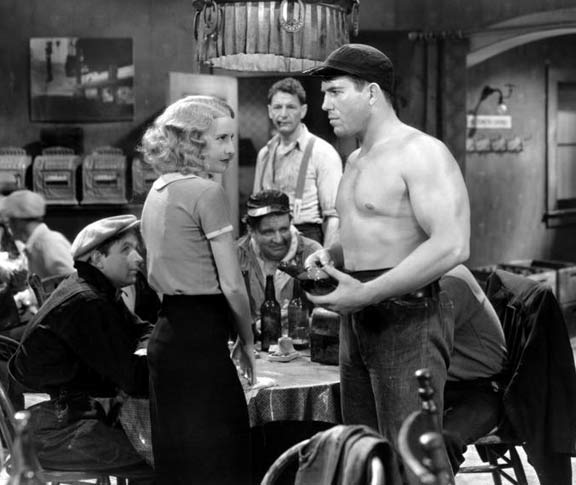


When I say that Baby Face sleeps her way to the top, she really has to start from the bottom. The first lucky fellow is the guy whose job it is to throw vagabonds out of the boxcars, whom she has to placate to even get to New York; and then when she gets there it's the fat slob whose job is to sit at the reception desk and keep the unemployed hordes at bay's lucky day. (That guy is at about my occupational level--today of course any woman ambitious enough to be willing, and alluring enough to be able, to rise by this means would at least be able to start out much higher up the ladder and get to skip these gross early steps). The further up she goes, the more havoc she wreaks in careers and personal lives and the less able the men seem to be either to resist her initial advances or to get over her once she has gotten them fired and broken up their engagements, and moved onto the next guy on the chain.

By the way, back in Erie, there is a German-accented old-timer in the 'hood who, in spite of his own seemingly lowly station, is into Nietzsche, and introduces Baby Face to some of that philosopher's most famous concepts, though the application of these in the film strikes me as the product of a decidedly sub-Straussian interpretation.

I don't love this movie, though I don't think it is supposed to be a great work of art so much as an interesting artifact of the zeitgeist of its period, as well as a showcase for the talents of Barbara Stanwyck, whom many connoisseurs of both film and women consider to be one of the greatest movie actresses of all time. I have to admit I do not really get the mystique of Barbara Stanwyck yet either. Some people think you either get something right away or you never get it--there is never any in-between ground with such people--but I often find that after multiple exposures to or efforts with poets, directors, actors and so on that I will begin to see something that I can appreciate or perceive some hint of greatness in.


I was going to write something about the folly of imagining what past times were like based on their presentation in movies, using the pre-Code/post-Code divide, when all manner of vice and bawdiness suddenly took on much more subdued and socially marginalized forms, as an example of this. But I am not sure that I believe it is all folly. The Depression era, especially after the election of Roosevelt, was a period of dramatic change. The centralization and overall tighter organization of society compared to what had existed previously could not fail to insinuate its effects into movemaking and other artworks. The crime rate did begin to plunge precipitously right around the time the Code was instituted (and ironically did not start shooting up again until the time it was lifted). We are so well trained to be suspicious now of the boldface narratives that formerly held sway in this country and assume they were all lies to cover up what was really going on that you almost have to look at what is not calling attention to itself or perhaps even conscious of itself in these old books and films to try to give yourself a persuasive idea of what was authentically happening or important at the time.


Tuesday, October 21, 2014

Separate Tables (1958)


While I have noted before that I am not much of a fan of movies set in courtrooms, ones set in hotels I cannot get enough of. When the lodging in question is of the shabby variety, populated by patrons clinging by their fingernails to the bottom rungs of the respectable middle class, and located in a second rate British seaside resort town, I am usually overcome by the second scene with the feeling that I have missed one of my true callings in life by not having passed through the purgatory of a year or so as one of the permanent inmates of such an establishment. Given the currents of the modern society and economy, it is hard to make a rational case either for the utility or attractiveness of this mode of living; but given how many books, plays and movies have adopted this setting as a milieu, creative types have obviously seen in it attractive possibilities related to our civilizational condition that productive and less static activities and pursuits have a tendency to mask and blur.

Separate Tables was nominated for seven Oscars in 1958 and won two (for best actor and best supporting actress). It also has an star-studded cast that is especially heavy on people who have been enthusiastically celebrated on this site. I had never heard of it. Certainly it does not come up at all in most channels of conversation about movie history and lore that I am aware of. It is dated in the sense that it is so heavily steeped in the conventions and themes of its particular time, and has no anticipation of the concerns that in 1958 were approaching rather rapidly. But in my current state of mind I do not look on that automatically as a fault even through a critical lens, and in this instance it accounts for a considerable amount of the charm of the movie.


The film is set in a hotel--functionally really more of a boarding house--in Bournemouth. The way it is presented in the movie it looks rather cozy, but we are supposed to have the impression that most of the characters have ended up there due to some misfortune, and would really rather find themselves in other circumstances. The title refers to one of the hotel's selling points, that you don't have to share a table at meals with other guests, a practice which evidently was still common in England in the 50s (it seemed to have died out there by the 90s, but it was still in practice on the continent, especially in the East). Leading the spectacular cast are Bourgeois Surrender Hall of Famers Burt Lancaster, Wendy Hiller, and Deborah Kerr. They are joined by David Niven, who won the best Actor Oscar referenced above (beating out Tony Curtis and Sidney Poitier in The Defiant Ones, reviewed here formerly, as well as Paul Newman & Spencer Tracy). I don't know what I was expecting from him--a full-on helping of arch British suavity, I suppose--but in this he plays a pretty sad sack character and really goes to work to endear himself to the sympathy of the audience. Obviously it worked, and not only on me. Rita Hayworth adds more star power and some Hollywood glamour to the proceedings, and the less famous (but far from lesser) players include numerous highly skilled veterans of the British stage, most notably Gladys Cooper as Deborah Kerr's suffocating mother (typical of the popular 50s themes with which this movie is suffused), and Felix Aylmer as the retired headmaster who detects the fishiness of the Major's public school reminiscences (among his other trangressions, the Major--Niven's character, who is not, in fact, a major either--claimed a more exalted background for himself than he had a right to do) when the latter is flummoxed by Aylmer's quoting of Horace.


This is adapted from a play by Terence Rattigan, who was popular in the immediate postwar era but whose overall style, as hinted at earlier, could not weather the transformations towards the edgier theater ushered in during the Angry Young Man period of the late 50s. His middlebrowness, in this movie at any rate, is almost pure, undiluted by any element either of cleverness or edginess or crassness or vulgarity (or visible anxiety about this, for that matter). He was apparently very gay, but nothing of that nature is remotely suggested in this plot that even our super-attuned modern sensibilities can readily discern. None of the characters really rise above being types; they don't possess much depth or roundness. However there are tropes and rituals, and gentle jokes, as well as various fumbling, Freudian-tinged 50sish explorations of human relationships. I liked the couple of the medical student and his girlfriend, though they were minor characters did not appear much in the final cut; I am assuming there was more of an explanation as to how she went from being dedicated to creating art and, it is implied, committed enthusiastically to free love in the opening scenes, to her abrupt decision at the end of the movie to get married and start pumping out babies as quickly as possible. The Deborah Kerr character was kind of ridiculous, especially for her to play, but this is the kind of movie where you go along with it, kind of like when the major gets arrested for harrassing women in a darkened movie theater you go along with the premise that, hey, he's not a bad guy, he's just lonely.


The Burt Lancaster-Rita Hayworth-Wendy Hiller love triangle was not believable in any of its aspects, perhaps because it was overloaded with all kinds of postwar class and emasculation issues that come off as ludicrous now at the expense of any kind of natural feelings. I love Burt Lancaster, and I know the presence of the American stars was probably considered exciting at the time, but he seems kind of out of place in this odd and dated but watchable and often interesting movie.

Wednesday, October 15, 2014

Buffalo Wild Wings

While I do for the most part lead a comparatively retired life in a dusty old house among dusty old books and shabby and mildewed old tables and cabinets, I still like to drop in once in a while--usually it ends up being quite a long while--at some loud, brassy modern barroom with a hundred gigantic televisions, video game consoles on the tables, frat party music pumping through the restroom, and cute young waitresses. I had forgotten to do this for several years until I was in the grocery store a few weeks ago and saw one such attractive woman** there who was wearing a Buffalo Wild Wings work shirt, at which the thought occurred to me that perhaps I ought to go there sometime. Of course I have long given up entertaining any thoughts of having any meaningful interactions even with women my own age, but for all that I am still biologically somewhat alive, and it still affects my spirits positively to see a few attractive women* on occasion, maybe (of course?) especially ones whose own spirits don't appear to be weighed down yet by children or bitter experience or the other cares of deep maturity***.


I found that I enjoyed indulging, for a little bit, in the overwhelming stimulation of the televisions, almost all of which were turned to sports stations. I have not had cable TV for years, and I have never owned a giant flat screen television, so the immensity of the picture and the scope of modern media coverage of sports are amazing spectacles for me to behold. I was especially drawn to the NFL Networks replaying of the previous week's games in 30 minute condensations. That would have seemed like Elysium to me as a ten year old. Once in a while I will sit down to watch a little bit of a football game at home, but my wife, who hated football long before it was fashionable, can only endure about a half an hour of this before some crisis or theretofore unsuspected (by me) necessary household project is found to exist which necessitates leaving off the game. Shortly after we were married my wife actually began taking down one of the walls of the living room in the middle of the NFC championship game--this had been planned, but it hadn't occurred to me that the demolition could, or would, begin during the game. This was what a football coach would call 'setting the tone' in the marriage. In truth the games are too long for any new age husband and father to reasonably give up more than a couple of Sunday afternoons for in a year, and those only if the weather is too bad to do anything outside. So I am not very attuned to the ethos of the man-cave lifestyle that is supposedly prominent in current society.

The food was not very good, which if I noticed it means it must have been beyond terrible. I know that refined opinion holds that all these kinds of places are atrocities against human culture, but usually I am either so hungry or otherwise stimulated that the awfulness does not make a pronounced impression on me (also I have no real idea what good food in the United States is supposed to taste like, or where to consistently go to get it,**** but that is another article). The excessive saltiness really did strike me this time, however. I think it is more that I am getting older and need less salt and am more sensitive to it. So I doubt I will go back there very often, if at all, but...it is one of those places, contrived and phony, though not wholly ineffective, that holds out some kind of tantalizing promise that Fun really does exist, and that maybe you, or somebody anyway, could have it at Buffalo Wild Wings. They won't discourage you from pretending or imagining it to be the case, anyway.

As a case in point with regard to this, when I was in the restroom I saw a truly awesome poster the absurdity of which made me nearly double over with laughter at the time, and caused me to suppress chuckles throughout the rest of the day. Here it is:


The humor of course lies in the fact that the guy in the picture is experiencing a level of ecstasy at indulging in the Tuesday night beer and chicken deals at Buffalo Wild Wings that no one ever experiences in real life. People are not this ecstatic when they win Olympic gold medals or Nobel Prizes. Maybe some men are this ecstatic if they get somewhere with a woman a level or more of desirability higher than they really merit, but this almost never happens. Maybe desperate authors and academics who land a publisher or tenure track position feel something like this, but the glory they feel may be more delusional than that brought upon by the arrival of the basket of hot wings. Top line rock stars are never this ecstatic; nor are even second rank rock stars. John Tesh is said to get pumped in this way during a concert, but I cannot find any photographic proof even of that.

So I think the poster is kind of genius. It sums up what all ordinary--i.e. non-cool--men deep down want their night at their bar to feel like, and that they imagine must be what they would feel if they could suddenly transform into a cool guy--and makes them believe what ordinary bars are too real and honest to pretend, that this feeling is what they are selling, and that it truly can be bought. Of course I know it cannot really be bought. Or can it, provided one is emotionally shallow enough?

* I know that in much of the country the waitresses at these kinds of establishments tend towards a more extreme bimboish or sorority girl model that is beyond what a person like me could really relate to. However that extreme type doesn't really exist in New Hampshire, and the women at the place I went to were quite normal-looking, young and thin and with regularly proportioned bodies, this being really almost the whole source of their attractiveness, as they were otherwise almost entirely normal in their appearance.

**I did not see the person from the grocery store on the day that I went to the restaurant. She was probably slightly prettier than the ones who were there, but really as I say they were all of a very similar type and the overall effect was little less pleasing.

***It is telling how pitiful the state of modern manhood that I seem to be experiencing this as some kind of revelation. Of course I always have imagined it must be so in theory, but have had vanishingly fewer and fewer occasions to test it in practice.

****I have always wondered about whether the women frequenting and working at vegan and other alternative/new age establishments would be of the sort to provoke this mood boost in me. The problem is, I either really can't abide the food at all (veganism) or don't have the habits/rhythms/ sense of purpose to effectively hang around trendy coffee shops or those arty/organic/raw milk anti-mainstream America type restaurants. Yet I still believe this is where my natural crowd and all the friends I should have in life are really to be found.

Thursday, October 09, 2014

Were Freaks Really What Made New York City Great?

I have links to a few other blogs in the right hand column of this page, but this has been a rather desultory process. Some of these have not published new material in upwards of a year, and the quality of some of the others, after my initially finding something in them that piqued me, has not remained consistently engaging. I suppose I will keep adding to the list whenever I find something that both publishes relatively regularly and has the sort of intelligence or humor or interests that I like. I come across very little that fits this description however, though I am sure there is a lot I would like out there, if I could manage to find it. I have not exactly cast any very large nets in this regard; it is more that I have turned over a few things that happen to have washed up on my little shore and seen something that made me want to put them on the shelf for a time. The links have never been a strength of the page and I almost never refer to them in my posts.


Today however I am going to refer to the 'Vanishing New York" blog, which is written by a guy named Jeremiah Moss, some of whose work has actually been published in real newspapers and magazines, including the New York Times. For those who are unfamiliar, the blog chronicles old-style Manhattan places, mostly restaurants and other small businesses such as barber shops and newstands, that are being/have been steamrolled by the ongoing gentrification and transformation of that island to its new identity as a luxury playground for the global elite. Moss deplores these changes. I find the economic forces at play in them unsettling, and as my affections for the city are mainly directed by a kind of patriotic nostalgia, change of the sort that is happening now threatens to make me feel even less at home and happy there than I have always been (and actually I almost never go there in real life. Still, I imagine there will be a time when my children are not little or I will have enough money and time to be able to go down for a few days a couple of times a year and go out to dinner and do other things I have always imagined I wanted to do there, though probably this will never be the case). I will admit to being impressed on recent visits with how clean the steets and parks are compared to the 80s and early 90s (let alone the infamous 70s), when one of my main impressions, doubtless from the circumstance that on those visits I didn't have anywhere to stay or any money to spend and therefore spent about eighteen hours a day walking everywhere in between catching the occasional nap on a park bench, was of the overwhelming amount of garbage and filth and the seeming physical impossibility that it could ever be eradicated. But Moss seemingly cannot bring himself to find much cheer or romance even in the lovely prospects that the restoration and brightening-up of older and architecturally preserved streets and landmarks offer, because he is too conscious of the costs, mainly in accessibility and character, that have made it possible.


One of Moss's primary laments is how the forces of ruthless wealth on such a scale that for a normal person to try to contend against it is the economic equivalent of trying to fight a tank attack and aerial bombardment with a bicycle corps, and the development that accompanies it, are clearing the city of freaks and any other free-thinking and challenging people with an eye toward making it attractive to tourists and other people devoid of personality who are more conducive to following the cues the corporate interests set out for them and expediting the processes of money-making.* He longs (along with many, many other people) for the days when the freaks were setting the tone in certain parts of New York City and keeping the kind of people who didn't get them, tourists and otherwise, where they belonged, which was decidedly not there. I have friends who had a similar attitude. If they walked into a diner or bar and there were a few transvestites sitting at the counter it was a great joy to them, a reassurance that they had found a place that was all right, and real. I never felt this exhilaration, I had good 1960ish liberal values, that tolerance was necessary and people should be free to be themselves and not persecuted, and I even had some sense that this was a part of why New York had become and was so great--but still, on a personal level, I found most of the extreme freakishness unattractive and not especially fascinating. Certainly they did not make New York. In the dream New York of my imagination, which is pretty much the 1920-1965 era, the lifeblood of the city are really normal people, some of whom end up doing great things, but most of whom are regular workaday family type people, who are maybe, stimulated by the environment and the institutions and their daily interactions with each other, just a little smarter, a little funnier, and a little more energetic than a similar collection of people would manage to be somewhere else, the cumulative effect producing the possibility that we identify as our own personal dream. I suppose we are all inclined to regard scenarios where people most like ourselves seem to have the most favorable circumstances for professional and social relevance and success, romance of our preferred type, etc, as the ideal, not merely for ourselves but for society as a whole. As indeed it is, from our own point of view.


*Complaining endlessly about tourists is of course a favorite pastime of a certain kind of New York City person, usually one who did not actually grow up there themselves, and whose personal contribution to the city's economic strength or cultural vitality and prowess seems as if it is not above questioning, if they are going to insist upon holding such attitudes. I say this as a person who has been largely relegated to dreaming even about going there as a tourist at this point. All this aside, I have never felt the presence of people who were obviously tourists to be anywhere near as overwhelming as it is in any of the famous cities of Europe. Maybe in the new post-2000 Times Square, but even there it was neither as crowded or as obvious as it is in most popular travel destinations. Even when I went to the Statue of Liberty about 80-90% of the other people on the boat were either orthodox Jews or very diverse school groups who seemed to be from pretty close by, if not perhaps Manhattan itself. And I did not see a single middle-aged fat couple from Iowa. I guess one of the complaints is that the tourists, who are extremely numerous, love chains and bad food generally which drives independent places out of business and causes the most popular areas to proliferate with characterless restaurants serving garbage. I don't think it is quite that simple. I believe most people, tourists or otherwise, want to have meals and experiences, especially in places like New York or Paris or Italy, that make them feel they are living a higher kind of life than they or almost anyone else is accustomed to, as often as they can. Most people have to eat several times a day, and if they have to work, or are on a tight schedule, or have children with them, or, as often happens in great cities, are timid about whether they will be welcomed at a place that looks to be of some quality or even that is populated by cool-looking people, they will probably, statistically, on average (i.e., not you, the way above average, sophisticated reader of exquisite taste) at some point in their life or vacation will for convenience's sake settle for a meal or two at the kind of establishment designed to accomodate this particular reality. Maybe you are pretty good, and you only go to the brand name places (I will include coffee shops in this as well) 3 out of 10 times. But of course if this ratio is repeated among 100,000 tourists, in the aggregate the individual chain locations will do much more business than the scattered and more individually numerous authentic/human places.


Monday, September 29, 2014

1960s BBC and the Czech New Wave Revisited

Wuthering Heights (1967)

BBC television production, in glorious black and white. Though I was taken enough with the whole effort, the highlight was the epically gorgeous 1967 hairdos worn by the lead actresses, who were both named Angela*; which hairstyles, imaginatively at least, translated well to the 1840s. One of the Angelas played Cathy Earnshaw as a brunette in the first two parts of the series, and Cathy Linton (the first Cathy's daughter; the mother of course died in childbirth) as a blonde in the last two. The other Angela played Isabella. The male leads were decent enough too, I guess, especially the guy who played Hindley was good. Ian McShane, who is something of a name, was Heathcliff. He did not to my mind emit to the full the masculine ferocity that this character so famously and belovedly exhibits in the book, though it does not seem as if anyone has managed to capture that on the screen (I have not seen the Olivier version, but supposedly he is an even milder Heathcliff than McShane). The sets and outdoor camerawork are simple but evocative, and one never feels that something would have been better if more money had been spent. Once again it is demonstrated that a little atmosphere, a few good-looking girls, supporting players with some presence and a good story can go a long way.

Regarding the story--like the Idiot, this is in my opinion one of the great stories of the post-renaissance era. It always works for me. I had the good fortune to read the book at a pretty young age, before I was fully cognizant of my mind's inability to keep up with my ambitions for it--it was the very first book I took up when I started reading again after I had been out of college for a while--so I remember it quite well. It is extremely funny, and all of the characters have either well above average verbal intelligence irrespective of their stations, or are so freakishly absurd in some way that their presence serves to stimulate rather than stifle the more intelligent characters. I think that the book resonates with as many people as it does because it does have all of this humor and intelligence while taking place far out of the way of great events or anything resembling intellectual ferment or heightened social stimulation or even economic and societal churn. To recreate this type of scene would seem to be more attainable to the socially isolated modern reader than those found in other books which either require extraordinary talents, years of high level training, or even generations of cultural indoctrination as their basis. Also, the characters that possess no inconsiderable amount of sex appeal (and any amount is not inconsiderable to me)--even Heathcliff--are not exactly surrounded by people equipped to properly appreciate and quench it, which does have the effect I suppose that its edge is never wholly dulled. I suspect a lot of people imagine this to be the case with themselves too and sympathize with the circumstance in the book.


Angela Scoular as Cathy Earnshaw (with Heathcliff)

*I have always liked the name Angela a lot and have brought it up as a possible baby name but my wife always immediately shoots it down as having trailer park-ish conntations for her. Perhaps this is more the case around here (New England). In the suburban mid-Atlantic area in which I grew up, I associate it more with energetic, slyly nice but maybe also slyly naughty daughter of an orthodontist types. My idea of trailer park names falls more in the direction of Crystal, Brenda, Tammy, and the like, though I associate Tammy as being usually the good-looking one from this pool and therefore have some fondness for that name as well.

The Report on the Party and the Guests (1966)


This is a somewhat hard movie to find. I ended up doing something I don't usually do, which is shell out for a four-DVD Criterion Collection set of "Pearls of the Czech New Wave", which includes six movies from 1966-69, one feature by each of five different directors, plus one collective effort in which each the featured directors contributed a short movie based on a story by the important and very good Czech writer Bohumil Hrabal. The Report on the Party and the Guests is only 70 minutes long, so I watched it twice. I don't think it is a great movie, but one has to grant that it took some cojones to make it (and I would think to be involved with it at all) in 1966 Czechoslovakia. The plot is that a group of vaguely bourgeois adults out on a picnic in a place that looks like it could be the Sumava forest are surrounded while strolling through the woods by a large band of unfriendly men who do not pointedly hurt or even threaten the picnickers but nonetheless make it clear that their movements are restricted, that they will not be allowed to leave the area, that they will have to submit henceforward to the authority of the men who have interrupted their walk; apart from a few weak and half-hearted attempts at protest and rebellion, the picnickers accede and become resigned to their new condition relatively quickly. In the second half of the movie they are brought to a large outdoor banquet like a wedding dinner along the wooded shore of a lake, and a number of odd things happen--for example, the guests all realize they are not sitting in their assigned places at one point and move en masse to find them. The meaning of a lot of what went on the second part admittedly was not clear to me. One of the picnickers, who had remained silent and sullen, does slip away from the table during the banquet; a search party is raised to go bring him back, and his wife (who is kind of attractive in a matronly late 30s way, but does not possess much character to oppose any convention or authority) apologizes to the leader for his antisocial behavior. Another picnicker, flattered by the new authorities' assurances that he is a reasonable and intelligent man, spends the banquet trying to ingratiate himself with them. As happens to me a lot with Czech movies, something will appear on the screen--some kind of food or utensil or mannerism or even the odd word or phrase which I can still pick out--which reminds me of when I was there and sends me into a reverie which distracts me from following the movie. Still, on the whole, I have a much easier time getting into these Czech New Wave movies than I do the likes of Godard and some of the other French avant-gardistes, even when the narrative does not take an easily-deciphered form, because I feel I have some sense of at least the material world these movies inhabit. Also even the most talented Czech artists--and this seems to extend even to major international figures such as Dvorak or Smetana--tend to see themselves and their countrymen more as underdogs and subversives trying to cut a few slivers through the massive quantity of baloney weighing people down to expose any fleeting flash of truth than as people in a position to make grand pronouncements and discoveries about the state of civilization or the nature of universal man that will take the average person a few generations to catch up to and absorb anyway.

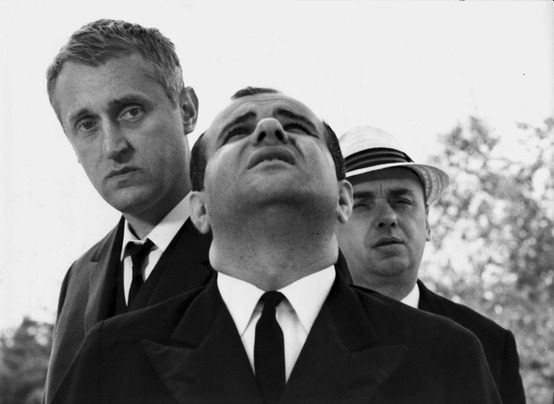
When the picnickers are first taken into power by the mysterious band their leader is a rather clownish guy who looks and kind of behaves exactly like Adam Sandler. Eventually a more distinguished gentleman shows up to conduct the captives to the party who is revealed as the real leader. 


The Adam Sandler Guy

The women in all of these films are variously quite attractive without being classically movie star beautiful. In this one they all seem to be in the 32-37 range for age--of course that is young to me now. I have gotten to the point where I at least am finding some 32 year olds as beautiful as I once thought women ten to fifteen years younger to be. Anyway these are the kind of women I imagined I would have hung out with a lot if I had ever been able to establish my artsy credentials. Of course our imagination always outstrips reality. As I have written before, I imagined myself before I went to college hanging out with women of a certain type that I thought, and congratulated myself for thinking, reasonably realistic, whom I found upon arriving at school barely existed at all, and when they did had far more desirable social and physical options than I could offer at the time. 


The Women I Found Attractive Despite Their Being Rather Weak and Stupid in the Movie

I have watched a couple of the other films in the collection. The first was Pearls of the Deep, which is the collection of shorts based on the Hrabal stories. It is a superb mixture of quirky Hrabal stories, imaginative and beautiful film-making, and documentation of the Czech life and personality. The directors were Jiri Manzel (Closely Watched Trains), Jan Nemecs (The Report on the Party and the Guests), Evald Schorm, Vera Chytylova (Daisies), and Jaromil Jires. If I had to rate the shorts, I would say Schorm's ("The House of Joy") about a butcher and amateur artist who covered every bare surface in his house with his painting, is the most interesting idea, Chytylova's (The Restaurant The World) is the most cinematically arresting, Jires's ("Romance") the most evocative of what it is like to be out and about in Prague. Menzel's ("Mr Baltazar's Death") is also very good--I wonder if it was not the most effective as a literary story--and had many ingenious images and directions that it took. The Nemec ("The Imposters") was good too, though the simplest and most straightforward of the set. I also saw the somewhat famous Daisies, which I liked for a while but of which I eventually grew a little tired. In its story of two anarchic girls running wild, rejecting conventional romance and other girlish concerns, cutting up penis-shaped fruits and meats, putting old men on trains they don't want to be on, and smearing food and various other things all over their beautiful young bodies, I was reminded a lot of Celine and Julie Go Boating. How much was I reminded of it you say?


Sedmikrasky (1966)


Celine et Julie Vont en Bateau (1974)
Quite a few other people on the internet have noted the similarities between these two films. It is not my special insight. 

At one point of the girl's names in Daisies was Julie too, but their names kept changing. 

The Adam Sandler guy was briefly in this also, as a hopeless sap in love with the more extreme 60s chick of the duo, the one with the rust-colored hair. I thought they were both sexy, but I suppose if I had to pick I have a slight preference for the brunette.    

Saturday, September 27, 2014

Some Recent Reading

Tennyson--"Guinevere"

Part of the Idylls of the King, which in the various books I have is never presented as a single coherent work, but as a set of various individual poems that belong to a cycle, and I guess Lord Alfred continued to add more episodes even after it was nominally finished. When I come around to undertaking the whole thing I suppose I will have to figure out what is considered really in and what isn't.

I've always been all right with reading Tennyson. He is still a pillar of English Poetry, and familiarity with some of his mass, his stories, his language, his way of looking at things, has been helpful to me as a background for reading other things. Right now my concentration and frame of mind are not conducive to do any very good reading of anything, but I am retaining contact with the field, and dipping into these classic guys on a semi-regular basis is important to me. (smooth and stout and suffering from comparatively little decay compared to some of his forbears,...I had meant to delete this but apparently forgot to. Maybe I will keep it in. It's not a chiseled thought, but maybe it indicates something).


King Arthur is too beta in this section, both in the way he is perceived by his disgraced queen as she reminisces on the delights of her relationship with Lancelot, and in his own address to her:

"I cannot touch thy lips, they are not mine,
But Lancelot's: nay, they never were the King's.
I cannot take thy hand; that too is flesh,
And in the flesh thou hast sinned; and mine own flesh,
Here looking down on thine polluted, cries
'I loathe thee:' yet not less, O Guinevere,
For I was ever virgin save for thee,
My love through flesh hath wrought into my life
So far, that my doom is, I love thee still."

No wonder Camelot fell.

Edward Hoaglund--"The Problem of the Golden Rule"


I had never heard of this guy, though he is still alive (born 1932), has been called the best essayist of his generation by numerous people (well, Edward Abbey and John Updike anyway) and has been working pretty steadily publishing in old guard magazines and newspapers right up to the present (articles of his appeared in the New York Times and The American Scholar in 2013!). His peak visibility and influence seems to have been in the late 60s and 70s. He is one of these old New York City/Deerfield Academy/Harvard guys who has lived in Vermont for decades now, when he isn't at his other place on Martha's Vineyard. The essay assigned for me appeared in Commentary in August of 1969. It was included in a collection of his essays published in 1979 under the title of The Edward Hoaglund Reader. I am always curious to read what people with some real literary perspective and ability have to say about this particular period, and this Hoaglund does have some of this. He has a talent for the hook--whenever he introduces an episode or an observation it seems like it is going to be interesting. In this essay however, these promising introductions never really come through, and they certainly do not come together to form any kind of unified theme in my mind. The premise of the essay is that in the modern world there are too many people, with most of whom one has increasingly little in common, to regard everyone as an individual or some kind of spiritual brother whom one can be expected to treat as one would be treated himself. He does not exactly wander away from this premise, but he does not maintain his focus on it with the clarity that I at least require. There is a germ there of a good idea, but the examples he uses to illustrate it are kind of all over the place, do not connect with each other all that well, and do not lead to any very vivid conclusion. I am piqued enough to try a couple more of these essays however and see if they have anything to say to me. I could use more somewhat contemporary writers whose manner I can bear.

Here is a sample passage. Does it give one something to chew over?:

"The difficulty will be how we regard individual people, a question which involves not only whether we think we're immortal but whether we think they are. The crowded impatience of suburb-city living doesn't often evoke intimations of other people's immortality, and neither do the hodge-podge, leveling procedures of a modern democracy. So much of the vigor of the Victorian church, for instance, grew out of the contrast between its members and the raw, destitute brown masses who covered the rest of the globe. Among an elite, self-congratulatory minority even the greatest of attributes--immortality--seemed plausible."


Milton--"Comus" (or, "A Mask")

This is pretty early Milton--he was 25 when it was presented. He had of course already been writing poetry for years by that point, and had already written 'L'Allegro' and "Il Penseroso', which retain some fame, though I have not as yet read these and passed my own all important judgment upon them. Milton is assuredly among those poets I still believe it does me good to retain contact with, even though at this point I would be hard-pressed to prove that classical English poetry has anything to do with my life, or that it will have anything meaningful to do with most of my children's lives (because all my own efforts at learning and development henceforth should be undertaken with a primary eye towards benefiting them). I have long believed that Milton is by far the least appreciated of the truly great English language authors. Even supposedly highly educated people think it is acceptable to scoff at reading him and assert that he is boring. In this one instance maybe more than any other I feel compelled to think, if the person is otherwise very confident and assertive regarding his own intelligence, 'no, it is you who are boring, and you reveal a limit in your own mental capacity that I have taken note of and marked as important whether you consider it so or not'. Maybe it is not quite this dramatic, but some thought of the kind does flutter across my mind even when everyone present, myself included, is more than satisfied of the otherwise overwhelming mental supremacy of my adversary. We English speakers take our language, a mighty gift and legacy that our forbears have bequeathed to us, too much for granted. Our precious intelligence is formed in large part by the images and scope for organized thought that our words give us, the possibilities of which are demonstrated by the great writers and speakers of our language, of whom Milton obviously was one.

All right, now that I have put in my plug for Milton, what do I think of the 'Comus'? It has the air of an exercise that our poet wanted to undertake. The subject involves a virgin who is separated from her brothers and protectors while crossing a wood and is set upon by a Satan-like figure (Comus) who is eager to relieve of her virtue, and the power of that virtue, if it is genuine, even in the face of the most dire threats. While Milton is careful in the course of most of his poems regarding matters of chastity and personal morality to present his official position as conformable with Puritan norms, he has a pronounced tendency to expound at great length, with great imaginativeness and great gusto on the alternative arguments to these correct positions. That is the best part of this poem too, when Comus dismisses the idea that God wants us to live a humble and austere life by pointing out the almost comical abundance with which He has furnished the world for our pleasure:


"Wherefore did nature powr her bounties forth
With such a full and unwithdrawing hand,
Covering the earth with odours, fruits, and flocks,
Thronging the seas with spawn innumerable,
But all to please and sate the curious taste?
And set to work millions of spinning worms
That in their green shops weave the smooth-hair'd silk
To deck her sons, and that no corner might
Be vacant of her plenty, in her own loyns
She hutch't th'all-worshipt ore and precious gems
To store her children with; etc....

To which the virtuous lady replies with:

Imposter, do not charge most innocent nature,
As if she would her children should be riotous
With her abundance...
 
Is it possible that there is not intellectual value in being exposed to this kind of concise, detailed, comprehensive and unique way of regarding the world and our existence on it? These are the kinds of arguments that would-be defenders of the humanities should be making and persuading people of the importance of if they want those studies to remain generally alive, that these kinds of studies do expand the mind, do expand thereon the collective richness and quality afoot in the common society. I don't know that even this will work on the general public, but someone at least ought to be able to put forth the argument confidently.


Wednesday, September 24, 2014

Dances With Wolves; Cries and Whispers

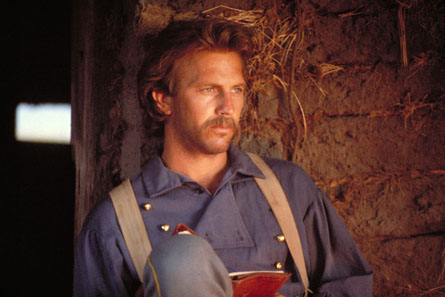
Dances With Wolves (1990)


Even though I went to the movies about every other week from 1989 to 1996 or so, I missed quite a few of the films from that era that were most celebrated at the time or have become so in the years since. I have never seen The Silence of the Lambs, or Pulp Fiction, or Braveheart, or even things like Kalifornia or Natural Born Killers that are often referenced in overviews of the zeitgeist of that period. Of course I never saw Dances With Wolves either, even though it won the Oscar for best picture and was otherwise a big hit at the time. Doubtless the western premise didn't interest me very much in those days. Also I had the impression that most of the highbrow, and wannabe-highbrow, eastern critics and opinion makers were dismissive of it, it was three hours long and had substantial dialogue in the Lakota language, the thought of which, unlike French or Swedish, did not inspire any very titillating feelings in me. So it did not seem that I was missing out on any particularly meaningful experience.


However, when the esoteric mechanisms that produce my movie list recently turned this up then, I was bemused rather than dismayed or fired with excitement. My expectations remained modest, but it was new for me, it was, or had once been, famous, it was an Oscar winner from a time of my life and in the life of the nation that I look back on now with perhaps more misty-eyed fondness than I was capable of feeling at the time; all of this aroused my curiosity to see what the appeal had been. And I will admit that while I was watching it I thought it was pretty good. It is the kind of movie that, even more than usual, ought to be seen on the big screen in the collective escapist sanctuary of the public movie house in one uninterrupted sitting. The story must have been reasonably engaging, though I am always more skeptical of the evil/rapacious/dead-souled European versus noble/wise/beauty-loving Indian dichotomy than I am supposed to be. The lives and language and speech and arts and sciences of the Indians strike me as excruciatngly limited and boring and incompatible with the rhythms (or anti-rhythms, if you will,) of my Euro-American soul, and nothing seems to be able to convey the grandeur that exists in them to me. However, the film does bring out the grandeur of the landscape of the American plains, and even (perhaps unwittingly) of the historical events that took place there in the era in which this film was set, and the music is unusually good; these things carry you along even when your intellect is uneasy and feeling some compulsion to protest.

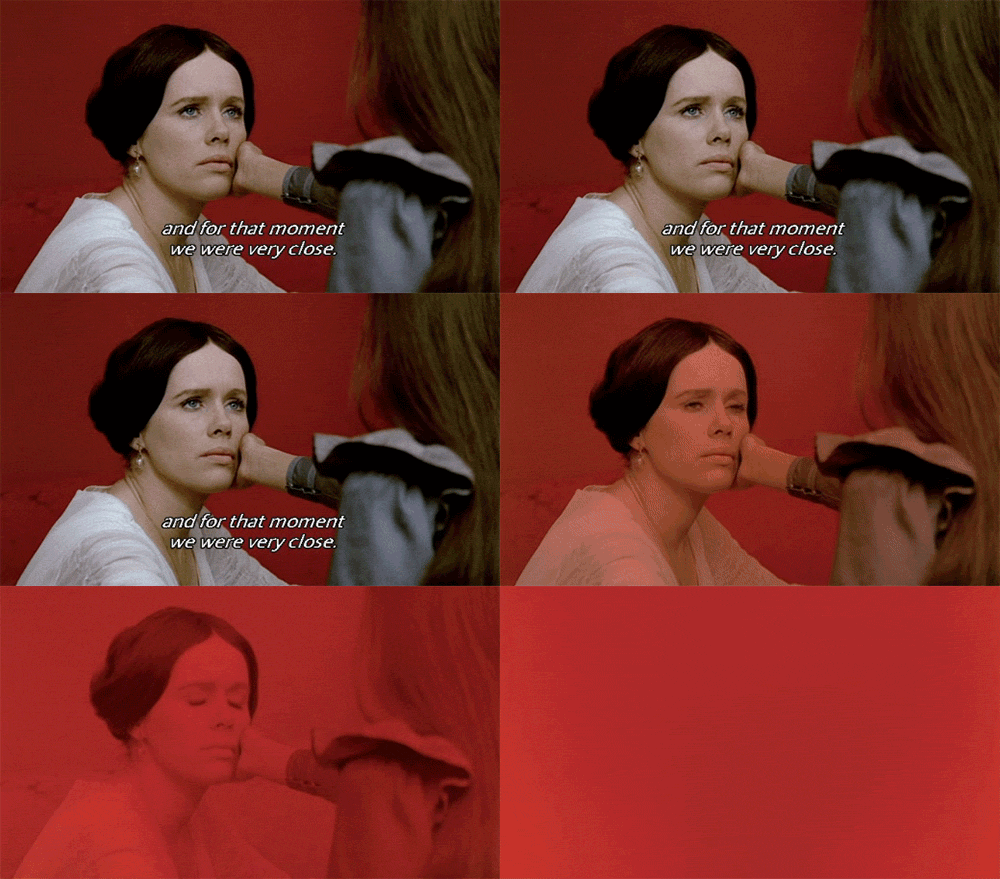
Cries and Whispers (1972)

I had avoided this up until now also. Though I am a fairly big fan of Ingmar Bergman's movies, this one always represented some idea of Peak Ingmar Bergman to me--the high water mark of his mainstream prestige, and of the prestige of the European art film generally, the full realization of his technical mastery of his art, the point at which his maturity, vigor, penetration, and knowledge of life and women came together at their highest levels, such that, as Roger Ebert famously noted in his review, the film represented a depiction of life the reality of which was difficult to watch--the prospect of all which seemed too for a long time too overwhelming to me, especially as it seemed unlikely I would be capable of deriving understanding, and certainly no one could derive any enjoyment, from it. But the tyranny of the list in a sense freed me from this grim fear, and of having to gird myself up to want to see it. It was on my list, it will come, I will watch it, I will expect to understand and appreciate nothing of it, at best maybe it will make some impression on me that will translate positively to the way I carry myself in the world, I send it back, I will write some nonsense on my blog, and then I will be done with it and I can look forward to the time when my list is back in the 30s and 40s again.


So the movie comes, I watch it through. (***Spoiler alert?***) There is a woman dying an excruciatingly painful death. There is a man who attempts to kill himself because his wife is unfaithful to him. There is another woman who sticks a shard of glass into her vagina until she draws blood. This same woman tells her sister that she has always hated her. There is another woman, a servant, who lost her only daughter to tuberculosis and who is treated as, well, a servant, and not an adult with any claim to having a serious life, by most of the characters in the movie. I don't remember if I am missing anything in this vein, but the movie ends, I am not sure that I have been able to hold the main threads of it together in my mind, or even identify what they were, but it did work a kind of mesmerizing fascination on me that I find to be rare, and I did determine that if this movie were stripped of all the baggage of the Ingmar Bergman legend, and I were encountering it as something that had come out of Sweden in 1972 by some obscure director--and there are certainly many great foreign directors who for whatever reason never achieved the fame in this country that Bergman did--that I would have unreservedly thought it was--and I hate using this word unless I can't think of another one that fits--a kind of masterpiece. This realization also freed me in a sense to take some enjoyment in the movie, for the idea of something's being a masterpiece invites the sensation of enjoyment in the form and technical qualities alone even if the themes examined are of the darkest and most unpleasant nature. I was not immediately certain that I wanted to watch it a second time, but I held on to it for a couple of days before deciding to send it back, at which I did decide to see it again, and this second viewing reconfirmed for me that the movie possesses numerous unique and suggestive qualities even in comparison to other great films.

So what are these unique and suggestive qualities? The main one is that every lurking menace that rears its head through the course of the film is carried through, with great patience, meticulousness, and formality, to some conclusion, in many cases its logical conclusion, though for the most part the viewer, at least if he be me, has not bothered to carry out these implications to their logical conclusions beforehand. This gives the whole work an air of fullness in all its parts that most movies fail to achieve, and makes a second viewing, and probably even further ones a fruitful exercise. Like most Bergman movies, it is very stagy, but I have come to realize that, being by nature rather a hyper-linear sort of thinker, I actually like staginess and formality and rules and so on. The sensibility that the movie conveys is that death and unhappiness and the general unpleasantness of living are not opposed to some alternative state of happiness that people ought to seek to achieve, but are the constant realities underlying the human condition and inform all art and love and meaningful response to or meditation upon the nature of our existence.


I have always had the idea that I did not like Liv Ullmann, who was the star of many Ingmar Bergman movies, and maybe I don't, but she is very beautiful in this movie, moreso than I remember her, or think I remember her. Maybe in the past I had confused her with someone else. I haven't seen very many of the later, 1970s-era Bergman movies, which are the ones Liv Ullmann is mainly in, being scared off by their reputed seriousness and grown-up themes, which I still do not think of as exactly applying to myself, other than Fanny and Alexander, which is in some ways a return to the somewhat less tormented spirit of the Wild Strawberries era. I also think I just don't like the name Liv. It evokes an idea in me of someone who is willfully unpleasant as a matter of principle. Her character's beauty in Cries and Whispers, in keeping with the character of the film, does not bring happiness or any sense of contentment to herself or to the other people around her, but seemingly the opposite; but one is persuaded that such ends are not important, that feminine beauty has its part and meaning, and it is a very great one, in the spectacle of life and death, but its nature is impermanent, elusive, and its weak hold able to distract for not much more than a handful of moments against the overwhelming force of existence, which is the relentless imminence of death,


Saturday, September 20, 2014

Report on Trip to Annapolis Last Weekend

I'm sure you're all dying to read this.

This was another reunion, twenty years out of college. For historical comparison, here is my write-up on the last one, five years ago. I am always happy to be there, though as always the place is too easy on me. The harshest thing anyone said the whole time was that smoking a cigar gave me an appearance of gravitas that I otherwise lacked. No one said out loud what I am always looking for them to say, which are things like, "Why are you here? Why were you ever allowed into this school in the first place? Have you no shame? Have we no shame that we continue to tolerate you in our presence? etc, etc", though surely someone in the administration of the college at least must think this when they see me or any other comparatively sorry graduate, of which our school appears to have at least its fair share. But I really was glad to be back in that environment, with its relaxing of the most humorless and unforgiving standards which govern most of polite society, even though it was only for a couple of short days. I was also happy to see more or less all of my old schoolmates, as was everyone else, though of course by our last couple of years there everyone was either tired of each other or, if not, had long given up hope of getting to better know the people they were not tired of and still had some interest in getting to know. But enough of the introduction. Here is the raw experience:

The Journey Down (And Back)

This used to be as big a highlight as actually getting there, but this is the first time I can recall going on a long trip where I could feel the ravages of age really affecting me. My usual plan is that I leave on Thursday after school and drive to Philadelphia, where my mother lives, inevitably getting there about 2 a.m., then I leave there around noon on Friday, usually rolling into Annapolis shortly before four, though on paper the drive should only take about two and a half hours. Then I stay over Friday and Saturday nights and, after the farewell brunch on Sunday, go the whole long way home. This time this regimen really wore me out, and even though it is now the following Thursday, I have still not caught up on my sleep, my laundry, the dishes, the lawn, and so on. I also developed some kind of infection or something the day I left which still hasn't gone away. I have had it before--it seems to have at this point an 8-10 month recurrence, during which it lasts for two or three weeks and then goes away again--but I don't like it. It made driving very unpleasant. I did not think I was particularly anxious leading into the trip--this condition always seems to rear its head at times when I am experiencing anxiety, though at that point the condition causes more anxiety than whatever it was that may have been bothering me before. I also did not have much of an appetite over the whole course of the trip. Usually a big part of the fun for me is stopping in at restaurants and so on along the way, but I was not up for any of that this time. My mother made me sandwiches when I was at her house (I also stopped in on the way back to pick up a few articles of furniture, that have also not been properly dealt with yet back at home), and I just nibbled on those when I got hungry. I did not actually buy any food in the entire four days (though I had paid for the Saturday dinner at school ahead of time). I had breakfast at my hotel and otherwise just sampled whatever snacks or hors d'oeuvres happened to be put out at the various functions I attended. My appetite has picked up a little since I got back home, though it is still not what it usually is.

Book Stores. I went into a couple of bookstores on Saturday, one a used shop in the village near the campus, and the other the college bookshop itself. In both instances I felt oddly overwhelmed by the actual books and quickly abandoned looking into any of them, though I did hang around the school shop for a little while fingering t-shirts and mugs and doing some surreptitious people-watching. I think it must have been the general social agitation that the weekend induced, because this does not usually happen to me on the rare occasions when I go to such places in New England. Of course in New England these kinds of stores tend to be in old barns or large Victorian houses and tend both to be more spacious and have numerous rooms or divisions of shelves laid out in labyrinth-like designs. Being a somewhat large person, still more tall than fat, I think, but carrying more than 200 pounds, I have always needed a good deal of room and privacy in order to read or even flip through books comfortably, neither of which the Annapolis stores provided. The used store actually looked pretty good, and they had quite a few of the books on one of my older reading lists that have fallen out of regular print, though I didn't get any of them.

Other People's Anxiety. I was surprised by the number of people at the reunion who (undramatically) admitted to being anxious beforehand, especially as these confessors included several people whom I anticipated as being more likely to be the cause of anxiety for others than to be afflicted by it themselves.I did not hear anyone elaborating in great detail about the particulars of their anxiety, but I found it interesting, and kind of comforting, that they found themselves able to say it in the natural flow of conversation and sense that the people they were talking to would know what they were talking about. This seems like a simple thing, but it bespeaks a level of unconscious intimacy that is hard to replicate with people one meets after age 25 or so.

House Tour. I went to visit the Hammond-Harwood house, which some people consider to be the purest expression of classical Georgian architecture in the entire United States, on Saturday afternoon. As I have begun reading more about old houses and the colonial era and those sorts of studies, Annapolis, which among other things has more preserved 18th century houses than any city in the country, keeps turning up, and I have had to admit a keen embarrassment at not having paid attention to this all during the nearly six years that I lived there. The Hammond-Harwood house especially, which is on Maryland Avenue and across the street from the Chase-Lloyd House, another massive colonial era pile occupying the better part of a city block, I must have walked past at least a hundred times, or fifty times anyway without stopping to take a look at it, or even noticing it. I know my thought deigned very little in those years to wander anywhere too far from the inside of my own head, sparsely furnished though that space was, but this defies belief. The docent properly chastised me the way I wish the St John's people would when I told him I had gone there but had never been over to see the house. The tour was very thorough and informative and had much of interest to look at. Near the end I could feel my agitation rearing its head though I cannot imagine for what cause. There was plenty of time left in the day. Under normal circumstances, where, however, I had nothing else to look forward to other than perhaps dinner, I would have felt the tour to be excellent, and the high point of the day.

There were several St John's connections with this famous house. The college actually bought the house at auction in 1924 when the last of the spinster descendants of the Harwood family passed on without any heirs. There was some daring involved, as a rumor had started that Henry Ford was interested in buying the house, taking it down, and re-assembling it at his Greenfield Village museum in Michigan, and the town fathers of Annapolis, not wanting this to happen, supposedly gave Henry the wrong time for the auction so that he missed it. Given that he was one of the most powerful people in the country at the time, it seems like if he had been really angry, that could have been the end for little old St John's. The college ran the house as a museum until 1932, when the Depression forced them to close it. In 1940, by which time the Great Books braintrust was running the school, and evidently seeing no use for maintaining a closed up Georgian mansion (though it would certainly seem to have potential for parties and other great social events) they sold it to the commission that still owns it today. The house also had on display several music and architecture books that had been lent or given to it from the college's collection.

Assessment of My Own Weekend. It was pretty good. I talked a little, with a greater variety of people than I usually do. I would still have liked to have talked more. I did wander off a few times for long periods and skip certain events because I am conscious of being a large presence that is often something of a void, and I wanted to give people a break from this, forgetting that the duration of the entire event is about 42 hours and then they don't have to see me again for 5 years. Even the most social people scarcely get to talk to everyone. I felt less of a barrier between myself and many people than I have felt in the past, which is good, but of course there is still, compared to others, more of this than I would prefer in a ideal world.

Wednesday, September 10, 2014

Some Pictures From the Summer (Part 1)

These are not all in order. I had to go through over 1,000 pictures from three different cameras for a decidedly limited number of people who are going to look at them, so it won't bother me if they are not arranged perfectly.

Tallulah Gorge State Park, Georgia.

This was this year's vacation spot determiner from the 1960s encyclopedia. The state park as currently organized seems to date only from the 1990s or so. Like the rest of society, the leisure opportunities at Tallulah Gorge are increasingly bifurcated between expert level rock climbing and walking along smooth paved footpaths to a series of marked and designated views. There were steps at various points leading down into the gorge, but the danger/warning signs posted at the beginnings of these descents were so dire that they scared us off of going down them, though my older children were interested in doing so. Near the end of our visit I came to a vantage where I could see down to the chain footbridge that crossed the gorge and it looked like there were plenty of ordinary fitness level tourists and other visitors walking across it, so I think we probably could have gone down. They have a good museum there too.


The place was beautiful, though due to having all of the children with us we only walked on one side of the gorge and did not go down into it at all, so for my own sake I felt that I did not commune with the nature very closely--the park is not very wild if you follow the designated paths. I was not psychologically prepared for that.


There was another site from the 1960s encyclopedia's family recommendations that I attempted to see on the way south--Elephant Rock in Talleyville, Delaware,  just north of Wilmington. I couldn't find it however. One assumes it is still there, though other than my encyclopedia the only reference to it I have found to it anywhere is from a guide book from 1976 that is on the internet. This gave a pretty precise location, being presumably on US route 202 3.5 miles from the Pennsylvania border on the left side driving south. However I did not see any rock that looked like an elephant at this general spot, but a string of shopping centers and then a suburban housing development. Perhaps the rock was dynamited to clear the way for this real estate. I am going to be going that way again soon, so maybe I will try to find out what's going on with this once vaunted and now apparently unknown attraction.


This is back at home, just a regular afternoon. It's a happy picture. The two little ones are very photogenic, which is good, because in an overpopulated world in which resources are running out, 4th and 5th born children need to justify their existence in as many ways as possible. 


The two younger children on the beach at Wells, Maine. We went to a campground there for four days in August. While I do like to see other parts of the country, summer in New England is special too, and I don't want us to miss out on those experiences either.


On the trolleybus in Wells. The two little ones are getting a lot of face time so far. They still smile for the camera, I guess


Now we are back in July on our southern trip. We camped on the way to Georgia in the George Washington and Jefferson National Forest in western Virginia. This is a view from there.


Our campsite in Virginia, with #s 1, 2 & 5.


In Georgia we stayed in cabins in Unicoi State Park (a very beautiful park with great facilities and what appears to be a man-made lake), which is near the tourist town of Helen. Helen is famous for having all of its buildings being decorated in the Bavarian style. There are consequently numerous beer halls and German-themed restaurants, though unfortunately I did not get to sample any of these (having to feed five children numerous times a day away from home precludes all but a couple of restaurant outings on a week long vacation).


Representation of Smokey the Bear at the visitors' center for Anna Ruby Falls in the Chattahoochee National Forest, which is adjacent to Helen and Unicoi State Park.


There are actually two falls facing each other at about a 45 degree angle. This is also a very beautiful walk, but again the path is paved and perfectly maintained and the walk is only about 0.4 miles, so it is as if all the work has been done for you. Our trails in New England, even the most popular ones, are not quite so completely streamlined for the convenience of visitors.


#2, back in Helen.


I would come back to this place sometime, to eat some German food and see what the bar scene is like. Even though it is in Georgia, it is in the northern part, at the edge of the Appalachian mountains, and it feels more like Gatlinburg and the Smokies than your Flannery O'Connor/Ray Charles idea of Georgia.


Underneath the dome of the Georgia State House in Atlanta. This picture is out of order.


Back in Helen at the pancake house (which was adorned outside in the Heidiesque manner). This is the reclusive, camera shy child #3.


Child #2's collection of patches from the trip. On the way home we drove up through Smoky Mountains National Park (where we have gone twice on vacation--pictures somewhere on the site) and stopped at the visitors' center on the North Carolina side so he could get that patch.


Really on the way home now, looking at New York City from I-287 in Brooklyn.


Back in Atlanta, the group hanging out in some kind of southern tree that I can't think of the name of on the Georgia State House lawn. 


We only went to Atlanta for the day, which really ended up being about six hours, and we only saw two things. I had never been there before. My impression was much more positive than I was expecting. Having lived my entire life basically in the Northeast (north of D.C.), the rest of the country, other than a few obvious cities such as Chicago and the great cities of the Pacific coast, really is portrayed in a very negative light. My ideas of Atlanta were that the traffic was biblically horrific, that the downtown was nothing but an endless stretch of hotels, parking garages and highways, and completely devoid of people, and that any structure that had character or predated the 1970s was compulsively torn down to make way for some garish corporate enterprise, So I was pleasantly surprised to find that it really did not differ all that much in its general feel from being in most of our northeastern cities on a weekday, that there were people out, and busy shops and restaurants on Peachtree Street, and that there were a few pockets (such as the area around the State House) that evoked something of the sense of the charm that many people do associate with the South, notwithstanding the ugly truths of history that you are always aware of lying behind it. It probably helped that I had the good luck to be there on an 83 degree day in July with no humidity. I would like to go back to Atlanta now too. There is actually quite a lot to see and do there. It is a major city now.


Last picture from Wells Beach. I will probably do another set of these at some point, as a few things got left out. It will probably be a month or two though.