Tuesday, March 31, 2009

A Periodic New Series: Critically Adored Movies That are Not Readily Available For Home Viewing in This Country

#1 Europa '51 (Italy-1952)


This is not a complaint. Looking over my various posts, I see so many places where I open myself so baldly not merely to chastisement and virtuous contempt, charges of stupidity and things far worse even than that, but also to callousness. Wars, genocide, sex slavery, starvation, horrific poverty rage unabated in some corner of the globe or other, and I neglect even to consider, let alone work on, any possible resolutions for them, and write such commentary as this instead. Still, I think it is a curious phenomenom, if not a pressing one.

Given that everything media-related that is worthwhile ought, it seems at this point, to be pretty easily accessible to anyone who wants it, it is surprising to open some journal nearly every week and discover entire troves of supposedly brilliant, culture-defining film masterpieces that have scarcely ever been seen by anyone even in Paris, let alone released on DVD and displayed side by side with Twilight in the supermarket aisle. I thought after sitting through 15 or 20 Japanese samurai films I was getting close to exhausting the genre, at least as far its vital works of genius were concerned. Guess again. There are dozens, perhaps even hundreds more, that remain virtually unknown in the west. When the apparently more heard-of than seen classic Spirit of the Beehive was released on disc to great fanfare last year after a good 3 decades in hibernation, cinema fans were teased with the suggestion that this was but the tip of the iceberg as far as brilliant and totally unknown works from Spain's Franco era were concerned. Now that I find I am starting to accumulate a small list of "to-see" movies that I actually can't see even with the expanded resources of the internet for tracking a copy of such kinds of entertainments down, I thought I ought to commemorate them.

Like nearly all the movies on the list, Europa '51 does not suffer from a dearth of big names, having Ingrid Bergman for its star and the famous neo-realist Roberto Rossellini as its director. Despite this it seems never to have been released either on DVD or VHS, certainly not in the English speaking world. Someone I read on the internet claimed to have seen a tape of it that was recorded from a TV broadcast in Europe, either Italy or Spain. I'm not sure where the Youtube clip of it that is in circulation (no subtitles) was taken from. The premise of the film, which is made in the neo-realist style, according to Wikipedia anyway, involves Ingrid Bergman as a cold haute-bourgeois type whose young son effectually kills himself due to her emotional neglect, after which she befriends a communist who is supposed to be analogous to St Francis of Assisi, finally ending up in an insane asylum. The clip above looks very somber. I wonder if Rossellini is not the most somber of the neo-realists, which would explain his appeal to the Swede. I saw his first big success, Rome: Open City, much of which was filmed while Rome was still occupied by the Germans, a few years ago, and I remember that was really somber too, and kind of slow-moving, though I should probably see it again, as I think I was rather sleepy when I watched it and it was one of those movies that demands good concentration. Having only seen Ingrid Bergman in Casablance and a later movie I can't remember the title of in which she plays a missionary in China, I had never noticed before how big she was. In the clip above she is built like a power forward.

Friday, March 27, 2009

Mark Antony ConsideredOf all the Great Romans of his time whose exploits and persons are written about in Plutarch and other ancient authors, Julius Caesar, Cicero, Cato the Younger, Pompey the Great, even the arrogant and ill-fated Crassus, Mark Antony was always the one I found least impressive. My favorite was Pompey the Great, who in his youth and early manhood was the golden boy of this generation, and had the misfortune, as it were, to live too long. Cicero came off as an intellectual who foolishly got mixed up in disputes with the wrong crowd without having anybody at his own back; in his natural sphere of action he was a singular talent, however. Cato had one of the most remarkably developed, and disciplined, consciences of all time, wholly free from any taint, so far, it seems, as he could make out according to his own rigorous processes, either of impure motive or illusion. He went to his death, the books say, with the edifice of his mind unbroken in all its parts, and raised even then to the most complete and superior state it had ever to point attained. Antony, on the other hand, seemed to lack any particularly distinguishing spark of mind, an able, perhaps even likable, second banana, and manager of campaigns, enterprises, etc, in cooperation with or under the direction of men of greater talents, but intellectually rather out of his league at the extreme levels of society, culture and politics where he ultimately found himself. His end, at least as it has been traditionally conveyed, was pitiable. To fall under the spell of sensualism so recklessly! I do not begrudge indulgences in such exertions if one is of an irresistibly lusty constitution, indeed I stand in awe of them, so long as the sensualist does not deplete his strength, that quality which is the source of his greatness, in his debaucheries. The first Caesar, if legend is to be believed, came upon the teenaged Cleopatra, infused her with his love, and progeny, and one imagines contributed to the formation of her ultimate character that was found so marvelous and attractive, and returned to the arenas of war and politics twice as robust, which lends credence to the theory that such kinds of sexual affairs, where a man acts as a sensual and worldly teacher to a young girl/woman, are generally invigorating to men of parts at least and a spur to dynamic actions and achievements in the public sphere. Antony meanwhile found himself infatuated with a woman whose character and intellect were already as it were formed beyond anything he could contribute further, and his hopeless determination to defy this limitation drained him of all his force and heat. Mark Antony himself does not stir up much more feeling in my imagination, so I will write something of my feelings about the Roman world generally. Because this blog is not about thought of course, but is about the struggle to give feelings something of the form of thought.

On the rare occasions when I dare to peek at the writings of modern scholars with a serious background in Greek or Roman studies, I usually become depressed within a few sentences, so great, I discover, is the gulf between any real knowledge of those times and peoples, and what the general mass of the public has been told about them. As seems to be the case in most areas of study in our times also, at the same time that the knowledge and work of a tiny cadre of experts is vastly superior to that of generations of predecessors and amateurs in their fields, the level of accurate, semi-thorough basic knowledge in these areas among the ranks of the nominally educated but non-expert seems to be dropping. Hence the scholarly understanding of say, the Latin language, its origins, the translations of its literature, etc, are heaps more accurate, supposedly, than they were in 1750, despite the circumstance that a more than working knowledge of Latin was taken for granted in all writings aimed at educated people at that former period, and hardly anyone who is not a specialist could decipher so much as the Vulgate Bible in it today. When John Stuart Mill's father set out to teach him Greek at the age of three, there was not even any such thing as a Greek-English lexicon (that did not appear until the 1840s or 50s), the father himself had to serve as his own lexicon, with reference to a Latin-Greek dictionary if he happened to forget the meaning of one of the words in Homer or elsewhere that only has one or two known appearances in the whole of Greek literature. With such handicaps it is doubtless certain that Mill and his father knew much less about the real nature of Greek history and culture than modern research reveals to us. The question of course is why the general dissemination of knowledge such as the Greek language, which would appear to be so much easier to teach to a far wider range of learners now, and would seem to be no less useful a foundation for acquiring all sorts of other knowledges and cognitive skills than it ever was, appears to have actually declined among the identifiably bright? Surely it is not taught well enough in most instances, perhaps not infused enough with the right spirit/conviction when it is competently taught? I suspect that if one really learned the languages, and really read the literature, all of the things--music, economics, women's status, history--it is argued, that an education based solely on reading, leaves out, you would find yourself as immersed in the actual nature of these subjects about as accurately as it is possible to get. The more knowledge you have, the more facts you know, the more other knowledges you will find yourself coming into contact with, the more insights are likely to come to you. Far from ignoring or closing off aspects of Greek life or the Greek mind that lay outside the acceptable narrative of Greatness!, Greatness!, Greatness! the interpretations and conclusions of former scholars, their understanding regarding these matters concerning the whole of Greek or Roman society I suspect are underestimated, because they understood certain aspects of life differently than we do, and took others for granted that we don't. We, or I should say many modern scholars, seem to make it a point of honor not to allow themselves to take this into consideration.

This reminds me of the 13 volume set of Will Durant's history of civilization, which we used to have in our house, I must confess, and which books I have the general impression are laughed at by serious people, the truly intelligent, and that whole crowd, you may or may not know who they are. Anyway, it always seemed to me that if one actually read all the books, whatever the interpretations of the writers, exposure to the facts alone, which for the most part I would think are not controversial, would still make one more knowledgeable about history than probably 99% of the population--even if only 97 or 98 that is still a decent start--but I guess the argument is, everyone who is actually intelligent knew everything in the Will Durant book when he was 12, and understood it better than Will did, so the idea that sitting in your veneer-paneled basement thumbing through such books is going to do anything meaningful for your intellect is a cruel, even borderline sadistic joke to be perpetrating on the earnest American masses.

If I still had those Will Durant books I would have looked up what he said about Mark Antony and Cleopatra for you, but I don't have them.

Wednesday, March 25, 2009

Pictures From Florida 2009

Some research I did when I was younger indicated that the most common age for publishing a literary masterpiece was 41, and most of the runner-up ages were within a few years of that. Just to take some of the biggest names, Tolstoy was exactly 41 when War and Peace came out, Joyce 40 at the publication of Ulysses, Proust 42 for Swann's Way, Tom Jones came out when Fielding was 42, Kafka died at 41 but had to that point been working on and was nearly finished, it seems, The Castle, Shakespeare knocked out King Lear at 40, Hamlet at 41 and Macbeth at 42, Dickens Bleak House, which seems to be widely held among the most exacting readers nowadays to be his best book, at 41. In short, I should be hitting my peak as an author just about now (of course, if I put out an edition of my one finished novel sometime in the next year or two and never manage another one, this would appear to have been the case with me as well, on my own microscopic scale, however the bulk of this book, and all of the lively part of it, was written ten and eleven years ago, when I was in my late twenties). In reality, my ability to write anything requiring more than a modicum of complicated reasoning and construction seems to have collapsed entirely. The knowledge of how to do this, which I attained through many years of study and practice, is still there, I assume. I am unfortunately one of those people who requires a greater than usual amount of concentration and undistracted rumination to get at thoughts, feel the atmosphere and movement of stories, the rhythms of words strung together, I don't carry them about in the forefront of my consciousness, ready to spring forth in a conversational manner at a moment's notice. This indicates perhaps that writing was not really my proper vocation, that I have wasted too many valuable years in trying to fit myself into an attitude and a relation to the world that did not suit me. There was at least however no obvious path to follow that I have rejected. The forefront of my consciousness, as it is, is strangely empty, strangely uninstinctive, strangely indifferent even. Did I not try to give it some sort of form through all of this seemingly pointless activity, these attempts at rumination and exposure to art, to books, to simulations of experience that I do not naturally seem to feel, it is not clear to me what more desirable natural being, as has been hinted to me by more than one person, might be supposed to exist there. I don't perceive any such person to have ever been lying in potentia there, muffled by my habits.

I never expected I would be the sort of person to take a family vacation in Florida every winter. It has only been four years, and may be a phase that will run its course, and we will then go to Italy in the winter, or sit shivering in our unheated and darkened house roasting a single moldy potato over a small hearth-fire for the family dinner, as some pessimists are predicting will be the typical family's lot within a couple of years. In recent years the length of the winter has finally begun to weary me. Even now, on March 26, I am feeling a bit chilly as I type this, it is 35 degrees and windy outside and there are still good-size patches of snow all over the yard, though the light at least is a spring light. When I was in high school in Maine, it did not bother me in the least, indeed I liked it. There were enough things to look forward to, parties, games, seeing one's friends, seeing pretty girls every day except Sunday, to distract one's mind from the fact that one was constantly freezing. That is why, I have no doubt, people in these small cities and towns in New England, like the one portrayed in the play Our Town, used to have things like church suppers, dances, dinner parties, a strict routine of visiting rounds, and so on, to literally keep them from killing themselves. Now we have television and the computer, I guess, and I will say, a very good movie or piece of reading--especially to me, as I never talk anyway--is still sort of like spending a few hours with amusing company, and I feel in a somewhat rejunvenated state for a little while afterwards, though of course such productions are quite rare, and are all by themselves ultimately no substitution for real socialization, even the most brilliant of them.

This picture was taken in South Carolina on the way down. This place was a depressing dump, as is just about everything off of I-95 between Richmond and the southern limits of Jacksonville, at least. That is one dreary corridor of our nation. If I had more time I would go another way, because I know the real NC-SC-Ga etc isn't really like that.

I succumbed to the temptation to stop and check out St Augustine when passing by it, against my better instincts. Not that it is not a worthy, pleasant and historic town, but it is really popular, as in, traffic backed up 4 miles out of town and six story parking garages to handle all the visitors popular. As I often do I was basing my anticipations of my visit on pictures I had seen in a travel book from the 1950s, imagining I would pull up the old car right at the edge of the historic area, stroll around for an hour, have a leisurely and inexpensive lunch perhaps in an uncrowded outdoor cafe. That was not to be. We ended up wandering around this 17th century fort for about an hour with several hundred other equally disorganized people before moving on.


I would still go back there sometime though. I would plan ahead, or stay overnight or something, figure out what it was I wanted to do there. Unfortunately if you go to a place that is touristic chaos, you need to have some focus or it will defeat you, knock off your equilibrium, whatever. Maybe there is really nothing there for me to get out of it. I don't know.


While we stay in the resort with the world-famous white sand, we start to crack under the strain of so much luxury and have to retreat one day to the public brown sand beach. This is Turtle Beach, on Siesta Key (Sarasota), which is all in all a fine beach in its own right.


A more active generation of seniors means the shuffleboard courts lie idle. This is a very nice, well-maintained court too. I've never seen anyone playing on it.

Back on our white sand beach. The picture looks cute, but when your own mother makes statements about you like "The child is a barbarian" as this person's does, you have some issues. There is a neighbor girl who is 4 days older than Georgie who reads, uses the potty, and has excellent manners without even being prodded. Georgie does none of these things. In temperament he seems to have more in common with Dionysius the tyrant of Syracuse than he does with me.


Why is this man smiling? Seriously.

Friday, March 20, 2009

Cleopatra Overview

If you still lie awake at night thinking about the series I did a couple of years back on the legend and literary legacy of Joan of Arc (Part 1, Part 2, and Part 3), you are in luck, for now I am going to take on, only with that much more blogging experience, her primary feminine rival for supremacy in the Western artistic imagination, the fantastic and doomed last queen of Ptolemiac Egypt.

I have started this paragraph four or five times and each time completely contradicted one of the assertions I had made in the draft before. As far as posterity is concerned Cleopatra of course is all about one thing--i.e., not her ideas about effective governance--that I am clear on, though where to go with my story once I have satisfied myself on that matter I am finding more difficult to do than it is with the likes of Joan of Arc. Joan talked to God, and took on the persona of a divinely inspired figure, which is easy to prattle on about. One may not understand it, but one has an idea of what its form would probably be like if he did understand it, and that without a heavy blow to one's self-esteem. Cleopatra, in her finest manifestation, took on the persona of an actual goddess with no pretension to any other but earthly concerns, and in a convincing and seductive manner. This should be a much more recognizable and readily comprehended human experience, even in our much-sanitized modern version of life. I am only comfortable trafficking in abstractions however. Coming thus near to such circumstances of real existence that call out for acknowledgement only causes my mind to tremble.

I have the fortune, good I think, to have not seen any Cleopatra movies such as may have influenced my impressions of her too strongly before reading the more classical literary material. The most salient impressions made upon me from the literary accounts are her intellectual superiority--in modern terms we are talking multiple Rhodes/Fulbright scholarship material, worshipped by all her professors as the penultimate dream student of their career; her apparently total comfort with employing sex full-on as a weapon in her political and social maneuvering (maneuver, by the way, is on my list of the hardest common words to remember the spelling of in the English language; I have to look it up every time), her hasty flight in the decisive battle of Actium, which incredibly drove Antony after her, abandoning the entire Roman Empire to the unflappable young Octavian (whom Cleopatra could not stir to wild desire--my theory is that, Octavian being younger, and of a more ruthlessly pragmatic generation besides--generations decidedly having temperaments--the magic of her wiles had prematurely run their course), and in the end her ultrafeminine Madame Bovary-like determination to commit suicide in as painless and unbloody and undisfiguring a manner as possible. I will elaborate on some of these points below.

1. The main account I am aware of of how brilliant she was, in the true tradition of the heir of a great high culture in its mature and declining stages (in her case, Greek), which produces a staggering overall sophistication of both mind and person, as well as sensual awareness, comfort, and ultimately, heedlessness, in anyone who is raised in such, is from Plutarch: "...her actual beauty, it is said, was not in itself so remarkable that none could be compared with her, or that no one could see her without being struck by it, but the contact of her presence, if you lived with her, was irresistible; the attraction of her person, joining with the charm of her conversation, and the character that attended all she said or did, was something bewitching. It was a pleasure merely to hear the sound of her voice, with which, like an instrument of many strings, she could pass from one language to another; so that there were few of the barbarian nations that she answered by an interepreter; to most of them she spoke herself, as to the Aethiopians, Troglodytes, Hebrews, Arabians, Syrians, Medes, Parthians, and many others, whose language she had learnt..." (Life of Antony).

2. Her arrival in a barge in the person of Venus to meet Antony, and the spectacular contrivances of lights and settings for his entertainment was one of the top 100--perhaps even top 50, or top 25, if episodes from the Bible are not included--magical moments of all antiquity for sensitive and imaginative types in all ages and in all countries. After this, Antony, Plutarch noted, "...was very desirous to outdo her as well in magnificence as contrivance; but he found he was altogether beaten in both, and was so well convinced of it that he was himself the first to jest and mock at his poverty of wit and his rustic awkwardness." Whether Cleopatra was "beautiful" or not is one of the silliest debates that has ever existed in the history of knowledge. If the stories as they have been passed down through history have any truth at all in them, then unless we are talking about people who know nothing of what makes men fall into sexual infatuation with women, which is that some quality in the woman is strongly persuading them that they are detecting some beauty so rare and extraordinary in the object of their desire that it will be as death to them, render their entire lives pointless not to possess it, it is fairly obvious that she was beautiful, and an analysis of the particular fineness of her features, skin texture, etc, is not relevant. I think there is a tendency in our time to imagine that men, especially powerful ones, in the distant past, were able to take advantage of women beneath them in rank whenever they felt like it, and that therefore the type of love-infatuation that we associate mainly with desperation, men who cannot get a woman to come within twenty feet of them and so forth, could not have been possible. Caesar and Antony had legions of slaves and conquered women and eager and willing daughters of the higher ranks of the plebians available at the twitch of a finger. Why would they waste valuable months to loll in bed with Cleopatra, if not for some geopolitical, or economic motive, which is our default real explanation for everything important that has ever occurred in human history? Egypt was not geopolitically insignificant, and yes, Rome was interested in taking it over--at that point they had just taken over a hunk of Britain that was thousands of miles from Rome and populated by what were by the standards of the day quasi-savages, so what weren't they interested in taking over? And yes, I know there were large deposits of tin there--but that it happened to be (literally) where the action was for numerous members of the Roman elite between around 50 and 30 B.C. seems to have been largely attributable to Cleopatra. Once she died the vacations and length of visits to Alexandria by emperors and leading generals seem to have dropped off dramatically, though the city still remained a dynamic intellectual center, particularly in mathematics and astronomy, and one assumes still housed a decent population of sophisticated, beautiful, culturally Grecian babes.

3. Even the horrors of battle in World Wars I and II somehow do not quite compare in the reading to accounts of ancient Greek and Roman warfare. Perhaps this is because the ancients were more effective writers, but I think too that the purer impression of the brutality of nature that is in them--the more personalized slaughter, the circling vultures, the swirling dust, the images of steel turning in a hapless body, the vastness of the plains and seas and the comparative...scale of human population and enterprise--may act upon the imagination more vividly than the often numbing and rootless, disembodied and anonymous descriptions of modern mechanized carnage. In any case it is not hard to imagine that a woman so highly refined as Cleopatra might not have much appetite for an all out Roman-style bloodbath, hence her hasty Flight from the decisive fight at Actium. It is reiterated in all the sources that her greatest dread, (and on the other side, the fervent desire of Young Caesar, i.e., Octavian) was to be taken alive and paraded in triumph through the streets of Rome. I suppose it is an indication of how thoroughly developed her nobility was that such an indignity was truly intolerable, and death welcomed, however reluctantly. Reading through Plutarch, and to a lesser extent Diodorus Siculus (whose sections dealing with this era of Roman history were largely lost), many triumphs are recounted, but it was a very rare occasion that any conquered monarch was captured and paraded alive through Rome. I can only recall one major one, the king of Macedonia when that once-vital nation collapsed before the Roman onslaught in 146 B.C. I believe his name was Perseus. Needless to say, most of his commentators were astounded that he neglected to fall on his sword and submitted to this ultimate disgrace. The account of his demeanor both in his defense of his country, his capture and his parade through the streets of Rome depicted a very indifferent, almost obtuse man who spoke little, ate such meals as were provided him as if there were nothing remarkable about his situation, and otherwise gave little impression of being terribly upset about the fate of his country, certainly, and even, by normal human standards, himself.

4. Cleopatra's suicide by immuring herself in a tower with a smuggled basket of poisonous asps was a stroke of absolute genius for her future life as one of history's legendary women. I find myself looking forward to seeing how the writer/artist/filmmaker presents that scene in every interpretation that comes up. What a way to go, and what a statement about the madness of this particular existence that is a human's lot.

The search for Antony and Cleopatra's tomb, which it is apparently believed by some respectable scholars is still lying out there somewhere in a state to be found and identified, is one of the major ongoing quests in the ranks of big time archaeology. Actually there was some excitement on that front recently, but given that the story seems to have died--I would think it would have been a bigger story than this if it had really turned out to be the tomb--I am guessing that there must have been some conclusive evidence that it was not the tomb. Hopefully, the search will go on.

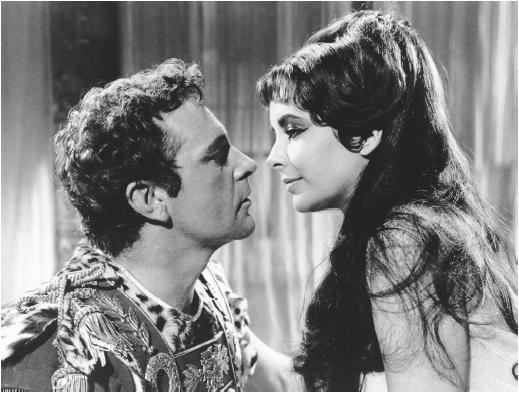
I am not ordinarily a great fan of the legendary celebrity and beauty Elizabeth Taylor, whose picture I have obviously put up at the top of this page, but I liked the look she has going on with her hair, which was a very common way for women to wear their hair when being photographed in the 1960s--frequently in Playboy type publications, it is true, but the French went in for this style, Brigitte Bardot, et al, and my own mother used to wear her hair like this too in her salad days. You hardly ever see anyone wearing their hair like this anymore. Alpha men love it. All those macho film directors and rock stars and cult writers of the 60s, who knew how to handle and turn on beautiful women in ways we don't even believe exist anymore had girlfriends with hair like this. It was the way to be sexy then, and I must say, there was something in it.

Tuesday, March 17, 2009

News of the World

I Think I Get That Hitler Was a Philistine. If you read The New York Times alone, in the last couple of months you would have had the opportunity to discover that the infamous dictator had "shocking" table manners, an expensive phonograph on which he was fond of listening to recordings of Wagner and Beethoven "with great emotion, if not artistic appreciation", and a library of 16,000 books arrayed in cases--"...handsome piece(s) of furniture with scalloped molding"--in which Anti-Semitic screeds and artless paeans to German nationalism were more favored and read than the serious works of literature, history, philosophy, etc, that one would expect to find on a real book lover's shelves. An internet search turns up lots more damning revelations of the Fuhrer's intellectual destitution, including this gem by the always reliable Francine Prose--who has displayed an unusual concern with the way people behave in art museums on several occasions during the course of her career--in which we find out that not only did the imbecile Hitler think Michelangelo and Caravaggio were the same person, but(though he famously aspired to be a painter, and might therefore be supposed to have some passing interest in technique) lied to his guide that he was admiring the play of light and shadow in the works on display, when in fact he was oscillating between being turned on--inappropriately so it is implied--by an erotic depiction by Corregio of Leda and the Swan and seeking reassurance of Rembrandt's disdain for Jews. Hitler's own paintings of course are predictably skewered not merely as the strangely sterile nonentities they are (strange given the popular image of their producer as in great part a raving lunatic), but as the productions of a singularly mean, hidebound, profoundly talentless and unimaginative intellect by every respectable person who considers them. Even his drinking habits--he would have a glass of beer or two with dinner, and nothing more--were cast in a dubious light by his guests and other commenters, whom one must assume were more accustomed to dinners where the Veuve Clicquot, as well as the joviality, the pretty girls, the cross-dressing and so on flowed freely all the way through dessert (at which by the way it was reported the Fuhrer frequently ate plates of cake which contributed to his having an unflattering physique), which was apparently not the case when dining with Hitler.

My problem with this is not that people are piling on Hitler, though I have always thought there were some rather unpleasant implications in this eagerness to emphasize Hitler's inferior background, education and understanding of beautiful things and difficult ideas to the person doing the emphasizing, as if his lack of suavity, bad taste in books, and inability to paint and properly appreciate music were identifiable causes and giveaway symbols of his unfortunate character. It is a convenient and self-serving means, for intellectuals especially, to disassociate themselves from him, and any taint of his ideology, but how important was it really? Yes, some real humanism properly grasped of the Thomas More variety would have made a great difference in him; it would with most people, I presume. I wonder though if it had only been some attractive trappings of humanism, if it would not have had some effect on the view of his legitimacy, which I always take to be one of the great issues people have with Hitler, as opposed to other murderous despots. Understood as an inherently inferior person, especially one who seems to have sought some level of culture and conventional social acceptance and failed to achieve it, his ascension to and abuse of power is seen as that much more illegitimate, and compounds the sickness people feel at his rule. This creep was easily enough denied a place in art school, popularity, love, etc, as a private citizen; how could he have gained the power of state machinery, armies, etc, so absolutely?

World Baseball Classic Semi-Defense. Not that I am following it. The format is clunky, the whole concept has been way too forced, the participation is oddly reluctant--there is too much adult supervision in general--but the constant sarcasm and negativity of the American sporting press directed at the event is getting on my nerves. There is nothing inherently wrong with the idea of an international baseball competition. I would prefer the event were a lot more organic, and had less of the stink of marketing about it, that some measure of enthusiasm had preceded organization too. What really is angering me about the whole event--and it is probably worse in New England than anywhere else--is the obsession on the part equally of fans, management and media with potential injuries and overworking pitchers. When did this idea that strong and healthy men in the prime of life are at constant risk of hurting themselves if not carefully monitored take such hold in the culture. I understand that guys make too much money now to be completely inattentive to the possibility of a serious injury, but until very recently it was not unusual for pro ballplayers, including stars and pitchers, to play a decent amount of competitive baseball in the off-season. Besides things like all-star tours of Japan, which date back to the days of Babe Ruth, the Caribbean winter leagues featured lots of big league talent, including almost all of the players who were natives of that region. The U.S. media for the most part didn't pay much attention to "winter ball", but it was a real thing, and I don't recall a lot of established players getting hurt in these leagues. Going back even further of course to the pre-World War II era, various teams of big leaguers would barnstorm around the countryside in the offseason playing games against local teams, college teams, The House of David, black teams. Dizzy Dean and Satchel Paige once pitched against each other in one of these exhibitions that ended 1-0 in 18 innings, both pitchers of course going the whole way (the mere thought of this would be enough to give a modern GM a coronary). Again, I don't recall reading about too many established players getting seriously hurt in these games. Anyway, I suspect life was understood to be generally more hazardous in that era. The fear of injuries was not as pervasive as it is now; and I don't think it had occurred to the executives of that time that they could forbid a grown man to do a whole list of activities wherein he might get hurt, as is standard in contracts today, unless they paid him more, which they were also far less willing to do. It is really the paranoia that has taken root among the fans that a guy might get injured in a non-major league game (or in one, for that matter) that I don't get. It's time to back away from ESPN, the Sons of Sam Horn.com, Curt Schilling's blog (he's against the WBC, by the way) whatever. This business of reporting on television if a guy was favoring his ankle during infield or skipped batting practice--it's ridiculous. Until a guy misses at least three games in a row, or two starts as a pitcher, I don't consider that to be an "injury" that needs to be reported.

Demise of the Pub/Tavern/Hospoda Such as Everyone Supposedly Loves so Much. This week it is the genuine Irish pub whose position has reached the critical stage. The British pub has moved beyond that threshhold for some time, and the kind of hard-drinking, happy hour lasts all day-type American bar that was once ubiquitous in our urban areas and familiar from a thousand black-and-white movies has been slowly grinding to extinction, and the moment may have already arrived. There weren't many left twenty years ago, and those were accidental, a matter of old ownership that hadn't bothered to update the decor or menu since 1958. The raw numbers of bars are in decline too. According to one study, there are 1,321 taverns currently in Chicago today, down from nearly 7,000 in 1947, and the numbers of bars in Philadelphia has declined 33% since 1971 (I can vouch for this personally. When I was a kid if there was an intersection with a traffic light, there was almost guaranteed to be a bar, if not two, on the corner. Spotting the corner bars was actually a game we used to play while driving around in town). The traditional Czech pub, which is a wonderful place that is even less organized to bring in the necessary 21st-century levels of income flows than these other dying sorts of establishments, must be hearing the footsteps of the grim reaper (though it must have the lowest overhead/set-up cost of any business I've ever seen. A large room, a few tables and chairs and ratty tablecloths, a couple of shelves with about ten bottles of hard liquor, a rack for glasses, and a small counter to set your one beer tap--the beer is always good, so it doesn't matter that you've only got one kind--and you're in business). And oh yes, the number of French cafes has declined from 600,000 or so in the mid-20th century to 41,000 today and dropping. What the hell are people doing with their lives?

I want to end the post, so while I would like to delve more into the causes of these, in my opinion, catastrophic developments, I think the main reason has to be that unfortunately their model, as solo establishments especially, just isn't economically viable anymore. Even a handful of alcoholics or bohemians sitting around for hours nursing $2 drinks and sipping 60 cent coffees might have sufficed to pay the bills in 1910, or 1960--and in the Czech Republic, which still has a pretty primitive economy, or at least did in the mid to late 90s, this kind of low-level economic activity still provides some value--but it can't compete on the (macro-level?) in 2009.

Addendum: Upon further rumination, some of the statistics cited in the last section are either misleading or do not pass the muster of probability. While the number of bars in Philadelphia may well have decreased 33% since 1970, the city's population has decreased about the same percentage in that period, from around 2.1 million to 1.4 million, where it appears for the moment at least to have stabilized. The effect of this decreased population, as well as the consequent decrease in the number of bars, is obviously noticeable however to anyone who has been familiar with the city over this span of years. The numbers on the French cafes in the heyday of that institution have to be way too high. When there supposedly 600,000 cafes in France the population of the entire nation was around 40 million tops. One cafe for every 65 people? The same article I linked to states there were 200, 000 cafes in Paris alone. The current population of the city of Paris proper is around 2 million, and I don't think it has shrunk appreciably in the last century. That would mean there was 1 cafe for every 10 residents of the city, not to mention that one or two people at least would always have to be working. There is no way that figure can be accurate.

Thursday, March 12, 2009

Walt Whitman--"When I Heard the Learn'd Astronomer"

It's short, so I might as well type it out for anyone who hasn't already got it memorized:

"When I heard the learn'd astronomer,
When the proofs, the figures, were ranged in columns before me,
When I was shown the charts and diagrams, to add, divide, and measure them,
When I sitting heard the astronomer where he lectured with much applause in the lecture-room,
How soon unaccountable I became tired and sick,
Till rising and gliding out I wander'd off by myself,
In the mystical moist night-air, and from time to time,
Look'd up in perfect silence at the stars."

Gil Roth, over at his site, has a semi-regular feature on famous authors of whom he has never read anything. Apart from this single 8-line poem, which I read for the first time when I was 38 years old (judging from the Internet, everyone else apparently reads this in high school; but as I attended three different high schools, I must have managed to miss this whenever they read it at any of them. I avoided ever having to read The Lord of the Flies this way as well. On the other hand, I got to read A Separate Peace and Great Expectations twice), I am 0-fer on Walt Whitman, and that includes the rest area, which I believe is south of Exit 6, where I always turn off to go to Pennsylvania. Since many people consider him to be the greatest poet in the history of the United States, as well as one of a very small handful of genuine literary world-geniuses that America has ever produced, this is a rather significant omission. I expect if I can manage to live another ten or fifteen years I will get through the whole Leaves of Grass someday. It is on my List somewhere, and I will doubtless adhere to my List unless some exciting vision of a different course of life jolts me to leave it off and pursue another line, which seems unlikely. Normally I would hold that it is better to be acquainted with the greatest achievements in any field as early in life as possible, that one may have more years to be able to incorporate their animating spirits into one's own intellect and person in a somewhat natural-seeming manner; though at the same time it is perhaps one of life's understated, though I think inevitably disappointing thrills to have a few potential treats left to anticipate for the slog of middle age. Besides, I admit I have always been a little wary of Walt Whitman. His champions tend to present him as a kind of authentic, almost perfect American--earthy, unrepressed, self-created, alive to the subtle rhythms of the language and life of the new world. His persona thus manages to be both a repellent and a reproach to me at the same time, for I am the absolute opposite of this type of American--i.e., I am the hidebound sort--and thus can expect little affection from anyone who considers Walt Whitman a prototype of our best type of selves. Given the poem's evident place in the current intellectual life of the nation as a high school staple, I am not going to indulge in any earnest analysis of it. You may assume I, a man of wide reading and experience of the world, understand its insights more than adequately. Of course when I tried to answer the two questions on the poem in the GRE test guide which is the source of my reading list I missed them both. The first one was: "All of the following oppositions or contrasts are present in the poem EXCEPT" (A) applause/silence (B) scientific analysis/mysticism (C) mathematical certainty/error (D) light/dark (E) group/individual. The correct answer was (C). I chose (D), not because I actually thought it was right either--I guess the question involved too much complicated thinking for me--but because I figured that contrast was too obvious/ mundane to merit serious consideration in a masterwork of poetry. The second (of course there had to be a second) was: "Which of the following words has more than one meaning in context?" (A) Figures (line 2) (B) Measure (line 3) (C) Applause (line 4) (D) Mystical (line 7) (E) Perfect (line 8) Th answer was (E). I think I refused to play the game at this point, like the cats who refuse to push levers and demonstrate logical thinking skills to receive food in science studies as mice and dogs do. One could interpret any of them as having a double meaning, except applause. I thought both questions were rather weak, really. I certainly hope the reason for my having to spend most of my life warehoused at a great remove from any kind of living society of learning and litterateurs is not due to these kind of subtle, teeny-tiny little faux pas. I'm sure it is not, is in most part due to failings of much vaster and probably insuperable import with regard to understanding what art, thought, etc, and their relation to the vital life signify. But still, the small failures constititute a substantial part of the big.

Having established now that I probably don't have the slightest understanding of what the poem is about, I suppose it hardly matters whether I liked it or not. This is a blog entry however so naturally I am going to try to tell, anyway. Here is what I wrote in my book: "I like it, I see it, the American atmosphere. Nature being outside the lecture-hall for a man to indulge in is well-(?conuited). Word choice good. Poem is good/it effects, it is quite ingenious." Oh my. I also thought significant the "forces of reason/science" represented by such words as "proofs", "figures", "ranged", "columns", etc, and thought the word "moist" supposed to evoke life. On a few further perusals I do still like the construction of this poem, the unlikely subject/conceit, and the amount of punch that is packed into a very small space of lines. When I said, "I see it" however, this was a bit misleading. I see it as a construction of my imagination, as what I think the atmosphere of America as presented by Walt Whitman is supposed to look like, but not as any kind of immediate participant in its language, its attitude, the feeling it conveys. I have failed as yet to connect with it on any surer ground than this.

Due to the bridge named after him which connects Philadelphia with Camden, New Jersey (where he lived most of his later life and is buried), people in that part of the world still have to invoke Whitman's name aloud a lot (I think this gives him a lot of power/positive energy even from the regions of the dead, doesn't it?), which, according to the local colorists, they pronouce as "Wall Women". For the record, as someone who lived--well, at this point, only about half my life--in that area, I assure you, the only people I ever heard pronounce the poet's name in any way resembling "Wall Women" in reference to the bridge were such as had actual learning or speech disabilities.

Tuesday, March 10, 2009

John Donne--"The Bait"

Hello to the 2 official followers of the blog, if you are still following. I am guessing that people who introduce themselves as readers on a site whereon few do aren't opposed to being acknowledged or engaged in some way. Thanks for visiting.

Before attempting to take on "The Bait", I am looking once more over the notes and analysis I made of Donne's "The Sun Rising" back in November of 1996. There is nothing earth-shattering about them, though they are certainly thorough compared to the way I read anything now. There is hardly a choice of word or image that I didn't try to take apart and assign a precise meaning or motivation to. Most of these meanings would be obvious enough, or at least simplistic enough, to an experienced reader that perhaps I don't need to bother making note of such things now. For all that I seem not to be very much inclined to apply the same degree of effort to attain the further, and greater, levels of comprehension. When I got to around 32 or 33 years old I began to grow rather petulant and determined that I had read, and done various other things, as a schoolboy long enough, and henceforth wanted to live and read in the character of a man of the world, whose valuations of general subjects must be accorded a certain importance merely by virtue of my established person. I did not regard myself as a wholly finished creature, and still intended further improvement, as much as it is reasonable to expect in a largely formed adult; however I considered that if I were not adequate to live and converse among men and women as a serious, grown-up person of some kind at 33, there seemed little point in struggling on in the hope, probably faint, of suddenly becoming so at 53, or 73. So, privately anyway, I declared that I was henceforth to consider myself as adequately educated and qualified for the myriad activities, pleasures, refinements and responsibilities of a worldly man. It is unfortunately a fantastical delusion when one considers my relation to any real society of men or women; but I have truly internalized it to a great degree, and it holds the brittle facade of my being together as well as anything could be expected to. "The Bait" actually does use a fishing metaphor, presumably for comic/satirical purpose, by way of response to "The Passionate Shepherd". The strange conceits of the metaphysical poets, Donne prominent among them, were so memorably remarked upon by Johnson in his famous analysis of them in the Life of Cowley that I cannot help but be immediately reminded of the idea in this poem. This is one of Donne's tamer efforts, for all that. The conceit is strange, but it is never strained in the telling, nor are his other attempts to present reality through somewhat unorthodox choices of images or words (sometimes the more strained efforts contain substantial beauties and insight, too, though with the effect, unlike with someone like Shakespeare, also of still being strained). In short, the girl is her own bait, and all the "fish" swarm around her whenever she goes for a swim, and allow themselves to easily snared. Apart from this main device, the poem is pretty conventionally written, most smoothly and elegantly I should add, as is not easily imitated, but there are no especially ingenious images such as the compasses of "To the Sunne" or the "gold to airy thinness beat" of "A Valediction: Forbidding Mourning". My favorite stanza was:

"Let others freeze with angling reeds,
And cut their legs with shells and weeds,
Or treacherously poor fish beset
With strangling snare, or windowy net."

I think Donne, and Marlowe as well, were almost too capable of poets to do much with the standard pastoral genre beyond dashing off neat, flawless little examples of them. Donne tried to make a joke, I think, but once he sets out on that path he pretty much follows it in a straight, flat line to the end rather than building up the absurdity further and further with every stanza. A tough group for me to say anything about. They really stumped me.

I figured if I just typed in "The Bait" and did a picture search a dangerous photo of some young girl would have to appear. This is all that came up though (well, besides the 47-year old bikini-clad lady holding up a catfish in a Florida swamp, but I couldn't bring myself to put that picture up).

Saturday, March 07, 2009

"The Nymph's Reply to the Shepherd"--(Sir) Walter Ralegh

It's been a while since I first and most intently thought on this so I am going to refer to the notes I scratched in my crumbling Norton Anthology of English Literature, the 1962 edition, which I believe was the first, which I bought for $7.50 on a very hot afternoon in the summer of 1993 at the old Rock Creek Book Store in Washington, D.C. for $7.50, which store was one of those that you had to go up a flight of stairs to get in, and the literature section I think was even one or two more stories up. It was all air-conditioned, though. I have had the book with me a lot since that time. I had it in a little room I rented when I only had about ten or so other books in my possession, and I took it with me to Prague too. Now it is falling apart. I could get it rebound, I suppose, but I am fond of the endpapers, "A Literary Map of England" and "London: With Points of Literary and Historical Interest From Chaucer to the Victorians", which in the days when I was comparatively print-deprived were a source of much minor entertainment and delight to me, so I shouldn't like to lose them.

"It is like an exercise of poetry," I wrote of the Ralegh, "with its basic versification, ruminations on time, romance, nature imagery. All of the elements are in place. It is wistful, natural, humane above all." This doesn't tell us much. I am starting to worry that these mellifluous Elizabethans don't say anything to me. The words I circled in the poem as striking me with the most significance, whether with regard to position or suggestive meaning, were "If", "young", "truth", "might", "Time", "wanton", "reckoning", "honey", "fancy's", "wither", "forgotten", and "might" again, the 2 mights being verbs, in the first and last stanzas, and leading into the nearly identical sequences "might (me) move/To live with thee and be thy love". Much of the history of lyric poetry consists of a continual tension between the pastoral tradition, or impulse, which is clearly very dear, as well as instinctive, to a wide strain of the human sensibility, and the more clear-headed species of attitude that perceives death and decay and the comparative weakness and fleetingness of individual will and emotion to be the primary truths, the real driving forces in human existence. Most of the history of poetry, like most of the history of anything, is rather boring in itself to anyone who is not borderline fanatical in his interest. It has been a frequent theme of mine in this diary that any interest one has in esoteric subjects are of little account unless he is well-respected and has acquitted himself admirably in some field, and preferably several, of more widely accepted importance, so I won't go into it too much here. But in short, a person's interest in anything is only interesting so far as he is interesting, and plays a part in the life of the world that is interesting. I understand that it thus must appear contradictory for me to continue maintaining a blog, or to write at all or try to make sense of the history of poetry, but I am not a well man, I am delusional, I am in every sense the last person who should be writing and the first, or one of the first, to put pen to paper as it were.

The Elizabethans were the high tide of English poetry, I do not see that there can be much doubt of it. It is clear to me that well-educated people, and people of that temperament, thought in poetic form, that they were always taking their impressions and imagined conversations and rebut and condensing and cropping them to fit lines of pentameter, the unit of thought. The choices of words and the presentation of images even in minor poets are rarely overlabored or strike the reader--or the listener--as unnatural. That they are minor poets is due more to the lesser power of their images and ideas, not the poetic sensibility on display. That Ralegh of course was a man whose poetic gift was usually noted in his lifetime as his fourth or fifth most distinguishing attribute I have commented on elsewhere. It is illustrative of the attitude that existed at the time that being a writer of verses was a part of being a properly developed man, that it would be part of such a person's nature.

But all that said, what is special about this poem? For special it is in some respect, as it is in nearly every comprehensive anthology of English poetry, and the one I have before me calls it the "best" of the replies to Marlowe. I suppose it rather cleverly refutes one by one all of the promises and wild declarations that Marlowe's shepherd makes, and Ralegh demonstrates some admirable skill in alliteration, balancing his lines, and the choice of words such as make the images of the poem move rapidly and at the same time in a circle. It is hard to explain because it seems very simple--I think it actually is that simple, or something like it, and that therefore I don't have the language, or the relation to language, to really understand such a conception of the world as such use of language entails. That is 60 or 70% of getting at the crux of what all great poems are about, is that sort of becoming comfortable with the language and where it is coming from, and I find that very difficult to do with the Elizabethans, and I don't really know why.

Wednesday, February 18, 2009

"The Passionate Shepherd to His Love"--Marlowe

I have been away, thus the lag between postings--it is even more hopeless for me to try to get on a computer on vacation than it is at home. I hope the break has had some kind of refreshing effect on my brain. Feeling that one has written something decent every now and then may be the cheapest of all thrills, but it is one I have not been having much of lately, and I find my being strangely empty to have to do constantly without it.

I lay out in the sun for two days, albeit with my shirt on, but for the first time in my life I have what might plausibly be called a tan, as well as a few blond highlights in my hair. The tan would look a lot better if I had remembered to take my sunglasses off--the coloring of my face currently resembles that of a raccoon--but being, in private anyway, the utter narcissist that I am, I am taken with the effect of it. It at least looks different, something of which sort I realize I have been craving for at least ten or eleven years but could not quite think or determine on what exactly to do, and how to bring it about.

This Marlowe poem is one of a set of three, the other two, Ralegh's "The Nymph's Reply to the Shepherd", and Donne's "The Bait", being direct responses to the first. I was going to kill them all in a single posting, but as I don't have anything really to say about them--wonderful little concoctions of words and thought though they all are--each one will get a separate, and hopefully short, post, primarily about something else. I do care about the poems though, and all that they stand for. It gives me great satisfaction to think about them, not 'in themselves', but as little monuments of history that I have came upon, as upon an engraved stone in some windswept field or other, and must record the encounter with a snapshot of myself in some undefined proximity to the stone. This is primarily what literature is to me, but this approach still can dominate your life in myriad ways, which are not fully appreciated by the crowd that actually understands what all the books and pictures and historical developments actually are about

When I was in Florida I went one afternoon by myself to the Ringling Art Museum in Sarasota. I had been there once before but I had had my children with me and had only made it about halfway through the collection before it closed. I had not seen any such old art in person for several years, since one of my sons climbed up onto an Empire bed with a satiny-looking green and gold coverlet at the MFA in Boston, which you are not supposed to do. While I felt in pretty good spirits in the early rooms, among the Rubenses and the medieval triptychs and the Renaissance both early and late and the Dutch masters and the Poussins, seeing one of which--there were two on display this time--had so excited me on my previous visit there, I was not really at ease, and felt somewhat estranged both from the pictures and the scene in my current state of mind. It was much more crowded than it had been the other time I was there, with almost everyone in the place being over 60, and giving off much more of a vacationing/wintering/sightseeing vibe than an "art vibe", whether pretentious or earnest or edgy. The exception was a high school group of very conservative-looking but gentle-seemed, well-groomed Christians (they were earnest). I had the thought that perhaps I could not really look at art and enjoy it anymore, as I often think I should stop reading too and focus more on my lawn or something for a few years, that a person has to have attained some degree of coherence within himself and in his relation to the world to be able to encounter books and artworks and people and get--or give--anything out of it. When I was the age of a student I was credible enough as one to get away with reading poems and thinking about artworks to some extent, that it seemed natural enough to think them, as well as my own relationship to them, to be matters of real importance, to be meaningful. I still believe that they are meaningful, in their most developed senses--I was not sure, however, whether they were any longer meaningful to me.

As I moved along however the crowd thinned somewhat and I came on some rooms dedicated to nations and time periods that were more in line with my own current feelings and desires. First there was a picture by a Dutch artist, Nydacker I believe was his name, one of those 18th-century evocations of the sublime featuring a wooded and vaguely wild-looking mountain in Italy, which sentiment appealed to me. Then there was the Spanish room, which had a portrait of Philip IV by Velasquez, who never fails to rouse my excitement with regard to human possibility, and two crucifixions by El Greco, which also hit me right where I was standing--why I cannot seem to forumalte--so to speak. After this was a room devoted to 18th century French painting, which I have to think must be one of my favorite schools, though I never have put much thought into the matter, based on the placid mood in which paintings from this time ever put me. Unfortunately Vigee LeBrun's portrait of Marie Antoinette in her salon holding a partially closed little book after the French manner of little books was covered with a plastic sheet; but you could still sort of see it. This was a very good painting. After this was a room with 5 floor to ceiling wallpaper-like panels featuring Arcadian scenes, also from the 18th century, which is also the sort of thing I love, and finally there was a room devoted to the era of the Grand Tour--Venetian cityscapes, outrageous interpretations of scenes from Homer and classical antiquity set amongst modern architecture and landscaping, evocations of civilized and learned adventure. All of these 18th-century attitudes served to prop up my sense of being connected to some nobler experience and conception of humanity for a few hours, which is what I had come for, and always "come for" to speak more broadly, though certainly different attitudes and periods and types of paintings have this effect on me at different times. 18th century art is quite fantastical even when it was not necessarily trying to be. The portraits and landscapes of the age are wonderful, but they are not convincing as resembling any man or place that ever really existed. This is the need that evidently requires feeding in me right now. My feeling about the poem sticks upon the simplicity--the at the same time highly artful simplicity--of the expression of the desires that are what it is about. Simplicity and clarity of expression of generally complicated conceptions as much as is possible, are I believe--at least to some portion of one's audience--the ultimate aims of all serious artistic efforts. What is most notable to me in this poem is the number and organization of images evoking earthly romantic bliss that are introduced and contribute to the overall sense of the poem in a limited space. That is the brilliance, the art, the purpose of the exercise. There doesn't need to be anything more to it than that.

Here is a soothing little video which features a recitation of the poem at the end.

Tuesday, February 17, 2009

Winter Pictures II

View of NH Route 9 somewhere between Hillsboro and Keene. I saw my only moose on this same stretch of road about 7 or 8 years, on Memorial Day. It was a small one. On the Sledding Hill at Living Memorial Park in Brattleboro. There was a gaggle of alternative-looking families right beside us, shaggy beards and flannel on the guys, shawls and braids for the women, old innertubes and slabs of cardboard for the kids' sleds, but they still all had their cellphones out and were talking to their brokers and tax preparers.


I attend a wedding as one of the minor (probably 4th tier) guests. Since I don't think anyone really reads the site anymore--even my one follower has abandoned me, as I predicted would happen--there is no reason to hide my physical, as well as intellectual, decline from the world any longer.


The Making of Valentines. If you are a certain kind of family, you have to be at least modestly creative in your Valentine making nowadays to demonstrate that your children will be prodded to make some effort in life to not be a drain on the productive portion of society in order to retain a reasonable level of respectability in the demi-monde of schools and parenting (These painted hearts will be made into necklaces, incidentally).


Late Christmas!


The Sledding Hill at camp, Brattleboro (actually Dummerston) VT


Thursday, February 12, 2009

Peak Eras For Various Sports (As I Once saw Them)

Peak Eras For Various Sports (A Personal View) That's right. All the major sports aren't as good as they used to be either. Just to prove that I am not an absolute fuddy-duddy, I know that are many things going on right now which are in their golden ages, where you can find the real genius and spirit of the age. Unfortunately however, I have no idea what any of these things are. Pro Football's aesthethic peak spanned roughly the era of the 14-game schedule, 1961-1977. I might even restrict it to the 60s, before the AFL-NFL merger, because I like smaller, exclusive leagues, and the 70s saw the debut of a lot of new and ugly stadiums, but there was also a lot of interesting stuff going on in the early-mid 70s--the George Allen Redskins, the colorful Raiders teams, the great Miami teams, the great early Steelers teams, the very good Minnesota teams back when that franchise played outdoors in what wouldn't be an acceptable stadium for a Division II college team today. The outstanding work of the NFL Films company in this era, when the corporate arm of the league as well as the coaches and players took themselves considerably less seriously than they do today, reveals all kinds of fascinating nuggets of detail about both football and everyday life in the 1960s and 70s that are astounding to see, or in some cases be reminded of, now. Everything was comparatively so small-time, or perhaps I would better say, on a reasonably human scale. The stadiums, the media coverage, the money, the players' bodies, the locker room amenities, are all phenonema well within the realm of ordinary experience. The crowd at a modern game is so individually insignificant and stifled, overwhelmed by the spectacles of technology, money and modern security, as to be little better than ants. In most of the stadiums (stadia?) of the 60s they tended to be closer to the field, in more intimate communion both with the players and other people around them, less distracted by other demands on their attention; the filmed crowd shots of the era reveal livelier and more engaged expressions (as well as better clothes) than fans have nowadays, who if they are acting in an energized manner are probably responding to television or some other media provocation than anything they can see with their eyes. When the Eagles used to play at Franklin Field (which is still used, by the way, as the home field of the University of Pennsylvania), or the Colts at Memorial Stadium, even the grass and mud were recognizable as the same sort you had in your backyard if you lived in the area. Now the grass is grown in a lab and flown in, because the local stuff isn't good enough. The whole enterprise descends more and more into fakery every year. I could go on, but I must proceed to the next sport now.


Baseball.
The heyday of baseball all around, as a participatory as well as professional sport, was probably from 1880 up until around 1918. By the 1920s you finally began to get modern parents like Bob Feller's who actually aspired for their children to be professional ballplayers, which was simply unheard of before World War I, and made calculated decisions to achieve that goal, as well as much more sophisticated methods of scouting and developing young talent by the pro teams, which sorts of developments inevitably suck some of the joie de vivre out of any enterprise, however unintentionally. Pro baseball remained essentially conservative however--from the 1910s to the 1950s there were virtually no new stadiums, no franchise shifts, no changes in the playoff system, no expansion, after the advent of power hitting in the 1920s few major changes in the way games were played, strategies employed, etc. After 1947 of course there was an infusion of black players, though this was primarily limited to a handful of teams and did not immediately lead to major shifts in the way the game was played. The game became really a contest of pure talent, whose players could best execute the time-tried methods (usually the Yankees, as it were). In this regard baseball had a second classical period from around 1920 to 1957, when the Dodgers and Giants abandoned Ebbets Field and the Polo Grounds for California. Though these moves were for a long time often lamented, and definitely demarcated the end of an era that will never return, there was really nothing else to be done. The old neighborhoods around almost all the old ballparks were in terminal decline by the late 50s (though the swiftness of the decline in Brooklyn and New York--the atmosphere in those neighborhoods and stadiums even in '51 and '52 had still been so intense bustling--perhaps amplified the shock) and it was absurd that in 1957 there were no major league teams west of Kansas City or south of St Louis, however much those of us in the northeast like to pretend those regions aren't really part of the country. The world that had nurtured classical baseball was suddenly gone, and had probably been prolonged about as long as it possibly could have. Baseball in the 60s, for all this, was not that bad. Looking back it seems a little bland now, pitching-dominated, no offense, still overwhelmingly white, but unlike in the 20s and earlier decades, of the increasingly homogenized, boring, bourgeois strain of whiteness that no one interesting likes, boring new stadiums (except for L.A.), scary, crumbling old stadiums (+ Shea, which was scary and crumbling even when it was new), very behind the times on issues like marketing, playoffs, night World Series games, statistical savvy (though the decade saw the first rumblings of this coming tsunami). These faults and blindnesses make the era seem endearing now though. The 70s are remembered unfondly for astroturf, domes and polyester uniforms, as well as the emergence of agents, batting gloves, pitchers who had no intention of completing games and other elements that removed us even further from the cornfields of the baseball ideal. On the positive side, there were some truly outstanding teams in the decade, the Orioles, the A's, the Reds, the Yankees, which were excellent top to bottom with largely the same cast of players over a period of several years. As baseball is, after all, a team game, one of its greatest--perhaps its primary--pleasure comes when it is able to produce a great team, which the dynamics of the modern game, expansion, free agency, etc, seem to have made increasingly difficult. The 80s were rather blah, memorable to me mostly for a series of pitchers breaking out with incredible one-season runs (John Tudor & Dwight Gooden '85; Mike Scott '86; Orel Hershiser '88, etc). Nowadays even if a guy gets that hot, they shut him down out of fear he's going to hurt his arm rather than let him ride out whatever magic has possessed him, and likely won't possess him anymore after the winter anyway. Problems with the game now: Way too many teams. Not near enough good pitchers; even bad teams should have one or two good pitchers who battle to 16-14 or 14-17 records with otherwise good stats. Interleague play further dilutes the schedule. Expanded playoffs too much of a crapshoot, renders the long regular season less meaningful & destroys its natural flow, way too much organization/parental/adult involvement at the amateur level, way too many mediocre relief pitchers deciding games. The passion of the unselfconscious people of the nation for the game, at least in America, seems to have been declining since World War II. It's a very bourgeois sport now, in America (there is always the Dominican Republic, I guess) which is always deadly to anything's spiritual vitality. One thing I wanted to fit in, but couldn't, was about the economics of baseball in say, the 1930s and 40s. The St Louis Browns, traditionally a woeful team, drew about 2,000-3,000 fans a game for the better part of 2 decades, in a era before TV, before merchandising and modern concessions, before there were many opportunities to bring in income. If they had a radio contract--and I don't know that they did--there is no evidence that there would have been a large audience for the broadcasts. How did they survive at all? The only thing is that I know they owned the stadium from way back and rented it or leased it out to the Cardinals (both teams shared the park), who were after 1925 or so always the main team in town, for them to use to. That must have been what kept them afloat.



Pro Basketball. 1970-1979. This is when the NBA was supposed to be dead, of course, before Magic Johnson and Larry Bird, and then Jordan, saved it in the '80s. Like most things in this world, the league was much more interesting when "no one" was paying any attention to it. Similarly the defunct ABA, though always a shoestring operation on the brink of collapse in its time, is now often lamented, especially by people my age who can't have much memory of it, let alone followed any of its seasons in a serious manner. Again it is a matter of smaller/better-looking and more interesting gyms, construction/competitiveness of teams, manner of play, and manner of presentation. With regard to the arenas, this was the period when the NBA began making its move towards trying to attract a more upscale clientele, since in the some cases the fan base coming to the games had gotten a little more urban than the right kind of people liked. The Pistons used to play in a place called the Cobo Arena in downtown Detroit; the typical crowd at a game in the '70s consisted primarily of white auto workers and black people. Wildly dressed pimps, drug dealers, and other hustlers and their entourages occupied a lot of the best seats near the court. The team relocated, with the league's enthusiasm, to the enormous, suburban and calculatedly impersonal Silverdome in 1978, and has never returned to the city since. The number of teams was probably about right at this time. Most of the good teams in the decade were not of the two-superstar-and-three-warm-bodies-who-stay-out-of-the-way model that has predominated in recent years, but had six or seven really capable, multidimensional players who were essential to the personality of the team (think of the beloved '70-'73 Knicks, or the '74-'76 Celtics, neither of whom were clearing out the floor for one superstar to put up 35 shots a game). The pregame activities in this era involved rolling a rack of balls out onto the floor, taking some layups, shooting around, and watching the crowd file in. No dimming of lights, fireworks, player introductions modeled on the coronations of Roman Emperors, and contrived music blasting from the sound system at choreographed intervals were necessary. Real Hockey fans--i.e. Canadians--seem to long for the days of the original 6 teams, which lasted from the 20s all the way to 1967! Like baseball, hockey is a game that sees itself, and is seen by its fans, as central to the life and history of its people, so it was conservative for a very long time and thus woke up one day perceiving itself to have been left behind more market-savvy sports. In trying to catch up it has overcompensated and finds itself currently in a rather ridiculous state--the spectacle of the shootout, and even the 5-minute overtime, that the players despise so that parvenu fans will not have to endure a tie, while at the same time appeasing the players by awarding a point for the tie in the standings, is the most glaring, but not only example of this. Having teams in so many cities where hockey has never been part of the culture isn't giving the sport any positive energy. Montreal never took to big league baseball wholeheartedly though the sport actually had a long tradition in the city; why does anyone think hockey will blossom in Phoenix? Philadelphia is something of an exception to this, in that the sport has been able to nurture a pretty intense fan base for the local franchise really out of nothing. The team had the fortune to be both very good right away, and at a time when all the other local pro teams were terrible, and nasty in a way that appealed greatly to the Philadelphia psyche. The Flyers franchise is still riding on the goodwill generated by the championship teams of '74 and '75. A similar level of enthusiasm never took root in Washington, for example. I don't know enough about the days of the original six and Hall of Famers being discovered on the frozen ponds of the syrup country of eastern Ontario to lament this period with proper feeling, so I am going to default again to the period of 1970-1980 as my favorite in the annals of a sport. I love the configuration of the league at this time. By the end of this period you had a 21 team league in which 16 teams made the playoffs. All the teams except the L.A. Kings and arguably St Louis and Washington were in Canada or plausible hockey cities in the northern U.S. Best of all, for the playoffs there was no rigid adherence to division or conference alignments. Teams were seeded 1-16, which allowed for such Stanley Cup finals as Montreal-Philadelphia, Montreal-Boston, Montreal-New York Rangers, and New York Islanders-Philadelphia, which could never happen now. Also the good teams and serious fans were in the same places for the most part, without which you can't have a great era. I'm not really a big hockey person at all, but...there is a lunch counter-type restaurant in Montreal that I have gone to a couple of times when I've been there, the walls of which are a shrine to the many great Montreal Canadiens teams of the 1950s-1970s. Montreal is often celebrated as a cosmopolitan city, lots of bilingualism, beautiful women, cool students, fine dining, bars open till 4am, European attitudes, etc, but it is also one of the great provincial cities in all North America when you stumble into such places, bars, restaurants, shops, etc, as will take you back 30 or 40 years to a mindset that is vaguely familiar from reading or films or other remote experience but that you have not been conscious of for some time. Anyway this poutine-serving lunch counter with all the pictures of lost hockey players evokes this kind of feeling. I also have to wonder if the increasing presence of European players from a variety of nations has not had additional effects on the cohesiveness of teams and the connection the fans can feel with players, in addition to the greater money, earlier estrangement from a common culture, etc, for NHL teams are really heavily European in make-up now, and their devotion to the Canadian hockey mythology is, one senses, not a very significant part of their psyches.


The main problem with College Football for anyone in the northeast in the last 50 years is that all the major teams are in faraway states, of many of which we know nothing (Oklahoma? Alabama? Boise State?) and others of which (Texas, California) are psychologically analagous to Russia or Japan. I tend to think of the 20s, 40s and, surprisingly, most of the 60s, as fun periods for college football. The 1910s look pretty raucous too, judging by the drinking-oriented and other high-spirited songs that sprung up during that era around the football scene, but I have little sense of the drama of the actual game itself as it existed in that time. One thing these eras have in common is that they were periods when middle class people, both adults and students, were not as cynical in general about colleges as they are at many intervals of our history, including, I think, today. There seems to me to have been more enthusiasm and optimism, in much of the popular media of the day anyway, that happenings of great moment, both intellectually and in the drama of life (I am thinking of Animal House here), could be expected to occur on college campuses. This general enthusiasm combined with the natural high spirits of youth probably had a spillover effect on the atmosphere surrounding football. I don't think it was so much that people actually cared more about football than they do now--probably they didn't in fact--but their relationship to and involvement in its rituals was different. Again, the football was more rooted, more connected with the idea of the university, its particular social life, its dining halls even--people are drawn to that kind of thing--rather than ESPN and the corporate world. Football players as a whole were no more scholars than they are now--the Gipper himself, it is well known, never went to a single class his last season and spent his afternoons in the pool halls of South Bend, or more likely, Chicago--though in the WWII and postwar era especially, there did seem to exist a sense on the part of the colleges that they had some responsibility to educate athletes. I touched some on what I think are the woes of college sports in this up-and-down post of a few years back. The omphalos of College Basketball is without any doubt the Palestra in Philadelphia, Saturday afternoon, Big 5 doubleheader circa 1965, the streamers flying on the court, half the people in the gym know each other one way or another, either from the neighborhood, or the parish, or high school. Well, that's all over now. The Big East however had a good thing going on back around 1983-87 or so. There used to be games on ESPN every Monday (there still are, actually) and Wednesday nights, and I followed the league quite closely. At that time the league was very Catholic (Pitt was mediocre and Connecticut was one of the worst teams in it). You had St John's with Mullin and Carnessecca and the whole New York vibe, Georgetown in its heyday, Villanova was good, Providence had Rick Pitino when he was still an up and coming guy. If Georgetown wasn't visiting most of the teams still played home games in their ratty little on-campus gyms--St John's was like a high school gym, there were no seats behind the baselines, just a wall at either end of the court. The schools were not displaying huge amounts of wealth and outlay on their b-ball programs--the recruiting was heavily local too in that era--yet they would get into the tournament and regularly drub their larger and more lavishly funded opponents (I'm talking to you, Kentucky). Naturally that couldn't last. Three important league teams played big time football, and they threatened to leave the conference. They are appeased by bringing in (freaking) Miami, which, even though they aren't any good at basketball, completely changes the whole personality of the league. Rutgers and West Virginia I'm OK with. Where else are they going to go? And besides, I kind of like West Virginia--I used to go to summer basketball camp there for one thing because one of my high school coaches had played there, and it's actually a nice place--and also they get no respect from the big forces in either football or basketball yet consistently field top 25 or higher teams. But then you have all those midwestern teams, not to mention an absurdly gargantuan league. It's a joke. Marquette? DePaul? Yes, they're Catholic, but can't they start their own geographically appropriate league? South Florida, same league as Syracuse and Seton Hall? And I like Notre Dame, but they don't belong in the Big East either. I apologize for the various incoherent paragraphs here, especially at the end. I am very tired, and I want to be done with this post.