Thursday, January 22, 2015

Movies 1959-1963 (Legendary Ones Too!)

As increasingly happens to me with books, I have hit a snag with regard to my movie watching where I haven't been enjoying it as much lately as I did before. Part of this is that there are always too many other things going on, and I don't have, or don't feel that I have, even an hour in a day that I can take to watch a film or write or do anything I want to do without getting distracted or jittery. The other part is that I have been seeing almost all modern things, modern for me being anything after about 1970, which I rarely like. So having finally gotten back again towards the time period and the accompanying sensibility that I like, and with the next three pictures up on my list iconic and all time popular classics, I had hope that I would get swept up in the spirit of the project again, as seems to have been the case with my reading when I began sprinkling in again novels and plays of the sort that I like, intelligent and funny without being at every instant a test or indictment of my intelligence or other development, among the heavier material that I find I am no longer able to read with any sense of accomplishment or enjoyment. This partially happened. I did feel, in one instance especially and in parts of the other two, that I was experiencing great and significant work, and I could see where at another time and in another psychological state of mind I would have taken to them with real enthusiasm. At the same time I feel at this point so remote from the artistic process and the state of mind in which it flourishes and which is the basis of what most great artworks are about, maybe more so than at any time in my life, that it is hard for me to take up anything that does not belong to the truly remote past, before the adult memory of almost any living person, without feeling sheepish or embarrassed before it. Also at least two of these movies were very long, so that I had to watch them over several nights, and in my current agitated state I was never really being able to settle in to the world which the film inhabited, which is especially important to do with epics.

8 1/2 (1963)


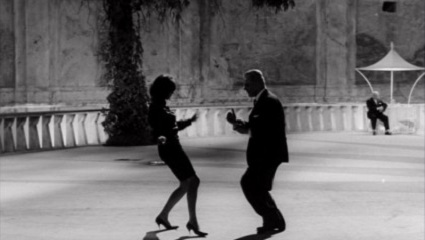
I may have the mind and perception of a child, but I have enough sense to know that this has greatness imprinted on it in just about every frame. This does not require a keen insight, as the movie's status as one of the immortal monuments of the postwar international art cinema has been established almost from the day it came out. It is hard for me to project seriousness, but I do mean it, it's an impressive work. Fellini was a true badness, and this movie is a two hour and eighteen minute. masterfully stylized demonstration of what being that kind of artist consists of. The scene (I was going to say the famous scene, but almost every scene in this is famous) where Mastroianni, who seems to have been a badass of acting in his own right, in his dream, has gathered all of the important women in his life, wives, mistresses, prostitutes, childhood fascinations, actresses and so on, in his childhood home where they cook dinner and bathe him and wrap him up in blankets before they begin to snipe and make accusations and demands, at which he has to drive them back with a whip is one of the most memorable depictions of a properly flourishing male ego that I have seen. But then the set of the spa, both by day and night, where Mastroianni and his entourage have come, nominally to begin work on his next movie, the nightmare of the traffic jam, the dingy railway hotel where he stashes his mistress--these are all wonderful enhancements and understandings of the possibilities of life also. But you knew all that.

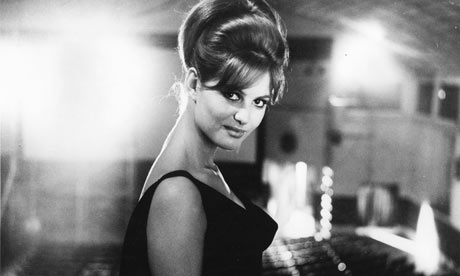
It is a sign however of how off I am at the moment that I did not feel much personal emotion or thrill, even of the quieter sort, while watching this, which I usually do when encountering artworks of this stature and caliber. As enumerated above, this has much to stir and raise even the most dormant spirit, but mine does not seem to be capable of being stirred by anything. It even has Claudia Cardinale in 1963 for goodness's sake-- her 1963 is one of those singular years in the history of movies, or anything else, where a woman attains a unique and frankly awesome state of near perfection that is too fragile to hold for more than a few months (Grace Kelly around 1954 comes to me as another example of this phenomenon; no one else is coming immediately to mind in this same way at the moment). But I can't feel that any of this has anything to do with me anymore, and such a thing is to me a kind of indictment or accusation for the obvious reasons that we don't need to go over again. But I hope our culture can continue to produce enough people who possess enough intelligence and spirit to enable the film to survive, that it may speak to people even many generations from now and the names and personae of Fellini and Mastroianni and Cardinale and Italy and even Europe will still resonate and have meaning for them. I don't think it is a certainty that they will by any means.


Psycho (1960)

To be honest, I find the story here to be unsatisfying. It doesn't hold together. The characters aren't strong enough. From the 21st century point of view it is wholly implausible that the Bates Motel would not be under 24 hour police surveillance just on principle, though implausibility in itself is not enough to mar an otherwise fascinating tale. There isn't really enough tension or motivation here to interest me.


That said, I find it very watchable. The world of the old U.S. highways with their oddly designed turns and exits, lined by empty spaces or local nature that looks more organic than that along most of the interstates with the occasional sketchy hotel or odd, out of place looking Victorian mansion has largely disappeared in much of the country, namely the more populated parts of it, but where I live the roads are largely still like this. The film was shot on the same lot as Hitchcock's TV series was, and it has the look and feel of television productions from that time, which effect however I like (Inherit the Wind was also filmed on a TV lot around this time, and I noted that I liked this aspect about that movie too). Janet Leigh's muscular, almost strapping, physique caught my attention--it is not a type I associate with this time period. As I begin to move beyond the time of life where I can even pretend that varied experiences of the sensual kind are still realistic possibilities, I have taken more of an interest in the variety of physical body types and attributes than I was want to do in my desperate youth, when I wrote off everything beyond finding someone who was identifiably female from ten feet away and would not be too harsh for my fragile personality to be capable of contending with as luxuries I could not afford. I also like the quiet, slow pace of this movie; it is not that I don't like the frenetic, anything can happen style of Fellini and other artists of his type, but as hardly a day of my life has ever assumed that form, it is always an alien experience for me to try to comprehend. The tone of my day to day life is, unfortunately, a hell of a lot closer to Norman Bates's than it is to that of any character in a Fellini movie. Anyway, the main thrust is there are many things about Psycho that I like, I just think the plot misses in some way. I missed the Hitchcock cameo as I always do. I haven't bothered to look up where it was--what's the point of that? The game is to find it on your own.


Ben-Hur (1959)

I was a little piqued when this came up. It is certainly legendary, and won a chariotful of Oscars, which kinds of movies I find I usually enjoy, provided they are old enough. I also had not seen anything of this kind, namely an old Hollywood studio epic set in ancient times, in a while, and I thought that might be something that could revive my sense of enjoyment of life, which effect watching and reading depictions of Roman-era fighting, torture, injustice and so on often inspires in me.


I had seen it. or some of it at least, when I was around eleven, and while various of the more vivid scenes, i.e. the slave galley and the chariot race, had imprinted themselves on my memory, my ability to follow the story had been hindered by my complete lack at that time of any background in either religion or ancient history. I may have recognized that the unnamed man who gives Ben Hur water when the slave caravan passes through his village is supposed to be Jesus, but how that otherwise fit into the story would have been beyond me. The emphasis on Ben Hur's being a Jew would also have meant little to me at that time other than as a signal that he was probably going to be treated unfairly (i.e., I don't think I was clear at the time what 'being Jewish' meant either in a religious or racial sense). Other aspects of the plot had been confusing to me as well. Seeing as my understanding of some of this background matter has improved somewhat in the ensuing 34 years, I anticipated a much heightened viewing of the movie this time around.

Ben-Hur has its moments, though the three hour and forty-two minute running time is a bit excessive, given that the major episodes in the plot, extended though some of them are, are really not that numerous. There is a lot of dead time waiting around for the highlights. After the chariot race there are still forty or so minutes left, which are given over mainly to Ben Hur's finding his mother and sister in the leper colony and the last days and passion of Jesus Christ. It may have been good, but by that point in the movie my concentration was gone. I assume Ben-Hur must have converted to Christianity at the end, but I do not remember the scene or announcement when he did this, which is kind of embarrassing.


The logistics of showing this in the theater in some noweheresville American town, or even a place like Brattleboro or Concord, in 1959 are of interest to me. Unemployment in those days was like 2% and nothing stays open past 10pm even now so during the week they must have had to start the show around 6pm sharp, and with intermission they'd be lucky to be done by ten o'clock. It was a full night's outing, or afternoon if you went to the matinee. I suppose I only find it fascinating because I feel like I haven't had an evening, or a four hour block of time in which to do anything, sit in a beer garden or whatever, in years, and so I assume no one does such things anymore.

Burt Lancaster (as well as Marlon Brando) was offered the role of Ben Hur before it descended upon Charlton Heston, which only strengthens my theory that you could not keep Burt Lancaster out of classic movies in the late 50s and early 60s, unless he kept himself out of them.

Ben Hur's sister was played by Cathy O'Donnell, who was Wilma, the girlfriend/wife of the amputee in The Best Years of Our Lives, which was also directed by William Wyler. I had never seen her, or noticed her, in any other part. Ben-Hur turned out to be her last film.

I have to admit that I kind of like Charlton Heston. He was really a man of his generation, which is pretty much gone for good now, including him, though he was active in an often outrageous, frequently hilarious and to me somewhat endearing way up to the early 2000s. Of course as one of the last visible and combative elders of the World War II generation the ever obnoxious baby boomers were sniping at him to the very end, at which point he had alzheimer's and probably didn't know what he was saying half the time. I'm sure he was a more genial man to talk to in person than most baby boomers of similar stature would be. Though he became famous late in his life as a right wing caricature, he did not vote for a Republican presidential candidate until Nixon in 1972 when he was nearly fifty years old, which was an election when a lot of people of roughly his age decided things had gone a bit far and switched side. He did not officially register as a Republican and become the activist on their behalf that he is thought of as now until he was in his 60s. I suspect that in the 2030s, when I am 64 or so, I will appear to younger people to be the embodiment of a conservative reactionary, they'll regard me as Samuel Johnson regarded the old Puritans who were still hanging around scowling at everybody when he was a boy. I hope it doesn't happen, but we've all seen that old men, especially if things have always gone along pretty well for them in life, don't as a group take much to change, which eventually comes to some point that they just can't go across.    


The next five star movie on the list is the cartoon Aladdin, which I am not going to watch. It is not a favorite of my children, though they saw it once, or the older ones did, a few years back, and what I saw of it I didn't like. So I am recording it as done here.

The incident from Ben-Hur that made the greatest impression on me was the part during the chariot race when Messala, who has by that point long established himself as the embodiment of Roman tyranny and cruelty for the sake of cruelty, lays off from lashing his horses for a moment and in a furious rage begins to lash Ben Hur, his childhood best friend whom he has already sent to the galleys for three years, with the intention that he never return. I was struck by the capacity that Messala had to hate another man that much for what appeared to me at the time no apparent reason, because I did not understand the exchange in the beginning when Ben-Hur refuses to sell out his people to give smoother sailing to Messala's political ambitions. It seemed something worth noting to me.

Saturday, January 17, 2015

Battle of the Broadcasting Erins

I need to get some quick copy in here while waiting for the appearance of my next important think piece. I do have a few new posts up on my spinoff blog dedicated primarily to the nostalgic feelings aroused in me by old books and literature. It has an appropriately miniscule readership, so anyone going there will immediately be one of the elect, after a fashion.

Of course there is no actual battle here. That is entirely the creation of my fancy. Doubtless if these two seasoned professionals met they would embrace cordially and agree that they would never let that silly Bourgeois Surrender pit them against each other.

For some time now when I have a fifteen minute break at my work I often go and sit in an empty meeting room in the dark and watch television. There is never anything on that interests me, but I'll still sit there and flip through the channels figuring there must be some cute girls on somewhere, if nothing else. In spite of supposedly knowing better I find some of the Duggar girls to be cute (the ones old enough to get married, obviously), so I've watched five or ten minutes of that show a few times. Their lifestyle and belief system would not be my ideal, but evidently they have some qualities I find appealing. I assume they fit in much better in Arkansas than they would in the east, where there is a lot of company it would be problematic to bring them into. They are not in themselves weird in the least; if anything, they are the very product that the culture they grew up in desired them to be, and the projection of that inner sense of success probably contributes to my perceiving them as attractive. It is the people who end up completely at odds and unable to connect with their own native environment that develop the most characteristics of pure weirdness.

There was another night, however, when I noticed that the woman doing the news, or some kind of news-driven program, on CNN was more than usually attractive to me. I lingered for a minute or so and moved on, as the topic on the show was terrorists or racism or immigration or some other subject that never gets resolved or even produces interesting conversation on television. But afterwards I came across the same lady on a few other occasions and thought each time 'she is really quite pretty', I made a point of finding out her name so that I could at least look her up on the Internet. This proved to be *Erin Burnett*, which is a very good 90s-era liberal arts girl kind of name. I could relate to that. Of course the substance of her interviews with leading experts on major international financial and political events was always so far above where my mind was in the moment that I never even bothered trying to analyze or otherwise make sense of it.


Erin Burnett seems to be an identifiable representative of the .01 percent, certainly of the northeast meritocracy division of that club. She grew up in Maryland (albeit on the eastern shore, which is not a region at the white hot center of the production of these kinds of people), went to a boarding school in Delaware and to Williams College, in my lifetime always considered one of the only real contenders (out of a field of about three) for the title of American's best liberal arts college. She got a job at Goldman Sachs, and not as a secretary either, right out of school before getting into television, it seems through connections acquired through the Goldman Sachs job. Seeing what is at the end of that gauntlet, socially, of trampling all the competitors of your generation for admission to the best schools, the best graduate programs, the best internships, the best jobs, in traveling and athletic prowess and financial acumen, is interesting to me. I don't know these people at all naturally, though I admit that if the king were to tell young me before I set out to try to achieve something worthwhile that my reward on coming back successful would be the best-looking (or even the second or third best-looking) girl on the Williams College field hockey team, I would have been pretty pleased with that prospect without even needing to know who the person was as an individual. And it will always be curious to clueless people that individual persons not of immediately obvious and overwhelming superiority should occupy particular positions at such commanding heights, and to possess a value in monetary terms that would appear impossible of attainment to most onlookers.


Erin Burnett acts out the course of her life trajectory vis-a-vis the author 

Here are the students of Williams College on the annual day when they hike their mountain. They don't look that intimidating, but nearly all of them will make their way to being high end adults. Not too many of them are very fat either. From what I have seen of other top schools in my neck of the woods (Dartmouth, Middlebury, Bates, Bowdoin) they seem to do some kind of screening to weed out fat people, and the slovenly and unkempt in general. Coming from St John's, the total absence of this element (which includes a lot of highly intelligent people, by the way) on these campuses strikes one immediately.


For all that I don't really 'like' Erin Burnett all that much, though my response to her indicates to me that her type is representative of one of the especially important missing pieces of my youthful experience and attempts to participate actively in Life, the paucity of success in which I have never been able to overcome. Also I can only take her show in very small doses. Fortunately her program often runs opposite The New Hampshire Chronicle on WMUR-TV channel 9, an ABC affiliate that is New Hampshire's only non-PBS broadcast station. One of the stars of the Chronicle, and also WMURs news anchor, keeping us informed on a nightly basis of all the crimes, fires, car crashes, wild animal incursions and other perils of living in the Granite State, is Erin Fehlau, the other half of our battling Erins. In contrast to Erin Burnett's nightly powwows with potentates of finance and government policy breaking down the state of the world, Erin Fehlau, in her NH Chronicle incarnation, travels around to the hidden corners of our tiny state visiting apple farms and outposts of the Appalachian Mountain Club. It is truly a Main Street versus Wall Street confrontation.

  
Erin Burnett was born in 1976, and Erin Fehlau in 1973, the same year as my wife. 1973 was a great year for women, though the vintage is a rare one, 1973 being the year with the lowest total number of births in the United States of any since 1945, and the only one in which the total number of births dropped below 3 million (by comparison, the current number is around 3.9 million, and it was over 4 million in the years before the recession). I was born in 1970; the birth rate crashed noticeably in 1972, bottomed out in '73, and remained low all the way through the remainder of the decade. Like many men, since I was and remain fairly immature it was evident from a fairly early point that if I were ever going to get any women they were going to have to be from one of the younger age cohorts--age cohorts that turned out to be considerably smaller than my own, causing a squeeze in the competition for these ladies. I have always clung to the theory that this shrunken pool of women in the key years for my fishing for them was a leading cause of my restricted success in getting to date many of them. Because even admitting my many shortcomings, I am still far enough above the true average in most areas that I should have been able to do a little better than I did.

Like most successful people in New Hampshire, Erin Fehlau actually grew up in Massachusetts. I wonder if there is any other state in the union where the majority of the most prominent citizens originate not only from another state, but from one particular state, as if it were a de facto colony of that state. I guess Vermont seems to largely run by people from New York (Howard Dean, Bernie Sanders, Ben & Jerry; J.D. Salinger, ever the contrarian, managed to end up in New Hampshire, though the town where he lived was right across the river from Vermont, and is culturally more like that state), and I suspect there is a state or two in the west that has been taken over by settlers or refugees from California. Whatever native talent there is in New Hampshire usually finds it necessary to leave. Anyway Erin Fehlau went to Syracuse, which (along with Northwestern) is a school people actually go to to study how to be in television media. She has three children (Erin Burnett, though she is married to a Wall Street trader who presumably has genes nearly as spectacular as hers are, as well as hundreds of millions of dollars to boot, has just one, which lends credence to my theory that people who perceive that they have attained kind of maximization or perfection of their genetic potential do not feel as great a need to have children as people who do not think they have done this). I actually know very little about her, and I don't even have much of an idea of how smart she is, but I enjoy seeing her on television, she doesn't annoy me, and I think she is cute, so she must have some kind of brains going for her.


This guy plays 'rhythm bones'. Sounds like something you could make a joke out of. Erin F. was intrigued enough to put him on her show.


Erin F with a retro 80s hairstyle. Still cute. 
   

Wednesday, January 07, 2015

Notes on Dead End Reading

The Pilgrimage to Parnassus; The Return from Parnassus (c. 1598-1602)

A series of plays put on at St John's College, Cambridge around the end of the Elizabethan period, as part of their Christmas festivities, though they are not about Christmas. They are about a couple of students who decide to make their way in the world as poets, and the predictable indifference, humiliation, and poverty that befall them when they set out to do this. There is some comfort in being reminded that the problem of impractical young people with liberal arts degrees leaving school without any prospects for obtaining an income, nor any realization of how one might ever go about developing any did not just spring up in the last 20 years. Maybe these kinds of schools, which ironically seem to be most emotionally necessary as a pleasant refuge during youth from the otherwise pitiless business of real life for the less successful of their graduates, will continue to sputter along in some form, in spite of even the most well-meaning, though mistaken efforts to kill them off and spare these more hopeless graduates from what is perceived to be the source of all of their perceived subsequent misery.


The plays themselves are hard going at times to read--I guess they have not been edited so as to be made intelligible to modern readers, assuming that can be done, and there are lots of references to people and inside jokes and slang that doubtless meant something to the assembled audience but can signify nothing to me. There are numerous references to contemporary as well as historical English poets (i.e. Chaucer), including Shakespeare, which accounts in some part for its historical interest. Shakespeare is identified only as a poet and the author of the Rape of Lucrece and Venus and Adonis. His plays I did not notice as being referenced at all, though even by 1598 a good part of the comedies and histories would already have been written.

It could be interesting if it could be made more intelligible, I guess, though even most of the experts seem to be of the opinion that only the middle play (the first part of The Return) contains any real literary value.

Philippics--Cicero (44-43 B.C.)

This was the first Cicero I had ever read, and I am well into my forties. My education has been light on the Romans, so he is not the last of them that I have yet to read either (all in translation, of course, which I know scarcely counts anyway). These writings, being purportedly the transcripts of orations, are much different in tone from those of other classical authors with which I am familiar, having much more raw agitation and hostility in them. Of course Cicero here is an active partisan politician who has to sway the wavering opinions of, if not precisely a mob, a body of senators. I suppose I was expecting the style of delivery and the subject matter to be grander, less earthbound.


The Young Cicero Reading--Vicenzo Foppa (1464)

The fourteen Philippics are denunciations of Mark Antony, who at this time following the assassination of Julius Caesar was out of the city seeking military allies and in Cicero's opinion carrying on the worst of the dead Caesar's transgressions against the traditions of the old Republic. It is a different view of Antony than we usually get from both classical and post-renaissance literature. His arrogance, which in other depictions is usually presented with a heavy emphasis on vanity, here is expressed as of a more dangerous and willful quality. He is ambitious, a driver of events and a leader, of sorts anyway. I didn't previously think of him (based mainly on Plutarch and all the Shakespeare and Cleopatra plays) as a man capable of rousing this degree of anger and condemnation as a main target in himself, separate from his association with other people or events that are greater than he is.

I did not read this all that well. I suppose it is possible that the entire book is not great as a whole (various of the individual Philippics, especially the second, seem to be considered more important than the whole collection), maybe the translation did not perfectly capture the mood of high excitement and historical seriousness. I also have the sense that the Orations against Catiline (which Cicero himself, reliving that glory, references dozens of times in the course of the Philippics) are the essential Ciceronian reading. In any case he demands a more serious consideration than I seem to be able to give him at present.

Ben Jonson's Conversations with Drummond of Hawthornden (1618-19)

There is not much conversation here, on Drummond's part anyway, and what was recorded was mostly snippets--what would become popularly known as table talk--of Ben Jonson's observations, which amounted to 58 printed pages, most of which were more than half taken up with footnotes. The impression given is that there was not much in the way of give and take between Drummond and his guest, but that their talk consisted mostly of Jonson making pronouncements in a vaguely bullying manner. I don't remember much of this, either. Obviously I have reached the point where it is pointless for me to read any more. I am struck by so little of it, and as you can see I have trouble even putting my most simple general observations into words at this point. But I would have to take up some other pursuit to fill the time--I still can't just spend all my waking hours doing laundry and dishes, but maybe I am being ground down to the state where that is all I will be capable of doing--and I still desperately want to have some communication with the reasonably intelligent (and socially relevant) part of the world, and I don't know how else I can achieve this than by some attempt at producing content.


Drummond of Hawthornden

Tour of the Hebrides--Boswell (1773)

Not included in most editions of the Life of Johnson, this comparatively under-celebrated work is a book-sized bonus treat for people like me who are fans of this lively duo and their exploits in the social and literary society of their day. Johnson wrote his own account of this famous trip as well, which is one last further treat for me to look forward to, assuming I ever get around to reading it.


This is the edition I read.

I ordered my copy of this book online, and as sometimes happens with older memoir-type books, the edition I received was not the edited and polished standard one that all of the professors and other critics who have promoted the book as great are primarily thinking of, but the rougher version of the tour as it appeared in Boswell's journals. Nothing was left out as far as the major episodes of the trip went; on several occasions where pages of the journal had gone missing, the editors filled in the missing parts with the text from the printed Tour. These finished excerpts were far superior from a reading standpoint to the journal account, giving off much of the same high-spiritedness and humor of the Life itself, and I kind of wish now I had abandoned my edition entirely and found a copy of the traditional printed Tour. The journal was by no means a bad read, and almost certainly was more representative of what the trip was like on a day to day basis. There were numerous passages in it detailing parts of the trip where Johnson especially was bored and restless on account of the inferior level of education and dull conversation of many of the people they encountered, which provoked in him some rather harsh and decidedly unforgiving observations with regard to the limitations that several of their hosts and new acquaintances had revealed. My impression from the scholarly notes is that most of this material was either left out of the published version, or softened so as to appear more in a humorous and flattering light. And I think this was a good idea, as much of the special quality of these Johnson books come from the atmosphere of heightened intellectual alertness and drama that the scenes in them evoke. The life and conversation in them is far more entertaining and captivating than anything that ever occurs in real time, while plausibly resembling reality (if nothing else, the contrast between the journal and the published book reminds the reader of the art that is essential even in the production of a ostensibly non-fiction account to give it this sheen of heightened reality); but I realize more and more that it is these appearances of life heightened and made more consistently intense and significant and exhilirating that I seek in reading and other artistic entertainment.   

Tuesday, December 30, 2014

The Most White Privilege-Evoking Song of All Time?

antonius antonius ut mihi


Probably not, but I heard it, or the more uptempo recorded version of it, on the radio the other day and it made me think of it, and I don't remember any other song having that precise effect on me. It does seem to have everything the most socially advanced people truly hate packed into one four minute sequence. And if these same people think white privilege is obnoxious and an obstacle to civilizational advancement now, I guess they can be glad they weren't around in the 40s, because they were really kicking it back then.

I also associate the song with this movie, The Harvey Girls, which I have not seen apart from a few clips on the internet but which in general seems to be a celebratory film about white people pouring almost giddily into the American west and carrying all of the most vulgar aspects of their civilization with them whole hog, oblivious to any idea of respect for nature or the effects on the indigenous population as we would understand those things. The Harvey Girls themselves of course were waitresses in the chain of Harvey restaurants that sprung up along the railroads specially chosen for (and, it might be noted, fondly remembered for over a hundred years later) their whiteness, attractiveness, and feminine pleasantness, the contemplation of the latter two of which is offensive to a whole other host of modern sensibilities. The privilege on display here is most remarkable for its purity. These people really seem innocent of any idea (or at least unconcern about the significance of such ideas, if anyone had them), that they are depicting and celebrating all kinds of things that large numbers of later and more evolved people would consider to be morally, as well as aesthetically, repugnant. The assumptions about the social order, the nature of men and women, the universality of the worldview and peculiar desires of white middle Americans with total unconsciousness of that of anyone else having existence in any kind of serious manner strike us--even me--as almost brazen, insouciant. It's hard to imagine anyone today being able to believably project themselves in quite this extreme manner, at least no one I would ever be likely to encounter.

On the other hand popular culture does project some uncomfortably unconscious, and I suppose heavily 'white' assumptions, in other ways, a lot of which are connected with wealth or other attitudes towards food, health, technology, professionalism, and those kinds of things that a certain segment of the population has gone in for heavily over the last twenty years or so. I don't really relate to these people at all however, and it is almost certainly why I never like any modern movies or books (the Breadloaf conference was full of this over-wealthy, rather languid crowd when I went there too), because they are populated with characters and are written by authors whose mindsets are not recognizable to me in any way.

The white privilege meme seems to be coming up more even in my sheltered life. It think in its current incarnation, being a target of antagonism and disdain, rather than respect and aspiration, it is a wiser move for people like myself, and my children, to embrace it if people insist upon its being an issue rather than to devote ourselves to mitigating its effects. But I am out of time to elaborate more on this now. I probably won't be back until after the new year.

Wednesday, December 24, 2014

Very Brief Christmas Greeting


Weak Christmas posting this year. I find in recent years that I'm kind of crabby at Christmas time. I shouldn't be, and certain I feel very sentimental about Christmas in many ways, but I am nonetheless kind of constantly grouchy throughout the holidays. Still, let young people and grandparents carry the banner for Christmas spirit, it's asking a lot of middle-aged guys. Maybe if we could get to go to parties like this again.

Tuesday, December 23, 2014

Three Movies From the Seventies

The Tree of the Wooden Clogs (1978)

Three-hour plus Italian epic about peasants circa 1900 in the sweeping, novelistic style that was popular from 1975-82 or so, especially in Europe, but was also visible in things like Acopalypse Now, The Deer Hunter, Kagemusha and other films of the period that took it for granted that there existed a critical mass of moviegoers who would go to the theater, and sit through long, dense, meticulously detailed serious movies, especially if they were the work of important directors. I suspect that this is actually very good, but I was unable to get into it at this particular time. My mind kept drifting away from whatever was going on in the movie to focus on my own personal existential crises. But I will try it again someday. It verily is about the extremely humble and limited lives of rural peasants, I believe in the northern part of Italy, in a period probably within the lifetimes of the director's parents, their childhoods at least, a life that most Italians by the 1970s had, with evidently mixed feelings however, ceased to lead. I was not struck on this initial viewing with what was most important about it.


One probable reason for why I had trouble getting into the movie (besides the fact that I am too exhausted in the evening anymore to really concentrate on anything) is that I watched it on a faded VHS copy in which the indoor and nighttime scenes especially were so dark that I imagined they could not have been thus on a good print. Netflix doesn't have it. In truth, they don't have a lot of what I want these days. Here is my current list of 'Saved Titles: Availability Unknown' with that service:

1. Alice Adams
2. Follow the Fleet
3. Giant
4. Giant: Bonus Material
5. Odd Man Out
6. Separate Tables
7. Soldier of Orange
8. Stella Dallas
9. Harold Lloyd Collection, Vol 1: Disc 1
10. Man With the Golden Arm
11. The Tree of the Wooden Clogs
12. Three Brothers

Obviously I have found old VHS tapes for a few of these and watched them, but it seems like that ought to be an unnecessary hassle, especially as none of the movies in the above group are obscure in the least, and all of them, except maybe The Tree of the Wooden Clogs, have easily recognizable stars. I guess I imagined Netflix as bascially a subscription library that would have anything that has ever been released on DVD readily available. Actually, of course it is an ambitious, scheming, 21st century internet business that wants to make billions of dollars, and that apparently doesn't involve investing in enough copies of Odd Man Out to make people like me happy. I have read that they are making fewer DVDs available because they want to phase out the mail order part of their business, which costs them a lot of money, and push everybody onto streaming. I don't have my television set up to receive streaming, which probably isn't that hard, but it seems like it might be a minor pain in the neck at the very least. And then it isn't clear that the things I want to see are even going to be available anyway.

Silver Streak (1976)

Sometimes a pointedly humorous book or other entertainment causes me to ask myself, what is that I want from a comedy anyway? The truly successful comedy in any art is a rare achievement. The work that is not primarily intended as comic but is punctuated with frequent humor or wit is often better received and gives more pleasure. The straight comedy, it seems to me, comes laden with an expectation that is usually impossible to live up to. Long form works especially depend on certain jokes, or persons, or situations, being so conceived as to maintain their ability to amuse throughout the length of the story, and feeding off of and into other jokes.

Silver Streak is not altogether unsuccessful--there are a few modest laughs in it, the premise and characters give it at all times the potential that something very funny might happen, and it has some sociological interest as a relic of its time--but in the end I didn't get enough fun out of it to be satisfied. I did make a few mental notes re certain things that struck me:

I was always under the impression that the early to mid 70s were the nadir of passenger rail travel in the United States, the last of the dinosaur private companies going out of business at the beginning of the decade and the early years of Amtrak which followed being universally mocked as a disaster, so that making a movie about a train trip at this time was akin to making one now about people who read physical books and newspapers or something like that.


Gene Wilder is an odd leading man. It is not merely his hair, though that probably does influence me a little, but the way he moves and his expressions, he does not give off the air of a guy really inhabiting a character or carrying a movie. Often it seems as if his mind is remaining archly aloof from the film while he physically moves through and mouths his part. This kind of thing was appreciated at the time. By the time I became conscious of the movie landscape, around 1980, Wilder was still a big name though most of his big roles were behind him by then and his star was, however imperceptible it probably was even to him, going into decline.

Very 1976 how Gene Wilder manages to get laid by a complete stranger within an hour of getting on the train; which turned out to be extra fortunate, because all of the mayhem that broke out on the train immediately after the successful consummation of this tryst would probably have forestalled it if they had waited a second hour. Maybe it would be a good thing if the crime rate really went back up again after all.

Jill Clayburgh. To paraphrase Ben Jonson, she was evidently not for all time but for an age, that age being approximately from 1975-1980. She was always a name from my childhood, but I had never seen her before. She reminds me of somebody's mother--the mother who is not really very nice and is in fact judgmental and a bit of a snob.

The Conversation (1974)

Interesting movie in terms of visuals and sounds, which depict pretty well what the sensory impression of existing in America in 1974 felt like (this was the first year that I have any real memory of at all). The fact that it was made at all is a testament that it was also at the peak of the power of the more humanistic and art-focused New Hollywood movement, the snuffing out of which, we are told, would begin in earnest in the following year with the colossal success of Jaws. But in '74 things still appeared to be solidly moving in the less bombastic and more subtly alert direction of which this movie is a good illustration.

There are a lot of the kinds of little artistic touches in this that elude most filmmakers but please the viewer and keep drawing him back into the story, especially in the first half. The choice of jazz music works very well here, and also calls back the popular pastime of sitting in a room playing longform records out loud, which I don't think is something people do much any more. The old reel to reel tape machines and the other for the time sophisticated recording equipment possess a kind of mesmerizing beauty--maybe this did not strike people as so in the 1970s. Most of the characters in this wear eyeglasses, and by the standards of the present these glasses are almost gaudy ornaments on the face--again, this may be a happy coincidence with the fashion of the time, but I found I was frequently drawn to contemplate the fact and nature of this eyewear. The party at the shop after the surveillance convention with its instant bar of hard liquor bottles and the seedy, quietly desperate quality of the guests and conversation, also strikes me as reminiscent of its time. These things all work well. That said, the actual plot itself, while well-written and quite clever even, I don't find as compelling. The narrative, for me, does not go hand in hand with what else is interesting in the movie.


The disc came with multiple commentaries, including one by Francis Ford Coppola himself. I listened to about twenty minutes of it. I have not gotten into any commentaries in a while. The 70s guys will talk all about the film and what they are doing but I find it in their case more interesting to just watch the movie and find out what works for me on my own. The 70s are still near enough, to me anyway, that explanation is either overkill or pointless. You need to get to it on your own or it doesn't do you any good. Now going farther back in time, though maybe all the way to the 50s or even the 40s, I find a good commentary can be helpful, or at least enjoyable, because you are dealing with things that you are not directly connected to in time or sometimes place. But with newer things, if you don't understand them even somewhat intuitively, then they are not meant for you anyway I suspect.  

Good role in this for Harrison Ford. One gets the feeling too that the character he plays in this is what he is really like.

I remember as a child always thinking minor 70s icon Cindy Williams was *pretty* in her famous roles in "Laverne & Shirley" and American Graffiti, but as an adult (me) she too seems to possess some kind of generic 70s quality that I am kind of repelled by. Maybe it is that these people are all about the age of my mother and I must have seen them, or their type, on television a million times and identified them vaguely as some kind of alternative mother or mother-aged female figure and that is all playing into my response to them now. Who knows.

Sunday, December 14, 2014

Very Brief Posting About Current Events

I spent nearly two weeks working on a post about Ferguson, et al, and my stance with regard to it, because I felt like I should acknowledge that I was aware of it and thought something about it, even if those thoughts were not as informed or coherent or had as much conviction as most commentators on the situation seemed to require.

I found that I was not really able to write in a natural and human tone about the matter. This was not because I was secretly sympathetic to the police. I have never thought much of the police, have always found there were too many of them and their presence too ubiquitous wherever I have lived in this country, in those places have always felt that their power to do harm far exceeded all of the supposedly wonderful things that were always attributed to them, and never understood the broad liking for them that seems to exist. Especially in New Hampshire it seems to me a far greater likelihood and cause of worry that I or one of my four sons will get caught up in the racket of the criminal justice system for some trifle or behavior that does not intuitively occur to one as being a crime than that any of us are as a matter of rule in imminent danger of being victimized in some particularly violent or horrific way but for modern police practices.

I have always had, compared to other people, a weak sense of morality, of almost anything being absolutely right or wrong, or good or bad, independent of my personal inclinations.  

While I am sympathetic with those who assert that the police are way too heavy handed in the use of lethal force, especially against black people, as in many controversies one is not always readily accepted by the partisans of either side as sharing their position unless he accepts and adheres without doubt or qualm to a number of correlating stances. And as I am much less certain about the absolute truth of some of these, I therefore cannot help but appear to be insufficiently incited by the more fervid advocates of social justice.

Many, many people in this world, including quite a lot who are quite fortunate and privileged in their lives and suffer little in the way of direct oppression, carry within them a store of righteous anger that never fails to impress me. Some of them brim with it just about all the time, while others who are usually jovial enough are able to call it up in a flash when occasion calls for it. In addition to all of the outrages they are angry about, many of these people are angry that other people are not angry in the way they are angry, which mass indifference or pusillanimity they see as a primary obstacle in effecting the changes they desire. Anger, like love, is of course an emotion, and in raw form it is as silly to demand another to spontaneously feel strong anger such as you feel as it is to demand that they feel love in the way that you would have them do so. I suppose the argument is that a moral system can, and ought to be, cultivated through education that is central to a person's waking consciousness, such that, unless he is utterly devoid of natural spirit (though this does seem to be the case with multitudes of modern people, especially Americans) he can be trained to muster up some degree of response or agitation to gross wrongs passing under his nose. It is true that most people, myself included, do not receive a moral education with anywhere near the degree of intensity needed to produce this reaction, however.

I also wonder, and this is purely a conjecture I am throwing out, whether the competitiveness of our society, and the increasing attitude that only the most serious and accomplished practitioners in any area of life really matter, is causing people with weaker levels of anger who are in the main sympathetic to an issue to doubt whether they in fact care anything about said issue, or any other, at all, and certainly whether their tepid sense of outrage could ever be of any use, since even the people who seem to experience all of life as an endless series of crimes against righteousness and possess an endless amount of fire for railing against it appear to be able to effect very little change such that their moral sense is ever satisfied for long, which ultimate satisfaction the non-crusader, doubtless mistakenly, assumes to be the purpose of employing this anger.

The racial aspect of this police and prison culture, the effects of which are obviously multiplied many, many times in black communities, even acknowledging that the violent crime rate is many, many times higher in these communities, is the problem that it is seen as incumbent on white America especially to come to terms with and address. The tone taken in many of these declamations is that this persecution can stop, or be turned off, at anytime if white America decides it wants to do so, at no real cost to it, but that it obstinately refuses to take this just action. From the 'white' point of view, and I think it is pretty safe to say that there is such a thing in general that is distinct from the 'black' point of view, or the 'non-discriminating human in the abstract' point of view, is that the general tenor of life in poor black communities tends to be totally incompatible with--to the point of non-negotiability, in truth--the general tenor of white middle and upper class life (I say general tenor so that those who are comfortable in all places and with all people and with all lifestyles and do not even perceive that there are any differences between them understand that I know and am not talking about them). I do believe this is, all else aside, the main reason why even well-meaning white people cannot achieve more progress in resolving the racial disparities with regard to justice and law enforcement that I do think many of them really do want to see resolved. By incompatible here I mean that there are very few white people, and essentially none with any middle class pretensions, who can handle on a day to day basis the stress that the level of crime, social disorganization, low quality of schools, confrontation in routine interactions, etc, etc, that prevails in many poor black communities. The degree of integration on the part of the white middle class that progressives claim that they want and that we should be achieving will never happen until there can be serious assurance that these problems, whoever's fault they may be, are either resolved or can somehow be subjected to tight social control. Otherwise, I can't see how it is ever going to happen.

Most of the policemen I have had occasion to know in my life (I am, in part, from an Irish family in Philadelphia, and there are policemen among my extended relatives or their spouses or circle of friends) would be considered appallingly racist by anyone in the liberal arts intelligentsia. There is no way to sugarcoat it and it is not even particularly subtle, but describing the form it takes in such a way as to overcome that which the enlightened liberal imagination already has in its head is a little problematic. There is a belief that the kind of nice white people who hate racism and would never work as policemen are hopelessly naive and would have their (the police's) more 'realistic' attitudes towards the black community if they really knew the kinds of things that went on there. Outside of their families and people like themselves, they really don't care about the feelings or perceptions of other people towards them in the same way that sensitive people with high SAT scores who care about the environment and animals and so on do. While I don't think it is difficult for writers and so on to believe this, I think it is hard for them to grasp what it is like to approach life with this kind of mind at every instant of the day.

These policemen when they are sitting around the barbeque grill or in the stands at the little league game or whatever will once in a while go on about their training in firearms and how they could blow your or anybody else's head off from a distance of such and such yards and so on. I don't remember anyone explicitly expressing a desire to do this, whether to black people or anyone else, but some of them didn't seem to mind letting it be known on occasion that they had it in them to do so if circumstances required it.

A number of writers felt called upon in addressing the crisis to expostulate on the various deficiencies and moral vacuity of white people as a collective entity, or blot, I guess, on the face of the earth. Many of the more zealous of these commentators could not easily escape being fingered as belonging to the blot themselves. They doubtless appeal to a certain kind of reader, though I rarely find anything in them that I consider to be insightful as far as what is wrong with me, let alone all of the much smarter and better adjusted white people whom one assumes would be in a better position to effect change than I am. A reporter from the Guardian accused the whites of America of isolating themselves in their cars and crying to the Frozen soundtrack instead of dealing with the world exploding and rising up in a fury all around them (I hate it when they get personal like that). This is a familiar, and old, attack, that white Americans in particular are the world's perpetual sheltered and fragile children, as compared with the seriousness and maturity of, apparently, everybody else. I don't really see this as being true; I think that what is meant is that the white American middle class is always perceived as having more power, if it could rouse itself from its frivolous amusements, to affect political and social change, fight racial injustice, prevent the government from starting wars, throw the bankers and torturers in jail, prevent the establishment of for profit prisons, and so on, than maybe it really does, especially anymore. Outside of a few social issues, the public certainly seems to have lost any kind of moral force as far as being able to constrain the powerful from acting on the most outrageous impulses of greed and injustice and even cruelty. But it strikes me that people seem to be more aware of and upset about these things than they were in the past, it is just that their ability to protest and contend against them has become so feeble.

Tuesday, November 25, 2014

Movies 1985-1998

jahn s done remains chance anecdotes retire verses before inverness coirechatachan

I really do not like much from the 90s, movies or anything else, which is a little sad, since that was the decade I was in my twenties, and one would think I would enjoy being reminded of that era. But I find that I do not at all. With regard to the art and entertainment of the time in themselves, my charitable interpretation of this is that they are currently passing through that awkward age where their charms, assuming that they have any, are hard to discern, and their themes and guiding assumptions feel tired and unappealing, because the psychic universe they inhabit is still much the same as that which prevails now, only with an incomplete awareness of everything that has happened in the interval, which has the tendency to give them a rather grotesque character. This is similar to how I felt about the entertainments of the 1960s and 70s when I was younger, and what I presume is how people in those times felt about the ones of the 1940s and 1950s. In these latter cases enough time has passed now that the environments and social atmosphere we see in them seem quite unlike that in which we currently live, and in some instances the differences--including many that we either took for granted or considered to be unfortunate if we happened to be sentient at the time--have become attractive with the passage of years, at least to some people. If I have enough energy, I may elaborate on this more later on.

Pi (1998)


Maybe it seemed good at the time, but now it comes across as a compendium of the worst tendencies of Generation X alienation, ennui, and incapablility of engaging with anyone at all who does not perfectly suit one's imagined social requirements dedicated to celluloid. It is a low budget indie shot in dreary black and white about a guy who has presumably a very high IQ but, unfortunately for the interest of the film, has little in the way of accomplishments, palpable genius, or even social acquaintance. He is obsessed with number patterns, though certainly nothing beyond what the internet has revealed lots of people to have, has a pill addiction, rarely leaves the house, has no real friends and grows ever more incapable of interacting with people or even being sentient as the film goes on. It did recall to me the time when most smart people built their own computers (maybe they still do, but I haven't met anyone who does this in years) and when New York City was the domain, both in reality and in the popular imagination, of a large population of eccentric obsessives and introverts who lived in apartments lined with bookshelves and were economically neither exceptionally busy nor productive. I suppose there are probably a few such people hanging on in today's New York. though they would seem to be increasingly marginalized, and it would not appear that they are setting any kind of dominant tone in the current life of the city.

The Usual Suspects (1995)


This has always had a high reputation, but I didn't care for it. It gave me no joy. The dialogue is 97% macho posturing and insults and defiance directed at other people. I think it is considered to be funny, but most of the humor was lost on me. This movie had an over-the-top aspect about it in the writing, acting, plot, etc, that makes me think it is a commentary on the Industry of some kind, which is the cause of its being so celebrated. I don't like most of the actors in this either. Chazz Palmintieri especially is like the anti-Claude Rains. I see his name listed in the cast and my heart sinks. Gabriel Byrne isn't much better.

Braveheart (1995)


I had never seen it. It at least has some entertainment value, though it could have been a little shorter. Mel Gibson is a polarizing figure now I suppose but I don't react to him strongly one way or the other. Clearly he has a violence fetish and he is more openly assertive in expressing contempt for weak and timid men who shy away from combat and struggle than most people are. This helps him as a director and actor in that it gives everything he does a decided character, but it is ultimately not one that moves me to any kind of especial response. One is reminded that people really love medieval fighting. The depiction of the blatantly homosexual Prince Edward, later Edward II, is mildly hilarious, but is probably too over the top to be acceptable to people nowadays.  

The Fugitive (1993)


Thriller starring Harrison Ford and Tommy Lee Jones, well-received at the time. For a 21-year old movie where people still use pay phones all the time its atmosphere, particularly when in professional and corporate environments, is very recognizable to anyone living in the present. I know that you are supposed to suspend belief and the necessity for strict realism when you watch this kind of a movie, and let yourself be carried along by the narrative, but this one asks a little too much of that, particularly since there isn't really anything else going on in it. I had a thought come to me about this movie about 3 days ago, when I was not a liberty or had materials to record it, that encapsulated better my impression of it, but I cannot remember any of it now.

This is set in Chicago, a city that has always held comparatively little appeal to me, and I suspect to most people from the east coast as a rule. I know a number of people who lived there for a time, mostly for graduate school, and I don't recall that any of them loved it, and several seemed to have loathed it more than I probably would have found necessary. But it is true that it has never struck me, in movies or in person (apart from Wrigley Field), as an attractive place, especially in winter. The weather is just as dreary as it is here probably, but we at least have trees and hills, and winding roads, and the light seems to be a little warmer. I would probably not dislike it that much if I had had a reason to spend some time there. I would like all the bars and the central and eastern European food, which latter especially is thin on the ground in New England.

Apropos of nothing, the 1960s television show which inspired this movie was apparently a favorite of my grandmother's. I have never seen it.

Mask (1985)

Now we are further back in time, to an era that does feel different to me from the present, and of which I do feel a certain fondness, though the period of which I am particularly fond was quite short. The peak, or 'real' 80s for me, were essentially two years, '84 and '85. '86 still had some of the qualities of these previous years but you could sense it was a year of transition. '87 and to a lesser extent '88 were disappointing. '89 to '91 I thought promising, as if building up to a world in which I might comfortably and meaningfully move, but it was really the swan song of a dying order. In '92 and '93 the new cultural environment, in which we still largely find ourselves, really began to insinuate itself, '94 and '95 were kind of dog years in which some of the lingering detritus from the previous age had to receive its final crushing (I remember these being the years when the restrictions on smoking really begin to be amped up, for example). '96 and '97 weren't bad. I essentially lost contact with the world after '97 and cannot tell one year from another since then. My feelings about these years by the way do not always correlate with what was happening in my own life, but with what I felt the possibilities in the greater society were if one could be a part of whatever was happening. I personally personally had better years socially in the early 90s than in 1985, but my sense was always that the opportunities I could have had if I had been cool 1985 or 1989 were better than those I could have had if I had been cool in 1993 or '94.

From a distance of 29 years, Mask has a good deal of this to me positive 1985ish vibe. Of course at the time (I was 15) I would not have found it so. Indeed, I remember when this came out and the way it was promoted it seemed about the most hideous thing possible, a tear-jerker about a deformed freak starring Cher, who seemed to me at this juncture the embodiment of everything gross about the 60s (and my dominant impression of the "60s" then, notwithstanding a thousand other things I surely knew about it, was that it was at its core an orgy of grossness, Woodstock, LSD, extremely hairy people on sexual rampages, and so on). If I had seen it in 1985, my response to it would have been morally reprehensible as well, something along the lines of, 'OK, so this guy had to live with a horrible and painful facial disfigurement and died when he was sixteen, but you know what, he still got more action in his life than it looks like I am going to get. I also would have begun to fantasize about getting a job a counselor at camp for blind people, which is where the character in this movie was able to meet his girlfriend, though, as wife my helpfully points out, my looks really are not my problem so much as my personality, which would have sabotaged all my efforts at picking up one of the blind girls.*


When this turned up on my list something of this ancient repulsion almost immediately started to rise up in me, though I was willing to give it a chance based on my warm feelings for its year. I also noticed that it was directed by Peter Bogdanovich, several of whose 1970s movies I had thought were good, and this piqued my interest a little as well. There were a number of directors who made well-regarded movies in the early part of that decade (William Freidken; Francis Ford Coppola) and then went off the rails somewhat as it went on, but continued to work fairly steadily through the 80s and 90s, though their later work is not much celebrated. I like Bogdanovich's sensibility, and it informs this movie too, which on paper has a lot of things about it that I would otherwise be pre-disposed not to like.

The movie, or I should said the re-issued director's cut that I saw, has an excellent classic rock soundtrack that accurately captures the way that kind of music existed in the general atmosphere in those days, especially the Bruce Springsteen songs, which had to be cut from the original release of the movie due to a dispute with the record company over royalties, which dispute has evidently been cleared up now. You can also see in this, which even by the early 90s was beginning to change, how comparatively smaller the difference in socio-economic classes were compared to now. The film is set among a community of bikers, and they are different, and a subculture and all of that, but Bogdanovich and the actors do not seem to be daunted by the challenge of portraying or trying to make sense of this lifestyle, nor do they project a consciousness of it being something far beneath them that they are examining critically, nor do they need to pity the condition of their subjects and examine what ails them, because the community, while it has some problems with drug use and familial relationships, is not desolate and distressed in the way that such communities are often depicted as being now.

Cher did a good job acting in this, and supposedly she was considered in her youth by connoisseurs of the female form to have one of the most spectacular bodies of all time, but I still find her to be rather slaggy. The prejudices of youth die hard.


My recent late night time wasting has been watching old epsiodes of the very long-running 1960s TV show My Three Sons on Youtube. The shows in themselves are not particularly interesting, plotwise, though it is certainly enjoyable to imagine a world where a typical 'problem' is having made dates with two 1960s California babes for the same night. I like to study Fred MacMurray to learn how to be a dad. None of the children on this show ever scream at each other, or backtalk, or complain about boredom, or complain about work, or are on the autism spectrum, the dishes and laundry and vacuuming are always done. Fred MacMurray is an aeronautical engineer, and all of the other adults who appear in the show seem to be respectable professionals as well. It's all very calm. Of course I know the real world was nothing like this show even in the good old days; in my own family at this time, especially on the Irish side, severe alcoholism, chronic unemployment, domestic abuse, and problems of that ilk were more the order of the day than Steve Douglas, but for all that I do think to a certain extent MacMurray projects how the men and fathers of that day generally saw themselves, authoritative, necessary, competent, natural leaders in the community. The fathers of my generation, if they are of a squishy liberal background, are largely incapable of seeing themselves in this way. Those of a more right wing bent want to see and present themselves in this way and probably believe it is proper that they should, but even with them it is usually not convincing. It isn't deeply encripted in their world view the way it was with the older generation.


Another thing about this show I never realized is that even though for most of its run it was about an entirely male household, it was nonetheless a parade of really good-looking girls, the wholesome old California and Mormon types, mostly Robbie's dates or other love interests, but even the older teachers and social workers and so on who turned up were unusually attractive. My favorite episode so far is a blakc and white one from 1963 where in repsonse to various Russian threats Robbie's high school decided to award a letter jacket for excellence in science. The main competitors for this award are Robbie and a studious, bespectacled girl with blond hair whose father is a physican. When the jock types begin to mock Robbie about the science letter, he tries to lose on purpose. The smart blond girl does not like this. Wonder why? Her mom knows, and decides it's time for her to get down to the beauty parlor for a makeover. Robbie wins the award and Jimmy Stewart turns up (as himself) in his general's uniform to personally present it and give a rousing speech about the importance of young Americans to excel in school, and the sciences in particular, that everything we held dear depended on it (though I do not recall that the economy or the stock market or taxes were explicitly mentioned). Robbie and the blond girl end the show by going on a date to a highbrow musical concert. There are a lot of retro-stimulators that could be supposed to be appealing and reassuring to me packed into 23 minutes here. But I am not really taken in in practice.    

When the sons on this show (or two of them at least) get married, their (extremely lovely) wives move right into the house with the rest of the family and everyone gets along swimmingly and the house stays as clean and well-organized as ever. Even after one of the women gives birth to triplets!

I like Polly (Chip's wife). She was a cutie pie. She came in at the very tail end of the show, the last two years, from 1970-72 (It started in 1960).


*I forgot to note in the original posting the theme, still prevalent at that time in the Karate Kid and various other movies and TV shows, of the great California fantasy, wherein however hopeless of a loser one was at home in the East or Midwest, if he can make it to California he will inevitably find the beautiful, nice and happy girlfriend, in most instances blonde, of his dreams, whether his wildest or tamest ones I suppose depends on your personal preferences. I think everybody knew that this could not possibly be real, but myth was too alluring for most to avoiding succumbing to it. I haven't seen it depicted in a long time though, probably since the 80s, so maybe it has died out. 

Saturday, November 15, 2014

Me on Suffering


A few months ago I read a book by a professor of religious studies at the University of North Carolina named Bart Ehrman called God's Problem. I wrote about this guy a little on my other page. He is overbearing and arrogant towards everyone who is inferior to him in academic rank. I suspect he is probably insecure enough around those he perceives to be his peers or superiors that he expresses some of it through this overblown arrogance. Why do I judge the man in this way? I don't know, he does write that up until about the age of thirty or so he was a zealous and combative evangelical Christian, at which time his immersion into the world of academia and professional research as he pursued his career persuaded him that the episodes and personalities of the Christian story as they are related and traditionally interpreted in the Bible and other familiar sources, were most unlikely, and nothing substantial enough on which to base a belief in a supernatural deity. The need to account for his not having come to this realization until relatively late in life in his new professional and social circles, one suspects to have been, and to continue to be, a somewhat humbling experience for him. Being by nature a man of fire and a lover of debate however, whatever crisis of mind or spirit this caused our professor does not appear to have shattered his intellectual self-confidence at its core, and he is now as zealous in his exposing of the lies and inconsistencies of the standard Christian narrative as he previously was in championing it.

Anyway, the professor wrote in his book that, textual dubiousness aside, the main reason that he ceased believing in God was the existence of inexplicable suffering in the world, especially among children and other innocent people. The contrast with his own life of material comfort and plenty--if you're ever in Chapel Hill, Bart Ehrman's fridge is apparently stocked at all times with high quality steaks and craft beers--which he senses has been afforded him due to no outstanding moral merit on his own part, is disconcerting to him. He can't accept God, and certainly not the idea of God as an all-loving force of good in the universe on those terms. Personally I find this way of thinking about the matter inadequate. Historically the periods of the most fervent religious belief seem to have their origins in times of greater than usual suffering. There seems to be a point of suffering beyond which all hope or care to obtain hope is crushed and the human being becomes nullified, but even this is more concerned with the capacity in people for religious faith than the actual existence or not of a God. In the West and I suppose in the wealthy countries of the Pacific Rim in Asia as well the emergence of the modern life largely free from physical suffering and torment has hardly been accompanied by a more certain conviction of the existence, and greatness, of God, but in the certainty that the whole idea of God is ridiculous, and was the brainchild of men and women of whom the kindest thing that can be said is that they were intellectually stunted, probably through no fault of their own.

Obviously I cannot myself really believe in gods, at least not in any of the more charming ways that humans have conceived of them, I have an idea that the effects of such belief are often beautiful and inspiring and give an intensity to life that is hard to replicate for most people in other pursuits, but I am probably deceiving myself in this. My tendency has been to find people who are commited to a religious life admirable however, especially in that singular aspect. I don't know for the life of me why I do, especially since most people of this kind that I am thinking of tend to hold political positions that are at the least unpopular in the part of the world where I live and are considered by many to be dangerous or mad. I am sympathetic to the desire to be religious and to participate in that life. I admit that I think it an attractive trait in women especially to think that abortion is terrible, perhaps because I have known so few women in my life who seemed to think this. I go to a kind of church, though I do not consider myself a member of that church, and I enjoy the ritual, though I don't think there is a single person in the congregation who actually believes in the reality of the Christian God, and none of the people I was thinking of as being beautifully touched by religion are among its number. There is no suffering, at least none where I feel the existence of God is one of the forces at work in its operation. But then perhaps I am so prejudiced against this church that I cannot feel the presence of any spiritual feeling within it. Are these modern Catholic and remedial-level simple evangelical believers whom I feel some admiration for any more authentic? Well, I think perhaps, yes, though the Catholics at least are not outwardly very intense. I trust them more to be able to tap into something of the true spirit. They might not suffer physically, but if they retain their belief they will probably also retain some sense of their own wretchedness and the attendant humility, which awareness is not perhaps the main aspect of a healthy religious sensibility, but it is a great part of it.

This is just going to be like my diary now. It's 2:24am and I cannot write coherent essays at this juncture of my life.

Thursday, November 06, 2014

Ponyo; Disgrace

I never want to do three movie posts in a row but I don't want to fall hopelessly behind and if I can only schlup together any kind of post every 2 weeks, well...of course it would seem as if I ought to be able to say whatever I want to say about these movies in a few short sentences. Perhaps I could get them down to that length, but not easily. Indeed, it would take me twice as long to do a posting. I did put up a new post at the Vacation blog yesterday. And here is a site of old photographs by the famous photographer Albert Kahn that I was referred to in something I read that I think might be something of interest to my imagined readership, friends, etc.

Ponyo (2009)

This is a Japanese cartoon. It is written and directed by Hayao Miyazaki, who is a famous and esteemed maker of cartoons. Even though according to all the special features it takes hundreds, if not thousands of supremely talented people to bring cartoons to the screen, Miyazaki's is the controlling vision and the source of interest in this and other of his films, and as such the bulk of the glory falls on him.


Personally, after twelve years and counting of constantly having small children underfoot, I am very much cartoon and children's movied-out, so I could not get too much into this, though I can see where it would appeal to other people. It is set partly in the ocean and partly in an isolated Japanese coastal town where it rains all the time and there are lots of cargo ships. The human characters are all drawn with round eyes and childlike faces, in what I take to be a characteristic Japanese style, though they look as much English as they do Japanese. Ponyo is a fish who falls in love with a little boy and metamorphoses into a human. Her father has a human form, and a rather fantastic one, reminiscent of a late 1960s idea of an eccentric wizardlike character. He has long red hair and wears stiff suits with bright colors and stripes. He lives in a kind of underwater palace and goes to extreme and menacing lengths to bring Ponyo back. The American version has voiceovers by the likes of Tina Fey, Betty White, and Matt Damon. Like a lot of--maybe most?--Japanese art, the whole work is attended by a heavy atmosphere, and images that provoke strangely emotional responses even if one is not entirely engaged with them.

Overall it did not enthrall me however; whether this was due to its being aimed at children or its just being new and contemporary, and my inability to feel warmth for anything contemporary, I did not immediately discern. Though as I often like, or imagine I like, older children's movies, I suspect it is likely the latter.

Disgrace (2008)

Based on the novel by the very serious South African author (and Nobel Prize winner) J. M. Coetzee. While national boundaries and identities matter ever less and less for high level talent at least, I still find it of interest that this was primarily an Australian production, though it was filmed in South Africa, has a South African subject matter, and features an American star, John Malkovich. It's better than most movies I've seen that have come out in this new century. It has the advantage of being about a phenomenon that is large, obvious, and significant, that being the decline of Europeans and what remains of their culture, certainly in Africa, though perhaps by extension in the world as a whole, but what is unusual is that it is able to present this in a pretty straightforward, matter of fact way, without relying too heavily on ideology or emotion one way or the other, so that even while the plot is highly contrived, even formal, it feels natural, like a real story.


There is quite a bit of sexual symbolism, none of it flattering to Europeans, that is not especially subtle, to the extent that I imagine myself to be picking up on it. Malkovich starts out pretty robust. A professor of English literature specializing in the romantic poets, especially Byron, a devotee of European classical music who composes operas, whose house is furnished like the library at an exclusive London club and who seems only to indulge in the highest quality food and wine, he is about as stout a representative of the best of European culture as we can expect at this point. He takes a liking to one of his female students who appears to be of mixed African and European descent and goes after her with a surprising aggressiveness that is perhaps the one part of the story that feels off--who ever heard of a middle aged white guy, since about 1990 anyway, with any sexuality at all, let alone one that asserts itself so boldly and inconveniently to other people's prerogatives. He does not exactly rape the student so much as takes, or maybe leads her forcefully to bed--she does not exactly protest or resist his moves, and gets into his car and goes out to dinner and back to his house of her own volition, a weak one perhaps but not under any physical coercion or restraint that could not be contended against. She receives his European love with complete passivity and a lack of enthusiasm, and falls into a deep depression as a result of the affair. There is a scandal, Malkovich discovers, in what was apparently news to him, that he and his kind cannot get away with this kind of behavior anymore, and he is dismissed from the university and in effect exiled to the countryside to live with his lesbian daughter surrounded by a lot of black people.

Here the reality of the direction of things is illustrated much more starkly. With regard to fertility for example. All of the children who appear in the movie are black, and they are profuse in number. By contrast, the only fertile white woman, and white person of any sex under the age of fifty who appears in the movie is Malkovich's lesbian daughter. While the daughter shuns any contact with men in her own cultural community or whatever you want to call it and serves as a symbol of European sterility, she is raped by a trio of black teenagers, becomes pregnant, and ultimately comes to the determination to have the child and not to pursue criminal action against her rapists. She seems to be concerned about the prospect of overreaction on the part of white males, which would not be helpful, and perhaps more importantly, with whom she does not especially identify; though as it turned out there was little cause for worry on that front. The impression one gets in watching this movie, and indeed in reading about similar cases where white women are raped or violently attacked by non-white men and are apparently unable to feel as much anger or contempt towards their attackers as they do towards white guys, is that non-white men's being willing to press, insistently, the elemental fact of their own sexuality, and asserting their total independence of and indifference towards Western ideas and etiquette in such matters, is able to blow apart something in the elaborately constructed psyches and egos of the modern western women with regard to their sexual natures and forces a kind of acceptance of their own raw natural force in them that all but a few western men have apparently lost the ability to do. Malkovich's sexuality is downgraded into a tame and harmless form as well as the movie progresses, as he is reduced to afternoon sessions on the floor of the animal hospital with an overweight, post-menopausal woman of his own age whom he would not have considered when indulging confidently in his earlier Byronic persona.


I have not read the book, which sounds as if it is 'great' in the old sense of the word--that is to say, that the average university professor of 1950 would probably have been able to recognize it as a work of literature if it had been handed to him at the time--so the implications of the title probably apply to even more lives and situations and incidents and histories than are suggested in the movie. The weight of the word 'disgrace' however seems to fall pretty exclusively in this story on the Europeans. At least it is hard to see how it applies to and effects the African characters, here, to the same immediate degree, though I suppose they are the inheritors of a country and society that are not healthy, and that they are burdened with the hindrances this has placed on their various personal development. The baby that the raped daughter chooses to have I assume is supposed to be seen as illustrative of the movement of South African history, and the movie suggests that it may serve almost a cleansing purpose of sorts as history moves forward, though I have the sense that Coetzee is too serious and wary of declaring the eclipse of western power and ideas an unalloyed good (I have read some of his essays and critical writings) to take this simplistic and too neatly wrapped up stance.

I voted the other day, but the thrill was definitely gone, and to be honest, I found I did not care all that much who won, though I still had some worry that if the Republicans won and destroyed what was left of the country and I hadn't even bothered to vote, I would feel some guilt about that. Fortunately my children infused the process with some humor by repeating, innocently in most instances, and sometimes with their own malaprops, many of the more ridiculous ads and slogans ("Jeanne Shaheen fights with Barack Obama. Scott Brown fights with you"), which threw them into an absurd relief that made the whole process slightly less depressing.