Retraction
I have taken down one of my recent posts after it was brought to my attention that parts of it would likely be considered offensive. I don't like to do that sort of thing--many pieces on here are regrettable for one reason or another, usually for the poor quality of the thinking or writing, and I have tended to think that the reminders which their embarrassing presence offer will better serve to steer me in the direction of improvement than if they were all vanished or hidden from sight, though it is true that at this point there is no reason to believe that will be the case. As to offensiveness, while of course in many instances it is more than appropriate in writing to provoke offense--indeed, that is held by many writers to be the medium's most sacred purpose--my sense of which times and subject matters are appropriate for this however, and which are the most proper methods and tones to employ in thrusting one's points home, remain with me a work in progress. Criticism and judgement are not areas of the intellect where I am strong even limiting the comparison within the realm of my own mind (anticipating any allegations that no part of my brain could be designated as functioning, let alone strong, by any regular standards of intelligent humanity). If I must write at all, I should at least resist the temptation to write in those modes at which I am especially poor, in order that these sorts of embarrassing situations do not recur.
This all said, I consider that what really objectionable offense there was in this little article was in the crudity and poor execution of the writing to express certain of my positions and emotional responses rather than in those positions and responses themselves. I do think there is a lot of phony sanctimoniousness and outrage on certain senstive issues that are at the very least legitimate subjects for debate. I do think there are points where even the noblest causes can begin to develop a wearisome aspect, or succeed too much, where the equilibrium of a healthy, flourishing society and body politic may begin to be disturbed, and I often find myself wondering if such a point has not been broached in this one. But seeing as I suffer too much from the symptoms I diagnose, and cannot present my positions either gracefully or forcefully, it will not do any good to try to press them at this time, so I will drop all references to the subject for the foreseeable future. Besides, having had to work through some of the issues, or non-issues as many see them, that were bothering me, I feel a little bit better, or at least more comfortably resigned, about them than I did when I allowed my agitation to get the better of me before.
Saturday, August 21, 2010

Friday, August 20, 2010
Armies of the Night (V)
Looking back at a distance of 43 years now, the real anger and audacity of the 60s middle class rebels appear quite remarkable. Objectively it is easy enough to pooh-pooh their stances and complaints as insignificant, but what forcefulness there was in the wills of individual people! One feels nothing like that among all but a very few people, or at least intelligent people, one encounters now in ordinary life.
I get to flavor my blog with some summer of love type quotes now. Heady times, those 60s.
"Augustus Owsley Stanley, III...His statement was that LACE (hippie group, name a takeoff on MACE, which was some kind of military acronym) makes you want to take off your clothes, kiss people and make love...They would try to kidnap LBJ and wrestle him to the ground and take his pants off." Of course it is very silly but it is clear that at this time people were still taking a kind of childlike delight in just expressing the thoughts and uttering the words, which thrill unfortunately wore off rather quickly.
"This was to be the first of many speeches to be made to them...some professional, some--girls, for instance, opening buttons on their blouses--improvisational." Yes, I am very easily titillated. I like to think that this keeps me somewhat young, however. I can't pretend, like all the cool people my age, to have long done and seen it all. Indeed, I have seen virtually nothing.
The problems of the American Middle Class--in short, that it is wimpy, spiritless and has no real power besides--are laid out at such length that one is almost relieved at the prospect that the current economic reorganization is going to do away with most of it altogether and give the offspring of those falling out of it a shot at the 'easy confident virility' and 'physical courage' that the working class is supposed to have retained and which causes the soft sons of the suburbs so much unease. Of course the social gulf between these classes has gotten so big since the late 60s that I would venture very few suburban types view anything about the working class with much admiration at all, even (in those people who still have it) physical courage. The soft middle class doesn't play the same sports, doesn't join the military, is not for the most part in competition for the same women, in effect sees themselves as living a completely life in a more or less different society.
Jerry Rubin shows up. Mailer called him a "revolutionary mystic, whose roots were in Bakunin". I didn't know who Bakunin was. He was a 19th century Russian philosopher and active revolutionary whose ruling theory was Collectivist Anarchism. I certainly believe there are people who have genuine revolutionary-oriented personalities, and I find them extremely interesting, though I don't on the whole have any desires to follow such people. I don't know whether Jerry Rubin was such a character to the core or not, but he does seem to have had something of the type in him.
There should be more effective intellectual-oriented opposition to the ruling interests in our time. Even if it is the case that all of the most talented and capable people are co-opted into the service of the entrenched powers, which I don't believe, some kind of radical opposition should emerge from at least the fringes of that world. One assumes it will, that we are currently going through a very culturally dispirited cycle the lethargy of which will have to break eventually. I admit responsibility for my own part both in being unable to formulate and mount a credible alternative or challenge to the status quo, and for not allowing this to disturb my general tranquility as much as it ought to. "...they would be a new breed of American soldiers if they did not laugh." On the Army's potential response to the irreverant signs of the protestors. One feels there is something true in the sentiment here, though the wording or perhaps the example is not precisely right. The attitudes of soldiers towards certain large swathes of civilian society was I think something new, but so too were the circumstances of a publically unpopular war and a broad critique of many of the values that the army was supposed both to be defending and to exemplify. Mailer's own World War II generation of soldiers, or at least that part of it that became writers, tended to view themselves as more wary of the military establishment and other claimants to authority than their historical reputation would suggest. My guess would be that that is not literally true, but the circumstance that a lot of people of the time were concerned with and turned their most specific attentions to this attitude shows that whatever it signified was considered meaningful.
The middle class boy burns his draft card, his stomach churning with equal parts anxiety and revolutionary fervor. "He looks for a girl to kiss in reward." Ignoring the entitlement issues our young man is betraying, there is a beautiful simplicity in these old stories where one can perform a single feat, and in many instances not an especially onerous one, and immediately expect such a sweet payoff. When I set out looking for girls to kiss, the strategy was more along the lines of a five-year plan.
"There are very few on the Left who do not live with a partial belief their own life will end in such a way..." He happens to be referring in this instance to gas chambers but I assume the sentiment is meant to apply to any brutal extermination method governments have access too. I suppose from time to time thoughts of this sort fluttered into my head. I don't have them much now. I'm much more worried about...but I don't want to jinx myself by writing it. I does not involve being put to death in an disrespectful manner by a government or military tribunal or anything of that kind.
"The spokesman was speaking in totalitarianese, which is to say, technologese, which is to say any language which succeeds in stripping itself of any moral content...There are negative rites of passage as well. Men learn in a negative rite to give up the best things they were born with, and forever." This leads to the great question posed by the end of this book, which is Would I have been a hippy or a square? I would doubtless have been a square, and I would also doubtless have believed I really wanted to be a hippy. This would have led me to go halfway on the clothes and hair which would only have further exasperated my main problems at the time.
It is a fairly common opinion, I think, that some American form of totalitarianism is inevitable. Anticipating its appearance in the very near future--often within the next 5 years--is a favorite pastime of doomsdayers. Many of these doomsdayers also agree that the American strain of fascism is likely to be among the worst yet seen in the history of the world. I'm going to take a kind of mellow conservative view of this and predict that it will not happen within the next 5 years. Too many really bad things would need to coalesce before which the overwhelming majority of the population, which I am not in the least afraid of, would be powerless to stop. I don't see it coming to that. There are a lot of people on both of the main political sides who seem to attribute some motive of evil, pure and unfathomable of origin, to their enemies. But this is generally wy exaggerated.
I forgot to comment on the various Noam Chomsky sightings during the book. Chomsky didn't have much to do with Mailer. He is presented as very serious, and would neither join in any kind of banter nor discuss the linguistics works for which he was already becoming well known when Mailer tried to engage him on those subjects.
Looking back at a distance of 43 years now, the real anger and audacity of the 60s middle class rebels appear quite remarkable. Objectively it is easy enough to pooh-pooh their stances and complaints as insignificant, but what forcefulness there was in the wills of individual people! One feels nothing like that among all but a very few people, or at least intelligent people, one encounters now in ordinary life.
I get to flavor my blog with some summer of love type quotes now. Heady times, those 60s.
"Augustus Owsley Stanley, III...His statement was that LACE (hippie group, name a takeoff on MACE, which was some kind of military acronym) makes you want to take off your clothes, kiss people and make love...They would try to kidnap LBJ and wrestle him to the ground and take his pants off." Of course it is very silly but it is clear that at this time people were still taking a kind of childlike delight in just expressing the thoughts and uttering the words, which thrill unfortunately wore off rather quickly.
"This was to be the first of many speeches to be made to them...some professional, some--girls, for instance, opening buttons on their blouses--improvisational." Yes, I am very easily titillated. I like to think that this keeps me somewhat young, however. I can't pretend, like all the cool people my age, to have long done and seen it all. Indeed, I have seen virtually nothing.
The problems of the American Middle Class--in short, that it is wimpy, spiritless and has no real power besides--are laid out at such length that one is almost relieved at the prospect that the current economic reorganization is going to do away with most of it altogether and give the offspring of those falling out of it a shot at the 'easy confident virility' and 'physical courage' that the working class is supposed to have retained and which causes the soft sons of the suburbs so much unease. Of course the social gulf between these classes has gotten so big since the late 60s that I would venture very few suburban types view anything about the working class with much admiration at all, even (in those people who still have it) physical courage. The soft middle class doesn't play the same sports, doesn't join the military, is not for the most part in competition for the same women, in effect sees themselves as living a completely life in a more or less different society.
Jerry Rubin shows up. Mailer called him a "revolutionary mystic, whose roots were in Bakunin". I didn't know who Bakunin was. He was a 19th century Russian philosopher and active revolutionary whose ruling theory was Collectivist Anarchism. I certainly believe there are people who have genuine revolutionary-oriented personalities, and I find them extremely interesting, though I don't on the whole have any desires to follow such people. I don't know whether Jerry Rubin was such a character to the core or not, but he does seem to have had something of the type in him.
There should be more effective intellectual-oriented opposition to the ruling interests in our time. Even if it is the case that all of the most talented and capable people are co-opted into the service of the entrenched powers, which I don't believe, some kind of radical opposition should emerge from at least the fringes of that world. One assumes it will, that we are currently going through a very culturally dispirited cycle the lethargy of which will have to break eventually. I admit responsibility for my own part both in being unable to formulate and mount a credible alternative or challenge to the status quo, and for not allowing this to disturb my general tranquility as much as it ought to.
"...they would be a new breed of American soldiers if they did not laugh." On the Army's potential response to the irreverant signs of the protestors. One feels there is something true in the sentiment here, though the wording or perhaps the example is not precisely right. The attitudes of soldiers towards certain large swathes of civilian society was I think something new, but so too were the circumstances of a publically unpopular war and a broad critique of many of the values that the army was supposed both to be defending and to exemplify. Mailer's own World War II generation of soldiers, or at least that part of it that became writers, tended to view themselves as more wary of the military establishment and other claimants to authority than their historical reputation would suggest. My guess would be that that is not literally true, but the circumstance that a lot of people of the time were concerned with and turned their most specific attentions to this attitude shows that whatever it signified was considered meaningful.The middle class boy burns his draft card, his stomach churning with equal parts anxiety and revolutionary fervor. "He looks for a girl to kiss in reward." Ignoring the entitlement issues our young man is betraying, there is a beautiful simplicity in these old stories where one can perform a single feat, and in many instances not an especially onerous one, and immediately expect such a sweet payoff. When I set out looking for girls to kiss, the strategy was more along the lines of a five-year plan.
"There are very few on the Left who do not live with a partial belief their own life will end in such a way..." He happens to be referring in this instance to gas chambers but I assume the sentiment is meant to apply to any brutal extermination method governments have access too. I suppose from time to time thoughts of this sort fluttered into my head. I don't have them much now. I'm much more worried about...but I don't want to jinx myself by writing it. I does not involve being put to death in an disrespectful manner by a government or military tribunal or anything of that kind.
"The spokesman was speaking in totalitarianese, which is to say, technologese, which is to say any language which succeeds in stripping itself of any moral content...There are negative rites of passage as well. Men learn in a negative rite to give up the best things they were born with, and forever." This leads to the great question posed by the end of this book, which is Would I have been a hippy or a square? I would doubtless have been a square, and I would also doubtless have believed I really wanted to be a hippy. This would have led me to go halfway on the clothes and hair which would only have further exasperated my main problems at the time.
It is a fairly common opinion, I think, that some American form of totalitarianism is inevitable. Anticipating its appearance in the very near future--often within the next 5 years--is a favorite pastime of doomsdayers. Many of these doomsdayers also agree that the American strain of fascism is likely to be among the worst yet seen in the history of the world. I'm going to take a kind of mellow conservative view of this and predict that it will not happen within the next 5 years. Too many really bad things would need to coalesce before which the overwhelming majority of the population, which I am not in the least afraid of, would be powerless to stop. I don't see it coming to that. There are a lot of people on both of the main political sides who seem to attribute some motive of evil, pure and unfathomable of origin, to their enemies. But this is generally wy exaggerated.
I forgot to comment on the various Noam Chomsky sightings during the book. Chomsky didn't have much to do with Mailer. He is presented as very serious, and would neither join in any kind of banter nor discuss the linguistics works for which he was already becoming well known when Mailer tried to engage him on those subjects.
Sunday, August 15, 2010
Changes
My eight year old has reached the age where he has become interesed in certain kinds of facts--about presidents, states, television shows. In addition to those morsels of knowledge that can be definitively stated--such as that Warren G. Harding was the 29th president and died in office, or that Lansing is the capital of Michigan--he desires me to give or direct him to more subjective judgements, what are the best, and especially, what are the worst, presidents, movies, states, cities, and so on, to which I give the best answers I can, though usually with so many qualifiers as to be ultimately unsatisfactory to the eight year old mind. I suppose I could give him books like Howard Zinn's Children's History of the United States, which offer more confident assessments of historical events, but the particular variety of stridency and point of view of such books I must confess I am not in a very close sympathy with. This is not much of moment at present, however. Of those more solid facts that are printed in his books, he sometimes quizzes me, partly to see what I know, and partly to be reassured of the truth of his reading, and I don't do too badly; however I have noticed that according to his atlas--a recent publication--the largest cities in quite a few states are different from what they were when I was eight. As these changes had taken place with me wholly oblivious to them, and I have always had some interest in populations and the history of them, I was curious to see what had been going on, and whether or I could glean any insight from the patterns and answers I discovered.
In all, 6 U.S. States have a different largest city than they did in 1962, the date of the primary reference atlas of my youth, which I still have. For a while I thought there were 7, but the last turned out to be an error in strict detail, thought still revealing much in drift. I also have an atlas from 1938 which gives population figures that I would think would be of much general interest, not only in the remarkable growth of certain locales both national and international, but the comparative stagnancy of others. So for even more vivid effect I will include the data from this atlas in my essay too.
The states with new largest cities fall into 3 groups. The first, being those states where a longtime champion has been recently toppled from its provincial primacy, group thus consists of three states. They are:
Connecticut. In Connecticut the competition for population supremacy among its cities has long been a tightly contested affair between the big 3 of Hartford, Bridgeport and New Haven. In '38 Hartford edged New Haven 164,000-163,000, with Bridgeport holding 3rd place at 147,000. In '62 Hartford still carried the prize with 162,000, while Bridgeport had risen to 2nd with 156,000 and New Haven slumped behind at 152,000. Currently however Bridgeport has taken a surprisingly substantial lead despite having a considerably reduced population of 139,000, Hartford and New Haven being in a veritable heat for 2nd place at around 124,000 apiece (and still falling?).
These numbers are interesting to me because all 3 of these cities have a reputation in New England as being dumps, and Bridgeport especially; while I have driven through each of the three at least a hundred times in my frequent travels across the northeast I have always made a general point of avoiding stopping in them (though years ago there was a diner in New Haven I used to stop at somewhat regularly, and cannot remember when or why I stopped doing so). Bridgeport's relatively strong continued population showing would seem to be objectively inexplicable, unless it is warehousing a lot of people who can't afford to live anywhere else in what is an expensive area. I was just in Hartford last week (which trip I intend to write about more at length in an upcoming post), where I had never spent any time at all before, and while my visit was brief the parts I was in anyway I found to be much less unappealing than I had expected. This, combined with the general trend in much of the rest of the country that state capitals and other seats of government seem to be growing at the expense of the old industrial cities, makes the city's continued shedding of population and inability to generate much enthusiasm for itself a mystery to me.
Missouri. I knew that St Louis had been going down for some time, but this really shocked me. Here are the numbers: 1938: 1. St Louis, 822,000 2. Kansas City 400,000 3. St Joseph 81,000. 1962: 1 St Louis 750,000 2. Kansas City 475,000 3. Springfield 95,000. 2010: 1. Kansas City 441,000 2. St Louis 320,000 3. Springfield 150,000 (in case you were wondering, St Joseph's is in 7th place currently, down to about 71,000).
I know I may seem to have a habit of going to places and finding them not as bad as their reputations, but St Louis, which 100 years ago was one of the great cities of North America, and really the world, was truly depressing. What in the heck happened? Percentage-wise, the population drop from 1938 to now is greater than Detroit's (and I would say that the cultural contribution of St Louis, including music, was substantially greater than Detroit's). The other obvious question is, Why has Kansas City, also seemingly not quite at the center of the action of modern life, been able for the most part to hold its population?
Ohio. 1938: 1. Cleveland 900,000 2. Cincinnati 451,000 3. (tie) Columbus & Toledo 291,000. 1962: Cleveland 876,000 2. Cincinnati 502,000 3. Columbus 471,000. 2010: 1. Columbus 736,000 2. Cleveland 449,000 3. (tie) Toledo & Cincinnati 306,000.
Cleveland's decline has been well documented; it is the rise of Columbus that was stunning to me. I had no idea the place had over 700,000 people. The other question is, why is Toledo comparatively doing so well? It is dead smack in the midst of some of the most depressed and rapidly depopulating areas in the nominal first world. I stayed in a Motel 6 on the outskirts of Toledo on one of my driving trips once, and the place had one of the worst vibes I have ever felt anywhere. And this impression was before I was awakened in the middle of the night to find the hallway full of cops who had been called to intervene in a domestic dispute that had been taking place in a room down the hall.
The second category consists of one state where a former champion has re-ascended to the penthouse.
Florida. In 1938, the biggest city in Florida was Jacksonville, with 146,000 souls, followed by Miami at 128,000 and Tampa at 100,000. By '62 Miami was the biggest city with 291,000, followed by Tampa at 274,000 and Jacksonville dropped to 3rd at 201,000. Today however Jacksonville, which occupies a huge area and was born to absorb sprawl, is back on top at a whopping 797,000, with Miami a distant 2nd at 382,000, and Tampa still trailing 324,000.
Jacksonville looks like it would be a singularly ugly, boring and depressing place to live, but I know a number of people who retired to that city, the main reason given for which is that it is cheap. The appeal of cheap can never be underestimated, though it frequently is by people like me in the Northeast who are perpetually boggled by how millions of people can endure living in dreary endless apshalt hellholes like Houston or Phoenix or Jacksonville. I suppose I could endure it if I had a steady stream of hot girlfriends drawn from the local pool of Applebee's and Hooters waitresses and for-profit college students, but otherwise...no.
Orlando had only 30,000 people back in 1938 but even now it has only 207,000, not near as big as I thought and is only the 6th largest city in Florida (behind St Petersburg & Hialeah, for the record).
That leaves two states where there has been a different largest city in each of the three years.
Montana. I know nothing about any of these cities, Montana being surely in the handful of the most obscure states in the country. In 1938 the biggest city there was Butte, with around 40,000 people, followed by Great Falls (29,000) and Billings (16,000). In '62 Great Falls (55,000) had taken a slim lead over Billings (52,000) while Butte, now 3rd, had slipped all the way to 27,000. The methodical ascent of Billings has carried into the present, where the population now stands at 99,000 and its position as the main municipality of the state seems to be pretty solid for the foreseeable future. If there is to be a challenger however, the money would like to be on the new runner-up, Missoula, seat of the state university and, it is my impression, an increasingly popular destination for the organic food and natural body hair crowd (a crowd I secretly kind of like, incidentally), which has come out of nowhere to be the home of 63,000 people. Great Falls at 56,000 has remained stagnant now for half a century, and Butte, the one time champion, now dropped to fourth with a count of 34,000 people, has yet to regain the population it had in 1938.
Given the relatively small population figures for these towns, it does not require much of an influx or outflux of people to have an effect on their statuses vis-a-vis each other. However I should do the service of researching a little what has gone on in these places to explain the patterns of growth and decline.
Butte was a copper boomtown that actually reached its peak around 1920 or so. It underwent a major decline in the 1950s.
Great Falls, due in part to the hydroelectric possibilities suggested by its name, became an industrial, transportation and supply center for both the mining and agricultural industries--the town's main landmark until it was demolished in 1983 was an enormous smokestack for a copper smelter. After the 1940s there was also a military base. All of these enterprises declined precipitously in the 1980s.
Billings originated as a railroad town. Even in the beginning, it was known as "The Magic City" because it 'seemed to grow by magic'. Today it is the 'financial, medical, agricultural and cultural center for the Northern Rockies/Great Plains', and the nearest city larger than it is 350 miles away. It must have a good location. The photos of it are pretty, but the surrounding landscape reminds one more of one of the remote cities on the Trans-Siberian railroad than an American city.
Virginia. 1938: 1. Richmond 183,000 2. Norfolk 130,000 3. Roanoke 69,000. 1962: 1. Norfolk 304,000 2. Richmond 219,000 3. Portsmouth 144,000. 2010. 1. Virginia Beach 425,000 2. Norfolk 234,000 3. Chesapeake 199,000.
The geography of Virginia is somewhat difficult to keep up with. Virginia Beach, now officially the largest city in the state, is listed in the 1938 atlas as having 2,000 people, but that municipality was but a small part of the present city called Virginia Beach, which is the result of the consolidation of a good number of formerly separate towns in 1963. Also Norfolk, Portsmouth, Chesapeake and Virginia Beach are all right next to each other and together, with a few other places, make up a significant metropolis of over one and a half million people that most people even in the northern part of the state are barely aware of the existence of. Norfolk seems to still be considered the primary "city" around which this conurbation is oriented, with the other places, even 400,000+ Va Beach being suburbs. Needless to say I have never been down there to try to make some sense of what looks like a mess. And man, there are a lot of people living there. What do they do? Are the girls hot? (I'm running a comparison on Hotornot.com between the women of Billings and the women of Virginia Beach. The Va. Beach team has more depth and overall hotness, but the Billings girls look cleaner and bring a lot less attitude--and when they are hot, they are really hot, and in a manner largely exotic in quality to those of us in the northeast--all this just for the record).
I don't know where this state is going in the future.
Tennessee. I started all this because my boy's book had Nashville listed as the largest city in Tennessee with 511,000 people, surpassing longtime king Memphis, and indeed in 1962 Memphis was home to 497,000, with Nashville logging a distant second at 170,000. Subsequent researches have left me pretty certain that Memphis is in fact still the biggest city there, though not by too much, perhaps 100,000 for so. Nashville has grown much during my lifetime from a respectable but decidedly minor league sized state capital and cultural center to a fairly major city. A lot of formerly modest state capitals have followed in a similar vein, particularly those that are also home to mega-universities. Austin, Texas is the size of Boston now. Madison, Wisconsin it is my impression is more of a big city than the intimate all-American kind of place it was formerly. Columbus of course. Is Sacramento a major city now, or do I just imagine that because they have an NBA team? (ed--est. current pop. 407,000, up from 191,000 in 1960).
Saturday, August 07, 2010
Armies of the Night 4
p.127--"Mailer had then that superimposition of vision which makes descriptions of combat so contradictory when one compares eyewitness reports." Remember the hubbub during the last election about Hilary Clinton's false memory of being fired on by snipers during a trip to Bosnia?
p.138 A Fran Tarkenton reference--we always like those. The arresting marshal is described, when his rage has subsuded, as having "an intelligent, clean-featured American face, not...unlike the pleasant modest appearance of Mr. Fran Tarkenton, quarterback for the New York Giants." I only remember him at the tail end of his career with the Vikings, '76, '77 when he broke his leg late in the season and everybody figured he was finished, and the last year in '78, when the expanded schedule and a number of rule changes seemed to my young eyes to dramatically alter the league almost overnight. The Vikings of that time were very representative of the old league that was being superseded, as they had lots of really old players, an old school but conscipuously intelligent-seeming coach (Bud Grant), they played in a decrepit stadium where it was snowing and below 10 degrees for about half the season, and they were very good but always got upended by some speedier or flashier or just plain better team in the end. Naturally I liked them a great deal.
p. 139--while being transported to jail. This is a good description of how I feel (on the increasingly rare occasions) when I wake up unprompted in an immediate stillness: "...seeing objects now with the kind of filtered vision which sometimes comes to a man on drugs in the bleak hour when he is coming down--a glimpse is had of everyday things in their negative aspect, the truth of the object...stripped of all love, sentiment, or libido."
Mailer reports, after triumphing in an eye-staring contest with a Nazi, that he regularly got into such confrontations "and rarely lost them". Like much else in this writer, the line between silliness and vitality is probably crossed for the worst here. Not that Hemingway or someone else would not have written about this type of encounter, but they would have been able to load its occurrence and outcome with more literary significance than seems worth the while here.
 "As the power of communication grew larger, so the responsibility to educate a nation lapped at the feet...a new responsibility...one had become a writer after all to find a warm place where one was safe--responsibility was for the pompous...writers were born to discover wine." The ability to genuinely educate a nation as a writer is a rare ability, and probably one that cannot be consciously cultivated any more than writing about wine or suburban angst in ways that will be meaningful and uplifting to a good cross-section of intelligent people are, to name two other examples of things many people would like to be able to do well, but few succeed in accomplishing. Good books are never, I don't think, the result of someone consciously fulfilling a perceived responsibility to educate or repudiate the mass public. They tend, if anything, to be an expression of their times' most ascendant spirits and characteristics in a form that gives them a relation to the beautiful, the eternal, the true that will crystalize the questions under consideration for a contemporary, and that a reader in a later age will be able to recognize as meaningful at whatever point in history he takes it up. If the masses don't read/relate to the world through reading in this way, I am not sure that beyond introducing the subjects in a reasonable degree during formal schooling that there is any greater responsibility to make them do so.
I have already said something of my own memories of Northern Virginia in this general period. It was very slow outside of Monday to Friday working hours, very quiet, little traffic. Government employees, much less numerous in those days then they are now, had a well-deserved reputation for being boring. Even in the 70s the D.C. area had not yet become a place where many young people came looking to do anything besides work--people in search of an exciting lifestyle were heading west in those days, especially to California and Colorado (New York was generally considered a nightmare by bourgeois people when I was a child, and I didn't know anybody who moved there in that period, though now lots of people who were young and cool and survived it consider 70s New York to have been a glorious time. But any time you are young and cool and you actually find other people who you think are young and cool to share your youth and coolness with it is going to seem glorious). My parents had friends who had an apartment somewhere very near in, Alexandria or Arlington maybe, and my parents being quite young none of these people they knew ever had any children and were still into smoking pot and so on, all of which however is quite boring for a four or five year old (there were never any toys at these places and apparently it didn't occur to my parents to bring any of ours with them) so I used to entertain myself by staring out the window of the high apartment building and counting the cars that passed through the traffic light at the intersection below. On a Saturday or Sunday afternoon you could easily count every car that passed through. Maybe it's the same now, but I get a different feeling when I am back there; it was always a depressing and psychically unhealthy place but now there is a lot of bustle and aggression and encouragement of stress whereas before it was just dead and devoid of any sense of community or culture. It was in contrast with today shockingly uncosmopolitan, certainly beneath the highest levels of the governing classes. It is actually much preferable now to what it was before, questions of whether the incredible increase in the size of the government over the last 40 years is desirable or not aside.
It doesn't require much genius these days to lay out a list of reasons why the Vietnam war was bad, as it doubtless won't require much genius 40 years from now to explain why fighting for 9+ years in Iraq and Afghanistan was a poor idea, but at the time it does take a strong amount of moral conviction to even propose that the war should not be carried on, and have anyone take it seriously. I won't lay out Mailer's case against the Vietnam conflict but I thought many of his points very good, fairly and clearly explained.
p. 186--Karl Marx's mind is described as "perhaps the greatest single tool for cerebration Western man had ever produced". Karl Marx was a legitimately interesting writer, and I have no doubt he was a remarkable man who would have made his mark somewhere under almost any circumstances. I don't have a good sense however of where he would exactly rank in the annals of the very greatest thinkers of all time.
 Mailer didn't want to plead Nolo Contendere to the charges on which he had been arrested becuase it seemed squishy and defeated the purpose of the gesture but the "Legal Defense Committee" talked him out of it easily enough as he didn't feel like spending more time in jail. The lawyers always want you to plead Nolo Contendere. The right wing moralists are always exhorting people to show some magnanimity and accept full responsibility for their actions, but unfortunately the public has figured out that that just gets you slammed in court, and being squirrelly is the prudent alternative. This actually made me feel better, since Great Men and Women of the past such as Socrates, Jesus, Joan of Arc, Ben Franklin, Samuel Johnson, etc, (as well as many wicked ones such as numerous of the Nazis at the Nuremberg trials), even if, as usually happened, their case went against them, were always able to run mental circles around the professional legal class whenever they had to deal with them and expose them as having the weaker minds. But no layman in modern times that I have found has proven able to swat them down in any substantial manner.
There was a point about the prison wardens re-enacting their poor southern childhoods in their jobs that I thought was interesting. I like psychological analysis as a tool of understanding. There is art and real life in its best insights, which unfortunately most working practitioners don't seem to have the right mental instincts to recognize. I certainly seem to be perpetually re-enacting various aspects of my own childhood, namely my relations with my father and school, in both of which areas my standing was so inferior that I have never proven able to move beyond them into the life of a highly functioning and serious adult.
p 202--in jail: "They spent time idly, pitching pennies to a line in the composition floor." They take all your money from you now.
Mailer really has the habit of describing people according to what their role/type would be in television or pro football. He is more into that than comparable (i.e. other famous literary-approved) writers of his time would be. Thomas Pynchon does things like that, but it always comes across as joking, as pointing out how absurd someone or some aspect of life is.
 p. 216 "He wrote of necessity at a rate faster than he had ever written before, as if the accelerating history of the country forbade deliberation." I've tried this in the past (writing quickly and without deliberation) but the results were not good. It must be a wonderful sensation to write thus and have something reasonably pleasurable and intelligent as the result.
p.127--"Mailer had then that superimposition of vision which makes descriptions of combat so contradictory when one compares eyewitness reports." Remember the hubbub during the last election about Hilary Clinton's false memory of being fired on by snipers during a trip to Bosnia?
p.138 A Fran Tarkenton reference--we always like those. The arresting marshal is described, when his rage has subsuded, as having "an intelligent, clean-featured American face, not...unlike the pleasant modest appearance of Mr. Fran Tarkenton, quarterback for the New York Giants." I only remember him at the tail end of his career with the Vikings, '76, '77 when he broke his leg late in the season and everybody figured he was finished, and the last year in '78, when the expanded schedule and a number of rule changes seemed to my young eyes to dramatically alter the league almost overnight. The Vikings of that time were very representative of the old league that was being superseded, as they had lots of really old players, an old school but conscipuously intelligent-seeming coach (Bud Grant), they played in a decrepit stadium where it was snowing and below 10 degrees for about half the season, and they were very good but always got upended by some speedier or flashier or just plain better team in the end. Naturally I liked them a great deal.
p. 139--while being transported to jail. This is a good description of how I feel (on the increasingly rare occasions) when I wake up unprompted in an immediate stillness: "...seeing objects now with the kind of filtered vision which sometimes comes to a man on drugs in the bleak hour when he is coming down--a glimpse is had of everyday things in their negative aspect, the truth of the object...stripped of all love, sentiment, or libido."
Mailer reports, after triumphing in an eye-staring contest with a Nazi, that he regularly got into such confrontations "and rarely lost them". Like much else in this writer, the line between silliness and vitality is probably crossed for the worst here. Not that Hemingway or someone else would not have written about this type of encounter, but they would have been able to load its occurrence and outcome with more literary significance than seems worth the while here.
"As the power of communication grew larger, so the responsibility to educate a nation lapped at the feet...a new responsibility...one had become a writer after all to find a warm place where one was safe--responsibility was for the pompous...writers were born to discover wine." The ability to genuinely educate a nation as a writer is a rare ability, and probably one that cannot be consciously cultivated any more than writing about wine or suburban angst in ways that will be meaningful and uplifting to a good cross-section of intelligent people are, to name two other examples of things many people would like to be able to do well, but few succeed in accomplishing. Good books are never, I don't think, the result of someone consciously fulfilling a perceived responsibility to educate or repudiate the mass public. They tend, if anything, to be an expression of their times' most ascendant spirits and characteristics in a form that gives them a relation to the beautiful, the eternal, the true that will crystalize the questions under consideration for a contemporary, and that a reader in a later age will be able to recognize as meaningful at whatever point in history he takes it up. If the masses don't read/relate to the world through reading in this way, I am not sure that beyond introducing the subjects in a reasonable degree during formal schooling that there is any greater responsibility to make them do so.I have already said something of my own memories of Northern Virginia in this general period. It was very slow outside of Monday to Friday working hours, very quiet, little traffic. Government employees, much less numerous in those days then they are now, had a well-deserved reputation for being boring. Even in the 70s the D.C. area had not yet become a place where many young people came looking to do anything besides work--people in search of an exciting lifestyle were heading west in those days, especially to California and Colorado (New York was generally considered a nightmare by bourgeois people when I was a child, and I didn't know anybody who moved there in that period, though now lots of people who were young and cool and survived it consider 70s New York to have been a glorious time. But any time you are young and cool and you actually find other people who you think are young and cool to share your youth and coolness with it is going to seem glorious). My parents had friends who had an apartment somewhere very near in, Alexandria or Arlington maybe, and my parents being quite young none of these people they knew ever had any children and were still into smoking pot and so on, all of which however is quite boring for a four or five year old (there were never any toys at these places and apparently it didn't occur to my parents to bring any of ours with them) so I used to entertain myself by staring out the window of the high apartment building and counting the cars that passed through the traffic light at the intersection below. On a Saturday or Sunday afternoon you could easily count every car that passed through. Maybe it's the same now, but I get a different feeling when I am back there; it was always a depressing and psychically unhealthy place but now there is a lot of bustle and aggression and encouragement of stress whereas before it was just dead and devoid of any sense of community or culture. It was in contrast with today shockingly uncosmopolitan, certainly beneath the highest levels of the governing classes. It is actually much preferable now to what it was before, questions of whether the incredible increase in the size of the government over the last 40 years is desirable or not aside.
It doesn't require much genius these days to lay out a list of reasons why the Vietnam war was bad, as it doubtless won't require much genius 40 years from now to explain why fighting for 9+ years in Iraq and Afghanistan was a poor idea, but at the time it does take a strong amount of moral conviction to even propose that the war should not be carried on, and have anyone take it seriously. I won't lay out Mailer's case against the Vietnam conflict but I thought many of his points very good, fairly and clearly explained.
p. 186--Karl Marx's mind is described as "perhaps the greatest single tool for cerebration Western man had ever produced". Karl Marx was a legitimately interesting writer, and I have no doubt he was a remarkable man who would have made his mark somewhere under almost any circumstances. I don't have a good sense however of where he would exactly rank in the annals of the very greatest thinkers of all time.
Mailer didn't want to plead Nolo Contendere to the charges on which he had been arrested becuase it seemed squishy and defeated the purpose of the gesture but the "Legal Defense Committee" talked him out of it easily enough as he didn't feel like spending more time in jail. The lawyers always want you to plead Nolo Contendere. The right wing moralists are always exhorting people to show some magnanimity and accept full responsibility for their actions, but unfortunately the public has figured out that that just gets you slammed in court, and being squirrelly is the prudent alternative. This actually made me feel better, since Great Men and Women of the past such as Socrates, Jesus, Joan of Arc, Ben Franklin, Samuel Johnson, etc, (as well as many wicked ones such as numerous of the Nazis at the Nuremberg trials), even if, as usually happened, their case went against them, were always able to run mental circles around the professional legal class whenever they had to deal with them and expose them as having the weaker minds. But no layman in modern times that I have found has proven able to swat them down in any substantial manner.There was a point about the prison wardens re-enacting their poor southern childhoods in their jobs that I thought was interesting. I like psychological analysis as a tool of understanding. There is art and real life in its best insights, which unfortunately most working practitioners don't seem to have the right mental instincts to recognize. I certainly seem to be perpetually re-enacting various aspects of my own childhood, namely my relations with my father and school, in both of which areas my standing was so inferior that I have never proven able to move beyond them into the life of a highly functioning and serious adult.
p 202--in jail: "They spent time idly, pitching pennies to a line in the composition floor." They take all your money from you now.
Mailer really has the habit of describing people according to what their role/type would be in television or pro football. He is more into that than comparable (i.e. other famous literary-approved) writers of his time would be. Thomas Pynchon does things like that, but it always comes across as joking, as pointing out how absurd someone or some aspect of life is.
p. 216 "He wrote of necessity at a rate faster than he had ever written before, as if the accelerating history of the country forbade deliberation." I've tried this in the past (writing quickly and without deliberation) but the results were not good. It must be a wonderful sensation to write thus and have something reasonably pleasurable and intelligent as the result.That was the end of the "History as a Novel" section, which was the better part of the book. Now we are in the part taking the opposite tack.
p. 233 "Without one such fierce element of the fantastic, middle class life is insupportable. The same may be said of the old Left Wing life." This may be true.
p. 227 "...by no measure can anyone claim that the taxpayer's money is being wasted for extravagant interior decoration in the Pentagon."
Sunday, August 01, 2010
Further Thoughts on Recent Subjects
The bit from Norman Mailer about John Kennedy's presidency having, for a brief time anyway, inspired Americans to dress better made a big impression on me. Are there any political leaders nowadays who actually cause multitudes of people to earnestly seek self-improvement in small ways by mimicking certain aspects, or perceived aspects, of the leader's behavior? There was obviously some hope that Obama was going to be this way, perhaps especially among blacks and other minority groups, but as yet I have not seen any such response. Plenty of people loved Reagan's attitudes towards taxes and Communism, and many set to reiterating these in a spirit of great faithfulness, but I have noticed many people actually aping the man himself wholly separate from his ideologies however. Kennedy on the other hand, along with the sartorial example set off a speedreading fad among a certain segment of the public when it became public that he possessed and frequently resorted to this skill, as well as convinced many young boys especially (such as Bill Clinton and my father) that being a student of history and showing respect at least towards important figures in the arts could be cool (and not be a hindrance in skirt-chasing either, if you must go there. Kennedy's famous book, or the book that was published in his name, Profiles in Courage, which seems to have been shrewdly modeled after the vigorous but still cultivated works of admired fellow patrician-politicians such as Churchill and Teddy Roosevelt, was still selling well and had a pretty wide readership even into my childhood in the 70s. Of course armies of scholars and ideological enemies have been diligently at work over the last 30 years exposing Kennedy as a fraud--who doesn't know by now that he preferred Ian Fleming's james Bond books to those of the Nobel Laureates and legendary poets he was fond of entertaining at the White House? This is still largely beside the point, however. He exuded a certain degree of real urbanity and idealism, wherever or however he picked it up or packaged it, to which a great many ordinary people were attracted and aspired to emulate. I don't think this was such a bad thing. John Kerry (whom I voted for, but didn't particularly like) by many accounts is in his private life a genuinely cultivated man after a fashion, but politically he had no sense of how to turn this to any advantage with the public, and obviously in George Bush's America regarded it as something to be hidden from view at all cost. This very trait was the genius of most of the great political figures in American history however--making the people believe that fundamentally you really are one of them, in fact are just a somewhat more perfectly realized version of themselves.
One thing I left out in my account of my visit to Tennessee was how cheerful many people--and native-born Americans at that--were in working at what would appear to be very unpleasant and poorly-paying jobs in the service industry, the kind that in the Northeast, if they are not held by immigrants or the very young, are usually the provenance of, if not surly, decidedly unenthusiastic people indeed. I know I am working from a very small sample but the contrast was immediately large enough to make an impression. Obviously many of these workers, mostly women, but there were a few men, have children and all the usual expenses, they put forth a real conscientious effort both to do a good job and remain upbeat--I wish I could always say the same for myself--which contributes substantially to the quality of life, which by a cursory glance at the socio-economic statistics would appear to be rather low, in that area. I think they deserve a better deal, though maybe that will be their destruction, as the too easy life has (it is asserted) been the destruction of both the moral and intellectual vitality of modern Europe.
My understanding of both politics and economics is apparently so weak that even 'weak' as an adjective would give too strong an impression of it, but after some point doesn't the continued high unemployment rate, lack of job creation, etc, need to be addressed as a immediate political problem separate from a classical economics problem? The capitalists have done a very good job persuading important people as well as the general public that Franklin Roosevelt's policies exacerbated and extended rather than helped the recovery from the Great Depression, which would have come about sooner if the business cycles had been allowed to run their course. Why the general wage-earning public should trust the capitalists' interpretation of anything as far as it regards themselves, I don't know, but if the market determines that 20% or so real unemployment is inevitable for 5-10 years, or even more permanently, I certainly hope the government has some kind of plan for coping sensibly with a society living on these terms, which I don't think they do.
Another thing I don't get is the obsession right-wingers have with poor people not paying any, or even very little income tax. I suppose there is an argument that everybody with an income should have to pay something on principle, as a reminder of their having a stake in society, etc (which of course everyone does with regard to Social Security and so on). I would imagine however that classic economic analysis and number crunching would have determined that the sums acquired from taxing peole making $25,000 or so a year would not outweigh the increased burdens, services, etc that would result from the individuals' loss of that income...this last is just dashed off as I have to go. I will think it through more at another time.
Wednesday, July 28, 2010
New Film Reviews! The Best of Youth (2003) & Atanarjuat, or The Fast Runner (2002)
I hadn't seen any movies for a while, due to a combination of factors: summer, the completion of my previous list, the simultaneous breakdown of all my movie playing machines, and the necessity, when I got a new one, of getting a new television in order that the new machines might work properly (my old television, now moved to the bedroom, dates from 1997). This being finally all amended, I began putting together a new list, which it is my habit to generally watch the films of in reverse chronological order; I am not sure why this is, but the sensation of going backwards in time slowly and ultimately not very far appeals to me. This is another reason by the way why I haven't been watching much at the moment--more recent movies don't tend to excite me all that much even though many of them turn out to be pretty good, so I am usually in no great hurry to set about seeing them.
The Best of Youth, which originally appeared on Italian television as a six hour miniseries, is to me a good illustration of the thesis that the cinema may be dying just as much as the novel and rock and roll are, or are said to be. It is not a bad movie, in fact it is a pretty good movie, but as it appeared on many people's top ten lists for the entire decade of the 2000s, my intuition would be to say that if this was one of the top ten films of the 2000s (very few films from which I have seen, by the way, none of which I thought were great--Oldboy was very good) then the 2000s was not a good decade for the cinema. To begin with, its whole presentation is highly conventional and bourgeois--I have seen its structure compared in several places to that of a 19th century novel--and owes a lot more to modern Hollywood and television (which it was originally made for, to be fair) than to what one thinks of as the classic strain of Italian cinema. There is nothing wrong with this in itself, though it has the effect that nothing especially interesting or surprising ever really happens in the course of movie. I am surprised that so many serious critics seem to think highly of it, as it seems like more or less the same kind of thing they must have seen a million times before. The movie is a baby boomer saga set from 1966 to the present (2003). The main characters are two brothers, one of whom goes the leftist/communist route and the other who joins the army and becomes a policemen. A lot of famous/infamous episodes in recent Italian history pop up (though curiously the Berlusconi era, which one assumes the militant leftist characters of the 60s and 70s must despise at some level no matter mellowed they have become, is glossed over under the comfortable security of houses in Tuscany, pretty clothes, that edgeless, prosperous, self-satisfied style of yuppie wine-drinking that is so annoying to look at). Politics are ostensibly highly important in the movie but I did not think they were handled in a satisfactory manner, since I still don't have a good sense for what motivated, for example, the fury behind the student revolts of '68 and the riots and Red Brigade bombings of the 1970s, nor why this fury abated or is not re-emerging to the same degree today, when there are seemingly just as many good reasons to be violently angry as there were in the 70s. It sounds as if I don't like this movie, which actually I do. Some of the characters were interesting, especially the right-wing brother (above). There was a photographer played an actress named Maya Sensa who I thought was very good-looking (the second picture on this page is not of her, btw). It was filmed all over Italy, which is always beautiful and poignant. One oddity is that they didn't do much to alter the actors' appearances over the course of years, so the mostly 30-35ish cast looks way too old when they're supposed to be in college, and after about the mid-80s when they settle on a consistent hairstyle they don't really change at all, so that at the end of the movie when they should be in their 50s or pushing it they all look presposterously good.
There is a bit split in Italian movies around 1980 or so when the older, classic generation--Fellini, De Sica,Visconti, etc--finally passed on, and the postwar generation began to take their place. This was already becoming evident in some movies that were popular around the time I was in college, like Cinema Paradiso and The Postman (I enjoyed both of these movies, but I remember when seeing the latter in the theater one of the most esteemed faculty members at my college, who had probably been friends with Neruda for all I know, stood up about an hour into the showing and walked out with an expression of disgust. At the time I figured the banality of the movie's psychology had caused this reaction, but now I wonder if she had really been intending to see the post-apocalyptic Kevin Costner movie of the same name which happened to be out around the same time). One of the to me more interesting characteristics of those movies, as well as The Best of Youth and other lesser recent Italian films, is the sentiment of discomfort with one's own prosperity, which is in its apparent pervasiveness through a wide swathe the culture seems to be a peculiarly Italian phenomenom. This discomfort has two facets. One of which is the sense of 'we were hopelessly poor and we were starving half the time and our lives were run by priests and so on, but we were also somehow more alive and we have lost that vitality'. The second is the sense not merely of being undeserving of the degree of comfort and wealth which the modern economy has bestowed on one but of finding it at some level absurd and vulgar as well. I think it is curious that Italian filmmakers have such a strong sense of this, since plenty of ancient and relatively poor countries have undergone single generation transitions to affluent modern technolife in recent years, but the impression of something profound having been lost--not that it is exactly made clear what that something is either--is not as pervasive in movies and artworks and such that I have seen from these other nations.

The Fast Runner is a movie from Canada, made entirely in the Inuktuit language. As you may have gathered, it is about eskimos. The critics, who must be deathly starved for anything novel, on the whole loved it. It won an audience prize at Cannes and was voted one of the top ten Canadian movies of all time by a Toronto film festival panel, which I take to have been a distinguished bunch. Personally I didn't think it was particularly compelling. It was shot in videotape, first of all, which I don't think I will ever like. It was nearly three hours, with limited plot development and action, which was may too much. It should have been 80 minutes at most. The arctic landscape, while objectively beautiful in its special way, also rather quickly becomes bleak and oppressive, and the lives of eskimos in general, to be honest, can be described in similar terms. If you then imagine nothing but these images and activities repeated without any break for over a thousand years, these impressions only get worse. I had no idea while I was watching it whether the story was supposed to be taking place now, or a hundred or a thousand years ago, and I found that that dislocation from time also bothered and oppressed me. (though I thought that most of the eskimos had been moved into government housing and were now television-addicted alcoholics, a part of me was not sure of this). The story is a legend of revenge in the name of tribal cleansing and purification. It is the sort of thing that ought to be powerful but I confess was not able to experience it at that high level of conscious being, let alone the higher one of unconsciousness.
 The people in this see and communicate with spirits a lot, which phenomenon I do believe to have some kind of interesting basis in truth, though my own consciousness is way too overdeveloped to be able to accept or make contact with any of those intelligences.
I hadn't seen any movies for a while, due to a combination of factors: summer, the completion of my previous list, the simultaneous breakdown of all my movie playing machines, and the necessity, when I got a new one, of getting a new television in order that the new machines might work properly (my old television, now moved to the bedroom, dates from 1997). This being finally all amended, I began putting together a new list, which it is my habit to generally watch the films of in reverse chronological order; I am not sure why this is, but the sensation of going backwards in time slowly and ultimately not very far appeals to me. This is another reason by the way why I haven't been watching much at the moment--more recent movies don't tend to excite me all that much even though many of them turn out to be pretty good, so I am usually in no great hurry to set about seeing them.
The Best of Youth, which originally appeared on Italian television as a six hour miniseries, is to me a good illustration of the thesis that the cinema may be dying just as much as the novel and rock and roll are, or are said to be. It is not a bad movie, in fact it is a pretty good movie, but as it appeared on many people's top ten lists for the entire decade of the 2000s, my intuition would be to say that if this was one of the top ten films of the 2000s (very few films from which I have seen, by the way, none of which I thought were great--Oldboy was very good) then the 2000s was not a good decade for the cinema. To begin with, its whole presentation is highly conventional and bourgeois--I have seen its structure compared in several places to that of a 19th century novel--and owes a lot more to modern Hollywood and television (which it was originally made for, to be fair) than to what one thinks of as the classic strain of Italian cinema. There is nothing wrong with this in itself, though it has the effect that nothing especially interesting or surprising ever really happens in the course of movie. I am surprised that so many serious critics seem to think highly of it, as it seems like more or less the same kind of thing they must have seen a million times before. The movie is a baby boomer saga set from 1966 to the present (2003). The main characters are two brothers, one of whom goes the leftist/communist route and the other who joins the army and becomes a policemen. A lot of famous/infamous episodes in recent Italian history pop up (though curiously the Berlusconi era, which one assumes the militant leftist characters of the 60s and 70s must despise at some level no matter mellowed they have become, is glossed over under the comfortable security of houses in Tuscany, pretty clothes, that edgeless, prosperous, self-satisfied style of yuppie wine-drinking that is so annoying to look at). Politics are ostensibly highly important in the movie but I did not think they were handled in a satisfactory manner, since I still don't have a good sense for what motivated, for example, the fury behind the student revolts of '68 and the riots and Red Brigade bombings of the 1970s, nor why this fury abated or is not re-emerging to the same degree today, when there are seemingly just as many good reasons to be violently angry as there were in the 70s.
It sounds as if I don't like this movie, which actually I do. Some of the characters were interesting, especially the right-wing brother (above). There was a photographer played an actress named Maya Sensa who I thought was very good-looking (the second picture on this page is not of her, btw). It was filmed all over Italy, which is always beautiful and poignant. One oddity is that they didn't do much to alter the actors' appearances over the course of years, so the mostly 30-35ish cast looks way too old when they're supposed to be in college, and after about the mid-80s when they settle on a consistent hairstyle they don't really change at all, so that at the end of the movie when they should be in their 50s or pushing it they all look presposterously good.There is a bit split in Italian movies around 1980 or so when the older, classic generation--Fellini, De Sica,Visconti, etc--finally passed on, and the postwar generation began to take their place. This was already becoming evident in some movies that were popular around the time I was in college, like Cinema Paradiso and The Postman (I enjoyed both of these movies, but I remember when seeing the latter in the theater one of the most esteemed faculty members at my college, who had probably been friends with Neruda for all I know, stood up about an hour into the showing and walked out with an expression of disgust. At the time I figured the banality of the movie's psychology had caused this reaction, but now I wonder if she had really been intending to see the post-apocalyptic Kevin Costner movie of the same name which happened to be out around the same time). One of the to me more interesting characteristics of those movies, as well as The Best of Youth and other lesser recent Italian films, is the sentiment of discomfort with one's own prosperity, which is in its apparent pervasiveness through a wide swathe the culture seems to be a peculiarly Italian phenomenom. This discomfort has two facets. One of which is the sense of 'we were hopelessly poor and we were starving half the time and our lives were run by priests and so on, but we were also somehow more alive and we have lost that vitality'. The second is the sense not merely of being undeserving of the degree of comfort and wealth which the modern economy has bestowed on one but of finding it at some level absurd and vulgar as well. I think it is curious that Italian filmmakers have such a strong sense of this, since plenty of ancient and relatively poor countries have undergone single generation transitions to affluent modern technolife in recent years, but the impression of something profound having been lost--not that it is exactly made clear what that something is either--is not as pervasive in movies and artworks and such that I have seen from these other nations.
The Fast Runner is a movie from Canada, made entirely in the Inuktuit language. As you may have gathered, it is about eskimos. The critics, who must be deathly starved for anything novel, on the whole loved it. It won an audience prize at Cannes and was voted one of the top ten Canadian movies of all time by a Toronto film festival panel, which I take to have been a distinguished bunch. Personally I didn't think it was particularly compelling. It was shot in videotape, first of all, which I don't think I will ever like. It was nearly three hours, with limited plot development and action, which was may too much. It should have been 80 minutes at most. The arctic landscape, while objectively beautiful in its special way, also rather quickly becomes bleak and oppressive, and the lives of eskimos in general, to be honest, can be described in similar terms. If you then imagine nothing but these images and activities repeated without any break for over a thousand years, these impressions only get worse. I had no idea while I was watching it whether the story was supposed to be taking place now, or a hundred or a thousand years ago, and I found that that dislocation from time also bothered and oppressed me. (though I thought that most of the eskimos had been moved into government housing and were now television-addicted alcoholics, a part of me was not sure of this). The story is a legend of revenge in the name of tribal cleansing and purification. It is the sort of thing that ought to be powerful but I confess was not able to experience it at that high level of conscious being, let alone the higher one of unconsciousness.
The people in this see and communicate with spirits a lot, which phenomenon I do believe to have some kind of interesting basis in truth, though my own consciousness is way too overdeveloped to be able to accept or make contact with any of those intelligences. Saturday, July 24, 2010
Great Smoky Mountains National Park I went here recently on vacation. It's hardly an unknown spot--it gets something like 10 million visitors a year, is the most visited of all the national parks, several of the towns around the edges of it are major, even notorious, tourist resorts--but I did not know much about it. My family when I was growing up was not much into parks or spending time in nature, so I have never been accustomed to think of these kinds of places as being on the list of destinations I might want to see someday. As far as I can tell, this area is not very well known in the Northeast generally. It is a pretty long way from New England but not terribly far--8 or 9 hours--from the Washington, D.C. area, not farther than Cape Cod and closer than Maine certainly, but I don't remember hearing of anyone going to the Smokies when I lived there either, though it is possible it did not register with me because at the time I did not know anything about the place and hearing about it probably would not have interested me.
 As has happened in other instances over the last few years, I came upon the idea of going to the Smoky Mountains from my 1962 World Illustrated Encyclopedia, which offers travel recommendations rooted in the earnest enthusiasms and interests of an optimistic and aspiring middle class person of that time, with which sensibility I have a lot of sympathy. As I have noted elsewhere, this encyclopedia was especially keen on patriotic historical sites and parks, the main national ones of course, but a fair number of state parks or gardens and such were included as well. It liked the Smoky Mountains park a great deal, recommending the latter accompanied by numerous photographs in both the North Carolina and Tennessee sections (the park is located along the border of these states), but giving it its own article as well. Another set of (small) books I have from that same year, the American Geographical Society's "Know Your America Program" touts it enthusiastically and at great length as well. I was piqued and marked it down as something to look into, along with a few other possibilities within reasonable driving distance (defined this year as 12 hours or less either from New Hampshire or Philadelphia--Gatlinburg barely made the cut). Once I got on the internet and saw what a big deal tourism in the Smokies was and how fervently so many people loved it, and how fervently so many other people loathed the scene around the park and the masses who took part in it (no one loathes the park itself by the way) I was overcome with a very strong desire to go and see what this place was all about.
 Gatlinburg and Pigeon Forge (home of Dollywood) especially, my researches were telling me, were abominations, nightmares, horrid and tasteless spectacles, Wal-Mart culture at its most depraved, the poor man's Orlando or even Branson. They bulged with the spawn of southern America's trailer parks, an astoundingly (for this day and age) white crowd devoted to Jesus and guns and tattoos, most of whom had never had any exposure to real civilization at all, let alone been within fifty miles of even a semi-respectable school. This all actually did worry me a lot, though more for the sake of my wife, who (knowing nothing of the area herself) I thought might be really angry to find she had been dragged seventeen hours from home to find herself in a hellhole surrounded by stupid and nasty rednecks. However there was still the allure of the park, of which the consensus even of the most vociferous Gatlinburg haters was that it was super-duper, and also I read through a lot of personal blogs by people who loved vacationing there, and they seemed nice enough, and their lack of pretentiousness compared to east coast people was actually kind of charming--pretty young wives expressing enthusiasm about going to a favorite pancake house or a hotel with a heated pool, that sort of thing. I thought if it turned out to be absurd enough without being really disastrous I could at least get an essay out of it like the famous one David Foster Wallace wrote about his trip on a cruise ship which everyone loved so much.
 The park is truly gorgeous and spectacular, well worth going a long way for. Being from the east, and therefore at a long distance from most of the National Parks, this was the first one I had ever been to, including Acadia. It more than surpassed my expectation, which was high but based upon a much lower scale. Now I am curious to see more, though I don't know when I might get around to doing that, as must of the other famous ones are really far away (and then what does one do in say, Death Valley, anyway? It isn't like you can go hiking in the middle of the day, can you?). The Smoky Mountains are unique and interesting in addition to their beauty, which salient impressions I am not always on a sure footing with in matters of nature. The trees and plants and animals at the highest (4,000+ ft) elevations are similar to our mountains in New England, and southern Canada, a relic of the last ice age, the more common southern vegetation which gradually overtook the rest of the region having never conquered these peaks. The lower elevations, especially on the North Carolina side, have a more southern appearance, with horse trails and white water rafting and sycamore and oak trees. The air when one is up in the mountains is fresh and even primeval compared with what in usual in that part of the country in the summer, and even in town though it was in the 80s and fairly humid the air was still cleaner than one would have expected given the extent of traffic and other environmentally appalling human activity taking place there.
 On the way back we came some of the way, in both North Carolina and Virginia, on the Blue Ridge Parkway, which is a scenic road that is also administered by the National Park Service (several of the pictures on the page here--I believe the 1st and 4th from the top--were taken in North Carolina along this road). We did not go the whole way, as the road is 469 miles long through mountainous country and is rather slow going. At many points in North Carolina I had a hard time getting above 35 miles per hour. In any event I came away from this trip impressed with the work of the Park Service. Apart from the nature in and through which they operate, the human incursions in these parks--bridges, roads, trails, visitors centers, signs, etc, are tastefully and thoughtfully designed and beautifully maintained. I found the presentation of such information as regarded the natural and human history of the areas under consideration to be at a reasonable adult level of comprehension and interest without being overwhelming or abstruse for the amateur. A lot of people don't like government agencies as being unnecessary and bloated with incompetent and expensive employees, but most of the ones I come into contact with at my level of society are far more reliable, serious, on the level and accountable to the general public without the necessity of hiring legal counsel than most comparable private enterprises.
 The horrors of Gatlinburg (where I ended up staying), of which I was so apprehensive that I only reserved rooms for four days in case it should all be too unbearably awful, were decidedly overstated, such that I regretted I had not booked an extra night or two when it was time to leave. The polite travel writing community repeatedly emphasized the place as a mecca for the hee-hawing, tobacco-spitting Dukes of Hazzard loving community, and the kinds of amusements that appeal to this type; there were a few of these people, but no more than at the scruffier beaches or lakefronts in New England, of which there are more than a few. A person I know in New Hampshire who used to live in Nashville assured me when I mentioned where I was going that if I hung out in the town I would see the fattest people I had ever seen in my life; I did not notice that the people were on the whole any fatter than they are anywhere else other than perhaps Paris. In addition the ratio of attractive women to people who made one depressed simply by looking at them was considerably higher than it is almost anywhere in the east, especially at the socioeconomic level that frequents Gatlinburg. The area attracts a lot of families and as such most places are very relaxed about children, which is something I have to take into consideration. We did not stand out nearly as much in Tennessee as we do in much of the north, where families our size seem to be rarer and are considered quite big.
 Other misconceptions. The traffic in Gatlinburg and Pigeon Forge, it was related in book after book and site after site, was reputedly a nightmare. While there is some congestion in town that makes for slow going, "town" is about six blocks long, which maybe takes 15 or 20 minutes to get through and has the advantage of very good people watching and the ridiculous/fascinating conglomeration of shopping and outrageous attractions to distract one's attention. If you have ever driven anywhere in the D.C. or New York areas between about 2 and 8 pm on a weekday you will wonder what the fuss is even about. The first day or two I took the recommended shortcuts to avoid this, but I found I actually enjoyed checking out the strip and that the amusement this provided the whole family was well worth the extra twenty minutes it took to get into the park.
 A lot of people nowadays (doubtless from both the pro- and anti-diversity contigents) like to make note of the racial makeup of popular vacation spots and take this into consideration when deciding whether to go somewhere. The National Parks especially have become suspect in the eyes of many in recent years due to the fact that they appeal overwhelmingly to white people. It is true that there were very few blacks or hispanics at this place, though still more than you will find at similarly popular vacation spots in New England, with the exception perhaps of the city of Boston. Nonetheless, given the general area of the park's location, the absence of black people would have to be remarked upon by any sensitive reporter. I did see a good amount of Asian Indians there, as I do at parks and natural places in New England as well, and while I did not see any Indians of the American variety, there is a substantial Cherokee reservation just outside the North Carolina entrance of the park (with a big casino). I did not see a lot of Koreans, Japanese, etc, which one does come across quite frequently in New England during the popular seasons. I wondered if they had picked up on the fact that the Yale crowd doesn't think the Smokies are cool and planned their vacation accordingly. It is true that one does not see a lot of people who look like they went to Yale there, though there are certainly plenty of people who went to the University of Tennessee (which is only 30 miles away), and people who went there (as well as plenty of people who didn't go there) really love the University of Tennessee to a degree that would appear bizarre to most state school graduates in the northeast, few of whom seem willing to express the kind of passionate affection for their alma maters that people from Harvard and Bowdoin (people who went to Bowdoin I find really love Bowdoin) and the major state schools in flyover country do. Penn State is a partial exception to this rule, but that is because the school is at least half midwestern in personality. PSU-love is not especially detectable in Philadelphia but grows in fervor the further across the state, especially westward, one fans out.
 Another demographic circumstance I suppose I must note is that openly gay people were in serious short supply--I didn't notice anyone obvious at all--and by extension gay couples with children, of which there is at least one family in nearly every class/team/congregation/office I encounter in New England now, were nowhere to be seen. Being me, I actually hadn't noticed this at first. I only minimally have any kind of progressive instinct, and am only conscious of certain kinds of people when they are present and forget when they are blatantly absent to wonder what it is wrong with the place that they should not be there. It was only when I commented to my wife how I was surprised by how friendly everyone was, after reading about how backwards and hostile to anybody progressive or educated they were supposed to be, that she reminded me that yes, they were, but then we are conventional white people with a pretty large family (also of course, I can obviously easily pass for someone who is neither progressive nor educated). This was a good lesson for me.
 Al Gore Award. I know what you are thinking, I allowed myself to be overexcited by one of the sweet-talking Tennessee honeys and attempted an unwelcome and inappropriate love attack on her person, but no, though doubtless one can easily imagine a scenario in which such an unfortunate incident might come to pass, it did not do so on this occasion. No, it was my dear wife Sabrina, who hauled several large garbage bags of bottles all the way back to Philadelphia that she might recycle them, Al Gore's nominal home state evidently not having gotten around as yet to setting up a convenient system for doing this. When I asked Angie, the not bad-looking and slightly provocative-dressing manager of my hotel, what I ought to do with the bottles, she shrugged her shoulders and laughed mildly at the ludicrous earnestness of my question, and said in her Appalachian twang--I generally don't go for most southern accents but the Appalachian and general Tennessee versions really work on me for whatever reason--"Just throw 'em in the garbage."
 I went here recently on vacation. It's hardly an unknown spot--it gets something like 10 million visitors a year, is the most visited of all the national parks, several of the towns around the edges of it are major, even notorious, tourist resorts--but I did not know much about it. My family when I was growing up was not much into parks or spending time in nature, so I have never been accustomed to think of these kinds of places as being on the list of destinations I might want to see someday. As far as I can tell, this area is not very well known in the Northeast generally. It is a pretty long way from New England but not terribly far--8 or 9 hours--from the Washington, D.C. area, not farther than Cape Cod and closer than Maine certainly, but I don't remember hearing of anyone going to the Smokies when I lived there either, though it is possible it did not register with me because at the time I did not know anything about the place and hearing about it probably would not have interested me.
 As has happened in other instances over the last few years, I came upon the idea of going to the Smoky Mountains from my 1962 World Illustrated Encyclopedia, which offers travel recommendations rooted in the earnest enthusiasms and interests of an optimistic and aspiring middle class person of that time, with which sensibility I have a lot of sympathy. As I have noted elsewhere, this encyclopedia was especially keen on patriotic historical sites and parks, the main national ones of course, but a fair number of state parks or gardens and such were included as well. It liked the Smoky Mountains park a great deal, recommending the latter accompanied by numerous photographs in both the North Carolina and Tennessee sections (the park is located along the border of these states), but giving it its own article as well. Another set of (small) books I have from that same year, the American Geographical Society's "Know Your America Program" touts it enthusiastically and at great length as well. I was piqued and marked it down as something to look into, along with a few other possibilities within reasonable driving distance (defined this year as 12 hours or less either from New Hampshire or Philadelphia--Gatlinburg barely made the cut). Once I got on the internet and saw what a big deal tourism in the Smokies was and how fervently so many people loved it, and how fervently so many other people loathed the scene around the park and the masses who took part in it (no one loathes the park itself by the way) I was overcome with a very strong desire to go and see what this place was all about.
 Gatlinburg and Pigeon Forge (home of Dollywood) especially, my researches were telling me, were abominations, nightmares, horrid and tasteless spectacles, Wal-Mart culture at its most depraved, the poor man's Orlando or even Branson. They bulged with the spawn of southern America's trailer parks, an astoundingly (for this day and age) white crowd devoted to Jesus and guns and tattoos, most of whom had never had any exposure to real civilization at all, let alone been within fifty miles of even a semi-respectable school. This all actually did worry me a lot, though more for the sake of my wife, who (knowing nothing of the area herself) I thought might be really angry to find she had been dragged seventeen hours from home to find herself in a hellhole surrounded by stupid and nasty rednecks. However there was still the allure of the park, of which the consensus even of the most vociferous Gatlinburg haters was that it was super-duper, and also I read through a lot of personal blogs by people who loved vacationing there, and they seemed nice enough, and their lack of pretentiousness compared to east coast people was actually kind of charming--pretty young wives expressing enthusiasm about going to a favorite pancake house or a hotel with a heated pool, that sort of thing. I thought if it turned out to be absurd enough without being really disastrous I could at least get an essay out of it like the famous one David Foster Wallace wrote about his trip on a cruise ship which everyone loved so much.
 The park is truly gorgeous and spectacular, well worth going a long way for. Being from the east, and therefore at a long distance from most of the National Parks, this was the first one I had ever been to, including Acadia. It more than surpassed my expectation, which was high but based upon a much lower scale. Now I am curious to see more, though I don't know when I might get around to doing that, as must of the other famous ones are really far away (and then what does one do in say, Death Valley, anyway? It isn't like you can go hiking in the middle of the day, can you?). The Smoky Mountains are unique and interesting in addition to their beauty, which salient impressions I am not always on a sure footing with in matters of nature. The trees and plants and animals at the highest (4,000+ ft) elevations are similar to our mountains in New England, and southern Canada, a relic of the last ice age, the more common southern vegetation which gradually overtook the rest of the region having never conquered these peaks. The lower elevations, especially on the North Carolina side, have a more southern appearance, with horse trails and white water rafting and sycamore and oak trees. The air when one is up in the mountains is fresh and even primeval compared with what in usual in that part of the country in the summer, and even in town though it was in the 80s and fairly humid the air was still cleaner than one would have expected given the extent of traffic and other environmentally appalling human activity taking place there.
 On the way back we came some of the way, in both North Carolina and Virginia, on the Blue Ridge Parkway, which is a scenic road that is also administered by the National Park Service (several of the pictures on the page here--I believe the 1st and 4th from the top--were taken in North Carolina along this road). We did not go the whole way, as the road is 469 miles long through mountainous country and is rather slow going. At many points in North Carolina I had a hard time getting above 35 miles per hour. In any event I came away from this trip impressed with the work of the Park Service. Apart from the nature in and through which they operate, the human incursions in these parks--bridges, roads, trails, visitors centers, signs, etc, are tastefully and thoughtfully designed and beautifully maintained. I found the presentation of such information as regarded the natural and human history of the areas under consideration to be at a reasonable adult level of comprehension and interest without being overwhelming or abstruse for the amateur. A lot of people don't like government agencies as being unnecessary and bloated with incompetent and expensive employees, but most of the ones I come into contact with at my level of society are far more reliable, serious, on the level and accountable to the general public without the necessity of hiring legal counsel than most comparable private enterprises.
 The horrors of Gatlinburg (where I ended up staying), of which I was so apprehensive that I only reserved rooms for four days in case it should all be too unbearably awful, were decidedly overstated, such that I regretted I had not booked an extra night or two when it was time to leave. The polite travel writing community repeatedly emphasized the place as a mecca for the hee-hawing, tobacco-spitting Dukes of Hazzard loving community, and the kinds of amusements that appeal to this type; there were a few of these people, but no more than at the scruffier beaches or lakefronts in New England, of which there are more than a few. A person I know in New Hampshire who used to live in Nashville assured me when I mentioned where I was going that if I hung out in the town I would see the fattest people I had ever seen in my life; I did not notice that the people were on the whole any fatter than they are anywhere else other than perhaps Paris. In addition the ratio of attractive women to people who made one depressed simply by looking at them was considerably higher than it is almost anywhere in the east, especially at the socioeconomic level that frequents Gatlinburg. The area attracts a lot of families and as such most places are very relaxed about children, which is something I have to take into consideration. We did not stand out nearly as much in Tennessee as we do in much of the north, where families our size seem to be rarer and are considered quite big.
 Other misconceptions. The traffic in Gatlinburg and Pigeon Forge, it was related in book after book and site after site, was reputedly a nightmare. While there is some congestion in town that makes for slow going, "town" is about six blocks long, which maybe takes 15 or 20 minutes to get through and has the advantage of very good people watching and the ridiculous/fascinating conglomeration of shopping and outrageous attractions to distract one's attention. If you have ever driven anywhere in the D.C. or New York areas between about 2 and 8 pm on a weekday you will wonder what the fuss is even about. The first day or two I took the recommended shortcuts to avoid this, but I found I actually enjoyed checking out the strip and that the amusement this provided the whole family was well worth the extra twenty minutes it took to get into the park.
 A lot of people nowadays (doubtless from both the pro- and anti-diversity contigents) like to make note of the racial makeup of popular vacation spots and take this into consideration when deciding whether to go somewhere. The National Parks especially have become suspect in the eyes of many in recent years due to the fact that they appeal overwhelmingly to white people. It is true that there were very few blacks or hispanics at this place, though still more than you will find at similarly popular vacation spots in New England, with the exception perhaps of the city of Boston. Nonetheless, given the general area of the park's location, the absence of black people would have to be remarked upon by any sensitive reporter. I did see a good amount of Asian Indians there, as I do at parks and natural places in New England as well, and while I did not see any Indians of the American variety, there is a substantial Cherokee reservation just outside the North Carolina entrance of the park (with a big casino). I did not see a lot of Koreans, Japanese, etc, which one does come across quite frequently in New England during the popular seasons. I wondered if they had picked up on the fact that the Yale crowd doesn't think the Smokies are cool and planned their vacation accordingly. It is true that one does not see a lot of people who look like they went to Yale there, though there are certainly plenty of people who went to the University of Tennessee (which is only 30 miles away), and people who went there (as well as plenty of people who didn't go there) really love the University of Tennessee to a degree that would appear bizarre to most state school graduates in the northeast, few of whom seem willing to express the kind of passionate affection for their alma maters that people from Harvard and Bowdoin (people who went to Bowdoin I find really love Bowdoin) and the major state schools in flyover country do. Penn State is a partial exception to this rule, but that is because the school is at least half midwestern in personality. PSU-love is not especially detectable in Philadelphia but grows in fervor the further across the state, especially westward, one fans out.
 Another demographic circumstance I suppose I must note is that openly gay people were in serious short supply--I didn't notice anyone obvious at all--and by extension gay couples with children, of which there is at least one family in nearly every class/team/congregation/office I encounter in New England now, were nowhere to be seen. Being me, I actually hadn't noticed this at first. I only minimally have any kind of progressive instinct, and am only conscious of certain kinds of people when they are present and forget when they are blatantly absent to wonder what it is wrong with the place that they should not be there. It was only when I commented to my wife how I was surprised by how friendly everyone was, after reading about how backwards and hostile to anybody progressive or educated they were supposed to be, that she reminded me that yes, they were, but then we are conventional white people with a pretty large family (also of course, I can obviously easily pass for someone who is neither progressive nor educated). This was a good lesson for me.
 Al Gore Award. I know what you are thinking, I allowed myself to be overexcited by one of the sweet-talking Tennessee honeys and attempted an unwelcome and inappropriate love attack on her person, but no, though doubtless one can easily imagine a scenario in which such an unfortunate incident might come to pass, it did not do so on this occasion. No, it was my dear wife Sabrina, who hauled several large garbage bags of bottles all the way back to Philadelphia that she might recycle them, Al Gore's nominal home state evidently not having gotten around as yet to setting up a convenient system for doing this. When I asked Angie, the not bad-looking and slightly provocative-dressing manager of my hotel, what I ought to do with the bottles, she shrugged her shoulders and laughed mildly at the ludicrous earnestness of my question, and said in her Appalachian twang--I generally don't go for most southern accents but the Appalachian and general Tennessee versions really work on me for whatever reason--"Just throw 'em in the garbage."
Wednesday, July 21, 2010
Armies of the Night 3
"...his New York fever, that ferocious inflammation which New York always seemed to encourage: envy, greed, claustrophobia, excitement, bourbon, broads, action, ego, jousts, cruelty and too-rich food in expensive hateful restaurants." When I was on the 8th grade basketball team, I never got into games except at garbage time--even at that I may have gotten into 4 of the 10 games we played. Our team was involved in one very intense game, on the road, against a school from a relatively poor town which famously hated all the other schools in the league and took sports very seriously. The crowd was raucous and hostile, and there were several near fights due to rough play on the court. In spite of all this our team pulled away in the last few minutes and won the game by 10 or 12 points because we were considerably better than they were. The next day several of my more important teammates and various other people, including cheerleaders, were discussing the details of the game with one of our more jockish male teachers, and being always on the alert for a social in I placed myself near the edge of this discussion and, though I had not played a minute in the game, hoped that this fact would somehow be overlooked by the company and I would somehow appear as one of the actors in this drama that was being so eagerly rehashed. As this did not happen I said something, doubtless inane, at which of all people the teacher cut right to the chase and said, rather harshly, though with what I believe was intended as jesting laughter, "(Surrender), you didn't want to be anywhere near that court." This was not true. Now it is true that I would likely have failed miserably and looked ridiculous had I been inserted into the game, but to say that I did not want to be in the game was denying me any kind of ambition or interest in life at all. Yet people say such things all the time to show you that they think you are nothing. What then do I want, if not life? If not to be just like you?
The leaders among the radical protestors of the 60s were somewhat different from the way one thinks of that type of person today. many of the men were brash, cool, confident with chicks, etc. They did talk about the government as if were a faceless, soulless, practically all-powerful entity to be fearful of, but this attitude had not been internalized the way it is today, where people seem to be much more resigned to their own futility and afraid of the consequences of really angering the ruling powers than they were in the 60s. The motifs of things like mass-produced white bread being the embodiment of evil, the "infiltrated enemy who had a grip on them everywhere" were already present, though Mailer seemed to find amusement and possibility in this attitude.
"Lowell made a face. He had an expression which only a fellow writer could comprehend..." It goes without saying that one wonders at what point a person becomes considered a fellow writers. "One could not communicate the horror to anyone who did not write well." Newspaper writers would seem not to qualify, as they are being castigated here for building an ever larger wall of distortion between real writers and the uneducated public, and cultivating terrible habits in the latter. Something of the same effect seems to take place in courts of law, where the unitiated public is strongly dissuaded from trying to actively participate in the refined proceedings, and is not infrequently punished for such breaches of etiquette as not hiring a proper attorney even for minor cases such as traffic court. It is the inattention to the proper subtleties that always reveals the untrained mental type, and to the expert practitioner, this is where all the substance is.
"The thousand days of John Kennedy had done much to change the style of America; nowhere perhaps more than to the sartorial sense of the liberal and Left Wing intellectuals now gathering for breakfast--some drabness had quit them since the fifties...a hint of elegance." I think it is agreed that this era, if it ever in fact existed (though I do think it did, from about 1961-'67, right when this book was written), was extremely short lived. "The whores were out: not a common sight in Washington. The Capitol was usually about as lively at 1 a.m. as the center of Cincinnati late at night..." I have memories of the Washington area just a few years after this time (the mid to late 70s), and it was just starting at that time to become less sleepy and resemble the metropolis it has since become in terms of energy, youth, wealth, and so on. At that time even coming from Philadelphia it seemed a very sedate and minor legaue place--much of the 'talent' that came to work for (or against) the government, which was far fewer people at that time than at present, remained in the area only for a few years and then when the administration changed or whatever would return to where they came from. Every time I go down there nowadays I am astounded at how much huger, richer, more crowded, more attractive to cosmopolites it has become (as well as how huge the government is). Philadelphia by comparision, or at least the parts of it I am most familiar with, though it has of course changed some and had a decent influx both of hipsters and immigrants, the latter mainly Korean and Indian (the Hispanic population in Philadelphia remains very small), is not in the same degree unrecognizable from what it was 30 years ago. Another incredible thing when one regards the state of things today is that in northern Virginia many of the schools (and presumably other public institutions) only desegregated in 1968, one of the last places in the country where this happened, and after the events of this book took place. I know this was the case in Manassas, because one of my uncles lived there for a time and married a woman from there, and also in Alexandria (Remember the Titans!), which my impression is that it is now one of the tonier and more progressive suburbs of the capitol.
"A generation of the American young had come along different from five previous generations of the middle class. The new generation believed in technology more than any before it, but the generation also believed in LSD, in witches, in tribal knowledge, in orgy, and revolution." The scary thing is, most of these people are still very much alive and many are continuing to wreak endless havoc as we tap.
"...the walking American lobotomy: the corporation office worker and his high school son." I think they're talking about me again...
I like his Cuban revolutionary theory, which is that you create the revolution first and then worry about what it is actually about, i.e. "...the revolution existed in the nerves and cells of the people who created it and lived with it, rather than in the sanctity of the original idea." This is actually common sense. Real revolutions take on lives of their own pretty quickly, and most of them, especially during the last 100 years, have reputations for turning out very badly, but this latter is not inevitable, while from time to time revolutions of a kind probably are, which is why it is always wise to try to cultivate a certain degree of civilization and humanity in the populace so as to limit the catastrophe when these convulsions occur.
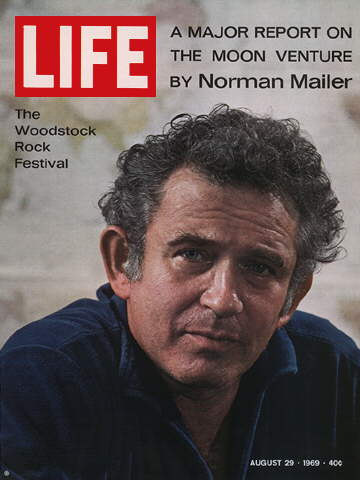 Several film references were made with regard to the hippies' clothes. Have Gun, Will Travel? (This apparently was a TV show). Claude Rains in Invisible Man? Mailer was, again, quite taken by the stridency of the young people, and compared them to Crusaders, which quality they did seem to have something of, and which perhaps in the absence of material and sensual diversions and pursuits might have manifested itself even more completely.
"Mediocrities flock to any movement which will indulge their self-pity and their self-righteousness, for without a Movement the mediocrity is on the slide into terminal melancholia." There is some truth in this. I have actually been looking for such a movement for some time but unfortunately (and predictably) all the movements which might fit this description for me tend to be full of losers and lack attractive leadership. This means on the other hand that there may be good opportunities for a person or persons of real ability to do what the America intelligentsia and power elite have often expressed fears of, rouse up the demoralized and humiliated masses into a powerful following that will stifle and possibly tear apart the culture and the nation.
On his having gone for a stroll and missed Martin Luther King's "I have a dream" speech in 1963: " Mailer--trusting no one else in these matters, certainly not the columnists and the commentators--would never know whether the Reverend King had given a great speech that day, or revealed an inch of his hambone." I guess I thought the hambone bit was too funny in the moment.
Dr Spock was another celebrity protestor at the march. Mailer however "had an animus against" him, for "three of Mailer's...wives had used Spock's book on infant and baby care as their bible."
Mailer's admission of modeling his attitude at various moments after Marlon Brando in The Wild One is almost too obvious (this movie, which I have never seen, looks tremendous by the way).
 I wonder if the famous episode of Ed Sanders, poet, vocalist of the Fugs and publisher of the unfortunately now-defunct Fuck You magazine, exorcising the Pentagon, remains celebrated because of this book. I had never heard of this guy. Maybe he stinks but he's a real make it happen New York kind of guy and he produces a lot of art, including, recently, 2,000 pages worth of verse constituting a history of the United States during the 20th century (I wonder if a lot of people have read that). These are exactly the kind of people I needed to know about as a young man, and for whatever reason did not. I listened to some his groups' songs; it isn't really my kind of stuff, but apparently it impressed some people worth impressing.
All the mystical gods/spirits/paganism 60s stuff, especially the various elements of it which involved naked young girls dancing and otherwise enjoying nature, does, I have to admit, seem like it was probably great fun at the time. It's no wonder that a lot of intelligent and now completely boring people have fond memories of it.
p.126--a reference to Matthew Brady's Civil War photos, which were apparently very popular at this time. I can definitely remember my father being into these, having several books on the subject, and often referring to them in his casual conversations about history or whatever with his friends as if he assumed they would be something familiar to everyone. Then suddenly Matthew Brady just totally dropped out of the public consciousness. I don't think I had heard or thought of his name in the last 25 years or so.
"...his New York fever, that ferocious inflammation which New York always seemed to encourage: envy, greed, claustrophobia, excitement, bourbon, broads, action, ego, jousts, cruelty and too-rich food in expensive hateful restaurants." When I was on the 8th grade basketball team, I never got into games except at garbage time--even at that I may have gotten into 4 of the 10 games we played. Our team was involved in one very intense game, on the road, against a school from a relatively poor town which famously hated all the other schools in the league and took sports very seriously. The crowd was raucous and hostile, and there were several near fights due to rough play on the court. In spite of all this our team pulled away in the last few minutes and won the game by 10 or 12 points because we were considerably better than they were. The next day several of my more important teammates and various other people, including cheerleaders, were discussing the details of the game with one of our more jockish male teachers, and being always on the alert for a social in I placed myself near the edge of this discussion and, though I had not played a minute in the game, hoped that this fact would somehow be overlooked by the company and I would somehow appear as one of the actors in this drama that was being so eagerly rehashed. As this did not happen I said something, doubtless inane, at which of all people the teacher cut right to the chase and said, rather harshly, though with what I believe was intended as jesting laughter, "(Surrender), you didn't want to be anywhere near that court." This was not true. Now it is true that I would likely have failed miserably and looked ridiculous had I been inserted into the game, but to say that I did not want to be in the game was denying me any kind of ambition or interest in life at all. Yet people say such things all the time to show you that they think you are nothing. What then do I want, if not life? If not to be just like you?
The leaders among the radical protestors of the 60s were somewhat different from the way one thinks of that type of person today. many of the men were brash, cool, confident with chicks, etc. They did talk about the government as if were a faceless, soulless, practically all-powerful entity to be fearful of, but this attitude had not been internalized the way it is today, where people seem to be much more resigned to their own futility and afraid of the consequences of really angering the ruling powers than they were in the 60s. The motifs of things like mass-produced white bread being the embodiment of evil, the "infiltrated enemy who had a grip on them everywhere" were already present, though Mailer seemed to find amusement and possibility in this attitude.
"Lowell made a face. He had an expression which only a fellow writer could comprehend..." It goes without saying that one wonders at what point a person becomes considered a fellow writers. "One could not communicate the horror to anyone who did not write well." Newspaper writers would seem not to qualify, as they are being castigated here for building an ever larger wall of distortion between real writers and the uneducated public, and cultivating terrible habits in the latter. Something of the same effect seems to take place in courts of law, where the unitiated public is strongly dissuaded from trying to actively participate in the refined proceedings, and is not infrequently punished for such breaches of etiquette as not hiring a proper attorney even for minor cases such as traffic court. It is the inattention to the proper subtleties that always reveals the untrained mental type, and to the expert practitioner, this is where all the substance is.
"The thousand days of John Kennedy had done much to change the style of America; nowhere perhaps more than to the sartorial sense of the liberal and Left Wing intellectuals now gathering for breakfast--some drabness had quit them since the fifties...a hint of elegance." I think it is agreed that this era, if it ever in fact existed (though I do think it did, from about 1961-'67, right when this book was written), was extremely short lived.
"The whores were out: not a common sight in Washington. The Capitol was usually about as lively at 1 a.m. as the center of Cincinnati late at night..." I have memories of the Washington area just a few years after this time (the mid to late 70s), and it was just starting at that time to become less sleepy and resemble the metropolis it has since become in terms of energy, youth, wealth, and so on. At that time even coming from Philadelphia it seemed a very sedate and minor legaue place--much of the 'talent' that came to work for (or against) the government, which was far fewer people at that time than at present, remained in the area only for a few years and then when the administration changed or whatever would return to where they came from. Every time I go down there nowadays I am astounded at how much huger, richer, more crowded, more attractive to cosmopolites it has become (as well as how huge the government is). Philadelphia by comparision, or at least the parts of it I am most familiar with, though it has of course changed some and had a decent influx both of hipsters and immigrants, the latter mainly Korean and Indian (the Hispanic population in Philadelphia remains very small), is not in the same degree unrecognizable from what it was 30 years ago. Another incredible thing when one regards the state of things today is that in northern Virginia many of the schools (and presumably other public institutions) only desegregated in 1968, one of the last places in the country where this happened, and after the events of this book took place. I know this was the case in Manassas, because one of my uncles lived there for a time and married a woman from there, and also in Alexandria (Remember the Titans!), which my impression is that it is now one of the tonier and more progressive suburbs of the capitol."A generation of the American young had come along different from five previous generations of the middle class. The new generation believed in technology more than any before it, but the generation also believed in LSD, in witches, in tribal knowledge, in orgy, and revolution." The scary thing is, most of these people are still very much alive and many are continuing to wreak endless havoc as we tap.
"...the walking American lobotomy: the corporation office worker and his high school son." I think they're talking about me again...
I like his Cuban revolutionary theory, which is that you create the revolution first and then worry about what it is actually about, i.e. "...the revolution existed in the nerves and cells of the people who created it and lived with it, rather than in the sanctity of the original idea." This is actually common sense. Real revolutions take on lives of their own pretty quickly, and most of them, especially during the last 100 years, have reputations for turning out very badly, but this latter is not inevitable, while from time to time revolutions of a kind probably are, which is why it is always wise to try to cultivate a certain degree of civilization and humanity in the populace so as to limit the catastrophe when these convulsions occur.
Several film references were made with regard to the hippies' clothes. Have Gun, Will Travel? (This apparently was a TV show). Claude Rains in Invisible Man? Mailer was, again, quite taken by the stridency of the young people, and compared them to Crusaders, which quality they did seem to have something of, and which perhaps in the absence of material and sensual diversions and pursuits might have manifested itself even more completely."Mediocrities flock to any movement which will indulge their self-pity and their self-righteousness, for without a Movement the mediocrity is on the slide into terminal melancholia." There is some truth in this. I have actually been looking for such a movement for some time but unfortunately (and predictably) all the movements which might fit this description for me tend to be full of losers and lack attractive leadership. This means on the other hand that there may be good opportunities for a person or persons of real ability to do what the America intelligentsia and power elite have often expressed fears of, rouse up the demoralized and humiliated masses into a powerful following that will stifle and possibly tear apart the culture and the nation.
On his having gone for a stroll and missed Martin Luther King's "I have a dream" speech in 1963: " Mailer--trusting no one else in these matters, certainly not the columnists and the commentators--would never know whether the Reverend King had given a great speech that day, or revealed an inch of his hambone." I guess I thought the hambone bit was too funny in the moment.
Dr Spock was another celebrity protestor at the march. Mailer however "had an animus against" him, for "three of Mailer's...wives had used Spock's book on infant and baby care as their bible."
Mailer's admission of modeling his attitude at various moments after Marlon Brando in The Wild One is almost too obvious (this movie, which I have never seen, looks tremendous by the way).
 I wonder if the famous episode of Ed Sanders, poet, vocalist of the Fugs and publisher of the unfortunately now-defunct Fuck You magazine, exorcising the Pentagon, remains celebrated because of this book. I had never heard of this guy. Maybe he stinks but he's a real make it happen New York kind of guy and he produces a lot of art, including, recently, 2,000 pages worth of verse constituting a history of the United States during the 20th century (I wonder if a lot of people have read that). These are exactly the kind of people I needed to know about as a young man, and for whatever reason did not. I listened to some his groups' songs; it isn't really my kind of stuff, but apparently it impressed some people worth impressing.
All the mystical gods/spirits/paganism 60s stuff, especially the various elements of it which involved naked young girls dancing and otherwise enjoying nature, does, I have to admit, seem like it was probably great fun at the time. It's no wonder that a lot of intelligent and now completely boring people have fond memories of it.
p.126--a reference to Matthew Brady's Civil War photos, which were apparently very popular at this time. I can definitely remember my father being into these, having several books on the subject, and often referring to them in his casual conversations about history or whatever with his friends as if he assumed they would be something familiar to everyone. Then suddenly Matthew Brady just totally dropped out of the public consciousness. I don't think I had heard or thought of his name in the last 25 years or so.
Monday, July 19, 2010
Re-Starting With Some Memes
Trying to do a few quickie exercise-type posts to get the blog running again. I had what seemed like a good idea for a post this morning but I have already forgotten what it was (Addendum--this 'good idea' actually came to me in a sleep dream, it was not a good idea, and it was based on wholly false premises). I haven't done a questionnaire for a while, so I thought I would look for one of those. My first researches didn't turn up anything good, but I did come upon a couple of picture memes I thought I would try. The first involved going to the 6th folder of photos on your computer, posting the 6th photo in that 6th folder, and explaining it on one's blog. Here is the result in my case: This is at the shopping mall in Concord, NH, sometime in March, 2008. My oldest son, who is now 8 and going into 3rd grade, would have been 5 and in Kindergarten at this time. He looks very little compared to what he is now. Going to the mall and playing on the various coin-operated rides they have there is something we have done numerous times, so I have no especial memory of this occasion.
The second photo meme involved publishing the 8th photo from the 8th folder. Here is the result of that:
 This is a quite good picture, taken in the woods near the Brattleboro camp in April, 2008. By coincidence both pictures happen to be of the same son. This is like one of those old poems, which used to be produced in New England in great profusion, about "A Boy's Life" or some similar subject, come to life. He looks a little more like his present self in this photo than the earlier one, though it is only a month later.
Trying to do a few quickie exercise-type posts to get the blog running again. I had what seemed like a good idea for a post this morning but I have already forgotten what it was (Addendum--this 'good idea' actually came to me in a sleep dream, it was not a good idea, and it was based on wholly false premises). I haven't done a questionnaire for a while, so I thought I would look for one of those. My first researches didn't turn up anything good, but I did come upon a couple of picture memes I thought I would try. The first involved going to the 6th folder of photos on your computer, posting the 6th photo in that 6th folder, and explaining it on one's blog. Here is the result in my case:
 This is at the shopping mall in Concord, NH, sometime in March, 2008. My oldest son, who is now 8 and going into 3rd grade, would have been 5 and in Kindergarten at this time. He looks very little compared to what he is now. Going to the mall and playing on the various coin-operated rides they have there is something we have done numerous times, so I have no especial memory of this occasion.
The second photo meme involved publishing the 8th photo from the 8th folder. Here is the result of that:
 This is a quite good picture, taken in the woods near the Brattleboro camp in April, 2008. By coincidence both pictures happen to be of the same son. This is like one of those old poems, which used to be produced in New England in great profusion, about "A Boy's Life" or some similar subject, come to life. He looks a little more like his present self in this photo than the earlier one, though it is only a month later.
Book questionnaires are pretty lame, but I'm not finding anything else much that I like either. I'll try to pick questions I haven't answered a million times before.
1. Hardcover or paperback, and why? Hardcover, especially from about the 1920-1960 era (I feel alienated from present intellectual life in pretty much all its forms), though it doesn't really matter, and there are certain paperbacks, usually giant ones (Clarissa!), I am fond of. I do like hardcovers for smaller books and plays, or collections of plays and poems if I can find them. It makes them feel more substantial.
2. If I were to own a book shop I would call it...The Dutch Bookshop. Because Dutch is a strange word, and I don't think anyone has any good sense of what true Dutchness really is, but again, the sound conveys substance somehow.
3. My favorite quote from a book is..."And was it his destined part/For only a moment, to be close to your heart?" from Pushkin, I believe, used as the epigram for Dostoevsky's "White Nights". It is actually kind of goofy, at least as translated, but it has lodged itself in my brain and often rears itself up at odd moments. I do not have a good memory for quotes, is the main issue here.
4. The author (alive or deceased) I would love to have lunch with would be... Dorothy Parker is too obvious, but I would like to have lunch with her, or somebody like her. Samuel Johnson is also obvious, though nobody who isn't a 55 year old Republican seems to like him anymore. Fitzgerald maybe. The young Evelyn Waugh. Somebody who drank a lot. Thomas Malory would be certainly be a different candidate.
5. If I could go to a deserted island and could only bring one book, except from the SAS survival guide, it would be...Something Greek, though not philosophy. Probably Homer or Thucydides. And in Greek too--what better opportunity or excuse to finally learn that tongue than stranded on a desert island? Shakespeare would be bearable. I can't think of any novel I could bear to read exclusively forever.
6. I would love someone to invent a bookish gadget that...I have no imagination for gadgets. The internet, and its ability to instantly find what works/authors certain passages/quotations come from, as well as simply find copies of books I could not previously find, have solved the major needs I once had.
7. The smell of an old book reminds me of...a used book barn that used to be in Bucks County, Pa, near the Peddler's Village shopping complex. I went looking for it recently but I couldn't find it. I suspect it isn't there anymore. I bought a box of green and mustard spined "World's Literary Treasures" there, among other things, which books carried a very pungent odor. They charged the 6% Pennsylvania sales tax though there was no cash register, and they recorded all their transactions on paper, which greatly annoyed my grandfather, who of course was certain there was no way the state was seeing any of that sales tax.
8. If I could be the lead character in a book, it would be...Prince Fabrizio in The Leopard. He was the finished product all around. The choices in this kind of question are between perfection of spontaneity/action and perfection of intellect/culture for the purpose at hand. My heart's desire obviously lies with the latter.
9. The most overestimated book of all time is...Of all time? I really don't know. True Classics really do become unassailable after a certain point because they become so embedded in the history of a people, language, etc. It's not an easy question. Still, I am prodded from time to time with an instinctive reflex
of feeling something might be overrated. One of my deep dark secrets is that I got this feeling in reading Huckleberry Finn, which nonetheless is not going anywhere as far as its classic status goes. I have similar feelings about the writings of David Foster Wallace, by whose genius even his own college professors were blown away, which is practically unheard of in modern humanities departments. But given his contemporaneity to me, his particular consciousness and understanding that are so captivating to the people who get it is probably still 20-30 years from becoming digested by the greater culture thoroughly enough to become comprehensible to the mind such as mine.10. I hate it when a book...is completely blind to its own deficiencies, betrays too much ignorance of the 2500+ years of literary history that preceded it, and is obstinately humorless where humor would be even occasionally acceptable or called for
11. What author do you own the most books by? I'm pretty sure it is Dickens, though it may be L Frank Baum. I have also accumulated a lot of Jane Austen books, a lot of singularly inferior minor editions of Shakespeare, and a frightening quantity of single Henry James novels (should have gone for the Library of America multipacks with him).
12. What was your favorite book when you were ten years old? Probably an Oz book. I'm not sure which one I liked the most at the time. I don't remember much about being ten years old.
13. What is the worst book you've read in the past year? Some book by Harold Bloom about appreciating literature, poetry, etc, and how essentially he is the only person left in America who properly understands this. I couldn't stomach it beyond 50 pages or so. I am depressed that such a person seems to be considered by so many people in our society to represent real literary culture. No wonder only pantywaists want anything to do with it.
14. What is the best book you've read in the past year? I haven't read anything all that great in the past year, to be honest. The House of the Seven Gables was better than I thought it was going to be, was quite good actually. Maybe that was it. Nightmare Abbey by Thomas Love Peacock was great fun--I considered at the time whether or not I could write something along similar lines--but was only 70 pages long. I wanted more. Of Human Bondage had some major flaws, but it had many merits too, and I enjoyed reading it a great deal, which must count for something. I also enjoyed Point Counter Point by Aldous Huxley, and it was also much better than I thought it would be, but then I am a junky for anything from Britain between the wars. Anybody who wasn't would probably find it tedious.
15. If you could force everyone you know to read one book, what would it be? I have no desire to do such a thing.
16. What book would you like to see made into a movie? Hajji Baba in London by James Morier. It could be awesome, but no modern Westerner I think would be able to pull off the spirit. I would hire one of the hot young Romanians--the most high-spirited of the bunch--to direct.
17. What is the most difficult book you've ever read? Einstein's Theory of Relativity? Maxwell's Electricity and Magnetism? As far as novels, the Beckett trilogy, Molloy, Malone Dies, & the aptly titled The Unnameable, I must confess, totally defeated me, though not enough that I don't want to give them another go someday.
18. Favorite short story? I think it is still "White Nights". "The Cask of Amontillado" is also an old favorite, because it is so ecstatically absurd.
19. Favorite work of non-fiction? The Decline of the West, Ezra Pound's literary essays, The Spectator, the various Samuel Johnson-related classics by and about him. Nietzsche's various works. I can't think of much else. C.S. Lewis's Allegory of Love? E.B. White's New Yorker essays? I'm thinking of things I have and I look back into from time to time after I've read them.
20. Who is your favorite writer? At the moment, Shakepeare and Thucydides, because they seem to offer the most consistently different and interesting possibilities, especially to a tired mind. I do not mistake them for my special friends though.
21. What fictional character are you secretly in love with? I did really have a big crush of Ursula Brangwen from The Rainbow. And of course Dora and Agnes from David Copperfield would make for kind of an ultimate Victorian England threesome. There's got to me more. How about Maggie Tulliver from the Mill on the Floss? The main problem there of course is that she is largely modeled on young George Eliot herself (who did not exactly develop into a hot babe, for such as may be tempted to ask 'what's wrong with that?').
22. What book have you read the most times in your life? I don't know. Probably something in childhood.
23. Who is the most overrated writer alive today? Besides Harold Bloom...I don't usually have particularly ferocious responses to individual writers but for some reason I have always viscerally detested Francine Prose.
24. What is the most lowbrow book you've read as an adult? I have a weakness for a certain kind of right wing you're-not-dreaming-this-society-really-is-a-disaster type books, but I'm not sure they really qualify as lowbrow. Really blatantly lowbrow books I can't get through. I don't read 'popular' fiction. Some people say one should, but what I have looked into doesn't really look that worthwhile. I read Joe Queenan's book about trash culture, going to Red Lobster and John Tesh and Barry Manilow concerts. That felt pretty lowbrow.
25. Shakespeare, Milton, or Chaucer? Poor question. You might as well ask Smoking, Drinking, or Dancing (Milton would be Smoking, I think).
26. What book do you own the most copies of? I have a lot of Pride and Prejudices. I think that may be the winner. Huckleberry Finn and Gulliver's Travels are also represented numerous times.
27. Who deserves to win the next Nobel Prize for literature? I don't have any idea who deserves to win it, but it seems like it's been a few years since a poet won. I have heard there are some great poets in Iran, and that seems to be kind of a hot country among the international intelligentsia right now, so it looks like a good match. Dark horse would be a poet from Brazil. That Murakami guy from Japan hasn't won it yet either, has he? He seems to be popular with all the right kind of people to make it happen.
28. What book would you least like to see made into a movie? No more F Scott Fitzgerald or Evelyn Waugh adaptations for a couple of generations at least. For whatever reason, what lives in the books dies on the screen with these guys.
29. Do you prefer the French or the Russians? The Russians are the best, but the French truly are the second best, and have maybe become a little underappreciated in recent years.
30. Roth or Updike? I don't know. I go back and forth. I do like both, but at the same time both are best in small doses, and I have no desire to read either's entire opus. Greatest hits will suffice.
31. David Sedaris or Dave Eggers? Sedaris does less than nothing for me.
32. Austen or Eliot? They are almost equivalently charming in their own manners.
33. What is the biggest or most embarrassing gap in your reading? Germans! Non-Western greats. I can't read Latin. The Man Without Qualities. Gibbon. Deep dark secret #2. I never finished The Brothers Karamazov. It was certainly very great, but it was a school assignment that I started too late, got only to page 300 by class time, gave up, didn't participate even mentally in the classes, and the program moved on to something else. So that is still out there.
34. What is your favorite novel? All time I am not sure at the moment. Of the last five years, Tristram Shandy. It had the kind of spirit I have been seeking, and not too often finding, at this particular period of my life. Age 30-35: David Copperfield & A Dance to the Music of Time. Age 25-30: Tom Jones (?) I read a lot of the major English classics in this period, so it is surprising that nothing else is standing out. 20-25: Don Quixote & War & Peace. Age 15-20: Pickwick Papers & Portrait of the Artist as a Young Man.
34. What is your favorite novel? All time I am not sure at the moment. Of the last five years, Tristram Shandy. It had the kind of spirit I have been seeking, and not too often finding, at this particular period of my life. Age 30-35: David Copperfield & A Dance to the Music of Time. Age 25-30: Tom Jones (?) I read a lot of the major English classics in this period, so it is surprising that nothing else is standing out. 20-25: Don Quixote & War & Peace. Age 15-20: Pickwick Papers & Portrait of the Artist as a Young Man.
35. Favorite Play? Another tough one. I am all over the place on plays. Shakespeare the obvious choice. Outside him, how about Our Town? I'm a sentimental guy at heart.
36. And...what are you reading right now? Cardinal Newman's Idea of the University. There are some nice defenses of liberal learning, and the idea of the community of learning--very St Johnsian--but his assertions of the ultimate primacy of Theological studies over the hard sciences in the university would be carved up and splattered like a pumpkin nowadays, to the accompaniment of much bemused laughter. I usually have a second, more recent, lighter, non-classic book going, but I don't have any such thing at the moment.
Sunday, July 18, 2010
Hello
I still have not retired, but have merely been on vacation. I am back now, and will probably post something within the next couple of days. In keeping with my ongoing identity crisis, I went to Gatlinburg, Tennesee for my vacation, and I actually enjoyed it, or some essential quality I discerned in it, more about which phenomenom I will doubtless write in one of my future posts. Otherwise I am the same, strangely incapable for the most part of writing anything, or even of forming impressions into coherent thoughts. Perhaps I ought to pull a Samuel Beckett and start writing in French and translating myself back into a sparer and more elegant English--the achievement of which, hard as it may seem to believe, has been my dearest desire for some years now. My whole thought process in English has become both so overcluttered and so confined within repeated narrow grooves that I seem to have lost my ability to manage any part of it, and some part of it at any rate I really need to find some way of getting back.
I still have not retired, but have merely been on vacation. I am back now, and will probably post something within the next couple of days. In keeping with my ongoing identity crisis, I went to Gatlinburg, Tennesee for my vacation, and I actually enjoyed it, or some essential quality I discerned in it, more about which phenomenom I will doubtless write in one of my future posts. Otherwise I am the same, strangely incapable for the most part of writing anything, or even of forming impressions into coherent thoughts. Perhaps I ought to pull a Samuel Beckett and start writing in French and translating myself back into a sparer and more elegant English--the achievement of which, hard as it may seem to believe, has been my dearest desire for some years now. My whole thought process in English has become both so overcluttered and so confined within repeated narrow grooves that I seem to have lost my ability to manage any part of it, and some part of it at any rate I really need to find some way of getting back.
Subscribe to:
Posts (Atom)

