Monday, May 10, 2010

Ralph Ellison--Invisble Man (1952)

In my posting of July 24, 2009, I put forth the suggestion that this book, which I read for the first time when I was 38, might be overrated. My basis for this seemingly ignorant judgement was the expectation of surpassing greatness that had been aroused in me by the decades of reverent hype regarding it that I had been exposed to, such that it was a turning point in American literary history, a candidate for the greatest post 1945 American novel, was to the 20th century what Moby-Dick had been to the 19th and so on. I was anticipating something, if not at, then very near the Tolstoy-Dostoevsky-Proust level, which category I do think Melville is in as well. While I won't dispute that I likely don't grasp more than 2% of what is going on in such books, I have read enough of them to recognize the kind of scope, vividness and freshness and liveliness and uniqueness of thought and vision and language and purposefulness and interestingness of action that sets this class of book apart from merely excellent and distinguished novels. Invisible Man did not strike me as being of the same quality as these superior types of books in any way. To quote myself, "I found it to be slow-moving, with long episodice stretches that never seem to pay off with value equal to the investment of writing that went into it. 300 pages, 400 pages in, I'm thinking, this just isn't taking off, something is going to happen, something is going to happen, and then at the end (which I guess the real end is actually at the beginning) the whole thing just kind of peters out. Either there was something really big and monumental that I somehow missed totally, or the book was (is) overrated."

I wonder if this book has not reached the stage in its career that has come to many classics two or three generations after their first appearances and been widespread acclaim, that being that the innovations and ideas which caused the original excitement of audiences have either become so internalized by them after a certain passage of time that their power becomes dulled, or else they have come to be seen as contributing to an attitude that now stifles where once it liberated, such that the book passes through a period where it does not speak to people as intensely as it did on its first appearance. Hemingway and Eugene O'Neill and Steinbeck and a number of other 30s writers have seemed to me to be in this position for much of the last 20 years, there was a backlash against Dickens and Tennyson and other Victorian writers in the 1910s and 20s, and even Shakespeare fell somewhat into oblivion 50-60 years after his prime, certainly during the period when the Puritan revolution took over England and closed down the theaters for 12-18 years, and even in the Restoration period there was a sizable school of critics who thought his writing barbaric and immoral. What is working against Ellison I think at this particular time for the purely literary point of view is that his book is most celebrated for its merciless depiction of a thoroughly racist society, presented in a way which was evidently a revelation to most of the intelligentsia in the 1950s; for someone my age however this particular point of view is one that we have been fairly well immersed in all our lives. A lot of the most famous incidents such as the 'battle royal' where the top students from the black high school are forced to fight with each other for the entertainment of the local white civic leaders, which I presume were based on real events, don't have the shock value they are promoted as having because so many similar stories have now been told during the interevening sixty that, while one is not dulled to it, you know pretty quickly when certain situations in the book are being set up what is going to happen, and this, combined with the very slow pace at which events unfold, means that very little happens in the course of the story which will seem new in 2010 to anybody who has been living in America for the last 40 years. However, as time goes on and the Jim Crow period passes out of living memory, and a greater and greater portion of the American population consists of people whose ancestors were not even in this country in the 1940s and 50s, the ubiquitousness and immediacy of this history in everyday experience will fade, and the power of the truths contained in the book will be revealed in a greater vividness at that further remove of time when the greater part of the specificities of circumstance and direct general influence will have largely ceased to be important. Ellison is a famously conflicted writer, who had trouble finishing anything, and he very often gives the impression of wanting to say one thing while actually saying, or at least believing, something else. In the introduction at one point he explained his intention in his writing of choosing the affirmation of humanity as opposed to despair or nihilism, citing Hemingway, of all people, though I thing the comparison was from his vantage point a good one, as an example of someone whose work was a struggle, only sometimes successful, to achieve this. I don't know know that Ellison succeeds as much. The inclination of his spirit was really at odds with that of his mind, and while he is smart, that is not the same as being equal to the myriad situations that arise in the course of life, and I am not talking about institutionalized racism and that sort of thing, I mean things like connecting with people. Ellison writes like a man who has no friends, no intimate or serious contact with interesting people. It is not surprising to me that he was only able to finish one book in his lifetime.

Ellison lived on a Vermont farm for a while during the 40s while he was working on his writing--the level of financial support and encouragement he received from well-placed persons as a black man and relative unknown during seven years of writing seems impressive to me--and one of the nearby villages put on a blackface performance of Uncle Tom's Cabin. They don't have this sort of thing there anymore of course but I asked around a little and apparently these kinds of shows were quite popular in this area at that time, before television. People affect to have been largely unconscious of the full racist implications of the performances and regarded them as innocent entertainments, actual black people being almost as completely unknown in rural Vermont in the 1940s as Hindoos or Polynesians would have been, as indeed they still were in these northern states even in the 80s when I first lived up here, though that is finally changing a little bit now.

"Yet I recalled that during the early, more optimistic days of this republic it was assumed that each individual citizen could become (and should prepare to become) President." Say what? Well, maybe they did--certainly as a child I had something like that impression but I got taken in by everything as a child--and I'm sure the country could not help but be improved if this kind of attitude was promoted, in the serious hypothetical way it is intended here at least, in the upbringing of young people.

The book starts. Prologue: "Those two spots (Broadway and the Empire State Building) are among the darkest of our whole civilization--pardon me, our whole culture (am important distinction, I've heard)..." It is hard to tell whether the prologue was written first or last. This edgy, defiant tone was not kept up through most of the rest of the work, though I suppose it is meant to be inferred that the narrator only adopted it after the action of the book

The narrator has an image of white people--a certain class of them anyway--at the beginning as "striking, elegant and confident". It struck as an unsual sentiment that you would be unlikely to hear couched in such terms nowadays.

Plantation imagery, or even the suggestion of it translated to more modern circumstances, is oddly evocative and powerful, almost as if there is something primal in it. The plantationesque scene in this was reminiscent of an incident in another book (Dorian Gray?) where a blind black boy climbed through the window of the manse to play the piano.

It appears that I did think in the beginning--at least up to page 118--that this book had the kind of natural, organic flow of production and form that I admire and strive to achieve. I'm sure I had the sense that it was building up to something spectacular which was never arrived at, or really felt like it ever came near being arrived at.

I'm not going to go through these books and do the quotes and all anymore. It takes too much time and the pieces don't really work. I'm not sure why it took me three years to figure that out.

Unless it's funny. Chapter 7, an acquaintance on hearing the narrator is going to New York: "And listen,' he said, leaning close to whisper, 'you might even dance with a white girl!'" I laugh and I cry at the same time, because I don't think I've ever actually gotten to do that in New York myself.

The terror of touching a white person is an oft-repeated theme.

In New York: "...I had the shock of seeing a black policeman directing traffic--and there were white drivers in the traffic who obeyed his signals as though it was the most natural thing in the world."

"White folks were funny; Mr Bates might not wish to see a Negro the first thing in the morning."

The part where he works in the paint factory awakened some unpleasant memories for me of my days at the J.J. Nissen industrial bakery in Portland, Maine. Cubicle life may be monotonous, deadening and garishly unsexy, but factories are these things in addition to being physically painful, hot, pressured, demeaning. There is nothing appealing about doing that eight hours a day for thirty years.

Symbolism. Whiteness ubiquitous. The factory's specialty pain ("we make the best damn white pain in the world") the glare of light bulbs, the hospital, of course white people and the massive world of objects and buildings and institutions and roads and so on that they had made (in the narrator's eyes) and owned utterly.

I guess I will still have to do a second post on this. Why shouldn't I, it's a major book?

Wednesday, May 05, 2010

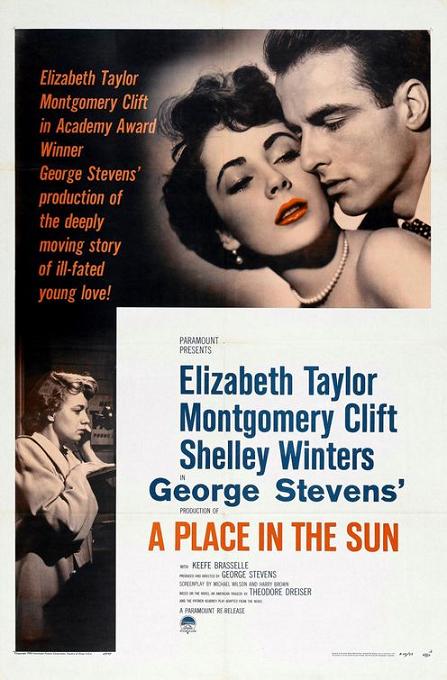
A Place In the Sun (1951)

Just as it is always exciting in the course of list-following to come upon some delightful work one had never heard of previously, it is often equally so to finally sit down to a standard classic one has been aware of and seen casually alluded to for years but has never taken up, especially if one has been able to avoid in that time picking up any sense of what it is about. This still happens to me a lot with movies, my familiarity with the classics of that art even now remaining surprisingly narrow. Today's subject for example marks my first experience of both the director George Stevens and the star Montgomery Clift, who are, if not colossal, at least significant figures in the lore of Hollywood. As this is also still pretty much in the time period from which I like watching just about anything if it is at all good, despite the rather grim subject matter I on the whole had a satisfying time of it.

If I were rating this movie, which I am not, because earnest film criticism, both good and bad, is one area of endeavor that the world has a more than adequate supply of, I would give it 3 1/2 stars out of 5, maybe 4 for the style and unusually strong visual appeal of the two main stars, though I have to say I wasn't impressed by Montgomery Clift as being any especially great shakes as an actor. I know it's the Method, and mumbling and a certain languidness are part of the approach, but I thought he came across as too flat and limp all around. Elizabeth Taylor, who I usually imagine as being an awful actress because she comes across as more than usually deficient in her overall mental development, was, I won't say good, but effective for what she was supposed to do. Of the various romantic ideals that Hollywood has presented over its history, she is not one of my personal favorites--the promise of voluptuous, luxurious, vapid lotus-eating without any forseeable end I take to be what she is supposed to represent--but she has a undoubtedly timeless quality about her as a movie star. Unlike most of the stars of the past, she doesn't seem to be a product especially of the specific period in which she was between 17 and 25, and it is not difficult to imagine her as a twenty year old getting roles in inane movies and TV shows today, and being effective in them. Her relation to media is like Wilt Chamberlain's to basketball, a genetic freak in which is embodied the prototype of the various qualities that their industries seek in a performer. An Elizabeth Taylor clone could get a movie contract in any era just as a Wilt Chamberlain clone would be the #1 pick in the NBA draft every year.Though set in the postwar times in which it was made, this film is avowedly based on Theodore Dreiser's novel An American Tragedy, which was published in 1925. I haven't read it, so perhaps the economic circumstances of 1951 portrayed in the movie were greatly exaggerated to accomodate the plot, though I don't get the feeling that they have been much. I note this because 1951 was right in the middle of the period in which the income tax rates for the top earners in the U.S. were supposedly 91%, and were purportedly much higher for well-off people across the board than they are now. It is true that the lifestyles of the families in this film who are supposed to represent an unattainable fantasy of wealth and privilege would be laughed at by the likes of Donald Trump and Aristotle Onassis and people of that ilk. Their children go to private schools and they have a nice but hardly ostentatious vacation house with a speedboat on a lake in Indiana or someplace like that. That Elizabeth Taylor's character has lots of nice clothes and is able to spend the summer sunning herself at the lake while the less privileged girls have to go to work in a factory is depicted as a cruel injustice and cause for resentment, though again, compared to the possibilities for expenditure, extravagance and opportunity open to wealth in our times, this seems like a rather quaint idea of how to spend the summer.

In any event, whether the movie is an accurate portrayal of economic life in 1951 or not, I have read enough accounts of the era to have gleaned pretty convincingly that rich and privileged people were still plenty rich and privileged even in a time of much higher taxation on income. Contrary to the argument one sometimes hears from anti-tax zealots who have allowed themselves to become overheated, that the American system is set up to "punish success", monetary success in particular is hardly rewarded more desirably anywhere else. To imply otherwise is misleading and insulting whatever your opinion is on the morality of taxation. It was a bogus argument in 1950, and it is certainly one now. I was reading one of Paul Theroux's travel books recently--the Mediterranean one, I've been reading one every year or so the last few years--and (though I take him for a rich person himself) he made the observation that when you hang around rich people they constantly talk about how they don't have any money. And look, I'm sure that when your tax bill is six and seven figures a year that it does seem cruel and tyrannical and that one is being taxed to death, but however exorbitant income taxes are, wealthy people still have more money than everybody else does, usually significantly more, as well, usually, as a continued ability to generate or gain access to substantial income streams. Once you reach a certain level the system for wealth generation is so stacked in your favor that the mediocrities and failures, who are made thus by the mechanisms of this system which by and large they cannot escape and are told they have no right to escape or agitate against, after a certain point have to regard progressive taxation at least as much of a self-defense measure than a shameful plundering of their betters. The concentration of wealth and laws which facilitate this among privileged castes have no benefit to people outside these castes, and there is no reason why such people should support such a system unless the society has a whole has become otherwise diseased.

I was looking for a good music video that took this movie for its subject, but I didn't find anything I liked. A lot of people have made maudlin tributes to Liz and Monty's supposedly deep platonic friendship (the gay Monty being supposedly the only man she knew at the time who did not desire her sexually), which has always struck me as preternaturally uninteresting. We all know nowadays that no woman is only good for Just One Thing, but if anyone was ever close to fitting that description, it was Elizabeth Taylor. There was one video of clips from the movie set to "Total Eclipse of the Heart", which might have been funny if the song weren't seven minutes long. Next time try the 90s disco remix version at least.

Mahalia Jackson--"In the Upper Room"


This is the last of the songs from this book.


"She put on a record by Mahalia Jackson, In the Upper Room, and sat at the window, her hands in her lap, looking out over the sparkling streets."


It takes a couple of minutes to get going, but I have to say, when it does, this is a ferocious good number.


Gospel music is yet another of the many genres I know virtually nothing about, though it is one of the great musical forms of our nation. As I have noted before, I seem to live in perhaps the most unmusical corner of the whole country, though it is not clear to me why this should be so. It just isn't important to people, even those with an earnest desire to know about it, in the same way it is elsewhere. The heretic church that I have been known to attend from time to time will sometimes slip an American 'spiritual' into its program--they had "Go Down, Moses" a few weeks ago--these really are great songs, absolutely on the level of the better traditional hymns. I suppose everybody else knew this already, but I had to see it played out over a period of months in the church setting, etc, before I could sign on wholeheatedly. I consider myself signed on now.

Tuesday, May 04, 2010

Billie Holiday--"Billie's Blues"

Another Country, Book III, Chap. 1: "In the background, he heard Billie Holiday singing Billie's Blues." I presume that unlike in War and Peace where the character "Napoleon" is actually the great general himself in the flesh, the "Billie Holiday" referred to here is only a recording.

I am not going to pretend to being the world's greatest Billie Holiday fan going back to my days in swaddling clothes, though believe me there have been plenty of occasions when I have fervently wished I were. Like a lot of this type of material, I sense that this song is something more good than bad, and maybe in the right atmosphere its greatness would become crystallized to my perception, which I am always hoping for; but ultimately the whole genre of "the blues" just doesn't seem to be my thing. If some condition of too extreme whiteness or something of the sort is the cause of this, I have enough assurance in my general sensibility to be at peace with that. I have certainly not rejected this type of music out of hand--indeed it rather saddens me that I don't seem to be able to love it the way others do--and I have been exposed to the recorded music of Billie Holiday enough over the last twenty years or so to have come to the acceptance that for whatever reason it just doesn't resonate with me.

When I was a schoolboy, Billie Holiday records, of which of course I had none, were often utilized in successful seductions of bourgeois white girls, whose attraction to and--identification?--with the art and wretched life of this singer is one of those phenomena that has never ceased to astound me. The poster with a photograph of Billie Holiday staring down at the floor looking exhausted and desperately gripping a three quarters empty glass of whiskey was well circulated among a certain type of young woman in the 90s, which type however as far as I can make out was not actually especially ruined or jaded or even all that alcoholic, but evidently harbored secret longings to be, or at least give off the appearance of being, all those things. I wonder if this is the case anymore, or if not what old records the studs are breaking out, not so much to 'seal the deal' of course, but to give it that extra dazzle so that the girls won't be able to resist telling all their friends about it with a sense of lingering excitement afterwards.

Sunday, May 02, 2010

Dmitri Shostakovich--5th Symphony

From Another Country, Book II, Chap. 3:

"The Shostakovich Fifth Symphony was on his record player; the play, Happy Hunting Ground, lay open on his bed, under his night light...A brief silence fell, and her we resounded more insistently than the drums of Shostakovich."

(I apologize for forever bringing up old stories from college and other scenes long past, but unfortunately the years since I was about twenty-seven have not yielded as many of the kinds of anecdotes that are useful for the pretensions of this site)

I was at a party in college once when a man with whom I had never spoken before began explaining to me about that momentous day in 1908 or 1909 or maybe even 1910 when Gustave Mahler, having completed one of his symphonies--the 5th? the 7th?--announced that the tonal order on which Western classical music had been based for centuries was exhausted, and that epoch of musical history closed, with which, remarkably, everyone of any importance in the European musical culture of the day seemed to recognize and agree at once, and all further composition in the established mode ceased from the instant of Mahler's proclamation forward. This explanation of a phenomenon both undeniable and to the untutored highly mysterious, was immediately pleasing to me, being both so neat and evidently uncontroversial, and it has remained with me all these years though I have never even looked into it to confirm that it is true.

I mention this because while what I and the class of people of whom I am respresentative think of as classical music more or less ceased all over Europe right around 1910, a definite variety of it continued in Russia well into the middle of the century, highlighted by the celebrated composers Rachmaninoff, Prokofiev and Shostakovich, who certainly sound classical and serious to the untrained ear, combined with a romantic/sentimental streak that is especially pleasing to the same. I like all these guys, whom I equate as well in spirit with the Impressionist composers Debussy and Satie--in classical music I have a tendency at times to tilt towards the French/Russian axis in my deepest darkest preferences rather than the German/Italian, which I think is considered bad form (in another college incident my volunteering the information of a certain fondness for Debussy that I thought would be acceptable was swatted down with an incredulous laugh at such naked, innocent idiocy and the observation that "the French are good at many things; music is not one of them"). This makes it sound though as if I am wholly unaffected by Strauss and Puccini and B/B/M and all those fellows, which is not the case either. The quality of the emotion one feels from some of the French and Russian music, because it is apparently less general than that of Bach or Mozart, on the extent of whose greatness everyone is more or less in agreement, is often of a more interesting nature depending on the circumstances, I think.

Here is another famous Shostakovich piece that I like. Perhaps it is derivative, not much of originality in it. I wouldn't really be able to tell. I don't have any instinctive feel for what the various forms of music mean. I think a piece of music good if it calls some kind of dream-image, usually a meadow, or a hill, or a small cluster of trees, a sky, a cloud, sometimes a pretty girl, movements, in rare instances something abstract will be summoned, a remembrance of the intense nature of youthful hope, or belief. None of these things expresses what exactly is going on when a cloud or a hill or a long forgotten memory are summoned to the imagination by the vibration of a few piano keys....

Saturday, April 24, 2010

Another Country 3

"She might very well love him and yet--he shuddered and threw down his drink--be groaning on some leather couch under the weight of Ellis." In the end I appear to have been fortunate in love, but the person who is overly susceptible to such feelings and is not equipped to cope in some productive way with potential catastrophes is going to invariably lead a limited and second rate life compared to those peers who attain a degree of mastery over the romantic prerogative.

"She had embarked on a voyage which might end years from now in some horrible villa, near a blue sea, with some unspeaking, unspeakably phallic, Turk or Spaniard or Jew or Greek or Arabian. Yet, she did not want it to stop. " Probably because it wouldn't really be all that bad. The Mediterrean villa as a repository of sexual decadence so pronounced, so fantastic and so masterful as not to be contended against by anybody wandering in out of ordinary life was a popular theme at this time, the prospect of being caught up in which obviously titillated and terrified in equal measure the more rulebound, conventional set in the era.

"...the three youths were giggling and covertly watching the dark man and the pasty girl; and if this evening ended as all the others had, they would presently drive off to some haven and watch each other masturbate." This is not my usual fare.

There is a discussion about Franco at one point. The Fascist era in Spain has always rather fascinated me because it artificially preserved a kind of society and way of life for quite a long time, well past the point of exhaustion and dead end. Obviously the old Iron Curtain countries offered a similar fascination, though Spain is unique in the ideas of sort of endless centuries of priests and haying carts and bulls and afternoon bottles of wine under the shade of a tree that play on the imagination, all of which has just abruptly come to an end within my actual living memory. I am sure what I imagine here is not true either, and of course the governments of all stagnant countries are by necessity repressive and horrible, but people are fascinated by these kinds of places where the world or 40 or 50 or more years past is as preserved in amber, as they are with Cuba and North Korea today, because sure as heck nothing remotely like this phenomenom ever happens here.

"They were both, as it were, racing before a storm, struggling to 'make it' before they were sucked into that quicksand, which they saw all around them, of an aimless, defeated, and defensive bohemia." One thing about this book that is somewhat interesting is that it is clear Baldwin reached the point in his life, around his mid-30s, which most non-geniuses usually do in spite of themselves, where he realized that the people who actually made everything happen in New York, and the world in general, were the ones who primarily cared about and directed all their waking efforts towards making money in a big way, and that 99% of the people who thought themselves writers and artists were not only kidding themselves as to their having any value in society, but were wholly dependent on these awful capitalists even to support their alcoholic poverty in some semblance of a style.

Americans, white ones anyway, are globally renowned for their unique ignorance of suffering, which in the case of ordinary people especially is considered to be wholly attributable to luck, real suffering being something one cannot choose to forego, but which engulfs one so as to mark and inform every facet of his character. The hour when this imbalance is corrected, being perceived as necessary to the progression of history, has been often predicted, though to no end as yet.

"'A woman who admires you will open her legs for you at once, she'll give you anything she's got.'" I don't know why I am writing this down. A part of me always wanted to talk like this, I guess. It's a bit crass, perhaps, but in the real world most people who have sex a lot really are quite crass, the girls too.

In Book III, Chap. 1, the male gay sex kicks in in earnest. I'm desperate to be accepted as a friend among the most civilized people, so I'll just say I really enjoyed reading about it.


"The physical pain he had sometimes brought to vanished, phantom girls had been necessary for them, he had been unlocking, for them, the door to life..." Do I need to say that the guy who has taken on all these women is really gay. There really is a lot of life on this planet but I'll be danged if...but all this will do is make people think 'he wanted the gay sex', because that's how people make themselves think nowadays. Most of the women are apparently astounded that people they don't like would have the audacity to even think about taking them to bed, which, for the most part, the inferior men are so cowed and tamed that they actually don't.

While we were on the subject, I was going to write about the worst gay sex image I have had the misfortune of coming across, but it will just show my eternal immaturity. The key words however were "rancid Crisco".

I commented that the characters in this book don't really come to life, except maybe Yves, the French guy. I also observed that it was not clear why anyone would be in love with any of them. I wanted to like Cass, the depressed alcoholic white lady who though a mess herself understood what was going on where other people were concerned, but she was ultimately too repulsive even for me.

"You begin to see that you yourself, innocent, upright you, have contributed and do contribute to the misery of the world." Jeez, you're in bohemian New York--Man-f-ing-Hattan at that--in the 50s. Savor the moment for me at least. Just kidding. I actually like this sentence.

"'Hope? No, I don't think there's any hope. We're too empty here...This isn't a country at all, it's a collection of football players and Eagle Scouts. We think we're happy. We're not. We're doomed." In my note I was clearly still traumatized by the explicit gay sex, because I wrote that 'that isn't helping, I don't think'.

"How I hated them...their little weak, white pricks jumping in their drawers...they wanted to do something dirty and knew that you know how. All black people knew that. Only, the polite ones didn't say dirty. They said real. I used to wonder what in the world they did in bed, white people I mean, between themselves, to get them so sick." Man am I tired.

Thursday, April 22, 2010

Planes, Trains and Automobiles (1987)Why, with the sands of life rushing down the chute of the past with ever increasing volume, am I watching and writing about the likes of this? I watched it because it came up on one of my lists, and it came up on one of my because Roger Ebert really likes it. And I am writing about it because it suggested enough things to me to fill a short blog post, which some admitted sickness is causing me to desire to produce on a consistent basis, to what purpose I have lost all sense of. The force I have allowed the medium to exert on me has taken over my will for the time being anyway.

As I have written before, I use five or six standard movie reference books to make up the lists of classics that I then watch. While I like Roger Ebert as a writer, including his blog, he is by far the most generous film rater among the major critics, so his book is the last one I go to, and only when the movies my system generates for the other ones are all ones I have seen within the past five or so years. When this turned up I wasn't terribly excited, but, I hadn't seen it, it was set in a time that I have very clear memories of but don't revisit very often anymore, even in music, and I was somewhat curious to see why Roger Ebert, who is a more respected figure in the film criticism world than I would have thought, considers it a great movie, so all of that made me willing to watch it.

The main observation I have to make about this movie is that it is not only set largely in the deep Midwest, a neighborhood that Hollywood hasn't ventured into much during the last 20 years or so, but it has a thoroughly Midwestern sensibility, which sensibility by the way has so disappeared from mainstream entertainment that I had forgotten that it used to be one of the major strains of the culture, and once I saw it I immediately recognized it. Maybe it doesn't even exist anymore, wiped out by outmigration, brain drain, industrial collapse, etc. Comedy in this sensibility is slow, hokey, earnest and gentle, often dependent on outrageous variations on commonplace situations like crazy taxi drivers! two ordinary guys, one of whom is fat, having to share a single bed in a hotel room! somebody else driving off with your rental car! This kind of humor is largely lost on people from the east coast, but in much of flyover country this film is apparently still much loved, and has become a Thanksgiving classic. Of the principals in the film, John Hughes the director is from the Chicago area; Steve Martin was born in Waco, Texas, though apparently he grew up in California; he certainly seems like he could be a midwestern guy; and John Candy is from Canada, which is more or less the Midwest as a quasi-sovereign nation. Roger Ebert of course is from Champaign, Illinois, which is about as heartland as it gets, so perhaps the movie spoke to him in a way that I might have missed.

This isn't to say I hated it. It's kind of cheerful, escapist, silly. Seeing the clothes and hairstyles and cars and hotel rooms and so on of '87 was fun. John Candy was not a terrible comic talent. I have always had my problems with Steve Martin, but a lot of that is generational, as he is about the same age as my father and his friends and has a lot of the same annoying tics in his expressions and such. I am always glad when I see these kinds of movies that I was a teenager in the 80s and not a 40-year old, which looks like it was an even drearier affair than being a 40-year old in 2010. There are at least other 40 year-olds now I would like to hang out and be friends with in theory. I can't imagine hanging out with any 40 year olds in the 80s. By the same token I would not like, I don't think, to be a teenager now, though I guess I didn't really like it all that much then either.

I've put a few condensed versions of these reviews on Amazon.com. I don't know why. Maybe somebody'll read 'em, I guess.

Monday, April 19, 2010

I Am Having Trouble Getting My Beta/Gamma Male Piece Going.

This story is well-covered, though for the most part not in a way that I find satisfying, which is why I intend to take a stab at it myself. As the (hypothetical) reader is probably aware, the perception is that there is a serious and ever-increasing shortage of useful, dynamic, well-educated and properly developed men comparative to women at every level of contemporary society apart from perhaps the top 5% or so, as well in all age groups to some extent up to about age 50, though especially acute in the under 30 cohorts, where apart from the elite 10 or 15% of men who retain enough ambition, will, intellect, personality and ability to hold the attention of a woman to be generally acceptable, everyone else is increasingly resigning themselves to a largely celibate life of inferior status both to these alpha males and the 40 to 60% or so most able and desirable women who are visibly too good for them. This is an unhappy state of affairs to say the least, and one that has many aspects to it that will be hard to account for succinctly, such that I am not even going to attempt to address more than a couple of them.

First I suppose I had better define my understanding of the general categories of males. The alphas are of obviously the energetic leaders, achievers, and sexual heroes prominent in every human society. From their point of view there are really only two categories of men worth distinguishing, themselves (the winners), and everyone else, which in a sense is certainly true. As everyone seeks to procure as much status for himself as he can however, men just one notch or two down the scale like to add numerous gradations to put some sense of distance between themselves and the bottom, which is why in most systems of this type beneath alpha you have beta men, sometimes further divided into three fairly permeable levels, and beneath these gamma and omega men. Omega men consist essentially of the very dregs of maledom, the homeless, the severly mentally ill or learning disabled, the guys who are more likely in the next six months by a factor of at least +50 to be the object of an intervention by Richard Simmons than they are to go on a date; in short, men whose lives pass largely outside of all contact with women whosever, who indeed would cause women either to leave at once or demand the removal of the intruder if they were to wander into a confined public area where any happened to be. The gammas would be the guys who are more generally functional but don't relate to or appeal to women at all, and are therefore largely shunned by them, in many cases apparently remaining virgins against their desires well into their late 20s and beyond. The rise of the internet and techno-culture have given these men a wide forum and more of a psychic presence in society than they used to have, which I believe may be helping to feed the widespread impression that the number of losers is far higher than it used to be. They may have a working class counterpart in the doughy, unattractive and not too bright guy who in the old days could still support a beastly wife and a passel of thick-necked cretin children as a butcher or delivery driver or something that was still a definite place in society, but who has really nothing to offer anybody in today's world. The majority or near-majority of men are still classic betas, which means marriage to a reasonably desirable woman out of the very limited selection who will consider having them, and a largely boring and unimaginative existence grounded in the routine of propriety, work, earnest child rearing and so on. The loose divisions of greater, middling and lesser beta are determined by a algorithim which I have not precisely formulated yet consisting of the man's general competence/value to society, the appealingness of his wife, and the extent to which said wife actually likes him as against her level of bitterness and constant reminiscing about not having been able to nab one of the 50 or so alpha males she slept with in her teens and twenties while her future husband was relegated to video games, porn, perhaps getting lucky once every couple of years or so and pining after the likes of her as an impossible dream. The theory is that in the good old days when women were dependent on having a husband for their financial support and respectability in social station and having children, the beta men were in a much more favorable position, indeed they were considered the normal sort of man most women could reasonably expect to date and marry, if they themselves were worthy enough, could keep house and cook and were relatively sexually virtuous, that sort of thing, but that now that women don't need the (usually weak)financial support and pallid respectability that betas used to be able to offer, the top 40-60% or so discussed earlier have thrown over this massive pool of men entirely and are going all in during the prime years of their beauty to snag one of the coveted alphas, a quest of course in which most are doomed to not achieve their goal. The consequences of this on Society in the future, many sober and mature voices warn, are not going to be benign.

I had the good fortune to know in my youth a few women who were willing to offer men honest, direct, and sometimes brutal assessments of their worth and place in the world, and from the collation of these assessments I pretty consistently come up with a percentile ranking of myself vis-a-vis my other men, with 0 representing a guy lying half-conscious on a sewer grate stewing in his own excrement and 100 representing a Warren Beatty or Bill Clinton level of development, of around 66. This translates nicely to around 6.5 on the more popular 1-10 scale, which, though nothing anyone could be proud of, long experience has confirmed as a pretty accurate reading, and one which has never seemed to change or improve across a period of several decades now. This is the great difference between now and when I was younger, because while I knew I was a 6.5, I honestly believed until I was maybe even over 30 that if I really tried hard, bought better clothes or exercised seriously or read a lot and became smarter, that I would improve by leaps and bounds, even all the way to 10. I think it has been starkly exposed that it doesn't really work this way, and that it is very difficult to raise your comparative value, especially once you are already making a real effort to do so. That is, if you are really fat and really ignorant or have really bad clothes, in other words have not been making any effort at all comparative to your potential, you probably can pick up a couple of points fairly easily, and I think at one point in my late 20s I myself may have pushed the needle as high as 7 for a few months, perhaps there were a few days or even a week or two where I got to 7.5, though I have definitely fallen back now to my natural level. What seems to be happening now is that more and more people are realizing as teenagers and certainly as young adults that their inferiority to their alpha competitors is something innate that it will be virtually impossible for them to improve substantially enough to make any kind of impression on women or powerful men who could further their development, and they see no scenario where their mediocre qualities possess any value, so they are giving up, which response I will address a little further on.

On the education question, where women are now receiving 60% of the bachelor's degrees and so on and therefore, since they don't like to marry down, further exacerbating the marriageable mate shortage, I am of two minds. I do think there is something wrong with the way men are relating to and absorbing education these days, and that includes myself. An education, if you have a decent one, should I would think by the time you are in your 40s be somewhat manifest in your person so that you project a certain amount of maturity and authority that is acknowledged and respected by other people, not as a matter of submission but merely as courtesy. A lot of men, including myself, who are nominally educated at least to the point of having a bachelor's degree, do not carry ourselves in a way that projects these kinds of qualities to the same extent that modern women do. My wife is a good example of this, though she has a master's degree and is thus officially more educated than I am. Her second degree was in an education program that was 95% female, many of whom she noted had the poise, attitude and lingo of the professional classes down cold while being in numerous instances shockingly ignorant of things such as what the Cold War was or that one could buy printed books in foreign languages like Spanish or Russian. I am not suggesting that this level of knowledge is typical of either our female advanced degree holders or our public school teaching corps, but it was something I did take care to file away for further reference. I also think there is at work with regard to the graduate population that even men who like school after a certain age are going to be less cheery about returning to the classroom for the mere purpose of obtaining credentials. I know that my own feeling is that at my age I oughtn't to still be requiring training, but should be ready to assume a leadership role in whatever area of society I operate in. If I, who am a pretty low testosterone kind of guy, feel this way, then I am pretty sure the transition to the new societal model of lifelong re-tooling is not going to be a smooth one for men.

The internet has been full of stories about the dating scene at large universities that are already 60% women, most of whom are empowered to the max and determined to get what they deserve in a man, where a small number of superstuds maintain virtual harems, often openly, leaving the girls resigned to the reality that they have to share to get an occasional night of the life they want, while the majority of the guys are completely ignored and left to play video games and so on. I am not too familiar with this kind of social dynamic, which seems however to be the dominant one in our society, where the alpha males form their own exclusive groups and draw almost all of the most eligible women to their circle, reducing all the other man to ever more remote spectators. At SJC there were not a great number of real alpha types, and these tended to prefer to form their own groups with themselves at the center rather than band with their fellow alphas to form one babe-hoarding supergroup (though a few entertained such a vision). The pickup scene as it was at parties and so on became in its best moments a competition between the leaders of the various groups and what they represented, which was much more interesting for the betas because it both got them into parties and much closer to such action as took place, and as such afforded them the opportunity to occasionally try to do a little scrapping themselves, as even the girls who are interested in them don't want to go to parties where there are no cool people present. I am probably presenting a rosier picture of things than really existed, but again, however much some people complained about the general unworthiness and inferiority of the men--and that probably went on even in the 50s when the male/female ratio was 65-35--the contemporary desperation/contempt of the capable and aspiring women and the lack of hope and any sense of fight in the subalpha men seems a more advanced stage of societal disease than what I knew.

I have reached my deadline, so while I have probably left out twenty things I meant to comment on, I am going to try to wrap this up by asking the great question of the moment, which is, Is a Man's Life Worth Living If He is Not an Alpha Male? As somebody with four sons, though I am confident they all have a good chance to reach a higher level than 66 anyway, I don't want to come out and say "No", but it is very frustrating to have to live for decades with badly mismatched or unevenly developed capacities. All things considered, I have in the end a reasonably good mind, but a mind that has always been hampered by a comparative lack of good looks, personality, identifiable talent towards which to direct itself, energy, and myriad other important qualities from engaging in the world at anything near what seems to be its full potential, so I have often been unhappy and not been able to use my mind in any really productive manner. But if your qualities and abilities achieve some kind of harmony amongst themselves even at a middling or lower level of comparative value, I think it is still possible to lead a respectable, honorable and contented life.

Friday, April 16, 2010

Beethoven--"Emperor Concerto"

From Another Country, Book II, Chap 1:

"Then, as he neared the Boulevard, he heard music. At first, he thought it came from the houses, but then he realized that it was coming from the shadows across the street, where there were no houses. He stood still and listened; to Beethoven's 'Emperor' Concerto, which was moving away from him...The boy hesitated on the corner; looked over, briefly, and his eyes met Eric's. He turned in the direction of St. Germain-des-Pres. Eric crossed the street. Tum-ta-tum, tum-ta-tum, tum-ta-tum, tum-ta-tum! went the music...'Hello,' Eric said. 'I'm afraid I've got to hear the end of that concerto.'"

As I have noted on numerous occasions previously, I am a complete Philistine when it comes to music, even beyond my usual level when confronted with anything meaningful. I don't even try to be serious about it. I judge pieces of music by how enjoyable and stimulating they are to get drunk to. I can read a basic score because I took violin in school from 6th through 10th grade. But I never practiced, and I had no talent, no feel for it anyway. I was the sixth chair out of seven in the violin section, though this had the consolation that the seventh chair, whom I had to sit beside and share a stand with, was occupied by Angie R, a smart girl from a good family who however bothered with practicing even less than I did. She had a lot of under-the-radar type sex appeal. She wore glasses and rather drab clothing, and she was small, but she was always perfumed and she had--well, she had the kind of build which exerts on me an especially great desire to poke and prod and so on, but the force of this was not something one felt across the room much at all, but which one felt at water boiler strength within actual touching distance. The particular excitement of this attraction is something that I have actually found, to my disappointment, to be quite rare. I don't know that I was even all that conscious of liking her outside of that class, maybe because I had my forty-five minutes a day of her perfumed sighs and heaving her (smallish, but perfectly proportioned) breasts a foot away from me and couldn't have taken much more. It never occurred to me to say, ask her out, not that she would have said yes, but the tension of sitting next to her in a darkened movie theater for two hours without touching her, which is almost certainly what would have happened, might nearly have killed me.

So I had to take a break to see if Angie R was on Facebook but I couldn't find her. She was always kind of enigmatic that way. Anyway I've gotten away from music again. I chose the Glenn Gould performance here, first of all because I do like it, but also because I can stomach him. Those old European grand masters, Casals and Vladimir Horowitz and people like that, who occupy the stage as if they have just descended from the Empyrean, even their clothes fitted by a tailor whose address the mapmakers I have access to have never found the location of, I know they are great and serious men, but I'm just not ready for that height of skill and understanding and cultivation--the gap between the minds is too great to be bridged. With his considerably less grand North American upbringing, Glenn Gould is not a representative of an entire way of life that is an unanswerable reproach to the one I have led, while at the same time managing to become apparently at least a decent piano player, though the ridiculous comment threads on all these classical music videos are well represented with haters and snobs.

This piece isn't bad drinking music. One would need to be in an optimistic and energetic rather than melancholic mood however for the mind to respond satisfyingly to its suggestions, I think.

Tuesday, April 13, 2010

Another Country--Part 2Book I, Chap. 3: "'Look like you people done got serious about your drinking too,' she said, in a raucous, whiskey voice. 'Let me have a taste of that there Cutty Sark.'" Now that's something I haven't had in a long time. Maybe that will be the spark I have been looking for to propel me back somewhat closer to bohemian writer mode.

"'My novel's about Brooklyn'...'That's quite an assignment. And if you don't mind my saying so, it sounds just a little bit old-fashioned... Brooklyn's been done. And done.'" They were already saying this in 1960 apparently.

Book II, Chap. 1. The action has moved to France. "Yves was not very fond of Americans, but he liked their clothes." That's a new one for me.

"Ah, les americains avec leurs drinks! I will surely become an alcholic in New York." The French love us!

"Yves did not like showers, he preferred long, scalding baths, with newspapers, cigarettes, and whiskey on a chair next to the bathtub..." This vision of the bathtub as a logical extension of bar and cafe life was a popular theme in films of the 60s, especially the early part of it, and especially in France (I have never seen Mad Men, but they haven't incorporated a scene like this into it by now, you know they really don't have a feel for the era). Personally I have always been too tall to loll comfortably in the standard bathtub. Either I have to sit way up or my knees are up or my feet have to be left hanging over the other end or propped on the wall above the faucets. The French tend to be shorter though, so it's a more natural proposition for them.

"'People who go to America,' said Madame Belet, 'never come back.'"

"Contrary to its legend, Paris does not offer many distractions; or, those distractions that it offers are like French pastry, vivid and insubstantial, sweet on the tongue and sour in the belly." I feel like I am being warned away from coming, or even desiring to come, just as when I was young the experienced and hardened drug users and sex indulgers used to tell me which hallucinigens and techniques they considered would be too intense for my delicate psyche to handle, and almost demanded that I not even think about or make reference to their existence. People feel the same way about Paris, that it is a place that quickly exposes the weak, the second-rate, and the failed, and having in some cases gotten a taste of this themselves and not liked it consider that anyone they consider weaker than themselves will be so far out of their depth even in speaking about it as to cause a needless and embarrassing spectacle. They are probably right, but it gives me a great deal of illusionary pleasure to write about it, so I am going to continue to do so until the urge is driven out of me through, most likely through some extreme humiliation or other.

Then went to Chartres. "All of the beauty of the town, all the energy of the plains, and all the power and dignity of the people seemed to have been sucked out of them by the cathedral...the people...seemed stunted and misshapen...even the children seem to have been hatched in a cellar...It was a town...frozen in its history as Lot's wife was trapped in salt.." There seem to have been a lot of tourists there too--Baldwin notes 2 accessories, 5 types of gauche clothing, 3 varieties of children, 7 behaviors indicative of inferior education/breeding, 2 modes of obnoxious transport, 4 nationalities, 2 varieties of unattractive body parts, and 1 military contigent (I'll let you guess where they came from).

"This sex dominated the long landscape of his life as the cathedral towers dominated the plains." Oh! No!

Book II, Chap.2. Back in New York. "So superbly was it in the present that it seemed to have nothing to do with the passage of time..." I have never gotten this feeling myself, but he is the one who lived there most of his life, not I. "This note of despair, of buried despair, was insistently, constantly struck." That sounds like my kind of town.

By the way, what is up with the phenomenon of primarily gay males having numerous girlfriends who they also sleep with if there is nothing else to do? Why is the typical straight bookish type seemingly less sexually desirable to beautiful art girls than guys who, all things being equal, would rather be sodomizing a teenage boy? And what, if anything, can be done about this sorry state of affairs?
"...As though there were an incipient war going on between himself and the musicians, having to do with rank and color and authority." At the jazz club. I never liked going to concerts much either, for similar reasons.

On folk singers: "The singers, male and female, wore blue jeans and long hair and had more zest than talent. Yet, there was something very winning, very moving, about their unscrubbed, unlined faces, and their blankly shining, infantile eyes, and their untried, hypocritical voices. They sang as though, by singing, they could bring about the codification and the immortality of innocence." I would have loved the chicks in this scene.

"So long, genius. I'm sorry you don't like me. Maybe one of these days you ought to ask yourself why. It's no good blaming me, you know, if you don't know how to hold on to what you want." The speaker is a guy who produces television shows. He's dynamic, confident, rich, is in a cutting edge field and is perhaps supposed to be shallow, but who cares about that? The addressed is a floundering, and soon to be failed would-be novelist. I think we all see where this is going.

"Everything was for the first time; at fifteen or sixteen; and what was her name? Zelda. Could that possibly be right? On the roof, in the summertime, under the dirty city stars." Why am I including this? Because it is the kind of thing that is reality, the stuff of life itself, for a great many people, and that fascinates me.

Do You Want to Go On My Daily Commute?

This is a video somebody took of a drive I've done about 3,000 times. At the very end he goes right past my house, though you can't see it. If you pause it at 6:30, where the mailman is crossing the street, behind him on the left there is a red fire hydrant visible on the corner in front of a bunch of trees. Those are our trees.

Here's another great road that I've driven on several hundred times, Philadelphia's notorious Schuylkill Expressway, which does look truly scary on the speeded up film.

The embedded video only half shows up. Here is the full view if you want to see that.

Saturday, April 10, 2010

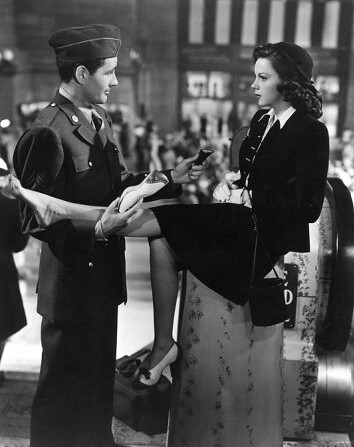
The Clock (1945)

This is a deviation from my usual adherence to lists of movies rated as great by one source or another, as it is unlikely this will appear on any such lists. I was intrigued however by the things James Agee wrote about it at the time it came out, of course I like Judy Garland as a movie star, and I am emotionally partial to many of the sentiments that informed all the arts in this time period, so I made an exception to my usual patterns to see it. It tends to get written about very enthusiastically on the internet--it is the 4th highest rated movie of 1945 by the reviewers at Amazon.com for example--but this is because it is the kind of movie that only people who will be inclined to like it in the first place are going to bother seeing it. It's a saccharine wartime romance about a soldier and an office girl he meets while on two days leave in New York City. The combination of Judy Garland in New York in 1945 is enough to draw me in however.

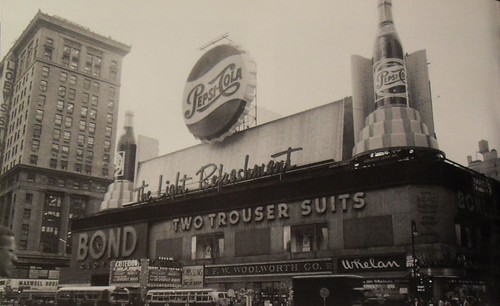
Like It's a Wonderful Life, this film was not a big hit at the time it came out. It was released as the war was winding down in May of 1945 and the critical consensus seems to be that people were starting to transition out of the mood for this kind of overly reassuring picture, perhaps looking forward towards a more materialistic postwar mindset, I am not sure. The settings where this movie takes place--offices, restaurants, train stations, apartments, hotel lobbies--tend to be cramped and crowded and well-worn and shabby, though enlivened by the energy and purpose which the war has unleashed, especially in the young people. This is one of the things I like about it, though in reality getting away from this urban shabbiness and bustle, which looks somewhat attractive after sixty years of suburban living, was one of the first things people were determined to do once the war ended. I have read that the whole movie was filmed on Hollywood sets, but the recreation of New York is very believable. There was even a facsimile made of the Grand Concourse in the interior of the old Penn Station for $66,000. Why, one may ask, would I be attracted to shabbiness? I wonder sometimes if it is not my natural element, since I am always uncomfortable in any kind of any kind of overly efficient and sanitized environment. Any depiction of shabbiness populated by moderately intelligent, or attractive, or even upstanding people--narratives of the bohemian Paris sort being the epitome of this genre--is almost like an affirmation for my existence, though I actually have nothing to do with such scenes in my own life.

Judy Garland is really very good in this. I don't know how intelligent she was--certainly she was not educated, and seems like somebody who even today would be an indifferent student in school--but she was truly gifted as a performer. It is common on the internet to suggest that if Judy Garland were to go on American Idol she would not win for whatever reason, but in fact the great unconscious dream of this contest is that somebody like Judy Garland is going to turn up on it, which, however, appears unlikely to happen, because, leaving aside the question of singing talent, the instinct for stagemanship and having to relate to an audience that is obvious in these old stars is not something that people seem to have anymore. Frances Gumm does not sing in this movie however, which was the first time she had ever had such a role, and she is great. She is wholly convincing as an average working woman that an average soldier would have met and fallen in love with in the mood of 1945. This is in part no doubt because aside from her unusual singing and acting talent, she was that kind of person. She is attractive enough to fall in love with on a good day, but is not anyone who was ever going to be mistaken for Ingrid Bergman. She pulls off the clothes, makeup, hair, conversation, etc, of the class of person she is supposed to be portraying to a very fine point of detail. When you watch some of the clips from her TV show in the 60s, when her speaking voice had become rather grating, and she cackles jarringly at bad jokes, and her eyes had an odd harsh/sad but at the same time not unkind expression, it is just like so many of the women of that wartime generation that I knew growing up. It is not a stretch to imagine that the appearance and temperament of Judy Garland in this movie is not far from what they were like themselves in 1945.

My grandparents were all born in the 1921-24 window, making them ground zero Generation GIs, and my parents were born in 1948 and 1950, which made them ground zero Baby Boomers, so I was exposed early to the conflict between those generations. As you have probably guessed, my sympathies have tended to lie with the World War II crowd from pretty early on. This is probably more a circumstance of chronological juxtaposition than anything else. If I'd been born in 1948, I probably would have had a lot of issues with them too. I know that my father had a very difficult upbringing, his own father, a WWII vet who left the scene for good around the time I was a baby and of whom I have no memory, being by all accounts a very wicked man, and the Catholic church and schools in that era, which accounted for most of the portion of his life outside of the house, appear to have been largely run by sadists who considered it their duty to be brutal and cruel children to a degree that it is unfathomable today. On the other hand, he also spoke critically and hardly about other older people I knew, relatives and family friends, in a way that seemed completely out of proportion to what they deserved. It is true, these people were politically and socially hidebound, many of them were alcoholics and had very troubled familial relations of their own--for example one of my mother's uncles, a foaming at the mouth Republican type who refused to cash his social security checks on principal, had a son in 1969, the story goes, who refused to get his hair cut, a situation which nowadays would probably blow over before dinner, but then my uncle threw him out of the house and they never spoke to each other again, though the father lived another thirty years. When I was a little boy however, these kinds of things didn't carry a lot of meaning for me, and I mostly related to how people made me feel; and my parents and their friends their own age always made me nervous, while the WWII-aged people for reasons that I have never quite figured out, did not. For one thing while the GI crowd would often be critical of children and young people in general, the baby boomers I knew tended more towards sarcasm, which I now realize has no effect on children, who don't understand it, except to confuse them. My perception was that my grandparents and their friends and the teachers I had who were that age were more accepting of me and had more faith in my competence and value to society, and also did more of the kinds of things that would be helpful to a young person. So now that they are largely gone I find I miss them.

A lot of the time I write as if I wished I lived at some past time and place which actually I would find miserable to endure if I were suddenly transported there. But New York in the 40s I really think I might like. Most of the technology I would least want to give up was already in place--electricity, refrigeration, central heat, radio, trains, cars, Coca-Cola. Music, for me at least, was at least as good as it is now, and nightclubs certainly better. I'm sure I could handle the food. Though I see it claimed otherwise (usually by women themselves), it wouldn't surprise me if there were as many attractive women in New York in 1945 as there are now, certainly who would be datable to anyone who wasn't a non grade-A alpha male. I'm guessing investment bankers weren't quite making 300-400X the income of the average worker. More like 10-20 maybe? Of course speculating on living in the past with a mind formed for a world 50 or 2,000 years in the future is not a proper use of said mind, and one ought not to indulge in it.

The scene with the aggressive drunk at the diner was good. I've heard that same tirade many times. Perhaps I have even given it once or twice.


This movie has in some regards nothing and in others seemingly a great deal in connection with the atom bomb, which was in production at the same time. The film has a very subtly, perhaps even largely unconsciously modernist undertone that I did not pick up on myself until several days afterwards. It is kind of taken for granted that the world is a big machine which has to be kept running on schedule, and that everybody in it had better conform to that schedule or they'll caught in the shredder. Throughout the movie the characters are constantly under the constraints of clocks and schedules, curfews, trains, buses, delivery routes, closing hours of museums and offices. The Clock of the title refers to the place they agree to meet for their date, for which Alice is actually a half hour late. Joe's persistence in waiting almost against hope as the clock moves well past the appointed time and life continues to rush on all around him becomes almost poignant. The atom bomb, probably the most awful of all man's inventions, certainly of his stupendous ones, seems to be in some ways the logical conclusion of this kind of society, a society though for which I yet feel a strong affection.

A confluence of circumstances culminating in the chaos into which so much of the populated world had descended by 1944-45 made the building of the atom bomb in the United States probably inevitable and by extension necessary. Using it was perhaps neither, but when wars reach the stage that had been reached at the beginning of August, 1945, a state that thankfully the western world has not experienced since that time, when there is no prospect of ending the hositilies without killing a whole lot of people one way or another, it is highly unlikely that a weapon possessing that much power is not going to be used. For this reason I have little doubt that they will be used again. I also think that the power most likely to use them again is still the United States. The risk of doing so will still be seen by it among all the potential users as the least. No one has really inflicted catastrophic, generation-destroying type destruction or casualties on this nation ever, and we don't seem to have a sense that that really could happen.

All right, I have to end this. I could ruminate more on the bomb, but I suspect it will come up again, and maybe I will think more about it before that time. I am trying to figure out the source of my strong attraction to and good feeling about the time period of the 1940s especially while accounting for all the awful stuff that was going on at that same time.

Thursday, April 08, 2010

The Navigator (1924)Buster Keaton was among the foremost of that race of performers, who flourished especially in the early days of Hollywood, who possessed such a singular collection of talents that his films are necessarily organized around their display, and are not conceivable without him in the lead role. Charlie Chaplin, Fred Astaire, the Marx Brothers and Judy Garland are other people who fit this type of the indispensible star, which is one that doesn't really seem to exist anymore; movies featuring rock stars as themselves I suppose are a relation to these types of movies, but even these are more reliant on the stars' pre-existing celebrity cult than any unique talents employed in the movie. There are of course famous acting performances without which it is difficult to imagine the movies having the impact they have on people--Brando in Streetcar, James Dean's movies, many of Jimmy Stewart's celebrated roles, Schwarzenegger in Conan the Barbarian--but all of these films, even Conan, would still have been written and made even without the stars with whom they are so closely identified. Buster Keaton movies do not exist, and are probably not conceived of as existing, without Buster Keaton. When one considers how repetitive and done to death most things in the arts are, the remarkable thing about the Keaton movies 85 years on is that even when you have something kind of like it, and you sort of know what is coming, you still have not quite seen anything exactly like it, that is exactly as satisfying, which is why he continues to have an impressively wide appeal among serious people and naifs alike even in our time.

I did not enjoy The Navigator quite as much as I did College, which is the only other Buster Keaton movie I have seen to date. I think this is due in part to the circumstance that I have a terror of boats and water generally, so the comic possibilities of drowning or being adrift at sea which the movie has to play upon come off to me perhaps somewhat darker than they do other people. Of course where I live there are ponds and lakes and rivers everywhere, often coming very close up by the road, especially during the rainy seasons such as now and in late fall, where there are also often no guardrails, so I have frequent occasion for Ted Kennedy-style flashbacks and apprehensions. I am a little better on ferries, which I sort of like to take, though I still worry slightly when I am on deck about myself or one of the children falling overboard. The film starts off with two inspired jokes right off the bat, the line where he turns to his valet and says "Wilson (or whatever), I've decided I want to get married. (pause). Today." Of course he has no girlfriend but he has someone in mind to propose to, so he calls for the car, which pulling up to the curb, he gets into it with great ceremony, at which the car pulls out, does a U-turn in the middle of the blissfully empty Los Angeles street (internet photos reveal that the street and the house are still there today, but traffic is much heavier, and pulls up in front of the house directly across the street. At this point I was thinking, this is going to be really great. And it is good, but the various gags on the ship, while often ingenious, don't always strike me as being as funny as other situations do.

To this point also I have to say I am more of a Chaplin than a Keaton fan--these two camps forming one of those strange divisions of life across which there seems to be little commonality or fraternization. Chaplin to me is the fuller human, and brings more of it really is like to be a person into his movies. Keaton may better represent some vision of modernity though. I know he was admired by Samuel Beckett, as well as other modernist intellectual types. His face really was striking, and a work of art in itself, which I don't have to tell you is rare, though it is a quality one notices in celebrated actors. Laurence Olivier's face made something of a similar impression, that of having been deliberately worked by the mind above all into the rather extraordinary and specific appearance it made on the screen.

The tape I had of this movie also included two shorts that kept with the maritime theme, The Boat and The Love Nest. The Boat is about a husband, a wife and their two sons who are a boat that springs a leak in the middle of the night during a tempest. It is actually kind of scary. The Love Nest is set on some kind of cargo ship. The captain is a tyrant who grabs people by the collar and tosses them overboard for things like spilling coffee while pouring it. Which is actually kind of funny.

I often think when watching these old films that my wife missed her true calling, which was to be a 1920s silent film actress, since about half the starlets of this time are of a similar height and body type, and have similar hairstyle and facial structures, which for the most part you don't see so much on television today. Now I don't want to come off as being like either one of those born-again Christians or nerds with a mail order bride from the third world that everyone makes fun of, the guys who are always proclaiming on the internet how hot and incredible their wives are and thanking Jesus for sending them an angel from heaven and so on. As was said of Samuel Johnson's mother, "she knew her son's value" but apparently did not talk about it much. And besides, perhaps not everyone will think it a wonderful thing to look like a 1920s movie star, though I will admit I do think it so. Now among the actresses I have seen lately that reinforced this impression that was made on me some time ago, Lya Da Putti looks like Mrs Bourgeois Surrender/Sabrina/Sarah whatever you want to call her while moving about and doing things in Variete, though not so much in the stills, but the dear one's real doppelganger is the lady who plays the wife in The Boat and several other Buster Keaton classics, the beautiful Sybil Seely, whom one internet commentator I have read considers to be "a whole world of hot" even today. In the film, and other clips available on the internet the resemblance sometimes is really uncanny. I realize this is of little interest to the general public, but some may like the comparison of the pictures. So first we have Sybil Seely, circa 1920:

Mrs Bourgeois Surrender circa 1994:


People love Buster Keaton. Lots of videos made to his work, which does lend itself to this kind of montage very well. I don't have time to watch through all of them. This one looks pretty good.


Wednesday, April 07, 2010

Variete (1925) I have a backlog of movies I wanted to make short commentaries on, and while I would usually prefer to combine them in one big post, the low number of posts I have put up the last few months and the current scarcity of time I have for writing here have persuaded me to try to do a series of White Castle Hamburger-sized mini-posts to get through these movies.

It is only within the last few years that I have begun to watch silent movies in any appreciable manner. As anyone's would, my investigations so far have revealed that greatness in this era has been largely designated as residing in three major scenes: the great comedians of Hollywood, Chaplin, Keaton, Lloyd, et al, plus D.W. Griffith, of whose work I have not seen anything yet, but who must be a truly awesome director, as he is the only American I am aware of whose greatness is insisted upon even though he was an avowed and virulent racist (seriously--I'm not sure it is even safe yet to put in a good word for Jefferson in respectable company, and his racism seems to have somewhat more of the conflicted rather than virulent strain); the Soviet avant garde, flush with the tumult of revolution and outrageous ideology combined with a high art tradition; and the brilliant nihilistic productions of Weimar Germany, in the very dark heart of the old shattered Europe, known by the name of Expressionism, which is the camp out of which Variete emerged.

This is not the easiest film in the world to find a copy of. I was able to buy a DVD for $14.99 from a guy in Phoenix, Arizona. The design, packaging and presentation of this DVD is a slight cut above the disks people burn on their home computers, but it was definitely not put out by any kind of high level media company either. The quality of the movie on it seems to be pretty good as far as I can tell. Variete was directed by Evald Andre Dupont, a native of Saxony, and stars Emil Jannings (born Switzerland) and Lya De Putti, a Hungarian born in what is now part of Slovakia. She died at age 32 and was buried in Ferncliff Cemetery in Hartsdale, New York, where James Baldwin and Judy Garland, among dozens of other celebrities, were also laid to rest. I am not familiar with any of these people outside of this film, but they were important figures in the German theater and arts of their time, which was a very advanced and serious culture that I take an interest in whenever I run across it as a kind of ultimate contrast to my own life.

Like so many classic movies, from Les Enfants du Paradis to La Strada to numerous of Ingmar Bergman's movies to a hundred others I can't think of off hand, the story is set among a troupe of vagabond performers, in this instance circus acrobats, a kind of life that is presented as hard, perilous and a great strain on any kind of stability on one's emotional life, but that also has a certain romantic appeal to bourgeois intellectuals, as the innate physicality suggests both heightened sensuality and authenticity, which are the two components of an interesting life most elusive to bourgeois intellectuals. I love these kinds of movies myself, as well as certain kinds of real theaters and circuses. In the summer in New Hampshire and Vermont there are a number of very small time circus troupes that either travel around from fairground to fairground or pitch a tent at one of the minor league amusement parks. These circuses are probably rather melancholy and pitiful affairs, but there is also a low tech human immediacy about them that makes them a refuge from a lot of the clinical harshness and impersonality of life that oppresses me. Most of the performers in these circuses seem to be Russian, the women attractive but hard-looking when you get closer to them. Some of the acrobats are Hispanic. But I am getting away from the movie again.

Like the best parts of life itself the movie is a tale of desire, jealousy, betrayal, and so forth. The scenes involving the acrobatics as well as the fading in and out between two contiguous scenes were innovative at the time and are celebrated for that, as is explained here. Unlike the vast majority of movies, the camera actually operates like an eye with a highly functioning and interesting brain attached to it. The effect of this is that human life, and its places and objects and rooms, when seen through the filter of this intelligence, appears to be possessed of such weight and meaning as it ordinarily lacks, which is of course the minimum aim I would suspect of all artistic creation. Here is one of the places where success is attained in this, and it is also an example of why I think it is impossible at bottom for any genuine piece of art to be nihilistic. In this case the camera by what it seeks and finds betrays any effect of meaninglessness that one might be susceptible to. It finds meaning everywhere.

Tuesday, April 06, 2010

James Pete Johnson & Bessie Smith--"Backwater Blues"

James Baldwin--Another Country Book I Chapter 1:

"Vivaldo said nothing. His face was pale and angry and he concentrated on looking through his records. Finally he put one on the machine; it was James Pete Johnson and Bessie Smith batting out Backwater Blues."


"There's thousands of people, Bessie now sang, ain't got no place to go, and for the first time Rufus began to hear, in the severely understated monotony of this blues, something which spoke to his troubled mind. The piano bore the singer witness, stoic and ironic. Now that Rufus himself had no place to go--'cause my house fell down and I can't live there no mo', sang Bessie--he heard the line and the tone of the singer, and he wondered how others had moved beyond the emptiness and horror which faced him now."

Bessie Smith--"Empty Bed Blues"
"He got up and turned the record over. Then there was silence, except for the voice of Bessie Smith.

When my bed get empty, make me feel awful mean and blue


'Oh, sing it, Bessie,' Vivaldo muttered.

My springs is getting rusty, sleeping single like I do."

This kind of music has so many fans and authorities that I will not attempt to add to it here. While I do like the first song especially, and can understand why people would think it was something special, I am at the same time quite self-conscious about putting these up on my site here, and wouldn't have done it if it weren't for the references in the book. This is as yet music I admire rationally but do not respond to in any kind of visceral or emotional way, though I have quite strong emotions for the time period in which it originated as well as for much music that are derivations from or inferior imitations of it. This frigid appreciation is not restricted to the blues with me. I have it as well with certain important classical pieces, operas, and such.

Saturday, April 03, 2010

James Baldwin--Another Country (1962) Part 1

I began a long and tortured introduction to this post, but decided to toss it out and just confess that I think this is a pretty bad novel. James Baldwin's life having provided him with enough material, it seems, to get through three books--Go Tell It On the Mountain, which I like, and Notes of a Native Son, which I read with interest, being primarily about being about James Baldwin's experience as a young black man in the 1930s and 40s, and Giovanni's Room, which I haven't read, but which it is my impression is about James Baldwin's experience as a young gay (and black) man in postwar Europe--Another Country, it looks like, was to be about James Baldwin's experiences among bohemians of various races and sexual orientations in 1950s New York. His imaginative powers noticeably hit a wall on this subject however. There is a lot of slang and listing first of all, which weaken the writing--indeed, the book's defining characteristic is how weakly written it is. The speech of the characters and the sex they have comprise most of what passes for action in the book, but even these parts are not tightly written, excessive speech and words that do not move the story, if indeed there even is an identifiable story in this at all. The sex scenes are bad, and don't give us anything we don't know--even me, for Christ's sake! So much of the writing has the effect of filling space--it is clear to me that he had no idea what he wanted to do with this book, but he was James Baldwin and he had to produce a novel, not that there isn't often some virtue in pushing through a period when things aren't working for one, as some of his later books, The Fire Next Time and Tell Me How Long the Train's Been Gone especially, still have some reputation (though so apparently does this one). The ending is wincingly, embarrassingly bad.
I determined about two thirds of the way through that "Another Country" may be supposed to be referring to Love. Though I am not sure.
In spite of the badness of the book, there will still probably be several posts worth of various passages from it with my commentaries on them. It is still New York in the 50s, there is sex, there are lots of great song references which 20 years ago I would have had no idea what was being referred to but which the power of the internet now allows me to fire up on the spot, so I will doubtless play a couple of those numbers too.


Book I, Chapter I: "And he took her arm, deliberately allowing the back of his hand to touch one of her breasts..." Life of the artist, man. What studs some people are.

One woman is described as "a big-assed Joan of Arc".

"...the slackness of their bodies making vivid the history of their degradation."

"He tried to force his mind back through all the beds he had been in..." And this guy is a pathetic nobody. How many girls do most people have?

"She held a drink and a cigarette in one hand and looked at once like the rather weary matron she actually was and the mischievous girl she once had been". I wouldn't mind knowing some people like this. I can think of one person I have met in the last five years who might even have tendencies in this direction.

"Small flames flared incessantly here and there and they moved through shifting layers of smoke...Two boys, one Spanish-looking in a red shirt, one Danish-looking in brown, stood at the juke box, talking about Frank Sinatra." lol. At least I have some memory of what such times were like.

"Head" as a word for toilet I have not encountered before.

"The train rushed into the blackness with a phallic abandon..." There is too much of this kind of stuff.

One of the characters commits suicide by jumping off the George Washington Bridge after addressing the city in the tone of a spurned lover with troubling woman issues. I've walked across this same bridge in not much sounder of a state, and while I had no intention of jumping off, when one is standing out there in the middle of the river looking on the glittering city that probably is never going to give you the love you crave, there is definitely that thought in the back of your head that I'll have to keep this in mind.

On another note I was reading an article a few years ago about all the people who commit suicide jumping off of the Golden Gate Bridge, and there was one guy who had actually survived his attempt. He had slipped his body over the railing and let his hands go off it. He said that about half a second after letting go, his thought was "why did I do that?"
Hey, and there's the bridge. On another note I'm not usually one to talk sales but if this book really sold 2 1/2 million copies that's impressive for a nominally literary novel (albeit one with a decent amount of sex), isn't it? I remember reading that some pretty big names, your Philip Roths and Martin Amises, sometimes can't even get to 50,000 sales (on the other hand The Catcher in the Rye is over 65 million worldwide)

Book I, Chapter 2: "Sorrow became him. He was reduced to his beauty and elegance--as bones, after a long illness, come forward through the flesh." It was beside this sentence on page 109 that I finally wrote "I think this book is kind of bad."

One thing I will say, the New York depicted in this book does feel more like what I think of as the real, normal New York than pretty much anything I read about it now. Even though I know when I go there or listen to a radio call in show when driving around in the area that the place is still full of the kind of people it has been for the last 150 years the Manhattan as a playground for millionaires theme and to a somewhat lesser extent the Brooklyn as destination for the environmentally conscious latte and microbrew-loving sets motif have kind of taken over the media presentation of the city over the last 15 years or so.

"The great question that faced him this morning was whether or not he had ever, really, been present at his life." When I do my own novel-writing, I really do try to stick to the parts of my life where I was present, even though that places severe limits on the kind of material available to be. The wisdom of that approach is reinforced by reading this book however.

"'She used to be a nice girl. Some cat turned her on, and then he split.' He spat on the sidewalk. 'Man, what a scene.'" This is just so much like my own life that I had to include it.

"They had just come up from the subway and it was perhaps this ascent from darkness to day which made the streets so dazzling." Yeah, everybody notices this, but it's still true, and still has the power to give me a thrill when it happens even at age 40, so I like it, and I'm putting it up here.