The idea is commonly put forward by lovers of the idea of free markets that any expression of dissatisfaction with the degree of income inequality generated by the economy in its current form is attributable to nothing more than envy; and envy being a base emotion that can by definition only have origin in inferiority, either inherent or demonstrated, and failure, it is not a ground from which legitimate complaint or criticism can be launched. Given the variability in thought and behavior among human beings generally, as well the widespread concern permeating even into relatively thriving quarters of the population that at least some aspects of this inequality are contributing to serious problems, this dismissal is a little too aggressively simplistic for my liking. To the extent that envy is ever the ruling passion it is asserted as being here, my sense is that it tends to surface rather higher than lower on the scale of accomplishment, among people who actually have attained some desirable position relative to the general population, but simply not desirable enough to themselves. To be truly consumed with envy about another person's money in the sense that free market champions want to ascribe to its critics would appear to require a certain degree of passion or obsessiveness about, and the conception of oneself as a genuine competitor in, that arena. In most instances, and certainly at my level of society, I suspect that the prevailing emotional response to the spectacle of ever-phenomenally expanding wealth for the few who have grasped either how to create or lay claim to a share of some torrent of revenue while the remainder of the cognoscent feel more palpably the extent to which they are being left behind not just financially but intellectually, socially, politically, etc, every day, and the non-cognoscent descend into a state of existence only tangentially related to any kind of advanced civilization at all, would properly be described as anxiety rather than envy. Anxiety does not carry with it the same sting of reprehensibility that envy does, and is a deeper set state of mind, less susceptible to being overcome by mockery or dismissal as well. Grown large enough, unlike the rank envy of petty individuals, I do not see how it will not have effects on the public mood and discourse.
Still, this does not address the popular arguments that are always pressed, such as that income inequality, or at least the amassing of incredible wealth by the savviest people, is not a problem and not only has no significant effect on the life of anybody else, but in fact improves the lives of the lower orders in ways that they are usually too dense to perceive.
First I will speak for myself, since with regard to envy I suppose I might be considered by the productive class a prime example of a person who must be seething with it towards every more realized person around him based on the disparity between my private self-conception and actual demonstrated value. And when placed in very near proximity to men with some similarities of background to myself who are very popular with women, who live in New York, who work or are otherwise involved in the arts or Bohemia to some extent (and consequently socialize frequently with the sophisticated and artistic women of those circles), who seem to be able to travel a lot, who are notably brilliant or at least are widely considered to be so, I have probably felt some twinges of jealousy for the things they are able to do that I am not, though in doing so I am usually acknowledging the superiority of these rivals and not attributing their success to undeserved luck or scheming how to cut them down to my level. But I am rarely in proximity to such people, especially in recent years, and real envy seems to have little pull when remote either in physical space or cultural background. Again most of what might be attributed as envy on my part seems to me much more like anxiety.
Around the time I began plotting this essay, I came upon this nasty article, which gives some examples of this attitude that petulant envy is driving most of the expression of discontent with the current direction of economic life. Like most people who hate anyone with the vaguest leftish sympathies, the aiuthor's ardor is mainly directed towards people who are as worked up on behalf of their own world views as he is for his own; still I don't like the overall tone of the piece and think the point with regard to inequality concenr is as usual missed entirely.
First there is the inevitable comparison of inequality complainers to Holden Caulfield, whose supposedly whiny and passive aggressive, competition-averse persona has long since become a cliche for manly right wing pundits to tag their enemies with. Holden Caulfield is a teenaged character in a novel who suffers a nervous breakdown because his mind is out of step with the prevailing society all around him. I suspect he would have had little more use for modern day leftists than he would even for Republicans. The idea that there is a large class of adults, developmentally delayed or not, in 2015 that deeply identifies with this character to the point that he informs their politics to a delusional and unhealthy degree, strikes me as improbable. His book retains its popularity among some reasonably intelligent people because it is a good read, is funny, and nowadays evokes strong nostalgic associations about things like New York City and boarding schools and the 1940s, though the book nominally does not intend for them to be regarded in this light. Perhaps it appeals to people who lean somewhat leftward to begin with (though the boarding schools and the socially unjust world of the 1940s would seem to be counterintuitive or at least problematic as sources of leftist nostalgia), but its main character hardly represents the default personality of all people who are not absolutely worshipful of capitalism in the form it has taken over the last twenty years.
The hostility about the supposedly misattributed Balzac quote was bizarre. I admit I assumed that Balzac was the source of the "behind every great fortune there is a great crime" quote since everyone has always attributed it to him (the author implies that he knows this because, unlike all of the people who flourish this statement as if it contained any truth, he has read a great deal of Balzac's corpus; for my part I must confess I have only read Pere Goriot, though I did perceive the genius in it, and Cousin Bette and Eugenie Grandet at least are on my list for someday--what I gathered from Goriot was again that the author tended to view everybody as more or less equally petty, selfish, and slavishly striving after social status, regardless of political orientation). Anybody who is a semi-conscious adult has seen examples of moneyed interests using their resources to circumvent or otherwise protect themselves from the consequences of breaking existing laws to preserve and expand the wealth that they already possess, so it is not too far-fetched to imagine that the same ethos might in some instances have been applied in the course of amassing the original fortune. But even granting that the origins of all great wealth are founded purely in solid business acumen, at a certain level of the game artificial advantages begin to accrue to existing wealth that considerably aid the multiplication of that wealth, and enable its possessor to generate sums of money in a hour that a laborer could not make in ten or twenty years. It is this aspect of the business that I most dislike because it seems more excessive and unnecessary in its unfairness. The unfairness lies in the circumstance that all people need money, and most have a devil of a time trying to get any of it, while some few have access to sums larger than the economy of entire nations or regions. Surely there is some point at which this becomes ridiculous, if it cannot be demonstrated to be wrong or applicable to any moral system at all. But there is at present no unified movement of capable people able to apply any restrictions on its practice, which dearth of ability devoted to organizing a more empowered and juster mass society I think will eventually bring our civilization to doom.
With regard to his point about Harvard and Yale and a handful of other prized colleges, while it is true that I know a few people, albeit in my own generation, who made it into those schools from relatively ordinary backgrounds as a result of their talent and hard work, I do not know that their efforts, coming from a similar background, would be sufficient to land them there now. There does seem to be more of a suspicion than there was thirty years ago, at least when it comes to native born Americans beyond the first or second generation, that if the family has not been able to accede to some prominence by now that perhaps there is something deficient in its genetics that the top institutions would be better off not associating themselves with, apart obviously from the very rare cases where some overwhelming talent has been demonstrated during the teenaged years. I do not see how people can claim that having important or significantly wealthy parents is not a marked advantage in being admitted to these schools, even if the talented aspirant without good connections is perhaps not completely devoid of hope. I am not even going to argue in this instance that it is wrong that the children of the best people are given some priority, since wherever they congregate is naturally going to be desirable. However the entering classes at the most coveted schools remain so small that after they accomodate all of these people there are not very many spaces for the remainder of the top 1-3% of the intelligence distribution that is scattered out in the hinterlands. Despite the fearsome reputation for snootiness of Oxford and Cambridge, something like 2% of all 18 year olds in Britain matriculate at one of these two universities. That is ten times the percentage of US 18 year olds in the entire Ivy League. The anxiety about the Ivy League among people in these top few percentiles of the intelligence distribution clearly stems from the circumstance that graduates of these schools, which are inaccessible even to most people in the very top percentile of smarts and achievement, appear to be disproportionately represented among the powerful and influential (and the merely gainfully employed) in government, journalism, finance, certain fields of the arts and so on, and in many instances offer a much surer entry into these professions vis-a-vis other individual schools, many of which have many times the number of students. Part of this effect is exaggerated because media such as The New York Times cannot resist identifying people as Harvard or Princeton educated even in stories where it is not otherwise relevant (such as people taking winemaking seminars in France) which they do not feel a need to do if the person is a graduate of the University of Minnesota. There is also a degree of hype regarding products of these schools that gives them an aura of being almost superhuman in intellect and ability compared to everyone else just as a result of their school connection which is decidedly more pronounced than it was thirty years ago. All of this contributes to anxiety among people who want to be recognized as mentally capable but do not know any surer way than through academic credentialing.
He also states that the middle classes inherit a much higher percentage of their wealth than the mega rich. I am not sure where the cutoff between one class and another is in this instance, but this seems like one of those sleight of hand arguments aimed at people without any grasp of mathematics. There is a lot of ground here on which to shift. Some relevant data here would be actual figures of cash dollars, which are not given. Obviously if a middle class person has no essential wealth from his $50,000 a year income, any inheritance will make up the vast majority of his overall wealth. I do not pretend to know anything about the finances of whenever constitutes the wealthy in this statistic, but it makes it sound as if either no one is passing on these massive fortunes, or they are being passed on to people who are independently even more successful than the original bequeathers, all of which sounds suspicious to me...
Right wing thinkers really do seem to crave a docile underclass that eagerly and cheerfully works for low pay, with no hope or expectation of that pay ever increasing unless the worker demonstrates such truly superior skill that his employer determines him to merit it, goes devoutly to church, marries in the traditional sense and sets a sober, humble example of behavior for their lower class children, asks for nothing in social services or assistance of any kind, seeks no health care or retirement that is not self-funded, and does not demand schooling for their children at government expense. That kind of society requires the underpinning of a serious and fairly deep cultural structure, which on the whole business is not commited to nor interested in developing or upholding. So that isn't going to happen anytime soon.
I have not even addressed the argument that in global terms the American middle class is the 1% and that their wealth and income, if we want to be truly just, should be cut down and redistributed to people in Indonesia and the like. But after two weeks of trying to write this post I need to end it and move on...
Thursday, March 19, 2015

Tuesday, March 03, 2015
Luis Bunuel/John Huston/James Joyce/Andy Williams
The Dead (1987)
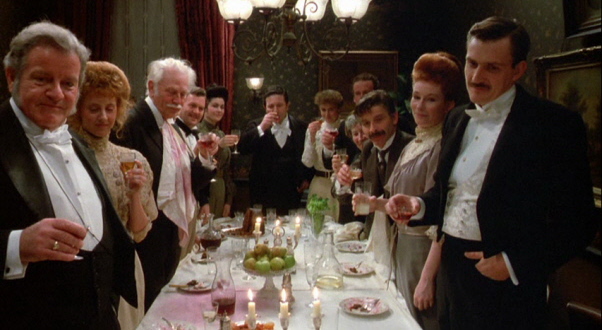 I had seen this about twenty years ago, and I still think pretty much what I thought then, that if you are familiar with the story, the movie doesn't add anything to it, though it is certainly watchable and not an abomination. It is famous for being John Huston's last movie. It is comparable to another literary adaptation he made about ten years previously, of the Flannery O'Connor book Wise Blood. That did not add much to its source material either, though I thought it was mildly more interesting as a movie due to the casting and a slightly more off-kilter approach with regard to its presentation. The Dead is almost a straight transliteration of the events and settings of the book to the screen. Huston's daughter, the famous, or at one time famous actress Angelica, does not come off to me as Gretta, which character I always took to be more of an idealized Celtic type, earthy, but in a particular Irish way that is not quite so heavy and earth-motherly as this usually implies and allows for a suggestion of an inner etherealness that is largely undetected by non-poetic types. I had also always pictured Molly Ivors as being more attractive, in an athletic, vivacious way, than the actress they had playing her here, though both of these are doubtless my personal prejudices at work. The most striking characters in the movie to me were the hard-drinking duo of the protestant Mr Browne and especially the wretched and hopeless but not wholly uncharming alcoholic Freddy Malins. Freddy Malins types seem to have been fairly common in society at large when I was young, but I do not recall coming across one in years. Certainly they would be shunned by any company frequented by high-functioning and respectable people, presumably even in an extended family setting such as that in The Dead.
This is, all in all, a pleasant enough little movie, and depicts a higher level of civilization and conversation than most people experience on a day to day basis. I think if it were not directed by the Great John Huston, one would be more fully satisfied by it. But being directed by the Great John Huston, one feels that it is lacking some extra push or flair properly characteristic of that Greatness.
Born Free (1966)

This is, apparently, a widely known movie, considered by some to be a children's classic, though I had never heard of it. I was certainly familiar with the hit theme song, made famous by Andy Williams among others, which is to this day a staple of AM golden oldies radio stations, but again I had no idea of its being a movie theme, especially for the kind of movie it was, whatever it was: for it does not fit naturally into any genre of contemporary entertainment, though I do like it, partly for that very reason.
My sense of its not fitting into any contemporary genre are due to the following points:
1. While the movie is clearly aimed somewhere at the 10 to say, 16 year old market, which was a big market in the mid-1960s, I think the younger end of that age group would have trouble following the story, especially today, while the whole presentation of the movie is nowhere near cool enough to attract the attract the interest of more than a handful of kids at the upper end.
2. Vestigial colonial attitudes. I joked at one point, after an African women washing clothes along the river had been mauled to death by a lion (not shown on camera), that there should have been a disclaimer stating that 'No caucasians were injured in the filming of this motion picture', because it was fairly obvious by the whole tone of the production that the British naturalist and his blonde wife, while lovers and custodians of nature, were also at all times able to exercise and maintain control over it no less than over the human society around them. They were not going to be overwhelmed or caught off guard by the inferior life forms among which they had thrust themselves, though they affected a respect for them within certain parameters dictated by their conditions of life.
3. I touched on this some in point 2, but being a movie scientist and nature lover in the 1960s involved considerably more recourse to firearms and celebration of carnivorousness than sensitive animal lovers, especially children, would probably be comfortable with nowadays. Our naturalist has to put down (with his rifle) at least 3 lions in the course of the film whose behavior has crossed the line of decency with regard to aggression towards humans, and this without it being suggested that perhaps the people need to remove themselves from proximity to the lions' habitat. Another major part of the plot is the need of the young lioness brought up in captivity to learn how to feed itself by hunting down and devouring zebras and wart hogs and other traditional lion fare. It seems to me it would be hard for a good-hearted contemporary thinker to embrace this facet of development, even in an animal, with any very robust enthusiasm.
The unironically heart-warming ending may represent a kind of peak in the expression of the postwar bourgeois sentiment. There wasn't really anywhere to go after it.
Nazarin (1958)

A Bunuel film from his Mexican period, evidently little seen in the United States, not released here on DVD and available on VHS, which is how I saw it, in very limited supply. I am a true believer in the greatness of Bunuel, but I have become resigned to the understanding that I will probably need to see any of his films three or four times at least before I can perceive and experience this greatness in each individual instance. I watched Nazarin through twice. It is in the somewhat overly stark black-and-white that seems to be especially particular to 1958 (The Defiant Ones and Separate Tables are two examples coming immediately to mind where the film itself has this less than normally striking quality) and which gives the whole work a more artificial quality on a first viewing than other movies in this general period. The subtitles, on the version I saw anyway, come and go very quickly, and as, as might be supposed, there is no inconsiderable degree of weight and subtlety contained within this dialogue, it is something of a chore to keep up. Also I am more than usually tired lately, due to the new baby, and probably my age, and the first time I tried to watch I struggled from about minute twenty through minute sixty to remain awake and alert before finally succumbing to sleep in my armchair; the second time I made it through all the way to the end, though I faded again in the last hour, and the next day when I tried to recount what happened to the main character at the end I could not remember at all for several minutes before my brain, scanning its own recesses desperately for some image or clue, came upon the ox or horse-drawn fruit cart that does appear in the last scene. Needless to say I have to consider my assessment of this movie incomplete for the time being.

I suspect that after another viewing or two (at some future time) something that binds together its to me still disjointed and not wholly coherent parts will become clearer to me and the movie will attain for me a whole that I have not yet been able to grasp.
This is, all in all, a pleasant enough little movie, and depicts a higher level of civilization and conversation than most people experience on a day to day basis. I think if it were not directed by the Great John Huston, one would be more fully satisfied by it. But being directed by the Great John Huston, one feels that it is lacking some extra push or flair properly characteristic of that Greatness.
Born Free (1966)
This is, apparently, a widely known movie, considered by some to be a children's classic, though I had never heard of it. I was certainly familiar with the hit theme song, made famous by Andy Williams among others, which is to this day a staple of AM golden oldies radio stations, but again I had no idea of its being a movie theme, especially for the kind of movie it was, whatever it was: for it does not fit naturally into any genre of contemporary entertainment, though I do like it, partly for that very reason.
My sense of its not fitting into any contemporary genre are due to the following points:
1. While the movie is clearly aimed somewhere at the 10 to say, 16 year old market, which was a big market in the mid-1960s, I think the younger end of that age group would have trouble following the story, especially today, while the whole presentation of the movie is nowhere near cool enough to attract the attract the interest of more than a handful of kids at the upper end.
2. Vestigial colonial attitudes. I joked at one point, after an African women washing clothes along the river had been mauled to death by a lion (not shown on camera), that there should have been a disclaimer stating that 'No caucasians were injured in the filming of this motion picture', because it was fairly obvious by the whole tone of the production that the British naturalist and his blonde wife, while lovers and custodians of nature, were also at all times able to exercise and maintain control over it no less than over the human society around them. They were not going to be overwhelmed or caught off guard by the inferior life forms among which they had thrust themselves, though they affected a respect for them within certain parameters dictated by their conditions of life.
3. I touched on this some in point 2, but being a movie scientist and nature lover in the 1960s involved considerably more recourse to firearms and celebration of carnivorousness than sensitive animal lovers, especially children, would probably be comfortable with nowadays. Our naturalist has to put down (with his rifle) at least 3 lions in the course of the film whose behavior has crossed the line of decency with regard to aggression towards humans, and this without it being suggested that perhaps the people need to remove themselves from proximity to the lions' habitat. Another major part of the plot is the need of the young lioness brought up in captivity to learn how to feed itself by hunting down and devouring zebras and wart hogs and other traditional lion fare. It seems to me it would be hard for a good-hearted contemporary thinker to embrace this facet of development, even in an animal, with any very robust enthusiasm.
The unironically heart-warming ending may represent a kind of peak in the expression of the postwar bourgeois sentiment. There wasn't really anywhere to go after it.
Nazarin (1958)
A Bunuel film from his Mexican period, evidently little seen in the United States, not released here on DVD and available on VHS, which is how I saw it, in very limited supply. I am a true believer in the greatness of Bunuel, but I have become resigned to the understanding that I will probably need to see any of his films three or four times at least before I can perceive and experience this greatness in each individual instance. I watched Nazarin through twice. It is in the somewhat overly stark black-and-white that seems to be especially particular to 1958 (The Defiant Ones and Separate Tables are two examples coming immediately to mind where the film itself has this less than normally striking quality) and which gives the whole work a more artificial quality on a first viewing than other movies in this general period. The subtitles, on the version I saw anyway, come and go very quickly, and as, as might be supposed, there is no inconsiderable degree of weight and subtlety contained within this dialogue, it is something of a chore to keep up. Also I am more than usually tired lately, due to the new baby, and probably my age, and the first time I tried to watch I struggled from about minute twenty through minute sixty to remain awake and alert before finally succumbing to sleep in my armchair; the second time I made it through all the way to the end, though I faded again in the last hour, and the next day when I tried to recount what happened to the main character at the end I could not remember at all for several minutes before my brain, scanning its own recesses desperately for some image or clue, came upon the ox or horse-drawn fruit cart that does appear in the last scene. Needless to say I have to consider my assessment of this movie incomplete for the time being.
I suspect that after another viewing or two (at some future time) something that binds together its to me still disjointed and not wholly coherent parts will become clearer to me and the movie will attain for me a whole that I have not yet been able to grasp.
Sunday, March 01, 2015
Check-In & Commemoration
I haven't been able to sit down at a computer for any length of time in a few weeks. I have a lot to catch up on, though for me the process of actually writing anything requires me to slow down and just let the essays come out at the pace they need to come out at. Before my recent week off (winter vacation, though due to the new baby we did not go to Florida this year), I saw that Lloyd Fonvielle, a writer whose blog I had linked to and who was a friend of this site insofar as he linked to it and one or two visitors a week drifted over from his site, died, suddenly from my vantage point as I do not know what the cause of death was, he had been posting on his page up to about a week before he died, and had gone on a pretty active road trip around the southwest as recently as the Christmas season. I liked that guy, or at least I liked his site. There aren't many blogs, to be honest, that consistently deal with the kinds of things I am interested in, and even fewer that do so in a congenial way. So I feel a mild compulsion to acknowledge that. When I was looking at the pictures of his road trips, where he seemed to have all the time in the world out among those open spaces in the west and was able to go out to bars at night and eat in cool-looking restaurants I was quite envious and thought, oh, for the day, if it ever does come, when I will be able to do that sort of thing, some of it again, some of it almost for the first time. But the nature of things for most men anyway is to be occupied with some other business than what you want to be occupied with right up to the very last. It is necessary, for you at least, if nothing else.
Anyway I hope to be putting up more posts here soon. I have not quit the blog.
Anyway I hope to be putting up more posts here soon. I have not quit the blog.
Wednesday, February 18, 2015
Mid-Winter Music & Video Post
Consistent with the theme that has predominated with me of late, I haven't been enjoying much in the way of music recently, even any of the usually reliable awful stuff. My schedule tells me it is time to do a music post however, so I am going to try to remember a few things I have clumsily groped with over the past few months.
Dance contest to the Jackson 5 on Top of the Pops from 1970. I like the enthusiasm of the English girls in this period. Yes, they were reaping the great fun that the atmosphere of the age promised and provided, but they were also instrumental in the generation and diffusion of it as well. There was almost a virtuous cycle of fun, with boys and girls equally capable, it seems, of giving the opposite sex something of what it wanted, for a brief period there.
Here's another episode from the same time. The girls are even better in this one. I think the song is quite good, too. I had never paid close attention to it before. It possesses the realized form as well as interior fullness that is the first source of success in all human endeavor, whatever the scale.
For a while they were playing this song a lot on the golden oldies radio station I usually have on in the car, and it kind of grew on me, though of late it has been growing away from me again. Several of the comments on the video posit that it may be the worst music video of all time. I think it is a contender. Very creepy, full of static, odd-looking people and repetitive camera shots; even the cuteness of the waitress can't redeem it.
This is my favorite Carpenters song.
All right, it is the epitome of a bland white-guy pop song. It does have the kind of sound that is comforting when it comes on in an empty Rite-Aid on a gloomy winter afternoon in a remote corner of the country. Granted, something Greater would doubtless be even more comforting, but they probably aren't going to play that.
There were about a million guys in 1978 who looked approximately like this singer (and about half of them were named Steve, too). It was the generic white guy look at the time. Today the default for this demographic is to look roughly like Louis C K, which seems a strange direction in which to have evolved. It also seems strange, or at least counterintuitive to me both that people in the same generation should physically have certain broadly shared characteristics, and that these do not carry over to immediately succeeding generations. Yet the phenomenon is observed by almost everyone.
Towards the middle of this one there are a bunch of old men who, the minute you see them, you are reminded that that was what lots of old men looked like in the 1970s, their faces, hair, wrinkles and so on. I see hardly any old men who look like that now.
I am not a James Taylor fan at all, though I do kind of like this song and this little video, both of which are kind of New Englandy. James Taylor is rather famously from New England--granted, that part of New England that goes to boarding school and summers on the Cape, but then that is the part that most of the outside world thinks of when they think of New England. Indeed, it is the part I think of as representing the real New England when I am not bogged down in the boring details of day to day life. Anyway, there are a lot of obviously New England towns featured in this wistful and nostalgia-inducing video, several of which I am sure I have probably been to, but cannot exactly place because I was probably only there once. The only one I am fairly sure of is that the town around 2:40 is Portsmouth, New Hampshire.
I heard this on the radio the other day and remembered that I hadn't listened to any Jo Stafford for a while. It's important that I revisit her from time to time.
I have been going through one of my periodic (every 2-3 years maybe?) spells of Paris nostalgia. I couldn't find any music videos that really captured my mood. There is however, frozen forever in the late 80s period approximate to the first time I went there (1990), the good old 'French in Action' TV series, starring the incomparable Mirielle (Valerie Allein), Pierre Capretz as the excitable Gallic teacher, and Robert the American sporting around Paris with his Yale t-shirt under a blazer. I like Robert's character too. He seems practically laid back, unobsessive about burnishing his resume and modest about his intellectual prowess to be a candidate for the Ivy League nowadays, but I suppose the pushing fifty version of the character might have snapped to attention when this new zeitgeist came in around 1992-95 and allowed these aspects of his persona more play. The city I suspect is radically changed from what it was even when I was last there, which was in 1999. Paris is the city above all others (well, Paris & maybe Prague) that I have the most attachment to in the particular version in which it existed in my youth. My love for it, even stripped of and beyond the idea of it, or ideas in general, is one of the few things I feel to be real in the whole of my existence.
I had one of those intense dreams the other night that I was there, though I was actually only in the conference room of a mid-level American chain hotel eating breakfast. There was a black preacher running a service for a largely black congregation at this breakfast, during which however I was drinking and, most uncharacteristically, laughing giddily and otherwise acting out, much to the consternation of everyone present, so that my wife, who had not been there previously, had to come in and get me and lead me out of the room and down something like an airport corridor and then suddenly back to our own kitchen. I had been whisked straight back from Paris before I had seen anything, before I had even gotten out on the street. My wife told me I could fly back later on in the day or week, but you know the dream never got to that point.
Well, there is always this, too.
Dance contest to the Jackson 5 on Top of the Pops from 1970. I like the enthusiasm of the English girls in this period. Yes, they were reaping the great fun that the atmosphere of the age promised and provided, but they were also instrumental in the generation and diffusion of it as well. There was almost a virtuous cycle of fun, with boys and girls equally capable, it seems, of giving the opposite sex something of what it wanted, for a brief period there.
Here's another episode from the same time. The girls are even better in this one. I think the song is quite good, too. I had never paid close attention to it before. It possesses the realized form as well as interior fullness that is the first source of success in all human endeavor, whatever the scale.
For a while they were playing this song a lot on the golden oldies radio station I usually have on in the car, and it kind of grew on me, though of late it has been growing away from me again. Several of the comments on the video posit that it may be the worst music video of all time. I think it is a contender. Very creepy, full of static, odd-looking people and repetitive camera shots; even the cuteness of the waitress can't redeem it.
This is my favorite Carpenters song.
All right, it is the epitome of a bland white-guy pop song. It does have the kind of sound that is comforting when it comes on in an empty Rite-Aid on a gloomy winter afternoon in a remote corner of the country. Granted, something Greater would doubtless be even more comforting, but they probably aren't going to play that.
There were about a million guys in 1978 who looked approximately like this singer (and about half of them were named Steve, too). It was the generic white guy look at the time. Today the default for this demographic is to look roughly like Louis C K, which seems a strange direction in which to have evolved. It also seems strange, or at least counterintuitive to me both that people in the same generation should physically have certain broadly shared characteristics, and that these do not carry over to immediately succeeding generations. Yet the phenomenon is observed by almost everyone.
Towards the middle of this one there are a bunch of old men who, the minute you see them, you are reminded that that was what lots of old men looked like in the 1970s, their faces, hair, wrinkles and so on. I see hardly any old men who look like that now.
I am not a James Taylor fan at all, though I do kind of like this song and this little video, both of which are kind of New Englandy. James Taylor is rather famously from New England--granted, that part of New England that goes to boarding school and summers on the Cape, but then that is the part that most of the outside world thinks of when they think of New England. Indeed, it is the part I think of as representing the real New England when I am not bogged down in the boring details of day to day life. Anyway, there are a lot of obviously New England towns featured in this wistful and nostalgia-inducing video, several of which I am sure I have probably been to, but cannot exactly place because I was probably only there once. The only one I am fairly sure of is that the town around 2:40 is Portsmouth, New Hampshire.
I heard this on the radio the other day and remembered that I hadn't listened to any Jo Stafford for a while. It's important that I revisit her from time to time.
I have been going through one of my periodic (every 2-3 years maybe?) spells of Paris nostalgia. I couldn't find any music videos that really captured my mood. There is however, frozen forever in the late 80s period approximate to the first time I went there (1990), the good old 'French in Action' TV series, starring the incomparable Mirielle (Valerie Allein), Pierre Capretz as the excitable Gallic teacher, and Robert the American sporting around Paris with his Yale t-shirt under a blazer. I like Robert's character too. He seems practically laid back, unobsessive about burnishing his resume and modest about his intellectual prowess to be a candidate for the Ivy League nowadays, but I suppose the pushing fifty version of the character might have snapped to attention when this new zeitgeist came in around 1992-95 and allowed these aspects of his persona more play. The city I suspect is radically changed from what it was even when I was last there, which was in 1999. Paris is the city above all others (well, Paris & maybe Prague) that I have the most attachment to in the particular version in which it existed in my youth. My love for it, even stripped of and beyond the idea of it, or ideas in general, is one of the few things I feel to be real in the whole of my existence.
I had one of those intense dreams the other night that I was there, though I was actually only in the conference room of a mid-level American chain hotel eating breakfast. There was a black preacher running a service for a largely black congregation at this breakfast, during which however I was drinking and, most uncharacteristically, laughing giddily and otherwise acting out, much to the consternation of everyone present, so that my wife, who had not been there previously, had to come in and get me and lead me out of the room and down something like an airport corridor and then suddenly back to our own kitchen. I had been whisked straight back from Paris before I had seen anything, before I had even gotten out on the street. My wife told me I could fly back later on in the day or week, but you know the dream never got to that point.
Well, there is always this, too.
Monday, January 26, 2015
Blog News
I have been away from the site for a couple of weeks because my wife had another baby, and I haven't been organized enough to put up a post about it, even just a few pictures. But things have calmed down enough that I should be able to manage to do that at least.


The baby's name is Dorothy Harriet. It was tentatively going to be Harriet Dorothy for about a month until it was born, when some reservations about Harriet emerged. I have always wanted to name a daughter Dorothy, though I do like Harriet too. So far I find I am calling the baby Dodo Bird a lot, but this will probably not persist once the child progresses into the early grades of elementary school.

I am backtracking here to Christmas time, which I missed on the site this year. This is all four of the boys at their grandmother's house.

#1 & #4 visit the hospital. With me. This is probably what I look like most of the time.

Completely spontaneous and unposed picture of Dorothy's first homecoming. This was only a week ago. We've had about two more feet of snow and a seemingly continuous decline in the temperature since then. It is not actually unusual for us to get the amount of snow we have had in the last month, but it is unusual to have these kinds of large storms when it is simultaneously 10 or 15 degrees out (rather than say, 29). That's what has really been the story of the weather, to me.

Obviously this picture of my older (age 3) daughter was too much to pass up.
The baby was a girl (this was known in advance), the second daughter after four boys. I'll be 63 when she graduates from high school, and 75 when she turns 30, if I make it that far. I sure hope all of these children will be all right by then, able to make some kind of life for themselves and so on. The general zeitgeist is so pessimistic about this unless the individual person is both unusually talented and possessed of a superhuman work ethic (I suppose it could be argued it is my duty to instill the superhuman work ethic in them, though I am not really sure what the inner qualities and motivations necessary to drive it consist of). I am not quite so pessimistic about this, first because I kind of have to be, but also simply because beyond a certain point the number of young people with a prayer of achieving any sense of success in life becomes so vanishingly small as to become logically unsustainable. What I mean is that the society will have to re-orient its understanding of what is an acceptable or desirable goal for young people, especially those of above-average brightness, to something that is at least reasonably attainable, if it hopes to reclaim some semblance of sanity. I think that it will do this over the next few decades.
The baby's name is Dorothy Harriet. It was tentatively going to be Harriet Dorothy for about a month until it was born, when some reservations about Harriet emerged. I have always wanted to name a daughter Dorothy, though I do like Harriet too. So far I find I am calling the baby Dodo Bird a lot, but this will probably not persist once the child progresses into the early grades of elementary school.
I am backtracking here to Christmas time, which I missed on the site this year. This is all four of the boys at their grandmother's house.
#1 & #4 visit the hospital. With me. This is probably what I look like most of the time.
Completely spontaneous and unposed picture of Dorothy's first homecoming. This was only a week ago. We've had about two more feet of snow and a seemingly continuous decline in the temperature since then. It is not actually unusual for us to get the amount of snow we have had in the last month, but it is unusual to have these kinds of large storms when it is simultaneously 10 or 15 degrees out (rather than say, 29). That's what has really been the story of the weather, to me.
Obviously this picture of my older (age 3) daughter was too much to pass up.
Thursday, January 22, 2015
Movies 1959-1963 (Legendary Ones Too!)
As increasingly happens to me with books, I have hit a snag with regard to my movie watching where I haven't been enjoying it as much lately as I did before. Part of this is that there are always too many other things going on, and I don't have, or don't feel that I have, even an hour in a day that I can take to watch a film or write or do anything I want to do without getting distracted or jittery. The other part is that I have been seeing almost all modern things, modern for me being anything after about 1970, which I rarely like. So having finally gotten back again towards the time period and the accompanying sensibility that I like, and with the next three pictures up on my list iconic and all time popular classics, I had hope that I would get swept up in the spirit of the project again, as seems to have been the case with my reading when I began sprinkling in again novels and plays of the sort that I like, intelligent and funny without being at every instant a test or indictment of my intelligence or other development, among the heavier material that I find I am no longer able to read with any sense of accomplishment or enjoyment. This partially happened. I did feel, in one instance especially and in parts of the other two, that I was experiencing great and significant work, and I could see where at another time and in another psychological state of mind I would have taken to them with real enthusiasm. At the same time I feel at this point so remote from the artistic process and the state of mind in which it flourishes and which is the basis of what most great artworks are about, maybe more so than at any time in my life, that it is hard for me to take up anything that does not belong to the truly remote past, before the adult memory of almost any living person, without feeling sheepish or embarrassed before it. Also at least two of these movies were very long, so that I had to watch them over several nights, and in my current agitated state I was never really being able to settle in to the world which the film inhabited, which is especially important to do with epics.
8 1/2 (1963)
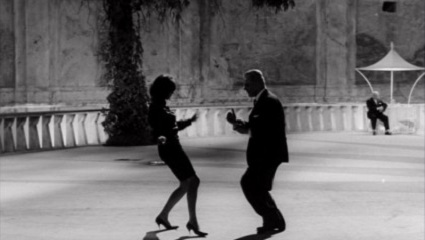
I may have the mind and perception of a child, but I have enough sense to know that this has greatness imprinted on it in just about every frame. This does not require a keen insight, as the movie's status as one of the immortal monuments of the postwar international art cinema
has been established almost from the day it came out. It is hard for me to project seriousness, but I do mean it, it's an impressive work. Fellini was a true badness, and this movie is a two hour and eighteen minute. masterfully stylized demonstration
of what being that kind of artist consists of. The scene (I was going to say the famous scene, but almost every scene in this is famous) where Mastroianni, who seems to have been a badass of acting in his own right, in his dream, has gathered all of the important women in his life, wives, mistresses, prostitutes, childhood fascinations, actresses and so on, in his childhood home where they cook dinner and bathe him and wrap him up in blankets before they begin to snipe and make accusations and demands, at which he has to drive them back with a whip is one of the most memorable depictions of a properly flourishing male ego that I have seen. But then the set of the spa, both by day and night, where Mastroianni and his entourage have come, nominally to begin work on his next movie, the nightmare of the traffic jam, the dingy railway hotel where he stashes his mistress--these are all wonderful enhancements and understandings of the possibilities of life also. But you knew all that.
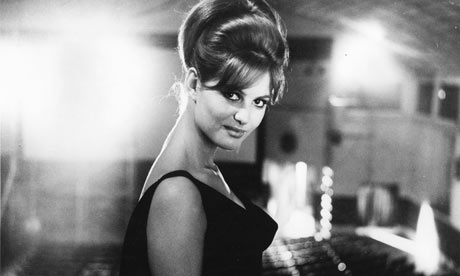
It is a sign however of how off I am at the moment that I did not feel much personal emotion or thrill, even of the quieter sort, while watching this, which I usually do when encountering artworks of this stature and caliber. As enumerated above, this has much to stir and raise even the most dormant spirit, but mine does not seem to be capable of being stirred by anything. It even has Claudia Cardinale in 1963 for goodness's sake-- her 1963 is one of those singular years in the history of movies, or anything else, where a woman attains a unique and frankly awesome state of near perfection that is too fragile to hold for more than a few months (Grace Kelly around 1954 comes to me as another example of this phenomenon; no one else is coming immediately to mind in this same way at the moment). But I can't feel that any of this has anything to do with me anymore, and such a thing is to me a kind of indictment or accusation for the obvious reasons that we don't need to go over again. But I hope our culture can continue to produce enough people who possess enough intelligence and spirit to enable the film to survive, that it may speak to people even many generations from now and the names and personae of Fellini and Mastroianni and Cardinale and Italy and even Europe will still resonate and have meaning for them. I don't think it is a certainty that they will by any means.
Psycho (1960)
To be honest, I find the story here to be unsatisfying. It doesn't hold together. The characters aren't strong enough. From the 21st century point of view it is wholly implausible that the Bates Motel would not be under 24 hour police surveillance just on principle, though implausibility in itself is not enough to mar an otherwise fascinating tale. There isn't really enough tension or motivation here to interest me.

That said, I find it very watchable. The world of the old U.S. highways with their oddly designed turns and exits, lined by empty spaces or local nature that looks more organic than that along most of the interstates with the occasional sketchy hotel or odd, out of place looking Victorian mansion has largely disappeared in much of the country, namely the more populated parts of it, but where I live the roads are largely still like this. The film was shot on the same lot as Hitchcock's TV series was, and it has the look and feel of television productions from that time, which effect however I like (Inherit the Wind was also filmed on a TV lot around this time, and I noted that I liked this aspect about that movie too). Janet Leigh's muscular, almost strapping, physique caught my attention--it is not a type I associate with this time period. As I begin to move beyond the time of life where I can even pretend that varied experiences of the sensual kind are still realistic possibilities, I have taken more of an interest in the variety of physical body types and attributes than I was want to do in my desperate youth, when I wrote off everything beyond finding someone who was identifiably female from ten feet away and would not be too harsh for my fragile personality to be capable of contending with as luxuries I could not afford. I also like the quiet, slow pace of this movie; it is not that I don't like the frenetic, anything can happen style of Fellini and other artists of his type, but as hardly a day of my life has ever assumed that form, it is always an alien experience for me to try to comprehend. The tone of my day to day life is, unfortunately, a hell of a lot closer to Norman Bates's than it is to that of any character in a Fellini movie. Anyway, the main thrust is there are many things about Psycho that I like, I just think the plot misses in some way. I missed the Hitchcock cameo as I always do. I haven't bothered to look up where it was--what's the point of that? The game is to find it on your own.

Ben-Hur (1959)
I was a little piqued when this came up. It is certainly legendary, and won a chariotful of Oscars, which kinds of movies I find I usually enjoy, provided they are old enough. I also had not seen anything of this kind, namely an old Hollywood studio epic set in ancient times, in a while, and I thought that might be something that could revive my sense of enjoyment of life, which effect watching and reading depictions of Roman-era fighting, torture, injustice and so on often inspires in me.

I had seen it. or some of it at least, when I was around eleven, and while various of the more vivid scenes, i.e. the slave galley and the chariot race, had imprinted themselves on my memory, my ability to follow the story had been hindered by my complete lack at that time of any background in either religion or ancient history. I may have recognized that the unnamed man who gives Ben Hur water when the slave caravan passes through his village is supposed to be Jesus, but how that otherwise fit into the story would have been beyond me. The emphasis on Ben Hur's being a Jew would also have meant little to me at that time other than as a signal that he was probably going to be treated unfairly (i.e., I don't think I was clear at the time what 'being Jewish' meant either in a religious or racial sense). Other aspects of the plot had been confusing to me as well. Seeing as my understanding of some of this background matter has improved somewhat in the ensuing 34 years, I anticipated a much heightened viewing of the movie this time around.
Ben-Hur has its moments, though the three hour and forty-two minute running time is a bit excessive, given that the major episodes in the plot, extended though some of them are, are really not that numerous. There is a lot of dead time waiting around for the highlights. After the chariot race there are still forty or so minutes left, which are given over mainly to Ben Hur's finding his mother and sister in the leper colony and the last days and passion of Jesus Christ. It may have been good, but by that point in the movie my concentration was gone. I assume Ben-Hur must have converted to Christianity at the end, but I do not remember the scene or announcement when he did this, which is kind of embarrassing.

The logistics of showing this in the theater in some noweheresville American town, or even a place like Brattleboro or Concord, in 1959 are of interest to me. Unemployment in those days was like 2% and nothing stays open past 10pm even now so during the week they must have had to start the show around 6pm sharp, and with intermission they'd be lucky to be done by ten o'clock. It was a full night's outing, or afternoon if you went to the matinee. I suppose I only find it fascinating because I feel like I haven't had an evening, or a four hour block of time in which to do anything, sit in a beer garden or whatever, in years, and so I assume no one does such things anymore.
Burt Lancaster (as well as Marlon Brando) was offered the role of Ben Hur before it descended upon Charlton Heston, which only strengthens my theory that you could not keep Burt Lancaster out of classic movies in the late 50s and early 60s, unless he kept himself out of them.
Ben Hur's sister was played by Cathy O'Donnell, who was Wilma, the girlfriend/wife of the amputee in The Best Years of Our Lives, which was also directed by William Wyler. I had never seen her, or noticed her, in any other part. Ben-Hur turned out to be her last film.
I have to admit that I kind of like Charlton Heston. He was really a man of his generation, which is pretty much gone for good now, including him, though he was active in an often outrageous, frequently hilarious and to me somewhat endearing way up to the early 2000s. Of course as one of the last visible and combative elders of the World War II generation the ever obnoxious baby boomers were sniping at him to the very end, at which point he had alzheimer's and probably didn't know what he was saying half the time. I'm sure he was a more genial man to talk to in person than most baby boomers of similar stature would be. Though he became famous late in his life as a right wing caricature, he did not vote for a Republican presidential candidate until Nixon in 1972 when he was nearly fifty years old, which was an election when a lot of people of roughly his age decided things had gone a bit far and switched side. He did not officially register as a Republican and become the activist on their behalf that he is thought of as now until he was in his 60s. I suspect that in the 2030s, when I am 64 or so, I will appear to younger people to be the embodiment of a conservative reactionary, they'll regard me as Samuel Johnson regarded the old Puritans who were still hanging around scowling at everybody when he was a boy. I hope it doesn't happen, but we've all seen that old men, especially if things have always gone along pretty well for them in life, don't as a group take much to change, which eventually comes to some point that they just can't go across.
The next five star movie on the list is the cartoon Aladdin, which I am not going to watch. It is not a favorite of my children, though they saw it once, or the older ones did, a few years back, and what I saw of it I didn't like. So I am recording it as done here.
The incident from Ben-Hur that made the greatest impression on me was the part during the chariot race when Messala, who has by that point long established himself as the embodiment of Roman tyranny and cruelty for the sake of cruelty, lays off from lashing his horses for a moment and in a furious rage begins to lash Ben Hur, his childhood best friend whom he has already sent to the galleys for three years, with the intention that he never return. I was struck by the capacity that Messala had to hate another man that much for what appeared to me at the time no apparent reason, because I did not understand the exchange in the beginning when Ben-Hur refuses to sell out his people to give smoother sailing to Messala's political ambitions. It seemed something worth noting to me.
8 1/2 (1963)
It is a sign however of how off I am at the moment that I did not feel much personal emotion or thrill, even of the quieter sort, while watching this, which I usually do when encountering artworks of this stature and caliber. As enumerated above, this has much to stir and raise even the most dormant spirit, but mine does not seem to be capable of being stirred by anything. It even has Claudia Cardinale in 1963 for goodness's sake-- her 1963 is one of those singular years in the history of movies, or anything else, where a woman attains a unique and frankly awesome state of near perfection that is too fragile to hold for more than a few months (Grace Kelly around 1954 comes to me as another example of this phenomenon; no one else is coming immediately to mind in this same way at the moment). But I can't feel that any of this has anything to do with me anymore, and such a thing is to me a kind of indictment or accusation for the obvious reasons that we don't need to go over again. But I hope our culture can continue to produce enough people who possess enough intelligence and spirit to enable the film to survive, that it may speak to people even many generations from now and the names and personae of Fellini and Mastroianni and Cardinale and Italy and even Europe will still resonate and have meaning for them. I don't think it is a certainty that they will by any means.
Psycho (1960)
To be honest, I find the story here to be unsatisfying. It doesn't hold together. The characters aren't strong enough. From the 21st century point of view it is wholly implausible that the Bates Motel would not be under 24 hour police surveillance just on principle, though implausibility in itself is not enough to mar an otherwise fascinating tale. There isn't really enough tension or motivation here to interest me.
That said, I find it very watchable. The world of the old U.S. highways with their oddly designed turns and exits, lined by empty spaces or local nature that looks more organic than that along most of the interstates with the occasional sketchy hotel or odd, out of place looking Victorian mansion has largely disappeared in much of the country, namely the more populated parts of it, but where I live the roads are largely still like this. The film was shot on the same lot as Hitchcock's TV series was, and it has the look and feel of television productions from that time, which effect however I like (Inherit the Wind was also filmed on a TV lot around this time, and I noted that I liked this aspect about that movie too). Janet Leigh's muscular, almost strapping, physique caught my attention--it is not a type I associate with this time period. As I begin to move beyond the time of life where I can even pretend that varied experiences of the sensual kind are still realistic possibilities, I have taken more of an interest in the variety of physical body types and attributes than I was want to do in my desperate youth, when I wrote off everything beyond finding someone who was identifiably female from ten feet away and would not be too harsh for my fragile personality to be capable of contending with as luxuries I could not afford. I also like the quiet, slow pace of this movie; it is not that I don't like the frenetic, anything can happen style of Fellini and other artists of his type, but as hardly a day of my life has ever assumed that form, it is always an alien experience for me to try to comprehend. The tone of my day to day life is, unfortunately, a hell of a lot closer to Norman Bates's than it is to that of any character in a Fellini movie. Anyway, the main thrust is there are many things about Psycho that I like, I just think the plot misses in some way. I missed the Hitchcock cameo as I always do. I haven't bothered to look up where it was--what's the point of that? The game is to find it on your own.
I was a little piqued when this came up. It is certainly legendary, and won a chariotful of Oscars, which kinds of movies I find I usually enjoy, provided they are old enough. I also had not seen anything of this kind, namely an old Hollywood studio epic set in ancient times, in a while, and I thought that might be something that could revive my sense of enjoyment of life, which effect watching and reading depictions of Roman-era fighting, torture, injustice and so on often inspires in me.
I had seen it. or some of it at least, when I was around eleven, and while various of the more vivid scenes, i.e. the slave galley and the chariot race, had imprinted themselves on my memory, my ability to follow the story had been hindered by my complete lack at that time of any background in either religion or ancient history. I may have recognized that the unnamed man who gives Ben Hur water when the slave caravan passes through his village is supposed to be Jesus, but how that otherwise fit into the story would have been beyond me. The emphasis on Ben Hur's being a Jew would also have meant little to me at that time other than as a signal that he was probably going to be treated unfairly (i.e., I don't think I was clear at the time what 'being Jewish' meant either in a religious or racial sense). Other aspects of the plot had been confusing to me as well. Seeing as my understanding of some of this background matter has improved somewhat in the ensuing 34 years, I anticipated a much heightened viewing of the movie this time around.
Ben-Hur has its moments, though the three hour and forty-two minute running time is a bit excessive, given that the major episodes in the plot, extended though some of them are, are really not that numerous. There is a lot of dead time waiting around for the highlights. After the chariot race there are still forty or so minutes left, which are given over mainly to Ben Hur's finding his mother and sister in the leper colony and the last days and passion of Jesus Christ. It may have been good, but by that point in the movie my concentration was gone. I assume Ben-Hur must have converted to Christianity at the end, but I do not remember the scene or announcement when he did this, which is kind of embarrassing.
The logistics of showing this in the theater in some noweheresville American town, or even a place like Brattleboro or Concord, in 1959 are of interest to me. Unemployment in those days was like 2% and nothing stays open past 10pm even now so during the week they must have had to start the show around 6pm sharp, and with intermission they'd be lucky to be done by ten o'clock. It was a full night's outing, or afternoon if you went to the matinee. I suppose I only find it fascinating because I feel like I haven't had an evening, or a four hour block of time in which to do anything, sit in a beer garden or whatever, in years, and so I assume no one does such things anymore.
Burt Lancaster (as well as Marlon Brando) was offered the role of Ben Hur before it descended upon Charlton Heston, which only strengthens my theory that you could not keep Burt Lancaster out of classic movies in the late 50s and early 60s, unless he kept himself out of them.
Ben Hur's sister was played by Cathy O'Donnell, who was Wilma, the girlfriend/wife of the amputee in The Best Years of Our Lives, which was also directed by William Wyler. I had never seen her, or noticed her, in any other part. Ben-Hur turned out to be her last film.
I have to admit that I kind of like Charlton Heston. He was really a man of his generation, which is pretty much gone for good now, including him, though he was active in an often outrageous, frequently hilarious and to me somewhat endearing way up to the early 2000s. Of course as one of the last visible and combative elders of the World War II generation the ever obnoxious baby boomers were sniping at him to the very end, at which point he had alzheimer's and probably didn't know what he was saying half the time. I'm sure he was a more genial man to talk to in person than most baby boomers of similar stature would be. Though he became famous late in his life as a right wing caricature, he did not vote for a Republican presidential candidate until Nixon in 1972 when he was nearly fifty years old, which was an election when a lot of people of roughly his age decided things had gone a bit far and switched side. He did not officially register as a Republican and become the activist on their behalf that he is thought of as now until he was in his 60s. I suspect that in the 2030s, when I am 64 or so, I will appear to younger people to be the embodiment of a conservative reactionary, they'll regard me as Samuel Johnson regarded the old Puritans who were still hanging around scowling at everybody when he was a boy. I hope it doesn't happen, but we've all seen that old men, especially if things have always gone along pretty well for them in life, don't as a group take much to change, which eventually comes to some point that they just can't go across.
The next five star movie on the list is the cartoon Aladdin, which I am not going to watch. It is not a favorite of my children, though they saw it once, or the older ones did, a few years back, and what I saw of it I didn't like. So I am recording it as done here.
The incident from Ben-Hur that made the greatest impression on me was the part during the chariot race when Messala, who has by that point long established himself as the embodiment of Roman tyranny and cruelty for the sake of cruelty, lays off from lashing his horses for a moment and in a furious rage begins to lash Ben Hur, his childhood best friend whom he has already sent to the galleys for three years, with the intention that he never return. I was struck by the capacity that Messala had to hate another man that much for what appeared to me at the time no apparent reason, because I did not understand the exchange in the beginning when Ben-Hur refuses to sell out his people to give smoother sailing to Messala's political ambitions. It seemed something worth noting to me.
Saturday, January 17, 2015
Battle of the Broadcasting Erins
I need to get some quick copy in here while waiting for the appearance of my next important think piece. I do have a few new posts up on my spinoff blog dedicated primarily to the nostalgic feelings aroused in me by old books and literature. It has an appropriately miniscule readership, so anyone going there will immediately be one of the elect, after a fashion.
Of course there is no actual battle here. That is entirely the creation of my fancy. Doubtless if these two seasoned professionals met they would embrace cordially and agree that they would never let that silly Bourgeois Surrender pit them against each other.
For some time now when I have a fifteen minute break at my work I often go and sit in an empty meeting room in the dark and watch television. There is never anything on that interests me, but I'll still sit there and flip through the channels figuring there must be some cute girls on somewhere, if nothing else. In spite of supposedly knowing better I find some of the Duggar girls to be cute (the ones old enough to get married, obviously), so I've watched five or ten minutes of that show a few times. Their lifestyle and belief system would not be my ideal, but evidently they have some qualities I find appealing. I assume they fit in much better in Arkansas than they would in the east, where there is a lot of company it would be problematic to bring them into. They are not in themselves weird in the least; if anything, they are the very product that the culture they grew up in desired them to be, and the projection of that inner sense of success probably contributes to my perceiving them as attractive. It is the people who end up completely at odds and unable to connect with their own native environment that develop the most characteristics of pure weirdness.
There was another night, however, when I noticed that the woman doing the news, or some kind of news-driven program, on CNN was more than usually attractive to me. I lingered for a minute or so and moved on, as the topic on the show was terrorists or racism or immigration or some other subject that never gets resolved or even produces interesting conversation on television. But afterwards I came across the same lady on a few other occasions and thought each time 'she is really quite pretty', I made a point of finding out her name so that I could at least look her up on the Internet. This proved to be *Erin Burnett*, which is a very good 90s-era liberal arts girl kind of name. I could relate to that. Of course the substance of her interviews with leading experts on major international financial and political events was always so far above where my mind was in the moment that I never even bothered trying to analyze or otherwise make sense of it.

Erin Burnett seems to be an identifiable representative of the .01 percent, certainly of the northeast meritocracy division of that club. She grew up in Maryland (albeit on the eastern shore, which is not a region at the white hot center of the production of these kinds of people), went to a boarding school in Delaware and to Williams College, in my lifetime always considered one of the only real contenders (out of a field of about three) for the title of American's best liberal arts college. She got a job at Goldman Sachs, and not as a secretary either, right out of school before getting into television, it seems through connections acquired through the Goldman Sachs job. Seeing what is at the end of that gauntlet, socially, of trampling all the competitors of your generation for admission to the best schools, the best graduate programs, the best internships, the best jobs, in traveling and athletic prowess and financial acumen, is interesting to me. I don't know these people at all naturally, though I admit that if the king were to tell young me before I set out to try to achieve something worthwhile that my reward on coming back successful would be the best-looking (or even the second or third best-looking) girl on the Williams College field hockey team, I would have been pretty pleased with that prospect without even needing to know who the person was as an individual. And it will always be curious to clueless people that individual persons not of immediately obvious and overwhelming superiority should occupy particular positions at such commanding heights, and to possess a value in monetary terms that would appear impossible of attainment to most onlookers.

Erin Burnett acts out the course of her life trajectory vis-a-vis the author
Here are the students of Williams College on the annual day when they hike their mountain. They don't look that intimidating, but nearly all of them will make their way to being high end adults. Not too many of them are very fat either. From what I have seen of other top schools in my neck of the woods (Dartmouth, Middlebury, Bates, Bowdoin) they seem to do some kind of screening to weed out fat people, and the slovenly and unkempt in general. Coming from St John's, the total absence of this element (which includes a lot of highly intelligent people, by the way) on these campuses strikes one immediately.
For all that I don't really 'like' Erin Burnett all that much, though my response to her indicates to me that her type is representative of one of the especially important missing pieces of my youthful experience and attempts to participate actively in Life, the paucity of success in which I have never been able to overcome. Also I can only take her show in very small doses. Fortunately her program often runs opposite The New Hampshire Chronicle on WMUR-TV channel 9, an ABC affiliate that is New Hampshire's only non-PBS broadcast station. One of the stars of the Chronicle, and also WMURs news anchor, keeping us informed on a nightly basis of all the crimes, fires, car crashes, wild animal incursions and other perils of living in the Granite State, is Erin Fehlau, the other half of our battling Erins. In contrast to Erin Burnett's nightly powwows with potentates of finance and government policy breaking down the state of the world, Erin Fehlau, in her NH Chronicle incarnation, travels around to the hidden corners of our tiny state visiting apple farms and outposts of the Appalachian Mountain Club. It is truly a Main Street versus Wall Street confrontation.

Erin Burnett was born in 1976, and Erin Fehlau in 1973, the same year as my wife. 1973 was a great year for women, though the vintage is a rare one, 1973 being the year with the lowest total number of births in the United States of any since 1945, and the only one in which the total number of births dropped below 3 million (by comparison, the current number is around 3.9 million, and it was over 4 million in the years before the recession). I was born in 1970; the birth rate crashed noticeably in 1972, bottomed out in '73, and remained low all the way through the remainder of the decade. Like many men, since I was and remain fairly immature it was evident from a fairly early point that if I were ever going to get any women they were going to have to be from one of the younger age cohorts--age cohorts that turned out to be considerably smaller than my own, causing a squeeze in the competition for these ladies. I have always clung to the theory that this shrunken pool of women in the key years for my fishing for them was a leading cause of my restricted success in getting to date many of them. Because even admitting my many shortcomings, I am still far enough above the true average in most areas that I should have been able to do a little better than I did.
Like most successful people in New Hampshire, Erin Fehlau actually grew up in Massachusetts. I wonder if there is any other state in the union where the majority of the most prominent citizens originate not only from another state, but from one particular state, as if it were a de facto colony of that state. I guess Vermont seems to largely run by people from New York (Howard Dean, Bernie Sanders, Ben & Jerry; J.D. Salinger, ever the contrarian, managed to end up in New Hampshire, though the town where he lived was right across the river from Vermont, and is culturally more like that state), and I suspect there is a state or two in the west that has been taken over by settlers or refugees from California. Whatever native talent there is in New Hampshire usually finds it necessary to leave. Anyway Erin Fehlau went to Syracuse, which (along with Northwestern) is a school people actually go to to study how to be in television media. She has three children (Erin Burnett, though she is married to a Wall Street trader who presumably has genes nearly as spectacular as hers are, as well as hundreds of millions of dollars to boot, has just one, which lends credence to my theory that people who perceive that they have attained kind of maximization or perfection of their genetic potential do not feel as great a need to have children as people who do not think they have done this). I actually know very little about her, and I don't even have much of an idea of how smart she is, but I enjoy seeing her on television, she doesn't annoy me, and I think she is cute, so she must have some kind of brains going for her.

This guy plays 'rhythm bones'. Sounds like something you could make a joke out of. Erin F. was intrigued enough to put him on her show.

Of course there is no actual battle here. That is entirely the creation of my fancy. Doubtless if these two seasoned professionals met they would embrace cordially and agree that they would never let that silly Bourgeois Surrender pit them against each other.
For some time now when I have a fifteen minute break at my work I often go and sit in an empty meeting room in the dark and watch television. There is never anything on that interests me, but I'll still sit there and flip through the channels figuring there must be some cute girls on somewhere, if nothing else. In spite of supposedly knowing better I find some of the Duggar girls to be cute (the ones old enough to get married, obviously), so I've watched five or ten minutes of that show a few times. Their lifestyle and belief system would not be my ideal, but evidently they have some qualities I find appealing. I assume they fit in much better in Arkansas than they would in the east, where there is a lot of company it would be problematic to bring them into. They are not in themselves weird in the least; if anything, they are the very product that the culture they grew up in desired them to be, and the projection of that inner sense of success probably contributes to my perceiving them as attractive. It is the people who end up completely at odds and unable to connect with their own native environment that develop the most characteristics of pure weirdness.
There was another night, however, when I noticed that the woman doing the news, or some kind of news-driven program, on CNN was more than usually attractive to me. I lingered for a minute or so and moved on, as the topic on the show was terrorists or racism or immigration or some other subject that never gets resolved or even produces interesting conversation on television. But afterwards I came across the same lady on a few other occasions and thought each time 'she is really quite pretty', I made a point of finding out her name so that I could at least look her up on the Internet. This proved to be *Erin Burnett*, which is a very good 90s-era liberal arts girl kind of name. I could relate to that. Of course the substance of her interviews with leading experts on major international financial and political events was always so far above where my mind was in the moment that I never even bothered trying to analyze or otherwise make sense of it.
Erin Burnett seems to be an identifiable representative of the .01 percent, certainly of the northeast meritocracy division of that club. She grew up in Maryland (albeit on the eastern shore, which is not a region at the white hot center of the production of these kinds of people), went to a boarding school in Delaware and to Williams College, in my lifetime always considered one of the only real contenders (out of a field of about three) for the title of American's best liberal arts college. She got a job at Goldman Sachs, and not as a secretary either, right out of school before getting into television, it seems through connections acquired through the Goldman Sachs job. Seeing what is at the end of that gauntlet, socially, of trampling all the competitors of your generation for admission to the best schools, the best graduate programs, the best internships, the best jobs, in traveling and athletic prowess and financial acumen, is interesting to me. I don't know these people at all naturally, though I admit that if the king were to tell young me before I set out to try to achieve something worthwhile that my reward on coming back successful would be the best-looking (or even the second or third best-looking) girl on the Williams College field hockey team, I would have been pretty pleased with that prospect without even needing to know who the person was as an individual. And it will always be curious to clueless people that individual persons not of immediately obvious and overwhelming superiority should occupy particular positions at such commanding heights, and to possess a value in monetary terms that would appear impossible of attainment to most onlookers.
Erin Burnett acts out the course of her life trajectory vis-a-vis the author
Here are the students of Williams College on the annual day when they hike their mountain. They don't look that intimidating, but nearly all of them will make their way to being high end adults. Not too many of them are very fat either. From what I have seen of other top schools in my neck of the woods (Dartmouth, Middlebury, Bates, Bowdoin) they seem to do some kind of screening to weed out fat people, and the slovenly and unkempt in general. Coming from St John's, the total absence of this element (which includes a lot of highly intelligent people, by the way) on these campuses strikes one immediately.
For all that I don't really 'like' Erin Burnett all that much, though my response to her indicates to me that her type is representative of one of the especially important missing pieces of my youthful experience and attempts to participate actively in Life, the paucity of success in which I have never been able to overcome. Also I can only take her show in very small doses. Fortunately her program often runs opposite The New Hampshire Chronicle on WMUR-TV channel 9, an ABC affiliate that is New Hampshire's only non-PBS broadcast station. One of the stars of the Chronicle, and also WMURs news anchor, keeping us informed on a nightly basis of all the crimes, fires, car crashes, wild animal incursions and other perils of living in the Granite State, is Erin Fehlau, the other half of our battling Erins. In contrast to Erin Burnett's nightly powwows with potentates of finance and government policy breaking down the state of the world, Erin Fehlau, in her NH Chronicle incarnation, travels around to the hidden corners of our tiny state visiting apple farms and outposts of the Appalachian Mountain Club. It is truly a Main Street versus Wall Street confrontation.
Erin Burnett was born in 1976, and Erin Fehlau in 1973, the same year as my wife. 1973 was a great year for women, though the vintage is a rare one, 1973 being the year with the lowest total number of births in the United States of any since 1945, and the only one in which the total number of births dropped below 3 million (by comparison, the current number is around 3.9 million, and it was over 4 million in the years before the recession). I was born in 1970; the birth rate crashed noticeably in 1972, bottomed out in '73, and remained low all the way through the remainder of the decade. Like many men, since I was and remain fairly immature it was evident from a fairly early point that if I were ever going to get any women they were going to have to be from one of the younger age cohorts--age cohorts that turned out to be considerably smaller than my own, causing a squeeze in the competition for these ladies. I have always clung to the theory that this shrunken pool of women in the key years for my fishing for them was a leading cause of my restricted success in getting to date many of them. Because even admitting my many shortcomings, I am still far enough above the true average in most areas that I should have been able to do a little better than I did.
Like most successful people in New Hampshire, Erin Fehlau actually grew up in Massachusetts. I wonder if there is any other state in the union where the majority of the most prominent citizens originate not only from another state, but from one particular state, as if it were a de facto colony of that state. I guess Vermont seems to largely run by people from New York (Howard Dean, Bernie Sanders, Ben & Jerry; J.D. Salinger, ever the contrarian, managed to end up in New Hampshire, though the town where he lived was right across the river from Vermont, and is culturally more like that state), and I suspect there is a state or two in the west that has been taken over by settlers or refugees from California. Whatever native talent there is in New Hampshire usually finds it necessary to leave. Anyway Erin Fehlau went to Syracuse, which (along with Northwestern) is a school people actually go to to study how to be in television media. She has three children (Erin Burnett, though she is married to a Wall Street trader who presumably has genes nearly as spectacular as hers are, as well as hundreds of millions of dollars to boot, has just one, which lends credence to my theory that people who perceive that they have attained kind of maximization or perfection of their genetic potential do not feel as great a need to have children as people who do not think they have done this). I actually know very little about her, and I don't even have much of an idea of how smart she is, but I enjoy seeing her on television, she doesn't annoy me, and I think she is cute, so she must have some kind of brains going for her.
On another note, this guy sounds like he must be really fun at parties. Good lord
Erin F with a retro 80s hairstyle. Still cute.
Wednesday, January 07, 2015
Notes on Dead End Reading
The Pilgrimage to Parnassus; The Return from Parnassus (c. 1598-1602)
A series of plays put on at St John's College, Cambridge around the end of the Elizabethan period, as part of their Christmas festivities, though they are not about Christmas. They are about a couple of students who decide to make their way in the world as poets, and the predictable indifference, humiliation, and poverty that befall them when they set out to do this. There is some comfort in being reminded that the problem of impractical young people with liberal arts degrees leaving school without any prospects for obtaining an income, nor any realization of how one might ever go about developing any did not just spring up in the last 20 years. Maybe these kinds of schools, which ironically seem to be most emotionally necessary as a pleasant refuge during youth from the otherwise pitiless business of real life for the less successful of their graduates, will continue to sputter along in some form, in spite of even the most well-meaning, though mistaken efforts to kill them off and spare these more hopeless graduates from what is perceived to be the source of all of their perceived subsequent misery.

The plays themselves are hard going at times to read--I guess they have not been edited so as to be made intelligible to modern readers, assuming that can be done, and there are lots of references to people and inside jokes and slang that doubtless meant something to the assembled audience but can signify nothing to me. There are numerous references to contemporary as well as historical English poets (i.e. Chaucer), including Shakespeare, which accounts in some part for its historical interest. Shakespeare is identified only as a poet and the author of the Rape of Lucrece and Venus and Adonis. His plays I did not notice as being referenced at all, though even by 1598 a good part of the comedies and histories would already have been written.
It could be interesting if it could be made more intelligible, I guess, though even most of the experts seem to be of the opinion that only the middle play (the first part of The Return) contains any real literary value.
Philippics--Cicero (44-43 B.C.)
This was the first Cicero I had ever read, and I am well into my forties. My education has been light on the Romans, so he is not the last of them that I have yet to read either (all in translation, of course, which I know scarcely counts anyway). These writings, being purportedly the transcripts of orations, are much different in tone from those of other classical authors with which I am familiar, having much more raw agitation and hostility in them. Of course Cicero here is an active partisan politician who has to sway the wavering opinions of, if not precisely a mob, a body of senators. I suppose I was expecting the style of delivery and the subject matter to be grander, less earthbound.

The Young Cicero Reading--Vicenzo Foppa (1464)
The fourteen Philippics are denunciations of Mark Antony, who at this time following the assassination of Julius Caesar was out of the city seeking military allies and in Cicero's opinion carrying on the worst of the dead Caesar's transgressions against the traditions of the old Republic. It is a different view of Antony than we usually get from both classical and post-renaissance literature. His arrogance, which in other depictions is usually presented with a heavy emphasis on vanity, here is expressed as of a more dangerous and willful quality. He is ambitious, a driver of events and a leader, of sorts anyway. I didn't previously think of him (based mainly on Plutarch and all the Shakespeare and Cleopatra plays) as a man capable of rousing this degree of anger and condemnation as a main target in himself, separate from his association with other people or events that are greater than he is.
I did not read this all that well. I suppose it is possible that the entire book is not great as a whole (various of the individual Philippics, especially the second, seem to be considered more important than the whole collection), maybe the translation did not perfectly capture the mood of high excitement and historical seriousness. I also have the sense that the Orations against Catiline (which Cicero himself, reliving that glory, references dozens of times in the course of the Philippics) are the essential Ciceronian reading. In any case he demands a more serious consideration than I seem to be able to give him at present.
Ben Jonson's Conversations with Drummond of Hawthornden (1618-19)
There is not much conversation here, on Drummond's part anyway, and what was recorded was mostly snippets--what would become popularly known as table talk--of Ben Jonson's observations, which amounted to 58 printed pages, most of which were more than half taken up with footnotes. The impression given is that there was not much in the way of give and take between Drummond and his guest, but that their talk consisted mostly of Jonson making pronouncements in a vaguely bullying manner. I don't remember much of this, either. Obviously I have reached the point where it is pointless for me to read any more. I am struck by so little of it, and as you can see I have trouble even putting my most simple general observations into words at this point. But I would have to take up some other pursuit to fill the time--I still can't just spend all my waking hours doing laundry and dishes, but maybe I am being ground down to the state where that is all I will be capable of doing--and I still desperately want to have some communication with the reasonably intelligent (and socially relevant) part of the world, and I don't know how else I can achieve this than by some attempt at producing content.

Drummond of Hawthornden
Tour of the Hebrides--Boswell (1773)
Not included in most editions of the Life of Johnson, this comparatively under-celebrated work is a book-sized bonus treat for people like me who are fans of this lively duo and their exploits in the social and literary society of their day. Johnson wrote his own account of this famous trip as well, which is one last further treat for me to look forward to, assuming I ever get around to reading it.

This is the edition I read.
I ordered my copy of this book online, and as sometimes happens with older memoir-type books, the edition I received was not the edited and polished standard one that all of the professors and other critics who have promoted the book as great are primarily thinking of, but the rougher version of the tour as it appeared in Boswell's journals. Nothing was left out as far as the major episodes of the trip went; on several occasions where pages of the journal had gone missing, the editors filled in the missing parts with the text from the printed Tour. These finished excerpts were far superior from a reading standpoint to the journal account, giving off much of the same high-spiritedness and humor of the Life itself, and I kind of wish now I had abandoned my edition entirely and found a copy of the traditional printed Tour. The journal was by no means a bad read, and almost certainly was more representative of what the trip was like on a day to day basis. There were numerous passages in it detailing parts of the trip where Johnson especially was bored and restless on account of the inferior level of education and dull conversation of many of the people they encountered, which provoked in him some rather harsh and decidedly unforgiving observations with regard to the limitations that several of their hosts and new acquaintances had revealed. My impression from the scholarly notes is that most of this material was either left out of the published version, or softened so as to appear more in a humorous and flattering light. And I think this was a good idea, as much of the special quality of these Johnson books come from the atmosphere of heightened intellectual alertness and drama that the scenes in them evoke. The life and conversation in them is far more entertaining and captivating than anything that ever occurs in real time, while plausibly resembling reality (if nothing else, the contrast between the journal and the published book reminds the reader of the art that is essential even in the production of a ostensibly non-fiction account to give it this sheen of heightened reality); but I realize more and more that it is these appearances of life heightened and made more consistently intense and significant and exhilirating that I seek in reading and other artistic entertainment.
A series of plays put on at St John's College, Cambridge around the end of the Elizabethan period, as part of their Christmas festivities, though they are not about Christmas. They are about a couple of students who decide to make their way in the world as poets, and the predictable indifference, humiliation, and poverty that befall them when they set out to do this. There is some comfort in being reminded that the problem of impractical young people with liberal arts degrees leaving school without any prospects for obtaining an income, nor any realization of how one might ever go about developing any did not just spring up in the last 20 years. Maybe these kinds of schools, which ironically seem to be most emotionally necessary as a pleasant refuge during youth from the otherwise pitiless business of real life for the less successful of their graduates, will continue to sputter along in some form, in spite of even the most well-meaning, though mistaken efforts to kill them off and spare these more hopeless graduates from what is perceived to be the source of all of their perceived subsequent misery.
The plays themselves are hard going at times to read--I guess they have not been edited so as to be made intelligible to modern readers, assuming that can be done, and there are lots of references to people and inside jokes and slang that doubtless meant something to the assembled audience but can signify nothing to me. There are numerous references to contemporary as well as historical English poets (i.e. Chaucer), including Shakespeare, which accounts in some part for its historical interest. Shakespeare is identified only as a poet and the author of the Rape of Lucrece and Venus and Adonis. His plays I did not notice as being referenced at all, though even by 1598 a good part of the comedies and histories would already have been written.
It could be interesting if it could be made more intelligible, I guess, though even most of the experts seem to be of the opinion that only the middle play (the first part of The Return) contains any real literary value.
Philippics--Cicero (44-43 B.C.)
This was the first Cicero I had ever read, and I am well into my forties. My education has been light on the Romans, so he is not the last of them that I have yet to read either (all in translation, of course, which I know scarcely counts anyway). These writings, being purportedly the transcripts of orations, are much different in tone from those of other classical authors with which I am familiar, having much more raw agitation and hostility in them. Of course Cicero here is an active partisan politician who has to sway the wavering opinions of, if not precisely a mob, a body of senators. I suppose I was expecting the style of delivery and the subject matter to be grander, less earthbound.
The Young Cicero Reading--Vicenzo Foppa (1464)
The fourteen Philippics are denunciations of Mark Antony, who at this time following the assassination of Julius Caesar was out of the city seeking military allies and in Cicero's opinion carrying on the worst of the dead Caesar's transgressions against the traditions of the old Republic. It is a different view of Antony than we usually get from both classical and post-renaissance literature. His arrogance, which in other depictions is usually presented with a heavy emphasis on vanity, here is expressed as of a more dangerous and willful quality. He is ambitious, a driver of events and a leader, of sorts anyway. I didn't previously think of him (based mainly on Plutarch and all the Shakespeare and Cleopatra plays) as a man capable of rousing this degree of anger and condemnation as a main target in himself, separate from his association with other people or events that are greater than he is.
I did not read this all that well. I suppose it is possible that the entire book is not great as a whole (various of the individual Philippics, especially the second, seem to be considered more important than the whole collection), maybe the translation did not perfectly capture the mood of high excitement and historical seriousness. I also have the sense that the Orations against Catiline (which Cicero himself, reliving that glory, references dozens of times in the course of the Philippics) are the essential Ciceronian reading. In any case he demands a more serious consideration than I seem to be able to give him at present.
Ben Jonson's Conversations with Drummond of Hawthornden (1618-19)
There is not much conversation here, on Drummond's part anyway, and what was recorded was mostly snippets--what would become popularly known as table talk--of Ben Jonson's observations, which amounted to 58 printed pages, most of which were more than half taken up with footnotes. The impression given is that there was not much in the way of give and take between Drummond and his guest, but that their talk consisted mostly of Jonson making pronouncements in a vaguely bullying manner. I don't remember much of this, either. Obviously I have reached the point where it is pointless for me to read any more. I am struck by so little of it, and as you can see I have trouble even putting my most simple general observations into words at this point. But I would have to take up some other pursuit to fill the time--I still can't just spend all my waking hours doing laundry and dishes, but maybe I am being ground down to the state where that is all I will be capable of doing--and I still desperately want to have some communication with the reasonably intelligent (and socially relevant) part of the world, and I don't know how else I can achieve this than by some attempt at producing content.
Drummond of Hawthornden
Tour of the Hebrides--Boswell (1773)
Not included in most editions of the Life of Johnson, this comparatively under-celebrated work is a book-sized bonus treat for people like me who are fans of this lively duo and their exploits in the social and literary society of their day. Johnson wrote his own account of this famous trip as well, which is one last further treat for me to look forward to, assuming I ever get around to reading it.
This is the edition I read.
I ordered my copy of this book online, and as sometimes happens with older memoir-type books, the edition I received was not the edited and polished standard one that all of the professors and other critics who have promoted the book as great are primarily thinking of, but the rougher version of the tour as it appeared in Boswell's journals. Nothing was left out as far as the major episodes of the trip went; on several occasions where pages of the journal had gone missing, the editors filled in the missing parts with the text from the printed Tour. These finished excerpts were far superior from a reading standpoint to the journal account, giving off much of the same high-spiritedness and humor of the Life itself, and I kind of wish now I had abandoned my edition entirely and found a copy of the traditional printed Tour. The journal was by no means a bad read, and almost certainly was more representative of what the trip was like on a day to day basis. There were numerous passages in it detailing parts of the trip where Johnson especially was bored and restless on account of the inferior level of education and dull conversation of many of the people they encountered, which provoked in him some rather harsh and decidedly unforgiving observations with regard to the limitations that several of their hosts and new acquaintances had revealed. My impression from the scholarly notes is that most of this material was either left out of the published version, or softened so as to appear more in a humorous and flattering light. And I think this was a good idea, as much of the special quality of these Johnson books come from the atmosphere of heightened intellectual alertness and drama that the scenes in them evoke. The life and conversation in them is far more entertaining and captivating than anything that ever occurs in real time, while plausibly resembling reality (if nothing else, the contrast between the journal and the published book reminds the reader of the art that is essential even in the production of a ostensibly non-fiction account to give it this sheen of heightened reality); but I realize more and more that it is these appearances of life heightened and made more consistently intense and significant and exhilirating that I seek in reading and other artistic entertainment.
Tuesday, December 30, 2014
The Most White Privilege-Evoking Song of All Time?
antonius antonius ut mihi
Probably not, but I heard it, or the more uptempo recorded version of it, on the radio the other day and it made me think of it, and I don't remember any other song having that precise effect on me. It does seem to have everything the most socially advanced people truly hate packed into one four minute sequence. And if these same people think white privilege is obnoxious and an obstacle to civilizational advancement now, I guess they can be glad they weren't around in the 40s, because they were really kicking it back then.
I also associate the song with this movie, The Harvey Girls, which I have not seen apart from a few clips on the internet but which in general seems to be a celebratory film about white people pouring almost giddily into the American west and carrying all of the most vulgar aspects of their civilization with them whole hog, oblivious to any idea of respect for nature or the effects on the indigenous population as we would understand those things. The Harvey Girls themselves of course were waitresses in the chain of Harvey restaurants that sprung up along the railroads specially chosen for (and, it might be noted, fondly remembered for over a hundred years later) their whiteness, attractiveness, and feminine pleasantness, the contemplation of the latter two of which is offensive to a whole other host of modern sensibilities. The privilege on display here is most remarkable for its purity. These people really seem innocent of any idea (or at least unconcern about the significance of such ideas, if anyone had them), that they are depicting and celebrating all kinds of things that large numbers of later and more evolved people would consider to be morally, as well as aesthetically, repugnant. The assumptions about the social order, the nature of men and women, the universality of the worldview and peculiar desires of white middle Americans with total unconsciousness of that of anyone else having existence in any kind of serious manner strike us--even me--as almost brazen, insouciant. It's hard to imagine anyone today being able to believably project themselves in quite this extreme manner, at least no one I would ever be likely to encounter.
On the other hand popular culture does project some uncomfortably unconscious, and I suppose heavily 'white' assumptions, in other ways, a lot of which are connected with wealth or other attitudes towards food, health, technology, professionalism, and those kinds of things that a certain segment of the population has gone in for heavily over the last twenty years or so. I don't really relate to these people at all however, and it is almost certainly why I never like any modern movies or books (the Breadloaf conference was full of this over-wealthy, rather languid crowd when I went there too), because they are populated with characters and are written by authors whose mindsets are not recognizable to me in any way.
The white privilege meme seems to be coming up more even in my sheltered life. It think in its current incarnation, being a target of antagonism and disdain, rather than respect and aspiration, it is a wiser move for people like myself, and my children, to embrace it if people insist upon its being an issue rather than to devote ourselves to mitigating its effects. But I am out of time to elaborate more on this now. I probably won't be back until after the new year.
Probably not, but I heard it, or the more uptempo recorded version of it, on the radio the other day and it made me think of it, and I don't remember any other song having that precise effect on me. It does seem to have everything the most socially advanced people truly hate packed into one four minute sequence. And if these same people think white privilege is obnoxious and an obstacle to civilizational advancement now, I guess they can be glad they weren't around in the 40s, because they were really kicking it back then.
I also associate the song with this movie, The Harvey Girls, which I have not seen apart from a few clips on the internet but which in general seems to be a celebratory film about white people pouring almost giddily into the American west and carrying all of the most vulgar aspects of their civilization with them whole hog, oblivious to any idea of respect for nature or the effects on the indigenous population as we would understand those things. The Harvey Girls themselves of course were waitresses in the chain of Harvey restaurants that sprung up along the railroads specially chosen for (and, it might be noted, fondly remembered for over a hundred years later) their whiteness, attractiveness, and feminine pleasantness, the contemplation of the latter two of which is offensive to a whole other host of modern sensibilities. The privilege on display here is most remarkable for its purity. These people really seem innocent of any idea (or at least unconcern about the significance of such ideas, if anyone had them), that they are depicting and celebrating all kinds of things that large numbers of later and more evolved people would consider to be morally, as well as aesthetically, repugnant. The assumptions about the social order, the nature of men and women, the universality of the worldview and peculiar desires of white middle Americans with total unconsciousness of that of anyone else having existence in any kind of serious manner strike us--even me--as almost brazen, insouciant. It's hard to imagine anyone today being able to believably project themselves in quite this extreme manner, at least no one I would ever be likely to encounter.
On the other hand popular culture does project some uncomfortably unconscious, and I suppose heavily 'white' assumptions, in other ways, a lot of which are connected with wealth or other attitudes towards food, health, technology, professionalism, and those kinds of things that a certain segment of the population has gone in for heavily over the last twenty years or so. I don't really relate to these people at all however, and it is almost certainly why I never like any modern movies or books (the Breadloaf conference was full of this over-wealthy, rather languid crowd when I went there too), because they are populated with characters and are written by authors whose mindsets are not recognizable to me in any way.
The white privilege meme seems to be coming up more even in my sheltered life. It think in its current incarnation, being a target of antagonism and disdain, rather than respect and aspiration, it is a wiser move for people like myself, and my children, to embrace it if people insist upon its being an issue rather than to devote ourselves to mitigating its effects. But I am out of time to elaborate more on this now. I probably won't be back until after the new year.
Wednesday, December 24, 2014
Very Brief Christmas Greeting
Weak Christmas posting this year. I find in recent years that I'm kind of crabby at Christmas time. I shouldn't be, and certain I feel very sentimental about Christmas in many ways, but I am nonetheless kind of constantly grouchy throughout the holidays. Still, let young people and grandparents carry the banner for Christmas spirit, it's asking a lot of middle-aged guys. Maybe if we could get to go to parties like this again.
Tuesday, December 23, 2014
Three Movies From the Seventies
The Tree of the Wooden Clogs (1978)
Three-hour plus Italian epic about peasants circa 1900 in the sweeping, novelistic style that was popular from 1975-82 or so, especially in Europe, but was also visible in things like Acopalypse Now, The Deer Hunter, Kagemusha and other films of the period that took it for granted that there existed a critical mass of moviegoers who would go to the theater, and sit through long, dense, meticulously detailed serious movies, especially if they were the work of important directors. I suspect that this is actually very good, but I was unable to get into it at this particular time. My mind kept drifting away from whatever was going on in the movie to focus on my own personal existential crises. But I will try it again someday. It verily is about the extremely humble and limited lives of rural peasants, I believe in the northern part of Italy, in a period probably within the lifetimes of the director's parents, their childhoods at least, a life that most Italians by the 1970s had, with evidently mixed feelings however, ceased to lead. I was not struck on this initial viewing with what was most important about it.

One probable reason for why I had trouble getting into the movie (besides the fact that I am too exhausted in the evening anymore to really concentrate on anything) is that I watched it on a faded VHS copy in which the indoor and nighttime scenes especially were so dark that I imagined they could not have been thus on a good print. Netflix doesn't have it. In truth, they don't have a lot of what I want these days. Here is my current list of 'Saved Titles: Availability Unknown' with that service:
1. Alice Adams
2. Follow the Fleet
3. Giant
4. Giant: Bonus Material
5. Odd Man Out
6. Separate Tables
7. Soldier of Orange
8. Stella Dallas
9. Harold Lloyd Collection, Vol 1: Disc 1
10. Man With the Golden Arm
11. The Tree of the Wooden Clogs
12. Three Brothers
Obviously I have found old VHS tapes for a few of these and watched them, but it seems like that ought to be an unnecessary hassle, especially as none of the movies in the above group are obscure in the least, and all of them, except maybe The Tree of the Wooden Clogs, have easily recognizable stars. I guess I imagined Netflix as bascially a subscription library that would have anything that has ever been released on DVD readily available. Actually, of course it is an ambitious, scheming, 21st century internet business that wants to make billions of dollars, and that apparently doesn't involve investing in enough copies of Odd Man Out to make people like me happy. I have read that they are making fewer DVDs available because they want to phase out the mail order part of their business, which costs them a lot of money, and push everybody onto streaming. I don't have my television set up to receive streaming, which probably isn't that hard, but it seems like it might be a minor pain in the neck at the very least. And then it isn't clear that the things I want to see are even going to be available anyway.
Silver Streak (1976)
Sometimes a pointedly humorous book or other entertainment causes me to ask myself, what is that I want from a comedy anyway? The truly successful comedy in any art is a rare achievement. The work that is not primarily intended as comic but is punctuated with frequent humor or wit is often better received and gives more pleasure. The straight comedy, it seems to me, comes laden with an expectation that is usually impossible to live up to. Long form works especially depend on certain jokes, or persons, or situations, being so conceived as to maintain their ability to amuse throughout the length of the story, and feeding off of and into other jokes.
Silver Streak is not altogether unsuccessful--there are a few modest laughs in it, the premise and characters give it at all times the potential that something very funny might happen, and it has some sociological interest as a relic of its time--but in the end I didn't get enough fun out of it to be satisfied. I did make a few mental notes re certain things that struck me:
I was always under the impression that the early to mid 70s were the nadir of passenger rail travel in the United States, the last of the dinosaur private companies going out of business at the beginning of the decade and the early years of Amtrak which followed being universally mocked as a disaster, so that making a movie about a train trip at this time was akin to making one now about people who read physical books and newspapers or something like that.

Gene Wilder is an odd leading man. It is not merely his hair, though that probably does influence me a little, but the way he moves and his expressions, he does not give off the air of a guy really inhabiting a character or carrying a movie. Often it seems as if his mind is remaining archly aloof from the film while he physically moves through and mouths his part. This kind of thing was appreciated at the time. By the time I became conscious of the movie landscape, around 1980, Wilder was still a big name though most of his big roles were behind him by then and his star was, however imperceptible it probably was even to him, going into decline.
Very 1976 how Gene Wilder manages to get laid by a complete stranger within an hour of getting on the train; which turned out to be extra fortunate, because all of the mayhem that broke out on the train immediately after the successful consummation of this tryst would probably have forestalled it if they had waited a second hour. Maybe it would be a good thing if the crime rate really went back up again after all.
Jill Clayburgh. To paraphrase Ben Jonson, she was evidently not for all time but for an age, that age being approximately from 1975-1980. She was always a name from my childhood, but I had never seen her before. She reminds me of somebody's mother--the mother who is not really very nice and is in fact judgmental and a bit of a snob.
The Conversation (1974)
Interesting movie in terms of visuals and sounds, which depict pretty well what the sensory impression of existing in America in 1974 felt like (this was the first year that I have any real memory of at all). The fact that it was made at all is a testament that it was also at the peak of the power of the more humanistic and art-focused New Hollywood movement, the snuffing out of which, we are told, would begin in earnest in the following year with the colossal success of Jaws. But in '74 things still appeared to be solidly moving in the less bombastic and more subtly alert direction of which this movie is a good illustration.
There are a lot of the kinds of little artistic touches in this that elude most filmmakers but please the viewer and keep drawing him back into the story, especially in the first half. The choice of jazz music works very well here, and also calls back the popular pastime of sitting in a room playing longform records out loud, which I don't think is something people do much any more. The old reel to reel tape machines and the other for the time sophisticated recording equipment possess a kind of mesmerizing beauty--maybe this did not strike people as so in the 1970s. Most of the characters in this wear eyeglasses, and by the standards of the present these glasses are almost gaudy ornaments on the face--again, this may be a happy coincidence with the fashion of the time, but I found I was frequently drawn to contemplate the fact and nature of this eyewear. The party at the shop after the surveillance convention with its instant bar of hard liquor bottles and the seedy, quietly desperate quality of the guests and conversation, also strikes me as reminiscent of its time. These things all work well. That said, the actual plot itself, while well-written and quite clever even, I don't find as compelling. The narrative, for me, does not go hand in hand with what else is interesting in the movie.

The disc came with multiple commentaries, including one by Francis Ford Coppola himself. I listened to about twenty minutes of it. I have not gotten into any commentaries in a while. The 70s guys will talk all about the film and what they are doing but I find it in their case more interesting to just watch the movie and find out what works for me on my own. The 70s are still near enough, to me anyway, that explanation is either overkill or pointless. You need to get to it on your own or it doesn't do you any good. Now going farther back in time, though maybe all the way to the 50s or even the 40s, I find a good commentary can be helpful, or at least enjoyable, because you are dealing with things that you are not directly connected to in time or sometimes place. But with newer things, if you don't understand them even somewhat intuitively, then they are not meant for you anyway I suspect.
Good role in this for Harrison Ford. One gets the feeling too that the character he plays in this is what he is really like.
I remember as a child always thinking minor 70s icon Cindy Williams was *pretty* in her famous roles in "Laverne & Shirley" and American Graffiti, but as an adult (me) she too seems to possess some kind of generic 70s quality that I am kind of repelled by. Maybe it is that these people are all about the age of my mother and I must have seen them, or their type, on television a million times and identified them vaguely as some kind of alternative mother or mother-aged female figure and that is all playing into my response to them now. Who knows.
Three-hour plus Italian epic about peasants circa 1900 in the sweeping, novelistic style that was popular from 1975-82 or so, especially in Europe, but was also visible in things like Acopalypse Now, The Deer Hunter, Kagemusha and other films of the period that took it for granted that there existed a critical mass of moviegoers who would go to the theater, and sit through long, dense, meticulously detailed serious movies, especially if they were the work of important directors. I suspect that this is actually very good, but I was unable to get into it at this particular time. My mind kept drifting away from whatever was going on in the movie to focus on my own personal existential crises. But I will try it again someday. It verily is about the extremely humble and limited lives of rural peasants, I believe in the northern part of Italy, in a period probably within the lifetimes of the director's parents, their childhoods at least, a life that most Italians by the 1970s had, with evidently mixed feelings however, ceased to lead. I was not struck on this initial viewing with what was most important about it.
One probable reason for why I had trouble getting into the movie (besides the fact that I am too exhausted in the evening anymore to really concentrate on anything) is that I watched it on a faded VHS copy in which the indoor and nighttime scenes especially were so dark that I imagined they could not have been thus on a good print. Netflix doesn't have it. In truth, they don't have a lot of what I want these days. Here is my current list of 'Saved Titles: Availability Unknown' with that service:
1. Alice Adams
2. Follow the Fleet
3. Giant
4. Giant: Bonus Material
5. Odd Man Out
6. Separate Tables
7. Soldier of Orange
8. Stella Dallas
9. Harold Lloyd Collection, Vol 1: Disc 1
10. Man With the Golden Arm
11. The Tree of the Wooden Clogs
12. Three Brothers
Obviously I have found old VHS tapes for a few of these and watched them, but it seems like that ought to be an unnecessary hassle, especially as none of the movies in the above group are obscure in the least, and all of them, except maybe The Tree of the Wooden Clogs, have easily recognizable stars. I guess I imagined Netflix as bascially a subscription library that would have anything that has ever been released on DVD readily available. Actually, of course it is an ambitious, scheming, 21st century internet business that wants to make billions of dollars, and that apparently doesn't involve investing in enough copies of Odd Man Out to make people like me happy. I have read that they are making fewer DVDs available because they want to phase out the mail order part of their business, which costs them a lot of money, and push everybody onto streaming. I don't have my television set up to receive streaming, which probably isn't that hard, but it seems like it might be a minor pain in the neck at the very least. And then it isn't clear that the things I want to see are even going to be available anyway.
Silver Streak (1976)
Sometimes a pointedly humorous book or other entertainment causes me to ask myself, what is that I want from a comedy anyway? The truly successful comedy in any art is a rare achievement. The work that is not primarily intended as comic but is punctuated with frequent humor or wit is often better received and gives more pleasure. The straight comedy, it seems to me, comes laden with an expectation that is usually impossible to live up to. Long form works especially depend on certain jokes, or persons, or situations, being so conceived as to maintain their ability to amuse throughout the length of the story, and feeding off of and into other jokes.
Silver Streak is not altogether unsuccessful--there are a few modest laughs in it, the premise and characters give it at all times the potential that something very funny might happen, and it has some sociological interest as a relic of its time--but in the end I didn't get enough fun out of it to be satisfied. I did make a few mental notes re certain things that struck me:
I was always under the impression that the early to mid 70s were the nadir of passenger rail travel in the United States, the last of the dinosaur private companies going out of business at the beginning of the decade and the early years of Amtrak which followed being universally mocked as a disaster, so that making a movie about a train trip at this time was akin to making one now about people who read physical books and newspapers or something like that.
Gene Wilder is an odd leading man. It is not merely his hair, though that probably does influence me a little, but the way he moves and his expressions, he does not give off the air of a guy really inhabiting a character or carrying a movie. Often it seems as if his mind is remaining archly aloof from the film while he physically moves through and mouths his part. This kind of thing was appreciated at the time. By the time I became conscious of the movie landscape, around 1980, Wilder was still a big name though most of his big roles were behind him by then and his star was, however imperceptible it probably was even to him, going into decline.
Very 1976 how Gene Wilder manages to get laid by a complete stranger within an hour of getting on the train; which turned out to be extra fortunate, because all of the mayhem that broke out on the train immediately after the successful consummation of this tryst would probably have forestalled it if they had waited a second hour. Maybe it would be a good thing if the crime rate really went back up again after all.
Jill Clayburgh. To paraphrase Ben Jonson, she was evidently not for all time but for an age, that age being approximately from 1975-1980. She was always a name from my childhood, but I had never seen her before. She reminds me of somebody's mother--the mother who is not really very nice and is in fact judgmental and a bit of a snob.
The Conversation (1974)
Interesting movie in terms of visuals and sounds, which depict pretty well what the sensory impression of existing in America in 1974 felt like (this was the first year that I have any real memory of at all). The fact that it was made at all is a testament that it was also at the peak of the power of the more humanistic and art-focused New Hollywood movement, the snuffing out of which, we are told, would begin in earnest in the following year with the colossal success of Jaws. But in '74 things still appeared to be solidly moving in the less bombastic and more subtly alert direction of which this movie is a good illustration.
There are a lot of the kinds of little artistic touches in this that elude most filmmakers but please the viewer and keep drawing him back into the story, especially in the first half. The choice of jazz music works very well here, and also calls back the popular pastime of sitting in a room playing longform records out loud, which I don't think is something people do much any more. The old reel to reel tape machines and the other for the time sophisticated recording equipment possess a kind of mesmerizing beauty--maybe this did not strike people as so in the 1970s. Most of the characters in this wear eyeglasses, and by the standards of the present these glasses are almost gaudy ornaments on the face--again, this may be a happy coincidence with the fashion of the time, but I found I was frequently drawn to contemplate the fact and nature of this eyewear. The party at the shop after the surveillance convention with its instant bar of hard liquor bottles and the seedy, quietly desperate quality of the guests and conversation, also strikes me as reminiscent of its time. These things all work well. That said, the actual plot itself, while well-written and quite clever even, I don't find as compelling. The narrative, for me, does not go hand in hand with what else is interesting in the movie.
The disc came with multiple commentaries, including one by Francis Ford Coppola himself. I listened to about twenty minutes of it. I have not gotten into any commentaries in a while. The 70s guys will talk all about the film and what they are doing but I find it in their case more interesting to just watch the movie and find out what works for me on my own. The 70s are still near enough, to me anyway, that explanation is either overkill or pointless. You need to get to it on your own or it doesn't do you any good. Now going farther back in time, though maybe all the way to the 50s or even the 40s, I find a good commentary can be helpful, or at least enjoyable, because you are dealing with things that you are not directly connected to in time or sometimes place. But with newer things, if you don't understand them even somewhat intuitively, then they are not meant for you anyway I suspect.
Good role in this for Harrison Ford. One gets the feeling too that the character he plays in this is what he is really like.
I remember as a child always thinking minor 70s icon Cindy Williams was *pretty* in her famous roles in "Laverne & Shirley" and American Graffiti, but as an adult (me) she too seems to possess some kind of generic 70s quality that I am kind of repelled by. Maybe it is that these people are all about the age of my mother and I must have seen them, or their type, on television a million times and identified them vaguely as some kind of alternative mother or mother-aged female figure and that is all playing into my response to them now. Who knows.
Sunday, December 14, 2014
Very Brief Posting About Current Events
I spent nearly two weeks working on a post about Ferguson, et al, and my stance with regard to it, because I felt like I should acknowledge that I was aware of it and thought something about it, even if those thoughts were not as informed or coherent or had as much conviction as most commentators on the situation seemed to require.
I found that I was not really able to write in a natural and human tone about the matter. This was not because I was secretly sympathetic to the police. I have never thought much of the police, have always found there were too many of them and their presence too ubiquitous wherever I have lived in this country, in those places have always felt that their power to do harm far exceeded all of the supposedly wonderful things that were always attributed to them, and never understood the broad liking for them that seems to exist. Especially in New Hampshire it seems to me a far greater likelihood and cause of worry that I or one of my four sons will get caught up in the racket of the criminal justice system for some trifle or behavior that does not intuitively occur to one as being a crime than that any of us are as a matter of rule in imminent danger of being victimized in some particularly violent or horrific way but for modern police practices.
I have always had, compared to other people, a weak sense of morality, of almost anything being absolutely right or wrong, or good or bad, independent of my personal inclinations.
While I am sympathetic with those who assert that the police are way too heavy handed in the use of lethal force, especially against black people, as in many controversies one is not always readily accepted by the partisans of either side as sharing their position unless he accepts and adheres without doubt or qualm to a number of correlating stances. And as I am much less certain about the absolute truth of some of these, I therefore cannot help but appear to be insufficiently incited by the more fervid advocates of social justice.
Many, many people in this world, including quite a lot who are quite fortunate and privileged in their lives and suffer little in the way of direct oppression, carry within them a store of righteous anger that never fails to impress me. Some of them brim with it just about all the time, while others who are usually jovial enough are able to call it up in a flash when occasion calls for it. In addition to all of the outrages they are angry about, many of these people are angry that other people are not angry in the way they are angry, which mass indifference or pusillanimity they see as a primary obstacle in effecting the changes they desire. Anger, like love, is of course an emotion, and in raw form it is as silly to demand another to spontaneously feel strong anger such as you feel as it is to demand that they feel love in the way that you would have them do so. I suppose the argument is that a moral system can, and ought to be, cultivated through education that is central to a person's waking consciousness, such that, unless he is utterly devoid of natural spirit (though this does seem to be the case with multitudes of modern people, especially Americans) he can be trained to muster up some degree of response or agitation to gross wrongs passing under his nose. It is true that most people, myself included, do not receive a moral education with anywhere near the degree of intensity needed to produce this reaction, however.
I also wonder, and this is purely a conjecture I am throwing out, whether the competitiveness of our society, and the increasing attitude that only the most serious and accomplished practitioners in any area of life really matter, is causing people with weaker levels of anger who are in the main sympathetic to an issue to doubt whether they in fact care anything about said issue, or any other, at all, and certainly whether their tepid sense of outrage could ever be of any use, since even the people who seem to experience all of life as an endless series of crimes against righteousness and possess an endless amount of fire for railing against it appear to be able to effect very little change such that their moral sense is ever satisfied for long, which ultimate satisfaction the non-crusader, doubtless mistakenly, assumes to be the purpose of employing this anger.
The racial aspect of this police and prison culture, the effects of which are obviously multiplied many, many times in black communities, even acknowledging that the violent crime rate is many, many times higher in these communities, is the problem that it is seen as incumbent on white America especially to come to terms with and address. The tone taken in many of these declamations is that this persecution can stop, or be turned off, at anytime if white America decides it wants to do so, at no real cost to it, but that it obstinately refuses to take this just action. From the 'white' point of view, and I think it is pretty safe to say that there is such a thing in general that is distinct from the 'black' point of view, or the 'non-discriminating human in the abstract' point of view, is that the general tenor of life in poor black communities tends to be totally incompatible with--to the point of non-negotiability, in truth--the general tenor of white middle and upper class life (I say general tenor so that those who are comfortable in all places and with all people and with all lifestyles and do not even perceive that there are any differences between them understand that I know and am not talking about them). I do believe this is, all else aside, the main reason why even well-meaning white people cannot achieve more progress in resolving the racial disparities with regard to justice and law enforcement that I do think many of them really do want to see resolved. By incompatible here I mean that there are very few white people, and essentially none with any middle class pretensions, who can handle on a day to day basis the stress that the level of crime, social disorganization, low quality of schools, confrontation in routine interactions, etc, etc, that prevails in many poor black communities. The degree of integration on the part of the white middle class that progressives claim that they want and that we should be achieving will never happen until there can be serious assurance that these problems, whoever's fault they may be, are either resolved or can somehow be subjected to tight social control. Otherwise, I can't see how it is ever going to happen.
Most of the policemen I have had occasion to know in my life (I am, in part, from an Irish family in Philadelphia, and there are policemen among my extended relatives or their spouses or circle of friends) would be considered appallingly racist by anyone in the liberal arts intelligentsia. There is no way to sugarcoat it and it is not even particularly subtle, but describing the form it takes in such a way as to overcome that which the enlightened liberal imagination already has in its head is a little problematic. There is a belief that the kind of nice white people who hate racism and would never work as policemen are hopelessly naive and would have their (the police's) more 'realistic' attitudes towards the black community if they really knew the kinds of things that went on there. Outside of their families and people like themselves, they really don't care about the feelings or perceptions of other people towards them in the same way that sensitive people with high SAT scores who care about the environment and animals and so on do. While I don't think it is difficult for writers and so on to believe this, I think it is hard for them to grasp what it is like to approach life with this kind of mind at every instant of the day.
These policemen when they are sitting around the barbeque grill or in the stands at the little league game or whatever will once in a while go on about their training in firearms and how they could blow your or anybody else's head off from a distance of such and such yards and so on. I don't remember anyone explicitly expressing a desire to do this, whether to black people or anyone else, but some of them didn't seem to mind letting it be known on occasion that they had it in them to do so if circumstances required it.
A number of writers felt called upon in addressing the crisis to expostulate on the various deficiencies and moral vacuity of white people as a collective entity, or blot, I guess, on the face of the earth. Many of the more zealous of these commentators could not easily escape being fingered as belonging to the blot themselves. They doubtless appeal to a certain kind of reader, though I rarely find anything in them that I consider to be insightful as far as what is wrong with me, let alone all of the much smarter and better adjusted white people whom one assumes would be in a better position to effect change than I am. A reporter from the Guardian accused the whites of America of isolating themselves in their cars and crying to the Frozen soundtrack instead of dealing with the world exploding and rising up in a fury all around them (I hate it when they get personal like that). This is a familiar, and old, attack, that white Americans in particular are the world's perpetual sheltered and fragile children, as compared with the seriousness and maturity of, apparently, everybody else. I don't really see this as being true; I think that what is meant is that the white American middle class is always perceived as having more power, if it could rouse itself from its frivolous amusements, to affect political and social change, fight racial injustice, prevent the government from starting wars, throw the bankers and torturers in jail, prevent the establishment of for profit prisons, and so on, than maybe it really does, especially anymore. Outside of a few social issues, the public certainly seems to have lost any kind of moral force as far as being able to constrain the powerful from acting on the most outrageous impulses of greed and injustice and even cruelty. But it strikes me that people seem to be more aware of and upset about these things than they were in the past, it is just that their ability to protest and contend against them has become so feeble.
I found that I was not really able to write in a natural and human tone about the matter. This was not because I was secretly sympathetic to the police. I have never thought much of the police, have always found there were too many of them and their presence too ubiquitous wherever I have lived in this country, in those places have always felt that their power to do harm far exceeded all of the supposedly wonderful things that were always attributed to them, and never understood the broad liking for them that seems to exist. Especially in New Hampshire it seems to me a far greater likelihood and cause of worry that I or one of my four sons will get caught up in the racket of the criminal justice system for some trifle or behavior that does not intuitively occur to one as being a crime than that any of us are as a matter of rule in imminent danger of being victimized in some particularly violent or horrific way but for modern police practices.
I have always had, compared to other people, a weak sense of morality, of almost anything being absolutely right or wrong, or good or bad, independent of my personal inclinations.
While I am sympathetic with those who assert that the police are way too heavy handed in the use of lethal force, especially against black people, as in many controversies one is not always readily accepted by the partisans of either side as sharing their position unless he accepts and adheres without doubt or qualm to a number of correlating stances. And as I am much less certain about the absolute truth of some of these, I therefore cannot help but appear to be insufficiently incited by the more fervid advocates of social justice.
Many, many people in this world, including quite a lot who are quite fortunate and privileged in their lives and suffer little in the way of direct oppression, carry within them a store of righteous anger that never fails to impress me. Some of them brim with it just about all the time, while others who are usually jovial enough are able to call it up in a flash when occasion calls for it. In addition to all of the outrages they are angry about, many of these people are angry that other people are not angry in the way they are angry, which mass indifference or pusillanimity they see as a primary obstacle in effecting the changes they desire. Anger, like love, is of course an emotion, and in raw form it is as silly to demand another to spontaneously feel strong anger such as you feel as it is to demand that they feel love in the way that you would have them do so. I suppose the argument is that a moral system can, and ought to be, cultivated through education that is central to a person's waking consciousness, such that, unless he is utterly devoid of natural spirit (though this does seem to be the case with multitudes of modern people, especially Americans) he can be trained to muster up some degree of response or agitation to gross wrongs passing under his nose. It is true that most people, myself included, do not receive a moral education with anywhere near the degree of intensity needed to produce this reaction, however.
I also wonder, and this is purely a conjecture I am throwing out, whether the competitiveness of our society, and the increasing attitude that only the most serious and accomplished practitioners in any area of life really matter, is causing people with weaker levels of anger who are in the main sympathetic to an issue to doubt whether they in fact care anything about said issue, or any other, at all, and certainly whether their tepid sense of outrage could ever be of any use, since even the people who seem to experience all of life as an endless series of crimes against righteousness and possess an endless amount of fire for railing against it appear to be able to effect very little change such that their moral sense is ever satisfied for long, which ultimate satisfaction the non-crusader, doubtless mistakenly, assumes to be the purpose of employing this anger.
The racial aspect of this police and prison culture, the effects of which are obviously multiplied many, many times in black communities, even acknowledging that the violent crime rate is many, many times higher in these communities, is the problem that it is seen as incumbent on white America especially to come to terms with and address. The tone taken in many of these declamations is that this persecution can stop, or be turned off, at anytime if white America decides it wants to do so, at no real cost to it, but that it obstinately refuses to take this just action. From the 'white' point of view, and I think it is pretty safe to say that there is such a thing in general that is distinct from the 'black' point of view, or the 'non-discriminating human in the abstract' point of view, is that the general tenor of life in poor black communities tends to be totally incompatible with--to the point of non-negotiability, in truth--the general tenor of white middle and upper class life (I say general tenor so that those who are comfortable in all places and with all people and with all lifestyles and do not even perceive that there are any differences between them understand that I know and am not talking about them). I do believe this is, all else aside, the main reason why even well-meaning white people cannot achieve more progress in resolving the racial disparities with regard to justice and law enforcement that I do think many of them really do want to see resolved. By incompatible here I mean that there are very few white people, and essentially none with any middle class pretensions, who can handle on a day to day basis the stress that the level of crime, social disorganization, low quality of schools, confrontation in routine interactions, etc, etc, that prevails in many poor black communities. The degree of integration on the part of the white middle class that progressives claim that they want and that we should be achieving will never happen until there can be serious assurance that these problems, whoever's fault they may be, are either resolved or can somehow be subjected to tight social control. Otherwise, I can't see how it is ever going to happen.
Most of the policemen I have had occasion to know in my life (I am, in part, from an Irish family in Philadelphia, and there are policemen among my extended relatives or their spouses or circle of friends) would be considered appallingly racist by anyone in the liberal arts intelligentsia. There is no way to sugarcoat it and it is not even particularly subtle, but describing the form it takes in such a way as to overcome that which the enlightened liberal imagination already has in its head is a little problematic. There is a belief that the kind of nice white people who hate racism and would never work as policemen are hopelessly naive and would have their (the police's) more 'realistic' attitudes towards the black community if they really knew the kinds of things that went on there. Outside of their families and people like themselves, they really don't care about the feelings or perceptions of other people towards them in the same way that sensitive people with high SAT scores who care about the environment and animals and so on do. While I don't think it is difficult for writers and so on to believe this, I think it is hard for them to grasp what it is like to approach life with this kind of mind at every instant of the day.
These policemen when they are sitting around the barbeque grill or in the stands at the little league game or whatever will once in a while go on about their training in firearms and how they could blow your or anybody else's head off from a distance of such and such yards and so on. I don't remember anyone explicitly expressing a desire to do this, whether to black people or anyone else, but some of them didn't seem to mind letting it be known on occasion that they had it in them to do so if circumstances required it.
A number of writers felt called upon in addressing the crisis to expostulate on the various deficiencies and moral vacuity of white people as a collective entity, or blot, I guess, on the face of the earth. Many of the more zealous of these commentators could not easily escape being fingered as belonging to the blot themselves. They doubtless appeal to a certain kind of reader, though I rarely find anything in them that I consider to be insightful as far as what is wrong with me, let alone all of the much smarter and better adjusted white people whom one assumes would be in a better position to effect change than I am. A reporter from the Guardian accused the whites of America of isolating themselves in their cars and crying to the Frozen soundtrack instead of dealing with the world exploding and rising up in a fury all around them (I hate it when they get personal like that). This is a familiar, and old, attack, that white Americans in particular are the world's perpetual sheltered and fragile children, as compared with the seriousness and maturity of, apparently, everybody else. I don't really see this as being true; I think that what is meant is that the white American middle class is always perceived as having more power, if it could rouse itself from its frivolous amusements, to affect political and social change, fight racial injustice, prevent the government from starting wars, throw the bankers and torturers in jail, prevent the establishment of for profit prisons, and so on, than maybe it really does, especially anymore. Outside of a few social issues, the public certainly seems to have lost any kind of moral force as far as being able to constrain the powerful from acting on the most outrageous impulses of greed and injustice and even cruelty. But it strikes me that people seem to be more aware of and upset about these things than they were in the past, it is just that their ability to protest and contend against them has become so feeble.
Subscribe to:
Posts (Atom)

