Blog Wind-Down
I am not planning this. It is happening organically. I don't seem to be able to write much anymore, or rather, I should say, think anymore. Certain mental processes which I formerly took some pleasure in are no longer available. I have lost confidence in them, without being able to replace them with another mode of thought that produces an equivalent satisfaction. The wise and knowing nod in unison. It is the course of life. The weaker minds, constitutions, et al, falter increasingly with every passing year, until finally the point is reached when their owners themselves realize they are pretty much tapped out, and then they collapse altogether. This is where I seem to be at the moment. We have reached Peak Bourgeois Surrender, and may even have entered the Death Spiral, out of which very few minds have ever managed to pull themselves.
Is it impossible at this point for us all to pick up and move to Park Slope? Is there anywhere else like that? Am I even at all really like these people? I need to find some community of adults somewhat like myself. I have already established that I am literally losing my mind. Maybe it won't help.
I have to give up trying to make sense of economics and economic theory with the intention of justifying my continued existence in the society. I wonder if this fixation will someday be regarded as the folly of our age. It's causing me to become peevish, at the very least, as I increasingly find myself unable to argue the intention stated above.
But how about a little light-hearted fun:
Hot Women of the OWS--Link Here
Almost makes you want to be there. You always have to pick a favorite, so I am going to take Miss Occupy Maine (aka #4), because even though I am plotting my move to Park Slope I obviously still have a soft spot for those elusive, though not so extraordinarily rare creatures, women of New England (and especially the 3 northern states of that region, whose ladies are frequently maligned, unfortunately not always without cause, as being less generally beautiful than their counterparts elsewhere) who are actually pleasant looking. I like to show support for anyone credibly representing the home team in this regard whenever the opportunity presents itself.
Part of my increased peevishness stems from the circumstance that I know the culture is awash in foolish arguments which the real aristocracy of the intelligent obviously would never treat as serious amongst themselves but which they choose not to prevent from circulating endlessly among the masses, the effects of which I cannot prevent myself from being absorbed into nor can effectively slaughter. It is infuriating.
I am not sure how to convince young people that they cannot harbor ambitions separated from a serious consideration of money reality; nor am I sure that it is really desirable to do so in spite of everything. Life should be taken fairly seriously, moreso perhaps in many regards than it is, but it is also brief and evidently insignificant. Most of my real regrets in life involve not pursuing more adventures, not living in more exciting places, not pushing harder at figuring out how to eke out a living doing something I am interested in, as well as not being a better student when I had the chance, though it isn't clear that I really have the mental/psychological makeup to be a successful professional in any event. Likely none of those things would have worked out economically in any event, but those are still the things that I think about. Much conventional wisdom seems to be that this mindset in a man is indicative of a failed upbringing. Obviously the likelihood that this is true weighs on me more and more as the years go by.
The common riposte whenever someone suggests that taxes could be higher that if the suggester wishes to pay more taxes nothing is preventing him from writing the government a check is officially tiresome. Anyone who thinks this is what anybody means is willfully missing the point. I am probably guilty of willfully missing the point on various of my more treasured topics, but that does not make it any less annoying to have to deal with such people.
Is there anything I can practically do to make my children become serious capitalists, financiers, engineers, scientists? I don't know that I can even properly inculcate the necessary work ethic, since I do not really understand what it consists of myself. And then there are legions of people who work hard but are too stupid to make anything of themselves in a competitive field, so they are essentially worthless too. Obviously one of my major goals for my children is that they believe they are not worthless, that they are able to contibute to the common weal in a way that is commensurate with their abilities, gives them dignity and merits respect from their fellows. But being serious about anything real smart or knowing people would consider worthwhile, really seems to be an impassible barrier to me. I don't understand how one breaks through to experiencing work, study, life, etc, on that plane.
Try as I might to disdain the whole ethos, I did not evidently, as I remarked earlier, have a strong upbringing, and so I probably am a socialist in my heart of hearts, though even I find the concept of forcible 're-distribution' less than desirable, if not distasteful. Unfortunately I find the direction which large sections of formerly middle and working class society are heading, if they are not already there--a world increasingly devoid of strong institutions (apart from the police and debt collection agencies) that actually have any interest in them, a basic sense of how to organize life, even such educational and career/income opportunities as used to be considered mediocre but at least passable for getting through life with some dignity--to be even more distasteful, so I am more concerned with shoring up or re-organizing what has collapsed for much of the bulk of society than I am in preserving the legitimacy of individual fortunes, if no less obtrusive means can be found.
Also, I always had the impression, growing up--perhaps I misunderstood--that one of the pillars of American society was the belief that there must be limits on the political power any individual is allowed to have. Given the close, and seemingly growing ever closer, relation between the two, I do not see why it cannot be discussed whether the public has an interest in placing limits on the ability of individuals to accumulate massive quantities of wealth as well. Again, maybe outright taxation/confiscation is not the best ends to achieve this, but surely there must be a way to introduce regulations of some kind to prevent the kinds of systems generating fortunes wholly incommensurate with the scale on which any other level of society operates. I know people like to bang on about how Wall Street and the financial industry for example pretty much carry the entire tax burden of New York, but does that sound like a healthy way for a city of 8 million people to be organized anyway? The Wall Street champions repeat this information as if they resent it, even though it would indicate that they are the only sector of the entire economy of the city that is thriving at all.
I tried to express something of my opinion on this on Facebook, of all places, in response to an article I had linked to. It was naturally found lacking, one of the commenters going on about how taxing capital gains (I cannot recall how the dialogue was steered towards them), the wondrous virtues of which relative to the economy at large it is probably obvious I have no understanding of, would cripple any hope of recovery for the immediate future. This commenter also demanded I name precise figures for how I thought income should be distributed, which question he claimed to have asked of dozens of liberals, and surprise, surprise, no one had ever been able to give him an answer. I spent about two hours trying to compose a response and finally gave it up. In honesty I find this demand for an exact figure to be rather stupid and beside the point, but I don't know how to convey that in a way that will have any effect on the kinds of people who look at things in such a way. My basic answer is something like this: I think the distribution of income which prevailed generally in the Western world from the late 1950s to early 1970s was preferable to that which we have now, so that could be a starting point, at least. If there are benefits from this concentration of wealth in terms of research/development, extreme high end educational improvements and the like, the positive effects of them on the mass of the population seem outweighed by the negative ones, such as widespread aimlessness, lack of purpose, pessimism about one's future prospects, such as I increasingly see all around me, and even in myself, because one can sense the proximity to so much in life that contributes to its value growing ever more inaccessible and remote because the costs of those things seem to be primarily driven by the capacity the top people have to pay for them. Of course we must try to improve ourselves, draw on our inner resources, define value for ourselves and not allow other people or the market to do it for us. But if one senses through constant experience that he is no match in any arena for those who have better credentials, resources and so on, and likely never will be unless as it were he can discover the mental secret which is the key to their power, it is going to be difficult for him to willfully shut himself off from consideration of these sorts of matters.
On a reading note, on November 3, I finished the last of the books in the 2nd of the 6 tests in the 1994 GRE test guide that has been the basis of my reading list. I am now on pace to finish this program in 2045, when I will be 75 years old, which is a three year improvement on my pace when I finished the first test. I began the list November 20, 1994 (the 1st book was Wuthering Heights, by the way) and finished the 1st test February 2, 2004. I suspect that my pace will continue to accelerate rapidly, as, one, many of the books that appear in the questions henceforward are ones I have now already read, and two, there don't appear to be very many of the extremely long books left such as Plutarch, Proust, Powell, The Bible and so on that take several months to read. There also don't appear to be very many new novels left to read--there is apparently a hard core of novels that everyone is expected to read and the questions just keep referring back to them. What I have mainly going forward are more short stories, a lot of poetry, a lot of criticism, essays and general 'letters'.
Thursday, November 03, 2011

Tuesday, October 25, 2011
Movie Set (Common Theme: Oscar Winners, Especially Foreign Category)
These are all pretty good. I confess to being a benevolent judge, and am heavily influenced by my sense of how difficult it is to produce something which can be generally said not to be a failure even on mechanical grounds alone.
The Official Story--(1985)
 From Argentina, won the Oscar for best foreign language movie in its year. It is about a politically naive, or at least willfully oblivious history professor married to a right wing businessman who discovers that their adopted daughter is likely the biological child of a communist agitator/leader shot during the country's infamous "Dirty War" of the late 1970s and early 1980s. I admit that I know virtually nothing about this war. The internet reference sites describe it as a near decade-long period of state-sponsored violence against the citizenry, presumably concentrated on the political opponents of the ruling regime. Between 10,000 and 30,000 people are estimated to have been killed. The movie, all of whose characters have recently lived through this upheaval, is serious and adult in tone. Conversations, relationships, political beliefs, professions, eating, dress, are engaged with an impressive, even almost unnerving, purposefulness. Characters are brusque, direct, knowing, competent, composed, and full of conviction. Even the main female character who is nagged by doubts and whose naivete is shattered during the course of the movie was an accomplished and put together professional, if politically and socially too submissive to the influence of her husband.
To an American sensibility the depth of conviction of the filmmaker's leftist/Communist sympathies is practically breathtaking. Hollywood people, however left wing they are supposed to be, have never been able to muster up this degree of heartfelt and unconditional hatred of the wealthy bourgeoisie, let alone the 0.1% or whatever precise stratum qualifies one as one of the truly rich. There is one scene where the plodding and increasingly successful businessman has Sunday lunch with his father and brother, socialists who cling to the woefully outdated small family concern that has no hope of being competitive in the modern international economy that even in the 80s was beginning to be recognized by more astute people. In the course of a political argument that becomes heated the successful brother calls them both out as losers and lays out for them how capitalism and the modern world works, how they would be foraging for roots and living in hovels without people like him, how he creates more economic value before lunch they have done in the last 40 years, and in general the rest of the standard argument that we have heard countless times from Republican party media and politicans over the last 30 years. Having had it deeply impressed on me that no one, no matter what they do, will ever be conceded to have won a political or economic argument in opposition to the core principals of capitalist enterprise on the merits of his case by anyone in a position of real authority, my impression of the scene was that while the socialist relatives might have been more endearing humans, the businessman had effectively demolished them, and demonstrated his strength, seriousness of purpose, and superiority over them to the extent that they, and the audience, must confess as much, at least when confronted by thriving capitalists of similar power and ambition. It was not until much later in the movie that I realized that we were actually supposed to hate the businessman, and that his speech, far from being conceived by the director as containing any force of truth, was intended to be despised for its grasping and petty conception of human affairs.
I gather that the characters in the movie represent a fairly privileged and elite class--even the professors and high school teachers work in more intellectually rigorous schools that most middle class Americans will ever have been exposed to--but the picture of Argentine society as depicted here looks more sophisticated and interesting at the ground, day to day level than ours does.
Madame Rosa (1977)
 French, won the foreign language best picture Oscar in its year. It stars French cinema legend Simone Signoret, whom, incredibly I am seeing for the absolute first time, in one of her most acclaimed roles. Despite all of this that it has going for it the movie does not appear to be presently available on DVD, so I had to dredge up a copy on videotape. Simone Signoret is a retired prostitute (and Auschwitz survivor) who lives by taking in the children of active practitioners of her former occupation that they cannot, or don't want to, take care of themselves. They are supposed to send Madame Rosa money for this. The movie is about her relations with these children, one in particular, as well as the household's general relation to the bohemian-multicultural-immigrant neighborhood where they live. It is characteristic of its era and nation of origin: pretty original conception, good plot/character development through the first half of the film, retrospectively attractive cityscapes and people--the Parisian neighborhood where Madame Rosa lives is a little run down but vibrant and still recognisably connected with the French cultural tradition, and French people below middle age in the 1970s always strike me as being extraordinarily healthy looking even with the ridiculous fashions of the time. It is somewhat marred by a unsatisfying Godardesque ending that is also endemic to the period. I used to presume that these endings, being obviously symbolic of something, were possibly profound, and that my inability to make any sense of them was a tremendous loss of life-quality to me. I suspect now that they may be merely intended to be challenging or illustrate a quality of nihilism which is only pleasing, as well as accessible to, people of exceptionally refined intellects. I would still like to be such an intellect, and qualify myself for inclusion into a more desirable segment of society, of course, though I no longer believe that dutifully straining my wheezing brain for another 20 years to try to figure out the meaning of this class of inscrutable ending is an especially productive use of that organ.
 Simone Signoret in her younger days. She was a commanding presence on the screen even in her dotage, but I was curious to see what the vintage version looked like. Not surprisingly, very like what I take to be the average attractive Frenchwoman's idealized self-image. Will have to get around to seeing some of her old movies.
 Won Oscar for regular Best Picture in its year. I had never seen it, though it is certainly one of the iconic movies of its time, which time being my early childhood is one whose attitudes have effected an especial influence on my development. For a long time the combination of the 1970s, drug dealers, car chases (there is a very celebrated car chase scene in the film) and Gene Hackman, while not wholly turning me off from seeing it, did not encourage me to make a special point of doing so either. So I was pleasantly surprised by how much fun it is--and as with The Godfather, fun is really the right word for the experience, despite the circumstance that the movie is filled with all manner of violence and blood and criminal activity--when I finally saw it.

 Did not win the Oscar for Best Picture in its year. In fact, it was not even nominated, which, especially as foreign language films don't seem to have been under any consideration at that time, seems almost a travesty now. While '62 saw a number of big time classics hit the screen, '63 was kind of a wide open year for the awards. There was no dominant English-language film casting a shadow over the rest of the field (Foreign-wise, I know 8 1/2 and Jules and Jim at least came out in '63; I can't remember anything else offhand). The winner was Tom Jones, which is sometimes listed among the worst Best Picture winners, and is detested by lots of serious film watchers. I have written elsewhere that I actually like it, though today at least I am pretty sure I would have voted for Hud over it for the Academy Award. I haven't seen any of that year's other nominees, but none of them stand out to me as anything highly regarded as great movies today: America, America, Cleopatra, How the West Was Won, and Lilies of the Field. Anyway, Hud is a real American movie with a lot of poignancy, it's from the tail end of the old days before the general personality of the country underwent the dramatic change that still informs it to a certain extent today, it's got Paul Newman in his prime years as a star taking on a role that requires him to play a rather small and unsympathetic man, it's got Texas in its full epic grandeur mode that Larry McMurtry, who wrote the source novel for this movie as well as that for The Last Picture Show, which has a very similar atmosphere to this, seems to have been able to tap into so well. There's a lot to like.
These are all pretty good. I confess to being a benevolent judge, and am heavily influenced by my sense of how difficult it is to produce something which can be generally said not to be a failure even on mechanical grounds alone.
The Official Story--(1985)
From Argentina, won the Oscar for best foreign language movie in its year. It is about a politically naive, or at least willfully oblivious history professor married to a right wing businessman who discovers that their adopted daughter is likely the biological child of a communist agitator/leader shot during the country's infamous "Dirty War" of the late 1970s and early 1980s. I admit that I know virtually nothing about this war. The internet reference sites describe it as a near decade-long period of state-sponsored violence against the citizenry, presumably concentrated on the political opponents of the ruling regime. Between 10,000 and 30,000 people are estimated to have been killed. The movie, all of whose characters have recently lived through this upheaval, is serious and adult in tone. Conversations, relationships, political beliefs, professions, eating, dress, are engaged with an impressive, even almost unnerving, purposefulness. Characters are brusque, direct, knowing, competent, composed, and full of conviction. Even the main female character who is nagged by doubts and whose naivete is shattered during the course of the movie was an accomplished and put together professional, if politically and socially too submissive to the influence of her husband.To an American sensibility the depth of conviction of the filmmaker's leftist/Communist sympathies is practically breathtaking. Hollywood people, however left wing they are supposed to be, have never been able to muster up this degree of heartfelt and unconditional hatred of the wealthy bourgeoisie, let alone the 0.1% or whatever precise stratum qualifies one as one of the truly rich. There is one scene where the plodding and increasingly successful businessman has Sunday lunch with his father and brother, socialists who cling to the woefully outdated small family concern that has no hope of being competitive in the modern international economy that even in the 80s was beginning to be recognized by more astute people. In the course of a political argument that becomes heated the successful brother calls them both out as losers and lays out for them how capitalism and the modern world works, how they would be foraging for roots and living in hovels without people like him, how he creates more economic value before lunch they have done in the last 40 years, and in general the rest of the standard argument that we have heard countless times from Republican party media and politicans over the last 30 years. Having had it deeply impressed on me that no one, no matter what they do, will ever be conceded to have won a political or economic argument in opposition to the core principals of capitalist enterprise on the merits of his case by anyone in a position of real authority, my impression of the scene was that while the socialist relatives might have been more endearing humans, the businessman had effectively demolished them, and demonstrated his strength, seriousness of purpose, and superiority over them to the extent that they, and the audience, must confess as much, at least when confronted by thriving capitalists of similar power and ambition. It was not until much later in the movie that I realized that we were actually supposed to hate the businessman, and that his speech, far from being conceived by the director as containing any force of truth, was intended to be despised for its grasping and petty conception of human affairs.
I gather that the characters in the movie represent a fairly privileged and elite class--even the professors and high school teachers work in more intellectually rigorous schools that most middle class Americans will ever have been exposed to--but the picture of Argentine society as depicted here looks more sophisticated and interesting at the ground, day to day level than ours does.
Madame Rosa (1977)
French, won the foreign language best picture Oscar in its year. It stars French cinema legend Simone Signoret, whom, incredibly I am seeing for the absolute first time, in one of her most acclaimed roles. Despite all of this that it has going for it the movie does not appear to be presently available on DVD, so I had to dredge up a copy on videotape. Simone Signoret is a retired prostitute (and Auschwitz survivor) who lives by taking in the children of active practitioners of her former occupation that they cannot, or don't want to, take care of themselves. They are supposed to send Madame Rosa money for this. The movie is about her relations with these children, one in particular, as well as the household's general relation to the bohemian-multicultural-immigrant neighborhood where they live. It is characteristic of its era and nation of origin: pretty original conception, good plot/character development through the first half of the film, retrospectively attractive cityscapes and people--the Parisian neighborhood where Madame Rosa lives is a little run down but vibrant and still recognisably connected with the French cultural tradition, and French people below middle age in the 1970s always strike me as being extraordinarily healthy looking even with the ridiculous fashions of the time. It is somewhat marred by a unsatisfying Godardesque ending that is also endemic to the period. I used to presume that these endings, being obviously symbolic of something, were possibly profound, and that my inability to make any sense of them was a tremendous loss of life-quality to me. I suspect now that they may be merely intended to be challenging or illustrate a quality of nihilism which is only pleasing, as well as accessible to, people of exceptionally refined intellects. I would still like to be such an intellect, and qualify myself for inclusion into a more desirable segment of society, of course, though I no longer believe that dutifully straining my wheezing brain for another 20 years to try to figure out the meaning of this class of inscrutable ending is an especially productive use of that organ.Simone Signoret in her younger days. She was a commanding presence on the screen even in her dotage, but I was curious to see what the vintage version looked like. Not surprisingly, very like what I take to be the average attractive Frenchwoman's idealized self-image. Will have to get around to seeing some of her old movies.
The French Connection (1971)
Won Oscar for regular Best Picture in its year. I had never seen it, though it is certainly one of the iconic movies of its time, which time being my early childhood is one whose attitudes have effected an especial influence on my development. For a long time the combination of the 1970s, drug dealers, car chases (there is a very celebrated car chase scene in the film) and Gene Hackman, while not wholly turning me off from seeing it, did not encourage me to make a special point of doing so either. So I was pleasantly surprised by how much fun it is--and as with The Godfather, fun is really the right word for the experience, despite the circumstance that the movie is filled with all manner of violence and blood and criminal activity--when I finally saw it.
It is very similar to The Godfather, which of course came out the next year (and also won the Best Picture Oscar) in the formula of its success. Besides the highly stylized killing, the plot has the same kind of classic construction that for whatever reason had a brief revival in the early 1970s and then largely vanished again, although Steven Spielberg I must say has maintained something of this talent even up to the present, which is doubtless one of the secrets of his continued success. The individual scenes, many of them become classics in themselves (the car chase scene lives up to the hype; it is legitimately thrilling, probably not least because such a scenario, indeed most of the scenarios in the movie, would be impossible to even conceive of with contemporary communications and surveillance technology in play) are highly vivid either in action, setting or dialogue and always clearly build further on what the viewer knows to be going on in the movie and continually move the story in the direction of the climax. This sounds elementary, but hardly anyone active in mainstream filmmaking seems to have a sense of how to do this, let alone with any mild interjection of vigor. Also, again like The Godfather, there is a certain amount of sardonic humor even in murder scenes that can be irresistible--the part where the French hitman after gunning down the Marseille cop in the hallway of his apartment in cold blood breaks off a piece of his victim's fresh baguette to snack on on his way out of the building comes immediately to mind.
As noted in a previous post, I've lately become more interested in the era around when this film was made ('68-'74 or so, which also happens to be the time right when I was born) than I had been previously. Indeed, for most of my life, it had been one of the periods of the 20th century I was least interested in. This disinterest was perhaps because the media focus on this era has always been on the extreme political and social turmoils and movements that defined it, which usually being depicted in broad and sweeping images never captured my imagination. It may also have been because the time, much of it my own childhood, struck me as not a particularly good one to be a child in. It also did not strike me in my 20s as a great time to have been in one's 20s, though the people who were that age, as people always do, certainly liked it well enough. It does strike me now however as not a bad time to have been a 40 year old man. The economy up until '73 was strong--you pretty much had to assault your boss with a baseball bat or embezzle money to lose your job--you weren't expected to do a lot of housework apart from mowing the lawn and simple repairs, you could still drink and smoke anywhere you wanted and not be the only person doing so, there seemed to be more leeway as far as flirting with women went, not that I would have been able to do that anyway, but the knowledge that some such possibility existed might have added a certain excitement to the day to day prospect of existence. Of course at the time all of this would have seemed so unremarkable that it would not have been any relief of depression anyway.
The city looks great in this movie too, even when it is supposed to be shabby and/or dingy. There seem to be so many interesting things for regular people to do, whereas the sense is that now this is not the case, that Manhattan at least is wholly the province of mega-millionaires and even nightclub life is become wholly organized around their status games. Against this backdrop, 1970-era New York suddenly looks less chilly than we remember it, though I know one must be wary against being taken in by appearances.
This is Arlene Farber as Angie Boca, the girlfriend of the small time middleman trying to make his first big score on the French drug deal. I thought Angie Boca was pretty sexy (she often disguised herself in blonde wigs as a 22-year old) and was taken with the idea of her for several days after watching the movie. I even posted on my Facebook status that "Angie Boca is the real dream NYC girlfriend", which observation alas garnered no responses, not even a like.
William Friedkin, the director, followed up this, which I believe was his first feature, with the Exorcist, after which he attempted a remake of the great 1950s French film Wages of Fear which proved disastrous, and after which his career never really recovered. He was evidently so arrogant and obnoxious in the period where he was successful, not least towards film studio executives, that many took pleasure in his downfall. I listened to his commentary on the film and he is obviously pretty intelligent, with some sense of humor, as well as at times rather self-deprecating. Probably he was on his best behavior.
Hud (1963)
Did not win the Oscar for Best Picture in its year. In fact, it was not even nominated, which, especially as foreign language films don't seem to have been under any consideration at that time, seems almost a travesty now. While '62 saw a number of big time classics hit the screen, '63 was kind of a wide open year for the awards. There was no dominant English-language film casting a shadow over the rest of the field (Foreign-wise, I know 8 1/2 and Jules and Jim at least came out in '63; I can't remember anything else offhand). The winner was Tom Jones, which is sometimes listed among the worst Best Picture winners, and is detested by lots of serious film watchers. I have written elsewhere that I actually like it, though today at least I am pretty sure I would have voted for Hud over it for the Academy Award. I haven't seen any of that year's other nominees, but none of them stand out to me as anything highly regarded as great movies today: America, America, Cleopatra, How the West Was Won, and Lilies of the Field. Anyway, Hud is a real American movie with a lot of poignancy, it's from the tail end of the old days before the general personality of the country underwent the dramatic change that still informs it to a certain extent today, it's got Paul Newman in his prime years as a star taking on a role that requires him to play a rather small and unsympathetic man, it's got Texas in its full epic grandeur mode that Larry McMurtry, who wrote the source novel for this movie as well as that for The Last Picture Show, which has a very similar atmosphere to this, seems to have been able to tap into so well. There's a lot to like.
While the idea of the traditional rural Midwest in the collective national as well as international imagination seems to grow ever fainter, Texas seems to have retained something of that mythology of the remote place set amidst the vast open spaces, distant from population centers or other significant physical contact with the wider mainstream culture at all. The idea seduces you with the promise of its purity, you can feel the landscape and the tumbleweeds rolling down the main street of the town, uncorrupted by extreme postmodern developments, though you can still get Coca-Cola and toothpaste at the 1950sish drugstore. Professional cynics think it's a lie, just as they doubtless think the quaint New England village motif is a lie. They are not, not wholly however, at least if you have the imaginiative power to see them.
I haven't said much about the actual movie. It's heavy on the midcentury Freudian-type themes, the conflicts between fathers and sons, sibling rivalry, the mysteries and deep significances of female sexuality. We largely avoid these themes altogether in our generation, as well as the one behind us; such relationships as we do manage to have seem to be small by the traditional standards of the humanistic tradition, and do not involve a very substantial engagement with the question of how to live. I didn't take much from the story, which struck me as a framework in which to express more sweeping general themes--the dying of old ways of life, the ever more elusive quest to attain fully realized manhood, the (supposedly) elusive depths both of female desirability and desire--in a picturesque setting, with exquisite-looking people. I usually try to take things on their own terms, and I have a certain degree of sympathy with these terms, so I liked it well enough.
I do not want to go on a long aside about Paul Newman's sideline of above average food products (I just had his raspberry vinaigrette salad dressing tonight and I think it has a temporarily positive effect on the sharpness of my thinking), but I do think that the emphasis on the labels on how all the proceeds go to charity is illustrative of the broad change in our society's attitudes towards wealth over the last 30 years, which younger people will never have known and a lot of older people claim to have no memory of. Nowadays if a celebrity opens a clothing line or a fine wine division it is regarded a savvy move promoting the brand or whatever, and no one expects the entrepreneur to give the money to charity. This would not have been the case in the mid-80s, which if I remember correctly is when the Newman products first appeared. People like my grandparents, whom it should be noted were Archie Bunkeresque welfare-hating Republicans, would have somehow thought it bad form for a presumably already very rich celebrity to be able to muscle in by virtue of his name recognition on a lucrative but traditionally unglamorous market. Frankly it is difficult now to try to remember or conceive what the rationale against Newman's making himself a pile of money was, because nobody thinks this way anymore, but obviously Newman himself had something of a similar mindset, because customers were assured right from the start that any money earned from the sales of his salad dressing and salsa would not be going directly to him.
I had a Contemporary Bonus as well, but I think I will save that for another post, as we are already over a week on this one.
Wednesday, October 19, 2011
The Anatomy of Melancholy III
The Anatomy of Melancholy II was a weak post, with little elaboration or personal input on my part, so I am going to take up III straightway as a corrective to that barren effort.
Fairy sightings: "Pauli, in his description of the city of Barcino in Spain, relates how they have been familiarly seen near that town, about fountains and hills." There is lots of stuff like this throughout the book.
"...prodigies frequently occur at the deaths of illustrious men...as in the Lateran Church in Rome, the Popes' deaths are foretold by Sylvester's tomb." The tomb of Sylvester II (999-1003) is still marked by a memorial, which dates from 1910, in this church. According to this informative web page with regard to relics, this monument "is said to 'cry' before a pope dies (its marble becomes moist)."
"Men's miseries, calamities, and ruins are the devil's banqueting dishes."--Lactantius. To be honest, the ideas at work in most of these quotations are at such a remove from my usual thought processes that I am hard put to say much of anything about them. As they are so different and imaginative after a fashion however, I like to have such expressions around me to a degree.
Stories of possession: "A nun did eat a lettuce without grace or signing it with the sign of the cross, and instantly possessed...Durand...relates that he saw a wench possessed in Bononia with two devils, by eating an unhallowed pomegranate, as she did afterwards confess, when she was cured by exorcisms." Bononia appears to be the Roman name for several different cities, including Bologna, Italy, Boulogne-Sur-Mer, France, Vidin, Bulgaria and Banostor, Serbia. I am guessing Durand was referring the one in France. Burton is obviously fascinated by any incident or story which introduces to human life some element outside of ordinary existence, the cause both of the interest and the invention I suspect he would take to be Melancholy. The section on palm-reading and astrology went over my head because I was unfamiliar with and could not get a good grasp of the terms.
Witches are said to have carnal copulation with the devil, after which their brains are crazed. The devil of course being the ultimate bad-boy alpha male.
"...in all ages there should be (as there usually is) once in six hundred years a transmigration of nations, to amend and purify their blood, as we alter seed upon our land...to alter for good our complexions, which were much defaced with hereditary infirmities, which by our lust and intemperance we have contracted." Well, here we are. Burton was looking for the Northern Goths and Vandals, innocuous, and free from riot and diseases, to come and reinvigorate the faltering stock of mainstream Europe. There is a lot of circulation of peoples in our time of course. I am not sure yet which carry the freshest and most vigorous reinforcements of blood however. I don't think it is supposed to be people like however, and indeed, I am almost certainly a double-barreled transmitter of the melancholy gene.
"...if a drunken man gets a child, it will never likely have a good brain, as Gellius argues..." I love to think of myself as a drunken man--it would give some texture and the possibility of unpredictability to my existence--but I really have not been one in a long time, and compared to serious drinkers, never.
 The chapter on Bad Diet as a cause of melancholy is one of my favorites in the whole book, as numerous of my favorite foods, and the damage they do to one's body and mind, are investigated at length. For example: "Carp is a fish of which I do not know what to determine. Franciscus Bonsuetus accounts it a muddy fish. Hippolytus Salvianus, in his book de piscium natura et praeparatione, which was printed at Rome in folio, 1554, with most elegant pictures, esteems carp no better than a slimy, watery meat." They eat a lot of carp in the Czech Republic, especially fried--it is even the traditional Christmas dinner. There are ponds stocked with them all over the country. For home dining the custom is to bring home a live one--and they are rather large fish--as we do with lobster, and have it swim around in the bathtub until dinner time, at which one kills it by clubbing it in the head with a mallet. My impression is that having this huge fish swimming around in your tub makes it less of a bother to beat it to death, if one is queasy about such things, by the same principle that one doesn't have a problem setting traps for or setting loose a cat to feast on the mice that share one's abode. You are highly motivated to get it out of there.
"Among herbs to be eaten I find gourds, cucumbers, cole-worts, melons, disallowed, but especially cabbage." What? Cabbage is bad too? here is a poem, translated from Plautus:
"Like other cooks I do not supper dress,
That put whole meadows into a platter,
And make no better of their guests than beeves,
With herbs and grass to feed them fatter."
Another translated poem, from an author called Crato, on the black Bohemian beer of middle Europe:
"Nothing comes in so thick,
Nothing goes out so thin,
It must needs follow then
The dregs are left within."
"Venus omitted produceth like effects...some from bashfulness abstained from venery , and thereupon became very heavy and dull; and some others that were very timorous, melancholy, and beyond all measure sad. Oribasius...speaks of some, 'that if they do not use carnal copulation, are continually troubled with heaviness and headache; and some in the same case by intermission of it'...Villanovanus...saith. he 'knew many monks and widows grievously troubled with melancholy, and that from this sole cause'."
 "Felix Plater, in the first book of his observations, tells a story of an ancient gentleman in Alsatia, that 'married a young wife, and was not able to pay his debts in that kind for a long time together, by reason of his several infirmities: but she, because of this inhibition of Venus, fell into a horrible fury, and desired every one that came to see her, by words, looks, and gestures, to have to do with her..." Among the charms of Burton is that he writes as if he is talking to himself, oblivious to any kind of outside audience, which has the effect for the reader who can find some commonality with him of having a greater intimacy than is usual. It also has the effect of making all of the incidents and reactions that appear in the book seem as if they could happen to anybody at any time, and in an atmosphere of exalted intelligence such as is extremely rare in real life but is strongly desired by the most desperate readers.
We move on to another favorite chapter, that on Bad Air. This sentence regarding the effects of heat is nothing I can really gloss on, but it is the sort of sweeping anecdote packed illustration of a facet of human experience that gives a lot of pleasure, (even where it depicts things that are actually extremely unpleasant): "At Aden in Arabia, as Lodovicus Vertomannus relates in his travels, they keep their markets in the night, to avoid extremity of heat; and in Ormus (located in what is now southeastern Iran, on the Persian Gulf), like cattle in a pasture, people of all sorts lie up to the chin in water all day long. At Braga in Portugal, Burgos in Castile, Messina in Sicily, all over Spain and Italy, their streets are most part narrow, to avoid the sunbeams. The Turks wear great turbans, to refract the sunbeams; and much inconvenience that hot air of Bantam in Java yields to our men that sojourn there for traffic; where it is so hot, 'that they that are sick of the pox lie commonly bleaching in the sun, to dry up their sores'."
We are reminded that cold air is almost as bad as hot however, and the list of places condemned for having air both cold and bad is too long to fruitfully include in the post here. Lithuania was among those locales singled out however, a very rare reference in literature to the land of 25% of my ancestors. If you follow food trends at all, you have probably observed that the Mediterrenean diet, especially favored by persons with ancestral roots in those countries, wins a good deal of approval. Unfortunately the Baltic Diet favored by my generations of my people--centered around whitefish, sausage products, heavy breads, beer by the hogshead, cabbage, potatoes, cream sauces, etc--does not seem likely to be embraced by the global foodie community any time soon. Which is kind of a shame.
The Anatomy of Melancholy II was a weak post, with little elaboration or personal input on my part, so I am going to take up III straightway as a corrective to that barren effort.
Fairy sightings: "Pauli, in his description of the city of Barcino in Spain, relates how they have been familiarly seen near that town, about fountains and hills." There is lots of stuff like this throughout the book.
"...prodigies frequently occur at the deaths of illustrious men...as in the Lateran Church in Rome, the Popes' deaths are foretold by Sylvester's tomb." The tomb of Sylvester II (999-1003) is still marked by a memorial, which dates from 1910, in this church. According to this informative web page with regard to relics, this monument "is said to 'cry' before a pope dies (its marble becomes moist)."
"Men's miseries, calamities, and ruins are the devil's banqueting dishes."--Lactantius. To be honest, the ideas at work in most of these quotations are at such a remove from my usual thought processes that I am hard put to say much of anything about them. As they are so different and imaginative after a fashion however, I like to have such expressions around me to a degree.
Stories of possession: "A nun did eat a lettuce without grace or signing it with the sign of the cross, and instantly possessed...Durand...relates that he saw a wench possessed in Bononia with two devils, by eating an unhallowed pomegranate, as she did afterwards confess, when she was cured by exorcisms." Bononia appears to be the Roman name for several different cities, including Bologna, Italy, Boulogne-Sur-Mer, France, Vidin, Bulgaria and Banostor, Serbia. I am guessing Durand was referring the one in France. Burton is obviously fascinated by any incident or story which introduces to human life some element outside of ordinary existence, the cause both of the interest and the invention I suspect he would take to be Melancholy.
The section on palm-reading and astrology went over my head because I was unfamiliar with and could not get a good grasp of the terms.Witches are said to have carnal copulation with the devil, after which their brains are crazed. The devil of course being the ultimate bad-boy alpha male.
"...in all ages there should be (as there usually is) once in six hundred years a transmigration of nations, to amend and purify their blood, as we alter seed upon our land...to alter for good our complexions, which were much defaced with hereditary infirmities, which by our lust and intemperance we have contracted." Well, here we are. Burton was looking for the Northern Goths and Vandals, innocuous, and free from riot and diseases, to come and reinvigorate the faltering stock of mainstream Europe. There is a lot of circulation of peoples in our time of course. I am not sure yet which carry the freshest and most vigorous reinforcements of blood however. I don't think it is supposed to be people like however, and indeed, I am almost certainly a double-barreled transmitter of the melancholy gene.
"...if a drunken man gets a child, it will never likely have a good brain, as Gellius argues..." I love to think of myself as a drunken man--it would give some texture and the possibility of unpredictability to my existence--but I really have not been one in a long time, and compared to serious drinkers, never.
The chapter on Bad Diet as a cause of melancholy is one of my favorites in the whole book, as numerous of my favorite foods, and the damage they do to one's body and mind, are investigated at length. For example: "Carp is a fish of which I do not know what to determine. Franciscus Bonsuetus accounts it a muddy fish. Hippolytus Salvianus, in his book de piscium natura et praeparatione, which was printed at Rome in folio, 1554, with most elegant pictures, esteems carp no better than a slimy, watery meat." They eat a lot of carp in the Czech Republic, especially fried--it is even the traditional Christmas dinner. There are ponds stocked with them all over the country. For home dining the custom is to bring home a live one--and they are rather large fish--as we do with lobster, and have it swim around in the bathtub until dinner time, at which one kills it by clubbing it in the head with a mallet. My impression is that having this huge fish swimming around in your tub makes it less of a bother to beat it to death, if one is queasy about such things, by the same principle that one doesn't have a problem setting traps for or setting loose a cat to feast on the mice that share one's abode. You are highly motivated to get it out of there."Among herbs to be eaten I find gourds, cucumbers, cole-worts, melons, disallowed, but especially cabbage." What? Cabbage is bad too? here is a poem, translated from Plautus:
"Like other cooks I do not supper dress,
That put whole meadows into a platter,
And make no better of their guests than beeves,
With herbs and grass to feed them fatter."
Another translated poem, from an author called Crato, on the black Bohemian beer of middle Europe:
"Nothing comes in so thick,
Nothing goes out so thin,
It must needs follow then
The dregs are left within."
"Venus omitted produceth like effects...some from bashfulness abstained from venery , and thereupon became very heavy and dull; and some others that were very timorous, melancholy, and beyond all measure sad. Oribasius...speaks of some, 'that if they do not use carnal copulation, are continually troubled with heaviness and headache; and some in the same case by intermission of it'...Villanovanus...saith. he 'knew many monks and widows grievously troubled with melancholy, and that from this sole cause'."
"Felix Plater, in the first book of his observations, tells a story of an ancient gentleman in Alsatia, that 'married a young wife, and was not able to pay his debts in that kind for a long time together, by reason of his several infirmities: but she, because of this inhibition of Venus, fell into a horrible fury, and desired every one that came to see her, by words, looks, and gestures, to have to do with her..." Among the charms of Burton is that he writes as if he is talking to himself, oblivious to any kind of outside audience, which has the effect for the reader who can find some commonality with him of having a greater intimacy than is usual. It also has the effect of making all of the incidents and reactions that appear in the book seem as if they could happen to anybody at any time, and in an atmosphere of exalted intelligence such as is extremely rare in real life but is strongly desired by the most desperate readers.We move on to another favorite chapter, that on Bad Air. This sentence regarding the effects of heat is nothing I can really gloss on, but it is the sort of sweeping anecdote packed illustration of a facet of human experience that gives a lot of pleasure, (even where it depicts things that are actually extremely unpleasant): "At Aden in Arabia, as Lodovicus Vertomannus relates in his travels, they keep their markets in the night, to avoid extremity of heat; and in Ormus (located in what is now southeastern Iran, on the Persian Gulf), like cattle in a pasture, people of all sorts lie up to the chin in water all day long. At Braga in Portugal, Burgos in Castile, Messina in Sicily, all over Spain and Italy, their streets are most part narrow, to avoid the sunbeams. The Turks wear great turbans, to refract the sunbeams; and much inconvenience that hot air of Bantam in Java yields to our men that sojourn there for traffic; where it is so hot, 'that they that are sick of the pox lie commonly bleaching in the sun, to dry up their sores'."
We are reminded that cold air is almost as bad as hot however, and the list of places condemned for having air both cold and bad is too long to fruitfully include in the post here. Lithuania was among those locales singled out however, a very rare reference in literature to the land of 25% of my ancestors. If you follow food trends at all, you have probably observed that the Mediterrenean diet, especially favored by persons with ancestral roots in those countries, wins a good deal of approval. Unfortunately the Baltic Diet favored by my generations of my people--centered around whitefish, sausage products, heavy breads, beer by the hogshead, cabbage, potatoes, cream sauces, etc--does not seem likely to be embraced by the global foodie community any time soon. Which is kind of a shame.
Thursday, October 13, 2011
The Anatomy of Melancholy II
Countries free from melancholy according to Burton: "Italy in the time of Augustus, now in China(?), now in many other flourishing kingdoms of Europe." The defining characteristics of these happy countries are obedience to God, a state of peace, quiet wealth, a well-tilled countryside, many fair-built and populous cities, and, "as old Cato said, the people are neat, polite and terse." I would not qualify to be a citizen of such a place.
"...he that teacheth the King of Macedon, teacheth all his subjects."--Antigonus. I liked this in the moment. I am going to skip writing out the Latin where it is appropriate in these quotations for the time being.
"Where they be generally riotous and contentious, where there be many discords, many laws, many lawsuits, many lawyers, and many physicians, it is a manifest sign of a distempered, melancholy state, as Plato long since maintained..."
Further regarding lawyers, quoting Sesellius ("a famous civilian sometime in Paris"): "...he must be fee'd still, or else he is as mute as a fish, better open an oyster without a knife." I should note that the style of the book is that once a topic such as the venality of lawyers is opened, Burton runs with it for many pages, relates about 50 pertinent quotations and episodes, mostly from obscure Latin authors, and exhausts the subject as thoroughly as he can without losing the vigor of his narrative. His approving readership must really love this.
 Burton felt that Ireland was allowed to lie uncivilized too long: "...it would turn to the dishonour of our nation, to suffer it to lie so long waste."
He considered Edward III (r. 1327-77) to be England's most renowned king.
To give a further indication of the book's rambling nature, there is a long recount of all of the major irrigation and canal projects going back to antiquity--unnavigable rivers being a sign of barbarism and thus to Burton a source of melancholy--that takes up several pages, still in the introduction.
He suggests a number of rules for lawyers that are intended to promote justice and de-emphasize financial interest, of which my favorite is that "all causes shall be pleaded suppresso nomine, the parties' names concealed, if some circumstances do not otherwise require."
 He was hard on debtors too: "A bankrupt shall be publicly shamed, and he that cannot pay his debts, if by riot or negligence he hath been impoverished, shall be for a twelvemonth imprisoned; if in that space his creditors be not satisfied, he shall be hanged." I admit I could never figure out how seriously one was supposed to take these proscriptions, many of which were of a violent severity that we would find appalling if uttered by a gentleman-scholar of our own age.
 As this point I was up to around page 150, where I noted that neither Shakespeare nor Spenser nor Chaucer nor any other English poet had yet been quoted, or even mentioned. I remember that Shakespeare and Spenser were eventually alluded to, which I doubtless commented on when these occurred, though it was still not more than a couple of references in the entirety of the Anatomy.
Countries free from melancholy according to Burton: "Italy in the time of Augustus, now in China(?), now in many other flourishing kingdoms of Europe." The defining characteristics of these happy countries are obedience to God, a state of peace, quiet wealth, a well-tilled countryside, many fair-built and populous cities, and, "as old Cato said, the people are neat, polite and terse." I would not qualify to be a citizen of such a place.
"...he that teacheth the King of Macedon, teacheth all his subjects."--Antigonus. I liked this in the moment. I am going to skip writing out the Latin where it is appropriate in these quotations for the time being.
"Where they be generally riotous and contentious, where there be many discords, many laws, many lawsuits, many lawyers, and many physicians, it is a manifest sign of a distempered, melancholy state, as Plato long since maintained..."
Further regarding lawyers, quoting Sesellius ("a famous civilian sometime in Paris"): "...he must be fee'd still, or else he is as mute as a fish, better open an oyster without a knife." I should note that the style of the book is that once a topic such as the venality of lawyers is opened, Burton runs with it for many pages, relates about 50 pertinent quotations and episodes, mostly from obscure Latin authors, and exhausts the subject as thoroughly as he can without losing the vigor of his narrative. His approving readership must really love this.
Burton felt that Ireland was allowed to lie uncivilized too long: "...it would turn to the dishonour of our nation, to suffer it to lie so long waste."He considered Edward III (r. 1327-77) to be England's most renowned king.
To give a further indication of the book's rambling nature, there is a long recount of all of the major irrigation and canal projects going back to antiquity--unnavigable rivers being a sign of barbarism and thus to Burton a source of melancholy--that takes up several pages, still in the introduction.
He suggests a number of rules for lawyers that are intended to promote justice and de-emphasize financial interest, of which my favorite is that "all causes shall be pleaded suppresso nomine, the parties' names concealed, if some circumstances do not otherwise require."
He was hard on debtors too: "A bankrupt shall be publicly shamed, and he that cannot pay his debts, if by riot or negligence he hath been impoverished, shall be for a twelvemonth imprisoned; if in that space his creditors be not satisfied, he shall be hanged." I admit I could never figure out how seriously one was supposed to take these proscriptions, many of which were of a violent severity that we would find appalling if uttered by a gentleman-scholar of our own age.At page 124, I noted that my book (I had the edition featured in the 1st picture above), was already dirty, and the main body of the treatise still had not started yet. Though it did begin immediately thereafter.
After a long litany of the woes of human existence, we are reminded that, "...and the latter end of the world, as Paul foretold, is still like to be the worst."
The number of bones in the human body was evidently still unknown at this time, popular estimates according to Burton being 304, 307 and 313.
As this point I was up to around page 150, where I noted that neither Shakespeare nor Spenser nor Chaucer nor any other English poet had yet been quoted, or even mentioned. I remember that Shakespeare and Spenser were eventually alluded to, which I doubtless commented on when these occurred, though it was still not more than a couple of references in the entirety of the Anatomy." 'Fear and sorrow' make it differ from madness; 'without a cause' is lastly inserted, to specify it from all other ordinary passions of 'fear and sorrow'." Definition of melancholy.
During a catalogue of various tyrants and other highly placed people who were known to have been punished by God for their wicked actions while still in life, there was a reference to Tiridates, an Armenian king, who as retribution for violating some holy nuns, was deprived of his wits. At the time I guess I thought everybody loved the idea of nun violations, since it is a theme that seems to come up a lot. But of course they wouldn't.
Monday, October 03, 2011
Senso (1954)
 I needed a break from all the modern movies I have been seeing--to say nothing of the general atmosphere of contemporary life--so I got this, which has many distinctions, among which is that it seems to have attained the status of a classic without quite being universally acclaimed as a particularly great movie. It was, as sometimes happened, exactly what I was looking for however. It has a great director--Luchino Visconti--and it is well-made, and elegant, but most importantly it is able by enough authentic touches and details to credibly conjure up another world, one that was already fading pretty rapidly in 1954, and which now is scarcely psychically accessible to us at all; one feels in seeing this that later variations on similar themes were not depicted with the really knowing accuracy, that of spirit. I refer of course to the world of old aristocratic Europe, or at least the residue of it, and not the British version of it either that is most familiar to us in the anglosphere, but that of the realms huddled around the Alps, where the traditional lands of the Teuton and the Latin and the Slav come into collision, the Catholic heart of the continent. Visconti was a product of the last flourishing of this culture, as was the star actress Alidi Valli, for whom I cannot find an adjective that accurately represents the responses which her mere existence on the screen arouse in me. She is routinely described, especially by modern critics, as "cold", is said never to smile, et cetera. Look, she is beyond any necessity of smiling; for all intents and purposes of conventional magazine criticism, the woman is nearly perfect. She is also, as it were, the embodiment of a world that is mainly dead, which persona also precludes the propensity for smiling. If genetic manipulation were to prove capable of producing persons of this type on a consistent basis, it would have no more enthusiastic advocate than I. I suspect it cannot, however. A being like Alida Valli is the result of centuries of deep human culture that I don't think can be replicated in the current conditions either of actual life or the laboratory.
Alida Valli is obviously in my personal pantheon of favorite female movie stars.
 This movie was formerly known in English by the title of The Wanton Contessa, but especially with Italian movies and other art-products, such as the best-selling records of the blind and supposedly (according to the music snobs) terrible singer Andrea Bocelli, the trend in recent years has been to go with the Italian titles, at least if they are simple. It is a period piece, set in 1866 during the uprising of Italian nationalists against Austria, which at the time controlled much of northern Italy, including the Veneto. I do not remember seeing an Italian period piece before, at least that was so convincing in terms of attitudes, manners and the like. I have not seen the movie of the classic book The Leopard, also directed by Visconti, which is set in roughly the same time period as this and is generally supposed to be the greater movie of the two. The climactic scene where the dissolute lieutenant coolly lays bare to the contessa how their whole affair was a fraud on his part to extract money and services from her, mixed in with lamentations about the way the world--their world--was passing away, and how neither of them would be fit nor have much interest to live in the new one, followed by the scene where my dreamboat the Contessa Serpieri nearly as coolly condemns the man she loves to death as revenge for his betrayal, were thrillingly beautiful to me as an education in the meaning of living and being human under the auspices of civilization, as was so much of the film, which begins of course in the legendary Venetian opera house La Fenice during a performance of Il Trovatore. All of which one can argue means nothing to me except to say, within the bounds of this story there are standards, of propriety, of manners, of expression, of beauty, which must not be trangressed, and which have nothing to do with being a nice or decent or well-meaning person. I really need a shot of that into my system once in a while.
 I have been loosely following the We Are the 99% page and the Occupy Wall Street movement. I support them insofar as it is obvious that some major changes in the economic and structure of the country are inevitable, and I would like the concerns of people outside the power elite to have some influence on the nature those changes take, and political activism, though I have never engaged in it due to a lack of absolute confidence in the merits of what I believe at any given time, is effective when carried out on a large scale:
I needed a break from all the modern movies I have been seeing--to say nothing of the general atmosphere of contemporary life--so I got this, which has many distinctions, among which is that it seems to have attained the status of a classic without quite being universally acclaimed as a particularly great movie. It was, as sometimes happened, exactly what I was looking for however. It has a great director--Luchino Visconti--and it is well-made, and elegant, but most importantly it is able by enough authentic touches and details to credibly conjure up another world, one that was already fading pretty rapidly in 1954, and which now is scarcely psychically accessible to us at all; one feels in seeing this that later variations on similar themes were not depicted with the really knowing accuracy, that of spirit. I refer of course to the world of old aristocratic Europe, or at least the residue of it, and not the British version of it either that is most familiar to us in the anglosphere, but that of the realms huddled around the Alps, where the traditional lands of the Teuton and the Latin and the Slav come into collision, the Catholic heart of the continent. Visconti was a product of the last flourishing of this culture, as was the star actress Alidi Valli, for whom I cannot find an adjective that accurately represents the responses which her mere existence on the screen arouse in me. She is routinely described, especially by modern critics, as "cold", is said never to smile, et cetera. Look, she is beyond any necessity of smiling; for all intents and purposes of conventional magazine criticism, the woman is nearly perfect. She is also, as it were, the embodiment of a world that is mainly dead, which persona also precludes the propensity for smiling. If genetic manipulation were to prove capable of producing persons of this type on a consistent basis, it would have no more enthusiastic advocate than I. I suspect it cannot, however. A being like Alida Valli is the result of centuries of deep human culture that I don't think can be replicated in the current conditions either of actual life or the laboratory.Alida Valli is obviously in my personal pantheon of favorite female movie stars.
This movie was formerly known in English by the title of The Wanton Contessa, but especially with Italian movies and other art-products, such as the best-selling records of the blind and supposedly (according to the music snobs) terrible singer Andrea Bocelli, the trend in recent years has been to go with the Italian titles, at least if they are simple. It is a period piece, set in 1866 during the uprising of Italian nationalists against Austria, which at the time controlled much of northern Italy, including the Veneto. I do not remember seeing an Italian period piece before, at least that was so convincing in terms of attitudes, manners and the like. I have not seen the movie of the classic book The Leopard, also directed by Visconti, which is set in roughly the same time period as this and is generally supposed to be the greater movie of the two. The climactic scene where the dissolute lieutenant coolly lays bare to the contessa how their whole affair was a fraud on his part to extract money and services from her, mixed in with lamentations about the way the world--their world--was passing away, and how neither of them would be fit nor have much interest to live in the new one, followed by the scene where my dreamboat the Contessa Serpieri nearly as coolly condemns the man she loves to death as revenge for his betrayal, were thrillingly beautiful to me as an education in the meaning of living and being human under the auspices of civilization, as was so much of the film, which begins of course in the legendary Venetian opera house La Fenice during a performance of Il Trovatore. All of which one can argue means nothing to me except to say, within the bounds of this story there are standards, of propriety, of manners, of expression, of beauty, which must not be trangressed, and which have nothing to do with being a nice or decent or well-meaning person. I really need a shot of that into my system once in a while.I have been loosely following the We Are the 99% page and the Occupy Wall Street movement. I support them insofar as it is obvious that some major changes in the economic and structure of the country are inevitable, and I would like the concerns of people outside the power elite to have some influence on the nature those changes take, and political activism, though I have never engaged in it due to a lack of absolute confidence in the merits of what I believe at any given time, is effective when carried out on a large scale:1. The Distresses of Middle-Aged People, Whose Situations are in Many Instances Truly Dire, Seem to be Causing Young People to Panic More than is Probably Necessary. If you are 25 and don't have a ton of extraneous issues, your bleak-looking financial/career situation should improve, or your present penury at least should take on a much different character, over the next 40 years. I admit I am naive but common sense seems to suggest that if everybody, or a critical mass of the important actors in a generation, has a terrible credit score and unpayable loans, that, seeing as society still has to carry on somehow, the problems represented by these circumstances will out of necessity either be resolved or cease to carry the same importance that they supposedly do now. I could have made a sign in 1995 detailing woeful financial circumstances and a lack of grand career prospects similar to a lot of those on the 99% website. I know the kids today have been more ambitious and competitive from an earlier age than people generally were in my generation, and so I guess they are more aware of what is happening to them as far as being shut off from any kind of good professional track at an early age, which I didn't really figure out until I was around 35.
I didn't have health insurance either until I got married and my wife told me I needed to get it, mainly for her sake. I did not think it likely that I was going to develop any medical problem that would rack up 10s of thousands of dollars in bills that would also involve not dying, and while this may have been stupid, even today I am 41, probably more than halfway through life, and, while I have insurance now, have still never required medical attention that cost more than $300. All of which leads to my next observation on the 99ers...
2. I can't believe how many people in their 20s have serious health problems. Obviously some people have conditions that are unpreventable, cancer being the most obvious, but if you're in your 20s or 30s and you have some kind of dubious disability or just chronic health problems, I don't know, that sets off red flags in a lot of people's minds.
I do advise keeping up with going to the dentist though as much as you can. My wife, who understands a great deal about the most essential practicalities of life that escaped me at least, impressed this upon me before I had let my teeth go unattended too long, and I am much obliged for that wisdom now.
3. I was wondering if prostitution/stripping was making any inroads among the former middle class due to the economic crisis. Apparently the answer is yes. My 1st thought of course, as it always is, was I'm missing all the action again, but that is really just me taking a little psychic indulgence into my fantasies of the steamy underworld where people have relations with other people that are primarily or almost purely carnal, and understood to be such. I used to be really obsessed with other peoples' sex lives, if I could imagine them to have one; even people I was not attracted to, overweight cashiers at Rite-Aid and the like, I would think, someone is taking or has taken this person to bed, what kind of a person is it, what did he do to get her to say yes and so on. Even looking at the laments of the 99ers, for such of the women who are good-looking my visceral response is, 'but at least you're hot'--because to me, being sexually desirable is one of the two or three, and easily the most common, be-alls and end-alls of existence, and I imagine that having this quality somehow renders all other aspects of life, including a comparative lack of money, irrelevant. But I know rationally this is not how life really is. Really, this development was probably inevitable. There are too many reasonably attractive young women walking around with children, terrible finances and dim prospects of marriage, along with, one presumes, still a fairly sizable population of men with disposable income who are most keen on sexual activity but are not able to get the quality or quantity they would like by means of their personal charms and attractions alone...I have seen some commentaries to the effect that the number of people who claim to have taken to prostituting themselves or stripping are exaggerating, but I am not sure--at a certain level of society, which includes an ever growing percentage of the population, and is still, apparently, blissfully a long way from the world in which most journalist types inhabit, the income potential in such pursuits is considerably higher enough than such other jobs as are available--if there be any at all--that they will be seriously considered or taken up by lots of people more than eminently qualified for the work.
4. I am glad that the student loan fiasco looks like it is coming to come to a head soon. Having five children, people often helpfully point to me that "you have to educate them all", which though it makes it sound as if they suspected I might be planning to gleefully spring a bunch of people in a state of subhuman ignorance onto an unsuspecting society, what they really mean of course is, "I hope you aren't expecting other people, i.e. me, to pay their way for you". I am optimistic over the long term, and I believe it possible in 10 years, when my oldest boys would be of age to go to college, and likely in 16-18, when the turn of the two youngest comes up, that the system will have been reformed to some resemblance of sense again, one way or the other. That is not to say college will become affordable again, or that it will be accessible to anyone who is not of the very best quality of intellect, but a lot of the sources of the negativity that seems to be currently overwhelming much of the public perception of whether what most people are doing between ages 18 and 25 is doing them any good at all will be addressed. In this climate, and when I hear the way other people talk about college and so on, whether they attended it or not, I increasingly have to regard my own college experience, which seemed perfectly normal and reasonable to me at the time, as a great privilege...but I have another post in the works somewhere down the line about all this.
My main points here are: the current levels of student loan debt are so ludicrous relative to the incomes of the people who have them, including people who actually have good jobs, that they are obviously never going to be paid back, regardless of how horrible the consequences will be to the economy. If you are in your 20s I have to believe this is going to be a short-term crisis that will not still be crippling people 20 and 30 years down the line. Adjustments will be made. As regards college costs...and taxes, and the mentality of businesspeople, and credit scores...I am going to save those for future consideration so I can post this.
Sunday, September 25, 2011
The Game of Art APPENDIX B(?): Household Art Edition
What do the art displays of disaffected provincial petit-bourgeois bloggers tell us? Today we are going to explore that very question.
Picture #1: Title unknown. Artist is the father of an acquaintance.
 One of the few actual paintings in this collection, the small canvas hangs in the attic on some paneling near a chimney, and the whole arrangement gives that softly lit part of the room a cheerier appearance. It has been up there ever since I moved into the house, and for all these years I thought it had been left behind by some former tenant, an anonymous work, but now that I have been discovered/caught snapping photos of all the pictures in the house, the true identity of the artist has been revealed to me.
I assume that the painting depicts a New Hampshire scene. The rust on the roofs of the barn is the most intimate detail of place. The seasonal appearances of the natural elements--sky, grass, trees, light--strike me as perhaps more incongruent than one would like. Still, I find something in the picture reassuring. It projects an idea of existence as more or less benign, which is a sentiment I confess to being open to.
2. Renoir--Flowers in a Vase
 I am not making up the title. On the pouring shelf in the refrigerator/pantry area, formerly known as the interrogation room for its charmlessness, lack of windows, and single severe lightbulb dangling from the ceiling. The fingerprints and other smudges on the glass make for a nice symbol of our current familial relation to the fine arts. Almost all of the pictures here are not mine, either by original ownership or inspiration by the way. I do not know what the origin of this particular print was, though the original is supposed to be in the National Gallery in Washington so perhaps it is a souvenir of a visit there. If I were decorating myself I would almost certainly have neglected any flower pictures and wondered what touch of delicacy or other the establishment was missing.
3. Gustave Dore, Illustration from the Inferno, Canto XIII (about the suicides)
 In the upstairs "office", where I spend less and less time as the years go on. We had to pay some homage to the Great Books, I guess--it's a part of the household narrative. Back in the late 90s a used book store in our town that has long since gone out of business had an art section from which they sold color plates and illustrations that had been torn from or removed from books singly, almost as prints. These Dante pictures were from that stash. I recall at the time that we got and framed four of them. There is a second one further down on this page but I don't know what happened to the other two.
4. Harald Sahlberg--From Roros (Side Street)
 Souvenir from our trip to Norway in 2000. We did not go to the actual town of Roros, famed for its copper mines, which is quite far north. Norway was a fairly poor country and was not even independent until late in the 19th century, so its art museums do not have much in the way of major foreign collections and are heavily domestic in orientation. This was good, as besides the considerable amount of Munch there was to see, I liked their old pre-World War I realist/academy school well enough at the time.
 Poster from an exhibit that we actually saw in London in 2001 (this painting is normally in Amsterdam, which I have never been to, though I once stood in a train station in Paris contemplating buying a ticket there and possibly seeking out a Dutch girl I had been pen pals with. It was only a couple of hours away. But, of course, I allowed the costs and practical difficulties for which I had not planned deter me from this romantic and possibly--why not?--fruitful plan). This is in the refrigerator room, on the wall opposite the Monet flower picture. I'm kind of surprised it's still up, though I guess it does have a kind of kitchen theme and it is a reminder that even I once had a different life before I had to fill out paperwork for kindergarten assuring my kid's 25 year-old teacher, that Yes, we have books in our home.
6. Alfons Mucha, Poster for Sokol Festival, which is a Czech Gymnastics-Calisthenic type thing.
 Not one of my favorite efforts by this painter, whom I wrote about in one of my old "Favorite Women of Art" posts (#6 or 8, if I remember correctly). This poster had a companion, which was the illustration I used for that other post, but that picture was put away some years ago and I don't know where it is at present. This one is hanging up in the downstairs bathroom, or powder room, as we used to call it in Philadelphia (that would be the old Philadelphia). That wallpaper dates from the 1940s or 50s and is peeling badly in places, but I am going to cling to it as long as possible because whatever replaces it will never be as cool.
What do the art displays of disaffected provincial petit-bourgeois bloggers tell us? Today we are going to explore that very question.
Picture #1: Title unknown. Artist is the father of an acquaintance.
 One of the few actual paintings in this collection, the small canvas hangs in the attic on some paneling near a chimney, and the whole arrangement gives that softly lit part of the room a cheerier appearance. It has been up there ever since I moved into the house, and for all these years I thought it had been left behind by some former tenant, an anonymous work, but now that I have been discovered/caught snapping photos of all the pictures in the house, the true identity of the artist has been revealed to me.
I assume that the painting depicts a New Hampshire scene. The rust on the roofs of the barn is the most intimate detail of place. The seasonal appearances of the natural elements--sky, grass, trees, light--strike me as perhaps more incongruent than one would like. Still, I find something in the picture reassuring. It projects an idea of existence as more or less benign, which is a sentiment I confess to being open to.
2. Renoir--Flowers in a Vase
 I am not making up the title. On the pouring shelf in the refrigerator/pantry area, formerly known as the interrogation room for its charmlessness, lack of windows, and single severe lightbulb dangling from the ceiling. The fingerprints and other smudges on the glass make for a nice symbol of our current familial relation to the fine arts. Almost all of the pictures here are not mine, either by original ownership or inspiration by the way. I do not know what the origin of this particular print was, though the original is supposed to be in the National Gallery in Washington so perhaps it is a souvenir of a visit there. If I were decorating myself I would almost certainly have neglected any flower pictures and wondered what touch of delicacy or other the establishment was missing.
3. Gustave Dore, Illustration from the Inferno, Canto XIII (about the suicides)
 In the upstairs "office", where I spend less and less time as the years go on. We had to pay some homage to the Great Books, I guess--it's a part of the household narrative. Back in the late 90s a used book store in our town that has long since gone out of business had an art section from which they sold color plates and illustrations that had been torn from or removed from books singly, almost as prints. These Dante pictures were from that stash. I recall at the time that we got and framed four of them. There is a second one further down on this page but I don't know what happened to the other two.
4. Harald Sahlberg--From Roros (Side Street)
 Souvenir from our trip to Norway in 2000. We did not go to the actual town of Roros, famed for its copper mines, which is quite far north. Norway was a fairly poor country and was not even independent until late in the 19th century, so its art museums do not have much in the way of major foreign collections and are heavily domestic in orientation. This was good, as besides the considerable amount of Munch there was to see, I liked their old pre-World War I realist/academy school well enough at the time.
5. Vermeer, Milkmaid
 Poster from an exhibit that we actually saw in London in 2001 (this painting is normally in Amsterdam, which I have never been to, though I once stood in a train station in Paris contemplating buying a ticket there and possibly seeking out a Dutch girl I had been pen pals with. It was only a couple of hours away. But, of course, I allowed the costs and practical difficulties for which I had not planned deter me from this romantic and possibly--why not?--fruitful plan). This is in the refrigerator room, on the wall opposite the Monet flower picture. I'm kind of surprised it's still up, though I guess it does have a kind of kitchen theme and it is a reminder that even I once had a different life before I had to fill out paperwork for kindergarten assuring my kid's 25 year-old teacher, that Yes, we have books in our home.
6. Alfons Mucha, Poster for Sokol Festival, which is a Czech Gymnastics-Calisthenic type thing.
 Not one of my favorite efforts by this painter, whom I wrote about in one of my old "Favorite Women of Art" posts (#6 or 8, if I remember correctly). This poster had a companion, which was the illustration I used for that other post, but that picture was put away some years ago and I don't know where it is at present. This one is hanging up in the downstairs bathroom, or powder room, as we used to call it in Philadelphia (that would be the old Philadelphia). That wallpaper dates from the 1940s or 50s and is peeling badly in places, but I am going to cling to it as long as possible because whatever replaces it will never be as cool.
7. 1980s Tourism Poster, Limousin, France
 This probably shouldn't count as 'art', but I tend to regard it as part of the visual collection. This is also in the attic, just below painting #1 and, as you can see, approaching the floor, or at least the top of whatever pile is stacked against this wall. As noted elsewhere, I am a bit of a nostalgist for the days when countries were a bit more a world onto themselves, less globalized, slightly fewer people speaking English and walking around with degrees from American and other great universities that get indigestion at the mere thought of people like me setting foot on their campuses even as a tourist. I regard France in this light maybe more than anywhere else. It had a lot of glamour and romance to lose by adapting more efficient and convenient modern habits, as well as becoming generally more accessible and accomodating to the global economy, and to my imagination it has lost a bit of it, but then again how reliable of a source am I on these sorts of things? The attic is a very suitable place for the poster.
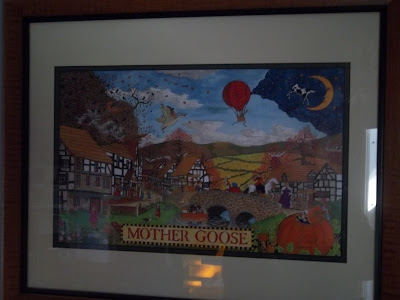 This is a print of one of my father's illustrations. Naturally it is in the children's room. This artist is not afraid of producing a busy composition, as you can see. I suppose I have inherited something of this same quality in my own outlook--my instinct is to pile up facts or names or other people's ideas and mistake them for detail. Detail is more akin to penetration. It is honing in on what is most significant, and that is why it is considered an important property of high art.
 Yes, I believe the title in English is "Chess Players". Unfortunately I could not get a good picture of this. If I turned the flash off it was too dark. Bear in mind I had a break of about 10 minutes in which to go around the house and take all these pictures or I probably could have figured it out. Here is a link to the picture as it is supposed to look. The flash notably obscures the tasty-looking mug of beer set beside the board.
 The simonists. Those guys get it good and hard in hell. Also in the office. Everything framed in that room is small in size, no larger than a standard sheet of typing paper. There are also barometers and such kinds of things as people like to look at and be surrounded by when they are taking refuge from their actual lives.
 This probably shouldn't count as 'art', but I tend to regard it as part of the visual collection. This is also in the attic, just below painting #1 and, as you can see, approaching the floor, or at least the top of whatever pile is stacked against this wall. As noted elsewhere, I am a bit of a nostalgist for the days when countries were a bit more a world onto themselves, less globalized, slightly fewer people speaking English and walking around with degrees from American and other great universities that get indigestion at the mere thought of people like me setting foot on their campuses even as a tourist. I regard France in this light maybe more than anywhere else. It had a lot of glamour and romance to lose by adapting more efficient and convenient modern habits, as well as becoming generally more accessible and accomodating to the global economy, and to my imagination it has lost a bit of it, but then again how reliable of a source am I on these sorts of things? The attic is a very suitable place for the poster.
8. The World of Mother Goose.
 This is a print of one of my father's illustrations. Naturally it is in the children's room. This artist is not afraid of producing a busy composition, as you can see. I suppose I have inherited something of this same quality in my own outlook--my instinct is to pile up facts or names or other people's ideas and mistake them for detail. Detail is more akin to penetration. It is honing in on what is most significant, and that is why it is considered an important property of high art.
9. Gustav Wentzel, Sjaakspillere
 Yes, I believe the title in English is "Chess Players". Unfortunately I could not get a good picture of this. If I turned the flash off it was too dark. Bear in mind I had a break of about 10 minutes in which to go around the house and take all these pictures or I probably could have figured it out. Here is a link to the picture as it is supposed to look. The flash notably obscures the tasty-looking mug of beer set beside the board.
This is the other print brought back from the Norway trip. Its appeal, formerly its air of a kind of gentlemanly bohemianism, is now augmented by that of leisure and relaxation, but still in a cultivated context, all of which is largely inaccessible to me at the moment. The picture's placement contains one interesting coincidence, in that as you can see our own chessboard is stored right beside it--and it does get a good amount of use, though as yet our games are not very relaxed affairs--and one irony, in that the major item of furniture beneath it, atop which all of these miscellaneous items are sitting, is an antique piano, which however, no one in our house knows how to play, and which is so badly out of tune that even people who come over to the house who can play cannot play it, because the sound is too painful to them.
10. The other extant Dante illustration, from Inferno XIX
 The simonists. Those guys get it good and hard in hell. Also in the office. Everything framed in that room is small in size, no larger than a standard sheet of typing paper. There are also barometers and such kinds of things as people like to look at and be surrounded by when they are taking refuge from their actual lives.
11. Covered Bridge, Somewhere in Pennsylvania.
 This is one of my father's early pictures from the 60s, when he was taking after the style of Andrew Wyeth. I am about to contradict what I wrote in my last entry, in that this picture is also in the office but is somewhat bigger than an ordinary leaf of paper. However it is set atop an enormous and nearly immovable wardrobe that is in the corner of the room, so that if one is sitting down in the room he does not notice it too readily.
 Doesn't this remind you of the painting in Mr. Rogers's kitchen? This, along with at least one other picture in the same style, decorated the paneling in my grandparents' basement for around 35 years. Now we have it up in the children's playroom. I don't know what happened to the rest of the set.
 The figure in this picture bears some resemblance to Mrs Bourgeois Surrender. It was given to us as a gift for that reason. It currently hangs in one of the niches of the dining room, above a couple of items I did not include in this survey, one a framed, waterstained tableau of some antiquity featuring a black and white image of some woods with the oft-maligned Joyce Kilmer poem "Trees" incscribed beneath them, the second a poster of Neuschwanstein Castle, which I have never been to, but which the children like. If it helps them develop an interest in learning about/traveling to Europe someday--apparently nowadays getting boys especially interested in anything traditionally associated with learning or culture has become a Herculean labor--then it will have served us well.
 This is one of my father's early pictures from the 60s, when he was taking after the style of Andrew Wyeth. I am about to contradict what I wrote in my last entry, in that this picture is also in the office but is somewhat bigger than an ordinary leaf of paper. However it is set atop an enormous and nearly immovable wardrobe that is in the corner of the room, so that if one is sitting down in the room he does not notice it too readily.
This picture was around during my childhood, and then it came into my possession after an interval of some 10-15 years through a third party whose hands it had fallen into. I don't know what it represents to me, other than a time--which the tendency is to imagine as a happy one though in reality it was no more or less happy than any other time--before I was born to which I have some relation. My father is not like me where his painting is concerned, angst-ridden and constantly suffering from crises of confidence and inferiority complexes. He paints not in a desperate attempt to become vital but because he is actually is vital, and as a celebration of that vitality. Obviously I can't really relate to that mindset.
12. Constable, Dedham Mill, Essex
 Doesn't this remind you of the painting in Mr. Rogers's kitchen? This, along with at least one other picture in the same style, decorated the paneling in my grandparents' basement for around 35 years. Now we have it up in the children's playroom. I don't know what happened to the rest of the set.
I have written elsewhere about my affection for this school of painting. It shares an attitude in common with other things I like, which is a kind of hopefulness or even optimism judiciously larded with a sense of authentic melancholy. As ways to understand existence go this seems to me a reasonable and comforting one, especially if a grander understanding is inaccessible due to limitations of the intellect or spirit which prove impossible to overcome.
13. A print, but who the artist is or anything else I do not know.
 The figure in this picture bears some resemblance to Mrs Bourgeois Surrender. It was given to us as a gift for that reason. It currently hangs in one of the niches of the dining room, above a couple of items I did not include in this survey, one a framed, waterstained tableau of some antiquity featuring a black and white image of some woods with the oft-maligned Joyce Kilmer poem "Trees" incscribed beneath them, the second a poster of Neuschwanstein Castle, which I have never been to, but which the children like. If it helps them develop an interest in learning about/traveling to Europe someday--apparently nowadays getting boys especially interested in anything traditionally associated with learning or culture has become a Herculean labor--then it will have served us well.
14. Postcard of our house, circa 1905
 It is largely obscured by the elm trees, which unfortunately of course all died in the great elm blight of the 60s which devastated this quintessential New England tree (it is still the state tree in Massachusetts) all over the region. We have planted one. It remains rather frail-looking even after a couple of years, but it is still alive.
A curious note for baseball fans, the house next door to us on the left, which is not visible in this postcard, was, I have been told, the boyhood home of Red Rolfe, who was the 3rd baseman for the Yankees from 1934-42, played on five championship teams, had several outstanding years, especially 1939 when he led the leagues in hits, runs scored and either doubles or triples, and was arguably the best player at his position in the history of that storied franchise (though granted, he would have batted 8th in the lineup of that all-time team) until the arrival of Alex Rodriguez.
 The bourgeois family extraordinaire. To be honest, I flatter myself by insuinating that I am bourgeois. Real bourgeois are actually quite rich by the standards of the median income or wealth. Five years ago when I began this page my ego, believe it or not, was still nowhere near deflated to a level correspondent to the truth; it still is not all the way there, nor am I ready for it to arrive at that point, though it continues to make a slow and grinding progress. Anyway, I thought at the time that by being bothered with conventional things like jobs and children meant that one was bourgeois, which seemed bad enough. That the truth is, in fact, probably even worse is something that will take a further number of years to come to terms with.
 This is the other picture from the library fire sale. This is the 3rd picture in the very artsy refrigerator room, above the Vermeer.
 One of my father's prints--such money as there is in this type of art is the ability to sell prints. I have a reputation for being fond of travel, so I received one of these as a present. It is true, I have never been much of a homebody. I like to get out of the house, especially if I am not going to be able to read or write. This is probably the main reason I always envisioned myself living in a big city and renting, so I wouldn't have to be bothered with the responsibility of upkeep on a house, for which so many other people seemed to me so much better suited than myself, while I seemed so well suited for bohemianism and reflection and sensualism and all that.
 It is largely obscured by the elm trees, which unfortunately of course all died in the great elm blight of the 60s which devastated this quintessential New England tree (it is still the state tree in Massachusetts) all over the region. We have planted one. It remains rather frail-looking even after a couple of years, but it is still alive.
A curious note for baseball fans, the house next door to us on the left, which is not visible in this postcard, was, I have been told, the boyhood home of Red Rolfe, who was the 3rd baseman for the Yankees from 1934-42, played on five championship teams, had several outstanding years, especially 1939 when he led the leagues in hits, runs scored and either doubles or triples, and was arguably the best player at his position in the history of that storied franchise (though granted, he would have batted 8th in the lineup of that all-time team) until the arrival of Alex Rodriguez.
This item hangs in the dining room above the china cabinet.
15. Degas, Portrait of the Belilli Family
 The bourgeois family extraordinaire. To be honest, I flatter myself by insuinating that I am bourgeois. Real bourgeois are actually quite rich by the standards of the median income or wealth. Five years ago when I began this page my ego, believe it or not, was still nowhere near deflated to a level correspondent to the truth; it still is not all the way there, nor am I ready for it to arrive at that point, though it continues to make a slow and grinding progress. Anyway, I thought at the time that by being bothered with conventional things like jobs and children meant that one was bourgeois, which seemed bad enough. That the truth is, in fact, probably even worse is something that will take a further number of years to come to terms with.
This picture is big and used to hang on the large wall in the staircase. It has since been replaced by photographs of the children and has been retired to the attic.
The public library in our town used to have a collection of framed copies of famous artworks they would allow you to check out for 28 days. Sometime in the early 2000s they ended this service and had a sale of the pictures. This is one of them. There is another directly below.
16. Henri Rousseau, Family Outing
 This is the other picture from the library fire sale. This is the 3rd picture in the very artsy refrigerator room, above the Vermeer.
I admit I was not a particular fan of Henri Rousseau, but my wife finds a lot of joy and life in his paintings, especially this one, and she is not somebody who goes around liberally declaring enthusiasm for artworks.
17. "Travel"
 One of my father's prints--such money as there is in this type of art is the ability to sell prints. I have a reputation for being fond of travel, so I received one of these as a present. It is true, I have never been much of a homebody. I like to get out of the house, especially if I am not going to be able to read or write. This is probably the main reason I always envisioned myself living in a big city and renting, so I wouldn't have to be bothered with the responsibility of upkeep on a house, for which so many other people seemed to me so much better suited than myself, while I seemed so well suited for bohemianism and reflection and sensualism and all that.
18. The Prophet Jeremiah from the Sistine Chapel Ceiling.
 In the dining room. I like it, though it does not really fit in with the rest of the collection.
 In the dining room. I like it, though it does not really fit in with the rest of the collection.
19. Postcard of the Former Union Station, Portland, ME
 I doubt I need to tell you what my opinion of the destruction of so many of America's great railroad stations is. A few years ago I saw a calendar/postcard type book featuring pictures of various stations in New Hampshire alone that were no more...but time is up. I will save my ruminations on America's lost train culture and how that may or may not have negatively affected my life in another post. It is 9 days since I started this, and it is time to move on.
 I doubt I need to tell you what my opinion of the destruction of so many of America's great railroad stations is. A few years ago I saw a calendar/postcard type book featuring pictures of various stations in New Hampshire alone that were no more...but time is up. I will save my ruminations on America's lost train culture and how that may or may not have negatively affected my life in another post. It is 9 days since I started this, and it is time to move on.
Thursday, September 15, 2011
Some Pictures From the South
I went on this trip back in July, so (as with everything else) I've been a laggard at writing anything about it. Being the digital age there are of course about 7 or 800 pictures. I won't put them all up, but I will probably do 3 or 4 postings worth. They are easy and usually fast, so I can inflate my pathetic post total for the year a bit. Judging by the page views no one looks at the trip photos, and it is true that people do always talk about how much they hate looking at other people's vacation pictures. I do like seeing them however, provided there is anything at all interesting in the presentation. Unfortunately I have very little ability to judge my own presentation so you will have to take my word that the presentation is not meant to be boring. Like the movie of Forever Amber, a lot will still have to be cut out. As I have done before, my plan is to take a more or less random selection of pictures and incidents and hope that they give some idea of an overall story.
I was not certain we would be going on this trip until about three weeks beforehand, due to the new baby. Ladies often do not feel up to traveling for some months afterwards in the wake of childbirth. Mr Bourgeois Surrender was feeling pretty robust after just a few weeks however and decided she would be up for it. Given the short notice, combined with the circumstances that everyone had enjoyed going to the Smoky Mountains the previous year and my own sense that we had not had enough days there on this previous occasion, we decided to head back in that direction; for, despite all the commercialism and lowbrow culture surrounding it, it is one of the great national parks of the country. I thought we should go somewhere new as well. So returning to what has worked so well for me these past few years, I returned to my 1966 Encyclopedia, with its 431 different travel recommendations for earnest middle class white families, and played the lottery game I have devised for it to see what should come up.
The first draw was Hawaii Volcanoes National Park. This doubtless would have been spectacular, but as it was not reasonable for the travel gods to expect me to make it there on a few weeks notice this particular summer, I excused myself from the obligation to undertake this particular trip at this particular time, filed it on one of my to-do lists (the vast majority of which items are of course never going to be done, but it is always good to have a reserve supply of ideas) and selected another destination. The second 'winner' was the Talladega National Forest in Alabama.
This one was less easy to dismiss outright than Hawaii, though it was not unproblematic, mainly because one still has to persuade others to want to go there, and it is easy to imagine the many arguments that might be made against it. In the first place, it is about five hours drive beyond the Smoky Mountains, which are already nearly two full days from home for us, and this with five little children, including an infant. In the second place it is in Alabama; and people from the north are wont to recoil instinctively from the idea of Alabama, especially if they have never been there. I was not wholly immune to this reaction myself.
Over the past few years I have documented the breaking down of my apprehension of traveling in the south, which, not having been to much at any time of my life, and not at all between approximately 1981 and 2006 or so, I had become convinced through my extensive exposure to internet and media accounts of the area's dominant socio-political passions, that as a comparatively effete and probably liberal yankee, I was going to be treated with cold hostility at best, and should expect the occasional encounter with someone whose anger was worked up to a hotter and less restrainable state. I was pretty sure that the days of the Deliverance-style treatment of unwelcome intruders were over; but in such matters one is never really certain either. Of course I told myself I must embrace such challenges and be eager to defend my own choices in and situation of life if I were unable to sniff haughtily upon such detractors as I might meet from a secure height, which is supposed to be the educated northerner's preferred stance in such matters. But after passing at various times over a period of several years through parts of southern Virginia, North and South Carolina, Georgia, Florida and Tennessee without any unpleasant incidents--there was the one gas station in the mountains of North Carolina whose windows were plastered over with pro-gun and anti-Obama signs where a crowd of unsmiling guys in overalls were looking over me a little overly hungrily, but even here nothing openly antagonistic transpired--as well as through the power of the internet slowly came to realize perhaps more palpably than I was able to through the haze of myth and reputation that the south is overwhelmingly populated with people who are in fact normal for the most part. But still...
A third problem was that, especially compared to the Smoky Mountains, there was a real dearth of practical information about the Talladega National Forest, and apparently not much of a developed tourist industry. This last of course offered itself as a potential bonus, though it might also have been an indication that the place was comparatively boring, since the competition for tourists is so well-developed nowadays that any place which does not have a sophisticated organization for promoting itself and is not well known to be favored by rich people is almost suspicious. Also I was concerned lest camping was the only option in the area, as we were not going to do that with a baby, and, to be honest, though I have become more enthusiastic about nature and exploring America and all of that in the past few years, I have not yet gone so far as to prefer this to sleeping indoors with showers and those kinds of things. Finally I found a guidebook (Lonely Planet's Southern Road Trips) which had a very short section on the Forest, in which it revealed that the best, and practically only accomodation requiring less than an hour's driving each day was in the Cheaha State Park, which is located on Mt Cheaha, which is Alabama's highest mountain, and is in the middle of the national forest. This state park was built in the 1930s by the CCC and had a hotel, cabins, chalets, and a restaurant, attractive enough in themselves and in a lovely setting, but not expensive. Friends of the hotel on Facebook gushed about it as well, so all this was enough to sell me on staying there should there be any spaces left for seven people on such short notice, which there was.
The fourth concern was that going to Alabama in July in itself seemed an invitation to ridicule from anyone in the north who should hear of it, though I reminded myself that the place is much more populated than Northern New England and presumably people go outside and do things in the heat. Though I must admit I was worried about what it would be like.
1. I-78 between Allentown and Harrisburg, PA, after stopping at Wawa.
 As we travel frequently to Philadelphia to visit my relatives we are no strangers to Wawa, most likely the world's greatest convenience store chain. As Wawa's fledgling empire is still largely confined to southeastern Pennsylvania, Southern New Jersey, and Delaware, with a few outposts as far afield as Maryland and northern Virginia, it was not a given that we would have the good fortune to come across one on this trip, as our route barely skirted the northern boundary of this territory in the Lehigh Valley. But we did.
2. Rolling hills adjacent to Exxon station, Natural Bridge, VA, off I-81.
 The Natural Bridge itself is a famous attraction, considered by some to be an overhyped one, though Jefferson and Patrick Henry, among other early patriots eager to promote such sublimities as were to be found in these lands as equivalent to their celebrated counterparts in the old world, were reputedly fans. We did not take the opportunity to see it this time, though maybe someday we will be back. It is among the 431 sites highlighted in the 1966 encyclopedia.
3. We are arrived at the Chalet in Cheaha State Park, Alabama.
 Alabama, along with Mississippi, and maybe Arkansas, about which nobody in the north knows very much at all, are still regarded as the hard core of the south and maybe, especially when one gets away from the interstates, still trapped in something of a nightmarish pre-civil rights era time warp. One sort of knows this is not true, but until you get there...
 This is the only nature picture that made it into this first set. This place was more beautiful than I thought it was going to be, and it was very uncrowded. Other than fifteen or so families staying at the park and a small number of day trippers/hikers there were scarcely any people for 20, 30 miles around in any direction, which when you have lived on the east coast all your life, even in New England, is practically unheard of roominess. It was extremely pleasant and rejuvenating. I could happily have stayed there for a week.
I went on this trip back in July, so (as with everything else) I've been a laggard at writing anything about it. Being the digital age there are of course about 7 or 800 pictures. I won't put them all up, but I will probably do 3 or 4 postings worth. They are easy and usually fast, so I can inflate my pathetic post total for the year a bit. Judging by the page views no one looks at the trip photos, and it is true that people do always talk about how much they hate looking at other people's vacation pictures. I do like seeing them however, provided there is anything at all interesting in the presentation. Unfortunately I have very little ability to judge my own presentation so you will have to take my word that the presentation is not meant to be boring. Like the movie of Forever Amber, a lot will still have to be cut out. As I have done before, my plan is to take a more or less random selection of pictures and incidents and hope that they give some idea of an overall story.
I was not certain we would be going on this trip until about three weeks beforehand, due to the new baby. Ladies often do not feel up to traveling for some months afterwards in the wake of childbirth. Mr Bourgeois Surrender was feeling pretty robust after just a few weeks however and decided she would be up for it. Given the short notice, combined with the circumstances that everyone had enjoyed going to the Smoky Mountains the previous year and my own sense that we had not had enough days there on this previous occasion, we decided to head back in that direction; for, despite all the commercialism and lowbrow culture surrounding it, it is one of the great national parks of the country. I thought we should go somewhere new as well. So returning to what has worked so well for me these past few years, I returned to my 1966 Encyclopedia, with its 431 different travel recommendations for earnest middle class white families, and played the lottery game I have devised for it to see what should come up.
The first draw was Hawaii Volcanoes National Park. This doubtless would have been spectacular, but as it was not reasonable for the travel gods to expect me to make it there on a few weeks notice this particular summer, I excused myself from the obligation to undertake this particular trip at this particular time, filed it on one of my to-do lists (the vast majority of which items are of course never going to be done, but it is always good to have a reserve supply of ideas) and selected another destination. The second 'winner' was the Talladega National Forest in Alabama.
This one was less easy to dismiss outright than Hawaii, though it was not unproblematic, mainly because one still has to persuade others to want to go there, and it is easy to imagine the many arguments that might be made against it. In the first place, it is about five hours drive beyond the Smoky Mountains, which are already nearly two full days from home for us, and this with five little children, including an infant. In the second place it is in Alabama; and people from the north are wont to recoil instinctively from the idea of Alabama, especially if they have never been there. I was not wholly immune to this reaction myself.
Over the past few years I have documented the breaking down of my apprehension of traveling in the south, which, not having been to much at any time of my life, and not at all between approximately 1981 and 2006 or so, I had become convinced through my extensive exposure to internet and media accounts of the area's dominant socio-political passions, that as a comparatively effete and probably liberal yankee, I was going to be treated with cold hostility at best, and should expect the occasional encounter with someone whose anger was worked up to a hotter and less restrainable state. I was pretty sure that the days of the Deliverance-style treatment of unwelcome intruders were over; but in such matters one is never really certain either. Of course I told myself I must embrace such challenges and be eager to defend my own choices in and situation of life if I were unable to sniff haughtily upon such detractors as I might meet from a secure height, which is supposed to be the educated northerner's preferred stance in such matters. But after passing at various times over a period of several years through parts of southern Virginia, North and South Carolina, Georgia, Florida and Tennessee without any unpleasant incidents--there was the one gas station in the mountains of North Carolina whose windows were plastered over with pro-gun and anti-Obama signs where a crowd of unsmiling guys in overalls were looking over me a little overly hungrily, but even here nothing openly antagonistic transpired--as well as through the power of the internet slowly came to realize perhaps more palpably than I was able to through the haze of myth and reputation that the south is overwhelmingly populated with people who are in fact normal for the most part. But still...
A third problem was that, especially compared to the Smoky Mountains, there was a real dearth of practical information about the Talladega National Forest, and apparently not much of a developed tourist industry. This last of course offered itself as a potential bonus, though it might also have been an indication that the place was comparatively boring, since the competition for tourists is so well-developed nowadays that any place which does not have a sophisticated organization for promoting itself and is not well known to be favored by rich people is almost suspicious. Also I was concerned lest camping was the only option in the area, as we were not going to do that with a baby, and, to be honest, though I have become more enthusiastic about nature and exploring America and all of that in the past few years, I have not yet gone so far as to prefer this to sleeping indoors with showers and those kinds of things. Finally I found a guidebook (Lonely Planet's Southern Road Trips) which had a very short section on the Forest, in which it revealed that the best, and practically only accomodation requiring less than an hour's driving each day was in the Cheaha State Park, which is located on Mt Cheaha, which is Alabama's highest mountain, and is in the middle of the national forest. This state park was built in the 1930s by the CCC and had a hotel, cabins, chalets, and a restaurant, attractive enough in themselves and in a lovely setting, but not expensive. Friends of the hotel on Facebook gushed about it as well, so all this was enough to sell me on staying there should there be any spaces left for seven people on such short notice, which there was.
The fourth concern was that going to Alabama in July in itself seemed an invitation to ridicule from anyone in the north who should hear of it, though I reminded myself that the place is much more populated than Northern New England and presumably people go outside and do things in the heat. Though I must admit I was worried about what it would be like.
1. I-78 between Allentown and Harrisburg, PA, after stopping at Wawa.
 As we travel frequently to Philadelphia to visit my relatives we are no strangers to Wawa, most likely the world's greatest convenience store chain. As Wawa's fledgling empire is still largely confined to southeastern Pennsylvania, Southern New Jersey, and Delaware, with a few outposts as far afield as Maryland and northern Virginia, it was not a given that we would have the good fortune to come across one on this trip, as our route barely skirted the northern boundary of this territory in the Lehigh Valley. But we did.
2. Rolling hills adjacent to Exxon station, Natural Bridge, VA, off I-81.
 The Natural Bridge itself is a famous attraction, considered by some to be an overhyped one, though Jefferson and Patrick Henry, among other early patriots eager to promote such sublimities as were to be found in these lands as equivalent to their celebrated counterparts in the old world, were reputedly fans. We did not take the opportunity to see it this time, though maybe someday we will be back. It is among the 431 sites highlighted in the 1966 encyclopedia.
3. We are arrived at the Chalet in Cheaha State Park, Alabama.
 Alabama, along with Mississippi, and maybe Arkansas, about which nobody in the north knows very much at all, are still regarded as the hard core of the south and maybe, especially when one gets away from the interstates, still trapped in something of a nightmarish pre-civil rights era time warp. One sort of knows this is not true, but until you get there...
The first day we drove from Concord all the way to Harrisonburg, Virginia (the home of James Madison University), arriving around midnight, at which time it was still around 90 degrees, which only added further to my concern that we were driving a third of the way across the country only to find ourselves unable to do anything once we got there due to the weather. The second day we proceeded through southwestern Virginia and eastern Tennessee, which latter has a rather comforting geography, hilly but with a lot of green farmland, horses, etc, visible from the road practically all the way to Chattanooga, which itself is situated in an interesting and dramatic setting, amidst mountains and a serpentine river, I presume the Tennessee River. After Chattanooga we went through a small slice of Georgia--about 20 miles--on I-59. This stretch of land is unihabitated, largely empty of traffic, hilly and profusely forested and green, almost junglelike, with lots of kudzu. The road is not in the best repair. It was well over 90 degrees of course, and there had been a shower or even a light thunderstorm, though not enough to clear the air of tension, and the sky was cranberry red. I was a little spooked out. When we finally made to Alabama darkness was starting to fall, and this somehow made it calmer, less sinister-looking than I was anticipating, though there was at least a further hour of driving through deep, dark woods with very few indications of human presence. My image of 'Alabama' had consisted of endless cotton fields, one (blinking) traffic light towns with brick city halls and austere white churches presiding around a tired looking grassy square. I knew this probably only described a small number of real places anymore, but I was not anticipating that the whole of northeast Alabama was basically sparsely inhabited hill country, with comparatively few black people or immigrants, at least that I saw.
4. View of the Talladega Forest from the Cheaha State Park swimming pool area.
 This is the only nature picture that made it into this first set. This place was more beautiful than I thought it was going to be, and it was very uncrowded. Other than fifteen or so families staying at the park and a small number of day trippers/hikers there were scarcely any people for 20, 30 miles around in any direction, which when you have lived on the east coast all your life, even in New England, is practically unheard of roominess. It was extremely pleasant and rejuvenating. I could happily have stayed there for a week.
5. Making the trail mix for the next day's hike.
 When we arrived--about midnight, after about a half hour of driving through pitch dark woods without seeing a single other car and only the occasional haunted looking sign directing us to our destination--it was a still sweltering 87 degrees or so and the chirping of the crickets/locusts/cicadas/boll weevils or whatever the local insect life was almost terrifying. Right now as I type this it is around 1:45am and I can hear some crickets outside the window. If the volume of these crickets is a "1" then that of the crickets in Alabama was about a "17". If these things had somehow been able to decide in unision that they wanted to swarm over and eat me, my life expectancy would have been about 4 minutes. As I clambered up to the office to get my keys I was still having my doubts as to whether this place was going to be fun or not, and I was really hoping that my semi-rustic chalet somehow had air conditioning, which in New England of course, such places never do. But in Alabama I guess they know and accept the evil necessity of air conditioning, because our cabin had it going full bore the whole time. I am something of a connoisseur of air conditioning--I spent most of my formative years in the very hot mid-atlantic, remember--and this was good air conditioning.
 When we arrived--about midnight, after about a half hour of driving through pitch dark woods without seeing a single other car and only the occasional haunted looking sign directing us to our destination--it was a still sweltering 87 degrees or so and the chirping of the crickets/locusts/cicadas/boll weevils or whatever the local insect life was almost terrifying. Right now as I type this it is around 1:45am and I can hear some crickets outside the window. If the volume of these crickets is a "1" then that of the crickets in Alabama was about a "17". If these things had somehow been able to decide in unision that they wanted to swarm over and eat me, my life expectancy would have been about 4 minutes. As I clambered up to the office to get my keys I was still having my doubts as to whether this place was going to be fun or not, and I was really hoping that my semi-rustic chalet somehow had air conditioning, which in New England of course, such places never do. But in Alabama I guess they know and accept the evil necessity of air conditioning, because our cabin had it going full bore the whole time. I am something of a connoisseur of air conditioning--I spent most of my formative years in the very hot mid-atlantic, remember--and this was good air conditioning.
6. Antique Playground Equipment of Cheaha State Park in Twilight.
 This place had some of the oldest playground equipment still in use that I have ever seen.
 She is only half the age she is now here.
8. A redundant playground equipment picture.
 Should have made another selection. However I will do another set from Alabama before we go back to Tennessee.
 This place had some of the oldest playground equipment still in use that I have ever seen.
Of course anytime you go somewhere in the south that is more than 40 years old and that is at all nice, you are aware that at the time whenever the place was originally built black people would almost certainly not have been allowed to go there. It is not that one has never been in such places before. My college in Maryland for example did not admit its first black student until 1947 and most of the buildings long predate that, and it is something one scarcely thinks about at all. But in Alabama one is highly conscious about all of these kinds of things, especially as when we were there every single person staying at the park was white, and in our whole four days there apart from one hispanic family that was having a picnic we did not encounter any non-white people in the entire preserved area at all. The atmosphere was really kind of 1950sish, which obviously I kind of was going for, though I guess I am always surprised to actually find it. As always in the south the other people were pretty outgoing and friendly to us, even though they were almost certainly pro-business, pro-Jesus, family values Republicans who think of themselves as disliking hand-wringing, goody-goody, meddling, socialistic whiny New Englanders, though I suppose we do not present ourselves as blatantly being of this type. There were two families, one from Texas and one from Florida, that I suppose regularly came up to the mountains of Alabama in the summer to "cool off" for a few days. I found that amusing.
7. Baby Susanna in Alabama.
 She is only half the age she is now here.
8. A redundant playground equipment picture.
 Should have made another selection. However I will do another set from Alabama before we go back to Tennessee.
I really would like to post more frequently. I have a lot going on, and I am a slow writer and thinker. The time constraints will not always be this way (I hope).
Subscribe to:
Posts (Atom)

