This subject sort of suggested itself in the last question of the nerd survey I took a couple of posts ago. It is a natural blog post. I have also not looked at anyone else's list on the same topic, so this will be pretty much straight from my active memory. I have made a rule that I have to have actually read the book for the movie to be included, which is why some obvious choices may not appear.
 #10-Ulysses (1967) I've always thought this film was underrated. It appears to have been made on a budget of about $100. The characters walk around Dublin in their Joycean costumes while 1960s street markings and shopfronts and heavy auto traffic in the distance are in plain view. I like the effect this makes though. It is kind of surreal. I'm surprised something like it isn't tried more often. This surrealness in an odd way gives the impression of being in the spirit of the novel, which was, and still is, widely considered to be unfilmable, though I think this movie proves that between all the real landmarks and places, and espisodes in those places, referred to and the thread of a genuine underlying story (Molly Bloom's adultery) to follow, it is actually filmable to a decent degree.

#9--Goodbye, Mr Chips (1939) Some might contend that the book on which this story was based is not properly literature, but the story is iconic, it primarily came to the consciousness of the world via the printed page, and it has enough of a literary sensibility about it that I am inclined to count it. The sentimental and whimsical works of James Hilton (he also wrote Shangri-La) and old Hollywood were destined to attract each other. The film has an excellent, intelligent cast, who, along with the director and other contributors to the film, grasped the spirit of the material but were able to treat it (the spirit) seriously, which is the secret of most successful literary adaptations.


#8--Hamlet (1948) I haven't seen the (4 hour+) Kenneth Branagh Hamlet, which a lot of people like, and I haven't seen the Olivier Henry V or Richard III which are also much loved, which leaves this for the moment as my favorite Shakespeare film adaptation. I'm kind of a Hamlet person by nature anyway, but the combination of the sort of atmosperically dreary postwar setting with the black and white cinematography is an especially good combination for this particular set of actors and this particular play.

#7-Tom Jones (1963) A lot of people like to rag on this movie, but I think it's pretty good. Tom Jones is a 1,000 page novel with one of the most complicated, albeit brilliant, plots of all time, and there is no way to make a two hour movie of it except as a kind of lively collage of character sketches, impressions, elaborate renderings of particular scenes (such as the fox hunt), and so on.
This movie gets extra credit for having Susannah York, who is such a babe to me at this time (early-mid 60s) as Sophie Western, Tom Jones's ultimate girlfriend. Like a number of the beautiful British women of this era--Shirley Anne Field, Charlotte Rampling, Edna O'Brien (who I know was Irish but the effect was similar) myriad Beatle and other rock star girlfriends--she did not age in a way that I would call graceful. The tumult of the late 60s and early 70s seems to have contributed to these women developing what I consider rather hard and unappealing looks by the time they were in their mid-30s, which is an age at which plenty of women are still plenty attractive without having totally compromised their principles or otherwise lobotomized themselves. The spirit of the time however was equally opposed to conceding anything to convention, including what some might call wisdom, the effect of which I think shows in the faces of the people who indulged in the ethos of that period the fullest.
(ed--looking over this again in July, 2019, I am not sure what I was talking about with regard to the decline of these actresses. However as I obviously thought something of this nature at the time, I will leave it up).
 #6-A Christmas Carol (1951 & 1984) I include both the Alastair Sim version and the later George C Scott version since I like them both. Also the later version is similar enough to the earlier that it seems to have been based on it (there is also the Muppets' Christmas Carol with Michael Caine as Scrooge and Kermit the Frog as Bob Crachit, which isn't bad either). The '51 is usually considered the classic, but having been made in the height of the austerity period it is a little spare in some of the warmer and more exuberant party scenes, which I like in the '84. Most Dickens adaptations I find disappointing. I haven't seen the Lean Great Expectations and Oliver Twist from the 40s, which are supposed to be the best ones (I have seen Oliver! the musical, but it didn't really do it for me). The Dickens mindset or attitude is one that many people feel and think they understand, but it seems to be hard to convey it if one is not actually Dickens, on film or in performance or critical analysis or otherwise. With The Christmas Carol I suspect the story is enough that filmmakers and actors are more easily able to give themselves up to it and let themselves be guided by it than they are comfortable doing with the other books.
 #5-A Streetcar Named Desire (1951) I wrote about this fairly recently. One feels that it captures where American writing and its relation to other artistic forms and movements was at in 1951 as well as any film ever made, and that that vision has held up pretty well going on 60 years later.

(ed--looking over this again in July, 2019, I am not sure what I was talking about with regard to the decline of these actresses. However as I obviously thought something of this nature at the time, I will leave it up).
#6-A Christmas Carol (1951 & 1984) I include both the Alastair Sim version and the later George C Scott version since I like them both. Also the later version is similar enough to the earlier that it seems to have been based on it (there is also the Muppets' Christmas Carol with Michael Caine as Scrooge and Kermit the Frog as Bob Crachit, which isn't bad either). The '51 is usually considered the classic, but having been made in the height of the austerity period it is a little spare in some of the warmer and more exuberant party scenes, which I like in the '84. Most Dickens adaptations I find disappointing. I haven't seen the Lean Great Expectations and Oliver Twist from the 40s, which are supposed to be the best ones (I have seen Oliver! the musical, but it didn't really do it for me). The Dickens mindset or attitude is one that many people feel and think they understand, but it seems to be hard to convey it if one is not actually Dickens, on film or in performance or critical analysis or otherwise. With The Christmas Carol I suspect the story is enough that filmmakers and actors are more easily able to give themselves up to it and let themselves be guided by it than they are comfortable doing with the other books.#5-A Streetcar Named Desire (1951) I wrote about this fairly recently. One feels that it captures where American writing and its relation to other artistic forms and movements was at in 1951 as well as any film ever made, and that that vision has held up pretty well going on 60 years later.
#4-The Magnificent Ambersons (1942) This represents an important strain of American literature (and life) that is more or less dead now, the novel of midwestern small-town aristocracies, their business interests, social ambitions, etc, between the Civil War and World War II, which events correlate exactly with the rise and decline of this kind of town and economic order. As I noted once on this blog, I live in the ruins of this sort of town, in a mansion (now divided into 3 units) that was built and lived in by one of the former local magnates who are usually major figures in this genre of novels. This movie gets what was appealing and stifling about that world pretty well (Orson Welles I believe came from such a midwestern town himself), as well as grasping its role, again for better and worse, in the rise of the modern American behemoth that had really begun to come into view in something like its accurate shape in the decades following World War I.
Booth Tarkington was a good novelist. I suspect his esteem plummeted due to the double blow of the ascendance of modernism, which essentially set itself up in opposition to writers like Booth Tarkington, and the fact that whenever a black character enters the narrative, usually as some kind of hapless servant, he does not, shall we say, rise to the occasion that a proper humanity would require he should. F Scott Fitzgerald to be frank has a similar problem, but the number of pages marred by it are somewhat lower in his books than in Tarkington's, and then Fitzgerald is still a good and interesting enough writer to important contemporary readers that he is cut a lot more slack. I will assert that Tarkington is a better novelist than Arnold Bennett, who is sort of his English counterpart, both having a similar provincial bent and relation to modernism. My impression is that Bennett's status has been a bit on the mend in recent years.
 #3--Dr Zhivago (1966) Both the movie and book have been declining in esteem in recent years, why I am not sure. Perhaps they were both overcelebrated at the times that they came out. Still, I don't see a whole lot of stuff coming out in the years since that is so appreciably better as to make these laughable now, as some seem to consider. The novel, at least in the old translation, reads very much like a classic (19th-century) Russian novel, set in only slightly recognizably more recent times. I thought there was a lot of interest in it, particularly the descriptions of the general shutting down of the ordinary functioning of society during the revolution--the cropfields overrun with millions of rats and other vermin, the trains sitting buried immobile under mounds of unplowed snow--especially as many people predict we are headed for an analogous type of societal collapse in this country within the next few years. Considering that the manuscript had to be smuggled out of the Soviet Union, and the author subsequently awarded the Nobel Prize (which he was not allowed to accept) as much for infuriating the Soviet authorities as for the quality of the book, it did not strike me as particularly subversive or condemnatory. Doubtless there are lot of hard judgements cast and truths revealed in the book too subtle for outsiders, especially those from cultures with low levels of intellectual refinement, to perceive, but at the same time it is a marvel to an American that the political leadership in other countries feels compelled to acknowledge artists and intellectuals who criticize them, in effect dealing with them as equals, or at least as humans, rather than just ignore or laugh at them.
 #2--A Room With a View (1988) In case you were wondering, my ranking is not necessarily in order of what is the best movie overall, but what is the best adaptation, in my opinion, of the book. In this instance the movie and the book are so nearly identical that I am inclined to say that the movie is actually better. I always thought Forster was quite a bit overrated as a novelist, but I may be influenced in this by the apparent ease with which he translates to film (Howard's End may also be more effective as a film than as a novel) and fairly easily digestible film at that. The Merchant and Ivory team take a lot of hits from sophisticates for their upper class Anglophilic porn movies, but in Forster at least they found a subject perfectly suited to their peculiar talents (I also thought the film of Remains of the Day seemed well-done; I haven't read that book however). You can see them get into trouble when they try to take on Henry James, though in this they are not alone. Indeed the evidence would suggest that the great unfilmable classic author is not Joyce or Sterne or Fielding, but Henry James, the odd fascination with adapting whom has sabotaged, or at least tied up for several years to no good end more than one career (maybe Spike Jonze's next assignment should be The Ambassadors). Why are people fascinated by these projects? One mistake is taking the approach that a Henry James movie should be at all a costume drama. Being a character in a Henry James novel is like being in one of those poker games with a $50,000 minimum bet rule: it can be taken for granted that you are in the top 1/10th of 1% in wealth and wear fabulous clothes. The distinctions between characters are almost entirely in their degree of mental refinement and development, their perception of these vis-a-vis the others, and their peculiar and often trivial petty resentments and grievances. In other words, things which are very difficult to convey on film. There is no mincing Cecil or strapping George or hormonally aroused Lucy in a Henry James novel to save the cinematic day. That said, one Henry James novel which seems to me like it might make a decent movie is the early The American. It has a Parisian setting, some over-the-top snooty French aristocrats (the sort who insist that the actual head of the French State is Louis XVIII's doddering great-great nephew who lives in the country and spends all his time hunting grouse), filthy rich naive Americans who have yet to become fully internalized psychologically. It could work I think since danger of the temptation to extreme earnestness combined with faulty understanding of the material would be less than usual.
#3--Dr Zhivago (1966) Both the movie and book have been declining in esteem in recent years, why I am not sure. Perhaps they were both overcelebrated at the times that they came out. Still, I don't see a whole lot of stuff coming out in the years since that is so appreciably better as to make these laughable now, as some seem to consider. The novel, at least in the old translation, reads very much like a classic (19th-century) Russian novel, set in only slightly recognizably more recent times. I thought there was a lot of interest in it, particularly the descriptions of the general shutting down of the ordinary functioning of society during the revolution--the cropfields overrun with millions of rats and other vermin, the trains sitting buried immobile under mounds of unplowed snow--especially as many people predict we are headed for an analogous type of societal collapse in this country within the next few years. Considering that the manuscript had to be smuggled out of the Soviet Union, and the author subsequently awarded the Nobel Prize (which he was not allowed to accept) as much for infuriating the Soviet authorities as for the quality of the book, it did not strike me as particularly subversive or condemnatory. Doubtless there are lot of hard judgements cast and truths revealed in the book too subtle for outsiders, especially those from cultures with low levels of intellectual refinement, to perceive, but at the same time it is a marvel to an American that the political leadership in other countries feels compelled to acknowledge artists and intellectuals who criticize them, in effect dealing with them as equals, or at least as humans, rather than just ignore or laugh at them.
The movie is actually very similar in tone to the book, again as it reads in English, and reproduces the plot quite faithfully as well. There is surprisingly little, narrative-wise, that gets left out. And yes, it is a very fanciful, Americanized (or maybe Britishized) vision of Russia, but I give it credit at least for making it a good one. If you're going to fancify, go all the way with it.
#2--A Room With a View (1988) In case you were wondering, my ranking is not necessarily in order of what is the best movie overall, but what is the best adaptation, in my opinion, of the book. In this instance the movie and the book are so nearly identical that I am inclined to say that the movie is actually better. I always thought Forster was quite a bit overrated as a novelist, but I may be influenced in this by the apparent ease with which he translates to film (Howard's End may also be more effective as a film than as a novel) and fairly easily digestible film at that. The Merchant and Ivory team take a lot of hits from sophisticates for their upper class Anglophilic porn movies, but in Forster at least they found a subject perfectly suited to their peculiar talents (I also thought the film of Remains of the Day seemed well-done; I haven't read that book however). You can see them get into trouble when they try to take on Henry James, though in this they are not alone. Indeed the evidence would suggest that the great unfilmable classic author is not Joyce or Sterne or Fielding, but Henry James, the odd fascination with adapting whom has sabotaged, or at least tied up for several years to no good end more than one career (maybe Spike Jonze's next assignment should be The Ambassadors). Why are people fascinated by these projects? One mistake is taking the approach that a Henry James movie should be at all a costume drama. Being a character in a Henry James novel is like being in one of those poker games with a $50,000 minimum bet rule: it can be taken for granted that you are in the top 1/10th of 1% in wealth and wear fabulous clothes. The distinctions between characters are almost entirely in their degree of mental refinement and development, their perception of these vis-a-vis the others, and their peculiar and often trivial petty resentments and grievances. In other words, things which are very difficult to convey on film. There is no mincing Cecil or strapping George or hormonally aroused Lucy in a Henry James novel to save the cinematic day. That said, one Henry James novel which seems to me like it might make a decent movie is the early The American. It has a Parisian setting, some over-the-top snooty French aristocrats (the sort who insist that the actual head of the French State is Louis XVIII's doddering great-great nephew who lives in the country and spends all his time hunting grouse), filthy rich naive Americans who have yet to become fully internalized psychologically. It could work I think since danger of the temptation to extreme earnestness combined with faulty understanding of the material would be less than usual.
I was once watching this movie with a group of (surprisingly manly) male friends when an aggressive man who happened to make one of the party turned violently to me and demanded "Do you like her?" referring to the lovely star Helena Bonham Carter, who plays Lucy Honeychurch. Stunned out of my customary hemming and hawing and qualifying by the urgency of the question I simply blurted out "Yes!" with a burst of some feeling.
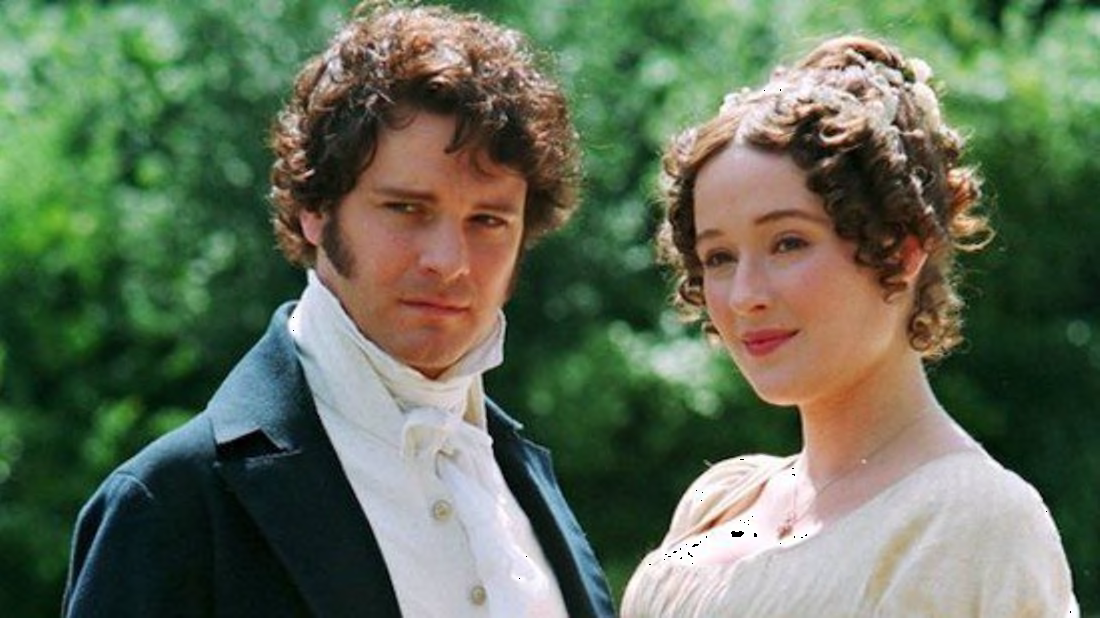
#1--Pride and Prejudice (1992) There are a lot of Jane Austen adaptations, most of which are OK, some of which are unbearable, but this 5 hour miniseries is the champion of them all (though I do think Colin Firth is too much of a pussy to be a convincing Mr D'Arcy, the consensus is otherwise). A good Jane Austen movie has above all else to properly appreciate the humor and spirited exchanges of intellect in the dialogue, and most of the people in this version seem to get that. The costumes, furnishings, and so on also feel to me to be accurate based on my readings in her books. As such they are unobtusive in the movie, so that they seem wholly natural to the characters moving about in them. Also I have one of those special loves such as one can only feel towards a very few distant and uattainable women for the girl who plays Elizabeth Bennett in this. Her name is Jennifer Ehle, and she is actually an American to boot. She also was born the exact same week I was (she is older by a couple of days) So I think between astrological and various other shared generational cohort experiences, we must have a great deal in common.
Honorable mention: My favorite costume drama of all time is probably Barry Lyndon, but I have never read the book on which that is based. Similarly I have never read, I must admit, the book of Lolita, which isn't supposed to resemble the Kubrick movie anyway, though that is also one of my favorites. When I made the list I forgot about the excellent film productions of Shaw and O'Neill plays, i.e. Pygmalion, Major Barbara and A Long Day's Journey Into Night, which are akin to A Streetcar Named Desire in being fairly contemporaneous with the original productions, featuring actors who had done the roles on stage, etc. I'm not sure where I would have slipped them in.