Showing posts with label reading lists. Show all posts

Monday, September 29, 2014

1960s BBC and the Czech New Wave Revisited

Wuthering Heights (1967)

BBC television production, in glorious black and white. Though I was taken enough with the whole effort, the highlight was the epically gorgeous 1967 hairdos worn by the lead actresses, who were both named Angela*; which hairstyles, imaginatively at least, translated well to the 1840s. One of the Angelas played Cathy Earnshaw as a brunette in the first two parts of the series, and Cathy Linton (the first Cathy's daughter; the mother of course died in childbirth) as a blonde in the last two. The other Angela played Isabella. The male leads were decent enough too, I guess, especially the guy who played Hindley was good. Ian McShane, who is something of a name, was Heathcliff. He did not to my mind emit to the full the masculine ferocity that this character so famously and belovedly exhibits in the book, though it does not seem as if anyone has managed to capture that on the screen (I have not seen the Olivier version, but supposedly he is an even milder Heathcliff than McShane). The sets and outdoor camerawork are simple but evocative, and one never feels that something would have been better if more money had been spent. Once again it is demonstrated that a little atmosphere, a few good-looking girls, supporting players with some presence and a good story can go a long way.

Regarding the story--like the Idiot, this is in my opinion one of the great stories of the post-renaissance era. It always works for me. I had the good fortune to read the book at a pretty young age, before I was fully cognizant of my mind's inability to keep up with my ambitions for it--it was the very first book I took up when I started reading again after I had been out of college for a while--so I remember it quite well. It is extremely funny, and all of the characters have either well above average verbal intelligence irrespective of their stations, or are so freakishly absurd in some way that their presence serves to stimulate rather than stifle the more intelligent characters. I think that the book resonates with as many people as it does because it does have all of this humor and intelligence while taking place far out of the way of great events or anything resembling intellectual ferment or heightened social stimulation or even economic and societal churn. To recreate this type of scene would seem to be more attainable to the socially isolated modern reader than those found in other books which either require extraordinary talents, years of high level training, or even generations of cultural indoctrination as their basis. Also, the characters that possess no inconsiderable amount of sex appeal (and any amount is not inconsiderable to me)--even Heathcliff--are not exactly surrounded by people equipped to properly appreciate and quench it, which does have the effect I suppose that its edge is never wholly dulled. I suspect a lot of people imagine this to be the case with themselves too and sympathize with the circumstance in the book.


Angela Scoular as Cathy Earnshaw (with Heathcliff)

*I have always liked the name Angela a lot and have brought it up as a possible baby name but my wife always immediately shoots it down as having trailer park-ish conntations for her. Perhaps this is more the case around here (New England). In the suburban mid-Atlantic area in which I grew up, I associate it more with energetic, slyly nice but maybe also slyly naughty daughter of an orthodontist types. My idea of trailer park names falls more in the direction of Crystal, Brenda, Tammy, and the like, though I associate Tammy as being usually the good-looking one from this pool and therefore have some fondness for that name as well.

The Report on the Party and the Guests (1966)
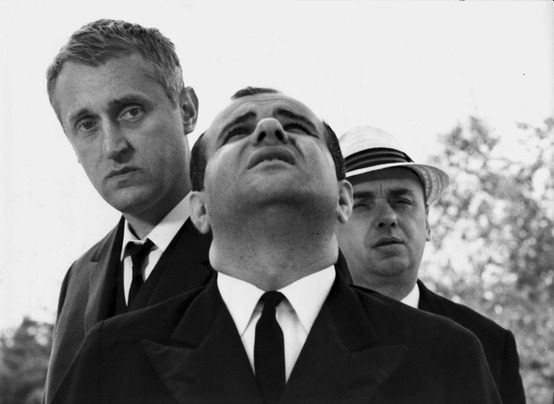


This is a somewhat hard movie to find. I ended up doing something I don't usually do, which is shell out for a four-DVD Criterion Collection set of "Pearls of the Czech New Wave", which includes six movies from 1966-69, one feature by each of five different directors, plus one collective effort in which each the featured directors contributed a short movie based on a story by the important and very good Czech writer Bohumil Hrabal. The Report on the Party and the Guests is only 70 minutes long, so I watched it twice. I don't think it is a great movie, but one has to grant that it took some cojones to make it (and I would think to be involved with it at all) in 1966 Czechoslovakia. The plot is that a group of vaguely bourgeois adults out on a picnic in a place that looks like it could be the Sumava forest are surrounded while strolling through the woods by a large band of unfriendly men who do not pointedly hurt or even threaten the picnickers but nonetheless make it clear that their movements are restricted, that they will not be allowed to leave the area, that they will have to submit henceforward to the authority of the men who have interrupted their walk; apart from a few weak and half-hearted attempts at protest and rebellion, the picnickers accede and become resigned to their new condition relatively quickly. In the second half of the movie they are brought to a large outdoor banquet like a wedding dinner along the wooded shore of a lake, and a number of odd things happen--for example, the guests all realize they are not sitting in their assigned places at one point and move en masse to find them. The meaning of a lot of what went on the second part admittedly was not clear to me. One of the picnickers, who had remained silent and sullen, does slip away from the table during the banquet; a search party is raised to go bring him back, and his wife (who is kind of attractive in a matronly late 30s way, but does not possess much character to oppose any convention or authority) apologizes to the leader for his antisocial behavior. Another picnicker, flattered by the new authorities' assurances that he is a reasonable and intelligent man, spends the banquet trying to ingratiate himself with them. As happens to me a lot with Czech movies, something will appear on the screen--some kind of food or utensil or mannerism or even the odd word or phrase which I can still pick out--which reminds me of when I was there and sends me into a reverie which distracts me from following the movie. Still, on the whole, I have a much easier time getting into these Czech New Wave movies than I do the likes of Godard and some of the other French avant-gardistes, even when the narrative does not take an easily-deciphered form, because I feel I have some sense of at least the material world these movies inhabit. Also even the most talented Czech artists--and this seems to extend even to major international figures such as Dvorak or Smetana--tend to see themselves and their countrymen more as underdogs and subversives trying to cut a few slivers through the massive quantity of baloney weighing people down to expose any fleeting flash of truth than as people in a position to make grand pronouncements and discoveries about the state of civilization or the nature of universal man that will take the average person a few generations to catch up to and absorb anyway.

When the picnickers are first taken into power by the mysterious band their leader is a rather clownish guy who looks and kind of behaves exactly like Adam Sandler. Eventually a more distinguished gentleman shows up to conduct the captives to the party who is revealed as the real leader. 


The Adam Sandler Guy

The women in all of these films are variously quite attractive without being classically movie star beautiful. In this one they all seem to be in the 32-37 range for age--of course that is young to me now. I have gotten to the point where I at least am finding some 32 year olds as beautiful as I once thought women ten to fifteen years younger to be. Anyway these are the kind of women I imagined I would have hung out with a lot if I had ever been able to establish my artsy credentials. Of course our imagination always outstrips reality. As I have written before, I imagined myself before I went to college hanging out with women of a certain type that I thought, and congratulated myself for thinking, reasonably realistic, whom I found upon arriving at school barely existed at all, and when they did had far more desirable social and physical options than I could offer at the time. 


The Women I Found Attractive Despite Their Being Rather Weak and Stupid in the Movie

I have watched a couple of the other films in the collection. The first was Pearls of the Deep, which is the collection of shorts based on the Hrabal stories. It is a superb mixture of quirky Hrabal stories, imaginative and beautiful film-making, and documentation of the Czech life and personality. The directors were Jiri Manzel (Closely Watched Trains), Jan Nemecs (The Report on the Party and the Guests), Evald Schorm, Vera Chytylova (Daisies), and Jaromil Jires. If I had to rate the shorts, I would say Schorm's ("The House of Joy") about a butcher and amateur artist who covered every bare surface in his house with his painting, is the most interesting idea, Chytylova's (The Restaurant The World) is the most cinematically arresting, Jires's ("Romance") the most evocative of what it is like to be out and about in Prague. Menzel's ("Mr Baltazar's Death") is also very good--I wonder if it was not the most effective as a literary story--and had many ingenious images and directions that it took. The Nemec ("The Imposters") was good too, though the simplest and most straightforward of the set. I also saw the somewhat famous Daisies, which I liked for a while but of which I eventually grew a little tired. In its story of two anarchic girls running wild, rejecting conventional romance and other girlish concerns, cutting up penis-shaped fruits and meats, putting old men on trains they don't want to be on, and smearing food and various other things all over their beautiful young bodies, I was reminded a lot of Celine and Julie Go Boating. How much was I reminded of it you say?


Sedmikrasky (1966)


Celine et Julie Vont en Bateau (1974)
Quite a few other people on the internet have noted the similarities between these two films. It is not my special insight. 

At one point of the girl's names in Daisies was Julie too, but their names kept changing. 

The Adam Sandler guy was briefly in this also, as a hopeless sap in love with the more extreme 60s chick of the duo, the one with the rust-colored hair. I thought they were both sexy, but I suppose if I had to pick I have a slight preference for the brunette.    

Thursday, January 03, 2013

Brief Notes on Secondary Reading


Seeing as I am about 4 years behind on the notes on my primary reading you would think that would be a higher priority. And I am going to try to bring that somewhat up to date over the next few months. This post could also be skipped, since none of these books I thought was especially good, and two of them were more or less abominable, but I feel like I should examine my complaints about them and why I have not been able to do markedly better. In any area of life.

The Emperor's Children by Claire Messud

I have not been reading many novels in my official list for the better part of two years now--long poems, Victorian biographies, philosophical treatises and some works of the Fathers of the Church have filled up the space once dominated by them--and at a certain point in the late summer or early fall I was craving one. Why I chose this I cannot logically account for; every now and then I am overcome by an urge to look into something contemporary, this was named one of the top 10 novels of the year (2006) by the New York Times and was longlisted for the Booker Prize, and it apparently even sold decently. It was supposed to be an accurate depiction of a certain influential and refined milieu. I hope for the sake of the milieu in question that it was not.

Successful literary types often love to recount moments when some joker wannabe reads something by one of the legitimate geniuses of his own generation and realizes he cannot compete in that league, but Claire Messud has something of the opposite effect. She reminds the contemporary would-have-been author that the pool of literary talent in his time was evidently so thin that anybody possessed of even modest ability should have had a golden opportunity not only to break into the field but to become a substantial figure in it. That is how abysmal this book is.

Now it is true that I read it all the way through. This was in part because I wanted to be sure that I was not utterly deceiving myself about the book's quality, but the main reason was that, insipid and insubstantial as the  rich, good-looking, expensively educated, fashionably dressed, culinarily sophisticated, Manhattan residing cultural creative characters were, I am of course obsessed enough with such people to try to find out what the secret of their grip over so much of our national artistic and intellectual life is, because it does not appear to be stupendous intelligence or learning. Apart from snobbery towards provincials and working class people, and maybe the details of clothes and lunches with the smart set, the book is pitifully weak in detail and giving much sense of what being alive on a minute to minute basis in contemporary New York is like, unless the sum of all mental and visual sensation of living there now results in a kind of cumulative emptiness. There is no story, or part of a story, or character, or scene, that is remotely gripping. I suppose the likes of me can take heart that in modern creative class New York there are apparently no straight American-born men. I only noted 2 in the book, one a fat loser from the provinces who primarily subsisted on Coca-Cola and potato chips and did not bathe regularly (no sex for him, needless to say), and the other a prominent liberal intellectual in his 60s who, as if to underscore the dearth of men in their 30s and 40s who are both acceptable to modern educated women and are sexually inclined in their direction, did have a robust affair with one of the main characters, a well-endowed 30 year old working in television. This absence was so blatant in fact that after I got through the book I made an outline for a short comic novel tentatively titled A Heterosexual in New York, in which a character like myself 15 years ago manages to become a force on the young New York literary social scene just by exerting a little heterosexual energy; but of course I haven't gotten going with writing any of it yet.

For what it's worth, Claire Messud is married to James Woods, whose current ranking among the most important literary critics in the United States would put him safely in the running for a BCS bid with a real shot at getting into the title game. She also attended Yale, and one of the characters in her book refers several times to an old professor whose theories happen to be the same as Harold Bloom's, so it is not implausible to presume that she was a student of this luminary's as well. She is also listed as a fellow with the Wissenschaftskolleg zu Berlin (Institute for Advanced Study). She is obviously well-steeped in almost the highest literary and cultural circles our society has to offer, or at least that the general public is vaguely aware of, yet the dominant characteristics of her work are banality and a general lack of vigorous talent. She has a good grasp on the construction of sentences, I suppose we can grant her that. There is no meat or power in the sentences though.

The September 11, 2001 terrorist attack features in the book. I admit that the events of that day as they seem to have been experienced by people who were in New York at the time have never really gripped my imagination. My own memories of the day, from afar, granted, are of a kind of absurdity. The media was apparently telling people to give blood, so we had people showing up at the hospital where I work rolling up their sleeves and demanding that someone draw their blood, screaming "Do you know what is happening?" and that sort of thing. The organization was not set up to service all of these donors on the spot but they did schedule a blood drive for a couple of days later to appease the mob, which ended up being cancelled because of course there weren't any survivors who needed it. My sense with writers trying to write about the catastrophe is that something about it always seems incongruous with what it really was, not that I know what it really was either, but I don't think the note that is taken by most authors on the subject has been the right one.

King Rat by James Clavell

From 1963. Best Seller. Opposite situation to The Emperor's Children, in that the premise of the story and the main character have real literary potential, but I found the writing something of a chore to get through. It was somewhat like Forever Amber, in that when I would take it up and get into it I could plow through 30 or 40 pages in a sitting, but I was never all that eager to take it up again until several days interval had passed. The Emperor's Children I actually got through fairly quickly--fairly quickly for me meaning 15-20 pages a day--and on a regular schedule, even though the book was lousy. I think I felt like its very existence was such an indictment of myself and my whole lousy literary generation that I was compelled by association, however tenuous, to wallow in the shame that it represented for as long as it lasted. There was a part in King Rat that, while typical of its time and not especially well-written, arrested me, about one of the loser lower-middle aspiring to middle-middle class character's agony over his inability to persuade his wife to willingly have sex with him. All of his desperate requests and attempts at seduction are met with a frigid "No" and the night before he is to leave for duty--the book is set in a Japanese prison camp during World War II--he violently tears apart the expensive dress she has put on to go out somewhere and I suppose it is implied that he raped her, though I don't have the book in front of me anymore and don't remember whether that was implied or if he just gave up when he realized she was completely uninterested in having relations with him. That one passage about frustration really stuck with me. And the King is really an excellent character, though my memory of details where he is concerned seems to be fading already.

The movie based on this that came out in 1965 is very good. I got it expecting it to be one of those lumbering 1960s World War II films, because it is not especially celebrated, so I was surprised by how well it worked as a movie. Even my wife, who is not the target demographic for World War II prison camp movies, thought it was good, and handled its subject matter tastefully (maybe this is why it has not been more highly rated by the critics). The King was played by George Segal, who seemed positioned around this time to become a fairly major leading man if one or two of his films, such as this one, had taken off, but that did not quite happen. His timing was unlucky I think in that he had a kind of classic All-American look and demeanor which became suspect in the minds of many serious art people just at the time he emerged on the scene. I have not seen him in much, but I've generally liked him, perhaps because he never did make that ascent to superstardom. The co-star and foil of the King is Tom Courtenay, who starred in a number of notable British movies of the early 60s like The Loneliness of the Long Distance Runner and Billy Liar.


Carlo Cipollo--The Economic History of World Population

From 1962. A very short book (117 pages). Demography is one of my peculiar fascinations, and interesting readable books about it are fairly rare, so whenever I come across anything on the subject that looks interesting I give it a try. I found my copy of this in the donations bin at the supermarket.

I always enjoy reading books from this time period because I find the tone and point of view which the authors of the era usually take to be more agreeable than that of contemporary writers. They may even be saying the same things, but they tend to be less hysterical about them. Carlo Cipollo for example, talks about the necessity going forward of adopting a more global point of view and the eventuality of resource depletion, but he manages to write about these matters, it seems to me, without the accusatory or imperious attitude that people promoting these positions feel compelled to inject into their statements on these subjects today. I am certain that he probably had such attitudes--his essays on human stupidity apparently rank among his better known works--but he was able to temper the urge to express them in his published work. Indeed, according to his Wikipedia page one of his tenets regarding stupidity was that "The probability that a person will be stupid is independent of any other characteristic of that person" which strikes me a sensible observation that people have totally lost sight of today.

The 1960s was, it strikes me, kind of a golden age of popular anthropological writing. I remember as a child my father's having numerous books that presented the story of prehistoric man in his journey from hunter and gatherer to maker of tools to his discovery of agriculture and language and primitive art and his eventual development into a creature vaguely resembling ourselves. It seems to me that this narrative regarding our human origins is not as prominent, or vivid in the collective consciousness anymore. Cipolla has a whole chapter in this vein which took me right back to the era of The Naked Ape and The Epic of Man and the opening scene of 2001 and the similar productions and imagery from that time.

Cipolla was quite concerned, and rightly so, at the time, about overpopulation. At the time he was writing, even though birth rates in the West had declined considerably since 1800 or so, they were still well above the replacement level everywhere, and of course in the third world they were absolutely astronomical. There seemed no likelihood that the birth rate would ever drop to a level low enough to meaningfully slow the rate of population growth, let alone stabilize it, though that did happen all across the West within a few years of the book's being written, and has since happened across much of the rest of the world, apart from sub-Saharan Africa and several (though not all) Islamic countries.

The Power of Habit by Charles Duhigg

I wouldn't even consider this to be a real book. It's one of those ubiquitous modern non-fiction exercises where a bunch of disparate examples are thrown together--this one had employee training at Starbucks, the Montgomery bus boycott, Paul O'Neill's reviving of the fortunes of the Alcoa corporation, the deadly London Tube fire of 1987, the excruciating process of figuring out how to market Febreze, middle-class people who are dumb as rocks but somehow have access to hundreds of thousands of dollars to blow at casinos, and the relentless mining of personal spending data by all major corporations--in support of a not especially compelling idea. Given that most of the chapters are concerned in some way with a triumph derived from some application of the principles of habit delineated in the book that resulted in soaring profits for some mega-company, I am assuming it is aimed at the business crowd. The depiction of the world it offers I think would be too depressing for anybody else to contemplate. The author is a reporter for the New York Times. He seems to find the corporate vision for human life going forward to be acceptable, legitimate and perhaps even interesting. His whole 90s Ivy League package--that includes his picture as well as his style of writing--is as if calculated to be extremely annoying to me anyway. I don't know these people at all. I don't know why you would write a book like this.

Bonus Recommendations: Children's Books

My older boys are reading the Great Brain series of books by John Fitzgerald, which originally came out in the 1960s and 70s. I never knew about them at the time, though they are the kind of thing I would have read. They are reminiscences of the author's childhood in Utah at the turn of the 20th century, at which time that part of the country was still very much on the frontier in many ways, though amenities of civilization like running water and mass market toys have already begun to make their insidious inroads on the theretofore unsullied lives of the settlers. Indeed, one of the big events in the series is when the author's family (the Great Brain is the author's elder brother) gets the first flush toilet in town. Republican types will like it, as all of the boys in the book--girls aren't referred to much throughout the series--are resourceful when it comes to satisfying their material needs, and naturally entrepreneurial. If there is some desirable item that you want, your parents aren't just going to go out and buy you the identical thing, or give you enough money to ever get it yourself, so your only hope of obtaining it is to either swindle it away from another kid who has it, or device a scheme to relieve your peers of their own allowances. The Great Brain--who has a lot of similarities to King Rat now that I think of it--is the master of devising such enterprises. The series loses a little steam as it gets into the later volumes--there is less of a sense of continuity binding one episode to the next, and the tone of the stories becomes less warm, I think--but I think they make for more entertaining reading than the various fantasy/magic/kids versus dark forces of evil books that are so popular now, and that my own children also like quite a lot.

The Pink Refrigerator by Tim Egan is a book for 3-5 year olds that I confess to liking. The premise is that there is this middle aged male creature of some kind who owns a junk shop. He lives alone and has been stuck in a routine for years. He never misses his favorite television shows though he usually falls asleep in his chair in front of the set. It is never implied that he is unhappy, just that he is not living life to the fullest. One day a mysterious pink refrigerator shows up in his junkyard. It has an old rusty magnet on it that has a different message every day. It also has something new inside it every day. One day it was a set of old literary classics. Another a set of paints. On the third a horn of some kind or other. One day there was a globe. At first our marmot-man does not know quite what to do with them, but they seem to exert magic powers. He puts the books in his shop window for sale, but finds he is unable to part with them when someone wishes to buy them. At length even the urge to watch television is overpowered. By the end of the book he is closing up his shop and setting out on a trip. It speaks to me. The guy who sleeps and watches television all the time is not a hopeless moron who needs a major intervention to reach enlightenment, he has just become lazy and needs a nudge, a reason, to engage in some degree with mental life again.

I completely missed the Christmas season. I couldn't find any Christmas videos this year that I just loved, so I guess I will skip that for 2012 and see if anything strikes my fancy next year.

Thursday, November 03, 2011

Blog Wind-Down

I am not planning this. It is happening organically. I don't seem to be able to write much anymore, or rather, I should say, think anymore. Certain mental processes which I formerly took some pleasure in are no longer available. I have lost confidence in them, without being able to replace them with another mode of thought that produces an equivalent satisfaction. The wise and knowing nod in unison. It is the course of life. The weaker minds, constitutions, et al, falter increasingly with every passing year, until finally the point is reached when their owners themselves realize they are pretty much tapped out, and then they collapse altogether. This is where I seem to be at the moment. We have reached Peak Bourgeois Surrender, and may even have entered the Death Spiral, out of which very few minds have ever managed to pull themselves.

Is it impossible at this point for us all to pick up and move to Park Slope? Is there anywhere else like that? Am I even at all really like these people? I need to find some community of adults somewhat like myself. I have already established that I am literally losing my mind. Maybe it won't help.

I have to give up trying to make sense of economics and economic theory with the intention of justifying my continued existence in the society. I wonder if this fixation will someday be regarded as the folly of our age. It's causing me to become peevish, at the very least, as I increasingly find myself unable to argue the intention stated above.

But how about a little light-hearted fun:

Hot Women of the OWS--Link Here

Almost makes you want to be there. You always have to pick a favorite, so I am going to take Miss Occupy Maine (aka #4), because even though I am plotting my move to Park Slope I obviously still have a soft spot for those elusive, though not so extraordinarily rare creatures, women of New England (and especially the 3 northern states of that region, whose ladies are frequently maligned, unfortunately not always without cause, as being less generally beautiful than their counterparts elsewhere) who are actually pleasant looking. I like to show support for anyone credibly representing the home team in this regard whenever the opportunity presents itself.

Part of my increased peevishness stems from the circumstance that I know the culture is awash in foolish arguments which the real aristocracy of the intelligent obviously would never treat as serious amongst themselves but which they choose not to prevent from circulating endlessly among the masses, the effects of which I cannot prevent myself from being absorbed into nor can effectively slaughter. It is infuriating.

I am not sure how to convince young people that they cannot harbor ambitions separated from a serious consideration of money reality; nor am I sure that it is really desirable to do so in spite of everything. Life should be taken fairly seriously, moreso perhaps in many regards than it is, but it is also brief and evidently insignificant. Most of my real regrets in life involve not pursuing more adventures, not living in more exciting places, not pushing harder at figuring out how to eke out a living doing something I am interested in, as well as not being a better student when I had the chance, though it isn't clear that I really have the mental/psychological makeup to be a successful professional in any event. Likely none of those things would have worked out economically in any event, but those are still the things that I think about. Much conventional wisdom seems to be that this mindset in a man is indicative of a failed upbringing. Obviously the likelihood that this is true weighs on me more and more as the years go by.

The common riposte whenever someone suggests that taxes could be higher that if the suggester wishes to pay more taxes nothing is preventing him from writing the government a check is officially tiresome. Anyone who thinks this is what anybody means is willfully missing the point. I am probably guilty of willfully missing the point on various of my more treasured topics, but that does not make it any less annoying to have to deal with such people.

Is there anything I can practically do to make my children become serious capitalists, financiers, engineers, scientists? I don't know that I can even properly inculcate the necessary work ethic, since I do not really understand what it consists of myself. And then there are legions of people who work hard but are too stupid to make anything of themselves in a competitive field, so they are essentially worthless too. Obviously one of my major goals for my children is that they believe they are not worthless, that they are able to contibute to the common weal in a way that is commensurate with their abilities, gives them dignity and merits respect from their fellows. But being serious about anything real smart or knowing people would consider worthwhile, really seems to be an impassible barrier to me. I don't understand how one breaks through to experiencing work, study, life, etc, on that plane.

Try as I might to disdain the whole ethos, I did not evidently, as I remarked earlier, have a strong upbringing, and so I probably am a socialist in my heart of hearts, though even I find the concept of forcible 're-distribution' less than desirable, if not distasteful. Unfortunately I find the direction which large sections of formerly middle and working class society are heading, if they are not already there--a world increasingly devoid of strong institutions (apart from the police and debt collection agencies) that actually have any interest in them, a basic sense of how to organize life, even such educational and career/income opportunities as used to be considered mediocre but at least passable for getting through life with some dignity--to be even more distasteful, so I am more concerned with shoring up or re-organizing what has collapsed for much of the bulk of society than I am in preserving the legitimacy of individual fortunes, if no less obtrusive means can be found.

Also, I always had the impression, growing up--perhaps I misunderstood--that one of the pillars of American society was the belief that there must be limits on the political power any individual is allowed to have. Given the close, and seemingly growing ever closer, relation between the two, I do not see why it cannot be discussed whether the public has an interest in placing limits on the ability of individuals to accumulate massive quantities of wealth as well. Again, maybe outright taxation/confiscation is not the best ends to achieve this, but surely there must be a way to introduce regulations of some kind to prevent the kinds of systems generating fortunes wholly incommensurate with the scale on which any other level of society operates. I know people like to bang on about how Wall Street and the financial industry for example pretty much carry the entire tax burden of New York, but does that sound like a healthy way for a city of 8 million people to be organized anyway? The Wall Street champions repeat this information as if they resent it, even though it would indicate that they are the only sector of the entire economy of the city that is thriving at all.

I tried to express something of my opinion on this on Facebook, of all places, in response to an article I had linked to. It was naturally found lacking, one of the commenters going on about how taxing capital gains (I cannot recall how the dialogue was steered towards them), the wondrous virtues of which relative to the economy at large it is probably obvious I have no understanding of, would cripple any hope of recovery for the immediate future. This commenter also demanded I name precise figures for how I thought income should be distributed, which question he claimed to have asked of dozens of liberals, and surprise, surprise, no one had ever been able to give him an answer. I spent about two hours trying to compose a response and finally gave it up. In honesty I find this demand for an exact figure to be rather stupid and beside the point, but I don't know how to convey that in a way that will have any effect on the kinds of people who look at things in such a way. My basic answer is something like this: I think the distribution of income which prevailed generally in the Western world from the late 1950s to early 1970s was preferable to that which we have now, so that could be a starting point, at least. If there are benefits from this concentration of wealth in terms of research/development, extreme high end educational improvements and the like, the positive effects of them on the mass of the population seem outweighed by the negative ones, such as widespread aimlessness, lack of purpose, pessimism about one's future prospects, such as I increasingly see all around me, and even in myself, because one can sense the proximity to so much in life that contributes to its value growing ever more inaccessible and remote because the costs of those things seem to be primarily driven by the capacity the top people have to pay for them. Of course we must try to improve ourselves, draw on our inner resources, define value for ourselves and not allow other people or the market to do it for us. But if one senses through constant experience that he is no match in any arena for those who have better credentials, resources and so on, and likely never will be unless as it were he can discover the mental secret which is the key to their power, it is going to be difficult for him to willfully shut himself off from consideration of these sorts of matters.

On a reading note, on November 3, I finished the last of the books in the 2nd of the 6 tests in the 1994 GRE test guide that has been the basis of my reading list. I am now on pace to finish this program in 2045, when I will be 75 years old, which is a three year improvement on my pace when I finished the first test. I began the list November 20, 1994 (the 1st book was Wuthering Heights, by the way) and finished the 1st test February 2, 2004. I suspect that my pace will continue to accelerate rapidly, as, one, many of the books that appear in the questions henceforward are ones I have now already read, and two, there don't appear to be very many of the extremely long books left such as Plutarch, Proust, Powell, The Bible and so on that take several months to read. There also don't appear to be very many new novels left to read--there is apparently a hard core of novels that everyone is expected to read and the questions just keep referring back to them. What I have mainly going forward are more short stories, a lot of poetry, a lot of criticism, essays and general 'letters'.

Sunday, June 12, 2011

New BabyI figure I had better announce, before she starts popping up, without formal introduction, in photos of writers' graves or outhouses or whatever, that I have a daughter, born May 18, 2011. This is a surprise, and perhaps an additional comfort for my declining years, even if society does descend into the total barbarism and chaos that is frequently predicted. Her name is Susanna. One of Shakespeare's daughters was named Susannah, you may recall, though that had nothing to do with my daughter's name, in fact I did not remember it until after the fact. It does give it a certain poetic glamour though, I think, which cannot be harmful to its bearer. Susanna was also the name of the bride in The Marriage of Figaro. I am sure I will remember or come upon other ancient or modern Susannas who further add to this lustre.

Since I recounted when my last son was born all the books I was reading at the times of the children's various births (The Golden Bowl; Confessions of an English Opium-Eater; The Spectator; and The Tower of London), I should report that the reading on this occasion was On Approval by Frederick Lonsdale, which is a champagne-fizzy British drawing room comedy from 1927. There are worse omens to be born under. On the other hand, my wife's own mother was reading The Gulag Archipelago at the time she delivered Dearest, and this has not resulted in any ill-effects thus far, so most likely there is nothing in these literary circumstances that surround ones birth.

Saturday, May 22, 2010

Untitled With Lists

I've alluded before to the long list of literary sites I have been compiling over the years. I haven't been to see any in quite a few years now and while I haven't lost all interest in them the lists have become lopsided and unwieldy in places, as well as inconvenient to keep up. Nonetheless I have been keeping them up, and I'm going to run some of the statistics here (this only counts things I have yet to see), starting with "Nations"

1. England--216 I organized my countries according to FIFA regulations, so England, Scotland, Wales and Northern Ireland are counted as separate countries (no literary site on my current list is located on the Isle of Man)

2. United States--126

3. France--63

4. Ireland--33

5. Italy--32

6. Scotland--30

7. Greece--22

8. Russia--21

9. Israel--19

10. Turkey--16

11. Germany--14

12. Egypt--13

Obviously I need to read more German literature, and where are the Spanish? (Spain is in 14th place currently, with 7 sites) Italy's number is inflated due to the Romans and the circumstance that a lot of English authors either lived there or wrote stories and poems about specific and easily identifiable places.

"England"

1. Middlesex (London)-71

I should have stuck to the ancient county boundaries, but when I began my listings, I recorded them according to the re-organization of 1974. Apparently there was a further re-organization in the 90s however, so many of my designations no longer signify anything.

On another note, the re-organization of internal boundaries that have sufficed for centuries has been one of the obvious symptoms of a nation's decline (widespread epicureanism is another), going back at least as far as the Roman Empire. This is why emotionally at least I am against doing this in the United States (or tearing up the Constitution and writing a new one, as some have argued is necessary) even if there are valid arguments for doing so.

2. Kent--14. I am continually surprised at how well Kent, which is not thought of as a literary region, does. Canterbury is the leading point accumulator in this county; besides the oft-referenced cathedral, a lot of writers either were born or lived there (Marlowe, Fletcher, Conrad, Maugham). Henry IV, king and also Shakesperean character, is buried in the cathedral as well.

3. Dorsetshire--13. Famous for Hardy, but Shelley and his wife and her parents, all noted authors, have connections to Bournemouth.

4. Cumbria--10. The Lake District. Wordsworth, Coleridge, DeQuincey, et al.

5. Somerset(shire?)--9. No dominant town or author (Bath used to belong to this county I think, but in my system is listed under the post-70s abomination of "Avon"), just a variety of different people.

Oxford and Cambridge come in much weaker than I would have thought. All of Cambridgeshire only has 3 sites on my list.

"United States"

1. (Tie) Massachusetts/New York-24

Nearly all of these places are within easy driving distance of my house, which should be proof to you that I have not been carrying out the project of visiting the actual places with same fanaticism with which I have kept up the lists.

3. Mississippi--8. Not surprising. I was actually on my way to Mississippi once, getting as far as New Madrid, Missouri, before my wife made me turn around due to severe tornado warnings all across the area to which we were heading. That was in 2003, so I have still never made it there.

4. Ohio--7

5. (tie) Connecticut/New Jersey--6. These are mostly just birthplaces and graves, some of them obscure. For example William Ellery Leonard was born in Plainfield, NJ--I can find no other information on him, though I assume he is buried in Madison, Wisconsin. The Revolutionary War poet Philip Freneau, according to the 1904 edition of his collected works, is buried at the "Philip Freneau cemetery" in Matawan, NJ, but as I cannot find any mention of this place on the internet, I question whether it actually exists or not.

"London"

1. Westminster--15


This is mainly people buried in the Abbey.

2. City--12. The square mile. This is where pretty much everyone pre-1800 lived and died. Unfortunately not much of that era is left.

3. (tie) Bloomsbury/Unknown--4. Unknown refers to people (usually very remote, like Spenser) whose birthplace is given as simply 'London', no street or house known.

5. (tie) Marylebone/Strand--3. A lot of people seemed to live in Marylbone in the late Victorian/Edwardian period, 1880-1914 or so. It's where Sherlock Holmes lived, I'm pretty sure. I don't remember what's in the Strand.

"Scotland"

1. (tie) Ayrshire/Dumfriesshire/Midlothian--6

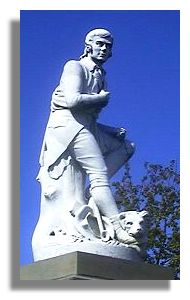
Another competitive country. Burns, who is the subject of more literary sites (10) than I think anyone (that should be another category) is resonsible for 5 in Ayrs, 4 in Dumfries, and 1 in Midlothian. Midlothian is otherwise where the very literary city of Edinburgh is located.

No other county in Scotland notched more than 2 sites.

"France"

1. Seine--23. This is obviously Paris. Again I am going by their modern departments, which date I believe back to Napoleon at least, rather than the traditional ancient regions.

2. Seine-Maritime--5. In Normandy. Rouen the major city. Joan of Arc, Flaubert, & Racine are identified with this region.

3. Vaucluse--4. In Provence. Avignon the town. Among the figures associated are Camus, John Stuart Mill, and Alain Chartier, author of the medieval love poem "La Belle Dame Sans Merci"

4. (tie)--Eure-et-Loire/Gironde/Indres-et-Loire/Loiret--3. The broken-up & famously castled and vineyarded Loire region showing some strength. Eure-et-Loire: Chartres and Proust's Cambray. Gironde is in Dordogne, capital is Bordeaux. Montaigne is the big guy there. Indres-et-Loire is the Tours (Balzac) and Chinon (Rabelais) neighborhood. Loiret is Orleans (Joan of Arc).

"Italy"

1. Lazio (Latium)-10

2. Tuscany--7

3. (tie) Campania/Emilio-Romagna--4. My impression is that Emilio-Romagna is not as overrun with tourists as the rest of Italy, but still has the kind of rich, beautiful, artistic ancient cities (Ravenna, Bologna, Parma, Ferrara, plus Rimini, the Blackpool/Jersey Shore of Italy), but on a smaller scale, that people love. Maybe I'll base myself there if I ever go back sometime.

5. Veneto--3

"Ireland"

1. Dublin--17

The capital areas are far more dominant, and the universities much less so (Germany may be an exception), in most European literatures than New York has even been in this country, though it doesn't always seem that way. I used to lament a lot that Philadelphia had never really nurtured much of a literary scene or apparent talent, and that something in the environment must be inimicable to a literary sensibility. However, Reading, a dump of an industrial city of a 100,000 people about an hour west, managed to produce both Wallace Stevens and John Updike (Philadephia's most famous authors by comparison are Ben Franklin, who grew up in Boston, Louisa May Alcott, who moved to Boston when she was about 5, and the 30s communist playwright Clifford Odets).

2. Galway--7. I forget who is responsible for all this Galway stuff. Yeats probably.

No other Irish county had more than 2 spots.

"Top Cities"

1. London--71.


2. Paris--22

3. Dublin--16

4. New York--8

5. Concord, Massachusetts--7. It's a little embarassing that this is in 5th place, but a lot of people lived there and there are a lot of museums and such. It's only about a hour from where I live, and it is a really beautiful and rich little town with delightful pastry shops and so on. I've only been there once, 13 years ago. This is the kind of place I ought to go to once every couple of years just to hang out in for a few hours and decompress from the vulgarity of most of modern life, but I never get around to it. Maybe this upcoming weekend.

6 (tie) Cambridge (Massachusetts)/Canterbury (England)/Edinburgh/ Jerusalem/Moscow/Rome/Troy (as in the Iliad)--6. That's a pretty good group there. Troy gets a point every time either one of its natives or itself is the subject of a work, usually a poem. I know there is nothing there but a bunch of stones and dirt and a reproduction of the Trojan horse. I've endured far more boring places.

Friday, March 26, 2010

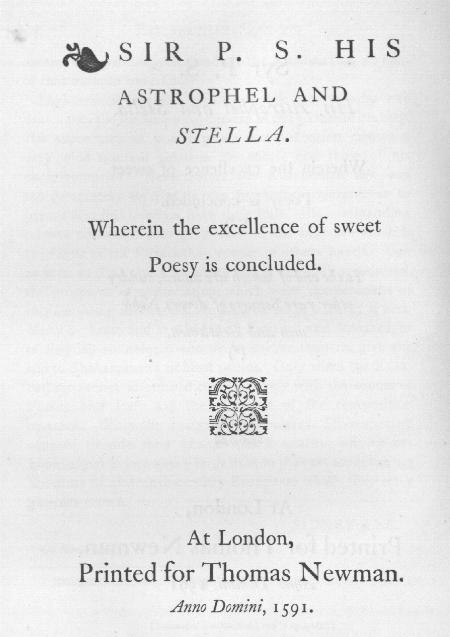
Sir Philip Sidney--Astrophil and Stella #49 (1581-3)

Back now to subjects that really matter, and whose relevance will never fade; of course I am referring to Elizabethan poetry.

I wrote about Sir Philip Sidney's spectacular career in an earlier which I can't find at the moment. You may have noticed that I have slowly been going back and assigning labels to some of the old posts--eventually there will be a Sir Philip Sidney category. Sidney died at age 31 of an infection after being shot in the thigh fighting against the Spanish in Holland; in contrast to Laurence Sterne (whom I wrote about last week) however, his biography is packed with action and brilliant accomplishment. Obviously it helped that he was very well born, but plenty of people are well born and disturbingly never progress beyond mediocrity in any field. He entered Oxford at 13 and was graduated by 18. A portion of his recorded travels include Paris, Strasbourg, Frankfurt, Heidelberg, Vienna, Venice, Padua, Genoa, Florence, Poland, Brno, Prague, Dresden, Antwerp, and all over Ireland and England as well. At 22 he was named Cup-bearer to the queen, about the significance of which post I can't find much satisfactory hard information right at hand, but it appears to have been considered desirable. At 23 he was sent to Prague as ambassador. Member of parliament at 27. Appointed governor of Flushing in the Netherlands, which involved leading English troops in battle. Wrote hundreds of poems ("The Major Works") is 329 pages long, about 215 of which are poetry. Astrophil and Stella, a sequence of love poems, consists of 108 sonnets and 11 songs. As he did not publish his poems during his lifetime, it is considered by scholars unclear why or for whom he wrote them.

Since I have known about him, I have always regarded Sir Philip Sidney as a person whose development, preparation, experience and activity in his adolescence and twenties were pretty close to the ideal. It is one thing, and an admirable thing, to learn to cut fat out of your schedule, not waste time, be purposeful, and all that. I know many people who have succeeded in doing this however, without attaining the ideal level of development that one feels with regard to Sidney. Sidney seems to have been able either to cut the fat from his thinking or perhaps, living in the age he did, to prevent it from ever insinuating itself there in the first place. These things seem likely to be ever-increasingly harder to do in our age, though they are the most vital quality the imaginative writer of poetry especially can possess. I read the entire Astrophil and Stella sequence back in April of 2004; as with Tristram Shandy, I was astonished by how long it had already been, for it seemed to me something I had read recently. The books I read before I had children I can place very neatly in memory with other things that were going on simultaneously in my life, seasons, outings, trips, the jobs or variety of idleness I had at the time, what rooms I lived in, bars and restaurants I went to, whether I read part of the book in the library or and what chair I sat in. Since the children were born and I have lived in the same house and had the same job everything runs together in a kind of eternal sameness. Evidently I was depressed or something at the time I read this book. My notes largely consist of sighs and 'too distracted to write about today' types of entries. Still I definitely had the impression that Sidney was a great poet, like many of the Elizabethans perhaps too great; their writing expressed their meaning and the process of thought by which they attained that meaning in such precise and perfect English that there seemed nothing really to say about them. As with Spenser, any sign of real struggle or conflict where impression, or truth, is concerned is difficult to detect. Language and perceptions are not with them, as they are to most people, further obstacles to truth, but its servants. This is what makes one find them so beautiful I think but also difficult to write about.

The book I use for my reading list had a question on some lines from the 49th sonnet, so that is why I am going to write my commentary today on that one rather than on any other one.

I on my horse, and love on me, doth try
Our horsemanships, while by strange work I prove
A horseman to my horse, a horse to love;
And now man's wrongs in me, poor beast, descry.
First off, the conceit is a good one, having not merely the usual duality of images, but with a common component between them which occupies the opposite position in the second that it does in the first. The fourth line is a little tricky, but as it is emphasized again later on that he is simultaneously riding and being ridden I believe he is encouraging his horse to expatiate on the various cruelties and other indignities he is inflicting on it, as he is about to do with regard to his own hard master.
The reins wherewith my rider doth me tie
Are humbled thoughts, which bit of reverence move,
Curbed in with fear, but with gilt boss* above
Of hope, which makes it seem fair to the eye.
boss-metal knob on the bit.
The humbled thoughts are the part I have the most trouble getting the sense of here. Humbled probably has a slightly different connotation than it does in our modern usage, though I am not sure what it would be. The original root from Latin via Old French, humilis, would translate as low, or lowly, from humus, ground. Certainly there is a hint of baseness, the whole image bespeaks a total degradation and loss of proper manhood on the lover's part. Also we are told directly that the bit of reverence only seems fair. Delusion and denial of one's proper state abound.
The wand is will; thou, fancy, saddle art,
Girt fast by memory; and while I spur
My horse, he spurs with sharp desire my heart;
He sits me fast, however I do stir;
I am not quite clear on the wand image. I assume it refers to the switch which one lashes the horse with. But then what is meant by will? The rider's will? Or the beast's, to be driven and overmastered by his rider.
And now hath made me to his hand so right
That in the manage myself takes delight.
I guess this clarifies a little my question about the wand.
The GRE questions on this poem were:
1. The poet's portrayal of "Love" (l.1) is an example of:
A. personification B. metonymy C. synecdoche D. apostrophe E. dead metaphor.
Uh...I'm going to go with A. Gut instinct and all that.
2. Horsemanships (l.2) is plural because:
A. love rides the speaker while the speaker rides his horse. B. the speaker has committed more than one wrong. C. love exercises many forms of control over the speaker. D. love controls him better than he controls love. E. love appears in many forms.
Dare I suppose that the answer is 'A' again?
These were too easy. I got both right.
What I'm getting out of the Elizabethans is not much in the way of philosophy or ethics for the most part, but their imaginative approach to language and understanding the world was developed to a far greater degree than in any other period of English literature, the use of language to elevate and expand the possibilities of what are, in many instances, fairly common thoughts and impressions. This is the secret of all great literature and art I guess, and every age is to an extent seeking the means to figure out how to do this freshly and as the times require. If we don't remind ourselves of this out loud from time to time however we won't even remember what it is we are looking for.

Thursday, March 04, 2010

People Must Love a Good Blog

But as with everything else, producing one even halfway good is not as easy as it ought to be. What a truly odd exercise this whole business of existence is.

Political Update. My understanding of the current crisis in the economic situation, if not the crisis itself, is very slow-developing and perhaps obvious, but I don't like the drift of things. Among anybody who still has anything, their entire focus seems to be on preserving what they've got at all costs, without much thought for the millions who are facing impoverishment and ruin, which I don't think can be a sustainable approach. I am disappointed by the lack of wisdom and leadership being displayed on this issue by the most able classes, those who perhaps alone still have a relatively strong future to anticipate. The near 20% real unemployment rate, with bankrupt governments and no recovery of real jobs to live on any kind of mass scale anywhere on the horizon, is a problem that somebody is going to have to own, and come up with some kind of better vision for its resolution than widespread homelessness, squalor and general societal breakdown. Is nobody on the side of the increasing large portion of the populace without any real promising prospects?

Literary Update. On a positive note, somebody bought one of my books. This marks a real milestone for me, as it is the first time anybody has paid for a piece of my writing. I hope to God whoever it was bought the download for $5.95 rather than the $45+ book. I have been meaning to organize and make available a paperback version, which would be cheaper. In any event I am very moved at having sold a book, though...oh, I will let it go at that. I do really need to write another one though, before I lose whatever knack I have for it altogether.

Literary Update II. For about the last six months I have been occupied with reading really long, earnest, hyperrealistic and exhaustingly overstuffed Edwardian novels. First there was H.G. Wells's Tono-Bungay (460 pages), then Arnold Bennett's The Old Wives' Tale (640 pages), and, last but decidedly not least, Dorothy Richardson's 13 volume monument to extreme navel-gazing, Pilgrimage (2,110 pages, of which I am approximately on page 1,752). The first two of these books weren't bad, though of Bennett I preferred the thinner Anna of the Five Towns, which I read sometime back around 2003, and there is a really good 250-300 page novel that could be hammered out of the Richardson, I think. Over the course of the winter I could feel this endless reading combined with other tiresome aspects of day to day existence wearing me down. So I decided not to take Pilgrimage to Florida with me, opting instead for the somewhat famous account of 1970s Hollywood, Easy Riders, Raging Bulls, (or How the Sex, Drugs, and Rock and Roll Generation Saved Hollywood). Hollywood books are an odd genre to come upon after you've been devoting yourself to self-consciously serious literature, history, etc, for a number of years. For one thing there is more speculation and conjecture than there is even in Plutarch ("it was observed by several people that her mother spent an unusually long time in the casting director's office the day she got her big break"), and anonymous sources are relied upon liberally. That said, I was rather burned out on high seriousness and the relentless Sturm und Drang of contemporary politics and economics, so I enjoyed much of the book, especially the parts set in the late 60s and early 70s before the era started to play itself out.

I have never considered myself an especially big fan of the movies of the 70s, though I realize that that is in part because I haven't seen that many of them. Most of the ones I've seen that they talk about in the book I guess I do like, though none of them are favorites, nor did I ever especially like most of the famous stars or directors featured in the book, though I did find myself interested in all the sex and power games, all which was more or less rawly expressed and experienced. One might wonder why I have become interested lately in the culture of (old) Hollywood rather than that of the army, or the biotechnology world, or Wall Street, or politics, or even art and music, which I seem to have written about more a couple of years ago. Maybe the sense that America, at least as I knew it, is collapsing, is making me nostalgic for a time when ordinary red-blooded middle-class Americans--which is the background from which most of the figures in this book emerged--were interested in things like sex and art as participants and not merely as theorists or consumers, and who actually managed to make some things happen in those directions. Though it is a little late for me to be studying this, I am always interested in how people manage to become successful in the arts. Having bought into the notion as a young man that being an artist is a good calling for morose and senstive people, I underestimated the amounts of energy and hustle that are desirable both to animate your work, but also to establish the relationships you need to get yourself into a position where people are willing to pay you. Even Warren Beatty, who seems to have more of both of these qualities than almost anyone who ever lived, in addition to other advantages, needed to employ them pretty much relentlessly to ensure himself of a career. At the same time filmmaking, as it is presented in this book, seems in comparison with playing in an orchestra, or opera singing, or ballet, or even acting in high level live theater, not to require an especially extraordinary amount of education or training to be successful. Steven Spielberg's background before getting hired by a studio for TV work at age 21 seems to have consisted of watching a lot of television and largely teaching himself how to use a movie camera, which wouldn't get you a sniff of the stage at Beyreuth. The process of filmmaking also appears to be far more messy and unpredictable than would be possible in most of the traditional high arts. The final form of most films that end up being regarded as classic often seem to be wholly unanticipated even by the filmmakers themselves until they are very deep into the process.

A few observations on the book:

Peter Bogdanovich seems to be the 70s director most like myself both in temperament and approach. He had a good sense of what movies ought to look, and perhaps more significantly, feel like, but was openly derivative and not a great generator of original ideas and material. His two best movies, The Last Picture Show and Paper Moon, both of which I like, were atmospheric period pieces he was basically assigned to. He would probably have had a better career in the system of the 30s and 40s which he was obviously perhaps over enamored of. He seems to have been well-matched with his first wife, who appears to have been smart and had some artistic talent as well, doing the set design on his more successful earlier movies, but having been a nerd in his youth he threw her over for a bimbo when the opportunity presented itself, his infatuation with whom is certainly presented in the book as contributing to the premature fizzling out of his talent, which sounds like something I might have stumbled into if I had suddenly made it in Hollywood at age 32 or whatever. There is a story in the book where the very young Victoria Principal came up to the at that time still geeky but rising Spielberg in the Universal cafeteria, thrust her breasts in his face and said "I'd like to get to know you better." I mean, Victoria Principal is the kind of person who doesn't excite me at all at a distance, but I have a feeling six inches away it would have been a somewhat different matter (obviously I mean in 1974, not now). Bogdanovich apparently also became really obnoxious and arrogant during the years when he was at the height of his success, which I could easily see myself becoming if I were ever to attain any status whatsoever anywhere.


The part where a completely drugged out and raving Dennis Hopper was excoriating the audiences that stayed away from his (apparently unwatchable) The Last Movie as not wanting to do a lot of thinking reminded me that the whole book has a kind of early baby boomer mindset wherein one can recount an anecdote such as this as if it were not in fact entirely absurd.


Another instance of this ur-baby boomer mindset are the general low level of regard for the mainstream culture, Hollywood in particular, of the 1940s and 50s. At one point the author (Peter Biskind is his name, by the way), in describing the new generation of cinephiles that emerged in the 60s, singles out as one of their characteristics that "they knew John Ford was better than William Wyler, and why." I have never actually understood why this is obviously so, though almost every reputable film scholar considers the matter to be beyond doubt. I haven't seen a lot of John Ford, but what I have seen (The Quiet Man and She Wore a Yellow Ribbon) has not blown me away, while obviously I think highly of many of Wyler's films, including some of the lesser known ones like Counsellor at Law, which I wrote about last fall and which I was really impressed with.


Maybe executives at multi million dollar companies still take tons of drugs at work like Hollywood people did in the 70s but somehow I doubt it.


The sexual hysterics among people in their 30s and even older in this era, married or not, is also like reading something out of science fiction. Maybe I need to be taken out and shown more, but the people of my generation just hit 25 or maybe 30 and basically threw in the towel as far as developing any kind of sensual side of themselves went. I mean, God, the French and other international playboy types are just getting started at that age, and the Americans are packing it in with 40, 50 years to live.


Margot Kidder slept with almost everybody who came to her party house, yet I still came out of the book with a mild crush on her. As with my Victoria Prinicpal repsonse, this is not a good instinct on my part, given my personality and so on.


My opinions on some of the films in the book:

Harold and Maude: I wrote about this in one my old Faerie Queene posts about 2 years ago. Call me conventional and unimaginative, but I didn't get the appeal.

Being There: This didn't excite me either. It's been a long time since I saw it though.

The Last Picture Show: I liked it. It's my kind of thing.

Paper Moon: Also liked it. The 30s were a popular setting for films at the time, being the childhood of many of the directors I suppose. I like the music, the attitudes, the aesthetics, etc of that time period myself.

The Godfathers: They are what they are. I haven't seen them in years.

The Conversation: I should see it again, I suppose. I remember it was well-written.

Apocalypse Now: I have the same problems with it as everyone else (too long, last third is a mess, etc)

American Graffiti: Who doesn't like this? Whatever becomes of America, they can't take our moment in the sun away from us now.

Star Wars: Just saw it with my sons for the first time. I was actually surprised at how not good it was. They loved it of course.

Taxi Driver: I'm glad it was made, because I remember how nasty everything looked in the late 70s and how gross so many of the people were and nobody would believe it if it wasn't on film, and it is in that sense an iconic movie, but let's face it, it's a pretty depressing portrait of humanity.

Raging Bull: Very good. Love the evocation of 40s New York too, though I know that wasn't the point.

Close Encounters of the Third Kind: I have to admit I kind of like this.

Bonnie and Clyde: Definitely worthy of its praise. Another 30s movie. But is the feel really a 30s feel, or is it the 30s movie feel, because all the good 30s movies made long after the 30s have pretty much the same feel.

Wednesday, August 26, 2009

100 Greatest Britons This is one of those posts that I began to wish I had never started once I got halfway into it. A poll was given to the British public on this topic. You may have seen the results. If you didn't, Princess Diana was voted the 3rd greatest British of all time, David Beckham the 33rd, and Boy George the 46th (meanwhile Morrissey didn't make the list at all). A lot of the rest of the list isn't terribly bad, however. I thought making my own list, though it probably wouldn't be any better, would be a good blog post. That was a bad idea. It's hard enough to pick 100 people for anything, and then you have to rank them, which is pretty much impossible. As far as the picking went, the first 50 names came pretty easily, the next 25 were pretty much people I think are OK but I'm sure aren't really among the top 100, and the last 25 I'm mostly grasping for interesting people I have heard of. Two of the larger omissions from my list are pretty much all businessmen/industrialists, and pure political activists/theorists (as opposed to philosophers), mainly because I find them boring. I have way too many authors, although authors were much more influential and historically important the farther back you go because 1) there were a lot fewer of them, 2) they are the most valuable source of information where any subject they have written about is concerned, and 3) their personalities live on more or less vividly on the page in a way that that of other men do not. Likewise the further back in history one goes, the more important dynamic personal leadership in political and military figures seems to be; it seems to have been easier for a single dominant personality to have a wide influence on events and institutions and therefore of subsequent history. On the other hand, recent figures are too near us in time to be able to accurately take the measure of their influence. We have to judge them by their relation to more established great figures, next to whom they will invariably appear small to their contemporaries even if they are really not. The nearer people are to us in history, of course, the better we know them, and the better we know them, the more evidence will present itself to our sensibilities that they could not possibly have been 'great' in the sense that Hume or even Sir Walter Scott was great. We aren't comfortable making that kind of assertion about living men, and I think perhaps we shouldn't be. But on to the list: 1. Shakespeare 2. Newton 3. William the Conquerer. I guess he is technically French, but he also dramatically altered the course of human history by causing England to develop in a completely different direction than it otherwise would have. 4. Thomas More. On reputation. 5. Elizabeth I 6. Dickens 7. Darwin 8. William Pitt the Elder. The 18th century was when England was really at the top of its game as far as producing brilliant personalities and original minds. It was in those years that it built up the capacities of the culture that would later defeat Napoleon and Germany, establish a global empire, and be a constant leader in multifarious fields of learning and the arts. Therefore I give the great men of this era the advantage over their 19th & 20th century counterparts in my rankings. 9. Henry V. Probably he wasn't, but there are a lot of arguments in his favor. 10. Byron. At the peak of his career, around 1816, when he was still in his 20s, Goethe named him and Napoleon as the two greatest men in Europe, and the statement does not seem to have been controversial. He remains an iconic figure, at least to people who are interested in such things, the heroic, high-spirited young man of real culture, learning and talent. I overrate him probably, but he made vivid possibilities of life that excited the imaginations of many talented people who would hold a great influence over the culture, and in that sense has a very real effect on history. 11. John Churchill, Duke of Marlborough. 12. Faraday. I don't have a great feel for precisely how great the scientists were or where they ought to rank. People who understand science seem to regard Faraday's discoveries as singular advances in human understanding and possibility, so here he is. 13. Winston Churchill 14. William Pitt the Younger--PM during French Revolution, early part of Napoleonic era. Regarded as having navigated his country competently and wisely during that tumultous period. Was 24 years old when he first became Prime Minister, and ended up as one of the best England ever had, which makes one wonder if younger leadership would occasionally not be the worst thing for a country. There is apparently a 1942 movie about Pitt's life starring Robert Donat, which I would be curious to see. 15. Henry VIII. Not a nice guy, but he absolutely dominated his time and altered the course of history in important ways, so what are you going to do, ignore him? 16. Milton. You write the only wholly successful epic poem in the national language, obviously you make the list. 17. Robert Walpole. PM 1721-1742. Essentially invented the position. Not everyone regards him as a great man, but given that this was a period in which England was making tremendous strides in a variety of areas while countries like France were enduring terrible leadership, I think he must be due for some credit. 18. Henry II. Big time alpha male medieval king (1154-1189) whose reign of nonstop action made England a major factor on the European scene. 19. Francis Bacon. Where did the extremely advanced strain of intellectual development that burst out in certain minds of the Elizabethan era come from? And then where has it gone? 20. Chaucer. 21. Samuel Johnson. He was obviously a great man, and one of the few people of whom it can be said that the whole character of England would be something much less than it is if he and his story had had a less prominent part in it. 22. Nelson. Probably should be higher. This guy is a total legend. Even in Rome one-eyed cats are invariably christened with the sobriquet "Nelson". 23. Richard Burbage. The original star actor of most of the great Shakespearean roles. Given the centrality of the theater in the national tradition, some of these people have to get recognized. 24. Robert Bruce. 25. Jane Austen. At the rate she's going, she should crack the top 10 in another 20 years. 26. Christopher Wren 27. Oliver Cromwell. See comment on Henry VIII. Cromwell of course is personally much more impressive, his own mind and character being the sole source of his power. 28. The Duke of Wellington. 29. Robert Clive. Main figure responsible for securing British rule in India, which was not one of the inevitable events of history. Whatever one's opinion of this is, it was not the work of a mediocre spirit. 30. Sir Francis Drake. We've hit the part of the list where I've stashed all of the swashbuckling adventure types. 31. Sir Richard Burton. This is the Victorian traveller who spoke 29 languages, sneaked into Mecca disguised as a Muslim, and had copious amounts of sex with with all varieties of partners across Asia and Africa, not the actor. 32. J. M. W. Turner. I think art is important. 33. Jenner. Smallpox vaccine guy. 34. Sir Walter Ralegh. A threat on so many different levels. This is what men really want to be. 35. William Blake. A unique and stirring mind. No one else can fill his role. 36. Gladstone. 37. Sir Philip Sidney. Probably overrated, but he was favored by history to live in a smaller world where his qualities shone with a brilliance that hardly anyone in our modern condition can expect to attain. 38. Thomas Hobbes. The crow. I am biased by the fact that I find his biographical details more than ordinarily interesting. 39. James Clark Maxwell. Probably should be higher. I had forgotten about him in my initial draft of this list, though I vaguely knew I was missing somebody on the science side of things. It's disgraceful actually. 40. Disraeli 41. Captain Cook 42. David Garrick. If you read anything written in or about the mid 18th century, you run into this guy over and over. He was the great acting star of his century, as well as an acquaintance of Samuel Johnson's all the way back to Lichfield, where he was a pupil in Johnson's floundering school and, in the crucial decision of his life, accompanied his 28 year old teacher to London when the latter determined to make a go of it there (Garrick was actually successful long before Johnson was). 43. Henry Purcell. He was about the only widely-respected English composer for almost 200 years. 44. John Locke. I read the Essay Concerning Human Understanding recently which maybe one day I will get around to writing about here. I am convinced that writing a completely logically cohesive and ontologically airtight book of philosophy might be the most impossible task for a human being to accomplish. 45. Joe Lister. Antiseptic surgery and all that. 46. Henry Fielding. 47. Edward Gibbon. I haven't read The Decline and Fall, etc, yet (though I do think I will someday, if I live a normal lifespan), so I am kind of taking a flyer here. I must say, this is one book where I have never met anybody who has read the whole thing. Gibbon didn't get much respect in the Life of Johnson. He apparently wasn't a brilliant conversationalist and Johnson and his friends made sport of him at dinner parties as if he were a dullard. He did write the most celebrated work of history by a Briton however, and that has to count for something. 48. Laurence Sterne. Hard to choose between a trio of great 18th century authors. 49. Charlie Chaplin. This is the one name I stole from the other list that I hadn't put on mine. 50. Edmund Spenser 51. Henry VII 52. Wordsworth. He is definitely the most ordinary of the Great figures of English history, especially after he turned 35. Still, almost every general history I have ever read, and many books about books-type things insist on his being a pivotal figure. The Romantic poets are to literature, certainly to poetry anyway, what the Impressionists are to art. To most people they are the main psychological touchstone to the meaning of the thing, the archetype. You can't avoid them. 53. Inigo Jones. With the architects I'm just throwing out the names I have heard the most, and of whose buildings I know a few instances. Now I'm remembering that I've forgotten entirely the main guy who worked in Bath. he could be on here (ed--probably John Wood is who I'm thinking of, but also Thomas Palmer). Also the guy who designed Greenwich Naval College (ed--this was Wren, and Vanbrugh, after Wren died, both of whom I do have on here). 54. The Beatles. It's hard to know where to rank them, but I have a feeling they are going to be around in the collective consciousness for a while, especially if no one new comes along with both the kind of catchy tunes people like, and the proper outlets for delivering them to a mass audience, which looks as if it might be the case. 55. David Livingstone. Intrepid explorer of Africa at a time when much of the continent had to be left blank in atlases. 56. David Hume. 57. Alexander Fleming 58. Alexander Pope. The back to back Davids followed by back to back Alexanders is a coincidence. I had everybody listed by last names before writing them up. 59. William Cecil. Elizabeth I's brilliant advisor. Effectually like a prime minister in his day. 60. Tennyson. For about eighty years every house in the English-speaking world that had a relation to the wider world through books had a volume of Tennyson as one of the bulwarks of its library, and one that seems to have actually been frequently opened and referred to on any number of points. He was one of the great authorities of the language and its use, which he conveys without relying on a hectoring insistence on rules, etc, to which a proper grammar book would have to resort. 61. George Eliot. 62. Adam Smith. Not many people are believed to have read him either. 63. Vanbrugh. Before taking on such modest projects as Blenheim Palace, Castle Howard, and the completion of the aforementioned Greenwich Naval College, Vanbrugh was a playwright with no formal training in architecture. He had a good sensibility though. 64. George Orwell. 65. Isambard Kingdom Brunel. I had never heard of this guy either, but Kenneth Clark thought he was a genius, and his physical body of work is as impressive as anybody's on this list. He was an engineer in the early days of industrialization and was a visionary in the development of railroads, tunnels, iron bridges, steamships and the like at a time when most people did not have a great conception of the forms these things would take or their possibilities. 66. Constable. 67. James Gibbs. Another 18th century architect. St Martin's-in-the-Fields on Trafalgar Square. Radcliffe Camera. Style influenced much colonial American architecture, particularly churches. 68. Alexander Graham Bell 69. Coleridge. See comment on Wordsworth. 70. James Watt. 71. Edward Elgar. 72. T.E. Lawrence "Lawrence of Arabia". Obviously his image is distorted by the popular film that was made about him, but he was a person of remarkable intelligence, learning, and leadership qualities. His superiority to the general run of humanity seems to have been palpable at the first encounter. 73. Harold. Ended up lying on the turf of Hastings with an arrow in his eye courtesy of William the Conqueror, but prior to that he was by all accounts an outstanding and vigorous leader in his own right who in the end was besieged on too many sides with not enough capable followers to hold his position. 


74. George Stephenson. Inventor of the first locomotive. 75. Henry Bessemer. Inventor of the first process for mass-producing steel. 76. Keats/Shelley. See comment on Wordsworth. 77. James Wolfe. Conquered Quebec from the French. As a North American I have raided the ranks of born and raised Englishmen who were important figures in the development of this continent to fill out this list. 78. The Venerable Bede. Why not? The guy lived in the 600s and alone among every person who lived in Britain in that century I have a positive working knowledge of who he is. 79. Kipling. He is fading but I am still impressed when I look at older reference books at how important he was considered to be. He is also of interest to me because he--the author of Gunga Din--married a Brattleboro, Vt girl and lived there for about five years, when he came to the realization that he would stagnate, and his latent powers die within him, if he did not get back to some more literarily stimulating locale. Philip Roth had a similar situation back in the 60s, married to a midwestern woman and living in Iowa, sensing he had to get back to New York and that way of life or he too would atrophy--he divorced the woman. Even Mr Rural New England himself, Robert Frost, had to decamp to London for a few years in his 30s to get his career going. And then there's me... 80. Hogarth. 81. Sir Humphrey Davy. Scientist, all-around Renaissance man type. Discovered numerous elements. Inventor. 82. Anthony Powell 83. John Wesley. I was looking desperately for some religious figures apart from Thomas More, and I thought I could do better than C.S. Lewis. 84. Ellen Terry. Diva actress of late 19th century. I'm pretty much winging it at this point. 85. Queen Victoria. 86. Sir Charles Barry. Architect of the Houses of Parliament. 87. Morrissey. As I was straining to think of more names to get my 100 a little inner voice kept insisting "Morrissey, Morrissey, Morrissey" to the exclusion of anyone else. 88. William Penn 89. Ruskin. He diesn't really belong here, but the rankings get complimented when you are comparing people at a similar level of accomplish in very different fields. 90. Florence Nightingale. I have no idea how great she was, but somebody decided she was a historically significant figure, and those of us who have read her story measure our own experiences with the nursing profession up against her. 91. Charles II. Considered by most no-nonsense intellectuals to be the last genuinely intelligent monarch England has had (though I think Victoria was probably quite smart, even if she didn't go in much for difficult scientific tomes and the like). 92. Gertrude Lawrence. Actress, heyday 1920s-30s. My old reference books refer to her as an iconic star, in the John Barrymore/Rudolph Valentino category. Here is a clip of her doing a radio play with Noel Coward. There is some good old British enunciation for you if you have a fetish for that sort of thing. 93. Richard I Couer-de-lion. For his name alone if nothing else. 94. William Bradford. Mayflower guy. 95. Sir Walter Scott. I can't get the colossal monument erected to him in Edinburgh out of my mind, nor the almost slavish devotion to him of many of his contemporaries and near-contemporaries, especially in Scotland. There must have been something more to him than is apparent to us now. 96. D. H. Lawrence. Very sexy, pugnacious guy, apparently had absolute confidence in his opinions even when their veracity was at best dodgy, condemnatory of pretty much everyone and everything perpetrated by conscious, historical man, and at his best (in the Rainbow and Sons and Lovers) an outstanding novelist. Seems to have lived life on his own terms and according to the dictates of his own will in all facets of life as much as was possible in the 20th century for a man tainted by modern education, technology, media, and so on. 97. Bertrand Russell. I don't actually know much about him, other than that it seems that a quite sizable number out of that remaining portion of the public that still reads in a generally omniverous way cites him as one of its favorite writers. 98. Beau Nash. The king of the social scene in Georgian Bath, which is one of the better recorded and most significant such scenes in history. 99. John Smith. That would be Jamestown/Pochantas/"No work, No food" John Smith. 100. C S Lewis. He was smart, he was a nice guy, he had faith in the values of civilization, he enjoyed hanging out at the pub, he wrote books that are enjoyable and erudite at the same time, and people love him. I forgot to put any economists on here. I don't personally miss their presence, but I should at least make note of the fact.